
❌

Reading view

France Reports 855 Arrests in Paris After Protests
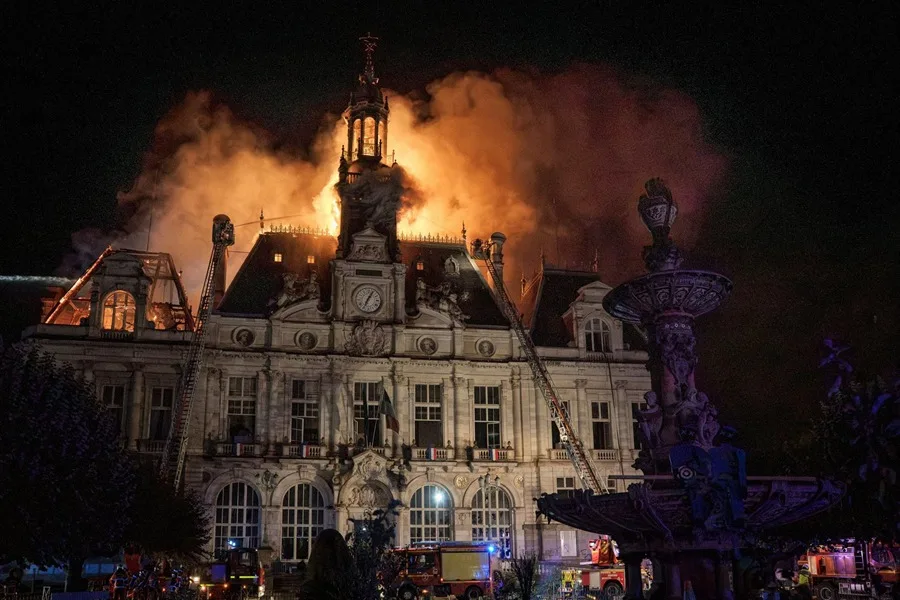
Fire damage at Limoges town hall after nationwide protests in France led to arrests, clashes and looting.

Nationwide demonstrations left 150 security personnel injured, one person dead and a historic town hall in Limoges severely damaged by fire.


French authorities reported 855 arrests in the Paris metropolitan area after nationwide protests on Saturday escalated into clashes, looting and property damage. One person died in Paris, while a fire severely damaged the historic town hall in Limoges.

RELATED: Demonstrations in Paris and Lyon Result in Significant Damage

The Paris Police Prefecture released the arrest figure on Sunday, covering cases recorded by 8 a.m. Investigations were continuing, including the review of video footage to identify additional suspects, authorities said.

Interior Minister Laurent Nuñez reported 1,200 arrests nationwide as of 8 p.m. Saturday and said 150 police officers and gendarmes had been injured. A more recent national tally was not immediately available.

The demonstrations, organized by several groups including students, trade unions and former leaders of the Yellow Vests movement, drew 550,000 people nationwide, according to Nuñez. Organizers estimated attendance at more than 800,000.

Text Reads: Minister Sébastien Lecornu confirmed the number of people detained during the police crackdown on protests across various parts of the country.
The Ministry of the Interior reported that 550,000 people took part in demonstrations nationwide, 110,000 of them in Paris.
The demonstrations—which included students, “Yellow Vests,” and climate activists—were also met with a crackdown in Marseille, Nice, Lyon, and Lille.
Volunteer medics reported a disproportionate use of force, including the deployment of stun grenades, high-intensity sound devices, and pepper spray.

In Paris, 110,000 people took part in the scheduled march, according to the Interior Ministry. The demonstration began at Place de la République and proceeded without major incidents until its conclusion. However, the police prefecture reported that separate groups, including what it described as radical left-wing elements, attacked security forces and looted shops.

From mid-afternoon, several unscheduled marches involving hundreds of people, and in some cases more than 1,000, were accompanied by looting and vandalism. The damage was concentrated around Place de la République and also affected Boulevard de Sébastopol and Boulevard Saint-Honoré. Police said the situation had stabilized by around 11 p.m.

Thirteen members of the security forces and two firefighters were injured during operations in Paris. The police prefecture also reported that one person had died after suffering a cardiac arrest but provided no further details.

Damage remained visible in central Paris on Sunday morning, with shattered shop windows, broken glass scattered across streets and barricades made from bins, barriers, bicycles and street furniture.

Fire damages historic Limoges town hall

In Limoges, firefighters brought a major blaze at the city’s historic town hall under control on Sunday and were working to extinguish the remaining hotspots, Haute-Vienne Prefect Maurice Barate told French television channel LCI.

Authorities said several demonstrators had forced their way into the building on Saturday and deliberately started a fire inside. The flames spread to the upper floors and reached the roof, which subsequently collapsed.

Mayor Guillaume Guérin said the town hall had been almost completely destroyed but pledged that municipal services would continue operating despite the damage.

“They have destroyed a building that the people of Limoges love, but they have not destroyed the public service,” Guérin said. “A monument is burning, but not the Republic.”

Barate said around 5,000 people had taken part in the Limoges demonstration, including several hundred individuals he described as radicalized and extremely violent. After the attack on the town hall, some demonstrators moved toward the prefecture, while others looted businesses in the city center, he said.

The prefect condemned the attacks on public buildings and businesses, describing the fire as deliberate. Guérin expressed hope that those responsible would be arrested and argued that officers deployed during the protest had lacked sufficient resources to contain the violent participants.

Built between 1876 and 1883, Limoges town hall is a listed historic monument featuring architectural elements inspired by the late Renaissance and the reign of Louis XIII.
  •  

France Protests: 1,200 Arrested and 150 Police Injured as Nationwide Demonstrations Turn Violent

More than half a million people took part in demonstrations across France on Saturday, 17 October, as protests over living costs and education deteriorated into riots, looting and attacks on public buildings in several major cities.

France is assessing extensive damage following nationwide demonstrations on Saturday, 17 October, that brought hundreds of thousands of people onto the streets and resulted in more than 1,200 arrests. Prime Minister Sébastien Lecornu said 150 police officers and gendarmes were injured as violent groups attacked public buildings, looted businesses and confronted security forces.

According to figures released by the French authorities, approximately 550,000 people participated in 110 marches across France, including 110,000 in Paris. Organisers, including trade unions and student associations, placed nationwide participation at 800,000.

The demonstrations represented a considerable escalation of the movement that began in September over deteriorating conditions in French secondary schools. The protests have since expanded into a broader campaign against rising living costs, public spending restrictions and the government’s economic policies.

Violence spreads beyond Paris

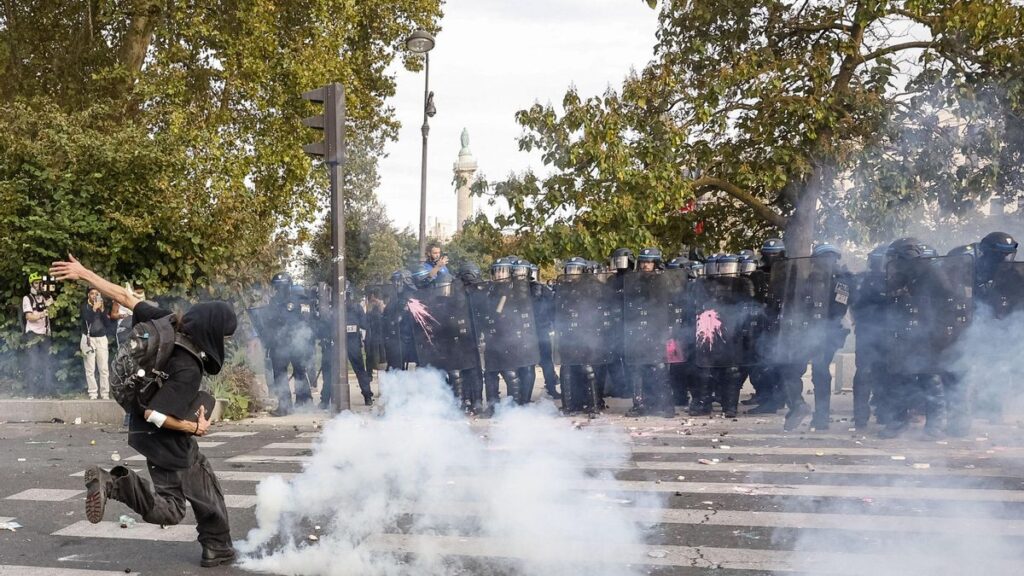
In the French capital, confrontations erupted around Place de la République, where masked groups threw paving stones, fireworks and other projectiles at police. Security forces responded with tear gas and water cannon as vehicles and rubbish bins were set alight.

Businesses along Boulevard Magenta and neighbouring streets were targeted, with shops broken into and goods stolen. Several central Paris Métro stations were closed as authorities attempted to restrict access to sensitive government locations.

Although the main authorised procession remained largely peaceful, violence continued elsewhere in the capital into Saturday evening.

The disturbances extended well beyond Paris. In Limoges, the historic town hall suffered extensive fire damage, with parts of its roof collapsing. Regional authorities described the destruction of the 143-year-old building as a major loss to the city’s architectural heritage.

In Marseille, groups forced their way into the town hall after using street barriers to ram its entrance. Municipal premises were vandalised before police regained control.

Further incidents were reported in Lyon, where a tourist office was attacked and a fire started, and in Bordeaux, where the official residence of the Gironde prefect was ransacked. Police also reported attacks or attempted break-ins at public buildings in Lille, Calais and Brest. The scale of the disturbances placed security forces under considerable pressure.

Government blames organised extremist groups

Lecornu accused organised far-left groups of deliberately instigating violence in several French cities. Nuñez similarly attributed much of the destruction to radical groups and individuals exploiting the demonstrations to loot businesses.

President Emmanuel Macron condemned attacks on public property and commercial premises, promising that those responsible would face prosecution.

The government has not announced a state of emergency, although authorities are reviewing the scale of the damage and the security response.

The mayor of Paris, Emmanuel Grégoire, described the destruction across parts of the capital as extensive and distinguished the peaceful protest movement from those responsible for vandalism.

Student unrest becomes a national movement

Saturday’s demonstrations followed several weeks of disruption across France’s education system.

As EU Today reported earlier this month, between 400 and 500 secondary schools faced partial or complete closures as students protested against teacher shortages, overcrowded classrooms and deteriorating facilities.

The subsequent confrontations with police intensified political tensions, with student organisations accusing authorities of using excessive force and police representatives complaining of inadequate protection.

A further controversy emerged on Saturday after a 17-year-old demonstrator in Saint-Étienne suffered a serious hand injury. An investigation was opened into the incident and assigned to France’s police inspectorate, the IGPN. Reports linked the injury to a grenade thrown by police; the precise circumstances remain under investigation.

The latest demonstrations also marked a revival of the Gilets Jaunes, or Yellow Vest, movement, which emerged in 2018 in opposition to fuel taxation and subsequently developed into a wider challenge to Macron’s economic programme.

Trade unions, including the CGT, joined calls for higher wages and pensions, lower consumer prices and increased investment in public services.

Political consequences for Macron and Lecornu

The unrest presents another challenge for Lecornu’s government as it attempts to manage France’s public finances ahead of the 2027 presidential election.

The demands for increased spending on education, wages and public services come as ministers face pressure to reduce the budget deficit and control public debt.

The political implications are already apparent. Jean-Luc Mélenchon, leader of the hard-left France Unbowed movement, has supported the student protests while opposing looting and destruction. Marine Le Pen has condemned the rioters and accused Mélenchon’s party of helping to legitimise the unrest.

The latest disturbances also follow growing criticism of the government’s policing strategy, particularly the use of riot-control weapons during demonstrations involving minors.

With municipal authorities calculating the cost of damage to public buildings and commercial premises, Lecornu has instructed ministers to support affected businesses. The immediate challenge is to restore public order while addressing a protest movement that has expanded considerably beyond its original demands for improvements in French schools.

  •  

Demonstrations in Paris and Lyon Result in Significant Damage

On Saturday, demonstrations in France against the rising cost of living turned violent in Paris and Lyon, with further unrest reported in other locations, according to the Police Prefecture and sources from the Ministry of the Interior.

RELATED:

France Suspends Stun Grenades After Teen Loses a Hand

In Paris, the day began with clashes at the Place de la République. The Prefecture reported that several hundred individuals, identified as members of far-left groups, threw projectiles at police officers and gendarmes. Some participants also damaged building facades, prying loose stones.

Security forces responded with tear gas and moved to disperse the violent groups. Despite these incidents, the march began its route at 2:15 p.m. local time (12:15 GMT), moving from the Place de la République toward the Place de Clichy, even as police operations continued in the area.

By 2:00 p.m. local time, authorities had made 133 arrests in Paris—primarily for alleged participation in groups organized to commit acts of violence or cause property damage, as well as for assaults on law enforcement officers. Additionally, police conducted 1,046 preventive security checks throughout the day.

Protests in #Paris and #Tunis put rising prices and deteriorating living standards in focus, as demonstrators demand economic relief and social rights. #France #Tunisia https://t.co/IlS12uwV3G

— Al Mayadeen English (@MayadeenEnglish) October 17, 2026

In Lyon, in southeastern France, a group of protesters smashed the windows of a tourist office located in the central Place de Bellecour and set it on fire, according to footage broadcast live by BFM TV.

The French government had previously warned of a high risk of unrest during the protests across various cities in the country. Sources close to Interior Minister Laurent Nuñez indicated that, by midday, 140 protest actions and 32,800 participants had been recorded across the provinces, while the total number of arrests throughout France had reached 166.

“There is a very high probability that the far-left will cause the afternoon demonstrations to turn violent,” the same sources stated, also reporting targeted acts of violence in Paris, Marseille, Rennes, Toulouse, and Angers.

According to the Ministry of the Interior, the incidents included attempted looting, attacks on security forces, the setting of fires to street furniture, and actions directed against institutions and media outlets.

In Marseille, several businesses were vandalized, and a municipal police station sustained damage. Additionally, a group forced open the doors of City Hall and briefly entered the lobby before being stopped.

Thousands of French people continued to protest and block educational centers just hours before student organizations held a new meeting with the Education Ministry, the third since the protests began more than two weeks ago.

Among the blocked institutions is the Paris School of… pic.twitter.com/yjld03PtLt

— teleSUR English (@telesurenglish) October 15, 2026
  •  

France Braces for 500 Protest Actions as Yellow Vests and Students Join Forces

French authorities are preparing for hundreds of demonstrations on Saturday, 17 October, as student unrest converges with protests over living costs, public spending and government policy. Up to 40,000 demonstrators are expected in Paris, where police and organisers remain divided over march routes.

France is preparing for a nationwide wave of demonstrations on Saturday, 17 October, with approximately 500 protest actions under consideration and more than 90 marches being organised, according to the Interior Ministry. The mobilisation brings together high-school students, trade unions, farmers and supporters of the Yellow Vest movement, raising the prospect of further confrontation after nearly a month of unrest.

Police estimates suggest that around 40,000 demonstrators could gather in Paris, with approximately 150,000 more expected elsewhere in France. The figures remain preliminary, while authorities warn that some protests could involve road blockades, disruption to essential infrastructure and violent clashes.

Interior Minister Laurent Nuñez initially outlined preparations for 250 gatherings and 80 marches on Friday morning. Subsequent assessments from his office indicated that as many as 500 actions were being considered, although not all had been formally organised.

Paris Faces Dispute Over Demonstration Routes

The authorities are particularly concerned about developments in the capital, where negotiations between police and protest organisers have failed to produce agreement over the proposed routes.

Paris police prefect Patrice Faure has rejected proposals for marches terminating near the Opéra district or Place de la Concorde, citing security concerns surrounding central government institutions.

According to details of the security preparations, police have proposed an alternative route between Place de la Bastille and Place de Clichy. The CGT trade union and climate campaigners have accepted the proposal, but student organisations and Yellow Vest representatives continue to oppose it.

Prime Minister Sébastien Lecornu has convened an interministerial crisis unit to coordinate the government’s response. Security officials have warned that attempts to obstruct major transport routes or critical infrastructure will not be tolerated.

The Interior Ministry has also indicated that stun grenades, whose use was suspended during the student protests, could again be deployed in cases of particularly serious urban violence.

Yellow Vests Return Amid Rising Living Costs

Saturday’s demonstrations are being promoted as a revival of the Yellow Vest movement, which emerged in 2018 following opposition to fuel taxation before developing into a broader protest against living costs, economic inequality and government policy.

The latest mobilisation has gathered support from organisations demanding measures to address rising fuel, energy and food prices. Campaigners are also challenging the government’s proposed 2027 budget and its implications for public services.

The agricultural union Confédération paysanne has called on farmers to join the demonstrations, arguing that rising agricultural fuel costs and deteriorating conditions in rural communities have increased pressure on producers.

The union has also linked its demands to environmental policy, public-service provision and access to affordable food.

The CGT, student unions and climate organisations have similarly expressed support for the protests, while political backing has come from La France Insoumise and the French Communist Party.

Student Protests Enter Their Fourth Week

The mobilisation follows weeks of demonstrations involving secondary-school pupils, teachers and public-sector workers. What began as protests over shortages of teachers, overcrowded classrooms and deteriorating school buildings has developed into a nationwide confrontation over education policy and policing.

As EU Today previously reported, between 400 and 500 secondary schools faced partial or complete disruption earlier this month as students organised blockades and demonstrations.

The movement has subsequently expanded beyond its original educational demands, with student organisations raising concerns about university admissions procedures, police tactics and government spending priorities.

The scale of the unrest has placed considerable pressure on French authorities. According to figures from the Justice Ministry, 6,877 people were placed in police custody during the protests between late September and 8 October, approximately 86 per cent of them minors.

Violence during the demonstrations has resulted in injuries among police officers, students and educational staff. Clashes on 8 October led to 504 arrests and injuries to 48 police officers, according to Interior Ministry figures.

Education Minister Édouard Geffray has announced emergency measures to address teacher shortages, including the deployment of replacement teachers. The ministry says 2,000 of the 3,000 promised replacements have already been assigned, but student organisations maintain that the measures are insufficient.

Growing Pressure on the French Government

The planned demonstrations come as France faces a difficult debate over public spending, taxation and the 2027 budget. Lecornu’s government must balance demands for higher salaries and increased investment in education against mounting pressure to reduce the deficit.

France’s deteriorating public finances have already attracted scrutiny from eurozone partners, while domestic opposition to spending restraint has become a central issue ahead of the 2027 presidential election.

The convergence of student organisations, trade unions and Yellow Vest campaigners could broaden the protests beyond the education sector, particularly if demonstrations over living costs attract participants who have not joined the recent school protests.

However, the extent of that mobilisation remains uncertain. Online protest maps contain substantially more proposed actions than the authorities’ estimates, and participation figures will not be established until Saturday.

For the government, the immediate test will be whether the demonstrations remain peaceful and whether the authorities can prevent disruption to transport networks and public services without provoking further confrontations with protesters.

  •  

France to Suspend Classes at Up to 500 Schools as Student Protests Continue

Between 400 and 500 French secondary schools are expected to suspend lessons fully or partially on Monday, 5 October, as nationwide student protests continue following several days of violence, arrests and damage to educational buildings.

French Education Minister Édouard Geffray said on Sunday that the number of affected lycées was likely to be broadly similar to Friday, when between 400 and 500 establishments suspended classes.

“There will probably be just as many on Monday, but with a partial, progressive resumption of classes,” Geffray said during interviews with France 2 and France Inter.

France has around 3,700 lycées. The government says classes are being suspended where normal security conditions cannot be guaranteed, including schools damaged during the unrest or where staff have been directly targeted. French reporting on the education ministry’s latest figures said Geffray expected disruption on a similar scale to Friday.

The closures mark the latest stage in a protest movement which began in the Paris region in September before spreading to cities across France.

Students initially mobilised over conditions in the education system, including shortages of teachers and replacement staff, overcrowded classrooms, deteriorating school buildings and demanding timetables. Pressure surrounding the Parcoursup university admissions system has also featured prominently in the demonstrations. Accounts from pupils involved in the blockades have highlighted frustration over conditions in schools and wider concerns about educational inequality.

As EU Today reported on 3 October, the protests have since developed into a broader confrontation involving students, education staff, police and political activists.

Geffray said on Sunday that 24 educational establishments had been “burned or vandalised” since the unrest intensified. He also said 78 employees of the national education system had been injured.

The minister has accused organised far-left activists of infiltrating the student demonstrations and contributing to the escalation of violence.

According to the government, some education staff have been deliberately attacked because of their position within the school system. Geffray said schools would remain closed or operate only partially in cases where staff or pupils could not be adequately protected.

The political argument over responsibility for the unrest has intensified alongside the protests. Government ministers have accused activists connected with the hard-left La France Insoumise of encouraging blockades and helping to broaden the mobilisation. LFI representatives have rejected accusations that they are responsible for the violence and have continued to support the students’ underlying demands. The dispute over the political role in the protests has become part of the wider confrontation between the government and the demonstrators.

Friday brought another large-scale police operation.

Interior Minister Laurent Nuñez said 1,747 people were detained during the day, compared with 1,954 on Thursday, taking the number of arrests since the beginning of last week to more than 5,000. Authorities said around 85 per cent of those detained were minors.

Of 735 schools affected by demonstrations or disruption on Friday, “urban violence” was recorded near 158, according to the Interior Ministry. The latest official arrest figures underline the scale of the police response.

The violence has increasingly complicated attempts by student organisations to maintain the focus on their original education demands.

Representatives of student organisations met Geffray on Friday but said afterwards that they had received no sufficiently concrete commitments from the government. They called for the mobilisation to continue and announced a new nationwide day of action, described as “Act III”, for Tuesday, 6 October.

Several education trade unions are also expected to participate in Tuesday’s action. Regional reporting on preparations for Monday and Tuesday said schools were preparing for continued disruption.

The government has already made one concession. A proposed measure that would have introduced registration fees of €178 for non-grant students entering BTS vocational programmes and €270 for preparatory classes for France’s grandes écoles was withdrawn as the demonstrations intensified. The withdrawal was announced as hundreds of schools were being affected by blockades.

The protests nevertheless show little sign of ending.

Many students continue to argue that their schools lack adequate staff and investment, while teachers and parents have raised similar concerns over replacement teachers and the condition of buildings.

At the same time, the scale of the damage and the number of injuries have moved security to the centre of the government’s response.

Monday will therefore provide an early indication of whether schools can begin returning to normal before Tuesday’s planned national mobilisation, or whether the disruption that affected hundreds of establishments last week will continue into a third week.

  •  
❌