Companies are announcing enormous new data centers to power the AI boom. Some promise facilities bigger than anything the industry has built before.
There's just one problem: Most of these projects may never happen.
Bernstein Research analyzed thousands of planned US data centers and concluded that only about 35% of the announced capacity is likely to get built. That's roughly 170 gigawatts of data center capacity out of a total of almost 500 gigawatts.
The rest? A significant chunk of it belongs to a category the industry has a wonderfully dismissive name for: "Bragawatts." These are ambitious announcements, often from newcomers with little experience building data centers, that have a slim chance of becoming reality.
"Press releases are cheap…concrete is not," Bernstein analysts wrote in a research note.
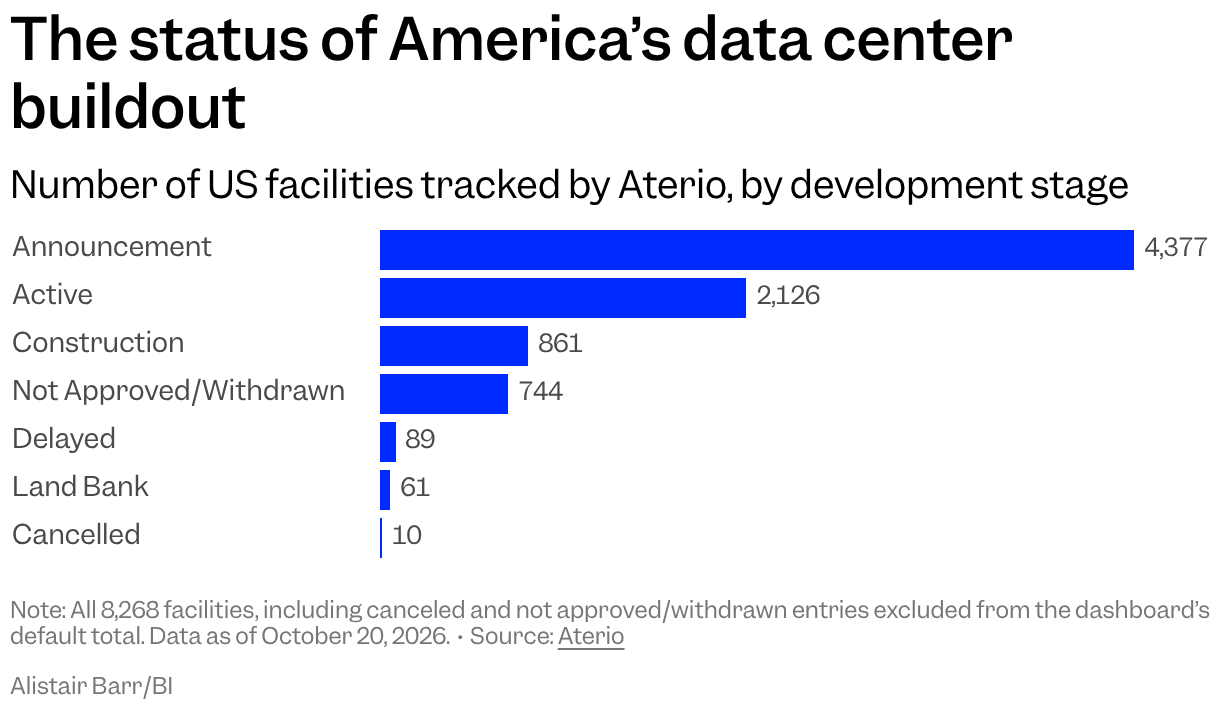
Bernstein began its analysis with more than 7,000 data center projects across North America, drawing on information from Aterio, a company that tracks construction through satellite imagery, permits, and other records. The analysts narrowed that to more than 5,000 projects (partly by excluding thosealready canceled).
Then they assessed the chances of these remaining projects being completed. The analysts considered factors such as whether construction had started, whether electricity was available, and whether the companies involved had successfully built data centers before.
The results revealed a striking divide.
The 'bragawatt brigade'
Kevin O'Leary.
Daniel Delgado Jr./Disney via Getty Images
Experienced operators including Amazon, Google, Microsoft, and Meta landed at the top. Bernstein gave these companies perfect scores of 5 out of 5 for their development credentials. Other data center specialists, such as Digital Realty, Equinix, and CoreSite, got top marks, too.
O'Leary Digital, associated with celebrity investor Kevin O'Leary, ended up at the bottom,with a credibility score of 0.35 out of 5, according to Bernstein. His company has announced 15 gigawatts of data center projects, and Bernstein estimates that only 489 megawatts, or about 3%, will actually materialize.
Although the term "bragawatts" has been doing the rounds in the data center industry lately, it's unclear who coined it, Bernstein analyst Madison Rezaei told me.
"I wish I could take credit for that," she said. "I believe I originally heard it from an Equinix executive, but I don't think he owned it either."
She said that whilesome ambitious newcomers could succeed, they haven't yet demonstrated they can deliver.
"It's not that all of these guys are sort of terrible and not going to deliver, but we just have lower confidence because we don't know them," Rezaei said.
O'Leary Digital responds
O'Leary Digital disputed Bernstein's assessment, saying the research doesn't account for substantial work that occurs before construction begins.
While acknowledging that O'Leary Digital is a young company, CEO Paul Palandjian said the team has decades of experience building major infrastructure projects and that its proposed 15 gigawatts of capacity would be built in stages over several years.
The company said it has secured binding agreements covering about 11,000 acres in Utah and 13,000 acres in Alberta, obtained a 30-year development agreement in Utah, and made progress on planning, engineering, and permits at both sites. It also said the projects would generate their own electricity.
The company said its early development work is funded, additional capital is committed to reaching key milestones, and experienced engineering and construction partners are involved.
"We would rather be judged on milestones than on a model," Palandjian said.
'An announcement in search of a project'
Opponents of the proposed La Osa data center attend a Pinal County Board of Supervisors meeting in Florence, Arizona, on August 26.
USA TODAY Network via Reuters Connect
Other low scorers in the "bragawatt" brigade included Vermaland and Joule Capital Partners, according to Bernstein analysis based on Aterio data.
Joule has announced 50 data center projects with a combined capacity of 11.7 gigawatts. Bernstein estimates that only about 11% of that capacity will actually get built. Almost all of Joule's planned capacity remains at the announcement stage, with little evidence of construction progress or of major customers committing to use the facilities, Bernstein wrote in a July note to investors.
The analysts gave Joule a credibility score of 2.05 out of 5, placing it among the lowest-ranked developers in its database.
"An announcement in search of a project," the analysts wrote.
Vermaland has announced plans for a massive data center project in Arizona. Bernstein estimates that only 4% of its proposed 2.2 gigawatts of capacity will get built. The company is primarily a landowner, not a data center developer. Its proposed $33 billion La Osa project near Eloy had already been sharply scaled back amid local opposition and without construction approval. In late August, regulators formally rejectedthe project. Even before that, the analysts gave Vermaland a credibility score of 0.75 out of 5.
Joule and Vermaland didn't respond to emails seeking comment this week.
A yawning gap for data centers
Sergio Toro, CEO of Aterio, sees similar patterns in his firm's voluminous, detailed data.
Aterio's tracking shows that roughly 30 to 40 gigawatts of new data center capacity get announced each month. Yet only about 7 gigawatts begin construction each month, while 2 to 3 gigawatts actually start operating.
This leaves a yawning gap.
Many announced projects get withdrawn before construction begins — and before real money has been spent.
"They just make the announcement, but they didn't get their approvals. Or they make multiple filings in multiple locations to see which one gets selected," Toro told me. "That's why we track with satellite if there's real movement on the ground or not."
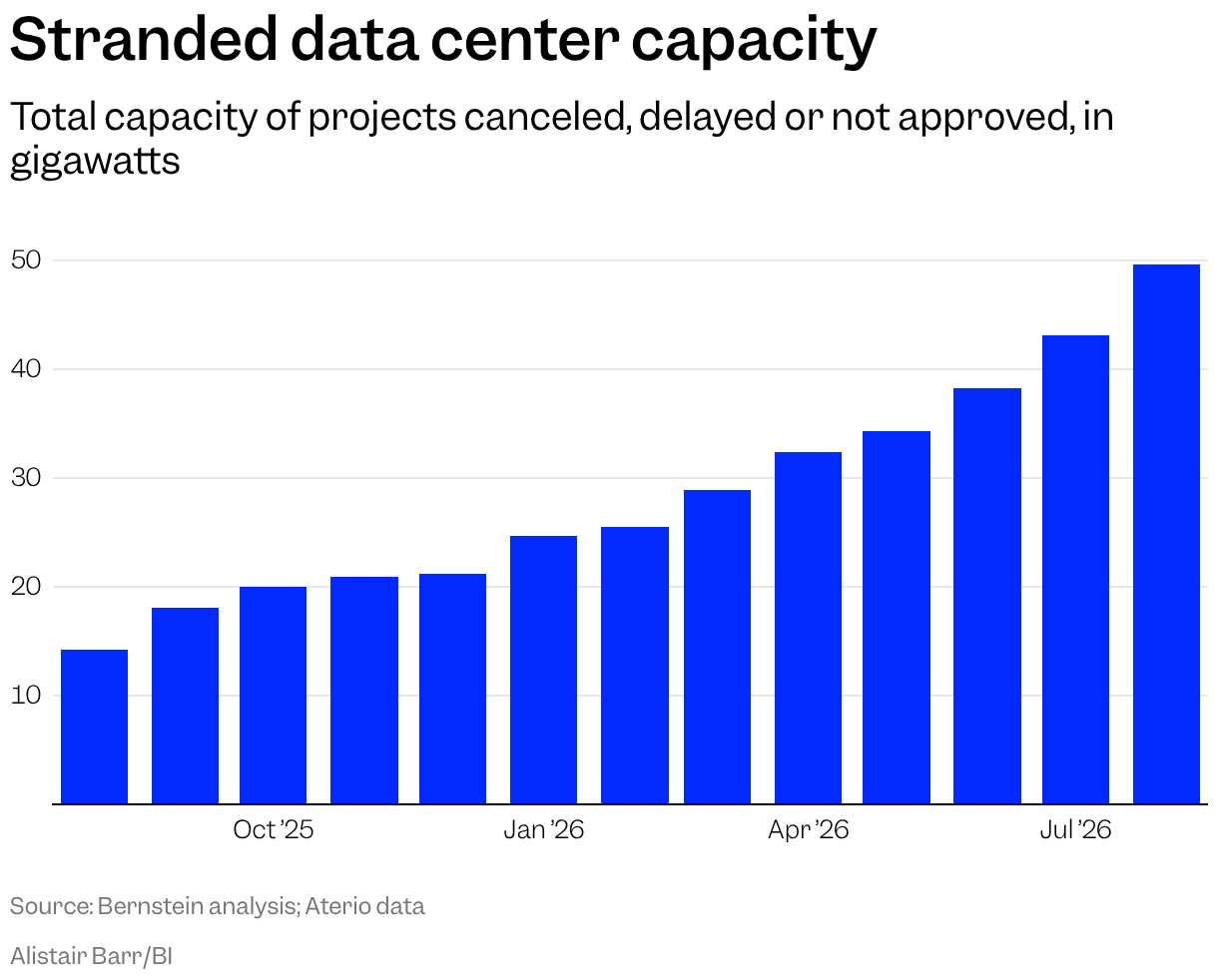
Indeed, Bernstein analysts wrote recently that the amount of "stranded" data center capacity has surged. These are projects that are either canceled, delayed, or not approved.
The AI boom's three tiers
Toro sees three broad groups competing to build AI infrastructure.
At the top are the established technology giants, including Amazon, Microsoft, and Google. They've built data centers for decades and generally deliver on their commitments. Most of their projects will get done, he said.
In the middle are "neoclouds," newer companies such as CoreWeave that rent out computing power specifically for AI. Although they're more vulnerable to financing problems and delays, many are making solid progress, especially because some of these players already have access to electricity.
"We see them advancing quite well," Toro said. "Sometimes we see some delays, but it's not something significant or any kind of big capacity that is at risk."
Then come the newcomers making extraordinary promises. That's where most delays and cancellations happen, Toro said.
Even Amazon needs a backup plan
A technician works at an Amazon Web Services AI data center in New Carlisle, Indiana.
Noah Berger/Getty Images via Amazon Web Services
Not every project that disappears was a fantasy, though. Even a top player like Amazon struggles sometimes to secure electricity and other supplies on time for these huge projects.
The biggest, most experienced tech companies deliberately pursue more potential data center capacity than they need because they know some developments will fail or get delayed.
Major AI companies were committing to three or four times the space and electricity they needed over the following two years, Jeffrey Moerdler, a data center lawyer, estimated during an interview with Bernstein analysts.
His reasoning: Of data center projects that haven't started construction, roughly a third will arrive on schedule, another third will be delayed, and the remainder won't happen.
Rezaei and Toro estimate that the top players don't over-commit that much — more like double the capacity they need at most.
The strategy provides a "Plan B," as Toro put it, in case of delays involving electricity, equipment, permits, local opposition, or other factors.
Texas has a ghost problem
The Decker Creek Power Station in Austin.
Brandon Bell/Getty Images
This helps explain another extraordinary number.
Data center companies have requested connections for roughly 450 gigawatts of electricity demand on Texas' main power grid, more than five times the grid's roughly 85 gigawatts of existing capacity, according to Toro and others.
Many of those requests are placeholders rather than firm construction plans. Toro calls them "ghost projects."
These speculative projects clog the waiting lists for electricity connections, making the electricity shortage look a lot worse than it actually is.
"Developers routinely spam projects across several sites, and many are speculative builds with no customer yet," Ryan McEntush, a partner at venture capital firm Andreessen Horowitz, wrote in a recent blog. "Often these new developers have never even plugged in a GPU, let alone a power plant."
Texas has paused applications to review and weed out projects that aren't serious. Toro, from Aterio, expects this to favor the established players at the expense of the bragawatts.
The real AI boom
None of this means the AI infrastructure boom is imaginary.
Aterio tracks thousands of buildings, including major projects already under construction. Bernstein estimates that nearly 80% of the capacity the largest technology companies are directly developing is credible.
And when speculative projects disappear, Rezaei doesn't expect a wave of unpaid debt. Many will fail before building begins, the stage when developers borrow serious money through project financing.
Some of those missing data centers were never really coming in the first place.
O BNP Paribas, o CaixaBank BPI, o Jefferies e a Keefe, Bruyette & Woods subiram esta terça-feira o preço-alvo do BCP. O banco francês é o mais otimista e vê as ações do banco liderado por Miguel Maya a valorizar quase 25%.
The majority of Australians who report a penicillin allergy are not truly allergic, prompting the peak body for immunologists to change its guidelines in a bid to reduce hospital stays and tackle antimicrobial resistance.
Penicillin, one of the most commonly prescribed antibiotics in Australia, was thought to cause allergies in 10% of Australians, or about 2.8 million people.
Australian researchers have identified a new subtype of depression – termed “circadian depression” – linked to disruptions in the body’s internal clock, which they believe is less responsive to traditional antidepressant treatments.
In a study published in British Journal of Psychiatry, involving clinical and genetic data from 11,380 Australians with mostly severe and recurrent depression, researchers identified circadian depression as affecting nearly a quarter (23%) of participants.
La guerra no provocada iniciada el pasado 28 de febrero por EE.UU. e Israel contra Irán cumple casi ocho meses sin que Washington haya alcanzado sus objetivos declarados ni logrado un acuerdo nuclear.
People diagnosed with attention-deficit/hyperactivity disorder (ADHD) face a roughly 71% higher overall risk of early death compared to those without the condition, according to a new review published in JAMA Network Open.
However, taking prescription ADHD medication may offer a protective benefit, lowering overall risk of death, the review found.
Researchers analyzed data from 19 observational studies involving nearly 16 million people across three continents to evaluate the long-term effects associated with the condition.
The review considered both unnatural causes of death, such as injuries and suicide, and natural causes, including physical health conditions like cardiovascular disease and diabetes.
Across all categories, individuals with ADHD experienced elevated mortality rates compared to those without the diagnosis.
"We found that people with ADHD face an increased risk not only of death by suicide and injury, but also of deaths by natural causes, adding to evidence that health inequalities faced by people with ADHD are broad and wide-ranging," senior author Joshua Stott, professor of aging and clinical psychology at University College London (UCL), said in a press release.
The risk of death from suicide was nearly doubled, showing an 89% increase, while the risk of dying from intentional or unintentional injuries, such as motor vehicle accidents, was 55% higher, the study found.
There was also a 27% higher risk of death from natural causes among people with ADHD.
The increased risk of death from natural causes was often tied to long-term health risks like smoking and substance use, as well as executive function challenges that can make it harder to manage chronic conditions, attend doctor’s appointments and follow treatment plans.
In one analysis, researchers checked whether medical treatment changed overall mortality rates.
Among people with ADHD, those taking prescribed ADHD medication had a 25% lower risk of death from any cause compared to those not taking medication, suggesting that effective treatment may lower some of the behavioral effects and health risks associated with the condition.
Despite these findings, the researchers emphasized several key limitations.
All included studies were observational, meaning the results show associations rather than direct cause-and-effect relationships.
The findings on ADHD medication came from just three of the 19 studies, so those results are still preliminary and based on a much smaller group of people.
Results also varied widely across individual studies due to differences in diagnostic criteria, healthcare access and tracking methods, while underlying factors such as socioeconomic status and other mental health conditions were not controlled across data sets.
"Our findings provide early evidence to suggest that medication may play an important role in supporting the health of people with ADHD, but this is based on a small number of studies and further research is needed to clarify this link," first author Lucy Corrigan, a research assistant in the University of Liverpool’s Department of Psychology, said in the same press release.
"Medication is just part of the story; many people with ADHD benefit from comprehensive, long-term treatment and support."
Applegate revealed that despite the misdiagnosis, she still has "every symptom of someone with MS," adding, "I still have to use wheelchairs when I go to the doctor's office. I can't walk from the car to the room."
O Centro de Ciências do Mar (CCMAR) associa-se, assim, a um grupo reduzido de instituições que detêm este selo no nosso país. O reconhecimento é atribuído pela Comissão Europeia e destaca o compromisso do CCMAR na progressão da implementação dos princípios da Carta Europeia dos Investigadores, promovendo uma melhoria contínua das políticas e práticas de […]
Cancer can strike at any age, often without symptoms. For many cancers, routine screening remains the best way to detect the disease early and reduce the risk of death.
For lung cancer, screening guidelines can vary, as the disease doesn’t always show obvious signals and can occur in both smokers and never-smokers.
Daniel J. Boffa, M.D., chair of the American College of Surgeons Commission on Cancer and a thoracic surgeon at Yale University, noted that lung cancer screening is "one of the most powerful ways" to boost survival.
"It reduces the chance of people dying of lung cancer by 20%," he told Fox News Digital.
The share of Americans who are eligible for screening but don’t comply translates to "tens of thousands of preventable deaths every year," according to Boffa.
"I'm hoping that within four or five years, a screening CT scan will only be confirmatory after they have a positive blood test done at your doctor's office," he added.
That approach could make screening easier and potentially help detect more lung cancers, according to the doctor.
Potential symptoms
In a recent interview with Fox News Digital, Lary Robinson, M.D., an oncologist at Moffitt Cancer Center in Tampa, Florida, noted that in most cases, early-stage lung cancer will not come with any symptoms.
In those who do have symptoms, however, the most common are related to the lungs, including a persistent cough, shortness of breath or coughing up blood.
Unexplained weight loss can result from any form of cancer, according to the oncologist. Neurological symptoms, like persistent headaches, may also warrant seeing a doctor.
Current guidelines
Current lung cancer screening guidelines recommend an annual low-dose CT scan for people between the ages of 50 and 80 who currently smoke or have a history of smoking or have at least a 20 pack-year history of smoking, according to the American Cancer Society (ACS).
Before making the decision to get screened, individuals should speak with their healthcare providers about the purpose of the screening and how it’s done, as well as the benefits, limits and possible harms, ACS advised.
Those who still smoke should be counseled about quitting and offered interventions and resources to help.
Individuals with serious health problems that will "likely limit" their lifespan should not be screened, according to ACS, as well as those who won’t be able to get treatment if lung cancer is detected.
Although one out of seven lung cancers will affect someone who has never smoked, there is currently not a set screening guideline for never-smokers.
Finding individuals who would benefit from screening is an "intense area of research," according to Boffa. For now, people with a direct family history of lung cancer without smoking should consider annual screenings, as should higher-risk demographics like Asian women.
"I would anticipate that in the next year or two, we will have better guidance for people who are at risk for lung cancer, but never smoked," Boffa predicted.
What to expect
Boffa noted that advances in lung cancer treatment have improved survival, even at advanced stages, so screening should not be viewed as a pathway to a terminal diagnosis.
"People are really reluctant to be diagnosed with lung cancer because it does carry a stigma," Boffa said. "For years, there was a reputation that it was a terminal diagnosis. It's just been amazing what research has done for lung cancer."
Most screenings detect a lung nodule or other abnormality, which is more often an infection, scar or inflammation than a tumor, he said.
In about one-third of patients, lung cancer screenings also detect unrelated health issues, including the hardening of heart arteries or a nodule in another part of the body.
"The reality is over 99% of nodules are actually benign," Boffa said. "And so, you need to have a conversation about what you are going to do with that information."
"I think having that conversation ahead of time is really important so that expectations are set – it's not uncommon to find something. Most of the time, it's not something that's going to affect how long you live."
The doctor noted that the CT scan only takes a couple of minutes to perform and does not take place in an enclosed space like an MRI.
"People who get claustrophobic usually don't have a hard time with lung cancer screening," Boffa said. "And it usually takes a few days to get a report back."
For those who are over 50 with a history of smoking, Boffa reiterated that getting screened is "one of the most powerful things you can do to reduce your chances of having your life shortened by lung cancer."
Electric aviation is still in the very early stages of its development. But a number of companies are moving forward with more ambitious plans. In contrast to its approach with other forms of electric transportation, the Trump administration seems willing to embrace a bigger rollout. Aviation correspondent Miles O'Brien reports on the promise and the challenges of the budding industry.
Ending routine vaccination for hepatitis B at birth, as the health secretary has recommended, would increase the number of chronic infections by as much as 83 percent, a team of researchers reported.
Last December, a panel of advisers chosen by Health Secretary Robert F. Kennedy Jr. recommended that parents should decide whether or when infants should get the shot if they were born to mothers who test negative for hepatitis B.
Antibody patterns in the blood may help doctors identify people at risk so they can be treated earlier, research shows
Patterns of antibodies in people’s blood could predict the onset of inflammatory bowel disease (IBD) a decade before diagnosis, according to research that raises hopes for catching the condition early.
Crohn’s disease and ulcerative colitis, the two main forms of IBD, are typically treated only after symptoms appear, when the gut has already been damaged. But scientists found that the immune system sends warning signals up to a decade before diagnosis, paving the way for potentially earlier detection and even prevention.
A Pew Research Center survey found 71% of middle-income earners have cut back on spending on extras, such as eating out.
andresr/Getty Images
A Pew Research survey found only 47% of middle-income earners could save money in the past year.
Lower-income earners are also having a hard time saving and affording necessities.
Inflation moving in the wrong direction doesn't help the affordability situation.
America's middle earners are feeling the squeeze.
A new analysis from the Pew Research Center examines how Americans' finances are faring, an especially salient topic in a midterm season where affordability is very much on the ballot.
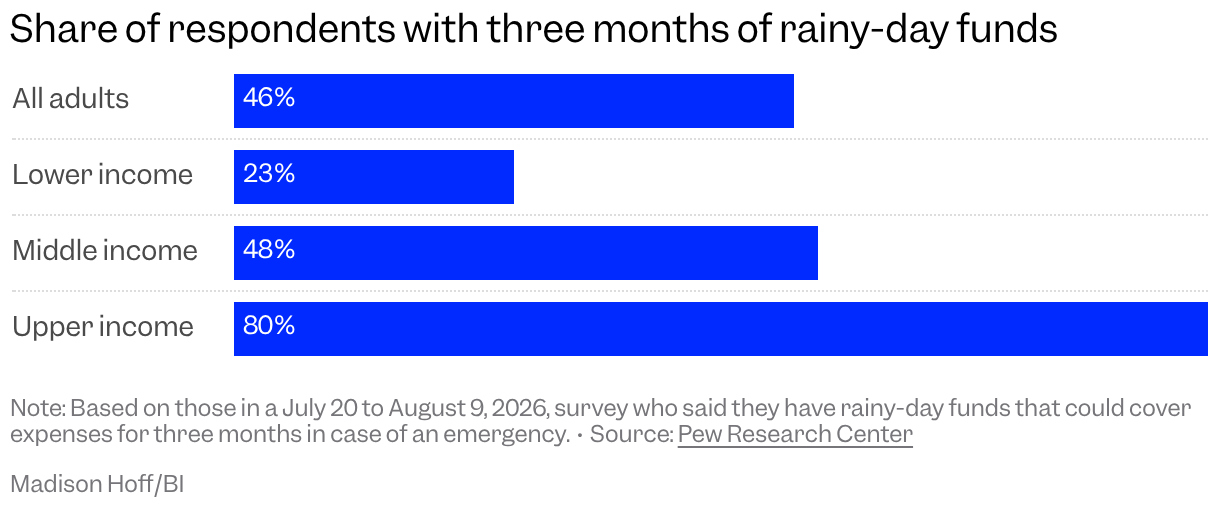
America's middle earners — those who make between $50,700 and $152,000 after adjusting for their family sizes and the cost of living in their areas — increasingly don't have enough saved for an emergency. Just over half of middle-income Americans say they don't have rainy-day funds that would cover expenses for three months in the event of an emergency.
Meanwhile, 47% of middle-income earners — and a measly 24% of lower-income earners — reported being able to save money in the past year. Across all income tiers, the majority of respondents said they had cut back spending on extras like eating out or streaming services.
Those dwindling emergency funds and sacrifices might be due to rising costs, which often take a particularly large bite out of lower-earners' wallets.
It could be getting worse; inflation is moving in the wrong direction. In September, the consumer price index inflation rate rose from 3.4% to 3.7%, just above the 3.6% forecast. Plus, inflation-adjusted wages have been falling for six months.
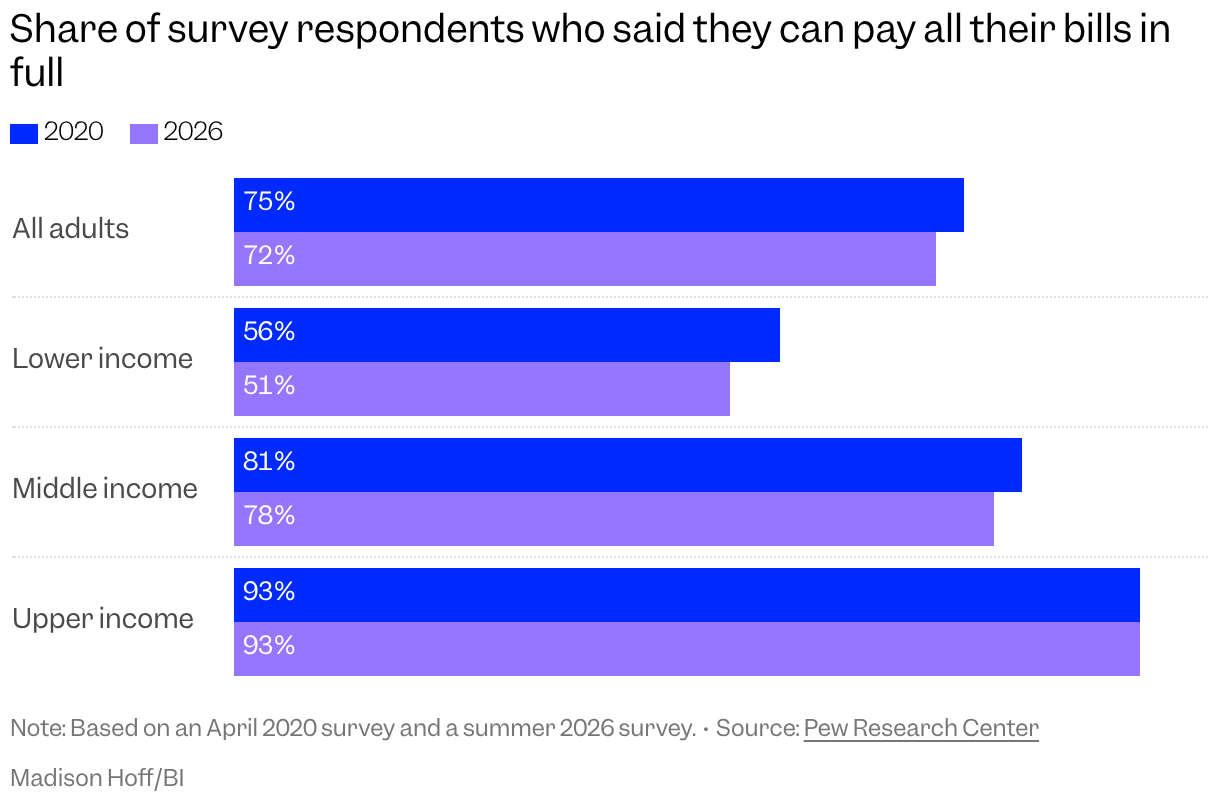
Today's economy is still more difficult for those at the bottom of the earnings ladder. Fifty-one percent of lower-income respondents said they can pay all of their bills in full in the 2026 survey, down from 56% in 2020. For middle-income respondents, the share dropped from 81% in 2020 to 78% in 2026, while the share of upper-income respondents held steady at 93%.
Pew also found 71% of lower-income US adults struggled with at least one kind of basic necessity, like affording medical care or paying their rent or mortgage, in the past year, compared with 39% of middle-income and 13% of upper-income Americans.
But the latest survey marks another sign that middle-income earners are increasingly aligning with their lower-earning peers, a dour sign for the health of the middle class. A separate report from the Urban Institute found that, even as lower-income renters were the most likely to report issues paying the rent, middle-income renters were increasingly likely to report struggling to pay.
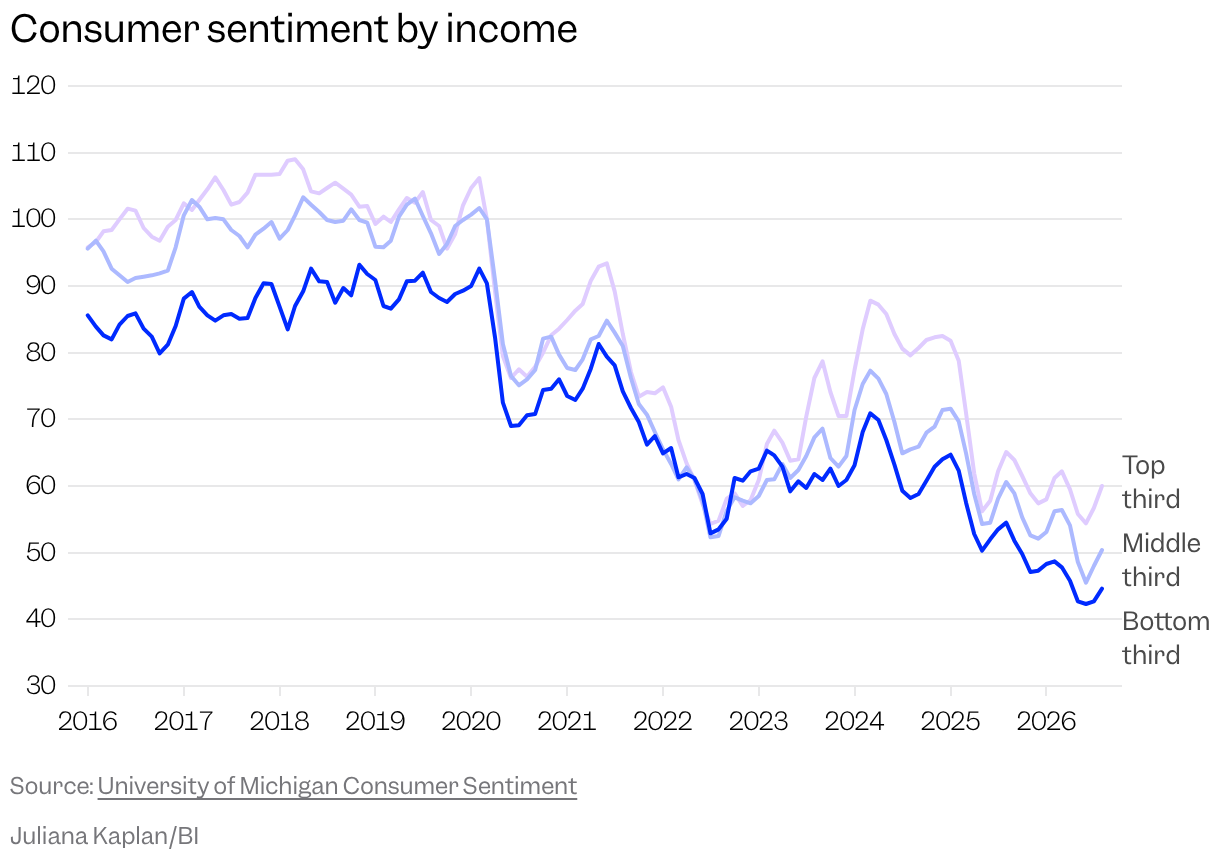
Similarly, middle-income earners' consumer sentiment has switched from mirroring their higher-earning peers to more closely aligning with lower earners — another sign that the middle class is falling on harder economic times.
"Working people are living on the edge, working longer and harder than ever for less money," said AFL-CIO President Liz Shuler. "They're angry every time they fill the tank. They're terrified of what their heating bills will look like this winter."
The CDC has confirmed more than 4,000 cases of measles this year as the country grapples with the largest outbreak of the highly infectious virus in 35 years. Nearly a fifth of cases comprise children under the age of five, and 95% are among unvaccinated people. Amna Nawaz spoke with Dr. Evan Shirey, a pediatric infectious disease doctor based in Pennsylvania.
COGAT claims Palestinian merchants halted coordination on shipment of goods due to Hamas intimidation, but Gaza truckers union says Israel made the decision
 Login