❌

Reading view

Kyiv gets no warning of the first of two Russian ballistic waves, hours after Zelenskyy said US alerts were back

kyiv attack

Russia attacked Kyiv with ballistic missiles in two waves overnight on 18–19 October. Information from partners did not arrive before the first wave, at around 23:00, Air Force spokesperson Yurii Ihnat said on national television. A warning came before the second wave, at around 03:00, but the window was short, he told NV.

Hours earlier, Ukrainian President Volodymyr Zelenskyy told NBC that US warnings of Russian ballistic launches were working again after three days without them, and that only the United States has that intelligence. Those warnings have for years given Ukrainian authorities several minutes to sound alarms and let civilians reach shelters before ballistic missiles hit.

“Once again, a Russian ballistic attack in several waves overnight, and once again there was no warning from partners,” Zelenskyy wrote. It was at least the third ballistic strike on Kyiv in a week to begin without warning from partners, following attacks on 12 October and 13 October.

Metro station damaged on Kyiv’s left bank

One person was killed and eight injured in Kyiv, Ukrainian Prime Minister Serhii Koretskyi said. A strike damaged a metro station on Kyiv’s left bank, and debris broke the rails beside it, Mayor Vitali Klitschko said. City authorities said the damaged station was above ground, closed Chernihivska and Lisova stations, and said red-line trains would run only between Akademmistechko and Darnytsia. The attack also damaged a 25-story building, a medical facility, and the Cosmo Multimall shopping center in the Solomianskyi district, NV reported, and Zelenskyy said a school was hit too.

The attack also damaged one of Ukraine’s main ice arenas, on Shalett Street in Kyiv, which hosts Ukrainian championship hockey games and youth training, hockey Telegram channel Flamingo reported. Parts of the facade, metal structures, and roof were damaged, but the ice surface showed no significant visible damage, according to preliminary information, Suspilne reported.

Damage in 11 oblasts, three missing in Irpin

Koretskyi said energy and infrastructure were the main targets, with damage in 11 oblasts. Russia also hit warehouses of medicines, railway stations, shops, and homes, he said. In Kyiv Oblast, Russian strikes injured six people in Irpin, including three children, and three more were missing, oblast head Tymur Tkachenko said. In Kharkiv Oblast, six people were injured, including two children, Koretskyi said. In Rivne Oblast, four people were injured, and one of them was hospitalized, regional police reported.

Zelenskyy said that more than 10 energy facilities were damaged and at least 550,000 families lost power. Ukrenergo reported new outages in 10 oblasts: Volyn, Zhytomyr, Rivne, Ternopil, Khmelnytskyi, Vinnytsia, Kirovohrad, Kharkiv, Odesa, and Mykolaiv. In Volyn Oblast, about 15 jet-powered Shahed-type drones targeted the region, and around 66,000 customers were without power on the morning of 19 October, oblast head Roman Romaniuk said. Kovel, Manevychi, and Lutsk were hit hardest, and no casualties were reported. In Vinnytsia Oblast, a critical infrastructure facility in Koziatyn was damaged, and power there would stay unstable for some time, city council secretary Iryna Repalo said, Suspilne reported.

Zelenskyy said Russia fired 16 ballistic missiles at Kyiv and Kyiv Oblast. The Air Force reported that Russia also used Iskander-K cruise missiles and 269 drones, and that by 09:00 air defenses had shot down or suppressed four Iskander-K cruise missiles and 243 drones. Its preliminary count did not list any ballistic missiles among the intercepted targets.

Rubio denies any pause and points to a software problem in Ukraine’s warning system

On 19 October, Rubio told reporters in Samarkand, Uzbekistan, that “there’s been no pause” in intelligence-sharing with Ukraine, Reuters reported. He said he did not know where Zelenskyy was getting such claims and that he should focus on ending the war. He also said he did not know whether a failure had happened the previous night, but that a few nights earlier there had been a software problem with “their early warning system,” and that US European Command was looking into the strikes, The Guardian reported. US officials had not mentioned a software glitch before, and in at least one case Ukraine was told that bad weather over southern Russia had hidden launch preparations, the newspaper noted.

Ihnat said Ukrainian specialists and their partners were working to establish why information about the first launch had not arrived. He added that similar gaps had occurred during earlier attacks.

Zelenskyy wrote that when missile supplies for Ukraine’s air defense are blocked while Russia gets sanctions relief or delays, “this is, unfortunately, a denial of reality on the part of partners.” A night earlier, Russia had hit Ukraine’s energy system again, while Ukrainian drones set fire to St. Petersburg’s oil terminal despite Washington’s pressure to stop refinery strikes.

  •  

Russia’s war on Ukrainian books: a second strike burns tens of thousands of a Kyiv publisher’s rebuilt titles

russia's war ukrainian books second strike destroys kyiv publisher's rebuilt stock · post book warehouse knyholav publishing house damaged russian missile attack kyiv's podil district 7 2026 знищений склад де

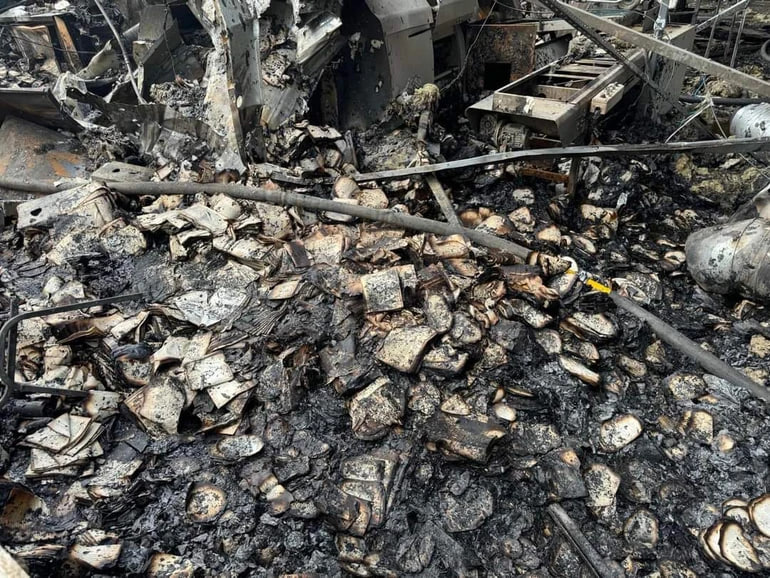
A Russian missile attack on Kyiv overnight on 7 October destroyed warehouse premises in the Podil district and badly damaged a book warehouse of Ukrainian publishing house Knyholav, the publisher said. Tens of thousands of books were lost, but no staff were hurt. It was the second time this year that Russia has destroyed Knyholav's stock.

Russia has destroyed Ukrainian books since the start of its invasion, seizing them from libraries in occupied areas and burning them in boiler houses. Since spring, it has also been aiming missiles and drones at the industry that makes them—printing houses, publishers' warehouses, and bookshops—destroying books by the millions. Each strike takes out not only stock but the reprints, new titles, and textbooks Ukrainian readers were waiting for, at a time when publishing in Ukrainian is part of how the country holds onto its identity.

Tens of thousands of books lost

The publisher can't yet say how many books were destroyed or can no longer be saved, it said, but tens of thousands were lost. The final count will be possible only once staff get full access to the warehouse and check the state of every book.

The burnt books in Kharkiv may 2024
Explore further

Russian aggression devastates 1,000 Ukrainian libraries and 200 million books

The losses include new titles Knyholav received over the past two months. They also include reprints of books Russia had destroyed in July at its previous warehouse. Knyholav had moved its rebuilt stock to this new warehouse after a Russian strike on 19 July destroyed its previous one outside Kyiv, along with about 250,000 books.

"This is a tangible blow for us. These are books we created, printed, and prepared for you," the publisher wrote. "But despite everything, we are holding on!"

The strike hit Kyiv's Podilskyi district, where a Russian attack caused a fire and the partial collapse of the floors of an office and warehouse building, Kyiv Mayor Vitali Klitschko said. The same overnight attack killed people in Pryluky, Kyiv, Kremenchuk, and Oleksandriia.

Millions of books burned

Russia's attacks destroyed more than 1.5 million books in July alone, Culture Minister Tetiana Berezhna said. On 1 August, a strike on the logistics center of publisher Ranok and the distribution center of the KnyhoLand bookshop chain in Kharkiv destroyed 8 million books, including 628,000 new school textbooks. Over three months, Russia burned about 13 million Ukrainian books, nearly a third of everything the country printed in 2025. In August, Russian missiles also hit Kyiv's largest book market.

  •  

Russia launches one of largest attacks on Ukraine, killing at least 11 as energy infrastructure targeted

Russia launched a large-scale missile and drone attack across Ukraine overnight into 7 October, killing at least 11 people and injuring more than 30. Kyiv, Pryluky, Kremenchuk and several other cities were struck as Moscow used ballistic and cruise missiles alongside 130 attack drones, with energy infrastructure among the principal targets.

Russia fired 70 missiles and 130 drones at Ukraine during one of the largest combined aerial attacks of recent months, striking Kyiv and at least a dozen regions between Tuesday evening and Wednesday morning.

President Volodymyr Zelenskyy said at least 11 people had been killed and 34 wounded in the attacks. He said energy infrastructure was among Russia’s principal targets and described ballistic missiles as the most difficult element of the assault for Ukrainian air defences. Reuters reported the remarks and casualty figures.

According to the Ukrainian Air Force’s preliminary assessment, the attack began at about 6pm on 6 October and involved a mixture of ballistic, anti-ship and cruise missiles launched from Russian territory, aircraft and the Caspian Sea. Russia also deployed 130 Shahed-type, Gerbera and decoy drones, including 46 jet-powered attack drones.

By 9am, Ukrainian forces said they had destroyed or electronically suppressed 161 aerial targets: 117 drones, 39 cruise missiles and five ballistic or other high-speed missiles. Six additional cruise missiles were still being assessed. Missile and drone impacts were recorded at 18 locations, while debris from intercepted weapons fell at another five.

The main directions of attack were the Kyiv, Kharkiv, Poltava and Dnipropetrovsk regions.

Residential buildings hit in Pryluky and Kyiv

Some of the heaviest civilian casualties were reported in Pryluky, in Chernihiv region, where a missile struck a multi-storey residential building. Emergency officials initially reported four people killed and 20 injured, including three children. Rescue teams continued searching the damaged structure on Wednesday morning. Associated Press reported on the rescue operation and casualties.

In Kyiv, ballistic missiles reached the capital during the night, with explosions reported shortly after 3am. Two people were killed. A non-residential building in the Podilskyi district was hit and caught fire, while garages burned in Darnytskyi district. The wider Kyiv region was simultaneously attacked by missiles and drones, damaging three production and warehouse facilities in the Obukhiv district.

Two people were also killed and seven wounded in Kremenchuk, in Poltava region, where missiles and drones struck the city and surrounding district. Damage was reported to residential buildings and an industrial facility. Further strikes were recorded in Dnipro, Zaporizhzhia and Oleksandriia.

Zelenskyy said Russia had deliberately sought to inflict serious damage on Ukraine’s energy system. “One of the key targets was our energy infrastructure,” he said, adding that further air-defence supplies had become an immediate requirement.

The attack came only hours after the Ukrainian president said intelligence services had obtained information indicating that Russia was preparing another major aerial operation. In his address on Tuesday evening, he urged Ukrainians to respond to air-raid warnings and said the country’s ability to withstand the expected attack would depend partly on the availability of Western-supplied defensive systems. His latest statements are available through the official presidential website.

The scale and composition of Wednesday’s barrage again exposed the pressure being placed on Ukraine’s layered air-defence network. EU Today has previously examined the shortage of Patriot interceptors capable of engaging ballistic missiles, which travel considerably faster than cruise missiles and drones and leave defence crews much less time to respond.

Russia’s use of different weapons within the same attack also forces Ukraine to employ several types of interception simultaneously. Cheap drones can be engaged by mobile fire groups, electronic warfare and interceptor drones, while ballistic missiles generally require more sophisticated systems such as Patriot.

Moscow’s Defence Ministry said its forces had carried out a “massive strike” using long-range precision weapons and drones against Ukrainian military-industrial facilities. It claimed that missile and drone production and storage sites, as well as port and ship-repair infrastructure, had been targeted. Those claims could not independently establish the nature of individual sites hit. Ukrainian authorities meanwhile documented damage to homes, businesses, energy facilities and other civilian infrastructure.

The overnight assault follows several weeks of intensified strikes as Ukraine approaches another winter under pressure on its power network. During German Chancellor Friedrich Merz’s visit to Kyiv at the weekend, Berlin announced a new assistance package of more than €1.3 billion, including military support and funding intended to help protect and repair the country’s energy infrastructure ahead of winter.

Wednesday’s attack demonstrated why those two areas — air defence and the resilience of the electricity system — have become increasingly closely connected. Even with more than 160 incoming weapons intercepted or suppressed, missiles and drones reached targets across several regions, leaving casualties and damage hundreds of kilometres apart.

  •  
❌