 Login

PHP crisis: Websites across the internet go down as hackers launch millions of cyber attacks
Government, banking and other key websites taken offline to respond to panic over technology that powers much of the internet

© Reuters

Government, banking and other key websites taken offline to respond to panic over technology that powers much of the internet
© Reuters
Government, banking and other key websites taken offline to respond to panic over technology that powers much of the internet
© Reuters

© Geert Vanden Wijngaert/Associated Press

Instead of prioritizing stakeholder profit, the Witkoff-Europe combo should address Eurasian security architecture and NATO-Russia-China frontiers to gain traction in Moscow.
Join us on Telegram , X
 , and VK
 .
Contact us: info@strategic-culture.su
Back in December 2025, U.S. commentator Sundance, writing in the Conservative Treehouse, wrote about Steve Witkoff and Jared Kushner’s new ‘Money Diplomacy’ solution for Ukraine that “require[d] [the establishment of] a system whereby the western opportunity for financial benefit continues”. From this perspective, the U.S. negotiators would “propose a long-term plan for continued financial benefit”.
From their current language it appears that Witkoff and Kusher are still confident they can construct a financial reward system for western banks, investors, politicians and Ukraine officials that will retain the benefits of war without the ancillary ingredient of bloodshed.
As Sundance noted —
“If the U.S. delegation can pull this off, then Russia can gain the territory they want, corrupt Ukraine officials can keep skimming investment money, the EU can retain the power it wants to extract financial payments, American politicians can use the “long-term recovery projects” for money laundering, and quasi-public/private investment banks can benefit from the exploitation of Ukraine resources”.
From this evident New York real estate worldview, all other issues — territorial boundaries, security and NATO’s encroachment into Central Asia’s security architecture — are but ‘downstream details’ “to the stuff that really matters, the money”.
Monetary diplomacy, however, has not brought a solution for Ukraine (nor for that matter, for Gaza either). Nonetheless, Witkoff has a new plan that David Ignatius has outlined in his column at the Washington Post.
Ignatius highlights that despite the recent Ukraine “flap” over its targetting of Russian refineries, “the U.S. and Europe are moving toward a joint peace proposal that would deliver financial and security benefits to both Ukraine and Russia as a baseline for a territorial settlement that falls short of both sides’ war aims”. In other words, ‘a sweetener’ dangled to persuade the sides to stop bombing each other’s refineries and to open the path for this ‘new’ initiative.
If Zelensky agrees to halt refinery attacks, “we’re back in, and we go to Moscow”, an American official told Ignatius.
In gist, the 4-point plan envisages a generous reconstruction framework to meet “Zelensky’s myriad cash needs”; security guarantees for Ukraine equivalent to NATO’s Article 5; the economic integration of Russia, Ukraine and Europe through an energy deal — “This might consist of a pipeline carrying Russian oil and gas to Europe with Ukraine and Russia splitting the profits. Such a pipeline could sharply reduce European energy costs”, a U.S. official said. In addition to providing Russia with “long-term access to the European energy market”, a peace deal would specify how and when existing economic sanctions on Russia would be removed.
The final point – wait for it — would be a ceasefire along the existing front line, or the ‘line of control’.
It seems extraordinary: The U.S. and Europeans negotiate amongst themselves, seemingly oblivious to the explicit statements issued by the Russian side.
Oil and gas would be supplied by Russia to the needy Europeans who voluntarily forsook their earlier cheap Russian supply, who are trapped by their own decisions and who denigrate Russia at every opportunity. And with the profits to be “split” with Ukraine? No way will Russia accept such a one-sided proposal.
FM Lavrov said at the UNGA no ceasefire under any format. That means that any negotiations would have to take place under fire, and Putin has suggested that even then, he would ‘think twice’ about starting any negotiations (whether under fire or not).
Putin’s spokesman Dmitry Peskov confirmed just last week that “piecemeal solutions and agreements” would prevent a comprehensive settlement from being reached; a “freeze” of the conflict would not help either —
“[Ukraine] is a highly complex matter, and the settlement must be comprehensive … We need a solution for future generations — one that is guaranteed and safeguarded against setbacks”.
It seems that the Europeans have not grasped that a Korean-style cessation of hostilities (as argued by General Kellogg) along a front where two militaries face each other is a recipe for precisely no solution. It has been 73 years since the Korean War was frozen by armistice. Nothing has changed.
The repeated return to this mantra of a ceasefire along line of contact, rather than solution first; ceasefire last, shouts out to the Russians that the West wants to keep Ukraine in the locker-room for the time when a platform from which to exert pressure (again) on Russia in the future is to be jacked-up.
The fatal flaw to this initiative is its cultural deafness. For Witkoff and Kushner it may be “all about the stuff that really matters – money” — but that is not the case for Russia.
If the Witkoff-Europe combo recalled Russian history, they would understand why, for Russia, security, security, security comes top.
Walter Munchau cautioned just this week that “the Ukraine war risks escalating” —
“We should be under no illusion about a war with Russia. We are absolutely not in a position to win. Whose bond markets are going to be blown up first? Who is going to run out of interceptor missiles first? … On every [count] — military, energy, finance — Europe is at a disadvantage. That’s not all. There is a relatively plausible scenario in which Ukraine and Iran merge into a single West Eurasian war — and become the ultimate proxy conflict between the U.S. and China”.
If, instead of putting continued ‘stakeholder’ grift first, with its mechanism to ensure “that the western opportunity for financial benefit continues”, the Witkoff-Europe combo chose rather to address the fundamentals to the conflict — the deeper question of a Eurasian security architecture; the definition of where exactly the frontier that separates NATO security interests from those of Sino-Russian interests physically lies — they might find a more receptive audience on their next trip to Moscow.
Alas, circumscribing NATO’s extent is not possible – as things stand.
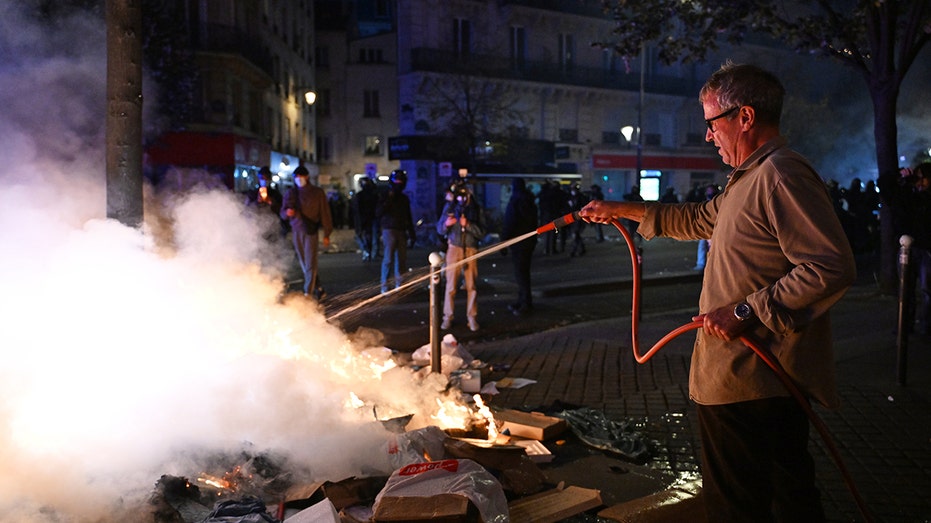
As violent riots grip France, British political leader Nigel Farage warned Americans against repeating what he described as Europe's mass immigration failures, arguing that years of unchecked migration have transformed European cities and fueled unrest that could eventually spread elsewhere.
"People like me who were warning about this years ago have sadly been proven right, but the problems are gonna be here for a very, very long time," Farage told Fox News Digital in an interview. "Please, please don't make the same level of mistakes that we have," he said in his message to Americans.
Violent riots have erupted across parts of Europe in recent weeks, particularly in France, with Farage pointing to years of mass migration and failed political leadership as key factors fueling the unrest. The Reform UK leader singled out Emmanuel Macron, arguing that the French president should have mobilized the military to confront the violence, after education protests spiraled into riots, destruction and theft.
MACRON JETS OUT OF RIOT-TORN FRANCE FOR GULF TRIP AS POLITICAL PRESSURE MOUNTS
"Macron was asleep at the wheel, and it isn't just that he was at a concert," Farage said. "And whilst the French do have effective police forces, the scale of the uprising, I mean the mass looting, the mass looting and violence that took place in Paris was genuinely horrendous."
"Meloni's reaction was swifter and a better sign of leadership," Farage said, referring to the Italian leader deploying 500 military troops to Milan in response to recent riots. "But the problem is, for people like Macron, who have always said, any criticism of immigration, whether legal or illegal, makes you racist, they psychologically find it hard to face up to their own failures of policy."
Farage warned that the unrest he described in France and elsewhere in Europe could eventually erupt in Britain, pointing to demonstrations in London and questioning whether British leaders would respond more forcefully than Macron.
ITALY UNLEASHES MILITARY RESPONSE TO VIOLENT RIOTS AS FRANCE FACES A RECKONING OF ITS OWN
"You know, my real worry is they can happen in this country too," Farage said. "We've got the same hard left here. We've the same hate mobs that march, chanting in the streets of London, from the river to the sea."
"I'm concerned that these things could happen here. And I wonder whether a British prime minister has got any more courage than President Macron in France," he added.
Farage contrasted Europe's failure to control its borders with President Donald Trump's immigration crackdown in the United States.
TRUMP, WALTZ LINK FRANCE RIOTS TO MASS IMMIGRATION AS THOUSANDS ARE ARRESTED
"Look, whatever you think of President Trump's current policies, one thing he has done, and he promised he'd do. He's closed the southern border," Farage said.
Trump vowed Tuesday to treat potential rioters in the U.S. "very rough," pointing to the unrest in France, he said at a rally in Greenville, North Carolina, before being interrupted by a protestor in the crowd.
"They're crazy, these people. Look at that guy. He's a nutjob," Trump said, in reference to the protester.
He warned that he would crack down on potential threats, saying he would not allow similar unrest to take hold in the U.S.
FRANCE COULD FACE EVEN WORSE DESTRUCTION WITH SECOND WEEKEND OF PLANNED RIOTS, STATE DEPT WARNS
"That's what you witness over the last three or four days. You watch nutjobs like him in France ruining their country," Trump said. "We're not going to put up with it by the way."
"If a possible threat, which could happen, I hope you won't get angry if I treat them very, very rough, because that's what's going to happen. They're not going to destroy our country," he said.
On Tuesday, British counterterrorism police rearrested two men suspected of assisting Iranian intelligence in an alleged plot targeting RAF Fairford, a U.K. base used by U.S. bombers.
Authorities say Iranian state involvement is "highly likely," though no charges have been filed.
FOILED TERROR PLOT AT BOMBER BASE SIGNALS WIDER THREAT TO US MILITARY INSTALLATIONS: EXPERT
Farage said he has foreshadowed such criminal acts, alleging that Iran has exploited illegal crossings of the English Channel to move operatives into Britain.
"I've called again and again for this to be declared a national security emergency. I have been ignored. If the Americans removing their bombers from RAF Fairford isn't enough warning. I don't know what is," he said.
CLICK HERE TO DOWNLOAD THE FOX NEWS APP
"We've just become so caught up over here in Europe and Britain with this human rights culture, which puts the interests, frankly, of the bad guys above the interests of the majority."

© Annegret Hilse/Reuters
Companies and governments around the world raced on Thursday to patch critical vulnerabilities in the widely used PHP programming language, as millions of hacking attempts were reported and authorities across Asia activated emergency cybersecurity measures.
The rush came after government websites in Europe and elsewhere went offline on Wednesday, with the disclosure of the flaws sending website operators scrambling to protect their systems.
PHP developers released urgent security fixes on Wednesday after vulnerabilities that had remained in the software for years were uncovered using artificial intelligence. The developers urged all users to update immediately.
Cloudflare Chief Executive Matthew Prince said attempts to exploit the vulnerabilities had surged dramatically following their public disclosure.
“In the 10 hours before it was publicly announced, across the network we saw thousands of attempts to exploit it,” Prince said in a post on social media platform X late on Wednesday.
“That jumped to tens of thousands in the 45 minutes post announcement, hundreds of thousands within 2 hours, and millions now.”
The vulnerabilities could allow attackers to execute malicious commands without authentication, steal sensitive information or take websites offline, according to South Korea’s science ministry.
South Korea raised its private-sector cybersecurity alert level on Thursday and activated emergency response measures, citing the increased risk of hacking attacks.
The presidential National Security Office convened an emergency meeting involving intelligence, defence and science ministry officials to coordinate responses across the public, private and military sectors.
The science ministry said it had issued security guidance to approximately 28,000 companies with registered chief information security officers and 5,900 members of a government information-sharing network.
Operators of critical infrastructure, web-hosting companies and data centres were also alerted.
Authorities urged organisations to install the latest PHP security updates and introduce temporary safeguards where immediate patching was not possible.
China’s industry ministry similarly called on organisations and users to inspect their systems immediately and upgrade to the latest secure version of PHP.
It also recommended strengthening cybersecurity monitoring and promptly changing accounts, passwords and security keys.
In Japan, Mitsubishi UFJ Financial Group said on Thursday it was temporarily suspending some internet services as part of emergency security measures.
Japan’s Finance Ministry also suspended some website content and online services while implementing protective measures.
Prime Minister Sanae Takaichi urged website operators on Wednesday to check whether their systems used PHP and prepare to install the security fixes.
The disruptions and emergency measures highlight the potential impact of vulnerabilities in PHP, a programming language widely used to power websites and online services.
The disclosure of the flaws, followed by the rapid escalation in attempted exploitation, has prompted governments and businesses to accelerate security updates to protect their systems from possible attacks.


AI-discovered security flaw leads to mass hacking fears

AI-discovered security flaw leads to mass hacking fears
The Council of the European Union adopted its negotiating position on Wednesday, 21st October, clearing the way for negotiations with the European Parliament once MEPs establish their position.
The measures form part of the European Commission’s Digital Omnibus package, introduced in November 2025, and represent one of Brussels’ most substantial attempts to simplify the regulatory obligations imposed on businesses operating across the single market.
The proposed reforms would modify several provisions of the GDPR, which has governed the processing of personal data across the EU since May 2018.
Rather than replacing the legislation, the Council wants to clarify existing obligations, particularly those concerning pseudonymised information, requests for access to personal data and the use of information in scientific research.
The agreed position retains the existing definition of personal data while introducing provisions intended to clarify when pseudonymised information can be linked to an identifiable individual.
Companies would also benefit from simplified procedures for handling manifestly unfounded or excessive data requests and from reduced information requirements in certain low-risk circumstances.
Another proposed change would extend the deadline for notifying authorities of personal data breaches, while establishing more consistent reporting templates across the EU.
For multinational companies, which currently navigate different interpretations of data protection obligations by national authorities, these provisions could reduce compliance costs and administrative duplication.
However, the changes have raised concerns among European privacy regulators.
In a joint opinion published in February, the European Data Protection Board and European Data Protection Supervisor warned that parts of the Commission’s original proposal could create legal uncertainty and undermine existing protections.
They were particularly concerned about proposals affecting the definition of personal data and the Commission’s potential role in determining when pseudonymised information falls outside GDPR requirements.
The Council’s decision to retain the existing definition addresses part of that debate, although the final legislative text remains subject to negotiations.
One of the most visible changes would affect the consent notices encountered by Europeans when visiting websites.
Under the Council’s proposal, additional categories of cookies and similar tracking technologies could be used without obtaining explicit consent, provided the relevant legal conditions are satisfied.
The proposed exemptions include technologies necessary to deliver a service, maintain device security or conduct audience measurement.
For website operators, publishers and online businesses, the changes could reduce the number of consent requests displayed to visitors and simplify technical compliance.
The current system has generated extensive legal disputes over whether consent is genuinely voluntary and whether tracking technologies collect information beyond what users have authorised.
EU Today has previously examined the enforcement of these obligations, including a Belgian court ruling concerning the legality of the advertising industry’s consent framework.
The latest proposal would not abolish consent requirements for commercial tracking or behavioural advertising. Technologies falling outside the permitted exemptions would remain subject to the applicable privacy rules.
The package also addresses the growing number of reporting obligations imposed on European businesses under overlapping cybersecurity legislation.
The Commission originally proposed a single European reporting mechanism for certain data and cybersecurity incidents.
Member states have instead agreed to establish national entry points, supported by an EU-level information system and provisions for coordinating cross-border notifications.
The Council’s position would also clarify the legal grounds for certain uses of personal data in artificial intelligence systems and introduce safeguards for processing sensitive information in specified circumstances.
These provisions follow increasingly complicated disputes over the application of European privacy legislation to AI development and automated decision-making.
As EU Today reported in its coverage of a major GDPR enforcement case involving Uber, automated processing already presents substantial compliance risks for companies operating within the bloc.
The Commission estimates that its wider digital simplification initiative could save European businesses up to €5 billion in administrative costs by 2029.
The initiative reflects pressure from European governments and business organisations to reduce the regulatory fragmentation that makes operating across multiple EU jurisdictions more expensive.
The Digital Omnibus is part of a broader legislative programme influenced by the competitiveness reports produced by former Italian prime ministers Enrico Letta and Mario Draghi.
Under the Council’s negotiating mandate, several existing data-related rules would also be consolidated, while provisions governing the protection of trade secrets would be strengthened.
The European Parliament must now determine its negotiating position before formal discussions between the institutions can begin. Until the legislation is agreed and adopted, existing GDPR, cookie consent and cybersecurity requirements remain in force.

A Florida attorney was arrested after she threatened to shoot ICE agents in the head while trying to buy a gun, federal authorities said.
Lisa White, who lives in Mississippi, was arrested in Long Beach after allegedly threatening to "kill federal agents" while attempting to purchase a firearm and pepper spray, according to a U.S. Immigration and Customs Enforcement release.
Homeland Security Investigations identified White as a Florida attorney in a post announcing her arrest on X.
Authorities said White asked whether specific firearms could penetrate ballistic vests, then allegedly said she would target agentsâ heads if she could not breach their armor.
HSI Gulfport special agents responded, interviewed witnesses and located and arrested White, according to the release.
The investigation began Sept. 23 after an agent with the Bureau of Alcohol, Tobacco, Firearms and Explosives alerted HSI to the encounter at High Caliber Guns, according to a criminal complaint obtained by the Sun Herald.
White entered the store around 11:30 a.m. and told employees, "I need a gun," according to the complaint cited by the outlet.
She allegedly identified herself as an activist and protester and said she wanted a firearm for protection at a protest because she believed "ICE agents are becoming crazy and wild."
But White also told an employee she wanted to buy a gun to kill ICE agents, according to the complaint.
While discussing the weapons, White allegedly gestured toward her torso and asked whether the guns could penetrate an agentâs body armor. If they could not, she said she would need to "hit them in the head, shoulder, arm or leg," the complaint states, according to the Sun Herald.
A shop employee reportedly warned White that pointing a gun at law enforcement would likely get her killed.
"If I have to die, I have to die," White responded, according to the complaint.
The employee then suggested White buy pepper spray instead of a gun and directed her to a shooting range for training, the complaint states.
White looked at two pistols but left empty-handed after the shop declined to complete the sale and told her she could return in two to three days, the newspaper reported. Store employees then alerted authorities, prompting the investigation.
"The safety of our personnel is paramount, and HSI takes any threat against federal law enforcement officers with the utmost seriousness," HSI Gulfport Assistant Special Agent in Charge Matthew Reidell said.
"We commend the vigilance of the citizens for recognizing these threats and notifying law enforcement immediately, which allowed us to intervene swiftly."
White remained in custody as agents prepared a federal charge of influencing, impeding or retaliating against a federal official by threat, ICE said.
"Threats against federal law enforcement will NOT be tolerated," HSI wrote on X. "HSI will continue to investigate threats against the brave men and women who put their lives on the line every day to protect our homeland."
The arrest comes as ICE reports a sharp increase in threats and attacks against its personnel.
HEROIC ICE OFFICERS, STAFF MEMBER OPEN UP ON GROWING DANGERS: âAM I GOING TO DIE?'
In its release, the agency cited an increase of more than 1,600% in assaults, 3,300% in vehicle attacks and 8,000% in death threats against ICE officers. It did not provide the underlying totals or comparison period.
ICE said President Donald Trump and Homeland Security Secretary Markwayne Mullin have made clear that violence against law enforcement will not be tolerated, warning that people who threaten or attack officers face arrest and prosecution.
CLICK HERE TO DOWNLOAD THE FOX NEWS APP
Fox News Digital reached out to White for comment.


A Dallas-area juvenile arrested by the FBI for planning a terrorist attack on behalf of ISIS may also have been planning to assassinate Rep. Keith Self (R-TX), the co-founder and co-chair of the Sharia-Free America Caucus, according to information reviewed by Breitbart News.
The post Exclusive — Juvenile Arrested by FBI for ISIS Terror Attack Plot May Have Also Planned to Assassinate Sharia-Free America Caucus Co-Founder Rep. Keith Self appeared first on Breitbart.
At least 10,561 gang members have been convicted by Salvadoran courts over the past four years since the start of the crackdown on gangs began in 2022, Attorney General Rodolfo Delgado detailed on Tuesday.
The post El Salvador Logs over 10,500 Gang Member Convictions Since 2022 appeared first on Breitbart.
Data released by maritime tracking agency Kpler on Wednesday showed that oil exports have reached, and even surpassed, pre-war levels despite resurgent terror attacks by Iran on commercial vessels in the Strait of Hormuz.
The post Oil Flows Return to Pre-War Levels Despite Iran’s Resurgent Hormuz Terrorism appeared first on Breitbart.
