Flooding has affected nine departments, forced families to relocate and prompted rescue operations as forecasters warn of more rain.
Flooding caused by heavy rainfall and the overflowing Paraná River has affected at least 3,000 families across nine departments in Paraguay, prompting emergency assistance and the relocation of thousands of families as authorities warn of further rainfall, according to the National Emergency Secretariat (SEN).
The southern departments of Ñeembucú, Misiones and Itapúa have been among the hardest hit, with floodwaters inundating homes and forcing emergency crews to distribute food, plastic sheeting and construction materials to affected residents.
The flooding has also affected Central, Guairá, Caaguazú, Concepción, San Pedro and Canindeyú, extending the emergency across nine of the country’s 17 departments.
In Misiones, the municipality of Ayolas has been particularly hard hit because of its proximity to the Yacyretá Dam, which is jointly managed by Paraguay and Argentina. Around 1,040 families in the area have received assistance, according to the SEN.
#FromTheSouth News Bits | About 1,200 families were evacuated last week in Ciudad del Este, Paraguay's second most populous city, due to severe flooding caused by the El Niño phenomenon, which raised the Parana River's water levels. pic.twitter.com/fu7fTJHzah
Rescue operations have also extended to animals. The nonprofit organization SOS Animal Ayolas has rescued about 247 pets trapped in flooded areas in recent days.
In Alto Paraná, along the border with Brazil, at least 1,300 families have been relocated. Water levels in the Paraná River have fallen slightly in the area, reaching 117.57 meters above sea level after approaching 121.19 meters on Thursday.
Firefighters from Bombers Pel Món, an organization based in the Spanish municipality of Valencia, have joined local emergency crews in assisting communities affected by the flooding near Foz do Iguaçu, Brazil.
Despite the recent decline in water levels in Alto Paraná, Paraguay’s Directorate of Meteorology and Hydrology has warned of a high probability of further rainfall from Wednesday through Sunday, with the greatest impact expected in the country’s Eastern Region.
Flooding along the Paraná River has affected thousands of families in Paraguay, prompting evacuations, rescue operations and emergency aid. Photo: Flooding in Paraguay as the Paraná River overflows, affecting thousands of families and prompting emergency evacuations.
Roman Catholics across South America responded to news of Pope Leo XIV's lung cancer diagnosis with an outpouring of prayers and support, along with concerns about whether the first American pope would go ahead with his highly anticipated and physically demanding visit to the region next month.
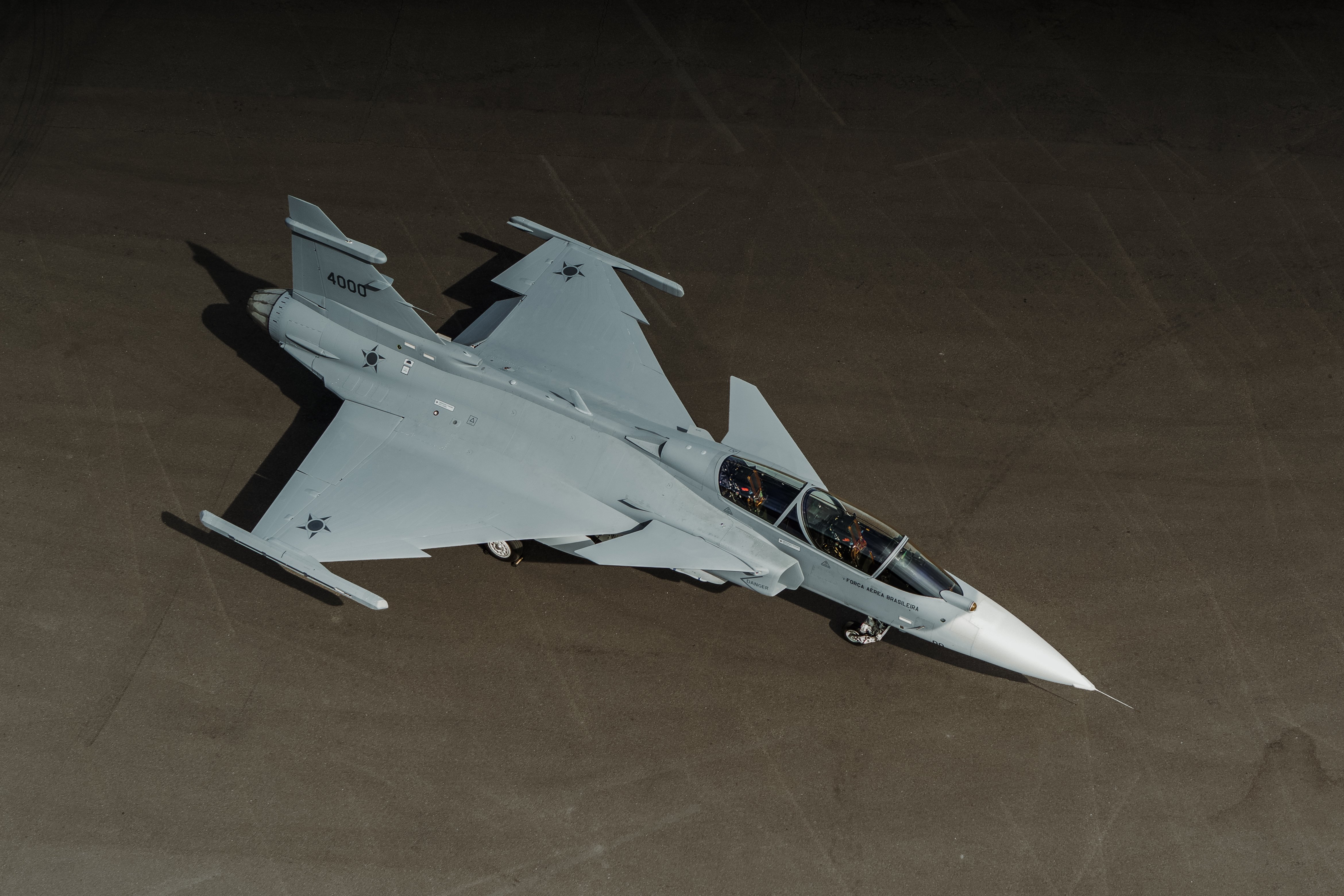
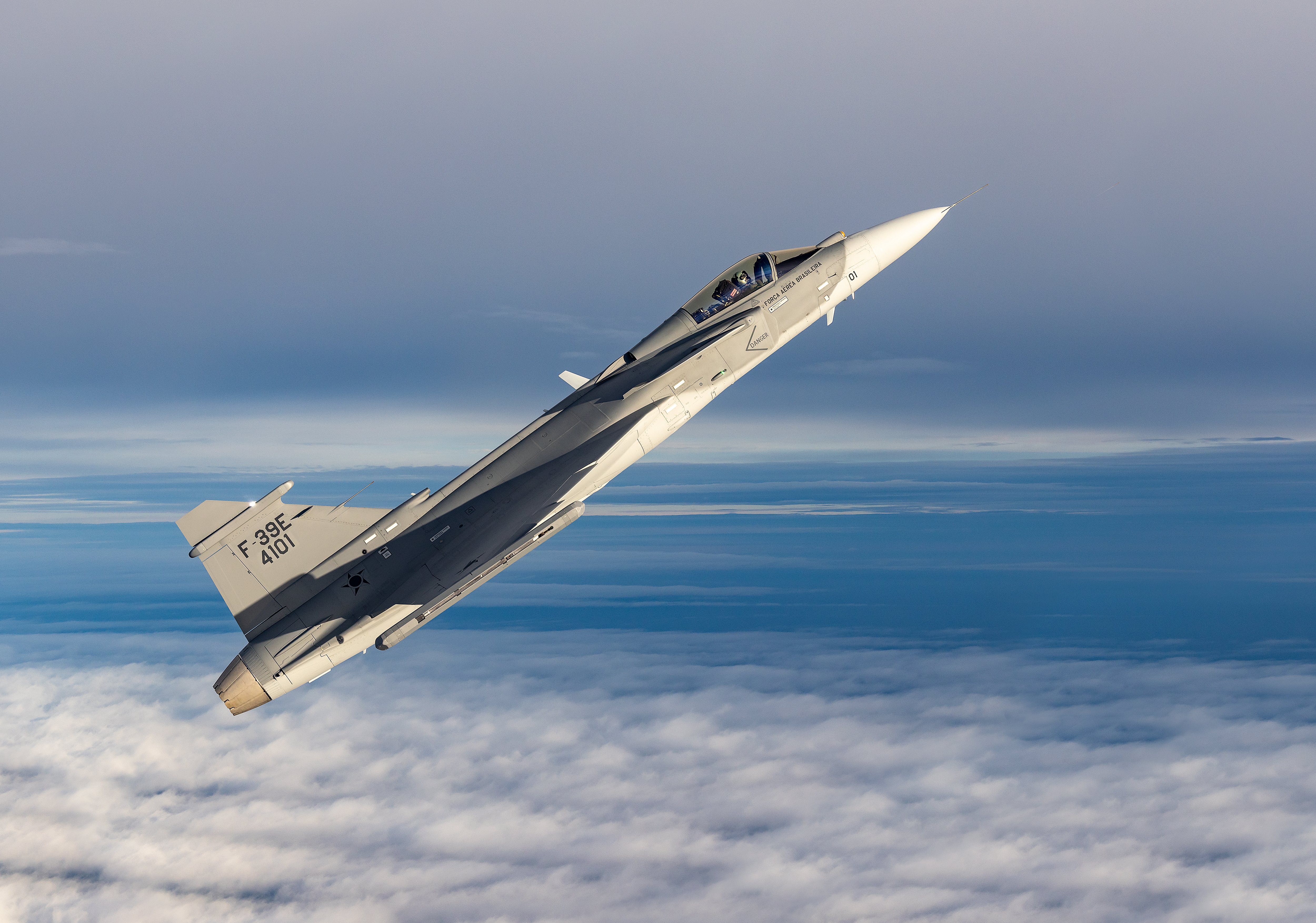
Saab’s first Gripen F two-seat fighter has taken to the air, marking the beginning of the flight-test campaign for a variant being developed in close cooperation with Brazil.
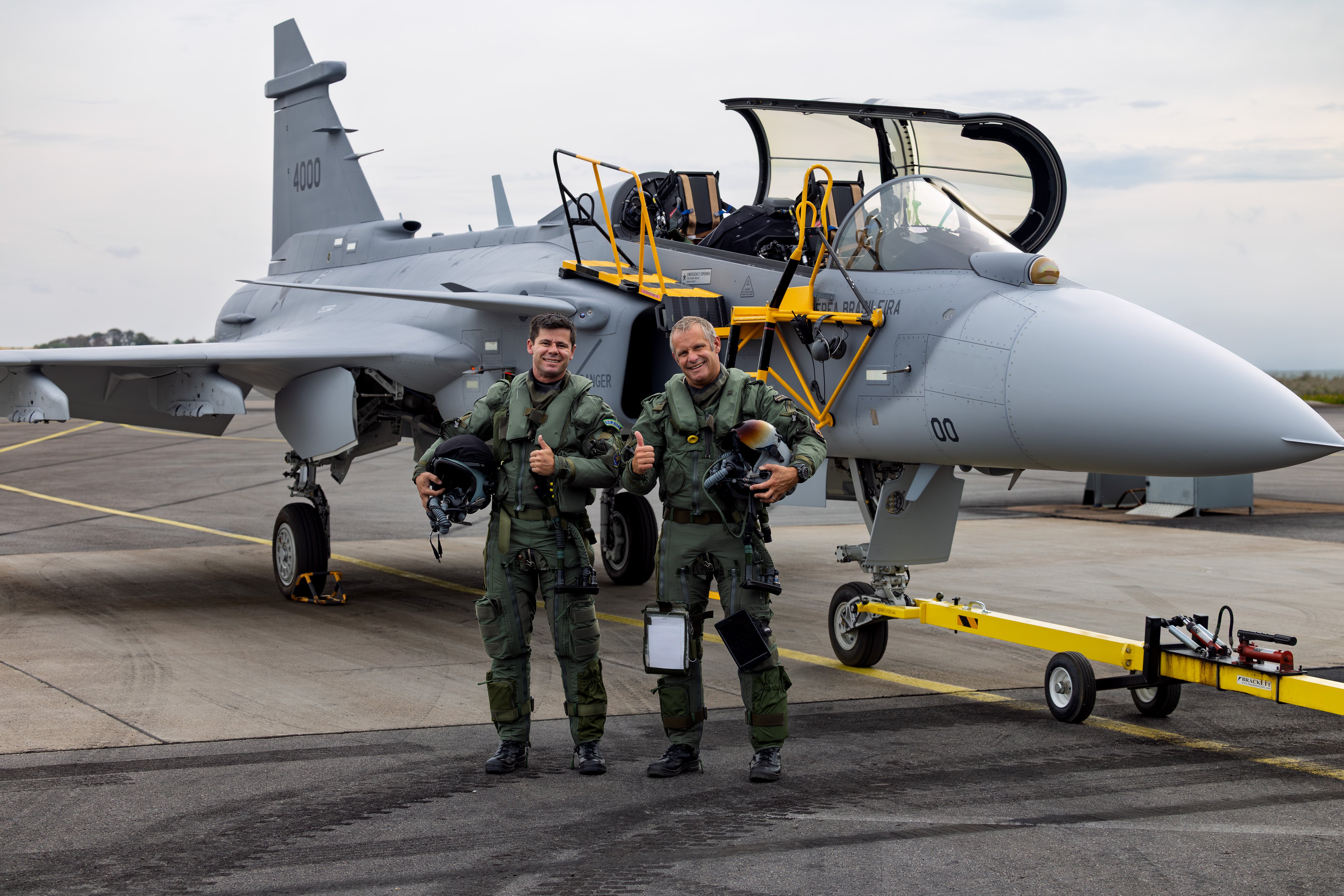
The aircraft departed Saab’s airfield at Linköping, Sweden, at 9:40 a.m. local time today and remained airborne for approximately 40 minutes. Saab chief test pilot Jakob Högberg and Brazilian Air Force test pilot Lt. Col. Aviator Abdon de Rezende Vasconcelos were in the cockpit for the inaugural sortie.
Gripen F test pilots Jakob Högberg and Lt. Col. Aviator Abdon de Rezende Vasconcelos. Saab
According to Saab, the flight was intended primarily to verify the aircraft’s core systems and initial flying characteristics. The company says the aircraft will now enter a more extensive test program, including progressive expansion of its permitted flight envelope.
That work will eventually cover the aircraft’s speed, altitude, G-loading, and angle-of-attack limits, as well as the tactical capabilities and systems associated specifically with the rear cockpit.
“This first flight represents an important step forward for both Saab and the Brazilian Air Force,” said Lars Tossman, head of Saab business area Aeronautics. “Seeing Gripen F take to the skies is particularly significant for all the Swedish and Brazilian teams whose years of engineering work have helped turn this aircraft into a reality. It is designed to accelerate pilot training while enhancing operational performance in advanced combat missions.”
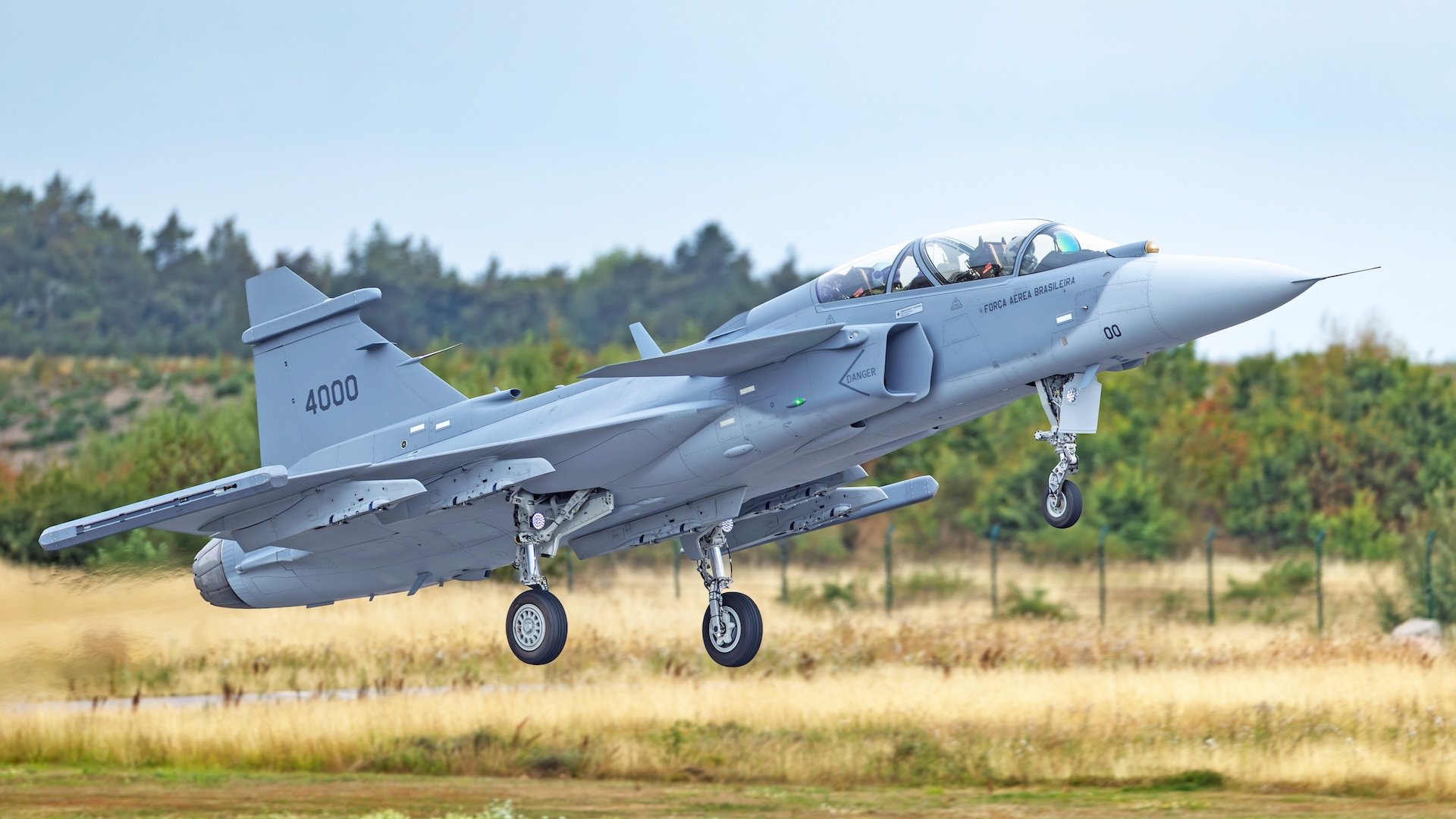
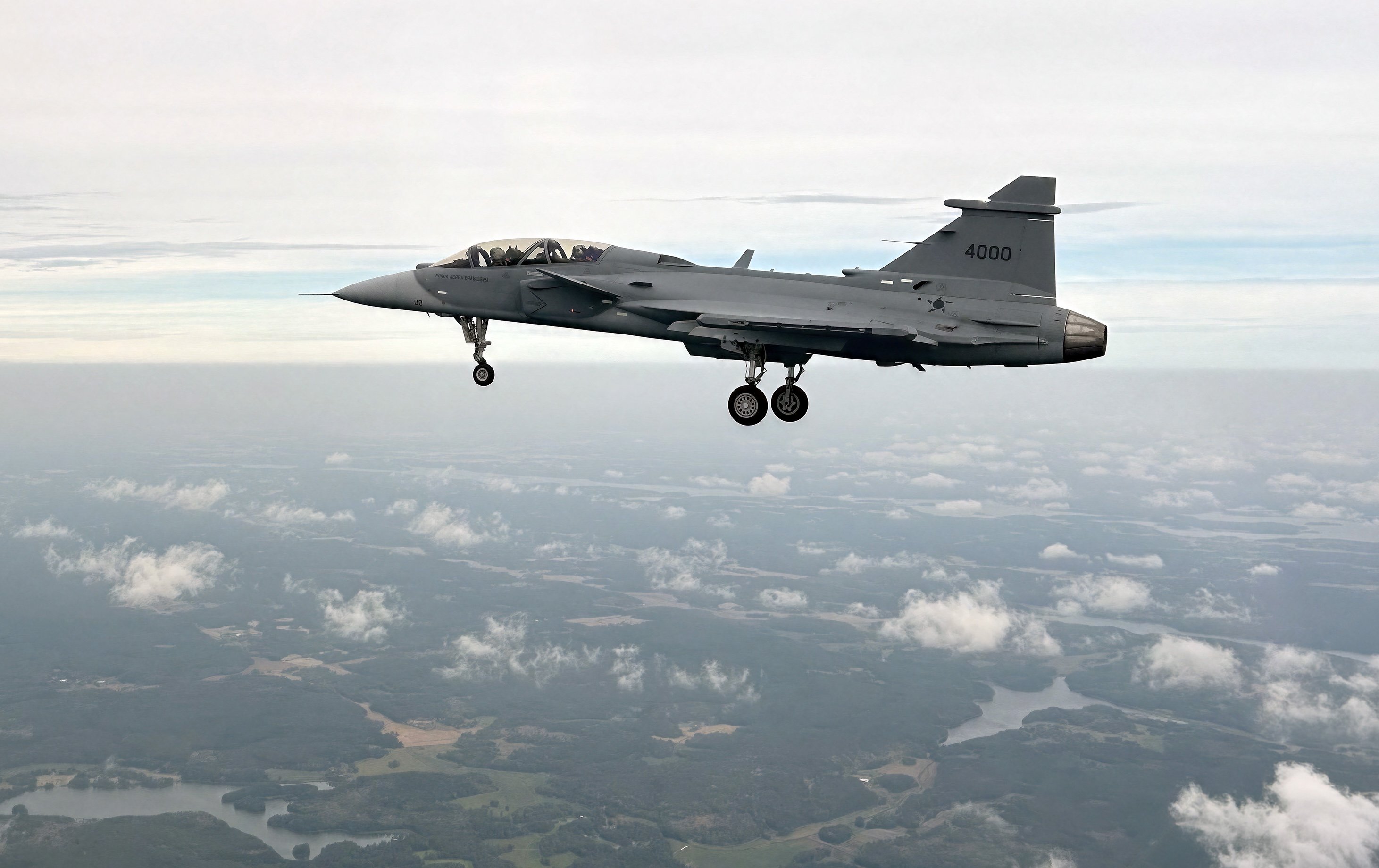
First flight of the Gripen F, with landing gear extended. Saab
The Gripen F is the two-seat derivative of the Gripen E, but it is not simply a conventional trainer version of the single-seat fighter. Saab has designed the rear cockpit to be independently functional, allowing the aircraft to retain an operational combat role while carrying a second crew member.
The configuration is therefore intended to support conversion training and mission preparation while also offering potential advantages during complex combat missions through the division of cockpit workload. This could also include as a ‘drone controller,’ a growing area of interest for many air forces and something that Saab is also working toward with its uncrewed aircraft plans.
The Gripen F before its first flight. Saab
Combining the Gripen F, in particular, with a high-end drone of the kind that Saab envisages, would make a good deal of sense.
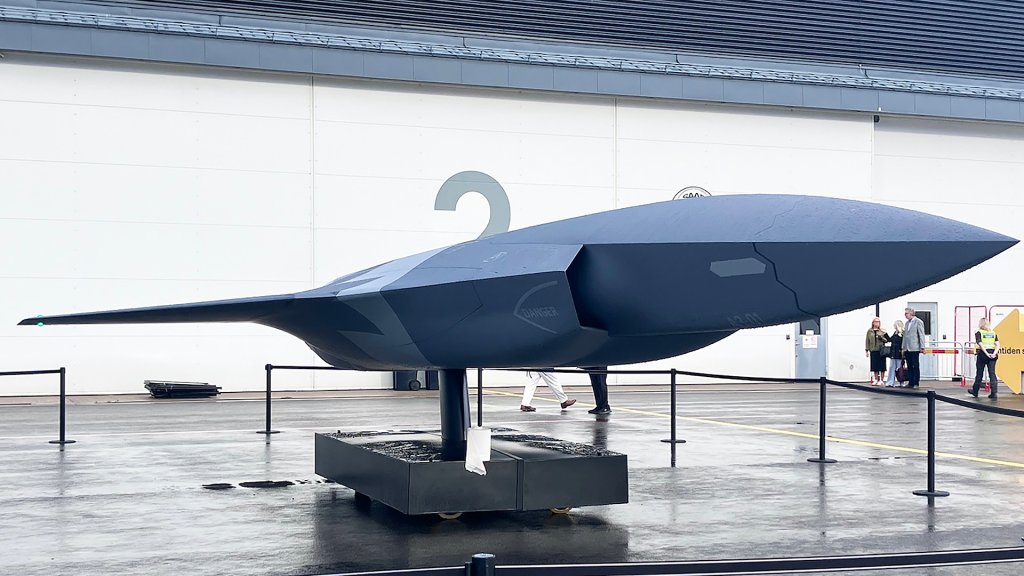
Saab has already pitched its stealthy, supersonic Autonomous Collaborative Platform (ACP) ‘fighter drone’ as an adjunct for the single-seater, describing it as “a great asset to the Gripen E.” Saab envisages the Gripen E serving as a tactical mission commander for one or more ACPs, working in conjunction with the company’s GlobalEye airborne early warning and control (AEW&C) aircraft.
The Saab A3 concept for its future Autonomous Collaborative Platform (ACP) ‘fighter drone.’ Thomas Newdick Thomas Newdick
The dual-crew benefits of the Gripen F, combined with the ACP, could give Saab an even more compelling route into the CCA market. After all, a fourth-generation fighter like the Gripen (Saab, it should be noted, rigorously avoids using this generational terminology), can remain highly relevant when teamed with CCAs, and a high-performance, stealthy drone like the ACP could make that combination even more potent. It could, at least possibly in some cases, allow air forces to skip the sixth-generation crewed combat air platforms altogether, or at least greatly reduce the need for them.
Brazil is central to the Gripen F program. The country was the launch customer for the two-seat variant and participated directly in its development as part of the broader technology-transfer arrangement underpinning its Gripen acquisition.
The first Gripen F was formally rolled out at Saab’s Linköping facility in June. Brazil’s original 2014 agreement with Saab covers 36 aircraft, in the form of 28 single-seat Gripen E fighters and eight Gripen F two-seaters. Deliveries of Brazilian Gripens began in 2020.
Rollout of the Gripen F. Saab
The F-model has also attracted interest beyond Brazil. Saab has subsequently received Gripen F orders from Thailand and Colombia. The South American nation will get two Gripen Fs, while the breakdown of Thailand’s Gripen E/F order has not been revealed. According to Saab, the 16 new-build Gripens ordered for Ukraine will all be single-seaters.
As for the Swedish Air Force, it plans to buy 60 single-seat Gripen Es, but bearing in mind the changing security situation in Europe, and the increasing focus on uncrewed aircraft, a future Gripen F order should not be ruled out. In particular, Saab has said it expects the Swedish government to acquire new Gripen E/Fs to backfill the 12 earlier Gripen C/D variants it has donated to Kyiv, and which are expected to arrive in Ukraine early next year.
Ukraine intends to purchase 20 Gripen E/F aircraft. In conjunction with the sale, Sweden will donate up to 16 Gripen C/D, including advanced ammunition. To replace the donated aircraft, new modern Gripen E/F will be procured for the Swedish Air Force. https://t.co/kPHjVDXnSbpic.twitter.com/IxEhsy2yvN
— Försvarsdepartementet (@ForsvarsdepSv) May 28, 2026
Saab also remains upbeat about the prospect of a Canadian order for the Gripen E/F.
Days after trade talks between Ottawa and Washington collapsed this month, further straining the Canada-United States relationship, Saab chief executive Micael Johansson told TWZ and other journalists that Gripen would be the “perfect” option if Canada moves ahead with a joint fighter purchase. The Swedish jet would add “combat mass” alongside the F-35, according to Johansson.
“I don’t think Canada will give up the F-35 completely; they will go forward with that to some extent,” Johansson said.
Johansson also pointed to the Gripen’s ability to operate from highway strips as well as conventional runways: “You get to use all kinds of airstrips that you cannot use with the F-35,” he added.
Part of the Saab pitch to Canada is the establishment of a new domestic final assembly line for the Gripen E/F, which would be the third such facility after Sweden and Brazil.
As for the Brazilian connection, this extends well beyond aircraft procurement. Saab says more than 350 Brazilian engineers, technicians, and pilots have participated in activities covering Gripen development, production, flight testing, and maintenance. Brazilian industry, including Embraer, has consequently become deeply involved in the program.
A Brazilian Air Force Gripen E. Saab
Meanwhile, Saab is continuing to expand what the fighter can actually do once it leaves the factory.
Recent work has included a test launch of the Taurus KEPD 350 cruise missile, as well as last year’s integration of Helsing’s Centaur AI agent, which was tested in a beyond-visual-range combat scenario.
TAURUS LAUNCH Today a TAURUS KEPD 350 cruise missile was launched from a Swedish JAS 39 Gripen for the first time. The test was conducted at the Vidsel Test Range in Norrbotten. Today TAURUS is a long-range cruise missile that introduces a new deep-strike capability. FMV pic.twitter.com/vYcL75Lu4p
Speaking last week, Johan Segertoft, head of Saab’s Gripen business unit, points to the fighter’s digital architecture as a key enabler of the rapid integration of new capabilities. The company says the Centaur integration took just 10 weeks.
“We chose BVR because it’s one of the most complex things to prove that we could take third-party software and do it, but there’s a lot of things in an aircraft and outside an aircraft that benefit from the advancement of software,” Segertoft said.
Since the Gripen E first flew in 2017, Saab has implemented around 300 capability upgrades, according to Segertoft. He contrasts that with what he describes as a theoretical maximum of around five upgrades for competing aircraft.
The Gripen E used in the Centaur AI trials. Saab
That approach is summed up by Saab’s internal mantra, Segertoft says: “code in the evening, deploy in the morning, learn by lunch.”
The Gripen F test campaign will now move beyond basic systems checks toward progressively more demanding flight conditions. Saab’s Flight Test Center in Sweden will conduct the campaign before the aircraft undergoes the remaining acceptance procedures and is eventually handed over to the Brazilian Air Force.
The first flight therefore represents a milestone not only for Saab’s new two-seat fighter but also for the industrial partnership that produced it. Potentially, that model could be repeated in Canada in the future.

 Login




 TAURUS LAUNCH
 FMV