Tesla said that it expects to release unsupervised FSD around Q2 2027.
Harald Tittel/picture alliance via Getty Images
Tesla's Full Self-Driving feature still requires drivers to pay attention to the road.
During its Q3 earnings call, the company said unsupervised FSD for personal cars is coming in 2027.
The catch? Your Tesla must remain within the company's Robotaxi geofences.
When I reviewed Tesla's Full Self-Driving software in January, I hailed it as an "impressive" driver-assistance feature that left me wanting more.
I dreamed of being able to flip the autonomous driving system on whenever I make my routine 400-mile trip from San Francisco to Los Angeles — kick my feet up, listen to music, and ideally fall asleep without having to supervise the road.
That's been part of Tesla's ultimate pitch for the future. "With autonomy, you get your time back," Elon Musk has said.
And the pitch may soon come true. Just don't expect to make long self-driven road trips quite yet.
On Wednesday, during Tesla's Q3 earnings call, Ashok Elluswamy, the company's VP of AI, painted a more modest picture of what FSD unsupervised will look like for a personal car — at least at first.
Elluswamy said unsupervised FSD is coming "somewhere around Q2 next year" for privately owned Teslas, with the rollout of FSD V15.
The caveat is that it will only be operable in areas where Tesla already operates its Robotaxi service, which represents a small fraction of square miles for the total number of Teslas on US roads.
The Robotaxi platform is available in parts of seven metropolitan regions: Austin, Dallas, Houston, Miami, Orlando, Tampa, and the San Francisco Bay Area.In the Bay Area, all Tesla robotaxis are supervised by a human operator.
"The only additional requirement is to make sure that, for example, the customer Model Ys can be part of the geofences and the fleet management that Tesla has for it to be fully autonomous," Elluswamy said.
In other words, your Tesla may be able to drive itself, but only if you're within the zones where Tesla Robotaxi is operating. If you're in Austin, that could cover about 260 square miles of the city, excluding high-speed roadways.
That's similar to what other aspiring self-driving car companies have pitched.
Tensor, a San Jose-based automaker, aims to sell a luxury sedan that it says can drive itself. However, the self-driving feature will only operate within restricted geofences, the company told Business Insider.
Tesla didn't say why it needs to limit the release of unsupervised FSD to geofences at first, although there are likely questions about liability that the company will have to address once it declares, Yes, our technology now lets you take your eyes off the road.
Autonomy is a difficult problem to solve after all. During the call, Elluswamy shut down the idea that competitors could catch up to Tesla's FSD.
"When they get in the long tail of this problem — it's so long that people don't realize — anyone with a sane mind should not attempt to solve this problem," he said. "It's so difficult."
Tesla posted a highlight reel showing off its robotaxi navigating real-world road conditions, including robotaxis getting in the way.
Andrej Sokolow/picture alliance via Getty Images
Tesla posted footage of its robotaxi driving without a safety driver ahead of its Q3 earnings call.
Two of the clips included footage of a Waymo robotaxi and Avride encroaching on Tesla's path.
The clips showed the Tesla Robotaxi slowing down.
Tesla took some subtle jabs at its robotaxi competitors ahead of its third-quarter earnings call on Wednesday.
On a website Tesla created for its robotaxi safety report, the company uploaded clips of its self-driving cars maneuvering in real-world conditions without a driver behind the wheel. Obstacles and hazards included stormy weather, a pedestrian crossing at a green light, stray pets, and rival robotaxis getting in the way.
Ashok Elluswamy, Tesla's VP of AI, also posted the video on X, calling it "Robotaxi B-roll."
At around the 1:44 mark of Elluswamy's post, the video shows a robotaxi coming to a complete stop in its own lane as a Waymo makes a wider-than-usual right turn. The Waymo can be seen encroaching into Tesla's lane before it returns to its own path.
A Waymo spokesperson did not immediately return a request for comment.
In another short clip, the Tesla robotaxi is seen driving at night, braking for an Avride car that pulled up from the right, a little too far into the Tesla's path.
Avride is a robotaxi company that offers robotaxi rides through Uber in Dallas and is testing rides with a safety driver behind the wheel in Austin.
A spokesperson for Avride did not immediately respond to a request for comment.
Tesla posted the footage as it seeks to make its case publicly on robotaxi safety. The company began offering a limited number of autonomous rides without an in-car safety monitor in Austin in January.
In the newly posted safety report, Tesla said its robotaxi service has driven 3.3 million miles autonomously — relatively small compared to Waymo's more than 271 million miles driven as of June.
Tesla said during its Q3 earnings call that it will launch unsupervised Cybercabs in Dallas in November.
On Wednesday, the Elon Musk-led automaker reported that its operating income fell 56% year over year to $718 million in the third quarter — below Wall Street's estimates of $746.3 million — while overall revenue of $28.05 billion came in a smidge below analysts' estimates.
Tesla pointed to higher operating expenses tied to its AI efforts, or "SI"/"Super Intelligence" as Trump prefers, and other R&D projects. Lower regulatory credit revenue and weaker energy storage gross profit also weighed on profitability, while lower vehicle prices hurt revenue.
"While we continue to execute on innovations to reduce the cost of manufacturing and operations, over time, we expect our hardware-related profits to be accompanied by an acceleration of SI, software and fleet-based profits," the company reported.
It's not all bad news for Tesla's profits. The company is still solidly in the green, and it beat on the bottom line. Tesla reported 48 cents in adjusted earnings per share, above the 44-cent analyst consensus estimate. Free cash flow of $1.5 billion was also a surprise after Wall Street had expected negative free cash flow of $4.92 billion.
The automaker also sees areas of profit growth in its future: autonomy subscriptions are trending up, and Tesla said it's offering the right, region-specific product mixes.
During the earnings call, Tesla's chief financial officer, Vaibhav Taneja, said the company is experiencing its "highest backlog" of vehicles in four years. The company, he said, is trying to increase vehicle production.
He also added that Tesla has secured $30 billion of borrowing to support expected capital expenditures, but the company doesn't expect to "make any draws under any of the new facilities in this calendar year."
"The main takeaway is that Tesla's surprisingly positive cash flow quarter did not come from stronger profits," Thomas Monteiro, senior analyst at Investing.com, said after the report.
"Added to the equation is the fact that Tesla's AI spending remains broadly inefficient, with research costs up nearly 70% and operating margins down to just 2.6%, while at SpaceX AI is already one of the biggest sources of revenue," the analyst added.
The new quarter has already made waves
The Tesla story continues to play out in real time, and it's had a busy month since the fourth quarter kicked off in October.
On Tuesday, during SpaceX's earnings call, Musk said that Tesla and SpaceX had each formed committees to explore a potential merger. Both companies are helmed by Musk — and he owns billions of dollars in stock of each.
Anticipation of the potential mega-merger has been building around the companies for much of 2026, and has only increased since SpaceX went public. Musk said he was not included in those committees and that calling the merger a foregone conclusion "would be overstating it."
It also came less than a week after Tesla held its high-flying demo for the Roadster. The sports car performed a gymnastics routine, including briefly jumping into the air and twirling over a lineup of other Tesla vehicles.
Tesla had a high-flying demo for the coming Roadster. It came nine years after the company first floated the sports car.
Tesla
It came nine years after Tesla first promised to relaunch the Roadster. Musk first showed off a prototype of the vehicle in 2017 and predicted a 2020 product launch.
GM executives confirmed to Business Insider that humans are still staffing OnStar call centers to handle emergencies.
General Motors
GM says it's keeping humans in its OnStar call centers to help with emergencies.
It comes as OnStar is getting a fresh makeover, complete with AI.
"The stakes are too high," an exec told BI about the human-in-the-loop.
GM is giving OnStar an AI overhaul. The automaker says it is not coming for the person who answers when your airbags deploy.
On Wednesday, during the company's tech conference, GM Forward, Ed Nightingale, GM's vice president of digital products, told Business Insider that the automaker would continue to use human OnStar staffers on emergency calls to contact first responders.
"That's something that isn't changing," Nightingale said. "We feel that, when it comes to a crash or a problem being solved, they want to make sure that there's a human in the loop. The stakes are too high."
After publication, a GM spokesperson told Business Insider that OnStar Advisors "aren't going away" and will remain a core part of the OnStar experience.
Humans-in-the-loop are a notable constraint on GM's AI ambitions compared to other software companies. Other AI-enabled companies, such as SpaceX, have recently highlighted how few customer calls are routed to humans.
GM said that keeping people involved in complex or sensitive situations is an intentional part of its AI strategy. Technology handles more routine interactions, while humans take the call during an emergency.
It also comes as the company gives OnStar — its 30-year-old in-car emergency service — a much bigger job.
GM showed off OnStar AI on Wednesday. It's a new voice assistant designed to understand a vehicle and the driver using it. The automaker said it can answer questions about vehicle alerts, control some functions, plan routes around bad weather, and offer more context-aware suggestions, including from information through a driver's digital calendar.
The assistant will arrive first on the 2027 Cadillac Lyriq via an over-the-air update in the coming months, GM said. Other vehicles will follow.
GM also plans to unify its brand-specific mobile apps under the OnStar AI name next summer.
Onstage, Sterling Anderson, GM's chief product officer, said the company was turning the 30-year-old service into "an intelligent platform."
The shift is part of a large bet from GM.
GM is focusing heavily on its tech capabilities. On recent earnings calls, CEO Mary Barra has highlighted GM's subscription products. Anderson previously told Business Insider about how AI has allowed the company to cut product development time in half, starting with the GMC Hummer EV, which only took 20 months of development. Industry-average product development is typically around 5 years.
On Wednesday, the company also highlighted the development of its hands-off, eyes-off self-driving features, set to make their debut in the Cadillac Escalade IQ in 2028.
GM still has to persuade drivers that the new tools are valuable enough to use — and, in some cases, pay for.
Nightingale said subscriptions only retain customers when drivers can see the benefit.
Work at GM? We want to hear from you. Contact Ben Shimkus at bshimkus@insider.com or Signal at bshimkus.41. Use a personal email address and a nonwork device.
Alaska Airlines is launching new cabins on its long-haul and select Boeing Max 10 planes.
Alaska Airlines
Alaska Air Group announced new premium economy seating on Alaska and Hawaiian Airlines flights.
The large recliners will have leg and calf rests, 38 inches of pitch, and upgraded dining.
It also announced upgraded business-class and lie-flat seats on some Boeing 737 Max 10s.
Alaska Air Group is the latest US air carrier to shore up its premium seating offerings — part of an industry-wide boom to cater to passengers who will pay more for premium perks.
In September, Alaska Air Group, which operates Alaska Airlines and Hawaiian Airlines, unveiled a new premium economy cabin called "Premium Reserve" and upgraded business-class suites. The new cabins are planned for long-haul international flights and select domestic routes.
Since acquiring Hawaiian for nearly $2 billion in 2024, Alaska has been pursuing its "Alaska Accelerate" plan to expand its premium offerings and international presence from its Seattle hub, including two new routes to Japan and Tahiti starting in 2027.
With its upgrades and expansion, Alaska increasingly looks like a major global carrier rather than the largely domestic airline it was once known as.
"We believe premium is more than a seat," Ben Minicucci, CEO of Alaska Air Group, said in a statement. "It's how guests feel from the moment they book their trip to the moment they arrive at the airport, to when they're in the air with us."
A new premium cabin and lie-flat seats on 737 Max 10s
Available to book on both airlines starting next summer, Alaska and Hawaiian's new premium economy will feature wide reclining seats with leg and calf rests and a pitch — or the distance from one seat to the seat in front of it — of 38 inches.
It will also include a 16-inch, Bluetooth-capable screen, outlets and USB-C charging ports, and upgraded in-flight dining menus.
A rendering of Alaska Airlines' Premium Reserve seating on a Boeing 737-10 Max.
Alaska Air Group
Alaska already offers a premium-economy-like cabin called Premium Class, but the cabin type will be a first for Hawaiian.
Premium Reserve will be available on Alaska's 787 and select 737 Max 10 aircraft, as well as Hawaiian's A330 fleet, with flights beginning in 2028. Alaska doesn't yet have the Max 10, which was nearing the finish line for certification after years of delays tied to safety and quality concerns. But CNBC reported on Monday that regulators have again delayed certification due to a newly discovered software issue.
Beyond premium economy, lie-flat business class — called "Aurora Suites" on Alaska and "Leihōkū Suites" on Hawaiian to retain each airline's distinct branding — has gotten a refresh.
A rendering of Hawaiian Airlines' refreshed business class.
Alaska Air Group
Hawaiian's Leihōkū Suite, its 787 business-class product, serves select routes to Asia, Oceania, and North America. It will be added to the A330 and feature "hotel-quality bedding and enhanced onboard amenities."
Alaska's Aurora Suites will be deployed on all 787 Dreamliners and include upgraded upholstery and materials. Both suites will have sliding doors, Bluetooth, big in-flight screens, and access to airport lounges.
Aurora will also be installed on 737 Max 10 planes flying select transcontinental routes, joining the increasing number of airline narrowbody planes with lie-flat premium seats.
Rendering of Alaska Airlines lie-flat seats on the Max 10.
Alaska Airlines
These premium cabins won't be cheap. A round-trip business-class flight from Seattle to Tokyo in mid-March is about $6,500 on Alaska; the same seat to London is about $5,300. Basic economy is about one-fifth of each of those business-class fares.
Hawaiian Airlines' fleet of A330s will also offer new nonstop flights from Seattle to Osaka, Japan, and Papeete, Tahiti, beginning in May and June 2027, respectively. Introductory round-trip Main Cabin fares will start at $1,199 to Osaka and $999 to Papeete; the planes will have Hawaiian's existing business-class product until the fleet's new interiors begin rolling out in 2028.
Alaska is facing fierce competition. It's up against legacy US carriers with already massive widebody fleets, extensive international networks, and well-established premium products.
The airline knows it's playing catch-up.
"I think where you're seeing strength with the legacy carriers is in the premium space and in the international space," Minicucci said in an April 2026 earnings call. "And if you look at our strategy under Alaska Accelerate, that's exactly where we're leaning into."
Courting passengers who pay a premium
In post-COVID air travel, US airlines are moving away from packing as many people as possible into economy to increase revenue. Instead, they are pivoting toward customers who will spend more on premium travel experiences, such as airline lounges and higher-tier in-flight amenities.
A McKinsey analysis published in June found that on transatlantic wide-body flights, business-class cabins are earning almost as much as economy cabins, even though they carry far fewer passengers.
That premium demand has remained despite rising oil prices and soaring airfares amid the war in Iran, partly buoyed by continued spending from more affluent travelers.
"The folks who are more oriented towards purchasing into our premium cabins have been super resilient," Minicucci said in a 2025 earnings call.
A rendering of Hawaiian Airlines' Premium Reserve seating on an Airbus A330.
Alaska Air Group
United Airlines' director of onboard products and partnerships, Peter Wolkowski, told Business Insider during the UK's Farnborough Airshow in July that premium economy is its fastest-growing cabin on the company's 787 fleet.
In 2025, Delta's premium revenue increased 7% year-over-year, while its main cabin revenue decreased. On an earnings call in October 2025, then-Delta president Glen Hauenstein predicted that premium revenue was expected to exceed Main Cabin revenue by 2027.
"When you think about what's different and what's changed over the last 10 or 15 years, the premium products used to be loss leaders, and now they're the highest-margin products," he said.
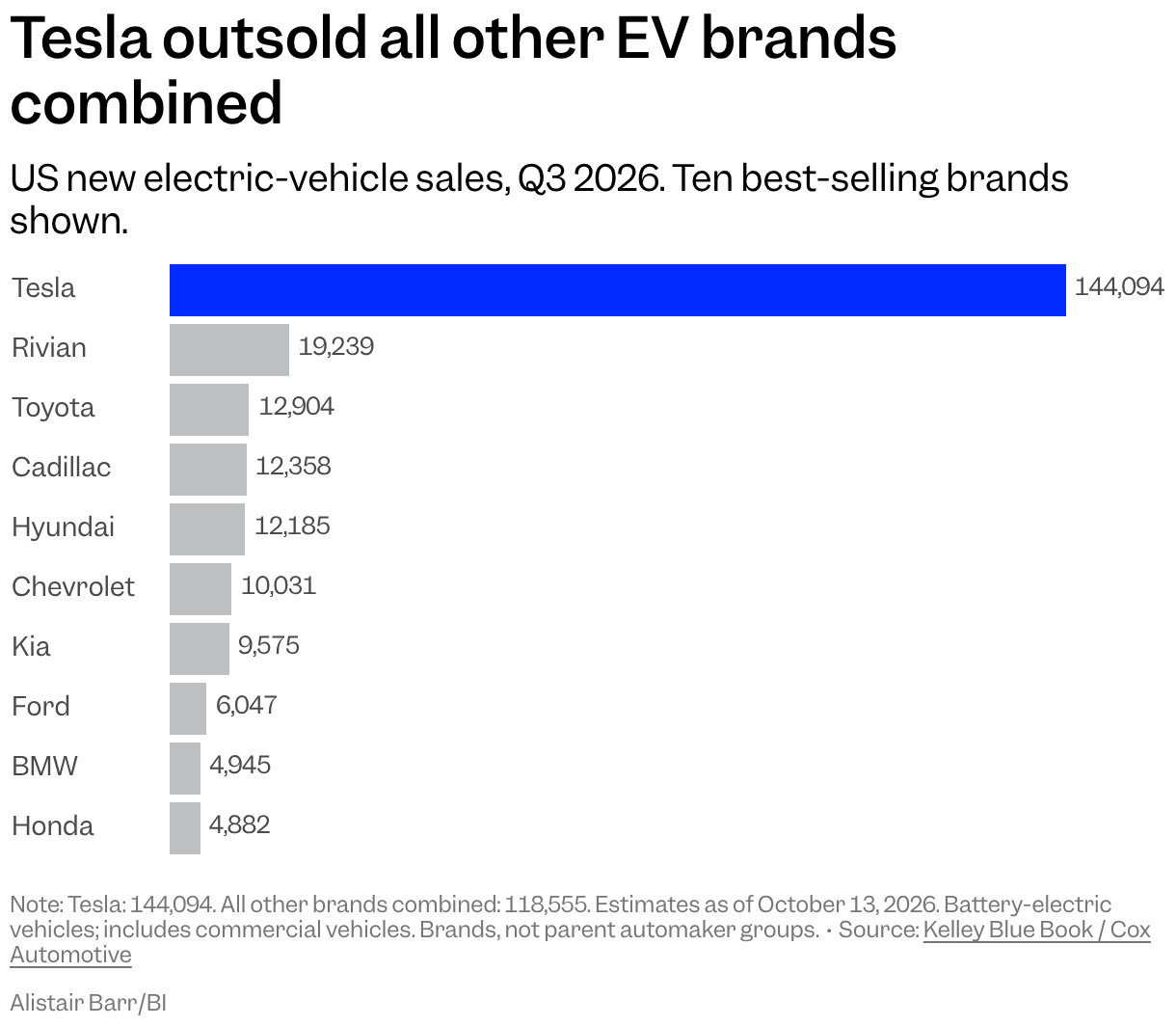
Tesla accounted for more than half of US electric-vehicle sales in the third quarter.
Its quarterly sales increase exceeded the entire market's gain, Cox estimates show.
High gas prices are helping EVs compete, though sales remain below last year's levels.
Tesla is taking a bigger slice of America's electric-vehicle market as high gas prices give drivers another reason to consider ditching the pump.
The company sold an estimated 144,094 vehicles in the US in the third quarter, up from 124,800 in the previous three months, according to Cox Automotive's latest sales report.
That increase was bigger than the gain for the rest of the US EV market. Put another way: Tesla drove the recovery. Everyone else, taken together, went backward.
The figures offer a new twist on the EV comeback I wrote about in July. Back then, sales had finally improved after the slump that followed the end of federal incentives in the US. Several manufacturers were benefiting, but only those withthe fortitude to stick with EVs after federal government support waned.
While recovery continued in the third quarter, it became more dependent on Tesla.
Americans bought 262,649 new EVs during the period, about 6% more than in the second quarter. Sales outside Tesla fell roughly 3%, based on a comparison of Cox's latest counts with its second-quarter report.
Tesla's own sales rose about 15% from the second quarter. It supplied 54% of the country's new EVs in the third quarter, extending its lead from the previous period.
High gas prices help make the case for going electric, according to Cox.
"With gas prices well above $4 a gallon, electric vehicles look better than ever," Stephanie Valdez Streaty, Cox's director of Industry Insights, said in the company's analysis of the quarter.
Expensive gasoline and diesel make running a conventional vehicle more painful. For drivers who can charge cheaply, particularly at home, an EV offers a valuable alternative to repeated trips to the pump.
There's an important caveat to the comeback story: Sales are improving from a depressed level.
Total US EV sales were down almost 40% from a year earlier. Last year's third quarter was unusually strong because buyers rushed to claim federal incentives before they disappeared.
Tesla's sales were down about 20% against that comparison. The company remains heavily dependent on two vehicles. The Model Y and Model 3 accounted for roughly 97% of its US sales in the latest quarter.
The Cybertruck sold over 4,300 units, and Tesla has stopped making the Model S and X. (There's a Roadster, though not until 2028).
So Tesla's growing dominance isn't a story of every model flying out of showrooms, or of selling more cars than a year ago.
For now, it is winning a larger share of a smaller market. As Americans return to EV shopping, Tesla is capturing more of their business.
During SpaceX's Tuesday earnings call, Elon Musk said both of the companies had created "special committees of independent directors" to discuss a potential merger.
Musk, who helms both companies and owns billions of dollars in stock of each, said he can't be part of those exploratory groups.
"Do I think it would be a good idea? Yes," he said on the call. "But at the end of the day, the shareholders have to be supportive of this, and particularly on the Tesla side, we will need a 50% vote of all shares, not just those who vote, but of all shareholders."
He said clearing that bar would be "quite a high hurdle."
It's the most detailed update investors have received yet on the idea of a tie-up, which has been the subject of much chatter since SpaceX went public earlier this year. If the companies ultimately decide to merge, it would further consolidate Musk's business empire, often referred to as Musk Inc.
His businesses have been on a consolidation kick. In 2025, xAI acquired Musk's social media company, X (formerly Twitter), and in February, SpaceX acquired xAI.
Musk also runs the brain-chip startup, Neuralink, and the tunnel-building firm The Boring Company. Both operate independently, but have had business collaborations within Musk Inc.
Tesla and SpaceX's stocks were up in after-hours trading following the news. SpaceX was up around 6.6% and Tesla 1.6%.
Musk sees clear benefits in tying the knot
"I do think there's a lot of merit to combining the companies as we are pretty much in the superintelligence singularity," Musk said during the call.
The most recent result of that partnership: On Thursday, Tesla demoed its long-awaited Roadster, which includes a version with SpaceX technology. The high-powered sports car's top trim will include cold-gas thrusters. The car launched, hovered, and flipped in the air during the demo.
While Musk is for the two companies tying the knot, he said investors shouldn't think it's a sure thing.
"I don't think we should necessarily assume that a SpaceX and Tesla merger is a certainty," he added. "That would be overstating it."
Uber is offering some drivers hundreds of dollars in incentive pay, depending on how many rides they complete in a given period.
Michael Macor/The San Francisco Chronicle via Getty Images
Uber is offering bonuses to some drivers for completing more rides or referring new drivers.
The bonuses can add up to hundreds or thousands of dollars.
Uber has used such extra pay in the past to attract drivers to the platform.
Uber is offering ride-hailing drivers something that many haven't seen in years: Big bonuses.
The ride-hailing service is coaxing some drivers to take more rides, offering up to several hundred dollars in "incentive" pay if they complete a set number of rides within a set time period, according to several screenshots of the offers seen by Business Insider.
In one example, a driver was offered $525 if the driver completed 45 trips within a few days. Similar offers involved smaller payouts and fewer trips, but paid out proportional amounts of $10 to $12 per trip.
That's a huge pay bump for many drivers, who make as little as a few dollars per trip, said Sergio Avedian, an Uber driver and senior contributor to the gig-driver-advocacy blog and YouTube channel The Rideshare Guy.
The bonuses might also be Uber's attempt to get more drivers on the road to meet rider demand during busy periods like Halloween and the holiday travel season, Avedian said.
"This may tell the story that they need supply," he said. "They're saying that we need to get everybody out there."
Some drivers have also gotten messages from Uber encouraging them to refer friends to sign up as drivers or get those who haven't driven in a couple of years back on the app, according to screenshots seen by Business Insider. Payment for those referrals can reach up to $1,225.
The payments are a potential boon to Uber drivers, whose pay can vary significantly between cities.
Uber drivers have to cover their own costs, such as car maintenance, since they are independent contractors, not full-time employees. Rising gas prices have eaten into drivers' pay after the US and Israel started a war with Iran earlier this year.
An Uber spokesperson did not provide details on why the company is offering the payments.
Uber has used targeted incentive payments before.
In 2021, demand for rides began to outpace the number of available drivers after many had stopped driving during the pandemic.
In response, the company decided "to invest fast and to invest aggressively in attracting drivers back to Uber" and increased the number of active drivers on the app by 65% between January and November that year, CEO Dara Khosrowshahi said on an earnings call at the time. Uber later pulled back on the extra pay.
"When we were coming out of the pandemic, they were short tons of drivers," said Avedian, who was driving for Uber at the time. "It was crazy bonuses out there."
More recently, riders have been paying more per mile and waiting longer for their rides to show up, according to a study published last month.
Do you have a story idea about Uber? Contact this reporter at abitter@businessinsider.com or via encrypted messaging app Signal at 808-854-4501. Use a personal email address, a nonwork WiFi network, and a nonwork device; here's our guide to sharing information securely.
United Airlines CEO Scott Kirby backed national wealth and inheritance taxes in an interview published Sunday, arguing they would help level the playing field for Americans. Kirby told The New York Times that wealth inequality “has become a danger to our society,” adding the federal government must “address” it. “We should have a national wealth…
United Airlines CEO Scott Kirby backed national wealth and inheritance taxes in an interview published Sunday, arguing they would help level the playing field for Americans. Kirby told The New York Times that wealth inequality “has become a danger to our society,” adding the federal government must “address” it. “We should have a national wealth…
Buyers can't keep scooping up the Toyota RAV4. Is it worth the hype?
Ben Shimkus/Business Insider
Want to buy a RAV4? Good luck finding one!
I drove the longtime favorite vehicle for a week. It's boringly good — and that's a huge compliment.
Toyota is ramping up its electric powertrains. The new RAV4 is the next great example.
Think of that awkward highway moment: You've accidentally cut someone off or made an obvious driving mistake. You wish you could sink into automotive oblivion before the other driver gets a good look at you.
The crossover SUV is good at nearly everything — efficient, comfortable, reasonably priced, and backed by Toyota's reputation for reliability — while wrapped in a package that looks like pretty much every other grocery getter on the road.
The Toyota RAV4's very conventional-looking side profile.
Ben Shimkus
I spent a week and about 200 miles in a 2026 RAV4 Limited AWD, driving through New York City and the Catskills region. The fully-loaded tester stickered at $46,883.
I found the RAV4 to be aggressively competent. Its performance won't get your adrenaline pumping, and its looks won't turn many heads. Instead, it'll get occupants comfortably from point A to point B while barely sipping fuel.
And consumers can't get enough of that.
RAV4 gets a facelift — and some fresh electric motivation
Toyota's RAV4 has some Prius in its soul — and those are some words of endearment.
Ben Shimkus/Business Insider
The RAV4, America's third-best-selling vehicle last year, is fresh out of the design studio.
It's the sixth generation of the SUV: Unlike its curvier predecessors, it's squared off and upright. The front and rear are nearly perpendicular to the ground and are finished off with LED head and taillights.
The more consequential change is under the hood.
For 2026, Toyota killed the gas-only RAV4. Every version now comes with a battery in the powertrain; the only remaining choice for RAV4 hopefuls is between a conventional hybrid and a pricier plug-in hybrid.
The RAV4's liftgate gets a more modern, squared-off look for 2026.
Ben Shimkus/Business Insider
That puts one of America's most popular vehicles squarely behind the hybrid strategy Toyota has spent years defending.
While rivals poured billions into all-electric lineups, Toyota kept betting that hybrids — which combine a gas engine with electric motors and a small battery that recharges as you drive — would be easier for mainstream buyers to adopt.
The RAV4 isn't Toyota's first bestseller going hybrid-only. The Camry sedan made the switch for 2025, and the Sienna minivan has been hybrid-only since 2021.
RAV4 is the most consequential expression of that hybrid bet. And the execution hits the nail on the head.
The base model is roughly $32,000 — similar to gas-powered competitors like the Honda CR-V or the Nissan Rogue.
Gas mileage is exceptional. During my test, I averaged 47 mpg, and saw 50-plus mpg on some shorter trips.
There are trade-offs. The RAV4 feels sprightly off the line, but ask for more power at highway speeds, and the gas engine starts working noticeably harder. The steering is vague, the engine can drone, and the transition between electric and gas power is still more obvious than I'd like.
Still, Toyota gets the boring stuff right. The RAV4 gets a smartly layered front-seat organization system, a clean gauge cluster, and easy-to-understand digital climate controls.
Toyota gets the small stuff right, including the RAV4's handsome interior.
Ben Shimkus/Business Insider
Buyers who want something faster, flashier, or fully electric have plenty of other options — including elsewhere in Toyota's own showroom. My Limited tester also proved you don't need to spend nearly $47,000 to get what makes the RAV4 appealing (the heads-up display, for example, really wasn't necessary).
The RAV4's trick is simpler: It doesn't require any major life changes from its owner. Shoppers don't have to install a charger, rethink a road trip, or learn a radically different car. They can just drive it — and, in my case, get 47 mpg.
Wow, it's popular
The RAV4 is comfy, efficient, and a Toyota. So, everyone wants it.
Ben Shimkus/Business Insider
That success does create a problem: Buyers can't get enough of the RAV4, especially as high gas prices add to already-strong hybrid demand.
Right now, a new RAV4 spends an average of just 17 days on a dealership lot, per CarGurus data shared with Business Insider. The industry average is above 70 days.
Kevin Roberts, director of economic and market intelligence at CarGurus, said the situation reminds him of the chip shortage era, when limited inventory sent shoppers hunting through dealership lots and helped push car prices higher.
"We're way out of the chip shortage now, so it's a really kind of unique environment," he said.
That scarcity is creating another oddity. CarGurus found that average used prices for 2026 RAV4s were actually running above the starting prices of equivalent new trims. Even 2025 RAV4s were retaining about 99% of that value.
His advice for shoppers: "Dust off some of the chip shortage playbook" by expanding their search radius, being flexible about options, or ordering a vehicle if they aren't in a rush.
Working remotely on an Amtrak train wasn't easy, but I would do it again.
Laura Gio Carroll
This summer, I took a four-day Amtrak trip with my spouse, and worked remotely the entire journey.
I loved working in the café car while taking in views of the Mississippi River and the Great Plains.
Even though the internet wasn't reliable, it was a great experience that I can't wait to do again.
This summer, my spouse and I decided to take the longest Amtrak trip we've ever taken — three trains from Washington, DC, to Vancouver over four days.
My partner, who is a teacher, had a break between the school year and the summer program, so this adventure was the perfect excuse to relax, disconnect from the world, and enjoy the train's views. That was, unfortunately, not the case for me.
Since I have an office job with limited vacation time, I decided I would work remotely throughout the entire trip. Even though I had my boss's permission to work on the train and had packed all my essentials, I still wondered how successful this endeavor would be.
Turns out, it was more challenging than I anticipated, but still worth the hassle.
I made sure to prepare for any WiFi outages and pack accordingly.
Laura Gio Carroll
Before the trip, I researched whether the trains would have WiFi, but found that it could vary by route.
Since I wasn't sure how reliable my internet options would be on board, I made sure to download the most important documents onto my computer instead of just relying on the cloud. This way, even if there was an unstable connection, I'd still be able to access them.
Additionally, I made sure to have my phone's hotspot at the ready for whenever there wasn't WiFi on the train.
And just as an extra precaution, I made a point of scheduling any important calls for either before or after our train rides, so that I wouldn't risk losing signal while speaking with my team.
To prevent any other hiccups, I packed everything I could think of that I might need: my work laptop, my portable monitor, all the appropriate cords and chargers, and my planner for anything I needed to do on paper.
The roomette's privacy was great, but it didn't have enough outlets.
Laura Gio Carroll
On two of our three train rides, we booked a roomette, a small bedroom with two seats facing each other that would convert into bunks at night.
The internet was spotty in there, but I was still able to wrap up the last emails of the day without any problems.
On the first train ride from DC to Chicago, the roomette had two power outlets, but on our journey from Chicago to Seattle, it had only one — forcing my spouse and me to take turns charging our devices.
I loved working in the café car.
Laura Gio Carroll
Sometimes, the roomette felt pretty cramped, so I took my work setup to the café car as often as I could.
Not only was there plenty of room for me to spread out with my laptop and second screen, but I could also witness amazing views — like the Mississippi River or the Great Plains — from the window.
However, since there weren't any power outlets in the café car, I was only able to be productive for as long as my computer and phone batteries lasted, which was about 2 hours. Then, once everything had run out of power, I had to return to the roomette and plug everything in, which disrupted my workflow.
I didn't think about how my hotspot wouldn't be reliable in rural areas.
Laura Gio Carroll
Since there was only stable WiFi on one of our three trains, I was relying heavily on my hotspot for most of the trip. But by the third day, the cellular signal kept getting spotty as we entered more rural areas of the country, making my hotspot less reliable.
Because of the weak connection, I couldn't access my team's folders, so I had to email my boss a report instead of uploading it to SharePoint.
I panicked a little, since we're not supposed to save documents directly to our computers, but this was my only option without a consistent signal.
When we sat in coach, I could barely get any work done.
Laura Gio Carroll
For the last leg of our trip from Seattle to Vancouver, we sat in coach instead of reserving a roomette.
We were able to sit at a small table, but it was too cramped to take out my laptop, and there wasn't any space to work in my seat either. This was the only portion of the trip where it was impossible to do any work, and it really made me miss my roomette.
Even though working on the train was challenging, the station lounges were perfect.
Laura Gio Carroll
Whenever we had train delays, I would work at the Amtrak stations, which were great places to be productive.
The station in DC had a place to stash our suitcases, decent WiFi, and various tables and chairs. The one in Chicago was also a great size, was well-lit, and had a strong internet connection and plenty of seating.
Similarly, the upper level of the Amtrak station in Seattle had a small art gallery and sitting area — a perfectly comfortable space for me to do my job.
It wasn't the easiest way to work, but I'd do it again.
Laura Gio Carroll
Although working on these trains wasn't always smooth, I still had a great experience and would definitely love to do it again.
Next time, though, I would pack a power bank to charge my phone and monitor without needing an outlet, and overprepare for a lack of WiFi.
Overall, even though working remotely on Amtrak trains had its challenges, I loved the stunning views and the chance to see new sights rather than just sitting at my desk.
Business Insider reached out to Amtrak for comment.
Matthew Guerrero drives for Uber in Southern California.
Matthew Guerrero
Matthew Guerrero says gas costs eat up much of his pay as an Uber driver in Southern California.
He prioritizes giving rides to weekend barhoppers who tend to tip well, he said.
Uber says that one driver's experience isn't representative of the broader platform.
This as-told-to essay is based on a conversation with Matthew Guerrero, a 41-year-old Uber driver in Southern California. It has been edited for length and clarity.
I've been seeking a workers' comp settlement that should be settled soon. In the meantime, my lawyer said that I could start working again. I needed a job really quickly, especially with three kids, so I started driving with Uber.
I've been driving with Uber for about five weeks. So far, it hasn't been very successful. For example, one week, I made $600 working 30 hours. To make that, I spent about $300 in gas driving my SUV.
Then, I have to put between 20% and 30% of what's left aside for taxes. That comes out to about $210 for 30 hours of work. That doesn't even include wear and tear on my car. I don't understand how anybody can do this long-term. It's not sustainable.
The pay is better if you drive in Los Angeles or San Diego. But I'm in Riverside County, and the pay seems to be lower here.
To get better-paying rides, you have to be strategic. Sometimes, I try to get a ride with a passenger who's headed to an airport in one of the big cities. Then, I stay there all day and take rides. That's not always feasible, though.
When I started with Uber, I realized that there were a lot of rides that involved taking people to morning doctor's appointments. Most of those people didn't tip well, though, and tips are key to making money.
Instead, I like to work Friday and Saturday nights around bars in Temecula. I usually log on around 4 pm and head home around 3 am. The pay is good, and the tips are a lot better than other rides in my area. Sometimes you have to deal with drunk people throwing up, but it's worth it.
I've given some rides to veteran Uber drivers — people who were working on the app back in 2015 and 2016. They said that they used to make better money than I do, and that they quit after they saw pay fall.
That was eye-opening for me. I don't understand how a company like Uber can pay as little as they do.
An Uber spokesperson said drivers in Riverside County, California make "at least $20.28 per engaged hour, plus $0.37 per engaged mile for vehicle expenses, with tips on top of that."
"While this guarantee doesn't cover time spent waiting for trips, it's important context when discussing driver compensation," the spokesperson said. Driver earnings can vary based on when drivers decide to work, where they drive, and rider demand.
"One driver's experience isn't representative of the broader platform," the spokesperson said.
Do you have a story idea about Uber? Contact this reporter at abitter@businessinsider.com or via encrypted messaging app Signal at 808-854-4501. Use a personal email address, a nonwork WiFi network, and a nonwork device; here's our guide to sharing information securely.
The United States Department of Transportation (DOT) lifted, effective immediately this Friday, the measures that had restricted Mexican airlines from establishing new flights to the U.S. from Felipe Ángeles International Airport (AIFA) and Benito Juárez International Airport in Mexico City (AICM).
In a joint statement, the Secretariat of Foreign Affairs (SRE) and the Secretariat of Infrastructure, Communications and Transportation (SICT) reported that the decision was reached through coordinated efforts between the governments of Mexico and the United States, as well as progress made in fulfilling bilateral aviation commitments.
The measure revokes Order 213-2, through which the DOT had restricted existing, proposed, and future operations by Mexican carriers. According to the Mexican government agencies, this resolution represents a step forward for air connectivity between the two countries and reopens the possibility of developing routes and flight frequencies from the AICM and AIFA to the U.S. market.
The Government of Mexico attributed this outcome to a process of dialogue and technical cooperation, which was strengthened following a Memorandum of Consultations signed in May 2026. “Since then, Mexico has made progress on the agreed-upon commitments,” the statement noted.
Mexican airlines can expand service to US cities after Washington lifted restrictions that blocked new routes from Mexico City’s two biggest airports https://t.co/Dvkt3zBGp3
The SRE and SICT indicated that the lifting of these restrictions reflects the desire of both administrations to move toward a new phase in the bilateral aviation relationship—one grounded in dialogue, respect for sovereignty, institutional cooperation, and the application of international standards.
The restriction had been announced on October 28, 2025, by the then-Secretary of Transportation, Sean Duffy, and affected Aeroméxico, Volaris, and Viva Aerobus. Washington accused Mexico of failing to comply with the bilateral air transport agreement and of favoring domestic carriers in the allocation of flight slots.
The dispute stemmed from a decree that shifted cargo flights from AICM to AIFA. At the time, President Claudia Sheinbaum maintained that the relocation was a technical decision, not a political one.
Mexico pledged to continue working with U.S. authorities to create greater opportunities for passengers, workers, and airlines, as well as to consolidate an aviation system that is safe, competitive, modern, and reliable.
Mexican President Claudia Sheinbaum inaugurated a new campus of the National Rosario Castellanos University in Nicolás Romero, State of Mexico, on Sunday, as her government pushes to expand access to public higher education. The campus will open with 800 students, half attending… pic.twitter.com/RlLWCV54xR
The Roadster's price is likely at least $250,000. Musk said it will be Tesla's only vehicle that humans drive themselves.
Tesla
Want to physically drive a Tesla in the future? The Roadster will be your only option, Musk said.
The car is not cheap.
Musk has compared today's driving to elevator operators.
Want to physically drive a Tesla in the future? Get ready to pay up.
On Thursday, Tesla CEO Elon Musk unveiled the new Roadster with a gravity-defying demo. The car suctioned to the side of a vertical ramp, drove upside down, briefly flew, stuck the landing, and later bunny-hopped and twirled over a standing lineup of other Tesla vehicles.
The stunts were choreographed with autonomy, Musk said — but Roadster owners will eventually be able to manually take the wheel. That will make it unique in Tesla's lineup.
"This will actually be, long-term, the only manually driven car that Tesla makes," Musk said on stage, before Tesla's lead engineer, Lars Moravy, added, "You gotta have some fun sometimes."
Tesla hasn't revealed the car's final price, but we know it'll firmly be in the luxury supercar tier. The company's reservation queue asks customers who want the base Performance trim to fork over a $50,000, due within 10 days. That reservation, alone, is nearly the price of an average car in America, and it doesn't capture the car's final price. Our best pricing ballpark dates back to 2017, when Tesla first said it was bringing back the Roadster. At the time, the automaker collected $250,000 payments from people who wanted a Founder Series model.
Meanwhile, Tesla has been ramping up its autonomy push for its more price-conscious vehicles.
In September, it started rolling out the Cybercab — a vehicle that leans so heavily into self-driving that it has no steering wheel, brake pedals, or side mirrors. Tesla says it wants to eventually sell those cars to consumers at less than $30,000 apiece.
On recent earnings calls, Musk has also praised the recurring revenue from subscriptions of Full Self-Driving (Supervised) from Cybertruck, Model Y, and Model 3 owners.
Musk has talked a lot about a world where driving becomes obsolete. He has compared driving a car to operating an elevator, a profession that was largely phased out in the mid-20th century as elevators became automated.
"Now, you just get in, press a button and a modern elevator, if inspected regularly, is extremely safe," he wrote on X in March.
Treating driving like elevator operation requires a pretty big leap. Driving is still a hobby, a sport, and — for many people — a point of pride. By Moravy's own admission, driving is fun.
There's still a chance in Musk's vision of his carmaker's future that drivers can control their own Tesla and lean into that fun. They'll just need to open their checkbooks.
Elon Musk unveiled Tesla's flying, thrust-powered Roadster with a jaw-dropping demo.
Tesla fans about to shell out as much as $250,000 to reserve it should probably read the fine print.
Tesla said it can't guarantee the Roadster will be delivered, and it's unclear if the rocket-powered version is street-legal.
Where Tesla's going, you might not need roads — but you still need to read the terms and conditions.
Tesla's thruster-powered, midair flip-kicking, flying supercar was a wow moment even by the standards of the company's famously off-the-rails product unveilings.
But Tesla fans lining up to pay as much as $250,000 to reserve the new Roadster, which can do 0-60 mph in under a second thanks to a system of cold-gas thrusters, should probably take a close look at the fine print.
Tesla's Roadster executes a gravity-defying flip.
Tesla
The company's T&Cs make it clear that the final price of the bleeding-edge EV — which comes in Performance, Thrust, and Rocket variants —has yet to be determined and state that there are no guarantees the Roadster will ever be delivered.
Meanwhile, it is unclear whether the two thruster-powered versions of the Roadster will actually be road-legal.
After combing through the Roadster's reservation agreement and Musk's comments at its unveiling, here's what you should know before splashing out on Tesla's most outlandish vehicle yet.
1. It's not clear where you can actually drive it
As the dust cleared on the jaw-dropping Roadster showcase, one key question remained unanswered: where exactly will you be able to drive it?
At the event, Musk said the cold air thruster-powered flying Roadster would be an actual "car that someone can own," not just a one-off concept demonstration.
But the Tesla CEO added that he was "not sure it's necessarily legal in all jurisdictions," and when an audience member asked if it would be street-legal, Musk was vague.
Elon Musk said the Roadster would enter production in 2028.
Tesla
"Depends on your street. But it'll be a viable car," the billionaire said.
The flying Rocket variant shown in the demo is invite-only. It's listed on Tesla's website with the caveat that it is "not approved for public road use."
The gravity-defying stunts, flips, and barrel rolls shown off at Thursday's unveiling were performed without a driver in the car for safety reasons, and Musk described the vehicle as "not necessarily a safety-optimized car."
One thing that has been clarified is whether the Roadster's airborne capabilities make it an aircraft: "The Tesla vehicle does not meet the FAA's definition of an aircraft," a Federal Aviation Administration spokesperson told Business Insider.
By contrast, Tesla describes the Performance variant — which costs $50,000 to reserve — as "road ready" with its fan-suction system providing "next-level performance on and off the track." That suggests the goal is for the base version of the Roadster, at least, to be road-legal.
The limited-edition Thrust variant, meanwhile, is described as "race ready," implying that this version might be exclusively for driving on race tracks. That would not be unusual for a high-end hypercar, with Ferrari, Pagani, and Bugatti all selling track-only supercars that don't adhere to normal vehicle regulations.
2. It could cost more than you signed up for
Shelling out up to $250,000 for a Roadster reservation by no means guarantees that you will get one at that price.
According to the terms and conditions of Tesla's Roadster reservation agreement, the fees for the Performance and Thrust variants are only an estimate, as the company is still "working on what options, features and hardware the vehicle will have."
Tesla unveiled a less science-fiction version of the next-generation Roadster in 2017.
Tesla
The final purchase price will be confirmed closer to the start of production, the document said, with the (fully refundable) reservation payment going toward the actual cost of the car.
3. Delivery is not guaranteed
The T&Cs also advise reservation holders that the Roadster is still "under development" and Tesla "cannot guarantee when your vehicle will actually be delivered or if it will be delivered."
This will likely bring back bad memories for Tesla fans who paid $50,000 to reserve the next-generation Roadster when it was first unveiled in 2017.
That version of the Roadster, a more conventional supercar that could still hit 0-60 mph in 1.9 seconds, languished in development for years and ultimately never entered production.
The delay caused some long-suffering reservation holders like Musk's arch-rival, Sam Altman, and tech YouTuber Marques Brownlee, to cancel their orders in frustration after waiting nearly a decade for a car that never arrived.
Tesla fans will be hoping that history doesn't repeat itself.
Editor's note: October 16, 2026 — This story was updated to include a comment from the FAA.
Elon Musk may have been years late on his Roadster deadline, but the tech Tesla showed off was just as described eight years ago.
Win McNamee/Getty Images
Musk described his plans for the Tesla Roadster during a 2019 exchange with YouTuber MKBHD.
On Thursday, the Roadster did exactly as Musk promised nearly eight years ago, leaping into the air.
While Musk missed his own deadline by years, the technology on display was just as he described it.
It's been a long time coming.
Almost eight years ago, in January 2019, Elon Musk shared plans on Twitter for Tesla's Roadster to lift off using cold-gas thrusters and ultra-high-pressure air. On Thursday, the much-anticipated Roadster did exactly that.
Musk's 2019 assertion came in response to a user sharing a GIF of the DeLorean from "Back to the Future" hovering in midair.
"The new Roadster will actually do something like this," he wrote. Tech YouTuber Marques Brownlee responded: "The thing is I feel like you’re not joking."
"I'm not," Musk said.
I’m not. Will use SpaceX cold gas thruster system with ultra high pressure air in a composite over-wrapped pressure vessel in place of the 2 rear seats.
He then described a SpaceX-made cold-gas thruster system that uses high-pressure air stored in a composite pressure vessel.
At a SpaceX test site in Texas on Thursday, almost 8 years later, a Roadster climbed a curved ramp, dropped, rolled through the air and landed on its wheels. It used the same basic technology: cold-gas thrusters fed by high-pressure air stored in composite pressure vessels.
The 2019 exchange was not Musk’s first mention of thrusters. In June 2018, he said the Roadster would include roughly 10 of them and suggested they might allow the car to fly.
Using the config you describe, plus an electric pump to replenish air in COPV, when car power draw drops below max pack power output, makes sense. But we are going to go a lot further.
When another user proposed compressed-air cold-gas thrusters, Musk said that configuration made sense and described a pump to replenish the air.
Musk's account of the technology has proved more consistent than his production timetable. Tesla unveiled plans for the second-generation Roadster in 2017 and originally targeted production for 2020. After repeated delays, Musk said in the reveal that production will begin in 2028.
The Roadster is not Tesla’s only vehicle to miss an ambitious release target. When Musk unveiled the Cybertruck in 2019, he said Tesla expected production to begin in late 2021. The first customer deliveries took place two years later, in November 2023.
While Musk has missed plenty of deadlines, many of his more improbable technology plans have made it beyond the drawing board. In December 2020, he said SpaceX would try to catch a returning Super Heavy booster with its launch tower.
We’re going to try to catch the Super Heavy Booster with the launch tower arm, using the grid fins to take the load
Starlux first flew in January 2020 and bills itself as a "boutique" international airline that operates nonstop flights from Taipei to several US cities, including Los Angeles, San Francisco, and Seattle.
My flight was on an Airbus A350-900 from Taipei to San Francisco, a nearly 12-hour overnight flight. It was the second leg of a trip that started in Kuala Lumpur, and the entire itinerary cost 85,000 Alaska Airlines miles.
The Starlux business class seat.
Zach Benitez
The cash fare on this route ranges from $2,600 to over $5,000, depending on the season, so the points redemption — Alaska is a Starlux partner — was a very good deal. And the experience blew me away.
The whole idea from the beginning was to build a luxury airline from nothing with meticulous attention to detail and an emphasis on the small stuff.
After flying Starlux, those minor details made all the difference. Here's what my flight was like and why I'd easily book again.
The seat felt like a private suite
Every seat in Starlux's business class opens straight into the aisle, and every one has a sliding door. The cabin is decorated with faux marble finishes and shiny black panels. It honestly looks more like a boutique hotel lobby than the inside a plane.
One of the cubbies stored a remote and headphones.
Zach Benitez
This extreme attention to detail is what sold me most.
My favorite example: there's a little gap under the storage cabinet door, so you can leave a charging cable running out of it with the door closed. Exploring the seat illuminated several thoughtful design choices. The pod felt deliberate in a way some brand-new airline seats just aren't.
Some people call business class doors a gimmick, mostly because they don't go all the way up. I loved mine anyway. Once the seat was flat and the door was shut, it felt like my own little room, further emphasized by the warm mood lighting, pristine leather accents, and large seat walls.
My little pod for 12 hours.
Zach Benitez
A flight attendant handed me pajamas before we'd even pushed back, so I changed right away.
After dinner, the crew made up my bed with a thick mattress pad and one of the softest blankets I've ever been given on a plane.
The lie-flat bed was comfortable despite the narrow footwell.
Zach Benitez
The footwell angles inward slightly, which makes it feel a bit tight when you're lying flat, but I slept well regardless. On an overnight flight this long, that's what matters most.
It started with warm, fluffy garlic bread, which felt out of place alongside the Asian meal, but I was thrilled to see it. When the flight attendant came to clear my appetizer, she asked if I'd like more bread, to which I obviously said yes.
The food was the best part of the flight.
Zach Benitez
Then a creamy miso mushroom soup showed up, and I'm not exaggerating when I say it's one of the best things I've eaten on a plane. It was rich and savory, the kind of thing I can still taste if I think about it today.
The main was beef with fried rice, which was flavorful and cooked to perfection.
The beef dish on Starlux.
Zach Benitez
Dessert was Italian gelato that was actually soft enough to eat straight away, which basically never happens with ice cream at 38,000 feet.
Breakfast before landing: waffles with figs were also notable. One of the few airline breakfasts I'd happily order again.
The waffle and fig dish on Starlux.
Zach Benitez
All of the food served looked as good as it tasted. Every course was properly plated, the flight attendant talked me through each dish, and she reset my table between courses without me noticing.
The crew truly elevated the experience
Starlux isn't perfect, and the first 20 minutes of my flight proved it. Pre-flight service felt as if the crew was simply going through the motions rather than trying to create a good experience.
But when the meal service started, it was like a switch flipped.
One flight attendant greeted me by name and knelt down next to my seat to take my order. At one point, my seatbelt locked up while I was reaching for my amenity kit; she saw it happen and handed me the kit before I'd said a word.
The amenity kit bag is reusable.
Zach Benitez
My main course came out a few minutes late, and she apologized profusely for it, which she really didn't need to do, but it tells you what standard this crew holds itself to.
By the time dinner was over, even the crew members who'd seemed checked out at first were warm and attentive. When I woke up and asked for tea, it was there almost immediately, with lemon and sugar on the side.
I love how fun Starlux is
The other thing I love about Starlux is that it doesn't take itself too seriously.
There's a space theme running through the whole airline, from the Galactic Lounge in Taipei to the COSMILE loyalty program. Since 2024, it's been working with Peanuts, so Snoopy turns up on themed flights and merch.
The Starlux lounge.
Zach Benitez
On my flight, the entertainment screen displayed a Snoopy welcome for me, and I still carry my things in a Starlux Snoopy tote bag.
Even the toilet paper is custom printed with a runway design. All of these things make the airline feel like it's enjoying itself.
The bathroom as a whole was clean and stocked with care products.
Zach Benitez
Starlux got the three things that actually matter right: the seat, the food, and the crew. And it did it with a sense of fun that a lot of the big-name carriers have somehow lost along the way.
I've flown business class on dozens of airlines, including some of the world's most famous seats. If you're flying between the West Coast and Asia, I'd book Starlux.
Starlux did not respond to a request for comment from Business Insider.

 Login