One drone launched another drone, which then shot down a third. All three were unmanned, and all at sea off Ukraine.
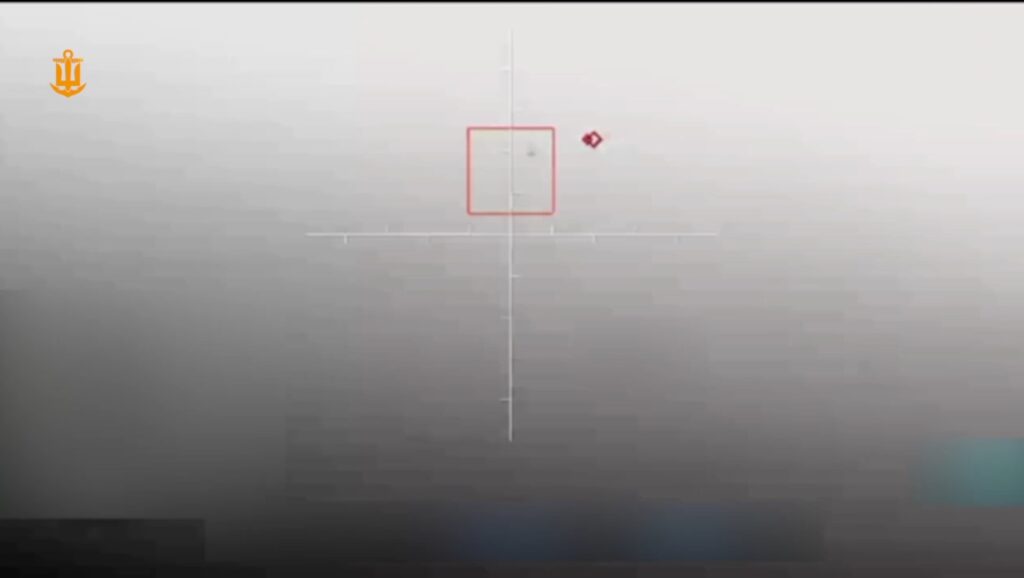
Ukraine’s Navy has destroyed a Russian Shahed attack drone with a Sting interceptor launched from the Sargan 3000 unmanned surface vessel, the Navy said, showing sailors adapting to new aerial threats with sea-launched interceptors.
Russian Shaheds threaten Ukraine’s ports, coastline and the ships that approach them, so meeting those drones out at sea, before they reach land, matters for the whole southern defense.
A Ukrainian Navy sea drone, the Sargan 3000, destroyed a Russian Shahed kamikaze drone with a Sting interceptor drone
Ukrainian troops continue to adapt to new threats to protect civilians and infrastructure Ukrainian Navy pic.twitter.com/kXvnqaebAw
The Sting is built to destroy Russian kamikaze drones such as the Shahed, Geran and Lancet, as well as reconnaissance drones, with quick deployment, a short training course and a top speed of 280 km/h, its producer, Wild Hornets, says.
The interceptor that has become Ukraine’s Shahed-killer
The Sting has earned its place at the front. The Ukrainian FPV interceptor has proven highly effective in combat, with a typical hit rate of 80 to 90% depending on the unit, and on some days reaching 100 percent, one launch for one kill.
It is currently Ukraine’s most productive Shahed interceptor, according to the Wild Hornets, having destroyed more than 3,000 drones in its first seven months of use. Mounting it on a sea platform extends that record from land into the Black Sea.
A drone boat that keeps finding new ways to kill
The Sargan 3000 has become a multi-purpose hunter. In July, Ukrainian naval personnel used a Sargan 3000 to sink a Russian second-rank border patrol ship.
In October, the same drone boat shot down a Russian Shahed with a turret-mounted machine gun over the Black Sea. Ukraine’s Navy took the Sargan 3000 into service in April 2026, and the drone boat has a combat radius of up to 1,600 kilometers, letting it clear the sky far from shore without putting a sailor in range.
Ukraine’s Navy hit six Su-34M bombers at Russia’s Borisoglebsk military airfield in Voronezh Oblast with Neptune missiles overnight into 15 October, the Navy said. Residents filmed a large fire at the base after a missile alert, and the Navy’s count has not been independently confirmed. The facility is about 400 km from the frontline.
Glide bombs are now central to how Russia’s army fights, used to pin down Ukrainian defenders, including drone teams, before small infantry groups move in. They also hit frontline cities and the civilians who live in them.
Six bombers and flight equipment hit, the Navy says
The Neptune coastal missile system also hit technical equipment that supports flights, the Navy said. It recorded secondary detonations and a fire on the airfield and said details were still being clarified.
The Su-34M can carry several guided and high-explosive aerial bombs at once, along with missiles, the Navy noted. It called the jet one of Russia’s key tools for glide-bomb strikes on Ukrainian positions and frontline towns. In September, a Ukrainian Neptune missile reached a Russian warship at its own pier.
Smoke over Borisoglebsk in Voronezh Oblast, Russia, during the fire at the town’s military airfield, 14 October 2026. Photo: Supernova+/Telegram
Fire over the airfield late on 14 October
Voronezh Oblast Governor Aleksandr Gusev declared a missile alert across the region shortly before 22:00 local time on 14 October. Within an hour, Ukrainian monitoring channel Exilenova+ reported explosions and a fire, preliminarily at the Borisoglebsk airfield. It later wrote that the airfield had come under missile attack and a fire was burning there. Ukrainian monitoring channel Supernova+ posted footage from the town showing the blaze.
On the morning of 15 October, Gusev claimed that 33 drones and several jet-powered aerial targets had been downed over the oblast overnight. He did not mention the airfield.
A base Ukraine has hit before
The airfield hosts the 783rd training aviation center and units of the 105th composite aviation division of Russia’s Aerospace Forces, which flies Su-34, Su-35S, and Su-30SM jets, Ukrainian defense outlet Militarnyi reported. In summer 2026, it had no permanently based combat jets, and Russia used it mainly as a stopover to refuel and rearm aircraft striking Ukraine, the outlet said, citing satellite observation.
Ukrainian drones hit the airfield overnight on 8 July, starting a fire, and satellite images later showed its fuel and lubricants depot destroyed. Drones also attacked the base’s pilot training center in July 2025.
The same night, Ryazan Oblast Governor Pavel Malkov reported a fire at an oil refinery in Ryazan. It came as Ukrainian President Volodymyr Zelenskyy said Ukraine was resuming strikes on Russian refineries.
Update: Satellite imagery confirms the strike
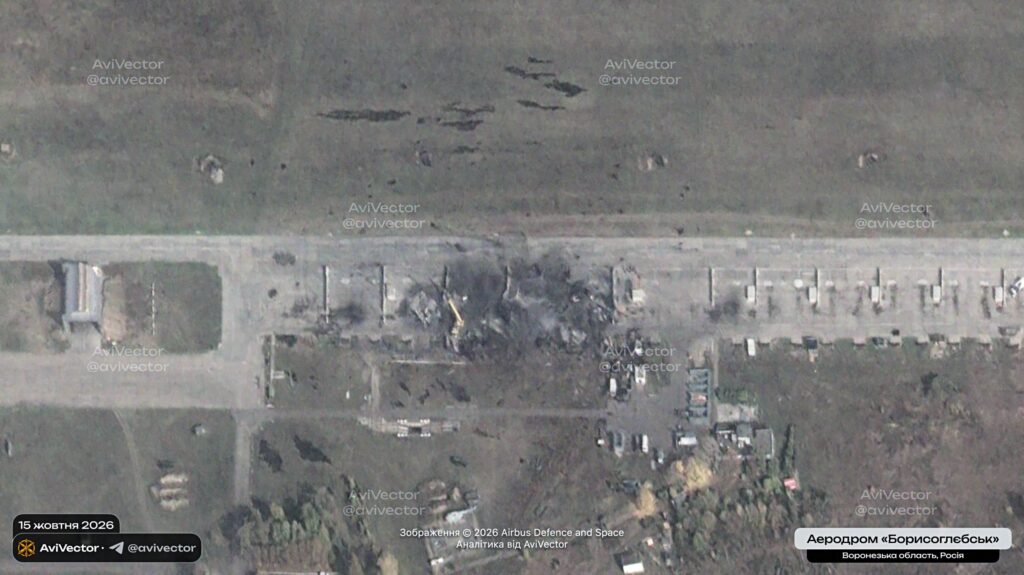
New satellite images show damage at Borisoglebsk airbase and six Su-34 bombers positioned in the affected area two days earlier, although the extent of the aircraft losses remains unconfirmed.
Satellite image shows the aftermath of Ukraine's strike on Borisoglebsk airbase in Russia's Voronezh Oblast on 15 October 2026. Image: Airbus Defence and Space / AviVector.Satellite image from 13 October shows six Russian Su-34 fighter-bombers parked in the area later struck at Borisoglebsk airbase. Image: Exilenova+.
The monitoring channel Exilenova+ reports that 4 airframes were completely destroyed, while 2 others sustained significant damage.
A Ukrainian Sargan-3000 sea drone shot down a Russian Shahed flying on a mesh radio network, Ukraine's Navy reported on 7 October. Ukrainian sea drones have downed Russian aircraft before, but with missiles. This one used a machine gun.
Russia has been hitting Odesa with air attacks that come in waves with short gaps between them. Guarding the sky over water is harder than over land. Since fall 2025, Russia has also used mesh radio networks to reroute Shaheds mid-flight and dodge Ukrainian air defenses. That leaves Ukraine needing more ways to meet these drones out at sea, before they reach its ports and coast.
A Shahed steered by radio
A mesh-network drone passes its control signals along a chain of radio relays, drone to drone and on to ground antennas. That lets a Russian operator steer it in flight.
In May, Serhii "Flash" Beskrestnov, then a Defense Ministry adviser, said only about 5% of Shaheds had got through in a recent Russian strike, and predicted that Russia would answer with jet-powered versions and strikes near the border. By July, Ukraine was testing jamming against mesh-controlled jet Shaheds, he said.
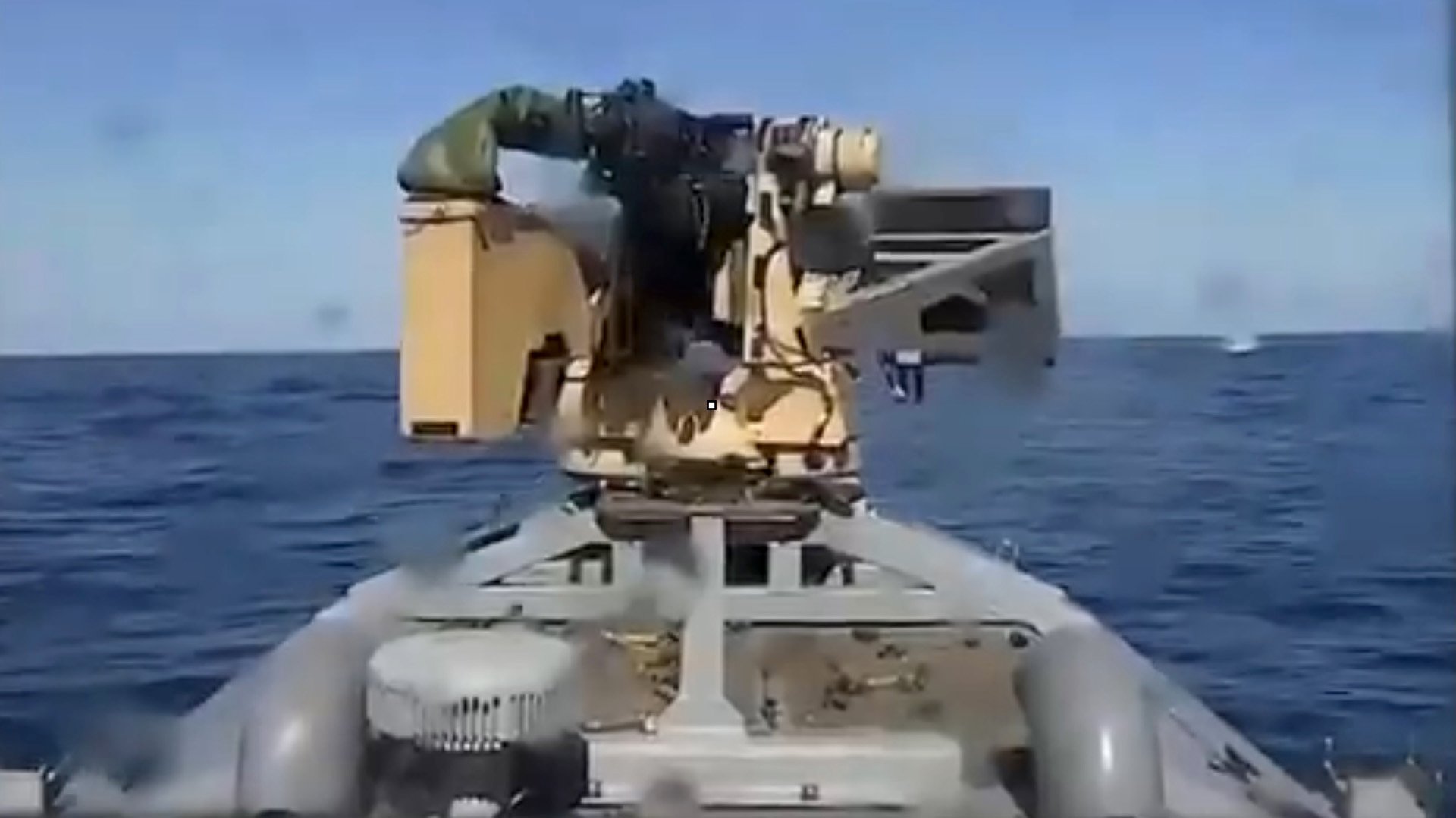
Protector RWS turret on the Ukrainian Sargan-3000 naval drone, October 2026. Screenshot from a video by the Ukrainian Navy
The Sargan-3000 fired its Protector remote weapon station, Militarnyi reported. The station is a remotely operated 12.7-mm (50-caliber) machine gun with electro-optical sights. The outlet added that the Sargan-3000 is designed for combat missions far from Ukraine's coast.
Built for the open sea
Ukraine's Navy took the Sargan-3000 into service in April 2026, according to Militarnyi. The drone boat has a combat radius of up to 1,600 km. It moves at 40–55 knots and carries up to 450 kg of payload.
In September, a Sargan-3000 sank a Russian uncrewed boat with machine-gun fire. Militarnyi called it the first battle between uncrewed sea platforms in history. Analyst H.I. Sutton wrote that the boat carried a Protector made by Norway's Kongsberg. That is the same weapon station named in the October shootdown. Sutton added that Russian attack sea drones work closely with Shaheds, which can relay the boats' mesh radio signals.
The Ukrainian Navy is claiming one of its uncrewed surface vessels (USV) sank a Russian USV, marking the first time one of these weapons, also known as drone boats, destroyed another. The engagement is the latest iteration in the use of combat drone boats, which Ukraine has employed to devastating effect against Russia’s Black Sea Fleet vessels and facilities, forcing the general evacuation of Russian naval assets from occupied Crimea to bases in Russia proper. The use of weaponized USVs is now proliferating around the globe at an increasing rate.
The incident took place somewhere in the Black Sea, said the Ukrainian Navy, which provided no details about when it happened or exactly where. TWZ cannot independently verify this claim; however, we cannot find any evidence of a drone boat killing another drone boat in the past.
“Units of the Main Intelligence Directorate (GUR) detected the target,” the Ukrainian Navy stated on Telegram. “The Ukrainian Navy’s ‘Sargan 3000’ unmanned boat, equipped with a remotely operated weapon station (RWS) Protector 12.7 mm, successfully destroyed it. This is the first naval battle in history between unmanned boats.”
An 81-second video released by the Ukrainian Navy opens with a view from the Sargan 3000’s onboard camera. It shows the Ukrainian USV acquiring, then engaging the Russian USV with its machine gun. It then cuts to a closer view of the Protector gun system firing at the Russian drone boat. At about the 30-second mark, the view switches to a feed from an aerial platform, though it is unclear if it is piloted or a drone. The video continues with the Sargan 3000 raking the Russian USV with its heavy machine gun until pieces start flying off and it eventually sinks, stern first.
Ukraine's Navy says a Sargan unmanned surface vessel destroyed a Russian unmanned boat with machine-gun fire in the Black Sea, the first-ever battle between unmanned surface vessels. Ukrainian Navy personnel operated in coordination with HUR. #Ukrainepic.twitter.com/Avg4ecz8m6
The Sargan 3000 (the name means needlefish in Ukrainian) was first introduced by Ukrainian President Volodymyr Zelensky in April as a “multi-purpose platform that has undergone testing and entered service with the Ukrainian Navy. These uncrewed vessels are highly maneuverable and capable of carrying out strike missions.”
“The maritime drone features a specialized low-profile hull with distinctive hydrodynamic lines and is constructed from materials that reduce its radar signature,” the publication explained. “The Sargan-3000 USV is equipped with a waterjet propulsion system (presumably powered by a diesel or hybrid engine to ensure a long operational range).”
AmalNews states that the Sargan 3000 is 6.9 meters (about 22.6 feet) long, 2.2 meters (about 7.2 feet) wide, with an operational radius of up to 1,600 km (about 994 miles) and can carry a payload of 450 kg (about 992 pounds). It travels at an estimated speed range of 40-55 knots.
During operations, the Sargan 3000 connects to Ukraine’s Delta situational awareness system, “enabling the real-time transmission of target data, video feeds, and telemetry to operators,” AmalNews noted. “It features multi-channel control capabilities, including redundant satellite communication terminals (utilizing secure Western commercial networks and NATO military networks).”
It is also equipped with “an autonomous inertial and optical navigation system to ensure operation in the event of GPS jamming, and it incorporates electronic countermeasures (ECM) modules.”
There are several variants of this USV. They include those equipped with machine guns; rockets; FPV drones; an electronic warfare version and one that lays mines, the publication added.
Ukraine’s Sargan-3000 naval drone was presented in an FPV drone carrier variant, additionally fitted with a remote weapon station. The type first appeared in combat conditions in early June, when one washed ashore and detonated in the waters of Romania’s Constanța port. #Ukrainepic.twitter.com/QyKnyJFqUq
The drone boat’s first publicly known combat engagement took place in July, when one “destroyed the Russian Federation’s FSB border guard ship Izumrud,” the Ukrainian Navy stated at the time.
“Ukrainian naval sailors sank the border guard ship of the 2nd rank with the Sargan-3000 maritime unmanned complex near Novorossiysk,” the Ukrainian Navy claimed on Facebook. “Among the crew of the ship are dead and wounded.”
It is unclear whether the USV acted as a kamikaze vessel or a weapons platform, although the former is most likely.
“It was Izumrud that on November 25, 2018, participated in the attack on the ships of the Ukrainian Navy in the Kerch Strait,” the service added. “Revenge is inevitable.”
Ukraine's Navy has sunk the Russian FSB Border Guard patrol ship Izumrud near Novorossiysk using the Sargan-3000 unmanned maritime system.
The vessel, a Rank 2 patrol ship, reportedly sustained catastrophic damage, with casualties and injuries among its crew.
— SPRAVDI — Stratcom Centre (@StratcomCentre) July 14, 2026
One sea drone killing another is a notable development given the damage these systems can inflict and the challenge of locating and destroying them on open waters. Being able to operate on the water over long distances and timeframes, they can be used to hunt down other drone boats, as what appears to have taken place in this engagement, or serve as a picket line of sorts to protect harbors, vessels and other targets that have been attacked by USVs in the past.
The Russian drone boat, which is not identified, did not appear to be armed.
Ukraine has carried out the world's first known combat mission in which a sea drone transported and deployed an armed ground robot behind Russian lines on the occupied Kinburn Spit. pic.twitter.com/zyJdFXWxVb
The U.S. used drone boats as kamikaze weapons for the first time in July, during an attack “on a submarine and ship maintenance facility in Iran,” U.S. Central Command (CENTCOM) announced on X at the time.
Yesterday, using multiple one-way attack surface drones, CENTCOM forces successfully struck a submarine and ship maintenance facility in Iran. Three Corsair unmanned surface vessels hit the port at Bandar Abbas Naval Base, marking the first time American forces have employed sea… pic.twitter.com/bOM2kmgRxz
Regardless, it looks like history was made with this incident in the Black Sea. But this involved a sea drone hunting down and destroying another that couldn’t fight back. Given the rapid pace of weapons development by both sides in the Ukraine war, it seems inevitable that a duel between two armed drones boats could soon follow.

 Login


Ukrainian Navy pic.twitter.com/kXvnqaebAw






 (@NOELreports)