❌

Reading view

Ghost Shark Uncrewed Submarine Shown Launching Aerial Drones For The First Time

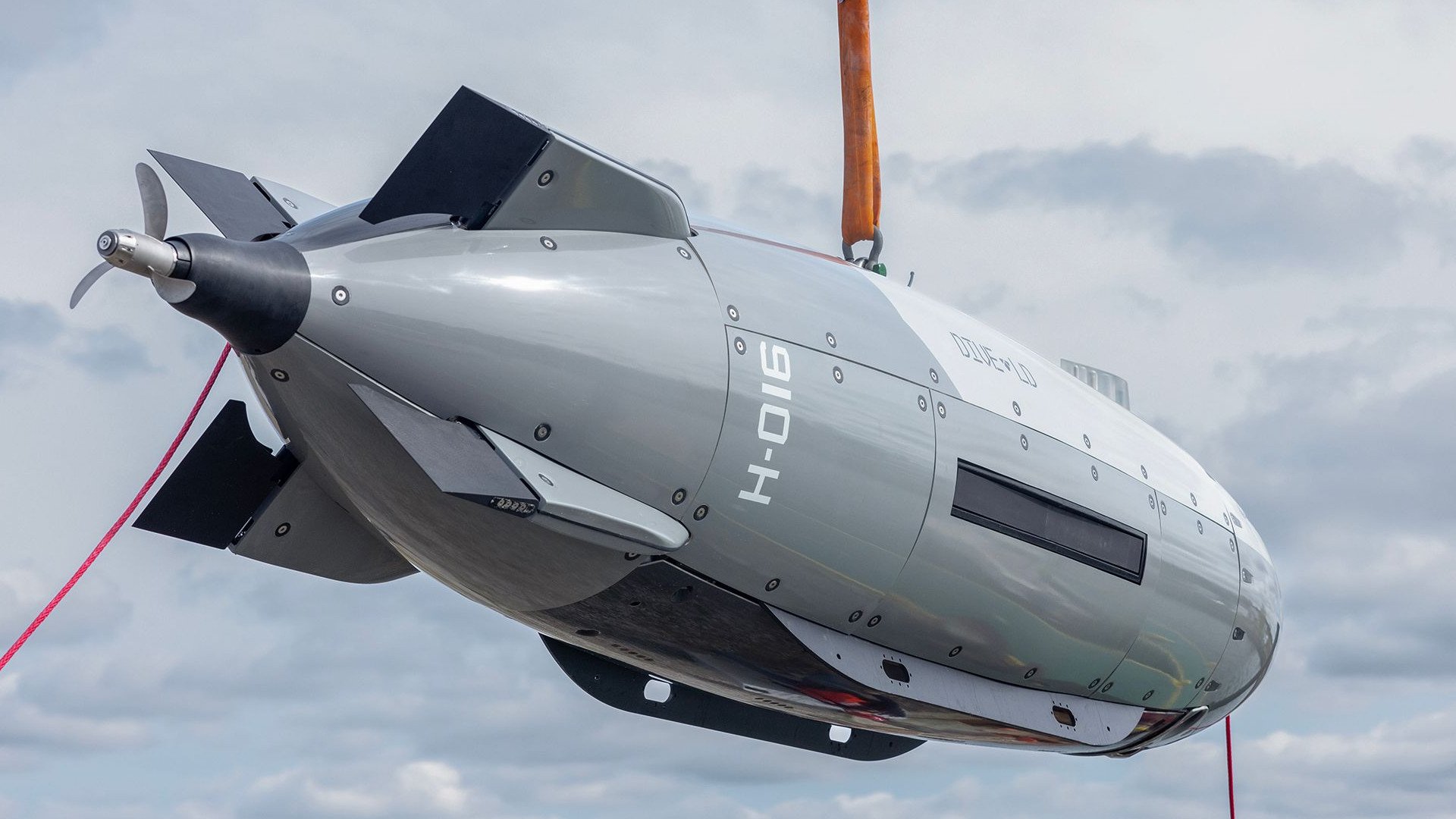
New footage of Australia’s Ghost Shark extra-large autonomous underwater vehicle (XL-AUV) provides the first look at how the vehicle launches aerial drones, while also revealing a pair of deployable masts not previously seen on the platform. The video comes soon after we got a glimpse of some of the payloads that the Royal Australian Navy plans to integrate on the new uncrewed submarine, as you can read more about in our coverage here.

"Ghost Shark has teeth now." – @PatConroy1, Australia's Minister for Defence Industry.

The @ausgov and @Australian_Navy confirmed the payloads that our Ghost Shark extra-large autonomous submarine carries: sea mines, logistics caches, and air-launched effects for ISR and strike.… pic.twitter.com/IALPFpOf4V

— Anduril Industries (@anduriltech) October 21, 2026

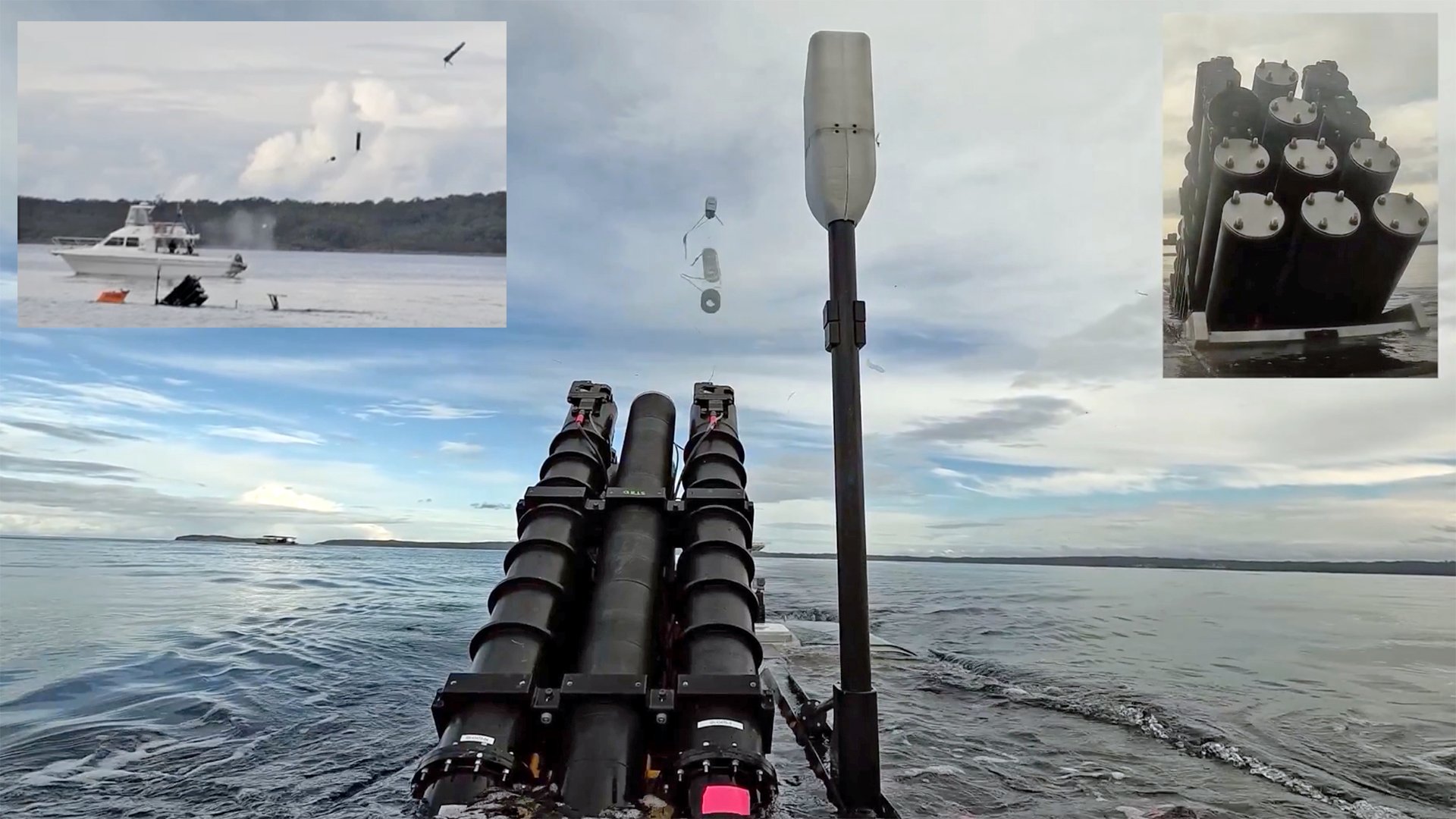
Published by manufacturer Anduril, the footage shows a Ghost Shark surfacing before doors on the top of its hull slide open. A launcher consisting of 12 angled tubes then emerges from a drone sub. Another launcher is seen in the other upper payload bay, but is not raised in the video. While it appears to be of the same type, the second launcher could also have a different arrangement of tubes.
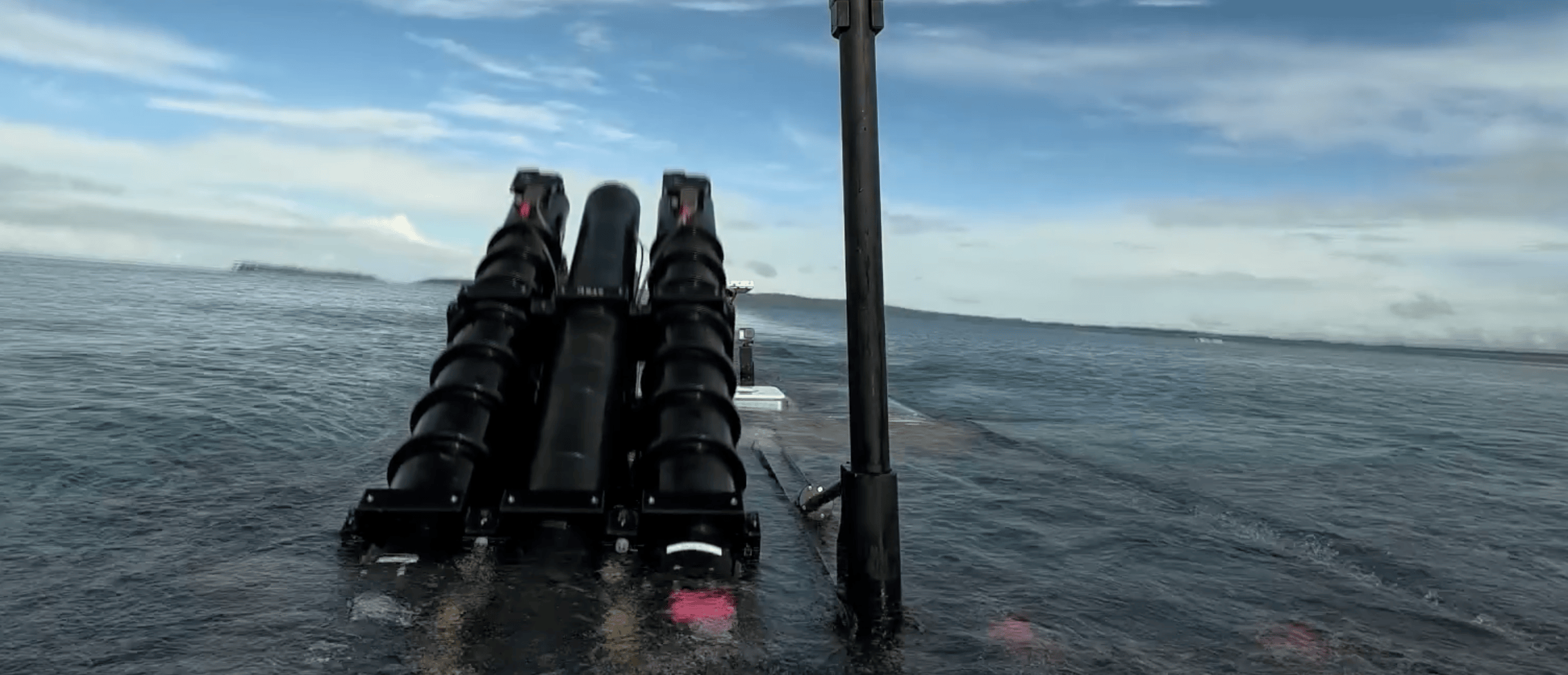
While the 12-tube ALTIUS aerial drone launcher on the left is seen elevating, the launcher on the right remains lowered. Anduril/screencap

The footage subsequently cuts to an ALTIUS-type drone being launched from one of the tubes, with Ghost Shark itself remaining surfaced.
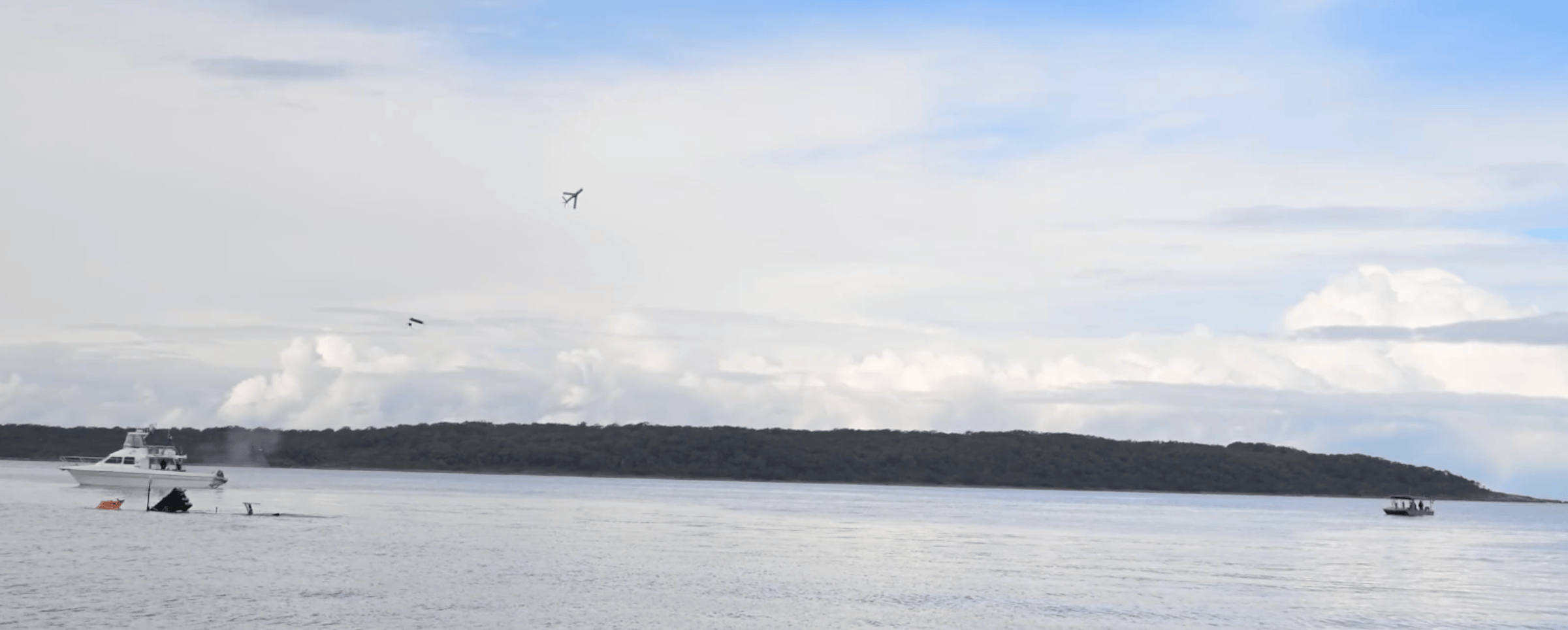
A Ghost Shark launches an ALTIUS aerial drone from a raised 12-tube launcher. Anduril/screencap

The sequence provides a much more concrete look at the aerial-drone deployment concept — or one of them — than the photographs released previously, which offered the first public view inside Ghost Shark’s side payload bay.

The Australian government has said the vehicle is being developed for missions including persistent intelligence, surveillance, reconnaissance (ISR) and strike, but the precise configuration and operational capabilities of its weapons and how they are launched had not previously been disclosed.

The video does not identify which ALTIUS variant is being launched. However, Ghost Shark has previously been displayed at the Altus factory in Australia alongside derivatives of the ALTIUS-600 family. This includes the ALTIUS-600 for ISR, as well as the ALTIUS-600M, which is designed for strike missions. You can read more about this family of drones here. As we noted before, unarmed variants of the ALTIUS-600 are designed to be optionally expendable, and can be reused, although in many scenarios that isn’t possible. In terms of capabilities, the ALTIUS-600 has a maximum range of around 275 miles and can remain airborne for at least four hours, according to Anduril.
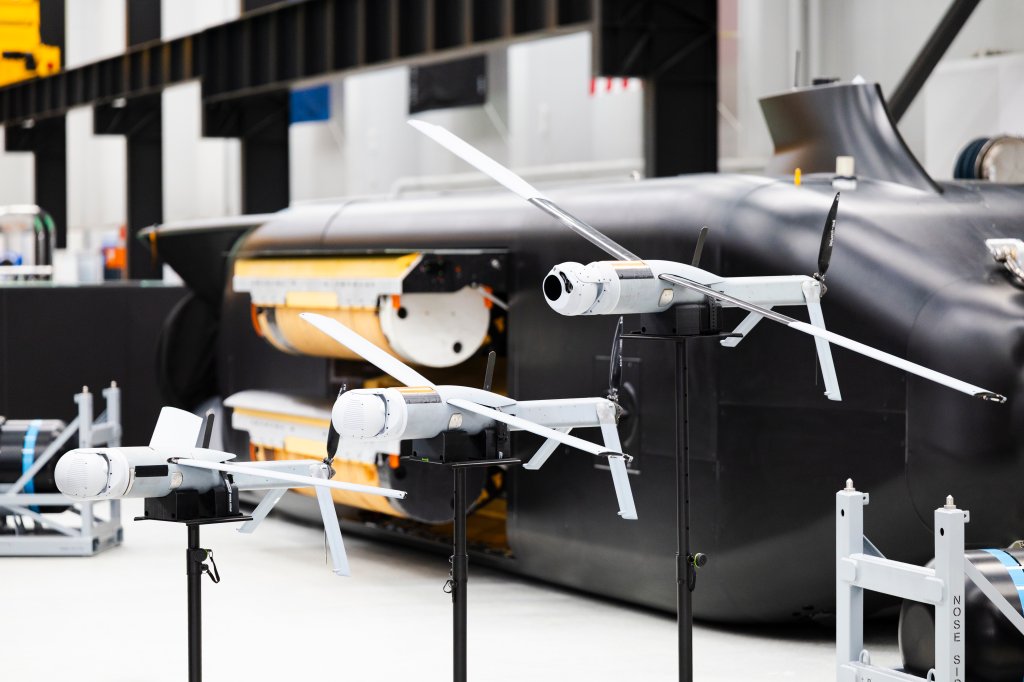
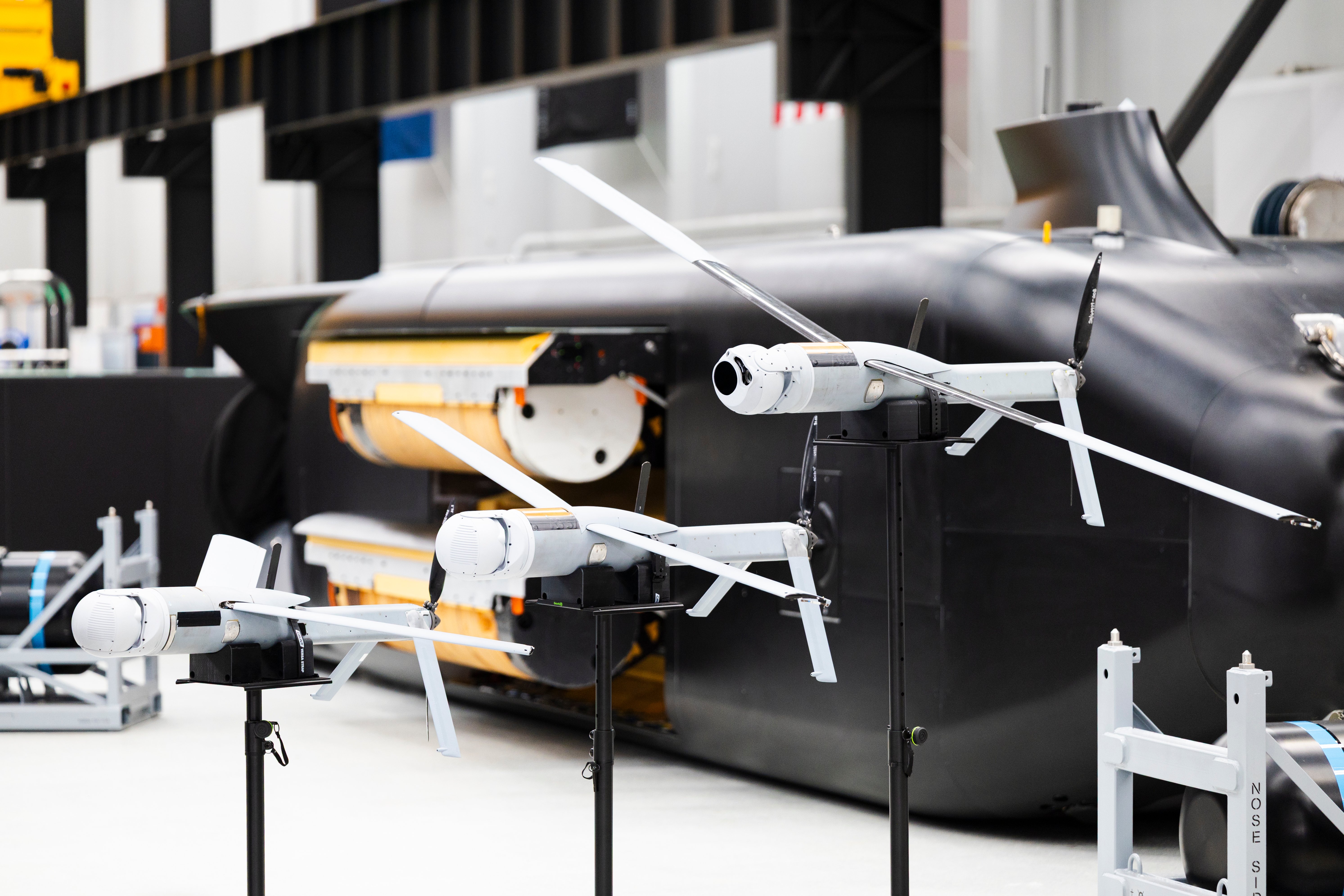
Examples of the Anduril ALTIUS-600 displayed during a press conference at the Anduril Australia factory in Sydney, New South Wales. Australian Department of Defense

Ghost Shark can clearly deploy a substantial number of aerial drones — two dozen in this case – in a single sortie, enabling swarms to be launched far from an adversary’s coastline. Depending on the drones carried and how they are employed, such a swarm could provide broad-area surveillance, wreak havoc on enemy air defenses via electronic warfare, or attack targets.

The concept could also have value below the threshold of open conflict. A mass launch of relatively inexpensive drones could be used to probe or stimulate an adversary’s air defenses, prompting them to reveal their locations, signatures and operating procedures for collection by other intelligence assets or even some of the drones themselves. There is a precedent for exactly this going back to the early Cold War years, which you can read all about here.

Ghost Shark could carry these capabilities deep into contested waters clandestinely without putting a crew at risk, unleashing their payload even at standoff distances or right next to the shore to give the drones maximum penetration and loitering time over target, depend on the risk profile.

At the same time, while the 12-tube launchers fit neatly into Ghost Shark’s hull architecture, the modular nature of the design means that the same space can accommodate many other payloads, which might include alternative types of aerial drones. This could be fewer larger, more capable types, or far more plentiful smaller, less capable ones.

The other notable development in the video is the appearance of two deployable masts. Their presence is particularly interesting given Anduril’s emphasis on designing uncrewed underwater vehicles without the kinds of protruding mast arrangements associated with traditional submarine designs. On UUVs, masts like these are generally used to support sensors, communications, and propulsion systems.
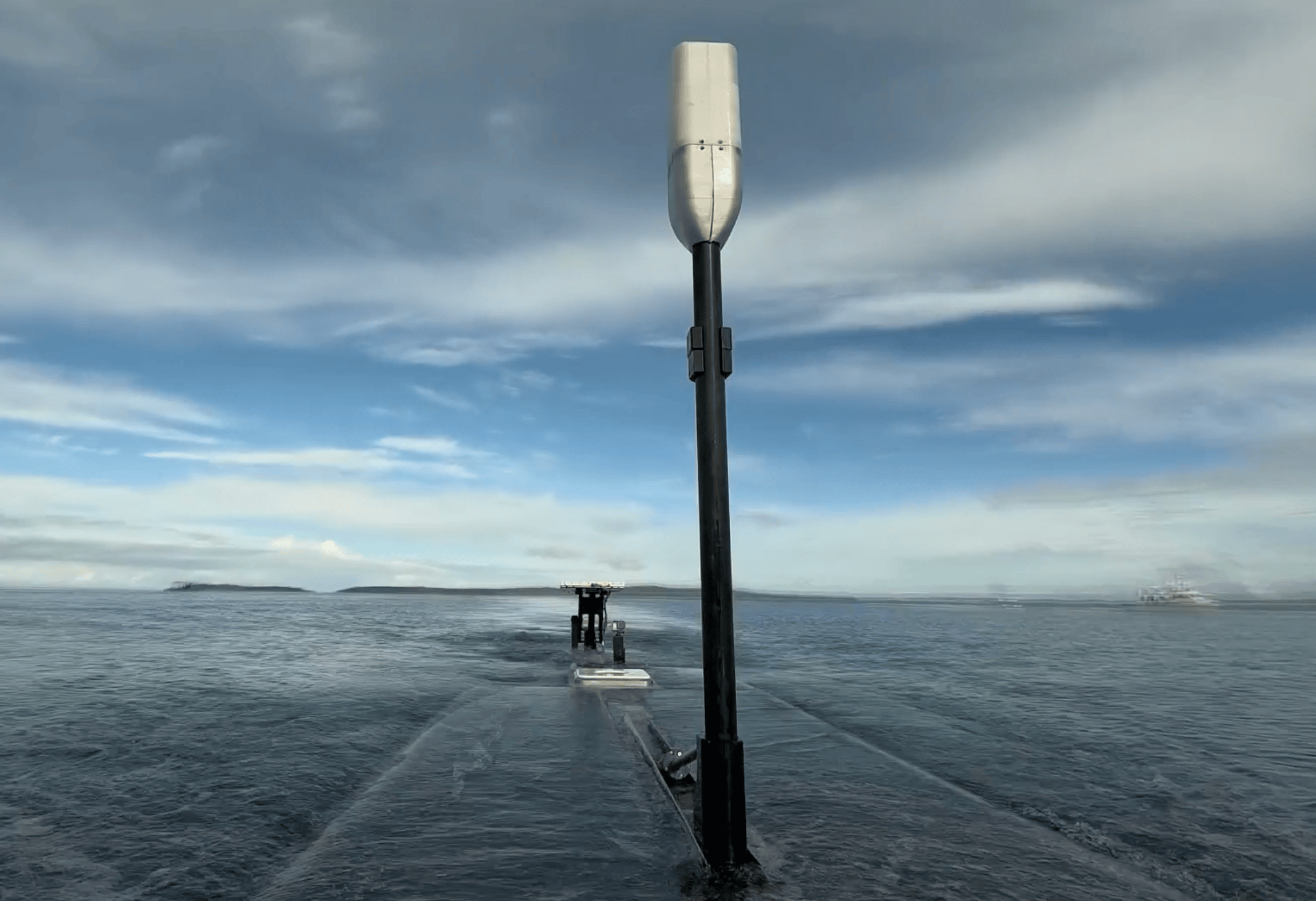
Looking aft, with the two masts raised. Anduril/screencap

“We don’t have big masts running down the backbone of our vehicle that a lot of other designs do that then preclude the ability for the payloads to come out in different directions… of the payload module itself,” Dr. Shane Arnott, Senior Vice President for Engineering at Anduril and the company’s maritime lead, told TWZ back in 2024.

“So we have… in effect, unlimited flexibility in this design, just the way that we’ve configured the vehicle and the payload bay itself could be almost anything within a size configuration that you can dream up,” Arnott added. “We haven’t encountered a crazy idea yet from a customer that … we can’t fit.”
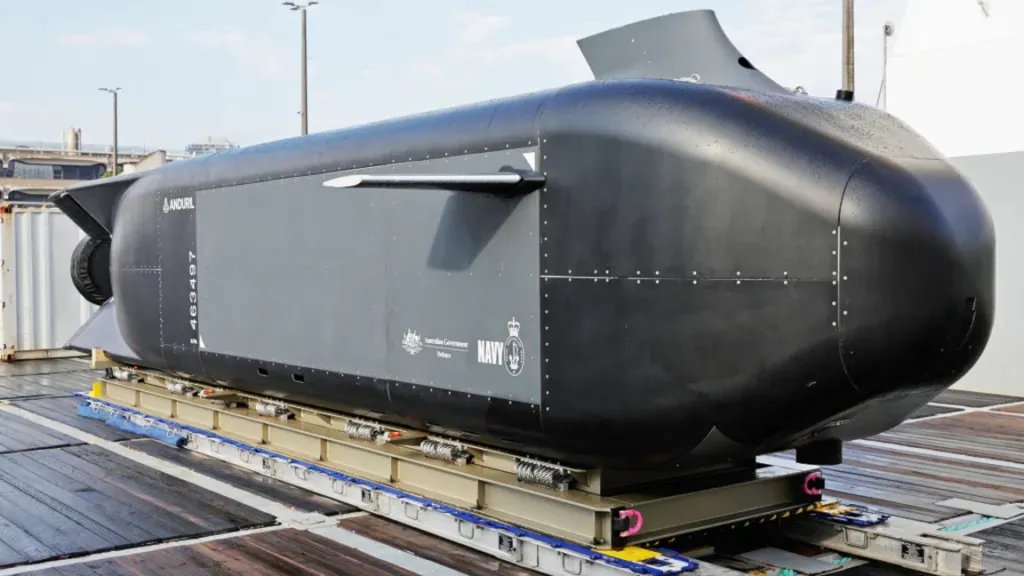
The first Ghost Shark for the Royal Australian Navy. In this earlier view, the retractable masts are not visible. Australian Department of Defense

The larger mast that lies flat is actually a fairly traditional one for large UUVs. It lies along the centerline of the hull when stowed, between the upper payload bays. It then deploys upward in an arm-like motion and carries an antenna. The smaller mast is located farther aft and rises vertically from its own housing. Potentially, the tall mast supports a line-of-sight datalink to the drones, while the other being a satcom array, such as one connected to Starlink/Starshield, sends drone feed to controllers anywhere in the world. It’s also worth noting that Ghost Shark could just launch the drones and send them on their missions autonomously, without needing to stay surfaced at all. Other arrangements could exist, as well, such as Ghost Shark launching a dozen drones and one larger one capable of carrying its own satcom terminal. This would allow direct control of the drones by operators anywhere in the world without Ghost Shark remaining present near the surface.

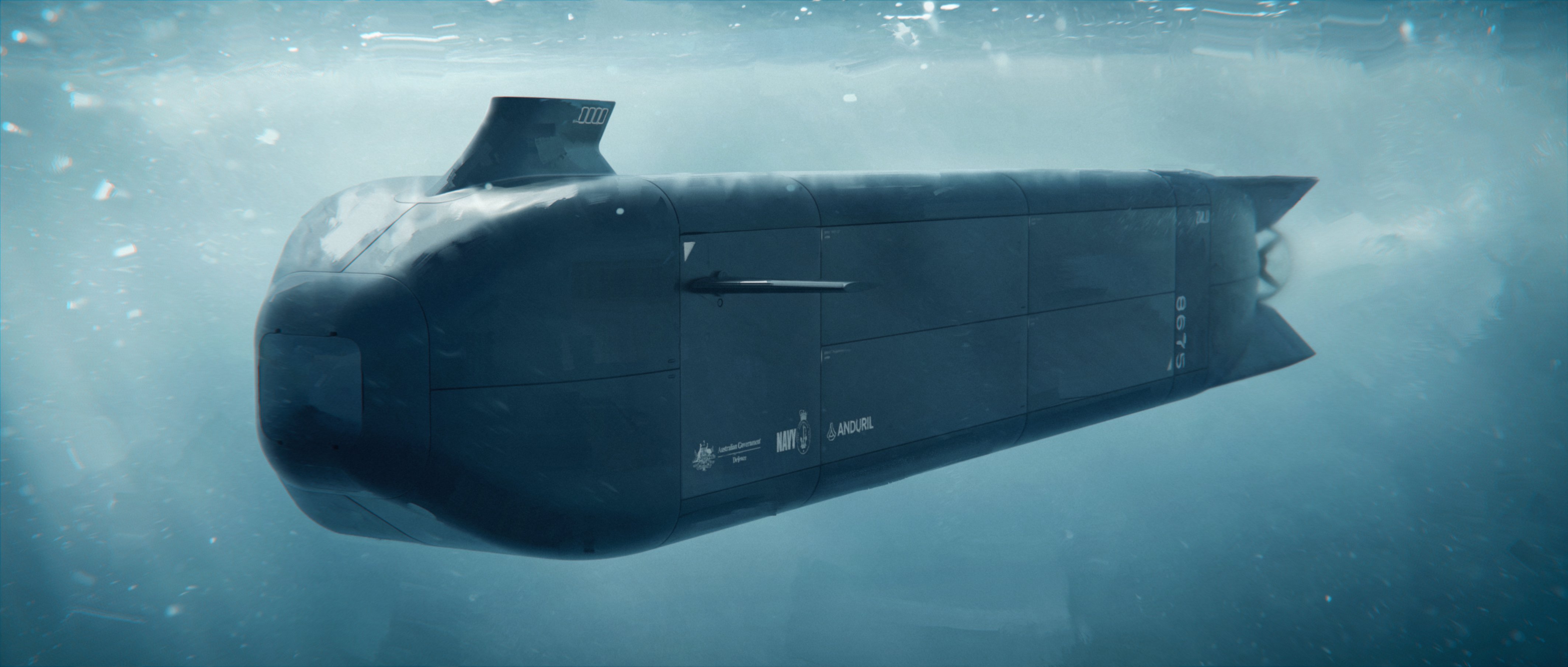
Ghost Shark also has a lower-profile swept-back sail on top of its nose section, not visible in the video. Overall, the vessel would retain a very small signature above the waterline while connected to the drones, making it hard to detect by radar and electro-optical imaging systems.
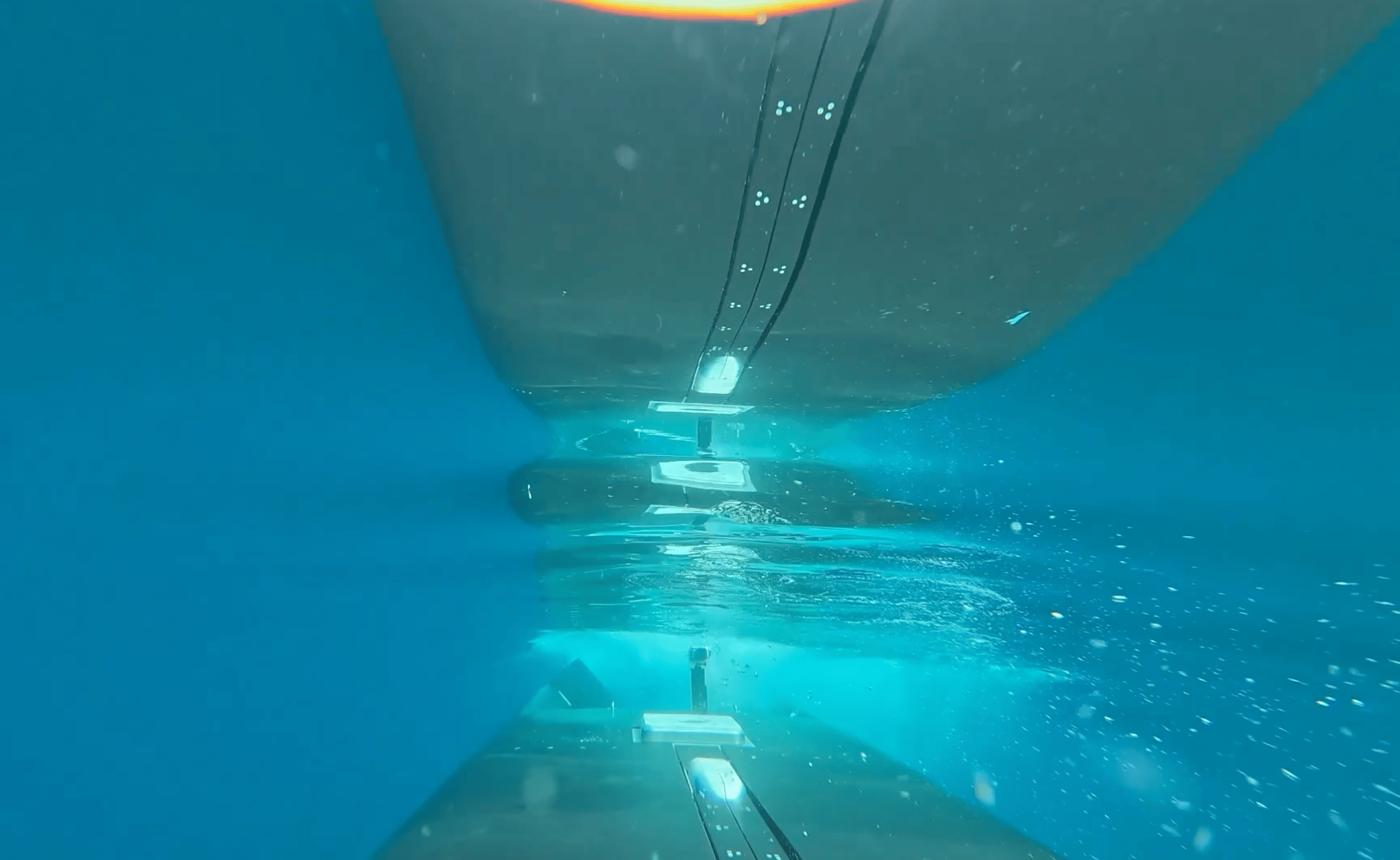
Ghost Shark submerged, with its reflection seen on the surface. This provides a good view of the retracted masts and how they fit neatly with the closed upper payload doors. Anduril/screencap

The new video follows the recent disclosure of three payload concepts for the Royal Australian Navy’s Ghost Shark: the deployment of up to 12 sea mines in a mission, the placement of supply caches on the seabed, and the launch of aerial drones. Those capabilities expand the vehicle beyond conventional underwater surveillance into a broader range of undersea warfare missions.

The mine-delivery option could support operations in strategically important maritime areas, while seabed caches could provide a means of positioning equipment and supplies for later retrieval. The aerial-drone capability, as seen in the new video, would allow Ghost Shark to extend surveillance beyond the reach of its own sensors or potentially deliver strike effects without exposing crewed platforms to the same risks. Having 12 ALTIUS drones ready to launch (and potentially the same number in the adjacent upper payload bay) would allow multiple missions to be undertaken.

The modular design is central to Ghost Shark. As we have discussed, the payload section can be configured using different hull sections and mission-specific systems, allowing the same underlying vehicle design to accommodate different requirements. The newly revealed launcher provides a first look at how at least one of those payload concepts may be implemented in practice.
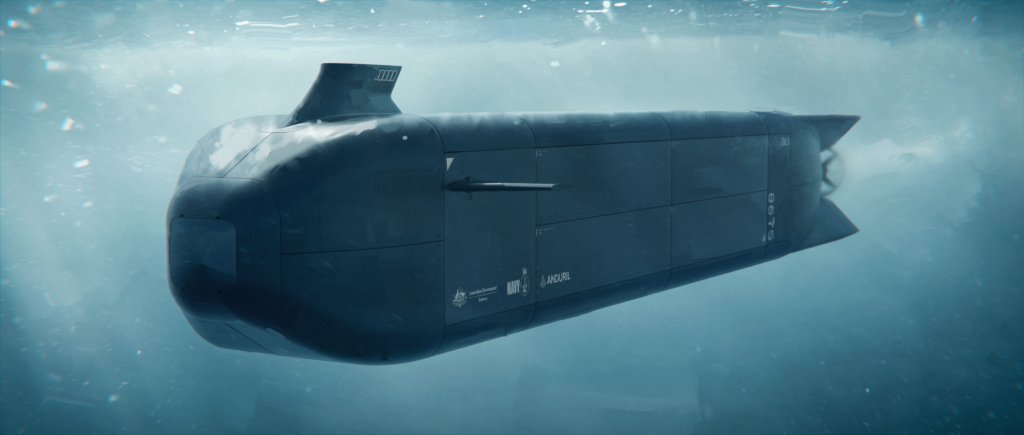
A rendering of a Ghost Shark in Royal Australian Navy service. Australian Department of Defense

Australia has committed substantial resources to autonomous and uncrewed undersea warfare capabilities, with a planned fleet of Australian-designed and built Ghost Shark vehicles serving alongside the Speartooth large uncrewed underwater vehicle (LUUV) and the BlueBottle uncrewed surface vessel (USV). The Ghost Shark program is also part of the broader AUKUS effort to develop advanced maritime technologies alongside the United Kingdom and the United States.

The new footage provides a clearer picture of the practical design choices behind that effort. Most notably, how the underwater vehicle can operationalize its aerial drone launching capability and the quantity of those systems it could potentially deploy very quickly before slipping back below the waves.

Contact the author: thomas@thewarzone.com

The post Ghost Shark Uncrewed Submarine Shown Launching Aerial Drones For The First Time appeared first on TWZ.
  •  

Ghost Shark Extra-Large Uncrewed Underwater Vehicles’ Payload Bay Seen For First Time

New photos provide an interesting first public look inside the payload bay of Australia’s Ghost Shark extra-large autonomous underwater vehicle (XL-AUV), and a glimpse of the highly modular concept at the heart of the Royal Australian Navy’s emerging undersea warfare capability. Australian authorities had said in the past that they plan to use Ghost Sharks to conduct “persistent intelligence, surveillance, reconnaissance and strike” missions, but without any real elaboration.

The photographs were taken during a recent visit to the Anduril Australia factory in Sydney, New South Wales, by Pat Conroy, Australia’s Minister for Defense Industry. They emerged as the Australian government announced new details of payload development for Ghost Shark, the Speartooth large uncrewed underwater vehicle (LUUV), and the BlueBottle uncrewed surface vessel (USV), on October 19. While the announcement described the payloads in very broad terms, the photos plus additional details from the Anduril event reveal a more concrete picture of the missions Ghost Shark is being designed to perform.

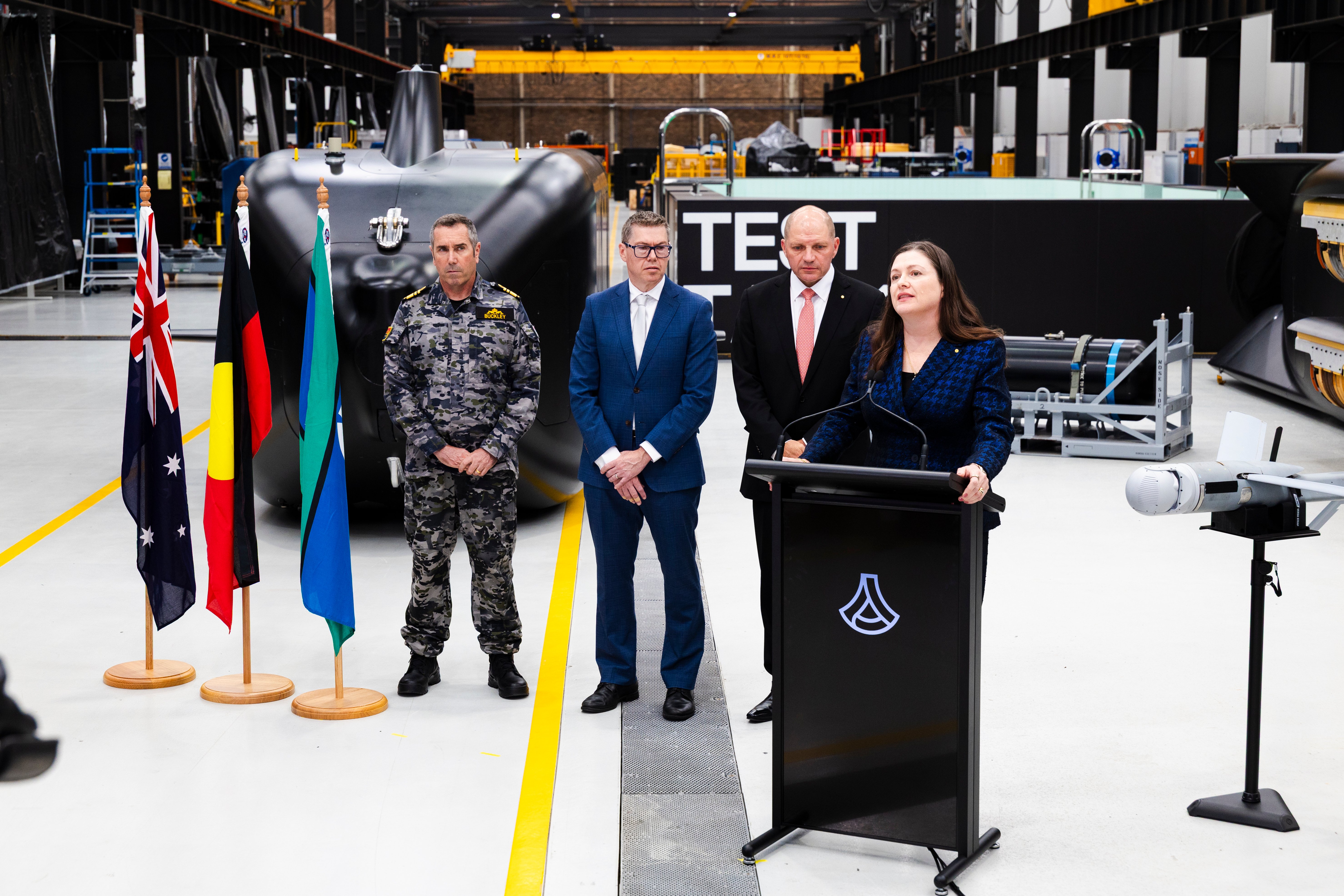
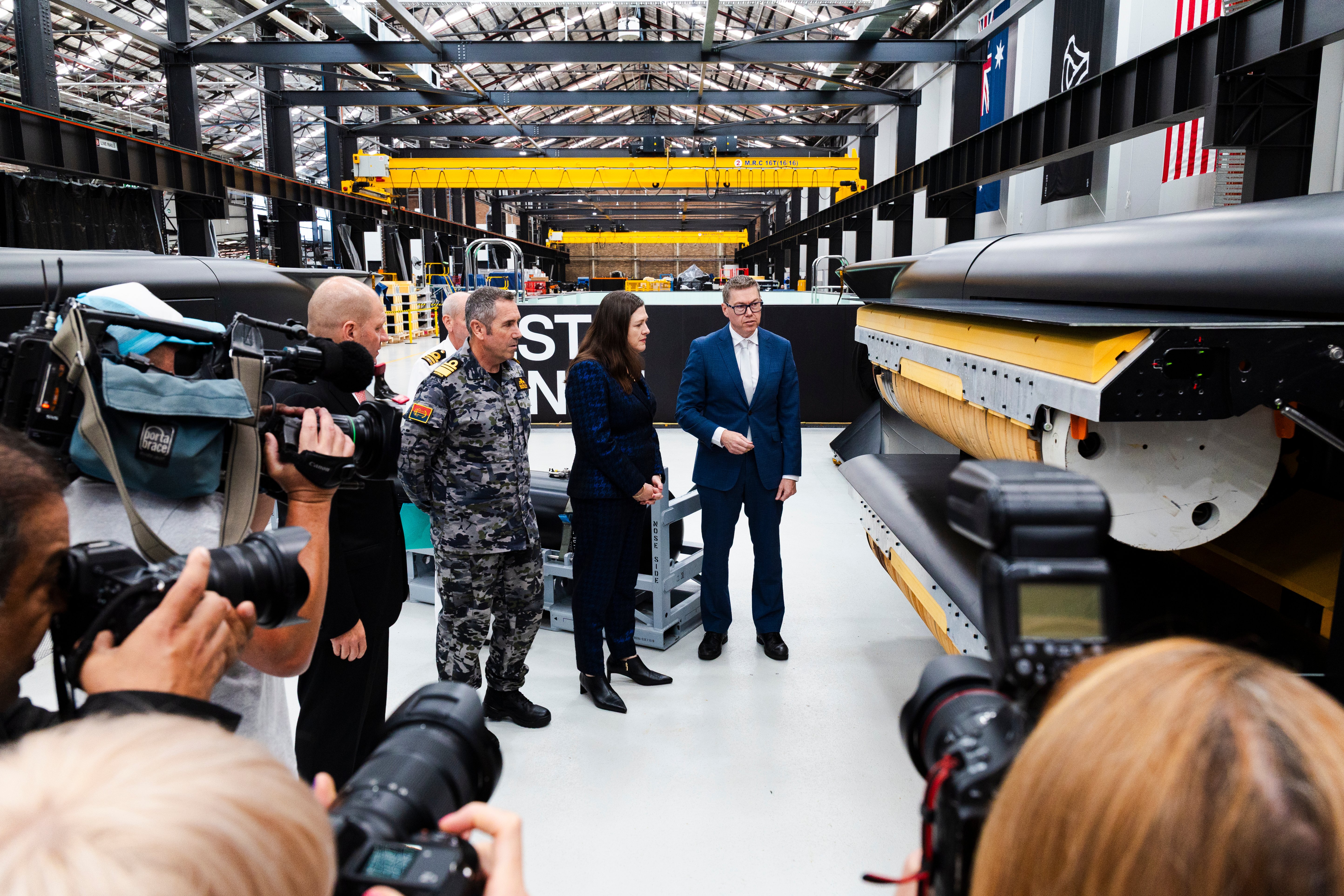
Left to right: David Goodrich, CEO of Anduril Australia; Chief of Navy, Vice Adm. Matthew Buckley; Professor Tanya Monro, AC Chief Defense Scientist; and Pat Conroy, Minister for Defense Industry, stand in front of a Ghost Shark, with payload bay open, at the Anduril Australia factory in Sydney, New South Wales. Australian Department of Defense

The three previously undisclosed payload options include deploying up to 12 sea mines in a mission, leaving supply caches on the seabed, and launching Anduril’s ALTIUS aerial drones for reconnaissance or strike missions.

“Ghost Shark now has teeth, and will have the ability to inflict damage on any potential adversary,” Conroy said.

The payload bay image is significant in its own right. Ghost Shark’s modular design is intended to accommodate different mission-specific systems, allowing the Royal Australian Navy to configure the same underlying platform for different operational requirements. Ghost Shark was designed to be extremely modular, flexible, and readily reconfigurable. As part of this, the overall payload portion can be readily configured in different ways using different-sized modular hull sections. Since the nose and the tail are different pieces, with an expandable section in the middle, there is plenty of scope for different payloads as well.

Seeing the internal bay for the first time provides a more tangible look at that approach than earlier photographs of the submarine’s exterior.

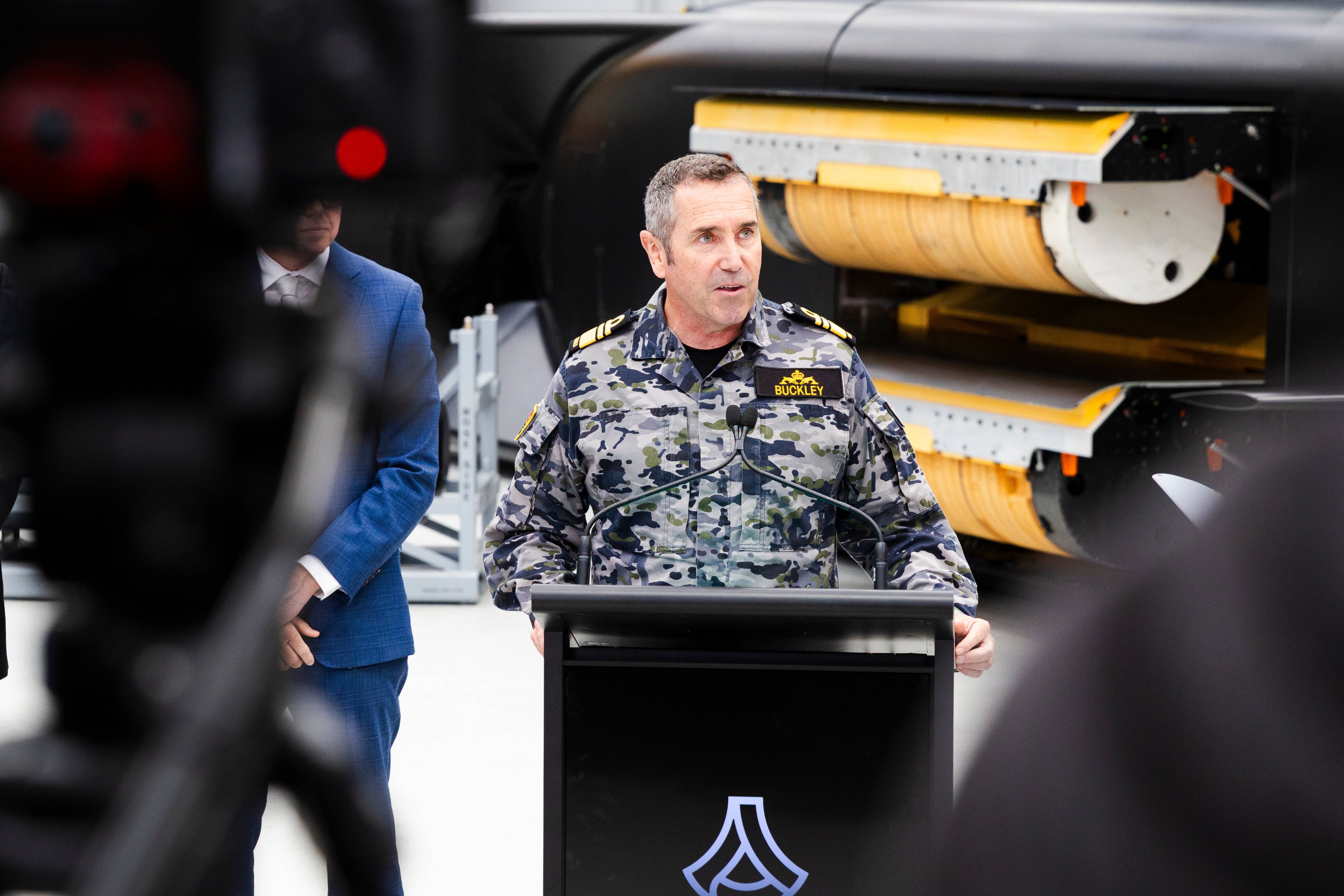
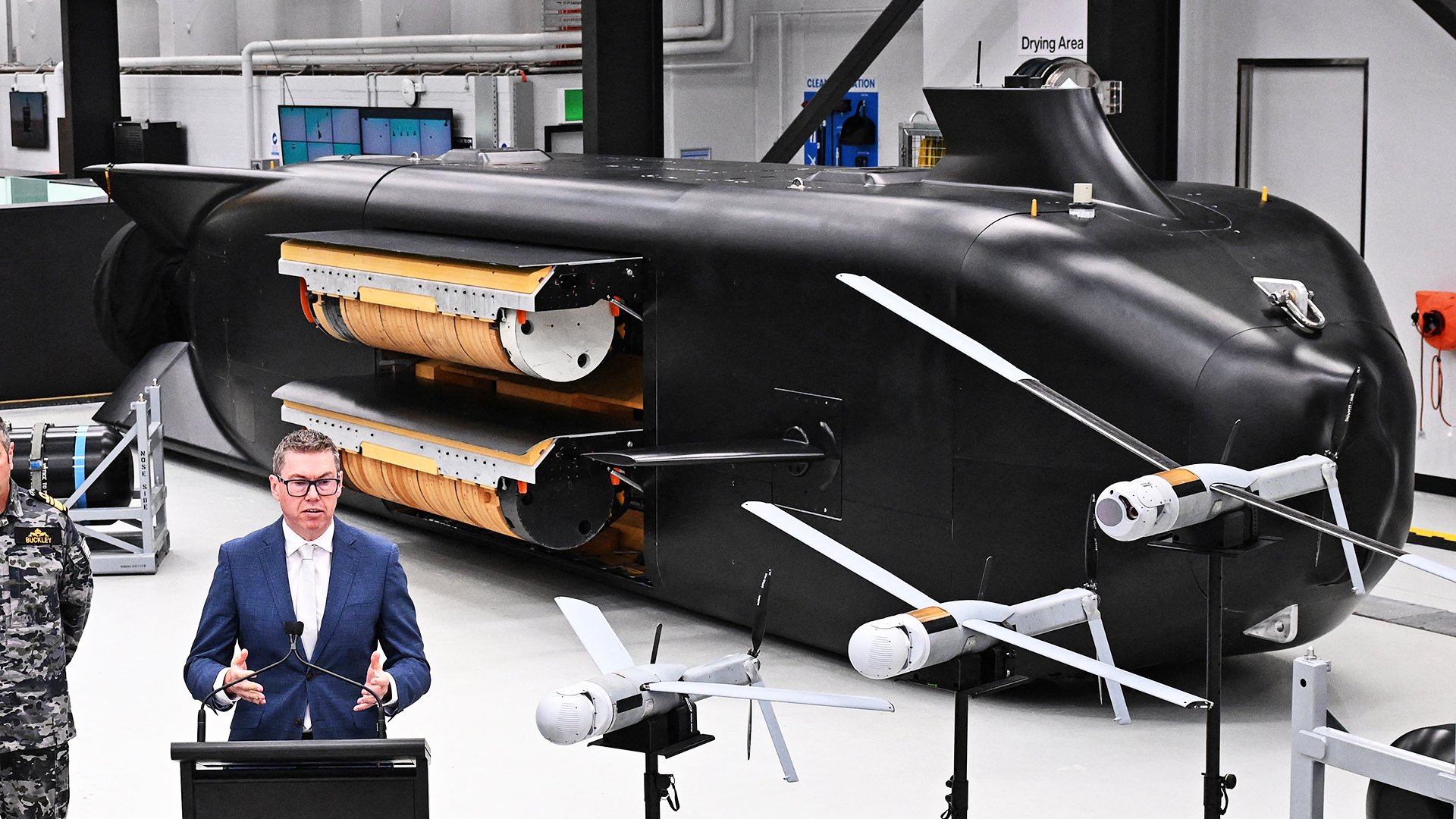
Chief of Navy, Vice Adm. Matthew Buckley, makes an address at the Anduril Australia factory in Sydney, New South Wales. The payload-bay spacers are seen immediately behind him. Australian Department of Defense

Inside the bay of one of the Ghost Sharks on display, there appear to be cylindrical spacers, formed in segments, rather than operational stores. These spacers, and other areas inside the bay, look as if they are fabricated from plywood or similar. Overall, this means it is not entirely clear if they represent the kind of ballast that would be loaded to take the place of actual payloads during trials, or whether they are part of a mockup.

Of the three payload options, the ability to deploy ALTIUS aerial drones is particularly noteworthy. An underwater vehicle capable of releasing aerial systems could extend a naval force’s intelligence, surveillance, and reconnaissance (ISR) reach beyond the submarine’s own sensors. Depending on the drone variant and mission configuration, it could also provide a means of delivering effects at a distance without putting personnel directly in harm’s way. Other roles could include stimulating enemy air defense networks, perhaps even responding to pop-up air defence threats as they appear and attacking them. The ability to put miniaturized satcom terminals, as well as AI, on small drones also greatly opens up the possibilities for UUV-launched aerial drones.

The Anduril ALTIUS-600 is displayed during a press conference at the Anduril Australia factory in Sydney, New South Wales. Australian Department of Defense

Which ALTIUS variants the Ghost Shark will be able to deploy has not been publicly disclosed. The models displayed at the Altus factory are all derivatives of the ALTIUS-600 family. Notable versions include the ALTIUS-600 for ISR, as well as the ALTIUS-600M, which is designed for strike missions. As you can read here, the basic drone has an overall weight of between 20 and 27 pounds, depending on its payload, which typically weighs between three and seven pounds. The ALTIUS-600 has a maximum range of around 275 miles and can remain airborne for at least four hours, according to its developer. Unarmed variants of the ALTIUS-600 are designed to be recoverable and reusable, although it is unclear how practical that would be after launch from a UUV.

There is another missing part of the payload puzzle, namely the kinds of capsules that would contain the ALTIUS UAVs for launch from the sub.

The Rheinmetall Asteria 533mm-diameter mine pictured alongside the Ghost Shark is not installed in the vehicle’s payload bay. Its appearance nevertheless provides an intriguing visual counterpart to the newly disclosed mine-delivery capability. According to the manufacturer, the Asteria can be deployed from surface vessels, aircraft, and submarines (normally via torpedo tubes). It can be remotely controlled via an acoustic link and is optimized for the defense of harbors, straits, ports, and other critical areas.

Professor Tanya Monro, AC Chief Defense Scientist, makes an address at the Anduril Australia factory, with the Rheinmetall Asteria mine behind her, immediately to her right, marked with a blue band. Australian Department of Defense

The seabed supply-cache concept points to a different operational role. Ghost Shark could position equipment and supplies underwater for later retrieval, potentially supporting forces operating in areas where conventional resupply is difficult or risky.

The notional supply cache payloads — which are under development by the Defense Science and Technology Group (DSTG) — don’t appear to be on display here. Alex Luck, a naval analyst who closely tracks submarine developments, told TWZ that the cache payloads would likely take the form of capsules, similar in shape to the Asteria mine, but containing whatever supplies need to be moved. It is not immediately clear who would use those caches. One option could be special operations forces, but if the payloads could later rise to the surface, they could be accessed by other forces, too.

It should also be noted that the U.S. Navy and U.S. Marine Corps, in particular, are envisioning future fleets of UUVs and USVs that can carry out kinetic attacks and employ electronic warfare and other non-kinetic effects, as well as emplace mines, providing a direct parallel with the planned mission set for Ghost Shark.

A rendering of a Ghost Shark in Royal Australian Navy service. Australian Defense Force

Some of the new payload capabilities are due to be featured in Exercise Maritime Big Play Pacific in San Diego, an AUKUS Pillar II activity focused on advanced maritime capabilities and interoperability. The Australian government says the development effort involves the Royal Australian Navy, Defense Science and Technology Group, the Advanced Strategic Capabilities Accelerator and defense industry.

As we have discussed in the past, Maritime Big Play has links to the U.S. military’s Technology Readiness Experimentation (T-REX) effort and NATO’s Robotic Experimentation and Prototyping Augmented by Maritime Unmanned Systems (REPMUS) exercise series, according to the Pentagon. The U.S. Navy has also been conducting a growing number of large-scale uncrewed-focused maritime exercises and demonstration events in recent years.

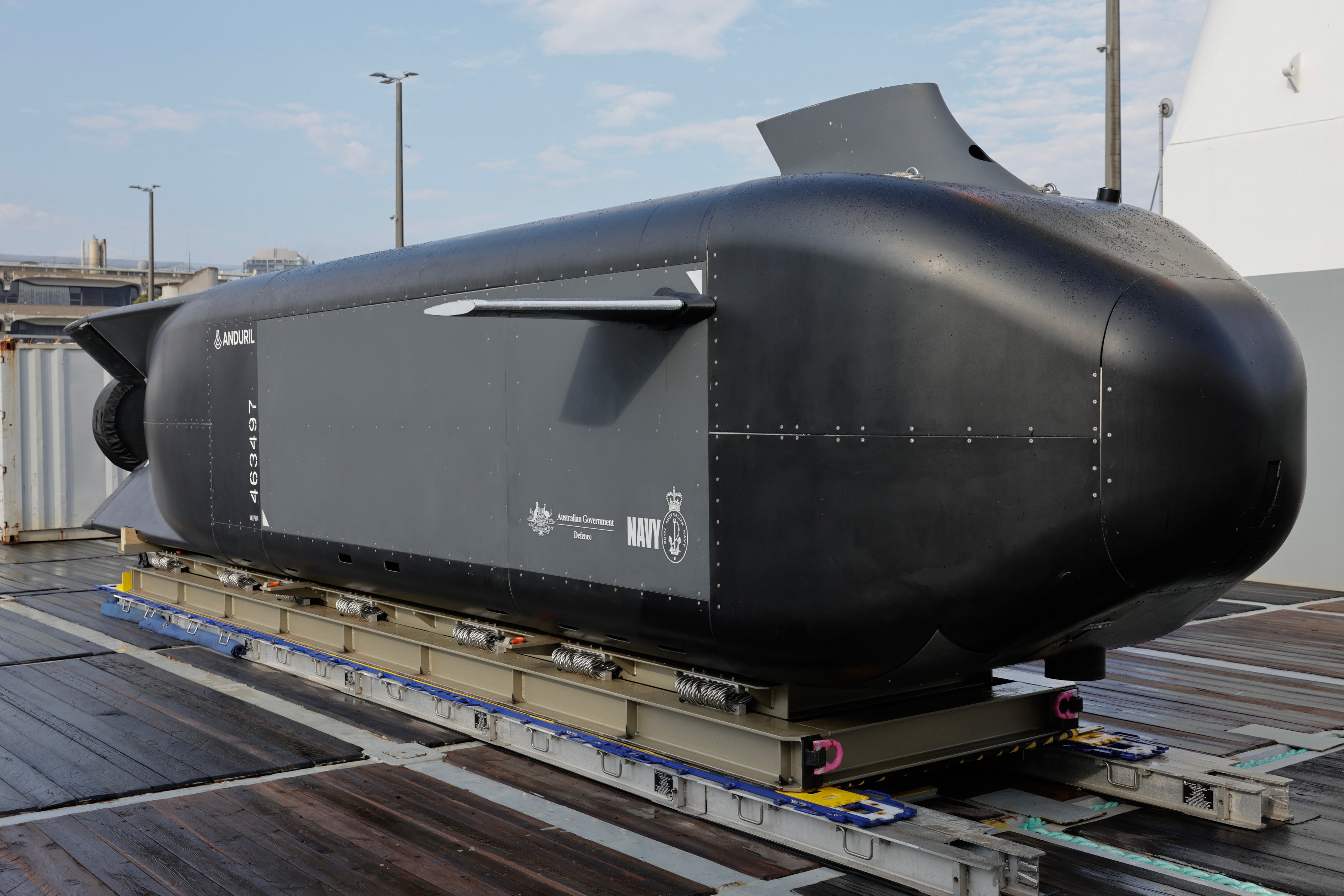
The Ghost Shark ‘Alpha’ first prototype was co-developed by Defense Science and Technology Group, the Royal Australian Navy, and Anduril Australia. Australian Department of Defense

Under AUKUS Pillar II, Australia is collaborating with the United Kingdom and the United States on Ghost Shark and its associated capabilities. While Pillar I centers on providing Australia with nuclear-powered submarines, Pillar II focuses on the joint development of advanced defence technologies, including artificial intelligence and autonomous systems.

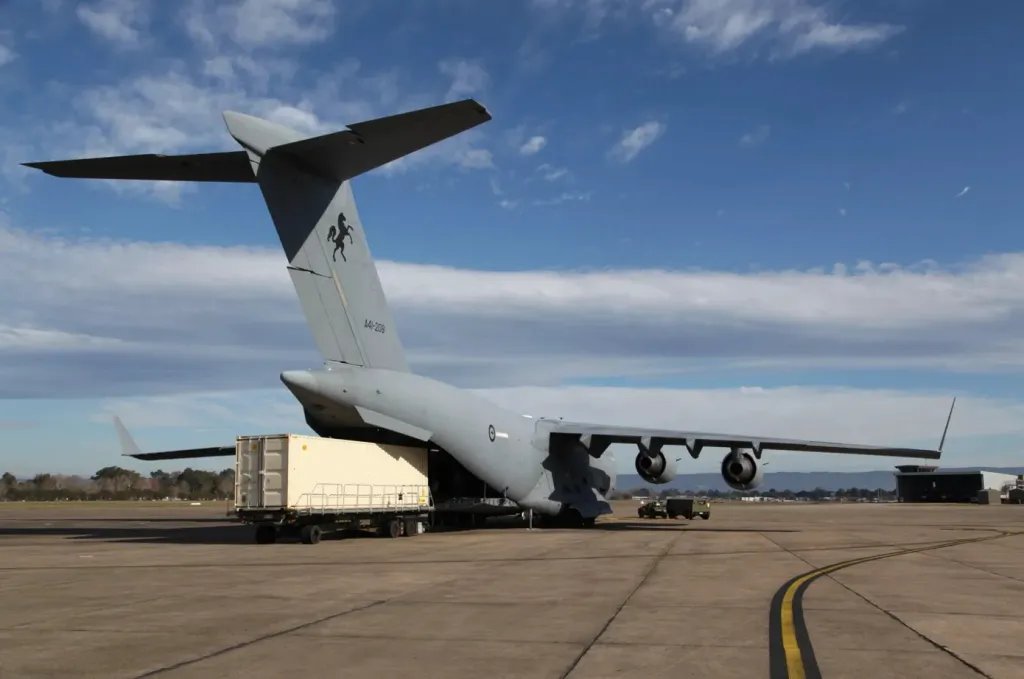
Exactly how the Ghost Shark will be deployed during the Maritime Big Play Pacific exercise is unclear, but, speaking about the concept of operations, Conroy described examples of it being deployed from a shipping container or launched from the back of a small vessel using a crane. In the past, we have also seen the Ghost Shark loaded in a standard shipping container and transported in a Royal Australian Air Force C-17A Globemaster III airlifter.

A Ghost Shark loaded in a standard shipping container for transport in a Royal Australian Air Force C-17A. Anduril

Overall, U.S. military wargames have highlighted how uncrewed systems could shape a high-end conflict across the Pacific, particularly a fight over Taiwan. One set of Taiwan conflict simulations found that large swarms of relatively low-cost, networked drones could be decisive in helping locate and attack an invading force, while other wargaming by the Center for a New American Security has highlighted the severe challenges of defending the island against a Chinese assault. Maritime drones could also play a major role: the U.S. Navy has explored submarine-launched aerial drones that act as “flying periscopes,” extending sensor coverage and providing targeting data beyond a submarine’s own reach, while uncrewed underwater vehicles could conduct mine-laying and other asymmetric missions around key maritime chokepoints. The rapid growth and technological advances made by the Chinese submarine fleet also underscore the critical importance of anti-submarine capabilities, in which uncrewed systems can play a major role. Together, these developments underscore the potential value of autonomous systems for the Royal Australian Navy as it prepares to operate across the vast distances of the Indo-Pacific.

Australia’s 2026 National Defence Strategy and Integrated Investment Program allocate up to A$5.8 billion (approximately $4.05 billion) over the decade to autonomous and uncrewed undersea warfare capabilities, including A$1.7 billion (approximately $1.19 billion) for a new fleet of Australian-designed and built Ghost Shark vehicles.

The newly released imagery and payload details offer the clearest picture yet of how Australia intends to expand Ghost Shark beyond a conventional underwater surveillance role. The next key milestones should provide more details of how the payloads will be integrated into the vehicle, and how they might be deployed in practice.

Contact the author: thomas@thewarzone.com

The post Ghost Shark Extra-Large Uncrewed Underwater Vehicles’ Payload Bay Seen For First Time appeared first on TWZ.
  •  

Second Chinese Submarine Drone Mothership Emerges

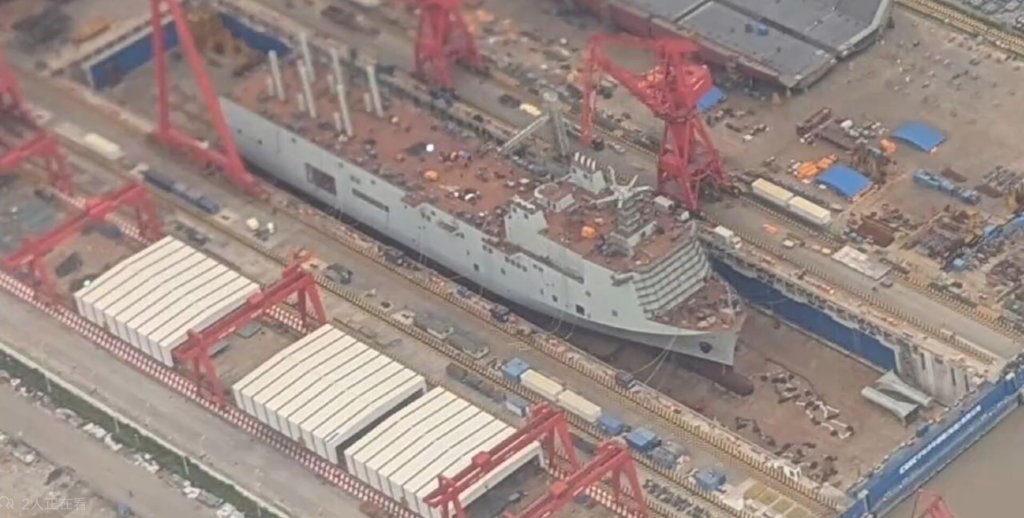
Nearly a month ago, we reported on a uniquely configured vessel that was far along in its construction at Hudong-Zhonghua Shipyard on Changxing Island in Shanghai. The intentions behind this design appeared to be as an uncrewed underwater vehicle (UUV) mothership, capable of deploying a handful of very large vehicles or many more smaller ones via its stern garage door and well deck. Its large pylons would be used to lift the vessels up and down out of the water and to different levels in the ship. Now it appears China has not just one, but two of these vessels nearly complete.

Make sure to read our initial report on this vessel configuration for full context by clicking here.

(Chinese Internet)

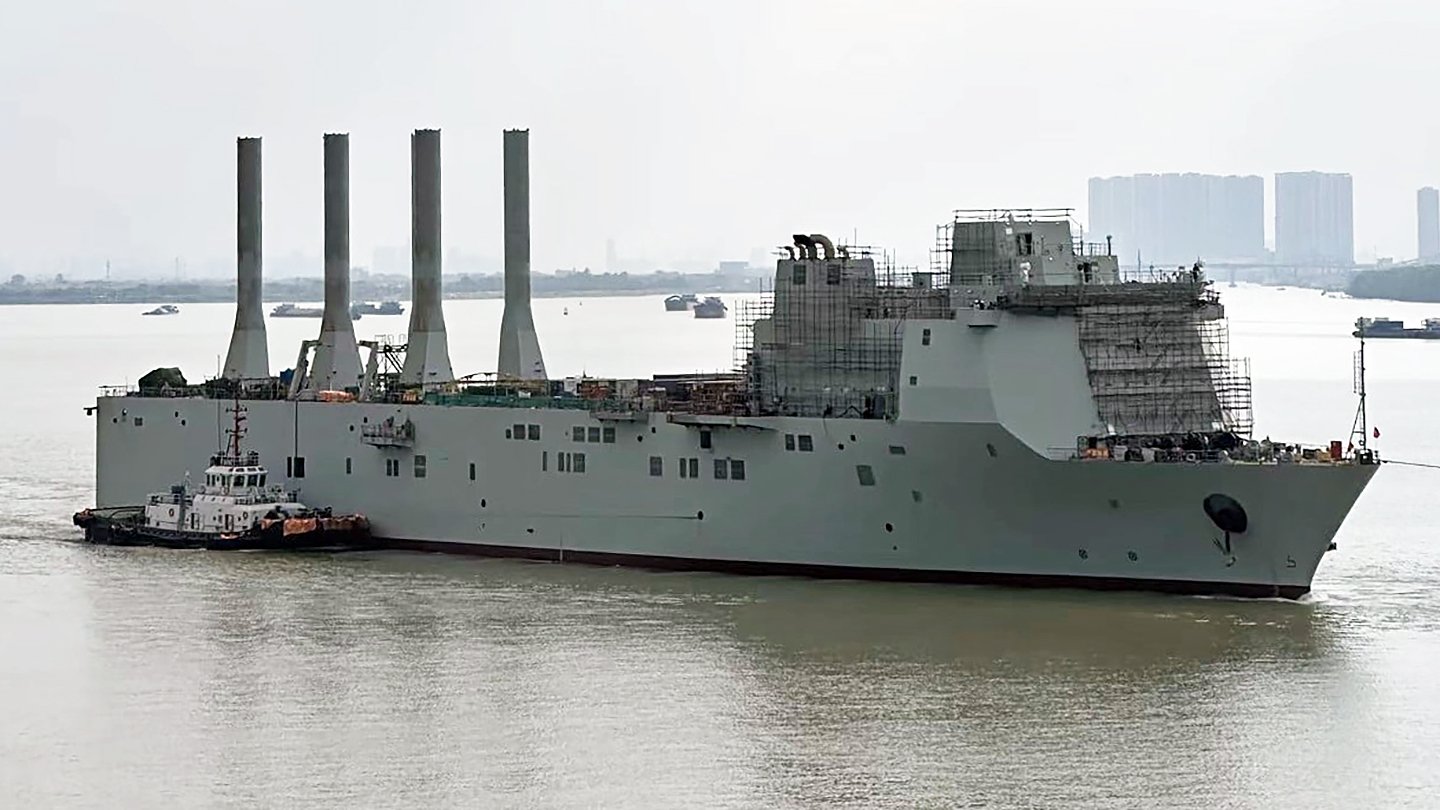
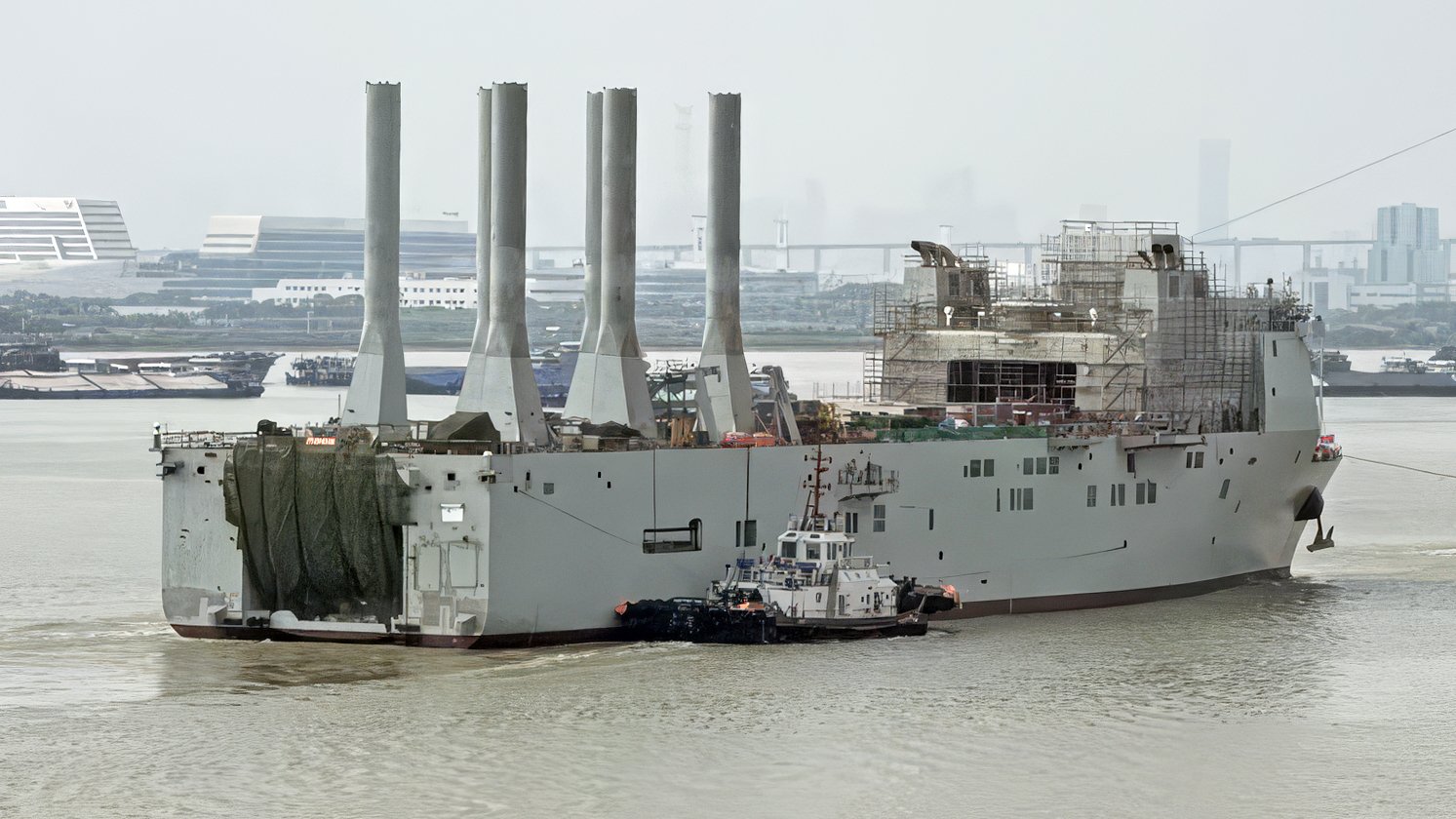
The new image was taken in Guangzhou and the vessel has a near identical shape, but with smaller proportions and minor changes to its overall moldline, compared to the larger one in Shanghai. This new vessel appears to be about a third smaller overall than its counterpart. The lift towers number six in total instead of six larger ones and six smaller ones on the Shanghai vessel. Regardless, the major design features are all there, including the flight deck and hangar behind the forward superstructure, the location of the smokestacks, and so on.

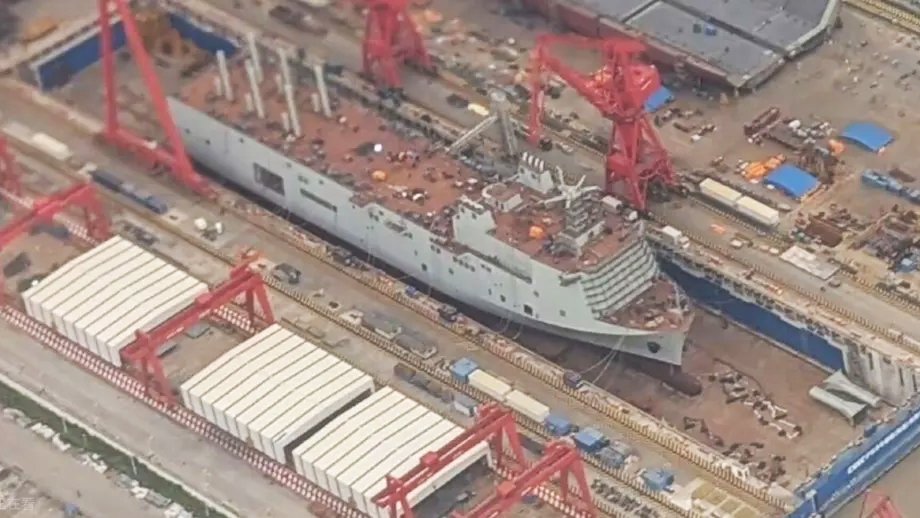
The larger but very similar in configuration UUV mothership that has now been launched in Shanghai. (Chinese Internet)

While two of these assets could still be considered largely intended for experimental use, a growing fleet would have increasing tactical and even strategic importance. Being able to easily launch and recover large numbers of UUVs, or a few very large ones, far from Chinese shores would provide an asymmetric capability. A fleet of ships that is dedicated to deploying, recovering, and tending to these systems, some of which can remain on patrol for very long periods, would be a major indication of how important China sees UUV operations as part of its future strategy.

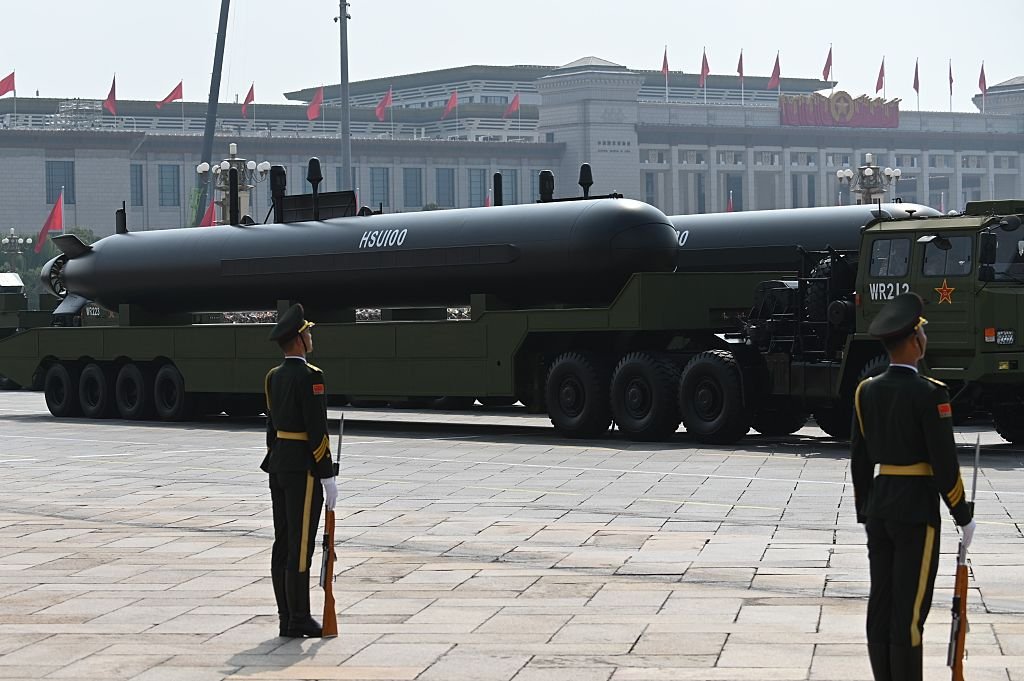
03 September 2025, China, Peking: Unmanned underwater drones ride along on military transporters at Tiananmen Square in Beijing during a military parade to mark the 80th anniversary of the end of World War II. Photo: Johannes Neudecker/dpa (Photo by Johannes Neudecker/picture alliance via Getty Images)
03 September 2025, China, Beijing: HSU100 uncrewed underwater drones ride along on military transporters at Tiananmen Square in Beijing during a military parade to mark the 80th anniversary of the end of World War II. Photo: Johannes Neudecker/picture alliance via Getty Images picture alliance

There have been rumors that these vessels are part of a larger overall program that will see more ships with similar capabilities constructed. Once again, this would be a strong indication that these vessels’ utility will go beyond testing and limited operational use cases. The launch and recovery of large UUVs remains a conceptual work in progress for the U.S., with nothing similar in the U.S. Navy’s inventory, as we discussed in our original post.

Large long-range UUVs can be used for many tasks, from mapping the sea floor to hunting submarines and ships to searching for mines to launching cruise missiles and drones to being turned into immensely destructive weapons in their own right that can circumvent traditional strategic defenses. For China, providing a credible threat to America’s outposts deep in the Pacific and even the U.S. seaboard would be on the table.

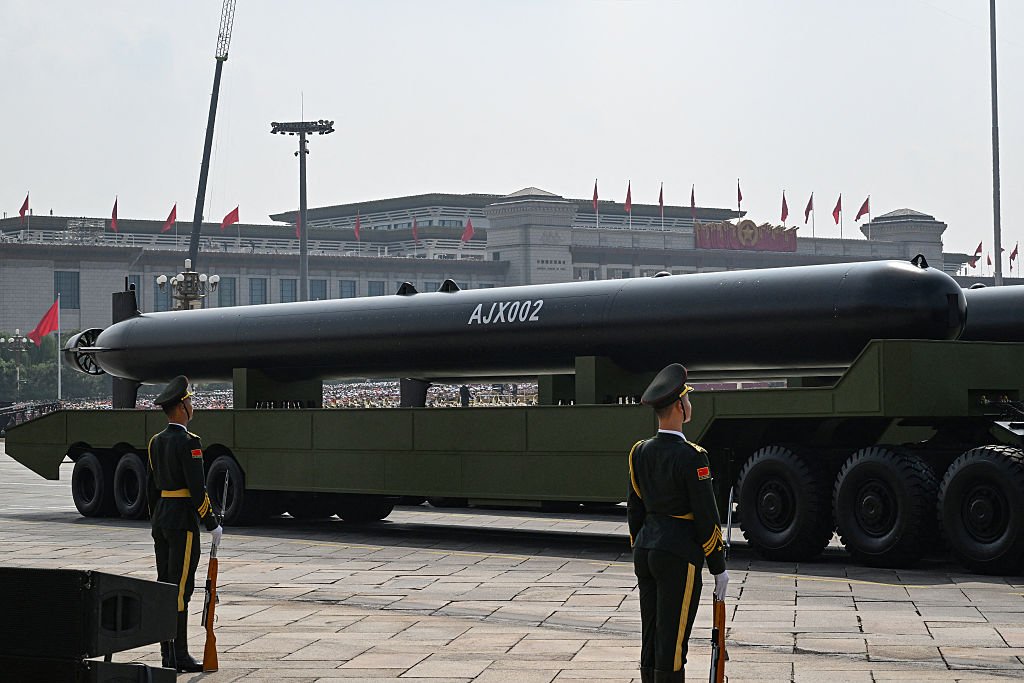
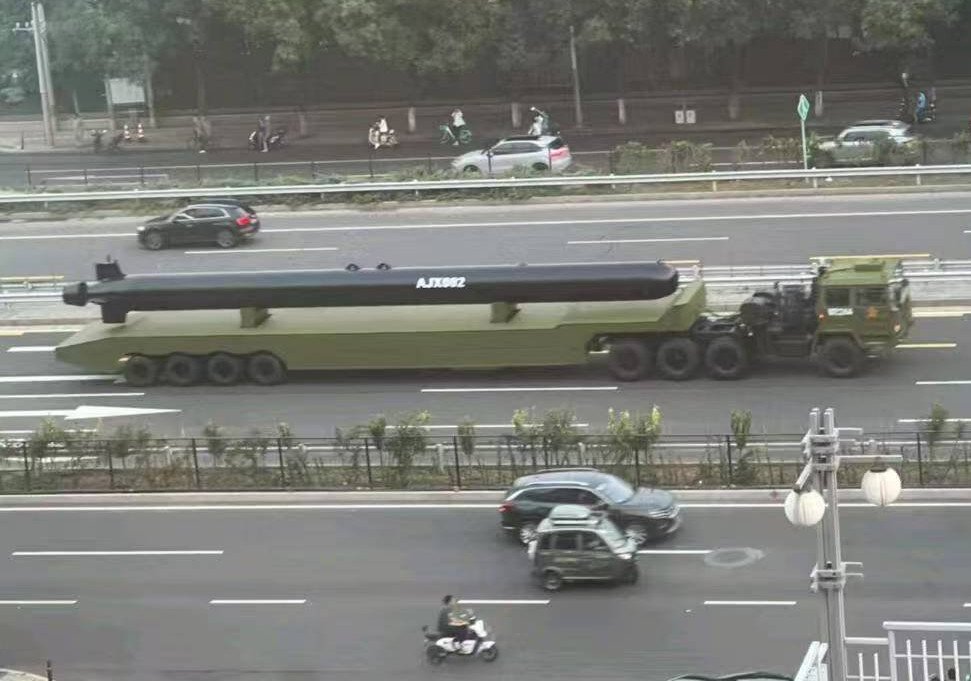
An AJX002 unmanned underwater vehicles is seen during a military parade marking the 80th anniversary of victory over Japan and the end of World War II, in Beijing's Tiananmen Square on September 3, 2025. (Photo by Greg Baker / AFP) (Photo by GREG BAKER/AFP via Getty Images)
An AJX002 uncrewed underwater vehicle is seen during a military parade marking the 80th anniversary of victory over Japan and the end of World War II, in Beijing’s Tiananmen Square on September 3, 2025. (Photo by Greg Baker / AFP) GREG BAKER

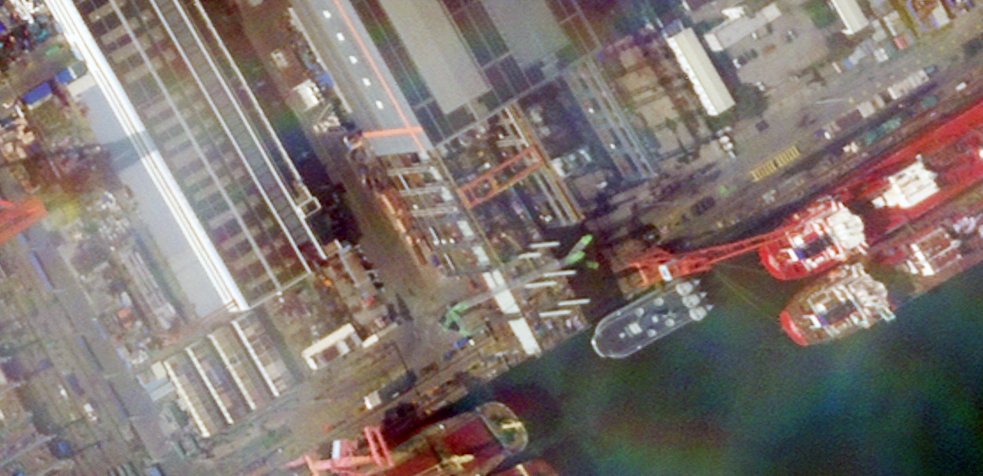
There is speculation online as to where exactly this vessel was built. The first place that came to mind is Guangzhou Shipyard International’s (GSI) facilities on Longxue Island, just southeast of the city of Guangzhou. GSI is a subsidiary of the China State Shipbuilding Corporation (CSSC). It is here that many of China’s most unique vessels are born. These include drone test ships of various kinds, massive beach landing barges, and giant supply ships. Upon closer review of archival satellite imagery, we can say for certain that GSI did build this ship. An image from October 2nd shows it peeking out of a covered graving yard area at the facility prior to launch.

{"properties": {"satellite_azimuth": -94.52266540871726, "satellite_elevation": 58.39625883531322, "sun_azimuth": 249.32095423698593, "sun_elevation": 33.00218550744084}}
PHOTO © 2026 PLANET LABS INC. ALL RIGHTS RESERVED. REPRINTED BY PERMISSION

The emergence of two of these large UUV tenders in such a short period of time underscores China’s major bet on the technologies they will support. If more ships are added to the currently known fleet of two, a clearer picture of the People’s Liberation Army Navy’s large UUV plans, and its expeditionary potential, will come into focus.

Contact the author: Tyler@twz.com

The post Second Chinese Submarine Drone Mothership Emerges appeared first on TWZ.
  •  

China Appears To Be Building A Mothership For Large Uncrewed Submarines

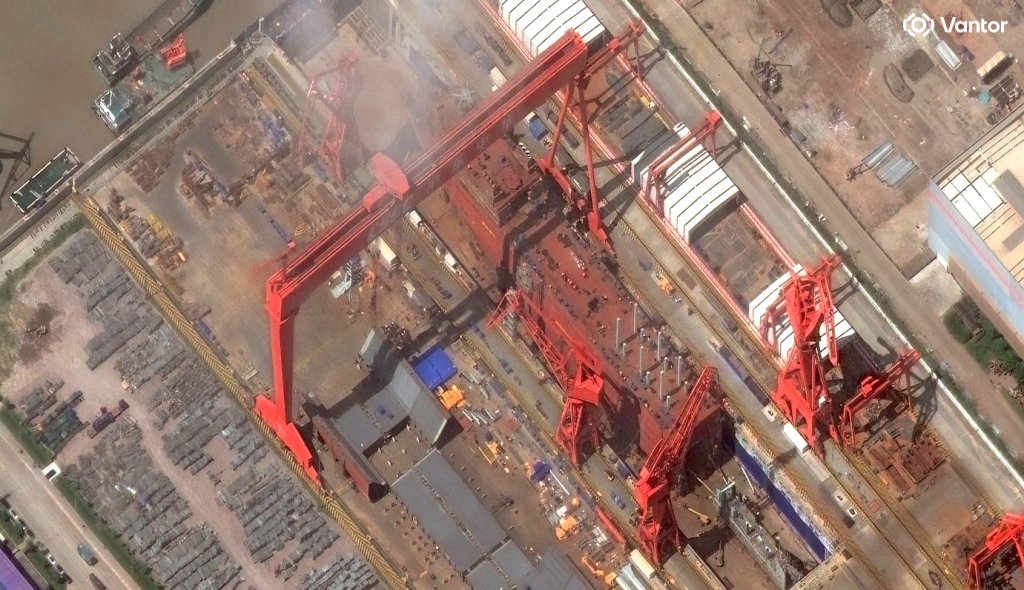
For the past six months or so, a curious-looking vessel with a very boxy superstructure has been taking shape at a shipyard in the Chinese city of Shanghai. A new satellite image lends credence to an earlier assessment that this is a mothership to support China’s growing fleets of ever-larger submersible drones, though it could also have other roles.

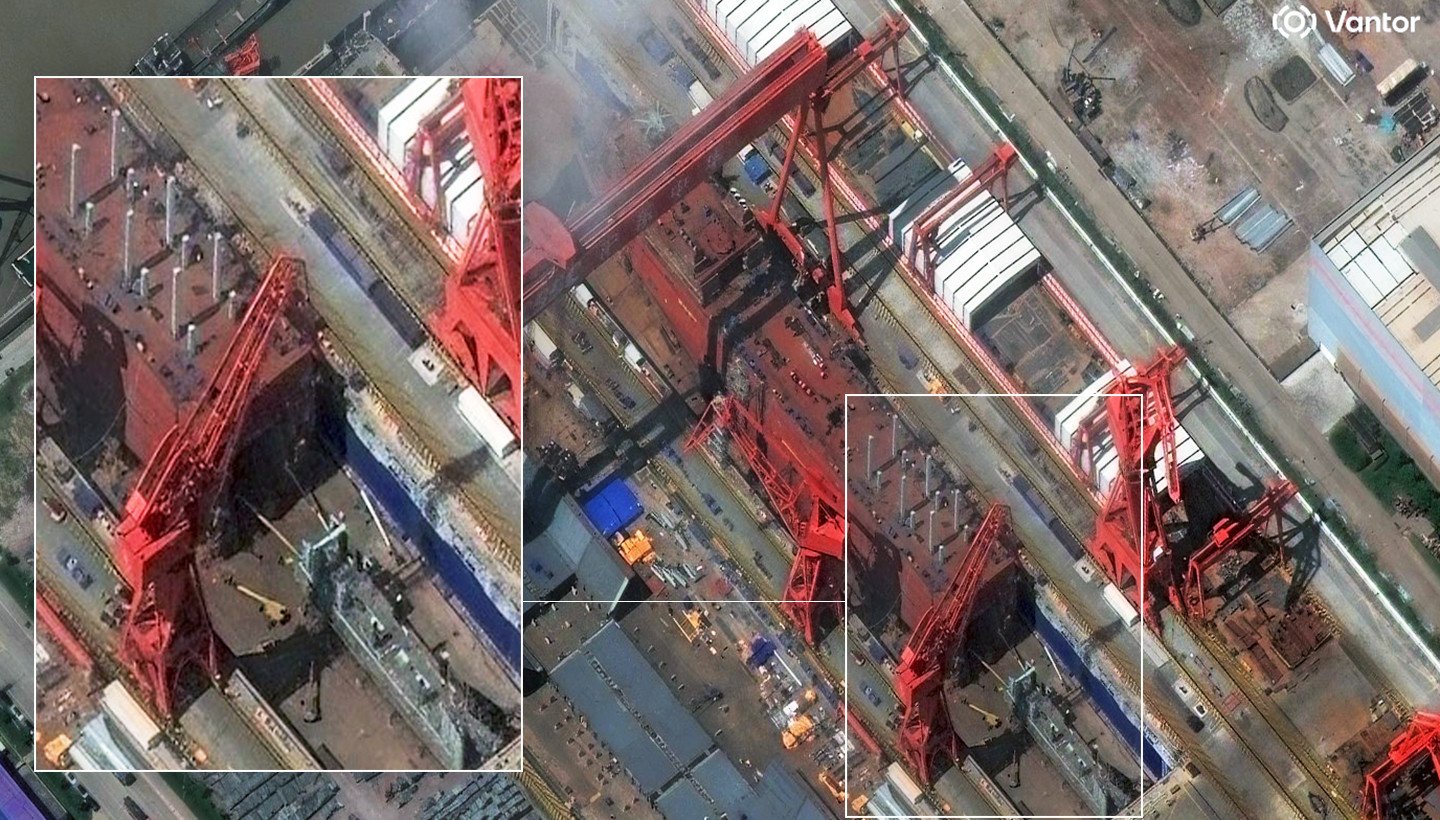
TWZ obtained the image of the ship in question, which was taken on September 10, from Vantor. Since then, it has also received an overall coat of gray paint, pointing to future service with the People’s Liberation Army Navy (PLAN). It is some 669 feet (204 meters) long and around 98 feet (30 meters) at its widest. In terms of basic length and width, the vessel being built now is very roughly comparable to China’s Type 071 amphibious warfare ship. However, it appears to be much taller overall than the Type 071.

The full September 10, 2026, image of the ship in question. Satellite image ©2026 Vantor
Another more recent view of the ship showing its new gray paint job. Chinese internet via X

The new ship has been under construction at the Hudong-Zhonghua Shipyard on Changxing Island in Shanghai since at least April. This yard produces a variety of naval vessels, including surface combatants and amphibious assault ships, as well as commercial designs.

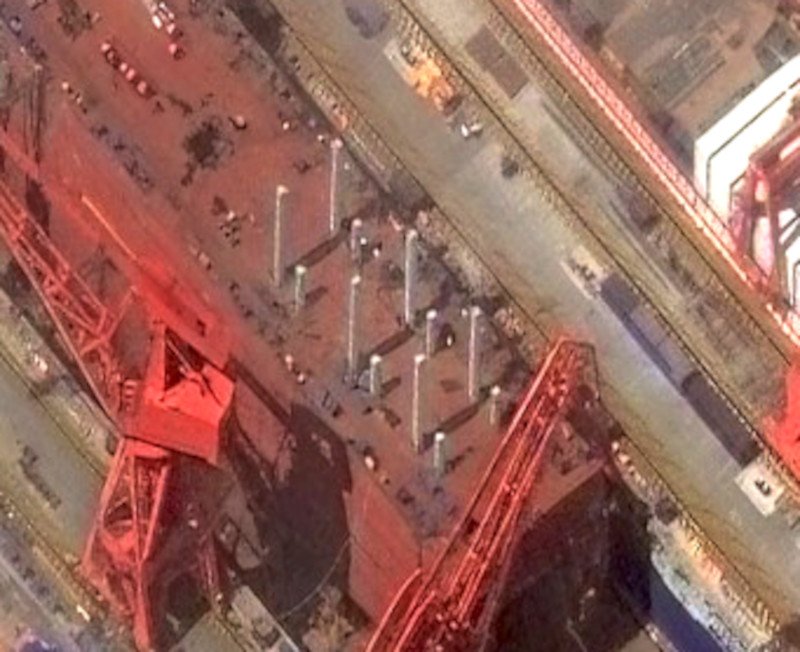
The September 10 image, which shows the ship from the stern, is interesting for a number of reasons. It notably confirms that the design not only has a well deck, but that it is sized around what looks to be a large cradle-like platform visible in the shot. The very roughly 164-feet (50-meter) long rectangular platform has an arch-shaped structure at one end and two teardrop-shaped ones at the other, as well as six pillars, three on each side, in between. The teardrop-shaped structures, in particular, point to the platform being at least a semi-submersible, as they would help with stability and otherwise guide the flow of water while being pulled along.

A closer look at the stern end of the ship, showing the opening for the well deck and the cradle-like platform. Satellite image ©2026 Vantor
An even closer look at the platform. Satellite image ©2026 Vantor
An earlier satellite image of the ship under construction taken on August 24, 2026, which also shows the cradle-like platform being built. Satellite image ©2026 Vantor

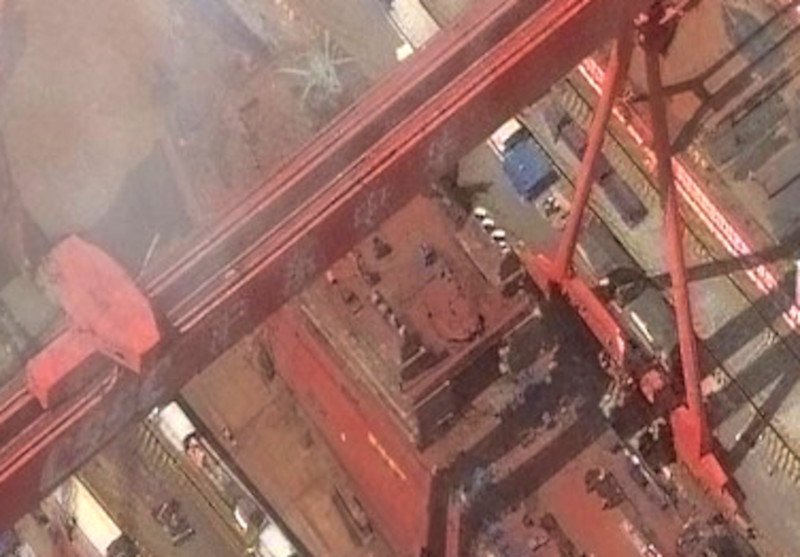
The satellite image also clearly shows six large struts extending from the top of the stern end of the superstructure, each one which is paired with a shorter strut, for a total of 12. Earlier this month, independent naval analyst H.I. Sutton, who tracks undersea warfare developments in particular, posited that these struts could be used to lower a platform or some other similar structure below the hull of the ship. He also assessed that they could be used as part of a larger system capable of moving payloads between decks internally. This would help account for the configuration of the core superstructure, especially how high it is all the way from the front to the back. Overall, signs point to the inside of the superstructure being largely hangars and other open work spaces, allowing for multiple large UUVs to be carried and supported. Individual UUVs would be launched and recovered, one at a time, via the cradle.

A closer look at the struts protruding from the top of the ship. Satellite image ©2026 Vantor

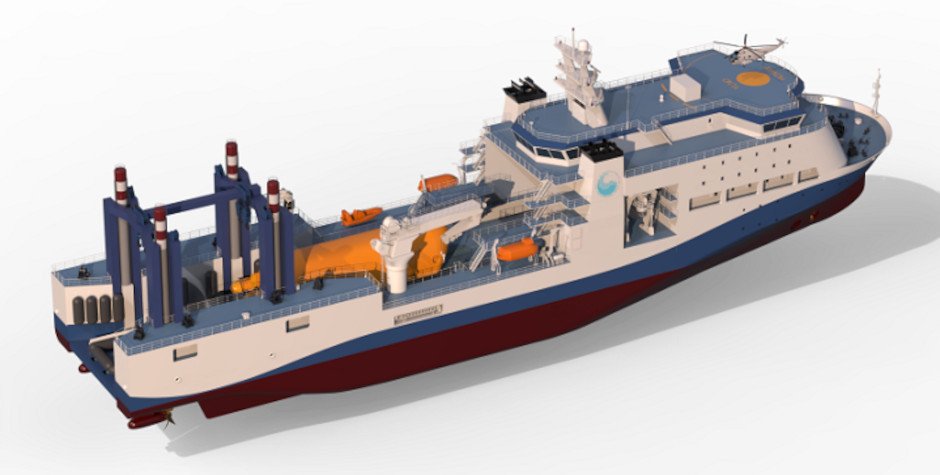
In making his assessment, Sutton drew specific attention to a previously shown rendering of a proposed Chinese scientific research vessel with a roughly similar strut-based system at the stern for deploying submersibles and other large payloads. However, on that design, the system was entirely exposed rather than contained with an extended superstructure.

The rendering of the proposed scientific research vessel with a system for deploying payloads at the stern that features four struts. Chinese internet via H.I. Sutton

The platform seen immediately behind the ship being built at the Hudong-Zhonghua Shipyard aligns with Sutton’s assessment about the purpose of the struts. At the same time, launches and recoveries could also be conducted in a more traditional manner via the well deck. The design of the cradle-like platform would seem to suggest the latter option is at least part of the plan.

The general idea of launching and recovering payloads through the bottom of the hull of a ship, including through moon pools, is hardly new. As another point here, Russia is known to have highly specialized mothership submarines that can carry crewed midget submarines and large uncrewed submersibles attached underneath their hulls, and that are also capable of launching ultra-long-range nuclear-powered and nuclear-armed torpedoes. The idea of deploying and retrieving large UUVs via well decks using cradle-like systems is something being explored by other navies globally, including in the United States. All that being said, a large specialized ship built for the purpose of launching and recovering very large underwater vehicles in an operational capacity is unique.

The image from September 10, as well as other recent views of the ship, highlight other features that are now taking shape. This includes a large opening on the starboard side, which could be for launching and/or recovering lifeboats or other watercraft, or moving payloads to and from the pier while docked, as well as a multi-pronged mast on top of the bridge. An additional part of the ship’s superstructure extends behind the bridge area, and there is what looks to be a hangar inside. There is no attached helipad present now, but one could well be added later on somewhere on top of the superstructure. Many naval auxiliaries, as well as commercial ships designed for offshore support and other specialized tasks, have open helipads on raised frames attached to different parts of the superstructures.

A closer look at the area of the superstructure around the bridge, showing the multi-pronged mast on top and what looks to be the opening to a hangar. Satellite image ©2026 Vantor

Though there is growing clarity about the ship’s design, many questions do remain about the full breadth of its intended purpose. In Sutton’s view, the PLAN has a need, just in general, for a dedicated mothership to support its growing uncrewed underwater vehicle (UUV) fleets. The PLAN is pursuing various tiers of UUVs to perform a host of different missions, including intelligence, surveillance, and reconnaissance (ISR), as well as mine-laying, special operations support, and even launching direct attacks on enemy vessels. Larger and larger UUV designs have been steadily emerging in China, which could require more specialized launch and recovery options to be feasibly employed operationally, especially from other vessels at sea. Deployment and retrieval at sea could, in turn, support very long duration missions far from China’s own shores.

“With smaller UUVs, even up to 20 meters like the AJX-002 and HSU-100 paraded in Beijing last year, they are road mobile. Truck mounted cranes should be sufficient for getting them in and out of the water making operations much simpler. With these latest, much larger XXLUUVs [extra-extra large uncrewed underwater vehicles] however, China will start to need dedicated port facilities,” Sutton wrote previously on his website. “Until now China has been using floating docks to house the two XXLUUV prototypes being tested on Hainan. One of these docks was purpose built while the other may have been taken up from general use.”

A Chinese AJX-002 UUV, or a mockup thereof, seen ahead of a major military parade in Beijing in 2025. Chinese internet via X

China's naval unmanned systems.

Consisting of (in order), AI enabled unmanned submersible (HSU-100), used for detection and attack.

Unmanned patrol boat.

Unmanned mine-laying/attack submersible (AJX-002), this was previously mistaken for a nuclear powered torpedo.
Because the… pic.twitter.com/Mlj55XLNBH

— Zhao DaShuai 东北进修🇨🇳 (@zhao_dashuai) September 3, 2025

“This arrangement also has a significant drawback: each floating dock can only carry a single XXLUUV,” Sutton added. “Or if more than one, then they both need to be placed in the water at the same time. Because the whole dock floods, there cannot be one undergoing maintenance while another is being launched or recovered.”

A mothership vessel able to discreetly deploy and recover large uncrewed and crewed submersibles and other large payloads underwater could be tasked with more specialized missions, including cutting cables, retrieving objects from the seabed, and other kinds of undersea espionage. There is overlap here with more benign roles, such as submarine rescue, salvage, and even deep-sea scientific research. There is also the matter of servicing an expanding array of Chinese underwater infrastructure, including sensor and communications networks. As something of a corollary, Russia’s spy ship Yantar is officially described as an oceanic research vessel. In China, the line between military and non-military assets and capabilities, including ships, is often very blurry, to begin with, as TWZ regularly highlights. This dichotomy was observed right at the Hudong-Zhonghua Shipyard around the end of last year after pictures of a commercial cargo ship being used to showcase a new family of containerized weapons, sensors, and other systems went viral online.

It is also worth pointing out that the boxy and largely enclosed design of the ship now being built at Hudong-Zhonghua Shipyard will inherently make it difficult to observe any activities onboard. This will have the additional knock-on effect of helping keep any payloads, as well as the crew, shielded from the elements. This could be valuable for operations in harsher locales, including waters in and around the Arctic, an ever-more strategic part of the world where China is working to be more engaged.

We also do not know if the apparent mothership vessel is intended to be a one-off or part of a larger class. It could be a stepping stone to broader plans or be part of an already extensive fleet of bespoke naval auxiliaries, as well as unique ostensibly commercial vessels, in service in China today. The PLAN’s aforementioned UUV ambitions will bring along significant test and evaluation requirements, as well as the need to support actual future operations.

If nothing else, evidence is only growing that the new ship under construction at the Hudong-Zhonghua Shipyard is intended to serve, at least in part, as a mothership for large submersible drones.

Contact the author: joe@twz.com

The post China Appears To Be Building A Mothership For Large Uncrewed Submarines appeared first on TWZ.
  •  

Torpedo Fired From Uncrewed Submarine For The First Time By U.S., U.K.

A British Excalibur uncrewed underwater vehicle (UUV) has fired a U.S. Mk 48 heavyweight torpedo in what is said to be a first-of-its-kind test for both countries. Though just a proof-of-concept so far, this is a significant new step for the United States and the United Kingdom toward future operational fleets of armed UUVs.

The U.S. Navy and the Royal Navy conducted the armed UUV test at the British Underwater Test & Evaluation Center (BUTEC), a maritime test range in Scotland, on September 13. Personnel from the Pentagon’s Defense Innovation Unit (DIU) and the Naval Undersea Warfare Center Keyport Division (NUWC Keyport), as well as unspecified industry partners, also took part, per a U.S. Navy press release.

📰 U.S. NAVY UPDATE: U.S. Navy and Royal Navy Successfully Test Fire Torpedo from Unmanned Undersea Vehicle

📍WASHINGTON – On September 13, 2026, the U.S. Navy and the Royal Navy successfully conducted the proof-of-concept launch of an exercise U.S. Mk 48 Heavyweight Torpedo… pic.twitter.com/lVB4wYSwC0

— Office of the Chief of Naval Operations (@USNavyCNO) September 22, 2026

The test was also carried out under the umbrella of Pillar 2 of the trilateral Australia-United Kingdom-United States (AUKUS) defense cooperation agreement, which was first announced in 2021. AUKUS’ Pillar 2 covers a wide range of advanced technology cooperation, with particular focus on uncrewed platforms and autonomy. Pillar 1 of the agreement centers on support for Australia’s establishment of a nuclear submarine force.

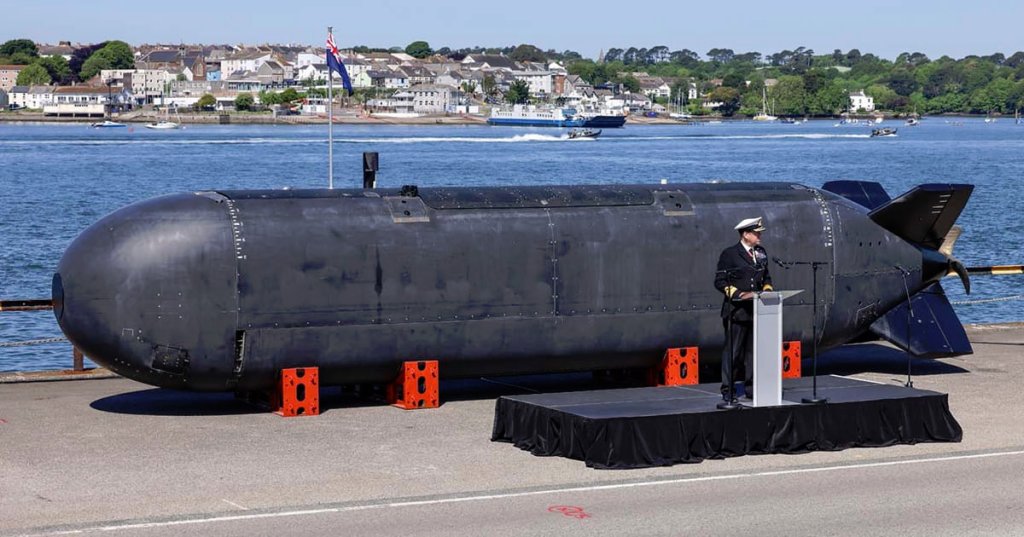
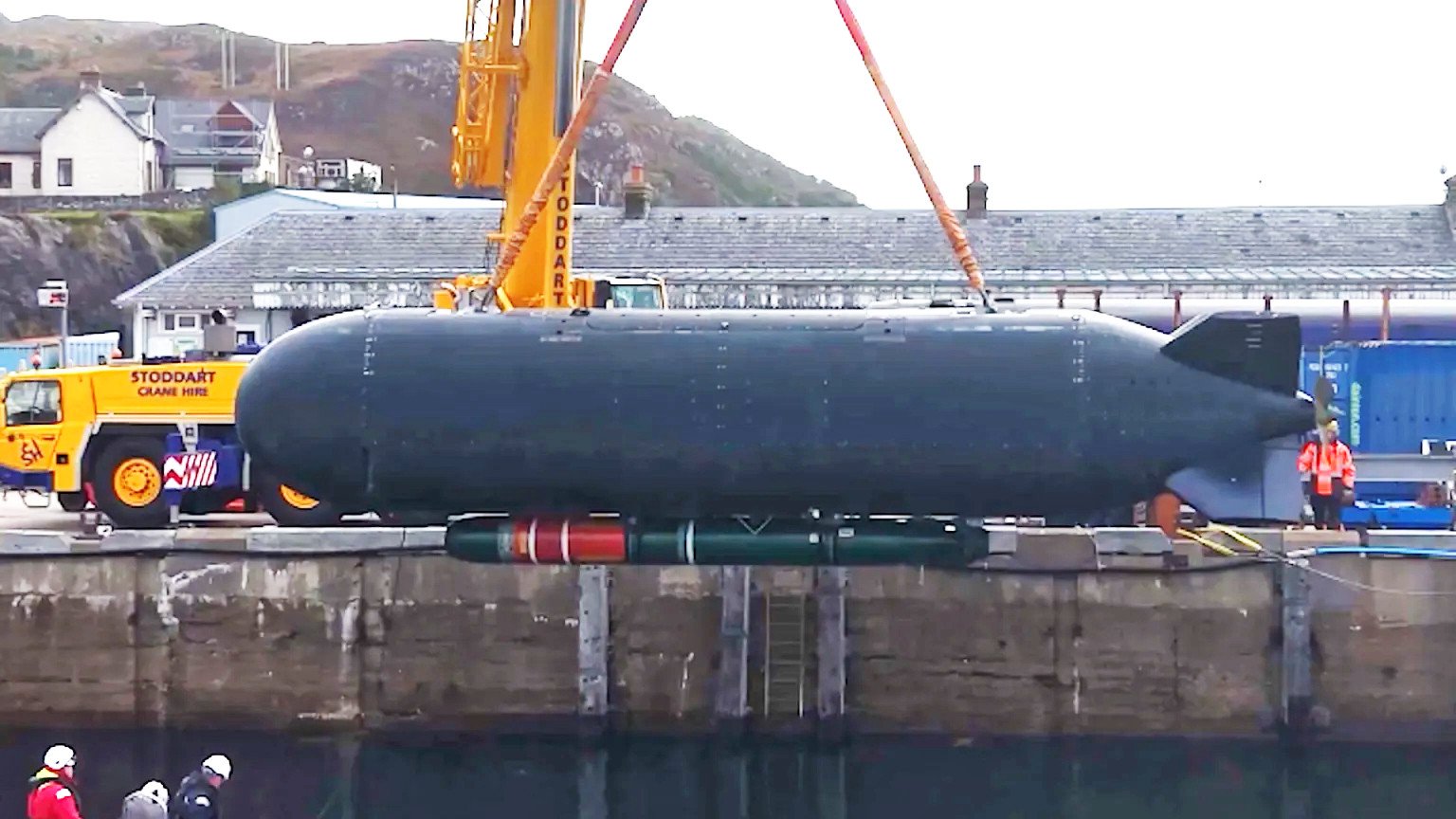
For the September 13 test, the Mk 48 torpedo was slung under the Excalibur UUV. The nearly 40-foot (12-meter) long, 19-metric-ton submersible drone has a large internal payload bay, but it is reportedly not large enough to accommodate the Mk 48, which is the standard heavyweight torpedo in U.S. Navy service today. The 19-foot-long, 21-inch-diameter weapon has been successively upgraded over the years to expand its capabilities and improve its resistance to enemy countermeasures.

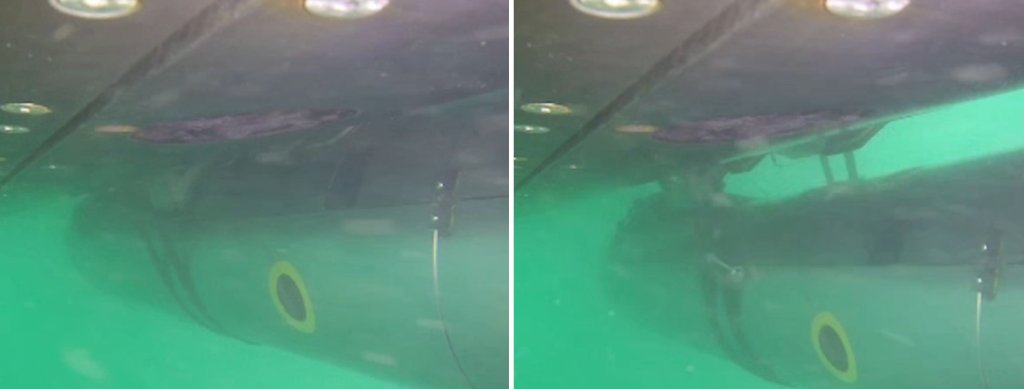
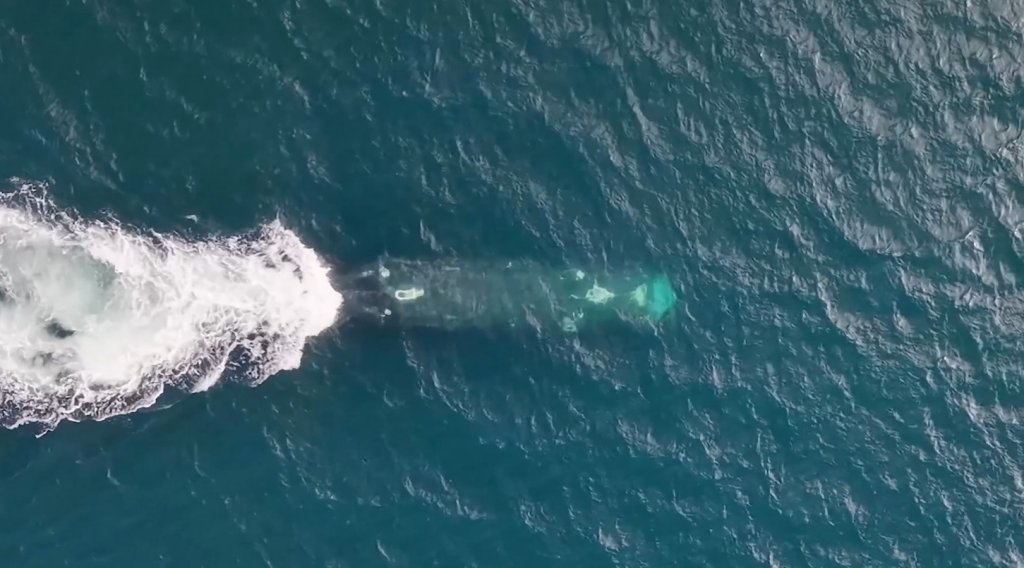
Screen captures from a video the US Navy released today showing the release of the Mk 48 torpedo from the Excalibur UUV during the test earlier this month. USN captures
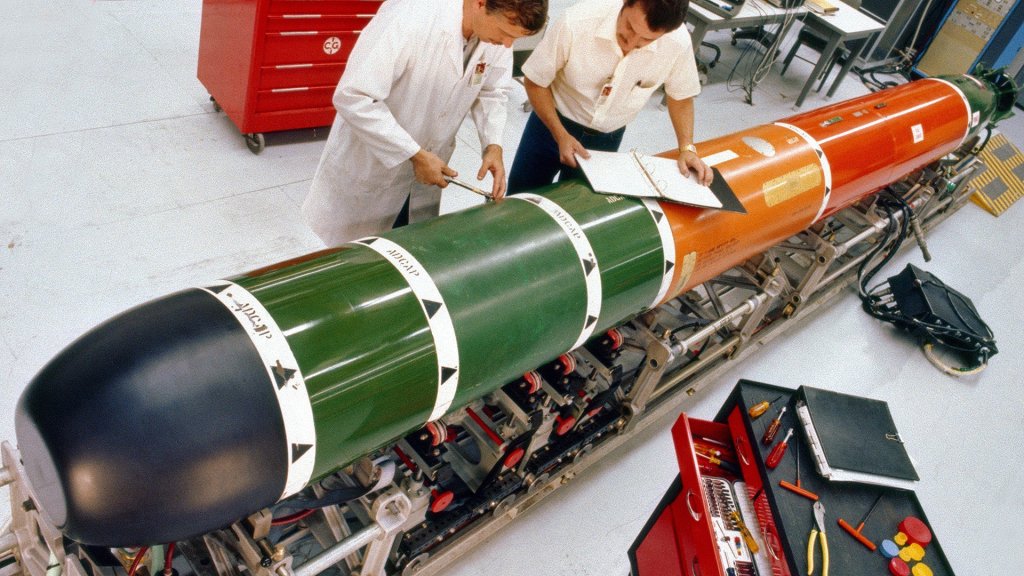
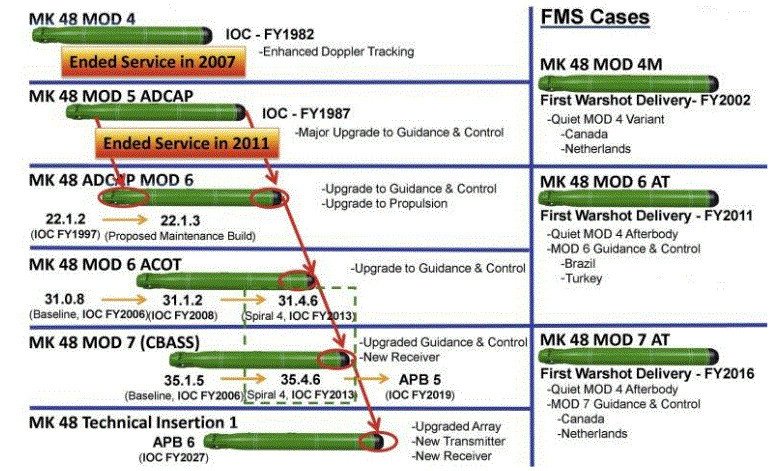
A stock picture of a Mk 48-series torpedo. DOD
A US Navy infographic detailing just some of the upgrades to the Mk 48 series over the decades. The Navy has now moved on to the further improved Mk 48 Mod 8 variant. USN

The Royal Navy officially unveiled Excalibur, which was developed by U.K.-based MSubs under Project Cetus, last year. The external torpedo launch capability was the result of two additional efforts, called Project Broadsword and Trial Iron, according to the U.S. Navy release.

A picture of an Excalibur UUV at the time of its unveiling in 2025, giving a good general sense of its size. Royal Navy

The September 13 test “successfully validated the mechanical, electrical, and software integration of a U.S. kinetic payload onto an allied autonomous vessel, proving that allied forces can rapidly achieve weapon interchangeability,” the Navy’s release adds. “Approved in February 2026 by the Department of the Navy Rapid Capabilities Office (DONRCO), the project was executed in less than seven months.”

How the Excalibur UUV was controlled during the test and whether the torpedo was launched at a test target of some kind are unknown. TWZ has reached out for more information.

A look at the Excalibur UUV submerged, from the video the US Navy released today. USN capture

“BROADSWORD is a great example of how AUKUS Pillar II drives interoperability in across the alliance. Demonstrating the launch of a US torpedo from a UK extra-large unmanned underwater vehicle (XLUUV) is an important early step in developing lethality in our undersea autonomous systems,” U.S. Navy Vice Adm. Robert Gaucher, Director of Submarine Programs, did say in a statement. “We look forward to continuing to leverage the AUKUS partnership to keep pushing the potential warfighting advantages of unmanned undersea systems.”

“This successful test marks a historic first for allied undersea warfare,” U.S. Navy Adm. Daryl Caudle, Chief of Naval Operations, also said in a statement. “Proving that we can seamlessly launch a U.S. heavyweight torpedo from a Royal Navy autonomous underwater vehicle validates our shared vision for true interchangeability.

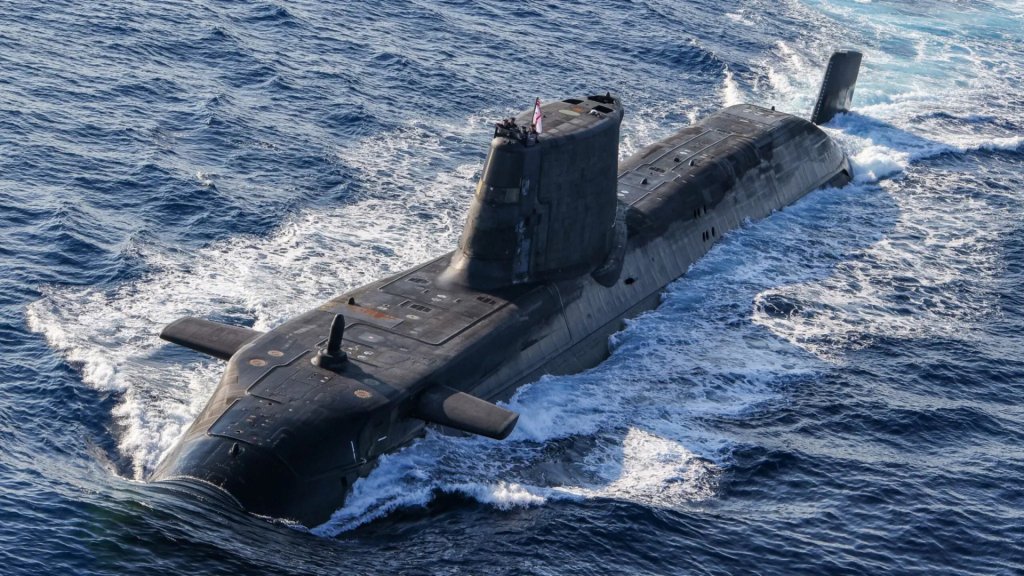
“This is a really important moment in our journey towards building a hybrid navy, which is where the Royal Navy will sail with crewed ships and submarines alongside uncrewed and autonomous vessels,” Luke Pollard, U.K. Minister of State for Defence Readiness and Industry, separately said in an interview with LBC radio. “It is a substantial increase in our lethality, to show that torpedoes can be fired not just by the Astute class hunter-killer submarines that we have in the Royal Navy, but also now by our uncrewed systems.”

A Royal Navy Astute class nuclear-powered attack submarine. UK Ministry of Defense

The U.S. Navy and the Royal Navy employ various tiers of UUVs operationally today, but primarily for mine-sweeping and reconnaissance and surveillance missions. Future fleets of submersible drones capable of carrying out attacks on other vessels will create entirely new operational possibilities. Operated closely together with crewed surface warships and submarines, torpedo-toting UUVs could be sent ahead into riskier environments and offer an immediate option for engaging any threats they might find. Even a bigger UUV like Excalibur would also be more challenging for opponents to spot and track than a traditional attack submarine.

Excalibur is also in a category of larger and more capable submersible drones that offer significant endurance and higher degrees of autonomy. Adding in the ability to launch torpedoes, in turn, then opens the door to new concepts for employing these UUVs in groups more independently of crewed companions. In the future, for instance, armed Excaliburs or similar UUVs might be deployed to a particular maritime choke point to not just monitor for enemy movements, but actively hold them at risk.

In addition, in general, UUVs offer a way to expand total undersea warfare capacity in a more cost-effective manner compared to acquiring and fielding more traditional submarines. The ability to have more presence below the waves at a lower price point also translates to more persistence across large areas, something that could be especially valuable across the broad expanses of the Pacific, as well as other bodies of water globally. This presents additional targeting challenges and uncertainty for opponents.

“In securing the North Atlantic, especially against those nations that wish to do us harm, like Russia, the ability for us to now say it’s not just where our submarines are that you need to worry about – it is about how we create greater deterrence and question marks in the eyes of our adversary, with uncrewed systems there as well,” U.K. Minister Pollard said in speaking with LBC.

Pollard’s remarks here speak to particular considerations the British government is faced with just in its backyard. This includes the so-called Greenland-Iceland-United Kingdom (GIUK) Gap, which is the main path through which Russian Navy submarines transit to and from bases in the northwestern end of that country and the Atlantic proper. There is also the English Channel and the nearby Baltic Sea. The Royal Navy has limited capacity with its crewed submarines to monitor this and other critical regional chokepoints. UUVs could then help take pressure off its fleet of just five (of a planned seven) Astute class submarines, helping free those boats up for the myriad other missions they are tasked with, including carrier escort and special operations support.

“By converting commercial and allied uncrewed undersea hulls into high-end strike assets, the partnership drastically alters the cost-exchange ratio in contested maritime environments,” the U.S. Navy’s press release today notes, as well.

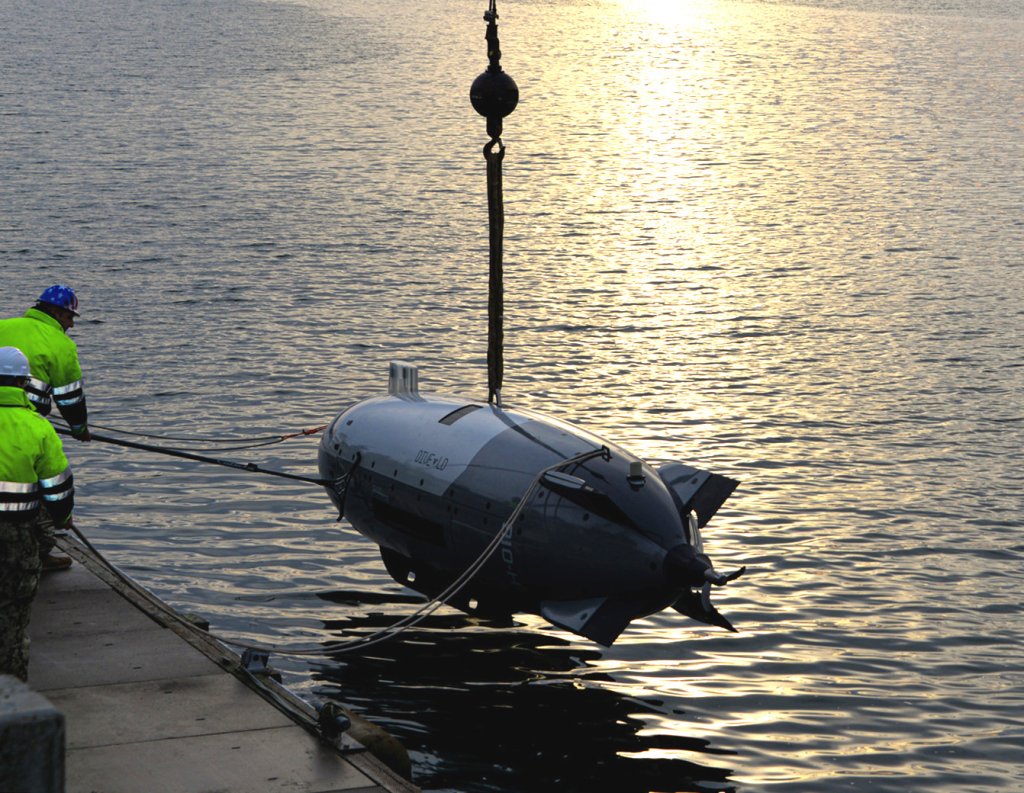
There are still many questions still to be answered about future larger UUV operations, including just how they will be deployed and recovered. Video the U.S. Navy released today shows that the torpedo-armed Excalibur was launched into the water in Scotland using a commercial truck-mounted crane. U.S. shipbuilders Huntington Ingalls Industries (HII) and General Dynamics National Steel and Shipbuilding Company (NASSCO), among others, have been working on new options for launching and retrieving larger drone submersibles from surface warships. External carriage on the hulls of ships and/or submarines might also be an option in the future.

A picture from a test in 2022 of a prototype portable cradle for launching large UUVs developed by HII. The UUV seen here is that company’s Proteus design. HII

Additional torpedo and other munition options for UUVs beyond the full-size Mk 48 could also be on the horizon. The U.S. Navy has invested heavily in compact and lightweight torpedo designs that could be well suited for employment from underwater drones like Excalibur.

The U.S. Navy says it is working with its international partners on another similar UUV capability demonstration, but this time involving an Anduril Dive-XL, under what is dubbed Project Cutlass. This effort “will tackle advanced payload integration data, command and control architectures, and tactical employment scenarios to further mature uncrewed undersea capabilities,” according to the U.S. Navy’s release.

The Royal Australian Navy is already in the process of acquiring and fielding a militarized version of the Dive-XL, called Ghost Shark. It’s also worth noting that the Dive-XL evolved from the earlier Dive-LD design. The Dive-LD is in at least limited operational U.S. Navy service now, a fact that was revealed by Iran’s capture of one of these submersible drones earlier this month, as you can read more about here.

The U.S. Navy is also continuing to push ahead with plans to field a force of Orca XLUUVs from Boeing. In August, the service announced that an Orca had conducted a 1,000-nautical-mile transit in the Pacific the preceding month as part of the ongoing development of that design.

Other countries are pursuing larger UUVs, as well. China has been making strides in this regard and is in some ways ahead of other competitors globally.

Excalibur’s ability to launch a standard Mk 48 heavyweight torpedo is already an important show of progress now toward a shared goal of a future underwater ecosystem that includes submersible drones that are able to attack other vessels.

Contact the author: joe@twz.com

The post Torpedo Fired From Uncrewed Submarine For The First Time By U.S., U.K. appeared first on TWZ.
  •  

Everything We Know About The U.S. Navy’s Submersible Drone Iran Just Captured

The U.S. Navy has lost an advanced uncrewed underwater vehicle (UUV), and it is now in Iranian hands. Here’s what we know about the Dive-LD drone and its apparent seizure, and its implications.

Authorities in Iran said earlier today that they had retrieved a U.S. Dive-LD uncrewed underwater vehicle (UUV) largely intact near the Strait of Hormuz. The regime in Tehran subsequently released pictures and video clips of the UUV being lifted out of the water, seen at various points below. This looks to be the first known instance of an operational deployment of the Dive-LD. This is still a relatively new capability for the U.S. Navy that only began entering service a little more than a year and a half ago. American officials have previously confirmed the use of UUVs, in general, to help keep the Strait of Hormuz free of Iranian naval mines, one of many threats that have dramatically slowed maritime traffic through this critical waterway.

Iran’s Islamic Revolutionary Guard Corps (IRGC) “captured one of the most modern, unmanned, and smart submarines … at the entrance to the Strait of Hormuz in a complex intelligence and operational action at dawn today,” according to a statement shared earlier today via Iranian state media. The exact circumstances surrounding the seizure remain unconfirmed.

“An underwater drone operated by U.S. forces malfunctioned more than a day ago,” a U.S. official said in response to our queries about the Iranian claims. “It was surveying regional waters in support of ongoing operations. The defective drone was an older model that neither collected sensitive data nor carried any classified sonar or radar equipment. U.S. operations in area waters continue.”

A top-down look at the Dive-LD Iran said it recovered. Iranian quasi-state media via X
An image showing the Dive-LD UUV being hoisted out of the water. Iranian quasi-state media via X
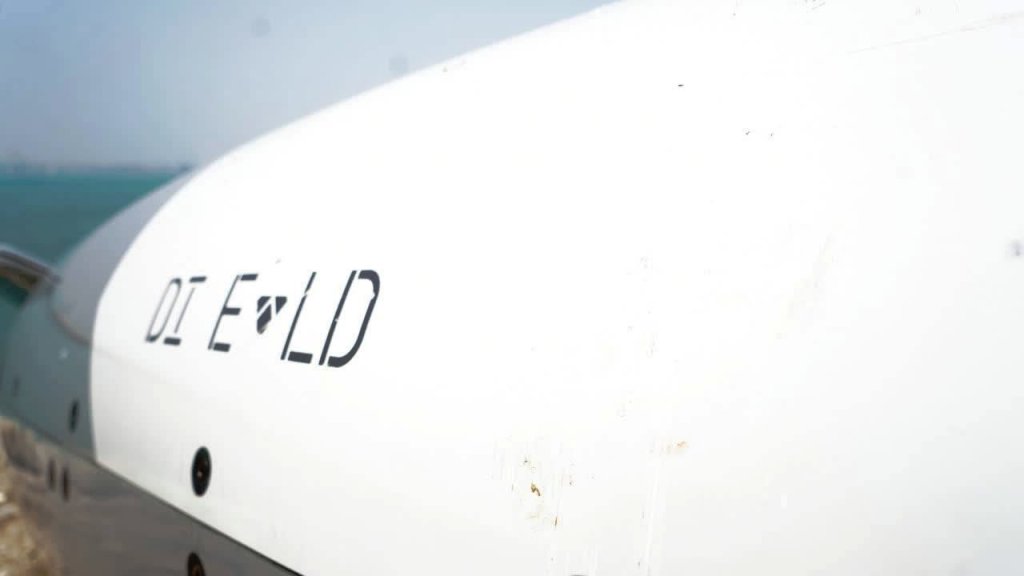
The Dive-LD markings, with the “V” worn away, seen on the side of the UUV. Iranian quasi-state media via X

The official did not confirm or deny the type of UUV in question, or that Iran had retrieved it. They also did not elaborate on the nature of the malfunction. TWZ also reached out to Anduril, which initially deferred any questions to U.S. Central Command (CENTCOM). However, they subsequently confirmed the loss of a Dive-LD operating in the region.

“Dive-LD is an attritable autonomous system, meaning it is designed from the outset to operate in dangerous environments where loss of the vehicle is an expected possibility. Its purpose is to keep warfighters out of the most dangerous parts of the undersea mission,” an Anduril spokesperson told us in a statement. “This vehicle had already delivered significant value operating thousands of hours in months-long operations in CENTCOM.”

Categorized as a large UUV, the Dive-LD is 19 feet (approximately 5.8 meters) long, four feet (around 1.2 meters) in diameter, and has a gross weight of close to three tons. The design features a 3D-printed exterior, but is said to be capable of diving down to depths of some 19,685 feet (3.7 miles or 6,000 meters). The UUVs can also remain at sea for around 10 days at a time, depending on their exact configuration, and do so with a high degree of autonomy. Dive-LD was originally developed by U.S.-based Dive Technologies, which was founded in 2018 and then acquired by Anduril in 2022.

Anduril announced the delivery of the first Dive-LD to the U.S. Navy’s Unmanned Undersea Vehicle Group One (UUVGRU-1) in April 2025. The Navy had already released a picture of personnel training with one of these UUVs five months earlier. How many Dive-LDs are now in U.S. service is unclear.

Members of Unmanned Undersea Vehicle Group One (UUVGRU-1) and Undersea Vehicle Squadron Three (UUVRON-3) train with a Dive-LD UUV in December 2024. USN

The Dive-LD has a highly modular design. Anduril’s website says that the UUV can be configured for various military missions, including so-called intelligence preparation of the operational environment (IPOE); general intelligence, surveillance, and reconnaissance (ISR); mine warfare; and precision placement of objects underwater. IPOE refers to the collection of various types of intelligence on a specific area as part of planning for upcoming operations.

As mentioned, U.S. officials have previously stated that UUVs have been supporting mine-clearance operations in and around the Strait of Hormuz. Broadly speaking, uncrewed underwater platforms offer a way to find and record the location of naval mines using sonars, cameras, and other sensors, while helping keep friendly forces further away from potential threats. Afterward, depending on the type of mines that are found, various methods can be employed to neutralize them. Mine sweeping is time-consuming and dangerous, even in permissive environments, let alone when conducted under the threat of enemy attack.

This past weekend, the Financial Times newspaper in the United Kingdom published a story saying U.S. forces have been using UUVs in exactly this way to help clear Iranian mines, citing “people familiar with the operation.”

“Mostly at night, it [the U.S. military] sent Navy Seal [sic SEAL] divers, robot boats and specialised underwater craft into the perilous strait for a four-month mine-clearance mission,” according to FT‘s report. “U.S. Navy divers worked in small teams using inflatable-hulled craft. They located Iranian mines with the help of robot boats and submersibles – such as the U.S. Navy’s Common Uncrewed Surface Vessel – operating towed sonar arrays.”

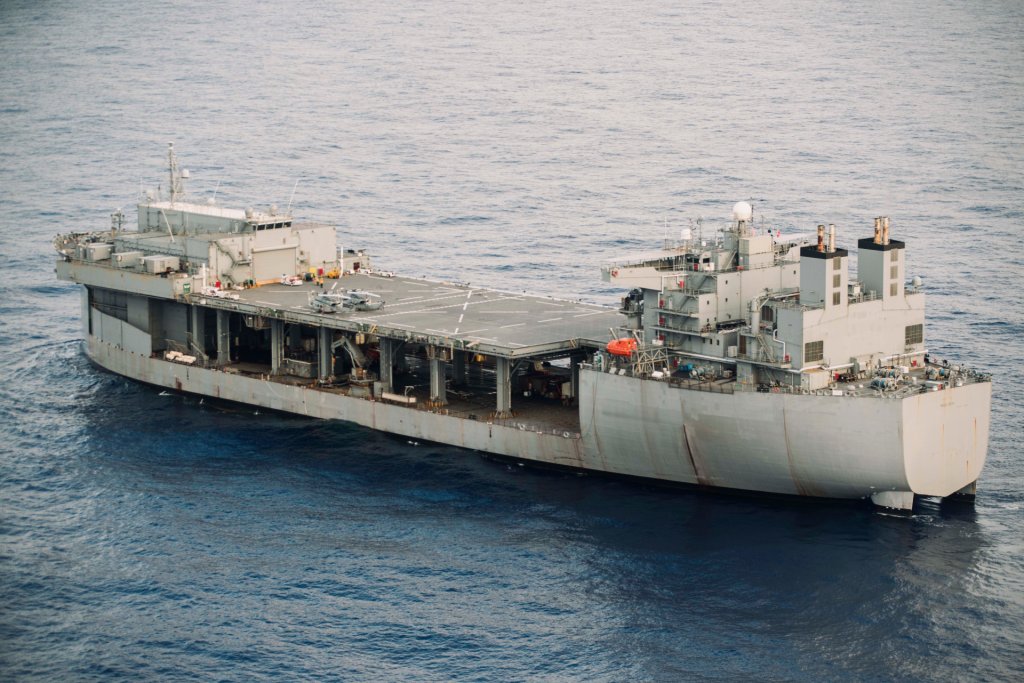
The Common Uncrewed Surface Vessel (CUSV) is a speedboat-sized drone boat that has been in Navy inventory since the early 2020s, explicitly for counter-mine operations. FT‘s story does not say where any USVs, UUVs, and/or boats full of divers were launched from as part of these operations in and around the Strait of Hormuz, but it posited that the Navy’s Expeditionary Sea Base ship USS Miguel Keith could have been involved.

A stock picture of the US Navy’s Expeditionary Sea Base ship USS Miguel Keith. USMC/Sgt. Luis Agostini

A trio of Independence class Littoral Combat Ships specifically configured for mine-sweeping duties, including using CUSVs, had been forward deployed in Bahrain before the start of the conflict with Iran in February. At least two of those ships, USS Santa Fe and USS Tulsa, emerged thousands of miles away in Southeast Asia in March, something TWZ was the first to report on. At the time of writing, those ships currently appear to be in Singapore. The exact disposition of the third of these LCSs, the USS Canberra, is unclear, but USNI News reported today that it is sailing in the South China Sea.

The Navy has a host of other warships in the Middle East that could support counter-mine missions. With a 10-day endurance, Dive-LDs, specifically, could potentially have been launched from locations away from the Strait of Hormuz, including friendly ports.

Dive-LDs could also be used for other missions beyond mine clearance in the region. As mentioned, the U.S. official told TWZ the UUV had malfunctioned while “surveying regional waters.” While this would be a relevant task in the context of a larger mine-sweeping operation, underwater surveys would be valuable for other purposes, too. For months now, U.S. forces have been facilitating the movement of ships in and out of the Persian Gulf via a route that hugs the Omani coastline, keeping them as far from Iranian threats as possible. Having up-to-date and highly accurate maps of the seafloor in these areas would be critical to ensuring they are deep enough for large commercial vessels to pass through safely.

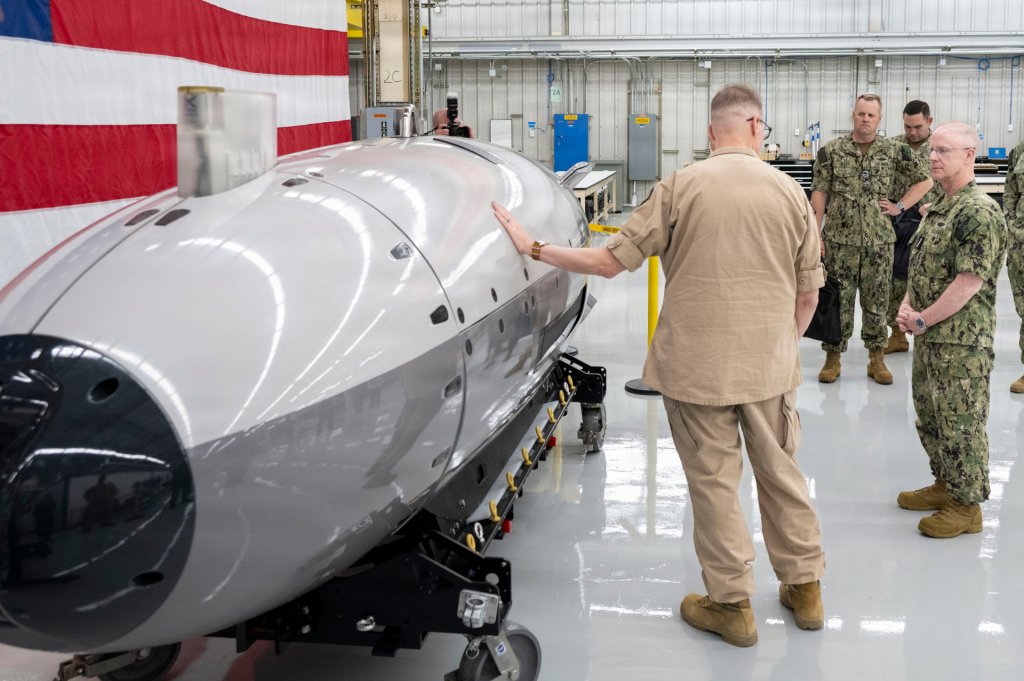
Chief of Naval Operations Adm. Daryl Caudle, at right, is shown a Dive-LD UUV during a visit to Naval Base Kitsap-Keyport, Washington, in June 2026. USN

IPOE and general ISR support, above and below the waves, would be part of any current or future U.S. activities in the region. This includes a new campaign of strikes targeting Iranian tanker ships that began last month and monitoring general port activity in Iran as part of the ongoing blockade.

Employing Dive-LDs in operations against Iran also provides a valuable real-world opportunity to prove out new UUV capabilities and associated tactics, techniques, and procedures, which could prove critical in a future high-end fight against a peer opponent like China. Dive-LD has been feeding into Anduril’s development of an even more capable large UUV called Ghost Shark, the first customer for which is the Royal Australian Navy. Ghost Shark is a militarized version of a design called the Dive-XL that followed the Dive-LD. In March, Anduril announced it was among those selected for the Combat Autonomous Maritime Platform Project (CAMP), an extra-large uncrewed underwater vehicle rapid prototyping effort being run by the Pentagon’s Defense Innovation Unit (DIU) and the Navy. Anduril did not say what platform it would be supplying for that project, but used a picture of Ghost Shark to illustrate the announcement.

The U.S. military is already known to have taken advantage of the ongoing conflict with Iran to demonstrate new weapon systems and other capabilities, including uncrewed maritime systems. In June, a Saronic Corsair drone boat conducted a first-of-its-kind at-sea rescue of the crew of a U.S. Army AH-64 Apache attack helicopter that had gone down in the Gulf of Oman. The following month, U.S. forces launched their first known kamikaze USV attack on Iran’s Bandar Abbas Naval Base using explosive-laden Corsairs.

With all this in mind, it is worth noting that the apparent loss of a Dive-LD intact to Iran is still significant, even if the core design is not brand new and if it does not have any especially sensitive mission systems onboard. It is not necessarily ‘exquisite,’ bleeding-edge technology as it is designed to be optionally attritable, but is still an advanced modern system in operational U.S. service now. Insights into its capabilities and limitations would certainly be of interest to Iran and others. What attempts the U.S. military made to recover the Dive-LD are also unknown. However, the fact that it was not destroyed before or while the Iranians were retrieving it points to American forces having completely lost any sense of its location beforehand.

For its part, Iran has long been a collector of foreign military hardware, primarily U.S. and Israeli, including drones of all types. The capture of a largely intact RQ-170 Sentinel in 2011 is the most famous (or infamous) example. The regime in Tehran also regularly works to reverse engineer what it recovers to varying degrees, and has promised to do the same with the Dive-LD. It could also share its latest prize with its own international partners, including Russia and China, for further analysis and exploitation. The Chinese People’s Liberation Army Navy (PLAN) notably has its own very active UUV programs.

On top of all this, the seizure offers propaganda benefits for the Iranian government, which is already making heavy use of the information space to push back against U.S. military and economic pressure.

Countries seizing foreign USVs and UUVs is certainly not new at this point, even in ostensible peacetime periods. TWZ pointed out that this was only likely to become commonplace, and that steps would need to be taken to address these risks, after a pair of incidents involving Iran in 2022. On August 29 of that year, the Iranian Islamic Revolutionary Guard Corps (IRGC) attempted to capture a U.S. Navy Saildrone USV in the Persian Gulf. Just days later, the IRGC briefly commandeered a pair of American Saildrones in the Red Sea.

The current conflict with Iran has only further underscored the important roles that uncrewed maritime platforms are playing in U.S. operations now, which are only set to keep growing as time goes on. As those same operations expand, so will the risks of capture and other losses.

Contact the author: joe@twz.com

The post Everything We Know About The U.S. Navy’s Submersible Drone Iran Just Captured appeared first on TWZ.
  •  
❌