❌

Reading view

Venezuela Sets Youth Popular Consultation for February 2027
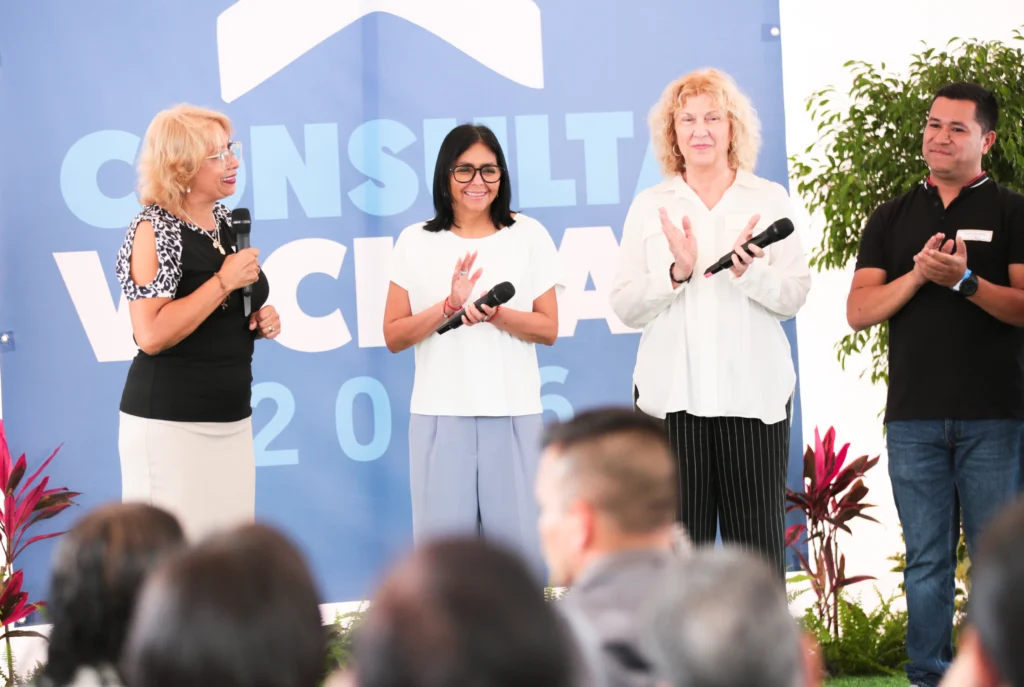
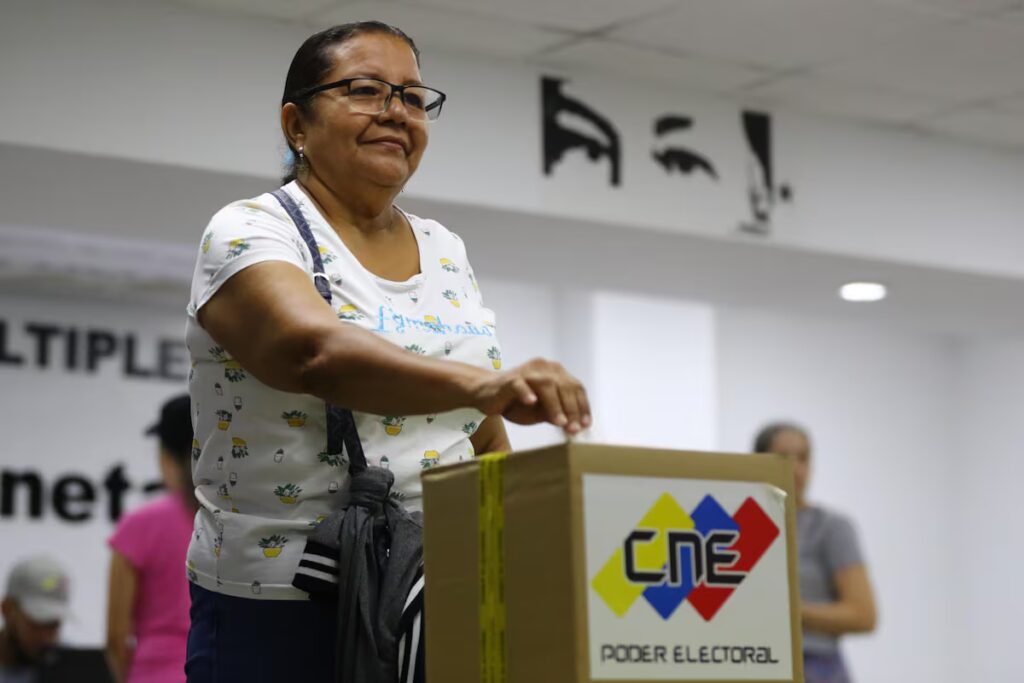
The Venezuelan Acting President urged young people to prepare actively for this new democratic appointment that will mark the course of next year. Photo: Venezuelan Presidential Press.

Acting President Delcy Rodríguez announced Wednesday that Venezuela will hold its Youth Popular Consultation in February 2027, a vote she framed as a platform for young people to convert their talent, creativity and ingenuity into a driving force for national development.


Venezuelan Acting President Delcy Rodríguez delivered the announcement during a visit to the Nueve Raíces de Simón communal circuit, where she urged the country’s youth to prepare actively for what she described as a democratic appointment that will mark the direction of the coming year.

Rodríguez said the process aims to vindicate the talent, creativity and ingenuity of the new generations and to propel Venezuela toward fresh development opportunities. The call places younger Venezuelans at the center of a participatory model that has gathered strength since 2024.

RELATED: Venezuela to Begin Funding Projects Selected in Popular Consultation Next Week

The announcement lands days after the Second National Popular Consultation of 2026, held on October 18. It was the eighth nationwide vote of its kind since 2024, and officials described the turnout as massive and successful. That result has now been translated into a fresh appeal aimed specifically at young people, signaling the government’s intention to widen the base of participants in community decision-making.

🗳️🔥 ¡LA JUVENTUD SE PREPARA: NUEVA CONSULTA EN FEBRERO 2027!🇻🇪✨

Tras una participación histórica en la pasada Consulta Nacional Popular, la ruta continúa: ¡Jóvenes de toda Venezuela a prepararse desde ya! 💪🌱

El compromiso no se detiene: es momento de seguir adelante,… pic.twitter.com/YyOteBQqLT

— Ministerio del Poder Popular para la Juventud (@Minjuventud__ve) October 21, 2026

Text reads: “Youth is preparing: new consultation in February 2027! After a historic participation in the last National Popular Consultation, the route continues: Young people from all over Venezuela to prepare now! The commitment does not stop: it’s time to move forward, organize and execute projects that will transform our territories.”

A Record October Turnout

Millions of residents from communities across the country turned out on October 18, prompting the National Electoral Council (CNE) to extend voting by one hour.

The scale of the exercise was measured in large numbers. More than 5,418 communes and communal circuits coordinated the work of over 48,000 communal councils, and voters selected among 37,205 priority community projects eligible for public financing.

Rodríguez has championed the consultation model as a vehicle for what officials call popular power. In separate remarks, she described participation in the October exercise as extraordinary, linking the strong turnout to a broader effort to place public decision-making directly in the hands of organized communities rather than distant institutions.

A Broader Community Voice

One of the most notable features of the October consultation was the first-time inclusion of condominium boards, which put forward 428 projects. Acting President Rodríguez celebrated that milestone on social media, underscoring the importance of keeping decisions about everyday matters firmly in the hands of communities themselves.

The proposals reflected local priorities. Acting President Rodríguez had previously detailed that 14% of the projects corresponded to the water sector, followed by initiatives in road infrastructure, lighting, electricity, public services and productive activities, showing residents directing public resources toward their most pressing daily needs.

With the youth consultation now scheduled for February 2027, the Acting President called young Venezuelans to assume what she called absolute protagonism in the process. Organizers expect the new consultation to build on the machinery tested in October and to channel the energy of younger generations into decisions that will shape the country’s near-term path.
  •  

Venezuela’s Acting President Reviews Wage Consensus With Business, Unions

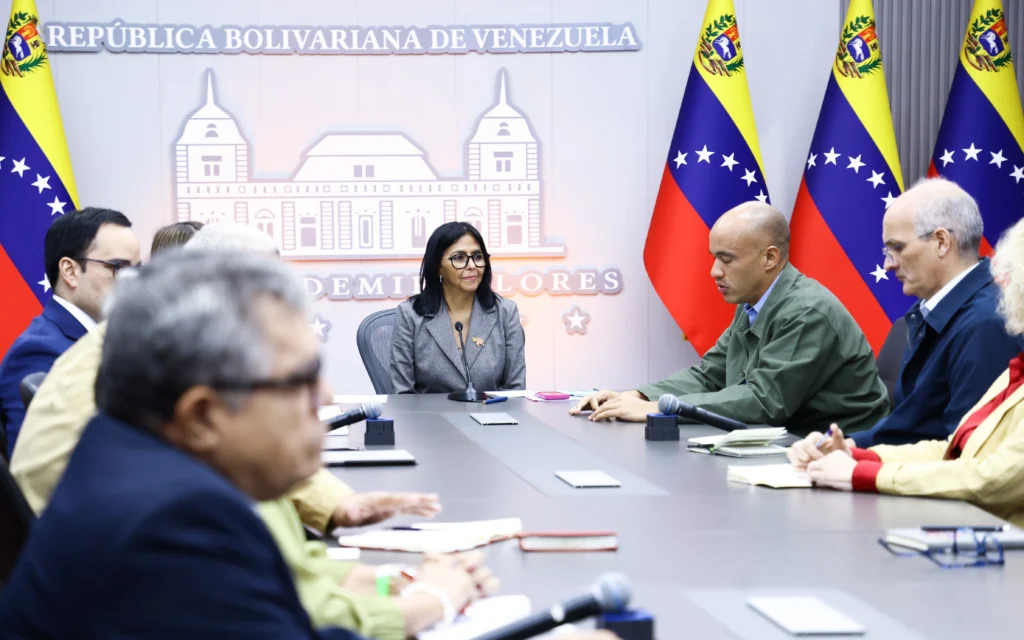
The Acting President, Delcy Rodríguez, led a strategic meeting aimed at consolidating labor and social consensus between the state, business federations and trade union centers of the country. Photo: Venezuelan Presidential Press.

Acting President Delcy Rodríguez led a meeting on Monday with Venezuela’s main business federations and national union confederations to consolidate agreements on wage restoration, salary scales and worker’s protections.


The meeting brought together the Federation of Chambers and Associations of Commerce and Production of Venezuela (Fedecámaras), the Federation of Chambers and Companies of Venezuela (Fedeindustria) and the country’s various union confederations.

The dialogue table evaluated the progress made in the days of debate focused on restoring workers’ purchasing power.

RELATED: Venezuela Promotes Venezuela Feeds Plan and Local Economy Law to Achieve “Hunger 0”

Three core areas shaped the agenda. The first was the progressive conversion of workers’ income into formal salary, a shift the government describes as progressive salary restructuring.

The second involved adjusting salary scales and tables. The third centered on designing guarantees of stability for Venezuelan workers. In this sense, the working group also reviewed draft laws and regulatory instruments meant to shield the framework of social and economic protection for workers.

Dialogue for Sovereign Growth

Venezuelan Acting President Rodríguez reiterated the government’s unwavering commitment to protecting the inalienable rights conquered by the people. She insisted on preserving the workday, end of year bonuses, additional bonuses, vacations, seniority premiums and social benefits in the face of external economic aggression. Following this, the authorities said the three-way dialogue strengthens the model of social justice and lays the groundwork for sovereign economic growth.

The government’s participants included Economy Minister and sector Vice-president Anabel Pereira, Sectoral Vice President for Social and Territorial Socialism Héctor Rodríguez, Planning Minister Ricardo Menéndez and Economy Sectoral Vice-President Calixto Ortega. Labor Minister Carlos Alexis Castillo, University Education Minister Ana María San Juan and Presidential Commissioner for the Constituent Assembly and Labor Consensus Eduardo Piñate also attended.

The labor meeting follows Rodríguez’s announcement days earlier before the UN Food and Agriculture Organization (FAO) that the executive will submit a draft Law for the Local Economy to the National Assembly.

Rodríguez explained that the legal text has as its strategic objective the dynamization of the domestic productive apparatus through the effective linkage of the different economic sectors of the country. Before the multilateral delegations, the Venezuelan Acting President detailed the guiding principles of the norm, designed to strengthen the food sovereignty and security of the Venezuelan people against the blockade of foreign powers.

  •  

Venezuelans Vote Sunday in Second Popular Consultation on 37,000 Projects

(FILE) The election day on this Sunday, October 18 will cover 5,418 communes in the country with direct funding from the Federal Council of Government. Photo: EFE.

Venezuela holds its Second National Popular Consultation this Sunday with 5,418 communal circuits choosing among over 37,000 locally proposed projects in water, roads, lighting, health and education.


Venezuela will hold its second National Popular Consultation of the year on October 18, in which communes across the country will vote directly on 37,205 budget proposals, with each winning project set to receive an initial $10,000 administered by the community itself.

The vote covers 48,086 communal councils grouped into 5,418 territorial circuits, which the source describes as guaranteeing self-government at the neighborhood level.

RELATED: Venezuela Presents Venezuela Renace Plan Update 100 Days After Earthquakes

To facilitate participation, authorities have set up 11,495 voting centers and 12,769 polling tables nationwide. The process will be guarded by 13,000 members of the Republic Plan security deployment, with operational support from more than 36,000 communal members advised by the National Electoral Council (CNE).

What Voters Will Decide

The proposals are tied to the government’s Concrete Action Agenda. The City and Services sector has the largest share, with 19,028 projects focused on water, electricity, roads and hospital infrastructure. The social area has 9,217 initiatives, and the economic sector has 4,887 proposals to boost local production.

Each project chosen by popular vote will receive an initial allocation of $10,000, to be managed and carried out directly by the commune. Institutional spokespeople said earlier editions closed with more than 80% successful executions, thanks to what they called the rigorous application of preventive social oversight.

Venezuelans will vote this Sunday on another National Popular Consultation. Each organized community will choose a project, according to local needs, that will receive 10k in state funding. Alongside communes, over 400 condominium boards are also participating pic.twitter.com/ecihlXWs8U

— Venezuelanalysis (@venanalysis) October 16, 2026

First Condominium Vote

One structural change stands out this year. More than 89 condominiums and horizontal property movements from Aragua, Miranda and the Capital District have joined the process formally. It is the first time these residential boards can put forward priority projects of their own, from elevator repairs to improvements in basic services inside buildings.

In the days before the vote, communes carried out house-to-house outreach to promote the proposals now heading to the ballot. That door-knocking campaign carried each initiative into homes and opened neighbor-to-neighbor debate over territorial priorities.

The Sunday vote will also promote the active participation of young people aged 15 and older, which authorities say favors generational renewal in local public management.

Acting President Delcy Rodríguez, speaking in at the Villa Zoila commune, emphasized that “the people are exercising a protagonistic and participatory form of democracy.”

“We are going to democracy, to participation and to the emotion that always comes with going to an election,” she said.

Rodríguez connected the vote to the delivery of the National Budget before the National Assembly. That spending plan, she explained, is built “from the communes.” Communes and community organizations take part in deciding where resources will be invested, an advance she said Venezuela must preserve.

The second edition of the year confirms the National Popular Consultation has moved beyond an isolated event. It now functions as a recurring mechanism of popular decision, with organized communes as the leading actors in local public spending, as a pillar of participatory democracy in Venezuela.

  •  

Venezuela Government and Opposition Open Third Dialogue Round

The negotiation process follows on from previous round agreements, which supported lifting restrictions on digital media and a review of radio spectrum use. Photo: EFE.

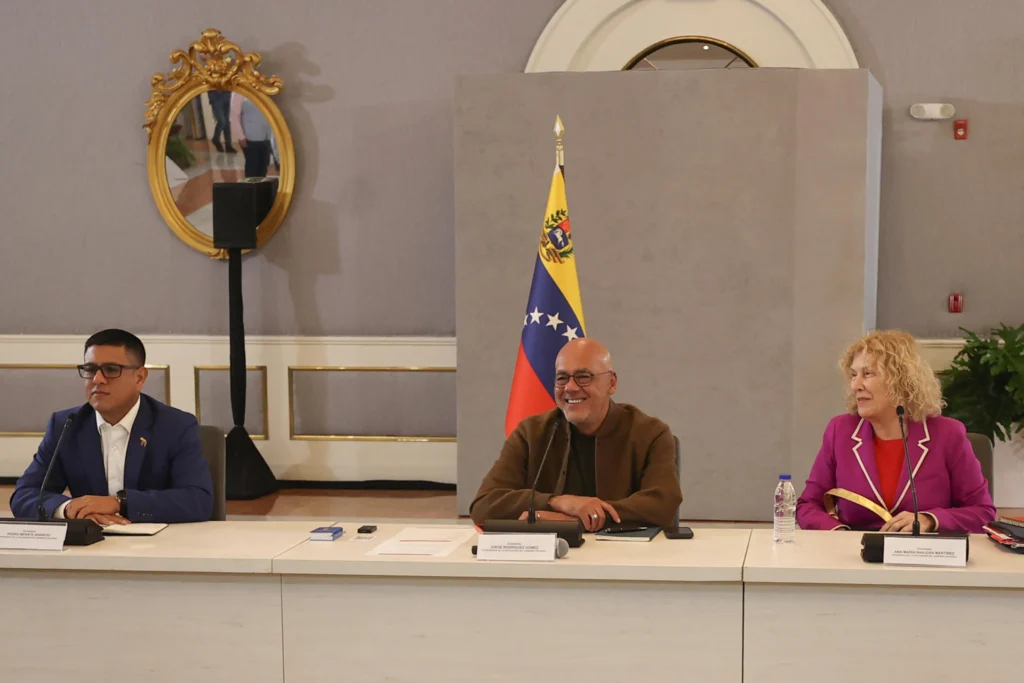
Delegations from the Venezuela’s government and the opposition 2015 National Assembly opened a third round of political dialogue Wednesday in Caracas, with the renewal of the Supreme Court and participation guarantees for political parties at the center of the agenda.


The Venezuela’s government delegation is led by National Assembly President Jorge Rodríguez, joined by university education Minister Ana María San Juan and lawmakers Jorge Arreaza, América Pérez, Génesis Garvett and Pedro Infante.

The opposition side is headed by Dinorah Figuera, leader of the 2015 Assembly. She is accompanied by former deputies Marco Aurelio Quiñones, Ramón López, Jorge Millán, Juan Miguel Matheus and Sergio Vergara.

RELATED: Venezuelan Government, 2015 Ex-Deputies Delegations Conclude Second Day of Talks

This third cycle gives continuity to the agreements reached in the previous round, which closed on September 25 after two plenary sessions and five technical working groups.

The talks resume five months after the reestablishment of diplomatic relations between Caracas and Washington. That rupture followed a January military operation under the Trump administration which led to the kidnapping of President Nicolás Maduro and his wife, the First Combatant Cilia Flores. The attack left at least 100 people dead and a similar number wounded.

#14Oct || Este miércoles se instaló la tercera Jornada de Diálogo Nacional entre el Gobierno y la AN 2015, desde el Hotel Meliá Caracas pic.twitter.com/CNeaHt7UcP

— Asamblea Nacional 🇻🇪 (@Asamblea_Ven) October 14, 2026

Text reads: “This Wednesday was the third Day of National Dialogue between the Government and 2015 National Assembly, from the Hotel Meliá Caracas.”

Court Renewal in Focus

The renewal of the Supreme Tribunal of Justice dominates this phase. A preliminary commission of the Venezuelan parliament, chaired by deputy Giuseppe Alessandrello, has begun interviewing 127 citizens nominated by different sectors of society and by their own initiative. The purpose is to form the Judicial Postulation Committee.

The evaluations run through Friday to structure a list of eligible candidates that will be presented to the full legislature next week. The final slate of nominees for Supreme Court magistrates is expected in early December.

In the previous round, both sides backed Acting president Delcy Rodríguez’s decision to lift administrative measures against news portals and digital media. They also agreed to create a Credential Review Council for aspirants to the top court, to promote debate on the use of the radio spectrum and to review the legal framework for transforming Venezuela’s justice system.

The Caracas meeting marks a further step in a process that has already produced concrete concessions on media access and now turns toward the judiciary. Both delegations consider the court’s composition central to the guarantees surrounding any future electoral contest, and the interview process under way is the first practical move toward that renewal.

What remains to be seen is whether the momentum built over two prior rounds holds through December. The presentation of the final magistrate candidacies will test whether the dialogue can deliver institutional change or whether it will stall once again at the stage of implementation.

  •  

Venezuela and Angola Deepen Strategic Alliance on Food Security at FAO Forum

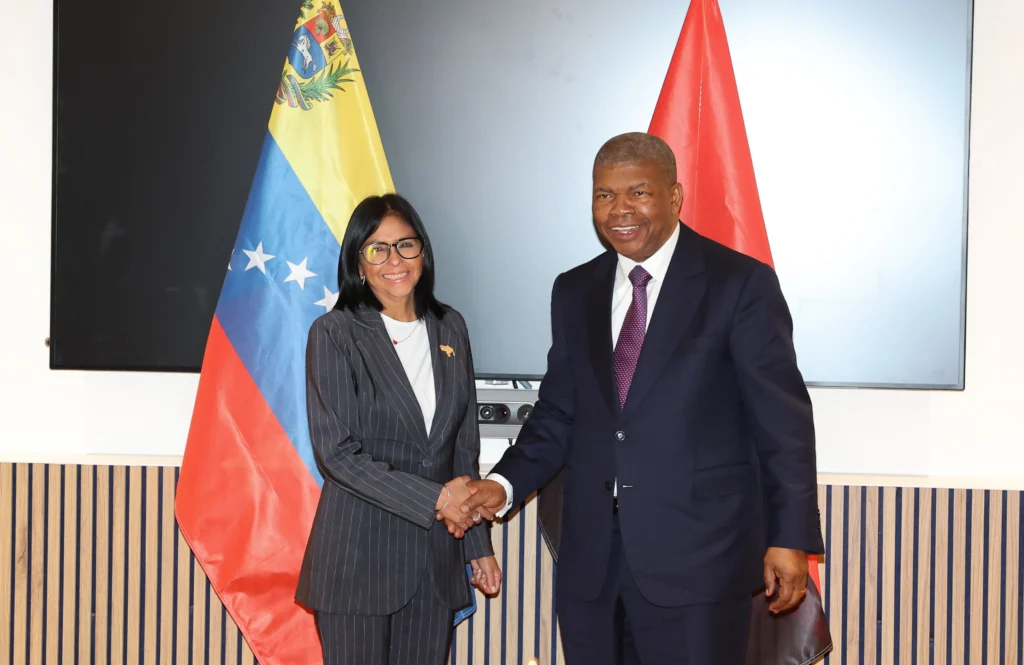
Venezuela and Angola focused their priorities on food sovereignty and shared agro-productive growth, boosting both sides' trade flow and production capacity. Photo: Venezuelan Presidential Press.

Venezuela’s Acting President Delcy Rodríguez and Angolan President João Lourenço met Monday in Rome to strengthen strategic relations around food security and sustainable trade on the sidelines of the UN Food and Agriculture Organization’s World Food Forum.


The meeting took place on the sidelines of the World Food Forum of the Food and Agriculture Organization of the United Nations (FAO), which is being held in Rome this week. It followed Rodríguez’s speech at the forum’s plenary session, in which she reaffirmed what she called the principles of Bolivarian Peace Diplomacy and the duty to promote social well-being.

During the encounter, both leaders discussed strategies aimed at improving sustainable trade and strengthening food security, but no specific agreements were announced.

RELATED: Venezuela Announces Plan to Achieve ‘Zero Hunger’ at 2026 World Food Forum

The working teams of both delegations focused on food sovereignty and shared agricultural growth, with the aim of boosting trade flows and the production capacity of both countries. Venezuela and Angola, the reports said, reaffirmed their willingness to strengthen mutual assistance in order to meet global demands on sustainability and food supply.

The Rome encounter followed a September 25 review of the bilateral agenda by Venezuelan Foreign Minister Félix Plasencia and his Angolan counterpart Tété António. The two officials identified openings for closer cooperation in trade, investment, mining and oil exploration.

They also agreed on the need to deepen the exchange of knowledge and experience across productive sectors. The goal, both governments said, is to drive sustainable economic growth and improve the welfare of their people.

The talks come as the World Food Forum, the FAO’s flagship event, brings together government delegations, farming communities, scientists and investors in Rome for a week of sessions on transforming global agrifood systems.

The meeting is the latest in a series of contacts between the two governments. On September 25, Venezuelan Foreign Minister Félix Plasencia and his Angolan counterpart, Tété António, reviewed progress on the bilateral agenda. They identified opportunities to deepen cooperation in trade, investment, mining and oil exploration. Both officials agreed on the need to reinforce the exchange of knowledge and experience across various productive sectors in order to promote sustainable economic growth.

Desde el Foro Mundial de la Alimentación, la presidenta Delcy Rodríguez sostiene un encuentro bilateral con su homólogo de Angola, Joao Manuel González Lourenço.

Tras su intervención en el evento internacional, la jefa de Estado evalúa junto al mandatario africano nuevos… pic.twitter.com/TJG1Y1Zl89

— Madelein Garcia (@madeleintlSUR) October 12, 2026

Text reads: “From the World Food Forum, Acting President Delcy Rodríguez supports a bilateral meeting with her counterpart from Angola, Joao Manuel González Lourenço. After her intervention at the international event, the Venezuelan Acting President evaluates with the African President new strategic mechanisms to strengthen agri-food production, sustainable trade and food sovereignty of both nations. The meeting aims to consolidate South-South cooperation and peace diplomacy.”

Ties Dating to 1986

Diplomatic relations between Caracas and Luanda date to December 6, 1986. The partnership rests on diplomatic cooperation, shared membership in OPEC, the Organization of the Petroleum Exporting Countries, and a sustained effort to strengthen agro-food security.

The relationship has gathered momentum in recent weeks. Venezuela reinforced cooperation with Angola, Italy and Guatemala, part of a broader diplomatic push that spans energy, agriculture and trade.

Venezuela’s Ministry of Communication and Information said in a statement that relations between the two countries are being consolidated through a strategic alliance based on energy, oil and diplomatic cooperation under the South-South principle.

The World Food Forum 2026 (WFF), hosted by the FAO in the Italian capital, has become a platform where leaders of the Global South coordinate responses to food insecurity. Venezuela used the gathering to present its food production agenda and to lock in alliances with partners in Africa and beyond.

For Angola, the talks offer a channel to diversify its economy beyond oil and to draw on Venezuelan experience in agricultural programs. For Venezuela, the partnership adds another node in a network of South-South ties that Caracas has cultivated to blunt the impact of sanctions and economic pressure. The public statements emphasized political will and shared priorities, with technical teams expected to translate the commitments into concrete projects in the coming months.

The meeting underscores a recurring theme in Venezuela’s foreign policy under Rodríguez’s government, that food sovereignty is a matter of national security and must be built through alliances among developing nations. As global supply chains strain and prices fluctuate, the partnership with Angola positions both countries to produce more of what they consume.

For now, the outcome is a reaffirmed agenda rather than a signed deal. The next test will be whether the cooperation announced in Rome translates into joint ventures, increased trade and higher agricultural output on the ground.

  •  
❌