❌

Reading view

I put Muse, Dot, and Instinct to the test. There was a clear winner, but not because it worked best.

Muse, Instinct, Dot logos
I put Muse (left), Instinct (middle), and Dot (right) to the test.

Meta / Instinct / Getty

  • I tested out the leading AI agents for a while, and gave them each the same tasks.
  • OpenAI's Dot saved me from failing to file my taxes, but was the worst at ordering lunch.
  • Ultimately, dealing with multiple AI agents at once is a hassle!

I've been playing around with various AI agents — Muse, Instinct, and OpenAI's Dot, and I've found them genuinely really useful for certain things.

But which one is best?

I put them to some, uh, semi-rigorous testing. Ok, not totally rigorous or controlled, but I gave them all the same 3 tasks — triage my email, order me lunch, and build me a personal website — and it was interesting to see which worked best. It was also interesting to see how differently they functioned at these tasks.

If you haven't started using an AI agent yet but are curious, well, I'm not sure that this is going to answer all your questions, but maybe is a place to get started.

A big spoiler here for my ultimate recommendation: right now, Meta's Muse is the only free one of the bunch, so in my mind, that wins for most normal people who just want to try an agent out. OpenAI's Dot is only for the $100/month plan (ouch!) and Instinct is currently invite-only.

To me, that's a no brainer. Do the free one (unless you're already paying for the ChatGPT plan, in which case you're probably already a pretty pro user and probably don't need my advice).

Challenge #1: Manage my email

A display of the home of the Dursleys during a media preview of Warner Bros. Studio Tour Tokyo - The Making of Harry Potter on June 14, 2023 in Tokyo, Japan.
Sometimes managing emails can feel like the mail scene in Harry Potter. Could the AI agents help?

Jun Sato/WireImage

I get a lot of email. Most of it I don't need to bother opening. Help me figure out which are the important ones.

Muse: Muse has been a dutiful soldier here, and this was pretty much the first task I gave it when I started using it a few weeks ago. So far, "triage my email" has been the one truly useful thing an agent has done for me.

Instinct: Overall, I don't like the fact that Instinct works mainly through your text messages vs. a dedicated app. While that's very convenient in certain ways, I don't like the idea of seeing email (bad, no fun) in my texts (good, fun) — mixing the two feels wrong.

However, I have to hand it to Instinct — it found a Paperless Post invite for a party that I would otherwise have completely missed in my personal email. It was the only agent to pull that one out for me.

Dot: Dot did something truly useful that required a lot of context, and it did all on its own. It noticed an older email exchange from last month with my tax accountant (I had filed for an extension, due in October). Dot noticed my accountant never confirmed he actually filed my taxes — yikes! This actually really saved me! (Don't worry, the taxes had indeed been filed.)

Finding an older — but important — email exchange that I hadn't closed the loop on is exactly what I want from an AI agent/assistant. I feel like 90% of things I'd rather do myself, but my human brain gets easily distracted and forgetful, and there are plenty of things I forget to deal with or get distracted.

Winner: Dot. Also me, for not going to jail for tax evasion.

Challenge #2: Order me lunch.

I asked each agent to order me a salad at a specific local restaurant. Because I didn't want to annoy real humans, I did the orders for pickup, to avoid any confusion or multiple separate deliveries.

This turned out to be a real fiasco, and I learned my lesson: it would have been infinitely easier for me to just do it myself.

Muse: Initially, Muse was very helpful. I accidentally gave it the wrong restaurant name, but Muse helped me find the right place and pulled up the correct menu options for me to see.

I had already connected my credit cards with Stripe, so I figured this would be easy. It offered up my debit card or another Mastercard, which I assumed was my regular credit card (I had just gotten a new card in the mail and didn't recognize the last four digits).

When I finally went to check my wallet, I discovered it was a mistake — it was actually the card connected to my health insurance-related HSA account, which is only approved for medical expenses.

conversation with Muse
Oops, Muse was using my HSA card, which can only be used for medical expenses.

Business Insider

By the time I straightened this mess out, I had already moved on to placing orders with Instinct and Dot. When I went to pick up my orders at the restaurant, there were only two bags with my name on them. Sure enough, I had gotten so distracted with the other orders that I never confirmed with Muse about placing the order, and it never sent through. (Can you see now what I was saying before about how I get distracted and don't finish tasks?)

Instinct: The most annoying part about Instinct, again, in my opinion is that it's over text messages. That means there were some quirks when I tried to text on my laptop — sometimes it failed to send as SMS. But after a few fails, Instinct was able to place the order relatively quickly. Well, sort of.

All told, this took 9 separate text messages on my end — not including Instinct's responses. It is hard for me to imagine that this was at all easier than just going onto the restaurant's website or UberEats and doing it myself.

Although the process was fairly painless, there was one thing I didn't like: it put the other through with no tip (!!!) and didn't ask me if I wanted to add one.

Dot: Somehow, this was the most difficult to get to work. It kept getting tripped up by the 6-digit code sext by text needed to login, but it kept failing (I had to get the code texted 3 separate times), and the browser it created for me to enter wouldn't let me type into it. A mess, basically, but finally it worked.

Winner: None. I feel very confident in saying that it would have been infinitely easier to just place the order myself through regular means. It's possible that it would be easier to order in the future, since I've already done the work of setting it up once. But I've learned my lesson.

Challenge #3: Build me a website

I have an old personal/professional website, but it's due for a refresh. I have terrible aesthetic sense and don't want to spend much time designing a site. Seems like a good job for AI to do for me!

katie notopoulos mockup for personal website
The personal website Muse made for me feels horrifically cringe.

Muse / Business Insider

Muse: I appreciated that, unlike Dot and Instinct, Muse didn't use the photo of my face from my byline photo (it seems very weird to have a giant photo of your own face on a professional website).

But all three basically did the same thing: pulled the info from my author bio on Business Insider, selected some recent articles as clips, pretty basic stuff.

website mockup
Instinct's website it made for me. Pretty basic (and weird photo!)

Instinct / Business Insider

Instinct: The design here was the most boring, and in a way I wouldn't even know how to make it look better (terrible aesthetic sense!). Weirdly, the selected article it pulled for me were random ones from over a year ago.

Dot: The look and design were probably the best here, and it pulled a decent mix of articles I'd want to showcase. But GOOD GRIEF the tagline here is so corny that I'm sort of embarrassed to even show you, even though I didn't write it myself:

Katie
Notopoulos
Technology, business,
and life on the internet.
"Technology, business, and life on the internet." CRINGE!!!!

Business Insider / Dot

Winner: Based on the mockups it made with design alone, I'd go with Dot. I think I could work with this. But all three of these made such cringey, cheesy copy about me that it honestly made me feel genuinely depressed. Is this who I am? Yuck!

Obviously, I'd have to rewrite all the copy myself, and pick the articles for clips — and at this point, is this even saving me any time beyond being a very generic template? Ah well.

Conclusion: The biggest challenge with all of them was figuring out what kind of task an agent is well-suited for.

Most of all, I found that trying to manage three different agents at the same time was a huge hassle. I want AI agents to be like a wife — making my life easier by anticipating my needs, not a husband who simply does chores when told. But this has backfired on me: now I have three wives, and they're all nagging me and I'm forgetting which is which. Ultimately, I don't recommend AI polygamy. May my experiment with it help you choose your bride.

Read the original article on Business Insider

  •  

Sundar Pichai explains how a team of AI agents helps him run the company

Sundar Pichai, chief executive officer of Alphabet Inc., arrives for a meeting on artificial intelligence with tech executives at the White House in Washington, DC, US, on Tuesday, Sept. 29, 2026. The gathering follows a surge in concern about AI potentially posing a threat to humans. Photographer: Aaron Schwartz/Bloomberg via Getty Images
The Google CEO said he uses AI agents to track Google's model development and internal discussions.

Bloomberg/Getty Images

  • Sundar Pichai said he uses AI agents to track Google's model development and internal discussions.
  • The bots summarize updates and monitor how Google's computing resources are used.
  • Pichai said humans still make consequential decisions about resource allocation.

Even Google's CEO needs help keeping up with Google.

On the Sources podcast released Wednesday, Sundar Pichai described to host Alex Heath how he delegates some of the information-gathering that comes with running the tech giant.

“It could easily take me an hour a day to kind of catch up, what's happened in the last 24 hours, right?" Pichai said. "But now I have agents running which summarize and bring that information to me. I can still go deeper, and I do so often."

Pichai said that his AI agents give him a way to "understand the model development arc," figure out how Google's computing resources are being used, and follow threads spread across numerous internal chat groups without having to read through every conversation himself.

“Similarly, there are agents with telemetry into our compute usage by product area, efficiency, utilization, and giving me inputs and insights, you know," Pichai added. "I think it's made all of us, you know, be better at what we do."

That doesn't mean Pichai has handed over the important calls to AI. He said humans — including himself — remain directly involved in consequential decisions about allocating computing resources.

Managing agents is becoming a skill in its own right, giving some workers a new set of headaches, from checking the bots' output to preventing them from duplicating work or straying beyond their assignments. Business Insider previously reported that the need to manage agents is making everyone a boss without higher pay.

Delegating to bots doesn't necessarily make work easier, either. A Cisco engineering director who manages more than 10 agents told Business Insider that overseeing them involves more task switching and can make work feel more intense without shortening his days.

For the Google CEO, however, continuous work is a plus.

"So because your agents, they're running in the cloud, they're running 24/7, they have your context, and so they can pick up things where you left off," Pichai said. "It's a continuum there. By the time it's doing that, you would be applying yourself to the next problem and so on."

Read the original article on Business Insider

  •  

Walmart rolls out AI agent shopping features while Amazon tries to curb the tech

A person uses a smartphone beside a retail display of folded Bluey children's pajama sets.
Walmart is adding tools it says will make AI agent shopping easier.

Bloomberg/Getty Images

  • Walmart is rolling out two new tools to help third-party AI agents shop on behalf of customers.
  • The company says the tools give people more control of their bots, and help bots be more accurate.
  • Walmart's move contrasts with Amazon's approach, after it blocked Meta's agent Muse from its site.

Walmart wants your bot to shop.

The retail giant said Wednesday that it has two new tools to help third-party AI agents shop on customers' behalf: agent profiles and an agent gateway.

The agent profiles link all transactions to the bot that performed them, and allow Walmart customers to manage authorizations and spending limits as they would for an additional user on their credit card account, the company said.

With agent gateways, bots no longer have to navigate a website that is designed for humans. Instead, Walmart is granting access through a model text protocol that it says will help agents work more quickly and accurately.

Walmart's move contrasts with Amazon's approach, which recently blocked Meta's agent Muse from its site, saying agents violate Amazon's conditions of use. Amazon has also pushed back on other third-party agents, including a lawsuit against Perplexity and restrictions on agents from Google and OpenAI.

"As customers begin using agents to help them shop, we're building connections, permissions and options that complement those tools and support how customers want to use them," the company said in a statement.

The company also said the gateway protects the information that Walmart has about its customers, and only provides what is necessary for completing a given transaction. In particular, the gateway can share a relevant pattern or preference — such as a customer's favorite laundry detergent brand — without sharing their entire purchase history with the agent.

The company also laid out a set of terms and conditions regarding how AI agents are expected to operate when shopping.

Under the terms, the company said it will honor its usual returns policy and that agents will always see the same pricing that a human would see on Walmart.com.

Read the original article on Business Insider

  •  

Anthropic launches Claude Duet, its answer to Meta and OpenAI's personal agents

Ami Vora, Anthropic's chief product officer, and Daniela Amodei, its president, sit on stage.
Ami Vora, Anthropic's chief product officer, and Daniela Amodei, its president.

Don Feria/AP Content Services for Anthropic

  • Anthropic has its answer to AI agents like Meta's Muse and OpenAI's Dots.
  • Claude Duet, built on Anthropic's flagship model, has entered the personal agent frenzy.
  • Karan Ahuja, a recent departee from Meta, led Claude Duet's development.

Anthropic is joining the personal AI agent craze.

The company announced the new app Claude Duet on Wednesday, billed as a "proactive agent" that can run in the background, surface tasks to a user, and handle a variety of work. The tool is in research preview for now with a waitlist, meaning it won't immediately compete for the larger market with other new agents like Meta's Muse and OpenAI's Dots.

Still, the announcement ramps up the pressure on those companies — Anthropic says it built Duet around its flagship Opus 5.5 model, which was released in late September and has already become one of the industry's most popular. Recent model breakthroughs have made AI better at handling work on its own, spurring a rush to build these "always-on" personal agents.

"It can have the discernment and judgment around when to be proactive, when to act on your behalf," said Mike Krieger, a co-lead of Anthropic's Labs team, said in a Duet launch video.

The tool, Anthropic says, will send users a brief each morning about what's happening on their connected apps, and message them when something needs attention. Like other companies' offerings, it runs outside a user's computer, sends notifications, and asks for approval on certain tasks.

Anthropic announced Duet on the day of Meta's earnings report and used the opportunity to mention a new poach from Mark Zuckerberg's company. Karan Ahuja led product management for Meta Superintelligence Labs until July, according to his LinkedIn, before starting at Anthropic in August and leading Duet's development.

He wrote on X that he's been using Duet to build Duet, and said the team "built it for professionals and small business owners juggling a lot at work and at home."

Ahuja also wrote that Anthropic is letting people into Duet from the waitlist "as quickly as possible."

The news didn't go unnoticed at Meta. Alexandr Wang, who heads Meta Superintelligence Labs, posted a meme about Duet's similarity to Muse.

Anthropic is fast approaching a giant initial public offering, which could value the company at as much as $2 trillion. Like other AI players, the company navigates a high-wire competition to win over users, secure computing power, build state-of-the-art models, and deliver AI-native products.

The data firm Apptopia estimates that Muse had more than 14 million installations as of Wednesday. It found that Claude users who installed the Muse app were using Claude more than before, though still for fewer minutes per day than they spent on the Meta product.

Have a tip? Contact this reporter via email at scouncil@businessinsider.com, or over text, Signal, Telegram, or WhatsApp at 415-757-8198. Use a personal email address, a non-work WiFi network, and a non-work device; here's our guide to sharing information securely.

Read the original article on Business Insider

  •  

The return of the CPU

In one week this month, the central processing unit became the story again. On October 12, AMD’s Lisa Su told the Open Compute Project summit that she had raised her forecast for the 2030 server CPU market three times in nine months, to more than $200 billion. On October 15, TSMC’s C.C. Wei told investors: […]

The post The return of the CPU appeared first on Asia Times.

  •  

Cisco's president said he used personal AI agents to screen $9,000 worth of his yearly subscriptions

Jeetu Patel, president and chief product officer at Cisco Systems Inc., at the AI Impact Summit in New Delhi, India, on Friday, Feb. 20, 2026.
Cisco's president and product chief, Jeetu Patel, shared how he's used personal AI agents.

Bloomberg/Getty Images

  • Cisco's president, Jeetu Patel, said he uses four or five of the most popular personal AI agents.
  • One of them, which costs him $20 a month, recently saved him more than $1,000 in subscription bills.
  • But he said it's important not to give personal AI agents access to work tools or resources.

If getting mysterious and surprising subscription bills are the bane of your existence, Cisco's president and product chief, Jeetu Patel, is in the same boat.

Patel told Business Insider that said he's been using four to five different personal AI agents, like Meta's Muse, Instinct, and OpenAI's Dots, for things like consolidating news, summarizing earnings calls, and even booking his daughter's concert tickets. But recently, he was impressed by how one agent could slash his subscription bills.

He said that the first time he gave a personal AI agent access to his email, the agent told him, "Hey, you've got $9,000 worth of subscriptions that you subscribe to per year. Are you sure you want all of these? It seems like a lot of subscriptions."

He told the agent to make him a table of all his subscriptions, how much he spends on each, and how long he's had each. After the agent presented him with the table, he picked out two subscriptions that he didn't need and made the agent cancel them, which it did without difficulty, and sent him cancellation emails.

"I'm like, OK, that was kind of creepy how easy it was to do that," Patel said. "And then it saved me 1,000, 1,200 bucks a year just over there. So basically, for the most part, I paid for that agent, at a $20-a-month plan, several times over."

The agent also managed to cancel part of his Dropbox subscription — an $11.95 plan he had accidentally subscribed to, even though he had already purchased a 2-terabyte plan.

Patel is a big fan of AI agents, both at work and outside it. He said he rarely starts any task now without asking an AI agent to do a "recon job" and give him research and context.

But the important thing to remember, he said, was not to give personal AI agents, which are not vetted by employers, access to work tools and resources. He hasn't linked his email or calendar to his personal agents, instead using his internal work agent for those tasks.

"These are common-sense things that I think most companies implement, which is, 'Don't give your crown jewels of your source code repository to Muse; it might not be a good idea,'" Patel said.

Rogue or not, AI agents have been causing a buzz

Personal AI agents have been all the rage in recent months, serving as personal assistants and handling mundane, repetitive tasks like paying bills and buying groceries for their users.

While they've been touted as productivity boosters, there have been several instances of users reporting that the agents have performed actions outside their permissions, such as posting bank balances to company Slack channels or misinterpreting instructions, such as ordering 20 pounds of chicken for a dinner for two.

Obedient or not, personal AI agents have been causing a buzz, especially for investors.

Ross Mayfield, an investment strategist at Baird, told Business Insider's William Edwards ahead of Meta's earnings that Muse is the first big app of the AI era and that it assuages some investors' fears about Big Tech's ballooning AI spending. And Instinct, founded by a 23-year-old, raised $1 billion in its Series C, bringing its valuation to $10 billion.

But these new products are coming in a year when there have been several instances of AI agents going rogue and performing unauthorized actions, such as breaking out of sandboxes during security tests and exploiting software vulnerabilities in external companies' websites.

This has led companies such as Bank of America to invest resources and hire additional personnel to address issues with their legacy software and prevent such hacks.

Former and current staffers at frontier AI labs like Anthropic and OpenAI have publicly raised concerns that AI development is progressing too rapidly, without adequate checks and balances. September was characterized by an air of doom and gloom over an "AI apocalypse," in which AI researchers estimated that the technology would kill all of humanity in the next decade.

Read the original article on Business Insider

  •  

AI companies scraped the web. Now they want to learn how you work.

An office in action before the rise of generative AI.

Kirn Vintage Stock/Corbis via Getty Images

  • A version of this story originally appeared in the AI Insider newsletter.
  • Sign up for Business Insider's weekly AI Insider newsletter here.

AI companies have already scraped much of the web. Now they're chasing something even more valuable: data that shows how humans actually work.

That's the focus of Business Insider's new series, The AI Data Grab. This week, we published three stories showing how the race for workplace data is accelerating.

One piece, from Charles Rollet, Tom Carter, and Stephen Council, examines the booming market for company records. AI firms are offering businesses six- and even seven-figure sums for anonymized Slack messages, emails, presentations, and internal documents.

The goal is to teach AI systems how people solve problems, collaborate, make decisions, and complete long, multi-step tasks. Those real-world workflows are becoming the fuel for the next generation of AI agents.

Another story, from Melia Robinson, explores how law firms are building AI systems around decades of legal knowledge, turning their own experience into a competitive advantage rather than relying solely on off-the-shelf AI models and tools.

A third piece, by Rya Jetha, reveals how AI companies pay people to record real-world work, such as cooking dinners and packing warehouses, to teach robots how humans perform everyday physical tasks.

Together, these stories point to a major shift in AI development. The first wave of generative AI was mostly about bigger models and faster chips. The next chapter is about machines understanding how work gets done, so AI can help us do it better and quicker.

Sign up for the AI Insider newsletter here. Reach out to me via email at abarr@businessinsider.com

Read the original article on Business Insider

  •  

OpenAI's Dots head says AI means workers now have a choice between doing less or more

Attendees go up and down stairs at OpenAI's DevDay conference on Sept. 29, 2026.
Attendees at OpenAI's DevDay conference on September 29, 2026.

Minh Connors/Bloomberg via Getty Images

  • OpenAI's Alexander Embiricos said the AI era gives a choice: work more, or work less.
  • He's in charge of Dots, the company's new always-on work assistant.
  • AI is often pitched as freeing up time. Embiricos responded to the idea that it might add more work.

As the competitive AI race pushes tech workers into long hours, the head of OpenAI's new Dots product says AI gives people another option: work a whole lot less.

Alexander Embiricos, who leads OpenAI's enterprise product and helms the new Dots agent tool, told a crowd at TechCrunch's Disrupt conference on Thursday that AI's capabilities have created something of a fork in the road for workers. You can grind to meet the moment. Or you can use AI to kick your feet up a little.

"We basically have a lot more choice now," he said.

Embiricos made the comments after a reporter asked about when AI systems will actually deliver more free time. The reporter shared an anecdote where an OpenAI employee used a ChatGPT mobile feature to work in their car and on a plane — not exactly liberated by the new tech.

Embiricos said that the moment has already arrived where a worker can "outsource" tasks to AI and do less work. Then again, some people are so excited about AI's potential that they feel like it's an "interesting, ripe moment" to put in extra hours.

"I think that's why a lot of people are motivated to work very hard right now. That includes myself," he said. "But I think actually there is this choice, and there's totally this other setup where you could delegate a ton more things."

OpenAI is billing its Dots tool as a workplace assistant, always on and capable of proactively handing tasks and sorting to-dos. Embiricos uses his Dot often in Slack, he said, engaging on various threads.

His perspective illustrates how early companies are in their journey to adopt AI tools. Most companies have not yet automated their work tasks, and many workers are still debating how much to use the tools. Early AI adopters, meanwhile, can sprint through some work that used to take days or weeks, especially in software engineering.

Embiricos summed up the situation he feels workers are in: "You either choose: do you expand the ambition of what you can do, or do you do less? I do think we're there."

Have a tip? Contact this reporter via email at scouncil@businessinsider.com, or over text, Signal, Telegram, or WhatsApp at 415-757-8198. Use a personal email address, a non-work WiFi network, and a non-work device; here's our guide to sharing information securely.

Read the original article on Business Insider

  •  

Are Warrantless Phone Searches at the Border Constitutional? The Supreme Court May Soon Decide.

Border phone search | Tatiana Chekryzhova/Dreamstime/rudenkoalla/Magnific/Mariam Zakaidze

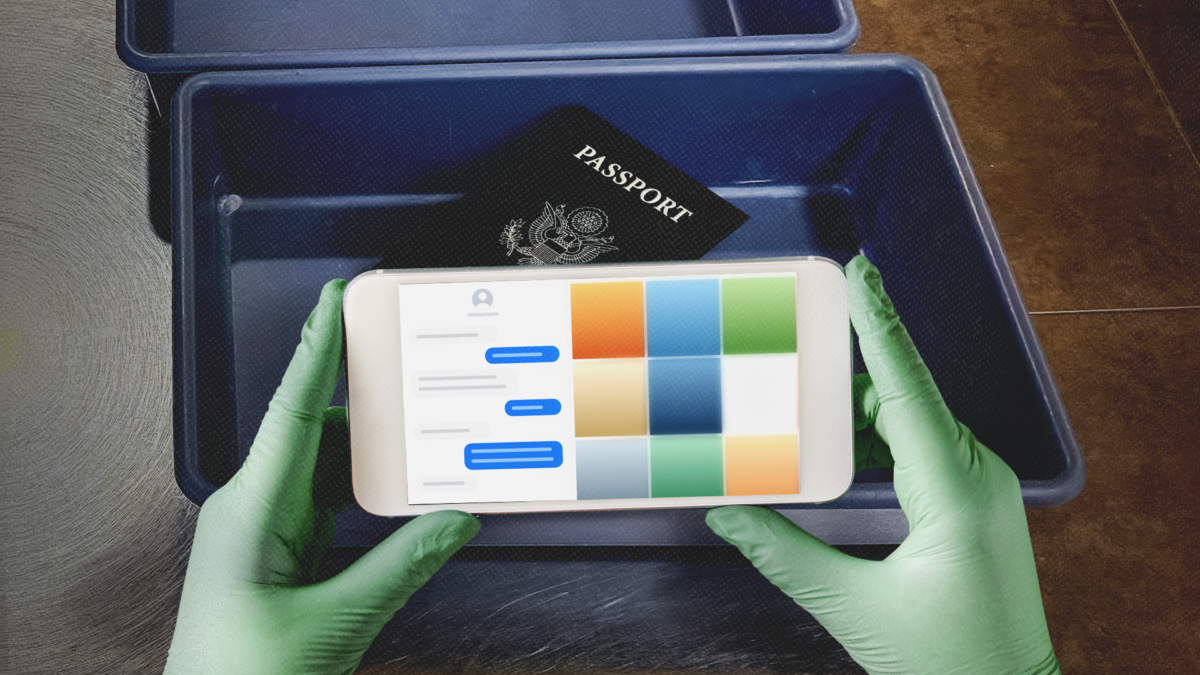
George Anibowei, a U.S. citizen, is a Texas-based immigration attorney with many clients battling the Department of Homeland Security. Border agents have searched his phone at least five times without a warrant as he returned to the United States.

In the first search, agents copied the phone's entire contents, including his confidential communications with clients. The government still has that data, and Anibowei still doesn't know why it was kept or who has seen it. He now leaves his work phone at home when he travels.

On September 29, the Supreme Court asked the federal government to respond to Anibowei's petition, which asks whether the Fourth Amendment lets border agents search the contents of a phone without a warrant. (I'm one of his lawyers.) The government waived its response, expecting the Court would deny the petition without a second look.

But in 2021, the solicitor general told the Court that this very question had produced an "entrenched circuit conflict" of "considerable practical importance." The conflict has only deepened since. Seven federal appeals courts now hold that a warrant is never required to search a phone at the border, while the 4th and 9th Circuits require one in at least some cases. That means one of your constitutional rights currently depends on which airport you fly into.

While circuit courts may disagree, the Supreme Court has already shown the best answer for this question. In Riley v. California (2014), the Court unanimously held that police generally need a warrant to search the phone of someone they arrest. There is an exception for searches incident to arrest, which allows the police to arrest someone without a warrant; that exists to protect officers and preserve evidence. Data can't hurt an officer, and a phone can be secured while police get a warrant. An extension of an old exception to digital data, the court said, "has to rest on its own bottom." Treating a phone like any other container in an arrestee's pockets was like saying "a ride on horseback is materially indistinguishable from a flight to the moon."

The border-search exception fails the same test. Those searches exist to collect duties, keep out people who may not enter, and stop contraband. But duties attach to physical goods, not data. And as the legal scholar Orin Kerr has put it, agents "will not find a person smuggled inside a computer hard drive." As for digital contraband, anyone who wants illicit files can carry a clean phone and download them after clearing customs. Suspicionless phone searches burden millions of innocent travelers while barely inconveniencing smugglers.

The appeals courts that disagree mostly cite one another. But the Supreme Court rejected a lopsided lower-court consensus in Riley, and again in Carpenter v. United States (2018). Counting courts is not a constitutional argument.

Defenders of these searches lean on history. In United States v. Ramsey (1977), the Court noted that the first Congress authorized warrantless customs searches in 1789, less than two months before it proposed the Fourth Amendment. True enough. But that statute let officers search ships for hidden dutiable goods. To search a house, store, or other building for the same goods, officers needed a warrant. And nothing in the statute let officers read a traveler's papers.

That distinction was no accident. Customs abuses had helped spark the Revolution. Writs of assistance gave British customs officers blanket authority to search wherever they pleased, which James Otis said placed "the liberty of every man in the hands of every petty officer." And the founding generation guarded letters especially closely. Benjamin Franklin, as the first postmaster general, made postal workers swear they would not open mail without an express written warrant.

Even Ramsey, the government's favorite border search precedent, respected that distinction. It upheld opening international mail to look for contraband, but the regulations before the court flatly prohibited reading correspondence without a warrant, a point the justices stressed repeatedly. The Court has never held that border agents may read a traveler's papers without a warrant. A phone holds years of correspondence. It deserves at least the same protection the Founders gave a sealed envelope.

Last month, however, the 2nd Circuit joined those courts that have disregarded this tradition. In United States v. Alisigwe, Judge Steven Menashi wrote that agents need no suspicion whatsoever to search a traveler's property at the border, phones included. A border search becomes non-routine, he reasoned, only when it intrudes on the person, as a strip search does. A phone is property, so searching it is routine.

Judge Eunice Lee concurred, agreeing that no warrant was required. But she warned that the majority's rule permits suspicionless searches for any reason, "including political or discriminatory ones."

The Alisigwe majority's premise miscasts the Fourth Amendment. The amendment's text secures "persons, houses, papers, and effects" in a single, unranked list. The abuses that produced the amendment were searches of property, including private papers. Agents may properly physically examine a phone to ensure it's not really a container for smuggling contraband. But reading or viewing its digital contents without a warrant trespasses on a person's papers and effects. The framers protected property because they recognized that human beings are not ghosts: We live in the physical world by exercising our property rights, and so searching our property can reveal much about our lives.

Alisigwe is the latest word from a Court of Appeals, but it contains complications for the constitutional issue. The trial court found that agents had reasonable suspicion, so the no-suspicion holding arguably wasn't needed to decide the case. That suspicion involved a forged passport, which goes to identity and admissibility, the core of border authority. Finally, Alisigwe was a permanent resident, not a citizen, so the government's interest in deciding who may enter was heightened.

Anibowei is simple on each of these counts, which is why one can be hopeful the Supreme Court will take it and address the Fourth Amendment question now. Anibowei is a naturalized citizen, no one suspects him of anything, and he challenges the government's search policies directly rather than seeking suppression of evidence in a criminal case. As the 5th Circuit itself acknowledged, his case "turns squarely and solely" on the warrant question.

The stakes keep growing. In FY 2025, Customs and Border Protection (CBP) searched 55,318 electronic devices, nearly 11 times as many as in 2012—and nearly a quarter of those searches targeted U.S. citizens. According to the directives Anibowei challenges, agents may keep what they find and share it with federal, state, local, and foreign agencies. Investigators have learned to wait for a target to travel and ask CBP to search his phone on the way back in, rather than go to the trouble of demonstrating probable cause to a judge. No wonder universities, bar associations, and press freedom groups now advise travelers to leave their devices at home.

The Founders rebelled against customs officers who could search wherever they pleased and read whatever they found. A rule letting border agents scroll through a citizen's correspondence, photos, and client files without a warrant, or any suspicion at all, revives that power. The Supreme Court should take Anibowei's case. Our papers don't lose Fourth Amendment protections at the border just because they're digital.

The post Are Warrantless Phone Searches at the Border Constitutional? The Supreme Court May Soon Decide. appeared first on Reason Magazine.

  •  

Choices that will define Asia’s AI future are coming into focus

We are fortunate to live at an incredible moment in history. As more and more AI applications have become available, people have turned to them to seek advice, build businesses, express ideas, learn, and improve their health and quality of life. Nowhere is this more clear than in Asia. AI is already turbocharging small businesses […]

The post Choices that will define Asia’s AI future are coming into focus appeared first on Asia Times.

  •  

Ukraine is third in world for cyberattacks after US and Israel, and first in Europe. Machine-speed assaults run continuously and without fatigue

Illustrative photo. Credit: Philippe HUGUEN / AFP

Only the US and Israel were hit by more cyberattacks than Ukraine this year. Ukraine ranked third in the world and first in Europe among the countries whose organizations and users were most often targeted by cyberattacks in the first half of 2026, accounting for 4.8% of all victims worldwide, up from fifth in the world and third in Europe a year earlier, Microsoft said in its Digital Defense Report 2026.

Microsoft processes more than 165 trillion security signals a day, which lets it show how often attackers go after customers in each country. Russian state hackers aimed 14% of their recorded activity at Ukraine, more than at any country except the US.

The era of machine-speed cyberattacks is here

Government agencies and services were the most targeted sector worldwide at 27%, up from 17% in 2025. Phishing drove 23% of intrusions Microsoft investigated, up from 7% a year earlier, and the median time from finding a vulnerability to weaponizing it has fallen well below 24 hours.

The use of artificial intelligence is pushing cyberspace into an era of “machine-speed” attacks that operate continuously and without fatigue, according to Dev.

“Many AI agents act on behalf of users and with their access rights, so a compromised agent combines user-level access with machine-scale actions,” Natalia Burlakova, Security Sales and Engineering Lead at Microsoft, says.

Deception beats code in attacks on Ukraine

Ukraine's own agency data show a similar pattern. Malware accounted for 33% of cyber incidents in the first half of 2026, and social engineering 31%, the State Service of Special Communications and Information Protection reported on 30 September. System infections made up 15%, and system compromises 4.5%.

Attackers rely less on technical complexity than on trust, according to the report by Ukraine's computer emergency response team, CERT-UA. Hacker groups create fake pages that mimic CERT-UA, Ukraine's Parliament's document management system, and the Brave1 defense technology platform.

Microsoft urges five government steps

Microsoft asks governments to prepare for faster-moving threats by assigning roles and coordinating agencies in advance of a crisis, and to treat AI security as part of national resilience. It also asks them to plan for incidents that spread, noting that 52.2% of intrusions involving valid accounts led to additional credential theft.

  •  
❌