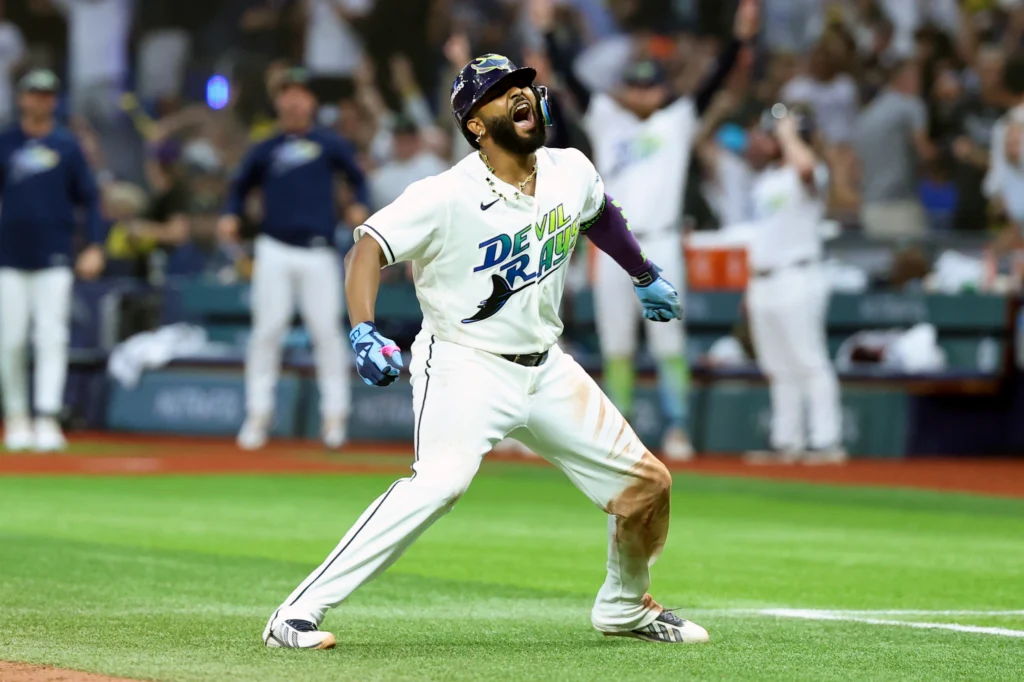
The day before receiving the award, Caminero hit a home run and drove in two runs in his team’s 7-3 victory.
On Tuesday, Tampa Bay Rays third baseman Junior Caminero was honored with the Juan Marichal Award, an accolade given annually to the best Dominican player in Major League Baseball.
Juan Marichal announced the award himself at the Ministry of Sports, where he highlighted the outstanding season completed by the 23-year-old. Marichal praised Caminero’s performance and asserted that he is destined to become “one of the great figures” of Dominican baseball.
The award comes at a time of great prominence for the third baseman, who played a decisive role in the Tampa Bay Rays’ qualification for the World Series.
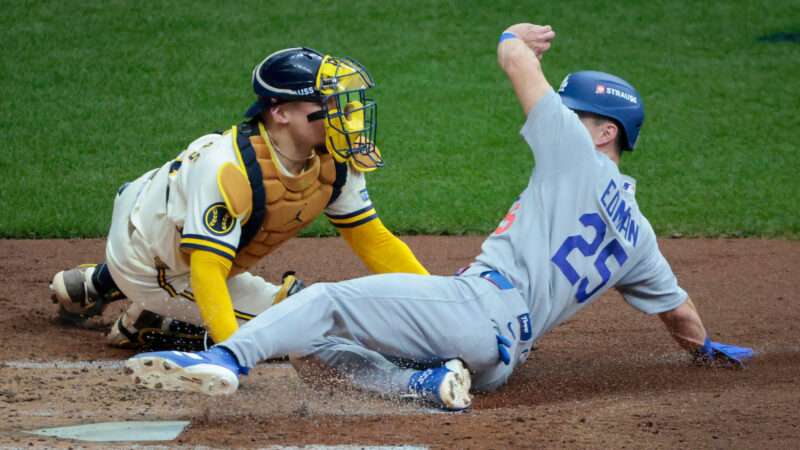
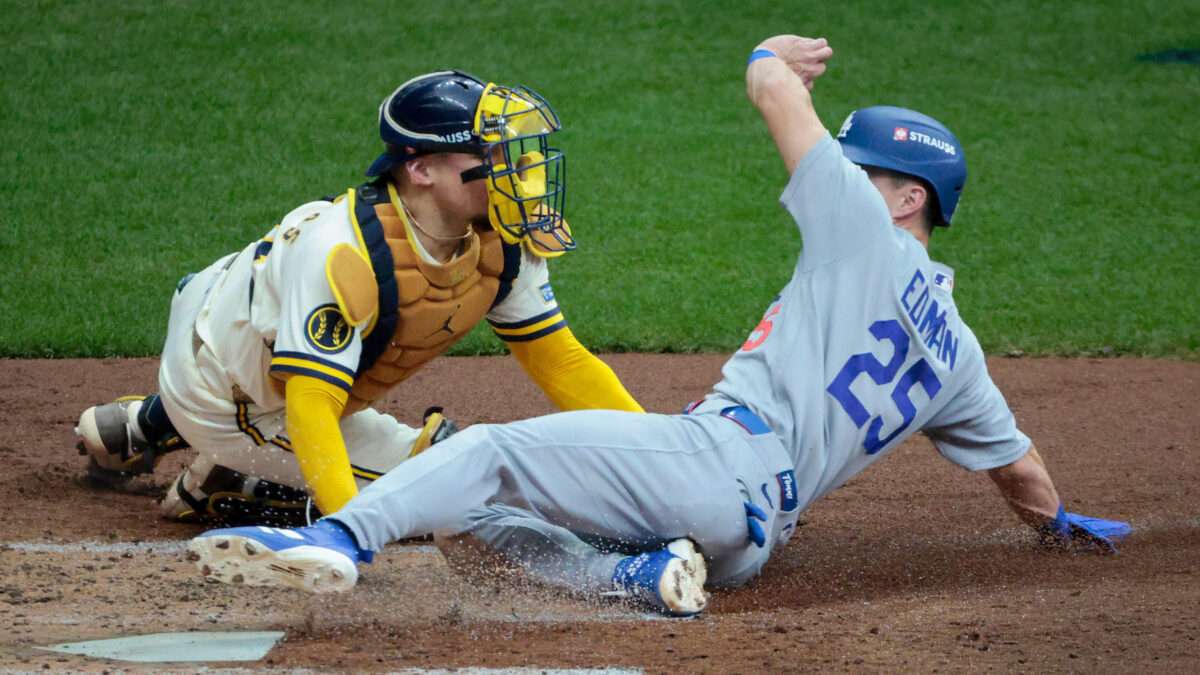
The day before receiving the award, Caminero hit a home run and drove in two runs in his team’s 7-3 victory over the Cleveland Guardians, a result that secured their place in the Fall Classic.
During the regular season, the Dominican slugger achieved 42 home runs and 101 RBIs, which placed him among the American League’s offensive leaders. In addition to his power at the plate, Caminero finished the season with a .276 batting average, 170 hits, 100 runs scored, and 25 doubles.
In the Juan Marichal Award voting, he received overwhelming support, garnering 82 of the 100 first-place votes for a total of 558 points.
The Tampa Bay Rays player beat out pitcher Cristopher Sanchez of the Philadelphia Phillies and shortstop Elly De La Cruz of the Cincinnati Reds, who finished second and third, respectively.
#FromTheSouth News Bits | Social, trade union, and peasant organizations across the eastern Dominican Republic took to the streets of Higüey for a massive regional march with the slogan "the east rises: we can stand no more abuses." pic.twitter.com/e2TMhYTVgn
La Nave Turca desplegó un ataque de 15 imparables en Barquisimeto para superar 11-7 a Lara y dejar atrás el peor inicio en la historia de la franquicia.
Hello and welcome to another edition of Free Agent! Be careful when you're behind the wheel this week.
College football is great! Surely you want even more of it, right? We'll get into the problems with a 24-team College Football Playoff (CFP), then talk about the NBA's new betting restrictions, and close with thoughts about President Donald Trump's new government golf course plans. And just in case you don't make it to the end, here's a shortcut to our survey on who you're rooting for in the World Series.
But first, many congratulations to "Gary's 1st Entry" on outlasting everyone else in our NFL Survivor group. There's no prize other than this shoutout, so be sure to print out today's newsletter, highlight this paragraph, and frame it in gold. Perhaps Gary can keep going and challenge Primetime Paulie Rothrock's 13-game winning streak from last season.
Locker Room Links
Both teams in the WNBA Finals left the court for the National Anthem—unclear if this was a protest or just part of the pregame routine. WNBA policy doesn't require teams to be on the court for the anthem, but does require a "dignified posture" if they are.
In the thick of a playoff race, three Zambian women's soccer players are separated from their National Women's Soccer League teams because they played in Uganda, and the Centers for Disease Control and Prevention has a three-week restriction on reentry due to Ebola. (There are zero active Ebola cases in Uganda and Zambia.)
This is the kind of excessively nerdy fantasy football content I live for. (Yahoo remains the best fantasy sports system. ESPN's is trash, relying on name recognition to get by.)
I figured out how ESPN calculates fantasy football win percentage, it's bad!
ESPN made a stats 101 error when calculating their win percentage which leads to horribly miscalibrated numbers. ( thread) pic.twitter.com/bDypgjelKj
Saturday was one of the best days of college football ever—or perhaps it could have been, if we thought any of the five top-10 teams who took a loss were now certainly out of playoff contention. Instead, Georgia, Notre Dame, Indiana, Alabama, and Texas are all still very much alive in the championship hunt.
Today was one of the craziest days in college football history:
- First time ever five teams ranked in the top 7 lose in a single week - First time the No. 1-ranked team loses to an unranked team in consecutive weeks since 1990 - First time Texas, Alabama, and Georgia all lose… pic.twitter.com/psVRoM5s5b
With two losses, Alabama and Texas are at least on the edge of the playoff bubble with perhaps no more room for error. But that's only true under this year's CFP format. Next year, the playoff is almost officially set to balloon to 24 teams, making the chaos of a day like Saturday matter even less.
Fans will always celebrate a huge upset or major rivalry win, of course—Tennessee fans don't need playoff stakes as an excuse to get drunk when they beat Alabama. But the joy of a rivalry win in the past was always bigger because of the off-field stakes, too—the first loss for your rival meant they probably wouldn't be national champions, the second meant they'd be out of the Rose Bowl, a third meant you could be proud your team sent them packing for the Alamo Bowl. Winning is great; ruining your rival's season is even better.
With 24 teams in the playoff, the joy is a bit diminished because it will take four or possibly five losses to knock a powerhouse program out of the CFP (Iowa, at 8–4, was ranked 23rd by the committee before last year's playoffs). It'll be a bit like a rivalry win in college basketball—we win, you suck, congrats on getting a slightly worse NCAA Tournament seed.
In the business of sports, more inventory for TV is king, and the powers that be think more teams playing more playoff games will make more money. At Free Agent, we don't begrudge institutions for trying to make more money—we all do the same every day. But it's not clear abandoning conference championship games will be the answer, especially when the Big Ten and SEC championships apparently outdraw many playoff games.
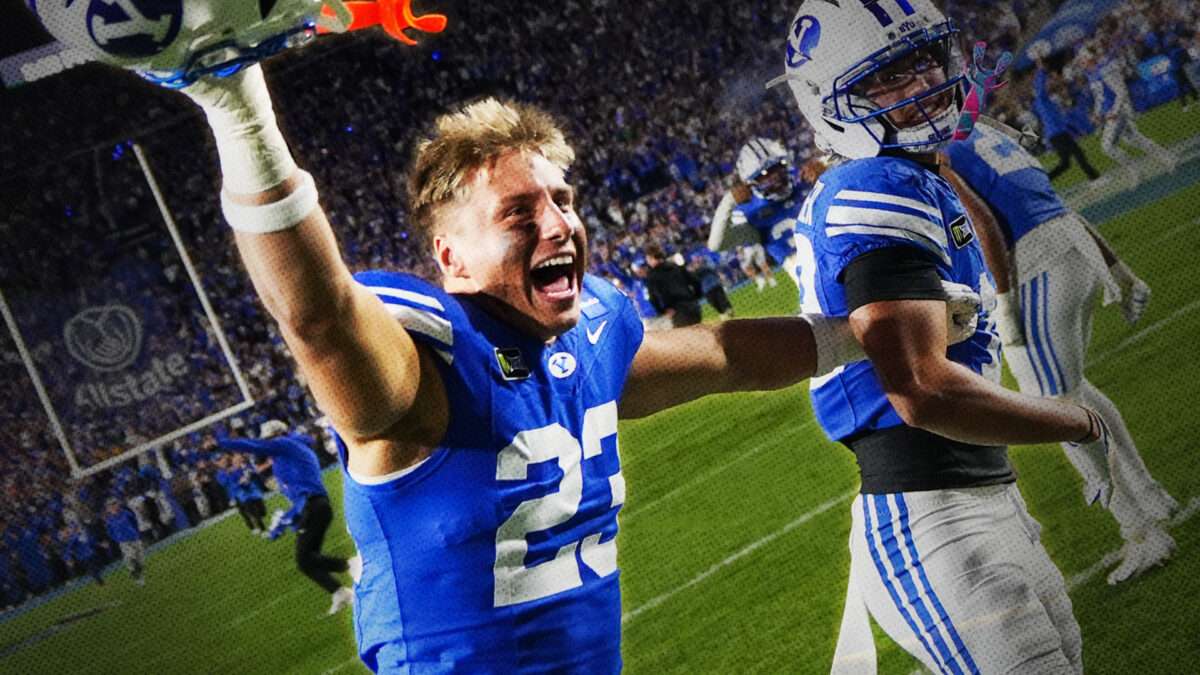
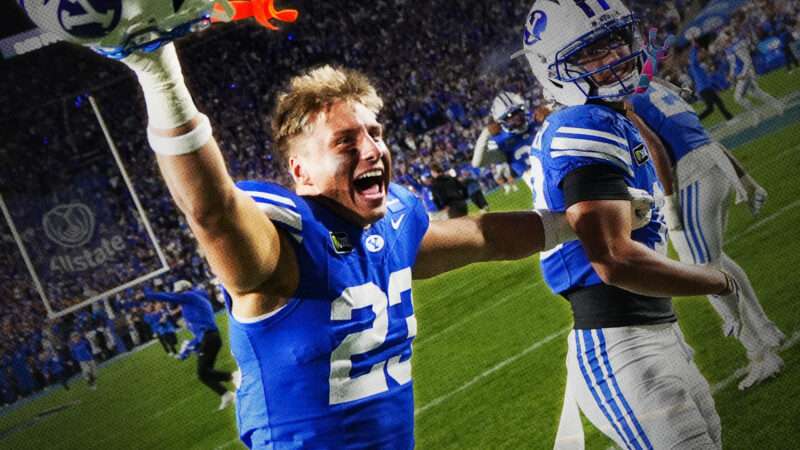
ESPN and the power conferences know fans aren't happy about it—just look at allthechatteronline, and how the crowd at BYU reacted when College GameDay discussed expansion on Saturday (especially when BYU would probably benefit from expansion!). They're betting enough people will watch to make the expansion profitable anyway. The last hope is that fans get loud enough to bully them into abandoning expansion—which only occasionally works, sometimes on things small (putting the trophy logo on the court for the NBA Finals) and large (soccer's European Super League). If any powerhouse considers going independent, that might shock leaders into a rethink too.
Almost every sport I know is adding more: more teams, bigger playoffs, more for TV. As fans, we still eat it up, of course—much to the excitement of the TV executives who are selling commercial time to the people trying to reach us, the viewing public. (The only counterexample is the MLB proposal to cut eight games from the regular season—I'd love to see each sport I follow cut its season by about 25 percent to make regular season games matter more, so I'm interested to see how this goes.)
Perhaps I'm biased because my favorite team, Michigan State, is a dumpster fire—they could expand the playoff to 64 teams and the Spartans still wouldn't deserve a bid. I personally don't have a whole lot at stake in the playoff format now or anytime soon. But as a neutral, the chaos of Saturday might have been viewed with my full attention in the past—instead, this year I just had it on in the background while I played video games.
Sports Are Regulating Bets Without Politicians, Part 3
After last year's major betting scandal, the NBA asked sportsbooks late last week to stop offering certain types of potentially problematic bets. The sportsbooks, which the NBA says handle roughly 99 percent of the U.S. betting market, agreed. No politician or regulation was necessary to solve the problem.
No longer can bettors bet on unders for a bit player who likely won't get more than 12 minutes of playtime. Bettors also can't wager on the opening tip or on players to miss specific shots. Parlays that string together under bets on the same player's statistics are also out (this one seems a bit harsh—if you just want to bet on a certain major player to have an off night, you can bet on stats separately, but not in a big multiplier parlay). Bets on players who have two-way contracts between the NBA and G League were already banned.
This all comes on the heels of similar developments last year in the NFL and MLB. While some people want to ban prop bets altogether, the NFL asked sportsbooks to eliminate bets in four different categories. Sportsbooks largely agreed or weren't offering those bets anyway. MLB, in light of some pitching-related scandals, asked for a $200 limit on pitch-specific bets and to keep them out of parlays—sportsbooks agreed to that too.
As I wrote last year, "Ideally, this is how the regulation of the sports betting industry should go….These approaches are catching the nuances of what works for both the leagues and for sportsbooks without the heavy-handed approaches of politicians who would use an axe to ban all prop bets instead of a scalpel to limit problematic bets."
It's important to note leagues are able to do this because they have commercial partnerships with the sportsbooks. Otherwise, the leagues would have no direct leverage over a sportsbook offering a bet the league doesn't like. Keep that in mind the next time you see people bemoaning a league partnership with a sportsbook or a prediction market.
Trump's Golf Course Plans Have People Teed Off
President Donald Trump has new plans for the National Park Service golf course at East Potomac—again. Last time new plans were announced, the site plan still had its historic miniature golf course, a par-3 course, and the existing road still ringing the property for bicycling, running, etc. Much of the public didn't like that plan anyway—now, none of that remains in the latest plans, just 18 holes of golf and a driving range.
What's really going on here seems quite clear to me: Like so many other things going on in the second Trump administration, this is a scheme to enrich the Trump family. The plan?
Step 2: Use taxpayer dollars to pay for renovation of the course into, allegedly, a championship-level course capable of hosting major golf tournaments (no matter that the area has next to zero parking, is a mile from the nearest Metro station, and only accessible by narrow roads not meant to handle tens of thousands of spectators).
Step 3: Have the federal government sign a sweetheart deal with, who else, the golf division of the Trump Organization to operate the course on extremely favorable and profitable terms.
If you're wondering why the Trump administration is doing something, corruption is usually a good guess.
The arguments for the course don't make much sense. There are plenty of adequate, competitively priced golf courses in the broader Washington, D.C., area. Several of them are already capable of hosting professional golf tournaments. Between LIV Golf and the PGA Tour, there were three tournaments at three different courses in the last couple years. The 2030 PGA Championship and 2037 Ryder Cup will happen just over the D.C. line in Bethesda, Maryland.
East Potomac is not the nicest course around, no thanks to the legal limbo it's been in for the past year. But if the National Park Service is going to, for some reason, be in the business of running a golf course, it should be a course that emphasizes and teaches its history instead of the pipe dream of a corrupt madman.
Who Ya Got? 2026 World Series Edition
For the first time in 46 years, we've got a World Series contested by two teams that have never won it before. Brewers against Rays is also a rare instance of the top seeds from each league outlasting the randomness of the MLB playoffs to make the World Series. And before you trot out the tired line that "TV executives must be seething about the small market teams" remember that they care much more about getting a playoff series that goes seven games with close results in each game (What did I say above? Inventory rules all!).
El venezolano pone fin a su carrera a los 37 años tras consagrarse como héroe de Serie Mundial con Los Ángeles y dejar un legado de liderazgo y defensa de élite durante 13 campañas en Las Mayores.
A billboard ad in Times Square for the sports-betting site Novig featuring the actress Sydney Sweeney. She appeared in commercials aired during the Major League Baseball playoffs.
Con una épica remontada de en Dodger Stadium, Milwaukee eliminó en cuatro juegos al bicampeón de la MLB y selló su boleto al Clásico de Otoño por primera vez desde 1982.
Con un estelar Gavin Williams y un cuadrangular de Petey Halpin, Cleveland doblegó 3-2 a Tampa Bay para tomar ventaja de 2-1 en la Serie de Campeonato de la Liga Americana.
Hello and welcome to another edition of Free Agent! It's a great week to do something nice for the furryfriends in your life.
Let's get into some nitty-gritty about baseball's salary cap fight. We'll dive in with two sections on that, then move on to some new thoughts about an old video game.
People are complaining about day games in MLB's division and league championship series. I'm old enough to remember when my elders would wax poetic about World Series day games. But it's interesting to see MLB use day games on weekdays to minimize overlap while the NBA and NHL are fine with multiple playoff games at the same time.
A Chinese player for Mississippi Valley State was taken into custody by Immigration and Customs Enforcement (ICE). His student visa had expired and he was on his way to visit his visa sponsor when he was detained. His lawyer said ICE forced him to sign a form for voluntary departure.
MLB's Salary Cap Fight Isn't About Balance, It's About Costs
In 2025, baseball fans wanting to avoid a lockout, a salary cap, or both, were rooting for the small market, small payroll Milwaukee Brewers to beat the goliath Los Angeles Dodgers in the National League Championship Series (NLCS). The Brewers got swept. Now it's 2026, and guess what? Baseball fans wanting to avoid a lockout, a salary cap, or both, are rooting for the small market, small payroll Brewers to beat the goliath Dodgers in the NLCS. (At least the Brewers aren't getting swept this time!)
But what if none of that matters at all to the salary cap fight?
A small market World Series victory for the Brewers (19th in MLB payroll), the Tampa Bay Rays (28th), or, yuck, the Cleveland Guardians (30th) helps boost the theoretical argument that MLB doesn't need a salary cap for small market teams to succeed. But labor negotiations are not decided by debate club rules—you don't win with a better policy argument. It's all about the power dynamics and leverage of what is essentially a business negotiation between employees and employers. The policy argument might matter to public opinion, but it makes hardly any difference to leverage.
Competitive balance may not matter to the owners at all (in fact, some studies have found that salary caps don't create more balance, but revenue sharing does). The owners are almost certainly focused on keeping down their labor costs. A salary cap would likely give an immediate boost to team values—when Formula 1 teams recently agreed to a broad cap on their expenses, valuations shot up.
The lockout fight will come down to who can endure the pain the longest, and how much the "losing" side is willing to stomach what the "winning" side is offering. The billionaire owners have plenty of wealth and income from their other assets, but also don't want a lockout to crater the value of one of their biggest assets. The players have had years to save and plan for a lockout, and some can still try to lean on endorsements, merchandise, and other nonpayroll income to help them along. The owners will try to say they're showing good faith by combining their salary cap with a salary floor that would force some teams to spend more on players—but that won't appeal much to the union's player leadership, which is largely made up of high-level players who want a big payday coming out of the lockout (I see you, future free agents Tarik Skubal and Paul Skenes).
The only way public opinion might matter is if government officials decide to get involved. President Donald Trump has already made noise about taking action, and backs the owners' push for a salary cap, but it's unclear how much he can lean on negotiations. The National Labor Relations Board may end up involved—all four members were appointed by Trump (one is a Democrat who used to work for the players union). Members of Congress could threaten to take away MLB's antitrust exemption, but probably wouldn't have the votes to do it.
It goes without saying all this is incredibly frustrating for fans (as well as players who want to earn a living and teams that want to plan for the future). The lockout is going to hit baseball like a car crash that everyone saw coming from miles away. The basic bargaining positions have not changed in years, but the two sides have made basically no progress.
At least Minor League Baseball won't get locked out, and should get a major viewership boost if MLB ends up losing games.
With All the Salary Cap Scandals, Are They Even Worth It?
What's funny to me is that the MLB salary cap debate is happening in the wake of two of the biggest spending cap scandals in sports history: the Los Angeles Clippers salary cap circumvention scandal and, in soccer, the Manchester City financial scandal. You'd think the difficulty of enforcing these rules would cause some people to think twice about a salary cap, and how cheaters can ruin the integrity of the game for fans.
If MLB owners do manage to convince the players to agree to a cap, the cap's rules will make a big difference in how successful it is.
The NBA had a scandal over fake endorsement deals, the Premier League had a scandal over fake sponsorships, and hockey fans got mad every year about players coming off the long-term injured reserve list just in time for the playoffs, changing their cap hit, until the league finally closed the loophole. In multiple sports, fans from high-income-tax states complain that their salary cap limits are the same as teams in low- or no-tax states, making the latter more appealing to free agents.
Meanwhile, in the NFL—actually, it's somehow been largely scandal-free on the salary cap front for over a decade, except for a couple minorscandals.
I'm not exactly sure how the NFL manages this—maybe it's the hard cap with few exceptions, maybe it's the size of their rosters, maybe it's because many of the tactics teams use to game the cap are legal (for example, converting a "signing bonus" into base salary paid out over five years). Or maybe there is a ton of salary cap circumvention with sham side deals and the NFL just fails to catch it.
Regardless, I'm morally not a fan of teams colluding to avoid paying players their competitive market wage. We're talking about millionaires, so you might not have much sympathy. But if you had the talent and put in the hard work to earn a million fans, you wouldn't want owners to collectively diminish your wage either.
4 Years Later, Gran Turismo 7 Still Slaps
Just when I thought I was out, Gran Turismo 7 has pulled me back in. First released in 2022 (see my brief review from the time here), the game is now my go-to activity when I have free time.
A few times a week, my 2-year-old son will ask to see race cars on TV, and sometimes I will fire up Gran Turismo 7 or the latest Formula 1 game for him to watch me play (he sort of pays attention, but what he really wants is to break small pieces off my Formula 1 Lego sets, forcing me to pause each lap and reassemble them). A few weeks ago, I noticed Gran Turismo 7 has weekly challenges of five races. While working through them, I noticed that—despite having beaten most of the game's most difficult challenges on its hardest difficulty—I'd won less than 40 percent of its races.
That just couldn't stand, and now I'm trying to work through them all. AI has added a new component for me—I've used it to help with car selection, pit strategy, and tweaking of settings.
All this is to say that I'm impressed a 4-year-old video game can still make me obsessed. Kudos to the Gran Turismo 7 team for releasing several updates throughout the year with new tracks, cars, and more.
Replay of the Week
I watched this live and on replay so many times, and still can't figure out what they thought was going on. Was it a designed run play, and with what purpose? Did the players forget they didn't have any timeouts? Were the Commanders coaches running the clock low because they thought they'd have to kick it back to the Giants? I thought maybe they were trying to line it up for the kicker, but that would have involved a quick kneel followed by a spike.
The whole overtime was bonkers, and the Commanders are cowards anyway.
Jayden Daniels thought the clock would stop at 5 seconds out of respect for him pic.twitter.com/CQ16tDxL5o

 Login

 thread)