❌

Reading view

Families are paying nearly $7,500 a year for health insurance. The next price hike is already looming.

Close-up of a receptionist giving a health card to female patient at clinic. Focus on hands of female with a health card.
Health insurance costs have soared for workers and employers.

Luis Alvarez/Getty Images

  • Workers on family health insurance plans paid $7,471 for premiums in 2026, a 9% increase from 2025.
  • Costs are even higher at smaller businesses: Workers there pay nearly $10,000 for family premiums.
  • Rising premiums have outpaced wage growth, and are only expected to increase more in 2027.

It's costing families nearly $7,500 a year for health insurance — and more increases are looming.

A 2026 health benefits survey from KFF found that workers on a family plan paid an average of $7,471 a year in premiums — a 9% increase from 2025. And that's just the worker contribution — when accounting for employer contributions, family plan premiums totaled $28,303 in 2026, a roughly 5% increase from 2025.
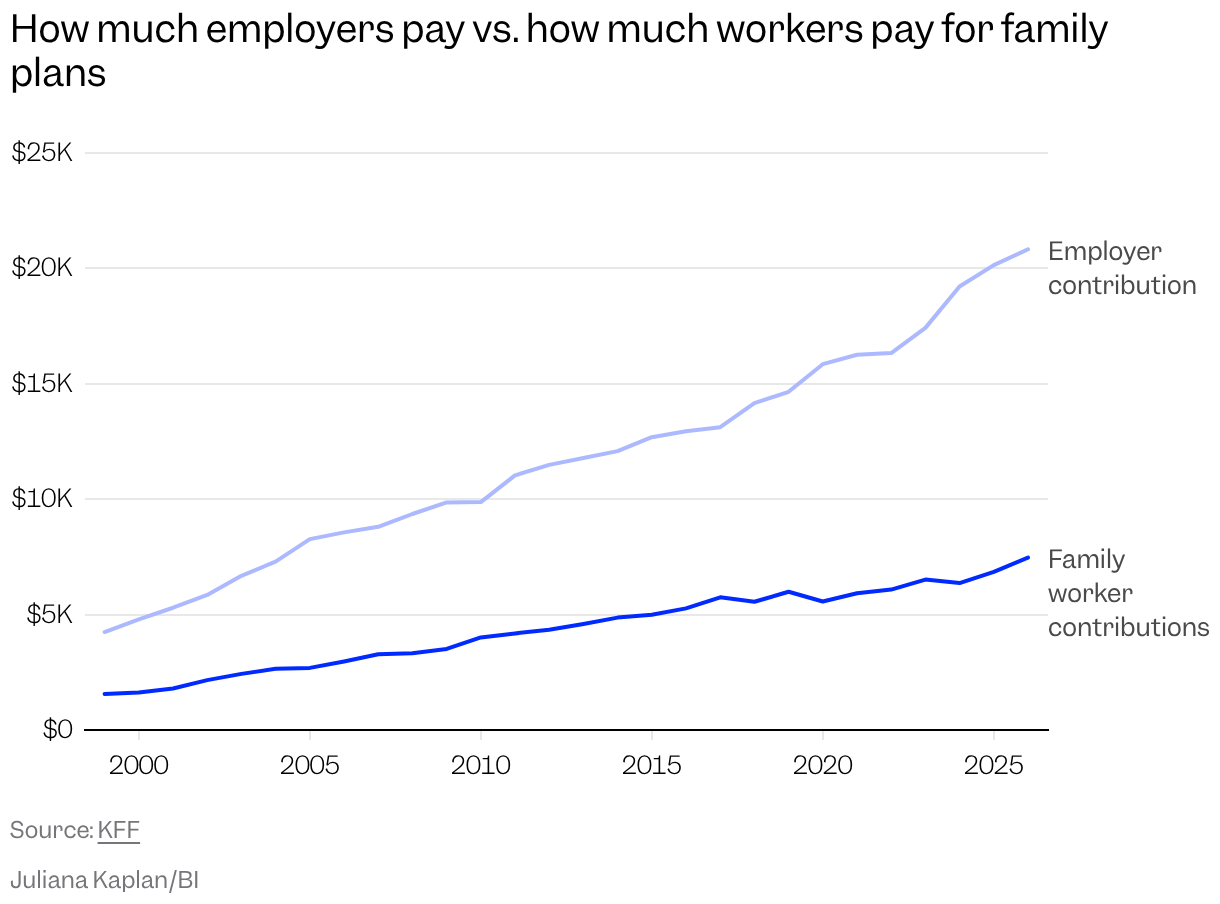
Line chart

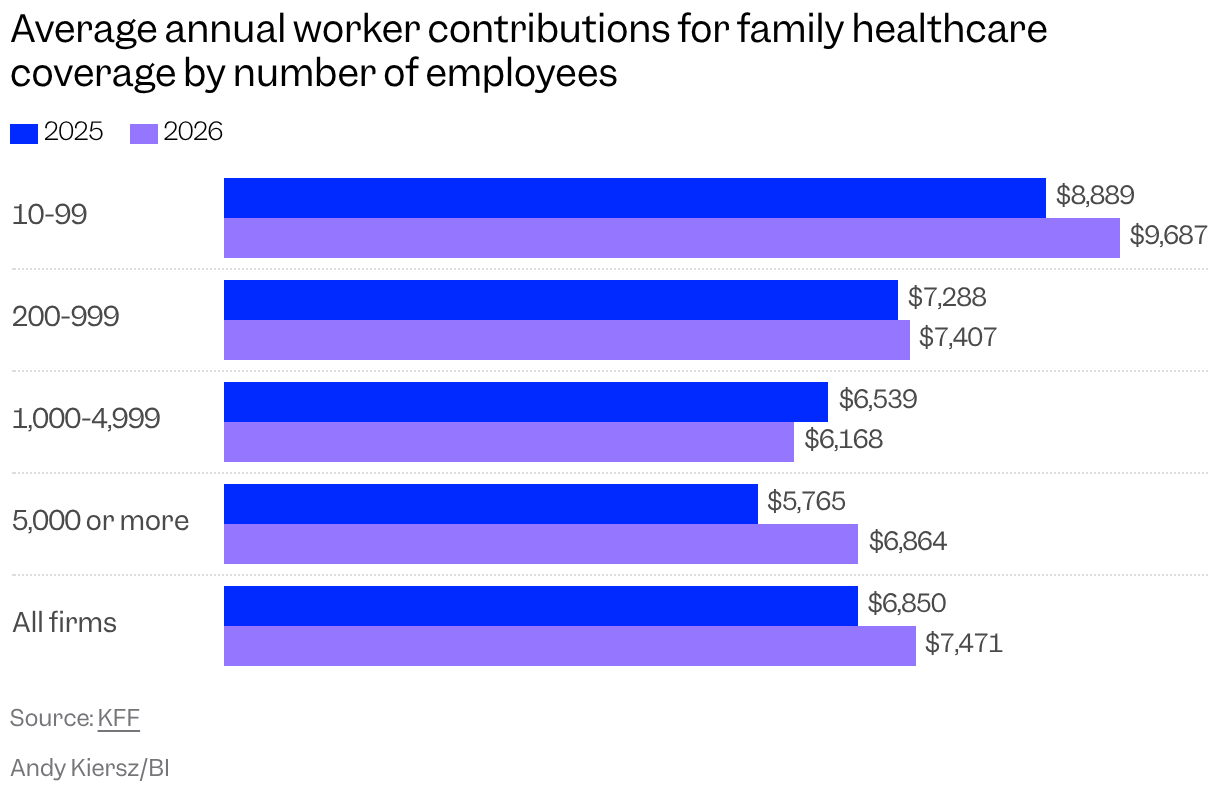
That's a hefty price for both workers and their employers, and even more acute for workers at smaller businesses: KFF's survey found that at firms with fewer than 200 employees, they paid nearly $10,000 toward family premiums in 2026. Smaller firms are often more beholden to insurance companies, since they don't wield the same bargaining power as larger firms.

Mounting health costs might be part of why consumers feel so gloomy: As wages have increased, insurance premiums have risen even faster. While wages increased 3.7% year-over-year for workers — which might look like a nice pay bump on paper — worker-paid premiums outpaced that salary growth, rising by 9%.

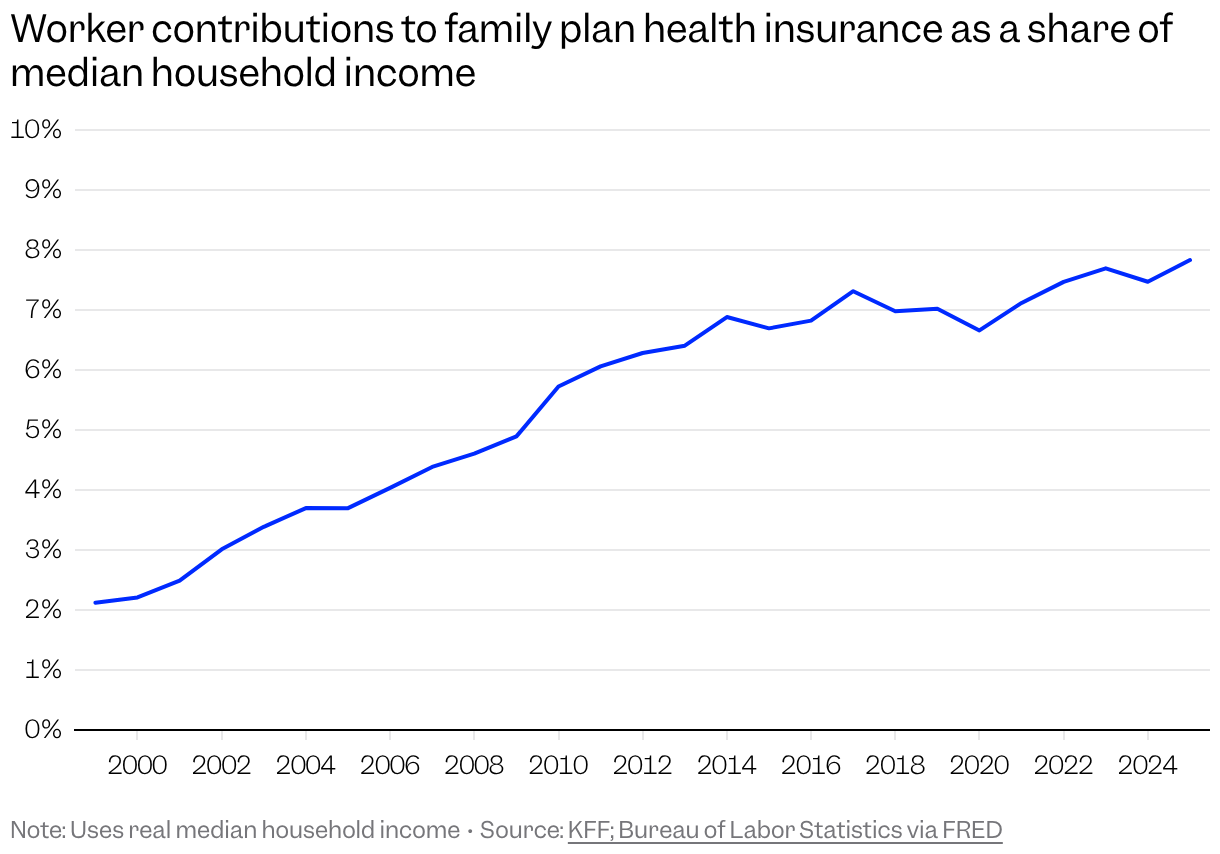
And over the past few years, how much workers pay for health plans has eaten up a larger share of their household income. For workers across all firms, their premium costs amounted to nearly 8% of real household median income in 2025.
Line chart

Are you worried about rising health insurance costs, or already paying thousands out of pocket? Share your story with this reporter at jkaplan@businessinsider.com.

All of that comes as employers and workers brace for open enrollment season, and more hikes loom: An analysis from PricewaterhouseCoopers, based on a survey of health plan actuaries, projects that commercial healthcare group costs will rise by 9% in 2027. Similarly, Aon, an insurance management firm, found that employer healthcare costs are projected to climb by 9.5% next year without any cost mitigation measures — meaning before firms figure out how to pass some of those mounting costs on to their workers.

For workers and firms, that means a tighter financial squeeze: Companies are paying more to cover their workers, but costs are likely still outpacing wages. At the same time, firms might not be able to provide higher wages as care costs climb. It means that everyone is paying more, and nobody's feeling good about it: An Ipsos/Axios poll found that 69% of Americans say a 10% increase would negatively impact their household finances, with 30% saying it would have a major negative impact.

Read the original article on Business Insider

  •  

Small businesses are getting clobbered by health insurance costs for their employees

Split scene shows an OPEN sign held in a window and a patient seated on an examination table.
Employees of small businesses are facing steep healthcare costs.

Getty Images

  • Small-business workers are facing higher costs for family health coverage than those at larger firms.
  • Affordability and healthcare costs are key concerns for American workers and voters in the midterms.
  • Small firms struggle with health benefit options due to less bargaining power and higher costs.

Health insurance costs are going up, and it's especially rough for workers at small businesses.

A new annual survey of employers and their health benefits from KFF found that small-business workers pay more for family coverage than workers at firms of every other size. At the same time, many of these workers have fewer plan choices than at larger firms, meaning they're often stuck with whatever option their employer selected.

From 2025 to 2026, annual worker contributions for family coverage at firms with 10 to 199 workers increased from $8,889 to $9,687, a 9% increase. While the largest firms saw a sharper increase, workers' contributions at employers with 5,000 or more employees were nearly $3,000 less. For all firms, contributions rose about 9% to $7,471.

Grouped Bars

Of covered workers at small firms, nearly one in three has a plan requiring an employee contribution of over $12,000 annually, more than double the rate at large firms.

According to the survey, 66% of small firms offer health benefits, compared with 98% of firms with 200 or more workers. That's up from 59% in 2025 but remains below the 72% level of five years ago.

Workers at small firms pay an average 37% of the family premium, compared with 25% at larger firms.

While premiums for health insurance plans that cover only a worker and not their family are similar for small and large businesses, the average deductible at small firms is nearly $1,000 higher than at large firms. More than half of small-firm workers face a deductible of at least $2,000, compared to just a third of large-firm workers.

Though the report doesn't get into the discrepancy for family plans in depth, small businesses often have less bargaining power with insurers. Because small businesses operate on smaller margins, they often don't have the money to subsidize spouses and children at the same level as larger businesses. Risk is also more concentrated among smaller businesses, meaning that future premiums and claims may be heightened by a single employee with costly medical needs.

Additionally, because small firms are much less likely to self-fund, they're often more dependent on insurers and therefore pass along rate increases to their workers. Average annual premiums rose 5% in 2026, with employers citing projected cost increases, while the survey separately found that GLP-1 coverage can affect prescription-drug spending. Workers at small employers are more likely to have weaker coverage for specialty drugs.

Affordability is top of mind for Americans gearing up to vote in the midterms. Healthcare costs remain a top financial concern. Millions of Americans have lost health coverage as ACA marketplace subsidies expired and Medicaid enrollment protections ended.

Small businesses have been hit hard over the past few years by inflation, higher interest rates, and tariffs. Small businesses have been embracing AI as a cost-saving measure, though many face unexpected costs due to token overuse or subscription price increases.

Dozens of workers have told Business Insider that preparing for retirement has been a significant source of stress as they navigate a tight job market. However, among employers that offer health benefits, 23% of firms with 200-999 workers offer retiree health benefits, versus 35% of firms with 5,000 or more workers.

There are some silver linings for workers. Premiums for single workers are slightly lower at smaller firms than at larger ones overall. Employees at small firms on single health insurance plans were much more likely to have their entire premium paid by their employer, though they're also much more likely to pay more than half of the family premium. Among small firms offering coverage, nearly all offer family coverage.

Read the original article on Business Insider
  •  

Google Deepmind Employees Resign in Protest over AI Deal with Trump's Pentagon

Several Google DeepMind employees have resigned in recent weeks over the company's Pentagon contract signed earlier this year that allows its AI technology to be used in classified settings.

The post Google Deepmind Employees Resign in Protest over AI Deal with Trump’s Pentagon appeared first on Breitbart.

  •  

Leading Indicators Point To Brighter Prospects for Growth

Prospects for U.S. economic growth have brightened, with a broad improvement in leading economic indicators pointing toward a continued expansion, the Conference Board said Thursday. The Conference Board’s Leading Economic Index rose 0.6 percent over the six months ending in

The post Leading Indicators Point To Brighter Prospects for Growth appeared first on Breitbart.

  •  

EU’s Arctic oil-and-gas pledge leaves a Norway-sized loophole

Earlier this week, EU officials said in unusually staunch terms that they would not buy Arctic oil and gas.

Even if someone (Norway) decided to drill new oil or gas wells in the Barents Sea, which is well above the Arctic Circle, the EU would not purchase it.

The goal is to dissuade investors. It costs many billions of euros to develop gas or oil at scale in the harsh conditions of the far north.

If there is no offtake market in continental Europe, no-one is going to take the risk.

The thing is, EU buyers already buy gas (and oil) from the Arctic. A lot of it.

Most of the gas, some 12 million tonnes so far this year, comes from Russia’s Yamal LNG plant, which sits on the shore of the biggest estuary you have never heard of, the Gulf of Ob (Obskaya Guba in Russian).

But that will end 10 weeks from now, when the EU ban on Russian LNG kicks in.

This article continues, but the full version is available only to EUobserver.com subscribers. Visit account.euobserver.com/membership

  •  

Working one job isn't always enough. Gen Zers and millennials are taking on side hustles and freelance work.

People crossing the street in a city
A new study finds 80% of Gen Zers have worked outside their main jobs.

LeoPatrizi/Getty Images

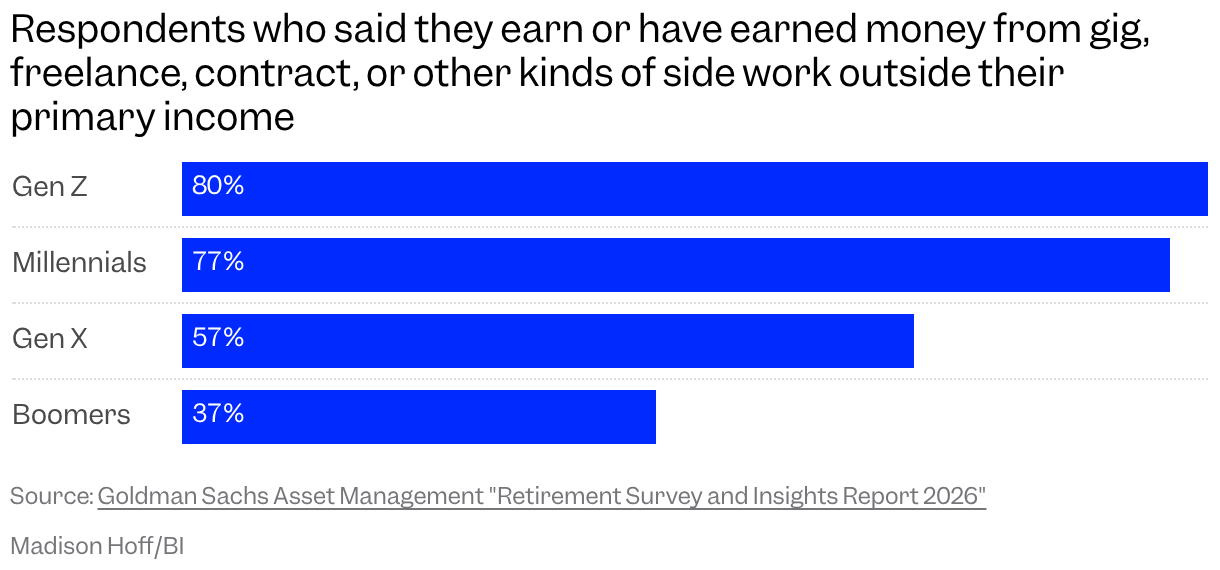
  • Goldman Sachs Asset Management found 80% of Gen Zers have worked outside their primary jobs.
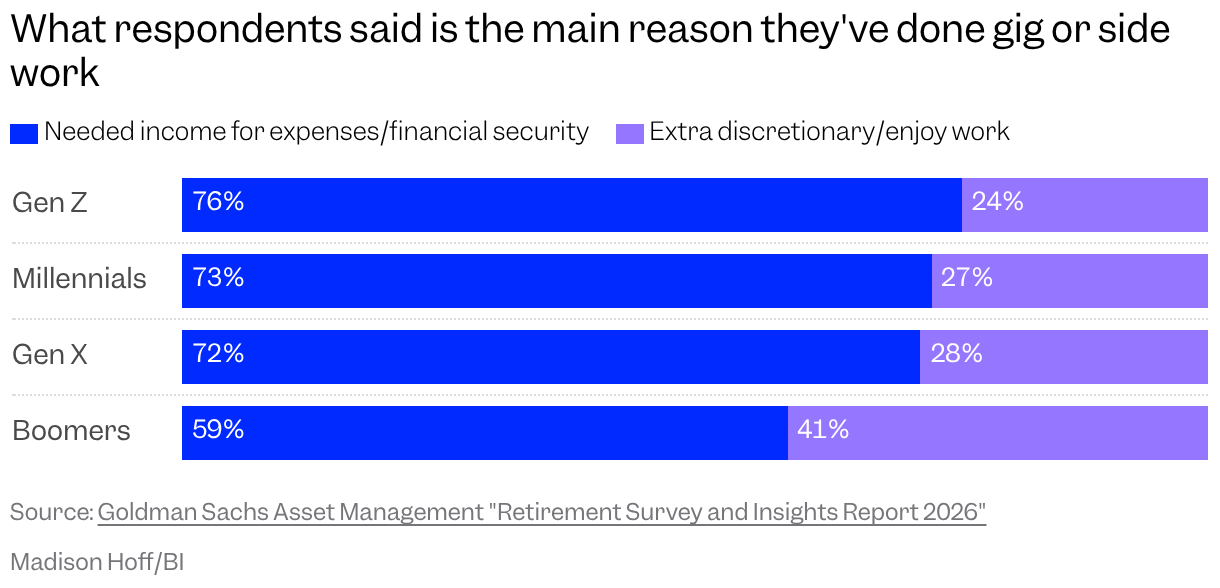
  • People across generations said this was because they needed the money or for financial security.
  • Not feeling secure can affect financial goals, like homeownership.

Having a job doesn't always mean you have enough to cover daily living or savings goals.

A July survey of Americans by Goldman Sachs Asset Management and the behavioral economics firm Escalent found over 60% of respondents have worked outside their primary roles, largely because they needed to. Twenty-seven percent of respondents said work covers their expenses, but it's tough to get ahead.

"Employment remains essential for retirement security, but for many Americans, it is no longer sufficient," a Goldman Sachs Asset Management retirement report said.

Gen Zers were most likely to say they earn or have earned money outside their primary job; millennials followed closely behind. The report said that's despite most Gen Z and millennial workers reporting their jobs provide financial stability.

"Younger workers may feel stable in their main jobs while still seeing extra work as necessary," the report said.

Bar chart of respondents who said they earn or have earned money from gig, freelance, contract, or other kinds of side work outside their primary income, by generation

Throughout the generations, a majority said they're doing gig or side work out of necessity or for financial security.

"The traditional full-time job may no longer be carrying the full weight of financial security," the report said. "For many, supplementing income appears to have become part of the baseline."

Stacked bar chart of what respondents said is the main reason they've done gig or side work by generation

Some Americans are living paycheck to paycheck or adjusting their budgets to cope with rising gas prices and other everyday expenses. It can be hard to get ahead when wage growth has been consistently falling short of inflation, and it's tough to find a new job to try to earn more money.

Not feeling financially secure can lead to putting off savings goals. Eighty-three percent of Gen Z and 78% of millennials said they put major financial goals on hold. Forty-one percent of millennials have delayed emergency savings despite being employed, and 30% said they delayed housing or homebuying goals. For Gen Zers, the shares were 35% and 34%, respectively.

While some people may be working a part-time side job, others are "overemployed" and working multiple full-time jobs. One millennial has worked five full-time remote IT jobs, earning over $700,000 annually. As Business Insider's Jacob Zinkula reported, overemployed people use their extra earnings for different reasons, such as retiring early or paying down debt.

Having multiple income streams can also be considered a "portfolio career," where people piece together different kinds of work, such as writing a newsletter, doing a side gig, and holding an office job. It can be one way to try "stability stacking" to feel more secure about your career if, for example, you were laid off and lost an income stream.

"When you decentralize everything from one 9-to-5 and build a portfolio career, you protect yourself from the emotional and financial shock if and when business needs change at your 9-to-5," said career coach Janel Abrahami in a TikTok video.

And sometimes, working a side gig can become a complete career pivot. Harlan Rappaport, in his 20s, turned his email marketing side hustle into a full-time career after working as an investment analyst at a financial institution.

"I used to get really excited about the numbers, but over the last couple of years, I realized it's more about the freedom I've had in my life over the last couple of years as a freelancer," Rappaport said in an as-told-to essay. "I don't miss family events, can travel when I want, and can work from anywhere in the world."

Read the original article on Business Insider

  •  

Why managing fiscal is a tightrope for State governments

Most State government expenditure is on social sectors, such as health and education, and economic sectors, such as agriculture and irrigation. In Kerala, such spending has driven social progress since the 1960s. The gap between expenditure and receipts is usually financed through market borrowings.

  •  

Pizza Fan owner, accountants arrested for tax evasion fraud scheme

Well-known pizza chain Pizza Fan was boasting that “everything was Greek.” Allegedly everything was Greek including the fraud scheme that cost the state 25 million euros in Value Added Tax. On Thursday, teams of the Greek Directorate for Combating Organized Crime raided the headquarters of Pizza Fan, an unknown number of its affiliates stores, houses […]

The post Pizza Fan owner, accountants arrested for tax evasion fraud scheme appeared first on Keep Talking Greece.

  •  

Canada opens free trade talks with Turkey

Canada, which is in the midst of a trade war with the United States, opened talks with Turkey Thursday on a free trade agreement during a landmark visit by Prime Minister Mark Carney.

Carney, a former central banker, has made reducing dependence on Washington and diversifying Canada's partnerships one of the cornerstones of his term, which began in March 2025.

"We decided to begin negotiations for a free trade agreement, which includes increasing trade and investment, before the end of the year," Turkish President Recep Tayyip Erdogan said in a joint address to reporters.

Carney is the first Canadian prime minister to pay an official visit to Turkey.

"We hope to increase our trade volume, which is currently around $3 billion, to $5 billion and then $10 billion. We will approximately double direct flights between our countries," Erdogan said.

Carney said Canadian negotiators would come to Ankara next month for the first round of free trade talks.

"Our goal is not self-sufficiency, it is collective resilience," said Carney.

"And that's why Canada is building deeper partnerships with reliable partners that create new opportunities for us both. And in Turkey, we have an exceptional partner."

Carney is due to meet on Friday with Turkish business leaders in Istanbul, in strategic sectors such as energy, aerospace and critical minerals.

Canada and Turkey have also identified potential for cooperation in nuclear energy.

They also announced a partnership agreement in the defence industry.

"Today's new Agreement on Defence Industry Partnership will connect Canadian and Turkish companies to work together, creating good jobs at home, export opportunities abroad, greater security for our citizens, and contributing to a stronger NATO alliance," Carney said.

Carney has multiplied overseas trips, renewing ties with nations such as Saudi Arabia, India and China with which relations had been strained or even broken under his predecessor Justin Trudeau.

Carney has also drawn closer to Europe.

  •  

The RBI and its growing fiscal role

RBI’s record ₹2.87 lakh crore surplus transfer to the Centre shows its growing fiscal significance, as earnings from reserve management and foreign assets support govt. finances; the trend raises questions about central bank independence, fiscal centralisation, and exclusion of such transfers from fiscal devolution to States

  •  

New Mexico Judge Orders Meta To Pay $25 Billion in Cambridge Analytica Case

A New Mexico judge has ordered Mark Zuckerberg's Meta to pay $25 billion in penalties over its handling of the Cambridge Analytica data scandal, according to a court filing issued Wednesday.

The post New Mexico Judge Orders Meta To Pay $25 Billion in Cambridge Analytica Case appeared first on Breitbart.

  •  

The reality behind falling net FDI

India’s net FDI has declined sharply despite strong gross inflows, underlining the impact of disinvestment/capital repatriation; an understanding of these trends requires looking beyond aggregate inflow, outflow figures; investor classes, modes of entry, and exit strategies can have important implications for technology transfer, industrial development, and external sustainability

  •  

Minneapolis Restaurant that Eliminated Prices to Protest ICE Raids Announces It Will Close

Modern Times Café, the Minneapolis restaurant that eliminated prices for meals to protest Immigration and Customs Enforcement (ICE), has apparently protested itself right out of business.

The post Minneapolis Restaurant that Eliminated Prices to Protest ICE Raids Announces It Will Close appeared first on Breitbart.

  •  

Kiley: I Voted Against Tariffs That Raise Costs, My Opponent Voted for California Gas Tax That Raised Prices

On Wednesday’s broadcast of CNN’s “The Story Is,” Rep. Kevin Kiley (I-CA) said that he voted against tariffs that have raised costs, while his Democratic opponent “voted for a gas tax increase that has more than doubled the gas tax

The post Kiley: I Voted Against Tariffs That Raise Costs, My Opponent Voted for California Gas Tax That Raised Prices appeared first on Breitbart.

  •  

Dem Rep. Kamlager-Dove: CA's Tax System 'Very Volatile' Because It Relies on Small, Heavily-Taxed Group, Should Be 'More Equal'

On Wednesday’s broadcast of Bloomberg’s “Balance of Power,” Rep. Sydney Kamlager-Dove (D-CA) said that, in California, “We rely on a small number of people to provide a lot of tax revenue to the state, and that brings with it volatility. So,

The post Dem Rep. Kamlager-Dove: CA’s Tax System ‘Very Volatile’ Because It Relies on Small, Heavily-Taxed Group, Should Be ‘More Equal’ appeared first on Breitbart.

  •  
❌