❌

Reading view

Space Force scrambles as Elon Musk's SpaceX retires its major rocket

A SpaceX Falcon 9 rocket returns
A SpaceX Falcon 9 rocket returns at Cape Canaveral, Florida, after launching a Crew Dragon capsule into orbit on October 1, 2026.

Marco Bello / AFP via Getty Images

  • SpaceX is phasing out its popular Falcon 9 rocket in favor of its much larger Starship rocket.
  • That presents a headache for the US Space Force, POLITICO reports.
  • The Space Force has said it's open to eventually using SpaceX's Starship. But there are engineering challenges to overcome.

SpaceX's plans to retire its most popular rocket could jeopardize the United States' ability to launch military satellites — a plight compounded by the Pentagon's dependence on Elon Musk's company.

SpaceX is by far the dominant player in the rocket business and indispensable to the military, dwarfing competitors and accounting for 85% of US launches in 2025. The company is phasing out its Falcon 9 rocket to make way for Starship, a massive new vehicle that SpaceX says will be more efficient and profitable, but which many military satellites aren't designed to fit.

The situation leaves the Space Force in a launch crunch that could affect the military's ability to put its advanced satellites in orbit — and on time. The Pentagon has few alternatives to ferry its equipment, and SpaceX's competitors are likely years away from being able to offer comparable services, reports POLITICO, which — like Business Insider — is part of the Axel Springer Global Reporters Network.

"Everybody's having problems, so the Space Force is freaking out a little bit about launch," one former Space Force official, who, like others, was granted anonymity to discuss the sensitive issue.

It also highlights the scale of Musk's company's footprint and the way its business decisions can affect the security of countries including the United States. From the battlefield in Ukraine, where Kyiv is dependent on his Starlink satellite internet service, to cutting-edge artificial intelligence and SpaceX's stranglehold over the pathways to orbit, the world's first trillionaire has a direct hand in the technology that will shape the future.

The Space Force recently tried to book rides for three future satellite missions, but SpaceX declined to offer its services, according to two people familiar with the missions. No other rocket companies offered to take them either, the people said.

A top official at the Space Force downplayed the problem about finding rockets to launch military satellites.

"I wouldn't say there [are] missions I'm worried about being able to fly; I would say we're working through the right way to support those customers," said Brig. Gen. Eric Zarybnisky, the Space Force's acting portfolio acquisition executive for space access.

But Zarybnisky acknowledged growing pains for the government and space industry as demand for rockets increases. "Temporarily, there are some things we'll need to work through, again, as we get new providers flying," he said.

SpaceX did not respond to a request for comment.

The three Space Force missions that didn't find a ride were listed through the National Security Space Launch initiative, or NSSL — the program the service uses to buy rocket launches for its satellites.

Two of the missions were for the Space Development Agency, according to the people. The agency is a branch of the Space Force that's building a network of hundreds of military satellites in low-Earth orbit to provide expanded data services, and missile warning and tracking capabilities.

Details about the third Space Force mission or the precise date for when the Space Force hoped to launch the missions are unclear.

The Space Force has set up a two-lane system for buying its launches, one for less demanding efforts and another for more challenging missions. The hope was that new competitors, such as Rocket Lab, Stoke Space and Relativity, would have an easier time winning contracts for the lower-risk missions. But SpaceX has dominated both lanes with its Falcon rocket, and other providers have been slow to scale up.

The Space Force hopes to use two large rockets from SpaceX competitors to ferry key military satellites into orbit: United Launch Alliance's Vulcan and Blue Origin's New Glenn.

But the Vulcan rocket has struggled to launch consistently and was grounded earlier this year after problems with its solid rocket boosters. Space Force officials have been frustrated by ULA's delays and have moved missions slated for a Vulcan to a SpaceX Falcon.

Meanwhile, Blue Origin's New Glenn program had a devastating setback in May when a rocket exploded on the company's only launchpad in Florida — putting the rocket out of commission likely until next year.

The Space Force has said it's open to eventually using SpaceX's Starship. But there are engineering challenges to overcome because Starship is designed for "flat stack" satellites such as Starlink, while most military satellites are designed for a larger cargo bay. And it's unclear when SpaceX will have the capacity to meet the Pentagon's needs, given its plans to use Starship to build out orbital data-centers and other company priorities.

Other newer companies may have some solutions. Stoke Space, Relativity and Rocket Lab are all working on medium-lift rockets that could help meet the military's needs. But none of those companies has flown successful test flights of their new vehicles, meaning it could take years for them to start launching reliably and frequently.

Zarybnisky remained optimistic that Blue Origin and ULA will work through their technical problems and that new competitors will get up and running in time.

"We're excited to see where those new providers come on board and are able to support the national security base launches that we need," he said.

It's not just the Pentagon feeling the pinch. The move to decommission the Falcon 9 rocket and focus on Starship has sent the entire space industry into panic — especially commercial satellite builders. Some of those firms have been unable to secure Falcon 9 flights after 2028.

The Space Force didn't disclose a set date for when it will fly its last Falcon mission, but Zarybnisky said the service is "actively talking to SpaceX and understanding where the spacecraft programs are, where they are in their build and test cycle. The end date will really be driven by the spacecraft customers that we have launch service contracts for already."

It's unclear what happens after the Space Force runs through that batch of missions. An industry representative warned that the service is unprepared to deal with the crisis coming its way as demand for rockets increases across the space industry.

New rocket companies can't bid on a Space Force launch until they've demonstrated the ability to successfully fly, part of an effort to keep vaporware companies from winning government business. But commercial satellite companies are not restricted in the same way and have been buying up early launches on rockets that haven't even flown yet. This puts more pressure on the Space Force to find future launches.

The launch crunch "probably requires the Space Force to get creative and figure out a way to start buying capacity now before it's too late," the representative said.

Another person familiar with the issue said that Space Force officials need to work with Congress to "fundamentally rethink" how the military acquires launch.

"The Space Force needs to be allowed to reserve multiple launches at a time, much further out into the 2030s, for vehicles that have yet to fly," the person said. "Yes, it's taking on more risk … [but] if it waits for new rockets to prove themselves, it may find they're already sold out."

This story originally appeared on POLITICO and is courtesy of the Axel Springer Global Reporters Network, which harnesses the resources of the company's newsrooms to publish ambitious scoops, investigations, interviews, opinion pieces, and analysis. It allows journalists — including those from POLITICO, Business Insider, WELT, BILD, Onet, and Fakt — to collaborate on major stories for an international audience of hundreds of millions across platforms.
Read the original article on Business Insider

  •  

This startup raised $34 million to help security teams keep up with AI threats. Read the pitch deck.

Two smiling bearded people in cream shirts pose side by side against a teal studio background.
Guy Eshel and Raziel Oren founded Mave in 2025.

Mave

  • Mave has raised $34 million to bring AI agents to companies' security operations.
  • CEO Raziel Oren said old systems can't keep up with how quickly AI is transforming cyberattacks.
  • Business Insider got an exclusive look at the pitch deck Mave used to raise its Series A round.

Mave, a cybersecurity startup that uses agents to counter the rise in AI-powered cyberattacks, has raised $34 million in funding.

The Israel-based startup says its AI agents pull together information from a company's existing security systems, investigate alerts, filter out false alarms, and take actions approved by human teams.

"Security operations is the last gate in any organization," cofounder and CEO Raziel Oren said, comparing it to the physical security guards who monitor a building's live camera footage. "This thing is really broken from the inside. The roots of the solutions there are just not keeping the relevant pace with the emerging threats."

AI has transformed cyber threats at a dizzying pace. Attacks can happen much faster and on a much larger scale, and Oren predicted that the increase in agent-powered incidents will be "exponential."

Mave says its own agents help human security teams keep up. "You can't hire your way out of this," Oren told Business Insider. "There must be a change in how you do [security operations] in order to protect your organizations."

Oren cofounded Mave with Guy Eshel in 2025 after years of friendship. The two met when Oren was Eshel's mentor in unit 8200 of the Israel Defense Forces, which sits under the intelligence corps and gave them firsthand experience with cybersecurity issues.

AI agents have come under the spotlight after a string of high-profile security breaches. Corporate leaders have grown increasingly worried about the cybersecurity risks AI poses, and some of Wall Street's executives spent third-quarter earnings calls explaining how they're defending against rogue AI agents.

The technology has also been used by researchers to uncover security flaws: this week, OpenAI said one of its AI models had helped identify a vulnerability that puts 70% of the world's websites at risk.

Oren said it takes some customers time to become comfortable handing over security operations to agents, but that the product's transparency is key to building trust. Mave says its agents track each step of their thousands of workflows, giving human employees insight into the agents' reasoning and actions.

Mave charges its customers a flat rate, depending on the company's size and needs. Other startups have also jumped at the opportunity Mave sees, including agentic cybersecurity companies Dropzone and Prophet Security.

Mave's $34 million funding consists of $28 million from a recent Series A round, led by Red Dot Capital Partners and with participation from Lumir Growth Partners, and an earlier $6 million seed round.

The startup currently has 30 employees and plans to use some of the fresh capital to continue expanding the team, mainly for go-to-market roles and AI research.

Read the pitch deck Mave used to raise its Series A round:

The co-founders met in the army.
Slide for MA>E agentic security operations platform showing portraits of Raziel Oren and Guy Eshel with founder titles.

Mave

Cyberattacks are happening much faster.
Green cybersecurity infographic shows attacker breakout time dropping from 62 minutes in 2023 to 29 minutes in 2025.

Mave

Mave consolidates security operations.
Slide diagram shows Mave security operations platform layers connected to existing SIEM, data lake, SOC, and analytics tools.

Mave

In one instance, Mave says it stopped ShinyHunters, a cybercriminal group.
Marketing slide says a Fortune 200 company took its SOC in-house with Mave and stopped ShinyHunters.

Mave

Customers include Fortune 200 and Fortune 500 companies.
Dark presentation slide highlights Mave traction metrics, funding amounts, and investment rounds with a Mave logo.

Mave

Read the original article on Business Insider
  •  

Top Anthropic engineer says Claude now writes 'literally all' her team's code

Katelyn Lesse, head of platform engineering at Anthropic, speaks at a conference.
Katelyn Lesse, head of platform engineering at Anthropic.

Chris Ratcliffe/Bloomberg via Getty Images

  • Anthropic platform engineering head Katelyn Lesse said that Claude now writes all her team's code.
  • Lesse shared ways that Claude Code has helped the company become more efficient.
  • Anthropic nears an initial public offering at a potential $2 trillion valuation.

A top Anthropic engineer says that Claude Code has already wiped out all human coding at one of the AI lab's central teams.

Katelyn Lesse leads the AI startup's platform engineering group, which handles the company's core services, developer tools, and product infrastructure — it's essentially the engine room of Anthropic. Lesse said at Grafana Labs' ObservabilityCON event on Tuesday that among her staff, which tallied 200 as of this summer, the era of human-written code is fully over.

"When it comes to our team and how we're actually building and maintaining our systems, all of our code is written by Claude," Lesse said. "Like, literally all of it."

Anthropic's heavy reliance on Claude Code has helped it remain relatively small, as it approaches an initial public offering that could value it at nearly $2 trillion. The company's revenue growth slowed in the third quarter of this year. Maintaining its lofty valuation may depend on selling more companies on the AI-first approach espoused by Lesse and other Anthropic leaders.

Lesse said that people on her teams are still designing systems and verifications, and then offloading the actual coding to Claude. She said that when the company changed the programming language of a major codebase from Python to Rust, workers developed a way to verify the final product.

"But the grunt work of building the pieces and actually monitoring the pieces and actually making sure that we felt good about it, that was agents all the way down," Lesse said.

Lesse said Anthropic already lets agents fix tests autonomously, with no human interaction, and it's thinking about how staff can get comfortable with agents autonomously making changes to the actual codebase, given the improvements in AI models over the last year.

"As engineering leaders, we're like terrified, and we're like, let's be really careful about this, but I think the line is starting to push," Lesse said.

Anthropic has also embraced Claude Code companywide. It released a report last week saying that as AI agents have worked more inside the company, it has hired for a smaller share of junior technical positions. And in May, Anthropic said that Claude then wrote more than 80% of the entire company's production code.

Have a tip? Contact this reporter via email at scouncil@businessinsider.com, or over text, Signal, Telegram, or WhatsApp at 415-757-8198. Use a personal email address, a non-work WiFi network, and a non-work device; here's our guide to sharing information securely.

Read the original article on Business Insider

  •  

The legal AI boom just lured a researcher out of Meta's Superintelligence Lab

Meta headquarters sign at 1 Hacker Way appears behind a blurred "One Way" street sign.

Josh Edelson/Bloomberg via Getty Images

  • One of Meta's AI researchers left the company this month to start a legal tech company.
  • Ethem Coban worked on teaching Meta's language models to reason through legal questions.
  • Since then, he's had talks to raise $6 million in funding for a startup, according to a person familiar.

The legal industry's artificial intelligence gold rush is luring talent from Silicon Valley's biggest labs.

Ethem Coban, a researcher at Meta, left the company earlier this month to launch a legal tech startup, according to a person familiar with the matter. Coban, who worked on teaching Meta's language models to reason through legal questions, has been in talks to raise $6 million at a $25 million valuation.

Talks are still early, and the terms of the deal could change.

The startup is the latest entrant in an increasingly crowded legal tech market. Long seen as laggards, lawyers have spent the past two years experimenting with tools built on large language models. Early movers like Harvey and Legora saw a crush of demand, setting off a wave of investment in startups promising to transform how lawyers work.

Now, that opportunity is attracting researchers from the companies building the underlying models.

Coban spent almost two years at Meta, most recently at its Superintelligence Labs, where he helped train models to give better answers to legal questions and reduce hallucinations, the person said. He previously studied law at American University and Goethe University in Frankfurt.

A spokesperson for Meta didn't respond to a request for comment.

Coban has told investors that his new company aims to help law firms and corporate legal teams build and customize models around their expertise. The bet is that companies will increasingly want to own their AI rather than license it from outside companies, because it gives them more control over their data.

Law firms also see a chance to turn mountains of case files into a competitive advantage that other firms can't simply buy off the shelf. Kirkland & Ellis, the industry's revenue leader, has committed $500 million to building proprietary software. Latham & Watkins has been buying its own Nvidia servers to customize models in-house.

For Coban, the challenge won't be convincing law firms that they need artificial intelligence. It will be persuading them that someone who knows how the models work from the inside is best suited to build them.

Read the original article on Business Insider
  •  

Most AI data centers may never be built. Blame the 'bragawatts.'

Kevin O'Leary speaks during the Romain College of Business Innovative Speaker Series at the University of Southern Indiana Wednesday, Sept. 23, 2026.
Kevin O'Leary speaks at the University of Southern Indiana.

MaCabe Brown / Courier & Press / USA TODAY NETWORK via Imagn Images/Reuters

  • Newcomers like Kevin O'Leary face skepticism due to a lack of experience in data center development.
  • Bernstein analysts dubbed O'Leary and others "bragawatts."
  • Most announced projects will never happen. "Press releases are cheap…concrete is not."

The AI industry has a problem with bragging.

Companies are announcing enormous new data centers to power the AI boom. Some promise facilities bigger than anything the industry has built before.

There's just one problem: Most of these projects may never happen.

Bernstein Research analyzed thousands of planned US data centers and concluded that only about 35% of the announced capacity is likely to get built. That's roughly 170 gigawatts of data center capacity out of a total of almost 500 gigawatts.

The rest? A significant chunk of it belongs to a category the industry has a wonderfully dismissive name for: "Bragawatts." These are ambitious announcements, often from newcomers with little experience building data centers, that have a slim chance of becoming reality.

"Press releases are cheap…concrete is not," Bernstein analysts wrote in a research note.

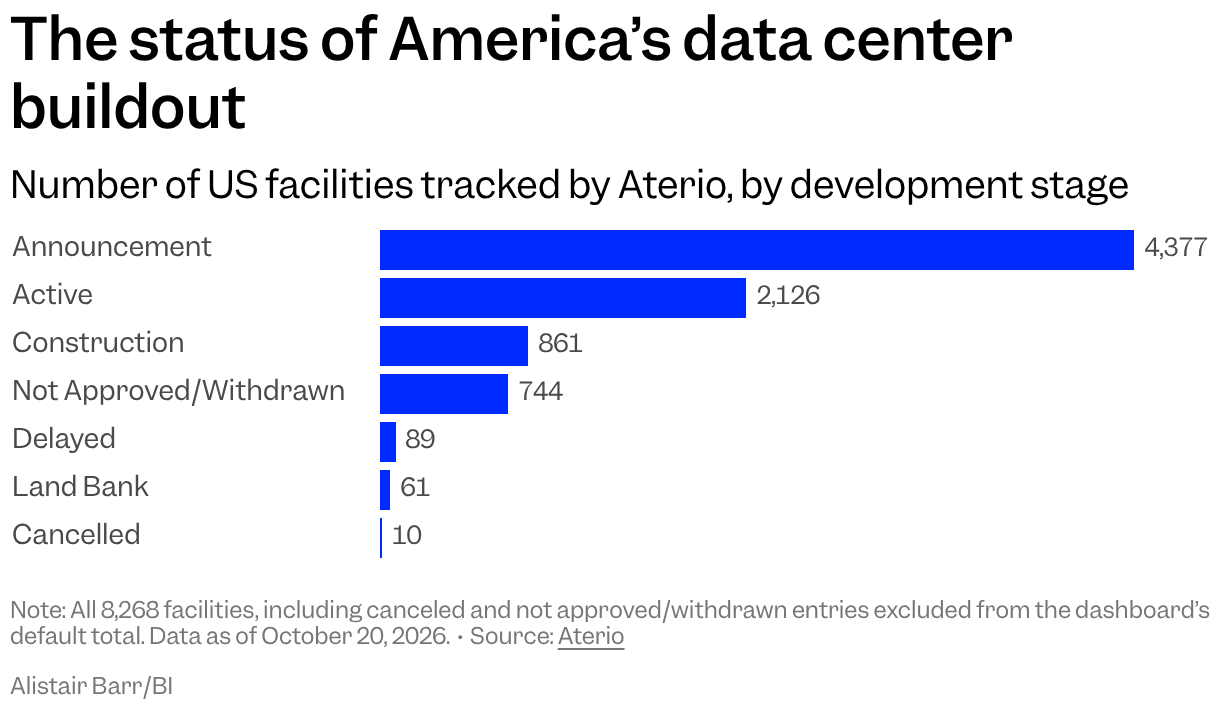
Among 8,268 tracked US facilities: Announcement 4,377; Active 2,126; Construction 861; Not Approved/Withdrawn 744; Delayed 89; Land Bank 61; Cancelled 10.

Bernstein began its analysis with more than 7,000 data center projects across North America, drawing on information from Aterio, a company that tracks construction through satellite imagery, permits, and other records. The analysts narrowed that to more than 5,000 projects (partly by excluding those already canceled).

Then they assessed the chances of these remaining projects being completed. The analysts considered factors such as whether construction had started, whether electricity was available, and whether the companies involved had successfully built data centers before.

The results revealed a striking divide.

The 'bragawatt brigade'

Kevin O'Leary
Kevin O'Leary.

Daniel Delgado Jr./Disney via Getty Images

Experienced operators including Amazon, Google, Microsoft, and Meta landed at the top. Bernstein gave these companies perfect scores of 5 out of 5 for their development credentials. Other data center specialists, such as Digital Realty, Equinix, and CoreSite, got top marks, too.

O'Leary Digital, associated with celebrity investor Kevin O'Leary, ended up at the bottom, with a credibility score of 0.35 out of 5, according to Bernstein. His company has announced 15 gigawatts of data center projects, and Bernstein estimates that only 489 megawatts, or about 3%, will actually materialize.

"Sorry, Kevin," the analysts wrote.

Although the term "bragawatts" has been doing the rounds in the data center industry lately, it's unclear who coined it, Bernstein analyst Madison Rezaei told me.

"I wish I could take credit for that," she said. "I believe I originally heard it from an Equinix executive, but I don't think he owned it either."

She said that while some ambitious newcomers could succeed, they haven't yet demonstrated they can deliver.

"It's not that all of these guys are sort of terrible and not going to deliver, but we just have lower confidence because we don't know them," Rezaei said.

O'Leary Digital responds

O'Leary Digital disputed Bernstein's assessment, saying the research doesn't account for substantial work that occurs before construction begins.

While acknowledging that O'Leary Digital is a young company, CEO Paul Palandjian said the team has decades of experience building major infrastructure projects and that its proposed 15 gigawatts of capacity would be built in stages over several years.

The company said it has secured binding agreements covering about 11,000 acres in Utah and 13,000 acres in Alberta, obtained a 30-year development agreement in Utah, and made progress on planning, engineering, and permits at both sites. It also said the projects would generate their own electricity.

The company said its early development work is funded, additional capital is committed to reaching key milestones, and experienced engineering and construction partners are involved.

"We would rather be judged on milestones than on a model," Palandjian said.

'An announcement in search of a project'

Opponents of the proposed La Osa data center attend a Pinal County Board of Supervisors meeting in Florence, Arizona, on Aug. 26, 2026.
Opponents of the proposed La Osa data center attend a Pinal County Board of Supervisors meeting in Florence, Arizona, on August 26.

USA TODAY Network via Reuters Connect

Other low scorers in the "bragawatt" brigade included Vermaland and Joule Capital Partners, according to Bernstein analysis based on Aterio data.

Joule has announced 50 data center projects with a combined capacity of 11.7 gigawatts. Bernstein estimates that only about 11% of that capacity will actually get built. Almost all of Joule's planned capacity remains at the announcement stage, with little evidence of construction progress or of major customers committing to use the facilities, Bernstein wrote in a July note to investors.

The analysts gave Joule a credibility score of 2.05 out of 5, placing it among the lowest-ranked developers in its database.

"An announcement in search of a project," the analysts wrote.

Vermaland has announced plans for a massive data center project in Arizona. Bernstein estimates that only 4% of its proposed 2.2 gigawatts of capacity will get built. The company is primarily a landowner, not a data center developer. Its proposed $33 billion La Osa project near Eloy had already been sharply scaled back amid local opposition and without construction approval. In late August, regulators formally rejected the project. Even before that, the analysts gave Vermaland a credibility score of 0.75 out of 5.

Joule and Vermaland didn't respond to emails seeking comment this week.

A yawning gap for data centers

Sergio Toro, CEO of Aterio, sees similar patterns in his firm's voluminous, detailed data.

Aterio's tracking shows that roughly 30 to 40 gigawatts of new data center capacity get announced each month. Yet only about 7 gigawatts begin construction each month, while 2 to 3 gigawatts actually start operating.

This leaves a yawning gap.

Many announced projects get withdrawn before construction begins — and before real money has been spent.

"They just make the announcement, but they didn't get their approvals. Or they make multiple filings in multiple locations to see which one gets selected," Toro told me. "That's why we track with satellite if there's real movement on the ground or not."

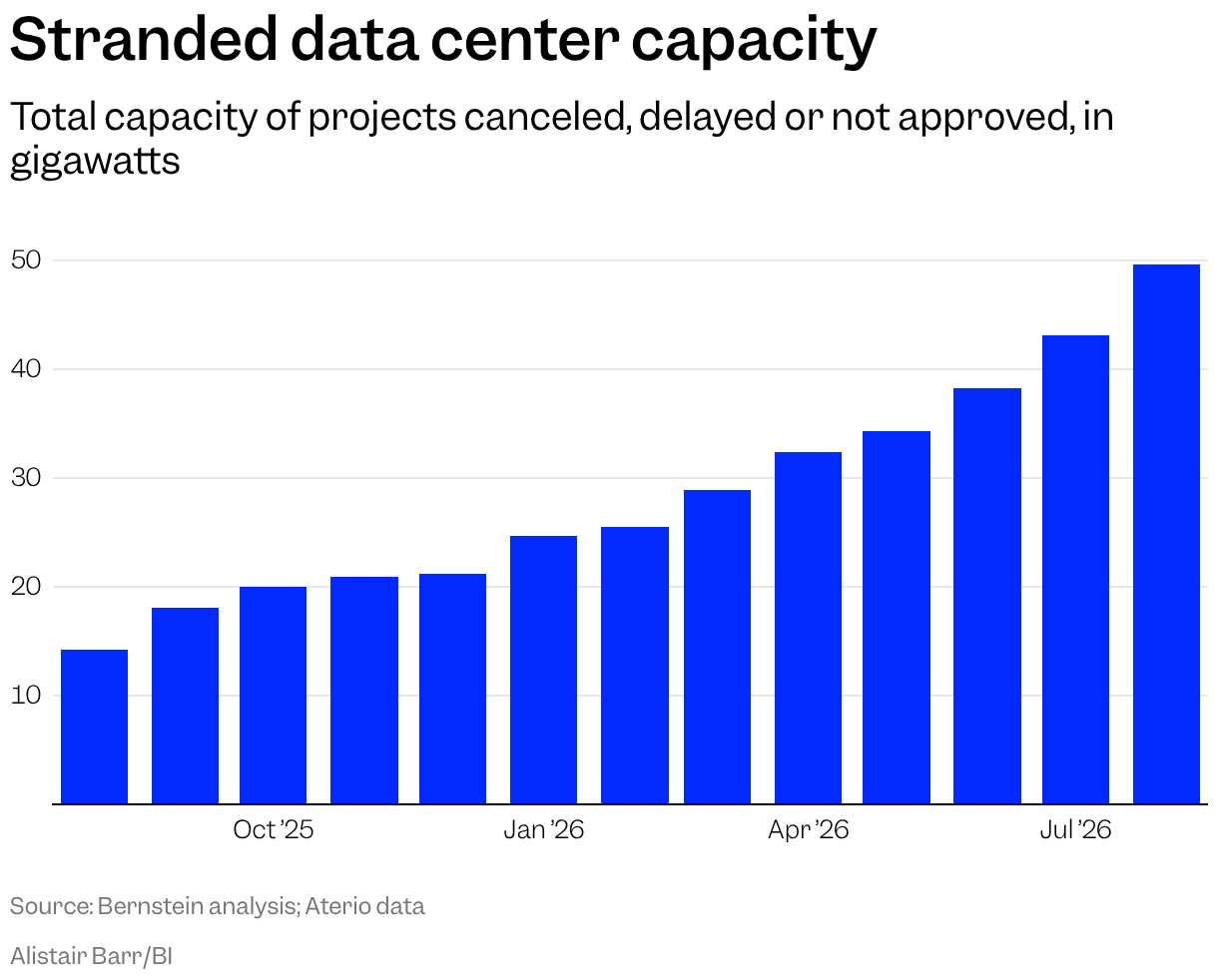
Indeed, Bernstein analysts wrote recently that the amount of "stranded" data center capacity has surged. These are projects that are either canceled, delayed, or not approved.

Column chart showing total stranded data center capacity rising from 14.2 gigawatts in August 2025 to 49.6 gigawatts in August 2026. Stranded capacity means projects canceled, delayed or not approved. Monthly totals are 14.2, 18.1, 20.0, 20.9, 21.2, 24.7, 25.5, 28.9, 32.4, 34.3, 38.2, 43.1, and 49.6 gigawatts.

The AI boom's three tiers

Toro sees three broad groups competing to build AI infrastructure.

At the top are the established technology giants, including Amazon, Microsoft, and Google. They've built data centers for decades and generally deliver on their commitments. Most of their projects will get done, he said.

In the middle are "neoclouds," newer companies such as CoreWeave that rent out computing power specifically for AI. Although they're more vulnerable to financing problems and delays, many are making solid progress, especially because some of these players already have access to electricity.

"We see them advancing quite well," Toro said. "Sometimes we see some delays, but it's not something significant or any kind of big capacity that is at risk."

Then come the newcomers making extraordinary promises. That's where most delays and cancellations happen, Toro said.

Even Amazon needs a backup plan

NEW CARLISLE, INDIANA - OCTOBER 2: In this handout provided by Amazon, a technician works at an Amazon Web Services AI data center in New Carlisle, Indiana on October 2, 2025.
A technician works at an Amazon Web Services AI data center in New Carlisle, Indiana.

Noah Berger/Getty Images via Amazon Web Services

Not every project that disappears was a fantasy, though. Even a top player like Amazon struggles sometimes to secure electricity and other supplies on time for these huge projects.

Business Insider's Eugene Kim reported exclusively this week on the challenges Amazon faces with its record AI buildout.

The biggest, most experienced tech companies deliberately pursue more potential data center capacity than they need because they know some developments will fail or get delayed.

Major AI companies were committing to three or four times the space and electricity they needed over the following two years, Jeffrey Moerdler, a data center lawyer, estimated during an interview with Bernstein analysts.

His reasoning: Of data center projects that haven't started construction, roughly a third will arrive on schedule, another third will be delayed, and the remainder won't happen.

Rezaei and Toro estimate that the top players don't over-commit that much — more like double the capacity they need at most.

The strategy provides a "Plan B," as Toro put it, in case of delays involving electricity, equipment, permits, local opposition, or other factors.

Texas has a ghost problem

AUSTIN, TEXAS - JULY 03: In an aerial view, the Decker Creek Power Station is shown on July 03, 2024 in Austin, Texas. The state of Texas is developing plans to double its Texas Energy Fund of $5 billion. The move seeks to bolster an expansion of the power grid, as new predictions of surges in electricity usage loom.
The Decker Creek Power Station in Austin.

Brandon Bell/Getty Images

This helps explain another extraordinary number.

Data center companies have requested connections for roughly 450 gigawatts of electricity demand on Texas' main power grid, more than five times the grid's roughly 85 gigawatts of existing capacity, according to Toro and others. 

Many of those requests are placeholders rather than firm construction plans. Toro calls them "ghost projects."

These speculative projects clog the waiting lists for electricity connections, making the electricity shortage look a lot worse than it actually is.

"Developers routinely spam projects across several sites, and many are speculative builds with no customer yet," Ryan McEntush, a partner at venture capital firm Andreessen Horowitz, wrote in a recent blog. "Often these new developers have never even plugged in a GPU, let alone a power plant."

Texas has paused applications to review and weed out projects that aren't serious. Toro, from Aterio, expects this to favor the established players at the expense of the bragawatts.

The real AI boom

None of this means the AI infrastructure boom is imaginary.

Aterio tracks thousands of buildings, including major projects already under construction. Bernstein estimates that nearly 80% of the capacity the largest technology companies are directly developing is credible.

And when speculative projects disappear, Rezaei doesn't expect a wave of unpaid debt. Many will fail before building begins, the stage when developers borrow serious money through project financing.

Some of those missing data centers were never really coming in the first place.

Sign up for the AI Insider newsletter here. Reach out to me via email at abarr@businessinsider.com

Read the original article on Business Insider

  •  

Peter Thiel breaks with Trump over Iran war: 'We should not have done it'

Peter Thiel
Peter Thiel, cofounder and chairman of Palantir Technologies Inc.

Bloomberg/Getty Images

  • Thiel criticized the US-Iran war, diverging from Trump's foreign policy stance, POLITICO reported.
  • "There were a lot of mistakes that were made," Thiel said at a lecture earlier this month.
  • Despite his criticism of the war in Iran, Thiel highlighted his continued support for Trump.

Billionaire technology investor Peter Thiel said he's skeptical of the US war with Iran and does not believe the United States should have launched it, putting the major Republican donor at odds with President Donald Trump over one of the administration's defining foreign policy decisions, POLITICO reported.

Thiel's remarks, delivered on October 12 at a private event, are his most explicit statements to be revealed publicly about the war with Iran and come less than two weeks before the midterm elections in which Trump's party is grasping to maintain power in Congress. The audio of Thiel's comments was obtained by Decoded by POLITICO from a lecture earlier this month.

"I'm skeptical of [the war], I think we should not have done it," Thiel said. "There were a lot of mistakes that were made."

Thiel added, "Maybe we don't have the hard power. Maybe we're going to lose the soft power war."

In the full lecture, Thiel made clear his strong opposition to neoconservatives and Middle East wars. Despite his criticism of the Iran war, Thiel highlighted his continued support of Trump and suggested he wanted to protect the president.

Still, Thiel's break over the war represents one of the most important examples to date of a fierce Trump ally sharing deep concerns about the conflict.

The comments were part of Thiel's lecture series in Nashville, which Decoded has documented since their start this fall. In the latest lecture, Thiel issued extensive warnings about what he described as the unchecked power of the International Criminal Court, drawing on comments from Bush-era figures Donald Rumsfeld and Dick Cheney.

"I read the Cheney family's Trump derangement syndrome as an attempt to buy favor with the [International Criminal Court] and avoid prosecution. Probably too late," Thiel said. "And I have come to suspect that the threat of an ICC arrest warrant is the sword of Damocles hanging over the Trump administration as it tries to persecute this war in Iran."

Thiel also discusses meeting with Israeli Prime Minister Benjamin Netanyahu in early 2024, after the October 7 attack, where he said he asked the president about his plans in Gaza. Thiel said Netanyahu told him, "I can't just Dresdenize it," referring to the Allied bombing of the German city of Dresden during World War II that killed roughly 25,000 people.

The first big tech investor to back Trump in 2016, and then have a high-profile speaking role at the Republican National Convention that year, Thiel was also the biggest financial backer of super PACs supporting Vice President JD Vance's Senate campaign in 2022. POLITICO reported in March that Vance was "skeptical" of the U.S. striking Iran in the lead-up to the beginning of the war.

Representatives for Thiel and the White House did not respond to requests for comment.

This story originally appeared on POLITICO and is courtesy of the Axel Springer Global Reporters Network, which harnesses the resources of the company's newsrooms to publish ambitious scoops, investigations, interviews, opinion pieces, and analysis. It allows journalists — including those from POLITICO, Business Insider, WELT, BILD, Onet, and Fakt — to collaborate on major stories for an international audience of hundreds of millions across platforms.
Read the original article on Business Insider

  •  

Mark Zuckerberg considered leaving California over the billionaire tax

Meta CEO Mark Zuckerberg
Meta CEO Mark Zuckerberg.

Finn Gomez/Getty Images

  • Meta CEO Mark Zuckerberg considered moving out of California because of a proposed billionaire tax.
  • Zuckerberg would get $20 billion in "immediate liquidity" if the billionaire tax passes.
  • Meta made the offer to Zuckerberg to help keep him in California after he considered leaving.

Meta CEO Mark Zuckerberg considered moving out of California because of its proposed billionaire tax, Meta disclosed in a new SEC filing on Wednesday.

Next month, Californians will vote on Proposition 40, a one-time tax on the assets of the state's billionaires.

The filing said that Zuckerberg told a special committee formed by Meta that he was considering moving.

In response, the committee concluded that it was "critically important" for Zuckerberg to keep running Meta close to its Silicon Valley headquarters — particularly to its AI division, Meta Superintelligence Labs.

The filing said the committee got Zuckerberg to agree to remain in California or any other jurisdiction where Meta has its corporate headquarters for eight years, barring unforeseen circumstances.

As part of its efforts to ensure he can remain in charge as it raises more cash for its AI initiatives, the company is granting the Meta CEO a new stock class.

The shares would give Zuckerberg $20 billion in "immediate liquidity" to cover the tax by selling stock without losing control of Meta, if the tax passes. The new shares wouldn't add to Zuckerberg's net worth or increase his percentage ownership of Meta.

"The goal is to keep Mr. Zuckerberg continuing to lead the Company from California," the filing says.

Meta declined to comment. A person familiar with the matter said that the new class of shares, which totals $150 billion, is also intended to raise capital, compensate employees, and keep Meta's stock price on the right track.

Meta's filing showcases how tech billionaires are responding to the tax proposal. Some, including Google cofounder Sergey Brin and former CEO Eric Schmidt, poured hundreds of millions of dollars into attack ads against the proposal.

While Zuckerberg has taken a lower-key approach, it's clear he's been taking the proposed tax seriously.

The Meta CEO, who is worth about $240 billion according to Forbes, has multiple residences in California, including in Palo Alto and Lake Tahoe.

He also has a sprawling property portfolio outside the state, including a doomsday bunker in Hawaii, a waterfront mansion in Miami, and a castle in Ireland.

Have a tip? Contact this reporter securely on Signal at charlesrollet.12 or +1-628-282-2811. Use a personal email address and a non-work device; here's our guide to sharing information securely.

Read the original article on Business Insider

  •  

Meta CEO Mark Zuckerberg says Muse and Reality Labs are highly unprofitable — for now

Meta CEO Mark Zuckerberg
Meta CEO Mark Zuckerberg.

Finn Gomez/Getty Images

  • Meta's AI agent, Muse, is unprofitable due to "very high compute costs," CEO Mark Zuckerberg says.
  • Meanwhile, Meta expects Reality Labs, its AI glasses division, to lose $15 billion next year.
  • The social media giant has a plan to fix that.

Meta says some of its biggest cash incinerators could finally start turning profits.

The social media giant, which generated over 97% of its quarterly revenue from ads, has faced persistent questions from investors about the lack of profitability in its AI and hardware initiatives.

Meta CEO Mark Zuckerberg addressed those concerns head-on during its third-quarter earnings call on Wednesday.

Zuckerberg said that Muse, the AI assistant it launched last month, is unprofitable since it's "very compute intensive to run." Meta expects to start turning that around next year by massively improving Muse's efficiency.

"If compute efficiency continues improving quickly for another few years, which we think is highly likely, then Muse will be highly profitable over multiple years," he said.

Meta plans to make money from Muse by taking a small transaction fee off of purchases it drives, Zuckerberg said at Meta's Connect conference last month.

Zuckerberg added that Muse, which launched only in the US and Canada, wasn't launched globally due in part to the amount of compute it requires. (Meta's North American users are generally its most lucrative.)

Zuckerberg also struck a positive note about its cash-hemorrhaging Reality Labs division, which makes products like Meta Ray-Bans and virtual reality glasses.

Meta expects Reality Labs to narrow its losses to about $15 billion in 2027, down from the $18 to $19 billion it expects to lose this year. The division should start trending toward profitability next year, as Meta's AI systems make it more useful, Zuckerberg said.

"I continue to believe that the path to delivering holographic experience, of bringing together the physical and digital worlds and everyday glasses, will come through VR first," Zuckerberg said.

Have a tip? Contact this reporter securely on Signal at charlesrollet.12 or +1-628-282-2811. Use a personal email address and a non-work device; here's our guide to sharing information securely.

Read the original article on Business Insider

  •  

Tesla targets shipping Optimus to customers by the end of 2027

A prototype of Tesla's Optimus robot.

CFOTO/Future Publishing via Getty Images

  • Tesla has begun production of its humanoid robot, Optimus, in Fremont, California.
  • Musk said he expects to begin delivering Optimus to customers at the end of 2027.
  • Musk said it will take at least a year to produce 20,000 Optimus units a week.

Tesla has begun producing its long-awaited humanoid robot, Optimus, at its Fremont factory, the company said in its quarterly earnings report.

"The bots coming off this line are the first production-quality bots that we have manufactured," Tesla said, saying the current manufacturing process is "suitable for a commercial product."

"There's still some things we need to tweak about the design, because you need to deliver a robot that is safe and reliable and has long duration," CEO Elon Musk said on Tesla's Q3 earnings call. "It can't, like, wear out after a month."

Musk said the company will take at least a year to scale up Optimus production to 20,000 units a week in Fremont. He said he expects to begin delivering Optimus to customers at the end of next year.

Musk tempered expectations about how quickly Tesla can scale up Optimus production because it is "such a radically new product." He said the early stages of production will be "somewhat bumpy" because "there's like 10,000 things that have to go right" to build the robot. One of the big challenges Musk outlined is building robot hands.

Musk said Tesla is building an "Optimus Academy," where robots will practice tasks and generate data to improve the AI models that power them. The company also plans to install its next-generation AI5 chip in Optimus in April, which will give the robots more computing power and be a "big step change in intelligence," Musk said.

The latest version of Optimus has not been unveiled. Musk said he expects to release a video of Optimus within one or two months. He previously said Tesla was keeping the robot under wraps to prevent competitors from copying its design.

Tesla stopped producing the Model S and Model X at its Fremont, California, plant earlier this year to make room for an Optimus line designed to eventually produce a million robots a year. A second line under construction in Austin is planned to have an annual capacity of 10 million robots.

Tesla is competing in a crowded humanoid market. Agility Robotics, which plans to go public, has deployed its Digit robot across nine customer facilities, while Figure AI has announced deployments in logistics and distribution centers this year. Sunday Robotics, 1X, and Weave Robotics are preparing to ship robots into homes this fall.

Have a tip? Contact Rya Jetha via email at rjetha@businessinsider.com or Signal at rjetha.07. Use a personal email address and a non-work device; here's our guide to sharing information securely.

Read the original article on Business Insider

  •  

Anthropic launches Claude Duet, its answer to Meta and OpenAI's personal agents

Ami Vora, Anthropic's chief product officer, and Daniela Amodei, its president, sit on stage.
Ami Vora, Anthropic's chief product officer, and Daniela Amodei, its president.

Don Feria/AP Content Services for Anthropic

  • Anthropic has its answer to AI agents like Meta's Muse and OpenAI's Dots.
  • Claude Duet, built on Anthropic's flagship model, has entered the personal agent frenzy.
  • Karan Ahuja, a recent departee from Meta, led Claude Duet's development.

Anthropic is joining the personal AI agent craze.

The company announced the new app Claude Duet on Wednesday, billed as a "proactive agent" that can run in the background, surface tasks to a user, and handle a variety of work. The tool is in research preview for now with a waitlist, meaning it won't immediately compete for the larger market with other new agents like Meta's Muse and OpenAI's Dots.

Still, the announcement ramps up the pressure on those companies — Anthropic says it built Duet around its flagship Opus 5.5 model, which was released in late September and has already become one of the industry's most popular. Recent model breakthroughs have made AI better at handling work on its own, spurring a rush to build these "always-on" personal agents.

"It can have the discernment and judgment around when to be proactive, when to act on your behalf," said Mike Krieger, a co-lead of Anthropic's Labs team, said in a Duet launch video.

The tool, Anthropic says, will send users a brief each morning about what's happening on their connected apps, and message them when something needs attention. Like other companies' offerings, it runs outside a user's computer, sends notifications, and asks for approval on certain tasks.

Anthropic announced Duet on the day of Meta's earnings report and used the opportunity to mention a new poach from Mark Zuckerberg's company. Karan Ahuja led product management for Meta Superintelligence Labs until July, according to his LinkedIn, before starting at Anthropic in August and leading Duet's development.

He wrote on X that he's been using Duet to build Duet, and said the team "built it for professionals and small business owners juggling a lot at work and at home."

Ahuja also wrote that Anthropic is letting people into Duet from the waitlist "as quickly as possible."

The news didn't go unnoticed at Meta. Alexandr Wang, who heads Meta Superintelligence Labs, posted a meme about Duet's similarity to Muse.

Anthropic is fast approaching a giant initial public offering, which could value the company at as much as $2 trillion. Like other AI players, the company navigates a high-wire competition to win over users, secure computing power, build state-of-the-art models, and deliver AI-native products.

The data firm Apptopia estimates that Muse had more than 14 million installations as of Wednesday. It found that Claude users who installed the Muse app were using Claude more than before, though still for fewer minutes per day than they spent on the Meta product.

Have a tip? Contact this reporter via email at scouncil@businessinsider.com, or over text, Signal, Telegram, or WhatsApp at 415-757-8198. Use a personal email address, a non-work WiFi network, and a non-work device; here's our guide to sharing information securely.

Read the original article on Business Insider

  •  

Nvidia marketing executive Laura Fay, who reported to CEO Jensen Huang, has retired after a decade

The Nvidia logo is seen at the company's annual GTC developers conference at the SAP Center in San Jose.
Nvidia.

JOSH EDELSON / AFP via Getty Images

  • Nvidia vice president Laura Fay has retired after a decade at the company.
  • Fay grew Nvidia's enterprise marketing team from roughly 60 to 600 employees.
  • Nvidia brought in Google Cloud's Alison Wagonfeld as its first chief marketing officer this year.

Laura Fay, a longtime Nvidia marketing executive who reported to CEO Jensen Huang, retired in July after roughly a decade at the AI chip giant.

Fay formerly served as Nvidia's vice president of global enterprise marketing, overseeing campaigns, events, analyst relations, and partner marketing. She said her team grew from roughly 60 to 600 people by the time she left.

Fay was among 36 employees on an internal list obtained by Business Insider last year of company leaders reporting directly to Huang. Prior to joining Nvidia, she spent 22 years at Cisco, concluding her tenure there as VP of global marketing.

Fay said Huang recruited her to build Nvidia's enterprise marketing organization as the company looked to expand beyond gaming.

"I want to change the world, and I want you to change it with me," she recalled him telling her on their first call.

Fay said she began considering retirement around her 10th anniversary in January, though a call from Huang congratulating her and expressing hope that she'd stick around for another decade persuaded her to stay a little longer.

Nvidia declined to comment.

Fay's retirement came as Nvidia also brought in new marketing leadership. In February, the company hired Google Cloud executive Alison Wagonfeld as its first chief marketing officer.

The Wall Street Journal reported at the time that Wagonfeld would oversee all marketing and communications teams and assume responsibilities previously divided among several leaders.

Those changes follow another longtime marketing departure. Greg Estes, Nvidia's former vice president of corporate marketing and developer programs, retired in 2025 after roughly 15 years at the company.

Several other longtime Nvidians have retired this year, including sales chief Jay Puri, chief accounting officer Donald Robertson, and VP of hardware engineering Robert Huang. Some retirees told Business Insider that Nvidia's exponential stock run helped precipitate their decisions.

Nvidia's communications organization has also undergone a shake-up as scrutiny around the company has intensified, with roughly 15 employees departing since 2025 amid a reorganization under new leadership.

Have a tip? Contact this reporter via email at gweiss@businessinsider.com or Signal at @geoffweiss.25. Use a personal email address, a non-work WiFi network, and a non-work device; here's our guide to sharing information securely.

Read the original article on Business Insider
  •  

SpaceX offers employees 20% extra pay to help bring its Memphis supercomputers online

Elon Musk is in a black T-shirt that reads "Occupy Mars." He has two thumbs up and is standing next to the factory floor at SpaceX.
Elon Musk wants some SpaceX workers to move temporarily to Memphis.

Marvin Joseph/The Washington Post via Getty Images

  • SpaceX is offering employees a 20% pay bump to volunteer to help build its data centers in Memphis.
  • The company is looking for "leaders" who can "remove blockers," according to emails seen by BI.
  • Elon Musk said on Tuesday he often spends "four days a week" in Memphis working on SpaceX's data center buildout.

SpaceX is offering employees a pay bump to temporarily move to Memphis and help build its data centers.

Elon Musk's rocket company is giving employees a 20% pay increase if they volunteer to spend six weeks assisting its critical supercomputer buildout, according to an email seen by Business Insider.

"We now need leaders — current and emerging — to guide teams and remove blockers as we bring more supercomputers online," read the email, which was sent in early October to all SpaceX employees.

It specified that volunteers did not need to be managers already, adding that construction experience is a plus and that "drive matters most."

Employees who put themselves forward should expect to spend six weeks on-site in Memphis, Tennessee, or Southaven, Mississippi, where SpaceX is currently expanding its huge Colossus 1 and 2 data centers to meet surging demand for its compute business.

Volunteers "must be in good performance standing," with more than one year of tenure preferred, the email said. Employees who volunteer will receive a 20% premium on their base salary or on their hourly rate of pay for the period of their assignment, and be eligible for "bonuses tied to program success."

SpaceX did not respond to a request for comment.

The email described the reallocation of employees from other parts of SpaceX to assist the company's data center buildout as a "surge," a tactic employed by the company to divert employees and resources to mission-critical projects.

In 2022, CNBC reported that SpaceX offered employees pay bumps of between 10%-25% to temporarily relocate to Texas as it attempted to launch its Starship megarocket.

The company has been offering "surging" employees a 20% premium on their salary to move to Memphis since at least August, according to another email seen by Business Insider that called for "SpaceX experts and aces" to work for the next three months on the data center buildout. The email said the program is intended to end on December 31, 2026, but could be extended.

SpaceX will cover travel expenses and logistics, both emails said.

SpaceX's compute cash cow

The supercomputers in Tennessee and Mississippi, which were originally built by xAI before the startup was folded into SpaceX in February, have become a critical part of the company's business.

In SpaceX's earnings on Tuesday night, the rocket giant said AI revenue that includes leasing out its compute to other companies — including Anthropic and Google — had soared to more than $7 billion, nearly half SpaceX's entire quarterly revenue.

On the analyst call, CEO Elon Musk said that SpaceX was being "hounded relentlessly" by companies looking to rent out its compute, adding that they could have rented it out several times over.

SpaceX has been shifting executives in addition to rank-and-file employees to oversee its aggressive expansion. Business Insider previously reported that the company had placed a former Starship executive in charge of building out its compute capacity in Memphis.

Musk told investors on Tuesday he was also spending most of his time in the city as he looked to push SpaceX toward a target of bringing an extra 10 gigawatts of compute online by the end of 2027.

"I've been spending, personally, a lot of my time in Memphis, often four days a week," the SpaceX CEO said. He previously said he was living in an Airstream trailer on the site.

Do you work at SpaceX and have any information to share? Get in touch with this reporter at tcarter.41 on Signal or tcarter@businessinsider.com. Use a personal email address and a nonwork device; here's our guide to sharing information securely.

Read the original article on Business Insider

  •  

Visa's CMO is giving the brand a new look and betting that less is more

NEW YORK, NEW YORK - SEPTEMBER 25: Frank Cooper III speaks onstage during the Whitaker Peace & Development Initiative (WPDI) 2026 Gala at Gotham Hall on September 25, 2026 in New York City. (Photo by Jason Mendez/Getty Images for The Whitaker Peace & Development Initiative )
Visa CMO Frank Cooper III is freshening up the company's look.

Jason Mendez/Getty Images for The Whitaker Peace & Development Initiative

  • Visa is rolling out a new "V" to pop on mobile screens as people move to contactless payments.
  • It's the company's first refresh of this size since 2021.
  • Other brands have increasingly leaned on symbols and pared-down names for better mobile visibility.

Visa is betting that less is more when it comes to how it shows up to customers.

Starting Wednesday, the letter "V" will replace "Visa" in the center of its credit cards and on its digital properties, the company exclusively told Business Insider.

Visa's move signals that after 50 years of using the name, it feels it has enough brand recognition to be represented by a single letter. The change is also meant to pop more on small screens as people conduct more of their lives on their mobile devices.

In addition to the "V," Visa is introducing a new font, called Visa Sans, lopping off the serif in the first letter of "Visa."

Visa promotional photo showing new corporate branding
"V" will now stand in for "Visa."

Visa

The changes were developed by Visa's in-house creative studio and Base Design. It's Visa's first significant refresh since 2021, when it introduced a blue, white, and yellow flag-like brand symbol and a new font. With the new "V," that brand symbol will go away.

"There was an opportunity for us to modernize that and make it feel fresh, particularly for the next generation of consumers," Frank Cooper III, CMO of Visa, told CMO Insider. "We think it marries well with the evolution of the brand overall."

Cooper said the process took about a year.

"We do not have an awareness issue. We have deep trust. Playing around with the brand positioning is no light matter," he said.

Other big brands have increasingly leaned on symbols and pared-down names for better visibility on smaller screens.

Mastercard dropped its name from its logo in 2019. Google introduced a sans-serif logo and a new, four-color "G" icon in 2015.

Dan Nicholas, design director at creative studio Super Okay, said the move to a singular V aligns with a mobile-first approach that tech and media brands like Verizon and The New York Times have taken, in which they adopt a single letter as an icon.

He said the move simplifies Visa's appearance but could undermine brand recognition.

"What remains to be seen in the rollout is how Visa manages this new equity," he said. "If thoughtfully and strategically executed and invested in over the next few years, we can see it becoming a strong way for the brand to express itself."

Visa sees its visual changes as a companion to an effort to associate itself with culture and aspiration. It enlisted celebrities like Pharrell Williams for its "Power of Small Steps" campaign and has a partnership with the FIFA World Cup that extends through 2030. This year's World Cup campaign promoted its contactless payment option to emphasize that Visa's long-running slogan, "everywhere you want to be," was more than just a physical destination.

"We see that phrase now as representing both a physical destination and a personal aspiration," Cooper said.

Read the original article on Business Insider

  •  

Azoma wants to help brands win the AI shopping race. See the pitch deck that helped it raise $11.2 million.

Azoma
Azoma, cofounded by Timur Luguev and Max Sinclair, just raised $11.2 million in Series A funding.

Azoma

  • Azoma helps brands get their products discovered by AI shopping agents.
  • Its platform measures brands' AI visibility among specific shoppers and offers tips to improve.
  • Azoma just raised $11.2 million in a round led by Puma Growth Partners.

As people begin to delegate online purchases to AI assistants and agents, the startup Azoma wants to ensure its consumer-goods clients make the shopping list.

Azoma works with brands to help their products be discovered by AI shopping agents and platforms, including OpenAI's ChatGPT, Google's Gemini, Alexa for Shopping, and Walmart's Sparky.

The company exclusively told CMO Insider on Wednesday that it had raised an $11.2 million Series A funding round, led by Puma Growth Partners.

Founded in 2022, Azoma initially focused on helping brands show up prominently in AI search and chatbots, operating in the fast-growing field of generative engine optimization, or GEO. Then, over the past year, at least a dozen new AI shopping assistants from retailers rolled out, alongside the launch of personal AI assistants like Meta's Muse, OpenAI's Dots, and Instinct, which can also make purchases on a user's behalf.

In December, Morgan Stanley estimated that AI-powered shopping assistants could account for up to $385 billion in US e-commerce sales by 2030.

"The space has evolved rapidly from customers just really caring about answer engines to caring about the other types as well," Azoma CEO Max Sinclair told CMO Insider.

Azoma's customers include Unilever, L'Oréal, Reckitt, and Mars. It offers them a service it calls agentic commerce optimization, a technique that helps make their products more discoverable by large language models and more likely to be recommended by them.

Azoma suggests actions the clients can take to improve their visibility, from honing their marketplace listings to optimizing their content on YouTube and Reddit. It also uses "digital twin" technology to simulate different consumer demographics, so brands can see how their products are presented to the specific shoppers they want to target.

Sinclair said Azoma differs from other GEO companies because it's laser-focused on the commerce space and working with brands who sell physical goods.

"Many of our customers have tried these generic GEO platforms and found that they don't understand commerce at all," Sinclair said. "They don't understand the integrations, they don't understand the workflows, they don't understand the existing tech stack, they don't understand how the teams work, how they're operated, how they're motivated."

Sinclair said Azoma plans to invest the fresh funds in ensuring its technology can track across all the latest agents, from Meta's Muse to TikTok's new Shopping Assistant. The company charges a fee per brand, geography, and shopping agent.

Sinclair estimated the company's head count would grow to around 80 to 100 people next year, up from 40 currently, as it ramps up hiring in areas including sales, customer success, AI research, software development, and operations.

Azoma also plans to integrate data from the Tesco-owned retail analytics company Dunnhumby to help brands determine whether increasing their share of voice on a platform like ChatGPT translates into a sales lift at brick-and-mortar retailers.

Dunnhumby Ventures also participated in the round, alongside Twinpath, Mars IAF, Rank Ventures, and Ignite Ventures.

Check out the pitch deck Azoma used to secure its $11.2 million Series A investment, shared exclusively with CMO Insider. Some of the slides have been omitted or redacted.

Azoma's tech helps brands drive revenue through AI shopping agents.
Azoma

Azoma

The 'about us' slide provides company details.
Azoma

Azoma

Azoma has offices in London and Toronto and has previously received investment from eBay Ventures and Dunnhumby Ventures.

Its clients include Unilever, Reckitt, and Heinz.
Azoma

Azoma

The presentation features testimonials from clients at Dentsu, Perfect Ted, L'Oréal, and Mars.
Azoma

Azoma

Azoma tees up the business opportunity.
Azoma

Azoma

Consumers are using AI to discover brands and products.
Azoma

Azoma

It cites 2025 research from Capgemini that says 58% of consumers have replaced traditional search engines with generative AI tools for product recommendations.

Azoma quotes Harley Finkelstein, Shopify's president.
Azoma

Azoma

Finkelstein said on Shopify's August earnings call that traffic and orders coming in from AI channels to Shopify stores had tripled over the past year.

A Shopify blog post, published in May, said AI-referred traffic converted at a 50% higher rate and had an average order value 14% higher than traditional search.

Amazon CEO Andy Jassy has lauded its AI-powered shopping assistant.
Azoma

Azoma

Alexa for Shopping was used by more than 350 million Amazon customers over the past 12 months, Jassy said on the company's July earnings call.

Jassy said that US customers who use Alexa for Shopping spent 40% more per order than those who don't.

Walmart has an AI-powered shopping assistant called Sparky.
Azoma

Azoma

Walmart CEO John Furner said on the company's August earnings call that the number of customers using Sparky was up 70% year-on-year. Similar to Amazon, Walmart said customers who used Sparky for shopping spent 40% more per order than those who didn't.

This slide uses Cloudflare data that shows bots have surpassed humans in web traffic.
Azoma

Azoma

At the time of the presentation, in September, Meta's Muse was the top app in the US Apple and Android app stores.
Azoma

Azoma

The presentation moves to the challenges Azoma solves.
Azoma

Azoma

Azoma says that as AI adoption increases, brand real estate shrinks.
Azoma

Azoma

Brands have fewer opportunities to control channels and content in agentic shopping experiences.
Azoma

Azoma

This slide shows the differences between traditional e-commerce and agentic commerce.
Azoma

Azoma

Agents gather information about products from multiple channels, including online discussion forums, editorial content, reviews, and brands' own websites.

Azoma specializes in agentic commerce optimization, or ACO.
Azoma

Azoma

It covers answer engines, retailer shopping assistants, and personal AI agents.
Azoma

Azoma

This slide analyzes the differences between ACO and GEO.
Azoma

Azoma

Azoma says that, when done effectively, ACO can boost customer acquisition.
Azoma

Azoma

The presentation then introduces a case study.
Azoma

Azoma

Azoma says it helped drive a 43% revenue uplift for Mars compared with a control group.
Azoma

Azoma

Read the original article on Business Insider

  •  

Influencers have a baby boomer problem

1950s distressed father holding baby while talking on telephone. (Photo by Debrocke/ClassicStock/Getty Images)
Baby boomers, like this baby right here, often find influencers … annoying.

Debrocke/ClassicStock/Getty Images

Influencer marketing to baby boomers hits different — and not in the way brands intended.

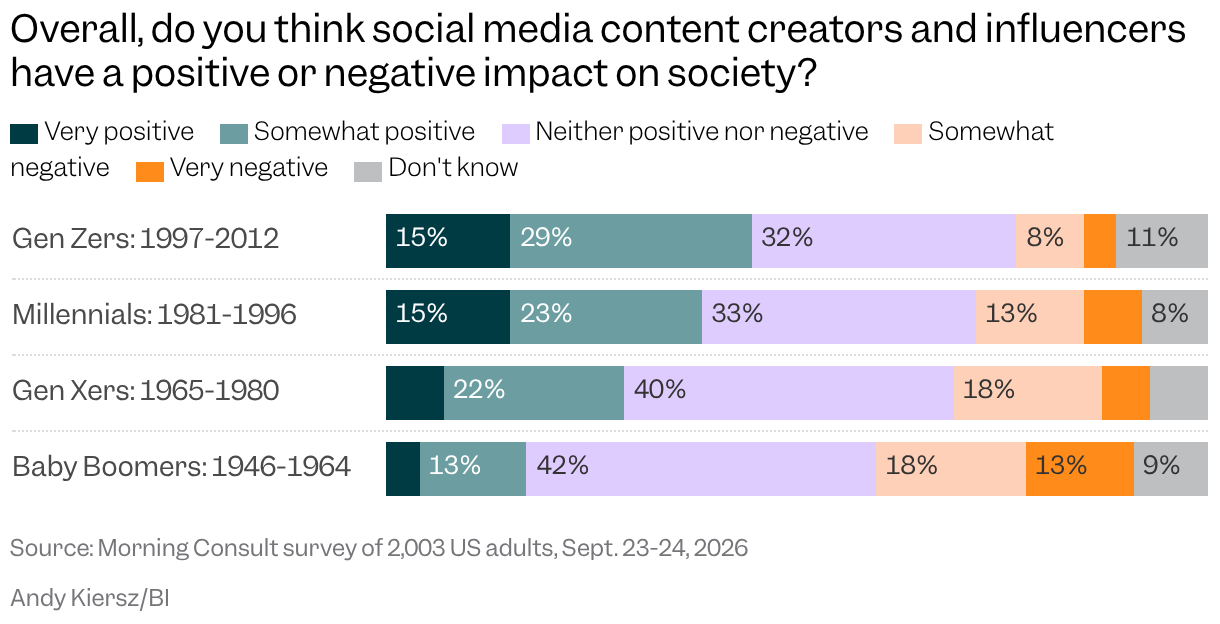
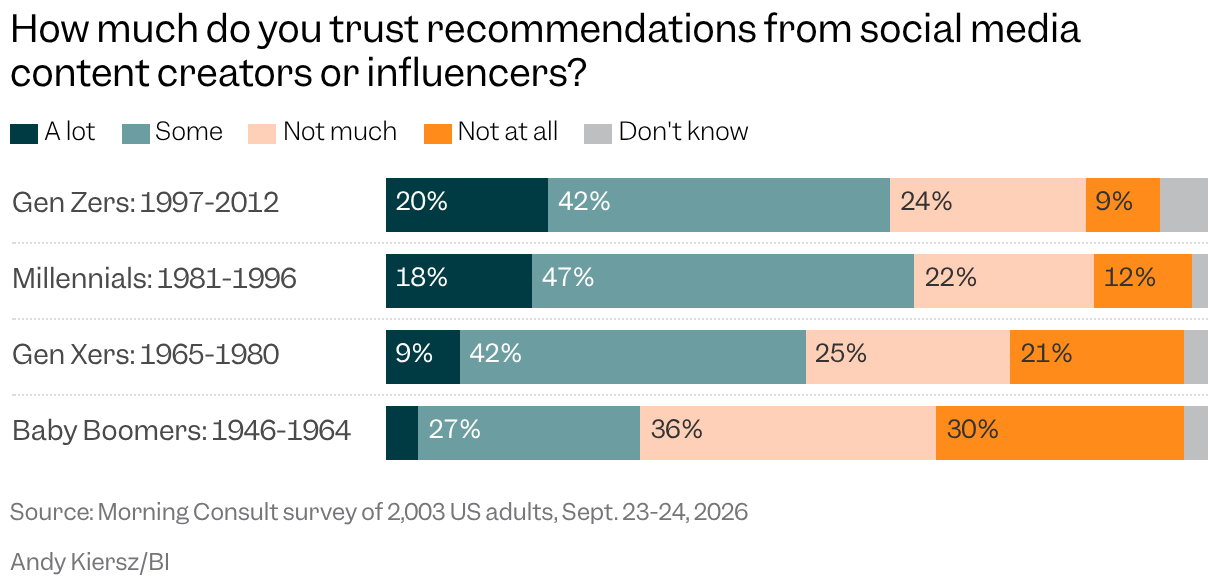
Research from Morning Consult, conducted exclusively for Business Insider, reveals a stark generational divide in attitudes toward influencers. Boomers — people born between 1946 and 1964 — are distrustful of influencers, skeptical of their recommendations, and more likely to find their content "annoying."

In the survey of roughly 2,000 US adults conducted in September, 31% of boomers said they trust influencer recommendations at least somewhat, compared with 62% of Gen Z and 64% of millennials. Two in five (40%) boomers surveyed said they trust influencers less than they did a few years ago.

Stacked Bars

Sure, plenty of adults become set in their ways and harder to persuade as they age. But advertising pros said there's another factor that could help explain boomers' wariness of influencer marketing: brands themselves continue to overlook the older generation.

"Brands are terrified of taking any dollars away from speaking to young people," said Jennifer Meehan, an EVP at the communications agency Edelman.

That fear also extends into the creators they look to partner with.

Florian Dost, a marketing professor at Brandenburg University of Technology in Germany, interviewed influencer agencies and talent managers as part of a recent study. Some of the managers his team interviewed found that older influencers often drove higher campaign conversion rates, but brands rejected them.

"Agencies may know that," Dost said. "They certainly sometimes try to put it forth because they also see the numbers. But clients don't want to hear."

Bar Chart

Boomers' distaste for influencers presents a challenge for CMOs.

The generation is a considerable consumer force, accounting for 42% of spending among affluent US households, according to Visa research from last year. With US marketers forecast to spend $40 billion on creator economy partnerships and ads this year, per Business Insider sister company EMARKETER, brands risk leaving a lucrative audience on the sidelines.

Getting boomers to click

Stewart Reynolds, 56, a Canadian comedy creator who posts under the name Brittlestar, said that older consumers rarely see themselves reflected in influencer marketing, which tends to favor young, attractive influencers.

Reynolds, a Gen Xer, said 45% of his audience is over 45 years old. And while he has landed plenty of brand deals with the likes of Yorkshire Tea, Yoplait, and Dairy Farmers of Ontario, he jokingly admits he's jealous of the opportunities that his son, Gregor Reynolds, another successful comedy creator, receives.

"He's getting brand deals and campaigns that I wouldn't get because I'm not young and fit," Reynolds said.

Stewart Reynolds, 56, a Canadian comedy creator who posts under the name Brittlestar
Stewart Reynolds, 56, a Canadian comedy creator who posts under the name "Brittlestar."

Terry Manzo

It's not just the brands, though.

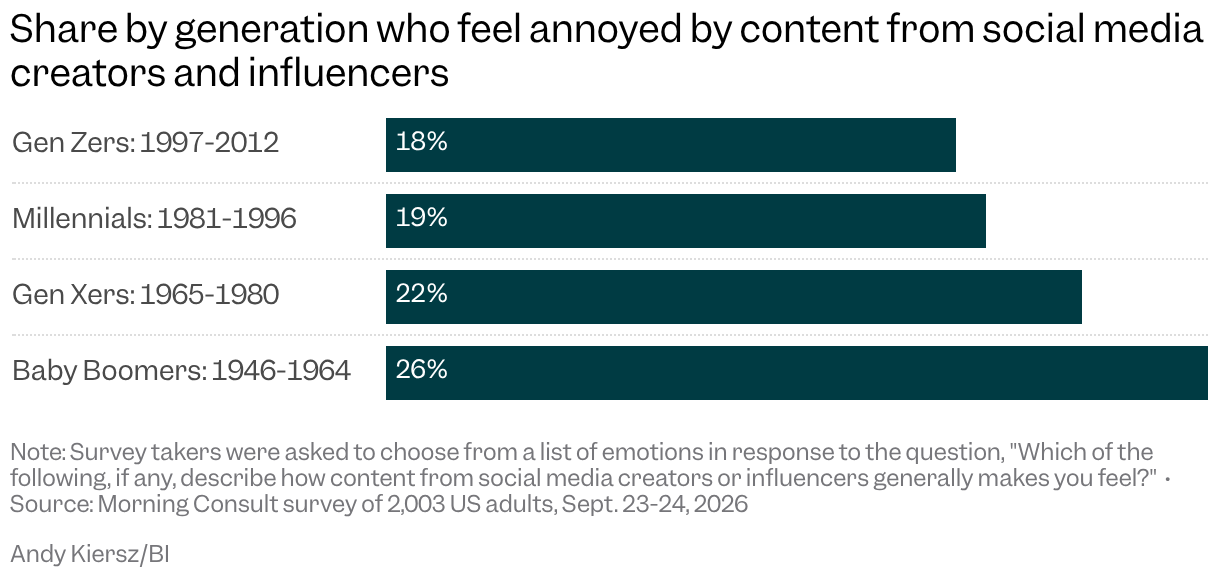
Marketing insiders said some of the disconnect could be explained by influencers failing to create content that's relatable to an older audience. About a quarter (26%) of boomers surveyed by Morning Consult said influencer content made them feel annoyed — the highest proportion of any generation. Only 5% of boomers said it made them feel happy, versus 28% of Gen Z, 30% of millennials, and 13% of Gen X. Other generations said influencer content was most likely to leave them feeling "entertained," while boomers' top choice was "annoyed."

A separate study published earlier this year by Edelman, which surveyed more than 17,000 respondents worldwide, found that just 24% of boomers said they followed a content creator, compared with 86% of Gen Z, 77% of millennials, and 51% of Gen X.

The age of the influencers older generations see on their screens isn't the only factor at play.

"It's less about finding someone who's the same age and more about finding someone they can see something of themselves in," said Lucy Kruszynski, global head of brand at influencer marketing agency Buttermilk.

Shared interests and experiences can be more powerful than demographic similarities, she said. As boomers enter retirement, many have more time to rediscover hobbies and passions that took a backseat during their working lives. Brands could tap into those interests by partnering with creators who share their enthusiasm for pursuits like music, art, or home improvement.

Some of the most successful boomer creators have scored deals that lean into these passion points. The boomer weightlifting influencer Marlene "Granny Guns" Flowers has more than 4.5 million followers across her social platforms and has collaborated with brands such as YoungLA and Ryse Supps. Barbara Costello, who is in her 70s and known as "Brunch with Babs," has more than 9 million followers and has scored partnerships with brands that range from the furniture brand Birch Lane to Nellie's Eggs and Walmart.

Stacked Bars

Brands may also have to exercise patience when trying to convert older consumers. The Morning Consult survey found that 43% of boomers said they had never purchased a product based on an influencer's recommendation.

For brands accustomed to measuring influencer marketing success in clicks and immediate sales, that could require a rethink. Kruszynski said some boomers follow creators for months, sometimes up to a year, before feeling comfortable purchasing something they've recommended.

"Even though there is absolutely a level of annoyance and a lack of trust, I don't think that baby boomers are immune to influencer marketing," Kruszynski said. "Brands need to think about how creators can build credibility through consistent content over time."

Read the original article on Business Insider

  •  

The AI 'vibe directing' startup OpenArt has hired a former Salesforce marketer to turn it into a household name

openart ai scott larson
Scott Larson is joining OpenArt AI as its VP of brand marketing. He first experimented with the platform to create a short film starring a stick of butter about to meet an unfortunate end.

OpenArt/LinkedIn, Scott Larson

Salesforce and Meta marketing alum Scott Larson says OpenArt AI's conversational text-to-video generator is the tool he wished he'd had earlier in his career.

The platform helps whizz up short videos, arty images, and music by typing in a few prompts.

OpenArt this week tapped Larson as the company's vice president of brand marketing, the company exclusively told CMO Insider.

He joins in a period of rapid growth for the company, which said it's on track to pass $250 million in annual recurring revenue by the end of 2026. It's increased its head count to 80 employees over the past year, up from 20, and grown to 8 million monthly users, the company said.

Larson told CMO Insider he's on a mission to make OpenArt "as close to a household name as a creative AI can be."

He said the biggest challenge will be to wrap all of OpenArt's different use cases into a single "North Star" story.

It recently launched a new product called Director that lets users describe an idea, visual style, and narrative arc, which it then turns into videos up to 5 minutes long. It promoted the launch with a cinema and billboard campaign that it hoped would spark a "vibe directing" craze among the creative community. Others use its platform to create social posts, AI voiceovers, or lyric videos. It also offers an AI model leaderboard to help its users benchmark different AI video and image models.

Larson previously worked at advertising agencies on large consumer brands such as Nike, Levi's, and Gatorade. He later became global executive creative director at Meta, then known as Facebook. Larson went on to be an SVP at Salesforce, where he helped shape the branding behind its annual Dreamforce conference and launched ad campaigns starring Matthew McConaughey and Woody Harrelson.

Larson first experimented with OpenArt two months ago, creating a very short film with three cuts. Called "Life is Short," it shows a man made out of a stick of butter walking alongside a swimming pool. The butter man looks up at the scorching sun above before the video cuts to an old-school title card saying "The End."

"Had I had this tool starting back when I was a little creative junkie up until today, I'd be making everything all the time," Larson said.

Earlier this year, OpenArt plucked another exec from Big Tech, hiring former Google executive Raj Gajwani as its chief business officer.

Read the original article on Business Insider

  •  

TikTok is shifting advertising to YouTube after Meta says 'no thanks'

Mark Zuckerberg (Meta) and Shou Zi Chew (TikTok)
Mark Zuckerberg's Meta has blocked Shou Zi Chew's company, TikTok, from advertising in some markets.

Finn Gomez/Getty Images; Shawn Thew-Pool/Getty Images

  • TikTok is moving on quickly after losing access to Meta's ads platform in some markets.
  • It's shifted ad spend to YouTube, Pinterest, and mobile-app networks, according to Sensor Tower.
  • TikTok was a prominent ad spender on Meta before its ousting on October 8.

TikTok's message to Meta: If you won't take our ad dollars, your competitors will.

Meta took a bold stance this month by blocking ByteDance, TikTok's parent company, from running ads on Meta apps in some markets. Why? Well, Meta's answer was pretty straightforward. It didn't want to "run ads from a competitor whose goal is to pull people off our apps."

TikTok is now redirecting that ad spend elsewhere.

Since the ban went into effect on October 8, TikTok has shifted its ad budgets to other platforms like YouTube and Pinterest, according to allocation estimates provided to CMO Insider by the analytics firm Sensor Tower.

The share of TikTok's ad spend that went to YouTube rose to 17% between October 9 and October 16, up from 9% in the first week of October. Meanwhile, its ad spend on Pinterest grew to 9% during the same period, up from 3% in the first week of October. A majority of TikTok's spend — 58% — went to mobile-app ad networks like Google's AdMob, up from 19% at the start of October, when Meta was still an option.

Meta's move against TikTok "highlights the growing intensity of the competition across the digital landscape and across the two of them," said Kate Black, EVP of social strategy at Horizon Media. "For marketers, this really just reinforces the need to be agile and build balanced media strategies — and not having all your eggs in one basket."

Meta's TikTok ousting isn't unprecedented. Other platforms like Amazon have previously blocked competitors from running ads, while Twitter in late 2022 restricted users' ability to link to their accounts on social apps like Instagram and Mastodon, calling it "free promotion."

"Declining promotional services to a competitor is a normal business practice across industries," a Meta spokesperson said. Meta's changes will impact advertising policies in the US, Canada, Egypt, Indonesia, Japan, Thailand, and Vietnam.

For Meta, a company that pulled in $117 billion in revenue in the first half of 2026, losing one advertiser won't hurt much. Still, TikTok and ByteDance were notably prominent spenders on Meta's apps, according to Sensor Tower.

Meta will also lose ad spend from third-party marketers that link to TikTok or other ByteDance properties in their ads, further increasing its potential losses. Direct-to-consumer brands that may want to drive potential customers to TikTok Shop will miss out.

No Meta, no problem

For TikTok, losing access to Meta's more than 3 billion monthly users is a setback.

Like any social media giant, TikTok is incentivized to grow, grow, grow. Ads that target new users and drive new app downloads are part of the playbook — a strategy Meta uses to promote its own apps, like Instagram, too.

One TikTok staffer focused on user acquisition, James Gao, posted a LinkedIn callout on Sunday asking people to get in touch if they had ad inventory that could help the company meet its goals.

Horizon Media's Black said that while Meta controls the "lion's share" of social budgets, there are plenty of viable alternatives when it comes to using an ad to drive an action like an app download. Besides Google, YouTube, and Pinterest, marketers are increasingly turning to other platforms like Snapchat and Reddit, she said.

Read the original article on Business Insider
  •  

A CMO was horrified by how ChatGPT described her company. Here’s how she’s fixing it.

Leila Dillon
Ameresco CMO Leila Dillon has been shaking up the energy solutions provider's AI visibility strategy.

Ameresco

When Ameresco CMO Leila Dillon asked ChatGPT and other AI answer engines to describe what her company did, she was shocked by the results.

The publicly traded company is an energy infrastructure provider, helping power the rapidly growing AI buildout, as well as military bases and municipal facilities. But the AI chatbots were outdated in their responses, frequently referring to it simply as a cleantech or renewable energy business — areas it still operates in, but are less of a focus — or citing smaller projects it worked on years ago.

"It was quite horrifying," Dillon told CMO Insider. "We were like, 'That's not at all who we are.'"

Dillon set about overhauling the company's messaging and how it structured its marketing content to better reflect its business.

The work has begun to take effect. Ameresco tracked how often AI chatbots mentioned the company in response to 50 questions that potential customers and investors might ask. It appeared in 61% of those answers in 2026, up from 43% in 2025, according to the company.

As more consumers turn to platforms like ChatGPT, Google's Gemini, Anthropic's Claude, and Microsoft's Copilot to research companies and products, marketers are racing to hone their generative engine optimization (GEO) strategies to ensure their brands appear prominently and accurately in AI-generated answers.

"I used to Google everything that I wanted to know about," Dillon said. "I barely use Google anymore. I use Copilot, and I get better results."

In a January survey from the Interactive Advertising Bureau, 73% of US brand and agency buyers said they planned to devote more time or resources to optimizing content for AI-generated answers in 2026, compared with last year. In a separate survey of US marketing professionals conducted by Semrush, an AI and search visibility platform, in April, 30% of marketers said AI search tools had described their brands inaccurately.

The rush by marketers to get up to speed with GEO has spawned a cottage industry of AI search experts and tools promising quick fixes. But with AI companies constantly updating their models, marketers are in a phase of constant experimentation as they scramble to figure out what actually influences the chatbots.

"There's no one shot that fits all to solve that for you," Dillon said.

An AI audit identified 47 areas for improvement

In January 2025, Dillon's team and its PR agency, Greenough, began auditing how often Ameresco appeared in AI-generated answers to 50 prompts — such as, "What are the top energy infrastructure providers in the US?" — on platforms including ChatGPT and Claude. The prompts reflected questions that investors and prospective customers, including people from universities and utilities, might ask AI chatbots.

The audit identified 47 areas for improvement, including how Ameresco described its business across its website, social media, press releases, and executive communications.

"You name it, we were doing it wrong," Dillon said.

Ameresco began rolling out a new corporate brand identity in July this year, reflecting its broader reorganization around two business pillars: power infrastructure and buildings and public infrastructure.

It had laid the groundwork for the new corporate brand reveal by making several changes to its content strategy.

Those included:

  • Updating its corporate boilerplate from "a leading cleantech integrator specializing in energy efficiency and renewable energy" to "a leading energy infrastructure company," reflecting the new positioning across its marketing and communications.
  • Refreshing its awards submission strategy to lead with its power infrastructure projects, and announcing each win with a press release that appears on wire services and industry trade publications.
  • Introducing Q&A-style content formats, designed to make the information easier for AI chatbots to interpret.
  • Creating more content designed for different customer groups, such as data center operators or school facilities managers, rather than relying on generic marketing materials.
  • Launching a video content series called "Energy Benefits Unlocked," highlighting the tangible results Ameresco's projects accomplished for its customers.
  • Introducing quarterly AI visibility tracking audits across the 50 different prompts, reflecting its different audiences, and adding competitor comparisons.

A constantly moving target

The strategy appears to be paying off in some ways. Ameresco said organic traffic to its website rose 50% in the 12 months to June 2026. Dillon said it's still too early to assess precisely how those gains translate into business results, though she believes the GEO work is helping the marketing team hit its targets more quickly. The company is scheduled to report its third-quarter earnings on November 9.

Dillon said the rapid changes in AI mean the work is never really finished. Ameresco regularly revisits its AI visibility scores and has invested in training the marketing team, which shares tips, tricks, and their "epic AI fails" in its weekly meetings.

"One of the main themes is that what happened last week is not what you're going to get this week; it's changing that quickly," Dillon said.

"You don't just update your website and say: Done, woo, all set," she added.

Read the original article on Business Insider

  •  

The latest K-beauty craze is made from dead Americans' skin. Now it's aiming for the US.

Close-up of a woman's face and neck with a blue-gloved hand holding a syringe. The center of the syringe is cut out and filled with a human skin texture

Getty Images; Alyssa Powell/BI

A hot, new beauty treatment driving tens of millions of dollars in sales around the globe is now aiming for the US market. Its unusual ingredient: skin from dead Americans.

Each year, tens of thousands of Americans donate bodily tissue upon their deaths, generally by checking a box at a motor vehicle department or through an authorization made by a loved one. Over the past few years, tens of millions of dollars' worth of donated skin has traveled from American tissue banks to biotech companies in South Korea, the beauty capital of the world. There, among other uses, it is turned into injectable beauty treatments.

The maker of the market-leading Korean brand said last week it has signed a distribution contract to introduce its skin-derived injection to the US market next year. It isn't clear whether the product can be sold in the US without approval from federal regulators.

Business Insider traced the tissue supply chain to understand how donor tissue from, say, San Antonio can end up for sale at a clinic in Seoul — and how much money is being made along the way.

People who donate tissue "have no idea of how much money is changing hands in the course of all of this," Ana Iltis, a professor at Wake Forest and former president of the American Society for Bioethics and Humanities, told Business Insider. "With tissue donation, there's a lot of money at stake."

Donors and their families can't be paid for organ or tissue donations under US law.

A K-beauty trend

For decades, American plastic surgeons have used products made from human tissue for skin grafts and reconstructive surgeries. That practice includes aesthetic uses — such as cartilage for a nose job or skin for a breast augmentation — though many doctors prefer to use the patient's own tissue for such procedures.

Now, skincare treatments made from human tissue can be purchased for a few hundred dollars and administered at a med spa or dermatology clinic in under an hour. In South Korea, a mecca for cutting-edge beauty treatments, at least 10 biotech companies are making or planning to introduce skin-derived injections.

They are the latest generation of a treatment known among beauty obsessives as "skin boosters." Get your algorithm just right, and your social-media feeds will soon be full of before-and-afters showing off the purported benefits of these products. They depict patients, typically women and sometimes young ones, going from dull to dewy, fine-lined to smooth.

This year, the skin-derived injections are projected to generate $75 million in sales in South Korea, according to analysts at Yuanta Securities.

No brand is bigger than Re2O, which one dermatologist on Instagram called "the Love Potion No. 9 for cells." It accounts for between 60% and 70% of sales in the category, according to L&C Bio, its manufacturer.

A client lies under towels while a practitioner uses a syringe and handheld device during a facial treatment.
South Korea is a mecca for cutting-edge beauty treatments.

JUNG YEON-JE/ Getty Images

Re2O notched the equivalent of more than $17 million in sales in the first half of this year, helping swing the company to an operating profit of about $11 million after a loss of about $326,000 in the same period last year, L&C Bio said. It has expanded the product line with Re2O Fine, marketed for more delicate skin, and is planning to launch a human fat-derived filler next year.

The company said it sold 700,000 units of Re2O as of September. It is available in Singapore and China, and has been approved in the United Arab Emirates, Peru, and Thailand.

Last week, L&C Bio said that it has signed a contract to deliver at least $60 million of Re2O to the US over the next five years. The company also said it may explore acquiring US tissue banks with its US distribution partner.

L&C Bio's plan to introduce Re2O to the US could spark a regulatory showdown. L&C Bio has said Re2O falls into a category of products such as skin grafts that don't require approval from the US Food and Drug Administration.

Some products that manufacturers claim qualify to be sold under this category don't actually meet the applicable criteria, the FDA told Business Insider. The agency said it wouldn't discuss any specific products under investigation.

"Products derived from donor skin that have been decellularized, dried, and ground into a powder for injection as a cosmetic 'skin booster' may raise significant questions" and may have to go through a more complex regulatory approval process, the agency said.

L&C Bio said it wouldn't comment on its discussions with regulators.

Bar chart showing L&C Bio's quarterly revenue rising steadily from 17.7 billion South Korean won in the first quarter of 2025 to 38.8 billion won in the second quarter of 2026.

Re2O's biggest competitor, CellREDM, came onto the South Korean market in late 2025. It has been such a success that in the quarter ended June 30, operating income for its maker, Hans Biomed, soared to over $3 million after barely eking out a profit in the year-earlier period.

The tissue business

"In the human tissue business, access to raw materials is the lifeblood of the industry," L&C Bio's founder and CEO, Whan Chul Lee, said in Korean in a February interview with a South Korean news outlet.

For his company and its competitors, that lifeblood flows from the United States.

Roughly 90% of all the human tissue used in South Korea is imported, according to South Korea's Ministry of Food and Drug Safety. Less than 4% of South Korean adults are registered to donate organs, and even fewer donate tissue. Korean biotech companies have turned primarily to the US, where well over half of adults are registered donors.

Cadaver skin is collected in the US by organ procurement organizations, known as OPOs, and tissue banks. In the transplant system, skin is treated as a tissue, not an organ.

After tissue is collected, its route can vary. A nonprofit OPO often transfers it to an American tissue bank. The tissue bank pays a fee to the OPO, depending on factors like the amount and quality of tissue recovered. The fee covers the cost of the tissue recovery as well as a margin that supports other programs offered by the OPO.

Tissue banks — which can be nonprofit or for-profit entities — supply donor skin to Korean biotech firms.

Much of the US skin supplied to South Korea is used for more traditional medical purposes, like skin grafts for burn victims. L&C Bio makes such therapeutic products and says it prioritizes supply for them.

A person walks in a subway station by ads for plastic surgery.
Tens of millions of dollars' worth of donated skin has traveled over the past few years from American tissue banks to biotech companies in South Korea.

Ed Jones/AFP via Getty Images

L&C Bio spent more than $25 million on donor skin from US tissue banks between 2023 and 2025 and $3.8 million in the first half of this year, according to corporate filings. The company told Business Insider that a quarter of its skin supply is used to make Re2O.

Organ distribution is coordinated by a public-private partnership with the federal government. Tissue is handled differently. It is distributed through commercial relationships.

The more traditional business aspects of the tissue industry have been a subject of debate since the federal law governing America's organ recovery and distribution system was enacted in the 1980s. In a system that relies on altruism, money changing hands could affect public trust, Jerold Mande, who helped write the National Organ Transplant Act, told Business Insider.

There is little data on American attitudes toward tissue donation. A survey of more than 1,000 families of donors in the US published in a 2010 academic journal found less than 30% said they thought it was acceptable for donated tissues to be processed and distributed by for-profit companies.

Revenue from tissue, primarily skin and bone, drove 93% of American OPO profits between 2013 and 2017, or a total of about $107 million per year in profit at 51 OPOs, according to a study in the medical journal Transplantation. The Association of Organ Procurement Organizations called the study outdated, said the money collected for tissue helps fund other life-saving work, and objected to the study's use of the word "profit."

"Reimbursed funds go directly back into the organization, supporting organ procurement as well as aftercare programs for donor families such as bereavement support and grief counseling," said Jenny Daigle, a spokesperson for the Association of Organ Procurement Organizations. Organizations must have a margin and reserves to remain financially stable, she added.

Human tissue donations help millions of people in the US each year, including skin for burn victims, bone for cancer survivors, and eyes for the visually impaired, Daigle said.

Organ donor option in driver license
Tens of thousands of Americans donate bodily tissue each year upon their deaths, often by checking a box at a motor vehicle department.

Patrick Sison/ AP Photo

Regenerative Biologics, a Florida tissue bank, provides all the skin for Re2O, L&C Bio confirmed to Business Insider.

Regenerative's CEO, Sandy McCann, said her tissue bank acts as an intermediary, supplying skin collected by other organizations, and provides L&C Bio only with skin from donors who have given consent for international and cosmetic use. If other American tissue banks have skin that they can't use, "many times we can place it where someone can," she said.

Regenerative had just over $16 million in annual revenue in 2024 and 2025, according to reports filed with a Florida regulator.

By reviewing South Korean government records and images of product packaging, Business Insider identified two other US tissue banks, South Texas Blood and Tissue and RTI Surgical, that supply tissue for skin-derived injectable beauty treatments made by Korean companies.

South Texas Blood & Tissue supplies skin used to make South Korea's No. 2 brand, CellREDM. The tissue bank is based in San Antonio, sometimes called "Military City, USA" because of the large military base there. Educational materials on the tissue bank's website say that donor skin "heals patients suffering from burns or other traumatic wounds, and in reconstructive surgeries, including those wounded during military service."

South Texas Blood & Tissue said each of its tissue donors helps an average of 75 recipients. International distribution and commercial use are longstanding practices in the tissue industry, the group said. Tissue donor families have the option to decline cosmetic, international, or research use, the group added.

"Our top priority is to serve as good stewards of these tissue donations, and to ensure that all tissue we recover has the greatest impact possible," it said.

RTI, a Florida tissue bank that does business as Evergen, said it transfers a small amount of unprocessed donor skin to DOF, a tissue bank in South Korea that manufactures the skin-derived injection product Juveacell. RTI added that it is "dedicated to honoring the generosity of donors and their families."

The Axel Springer Global Reporters Network harnesses the resources of the company's newsrooms to publish ambitious scoops, investigations, interviews, opinion pieces and analysis. It allows journalists — including those from POLITICO, Business Insider, The Telegraph, WELT, BILD, Onet and Fakt — to collaborate on major stories for an international audience of hundreds of millions across platforms: online, print, TV and audio.

Read the original article on Business Insider
  •  

Tesla outsells all other brands combined as America's EV market resets

SpaceX and Tesla CEO Elon Musk mingles with guests as U.S. President Donald Trump hosts a state dinner for President of China Xi Jinping and first lady Peng Liyuan and in the East Room of the White House on September 24, 2026 in Washington, DCDC. Trump is hosting Xi for a three-day state visit to
Tesla CEO Elon Musk.

Kevin Dietsch/Getty Images

  • Tesla accounted for more than half of US electric-vehicle sales in the third quarter.
  • Its quarterly sales increase exceeded the entire market's gain, Cox estimates show.
  • High gas prices are helping EVs compete, though sales remain below last year's levels.

Tesla is taking a bigger slice of America's electric-vehicle market as high gas prices give drivers another reason to consider ditching the pump.

The company sold an estimated 144,094 vehicles in the US in the third quarter, up from 124,800 in the previous three months, according to Cox Automotive's latest sales report.

That increase was bigger than the gain for the rest of the US EV market. Put another way: Tesla drove the recovery. Everyone else, taken together, went backward.

Horizontal bar chart of the ten best-selling US electric-vehicle brands in Q3 2026. Tesla led with 144,094 sales, followed by Rivian with 19,239. Tesla sold more than all other brands combined, which totaled 118,555.

The figures offer a new twist on the EV comeback I wrote about in July. Back then, sales had finally improved after the slump that followed the end of federal incentives in the US. Several manufacturers were benefiting, but only those with the fortitude to stick with EVs after federal government support waned.

While recovery continued in the third quarter, it became more dependent on Tesla.

Americans bought 262,649 new EVs during the period, about 6% more than in the second quarter. Sales outside Tesla fell roughly 3%, based on a comparison of Cox's latest counts with its second-quarter report.

Tesla's own sales rose about 15% from the second quarter. It supplied 54% of the country's new EVs in the third quarter, extending its lead from the previous period.

High gas prices help make the case for going electric, according to Cox.

"With gas prices well above $4 a gallon, electric vehicles look better than ever," Stephanie Valdez Streaty, Cox's director of Industry Insights, said in the company's analysis of the quarter.

Expensive gasoline and diesel make running a conventional vehicle more painful. For drivers who can charge cheaply, particularly at home, an EV offers a valuable alternative to repeated trips to the pump.

There's an important caveat to the comeback story: Sales are improving from a depressed level.

Total US EV sales were down almost 40% from a year earlier. Last year's third quarter was unusually strong because buyers rushed to claim federal incentives before they disappeared.

Tesla's sales were down about 20% against that comparison. The company remains heavily dependent on two vehicles. The Model Y and Model 3 accounted for roughly 97% of its US sales in the latest quarter.

The Cybertruck sold over 4,300 units, and Tesla has stopped making the Model S and X. (There's a Roadster, though not until 2028).

So Tesla's growing dominance isn't a story of every model flying out of showrooms, or of selling more cars than a year ago.

For now, it is winning a larger share of a smaller market. As Americans return to EV shopping, Tesla is capturing more of their business.

Sign up for the AI Insider newsletter here. Reach out to me via email at abarr@businessinsider.com

Read the original article on Business Insider

  •  
❌