
❌

Reading view

Russia’s supply base in occupied Luhansk Oblast burned overnight—NASA’s fire map caught it

russia’s old staging base occupied luhansk oblast burned overnight—nasa’s fire caught · post area khrustalnyi ukraine overnight 12 2026 exilenova news ukrainian reports

Ukrainian strikes hit a site housing Russian troops in Khrustalnyi, a city in Russian-occupied Luhansk Oblast, overnight on 12 October, according to local reports. Satellite fire data recorded blazes at a former motor depot there, in an area Russia once used as a logistics base for its offensive in the region.

Russia keeps attacking in Ukraine’s Donetsk Oblast and strikes Ukrainian cities and power plants every day. Its offensive depends on troops, ammunition, and fuel moved through occupied Ukraine, so strikes there reach the supply chain behind the front.

Fires at a former motor depot in occupied Khrustalnyi

Ukrainian forces launched heavy strikes around Khrustalnyi in eastern Ukraine overnight, the Ukrainian monitoring channel Exilenova+ reported. It counted three separate fires and one large blaze, and said local residents reported a hit on a site where Russian troops were based. Ukraine’s military had not officially commented on the strike by the publication time of this article on 12 October.

Ukraine’s Defense Forces are carrying out massive strikes in the area of occupied Khrustalnyi in Luhansk Oblast. Three separate fire hotspots and a large-scale blaze have been reported.

According to local residents, a site housing Russian troops was hit. pic.twitter.com/A8RHtuKY5i

— Exilenova+ (@Exilenova_plus) October 12, 2026

NASA’s Fire Information for Resource Management System (FIRMS), which tracks active fires by satellite, shows blazes at a former motor transport enterprise and an industrial zone in Khrustalnyi, Ukrainian military outlet Militarnyi reported. Three fire hotspots appeared there at 01:10 and spread by 02:07, the outlet said.

NASA FIRMS satellite map showing fire hotspots in Khrustalnyi, occupied Luhansk Oblast, Ukraine, on 12 October 2026
Fire hotspots recorded by NASA’s FIRMS system near a former motor transport enterprise in occupied Khrustalnyi, Luhansk Oblast, Ukraine, 12 October 2026. Map: NASA FIRMS/Militarnyi

Ukraine also hit the site on 16 June 2022, striking an ammunition depot there, and local residents then heard secondary detonations, Militarnyi said. The site served as an important logistics base for Russia’s 2nd Army Corps in its offensive on Sievierodonetsk and Lysychansk, two cities in Luhansk Oblast, the outlet added.

Map of Russian-occupied southern and eastern Ukraine with Khrustalnyi in Luhansk Oblast marked by a fire symbol
Khrustalnyi in Russian-occupied Luhansk Oblast, Ukraine, where local reports said Ukrainian strikes hit a Russian troop site on 12 October 2026. Map: Euromaidan Press/DeepStateMap

Explosions at a Crimean airfield Russia used to launch drones overnight

Drones attacked occupied Crimea from the evening of 11 October into the night, and Russian air defenses, including mobile fire groups, fired across the peninsula, Krym.Realii, Radio Liberty’s Crimea service, reported. Explosions sounded in Simferopol, Feodosiia, and Yevpatoriia, among other places, the Crimean monitoring Telegram channel Crimean Wind said, according to the outlet.

Subscribers told the channel about a series of explosions and a glow at Russia’s Hvardiiske military airfield in Simferopol district as air defenses fired. Krym.Realii said neither Ukraine’s nor Russia’s military had commented and that it could not verify the reports independently.
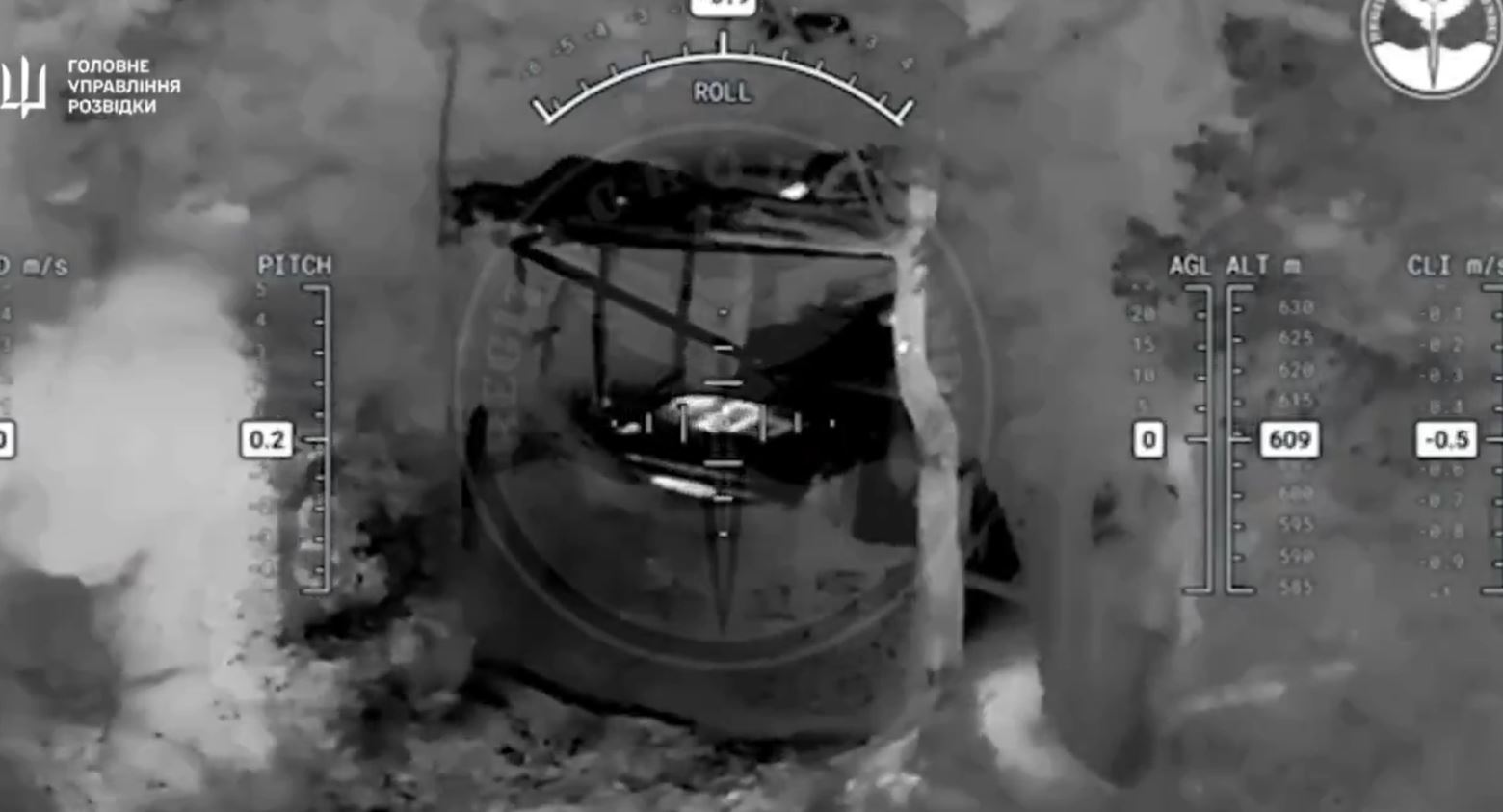
ukraine says struck bastion crimea launcher russia pairs zircon oniks missiles · post equipment under camouflage netting ukrainian drone's crosshairs occupied 2026 possibly covered nets news reports
Explore further

Ukraine says it struck a Bastion in Crimea, the launcher Russia pairs Zircon and Oniks missiles on

Overnight, Russia also launched attack drones at Ukraine from several directions, including Hvardiiske in occupied Crimea, Ukraine’s Air Force reported.

Ukraine’s General Staff said in August that a 3 August strike on the Hvardiiske airfield destroyed nine aviation fuel tanks and damaged two aircraft hangars.

Ukraine keeps hitting Russian rear areas in occupied territory

On 10 and 11 October alone, the General Staff reported hitting a Russian repair base and supply depots in occupied Luhansk Oblast, along with Russian troop concentrations near Lysychansk and two other towns there.

Ukraine has also kept up its campaign of so-called middle strikes, drone attacks on Russian supply lines in occupied territory beyond the front. French mapper Clément Molin counted 770 confirmed drone hits on Russian trucks in September, up from 630 in August, with the strikes concentrated on supply routes running through occupied southern Ukraine into Crimea.

Strikes on troop sites and airfields far behind the front leave Russia fewer safe places in occupied territory to house troops and launch drones, adding to the battlefield losses Ukraine’s drones already inflict.

  •  

Ukraine says it struck plant making parts for Russian military aircraft engines—a Snizhne factory Russia has used since 2014

snizhne_map_dark

Ukraine's 413th Separate Raid Regiment of the Unmanned Systems Forces struck the Snizhne Machine-Building Plant in occupied Donetsk Oblast in September, working with other Defense Forces units, the regiment posted on 6 October, sharing a video of the strike. The General Staff reported the strike on the plant on 11 September, saying that the extent of the damage was being clarified.

The strike adds to Ukraine's campaign of long-range attacks on Russian military targets as Russia has begun its winter campaign of strikes against Ukraine's energy infrastructure. Hitting the suppliers of aircraft parts goes after Russia's ability to keep its attack jets and helicopters flying.

The regiment said the plant works for Russia's military industry, producing engine components for attack aircraft and combat helicopters.

A former Motor Sich plant in occupied Snizhne

The Snizhne plant was a separate division of Motor Sich, a Ukrainian aircraft-engine maker based in Zaporizhzhia, a city that remains under Ukrainian control. Snizhne has been under Russian occupation since 2014. The plant specializes in producing parts for gas-turbine engines, including compressor and turbine discs and blades, the General Staff said. It never built whole engines. In September 2014, months into the occupation, it was machining blanks from Motor Sich's Zaporizhzhia plant into turbine blades and was one of only two plants in the former Soviet Union making such blades for helicopters, a plant worker said.

Motor Sich said in December 2017 that it had lost control of the plant. Weeks later, Viacheslav Bohuslaiev, then Motor Sich's honorary president and a member of parliament, told RFE/RL's Donbas.Realii that Motor Sich still owned the plant and had handed its management to a foreign company, while keeping it under the company's "full control."

In February 2023, Ukraine's Prosecutor General's Office served Bohuslaiev a notice of suspicion of aiding a terrorist organization, alleging that Motor Sich shipped blanks to the Snizhne plant and received finished engine parts through foreign-registered companies. The case went to court in October 2023, and Bohuslaiev, who denies the charges, has been in pretrial detention since October 2022 as the trial continues.

Snizhne, which Russia uses as a rear base, has been hit before. In May, Ukraine's Unmanned Systems Forces and the Security Service of Ukraine struck a Russian training center for drone pilots in the city, and in September, a strike on energy infrastructure cut power across Snizhne.

  •  

Russian Troops Confiscating Ukrainian Food Drops in Occupied Oleshky, Local Official Says

Russian troops in occupied Oleshky are confiscating food delivered to civilians by Ukrainian drones and questioning residents found with Ukrainian-supplied products, according to the head of the town’s Ukrainian military administration. The allegations come after Ukrainian forces transported about four tonnes of food and medicines across the Dnipro in one of their largest humanitarian drone operations to date.

Russian forces in occupied Oleshky are taking food parcels delivered by Ukrainian military drones from local residents and treating possession of the supplies as possible evidence of collaboration with Ukraine, according to Tetiana Hasanenko, head of the Oleshky City Military Administration.

Hasanenko said Ukrainian forces had delivered food to the Russian-controlled town by drone on several occasions, but that the latest operation was considerably larger, involving approximately four tonnes of supplies.

In comments published on 30 September, she said some residents managed to collect one or several packages, while others were unable to reach the supplies.

Russian personnel were subsequently taking some of the food from residents, she said.

According to Hasanenko, people found with goods that were not Russian-made were also questioned about where they had obtained them. Residents could then be accused of co-operating with the Armed Forces of Ukraine if Russian personnel concluded that the products had arrived through Ukrainian drone deliveries.

The allegations cannot be independently verified from inside Russian-controlled Oleshky. However, severe food shortages and restrictions on humanitarian access to the town have been independently documented by the United Nations.

Four tonnes carried across the Dnipro

The latest operation took place on 27 September and involved Ukrainian military units working with the Kherson regional authorities.

According to the regional administration, heavy drones transported approximately four tonnes of food and medicines to about 100 locations around Oleshky.

Instead of dropping the cargo directly from altitude, packages were lowered on cables to designated locations.

Units involved included the 30th Marine Corps, the 34th Separate Marine Brigade “Borysfen”, National Guard formations and Ukrainian border guards.

Ukrainian authorities say drone deliveries have become one of the few remaining ways of bringing supplies into the town. The Kherson administration said it had been sending food across the Dnipro by drone since March.

It estimates that around 2,000 civilians remain in Oleshky, including almost 50 children.

EU Today reported earlier this month that residents of Oleshky were facing increasingly severe food shortages as conventional supply routes became progressively more difficult to use.

The town lies on the Russian-controlled eastern bank of the Dnipro, opposite Ukrainian-held territory around Kherson. The area is exposed to artillery fire, short-range drone operations and extensive mine contamination.

UN documented food shortages

The humanitarian conditions described by Ukrainian officials are consistent with findings published by the UN Human Rights Monitoring Mission in Ukraine.

After interviewing more than 20 residents from Russian-occupied communities near the front line, including Oleshky and Hola Prystan, the mission reported in June that thousands of civilians were facing food shortages and inadequate access to medical assistance.

Residents told UN investigators that the security situation had deteriorated considerably during 2025 and 2026.

The last grocery shop in Oleshky had stopped regular operations in January because supplies had run out, according to testimony collected by the UN. For months, residents depended on preserved food and limited private deliveries.

As of 24 June, the UN said no food deliveries had reached the town since 26 May.

Drone attacks and mines have also made attempts to bring supplies into Oleshky dangerous. On 2 June, a civilian convoy carrying food and humanitarian assistance struck a landmine at the entrance to the town, killing one person and injuring three others.

Under international humanitarian law, an occupying power is required to ensure that food and medical supplies are available to the civilian population and to facilitate humanitarian relief when local resources are inadequate.

Pressure for humanitarian access

The deteriorating situation has prompted repeated Ukrainian appeals for international intervention.

The Ukrainian Council of Churches and Religious Organisations recently called on Pope Leo XIV and international humanitarian organisations to support efforts to reach civilians trapped in the town. EU Today reported on the appeal for humanitarian access and civilian evacuation, which was also directed towards the International Committee of the Red Cross and UN member states.

Hasanenko has also alleged that disappearances continue inside the occupied community.

She said one family had recently disappeared after being detained by Russian forces, adding that Ukrainian authorities did not know whether its members were still alive.

The individual case cannot presently be independently confirmed. The UN has, however, documented arbitrary detention, enforced disappearances, torture and ill-treatment of civilians in Russian-occupied Ukrainian territory during the war.

With independent humanitarian organisations unable to operate freely in Oleshky and conventional supply routes severely restricted, Ukrainian forces are increasingly using drones for a role far removed from their conventional battlefield purpose: carrying food and medicines across the Dnipro to civilians who remain behind Russian lines.

  •  
❌