Economist Aaron Terrazas warns inflation could drive economic inequality.
Baby boomers are helping to prop up the economy, as they're in their core retirement spending years.
There's an income premium for job switchers — and for retirees.
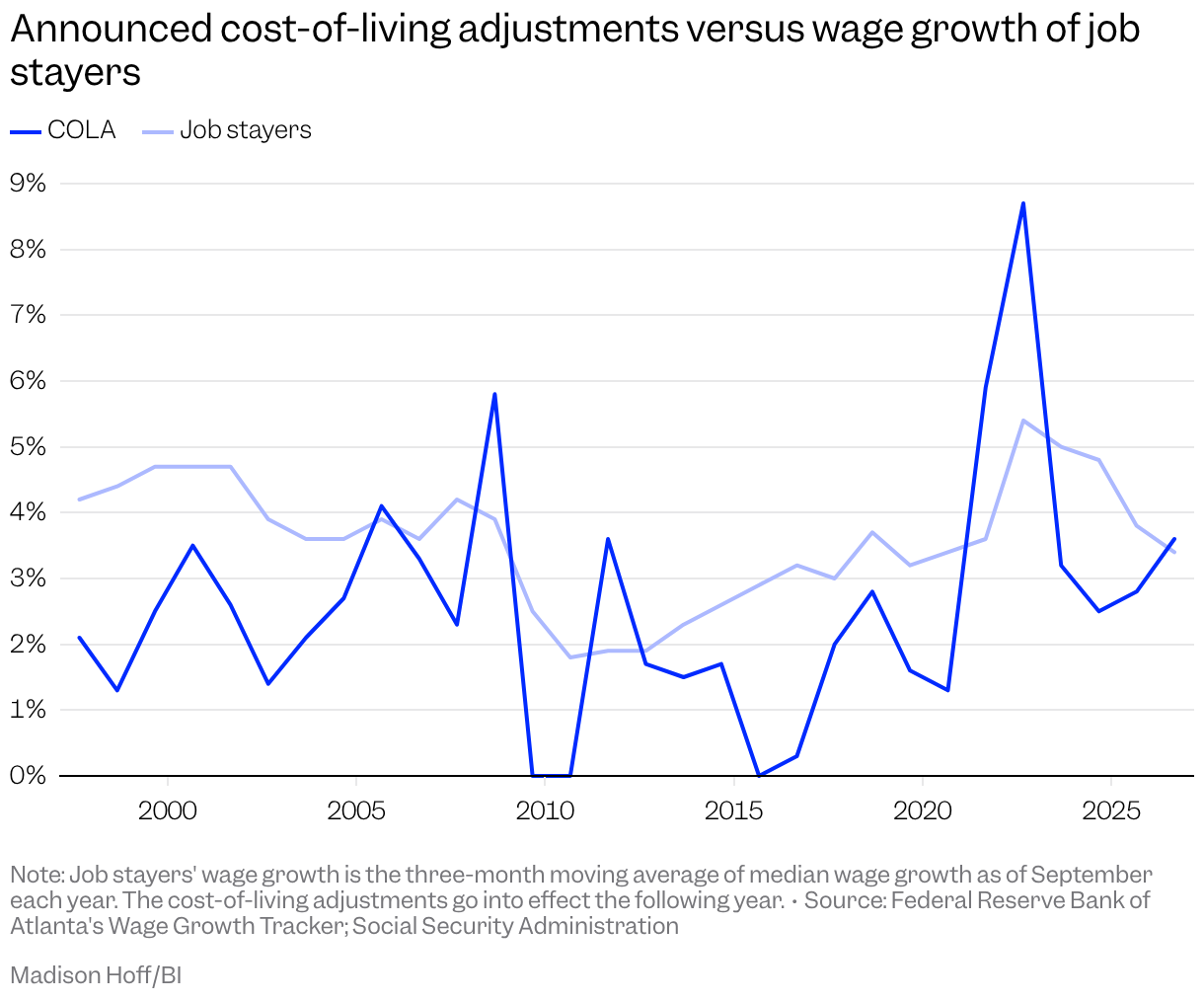
The Social Security Administration recently released the cost-of-living adjustment for next year. About 72 million recipients will experience a 3.6% increase in their benefits in January, higher than the September three-month moving average year-over-year median wage growth for job stayers at 3.4%.
Independent economist Aaron Terrazas said cost-of-living increases for Social Security beneficiaries were higher than job-stayers' increases in three of the past six years, the most recent being the 8.7% 2023 increase announced in 2022 amid the post-pandemic inflation spike.
"Retiree income is adjusted with the cost of living, whereas people who are working are mostly compensated according to the cost of labor," Terrazas said. "For most of the past decades, we've been in a low inflation labor shortage world, so that's worked out in workers' favor, but it feels like that's shifting underneath the surface."
The headline consumer price index increased 3.7% from a year ago in September, moving away from the Fed's 2% inflation target but down from the high rates back in 2022. The Social Security Administration bases the annual cost-of-living adjustment on the average of a related inflation rate during the third quarter of each year.
"Indexing incomes to the cost of living rather than cost of labor is a big part of what fueled inflation, the wage-price spiral in the 1970s," Terrazas said. "We moved away from that practice for most of the workforce, but not for retirees. With the growing share of Americans in their retiring years, more and more consumers are, whether we want it or not, having their incomes indexed to inflation rather than the cost of labor."
This, Terrazas thinks, could continue to drive the K-shaped economy of the haves and the have-nots, as he said older consumers are driving an outsize share of spending, although that could change as boomers start to age out of the peak retirement spending years.
"Baby boomers are in their core retirement spending years," he said. "When we think about consumer trends and what's holding up the economy, that is something we can't forget — that once people reach their 80s, we should expect that spending to start to contract as people become homebound."
Meanwhile, the three-month moving average for job switchers was higher than for job stayers and higher than the announced COLA, so job-hopping could be better than job-staying if you prioritize earning more. The problem is that it may be hard to find a new opportunity, depending on where you're looking. White-collar fields have been experiencing job loss, and employment levels in the leisure and hospitality sector have been pretty volatile.
The US has spent the last couple of years in a low-hire, low-fire period: Layoffs are low, so if you have a job, you're likely doing OK, but job openings and hiring have also been anemic, making an ominous situation for job seekers.
While that means employees may be more secure if they have a job, it also means employers don't have to do a lot to convince people to stay. Some workers have turned to "loud working" to try to make sure their accomplishments are being heard internally at their company or externally via LinkedIn or other platforms, whether that be because of fear of job cuts, to make the case for a raise, or some other reason.
"It's tough, I think, for job seekers to see headlines when we get the jobs report that unemployment is low, we're continuing to create jobs, but it's something very different from what they're feeling," Terrazas said. "And so I think it is important for them to understand that message that they're not alone. Many people, especially in white-collar work, are struggling to find new jobs or struggling to stay afloat in their workplaces."
I'm Gen Z and have always valued rest, leisure, and finding balance in my life.
My 86-year-old grandfather has worked as a doctor for 60 years and refuses to retire.
His dedication has changed how I think about ambition, purpose, and growing older.
As a Gen Z, I have struggled with my work ethic. I have learned to optimize leisure, travel, and rest, and to get into a flow state. However, my grandfather's work ethic has made me rethink my approach.
At 86, my grandfather refuses to retire. For the past 60 years, he has woken up at the same time every morning, showered, dressed immaculately, had breakfast, and left for his work as a general physician in his private clinic.
Barring sickness and rare travel, he has never taken a day off, never deviated from schedule, and has an enviable work ethic that I have not seen in anyone. My grandmother, who was 70, died last year, and he was back to work in a week.
He is the eldest son
Born in 1940 in the small town of Gonda in North India, he was the eldest of six younger siblings. In 1966, at the age of 26, he began his medical practice after completing his MBBS.
From the beginning, he has been focused on his career and his responsibilities as the eldest son of a South Asian family. He worked in big hospitals, then opened a private practice a few years later, and he also established a Rotary Club Chapter in his city, leading it many times in the decades that followed.
The author's grandparents in the 80s.
Courtesy of the author
There has always been a deep sense of empathy in him, which has made him a very considerate doctor for those who are economically marginalized. Because he charged less, took his time to understand each patient's issue, and prescribed medicines with great care, he gained popularity in his city very soon.
After six decades, the patients who were once young men and women bring their grandchildren from different cities to be treated by him. Only two years ago, he scaled back his work, working only till lunch. So now many patients come home in an emergency. "I don't like turning them away. Helping them makes me feel elated," he told me in one of our weekly phone calls.
He doesn't want to retire
From his work, he built a home for his parents and siblings, and another for his wife and children. He paid for the education of most of his siblings and put down a significant sum when it was time for them to get married. In short, he has been responsible for every role and relationship in his life.
He has three kids, two daughters and a son. They feel as if he should take it easy. "Why don't you retire?" My mother asked him a few years ago, and he shook his head vigorously, as if the thought itself was impossible.
"There were friends who were much healthier than me. They retired early, and I have seen many of them pass away," was his response to my mom. He also feels that being in a perpetual state of rest will dull his senses. Barring a partial hearing loss in one ear and a decrease in activity level due to age, he is fit and completely Independent.
He makes time to enjoy life
He can decide if he ever wants to retire because he has built his own practice, which is a privilege. However, he hasn't denied himself the pleasures of life either. He took time off to go on vacations and spent dedicated time with his kids, parents, and wife.
From him, I am learning that having a work ethic also means having a deep respect for your own life. It is not just dedication to his work; his ethic showcases his will to live as long as he can, independently. I want to live a purposeful and robust life, helping and guiding others and being of use till it's time to go. I want to eat clean, work out every day, put in the work to nurture my ambition, spend time with my loved ones, and focus on my goals. His work ethic has also shown me how he values his time. He nourishes it, nurtures it, and uses it to build a better life for himself. An honorable relationship with time and hard work has led him here.
He wants to be a functional part of society, and it has given me a fresh perspective on how I want to live my life. It is an odd thought, but I aspire to have a work ethic just like his and not retire.
I've spent the last three years living out of suitcases and housesitting from Washington to Mexico, trying to figure out where I want to retire.
Amber Campbell
At 55, I thought I would have already figured out where I want to retire in the next few years.
Instead, I've been living out of suitcases and housesitting in different places to see what I like.
I still don't know where I will retire, but I do have a much better idea of what I want — and don't.
I always thought I'd be settled somewhere for good by age 55, with a comfortable home, established garden, and chest freezer in the garage.
But after growing up in the San Francisco Bay Area, raising my kids in Seattle, and becoming an empty nester, I realized I had no idea where I wanted to settle down.
For the first time in more than 20 years, I suddenly had the freedom to choose where I wanted to live.
So at 52, I started housesitting in exchange for places to stay so I could travel without depleting my savings. I quickly realized how much I enjoyed the nomadic lifestyle and how this gave me the opportunity to test out places I might eventually want to live in.
After a few months, I liked it so much that I gave away almost everything I owned, put the rest in storage, and decided to do it full-time.
That was almost three years ago. Since then, I've lived in dozens of cities, towns, and remote islands, from northern Washington to the southeastern coast of Mexico's Baja California peninsula.
Housesitting has changed my mind about what I thought I wanted
Living in so many different places for several weeks or even months at a time helped me realize that how I want to live is just as important as where I want to live.
Amber Campbell
I typically stay in each home for two weeks to three months at a time, which allows me to get to know a new place without signing a lease, buying a house, or committing to a community.
Instead, I chat with locals, visit the library and grocery store, explore nearby nature trails, and try to imagine what it would be like to live there.
I ask myself a lot of questions: Can I tolerate this climate? Do I feel able to connect with this community? Could I live without whatever thing this place might be missing … which is sometimes as simple as my beloved Trader Joe's?
Throughout my stays, I've learned new things about myself and what I really want.
For example, I'd long pictured myself settling in a city since I've spent most of my life in major metropolitan areas.
So, I was thrilled to book a housesitting job right across the street from my old high school in San Francisco. I couldn't wait to walk the same streets I did in my youth and revisit my old haunts.
But the nostalgia wore off quickly, and a $105 street-cleaning ticket reminded me of the hassles of city life. I realized that a noisy, crowded, expensive city isn't where I want to settle after all.
These days, less traffic, more green space, and a slower pace feel more like my style.
I also thought I needed convenience and assumed I'd want to stay in the US, but housesitting changed my mind.
Amber Campbell
After that stint in the city, I went to the other extreme and booked a multi-week housesit on a remote Pacific Northwest island where the closest grocery store was a ferry ride away — long enough to require ice packs and a cooler to get my frozen food home before it defrosted.
At first, I couldn't imagine staying there for more than a few weeks, but I quickly fell in love with the solitude and have returned several times.
I realized that being surrounded by water, going days without talking to another person, hearing owls hoot at night, and watching a mother deer and her fawn wander across the yard made the extra effort of island life worthwhile.
I was willing to plan errands around the ferry schedule and give up some of the conveniences I'd always taken for granted for that kind of peace.
Now, I'm rethinking what it means to settle down — and if I'd even stay in the US
After three years and dozens of housesitting jobs, I still don't know where I want to retire — but I do have a much better idea of how I want to do it.
Amber Campbell
I'd also never even considered moving abroad until I booked a five-week housesitting gig for an American woman who had retired in La Paz, Mexico.
I felt inspired by my client's willingness to give up familiar comforts and conveniences to risk starting over in a new country in search of the life she wanted.
Although I'm not sure Mexico is where I want to settle, I loved my time in the Sonoran Desert and haven't ruled out retiring outside of the US. This experience helped me learn what living abroad was really like and realize I'm more capable of making that jump than I ever imagined if it's what I ultimately choose.
After trying out more than 50 locations in three years, I still don't know where I eventually want to retire. But I know I want to be somewhere I can walk in nature, enjoy some solitude without feeling isolated, and engage with a community when I'm ready for company.
Above all, I'm searching for a place that makes me feel at home — even when I'm visiting for the first time.
Social Security is racing towards insolvency because the program pays out more in benefits to retirees than it collects in taxes from working Americans.
Handing out even more generous benefits will make that situation worse. Yet that is exactly what the trustees who run Social Security are planning to do: Retirees will get a 3.6 percent cost-of-living adjustment (COLA) next year. That increase is 0.8 percentage points higher than last year's, and it is 0.9 percentage points higher than what Social Security was expecting to pay.
The Social Security trustees are doing what the law requires during a time of high inflation. That's why Congress ought to intervene here.
It should cancel the COLA.
No, this isn't a demand that lawmakers stick it to America's retirees. It's an appeal for some fiscal common sense. There are three good reasons to cancel this year's COLA.
First: Handing out higher benefits to wealthy retirees simply doesn't make sense when Social Security is trending towards insolvency.
As the Committee for a Responsible Federal Budget notes, the announced COLA would be a $900 increase in benefits for the average retired household—but some retirees could receive as much as $3,600 more.
Paying generous benefits to wealthy households is the main reason Social Security is facing insolvency in the first place. A program originally intended to keep seniors from falling into poverty has become a huge wealth-transfer scheme that overwhelmingly benefits those who don't need the handouts. The COLA doubles down on this flaw.
Second: What about the workers who are paying for those lavish benefits? Wages have risen by 3 percent, on average, over the past year. Those pay increases have already been outpaced by inflation, which is up 3.7 percent in the past 12 months.
You'll often hear retirees talk about how they are living on a "fixed income," but the math simply doesn't bear this out. Social Security beneficiaries will get a COLA that is larger than the average pay increase for the workers who are funding the COLA. Retirees are protected from the impact of inflation while younger Americans must deal with inflation and finance that protection for the elderly. That's crazy.
Third: Cutting the COLA could kick-start a conversation about how to solve Social Security's looming insolvency. The Social Security trustees estimate that an across-the-board cut of about 22 percent will be necessary in 2032. Eliminating COLAs won't meaningfully change that arithmetic, but it would change the conversation—which has for too long been dominated by politicians promising seniors that nothing needs to change. That's wrong—and the sooner that becomes apparent, the better off the political system will be.
If eliminating the COLA is too radical a change, Congress should instead change how the trustees calculate the annual increase.
Currently, the COLA is based on one particular measure of inflation: the Consumer Price Index for Urban Wage Earners and Clerical Workers, otherwise known as CPI-W. This is a relatively narrow index that reflects the spending habits of only about one-third of all Americans, as Romina Boccia points out in her newletter, The Debt Dispatch.
Instead, Boccia suggests using the Chained Consumer Price Index for All Urban Consumers, or C-CPI-U, which covers about 93 percent of all Americans and is generally regarded as a better measure of the rising cost of living. Other parts of the federal government already use C-CPI-U to update such things as tax brackets.
If Congress simply changed how Social Security's COLA was calculated, it could close 12 percent of the program's long-term shortfall. And while some retirees would see smaller COLAs as a result, the result would more closely match those increases to inflation.
Social Security's COLA reflects many of the fundamental flaws with America's old-age entitlement program. Like Social Security as a whole, it is too generous to the rich, too costly to the taxpayers, and too unfair to younger, poorer workers.
The author and her husband are spending a lot of time together after retiring and becoming empty nesters.
Courtesy of Susan Teresa
When my husband and I became empty nesters, he retired, too.
We used to have busy, individual lives, but now we are always together.
It took a lot of adjustment and honest conversations, but we're learning to navigate our new normal.
My husband and I have been married for 26 years, together for 32. That's more than half my life. I thought we'd experienced just about every version of our life together.
Then we became empty nesters. And then my husband retired.
We're now together 24/7 with nowhere else we need to be, and I realized that all these years, I'd never spent this much time with him.
Since the day he brought home his office belongings, I've caught myself thinking more than once, "Oh, you're still here?
Our home feels different now
Without school schedules or workdays organizing our lives, we have more unstructured time than we know what to do with. We navigate quiet hallways lined with unoccupied bedrooms.
We now split the responsibility for coddling our cat, who suffers from separation anxiety. We announce, "We're back," to the furniture and the cat, forgetting we left the house otherwise empty.
Our aching hearts inspired us to collaborate on a shared list of silver linings. We drafted wish lists, imagining what we could do now that we no longer had to accommodate five personalities with varying interests.
While we shared many ideas and dream list to-dos — things like traveling to Tuscany for cooking and painting retreats — we hadn't anticipated that our day-to-day would also require attention and planning.
The trouble with together-time all the time
Throughout our marriage, my husband and I had always noted how similar his parents and mine were. Connected at the hip, one parent was seldom without the other.
We, on the other hand, prided ourselves on allowing each other space. We'd spent decades insisting we weren't like them — valuing independence, traveling separately, and encouraging each other to pursue our interests.
Then, when my husband retired, we instantly became our parents. With freedom to do whatever we wanted, we fell into the rhythm our parents had modeled: together all day, every day.
Sometimes you really can have too much of a good thing.
I'm an introverted writer who loves spending time in my rich inner world. He's an extroverted adventurer always on the go — kayaking, swimming, walking on the beach, sometimes all three in the same day.
One day, the realization that we had to structure our time hit hard. I'd been sitting at my writing desk when my husband opened the door to ask what we were having for lunch.
Not wanting to be rude, I talked with him for a moment, then asked for a few minutes to finish my thought. He left. I stared at my screen, hands still on the keyboard. My thought was gone.
While we enjoy being together, we're learning the importance of agreeing on when to be together and when to allow each other space.
We're creating a new rhythm
Mornings offer the perfect opportunity to plan our day over coffee, breakfast, and a card game — usually rummy. Between playful attempts to end each other's winning streaks, we check the weather, compare plans, and decide what we'd like to do. Our morning ritual helps shape our lives now that external demands no longer impose structure on our time.
Unless we have plans with friends, mealtimes serve as natural meeting points. An unexpected result: his cooking is improving. I'm now enjoying gourmet meals in the middle of the day, and again at dinner. He gets to run around outdoors, while I get to lock myself in my attic feminine sanctuary and write.
In the evenings, we wind down together. After sharing a home-cooked meal, we enjoy a movie or simply each other's company.
We're embracing new opportunities to grow together
Now that we're home together most of the time, honest communication, negotiation, and compromise have become essential tools. After decades of countless demands on our time, we're now free to choose how we spend it.
We're not always perfect. Some days, I join him outdoors when I'd rather stay home. Sometimes he interrupts when I'm in the flow.
I'm learning to ask for space when I need it. He's learning that he can pursue his desire to travel — even without me.
After 32 years, I never imagined we'd have to learn how to spend time apart. Having all the time in the world together doesn't mean we have to spend every minute of it that way.
These days, staying happily married sometimes means knowing when to leave each other alone.
With Social Security barreling toward insolvency, the government is increasing benefits in January.
On Wednesday, the Social Security Administration (SSA) announced that retirees will receive a 3.6 percent increase in Social Security benefits next year. The raise, which was unveiled shortly after the Bureau of Labor Statistics reported consumer prices rose 3.7 percent year over year in September, will amount to an increase of $75 per month for the average beneficiary. It also represents a cost-of-living adjustment (COLA) that will be 0.8 percentage points higher than last year's, which was 2.8 percent, and 0.9 percentage points higher than what was projected by the Social Security Trustees, according to the Committee for a Responsible Federal Budget.
"Social Security will implement this cost-of-living adjustment for 76 million Americans, giving them greater financial stability," said SSA Commissioner Frank J. Bisignano in a press release. "Under President Donald J. Trump, Social Security is delivering better, faster, higher-quality service for the American people."
But the announcement comes as Social Security faces a looming funding cliff.
The program has been spending considerably more than it receives for years, thanks in large part to the U.S. demographic problem: Birth rates have collapsed, life expectancy has risen, and there are fewer working-age people paying taxes to fund retirees. In 2025, the program collected $1.45 trillion in revenue and spent $1.61 trillion, leaving a $160 billion shortfall. Trust fund reserves covered the gap, but they are rapidly dwindling. In June, Social Security's Trustees projected that, without legislative changes, incoming revenue would cover only 78 percent of scheduled retirement and survivor benefits by late 2032—a 22 percent shortfall. Combined retirement and disability funds are expected to run out by 2034. There are a handful of fixes, including raising the retirement age, reducing benefits, raising the cap on earnings, means-testing the program, privatizing it, or getting rid of it altogether.
While many lawmakers have acknowledged reality, Congress remains divided on how to address the issue. In August, Sen. Ron Wyden (D–Ore.) blocked a proposal from Sen. Bill Cassidy (R–La.) to establish a congressional process to consider reforms, arguing that it would slash retiree benefits and help billionaires "avoid paying their fair share."
"People are objecting to doing their job," Cassidy complained in September. "Congress needs to fix Social Security this year."
What makes Wednesday's increase even more unjustified is the fact that older Americans are already among the wealthiest age groups in the country. According to the Federal Reserve's latest Survey of Consumer Finances released last week, households headed by someone aged 75 or older had a median net worth of $504,900 in 2025, compared with just $33,000 for households headed by someone under 35. Despite their relative wealth compared to working-age people, retirees are getting a COLA increase that is greater than the average worker, whose wages have risen by 3 percent in the last year.
For the very wealthiest beneficiaries, the 2027 COLA will constitute an enormous increase. According to the Committee for a Responsible Federal Budget, the highest-earning couples who retired this year will receive a combined increase of $3,600, meaning that their combined benefits would exceed $100,000 next year. However, without congressional action, Social Security recipients could expect a 22 percent cut that, in 2032, would wipe out the previous nine years' COLAs all at once.
Despite years of warnings about Social Security's deteriorating finances, Congress has yet to enact reforms to avert the looming shortfall. For now, beneficiaries can look forward to larger checks in January, even as the program moves closer to the day when it can no longer pay the benefits it has promised.
America’s elders need more places to live, but even in liberal enclaves that recognize the problem, developers are facing fierce foes: America’s elders. Make it make sense! Charley Locke reports from her hometown of Oakland, California, where boomers are organizing against two proposals that would add 618 market-rate residential units to the city’s senior housing stock:
Many in the crowd had been marching against governmental and corporate overreach for half a century: against the Vietnam draft and the invasion of Iraq; against Wall Street; against police brutality. They’re part of a generational force that’s antiestablishment and suspicious of power. But in this fight, it wasn’t so clear who the establishment was or who had the power. Were these righteous middle-class activists fending off greedy developers who would charge high rents, or were they wealthy seniors prioritizing neighborhood character over ameliorating the housing crisis? Were they once again David, or had they become Goliath?
 Login