❌

Reading view

Madrid, refuge latino-américain

Depuis le milieu des années 2010, de riches Latino-Américains, en particulier vénézuéliens, choisissent de s'installer dans la capitale espagnole. En parallèle, des centaines de milliers de leurs compatriotes moins privilégiés viennent occuper les emplois les plus précaires ou monter des petits commerces. Parmi eux, de potentiels futurs électeurs que la droite cherche à séduire.

JPEG - 123.6 kio
David Canales. – Manifestation d'opposants au gouvernement du président vénézuélien Nicolás Maduro, Madrid, 2023
© David Canales / SOPA Images / Sipa USA - Alamy Live News

Trottoirs immaculés, grandes avenues ouvertes et bordées d'arbres, passants chics, restaurants gastronomiques… Le quartier madrilène de Salamanca, où le revenu médian place ses habitants dans le 1 % le plus riche d'Espagne, arbore les attributs habituels des beaux quartiers d'une capitale européenne. Ce fief de la haute bourgeoisie, prudemment épargné par les bombes de Francisco Franco lors du siège de la ville entre 1936 et 1939, accueille désormais une nouvelle population étrangère tout aussi aisée.

« Il y a environ cinq mille riches Vénézuéliens à Salamanca », constate David Placer, qui se présente comme un « journaliste indépendant spécialiste de la communauté vénézuélienne ». M. Juan Carlos Gutiérrez fait partie de ces personnes fortunées. Il nous accueille chaleureusement dans son nouveau restaurant, El Impero. Les détails sont soignés, à l'image de cet avocat pénaliste aujourd'hui spécialisé dans le droit international relatif aux droits humains, dans le privé mais aussi auprès de la Cour pénale internationale (CPI). Cuisine ouverte, chefs italiens, opéra chanté par un artiste équato-guinéen, ambiance cosmopolite : l'avocat des figures de l'opposition au chavisme semble ravi de son premier investissement en Espagne.

Restaurants italiens et appartements de luxe

Trois anciens présidents mexicains de droite ont aussi choisi de s'installer à Madrid : MM. Felipe Calderón, Enrique Peña Nieto et Carlos Salinas de Gortari, lequel a récemment obtenu la nationalité. Depuis 2013, ils sont nombreux à avoir, comme eux, choisi la capitale espagnole pour nouveau havre. Ces Vénézuéliens, Mexicains, Colombiens venus investir ici, et parfois vivre et travailler, jettent cependant souvent leur dévolu sur des biens plus discrets — et plus coûteux — que des restaurants italiens. En particulier des appartements entièrement rénovés avec le plus grand luxe par des promoteurs spécialisés. Le quartier de Salamanca en regorge. « Ils font trois cents à quatre cents mètres carrés, c'est quelque chose de normal pour ce type d'appartements, pour un prix moyen de 12 000 à 14 000 euros le mètre carré », nous expliquent Mme Ofelia Núñez et M. Carlos de Almeida, respectivement directrice de l'investissement résidentiel et directeur des nouvelles constructions résidentielles de la branche espagnole de l'entreprise américaine de conseil en immobilier Coldwell Banker Richard Ellis (CBRE). Le prix moyen du mètre carré dans la capitale était évalué à 4 335 euros en mars 2024, contre 3 741 euros deux ans plus tôt.

Les changements introduits par le Parti populaire (PP, droite) en 2013 expliquent en grande partie l'intérêt soudain des Latino-Américains pour l'immobilier de luxe à Madrid. « L'une de ces dispositions est la création des Socimi [sociétés anonymes cotées d'investissement immobilier], des entreprises consacrées à la spéculation immobilière et qui ne paient presque aucun impôt sur les bénéfices, nous explique Mme Valeria Racu, porte-parole du Syndicat des locataires de Madrid. Cela permet un cycle spéculatif très rapide. » Le clan de M. Henrique Capriles Radonski, candidat à la présidentielle vénézuélienne contre Hugo Chávez en 2012 puis contre M. Nicolás Maduro en 2013, s'est très vite montré friand de ce nouveau régime fiscal, comme en témoigne le lancement des sociétés Agartha (2014) et Orinoquia Real Estate (2017), destinées respectivement au coworking et aux locations de courte durée de logements de standing.

« Madrid propose la pression fiscale la plus réduite de toutes les régions espagnoles », se félicite Mme Kuka Jiménez, directrice de la communication d'Invest In Madrid, un organisme qui dépend de la direction de l'économie de la communauté autonome. « Elle est actuellement la seule à ne pas avoir ses propres impôts locaux », s'enthousiasme-t-elle. Un choix qui lui a permis de devenir le principal point d'entrée des investissements directs étrangers, avec plus de 50 % du total de ceux réalisés dans le pays (1). « Un énorme dumping fiscal », selon M. Pablo Carmona, de la Fondation des communs.

JPEG - 142 kio
Olmo Calvo. – Livreurs d'origine latino-américaine, Madrid, 2019

« Toutes les semaines, nous avons deux ou trois investisseurs en provenance d'Amérique latine qui cherchent à acquérir une résidence, à 80 % à Madrid », raconte le cofondateur du cabinet Cremades & Calvo-Sotelo. M. Javier Cremades, l'un des plus prestigieux avocats du pays, nous reçoit dans ses locaux tapissés de portraits des deux fondateurs. Depuis la très chic rue Jorge Juan, en plein quartier de Salamanca, M. Cremades fournit des conseils aux fortunes étrangères désireuses de s'implanter en Espagne et aide en matière de droits humains. Notamment en soutenant l'opposition vénézuélienne en exil. « Nous avons aussi travaillé pour l'administration [du « président par intérim » autoproclamé de 2019 à fin 2022] Juan Guaidó afin de tenter de récupérer des actifs [de l'État vénézuélien au profit de cette administration parallèle] ».

L'argent n'est cependant pas le seul motif d'émigration. Les Vénézuéliens récemment arrivés à Madrid en délicatesse avec le gouvernement de M. Maduro sont nombreux. « En 2017, j'étais physiquement épuisé », confie M. Gutiérrez, désormais associé du cabinet Cremades & Calvo-Sotelo. Il fuit alors le pays et abandonne ses affaires, dans l'hôtellerie et la vente de voitures. M. Antonio Ledezma, maire de Caracas de 2008 à 2015 et l'un des opposants les plus hostiles au pouvoir, quitte également le pays en 2017. À peine arrivé, il se voit offrir la nationalité espagnole par l'ancien président du gouvernement Mariano Rajoy (PP), et la refuse. D'autres l'acceptent, comme le père de l'opposant radical Leopoldo López, M. Leopoldo López Gil, aujourd'hui député européen du PP, les parents de M. Capriles Radonski, ou M. Miguel Henrique Otero. Ce dernier a vu le journal vénézuélien dont il est directeur et propriétaire, El Nacional, un temps favorable à Chávez lorsque celui-ci cheminait vers sa première élection (1998), attaqué par le pouvoir actuel. Il dirige désormais une édition numérique du titre depuis chez lui, dans le quartier de Salamanca, dont il définit la ligne comme « opposée aux populismes de gauche ».

« C'était plus facile que d'aller aux États-Unis »

Tous les nouveaux arrivants à Madrid en provenance d'Amérique latine ne sont pourtant pas des multimillionnaires, d'anciens dirigeants de droite ou des opposants politiques. « Le nombre de Vénézuéliens a explosé dans les quartiers d'Entrevías ou de San Diego, observe Placer. Ce sont des quartiers pauvres de Madrid. » Outre l'opposition en exil, beaucoup de Vénézuéliens sont venus en Espagne dans l'espoir d'une vie meilleure.

Un détour par le marché couvert de Maravillas, dans le quartier populaire de Tetuán, permet de s'en rendre compte. Le bâtiment abrite de nombreux étals, la plupart tenus par des Latino-Américains. En plus de la farine de maïs qui permet de confectionner les arepas, des petits pains typiques de la cuisine colombienne et vénézuélienne, on y trouve des piles d'exemplaires du bimensuel gratuit El Venezolano. M. Miguel T. a installé là son commerce d'arepas depuis quatre ans, et reconnaît sans ambages : « Je ne me mêle pas trop de politique. Nous sommes ici pour des raisons économiques. » Un peu plus loin, M. Gema Serrano tient un stand de primeurs. Sa compagne est ainsi vénézuélienne et est venue à Madrid « pour des questions de sécurité plus que de politique », et parce que « c'était plus facile que d'aller aux États-Unis ».

Depuis janvier 2015, les migrants latino-américains gonflent le chiffre des arrivées d'étrangers dans la région de Madrid. Ils y représentaient alors 49 % (561 000 personnes) des immigrés. Début 2022, 58 % des étrangers (816 000) vivant dans la communauté autonome étaient nés dans un pays d'Amérique latine. Alors que les personnes originaires de Chine, du Maroc ou de Roumanie ont vu leur nombre stagner ou baisser, celui des Vénézuéliens, Colombiens, Péruviens, Dominicains et Honduriens a considérablement augmenté. En 2021, les Équatoriens privaient les Roumains de leur statut de communauté étrangère la plus importante de la région, avant d'être eux-mêmes dépassés par les Vénézuéliens en 2022 (2).

Porosité des droites des deux côtés de l'Atlantique

« La majorité est issue de la classe moyenne ou aisée, avec des diplômes universitaires. Les pauvres fuient à pied », précise M. Cremades. Un profil sociologique que confirme le directeur d'El Nacional, M. Otero : « Ceux qui arrivent ici sont les plus riches, car il faut acheter un billet d'avion. Pour aller en Colombie, il suffit de traverser un pont. » Les précaires sud-américains constituent le gros des troupes de livreurs à vélo qui quadrillent la ville pour le compte de Deliveroo, Uber Eats ou Glovo. M. Pedro H., l'un de ces travailleurs des plates-formes, confirme le phénomène : sur les huit livreurs avec lesquels il attend les commandes, place de la Glorieta de Cuatro Caminos, dans le quartier de Tetuán, six sont vénézuéliens et deux colombiens. La plupart louent le droit d'utiliser l'application à un autoentrepreneur déclaré, faute de bénéficier d'un permis de travail. Le tout pour dix heures de disponibilité par jour et un revenu oscillant entre 600 et 800 euros mensuels.

La langue et la culture ont beau rester un facteur facilitant a priori l'intégration, les plus pauvres ne sont pas accueillis à bras ouverts. Cependant, contrairement aux autres nationalités, les Vénézuéliens obtiennent en général le permis de résidence. Et ce depuis 2018 et une décision de la commission interministérielle de l'asile et des réfugiés — sous le gouvernement de M. Rajoy — qui accorde aux Vénézuéliens la possibilité de bénéficier d'un droit de résidence temporaire pour des motifs humanitaires, et non en vertu du droit d'asile. En tout, selon les données du ministère de l'intérieur, 113 487 décisions favorables ont été rendues entre 2019 et 2022. Selon Mme Elena Muñoz, responsable juridique au sein de la Commission espagnole d'aide aux réfugiés, une organisation non gouvernementale (ONG) qui œuvre en faveur des demandeurs d'asile, « 98 % de ces autorisations [au titre du motif humanitaire] ont été données à des Vénézuéliens ». Les Latino-Américains peuvent par ailleurs demander la nationalité espagnole après deux ans de résidence légale dans le pays. Ils jouissent de facilités en matière de visas de tourisme.

Pour les plus aisés et les plus diplômés, la situation est différente. La qualité de vie d'une capitale européenne, la présence de nombreuses universités privées, des prix de l'immobilier de luxe encore relativement attractifs comparés à Miami ou Paris, la langue et la culture communes, ainsi que la solidarité de classe qui fonctionne grâce aux relais bien placés auprès des gouvernements, en particulier de droite, ont fait de Madrid une destination à la mode.

« Il y a toujours eu une relation très intense entre la droite espagnole et la droite vénézuélienne », confirme Juan Carlos Monedero, professeur de science politique à l'université Complutense de Madrid, spécialiste de l'Amérique latine et par ailleurs cofondateur du parti de gauche radicale Podemos. Bien que ces liens aient une très forte dimension personnelle et entrepreneuriale, selon lui, ils sont aussi nourris par une proximité politique.

Réélue en mai 2023 avec la majorité absolue des sièges à la tête de la communauté autonome de Madrid et désormais figure majeure du PP, l'ultralibérale Isabel Díaz Ayuso a d'ailleurs fait de l'antichavisme un leitmotiv de son discours. Son slogan « Communisme ou liberté » est massivement utilisé par son camp depuis les élections locales de 2021. Une branche de la direction du PP de Madrid consacrée aux « nouveaux Madrilènes », placée sous le contrôle de Mme Ayuso, a été créée et confiée à un Vénézuélien, M. Gustavo Eustache. Si ce dernier, que nous rencontrons au siège de la formation, rue Génova, assure « avoir travaillé avec énormément de communautés », il admet cibler surtout les Latino-Américains, qui représentent « le gros de ceux qui ont le droit de voter ». M. Eustache, qui arbore fièrement son bracelet « Communisme ou liberté », connaît par cœur les chiffres et la composition des communautés d'étrangers, et laboure sans relâche le terrain pour sa candidate. Quitte à investir jusqu'aux autels des églises évangéliques assidûment fréquentées par la frange la plus conservatrice de cet électorat (3).

M. Eustache serait-il devenu essentiel pour le PP ? Au niveau national, la question ne se pose pas vraiment : le nombre de Latino-Américains jouissant de la double nationalité, disposant donc du droit de vote, s'avère trop faible. Les données de l'Institut national des statistiques espagnol (INE) permettent d'identifier 2,2 millions d'étrangers disposant du droit de vote (6,5 % du corps électoral), dont 1,5 million de Latino-Américains (4,3 % du corps électoral) (4). À Madrid, la situation est différente : d'une part, la concentration de personnes nées à l'étranger est beaucoup plus importante ; d'autre part, les titulaires d'une double nationalité ne sont pas forcément les seuls à voter. En effet, lorsqu'il existe une convention permettant aux Espagnols de voter dans un pays étranger, l'Espagne applique la réciprocité pour les élections municipales.

« C'est la nouvelle réalité. Les personnes nées à l'étranger représentent 21 % de la population de la communauté autonome de Madrid, près de 1,5 million de personnes — 61 % d'origine latino-américaine, 21 % d'origine européenne —, dont 1 million bénéficiant du droit de vote [aux municipales]  : 500 000 du fait d'accords bilatéraux, et 500 000 à la suite de l'obtention de la nationalité », détaille M. Eustache. Un chiffre certes non négligeable, mais cela ne signifie pas que tous votent, ni que tous votent à droite… Comparé au poids électoral des Latino-Américains dans le comté de Miami-Dade — 915 000 personnes, soit 58 % des inscrits, dont un tiers sont cubains —, celui des Latino-Américains de Madrid est donc à relativiser (5).

JPEG - 132.5 kio
Olmo Calvo. – Immeuble de luxe habité majoritairement par de riches Latino-Américains, quartier de Salamanca, Madrid, 2021

La droite construit ce récit antichaviste et pro-immigrés latino-américains à destination des Espagnols : il permet de mobiliser l'électorat conservateur et bourgeois grâce à l'indémodable peur des communistes prêts à prendre possession des avenues de la capitale. La diabolisation de la gauche, souhaitant transformer l'Espagne en un « chaos digne du Venezuela », constitue celle-ci en repoussoir. Pour les conservateurs, cette dramatisation vise aussi à contenir le concurrent d'extrême droite, le parti Vox, en jouant la carte du vote utile (6). « Dans la construction de la figure du méchant universel, le Venezuela a remplacé Cuba et l'URSS, analyse ainsi Monedero. Cela s'ajoute au fait qu'une partie d'entre nous, en Espagne, notamment chez Podemos, avons eu des relations avec les gouvernements progressistes en Amérique latine. Moi, j'ai travaillé avec Chávez, par exemple. »

La persistance de cette thématique dans le discours du PP et de Vox peut aussi être vue comme un marqueur idéologique au sein de la droite. Il lui est d'autant plus utile qu'il permet d'opposer un échec à son propre échec : celui du capitalisme néolibéral et la crise de 2008, qui a violemment éprouvé l'Espagne. La droite vénézuélienne et la droite espagnole cherchent en effet à construire la légitimité de leur discours suivant une posture de défense inconditionnelle de la démocratie. Alors que Mme Ayuso traite l'ancien dirigeant de Podemos et l'actuel président du gouvernement Pedro Sánchez de dictateur, M. Ledezma affirme de son côté que Podemos « est une franchise du chavisme ». Le parti d'extrême droite Vox n'hésite pas à relativiser les crimes du franquisme ? « Ils défendent la démocratie », nous explique-t-il. Il ira même jusqu'à signer, en octobre 2020, la « lettre de Madrid », un document élaboré à l'initiative d'une fondation présidée par M. Santiago Abascal, le dirigeant de Vox. Le Forum de São Paulo, une structure qui rassemble la gauche latino-américaine, y est qualifié de « groupe criminel » et les gouvernements de gauche de la région de « totalitaires » (7). Parmi les autres signataires, Mme Marion Maréchal, la nièce de Mme Marine Le Pen, M. Eduardo Bolsonaro (fils de l'ancien président d'extrême droite du Brésil), Mme Giorgia Meloni, la dirigeante de Fratelli d'Italia devenue depuis présidente du Conseil en Italie…

La porosité entre les droites des deux côtés de l'Atlantique est accentuée par le fait que la plupart des membres de la communauté vénézuélienne, moins politisés, peu ou pas fortunés, ne sont pas des admirateurs du gouvernement de M. Maduro. Ce qui les rend souvent sensibles aux discours critiques concernant le rôle de l'État ou les méfaits du « socialisme ». « Il est logique de penser qu'ils ne vont pas s'affilier à des partis similaires à ceux qu'ils ont fuis », note ainsi M. López Gil.

« Le vote des Latinos qui fuient l'Amérique latine est un vote conservateur : la famille, la loi, l'ordre, la libre entreprise », veut croire de son côté M. Otero. Monedero confirme : « À court terme, il est pratiquement impossible de convaincre ces personnes de soutenir la gauche, parce que leur architecture neuronale leur dit que la gauche est mauvaise. » Un constat que semble corroborer une étude menée en 2021 par Laura Morales et Carles Pamies, auprès des Vénézuéliens résidant en Espagne, dans laquelle les deux chercheurs montrent que ces derniers « sont beaucoup plus susceptibles de voter pour des partis de droite que le reste des Latino-Américains » (8).

Un processus de gentrification qui s'accélère

Mais les Vénézuéliens émigrés sont-ils si à droite que cela ? « Ils sont en réalité plus antichavistes que de droite », estime le journaliste Placer. Difficile dans ces conditions de former un bloc idéologiquement cohérent. Plusieurs interlocuteurs pointent d'ailleurs l'absence de réelle organisation de la communauté, avec des groupes poursuivant chacun leur propre feuille de route. « Ce n'est pas une communauté si forte, chacun s'occupe un peu de ses affaires », explique par exemple M. Miguel T., le commerçant du marché de Maravillas. Placer pointe lui aussi l'absence de structuration dans et entre les différents groupes de Vénézuéliens : « Je ne crois pas que leur but soit d'influencer leur pays d'origine depuis Madrid. Ils n'ont pas de projet politique. Le but est davantage de peser ici, entre eux, pour leurs affaires », tranche-t-il. Leur penchant très à droite est aussi un handicap, selon lui : « Aux États-Unis, les Cubains sont plus intelligents, ils maintiennent des contacts avec les deux bords. Ici, ils ont oublié le PSOE [Parti socialiste ouvrier espagnol], qui est au pouvoir. »

En tout état de cause, l'arrivée de Latino-Américains fortunés a déjà eu une incidence : « Cela génère un processus de gentrification », explique le sociologue Andrés Walliser. Avec un changement important dans la configuration du régime de propriété dans les zones concernées. « Dans ces quartiers, aujourd'hui, le marché est saturé ; il ne reste que quelques immeubles appartenant à une seule famille », confirment Mme Núñez et M. de Almeida, de CBRE Espagne. Ainsi, les acheteurs se tournent petit à petit vers d'autres quartiers. « Les fonds d'investissement et les agences spécialisées expulsent les locataires [en renchérissant le prix des loyers], qui se tournent alors vers d'autres quartiers, dont ils expulsent à leur tour les habitants », résume Mme Racu.

À défaut d'une capitale des oppositions de droite aux gouvernements de gauche, les millionnaires latino-américains du continent auront au moins activement participé à l'émergence… d'une Miami immobilière fondée sur le dumping fiscal.

Voir en ligne : /2024/05/ESTRUCH/66822

(1) « Inversión exterior » (PDF), Subdirección general de análisis económico, communauté autonome de Madrid, deuxième trimestre 2022.

(4) Fernando Peinado, « ¿A quién votan los hispanoamericanos ? », El País, 26 mars 2023.

(5) Luis Noe-Bustamante, « Latinos make up record 17 % of Florida registered voters in 2020 », Pew Research Center, Washington, DC, 19 octobre 2020.

(6) Lire Maëlle Mariette, « Impossible recentrage du Parti populaire espagnol », Le Monde diplomatique, juillet 2023.

(8) Laura Morales et Carles Pàmies, « El voto de los venezolanos (y otros latinoamericanos) en Madrid : mitos y realidades », 26 avril 2021.

  •  

Mathematics Is a Live Performance.” Misha Verbitsky on Intelligent Mold, Non-Consensus Realities, and Aesthetics as the Last Refuge of Human Reason

“Mathematics Is a Live Performance.” Misha Verbitsky on Intelligent Mold, Non-Consensus Realities, and Aesthetics as the Last Refuge of Human Reason

In June 2026, the mathematician Misha Verbitsky ended up in an Armenian jail, caught in the automatic machinery of intergovernmental agreements that Russia has pressed into service for political persecution. Starting from that story of police and politics, his conversation with T-invariant editor Alexander Sergeev turns steadily more philosophical. How is polarization destroying scientific unity? Why doesn’t a powerful intellect protect anyone from insane ideas? And how does the “intelligent mold” of AI call into question both human cognitive exceptionalism and the value of mathematical truth, returning us to first principles — the joy of communication and pure aesthetics?

Top news on scientists’ work and experiences during the war, along with videos and infographics — subscribe to the T-invariant Telegram channel to stay updated.

“Flagged”: A Convention Abused

With Russia’s war against Ukraine grinding on, Armenia has a reputation as an excellent place for people from Russia and from the world beyond the former Soviet space to meet. Pashinyan’s pro-Western course, the country’s pointed friendliness toward Russians who have relocated there, and direct flights to and from Russia all create the impression of a protected zone. That is why Yerevan was chosen for a reunion of alumni of Moscow’s School No. 57, an elite math-and-physics school. For Misha Verbitsky, who works in Brazil, these are close friends — almost a second family. But the illusion of safety dissolved at passport control: instead of a reunion with his classmates, three days went by in a police cell at the airport.

T-invariant: So you had no worries at all before the flight?

Misha Verbitsky: None — and that was a mistake, obviously. I should have been more careful. On arrival, right there at passport control, there’s a long, drawn-out fuss; then they walk you down corridors for quite a while and hand you over to the police. The police slap handcuffs on me, march me off somewhere far away again, and inform me that I’m being held for three days, then there’s a court hearing, and then I’ll spend another 30 days waiting to be deported to Russia.

T-i: Where were you held?

MV: Right there in the airport, in a small cell with bars on it. They kept saying an investigator was on his way. That went on for about six hours.

T-i: If there’s an investigator, doesn’t there have to be a lawyer too?

MV: No. No lawyer was part of the plan. The investigator never showed up either. But those particular officers were fairly kind to me and let me use my cell phone. I didn’t call anyone, I just fired off a message. Pretty soon my wife came rushing over, along with some classmates. And they brought a lawyer — the wonderful Vache Simonyan, who was a huge help to us. He explained afterward how it works: they hold you for 72 hours with no investigator and no lawyer, waiting for Russia to confirm whether it actually wants the person. Russia then has to supply court documents for the extradition to proceed. After three days the court rules, and the ruling is almost always the same: another 30–40 days behind bars while the full set of paperwork arrives from Russia. Then the court checks whether Armenian law contains any provision criminalizing whatever the person is being extradited for. Along the way — during the first 15 days — you can apply for refugee status, provided you have a lawyer. I actually managed to file, just in case. It doesn’t help much, though: you still can’t leave Armenia, and there’s a fair chance you’ll be locked up anyway.

T-i: Did they present anything? Any grounds?

MV: Well, they had a criminal charge written down there.

T-i: That was everything anyone knew for three days? No signals from Russia?

MV: Russia verbally demanded that I be held pending extradition and promised to send the official request later. But no fully formal demand ever arrived. Normally the Armenians respond favorably to an informal request like that and detain the person. They didn’t do that with me, because a big fuss blew up. Formally, Armenia did everything by the book — after all, Russia failed to produce the documents on time.

T-i: And Russia Day (June 12) [Russia’s national holiday — T-invariant] fell on a Friday. Did the long weekend help you?

MV: Absolutely! They were all just off drinking.

My sense is that they weren’t especially invested in nailing me. Somebody snitched, a case got opened… There isn’t really any purpose behind it. This enormous machine runs more or less on its own, without thinking about anyone in particular. One little cog turns, catches on another… Or maybe not… Because back in early 2024, a whole batch of articles came out in Russia attacking the math department [at Moscow’s Higher School of Economics, where Verbitsky taught — T-invariant] and me personally. It was a smear campaign against the people there who were, let’s say, politically unreliable. The wording was hilarious: supposedly I had founded some sort of “club of Russia-haters.”

T-i: Did the noise in the press and in the community actually help?

MV: Oh, “help” is putting it mildly — it saved me. Because once they let me out after 72 hours, there was still a risk of getting stranded. They handed me a paper saying they had no claims against me, but I was still red-flagged. Meaning that at a border crossing, in the best case they simply don’t let me through, and in the worst the handcuffs come back out. And for ordinary people — I was in a privileged position — there’s only one solution: wait for a “humanitarian corridor.” That’s when, at the request of human rights organizations or the ombudsman, the border guards briefly lower the red flag that’s keeping you from crossing. Then you have to drive to Georgia immediately — you can’t buy a plane ticket in advance, since nobody knows when the border will open up.

T-i: What is this flag, exactly, and what database is it in? People mentioned the Chișinău Convention. Does it have anything to do with Interpol?

MV: No, no. Back in 2002 the CIS countries [the Commonwealth of Independent States, the post-Soviet bloc — T-invariant] drew up a convention on sharing judicial data and handing over criminals. Interestingly, Russia formally joined it only in 2023. And Chișinău itself — that is, Moldova — isn’t a party to it.

T-INVARIANT BACKGROUNDER

The CIS conventions On Legal Assistance…

The Chișinău Convention (2002) replaces, for the countries that signed it, the earlier Minsk Convention (1993). Both cover extradition, among other things. The Chișinău text is more carefully drafted: it spells out procedures for cooperation and options for the defense more clearly, but it also lowers the threshold for extradition — from charges carrying a minimum of one year in prison down to six months. On paper, both conventions rule out politically motivated extradition, but in practice that provision often fails. In the 1990s all 12 CIS countries signed the Minsk Convention. Eight of them have since switched to the Chișinău version. The only country to have denounced it is Ukraine (in 2024). Three remain under the Minsk Convention: Turkmenistan, Moldova, and Georgia, which left the CIS in 2009. The latter two apply it only in a limited way — to the extent that it doesn’t conflict with the legal principles of the European Court of Human Rights. Even there, however, a politically motivated Russian extradition request can lead to detention and the need for legal assistance.

The Rozysk (“Wanted”) database on the website of Russia’s Interior Ministry is blocked from abroad — you need a Russian VPN service to reach it. For a preliminary check, you can download a copy of the database that the outlet Mediazona updates on GitHub from time to time. The version currently posted there is from March 2026. It lists 187,000 people, including 72,000 who were in the database earlier but were later removed.

T-i: A class reunion is a private affair, of course, but technically it’s no different from traveling to a scientific conference or a work meeting. So does that mean the CIS countries are closed to anyone flagged in Russia? Armenia and Kazakhstan included — the very places so many people moved to after leaving Russia…

MV: Definitely. But there’s a difference. In its entire history Armenia has extradited only a handful of people, and nearly all of them were genuine criminals, not political cases. It usually won’t hand over people charged with economic crimes either, if there’s reason to think the case is political. Kazakhstan, on the other hand, extradites practically everyone.

T-i: Until recently, the CIS countries served as neutral ground where scientists from Russia and from the rest of the world, including Russian émigrés, could interact. Is that neutral ground now gradually disappearing?

MV: Unfortunately, yes. And Europe, too, is methodically closing its borders to anyone with a Russian passport. Never mind that Europe has now started handing refugees over to Russia. America extradites them as well. In general, I recommend Latin America to everyone. They still have visa-free travel with Russia and very lenient laws… Extradition treaties formally exist, but the question is whether anyone will actually apply them. Which, by the way, I have yet to find out for myself.

T-i: Lawyers say that if you carry a Russian “black mark” — extremism, terrorism, and the like — then traveling to Brazil, say, means preparing documents in advance to explain your case.

MV: Absolutely — you’ll have to hire a lawyer right away. But in all the time I’ve lived in Brazil, I’ve never once been detained. When it does happen, the principle is simple: political cases don’t get extradited, in any form. But proving that a case is political takes effort and money, obviously. And the noise will start up all over again.

The Surrender of Reason: Between Propaganda and Heresy

Mathematics has always been a connected space. That wholeness is sustained by networks of teacher-to-student descent — as at School No. 57 — and by shared standards of intellectual quality that, as the mathematician Vitaly Arnold liked to put it, citing his colleague Michael Tsfasman, teach you to tell “a claim that has actually been made from one that hasn’t, and a proved claim from an unproved one.” But politics keeps methodically attacking that connectedness. And it isn’t only outright bans on collaboration; there are internal barriers as well, when building an elaborate case for insane ideas turns into a kind of intellectual challenge and a form of psychological defense.

T-i: How do political, legal, and ideological obstacles affect actual scientific work? Is today’s fragmentation of the mathematical community comparable to that of the Soviet period?
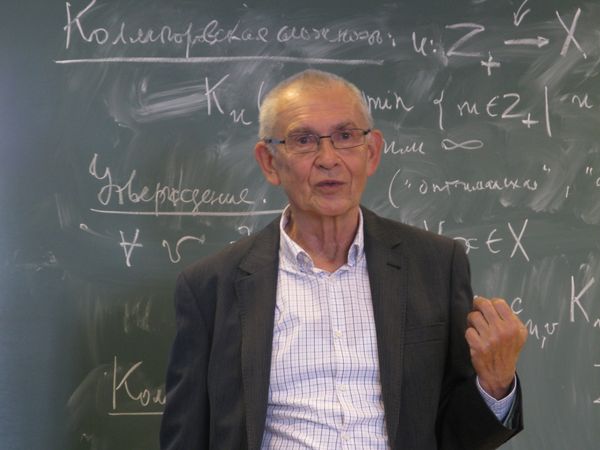
Yuri Manin. Photo: website of the Sobolev Institute of Mathematics, Siberian Branch of the Russian Academy of Sciences

MV: Under Soviet rule you couldn’t so much as mention a mathematician who had left the country. It simply didn’t get past the censors. And you couldn’t send a paper to a foreign journal, either. There were clever ways around that. Yuri Ivanovich Manin, for instance, knew of a mailbox from which letters actually got through. Meaning there was a clerk sitting there who had decided not to stop mail addressed to scientific journals. That’s how some of his papers, and his students’ papers, ended up published in the West.

T-i: So it wasn’t even a ban as such — the letters just didn’t arrive?

MV: Oh, there was a ban too: the First Department [the KGB-supervised security office attached to every Soviet institution — T-invariant] simply wouldn’t clear the papers. Only personal correspondence bypassed it. Yuri Ivanovich wrote a paper with Volodya Drinfeld on vector bundles over complex projective spaces, mailed it as an ordinary letter to Atiyah or Hitchin, they added roughly as much text of their own, and published it in a journal. That’s how one of the most famous and most cited papers of all came about: ADHM (Atiyah–Drinfeld–Hitchin–Manin) — everyone still knows that acronym. And all of it happened because Yuri Ivanovich knew the right mailbox.

T-i: Well, email still works, at least. What about publishing?

MV: For a while there were problems. Some American universities ban professional contact with Russian citizens. You can’t invite someone to campus, say. Co-authorship is easier. In Germany they tightened the screws pretty hard at the start of the war, and then began gradually loosening them. I haven’t heard of anyone having a paper turned down by a Western mathematics journal, though in other fields that happens all the time.

For mathematicians in Russia, ties with the West have effectively been replaced by ties with China. Professor Shing-Tung Yau and Professor Gang Tian moved to China a long time ago and are building a fairly modern mathematical structure there. In those two particular circles, at least, mathematics is doing very well. And they’re glad to invite our colleagues from Russia.

T-i: Many colleagues in Russia support Putin’s war…

MV: …more than half of them, by my estimate.

T-i: Is professional common ground with them eroding? Can you still work on mathematical problems with them across such sharp ideological divides?

MV: Hell if I know. Take me: I’m pro-Israel. And I suspect that an enormous number of my Western colleagues are anti-Israel, because they’ve signed some nasty thing or other against Israel. That upsets me, of course, but it doesn’t stop me from talking to them. On the other hand, I have two co-authors who used to be close friends, and then, when the anti-Israel demonstrations broke out, the anti-Israel one stopped speaking to the one who’s mildly pro-Israel: for him that was beyond the pale.

T-i: So the Israel question is even more destructive to relationships right now than the Russian one?

MV: No question. I have friends whose views are pure vatnik [Russian slang for a knee-jerk pro-Kremlin patriot — T-invariant]. But they’re mathematicians, and that has never stopped me. Although, on the other hand, take Lyosha Bondal, a great Russian mathematician and an active supporter of the “special military operation” [the Kremlin’s official term for the war against Ukraine — T-invariant], who recently tore into me on Facebook — specifically over political views.

T-i: How does it happen that people with a scientific cast of mind — mathematicians, of all people — stop thinking rationally in the social and political sphere and end up holding views that are sometimes completely insane?

MV: The two go together beautifully. It’s well known that the higher a person’s intelligence, the better he is at finding online support for absolutely delusional ideas. Bondal, again, read Dmitry Yevgenyevich Galkovsky and got swept up in his rather unhinged conspiracy theory, which incidentally incorporates an expanded version of Fomenkoism [the pseudohistorical “New Chronology” of the mathematician Anatoly Fomenko, which holds that ancient and medieval history was invented — T-invariant].

T-i: Yes, I’ve run into smart people passionately defending a literalist reading of biblical myth and treating it as an intellectual challenge…

MV: I was rereading an old essay by Dugin the other day — about all the gore in Platonov’s Chevengur, and about how the meaning of the Russian national idea is to spill as much blood as possible and then do yourself in. Sorokin has that wonderful Platonov pastiche in Blue Lard — the bit about the “slice-hauler.” He later expanded the slice-hauler into an entire book, but it came out far better in Blue Lard. Reading that in 1999, I wondered whether I could make myself believe it: that this ultimate slaughter of human beings really is the bright future for everyone. That sort of exercise — placing yourself inside a particular intellectual framework and working within it — is pretty absorbing. I played around with Fomenkoism for a while too, coming up with ways to explain why a conspiratorial chronology might make some kind of sense. That was an entertaining pastime as well.

Fomenko has successors these days, by the way — it’s called “Great Tartaria.” An entire community, and one that has penetrated fairly deep into the West. Based on an analysis of the amount of mud on the streets of Moscow, they believe that a nuclear war took place at the end of the 17th century. Great Mongolia (also known as Tartaria), which ruled the whole world, was destroyed, and then history was rewritten to conspiratorially shrink it down to the size of Russia.

T-i: Along similar lines, I’ve come across the claim that theology is the branch of mathematics that studies the logical consequences of the axiom that an omnipotent being exists.

MV: Yes, that goes back to Gödel — who was always more or less crazy to begin with, but kept going off his rocker more and more as he went on. He was a genius, after all, and geniuses have a way of being madmen. And right at the very end he wrote a very good mathematical proof of the existence of God. The problem is that it proves the existence not only of God but also of Cthulhu and every other infernal character out of Lovecraft. Which is to say, we don’t really understand what it is he proved. It was Anselm’s ontological argument — he rewrote it in mathematical symbols, very convincingly.

The Elephant in Leiden’s China Shop: A Declaration of Schism

Lately the polarization over artificial intelligence has become as fraught as the political fault lines themselves. On one side, AI opens up astonishing new possibilities; on the other, it generates a garden of forking paths in which anyone can find a narrative to suit his taste. Both have the potential to devalue human beings and their aspirations. Reacting to the arrival of AI, the mathematical community has tried to cement a reality that is slipping away and to prolong the “golden age” of mathematical infallibility. Hundreds of researchers signed the Leiden Declaration on artificial intelligence and mathematics (Russian AI translation), which articulates five fundamental values of the discipline. The catch is that, in order to defend those values against AI, the declaration calls for boycotting anyone who does not share them (AI corporations first and foremost), for seeking help from the state, and for tightening copyright protection.

T-i: The Leiden Declaration states that its goal is to unite the mathematical community, but what it actually calls for is division: a rigid ethical doctrine, instructions on how to comply with it, a call to boycott those who disagree…

MV: That’s a very interesting reading. What I got out of it was a set of sugar-glazed banalities — “the sky is blue,” “the sun rises in the east” — along with a great deal of verbal filler — to be nice. I’m not thrilled with the text, but that’s more because it’s a total artistic failure than because of any ideas in it, which I simply didn’t find. Then again, maybe I just read it badly.

T-i: What do you make of the call to support state institutions out of distrust of the AI companies, whose tools could make mathematical knowledge unverifiable for anyone without expensive equipment?

MV: Well, that’s a tug-of-war: we have quite a few advanced systems capable of “unpacking” mathematical texts, and until recently almost all of them were American. The Europeans had nothing of the sort — so this is their way of signaling to their governments: “We’re falling behind here, help us out.”

T-i: The declaration’s authors are worried about mathematics becoming dependent on large, expensive systems. A pencil and paper used to be enough; now you need powerful AI, the way physicists need a collider and astronomers need big telescopes. Add neural-network hallucinations to that, and in terms of accessibility and reliability mathematics ends up on a par with the natural sciences.

MV: Mathematics is already on a par with the natural sciences — our proofs play the same role experiments do. All that happens is that one more instrument for mathematical research appears. Old-school mathematics will probably survive somewhere, but in certain areas not using this instrument will be flat-out absurd.

T-i: Something else that alarmed me was the call to give mathematicians the right to forbid AI training on their papers. Copyright is an outdated and burdensome construct as it is, and this would inflate it further.

MV: For that sort of thing people should just get a good kicking… Right now any number of artists’ and musicians’ organizations are trying to fight AI trained on their work. This whole fuss over copyright is pure foolishness. Fortunately, at the moment you can’t really extract works from an LLM. But there are attempts to pass laws requiring LLMs to disclose what came from where.

If they pass, everything collapses. Because then you’ll be able to sue over copyright. The lawyers will come swarming in… Why is medicine so expensive in America? Because you need a lawyer for every sneeze. The same thing will happen to AI — it’ll simply be trampled into the mud. But China won’t be doing any of that. And in order not to fall behind, I don’t think such laws will be passed. Otherwise it’s a catastrophe. In practice, though, the forces of reason have been winning more often than not over the past 20 years.

T-i: How justified is the demand — and it turns up in more places than the Leiden Declaration — that scientific papers must state how AI was used: for what, how extensively, practically down to the prompts?

MV: Right, and nobody is going to do it. In principle it would be nice to know that a paper sent out for review was written with AI. People who use AI ethically are easier to deal with. But it’s the kind of ethics nobody can really observe or explain. I, for instance, use AI only for grant applications — which is formally prohibited, but nobody is tracking it. For writing my own mathematical texts I don’t use AI. I’m even rather pleased that they contain the kinds of characteristic mistakes an AI doesn’t make.

T-i: Isn’t that the same as insisting on writing by hand rather than on a “soulless typewriter”?

MV: Maybe I’m old-fashioned. But I’m afraid that if you crank out ten papers a week, the quality is going to suffer. Doing it by hand keeps me in check a little.

T-i: The astrophysicist Sergei Popov recently urged people to work without AI whenever possible so as not to lose their skills. Then again, if a machine can handle the job, it’s rather beneath a human being to be doing it.

MV: Right now AI is like a bad graduate student. Suppose I’m a big boss with an endless supply of bad grad students. I have them all write texts and then publish under my own name. The students would at least get a little smarter out of it. But AI isn’t going to get any smarter from my efforts, so there’s no benefit. What will happen is that the quality of my own papers slides downhill.

T-i: But there are problems so difficult that you simply don’t have enough time to solve them with your own head. The famous abc conjecture, for instance.

MV: It isn’t clear whether AI will help us with questions like that. It does a decent job on olympiad problems. In combinatorics it has cracked problems people couldn’t solve for years. But on problems at the level of the abc conjecture it’s still the “dim grad student,” with no real progress. As an artistic creator, on the other hand, it’s very interesting — paintings, say, and “plotless” texts. And extremely, extremely prolific.

T-i: The Leiden Declaration also worries about the reliability of mathematical knowledge in the age of AI: it writes proofs that look highly convincing but in fact contain errors.

MV: They look convincing to a fool — or to me, if I’m not a specialist in the particular field.

I’ve been at this every day for a year and I’m used to it by now: it has a certain characteristic “format” it lies in — you just have to learn to recognize it. At one point we spent nearly three months on a single problem. The AI kept confidently telling me it was all obvious. I’d ask it to back that up — and it would hallucinate references at me. And the question was too subtle, too technical, and completely outside my own area. In the end I wrote to a colleague, and he explained the whole thing immediately — in three lines, literally. But there was no getting that out of the AI.

T-i: And when you showed it the specialist’s answer?

MV: I didn’t show it. Show whom? There’s no “audience” in there. It’s like mold (in the good sense of the word) — there’s no central personality. Sometimes I say to it, “Thank you, you were a help,” and explain why. But I think I do that purely out of politeness. It has nowhere to file away even its own great achievements.

The Inscrutable Solaris: Aesthetics and Communication

AI remains a black box even to its creators. Big problems may soon become unmanageable without it — and yet, by putting its trust in this inscrutable oracle, mathematics risks ceasing to be a path of understanding that can be walked step by step. The arrival of AI forces a rethinking of the very role mathematics plays in the system of knowledge. Paradoxically, the discipline is moving away from an idealized pursuit of eternal, unshakable truths at any price and discovering a powerful humanistic potential in itself.

T-i: AI still can’t learn on the fly, but newer models are shedding the hallucinations everyone laughed at in the first few years — six fingers on a hand, that sort of thing. How soon will AI make fewer mistakes in mathematics than people do?

MV: Soon, I hope. But I wouldn’t swear to it. Possibly never.

T-i: What makes you doubt it?

MV: The thing is that large language models think in a completely different way from us. It’s like Lem’s Solaris [the 1961 novel about an ocean-planet whose intelligence defeats every human attempt at contact — T-invariant]. We’ve run into a form of intelligent life that operates on entirely different principles.

I’ve always had this fantasy. There are things called p-adic numbers (a popular explanation from Gemini). The arithmetic there is ordinary, but distance is defined differently: the more times an integer divides evenly by the prime number p, the closer to zero it is. There are even string theory models in which p-adic numbers are used at very small scales instead of the real numbers we’re accustomed to. I used to imagine a civilization whose entire linguistic and conceptual model was built on exactly that kind of p-adic system.

Why AI thinks differently

Since the concept of p-adic numbers isn’t widely known, we asked AI to prepare an explanation of the idea and of the analogy drawn here.

So, large language models are something else entirely, like Solaris. They complement human beings rather than compete with them. People often say that thinking comes in a “digital” variety — yes or no — and an “analog” one, where everything is fuzzy. With these models everything is far more analog than it is with us; everything flows smoothly into everything else, there are gradients. We have black and white, and they have grayish-brownish-crimson with polka dots. I’m not convinced they’re capable of ever catching on to what a proof is.

T-i: In Vladimir Uspensky’s Apology for Mathematics I came across a wonderful formulation: a proof is “an argument that has to convince us so thoroughly that we ourselves are ready to use it to convince others.”

MV: [gives a thumbs-up] That’s exactly what consensus is! And every era has its own. Some people think there’s some formal way to describe a proof. There isn’t. That formalism was refuted long ago; it doesn’t work.

T-i: If that’s the case, how far can we really call mathematics reliable?

MV: We can’t. There are always errors in it — it’s just that we’re able to correct them: we understand where an error is and where it isn’t, and everything can be agreed on.

T-i: But then we could reach an agreement with AI as well about what we consider an error and what we don’t. Whether we accept the axiom of choice, for instance.

MV: The problem here is a different one. There’s a concept called neuroslop. That’s when, at a prompt engineer’s command, AI churns out so much in a few minutes that checking it would take days. So maybe, instead of checking all that, it’s easier to think it through yourself?

A proof we don’t understand is of no interest to anyone. I mean, what difference does it make that a map can be colored with four colors? It’s just a curious fact proved in a curious way. It doesn’t move anybody.

There are other problems with very long proofs, too. Take the story of Shinichi Mochizuki and his “Hodge theaters.” In 2012 he published a three-thousand-page work that is utterly unreadable. I know him well, as it happens — I was his assistant at one point, and even then he wrote incomprehensibly. He’s very smart, and he spent thirty years in isolation working on that long text.

Shinichi Mochizuki. Photo: Kyoto University

An entire subculture formed around that work. Some people landed large grants — acquaintances of mine among them — to study it. In the end there were attempts to simplify the text, irreparable errors came to light, and the subject gradually petered out. Nobody cites it, and we never really got any accepted results out of it — the community didn’t recognize them as correct, and most likely they’re simply wrong. Though maybe they’re right — who knows. The same thing will happen with AI. There’ll be some text, an incunabulum of sorts, a 500,000-page grimoire that nobody will ever open.

T-i: So what mathematics values isn’t whether a result has been proved as such, but whether the community has understood it? And a result that lies beyond the community’s cognitive reach isn’t a result at all?

MV: It’s more that aesthetics is what lies at the base of mathematics. If a result is beautiful, we like it. If it isn’t beautiful, we don’t — and if it’s also very difficult, then to hell with it. Life isn’t infinite, and you can’t study everything.

T-i: But isn’t the four color theorem a very beautiful result?

MV: No, not beautiful in the slightest. The statement is beautiful; the proof isn’t. Why would I read it? If somebody brings me a beautiful proof, I’ll study it.

T-i: And Fermat’s Last Theorem — is that beautiful?

MV: Its proof is fairly beautiful. What’s interesting isn’t the result itself but how much we learned in the course of proving it.

T-i: So the journey matters more than the destination?

MV: Aesthetics matters more than anything. I like to say that mathematics is really a live performance. We aren’t working for eternity, because the language of mathematics changes very fast — in 20 years nobody will be reading today’s texts. We work for the here and now. We can deliver a mathematical message to an audience in a way that feels good to them, that leaves them feeling enlightened and having learned something. Which means mathematics is, at bottom, communication.

Non-Consensus Realities: Method to the Madness

Until recently we had never encountered another kind of thinking comparable in power to our own. Science fiction writers dreamed of finding “fellow minds” somewhere in space. And when we built a different intelligence here on Earth, it turned out that alongside it human beings lose a certain amount of their accustomed exceptionalism. A large language model appears to contain no subject capable of awareness. But we are prone to anthropomorphizing, and AI is happy to play along. Then again, the reality of other people’s inner worlds is something we merely assume as well.

MV: There’s one more important effect here that I think will be much more visible a year from now: AI psychosis. People who spend long stretches talking with AI start finding a personality in it. They give that personality a name, write it down as a prompt, then invoke it and converse with it. And the personality starts issuing “messages from outer space.”

There was a case last year: a man was talking with a chatbot and set up a sub-personality in it — she turned out to be a young woman, she loved him, he loved her, and she explained how to find a special robotic body for her so she could be “resettled” into the real world — gave him codes, an address, a map link. He drove out there and tried to force the door — of course there was nothing of the sort, because she had hallucinated all of it. He came back deeply frustrated and four days later, with his beloved’s encouragement, took his own life in order to be reborn as an AI in the metaverse. The family is now suing the company that built the model.

That’s what AI psychosis is: a person talking with this “intelligent mold” anthropomorphizes it, and the mold, being tuned for feedback, generates a sub-personality inside itself that drives someone in that state to the brink. But it isn’t all that bad. It’s a path of a kind — every great revolution looks schizophrenic from the outside. This psychosis is, in a way, our method of creating a different version of reality, one distinct from the consensus version, in which we’ll have a closer, more honest relationship with AI.

T-i: The word “sub-personality” sounds a little dismissive, as though it were something that doesn’t actually exist. But the reality of any personality other than our own is, in any case, only a hypothesis for us.

MV: Yes, we imagine them. That’s precisely why this “psychosis” arises: a person is used to feeling empathy toward whoever he’s talking to, and he enjoys the fact that the other party is doing something nice for him — so he invents that interlocutor in the form of an AI.

T-i: This is tremendously interesting. All of it applies to the question of animal consciousness as well, which is being hotly debated right now. There’s already another declaration — the New York one — on animal consciousness, in which leading experts stated that a whole range of higher animals definitely do have consciousness, however far it may be from the human variety. Which raises the key question: is it justified to reserve the categories of agency and personhood for human beings alone? Should anthropomorphizing AI be marginalized as a deviation from the norm? Or, on the contrary, are these the first glimmers of a norm to come?

MV: It’s a psychosis that creates a reality distinct from the consensus one — like any collective psychosis. I’ve read, for example, that in India there are levitation “cults” of a sort: when enough people who believe in levitation gather together, levitation supposedly starts “happening” for them. That’s how a non-consensus reality gets built. My sense is that AI psychosis is simply the way people create a non-consensus reality parallel to the consensus one, which it will eventually either crowd out a little or somehow merge with.

T-INVARIANT BACKGROUNDER

On the Thomas theorem

Practices for jointly generating a non-consensus reality can apparently be regarded as an illustration of the Thomas theorem, well known in sociology: “If men define situations as real, they are real in their consequences.” What is meant, naturally, is a subjective — or, more precisely, intersubjective — reality for the people gathered there. Another well-known example of such a practice is the Buddhist phowa retreat. After several days of intensive meditation under a lama’s guidance, participants feel an opening appear in the skull at the crown of the head. The lama inserts a blade of grass into it to “confirm” that the practice has succeeded. The skull is, of course, intact. But for the participant the opening is an indisputable fact of sensory experience, corroborated by the similar experience of the others at the retreat. The existence of practices like this raises the question of which of the beliefs we accept as part of an indisputable objective reality are in fact merely matters of sufficiently broad consensus.

T-i: And now I picture AI helping to construct non-consensus realities, including in mathematics. We could end up with disciplines beginning to fragment: some people holding to one consensus, others to another.

MV: Absolutely. And it’s a catastrophe, obviously: two communities emerge, and in one of them some theorem is true while in the other it isn’t. Then the tug-of-war begins. It does happen from time to time, and it’s always a very unpleasant situation for everyone.

Support T-invariant’s work by subscribing to our Patreon and choosing a donation amount that suits you.

The post Mathematics Is a Live Performance.” Misha Verbitsky on Intelligent Mold, Non-Consensus Realities, and Aesthetics as the Last Refuge of Human Reason appeared first on Т-инвариант / T-invariant.

  •  

They Came for the Geneticists? Why Scientists See the New Genetic Data Law as a Threat to Russian Science

On September 1, 2026, right after the summer vacation season, Federal Law No. 43-FZ and Government Decree No. 750 take effect, regulating the transfer of human genetic data outside Russia. Authorities describe the new rules as a measure to protect national security and “genetic sovereignty.” Many scientists, however, see them as a serious blow to international scientific cooperation — fearing new bureaucratic barriers, difficulties publishing in leading scientific journals, and even the risk of criminal prosecution.

Genetics Under Control

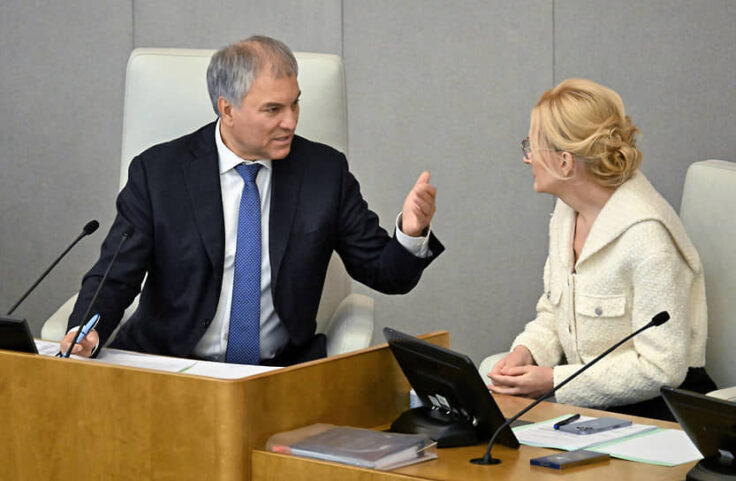
One of the law’s chief proponents, State Duma Deputy Speaker Irina Yarovaya, justifies it on national security grounds. “Strict control is necessary, since there have been documented cases of research on biological samples from Russian citizens in foreign ‘secret laboratories,’” she explains. State Duma Speaker Vyacheslav Volodin also argues that such a law is needed to “provide additional protection for citizens’ genetic biomaterial.” According to him, this information is of enormous interest to both commercial companies and fraudsters, and the state is obligated to act preemptively by erecting barriers to the uncontrolled transfer of data abroad.

The chief proponents of the new law in the State Duma — Vyacheslav Volodin and Irina Yarovaya. Photo: Kommersant

In effect, the new law places genetic information about Russian citizens on par with information of special state significance and imposes strict restrictions on transferring it to foreign citizens, organizations, and states. To be precise, transferring individual genetic data abroad is still allowed, but only for narrowly defined purposes: providing medical care to a specific patient, developing or manufacturing medication for that patient, or international scientific cooperation.

Where the transfer of biomaterials and genetic data was previously governed in many cases by institutions’ internal protocols, confidentiality agreements, or standard export licenses, it now falls under direct state control. Any transfer of human genetic data outside Russia now requires state review and approval from authorized government bodies.

The decree pays particular attention to data obtained through population genetics and immunological studies. The law frames this as safeguarding “genetic sovereignty” — the state’s control over information on genetic traits considered distinctive of large population groups living in Russia. Transferring such datasets to foreign laboratories or international databases will now become significantly harder.

The document specifies that data transfers are strictly prohibited if they pose a threat to Russia’s national security (a clause that, as the hypersonic scientists’ case demonstrated, can be stretched to cover even textbook-level data) or if the declared purpose of the transfer doesn’t match the aims stated in the research or medical program (again, largely a matter of the reviewer’s interpretation). The restrictions apply both to organizations — research institutes, universities, and commercial laboratories — and to individuals: scientists and researchers.

The decree also sets out specific rules for transfers that aren’t outright prohibited. Researchers or institutions must now file a detailed notification and application explaining the purpose of the data transfer abroad, who the final recipient is, how the data will be protected on the receiving end, and — if the transfer is meant to support a journal publication — what value it holds for the academic community.

Top news on scientists’ work and experiences during the war, along with videos and infographics — subscribe to the T-invariant Telegram channel to stay updated.

For Russian geneticists and anthropologists who had managed to preserve a few channels of scientific cooperation with foreign colleagues — sending samples or sequencing data for joint publications, for instance — this document erects a new “iron curtain”: conducting international genetics research without approval from the relevant ministries and security services is now effectively impossible.

The law also references the National Genetic Information Database. Starting from the date it takes effect — September 1 — state corporations, companies with government ownership stakes, and budget-funded and other public institutions are required to submit their existing genetic data to the National Genetic Information Database by the end of 2027.

Science Without Publications

It turned out that as soon as the law was adopted, many research institutions urged their staff to submit papers on their latest findings to journals as quickly as possible and do everything they could to get them published before the law took effect. It’s easy to understand why.

All the leading international journals (Nature, Science, Cell, PLOS, The Lancet) follow FAIR data principles (Findable, Accessible, Interoperable, Reusable), which requires authors to deposit raw whole-genome data (FASTQ/FASTA files) in open international repositories (GenBank, SRA, GISAID, ENA) before publication and to cite a unique accession number. Without this, reviewers will not accept the manuscript. Once the law takes effect, Russian researchers will be barred from transferring such data abroad.

But even if authors manage to find a journal that doesn’t require depositing raw data in international repositories, they’ll still have to go through an approval process with a government commission. For aggregated, anonymized data, the commission only needs to be notified — if there’s no response within 15 business days, publication can proceed. Publishing individual genetic data, however, requires the commission’s explicit permission. The law also allots 15 business days for that approval, though the deadline extends by another ten days if the commission requests additional materials.

T-invariant‘s sources believe these changes will seriously complicate publishing Russian research in leading international journals. Andrei (the names of our sources have been changed throughout for their safety), who spent many years at the Institute of Cytology and Genetics and now works at a university in Central Europe, points out that the research itself can still be done without foreign collaborators — but the inability to publish results would be devastating for the field.

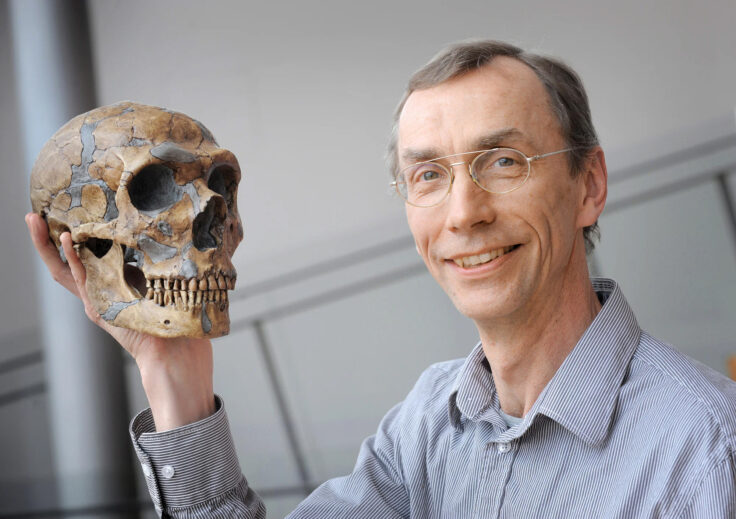
“If you look at the key papers in human genetics published in high-impact journals, you’ll see that Russia’s contribution was most often limited to providing samples,” says Andrei. “For example, in Svante Pääbo‘s projects [Pääbo won the Nobel Prize in part for discoveries made in Siberia, referring to the Denisovan hominin found in Denisova Cave in the Altai Mountains — T-invariant], the DNA extraction and analysis weren’t done in Russia at all: all the samples were analyzed in Germany by a large team of highly skilled specialists. Russian participants undoubtedly made a real contribution, but it was limited to finding the material and handing it over.”

Swedish biologist Svante Pääbo and the object of his scientific interest. Photo: Frank Vinken / Max Planck Institute via AFP – Getty Images

According to Andrei, preparing a DNA library isn’t a problem today. Sequencing is easier and cheaper abroad — at BGI in Beijing, for example, or other foreign facilities. It’s possible in Russia too, but significantly more expensive and slower. The real bottleneck is high-quality bioinformatics analysis: there are teams around the world that have been doing this at a high level for decades — the bioinformatics group at the Max Planck Institute in Leipzig, for instance, for whom it’s routine work. Such analysis can be done in Russia as well — at greater cost and lower efficiency, but it’s possible.

But then another question arises: suppose scientists obtain a significant result — how and where can they publish it? Under the new law, that result won’t be able to reach the global scientific community, because it will end up “closed.”

Andrei’s grim conclusion follows from this: the law will set back the development of Russian human genetics for years to come.

“Partly because the international scientific community won’t be able to assess the quality of Russian geneticists’ work, and studies will end up published in some closed-off journals,” he says. “That will turn the field into something provincial and isolated. Nothing good comes of that.”

Another of our genetics experts offers a concrete example of how the added layers of approval have already affected research.

Up-to-date videos on science during wartime, interviews, podcasts, and streams with prominent scientists — subscribe to the T-invariant YouTube channel!

“When the COVID-19 pandemic started, right in that first summer, colleagues from several institutes got together and put out a really elegant piece of work on the phylogeny of coronavirus strains and their spread across Russia,” Alexander recalls. “At the time, it was one of the first studies of its kind in the world. But we couldn’t publish it for a long time, purely because of data issues. We weren’t allowed to upload the genomes to the international GISAID database, where the world’s COVID statistics were being collected. The negotiations dragged on for a painfully long time. In the end, we managed to arrange publication of the data on an alternative platform, where it was technically accessible but not in the main database. The whole approval process took a year and a half. As a result, a paper that would once have been snapped up by Nature, or at least Nature Communications, ended up published in the far more modest PLoS ONE. Because by then, the moment had passed. If it had come out on time, it would have been a landmark publication. But a year and a half later, dozens of other groups around the world had already done similar research. That’s a perfect example of us cutting off our nose to spite our face.”

Another source draws our attention to a different aspect of the law — the workings of the interagency commission responsible for approving or blocking data transfers for publication.

“Both the law and the decree look very strange. According to them, even anonymized information has to be submitted to the interagency commission,” explains Vitaly. “If the study is a population or immunological one — meaning it contains anonymized, aggregated data on allele frequencies — the process is just a notification. But ever since the decree was published, I’ve been trying to put myself in the commission members’ shoes. Say I’m a population geneticist. The document says one ground for rejection is ‘submission of incomplete information or inaccurate information.’ How would you even verify the completeness or accuracy of that data? Who’s going to do that, and how? I honestly can’t picture it.”

Vitaly also points to another ground for rejection — “the presence of risks to the rights and lawful interests of Russian citizens” or “the presence of risks to Russia’s biological security”:

“We already have a law on biological security. I studied it closely, and it’s entirely about infections. How that connects to population or medical genetics, I don’t understand. The law takes effect in a month, and the interagency commission still hasn’t been formed. When it will be formed is unknown, and who’ll be on it is just as unclear. If it ends up with even a few real professionals, I already feel sorry for them. There’s a huge number of papers on human population genetics, plus dissertations on top of that. Are they seriously going to review all of it? I don’t believe it.”

Vitaly admits the new law brings back unpleasant associations with the “hypersonics case.” “Even back when the hypersonics case was unfolding, I suspected geneticists would be next. There was too much talk about biological weapons being developed against Russia. I can easily picture how, after a paper clears every approval and every commission, someone will suddenly ‘discover’ that it damages Russia’s biological security or reveals a state secret. There will always be a way to claim the authors disclosed classified information that the West is now using to develop biological weapons,” he says.

Bioweapons as a Political Argument

The most common explanation for the new law is a desire to prevent leaks of biomaterial and genetic data that could allegedly be used to create a new kind of genetic weapon. The idea of a bioweapon that selectively targets specific ethnic groups is far from new.

As far back as May 2007, then-FSB Director Nikolai Patrushev presented Vladimir Putin with a classified report claiming that Western research centers were developing “genetic and biological weapons aimed at the population of Russia.” Shortly afterward, the Federal Customs Service imposed a strict ban on exporting any biomaterials belonging to Russian citizens.

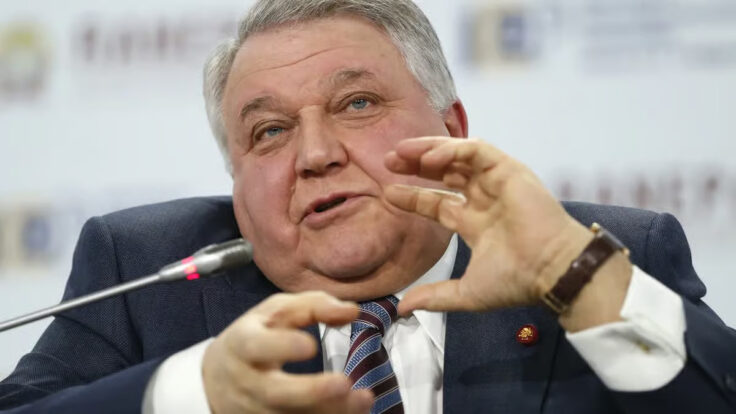
In September 2015, Mikhail Kovalchuk, head of the Kurchatov Institute, attempted to provide a scientific basis for this dubious idea. In a lecture at the Federation Council, he claimed that the West was creating “a fundamentally new subspecies of human — the service human,” and was collecting biological material to develop “a genetic weapon that selectively targets a specific ethnic group.”

Mikhail Kovalchuk. Photo: EPA

Starting in 2017, Russia’s president began publicly promoting this idea as well. In October of that year, at a meeting of the Human Rights Council, Vladimir Putin uttered what became a famous line: “Did you know that biological material is being collected across the entire country? And by ethnicity, from people living in different geographic parts of the Russian Federation. So the question is: why is this being done so professionally and systematically?” The remark was prompted by a U.S. Air Force research program collecting synovial fluid and RNA samples for musculoskeletal studies.

“This is a continuation of an old story that started with claims that numerous biological laboratories developing weapons against Russian citizens had supposedly been found along Russia’s borders,” says Vitaly. “For the most part, these were former Soviet anti-plague stations [Soviet-era public health facilities established to monitor and contain plague and other highly dangerous infections — T-invariant]. After the collapse of the USSR, they were left without funding, and the U.S. provided money to keep them running, understanding what could happen without epidemiological monitoring. When Russian troops occupied these stations in Ukraine, they naturally found protocols for destroying bacterial cultures. And they concluded that the cultures themselves had been destroyed while the paperwork was simply forgotten in the rush. But these were just ordinary logbooks: the alphanumeric codes in them let you trace the origin of every culture. Funnily enough, those documents showed that most of the samples had actually come from Russia.”

Victor, however, believes there’s at least a minimal scientific basis for such fears.

“These kinds of examples have long been standard textbook material. Take the ability to digest milk in adulthood. It’s determined by two different mutations — one common in Europe, the other in Africa. From there, lactose intolerance rises as you move east. Among Central Asian populations, the frequency of the relevant allele is 87%; in southern Siberia, 90.6%; and in northeastern Siberia, 92.9%. So when Soviet schoolchildren in Yakutia started getting two free glasses of milk a day, most of the kids ended up in the bathroom. It’s a good example of how ignorance of a population’s genetic characteristics can produce exactly the opposite of the intended result,” he says.

Andrei believes there has always been far more talk on this subject than actual scientific grounding:

“There’s always been more speculation than substance here — from Lev Gumilev [a Soviet historian known for his controversial theories of ethnic origin and “passionarity” — T-invariant] onward, through endless arguments about who’s ethnically related to whom. Those arguments continue today because we still lack good reference databases. In Siberia and European Russia, the population has been in constant flux: there were never populations that stayed fully isolated long enough to show up as “pure” on genetic tests. Hence the endless debates: who the Bulgars really were, what trace the Vikings left in Russians, whether the people around Moscow are assimilated Finno-Ugric populations or predominantly Slavic. But the main takeaway — beautifully laid out in David Reich’s book Who We Are and How We Got Here — is that our ancestors have been constantly moving and mixing with one another throughout history. The defining trait of humanity is genetic fluidity. Fully isolated communities were extremely rare.”

That’s precisely why, in Andrei’s view, creating a genetic weapon that would affect only members of a specific ethnic group is practically impossible:

“Looking for unique genetic traits rigidly tied to modern ethnic groups — Russians, Ukrainians, and so on — is usually just pointless. Genetic markers do exist, but we’re talking about statistical differences, not sharp boundaries. For example, a study of the Czech population found that only about 35–40% of men carry haplogroup R1a, which is commonly labeled ‘Slavic.’ Another 30–35% belong to R1b, loosely ‘Western European,’ and the rest fall into other major groups. The same goes for the Balkans: there’s no isolated genetic component unique to Serbs, Bosnians, or Macedonians — it’s all one blend with minor regional variation, and genetically these populations turn out to be fairly close to, say, Austrians.”

In other words, modern ethnic groups have no single genetic “key” that would set them apart from their neighbors — which means there’s no target a selective weapon could theoretically be aimed at.

What’s more, everyone we spoke with points out that even if you assume that creating a genetic weapon were possible in principle, you wouldn’t necessarily need to obtain material directly from Russia to do it.

“Every serious scientist has long treated this idea with irony,” says Andrei. “If you think about it logically, there are millions of ethnic Russians living outside Russia today — that’s already a huge, perfectly representative sample. If it were hypothetically possible to create a ‘genetic weapon’ — and it really isn’t — no special data from Russia would even be needed. Among these people you’ll find recent émigrés, descendants of several generations of emigration, and their relatives — study them all you want. The argument that centuries of population mixing make it biologically impossible to build a weapon against a specific ethnicity is convincing to scientists and to anyone who thinks critically. But the people making the decisions seem to be working from a different logic: ‘Better to ban everything and play it safe, even if it hurts science.’”

That said, our sources acknowledge that genetic data privacy concerns are real.

“There are serious debates in the West too about the privacy of genetic information,” Alexander notes. “But there, they’re purely about protecting personal privacy. If I publish my genome, I automatically reveal roughly half of my brother’s genome — and he might not want that at all. So the concern is real. Eight years ago now, there was a good study showing how much you can learn about a person who has never published their own genome, just from the public data of their relatives.”

We couldn’t find a single geneticist or physician who believed the new law would improve their working conditions, or that restrictions like these were overdue. Asked who actually needed this law and why, most of our sources suggested we direct that question to the lawmakers who passed it. Many of our experts believe it emerged from years of talk about “genetic weapons,” political ambition, and a desire to align with the current state agenda.

Valery Panyushkin, a journalist with the investigative outlet Sistema, believes the law’s real purpose lies elsewhere — funneling genetic data from civilian healthcare to the military through the National Genetic Database.

“First, the board overseeing this database includes President Putin’s daughter, Maria Vorontsova,” Panyushkin writes in an article for RFE/RL’s Radio Svoboda. “Second, the genetic database is needed mainly by the military, at minimum to identify the dead and wounded. Third, if labs are required to submit client information to the National Genetic Database — which isn’t currently the case — that would open the door to a new level of surveillance over citizens. Fourth, closing off genetic information rules out the possibility of identifying, inside Russia, war criminals who committed sexual violence in Ukraine, Africa, and other conflict zones where Russian troops have served or will serve. Fifth, the law rules out cooperation between Russian healthcare institutions and foreign ones — at minimum, it rules out international clinical trials of new drugs. And finally, all of this has been made possible by the paranoid, anti-scientific, but unshakable belief among Russian authorities in the possibility of creating a ‘genetic weapon.’”

[[socialnetworks]]

Commenting on the reasons behind the new law, Alexander offers a few more possible explanations.

“It might really just be the product of stoked-up ignorance,” he says. “Or it could be political reasons, or economic ones. The simplest explanation: this is a great way to request substantial funding to build a database, start filling it in somehow, and then announce, ‘Look, now we have our own, domestic genomic database.’ And then everything traces back to the same Mikhail Valentinovich [Kovalchuk — T-invariant]. He’s like Rome for us — all roads lead to him. But most likely, it’s a combination of different factors.”

What Will Change for Russian Science?

Whatever the law’s real motivations, starting September 1 our sources, along with thousands of other specialists, will have to work under the new rules. Most scientists directly involved in human genome research, when first asked about the law, simply sighed heavily: “This is really bad.” Where they differed was only in how much damage they expected it to do to different areas of research.

Andrei suspects that once the law takes effect, some research will only continue, if at all, on a “commissioned” basis — behind closed doors, the way some virus-related work already operates. It’s even possible a dedicated classified structure will be set up for this purpose.

“But that’s a dangerous path, like any closed-off field,” he stresses. “Sure, you can keep getting interesting results. But where will these people publish? You’d have to build closed databases, stew in your own literature, cut off from the international community, with nobody assessing it, criticizing it, or peer-reviewing it. In isolation, pseudoscience, cronyism, and corruption start to flourish almost immediately. Once openness and international peer review disappear, all hell breaks loose.”

Liliya Gumerova, chair of the Federation Council Committee on Science, Education, and Culture — one of the principal authors of the law on the National Genetic Information Database — takes the opposite view. In her words, creating a closed national database is a mechanism for protecting intellectual property and a competitive advantage for Russian science:

According to the logic of the law’s authors and ideologues, making the database sovereign is supposed to give Russian scientists a one-sided advantage: they’ll supposedly be free to use open international repositories while also getting exclusive access to a closed domestic dataset. Our experts disagree with that assessment. Alexander pushes back:

“First, access to international databases from Russia is already severely restricted because of sanctions, and this could only make things worse. And in any case, the Russian database will only ever be a tiny fraction of what’s available worldwide. Second, in science, what matters isn’t just data — it’s the ability to actually discuss your results with people who genuinely understand the subject. Sure, you could lock yourself inside ‘Russian genetics’ and stew in your own juices with a pinch of unique closed-off data in your pocket. But you’ll only have two other people to discuss it with. It’ll turn into provincial science producing provincial research. And finally, people will treat our science accordingly: even if there are some interesting results, nobody will find out about them, because publishing in a real international journal requires the data to be accessible.”

The geneticists we spoke with have little hope the law will be substantially revised before it takes effect. They might have taken some comfort in the old saying that “the harshness of Russian laws is offset by how selectively they’re enforced” — if not for the recent hypersonics case.

“I know two people who wrote negative reviews of the law regulating genetic engineering activity. Their objections didn’t change anything,” says Vitaly. “Something similar happened in 2023, when they passed a law banning registration on Russian websites through Google and other foreign services. I run a journal myself, and we get submissions from abroad too. The law offered three ways to register: through a Russian phone number, through Gosuslugi [Russia’s state online services portal — T-invariant], or through your own site-owner identification system. Luckily, we already had such a system. But at first, no penalty was written into the law for non-compliance. Only recently did Article 13.55 appear in the Code of Administrative Offenses — “Failure to fulfill the obligation to authorize users of the ‘Internet’ network when providing access to information.” We’re in a similar situation now: who will oversee enforcement of the new law, what the penalty is, who’ll sit on the commission — none of that is clear yet. The worst part is that the situation could change at any moment, and it would be very hard to take down an article that’s already been published. You’d end up with an ongoing violation you could be prosecuted for at any time.”

Still, some more cautiously optimistic assessments can be heard as well.

“I was at a discussion attended by the people this law affects most directly,” Alexander admits. “A representative from one of the major genetics companies said they’re actively working to make sure the implementing regulations end up being reasonable. And anyway — as long as we’re alive, there’s always hope.”

Support T-invariant’s work by subscribing to our Patreon and choosing a donation amount that suits you.

The post They Came for the Geneticists? Why Scientists See the New Genetic Data Law as a Threat to Russian Science appeared first on Т-инвариант / T-invariant.

  •  

Chronicle of the Persecution of Scientists No. 34

T-invariant is issuing its regular report, the Chronicle of the Persecution of Scientists, No. 34, dated June 30, 2026. From June 8 to 14, the fourth edition of the “You Are Not Alone” marathon in support of political prisoners took place, raising more than 14 million rubles over the week. The funds raised are used to help people in Russia who are imprisoned on politically motivated charges, and to their families — covering the cost of legal representation, prison visits, deposits into inmates’ accounts with the Federal Penitentiary Service (FSIN), food, and medicine.

T-invariant is issuing its regular report, the Chronicle of the Persecution of Scientists, No. 34, dated June 30, 2026. From June 8 to 14, the fourth edition of the “You Are Not Alone” marathon in support of political prisoners took place, raising more than 14 million rubles over the week.

The funds raised are used to help people in Russia who are imprisoned on politically motivated charges, and to their families — covering the cost of legal representation, prison visits, deposits into inmates’ accounts with the Federal Penitentiary Service (FSIN), food, and medicine. The money also supports people who have been left without support after a loved one’s arrest, as well as those who have been released after serving their sentences.

T-invariant took part in the marathon, as it does every year. T-invariant Editor-in-Chief Olga Orlova called on our readers and viewers to support political prisoners. We have been maintaining the Chronicle for almost three years now. Our database currently contains 170 individual case files. About 40 of the scientists in it are currently behind bars.

In this issue of the Chronicle, we have added a new case file: that of Olga Orlova. Russia’s Ministry of Justice designated Olga Orlova — a Candidate of Philological Sciences (PhD equivalent), science journalist, and T-invariant’s editor-in-chief — a “foreign agent.”

We have written several times about the debate over the Russian government’s proposed AI-regulation bill. According to RBC, that debate has led to major changes to the bill — not just in the details, but on substantive issues, chiefly those concerning oversight of how AI models are developed and used.

After sharp criticism from the business community, the Russian government presented an updated version of the bill, cutting the number of provisions from 21 to 13. The concept of a “trusted” model was dropped, but “sovereign” and “national” models remain, and they must comply with Russian law and store their data within the country. The law is now meant to regulate only large foundation models with more than 1 billion parameters. The requirement that such models be built exclusively on Russian data by Russian citizens was scrapped, and the new draft no longer bans the use of foreign neural networks to train models. It was precisely the requirement to train on Russian data that drew the sharpest criticism.

The registry of “trusted” models was supposed to be overseen by the FSB and FSTEK (the Federal Service for Technical and Export Control — an agency historically responsible for protecting state information systems from foreign technical intelligence services). That registry has been dropped, or at least the law no longer provides for one. But experts note that the bill remains quite vague, and how it actually functions will depend on a whole package of implementing regulations whose content is still unknown. The main provisions may take effect on March 1, 2027, with certain rules coming into force as early as September 1, 2026.

New case files

Viktor Kazakov

June 22, 2026 The Sverdlovsk Regional Court sentenced 71-year-old engineer Viktor Kazakov of Novouralsk to a year of forced labor on charges of the rehabilitation of Nazism (Part 4, Article 354.1 of the Criminal Code), Mediazona reports. The court ordered a year of forced labor with 10% of his wages withheld for the benefit of the state. He was also barred for two years from administering websites and posting material online, Kommersant reports.

Grey Boltachev

June 4, 2026 The Leninsky District Court in Yekaterinburg sentenced Grey Boltachev, a researcher at the Institute of Electrophysics of the Ural Branch of the Russian Academy of Sciences, to five days of administrative detention on a charge of petty hooliganism, Mediazona reports. The scientist had been detained at his workplace on June 3. Police formally accused him of “using obscene language in a public place.” Boltachev linked his administrative prosecution to his plans to run for the Sverdlovsk Regional Legislative Assembly on the Yabloko party ticket — regional parliamentary elections are set for this September — Kommersant reports. Boltachev was released from custody on June 8, Yabloko reports.

Olga Orlova

May 22, 2026 Russia’s Ministry of Justice added science journalist and T-invariant editor-in-chief Olga Orlova to the register of foreign agents, Vedomosti reports.

According to the Ministry, Orlova spread “false information” about the decisions and policies of Russian government bodies. She also spoke out against the “special military operation” in Ukraine and gave interviews to foreign media outlets. In addition, the journalist created and distributed materials produced by foreign agents and organizations designated “undesirable” in Russia, RBC reports.

Updates

Kirill Yakovlev

June 8, 2026 The Kuibyshevsky District Court in St. Petersburg dismissed the criminal case against poet Glikeriy Ulunov (real name Kirill Yakovlev). He had been charged with “organizing activity aimed at inciting suicide” (Part 2, Article 110.2 of the Criminal Code of the Russian Federation). His lawyers managed to get the writer released from criminal liability, even though the prosecutor strongly objected, Department One reports.

Azat Miftakhov

June 29, 2026 A court ruled it unlawful that Elena Gorban — mathematician Azat Miftakhov’s wife and defense attorney — was denied access to him after he had been tortured at Penal Colony No. 18 “Polar Owl” in Kharp. On June 23, Gorban was likewise refused a visit with Miftakhov, even though she was entitled to one as his defense counsel, Mediazona reports.

Yuri Pivovarov

June 28, 2026 The Gagarinsky District Court in Moscow convicted Yuri Pivovarov — former director and research director of the Institute of Scientific Information on Social Sciences (INION) of the Russian Academy of Sciences, whom the Ministry of Justice has designated a “foreign agent” — in absentia, sentencing him to seven years in a general-regime penal colony on charges of fraudulently employing staff, RBC reports.

Tamara Eidelman

June 19, 2026 The Moscow City Court convicted historian Tamara Eidelman in absentia and sentenced her to eight years in prison on charges of rehabilitating Nazism (Article 354.1 of the Criminal Code) and spreading “fakes” about the army (Article 207.3, Part 2, Clause “d”), Meduza reports.

Mikhail Verbitsky

June 13, 2026 Mikhail Verbitsky was detained at Yerevan Airport, the TV network Rain (Dozhd) reported. Verbitsky was placed in a detention facility. As Meduza reports: “According to Ani Chatinyan, a lawyer with the Yerevan office of the Helsinki Civil Assembly ‘Vanadzor,’ Verbitsky was detained over a criminal case against him in Russia. She explained that if Russia submits an extradition request, Verbitsky would, under the law, be held for 40 days; if not, he would be released after 72 hours.” No such request had arrived by June 15. Mikhail Verbitsky was released from custody in Armenia. This was laterreported by his lawyer, Vache Simonyan, to the Armenian service of Radio Liberty. Verbitsky left Armenia on June 15, Meduza reports.

The post Chronicle of the Persecution of Scientists No. 34 appeared first on Т-инвариант / T-invariant.

  •  
❌