❌

Reading view

Multiple fire fronts throughout Greece, hundreds evacuated

Firefighters and water-dropping aerial means have been operating in several wildfires across the country, from Crete to Central Greece and from Peloponnese to Attica on Friday, July 31, 2026. It is the third consecutive day where fires jump out like mushrooms and spread quickly due to gale-force winds blowing with intensity of 7 to 8 […]

The post Multiple fire fronts throughout Greece, hundreds evacuated appeared first on Keep Talking Greece.

  •  

Putin’s Falcons. Alabuga’s CEO patented a game called Drone Battle: Ukraine, while his deputy patented the war’s main drone

YouTube, TikTok and Twitch are blocking ads en masse for the Alabuga Special Economic Zone, which recruits young people to assemble combat UAVs. Yet Tatarstan’s efficient managers have relaunched the recruitment campaign – through the proxy project Stalin’s Falcons, the Dronecon cyber tournaments with million-ruble prizes, and the game Drone Battle: Ukraine. Details in a T-invariant investigation.

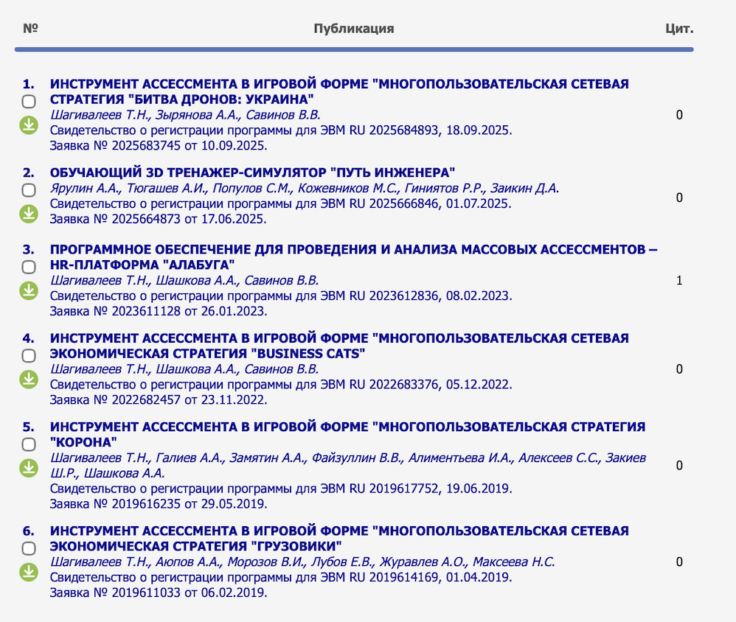
Alabuga SEZ CEO Timur Shagivaleev has registered a patent for an “assessment tool in game form: the multiplayer online strategy Drone Battle: Ukraine.” The strategy is available on its website in three languages: Russian, English and Chinese. According to the Whois service, the dronewars.su domain is registered to the Alabuga SEZ.

PREVIOUSLY IN T-INVARIANT

“Every Day I Live My Best Life” — While Teenagers in Alabuga Assemble Drones for the War

“Aerokitties” Fly in Swarms. How Higher Education Programs in Drone Technology Serve Military Objectives

Gamer Under Contract. The State Offers Students a New Role Model

Black Shaheds Will Be Assembled in Togliatti Instead of Cars

And Jupiter is Ours, and Europe is Ours

Shagivaleev is listed as the author of three more patents for various game-based “assessment tools.” According to Elibrary, all of them have zero citations. Another patent in his name covers software for conducting and analyzing mass assessments – the Alabuga HR platform. Shagivaleev is under sanctions from most countries in the Western coalition and appears on Ukrainian sanctions lists under the category “engineers of aggression.” At the same time, Shagivaleev did not add himself to patents related to UAV technologies that were registered by other SEZ employees or outside engineers (in Russia, the practice of adding a manager to patents and other intellectual-property documents is common).

Shagivaleev’s deputy for new production, Sergey Alekseev, is listed first among the authors of a patent for a “civilian unmanned aerial vehicle.” Less is known about Alekseev than about his boss. Judging by the widely discussed 2023 investigation by Protokol, which exposed the involvement of teenagers in assembling Shaheds at Alabuga, Alekseev appears to be the main advocate of the company’s signature method of motivating students to deliver results: punishing them by shooting them with paintballs. Looking at the outline of this “civilian” UAV, one can easily recognize the shape of the Shahed loitering munition, also known as the Geran-2. Little information is available about the other patent authors; only Mikhail Zavyalov has an obvious connection to the UAV industry. In all of the patents mentioned above, the rights holder is the Alabuga SEZ.

The abstract to Shagivaleev’s patent (for some reason, Alabuga SEZ chief accountant Anastasia Zyryanova is also listed as a co-author) states that “the main purpose of the program is to familiarize users with the situation in the special military operation zone through a training tool in game format, and to develop tactical and strategic planning among participants in game sessions.” Drone Battle: Ukraine is described as “a training simulator in the form of a multifunctional interactive web application with multiplayer support.” The first recorded uses date to 2025.

T-INVARIANT BACKGROUND

Who is hacking Alabuga’s production and propaganda machine?

On June 27, 2026, it became known that the Alabuga SEZ website had been hacked. Hackers from Black Spark claimed responsibility and said they had obtained a database of employees and supply chains. For several days, the site displayed a Black Spark placeholder page (what it looked like can now be seen here). By July 1, the site had been restored. In spring and summer 2026, an active campaign was under way to block Alabuga advertising; on June 19, the AlabugaGate project announced that almost no integrations remained on YouTube – nearly all had been removed or blocked. Earlier, in May 2026, information appeared that “Alabuga is Ukraine’s No. 1 target for 2026”; according to the Ukrainian Telegram channel Strategic Aviation, “preparation for the operation to destroy it has been under way for several years and may become one of the largest in the war.”

The active phase of the advertising campaign for Drone Battle: Ukraine began in spring 2026 and is still ongoing. T-invariant obtained a commercial proposal that advertising agencies are sending to YouTubers with million-strong audiences. According to the brief, the target audience for the ads is “men aged 18 to 45, GEO: all of Russia (mainly up to 1,500 km from Tatarstan).”

Alabuga’s management uses this multiplayer game to recruit people as UAV operators, mainly through its proxy project Stalin’s Falcons. The project’s slogan: “Our grandfathers developed and produced the best weapons in the world and used them to beat the fascists. Now it’s our turn.”

Left to right: Timur Shagivaleev, VTB head Andrey Kostin, Tatarstan President Rustam Minnikhanov, and a Stalin statue at the opening of Alabuga Polytech headquarters. Photo: Alabuga SEZ press service.

T-INVARIANT BACKGROUND

Timur Shagivaleev was born on January 28, 1978. He graduated from MGIMO. Since September 2011, he has served as CEO of the Alabuga SEZ. In 2023, he presented Russian officials and state banker Andrey Kostin with a 25-year, 491-trillion-ruble development project for Alabuga that envisaged colonizing four of Jupiter’s moons and incorporating them into the SEZ. According to the presentation, the colonization of Jupiter’s moon Callisto would include the development of biotechnology for human cloning, genome editing, and extending human life to 700 years. At the ceremonial signing of the plan at Alabuga, VTB head Kostin and Russian First Deputy Finance Minister Irina Okladnikova added their signatures (see T-invariant’s detailed analysis of the megaproject).

In February 2026, Radio Liberty published a major story on Stalin’s Falcons. Its journalists concluded that this Alabuga SEZ project was more likely serving PR and HR goals – attracting people “to the special military operation” and to drone assembly – than directly participating in hostilities. Stalin’s Falcons openly campaign among students. As T-invariant previously reported, on April 20, 2026, HSE University hosted a drone-piloting tournament organized by Stalin’s Falcons. To take part, students had to pass a preliminary selection specifically in the Drone Battle: Ukraine simulator. The university’s social-media groups published instructions (here and below, T-invariant preserves the authors’ spelling and punctuation):

“The procedure is simple:

– register on the platform: dronewars.su/ru

– complete 10 training chapters

– win a single-player game in Real Time mode, playing for the Russian Federation

After that, access to ranked games will open – this is your pass to the next stage.”

Stalin’s Falcons tournament at HSE University. Photo: T-invariant.

The competition took place in the atrium of HSE University’s main building on Pokrovsky Boulevard in Moscow. Interestingly, in the report “A Duel of the New Era” on HSE’s website, the press office removed the word “Ukraine” from the name of the simulator.

“Drone Battle is designed as a tactical simulator in which the player commands a UAV troops unit. The player has FPV infantry, vehicles and support stations at their disposal. The objective depends on the scenario: capture the enemy headquarters and hold it for one day of game time, or occupy a neutral base and hold it for five days. After the competition, representatives of Stalin’s Falcons spoke with students and explained how service in UAV troops works today,” the article said.

The Drone Battle: Ukraine simulator is also a key part of the large Dronecon cyber tournaments held in Tatarstan with support from the Alabuga SEZ and Stalin’s Falcons.

“The cyberbattle of the year: Russia’s largest tournament from Stalin’s Falcons!” is how major public pages, Z-bloggers and war correspondents advertise the event (see 1, 2, 3). So far, at least four large multi-day events have taken place: the tournament on April 11-13, 2025; the tournament on February 23-27, 2026; the tournament on April 11-13, 2026; and the tournament on May 8-14, 2026. Cyber athletes were invited to Tatarstan for these events, with all travel, accommodation, meals and entertainment covered, and the organizers did not stint on major rewards. The prize fund of the first tournament was announced at 18 million rubles, while the following tournaments offered 15 million rubles.

The first tournament organized by Stalin’s Falcons. Photo: Stalin’s Falcons Telegram channel.

The February tournament made the loudest splash in the media, on social networks and on YouTube. It was won by the esports player “Grisha Putin,” who received a check for 3.5 million rubles. He is Russia’s most popular Z-streamer; his second nickname is “Cyberwarrior of the Special Military Operation.” His real name is Grigory Korolev, and he is a student at St. Petersburg State University (in a recent interview, he said he was on the verge of expulsion for poor academic performance and was considering signing a contract with the UAV troops). Grisha Putin regularly draws huge audiences to cyber tournaments, including with Western streamers, and actively promotes the Z agenda in the global gaming community. The streamer says he raises millions of rubles from sympathetic foreign gamers for combat drones for the Russian army. One of the most popular lots is personalized shells, rockets, mines and UAVs: Grisha Putin arranges for Russian soldiers to write foreigners’ wishes on munitions and send photo and video reports (for example, it was reported that an Arab man allegedly asked them to write about his beloved cat).

Russia’s best-known Z-esports player Grisha Putin (second from left) celebrates his victory. Photo: “Grisha Putin’s Bunker” Telegram channel.

In press releases from Stalin’s Falcons, Grisha Putin describes his impressions as follows:

“Video games have long been more than youth entertainment. Many countries use them to promote their historical truth, thereby educating young people and giving them their point of view. Russia has begun releasing its own video games with support from the Internet Development Institute. I have already highlighted new domestic games such as the first game about the special military operation, Squad 22: ZOV by SPN Studio, Sparta 2035 by Lipsar Studio, and Gomel Bogatyrs by Playing Cats Studio. As for the Dronecon tournament by Stalin’s Falcons, it is an excellent example of drawing gamers who play popular global strategy games into the latest technologies of warfare. Gamers have skills in strategic thinking, game planning and instant reaction to partners’ actions. This is a unique and already very well prepared contingent for working with real-world projects.”

Grisha Putin at the tournament. Photo: “Grisha Putin’s Bunker” Telegram channel.

This is how Stalin’s Falcons describe the rules for participation:

1. You must submit an application on the website and choose a track.

2. Contact the tournament organizers for further interaction.

3. Complete the training in the Drone Battle simulation and play a single-player game for the Russian Federation – https://dronewars.su/ru. Send confirmation of completing the training to the organizers.

4. Collect a package of documents (passport, taxpayer identification number, SNILS) to create a participant card and verify the data. The tournament is held on a closed and guarded site to ensure the safety of participants and guests.

5. Confirm your participation in the tournament after your participant card has been approved.

6. Receive your tickets before the tournament and arrive.

You can expect paid transfer and accommodation; a fair prize fund; and the opportunity to receive an offer from Stalin’s Falcons.

The total advertising campaign has not gone unnoticed. Reviews by participants can be found on review sites. There is also feedback about the “closed and guarded site”:

“The tournament is not a scam, I was there myself. The only thing is that for those seven days you’re basically in prison: there’s almost no connection, you can’t leave the site, you’re supervised, and you sign nondisclosure documents about what you saw. On the plus side, they feed you for free and the food is tasty :), and they also give you their merch (the merch is really cool, in my opinion, but if your size is M, it’s better to try to get into the line first; those sizes are in short supply). There are different disciplines: instead of HoI, I had War Thunder; maybe the next tournament will have HoI. There are several disciplines: War Thunder (in my case), GeoGuessr, Drone Battle and FPV flights (first in a simulator, then on a real one). Points are counted in total. If you win first place in one discipline but are eliminated from all the others, that doesn’t necessarily mean you’ll get prize money. By the way, Alabuga covers the tax on the prize.”

A runway-style show at a Stalin’s Falcons tournament. Photo: Stalin’s Falcons Telegram channel.

t is difficult to name the exact number of people the organizers managed to attract to their events. Radio Liberty journalists wrote in February 2026 that only a few photographs from Dronecon could be found online: some were taken on the grounds of Alabuga Polytech, and others inside the premises of the Zarnitsa production association in Kazan. At the time, Radio Liberty found only one independent piece of evidence that the tournament had actually taken place: the Higher School of Petroleum in Almetyevsk reported on its website that one of its students had participated in Dronecon. He confirmed to journalists that he had gone to the tournament, called it “cool,” but noted that far fewer than the announced thousand people had taken part in Dronecon. The note is still available today.

[[socialnetworks]]

Radio Liberty also described in detail that many links can be found between Stalin’s Falcons and Alabuga, but no real traces can be found of the Falcons operating as a combat unit, nor of people connected to the unit beyond recruiters and marketers. Stalin’s Falcons have never been mentioned as a combat unit in reports by the Russian Defense Ministry or in federal media. Russian “war correspondents” write about the Falcons only in advertising posts. In addition, Radio Liberty found numerous negative reviews from people who had tried to join Stalin’s Falcons through recruiters.

The Ukrainian outlet 24 Kanal also published a major investigation into the Falcons. Its journalists concluded that Stalin’s Falcons look like “an element of a sprawling network where technology, information operations and controlled PR are combined.”

“In modern war, Russia is building not only combat units, but entire media systems of influence that operate simultaneously in the military, digital and public spheres,” the journalists conclude.

Thus, Timur Shagivaleev has managed to prove to the Kremlin his important role in supplying the key resource of modern warfare – UAVs – as well as the people who will assemble and then operate them. And while the whole world already knows about Alabuga as a physical point on the map where instruments of death are produced, far less is known about the cyber-Alabuga that Shagivaleev and other “Putin’s Falcons” from the Alabuga SEZ are building in parallel. Given the current shortage of personnel for the combat-drone industry, the task of recruiting young people online looks like no less important a national project than keeping the death factory in Tatarstan running. As T-invariant wrote earlier, “esports players are admitted without competition.” That was the headline of an article published by Tatar-inform at the height of the student recruitment campaign.

You can support T-invariant by subscribing to our Patreon and choosing a donation amount that works for you.

The post Putin’s Falcons. Alabuga’s CEO patented a game called Drone Battle: Ukraine, while his deputy patented the war’s main drone appeared first on Т-инвариант / T-invariant.

  •  

PUSIN for Putin: Who is selling the “happiness button” and how?

By the beginning of Vladimir Putin’s new presidential term in 2030, Russia’s fastest-growing neurotechnology company promises to begin developing solutions for maintaining mental health and cognitive function, as well as technologies for stimulating brain neuroplasticity and managing emotional states — specifically, “fear, happiness levels, and motivation.” Research and development are being handled by scientists at Moscow State University’s AI Research Institute, which is headed by Putin’s daughter, Katerina Tikhonova. Neiry Group already enjoys substantial support from both state development institutions and private investors, notably from billionaire Vladimir Potanin and other major Russian investors operating through closed-end mutual funds. What is at stake is extending life expectancy and improving quality of life in old age — a topic that deeply concerns the Russian President, though he is certainly not alone in this interest. With such positioning, Neiry expects to secure significantly more funding, according to T-invariant’s sources in the Russian venture capital market.

Top news on scientists’ work and wartime experiences, along with videos and infographics — subscribe to the T-invariant Telegram channel to stay updated.

From Rats to Humans

The MSU AI Research Institute has become a strategic partner for Neiry Group, which plans to move “from mass microchipping of animals to the first experimental human neurochip implant surgeries.” The institute houses an invasive neural interface development laboratory where joint research with Neiry is conducted. The company and its founder, Alexander Panov, participated actively in the recent St. Petersburg International Economic Forum (SPIEF). In the “Know Our Own” zone, as part of the “Minute of Techno-Glory,” Neiry’s booth operated alongside “The Welder Catherine,” Lapochka lemonade, Infomaximum, and other Russian brands. At the forum, the company announced a new funding round and even more ambitious plans than before (see previous T-invariant article on remote-controlled bio-drone pigeons and “conquering the world with neurotechnology”).

This new phase of active fundraising has shed light on the sources of funding used to consolidate Russian neurotechnology companies around Neiry. Meanwhile, an aggressive PR campaign has revealed what Neiry intends to do next.

“Just so you know, my co-founder of Neiry is Katerina Tikhonova, the idea for an AI-chipped rat came from Mikhail Kovalchuk, and our ambassador is Vladimir Putin!
*according to foreign agents, extremists, and Navalny’s idiots”

From the Telegram channel of Neiry founder and CEO Alexander Panov

In its investor presentation on the Aurora platform, Neiry listed six organizations as investors: Interros holding company, the Voskhod Fund, the NTI Fund, JSС Mira AI Capital, SPEC Investment, and the Seed Investment Fund. However, in the presentation on its own website, Neiry has omitted Interros, owned by billionaire Vladimir Potanin. As a reminder, the holding company is under US and Canadian sanctions, while Potanin himself has been on the US sanctions list since 2018, and after 2022 was sanctioned by Canada, the UK, Australia, and New Zealand. The Voskhod Fund was created by Interros and was sanctioned by the US in 2023.

Neiry raised a significant portion of its capital from state development institutions. Judging by the presentation, the NTI Fund was its first public investor. Among the third-round investors is the Seed Investment Fund (Russian abbreviation$nbsp;— FPI), displaying the old logo of the Russian Venture Company (RVC). Yet back in 2019, RVC announced the closure of its subsidiary funds (including FPI), and in 2021 it was reported that RVC had been integrated into the Russian Direct Investment Fund (RDIF).
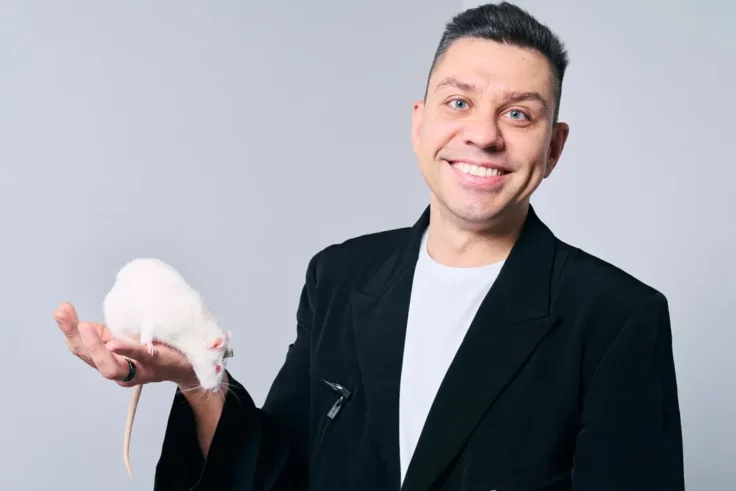
Founder and CEO of Neiry Alexander Panov. Photo: Forbes.

Meanwhile, FPI remains legally registered. This is likely due to the administrative peculiarities of RVC’s reorganization and the convoluted nature of winding up legal entities, especially of this type, according to a former RVC employee who spoke with T-invariant. There is no record of any substantive activity by FPI over the last 8–10 years — a fact confirmed to T-invariant by two former FPI employees.

Sources say it is difficult to explain why FPI appears in the “Neiry Group’s Capital” section of the investor presentation. “Perhaps it refers to some earlier investments in one of the neurotechnology companies that became part of Neiry, or maybe it’s somehow connected to RDIF, which now holds what used to be called RVC or was part of it,” suggests a former RVC employee. T-invariant sent an inquiry to Neiry Group to clarify this information, but no response has been received yet.

T-INVARIANT BACKGROUND INFO

The Russian Direct Investment Fund (RDIF) is a sovereign wealth fund established in 2011 by the Russian government to attract foreign capital into the Russian economy and co-invest in key projects. RDIF and its CEO, Kirill Dmitriev, were added to all major sanctions lists within days of the full-scale invasion of Ukraine (February 28, 2022, by the US; March 1, by the UK; and shortly after by the EU). Kirill Dmitriev has headed the fund since its founding. Today, he is one of the key Russian negotiators in economic and political dialogue with the US under the Trump administration.

During these active negotiations, a project for a tunnel across the Bering Strait (Chukotka–Alaska) was proposed. The fund and its founder have always been inclined toward mega-projects. In 2016, the fund invested in Hyperloop One, a company developing a high-speed vacuum train based on Elon Musk’s design. The deal’s value and terms remain unknown (though after the project collapsed, all investments were lost). In 2017, Kirill Dmitriev announced that RDIF would invest in the construction of Neom, the “city of the future” in Saudi Arabia. Dmitriev’s wife is Natalya Popova, a friend of Katerina Tikhonova and her deputy at Innopraktika (for more details, see the article “The ‘Single Perimeter’ State Corporation: How Putin’s Daughter and Her Fashion-Model Friend Decided to Turn Innopraktika into an Integrator for All High-Tech Companies”).

The remaining two public investors are JSC Mira AI Capital and SPEC Investment. These companies have not been included in sanctions lists. Alexey Mariza, the founder and former CEO of Mira AI Capital, also serves as the chief operating officer of Neuroroga. In 2025, during its third funding round, Neiry acquired a 50% + 1 share stake in Neuroroga. Consequently, Mira AI Capital’s investments now flow into both the parent company (Neiry) and its subsidiary (Neuroroga). The founder of SPEC Investment is the Minerva-Capital closed-end mutual fund with a 99.93% stake; this fund is managed by JSC AF Capital Management Company (known as JSC Veter Management until January 10, 2025).

The strategic partnership with Katerina Tikhonova’s institute serves as a signal of political priority and provides access to the largest pools of capital. Potanin’s funds provide financing, while VTB Bank — represented by its Deputy Chairman of the Management Board, Vadim Kulik — gives Neiry prominent visibility at the major Data Fusion conference (hosted by the state bank in collaboration with Tikhonova’s Innopraktika foundation) In 2025, Kulik personally moderated a panel titled “Neurotechnologies: The Race for the Future.” Judging by the list of participants, Neiry is the company driving this race — specifically, Neiry founder and CEO Alexander Panov, Chief Scientific Officer Mikhail Lebedev, and laboratory head Vasily Popkov (both scientists are key figures at the MSU AI Research Institute). Such high-level PR support is not even available to Russia’s largest and longest-established neurotechnology companies, such as Motorika, which specializes in functional cybernetic limb prostheses, neuroimplants, and medical device distribution (Motorika has received direct investment from RDIF and has completed a pre-IPO round).

“The development of neurotechnologies, which Neiry is engaged in, can be viewed as a tool of geopolitical competition, and the state’s current position regarding limited regulation of AI development allows for growth in all directions,” stated VTB Deputy Chairman Vadim Kulik.

The new, fourth funding round was split into two parts: a “public” round and one for professional investors. The round for retail investors ran from March 10 to April 24. The price per share was set at 5,250 rubles [~$70]. The minimum investment for retail investors was 152,250 rubles [~$2000], equivalent to purchasing 29 shares. On his Telegram channel, Panov said that over 200 individual investors became shareholders within three weeks of the campaign. In another post, he mentioned that Neiry “raised 100+ MILLION [~$1,3m] in funding” within five days of targeting individual investors — this is currently the only public information available on the financial results of the 2026 funding round. Looking ahead, he noted that from May through the end of 2026, participation in the round would be restricted “only to strategic partners and institutional funds with a minimum investment size of 100 million rubles [~$1,3m].”

Ultimately, according to the investor presentation, Neiry Group’s valuation is projected to reach 8 billion rubles [~$100m] by the end of 2026. Following that, an IPO is planned for 2028.

On-Demand Happiness

It is expected that 50% of the funds raised will be allocated toward accelerating research and developing invasive neural interfaces to treat neurological and psychiatric disorders, as well as enhancing cognitive abilities. This will culminate in the mass production of PUSIN — the “Personal Universal System of Invasive Stimulation.” Another 30% of the investment will be used to acquire other neurotechnology companies, with the remaining 20% dedicated to international market expansion, clinical trials, and related overhead costs.

The company’s website states that Neiry operates four proprietary surgical units, has performed over 500 successful animal surgeries, and is slated to begin human trials in 2026. The company has already announced recruitment for a study on deep brain stimulation (DBS) for patients with treatment-resistant depression and obsessive-compulsive disorder. This procedure involves implanting electrodes into specific brain regions to deliver stimulation, thereby mitigating symptoms. This is not a novel development — neuromodulation and neurostimulation techniques have long been used worldwide, for instance, in treating Parkinson’s disease. These routine procedures will likely serve as a “warm-up” for future, more invasive and complex devices — namely, brain-computer interfaces (BCIs).

Neiry’s flagship development is PUSIN. According to the company’s investor presentation, it will enable users to control gadgets using thoughts alone, as well as modulate their emotional state — for example, inducing feelings of happiness and improving sleep quality. Neiry expects practical applications of neurointerfaces to materialize around 2030–2035. During 2026–2027, the plan involves refining surgical procedures using Medtronic neurostimulators, for which proprietary clinics will be launched, alongside upgrading PUSIN following animal trials. The period between 2027 and 2030 will see the first human PUSIN neuroimplantation and technology optimization. Following this, the company plans to develop and roll out technologies for maintaining mental health and cognitive functions, alongside managing emotional states like fear, happiness, and motivation.

“Even though Neiry is probably ALREADY THE LARGEST PRIVATE PROJECT in the country by number of investors, valuation, and growth rate, I predict that our deep tech fan club will add several hundred more investors over the next three weeks. This means we will be able to do more, go deeper, and chip everyone even more aggressively, advancing our scientific, engineering, and product development all in the name of profit margins and saving human civilization.”

From Alexander Panov’s Telegram channel

Overall, according to Neiry’s strategy, the company’s primary focus areas include developing BCIs (such as PUSIN), invasive stimulators for psychiatric disorders, and non-invasive neurodiagnostic devices (wearable EEG units, psycho-emotional monitoring systems, etc.).

The company believes that neurotechnology development in Russia is hindered by numerous legislative loopholes, outdated regulations that require overhaul, an obsolete educational framework for training personnel, and rigid device testing requirements — arguing that special rules should be established for the development and testing of “breakthrough” devices.

On his channel and at other events (such as a strategy session NeuroNet — an industry association of neurotechnology companies) Panov’s rhetoric has become increasingly hardline. He argues that to outcompete the US and China, which currently lead the industry and can deploy massive capital, Russia needs to win on the regulatory front: “Designate a few regions in the country where ANY neuroimplantations are permitted based on an agreement with the patient/user. This simple fix would provide a massive boost to neuroscience and neurotechnology, and startups from all over the world would start moving here. Zero budget expenditure, massive benefits. We already have a huge list of clients ready to go.”

“We are making filthy money by cutting back on marketing, just because everyone writes about us (for free!)”

From Alexander Panov’s Telegram channel

Erection Subscriptions

While CEO Alexander Panov handles PR promotion personally, the entire team follows closely in his wake. Neiry initially began communicating its results by leaning into blatant clickbait. For instance, in 2024, a press release titled “Introducing a rat that is smarter than most people” circulated across media outlets. This referred to the presentation of the first results of Project Pythia — where scientists and developers claimed to have connected a rat’s brain to artificial intelligence “for the first time in the world.”

Pythia — a rat whose brain is connected to AI. Image: Neiry website.

In a recent interview, Panov discusses another acquisition: the company Neuroroga. In his words, a cow is a milk-producing machine that should yield as much as possible, but this machine has its own agency — for instance, deciding when to eat. To yield more milk, a cow needs to eat more. The management of a dairy farm approached them with a request: design a button that forces the cow to start feeding when pressed. Panov calls this a “cow subscription” — the technology works on a subscription basis: the cow has a neuroimplant installed in its brain that remains active as long as the farm pays the subscription fee. When payments stop, the stimulator shuts off, and the cow reverts to being a normal cow.

[[socialnetworks]]

According to Panov’s speculation on his Telegram channel, these smart cows yield 15% more milk. Yet the same smart cows, featured in the investor presentation, are claimed to yield up to 30% more.

It is likely safer to rely on the 15% figure — as that was the percentage that ultimately ended up on the label of the milk bottle designed by Artemy Lebedev Studio.

Packaging of the limited-edition “Neuromilk from the neurofarm”. Image: artlebedev.ru.

In the spring of 2026, Neiry’s bio-drone pigeons generated such intense blowback that the company now refrains from mentioning the topic altogether; Panov did not breathe a single word about it even during his most extensive and detailed interview with the business outlet Inc. The “cow subscription” and spy pigeons have been left behind. The PR focus has shifted entirely to human enhancement. In the interview, Panov talks at length about how he intends to sell a “happiness subscription” and an “erection subscription.” The only thing left is to officially put that human’s name in the project roadmap.

In that same interview with Inc., Panov mentions — whether jokingly or seriously — that certain products of the company are vetted by an “assigned officer from the Russian Orthodox Church.” Whether the journalist is genuinely surprised or just playing along is unclear. Either way, the desired effect was achieved: The Edinorog [Unicorn], a Telegram channel covering business, is seriously seeking confirmation of this from investor companies and ROC officials.

“I want to emphasize something very important: the 21st century will be the century of neurotechnology. Globally, it will mirror how the 20th century was defined by nuclear tech. It will spark a similar scientific race. Nations will compete in neurotechnology to make their citizens’ lives longer, better, and more efficient. Initially, this will be a matter of safeguarding public health, not through pharmaceutical means, but electroceutical ones. It will assist individuals with treatment-resistant depression, Parkinsonism, epilepsy, and several other conditions… But soon after, states will begin competing to have more upgraded people… The world will witness a race for a new kind of human. We call it homo superior — a human integrated with computers on a fundamentally new level. Such individuals will have the capacity to interface with computers and artificial intelligence in real time,” Alexander Panov says, outlining these prospects in his interview.

Twenty years ago, using a similar line of reasoning, Mikhail Kovalchuk secured roughly 180 billion rubles [$2,4b] from Vladimir Putin to develop nanotechnology. The objective was clear — leapfrog the West through fast-paced nano development. The funds were spent on various needs with varying degrees of efficiency, yet a domestic nanotechnology industry never materialized in Russia. The new visionary, Panov, outlines a far more ambitious goal — outliving the West via neurotechnology. And, judging by how the PR campaign is unfolding, there is every indication that it will meet the same fate as the grand “nano-project.” That said, few experts surveyed by T-invariant expressed any regret over this, arriving at a consensus: “It’s better they blow money on a happiness button, an erection lever, flying cows, and milk-yielding pigeons than on the war.”

T-invariant was unable to find scientists willing to offer a substantive evaluation of Neiry’s prospective plans or its investor presentation. One typical reaction was: “There was a major neurotechnology science conference recently. Throughout the entire event, I didn’t hear a single soul discuss their developments or anything related to them,” an interlocutor told the editorial team. As T-invariant previously pointed out, no peer-reviewed scientific papers detailing the mechanisms of Neiry’s neuroimplants in either animals or humans have been published. In the most famous video of the trials, the bio-drone pigeons merely fly left or right upon receiving a command, and nothing more. Perhaps an “assigned ROC officer” has no need for verified data published in peer-reviewed journals, given that the R&D outcomes are evaluated not by venture capital experts, but the main patient himself and his inner circle.

Support T-invariant’s work by subscribing to our Patreon and choosing a donation amount that suits you.

The post PUSIN for Putin: Who is selling the “happiness button” and how? appeared first on Т-инвариант / T-invariant.

  •  

Holding the U.S. to account, Tether exits EU & Congo’s conflict coltan

The United Kingdom has taken over the presidency of the Financial Action Task Force, the global standard-setter on tackling money laundering, and seems determined to keep calm and carry on despite the gigantic Donald Trump-sized hole being blasted in everything it’s trying to do.

The new president of the Financial Action Task Force is Giles Thomson, a career civil servant and archetypal safe pair of hands, who’s declared that the organisation’s priority for the next two years is fighting fraud. He estimated the global cost of fraud at $500 billion, which — if compared to the standard estimates of the volume of global money laundering as making up 2 to 5% of everything — means it contributes between a tenth and a quarter of all profits from financial crime.

Fraud is clearly thus a Very Big Deal, and therefore a well-chosen target for Thomson because everyone (including me) agrees that we need to hit it. However, I think I saw a hint of other perhaps more controversial tasks in the rest of his proposed priorities. The suggestion, for example, that the Financial Action Task Force (FATF) will conduct “proportionate assessments of lower capacity countries” looks to me like a recognition that it needs to stop criticising poorer countries that don’t actually launder money just because their legislation isn’t perfect.

This has been a weighty accusation in the past, not least because of the implicit suggestion of racism, made by, among others, regulator Charles Littrell, who summarised the FATF’s great flaw in 2022 thus: “the vast majority of dirty money and assets resides in, passes through, or is facilitated by the world's largest and richest countries. How then do the world's main [anti-money laundering] risk rankings invariably centre blame upon small, relatively poor, and nonwhite jurisdictions?”

This is not an academic question. Being blacklisted by the FATF is serious, and there has been definite unfairness in the past in which countries have ended up being singled out for a punishment beating. Hopefully a recognition of this reality is hidden somewhere inside Thomson’s rather gnomic utterance that “the FATF will support countries and the private sector to focus effort where the threat is greatest.”

Fortunately, the FATF will have an immediate opportunity to demonstrate that it shows neither fear nor favour when it comes to doing the right thing when it publishes the results of the ongoing evaluation of the United States. 

The U.S. was last evaluated in 2016, and the FATF made various recommendations, which Washington was supposed to have implemented within three years, and sort of did. With the passage of the Corporate Transparency Act in 2020, some progress was made, but since Donald Trump returned to the White House that has gone into screeching reverse.

Prosecuting foreign corrupt practices is “not a priority, ”transparency around residential ownership has been suspended, the Corporate Transparency Act  has been gutted, and crypto is everywhere. Above all, of course, the president himself has been making money at a rate that even Vladimir Putin would have to admire. His headline earnings figure —  $2.2 billion in the first year of his second term —  is clearly unprecedented, but so are the details. 

What for example will future historians make of the fact that the president declared his ownership of the trademark for “THINK BIG AND KICK ASS”? Ha, trick question, there won’t be any historians. They’ll have been replaced by AI.

Tether watch

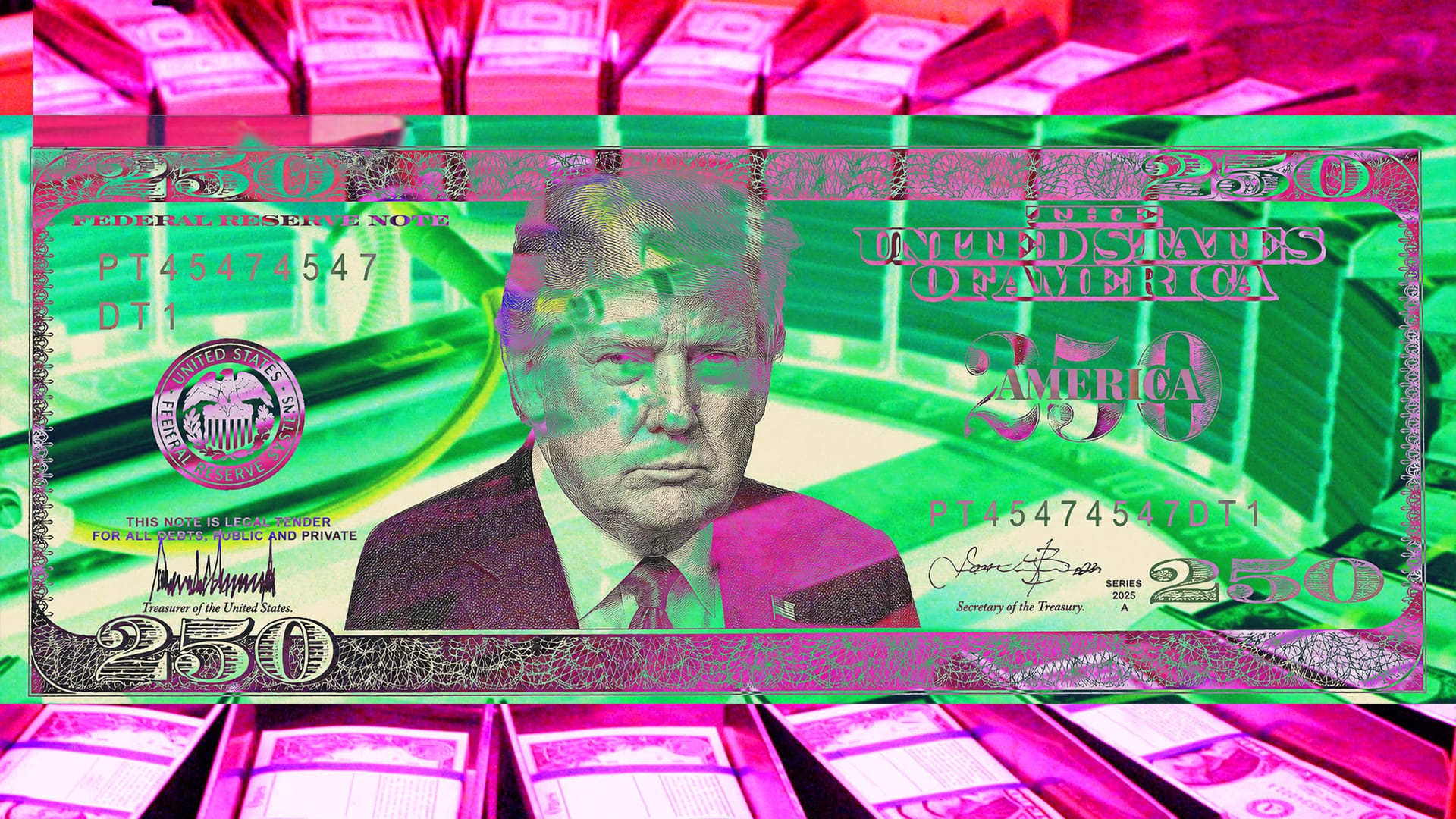
Talking of history, I had slightly been hoping that the U.S. dollars in circulation might hit the appropriately round number of $2.5 trillion to mark the round 250th anniversary of the Declaration of Independence, but it was not to be. If only the Fed had launched the $250 bill in time, perhaps it would have got there, but we’ll just have to wait.

Meanwhile, there’s an interesting time ahead for Tether, this newsletter’s favourite cryptocurrency, which is sailing into choppy waters. It has decided to pull its USDT out of the European Union rather than to comply with the Markets in Crypto Assets regulations on stablecoins, which is a boost for its great rival Circle (USDC), which is very much available in Europe. 

The two big stablecoins have markedly different strategies: Tether is dismissive of regulators, while Circle cosies up to them. And now here comes a new rival in Open USD, which is backed by many of the world’s largest banks and tech firms, and which also promises to abide by everyone’s regulations. Is Tether at risk of becoming irrelevant?

Congo’s conflict coltan

Huge credit to the good folks at Global Witness for this report from the Democratic Republic of the Congo, where coltan smuggling is helping to perpetuate the grim conflict in the east of the country. It is the kind of methodical, thorough research that really helps open your eyes to how grim things can be, and how complicit the rest of us are in a global supply chain forged from conflict. 

Congolese people hack coltan out of the ground under the eyes of M23 guerrillas, who then smuggle it into Rwanda, where it is repackaged as Rwandan and given certification intended to show it’s not from a war zone. It is then shipped to refiners in China or Kazakhstan to be processed into tantalum, which is in turn sold to leading companies to be incorporated in the phones, tablets, jet engines, and other products that we all rely on for our lovely modern lives.

“Rwandan official figures show that coltan exports have increased more than 2.5 times between 2021 and 2025,” the report notes. “Coltan is an important revenue stream for Rwanda, which levies a 5% tax on exports. Since 2023, it has become the country’s second-largest export earner, after gold.”

And where does the gold come from? Also from the Congo, which is why the U.S. Treasury sanctioned a Rwandan gold refiner last month, following action taken by the European Union against the same company last year, but it has done little to rein in M23.

A version of this story was published in this week’s Oligarchy newsletter. Sign up here.

The post Holding the U.S. to account, Tether exits EU & Congo’s conflict coltan appeared first on Coda Story.

  •  

How governments enable kleptocrats by doing nothing

I was listening to Ezra Klein interviewing a left-wing Democratic Party strategist the other day about what a post-Trump U.S. foreign policy might look like, and it was a pretty striking demonstration of Europe’s irrelevance right now that the only Western European country mentioned in the 90 minutes of the chat was the UK, and that was solely in the context of how it helps kleptocrats.

But aha, a notional Brit might have replied, at least we are about to convict Diezani Alison-Madueke, former head of OPEC, ex-Nigerian oil minister, for her alleged egregious corruption. That notional Brit would be feeling pretty foolish right now though, because this was yet another flop, with her being acquitted on all charges. 

Britain has a dire record both when it comes to enabling corruption and when it comes to successfully investigating it, as the failure of yet another high-profile prosecution shows. This latest fiasco should be the impetus the country needs to at last provide the resources and officers that its law enforcement agencies require.

Alison-Madueke saw the hand of divine providence in her acquittal. “It has been a hard journey,” she said, “but I tell you this, God will always do as he will. God will be God and God is not a man that he should lie; when he promises you something, he will see it through” — and who am I to say that she’s wrong? However, there are other potential explanations for what has happened beyond the Almighty manifesting at Southwark Crown Court to give instructions to the jury, including the entrenched incompetence of British police agencies.

It’s hard not to see a parallel with the failed attempt six years ago to investigate Dariga Nazarbayeva, daughter of the former president of Kazakhstan and possessor of a reasonable-to-large London property portfolio, which saw the National Crime Agency (NCA) being comprehensively outwitted by defence lawyers, just as it has been again.

“Today’s verdict is a major blow for the NCA who have come away empty-handed in one of their highest-profile corruption cases, which took over a decade to progress to trial,” said Zainab Saleem, Legal Fellow at Spotlight on Corruption. "It is vital that the UK government properly resources law enforcement agencies tasked with investigating complex bribery and corruption cases and does not take this defeat as grounds for rowing back on anti-corruption enforcement.”

It will be interesting to see what, if anything, results from the suggestions that the new Supreme Leader of Iran has been moving his wealth merrily around with the help of various Western banks, all of it now being investigated by the U.S. Department of Justice. “Funds for the transactions have been routed through financial institutions in the UK, Switzerland, Liechtenstein and the UAE,” reports Bloomberg.

What is the answer? Whatever it is, it will be even more embarrassing for the UK if it doesn’t come up with something plausible by the time it convenes its Illicit Finance Summit in December. (Unless it ends up being rescheduled again, like one of those meetings that no one actually wants to attend but also no one wants to be responsible for cancelling.)

Still, credit where it’s due, at least efforts to improve Companies House — the UK’s formerly-disastrous corporate registry — appear to be finally bearing fruit. It has sent almost a million enforcement letters to people who haven’t verified their identity, which must have been — at the very least — a useful money-spinner for the post office.

The idea of increasing funding to law enforcement agencies is something that Americans would do well to consider too, particularly when it comes to the Internal Revenue Service. “In 2022, under President Joe Biden, Congress approved an $80 billion increase in IRS funding over a decade, with more than half of it slated to restore the agency’s ability to go after the super-rich. This victory was short-lived. By March 2025, Republicans had slashed that $45.6 billion enforcement budget to just under $4 billion — “a 91% decrease,” it notes in this fascinating book excerpt.

I have been interested for a while in the idea of government’s being engaged in “legalisation by under-enforcement,” which is something we see with tax evasion, pollution of waterways, and almost anything else when the rules not being enforced benefit the kind of people who donate money to political parties. But I need a better name for the phenomenon, so please help me out and send one in.

Talking of phenomena that we need a new name for, Elon Musk’s wealth is doing weird things to the Forbes billionaires list. Whoever runs it appears to have decided to only display his net worth to two significant figures. That means that, while we can see an assessment of the wealth of relative paupers like Sergey Brin to the nearest $100 million ($277.6 billion, as I write), we only get a round $1.2 trillion for Musk. Or a round $1. 4 trillion, depending on what day it is, which means his wealth jumps up and down in a minimum increment that, on its own, would be sufficient to make its possessor the richest person in every country in the world except Spain, Canada, Mexico, the United States or France.

And talking of France, the G7 summit in Evian is over. It was of course at a previous French G7 summit when participants created what became the Financial Action Task Force. That was the 1980s and they were concerned about the spread of illegal drugs, the harm they were causing, and the fact that more countries were producing them, and wanted to stop drug dealers being able to keep their profits. Among other things they committed — in the words of the 1989 communiqué — “to prevent the utilization of the banking system and financial institutions,” which is part of the clause that gave birth to the entire global anti-money-laundering system. Well, 37 years have passed, so let’s check in on how that’s going. 

This year the G7 communiqué expressed concern about the spread of illegal drugs, about the harm they’re causing, and about the fact that more countries are producing them. “We emphasize the continued need to strengthen the global anti-money laundering architecture to prevent financial crime and improve enforcement and asset recovery outcomes, in line with the Financial Action Task Force standards,” this year’s summit document states. 

Plus ça change. Maybe in another 37 years, they’ll look up and wonder whether they should try something else, and indeed whether the FATF standards aren’t ripe for reconsideration.

A version of this story was published in this week’s Oligarchy newsletter. Sign up here.

The post How governments enable kleptocrats by doing nothing appeared first on Coda Story.

  •  

Trillionaires are a national security risk

I’ve been writing this newsletter since 2020, and in my first edition I marvelled at the concept of the centi-billionaire, and the fact there were at the time three people with 11 zeros in their net worth. What a six years it’s been. When I started writing this week’s edition, Elon Musk was a mere David Sun away from becoming the world’s first trillionaire, and now as I’m finishing it, Musk is worth the scarcely conceivable sum of $1.1 trillion. Nothing like this has ever happened before and there is no sign it is going to stop happening. There is no reason at all to suppose that in another half-decade I won’t be writing about how deci-trillionaires are the new thing.

This increasingly extreme inequality is a challenge for social cohesion, democracy and civilisation that we haven’t seen in modern times, second only to climate change as a threat to our future. Although in some ways, they’re the same challenge, considering the disproportionate share of emissions coming from rich people.

In some ways, if Musk’s wealth seemed to be making him happy it wouldn’t be so bad, but it appears only to make him angrier. I like to think that if I had a trillion dollars, I’d do something more constructive than stir up protests against ethnic minorities.

Reducing inequality is the right thing to do for every reason, not least because it would deprive very rich people of the ability to stoke pogroms anywhere they like. But how to do that? The only thing that has previously reduced inequality to any significant extent has been the 20th century’s series of global conflicts with massive destruction of life and property, and that’s the kind of thing it would be good to avoid.

I think there is a strong argument to be made, however, that the financial trickery abused by the very rich is also bad for national security, and it’s one nicely made here by Matthew McGlynn, who specialises in researching Russia. By degrading the ability of oligarchs to cheat their way to riches, we’d also limit the space of billionaires to dodge taxes and accountability.

It is notable that expert after expert speaking to the House of Representatives Committee on Financial Services about Chinese Money Laundering Networks pleaded for the Corporate Transparency Act to be properly implemented. “When a laundering network operates by scattering its footprint across hundreds of student accounts, dozens of shell companies, and multiple jurisdictions, traditional compliance frameworks may treat flags as isolated, minor incidents. The systemic risk is consistently underestimated, and responses remain heavily reactive,” noted Louis DeTitto.

If first we come for the money launderers, then the billionaires won’t speak out because they’re not money launderers. Also, it would mean we’d do a better job of tackling money laundering, which would be nice. 

While on the subject of congressional hearings, there are interesting moves by Senator Richard Blumenthal to probe how Iranian and Russian sanction-dodgers are using cryptocurrencies. In April, he wrote to Binance requesting further information, and now he’s written to Tether asking for information about misuse of its USDT stablecoin.

The details he’s requesting are far-reaching and potentially highly consequential, since they relate to connections with Iran and Russia, including A7, issuer of the leading ruble-denominated cryptocurrency. Perhaps most important, however, is his first question: “What legal jurisdictions does Tether believe it is subject to for USDT, in particular for anti-money laundering rules, reporting obligations, asset seizures, and sanctions compliance? Does Tether believe it is legally required to comply with Department of Treasury sanctions for USDT and issue suspicious activity reports (SARs) to the U.S. government?”

If the U.S. asserts regulatory authority over dollar-denominated cryptocurrencies as it has over all transactions in dollars then that would significantly undermine their attractiveness to illicit actors, and also do a lot to reassure people like me. Tether, meanwhile, has been bigging up its cooperation with law enforcement agencies, and says it’s frozen $450 million globally.

“For the past few years, stablecoins have come to dominate the landscape of illicit transactions, and now account for 84 percent of all illicit transaction volume,” concluded Chainalysis in 2026’s crypto crime report. It estimated total illicit transactions at $154 billion last year, so the stablecoin share of that was almost $130 billion. That is a fraction of the amount of money laundering estimated to move through either the trade system or indeed the formal financial network, but still a lot of money. It’s interesting to see, however, how Chainalysis still holds out hope for well-regulated cryptocurrencies helping to solve problems caused by standard finance.

“Stablecoins and on-chain settlement mechanisms in particular offer low-cost, borderless avenues for remittances, payments, and savings,” Chainalysis said. “If coupled with sound regulation and inclusive policy frameworks, these tools could help governments leverage crypto not just for resilience, but also for broader financial inclusion as part of economic recovery.”

Seeing will be believing.

A version of this story was published in this week’s Oligarchy newsletter. Sign up here.

The post Trillionaires are a national security risk appeared first on Coda Story.

  •  

Why Europe must disable Russia’s crypto ecosystem

Someone recently asked me what mark out of 10 I’d give for the efforts of governments to tackle financial crime. It got me thinking about that one bright spot of recent times — the West’s response to Russia’s full-scale invasion of Ukraine four years ago — and how it is now looking. Back in 2022, a lot of us were pleasantly surprised by the speed and ambition with which Western governments sanctioned the Russian government, state-owned companies and wealthy individuals. While Western pressure did not prevent the war, the asset freezes did impose a real cost on those conducting it. Four years on, however, those sanctions are beginning to look a bit shopsoiled. If they began at 7/10, they’re now scoring a lot lower.

There are reasons for this: Donald Trump does not appear particularly interested in Ukraine; the now former Hungarian prime minister Viktor Orbán has been snarling things up; and so on, as laid out in this analysis from Tom Keatinge. To make things worse, Trump’s latest adventure in Iran has pushed the oil prices sharply higher, earning more money for Russia while also giving Trump cover to lift sanctions, a temporary measure he has recently extended.

Keatinge argues that European countries need to be far more focussed on going after Russia’s payment mechanisms, particularly digital. “The extent to which crypto activity supports Russia’s war effort is clear,” he writes, “yet repeated initiatives to elevate the importance of opening a concerted line of effort on this issue are ignored. This must change.”

I agree, though it won’t be easy, considering the diffuse crypto ecosystem, and the increasing sophistication of Russian involvement in it. As long as Telegram is willing to host markets, the markets will continue to function to some extent whatever Western countries do (see the story of Xinbi, a Chinese-language hub for illicit crypto.) However, it does look like someone somewhere has lost patience with the ease with which Russia is funding itself.

“The sanctioned Russia-linked cryptoasset exchange Grinex announced an immediate suspension of its operations, citing a ‘large-scale cyberattack,’” reports Elliptic. According to the statement, which Kyrgyzstan-registered Grinex posted on Telegram, it lost around $13 million worth of USDT in the hack, blaming the theft on Western intelligence agencies.

“Today the attempts to destabilise our fatherland’s financial sector hit a new level, with the direct theft of the assets of Russian citizens and companies with the involvement of complex cyberattacks,” the statement said. Grinex is the successor to Garantex, which was shut down just over a year ago after years of effort by Western law enforcement. I would be surprised if Western countries had decided to take direct action against Grinex, as the exchange claims they did. Westerners tend to be a bit too legalistic for this kind of smash-and-grab, and I would expect any operation to more closely resemble what worked a year ago, conducted with Tether’s cooperation.

Instead, I suspect this attack is the work of hacktivists, perhaps working for or with the Ukrainians. Whatever the answer, it is embarrassing for the Russians, shows their crypto-security is not impregnable, and has made a noticeable dent in trading volumes of the A7A5 ruble-denominated stablecoin, which has become a key sanctions evasion tool. Three birds with one stone.

The important point is that sanctions were never supposed to be permanent: they are a foreign policy tool, not a law enforcement one. Hundreds of billions of Russian-owned dollars are languishing in various frozen bank accounts, and Western countries need to start thinking about what to do with them. They can confiscate them, investigate them or — if they’re feeling brave — use their potential return as leverage to persuade wealthy Russians to break with the Kremlin. What they shouldn’t do is leave them as they are to gather dust.

Hopefully, now that Orbán is out of the way, European countries will be able to take firmer collective action but they also need to be imaginative, and to start behaving as if they actually want Ukraine to win, rather than just not lose.

A defeat for transparency 

Of course, the United States will have a lot to say about that too, and what it ends up saying about how to tackle the Russian crypto operations will depend on what happens in the midterm elections this year. So, it strikes me as a big deal that crypto firms are once more pouring tens of millions of dollars into campaign vehicles in their quest for, what they euphemistically refer to as, “regulatory clarity.” Among them, of course, is Tether.

If you’re wondering quite how it’s possible to spend that much money on elections, I draw your attention once more to the great Integrity Index, with its records for who’s been spending what. It boggles my mind that, for example, the three Democratic rivals to the Republicans’ Susan Collins for the Maine Senate seat have raised more than $17 million just for the primary. Collins herself has raised over $10.5 million. There really shouldn’t be that much money in politics.

Besides, when it comes to value for money, investing in court cases beats investing in politics every day of the week. I don’t know how much the (ironically) anonymous plaintiffs in the 2022 case against corporate transparency in Luxembourg paid their lawyers, but its effects just seem to keep compounding to the benefit of those who want to hide their wealth from society. 

The European Union’s retreat from revealing the ownership of shell companies has given cover for Britain’s tax havens as they resisted efforts from London to force them to open up their own corporate registries. It looks like those efforts may have finally failed. “We are committed to full transparency, but I don’t think there will be any turning back,” said the British Virgin Islands’ Junior Minister for Financial Services Lorna Smith in comments confirming that the islands are in fact very much not committed to full transparency.

A version of this story was published in this week’s Oligarchy newsletter. Sign up here.

The post Why Europe must disable Russia’s crypto ecosystem appeared first on Coda Story.

  •  

How much longer will Orbán be Putin and Trump’s man in Brussels?

Viktor Orbán, Hungary’s prime minister since 2010, faces an election dogfight. Behind in the polls, he has been effectively endorsed by both the Kremlin and the White House, and a host of conservative world leaders. As wars in Iran and Ukraine exacerbate the fissures that have weakened NATO, as well as the U.S.’s relationship with the European Union, this is an election that is being followed with bated breath in Washington, Moscow, Kyiv and Brussels. 

Before the elections on April 12, a scandal engulfed the Hungarian government. On leaked recordings, foreign minister Péter Szijjártó can be heard deferentially acquiescing to his Russian counterpart Sergey Lavrov and passing on information from EU meetings. Szijjártó appeared willing to help the Kremlin’s cause in Brussels, to remove oligarchs and their relatives from the EU blacklist, and to block efforts to aid Ukraine. Hungary’s advocacy for the Kremlin’s agenda culminated in its recent veto of fresh sanctions on Russia and over $100 billion in loans to Ukraine. On X, Polish prime minister Donald Tusk wrote that while “Hungary is and will be in the European Union, Victor Orbán and his foreign minister left Europe long ago.” And the Irish taoiseach Micheál Martin described Szijjárto’s calls with Lavrov as both “sinister” and “alarming.”

Szijjárto alleged that “foreign intelligence services, with the active involvement of Hungarian journalists, have been intercepting my phone calls.” It is a plot, the Hungarian government claims, to influence the upcoming polls. Orbán directly blames Ukraine for seeking to unseat his government. The opposition, led by Peter Magyar, has a healthy lead in the polls and describes the Hungarian government’s closeness to the Kremlin as “treason.” According to European intelligence reports, Moscow sent a three-person team to Hungary, overseen by Putin confidant Sergei Kiriyenko who ran an operation to interfere in the Moldovan election back in September. His tactics encompassed “vote-buying networks, troll farms, and on-the-ground influence campaigns.” A Kremlin-linked media consultancy, facing EU sanctions, was hired to dismiss Magyar as a Brussels stooge and portray Orbán as the only candidate strong enough to to be treated as an equal by world leaders, as evidenced by the strength of his relationship with Trump. 

Despite a war with Iran that doesn’t appear to be going entirely to plan, the U.S. president took time out to back Orbán with enthusiasm and at considerable length on Truth Social. Trump said Orbán was “a true friend, fighter, and WINNER.” JD Vance, the vice president, is scheduled to visit Hungary on April 7, just five days before the election. And secretary of state Marco Rubio went to Hungary in February. It is now part of the U.S. National Security Strategy to work towards “cultivating resistance to Europe’s current trajectory within European nations.” To that end, notes the U.S. government, “the growing influence of patriotic European parties indeed gives cause for great optimism.” Orbán speaks MAGA’s language on immigration, traditional values and the Christian essence of Western societies. He is, like Putin and Trump, in MAGA’s view, an implacable opponent of secular, progressive, globalist politics as symbolised by Brussels.

Orbán, the longest serving current head of government in the EU, has become a figurehead for populist, nationalist movements across the world. The recent CPAC Hungary summit was attended by several of these leaders including France’s Marine Le Pen, Italian deputy prime minister Matteo Salvini, and the Netherlands’ Geert Wilders,who called Orbán “a lion on a continent led by sheep.” Latin American leaders close to Trump , including Javier Milei of Argentina and Jose Antonio Kast of Chile, also attended. Milei, who gave the longest speech at the summit, said Orbán was “a beacon for all… who refuse to accept that the West's destiny is one of managed decline.” This international network, with the United States and Russia included, has a vested ideological interest in seeing Orban continue to remain a thorn in the EU's side. 

But what can Brussels do? The answer, it appears, is not much. The EU is consensus driven; it needs all its parts to act in concert, giving holdouts like Orbán considerable power to hold the whole bloc hostage. But given Orbán’s prominence as an ideologue, when Hungary blocks sanctions or delays support for Ukraine, it is more than a single nation going rogue. Alice Weidler, co-chair of the far-right AfD, the largest opposition party in the German Bundestag, was among those who spoke at the CPAC Hungary conference last month. Robert Fico, prime minister of Slovakia, is an Orbán ally. On April 19, Bulgaria will have its eighth general election in just five years. Former president Rumen Radev’s new Progressive Party leads the polls and shares Orbán’s pro-Kremlin, anti-EU inclinations.

So polarized is the Hungarian election, that right wing groups are deploying their own observers from Argentina, Austria, the Czech Republic, Kenya, Poland, Germany, Italy, Spain, Serbia, Tanzania and the United States to monitor proceedings. EU observers have said the Hungarian government controls the national media and a recent documentary alleges that a desperate government is resorting to vote-buying, gerrymandering and intimidation tactics. It’s hard to see how either Orbán or Magyar will accept the election result without protest, unless the margin is crushing. But, given Trump’s disdain for NATO allies and the EU, an Orbán election defeat would be a much-needed victory for European unity. 

A version of this story was published in this week’s Coda Currents newsletter. Sign up here.

The post How much longer will Orbán be Putin and Trump’s man in Brussels? appeared first on Coda Story.

  •  
❌