
❌

Reading view

U.S. F-35B Crashes at Former Top Gun Base in San Diego; Pilot Safe, $109M STOVL Stealth Fighter Gutted

A US Marine Corps (USMC) F-35B fighter jet crashed and erupted into flames near Marine Corps Air Station Miramar in San Diego on Friday morning, officials said. The pilot ejected safely before impact and suffered minor injuries.

USMC said: Emergency personnel responded this morning to an aircraft mishap on the flightline of Marine Corps Air Station Miramar at approximately 10:00 a.m. local time today, involving an F-35B assigned to Marine Aircraft Group 11, 3d Marine Aircraft Wing. The pilot ejected, was transported to a local medical facility in stable condition for evaluation and treatment of non-life-threatening injuries.

The single-seat F-35 went down at approximately 10:00 am local time in the vicinity of the base’s flight line, south of Miramar Road near Mitscher Way, the Marine Corps said in a statement.

“There was an aviation mishap involving a Marine Corps F-35B in the vicinity” of the air station, base officials confirmed, classifying the incident as a Class A mishap — the military’s most severe category, typically involving the destruction of an aircraft, damage exceeding $2.5 million or the permanent disability or death of personnel.

No cause for the crash has been released, and officials have not identified the pilot.

MCAS Miramar, located about 14 miles north of downtown San Diego, is a major hub for Marine aviation and was once home to the US Navy’s elite “Top Gun” fighter weapons school, made famous by the 1986 film starring Tom Cruise.

The F-35B is the short take-off and vertical landing (STOVL) variant of F-35 Lightning II, a fifth-generation stealth fighter designed for the US Marine Corps. It is also operated by the UK and Italy.

Unlike the conventional F-35A variant used by the Air Force or the carrier-based F-35C, the B model is equipped with a shaft-driven lift fan behind the cockpit and a swiveling rear exhaust nozzle that can redirect thrust downward.

This propulsion system, powered by a Pratt & Whitney F135 engine producing more than 40,000 pounds of thrust, allows the aircraft to operate from short runways, amphibious assault ships or austere forward bases without needing full-fledged airstrips.

The F-35B has an approximate flyaway cost of $109 million, making it the most expensive of the three F-35 variants.

The crash is among several F-35 accidents in recent years involving various variants, though officials highlighted the aircraft’s safety systems as pilots managed to eject each and every time.
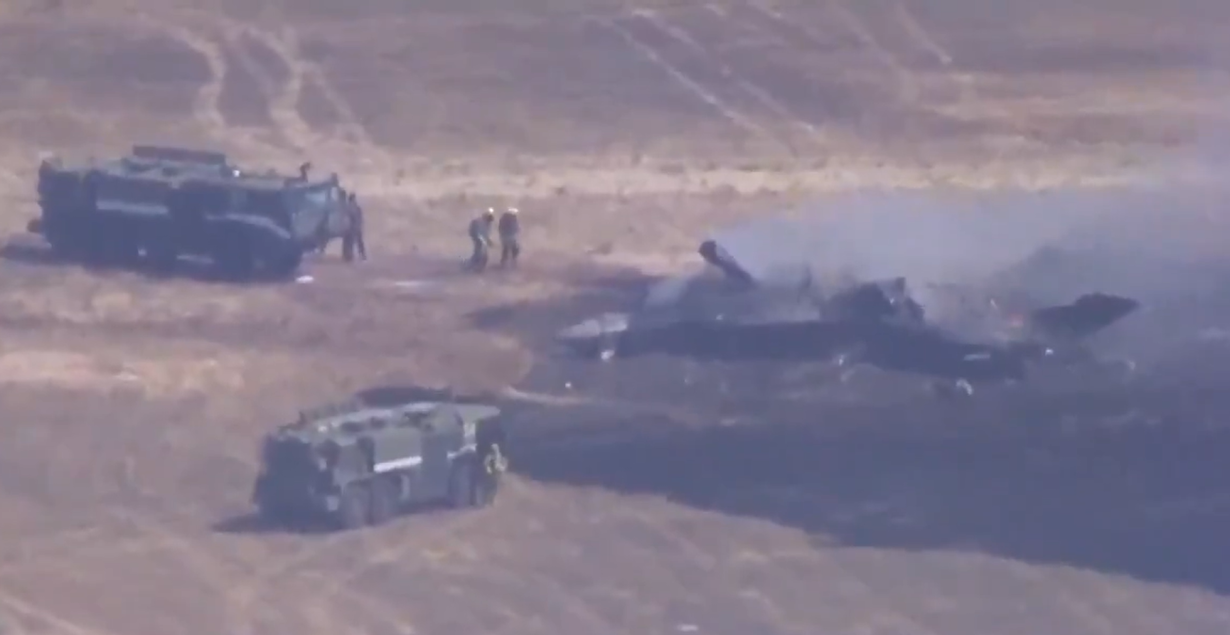
File Image: F-35 Crash

Earlier F-35B Crashes

On September 28, 2018, in South Carolina, the first crash of any F-35 variant was recorded. An F-35B from Marine Fighter Attack Training Squadron 501 crashed during a training flight. The pilot ejected safely. Investigators determined a manufacturing defect caused an engine fuel tube to fail.

The entire F-35 fleet was temporarily grounded for inspections.

Two years later, on September 29, 2020, an F-35B from Marine Fighter Attack Squadron 121 collided mid-air with a Marine Corps KC-130J tanker during aerial refueling near Naval Air Facility El Centro.

The pilot ejected, but the aircraft was destroyed. The KC-130 made an emergency landing, and all its crew members survived.

A year later, on November 17, 2021, a British F-35B crashed into the Mediterranean Sea shortly after takeoff from Queen Elizabeth aircraft carrier. The pilot ejected safely and was later recovered. An inquiry later found that an engine intake blank had been left in place, causing the loss of thrust.

On December 15, 2022, at NAS Joint Reserve Base Fort Worth, Texas, an undelivered F-35B undergoing production flight testing crashed during a failed vertical landing attempt. The test pilot ejected while the aircraft was still on the ground and was not seriously injured. The jet was written off.

Next year, on September 17, 2023, an F-35B from Marine Fighter Attack Training Squadron 501 experienced an electrical malfunction during a training flight in heavy rain and instrument meteorological conditions. The pilot ejected near North Charleston.

The unmanned aircraft continued flying for approximately 11 minutes and 21 seconds under its automatic flight-control systems before crashing in a rural area.

The aircraft’s debris was not discovered for more than a day. A Marine Corps investigation later attributed the mishap to pilot error, while noting the electrical failures and display malfunctions as contributing factors.

On May 28, 2024, an F-35B, a developmental test aircraft being flown by an Air Force pilot, crashed shortly after takeoff following a refueling stop en route from Fort Worth, Texas, to Edwards Air Force Base, California. The pilot ejected at low altitude, sustained serious injuries, but survived. The aircraft was completely destroyed.

Despite all these crashes, the pilots managed to eject and survive, though some sustained injuries.

By ET Desk

The post U.S. F-35B Crashes at Former Top Gun Base in San Diego; Pilot Safe, $109M STOVL Stealth Fighter Gutted appeared first on EURASIAN TIMES.
  •  

Ukrainian Drones Turn Crimea’s Resorts Into Ghost Towns — 70% Drop in Bookings, Beaches Go Empty

In a resort town on the southern coast of the Russian-annexed Crimean peninsula, ice cream vendor Anatoli was at his wits’ end.

His shop would typically sell up to 400 ice creams a day. But a series of Ukrainian strikes on the peninsula this summer has seen the visitors dry up.

“The season is completely ruined, it’s practically non-existent,” he told AFP from Simeiz, a beachside community of around 2,500 people.

Once a magnet for millions of Russian holidaymakers each year, Crimea’s tourism industry has collapsed in recent months, as Ukrainian drone attacks have starved the peninsula of electricity and fuel.

Hotel bookings have fallen more than 70 percent compared to last July, while restaurants and swimming pools lie empty.

The Russian government has pledged to support the sector, offering a one-time payment to tourism workers equivalent to three months’ salary, but the amount is based on the minimum wage and is not a long-term fix.

Anatoli said he was now trying to make ends meet on just a fraction of his former business.

“We’re still carrying on, because everything had been prepared in advance: the equipment, the repairs, the license, the taxes,” he said.

With its abundance of cicadas, plentiful sunshine a year and verdant olive groves, Crimea’s southern coast is in many ways more reminiscent of the Mediterranean than much of Russia, which seized the Black Sea peninsula from Ukraine in 2014.

Generations of Russians spent their holidays on the peninsula during the Soviet era, many of whom regard Crimea as an integral part of their country.

One luxury hotel in Simeiz –- whose managers did not wish to be named –- said it was offering 30 percent discounts to bring the tourists back.

“At the weekend it gets busier, but otherwise…” one hotel manager said, trailing off.

AFP saw walkways, sun loungers and a restaurant terrace at the hotel deserted.

Ukrainian attacks have killed more than a dozen people on the peninsula since the beginning of June, including a child, according to Russian-installed authorities.

Drone strikes on Crimea’s electrical substations have meanwhile triggered power outages, including in the largest city of Sevastopol, while Russian-installed authorities suspended fuel sales last month amid strikes on oil depots.

– ‘No-one’s safe’ –

Some tourists were undeterred, despite the danger.

Yulia said she was visiting Simeiz from Belgorod — a Russian region that borders Ukraine and has itself been the target of Ukrainian strikes

The night before, a Ukrainian drone crashed into a block of flats a few kilometres away from Simeiz, wounding 17 people, according to officials.

“I heard a drone twice and that was it,” she said.

“The reason we’ve come is that we’re not afraid. Everyone I know is writing to me, asking me how we weren’t afraid to come here.”

She came with her family on a train that crosses the Kerch Bridge — the only practical route into Crimea from Russia, as the road via Russian-occupied Ukraine has become too dangerous due to Ukrainian drone strikes.

Fellow tourist Vladislav, who arrived by road from the Russian region of Krasnodar, said he had brought jerry cans filled with petrol in case he was unable to find fuel.

Like Yulia, he said he was not worried, having become accustomed to the regular buzz of drones.

Ukraine often fires hundreds of drones into Russia each night, in retaliation for Russia launching hundreds of drones at Ukrainian towns and cities.

“Look, they fly over us too,” said Vladislav.

“They fly overhead, whether we’re waking up in the morning — at 7 am even — or when we’re going to bed, they’re always flying about. So no one’s safe.”

Business is Suffering

Ukraine says the strikes are aimed at pressuring Moscow into peace talks.

Moscow began its full-scale offensive against Ukraine in February 2022, and has regularly struck its neighbor, including from the Crimean peninsula.

The Russian government has pledged more than 4.3 billion rubles ($54 million) in one-time payments to employees in the sector, including travel agents, tour operators and restaurateurs.

But the payments only apply to tourism.

Lilia, a holidaymaker from an area north of Sevastopol, said the private sector was “struggling”.

“I know people who run a driving school. It’s completely at a standstill because of the high price of petrol,” she told AFP, sitting on a beach in Simeiz.

“Business is suffering, of course it is.”

By Agence France-Presse


The post Ukrainian Drones Turn Crimea’s Resorts Into Ghost Towns — 70% Drop in Bookings, Beaches Go Empty appeared first on EURASIAN TIMES.

  •  

Hashed al-Shaabi: Who Are the Iraqi Militia Group Hit by US-Saudi Strikes?

The US and Saudi Arabia have carried out coordinated attacks on positions held by the Hashed al-Shaabi, an Iraqi paramilitary network that incorporates powerful pro-Iran armed groups.

These factions, which form part of the broader Tehran-backed “axis of resistance,” have for years posed a persistent threat to American forces and interests in Iraq and the wider Middle East.

Meanwhile, a powerful alliance of pro-Iran armed groups warned on Wednesday that a response to the deadly US-Saudi strikes in Iraq was “inevitable”.

The Islamic Resistance in Iraq, which has targeted US facilities hundreds of times during the Middle East war, said: “our response to the American enemy is inevitable, and may target its tools in Saudi Arabia”.

Hashed al-Shaabi

The Hashed al-Shaabi, also known as the Popular Mobilization Forces (PMF), is a network of Shia-majority factions that was established in 2014 to fight the Islamic State group.

It was formed following a fatwa from Ayatollah Ali al-Sistani, the highest Shia Islamic religious authority in Iraq, at a time when IS was conquering swathes of the country.

Pro-Iran armed groups heeded the call and were also joined in the fight by Iraqi volunteers from across the country.

The Hashed forces were mostly trained by Iranians and led by Tehran-backed armed groups, which fought American forces after the US-led invasion that toppled former ruler Saddam Hussein in 2003.

Their efforts were overseen by General Qasem Soleimani, the former head of the Quds Force, the foreign operations arm of Iran’s Islamic Revolutionary Guard Corps.

Soleimani was killed in an American strike in Baghdad in 2020.

In 2016, a law integrated the Hashed into the regular security forces, and a year later the alliance contributed to IS’s defeat by the Iraqi army, which was supported by the US-led anti-jihadist coalition.

The US has held major sway in Iraq since its 2003 invasion. But Iran has also built its influence and seen its Shia allies installed in Baghdad’s halls of power.

Iraq has long been a proxy battleground for the US and Iran.

Today the Hashed encompasses dozens of groups, including brigades belonging to powerful pro-Iran armed factions, which are blacklisted as terrorist organizations by the US.

This US Navy handout photograph released on July 28, 2026, by US Central Command Public Affairs shows an F/A-18E Super Hornet launching from the flight deck of Nimitz-class aircraft carrier USS George H.W. Bush, on July 21, 2026. The US military said on July 28 it had intercepted multiple missiles launched by Iran, ending a days-long respite in attacks between the foes. Both sides had held fire over the weekend, following nearly two weeks of nightly strikes by the United States on Iran, and repeated missile and drone salvos by Tehran targeting Washington’s allies around the Gulf. (Photo by various sources / AFP) 

Some factions face accusations of collecting government salaries for their fighters while acting independently of the state.

Over the years, they have seen their clout grow, with some gaining seats in parliament, even as several group leaders, including the Hashed’s top commander, have been subjected to US sanctions.

Several pro-Iran groups are also part of the Islamic Resistance in Iraq alliance, which has claimed hundreds of attacks against US facilities in Iraq and the region during the Middle East war.

They pledge their allegiance first and foremost to the Tehran-led “axis of resistance”, which includes Lebanon’s Hezbollah, Hamas in Gaza and Yemen’s Houthis.

The most active among them are Kataeb Hezbollah, which has long spearheaded attacks on US interests in Iraq, and over the years has lost key commanders in American strikes.

They also include Kataeb Sayyid al-Shuhada and the al-Nujaba movement.

In some cases, these groups are present on Hashed al-Shaabi bases. But they also have their own bases, arm depots and workshops, mostly for making drones. The groups mainly rely on explosive-laden drones but also possess rockets and are believed to have short-range ballistic missiles.

By Agence France-Presse

The post Hashed al-Shaabi: Who Are the Iraqi Militia Group Hit by US-Saudi Strikes? appeared first on EURASIAN TIMES.

  •  

Iran War Latest News: US-Saudi Strikes in Iraq Kill 20, Including Iranians

US-Saudi strikes on Iraq killed at least 20 militants, including several Iranians, on Wednesday, according to the Hashed al-Shaabi, an armed Iraqi alliance that includes pro-Iran groups.

The United States and Saudi Arabia said they had struck Iran-backed armed militants in Iraq in response to attacks on US forces and Saudi oil facilities.

Washington and Tehran are Iraq’s main allies, but their enmity has long turned the country into a proxy battleground and left successive governments struggling to maintain a delicate balance between the foes.

The Hashed al-Shaabi, also known as the Popular Mobilization Forces (PMF), said that at least 20 fighters “were martyred and another 32 wounded according to a preliminary toll”.

Two Hashed officials told AFP that five Iranian advisors were among those killed in a strike in the central province of Diyala.

AFP correspondents saw coffins wrapped in Iranian flags during a funeral organised by the Hashed al-Shaabi in Baghdad for those killed.

The Hashed alliance was created in 2014 to fight jihadists before it was formally integrated into the Iraqi armed forces.

It now includes brigades belonging to Iran-backed groups reputed for acting unilaterally.

US President Donald Trump said the strikes were coordinated with the Iraqi government, according to Fox News.

They follow growing US pressure on Baghdad to disarm pro-Iran armed groups, which have frequently targeted US facilities in the country and have long called for the withdrawal of US troops.

Iraq’s new Prime Minister Ali al-Zaidi, who came to power this year with Washington’s blessing, vowed to ensure those groups would hand over their weapons, but has faced pushback from some powerful factions.

Earlier this month, Zaidi visited both the United States and Iran.

Inevitable Response

The strikes came after Riyadh said its forces had intercepted drones targeting oil facilities, blaming the Iran-backed groups in Iraq.

The most active pro-Iran armed groups are united under an alliance known as the Islamic Resistance in Iraq, which has acted in support of Tehran during the Middle East war, claiming hundreds of attacks against US bases in Iraq and across the region.

The Islamic Resistance in Iraq said, “our response to the American enemy is inevitable, and may target its tools in Saudi Arabia”.

But the group added that it would only retaliate after the Arbaeen day of pilgrimage, which falls on Tuesday.

The Arbaeen marks one of the most significant events in the Shia Muslim calendar, during which pilgrims, many from Iran, flock to Iraq to visit the holy shrines.

The pro-Iran groups denied attacking Saudi Arabia, and they haven’t claimed any attacks since the US-Iran war resumed earlier this month.

Violation

Iraq denounced the US-Saudi strikes and said it rejects “all acts of aggression, regardless of the party responsible or the justifications presented.”

The Ministerial Council for National Security said it would “confront any violation of Iraq’s sovereignty, and prevent any source from using Iraqi territory to threaten neighboring states”.

It reaffirmed its commitment to ensure the state’s monopoly over weapons.

Zaidi’s government has given those groups that Washington designates as terrorist organizations until September 30 to disarm.

Oil-rich Iraq has been trying to move past decades of war and unrest, but it remains vulnerable to regional and internal flare-ups.

Houthis attack Saudi tanker in Red Sea

Meanwhile, Houthi rebels said they targeted a Saudi oil tanker in the Red Sea with ballistic missiles for violating a blockade on the kingdom’s ports. Saudi Arabia had yet to comment on the Houthis’ claim, but reported having intercepted drones targeting oil facilities in its east, blaming pro-Iran militias in Iraq.

“The targeting of the Saudi vessel came after it ignored warnings,” a Houthi military spokesman said, identifying the ship as the NCC Ghazal and adding it had been “forced to turn back”.

The website MarineTraffic, owned by maritime tracking firm Kpler, listed the Ghazal as a Saudi-flagged tanker whose last known location was the port of Yanbu, the terminus of an important oil pipeline on the kingdom’s Red Sea coast.

Last week, the Iran-backed Houthis declared a maritime blockade of Saudi Arabia and have since claimed attacks targeting Saudi tankers and oil infrastructure.

The blockade has threatened Saudi Arabia’s ability to get its supplies to the world following Iran’s parallel blockade of the Strait of Hormuz after hostilities resumed in the Middle East war, cutting off the kingdom’s only other maritime route.

Riyadh last week struck Houthi targets in Yemen in response to the threats to Red Sea shipping.

A spokesman for the Saudi defense ministry said late Tuesday that “aerial defenses intercepted and destroyed several drones that attempted to target oil installations” in the country’s east.

The spokesman, Turki al-Maliki, added that “these new terrorist attacks were launched from Iraqi territory and carried out by militias linked to Iran”.

It was the second day in a row Riyadh had blamed Iran-backed groups in Iraq for launching attacks.

By Agence France-Presse

The post Iran War Latest News: US-Saudi Strikes in Iraq Kill 20, Including Iranians appeared first on EURASIAN TIMES.

  •  
❌