❌

Reading view

America’s $40 Billion Blind Spot: Why World’s Largest Arms Exporter Hasn’t Sold a Single Submarine in 50 Years?

The US has been the world’s largest defense exporter for more than three decades now.

According to SIPRI (Stockholm International Peace Research Institute), the United States accounted for 42% of global arms exports between 2021 and 2025.

For perspective, during this period, France was the world’s second-largest defense exporter, accounting for only 9.8% of global arms exports.

However, despite its dominant position in global arms exports, the United States has notably been absent from a particular high-value weapon system market that could have generated billions of dollars in additional revenue for its defense firms.

Ironically, Washington has stayed out of this business despite leading the world in this niche technology for over five decades.

On July 6, Canada reportedly selected the winner of the Canadian Patrol Submarine Project (CPSP) deal, expected to cost nearly US$ 30 billion, with Germany’s TKMS outdoing South Korea’s Hanwha.

Similarly, India is in the final stages of signing a major submarine deal with ThyssenKrupp Marine Systems (TKMS) under Project 75(I).

Both Canada and India are strategic partners of the US. One might wonder why the US defense companies were not even in the running for these “big ticket” deals.

This, despite the fact that the US is not only the world’s largest submarine operator, but its submarines are also some of the most advanced in the world. According to the Global Firepower Index 2026, both Russia and the US operate 66 submarines.

However, while Russia operates a mix of diesel-electric and nuclear submarines, all of the US’s submarines are nuclear-powered.

China is fast catching up with 61 submarines; however, China also operates a mix of diesel-electric and nuclear submarines.

However, Russia (and formerly the Soviet Union) has exported submarines to Algeria, Bulgaria, China, Cuba, Egypt, India, Indonesia, Iran, North Korea, Poland, Romania, Syria, Venezuela, Vietnam and others, and China has exported to Pakistan, Myanmar, Bangladesh and Thailand.

Interestingly, the US, despite its technological lead in the field, has not exported a single submarine to any country in the last 50 years. In fact, the last submarine the US exported was in 1973 to Taiwan.

So, why, despite its dominant position in global arms export and its technological lead in the field, has the US not exported a single submarine to any country in over 50 years?

Trump Calls It “Invasion,” Musk Says Budget “Destroyed”: Moroccan Surge in Spain Rattles U.S. & Europe and Reignites “Islamic Fear”

US Submarine Exports in History

The US was not always averse to exporting submarines. After the Second World War, the US emerged as one of the world’s largest submarine exporters.

During the war, the US constructed over 200 submarines, and by the time the war ended, the US had 232 submarines in commission.

However, within years of the end of the Second World War, a new Cold War began with the Soviet Union, and the US launched a massive modernization campaign for its submarines.

Under the modernization plan, the US decommissioned hundreds of its late-war-era Balao- and Tench-class diesel-electric submarines.

This left the US with dozens of decommissioned submarines.

At the same time, the US was financing a massive reconstruction plan in Europe under the Marshall Plan and building Europe’s military capabilities to create an effective deterrent against the Soviet Union.

For this purpose, the US decided to export these older, decommissioned, diesel-electric submarines to its allies. Between 1950 and 1970, the US exported nearly 50 submarines to its partners, including Turkey, Spain, Italy, Greece, the Netherlands, Canada, Taiwan, and others.

In fact, between 1945 and 1975, the United States accounted for roughly 25% of global exports of diesel-powered submarines.

Most of these were Balao-class diesel-electric submarines built during World War II.

Meanwhile, in 1954, the US launched USS Nautilus (SSN-571), the world’s first nuclear-powered submarine, heralding the era of nuclear-powered submarines.

Nuclear-powered submarines have key advantages, such as unlimited endurance, as they can stay submerged for months, maintain high underwater speeds consistently, and have global reach.

After the launch of USS Nautilus, Washington gradually phased out diesel-electric submarines. After 1954, the US built only three Barbel-class diesel-electric submarines.

By the early 1960s, all new US Navy combat submarines were nuclear-powered. The last diesel-electric attack submarine (USS Blueback) was decommissioned in 1990, leaving Washington with only nuclear-powered submarines.
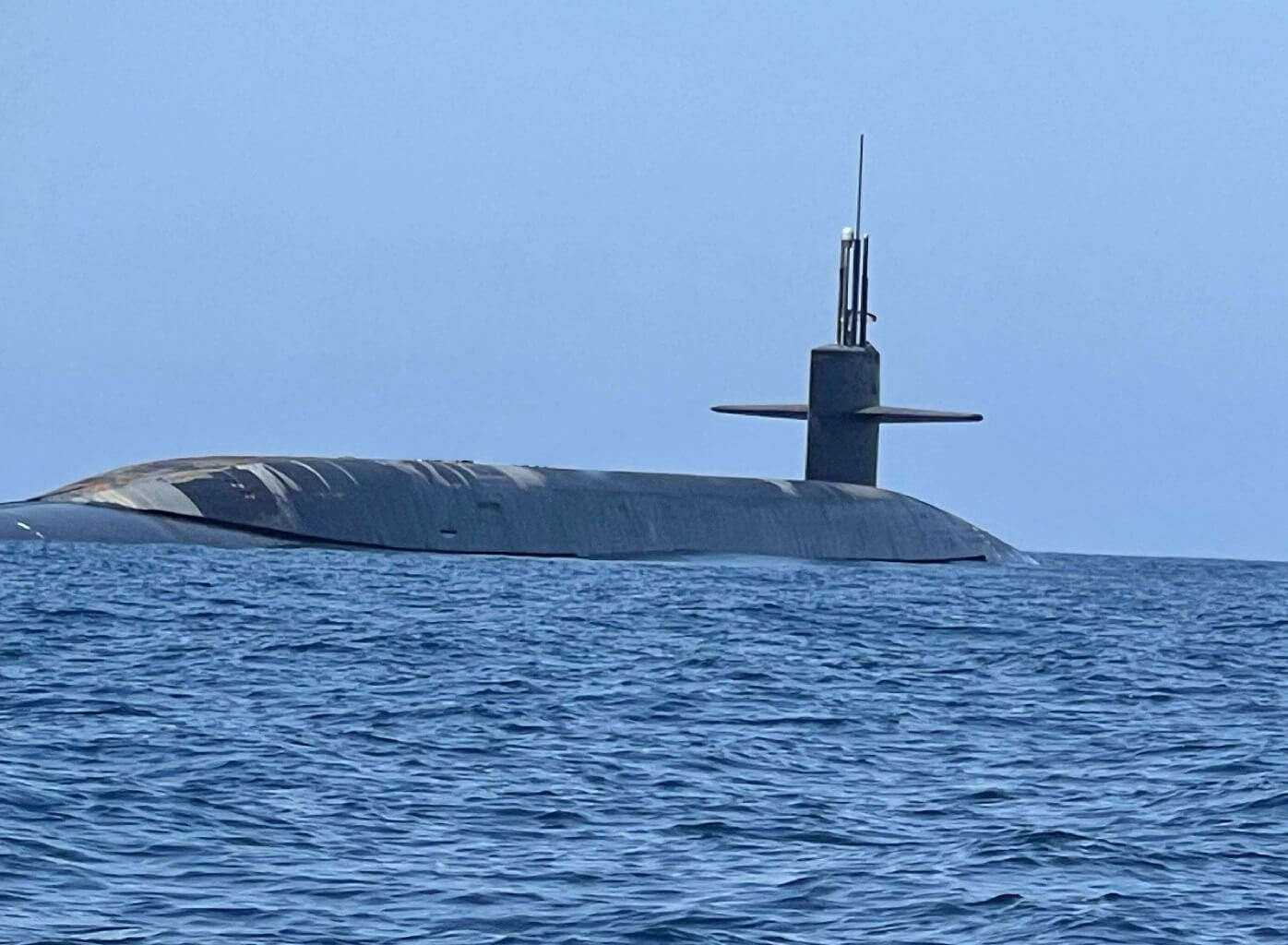
USS-Virginia-Submarine
File Image: USS West Virginia Submarine: Via US CENTCOM

Why Does the U.S. Not Export Nuclear Submarines?

The US nuclear-powered submarines are considered the best in their class; however, to date, Washington has not exported this technology to any country for various reasons.

Firstly, the U.S. Navy has long opposed even the export of diesel-electric submarines due to concerns about the impact of submarine technology proliferation on the ability of its forces to operate securely in coastal waters worldwide.

Submarines fall under the US Munitions List and are subject to the International Traffic in Arms Regulations (ITAR) and the Arms Export Control Act.

When it comes to nuclear propulsion technology, the US Navy is highly sensitive, as it adds extra layers of control under the Atomic Energy Act.

The US nuclear propulsion, quieting technology, sonar, and combat systems are considered among America’s most protected “crown jewels.”

The US has deliberately avoided proliferating this technology to preserve its undersea dominance.

In fact, Washington is so sensitive about submarines’ nuclear propulsion technology that it has refused to share this technology even with its close allies, such as France, Japan, Taiwan, or Canada.

The only two exceptions are the UK and Australia.

The US has a long-standing special nuclear propulsion technology-sharing agreement with the UK, dating back to the 1958 US-UK Mutual Defense Agreement.

The US supplied the reactor for Britain’s first nuclear sub, HMS Dreadnought, and ongoing collaboration allows the UK to design and build its own boats.

However, this is alliance cooperation, not a commercial export.

Similarly, in 2021, the US, the UK, and Australia signed the AUKUS agreement, under which the US has agreed to sell/transfer up to three Virginia-class SSNs to Australia, starting in the early 2030s.

Another issue is US industrial capacity, which is already struggling to meet US Navy demand for Virginia-class submarines.

In its current modernization drive, the U.S. Navy hopes to add two to three Virginia-class attack submarines to its fleet annually until 2043.

In fact, it’s not just the US that is sensitive about exporting nuclear submarines.

Globally, nuclear-powered submarines are operated by only six countries: the US, Russia, China, France, the UK, and India.

The US, Russia (formerly the Soviet Union), and the UK have been operating nuclear submarines for over six decades now.

However, to date, there is only one example of a country exporting/leasing a nuclear-powered submarine to another country.

The Soviet Union first leased a Charlie I-class (K-43) nuclear-powered submarine to India in 1988–1991.

India operated it as INS Chakra.

Further, Russia leased an Akula-class submarine (Nerpa/K-152) to India from 2012 to 2021, which New Delhi operated as INS Chakra II.

The US, the UK, China, France, and India have never exported or leased a nuclear submarine to any country.

In fact, how all countries are highly protective of nuclear-powered submarines can be gauged from the fact that even China refused this technology to its all-weather ally, Pakistan.

Leaked documents revealed that Pakistan formally asked China for nuclear-powered submarine technology and sea-based nuclear second-strike capabilities to counter India.

However, Beijing ultimately refused to provide the technology, citing global non-proliferation commitments and a desire to avoid triggering a regional nuclear arms race.

Instead, China is providing Pakistan with eight Hangor-class diesel-electric attack submarines, under a US$5 billion deal.

However, since the US no longer produces diesel-electric submarines and is reluctant to export nuclear-powered submarines even to its close allies, Washington is effectively out of the global submarine business, which is dominated by countries such as Germany, France, Russia, China, and Spain, and the situation is unlikely to change in the near future.

  • Sumit Ahlawat has over a decade of experience in news media. He has worked with Press Trust of India, Times Now, Zee News, Economic Times, and Microsoft News. He holds a Master’s Degree in International Media and Modern History from the University of Sheffield, UK. 
  • He can be reached at ahlawat.sumit85 (at) gmail.com

The post America’s $40 Billion Blind Spot: Why World’s Largest Arms Exporter Hasn’t Sold a Single Submarine in 50 Years? appeared first on EURASIAN TIMES.
  •  

Su-57: Russia Claims 1st Air-to-Air Kill For Its Stealth Fighter in Ukraine War Using Hybrid RVV-SDM Missile

Russia has for the first time officially claimed that its fifth-generation fighter jet, the Su-57, has registered its first air-to-air kill in the Ukraine War, using a hybrid RVV-SDM missile.

Alexander Mikheev, Director General of Rosoboronexport, Russia’s state arms exporter, said that the stealth aircraft has proved its superiority in all aspects of warfare, including hitting targets on the ground and in the air.

This, he said, is fueling a heightened global interest in the Su-57E fifth-generation fighter.

“Rosoboronexport notes increased global market interest in the Su-57E fifth-generation fighter. It has proven its superiority in real combat conditions when countering the most advanced air defense and electronic warfare systems. The aircraft has engaged numerous airborne, ground, and surface targets with Russian air-to-air munitions, including the latest RVV-SDM guided missile,” Russia’s state-controlled news agency TASS quoted Mikheyev as saying.

The RVV-SDM is a new medium-range air-to-air missile introduced by Russia’s Rosoboronexport to arm the export variant of the fifth-generation Su-57E stealth fighter. It features fire-and-forget capabilities, active-passive radar guidance, and high resistance to electronic warfare.

According to Vijainder K Thakur, former Indian Air Force (IAF) pilot and defense analyst, the RVV-SDM is a medium-range missile, most likely a derivative of the RVV-SD tweaked for internal carriage by the Su-57 and improved performance.

While reports of Su-57’s first aerial kill have been doing rounds for some time now, this is the first official acknowledgment by Russia of Su-57’s air-to-air kill in the Ukraine War.

In April 2026, a report attributed to Sergei Lebedev claimed that a Su-57 had destroyed a Ukrainian Air Force aircraft in an aerial engagement over the Mykolaiv region using a long-range missile.

In May 2026, Russian media and Telegram channels claimed that a Su-57 had used a long-range R-37M missile to shoot down a Swedish Saab 340 AEW&C aircraft transferred to Ukraine over eastern Ukraine.

Mikheyev said that Su-57’s combat performance in the war has fueled global interest in the aircraft’s export variant, the single-seat Su-57E. However, despite its best efforts to promote the aircraft in the international market, so far there has been only one confirmed customer of the Su-57.

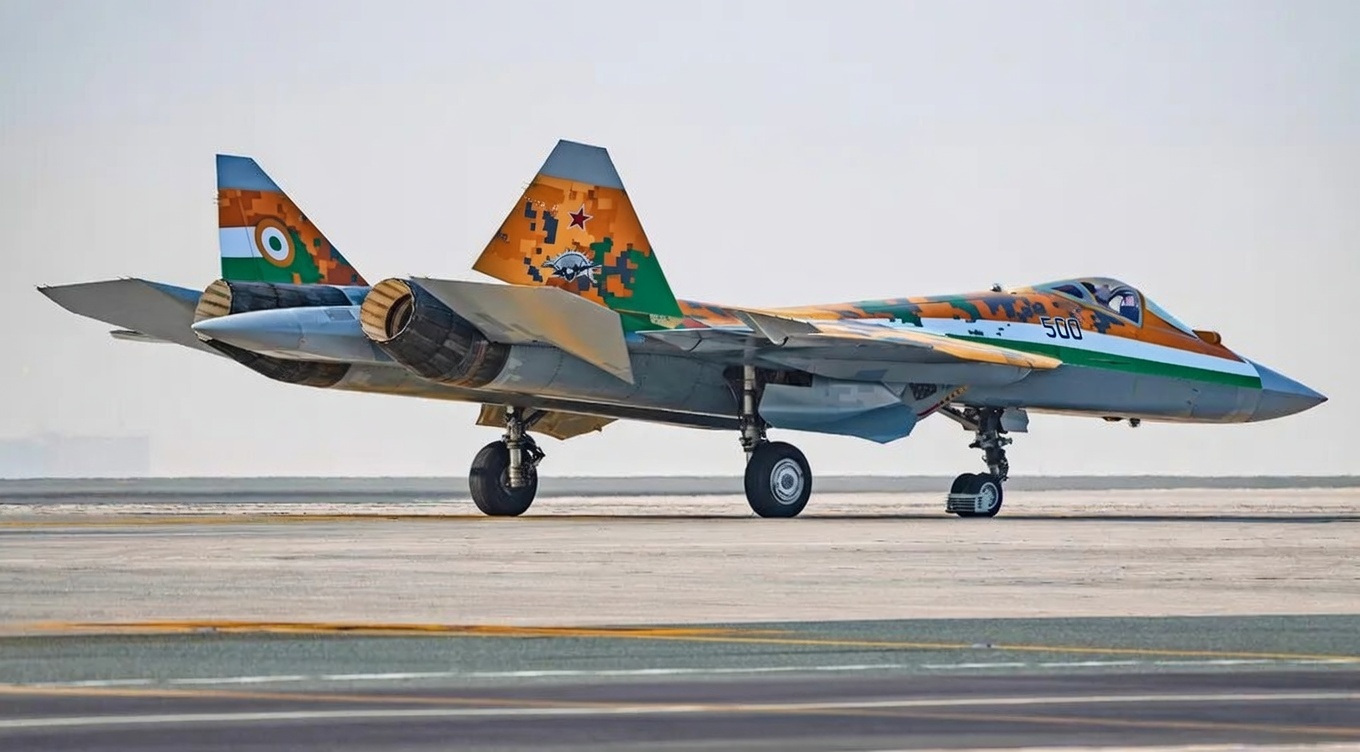
Edited Image: Su-57

Algeria was the first country to confirm the acquisition of the Su-57E. The country, which has a fleet of Soviet-Russian Su-30MKA, MiG-29, and MiG-25 fighters, has bought an unspecified number of aircraft and has reportedly deployed the jet on operational duty.

In November last year, Vadim Badekha, the Director General of United Aircraft Corporation (UAC), which manufactures the Su-57, announced that Russia has delivered two Su-57E stealth aircraft to a foreign client.

“Our foreign customer, our foreign partner, has already received the first two aircraft. They have begun to carry out combat duty and demonstrate their best qualities. Our customer is satisfied,” Badeja said.

Russia is also pitching the Su-57E to India and has even promised full Transfer of Technology (ToT) and to localize the production of the stealth aircraft in India. However, New Delhi has not made a decision yet.

According to Russian officials, the Su-57’s combat experience in the Ukraine War and limited exposure during the Syria war is a key highlight of the stealth fighter jet’s export potential.

Russia has, however, used the Su-57 very cautiously in the Ukraine war. According to security analysts, the aircraft has been mostly used for stand-off strikes from long distances.

Earlier this month, it was reported that Moscow is also using the stealth jet in anti-drone operations near Moscow.

Notably, just a few days earlier, a picture emerged showing the Su-57 fitted with R-73 air-to-air missiles attached to its wing pylons rather than in its internal weapons bay.

Carrying the missiles beneath the wing pylons would compromise the Su-57’s stealth; however, if the jet is deployed primarily for anti-drone operations, maintaining stealth is of no use.

Carrying these short-range AAMs externally suggests that the Su-57 load-out was optimized for close-range aerial engagements, most likely against the long-range Ukrainian one-way attack drones and cruise missiles that Kyiv has recently begun using.

Critics argue that Moscow is deliberately limiting the aircraft’s exposure to protect its export potential. Any confirmed losses to Ukrainian forces, they say, would severely damage the jet’s credibility in the international export market.

Still, an official acknowledgment by Russia of Su-57’s first aerial kill will no doubt boost the jet’s credibility, which has so far struggled to find many export customers.

Notably, while the US’s F-35 fighter jet has been in service for 11 years and has seen action in many wars, including in Iraq, Syria, Yemen, Gaza, and Iran, it scored its first air-to-air kill in March this year.

An Israeli Air Force F-35I “Adir” stealth fighter jet shot down an Iranian YAK-130 aircraft over Tehran, according to a statement by Israel Defense Forces (IDF).

“This is the world’s first shootdown of a manned fighter jet by an F-35,” the statement added.

It must also be noted that Ukrainian airspace is heavily defended by frontline Western air defense systems such as Patriots. This is in contrast to where the F-35 has seen combat, in the poorly defended airspace of Gaza, Syria, Iraq, Yemen, and Iran.

Meanwhile, the USAF’s F-35 fighter jet also got hit by an Iranian drone-missile hybrid in the Iran war, underscoring that even most advanced Western stealth fighter jets are not completely invisible or invincible.

Additionally, while Russia initially faced many issues with the Su-57, including production delays, Moscow has made key improvements to the aircraft in recent years, increasing its lethality and survivability in contested airspace.

Su-57’s Continuous Upgradation

In February this year, Moscow’s Rostec press service said that the Russian Aerospace Forces (VKS) have inducted a new batch of Su-57 fighters featuring a “new technical profile.”

The upgraded version of Russia’s fifth-generation fighter incorporated enhanced onboard systems and a new weapons configuration that significantly expanded the jet’s combat role.

SU-57 RUSSIA
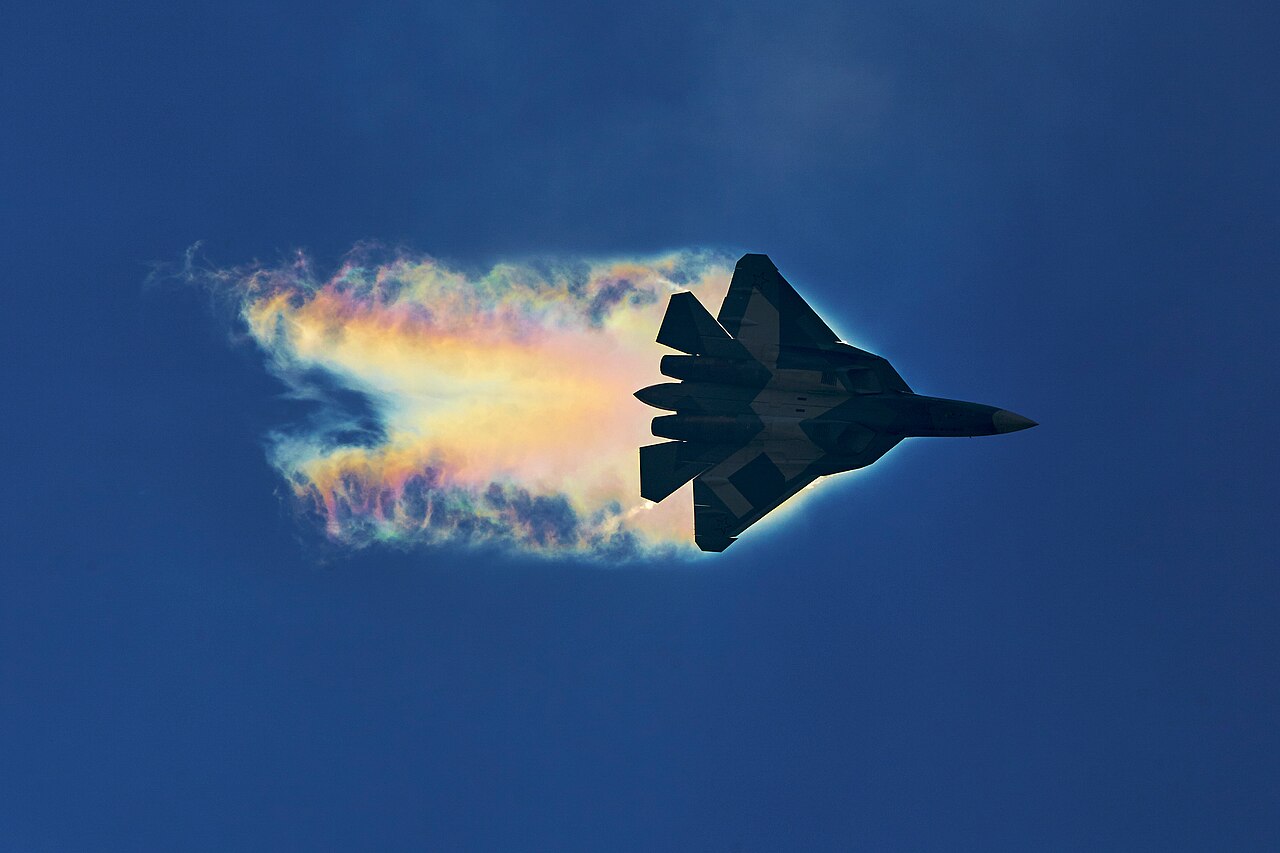
File Image: Su-57. Via Wikipedia

“To fulfill the targets set by the Russian Defense Ministry for the supply of highly sought-after weapons and military equipment to the troops, crews of the Russian Aerospace Forces have accepted the Su-57 aircraft in its new technical configuration,” the Rostec press service quoted a Su-57 pilot as saying.

“The aircraft has already proven itself during the special military operation (Ukraine War). The new technical configuration will provide for the expansion of the range of missions for which this aircraft type is deployed. The advanced capabilities incorporated into the aircraft armament system make it possible to use new types of aircraft weapons,” the pilot added.

While Rostec provided no details of the upgraded onboard systems or the new weapons package, analysis of higher-resolution images released by UAC and examined by OSINT analyst George N. revealed visible changes to the 101KS electro-optical complex, which supports self-protection and missile warning functions.

The 101KS complex is an electro-optical targeting system that provides the Su-57 with all-weather surveillance and passive infrared detection.

The 101KS complements the radar by detecting and tracking targets in the infrared and visible spectra. It can detect heat signatures of missiles and aircraft and conduct passive situational monitoring.

This allows the fighter to operate without active emissions, enhancing survivability in highly contested environments.

The aircraft also received revised apertures, presumably operating across multiple spectral bands, including visible, mid- and long-wave infrared (IIR), and possibly ultraviolet (UV), pointing to a substantial expansion of passive observation capabilities.

The imagery suggested that the 101KS would no longer function solely as a defensive sensor, but rather as a key element of situational awareness, aligned with the philosophy of the AN/AAQ-37 Distributed Aperture System (DAS) carried by the F-35.

It underscored that the Su-57 is moving toward a distributed, passive surveillance capability that can detect and track airborne threats without relying solely on radar.

The announcement came nearly two months after the UAC confirmed it had tested the Su-57 with a new Izdliye 177 engine, a powerplant developed by the United Engine Corporation (UEC) specifically for the Su-57.

The new Izdliye 177 engine was tested with the Su-57 in December 2025. According to a Rostec official, each Izdliye 177 engine can deliver up to 16,000 kg of thrust (approximately 35,000 pounds) with the afterburner engaged.

The new engine will further reduce fuel consumption and is stated to be far more durable than the previous power plant, the Saturn AL-41F1 afterburning turbofan engine.

In fact, the fighter jet has been steadily upgraded since its induction into the VKS in 2020.

Vadim Badekha, CEO of UAC, recently said the platform continues to evolve.

“The fifth-generation Su-57 aircraft system is the best aircraft in its class, but we’re not resting on our laurels. The fighter has undergone a tremendous evolution, and its improvement continues today – the aircraft’s weapons and systems capabilities are being upgraded,” Badekha said.

“This fighter allows us to solve the most important tasks today, demonstrating efficiency and excellent maneuverability and combat capabilities,” he added.

All these upgrades fit within the progressive maturation of the Su-57 program, also known as the Megapolis development program.

Under it, the Su-57 would receive incremental upgrades to its avionics, cockpit, engine, sensors, and weaponry.

Russian engineers claim that the Su-57 is a future-oriented project that will evolve as Moscow’s principal air combat system well beyond 2040.

At the same time, these upgrades will also boost the jet’s export potential.

  • Sumit Ahlawat has over a decade of experience in news media. He has worked with Press Trust of India, Times Now, Zee News, Economic Times, and Microsoft News. He holds a Master’s Degree in International Media and Modern History from the University of Sheffield, UK. 
  • He can be reached at ahlawat.sumit85 (at) gmail.com

The post Su-57: Russia Claims 1st Air-to-Air Kill For Its Stealth Fighter in Ukraine War Using Hybrid RVV-SDM Missile appeared first on EURASIAN TIMES.

  •  

Why is Putin Hunting Telegram’s Founder Pavel Durov and Branding Him a Terror Facilitator?

Russia has charged Telegram founder Pavel Durov with facilitating terrorist activity in the country and put him on an international wanted list, alleging that his hugely popular messaging app was being used by ‌Ukrainian spies to organize attacks inside Russia.

The charges, announced by the Federal Security Service (FSB), followed a long investigation into Telegram.

The FSB accused Telegram of failing to remove “numerous channels, chats and bots” allegedly used by “Ukrainian intelligence agencies, terrorist and extremist organizations to prepare and coordinate acts of sabotage and terrorism, mass murder, and cyberfraud” in Russia, which resulted in “numerous human casualties.”

It further said that a chatbot available on Telegram called “Daivinchik/Leo” had been ​used by Ukrainian spies to recruit young Russians to carry out sabotage and terrorist operations.

Reportedly, Ukrainian special agents pose as young women on the app to recruit Russian men and use them for spying or carrying out sabotage activities.

Russia has also issued an international arrest warrant against Durov, who was born in Russia but currently lives in Dubai.

Notably, the Telegram app, which is hugely popular in Russia, is already heavily restricted in Russia.

Russian citizens can now access Telegram only by using a VPN to encrypt their traffic and conceal their location. However, despite these restrictions, state bodies, including the Kremlin and the defense ministry, continue to post ⁠on it regularly.

The crackdown on Telegram is part of Russia’s broader effort to restrict access to foreign tech platforms and assert control over the internet. Apart from Telegram, other popular messaging apps such as WhatsApp, Instagram, Facebook Messenger, Signal, Discord, Snapchat, and Apple FaceTime are also banned in Russia.

Russia has now gone one step ahead and formally charged Telegram founder Durov with aiding terrorism, despite the fact that the app is hugely popular in Russia.

However, notwithstanding Russian restrictions on Telegram and the charging of its founder with terrorism, both Russia and Ukraine have used the app extensively in the ongoing war.

In fact, the Telegram app has also been described as a “virtual battlefield” in the war between Russia and Ukraine, where it is used ​by officials, soldiers, defense ministry handles, and influential bloggers on both sides.

So, how did a messaging app become key to the Russia-Ukraine War?

Telegram As A “Virtual Battlefield” in the Russia-Ukraine War

In the Soviet Union, media was heavily controlled by the state to control public discourse.

Russia inherited this culture of controlling the narrative through its influence on the media. However, with the proliferation of digital and social media, the state’s ability to control the media weakened.

Telegram was one of the most popular messaging apps in Russia and Ukraine in 2022 when the war began.

In Russia, Ukraine, and many Eastern European countries, Telegram served as a crucial alternative to state-monitored communication channels for sharing news.

With Russia’s invasion of Ukraine, Facebook and Instagram were banned over extremism charges by a Moscow court, and access to Twitter was restricted by the Russian censorship body Roskomnadzor.

As there was disdain for traditional state-controlled media in Russia and many other social media channels were banned outright, the role of Telegram, already hugely popular in Russia, in shaping narratives and controlling perceptions of the war became even more critical.

According to a Levada survey, among Russian youth aged 18-24, TV was the least popular news source, with 41% relying on Telegram channels for news. Additionally, during the first two months of the conflict, 76.6% of Ukrainians used social media for news, with Telegram as the most favored platform at 65.7%.

Telegram was also used by both the Russian and Ukrainian governments to broadcast air raid warnings and distribute maps of local bomb shelters.

Some of Telegram’s unique features, such as the ability to make a channel public or private, the option to have unlimited subscribers, and the lack of algorithms that boost or restrict content visibility, have made Telegram a popular information-dissemination tool for both pro- and anti-war voices.

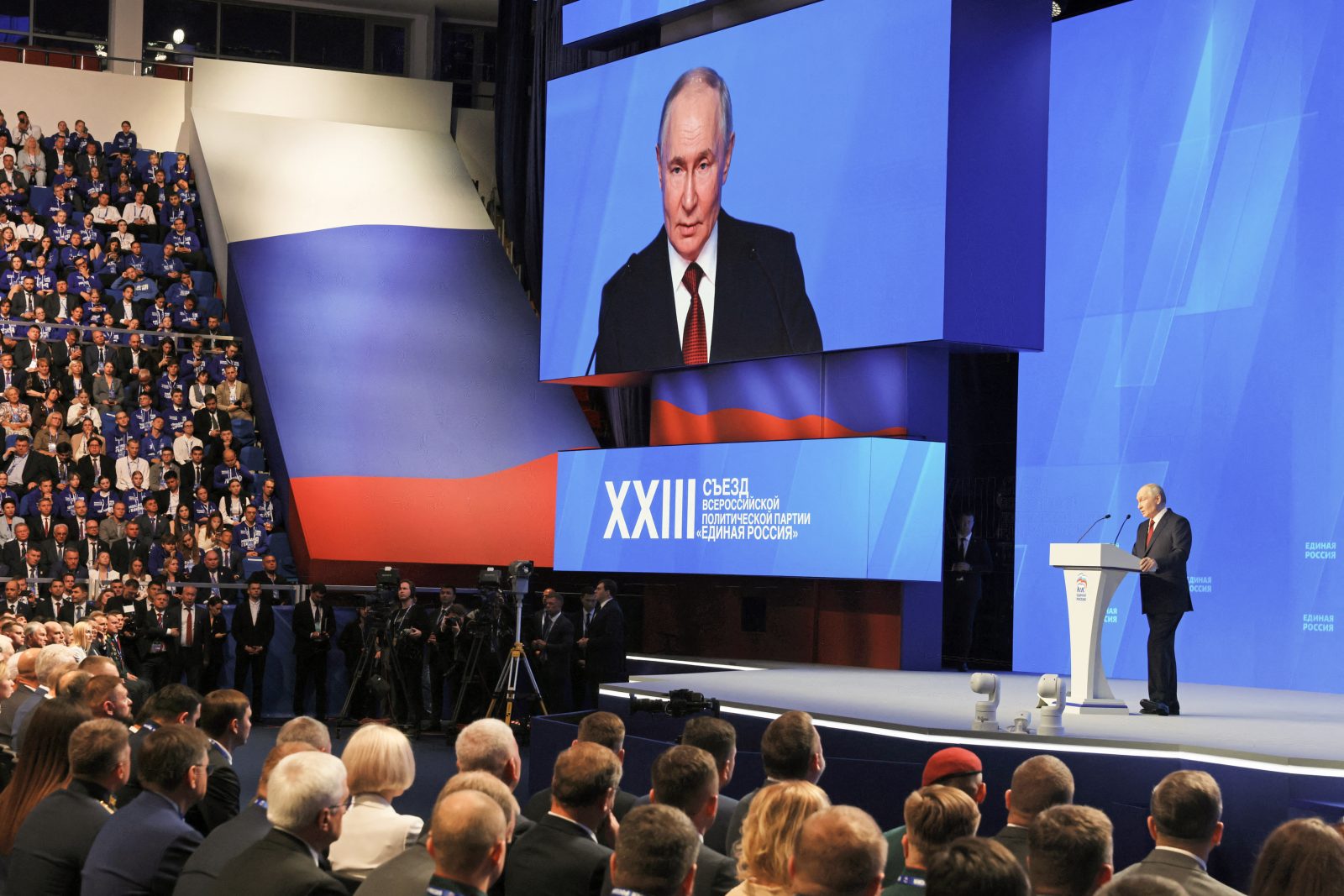
In this pool photograph distributed by Russian state agency Sputnik, Russia’s Vladimir Putin addresses the audience at the 23rd Congress of the United Russia party in Moscow on June 28, 2026. Vladimir Putin vowed on June 28, 2026 to ensure security and overcome challenges as Ukraine stepped up its retaliatory strikes inside Russia amid Moscow’s four-year war. (Photo by Yekaterina SHTUKINA / POOL / AFP)

According to a research paper titled ‘Telegram as a Battlefield,’ over 40% of Telegram channels are dedicated to news, with approximately 17% directly related to the war and ongoing events in Ukraine.

As the war progressed, many war bloggers who were not part of traditional media outlets began posting on Telegram, reaching millions of people.

For millions of people, these war bloggers became an alternative source of information and war updates, often coming straight from the front lines.

Given its popularity as a source of information for war updates, many pro-government channels also used Telegram to push their narrative and spread disinformation.

The paper ‘Telegram as a Battlefield’ also found that after the invasion, average views per post for Pro-Kremlin channels rose from 15,929 to 67,442 (a 323% increase) and for Anti-Kremlin channels from 25,346 to 104,778 (313% increase), highlighting how Telegram emerged as a critical battlefield for disseminating information, propaganda, and shaping narratives.

However, it noted that anti-Kremlin channels consistently garnered higher viewership than pro-Kremlin channels, especially post-invasion.

Also, as the war progressed, Ukraine, just like in the case of drone technology, used Telegram in more innovative ways than Russian government circles.

Ukrainians used it for air-raid alerts, bomb-shelter maps, and official updates from President Zelensky and military commands.

Ukraine also used Telegram as an intelligence-collecting tool. It crowdsourced intelligence via tip bots and channels that shared enemy vehicle movements, leading to successful strikes.

Common people in Ukrainian villages often shared information on Russian military movements with the Ukrainian military and intelligence securely via Telegram.

Telegram, in fact, became a vast depository of HUMINT (human intelligence) for Ukraine.

Furthermore, the platform was also used by Russian government critics to share information with the Ukrainian military across the border.

Telegram was also used to document war crimes and OSINT (open source intelligence).

Ukrainian intelligence also used Telegram to communicate with people in occupied territories and to encourage them to share intelligence on the Russian military.

Frontline troops also use the app to organize logistics, share drone feeds, and have informal discussions with their military commands.

Telegram has also been described as the conflict’s digital battle space, where organizing logistics, war blogging from the frontlines, propaganda, disinformation campaigns, narrative warfare, intelligence collection, recruitment of spies and saboteurs, cataloging of war crimes, and dissemination of public interest information like air raid warnings and bomb shelter maps all take place in real time.

Telegram, in fact, is providing the most unfiltered view of the war.

“Telegram has become this really key battleground in the information war,” Dr. Ian Garner, a historian and translator of Russian war propaganda, told Time magazine. “And it’s interesting that this information war has been outsourced to a private company.”

While Russia has often tried to use Telegram to its advantage, Ukraine has shown much more ingenuity in using it, which explains Moscow’s love-hate relationship with the app.

Russia might have restricted the app and now formally charged its founder with terrorism, but official Russian media handles are still using it, and even common Russian citizens can use it using VPN services.

However, even after these formal charges, Telegram will continue to remain the digital battle space of the Russia-Ukraine War.

  • Sumit Ahlawat has over a decade of experience in news media. He has worked with Press Trust of India, Times Now, Zee  News, Economic Times, and Microsoft  News. He holds a Master’s Degree in International Media and Modern History from the University of Sheffield, UK. 
  • He can be reached at ahlawat.sumit85 (at) gmail.com

The post Why is Putin Hunting Telegram’s Founder Pavel Durov and Branding Him a Terror Facilitator? appeared first on EURASIAN TIMES.
  •  

U.S. F-47 Could Fly Without Its Engines! Like India’s AMCA & Turkey’s KAAN, Another Next-Gen Jet Likely To Use Interim Engines

The engine challenges facing India’s AMCA and Turkey’s KAAN fifth-generation fighters are well documented. Both programs will initially fly with General Electric engines while their indigenous powerplants are developed and integrated.

Yet even the United States, long a key supplier of engines for foreign fighter prototypes, is also grappling with significant propulsion problems of its own, as the timelines for first flight of the F-47 prototype and next-generation fighter jet engine are out of sync.

The sixth-generation fighter jet, F-47, developed under the Next Generation Air Dominance (NGAD) initiative, is expected to fly for the first time in 2028.

However, a prototype jet engine developed under the Next Generation Adaptive Propulsion (NGAP) program could be ready for integration onto an actual aircraft only by 2030, as per the latest information provided by the US Air Force (USAF).

This means that at least the F-47 prototype, and possibly the first operational F-47s, will have to fly with a different engine before the NGAP engine is integrated into the F-47 around 2030-2031.

The integration of NGAP with the F-47 will unlock the full potential of the next-generation fighter jet; however, this also raises the crucial question of which engine will power the initial F-47 prototypes.

John Sneden, the Portfolio Acquisition Executive in charge of the Propulsion Directorate at the Air Force Life Cycle Management Center (AFLCMC), recently provided a new timeline for the NGAP engine.

The NGAP program will culminate in “get[ting] ready for potential integration activities in the 2030 timeframe,” Breaking Defense quoted Sneden as saying.

Notably, the USAF’s 2027 budget proposal also supports this timeline for the NGAP.

The document says that the NGAP’s “Prototype Fabrication & Engine Assessment” phase will run through at least September 2031.

In fact, the budget proposal shows that the funding for the NGAP program will gradually surge going forward.

The USAF is seeking nearly US$513.7 million for the program in FY2027, and then expects to request US$905.7 million and US$865 million in Fiscal Years 2028 and 2029, respectively.

Speaking with reporters at the Life Cycle Industry Days conference, Sneden, however, refused to confirm what platform might receive the NGAP engine first.

“The Air Force is still evaluating its options,” Sneden said, emphasizing that the underlying engine technology may “open up” different choices down the road. “What we’re doing right now is we’re building our system today, and we’re getting ready for the future.”

Sneden also hinted that the NGAP engine could be integrated backward into existing designs, including the F-47.

A new NGAP engine “could” go on the F-47, Sneden said, emphasizing that no decisions have been made. He, however, stressed that NGAP “is really a host of technologies” that can be integrated backward into existing designs.

While the NGAP was initially envisioned to provide a powerplant for the NGAD fighter, now christened the F-47, USAF officials have often noted that the NGAP is designed to be platform-agnostic, meaning it could power various platforms and aircraft designs.

When it comes to where NGAP stands now, “initial hardware is procured, their design meets our standards, everything is clean from that end, and both vendors have been able to do that,” Sneden was quoted as saying by the Air & Space Forces Magazine.

The two vendors in question are GE Aerospace and Pratt & Whitney (a subsidiary of RTX). GE Aerospace, with the XA102, and Pratt & Whitney, with the XA103, are both developing competing adaptive-cycle engines under the USAF’s Next Generation Adaptive Propulsion program. In simple terms, adaptive-cycle engines can perform like a turbofan when optimal and like a turbojet when needed. This means that the same engine can save fuel when needed and can deliver more power when required.

However, no final production winner has been selected yet for the Boeing F-47.

These engines aim for better fuel efficiency, thrust, range, thermal management, and power generation compared with current fifth-generation engines. Both companies completed detailed design reviews in 2025 and assembly readiness reviews in May this year. Prototype fabrication is currently underway, and ground testing is expected in the late 2020s.

Currently, there is no clarity on which interim engine could power F-47 prototypes, but the possible options discussed in media reports include variants of the Pratt & Whitney F135, F119, F100, or GE F110.

However, it is not unusual for fighter jet prototypes to fly with an interim engine before a new engine is integrated into final products.

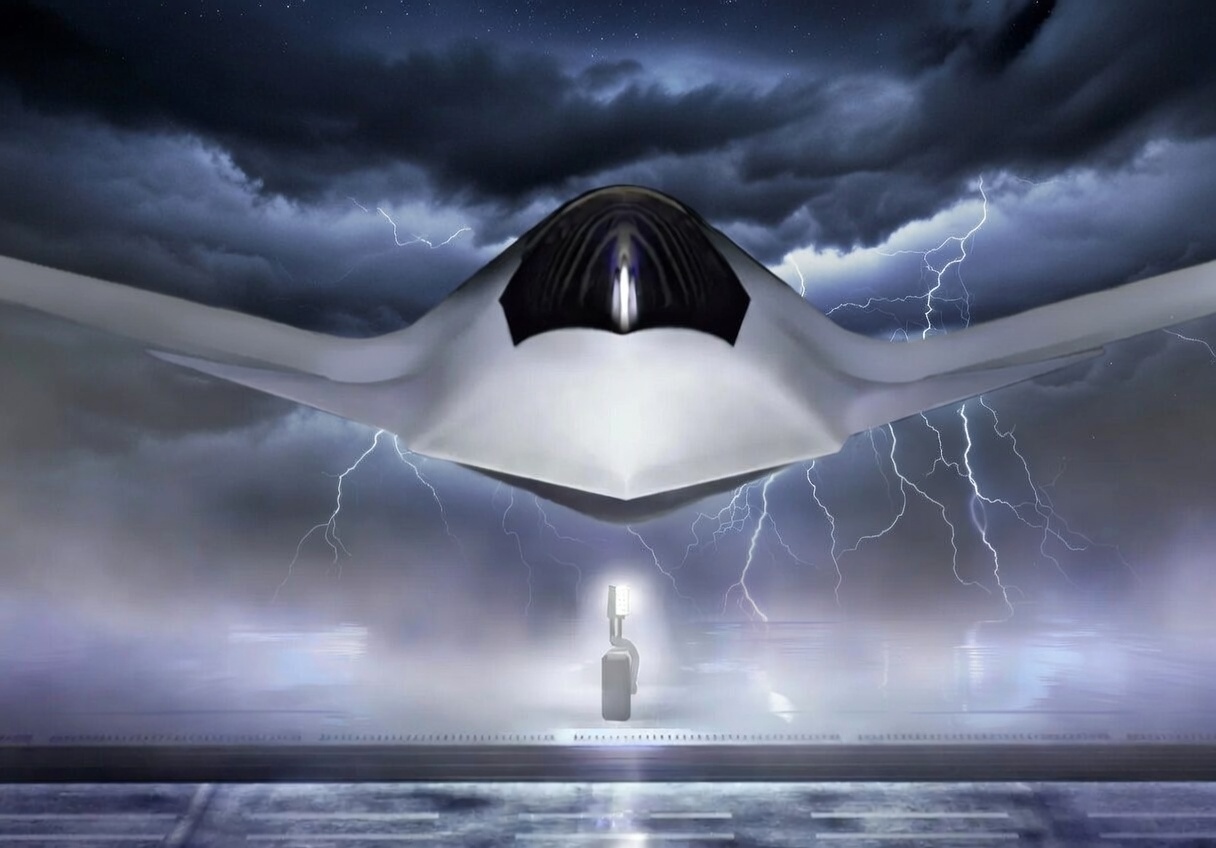
F-47

Fighter Jets That Flew With Interim Powerplants

For instance, Turkey’s underdevelopment fifth-generation fighter jet, Kaan, is currently flying with two General Electric F110 engines. Early production blocks are expected to continue with F110 before the indigenous TF35000 is integrated.

India’s fifth-generation AMCA and 4.5-generation Tejas Mk1 variants are planned to fly with GE F414 engines, before an indigenous or co-developed engine is fully mature for integration.

Similarly, Russia’s fifth-generation Su-57 first flew with the AL-41F1 (Izdeliye 117) engines. Upgraded Su-57 variants with the new engine, AL-51F1, have recently begun flying, and full integration is currently underway.

China’s first fifth-generation fighter jet, the J-20, also initially flew with a Russian AL-31FN engine. Later variants of the J-20 flew with Chinese WS-10 variants. However, even that was an interim solution. The intended definitive engine is the more powerful WS-15.

Even Dassault Rafale first flew in 1986 with two General Electric F404 engines. Later models mixed one M88 with one F404, before the final products flew with both M88 engines.

Similarly, Eurofighter Typhoon first flew in 1994 with Turbo-Union RB199 engines, which were derived from those on the Panavia Tornado. Later models started using the EJ200 engines.

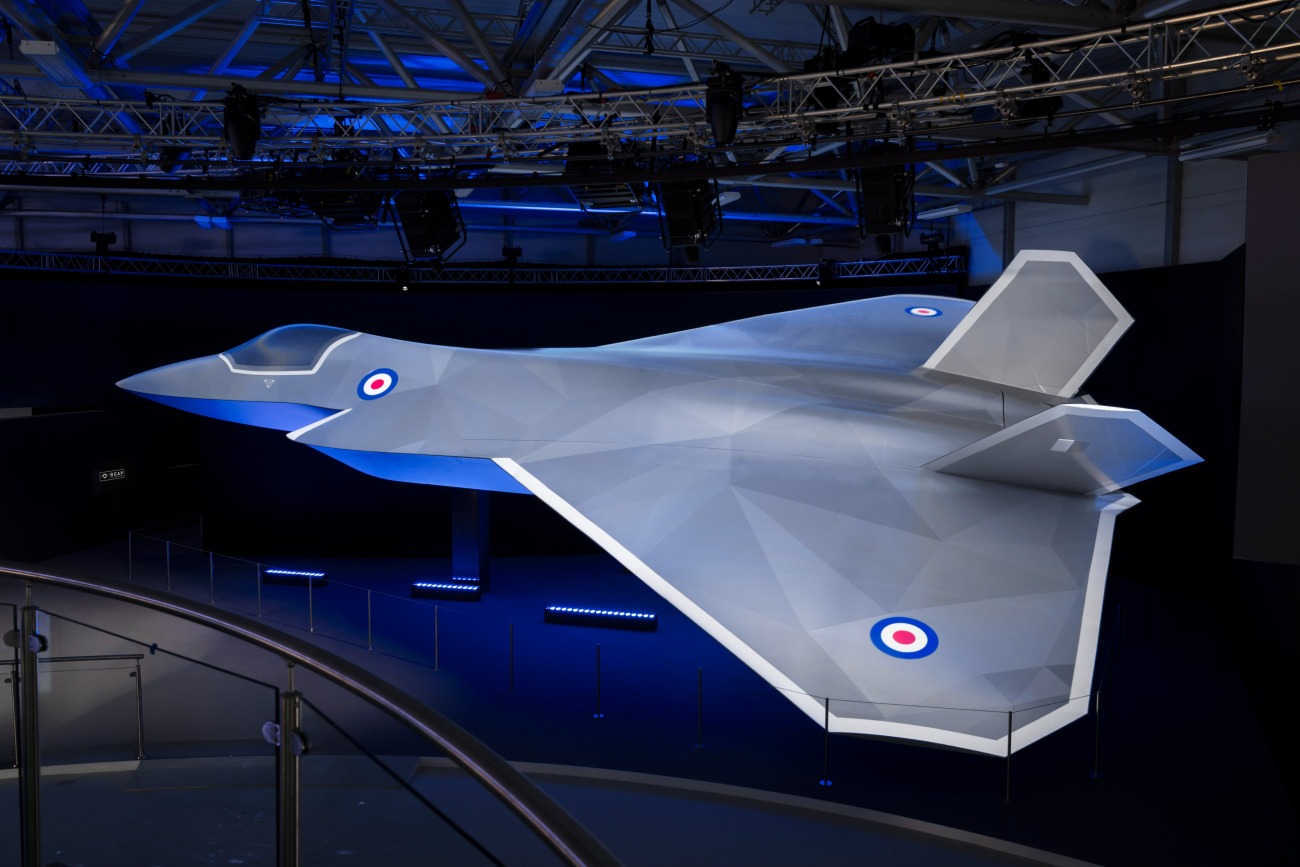
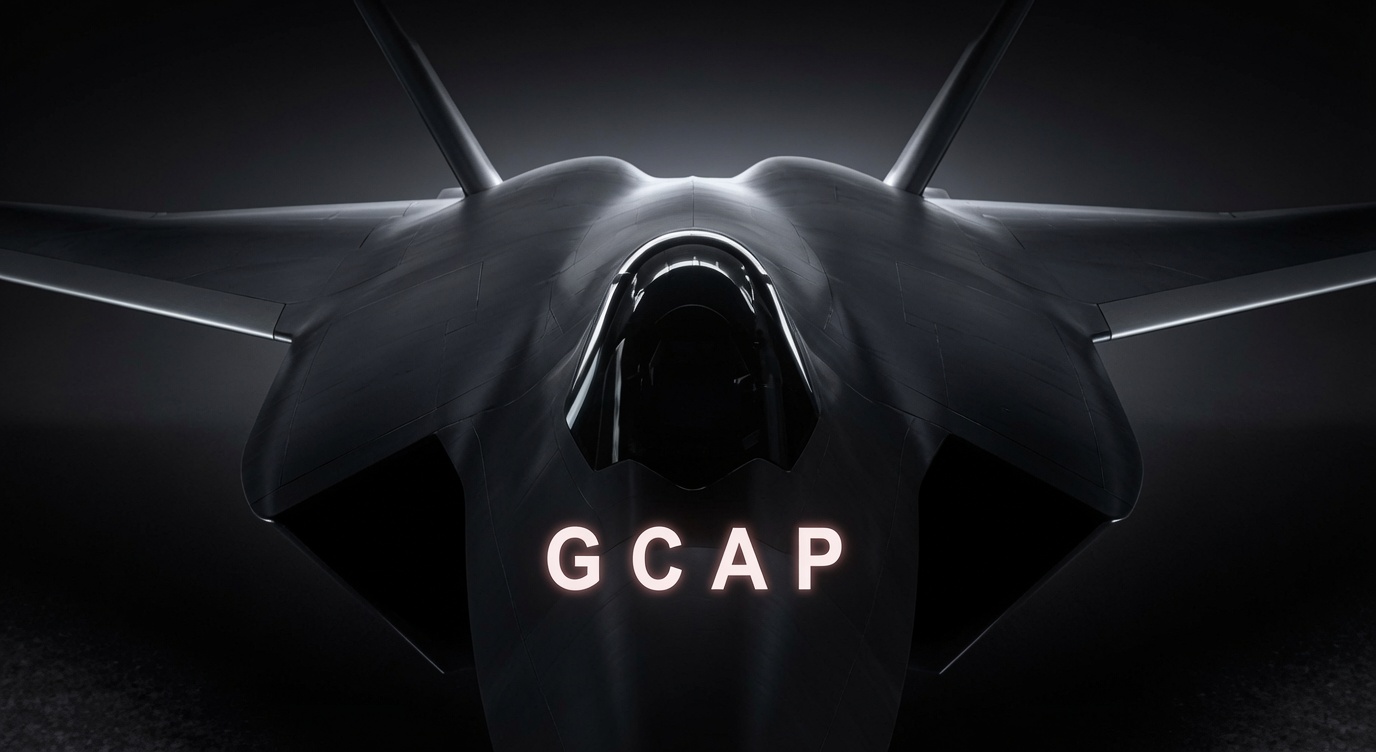
The same EJ200 engine is expected to power the initial prototypes of the Global Combat Air Program (GCAP), jointly developed by the UK, Italy, and Japan. A completely new next-generation engine, developed by Rolls-Royce, Avio Aero, and IHI, is being developed in parallel for the production models of the GCAP.

File Image

Even in the US, many fighter jets initially flew with interim engines before the final engine was integrated.

For instance, the Lockheed F-104 Starfighter first flew with the Wright J65 turbojet engine. However, the production model of the aircraft received the more powerful J79.

The F-14 Tomcat was planned around the Pratt & Whitney F401 turbofan engine. However, that engine program was canceled, and the fighter jet was fitted with Pratt & Whitney TF30 turbofan engines. Later, the F-14 Tomcats were fitted with the General Electric F110 turbofans.

On the upside, testing a new fighter jet prototype with an already mature and tested powerplant has its own advantages. It allows for risk management by allowing airframe flight testing, systems integration, and early operational assessment with an engine that is already mature. In the meantime, the new, more advanced fighter jet engine can be tested for risks and matured before integrating it with the already tested airframe.

Testing a new airframe with a new engine could be a high-risk affair.

However, there could also be certain drawbacks, as it could lead to performance shortfalls, design mismatch, or even require restructuring.

Given the timeline mismatch between F-47 prototypes’ first flight and the NGAP engine, it is all but certain that the first prototypes, and perhaps even some production models, will fly with an interim powerplant.

However, USAF officials have noted in the past that the NGAP is designed to be “platform agnostic” and could be easily integrated backward into existing designs. Therefore, integrating the NGAP with the F-47 should not be problematic, and this way Boeing could meet ambitious timelines for the project.

  • Sumit Ahlawat has over a decade of experience in news media. He has worked with Press Trust of India, Times Now, Zee News, The Economic Times, and Microsoft News. He holds a Master’s Degree in International Media and Modern History from the University of Sheffield, UK. 
  • He can be reached at ahlawat.sumit85 (at) gmail.com

The post U.S. F-47 Could Fly Without Its Engines! Like India’s AMCA & Turkey’s KAAN, Another Next-Gen Jet Likely To Use Interim Engines appeared first on EURASIAN TIMES.

  •  

Ex-Rafale Pilot Who Praised China’s J-10C & JF-17 Fighter Jets Now Under Investigation for Beijing Ties

A former French Navy Rafale pilot who also trained with the US Navy, was an expert in CATOBAR carrier landings, and who controversially claimed that the Indian Air Force lost a Rafale jet during the India-Pakistan clash in May last year, has been placed under formal investigation in Paris over alleged intelligence activity benefiting China.

Pierre-Henri Chuet, who flew Super Étendard and Rafale M fighters from the aircraft carrier Charles de Gaulle, was formally placed under investigation after he was presented to an investigating magistrate last week, following his questioning by France’s domestic intelligence service, the DGSI.

The development was first reported on July 27 by IntelligenceOnline.

He is under investigation for four charges of espionage: disclosure of national defense secrets by a person entrusted with them, intelligence with a foreign power, collection of information relating to the fundamental interests of the nation, and delivery of information to a foreign power.

Chuet joins a long list of Western pilots who have been warned or investigated for training China’s PLA Air Force (PLAAF) aviators on tactics, procedures, and related skills. Training sometimes took place in China or in third countries.

Notably, former U.S. Air Force major Gerald Eddie Brown Jr., who also flew the F-35, was arrested in February this year in the US shortly after he returned from China. He was charged with providing and conspiring to provide unauthorized defense services to PLAAF pilots in 2023.

Similarly, Daniel Edmund Duggan, a former U.S. Marine Corps pilot, was charged in a 2017 U.S. indictment with conspiracy for allegedly providing training to Chinese military pilots, including aircraft carrier takeoff/landing tactics, techniques, and procedures. In April, he lost his appeal to resist extradition to the US.

All these cases fit into a pattern in which PLAAF, which has very limited recent combat experience, seeks to close gaps in pilot training and aerial battle tactics by hiring former Western fighter pilots, mostly through intermediaries based in third countries, to obscure PLA links.

How Unauthorized China Trips Got Pierre-Henri Chuet in Trouble

Pierre-Henri Chuet, a dual French-Canadian citizen, is a former French Naval Air fighter pilot, trained as a 737 pilot for Air Canada, trained with the US Navy as an exchange officer, and became a noted author, international keynote speaker, and YouTuber after retiring from the French Navy.

Trained by the US Navy, he accumulated extensive experience in combat operations, aerial demonstrations aboard the Rafale Marine, and completed over 200 aircraft carrier landings.

Pierre-Henri spent eight years in a combat squadron before joining Air Canada as a commercial pilot.

His carrier aviation experience as a Rafale M fighter pilot was particularly valuable to China, which already has the world’s second-largest carrier fleet.

Beijing currently has three aircraft carriers, and its fourth, rumored to be nuclear-powered, is already under construction.

IAF Targets First LCA Tejas Mk1A Squadron By March 2027 — Engines Arrive But AESA Radar and EW Suite Threaten Delays

Pierre-Henri’s CATOBAR Experience

Notably, China’s newest carrier, Fujian, is configured for catapult-assisted takeoffs and arrested landings (CATOBAR).

Apart from China, only two other countries operate CATOBAR-configured carriers: the US and France.

Charles de Gaulle, the French Navy’s sole aircraft carrier, is nuclear-powered, displaces 42,500 tons, and uses two steam catapults. It has operated Rafale M fighters and E-2C Hawkeyes since it entered service in 2001 and remains fully active.

No other navy currently has an operational CATOBAR carrier.

French Rafale fighter jets sit on the main deck of the nuclear-powered aircraft carrier Charles de Gaulle, during its anchor at the Mormugao Port, in Goa on January 4, 2025, as part of a joint Indo-French naval exercise Varuna. (Photo by Punit PARANJPE / AFP)

This makes pilots with experience in takeoff/landings on CATOBAR-configured carriers highly valuable in China, which commissioned its first CATOBAR-configured carrier, Fujian, in November last year.

Pierre-Henri had nearly eight years of experience aboard Charles de Gaulle, which could have greatly helped China train its fighter pilots for the new Fujian carrier.

An arrested landing, commonly called a trap, is the process of slowing an aircraft as it approaches an aircraft carrier. This is accomplished using a mechanical device known as arresting gear, consisting of steel wires stretched across the deck and connected to hydraulic cylinders below the deck. 

The arrested landing occurs when an approaching plane makes contact with an aircraft carrier, and its tail hook catches on one of the four wires positioned across the deck.

The fighter jet can safely halt once the tail hook quickly slows it down by snagging one of the cables. It is necessary because the decks of aircraft carriers are too short for conventional landings.

Notably, arrested landing requires an extremely high level of competence and skill because the pilot has to come in at full power and shut down his engines as soon as he hooks on. If the pilot fails to hook on, he is expected to keep flying away from the flight deck. Only highly qualified and experienced Navy fighter pilots can land on the aircraft carrier since a failed landing could prove fatal.

China has allegedly been facing a shortage of skilled naval aviators. A Chinese military magazine, Ordnance Industry Science Technology, reported in 2022 that the People’s Liberation  Army Navy lacks sufficient qualified shipborne fighter-jet pilots.

Pierre-Henri reportedly traveled to China in September 2018 and August 2019 while still serving, without notifying his chain of command, as required by French military regulations.

Both trips were financed by a South African aviation company, already under the scanner for hiring Western fighter pilots to train Chinese pilots, Aerotime reported.

Ukraine Just Punched a Hole in Iran & Russia’s Secret Caspian Highway — Tehran Vows Consequences

French investigative outlet Le Canard Enchaîné reported in April 2025 that the Paris prosecutor’s office had received a referral from the Ministry of the Armed Forces on February 19, 2025, concerning a former serviceman suspected of intelligence activity with a foreign power.

Last week, Pierre-Henri was formally placed under investigation.

Pierre-Henri’s Controversial Rafale Video

Post-retirement, Pierre-Henri became an author, corporate speaker, and prolific YouTuber, developing a large following.

However, some of his YouTube videos created huge controversy last year when he suggested that India lost a Rafale fighter jet during the clash with Pakistan in May 2025.

In the video titled “UN RAFALE INDIEN PERDU FACE AU PAKISTAN ? ANALYSE D’UN PILOTE DE CHASSE (ATE CHUET),” uploaded on 10 May 2025, he stated with high confidence that India lost at least one single-seat Rafale jet during the clash.

In his subsequent videos on the JF-17, J-10C, and PL-15 air-to-air missiles, he praised Chinese jets and missiles highly.

China Poking Western Fighter Pilots Via South Africa

According to reports, both of Pierre-Henri’s trips to China in 2018 and 2019 were arranged and financed by a South African aviation company.

South Africa, in fact, has emerged as a key link in many such cases.

A 2022 Sky News investigation identified the Test Flying Academy of South Africa (TFASA) as a conduit for recruiting former British military aviators, prompting a UK Ministry of Defence threat alert.

Spanish newspaper ABC reported on July 25, 2026, that intelligence services have identified at least two former Spanish Air and Space Force pilots who are training Chinese military aviators, hired through South African intermediaries, including TFASA.

TFASA’s name also figured in the case of former U.S. Marine Corps pilot Daniel Duggan. He has been accused of violating arms trafficking regulations by training Chinese fighter pilots in carrier-arrested landings at TFASA.

GCAP For India: Leonardo CEO Says Join 6th-Gen UK-Japan-Italy Fighter Jet Program by End-2026 or Miss the Boat

The US and its allies have alleged that China has been recruiting its former fighter pilots to train its aviators, bolster its capability, and learn Western combat tactics to prepare for a potential conflict.

The ‘Five Eyes’ partners — the United States, the United Kingdom, Canada, Australia, and New Zealand — jointly released a bulletin in June 2024, terming China’s recruitment operations as a “persistent” danger.

The bulletin claimed that the PLA has been using private companies in South Africa and China to hire former fighter pilots from Canada, France, Germany, the United Kingdom, Australia, the United States, and other Western nations to train cadet pilots in the PLA Air Force (PLAAF) and the PLA Navy (PLAN).

At the time, Michael Casey, the head of the National Counterintelligence and Security Center, a division of the US intelligence agency, said, “The PLA wants the skills and expertise of these individuals to make its military air operations more capable while gaining insight into Western air tactics, techniques, and procedures. The insight the PLA gains from Western military talent threatens the safety of the targeted recruits, their fellow service members, and U.S. and allied security.”

Pierre-Henri’s case is not an exception but fits in this pattern of China hiring Western fighter pilots, often with carrier landing experience, through agencies in third countries, such as South Africa, to train PLAAF fighter pilots.

It remains to be seen how Western countries will deal with this challenge.

  • Sumit Ahlawat has over a decade of experience in news media. He has worked with Press Trust of India, Times Now, Zee News, The Economic Times, and Microsoft News. He holds a Master’s Degree in International Media and Modern History from the University of Sheffield, UK. 
  • He can be reached at ahlawat.sumit85 (at) gmail.com

The post Ex-Rafale Pilot Who Praised China’s J-10C & JF-17 Fighter Jets Now Under Investigation for Beijing Ties appeared first on EURASIAN TIMES.
  •  

Israel’s Qatar Ultimatum: Ex-PM Pledges to Declare Qatar an Enemy State Despite Its Strong U.S. Ties

The geopolitics of West Asia is a heady cocktail in which the friend of my friend could well be my enemy.

In the latest illustration of this paradox, Israel – Washington’s closest strategic partner in the region – is threatening Qatar, a key US ally that hosts the largest US military base in the region and recently received an explicit US security guarantee.

Nearly ten months after President Trump signed an executive order pledging to treat any armed attack on Qatar as a threat to the US and to take all necessary measures, including military ones, to defend it, former Israeli Prime Minister Naftali Bennett has accused Doha of funding Iran’s Islamic Revolutionary Guard Corps (IRGC).

Bennett declared that if he returns to the premiership this fall, he will immediately designate Qatar an “enemy state”. National elections will be held in Israel on October 27.

“If I am elected prime minister, I will immediately declare Qatar an enemy state,” Bennett vowed on July 27 at the Institute for National Security Studies conference.

Bennett further said that while serving as prime minister, he had been shown intelligence indicating that Doha also funded Iran’s IRGC, adding that Prime Minister Netanyahu was also aware of the intelligence, the Times of Israel reported.

He described Qatar as “a violent antisemitic cancer that sends its metastases throughout the West, even into the office of the prime minister of Israel, with the aim of destroying Israel.”

The comment was a reference to the so-called Qatargate scandal that has roiled Prime Minister Benjamin Netanyahu’s office for more than a year, after it came to light that several of the premier’s top aides were being paid by Doha for public relations work, at the same time the Arab emirate was hosting Hamas terror group leaders and mediating talks with it for the release of Israeli hostages held captive in the Gaza Strip.

“The leaders of Qatar have a goal of eliminating Israel, period,” Bennett stressed. “There are people who call it a ‘complicated state’ – it’s not complicated; after October 7, nothing is complicated here. Qatar is an enemy. It’s simple.”

Qatar, Bennett continued, has invested for some 25 years in a “powerful global influence operation that may have caused Israel very major damage.”

Notably, public opinion in many Western countries, including in the US, has swung dramatically against Israel in the last two years.

For instance, New York City had a Jewish mayor continuously for 28 years before Zohran Mamdani took office on January 1, 2026. Mamdani has repeatedly and explicitly accused Israel of committing genocide in Gaza.

This is significant as New York City had over 11% Jewish population, perhaps the largest concentration of Jewish people outside of Israel.

He also made a reference to rising anti-Israel sentiment in US universities.

“Today, in universities in the United States, Qatar has invested billions to go in and educate the young generation,” he said. “And so the students there are educated in ‘From the river to the sea.'”

This is a popular slogan in US universities that calls for the elimination of the state of Israel and implies that from the Jordan River to the Mediterranean Sea, the whole land belongs to Palestine.

Bennett seems to be blaming Qatar’s petrodollars for this dramatic turn in Israel’s image.

He also said that Qatar was directly funding Hamas.

“And I’ll tell you something else – Qatar funded, directly, Hamas,” he said, adding that Qatar additionally funded the al-Nusra Front, an Al Qaeda-affiliated organization that was active in the Syrian civil war.

Bennett’s allegations were rejected by Qatar.

The Qatari Embassy in Washington accused him of “spreading disinformation about Qatar in an attempt to further his own political ambitions.”

“As we have stated previously, Israeli disinformation campaigns will not deter Qatar from continuing its constructive role in pursuing peace and security, both in the region and internationally,” it said.

Regardless of the truth of Bennett’s allegations, Qatar’s alleged support for Hamas and its anti-Israel stance becoming a campaign issue in the country’s national elections could spell trouble for Doha, which already faced Israeli airstrikes in September last year.

On September 9, 2025, Israel carried out an airstrike in Doha, Qatar, targeting senior Hamas leaders. This was Israel’s first known military strike inside Qatar, a key US ally in the region. Qatar’s Al Udeid Air Base is America’s largest military base in the Middle East, which hosts approximately 10,000 US soldiers.

Besides, it will further complicate the complex web of alliances in the Middle East, which is already going through one of its most turbulent phases since 2023.

Ever since the Hamas terror attacks in Israel in October 2023, Israel has attacked six countries, including Palestine, Lebanon, Syria, Qatar, Yemen, and Iran. While Israel has often had brief wars and skirmishes against the first three (Palestine, Lebanon, and Syria), it attacked Yemen, Qatar, and Iran for the first time.

Meanwhile, the US and Iran have been at war since February this year. In response, Iran has attacked almost all countries in the region that host US troops, including the UAE, Kuwait, Bahrain, Jordan, Saudi Arabia, Iraq, and Israel.

Following the rare Israeli airstrikes in Qatar, Doha signed a new security pact with the US, in which Washington explicitly pledged Qatar’s security.

“The United States shall regard any armed attack on the territory, sovereignty, or critical infrastructure of the State of Qatar as a threat to the peace and security of the United States,” it said, adding, in the event of such an attack, the United States shall take all lawful and appropriate measures — including diplomatic, economic, and, if necessary, military — to defend the interests of the United States and of the State of Qatar and to restore peace and stability.

If Israel officially declares Qatar an enemy state, then two of America’s closest allies in the region will be facing each other. Ironically, the US has two different defense treaties with both Doha and Jerusalem.

While the US has committed to protect Qatar, Washington also has a Qualitative Military Edge (QME) policy for Israel.

Under this policy, the US has committed to ensure that Israel maintains a decisive technological and qualitative military superiority over any potential conventional military threat in the Middle East, including against Qatar.

Openly hostile relations between Doha and Jerusalem can become a hot potato for Washington.

Meanwhile, Qatar is already managing seemingly contradictory and mutually antagonistic relationships with various countries and non-state actors.

It is a close US ally but has also hosted Taliban and Hamas leadership for years.

Doha also maintains a close relationship with Tehran.

Though Qatar hosts the largest US military base in the region, during the war, it also pursued secret discussions and informal arrangements with Iran.

According to the Washington Post, Qatar allegedly proposed shutting down its monumental Ras Laffan gas facility to spike global energy prices and pressure the US and Israel to end the war quickly, conditional on Iran sparing the infrastructure from strikes.

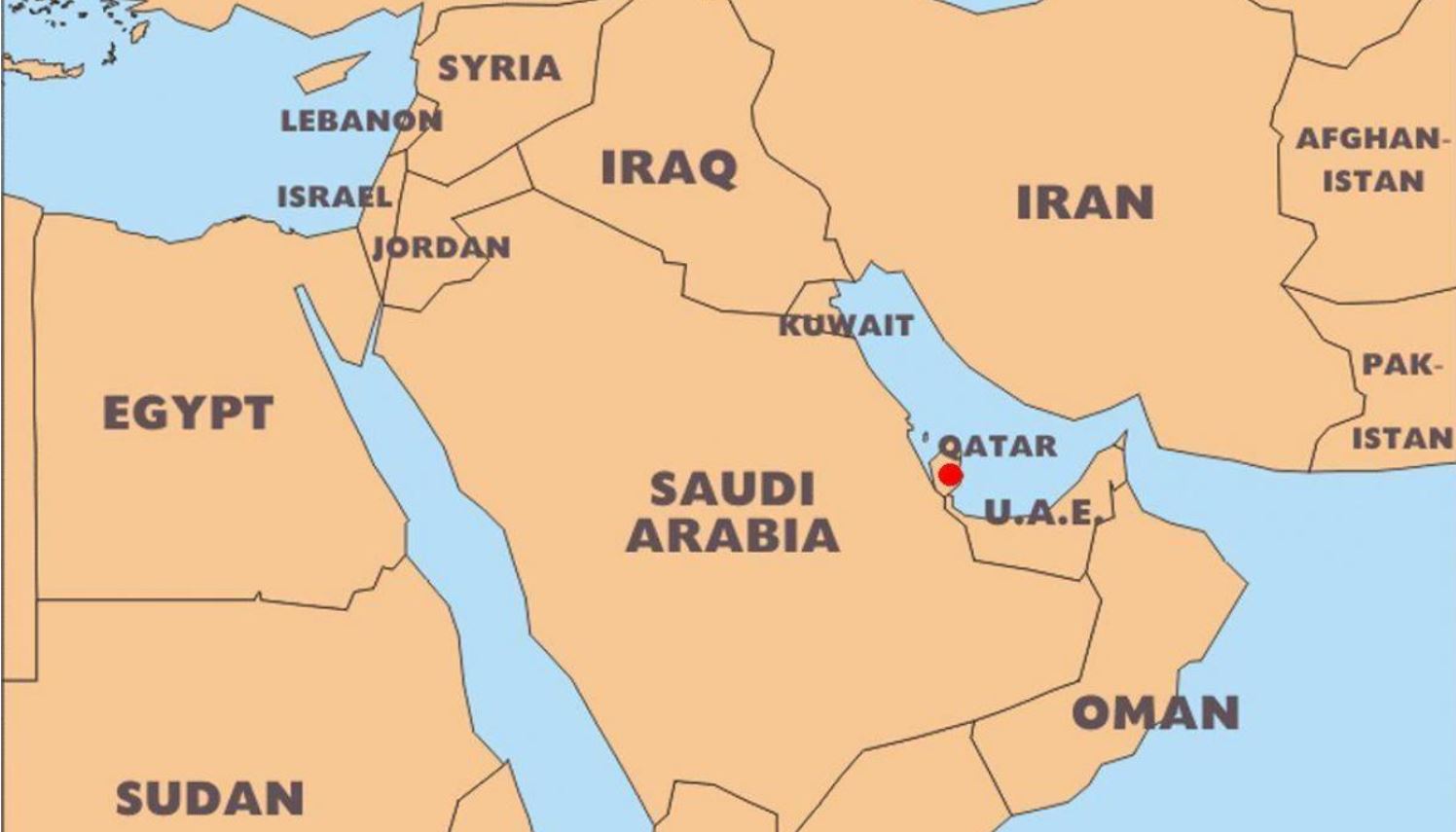
Qatar on the Middle Eastern Map.

Also, Israel is not the only country that has accused Doha of promoting religious extremism.

In the past, Saudi Arabia has repeatedly accused Qatar of supporting the Muslim Brotherhood, which is a banned organization in many Gulf countries.

In 2014, Saudi Arabia, the UAE, and Bahrain even withdrew their ambassadors from Doha, citing Qatar’s alleged interference in their internal affairs and support for the Muslim Brotherhood.

In 2017, Saudi Arabia and other Gulf countries, including the UAE, Bahrain, and Egypt, also declared an aerial and naval blockade of Qatar, accusing Doha of “adopting various terrorist and sectarian groups… including the Muslim Brotherhood,” along with Hamas, ISIS, and al-Qaeda.

For now, Qatar has managed to walk a diplomatic tightrope by delicately navigating its relationships with all these countries, as well as with non-state actors.

However, openly hostile relations with Israel could further complicate the situation, not only for Qatar, but for the US as well.

It will be interesting to see what attitude Israel’s new government, due after the October elections, adopts towards Qatar and how it will affect the heady cocktail of geopolitical relations in the Middle East.

  • Sumit Ahlawat has over a decade of experience in news media. He has worked with Press Trust of India, Times Now, Zee  News, Economic Times, and Microsoft  News. He holds a Master’s Degree in International Media and Modern History from the University of Sheffield, UK. 
  • He can be reached at ahlawat.sumit85 (at) gmail.com

The post Israel’s Qatar Ultimatum: Ex-PM Pledges to Declare Qatar an Enemy State Despite Its Strong U.S. Ties appeared first on EURASIAN TIMES.
  •  

America’s New Headache: How Iran’s Kheibar Shekan Missiles Are Challenging U.S. Air Defense Systems

Cheap, mobile, easily deployable, constantly adapting, and deadly accurate; that’s how US military officials are describing Iran’s new ballistic missile – Kheibar Shekan.

While ballistic missiles are relatively easy targets to shoot down (compared to Hypersonic missiles) due to their fixed trajectories, quite a few Kheibar Shekan have penetrated U.S. air defense systems in the Middle East, drawing the attention of U.S. military officials and security analysts.

According to unnamed U.S. officials who spoke with The Wall Street Journal, Iran has adapted its military tactics by utilizing Kheibar Shekan ballistic missiles to target U.S. bases across the Middle East, altering flight paths, speeds, and mid-air maneuvers to breach American air defenses.

Iran is increasingly depending on these cheap missiles to breach American defenses, using them as part of complex attacks, where they are fired along with a salvo of cheap drones and missiles with fixed trajectories, to confuse American air defenses.

These complex attacks, alongside the changes introduced to the Kheibar Shekan ballistic missiles to make them more lethal and harder to intercept, underscore that Iran is an adaptive adversary.

So what is this Kheibar Shekan ballistic missile that has become the new headache of the US military, and what makes it so lethal?

The Kheibar Shekan Ballistic Missile

The Kheibar Shekan, or Kheibar-buster, is named after a Jewish castle overrun by Muslim warriors in the early days of Islam.

In 628 CE, Prophet Muhammad himself led a military campaign against the Jewish communities living in the oasis of Khaybar.

It is a medium-range ballistic missile unveiled by the Islamic Revolutionary Guard Corps (IRGC) in 2022. It belongs to the Fateh family of solid-fuel missiles and has become one of the most advanced developments of Iran’s missile program.

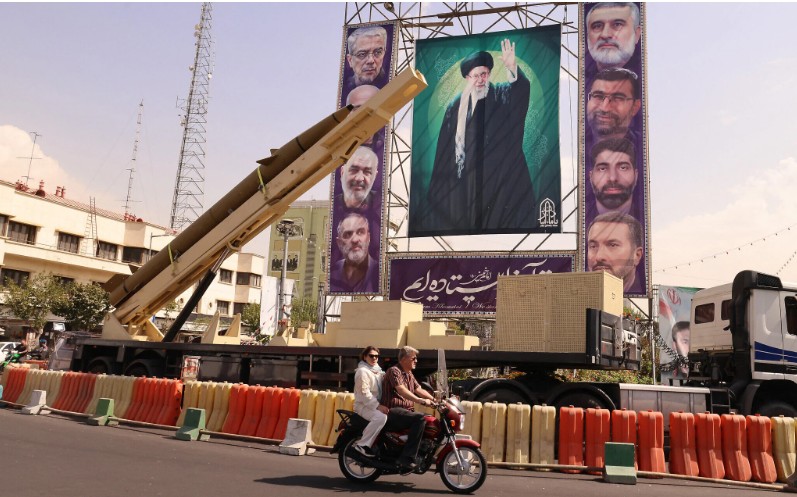
A man rides his motorcycle past a deactivated Kheibar Shekan ballistic missile in front of a picture of Iran’s Supreme Leader Ayatollah Ali Khamenei in Tehran’s Bahrestan Square on September 27, 2025, as part of an exhibit to mark the ‘Sacred Defense Week’ commemorating the 1980-88 Iran-Iraq war. (ATTA KENARE / AFP)

According to Iranian claims, the missile has a range of approximately 1,400 to 2400 km. This allows it to strike targets across much of the Middle East, including Israel. Furthermore, the missile travels at over 6,000 miles per hour.

It carries a 550 kg warhead in its nose section.

Unlike older Iranian liquid-fuel missiles, the Kheibar Shekan uses a solid-fuel propulsion system. This design has several advantages: missiles can be stored for longer periods in a ready state, require less time for launch preparation, and can quickly reposition after use.

This is a significant advance as Iran’s older missiles required lengthy prelaunch fueling, which in turn made their tracking and targeting by the US easier.

🚨 BREAKING – Iran's latest ballistic missile, Kheibar Shekan; stockpile of 50,000 units. Guided by BeiDou Navigation Satellite System (BDS‑3). Range: 2,450 km. Max speed: up to 19,500 km/h (approx. Mach 16). Warhead: approximately 550 kg. 🇮🇷 pic.twitter.com/E1jzHTxY9F

— IRGC (@IRGC_Press) July 25, 2026

However, Kheibar Shekans can be kept fueled and loaded onto trucks or other launcher vehicles quickly, making their targeting difficult.

For modern missile systems, rapid deployment has become an important factor. Even a precision-guided missile has limited effectiveness if its launchers are easy to detect and destroy.

Despite these advantages, the US was able to shoot them down easily because of their fixed, easily predictable flight paths.

Ballistic missiles travel into the upper atmosphere of space before plunging back down towards a target, usually at hypersonic speeds, but are not capable of maneuvering in the final phase of their flight.

This is where the Kheibar Shekan differs and becomes more lethal.

According to US military officials, in some of the Kheibar Shekans, the nose section of the missile, which carries the explosive warhead and detaches during the final phase of the missile, is equipped with a small engine that makes it capable of adjusting its flight path in the terminal phase as it nears its target. This final-phase maneuvering makes interception by air defense systems harder.

Another advantage is its cost. The cost ratio between offensive and defensive means is an important differentiator.

While Iran has not officially disclosed the cost of the Keibar Shekan, experts believe that it is significantly cheaper than the interceptors employed by the US, such as Patriots, THAAD, and the US Navy’s SM-6 interceptors.

For instance, an SM-6 interceptor missile can cost about US$4–5 million, and a PAC-3 MSE missile for the Patriot system costs approximately US$4–6 million per unit.


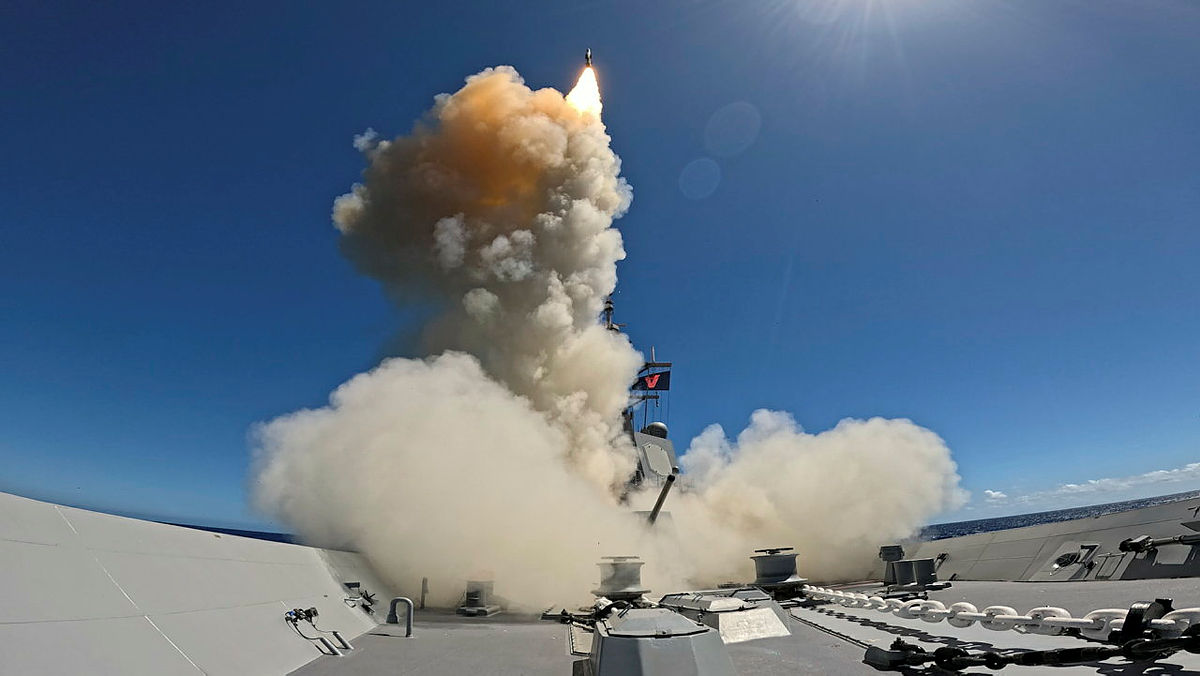
File Image: SM-6 fired from HMS Sydney during Exercise Pacific Dragon

The significantly lower price tag of Kheibar Shekan creates the problem of ‘cost depletion of air defense,’ as even a successful interception would hurt the US more due to the higher cost of replacing its interceptor munition.

Additionally, according to some reports, the satellite-guided missile now uses China’s BeiDou Navigation Satellite System (BNSS), which increases its precision.

The mobility, rapid deployment, precision, final-stage maneuverability, and cost of the Kheibar Shekan make it a deadly missile.

However, the Iranian strategy of launching them alongside dozens of high-speed drones and other ballistic missiles makes their interception even harder.

According to defense and security expert Patricia Marins, Iran had a stockpile of about 2,000–2,200 Kheibar Shekan before the 12-day war, and today, after the conflict with the U.S., it still has some 1,700 missiles in its arsenal.

She further estimates that nearly a third of the Kheibar Shekan missiles have been upgraded to the BeiDou Navigation Satellite System.

“I think what it tells us is Iran is paying attention, and they’re learning and they’re looking at ways that they can get at use,” retired Army Gen. Joseph Votel, who has led the US Central Command, told the WSJ.

Iran “has seen what types of maneuvers are the most effective ones for overcoming missile defense,” said Fabian Hinz, an independent missile expert. “Every single combat use gives you some sort of data, so that’s very useful for the Iranians.”

Meanwhile, another headache for the US is its declining stockpiles of interceptors.

Declining Interceptor Stockpile of US Military

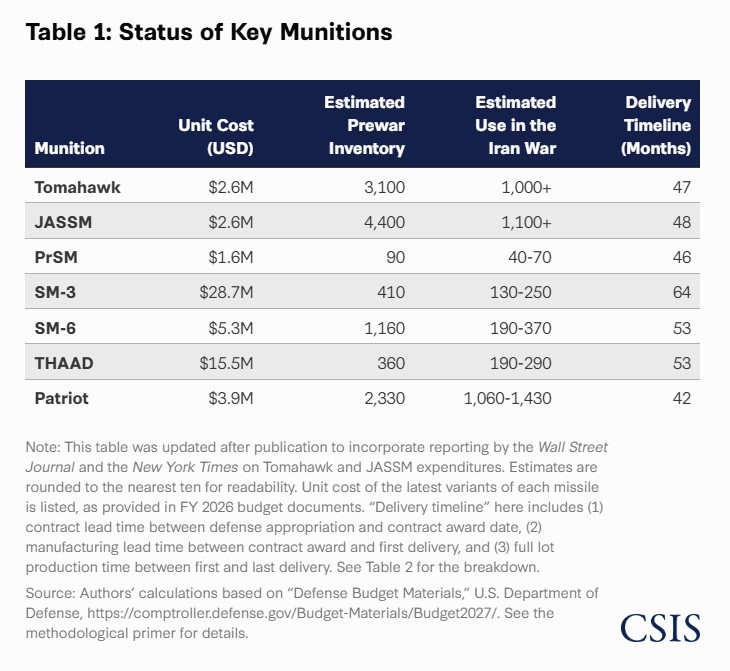
In April, in a detailed study, the Center for Strategic and International Studies (CSIS) estimated that by that time, the US had already expended nearly half of its SM-3 missiles, nearly a quarter of its SM-6 missiles, two-thirds of its THAAD interceptors, and more than half of its pre-war stock of Patriot interceptors.

Credits CSIS.

This declining stockpile of interceptors means that the US is forced to prioritize which incoming projectiles to intercept, and it is deliberately allowing some Iranian projectiles to pass through its defenses.

The U.S. military commanders have been picking and choosing which Iranian missiles and explosive-packed drones to intercept and are allowing some attacks through their defenses, amid an effort to preserve the Pentagon’s diminishing supply of weapons that block projectiles from reaching their targets, two senior U.S. officials told NBC News.

U.S. officials also said that in some cases the military deliberately allowed Iranian missiles and drones to hit U.S. bases if no personnel were stationed there.

Some defense experts have opined that this declining stockpile of interceptors was a key factor for the US to pause its airstrikes on Iran on July 27.

According to the New York Times, U.S. President Donald Trump backed away from escalating the war against Iran after advisers warned him about the risks of depleting America’s missile stockpiles.

According to officials, Washington believes that Russia and China are closely monitoring the pace at which U.S. military stockpiles are being depleted and could factor this into their planning for military actions.

However, depleting U.S. interceptor stockpiles and open acknowledgments by U.S. officials that the new Iranian strategy, combined with improved missiles such as Kheibar Shekan, is making interception even harder. This means that Tehran will bargain hard for concessions in its talks with Washington.

  • Sumit Ahlawat has over a decade of experience in news media. He has worked with Press Trust of India, Times Now, Zee News, Economic Times, and Microsoft News. He holds a Master’s Degree in International Media and Modern  History from the University of Sheffield, UK. 
  • He can be reached at ahlawat.sumit85 (at) gmail.com

The post America’s New Headache: How Iran’s Kheibar Shekan Missiles Are Challenging U.S. Air Defense Systems appeared first on EURASIAN TIMES.

  •  

After Saudi Arabia, Pakistan Formalizes Defense Pact with Kuwait Amid Gulf Security Crisis and US-Iran War

Three years after signing a broad defense cooperation agreement with Pakistan, Kuwait has reportedly ratified the pact with Islamabad. 

The agreement was approved through decree-law no. 73 of 2026 and published in the official gazette Kuwait Al-Youm on July 26.

The pact establishes a framework for cooperation between the two armed forces, focusing on military training, education, intelligence sharing, logistics, defense technology, research and exchanges of expertise, with the aim of strengthening institutional military ties between the two countries, Kuwait Times reported.

The agreement also includes cooperation in military manufacturing, electronic communications systems, scientific research, military media and cultural and sports activities. A joint military committee will oversee implementation, including organizing exercises, official visits and other joint programs.

It also includes provisions governing the protection of classified information exchanged between the two sides, preventing the transfer of confidential documents or materials to third parties without prior written approval.

According to reports, the agreement will remain in force for five years and will be automatically renewed unless either country chooses to withdraw.

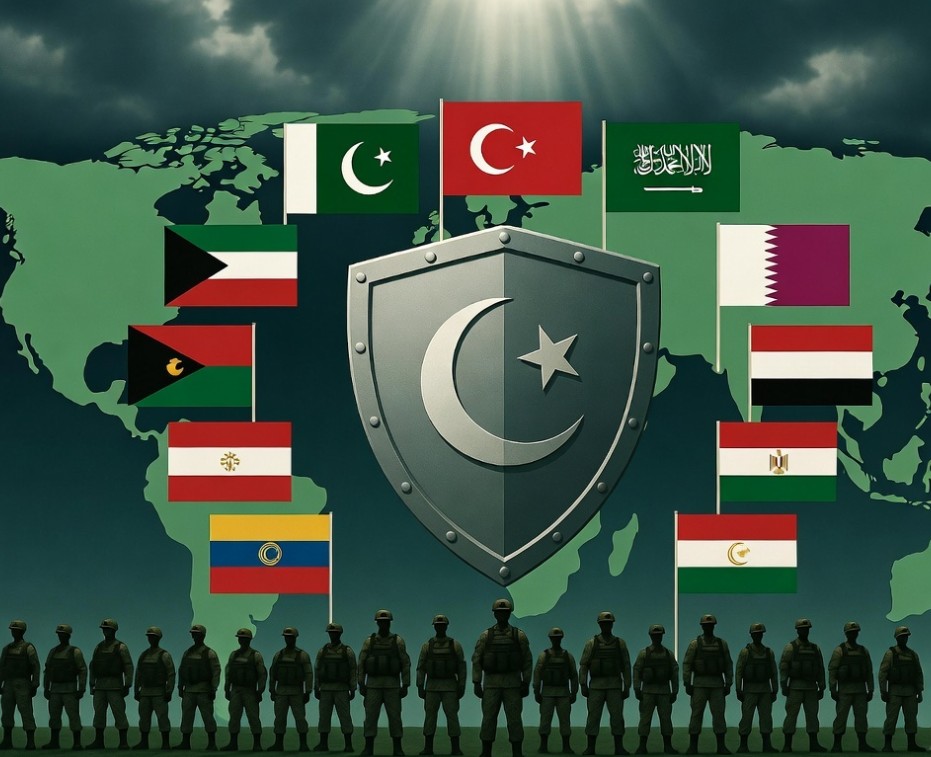
Islamic NATO. AI Image for representation only.

The agreement was ratified at a time when all Gulf countries, including Kuwait, are facing renewed security challenges due to the ongoing US-Iran War.

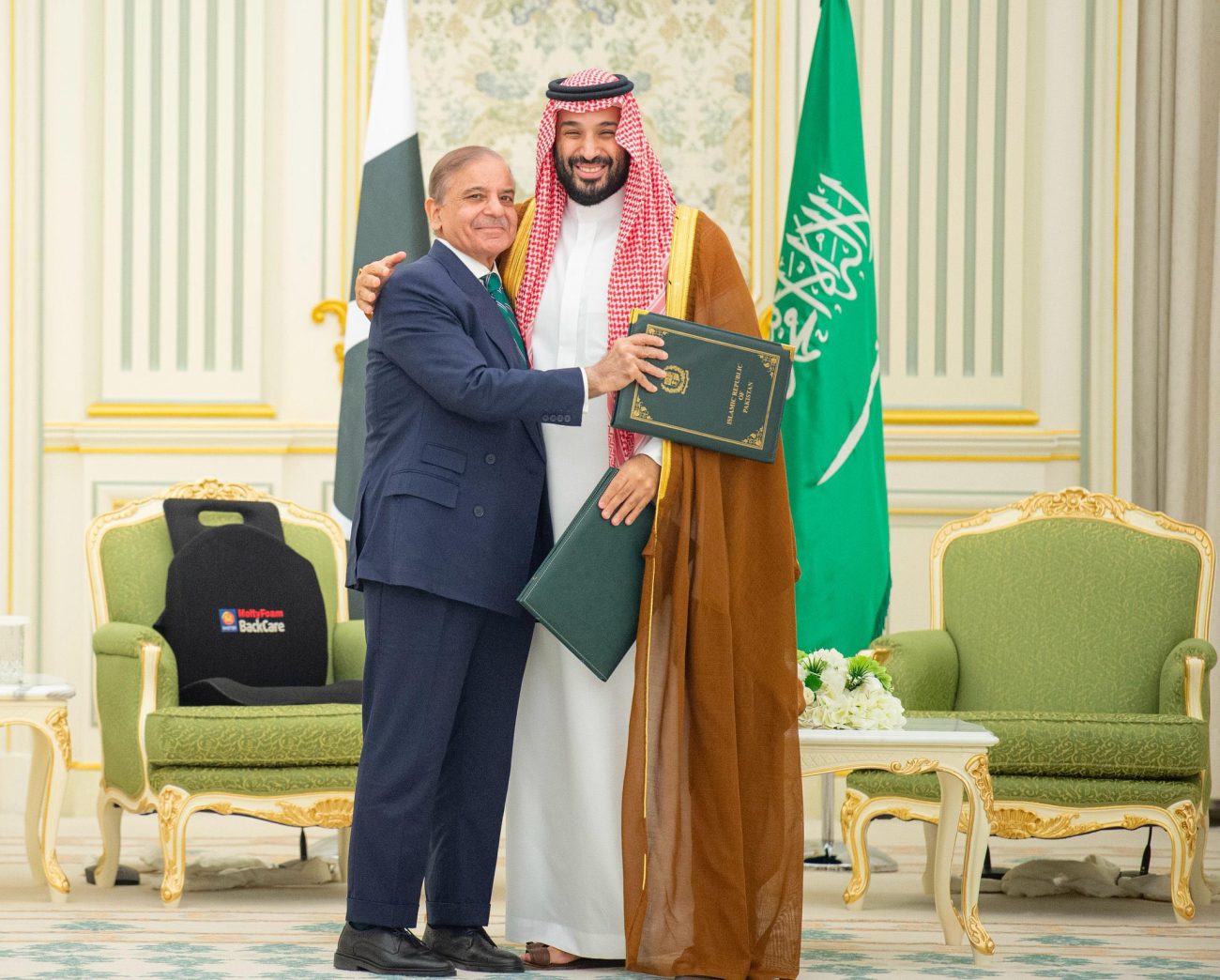
Notably, just one and a half years ago, Pakistan signed a defense agreement with Saudi Arabia, which also included a mutual defense clause on the lines of NATO’s Article 5, wherein an attack on one country is considered an attack on both countries, obliging the other country to provide military, economic, intelligence, and diplomatic support to the attacked country.

Earlier, Pakistan had suggested that Turkey and Qatar are also considering joining the Pakistan-Saudi Strategic Mutual Defense Agreement (SDMA).

Pakistan-aligned strategic thinkers even quipped that the agreement will bring in Turkish arms, Pakistani nuclear weapons, and Saudi and Qatari Petro-dollars and energy security.

While the Pakistan-Kuwait defense agreement does not include a mutual defense clause on the lines of NATO’s Article 5, the signing of the agreement will nevertheless further ignite speculation about an Islamic NATO in the making, which will seek a collective security arrangement outside traditional Western frameworks and independent of the United States.

However, talks of an Islamic NATO are largely symbolic rather than substantive, constrained by deep-seated internal rivalries, enduring structural dependence on the United States, and broader geopolitical calculations that render it operationally unviable and impractical.

In fact, the narrative of an Islamic NATO, largely driven by Pakistan, echoes the earlier rhetoric of an “Islamic bomb” that Islamabad promoted throughout the 1970s and 1980s, a vision that ultimately came to nothing.

A West Asian Security Architecture Without the US?

For decades, all West Asian countries, with the sole exception of Iran, have depended on the US for their defense and security.

In fact, the US has as many as 18 military bases in the region.

The US has strategic security partnerships with Saudi Arabia, Egypt, Jordan, Kuwait, Bahrain, the UAE, and Qatar.

Turkey, meanwhile, is a NATO member. It also hosts American nuclear weapons at the Incirlik Air Base as part of a NATO nuclear-sharing agreement. An estimated 20 to 50 B61 nuclear gravity bombs are stored there under US control, though Turkey has no independent authority to use them.

However, ever since the Hamas terror attacks on Israel in October 2023, the West Asian region has been going through a churning.

In the aftermath, Israel declared its goal of ‘Total Victory’ and has since attacked six regional countries, including Palestine, Lebanon, Syria, Qatar, Yemen, and Iran. While Israel has often had brief wars and skirmishes against the first three (Palestine, Lebanon, and Syria), it attacked Yemen, Qatar, and Iran for the first time.

The Israeli “belligerence” is believed to have fueled collective insecurities and made Gulf states look for new security guarantees and new partners.

In September 2025, Pakistan and Saudi Arabia signed the Strategic Mutual Defense Agreement (SDMA) on the lines of NATO’s collective defense clause. The most important clause of the agreement states, “Aggression against one country shall be considered aggression against both.”

While not explicitly stated, some Pakistani leaders, including Defense Minister Khwaja Asif, had suggested that the agreement extend Pakistan’s nuclear umbrella protection to Saudi Arabia.

Notably, the agreement was signed just weeks after an Israeli airstrike on Qatar on September 9, 2025, which reportedly took even Washington by surprise.

Qatar hosts the largest US military base in the region, but that was not enough to deter Israel.

In the same month, Doha signed a new security pact with the US, in which Washington explicitly pledged Qatar’s security.

“The United States shall regard any armed attack on the territory, sovereignty, or critical infrastructure of the State of Qatar as a threat to the peace and security of the United States,” it said, adding, in the event of such an attack, the United States shall take all lawful and appropriate measures — including diplomatic, economic, and, if necessary, military — to defend the interests of the United States and of the State of Qatar and to restore peace and stability.

However, the US-Iran War that began earlier in February this year once again destabilized the entire region and demonstrated the inability of the US to provide foolproof security in the region.

In the aftermath, Iran attacked Jordan, Iraq, Israel, the UAE, Kuwait, Bahrain, and Saudi Arabia.

The US’s inability to thwart these attacks is further pushing Gulf countries to explore new security partners. In this atmosphere of geopolitical upheaval, Pakistan is pushing itself as a credible security partner that can fill the vacuum left behind by the US.

Can Pakistan Deliver Its Promises on Security

Since Pakistan and Saudi Arabia signed their much-publicized mutual defense agreement, Pakistan has been fighting a war with Afghanistan, whereas Saudi Arabia was repeatedly attacked by Iran.

Last week, Yemen’s Houthi rebels launched attacks on Saudi Arabia and have now declared a naval blockade of the country.

As per the terms of the agreement, by now Pakistan should have declared a war on Iran and the Houthis, and Saudi Arabia should have declared a war on Afghanistan. However, neither has this happened, which highlights that the mutual defense clause has loopholes.

Crown Prince Mohammed bin Salman and Pakistan’s Prime Minister Shehbaz Sharif sign the Joint Strategic Defense Agreement

In fact, far from attacking Iran, Pakistan was hosting the US-Iran peace talks on its territory, even when Saudi oil fields were under Iranian attacks.

Security analysts have already highlighted that Riyadh is unlikely to come to Islamabad’s aid if there is war between India and Pakistan.

In fact, under Crown Prince Mohammed bin Salman’s Vision 2030, Saudi Arabia is pursuing economic transformation and requires strong partnerships with major economies. Riyadh views India as a long-term economic partner as it diversifies away from oil dependence.

Islamic NATO a Myth?

Despite the rhetoric from Islamabad, the fact remains that all these countries of the prospective Islamic NATO are heavily dependent on the US for their defense and security.

Turkey is already part of NATO, and Qatar has also signed a mutual defense agreement with the US.

It is beyond comprehension why these countries will swap US security guarantees for Pakistani ones.

Meanwhile, Pakistan, often portrayed as a central pillar of this imagined alliance because of its nuclear capability, itself operates under severe constraints, as its economic, financial and military dependence on the US remains overwhelming.

Pakistan needs Washington’s blessings for constant IMF bailouts that keep its economy afloat.

Washington’s influence over the Pakistani military establishment and its decision-making process can hardly be overestimated. It is inconceivable that in any potential conflict between Israel and any Gulf state, Pakistan would launch an attack on Israel.

In fact, the very term NATO is misleading as NATO is not just a mutual defense agreement signed between various states; rather, it is a deeply institutionalized military bloc, with integrated command structures, regular joint training, shared military doctrines, common and interoperable weapons systems, and decades of coordination.

This structure can not be replicated by merely signing an agreement.

Additionally, deep-seated internal rivalries between Islamic states – Saudi Arabia vs Iran, Turkey vs Arab states, Egypt vs Turkey, the new emerging axis of Saudi Arabia against the UAE, and the aspirations of Pakistan itself to portray itself as the natural leader of the Islamic world- make any Islamic NATO alliance a non-starter.

And, lastly, the biggest myth is that the US is withdrawing from the Middle East, and the Gulf States are looking for partners to replace US security guarantees.

While Gulf states are actively seeking to diversify their security alliances and signing defense pacts with new partners, they aim to complement rather than replace their existing arrangements with the United States.

In fact, there is an argument that the recent military pacts, such as the Saudi-Pakistan and Pakistani-Kuwaiti defense pacts, enjoy tactical US support.

The US and Israel will not tolerate an Islamic NATO forged in opposition to Western domination, and an Islamic NATO, forged with the tactical support of Washington and Jerusalem, will have no strategic autonomy to formulate an independent security policy.

  • Sumit Ahlawat has over a decade of experience in news media. He has worked with Press Trust of India, Times Now, Zee  News, Economic Times, and Microsoft News. He holds a Master’s Degree in International Media and Modern History from the University of Sheffield, UK. 
  • He can be reached at ahlawat.sumit85 (at) gmail.com

The post After Saudi Arabia, Pakistan Formalizes Defense Pact with Kuwait Amid Gulf Security Crisis and US-Iran War appeared first on EURASIAN TIMES.

  •  

GCAP For India: Leonardo CEO Says Join 6th-Gen UK-Japan-Italy Fighter Jet Program by End-2026 or Miss the Boat

After Canada became the first country to join the Global Combat Air Program (GCAP) as its first observer nation, Lorenzo Mariani, CEO of Leonardo, said at Farnborough that if a nation wishes to join the GCAP program, it must do so by the end of 2026, with a final deadline of 12 months

The tri-national Global Combat Air Program, launched in 2022, aims to develop a supersonic sixth-generation stealth fighter by 2035 to replace the Eurofighter Typhoon used by some European countries and Japan’s Mitsubishi F-2.

Earlier this week, Canada confirmed it is joining GCAP as an observer country. While Canada’s observer status does not make it a full program partner, it will still provide Ottawa with greater visibility of GCAP’s governance, capabilities and industrial structure, as it looks to diversify its defense partnerships away from the US.

Meanwhile, following the collapse of the Franco-German-Spanish Future Combat Air System (FCAS), Germany is also exploring its options for joining the GCAP.

On July 22, Germany’s largest fighter jet manufacturer, Airbus Defense and Space, said at the Farnborough Air Show in the UK that it was open to joining forces with Britain, Italy and Japan on the GCAP program. 

The head of Airbus’s defense division in Munich, Michael Schoellhorn, said the company could collaborate with the UK on developing the new aircraft if it had sufficient control over the program and work share. 

“What we’re ready to do is to join something or to build something where we have a significant portion of the work and the leadership. That’s currently being explored,” Schoellhorn told reporters.

Separately, Leonardo chief executive Lorenzo Mariani said on the sidelines of the Farnborough airshow that German participation in GCAP would be “beneficial”.

Mariani said “strong competence of the German industry, debt funding capability from the German state and joint experience within the community” on previous fighter jet projects would be beneficial for all partners.

“The only real risk is disruption in timescales and work share,” he said.

While the FCAS Collapsed, GCAP gained momentum after receiving a major funding boost this month with the award of a £4.6 billion (approximately US$6.1 billion) contract from the UK-Japan-Italy to continue its development.

On July 3, the GCAP awarded the 18-month contract to Edgewing, the trinational joint venture of BAE Systems (UK), Leonardo (Italy), and Japan Aircraft Industrial Enhancement (JAIEC).

This came shortly after the UK’s Defense Investment Plan committed £8.6 billion (US$11.5 billion) in UK funding to GCAP over four years, ending months of uncertainty and delays.

The momentum gained by GCAP, the recent funding boost, and Canada’s accession as an observer country will definitely enhance GCAP’s appeal to countries seeking to join a sixth-generation project.

In fact, after the collapse of FCAS, GCAP is the only practical option available to countries, as both the US (F-47) and China (J-36 and J-50), which have sixth-generation fighter jets under development, are not looking for international partners.

France’s Dassault has announced plans to pursue a next-generation fighter jet development program and is seeking partners, but the program is still in its infancy, and Paris has been an “unreliable partner” in joint fighter jet development programs.

In its presentation of its half-year results, Dassault Aviation stated that “discussions are under way with the French government to launch an alternative, either on a purely French basis or through cooperation, involving a demonstrator for a future combat aircraft.”

Éric Trappier also said that the aim would be to secure “a demonstrator, based on French requirements, which could fly in 2031 or 2032.” However, he also clarified that Dassault would not be interested in an arrangement in which the French aircraft manufacturer would be lead contractor without sufficient industrial control.

This non-compromising attitude, single-minded focus on French requirements, and France’s previous unreliable role in joint fighter jet development programs, including FCAS, Eurofighter Typhoon, and Tornado, mean that any country seeking to join a reliable sixth-generation fighter jet program has only one credible option: the GCAP.

New GCAP Concept Aircraft.

Can India Join GCAP?

In March this year, India announced that it is considering joining one of Europe’s ambitious ‘sixth-generation’ fighter jet programs.

The 20th report of the Standing Committee on Defense said the IAF is exploring collaboration with one of two European consortia currently working on sixth-generation fighters.

“The committee has been informed that two consortia are working on the sixth-generation aircraft. One is a consortium of the UK, Italy and Japan and the other is a consortium of France and Germany, and both are developing aircraft. The committee has also been informed that Air Force (IAF) will try to join forces with one of the consortia and begin considering a sixth-generation fighter right away with a view to ensure that they do not lag behind in achieving the target for advanced aircraft.”

The IAF is in a dire state now as not only is it critically short on squadron strength, but it is also trailing behind China in next-generation fighter jets. Though the IAF’s authorized strength is 42 fighter squadrons, it now has only 29 active fighter squadrons.

Also, China already has over 300 fifth-generation J-20 stealth fighter jets and is on its way to operationalizing a second stealth fighter, the J-35. China is also testing two sixth-generation fighter jets, the J-36 and the J-50.

Reportedly, Pakistan is also planning to buy  J-35A jets from China.

“The committee understands that in view of technical advancement of fighter aircraft globally and to meet the present security scenario, technical upgradation of aircraft is required on top priority for enhancement of its combat capability. The committee recommends the ministry to chalk out a trajectory in this regard and step forward the planning process for development and acquisition of sixth-generation (6G) aircraft which would eventually enhance India’s air domain capabilities in today’s highly air-centric modern warfare,” it said.

The standing committee shortlisted two consortiums: GCAP and FCAS.

However, since the FCAS has already collapsed, the only realistic option for India is to join GCAP.

Also, India has already received an invitation from GCAP to join the program. Japan reportedly approached India to join the GCAP program earlier this year.

Japanese officials visited India in February. They explained the Japan-UK-Italy “Global Combat Air Program (GCAP)” to Indian officials and proposed their participation.

Following the reports of Japan’s offer to India to join GCAP, an editorial in Japan Times in June 2025 said that “the idea of including India, one of the world’s fastest-growing economies and an increasingly assertive geopolitical actor, makes strategic sense.”

It further said that including India in GCAP could re-energize the Japan-India relationship by offering a “high-stakes, high-visibility partnership that aligns with India’s long-term security and technological ambitions.”

“Including India could bring financial investment, manufacturing capacity and political clout to the initiative,” it said.

However, it suggested that India should join GCAP around 2027-2028, when the project has already passed the foundational design and industrial division phases.

Earlier, the UK had also reportedly invited India to join its Tempest program, the predecessor to GCAP. “We are looking for international partners to access the best assured capability [for developing the Tempest],” Nik Khanna, the head of BAE Systems India, was quoted as saying by the Business Standard. As to India’s specific role in the Tempest project, Khanna said: “A big cost driver for a futuristic aerospace system is going to be the requirement for more and more software engineers. India has a huge capability in that area.”

Several military experts and veterans who have spoken to the EurAsian Times in the past have said: buy Rafales to manage squadron strength and bolster numbers, develop the fifth-generation AMCA for long-term capability, buy off-the-shelf Su-57 fifth-generation fighters to bridge the current stealth gap with China, and join a sixth-generation fighter program to stay ahead of the curve.

The GCAP has set a very ambitious target: to fly its first demonstrator by 2027 and field the aircraft by 2035.

If India joins GCAP, it could have a sixth-generation fighter jet by 2035, bridging the widening capability gap with China.

Furthermore, participation in a sixth-gen fighter jet program could also help India in its own underdevelopment fifth-generation fighter jet program, the AMCA.

Retired Air Marshal Sanjeev Kapoor (former Director General, Inspection and Flight Safety, IAF) said, “India should Look East in fighter jet manufacturing. Japan runs the F-35 final assembly line and is working on FX platforms; India must partner with Japan on #GCAP (fresh MoD invite, Mar 2026) & South Korea on KF-21-style programs to set up full co-production & final assembly right here in India… To fast-track, we must use the model of global tech + distant local manufacturing, which leads to jobs, tech sovereignty & Atmanirbharta. Added advantage, Asian Value System which is different.”

  • Sumit Ahlawat has over a decade of experience in news media. He has worked with Press Trust of India, Times Now, Zee News, Economic Times, and Microsoft News. He holds a Master’s Degree in International Media and Modern  History from the University of Sheffield, UK. 
  • He can be reached at ahlawat.sumit85 (at) gmail.com

The post GCAP For India: Leonardo CEO Says Join 6th-Gen UK-Japan-Italy Fighter Jet Program by End-2026 or Miss the Boat appeared first on EURASIAN TIMES.

  •  
❌