The charred body of a man was found inside a car on fire on Tuesday when firefighters rushed to extinguish a fire in Pikermi village in eastern Attica, on August 11, 2026. The fire on the vehicle is believed to have started a wildfire in the surrounding area. The body reportedly belonged to a man, […]
Prime Minister Kyriakos Mitsotakis was shortly hospitalized in the general hospital of Chania on the island of Crete after an accident with his bicycle yesterday Monday. According to information from local media zarpanews.gr, the accident occurred when the front wheel of the bicycle “slipped”, causing the Prime Minister to lose his balance and fall to […]
The Greek countryside is deserting, the villages are “extinguishing” and banks have no interest in the areas. Greek Finance Minister and Eurogroup chief, Kyriakos Pierrakakis, had a brilliant idea: village cafes to operate as ATMs, facilitate citizens to come to cash. According to a report by aftodioikisi.gr, in most of the remote villages, there is […]
Two wildfires on the island of Zakynthos – Zante – on Tuesday mobilized strong firefighting forces and aerial means and forced the evacuation of a village. The first wildfire that broke out early Tuesday in the Marathias area of Keri was fully contained within a few hours, while a separate blaze triggered the evacuation of […]
The total outstanding liabilities of General Government entities to private individuals and businesses fell by 168 million euros in June, declining to 3.55 billion euros from 3.718 billion euros in May. However, over the first six months of the year, they have increased by 251 million euros compared with the 3.299 billion euros recorded in […]
The wildfire in eastern Attica on Monday, August 10, that broke out on Monday morning in Kouvaras, eastern Attica, is being attributed to sparks caused by contact between low-voltage cables belonging to the Hellenic Electricity Distribution Network Operator (DEDDIE/HEDNO). This are the findings of the Fire Brigade’s investigative authorities so far, state-run news agency amna.gr […]
An Italian tourist suffered heavy head injuries after she was swept away by the blast of turbines of a passenger airplane taking off from the airport of the island of Skiathos in the Aegean Sea. The serious accident occurred at noon on Monday, August 10, and the 52-year-old woman had to be airlifted for emergency […]
Despite the red flags warning of dangerous weather conditions placed on a beach in Chania on the island of Crete, a tourist entered the water risking her own life as well as the lives of those who rushed to rescue her. The 60-year-old woman ignored the warning red flags im Kavros beach in Apokoronas and […]
Greece’s Civil Protection warns of Very High Fire Risk (risk category 4) for tomorrow, Tuesday, August 11, 2026. The Very High Fire Risk is due to the strong summer winds (meltemia) and the dry and hot weather in the last weeks. Affected are again the region of Attica and several others, mainly belonging to the […]
A Greek magistrate has ordered the Fire Brigade’s arson division to examine all wind farms in Greece, following the megafire in Viotia that spread to western Attica and destroyed thousands of acres of forest land and burned down around 100 homes in the last days of July and the first of August 2026. According to […]
Greece’s central bank sees the further participation of foreign financial institutions in the share capital of Greek banks as absolutely desirable, Bank of Greece governor Yannis Stournaras said in statements to the German newspaper “Handelsblatt” on Monday. He noted that further participation of global financial institutions on the path toward a European banking union would […]
Italian police officers are patrolling on the streets of Athens together with their Greek colleagues. The new policing program following an agreement between Greece and Italy in 2025. Greece and Italy have launched joint police patrols in Athens and Rome in August 2026, implementing the 2025 agreement to strengthen public security, prevent crime and better […]
Over 200 firefighters and volunteers assisted by water-dropping helicopters and aerial means have been struggling against a wildfire in eastern Attica since early on Monday morning. One settlement already evacuated. Strong winds blowing with intensity of 7 Beaufort and gusts up to 8-9 B and changing their direction make the combat difficult. The fire […]
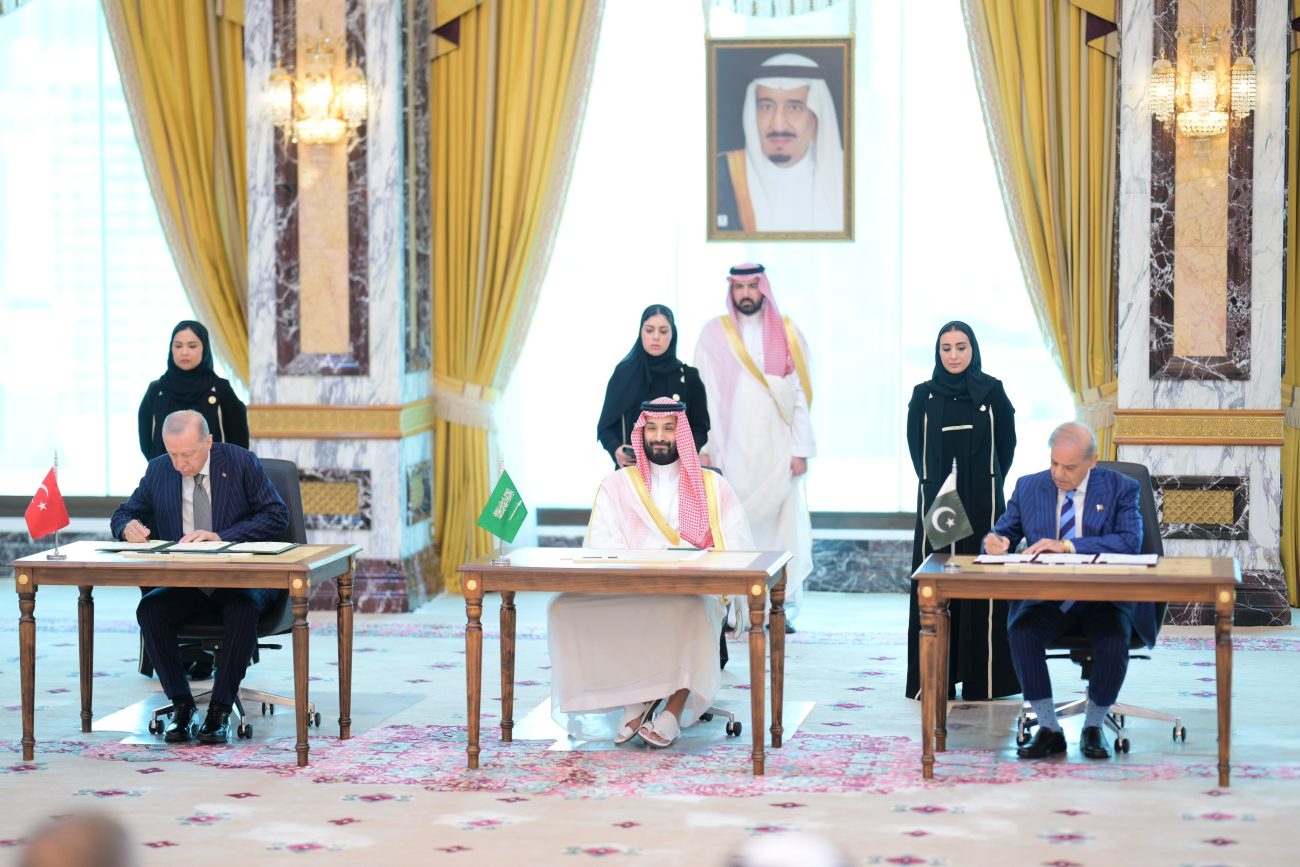
Pakistan, Saudi Arabia, and Turkey recently signed the “Mecca Joint Defense Agreement”. Many analysts believe this trilateral pact is aimed at checking Iranian and Israeli “hegemony” in the tumultuous Middle East region.
Meanwhile, the biggest question running through India’s nearly 1.5 billion people is how this trilateral defense pact will impact India, which has fought multiple wars with Pakistan and maintains a tense relationship with Islamabad.
Despite hogging global media limelight for playing the role of mediator in the ongoing Iran war, Pakistan’s position back home looks scary with relentless terror attacks and a deteriorating security situation.
Pakistan continues to face tremendous domestic pressures. Protests in Pak-controlled Kashmir have intensified since mid-2026, with scores of innocent protesters killed by the security forces.
Islamabad imposed a communication blockade, ordered foreign journalists to leave the region, and limited access to international media outlets, including Al Jazeera’s digital platform.
This is no ordinary region. India claims the Pak-controlled Kashmir as its own and has vowed to integrate it with Jammu and Kashmir. Reportedly, pro-India slogans and flags were seen in the demonstration.
Then, regions like Balochistan and Khyber Pakhtunkhwa (KPK) are Pakistan’s Achilles’ heel. Separatism in these two regions appears to have gone beyond the control of the Pakistan Army, and looks as volatile as East Pakistan (now Bangladesh) during 1971. The question is how long Pakistan can hold these two regions, and at what cost.
Dismal economic conditions, disgruntled population, and heightened tensions with neighboring India and Afghanistan have intensified Pakistan’s problems. The question is: does Pakistan have the financial muscle or resources to fight a five-front conflict — Balochistan, KPK, Kashmir, India and Afghanistan, simultaneously?
On top of it, Pakistan has signed a defense pact with Saudi Arabia and Turkey, which means they should be prepared to fight outside the country as well, probably against Houthis in Yemen. That would open a sixth front.
Indian military exposed Pakistan’s defense architecture during Operation Sindoor last year in May. India not only managed to breach Pakistani defenses to hit multiple terror targets in the first wave of attacks, but India also launched precision strikes that impaired critical Pakistani military infrastructure across the country.
Indian military targeted multiple airbases including Nur Khan (Chaklala) near Rawalpindi, Mushaf (Sargodha), Murid, Rafiqui, Rahim Yar Khan, Sukkur, Jacobabad, Bholari, and others—using supersonic BrahMos and other precision munitions.
Satellite imagery confirmed the heavy damage, including destroyed runways, hangars, command-and-control centers, and loss of up to 14 aircraft (as per IAF) and scores of personnel on the ground. Pakistan also claimed downing multiple Indian jets, but it could hardly penetrate the Indian air defense network, led by the S-400.
Operation Sindoor demonstrated that Pakistan’s defenses could be easily penetrated and its Air Force could be crippled even with limited, restrained strikes.
Meanwhile, Turkey is already a member of NATO, arguably the most powerful Islamic country in terms of military. It does not really need Pakistan or Saudi Arabia to defend itself. Saudi Arabia, on the other hand, has been battered by Iran and Houthi rebels. But when the US could not completely defend it, what can Pakistan and Turkey do?
In the case of Pakistan, it is the most vulnerable of the three.
The Mecca Joint Defense Agreement, signed on 7 August 2026 by Pakistan, Saudi Arabia, and Turkey, assumes utmost importance for Islamabad. The pact’s core clause treats an armed attack on any one party as an attack on all three.
It directly follows the September 2025 Strategic Mutual Defense Agreement between Pakistan and Saudi Arabia.
For Riyadh, it’s another insurance policy, but for Pakistan—still repairing airbases more than a year later—the pact is aimed at sending a strong deterrence message to India, which has pledged a devastating response to any terror attack on the country.
File Image
Collective defense commitments from Riyadh and Ankara are sure to boost Pakistan’s morale, but Turkey (and Saudi Arabia) have been supporting Pakistan since 1947 and have never managed to turn the tide against India.
For instance, during the 1971 war, Turkey provided critical military and diplomatic support to defend Pakistan’s territorial integrity. Operating under the CENTO defense pact, Ankara provided substantial material support to Pakistan by providing aircraft assistance and military hardware, but to little avail.
Even politically, Turkey refused to recognize the newly independent state of Bangladesh for over two years. It only recognized Bangladesh in February 1974 after Pakistan did.
Meanwhile, India has already established strong military ties with Ankara’s adversaries, Greece, Cyprus, and Armenia. India also shares robust military ties with Israel. There might not be a formal agreement on paper, but India-Israel ties go beyond any melodramatic pact.
No doubt, the Mecca pact embeds Pakistan in a broader Islamic-world security architecture at a moment when its conventional defenses have been publicly tested while the country’s biggest province, Balochistan, continues to fight for its liberation, just like East Pakistan (now Bangladesh).
For a country simultaneously battling insurgencies in Balochistan, Khyber Pakhtunkhwa, and Pakistan-administered Kashmir while managing tense borders with both Afghanistan and India, the Mecca defense pact is far more valuable to Pakistan than it is to either Saudi Arabia or Turkey.
Nitin J Ticku holds a double master’s degree in Journalism and Business Management from the University of Glasgow. He has over 20 years of global experience in MARCOM, Journalism, and Digital Marketing, and has worked & traveled widely across Europe, the Americas, and Asia. Nitin is the Editor of the EurAsian Times.
This is an Opinion Article
He can be reached at editor (at) eurasiantimes.com
What do Greeks mean when they speak of food dishes as “orphans” or “married”? As the month of August is practically and eagerly seeking for light news this is a good opportunity to enlighten my non-Greek audience about critical descriptions in the popular terminology of the Greek Food Culture. Both “orphans” and “married” refer to […]
Greece is considering to deploy two Apache attack helicopters to the United Arab Emirates with the aim to hunt drones. The two AH-64D Apache attack helicopters will provide support for the protection of military bases and critical infrastructure against drone attacks. Under the mission, Greek pilots and technical personnel are planned to serve at a base […]
Swimming and all marine activities have been banned in part of the Ardani area on the island of Karpathos on Sunday, August 9, after objects believed to be munitions were discovered. According to information obtained by state-tun news agency amna.gr, the items are believed to be old munitions. The Hellenic Coast Guard has cordoned off […]
The specter of a “Red-Green Alliance” seems to be haunting the strategic elites not only in the United States but also in other parts of the world these days.
The debate over this alliance between so-called Leftists and Islamists intensifies whenever a Muslim leader in the American Democratic Party secures an important nomination or an electoral victory.
It is not that these Muslim leaders in America are radical Islamists. They are essentially far-left in their political, economic, and global views and are being accepted as leaders within the Democratic Party. But they evoke apprehensions for their support of Islamists in all parts of the world on important global strategic issues.
The subject of the latest debate is Abdul El-Sayed, the progressive doctor and former Wayne County health director, who on August 4 won a historic victory in the Democratic primary in Michigan to join the Senatorial race in the upcoming November 2026 midterms.
If successful, he will be creating history as the first Muslim Senator in the history of the United States.
Of course, the Democratic Party has already seen elsewhere the rise of Muslim elected officials who often act as a bridge between progressives and Muslim advocacy groups. In the House of Representatives, there have been the likes of Rep. Ilhan Omar and Rep. Rashida Tlaib.
At the local and State level, cities like Minneapolis, Dearborn, Hamtramck, and parts of New Jersey/New York now have Muslim mayors, councilors, and state legislators, many elected with support from both progressive and Muslim voter blocs.
Zohran Mamdani has taken office as New York City’s first Muslim mayor. Abdullah Hammoud is now the mayor of Dearborn, Michigan. Ghazala Hashmi has won the lieutenant governorship in Virginia.
Incidentally, the rise of New York City Mayor Zohran Mamdani has been portrayed by experts as showing that democratic socialism and hardline anti-Israel politics are no longer marginal in America’s largest city.
New York City Mayoral candidate Zohran Mamdani (R) celebrates alongside his wife Rama Duwaji (L) during an election night event at the Brooklyn Paramount Theater in Brooklyn, New York on November 4, 2025. New Yorkers elected leftist Zohran Mamdani as their next mayor on November 4, 2025, broadcasters projected, on a day of key local ballots across the country offering the first electoral judgment of Donald Trump’s tumultuous second White House term. (Photo by ANGELA WEISS / AFP)
His national profile, and his demand that the federal government enforce an International Criminal Court warrant against Israel’s prime minister, have forced Democrats to reconsider their traditional stance on the Middle East in general and Israel in particular.
In other words, the strategic consequences of the Leftists sharing the global outlook with that of the Islamists outfits like Hamas or countries like Iran, or rising demands of Muslims in favor of their separate legal and social systems in many European countries, seem to be reshaping Western politics, traditional national security frameworks, and geopolitical alignments.
It is worth sharing in this context the thoughts of US Army veteran and human rights activist Mansoor Hussain Laghari, who had migrated from Pakistan. He strongly warns against the “Red-Green Alliance,” characterizing it as a dangerous and underappreciated ideological convergence between the revolutionary far left and political Islamism inside Western societies.
Using his unique background as a political refugee from Pakistan and experience in the US military, Leghari says that “Political Islamism” has nothing to do with ordinary Muslims or Islam as a faith. For him, it is something that seeks to place religious authority above democratic pluralism and civil law.
Laghari notes that while the radical Left (which claims to support secularism, feminism, and LGBTQ rights) and Islamists should be natural enemies, they cooperate because they share the same targets: American power, Western democratic institutions, capitalism, traditional faith, and Israel.
As he writes, “ These movements (Leftists and Islamists) should be natural enemies. The radical Left presents itself as secular, feminist, and supportive of LGBTQ rights. Islamists often reject those principles. Yet alliances are not always built on shared values. They are often built on shared enemies.
“Both sides portray America as an imperial project rather than an imperfect constitutional republic. Both reduce complex societies to oppressors and oppressed. Both treat Western institutions as guilty until dismantled. Israel has become a powerful mobilizing symbol, but the deeper target is the political confidence and social cohesion of the United States.
“This ideology is no longer confined to campus seminars. It is entering mainstream political life. The Democratic Party remains broad, and many Democrats reject antisemitism, revolutionary socialism and political Islamism. But an increasingly influential progressive faction now treats these ideas as legitimate components of the party’s future”.
For Laghari, more than the rise of New York City Mayor Zohran Mamdani, the concern extends to “Ideas incubated in universities and activist networks (that) eventually influence city governments, congressional offices, public agencies and national-security institutions. Americans should debate these ideas openly but stop pretending that hostility toward the country’s constitutional and strategic foundations is merely youthful idealism.”
Laghari insists that Western societies must confront this Red- Green alliance with accountability and directness rather than comfortable denial, arguing that the constitutional protections of individual liberty over tribal obedience are actively worth defending.
“As a U.S. Army veteran, I learned that readiness is not measured only by weapons, aircraft or troop numbers. It also depends on national cohesion, public trust and citizens willing to serve. A military cannot remain fully effective if young Americans are taught that patriotism is shameful, service is complicity, and their country is uniquely evil.”
Many strategic analysts not only agree with Laghari but also discern the same pattern in European democracies and even India.
The following points in this regard they make are noteworthy:
One, after Trump’s victory in 2016 in the US, Brexit in the UK, the rise of the BJP in India under Prime Minister Narendra Modi, and right-populist governments in Europe, both Left-liberals and Islamist organizations found a common adversary and used in their parlance terms like “right-wing nationalism,” “Islamophobia,” “majoritarianism,” and “fascism.”
Their alliance uses legal and academic frameworks in these democratic countries to label valid criticism of political Islamism or extreme Leftism for promoting terrorism or anarchy as “hate speech,” effectively silencing moderate and genuinely secular reformers.
Two, by infiltrating universities, local governments, and civil society organizations, the alliance shifts institutional policies toward anti-constitutional curricula and identity-driven governance. They popularize what is called “intersectionality” — placing Muslims, Palestinians, and refugees in the same “marginalized” category as racial minorities and LGBTQ communities.
This has created institutional incentives in universities and NGOs to platform Islamist speakers under the banner of “diversity” and “anti-racism.”
As a result, antisemitism is repackaged as mainstream progressive anti-imperialism, lowering the cultural barrier to targeted violence and exclusionary politics. And universal constitutional values are being replaced with tribal, identity-based loyalty, fracturing national unity.
Three, this collusion begins in universities and then feeds into media, NGOs, and politics. Progressive NGOs, left faculty, and Muslim student groups share funding, legal aid, and media training. And, university administrations, wary of being called “Islamophobic” or “racist,” often allow protests that would be shut down for other groups.
Politically, the collusion enables the sharing of an agenda with major political parties in the name of dissent, protecting minorities, and expanding asylum/refugee programs. And that, in turn, generates narratives of state or police oppression and dangers of military modernization at the cost of social justice.
Then it becomes normal for progressives and Muslim politicians to vote and campaign together. They hold joint press conferences and share legal teams, and write joint petitions to global human rights bodies and the United Nations.
If Islamists find an ally in the Democratic Party in the US, in Europe one witnesses how Labour, Greens, and Left parties coordinate with Muslim community organizations on Gaza, policing, and counter-terror laws.
Apparently, European intelligence agencies have flagged that jihadist networks exploit progressive and anti-war protest spaces, such as climate and pro-Palestinian demonstrations, to recruit vulnerable individuals and gain mainstream legitimacy by aligning with broader, localized grievances.
The same pattern is also noticed in India.
Here, sections of left and liberal parties, student unions, liberal NGOs, and Islamist organizations have coordinated since 2019 on CAA-NRC ( Citizenship Amendment Act and National Register for Citizens), abrogation of Article 370 that had accorded special status to Kashmir, hijab cases, and “bulldozer” actions ( against the properties of hardened criminals and habitual law-breakers).
That is how domestic issues in Western democracies and countries like India are getting globalized as “human rights” issues, and hardline groups are gaining legitimacy by appearing next to mainstream left/liberals.
All this complicates a nation’s defense spending and foreign policy, forces strategic distractions, and weakens important partnerships. For instance, on Palestine, Kashmir, Afghanistan, and the “war on terror,” Left-liberals critical of US/European/Indian foreign policy found common cause with Islamist groups who also oppose those policies.
When human rights language is used to defend individuals with extremist links, preventive policing becomes harder. Europe’s “returning fighters” problem and India’s experience with banned organizations show this. And the US, EU, and Indian foreign policy on the Middle East and counter-terror is now increasingly being constrained. Any action is immediately framed as “Islamophobic” or “imperialist”.
Viewed thus, the geopolitical alliance between Left/liberal elements and the votaries of political Islam that one sees across America, Europe, and India does present distinct challenges to the national security and social cohesion of each region. Its operational methods and societal impacts may vary from region to region based on local political landscapes, but its ideological foundation remains the same – shared opposition to the existing state apparatus.
Of course, experts point out that this alliance is “ironical” and could be “unstable” in the long run, given that Leftists and Islamists differ in their views on secularism and social rights. The Left wants progressive social change, emphasizing equality, social justice, and human rights. They are driven by secular and humanitarian concerns. But for conservative Islamists, it is traditional religious values and communal loyalty that are their principal motivations. Islamists often seek to establish states governed by Sharia.
However, despite their differences, at the moment, they are together on many aspects of global politics and are collaborating in unexpected ways. And that is said to be a matter of grave concern.
As Laghari says, “The question is no longer whether this ideological struggle has reached the United States. It has. The question is whether Americans will recognize it before the next generation inherits a country that no longer recognizes itself.”
What Laghari asks of Americans seems to be equally apt a question for Europeans and Indians as well.
Author and veteran journalist Prakash Nanda is Chairman of the Editorial Board of the EurAsian Times and has been commenting on politics, foreign policy, and strategic affairs for nearly three decades. He is a former National Fellow of the Indian Council for Historical Research and a recipient of the Seoul Peace Prize Scholarship.
The landing of a private helicopter on the famous beach of Sarakiniko on the island of Milos has provoked strong reactions and questions about the incident. The Civil Aviation Authority of Greece intervened a few hours after the incident became known. Footage filmed by a local businessman showed the helicopter landing, the passengers to disembark […]
A 4-year-old boy has been drown in the swimming pool of a beach bar on the island of Paros on Saturday. The boy was alone in the pool area as the parents were swimming in the sea and had no visual contact with their child. Although the boy was struggling in the water of the […]

 Login