50 Cent has pulled back the curtain on the darkest secret in entertainment. Beyoncé didn’t rise to the top on talent alone. She was trafficked as a child. By her Satanic family. Starting at age three. Passed [...]
Attention Deficit Hyperactivity Disorder (ADHD) does not exist and was invented by Big Pharma in conspiracy with government regulatory agencies to hook vulnerable children on lucrative psychiatric drugs, according to leading American behavioral biologist Dr. [...]
The British government has published a pamphlet for migrants to politely request they respect the customs of the United Kingdom, and stop raping women and engaging in sexual acts with children. In an apparent tacit [...]
Rabbi Shmuley Boteach has issued a public call for for Mossad-style action against US political commentators Tucker Carlson and Candace Owens, declaring “the Jewish people have to be feared.” Shmuley’s murderous rant began when he [...]
This story originally appeared in Common Dreams on Aug. 20, 2026.It is shared here under a Creative Commons (CC BY-NC-ND 3.0) license.
President Donald Trump on Wednesday insisted that Americans should welcome artificial intelligence data centers in their communities, despite polls showing widespread opposition to their construction across the US, as well as mounting evidence of their negative impacts on the environment, public health, and Americans’ utility bills.
During a White House event with cryptocurrency and technology leaders, Trump was asked what he would say to working-class voters who backed him in the 2024 election but are skeptical about the benefits of AI.
Trump said he saw no reason why there should be opposition to building data centers, which have drawn criticism for producing pollution and forcing major spikes in utility bills thanks to their massive energy needs.
“If I were the mayor of a town or the governor of a state, and I had a chance to get a big plant in, an AI plant, or a data center, I would absolutely want it,” Trump explained. “The jobs are enormous and the money paid, the taxes paid, are enormous. And if you don’t take it, you’re going to be left behind because there are plenty of places that want it.”
The president then suggested that the only reason data centers aren’t popular is due to lack of effective propaganda from the tech industry.
“Maybe it could use a little public relations help,” he said.
Trump: "If I were the mayor of a town or the governor or a state, and I had a chance to get a big data center, I would absolutely want it" pic.twitter.com/9caqZ8L76b
An internal memo written by the National Republican Senatorial Committee that leaked to Axios on Wednesday warned Silicon Valley that data centers were massively unpopular throughout the country and were putting GOP candidates at risk.
In particular, the memo singled out the US Senate race in Ohio, where former Democratic Sen. Sherrod Brown has used incumbent Republican Sen. Jon Husted’s support for data centers as a cudgel.
“If voters’ perceptions of data centers are not fixed quickly,” the memo cautioned, “the campaign against them will expand far beyond Ohio.”
The New York Timesreported on Thursday that the backlash to data centers has gotten so strong that it has inspired recall campaigns against officials who approved their construction in states including Missouri, Oklahoma, and Michigan.
Sen. Bernie Sanders (I-Vt.), who has proposed a nationwide moratorium on AI data center construction, told the Times that opposition to Big Tech should be a basic litmus test for any ambitious politician.
“People are standing up and saying, ‘Sorry, we don’t want these data centers in our communities for a number of reasons,’” Sanders said. “If you can’t have the guts to stand up to some large corporation, you should not continue serving in office.”
This story originally appeared in Common Dreams on Aug. 19, 2026.It is shared here under a Creative Commons (CC BY-NC-ND 3.0) license.
The Teen Pregnancy Prevention program, first authorized through bipartisan legislation in 2009, has been credited with helping to dramatically reduce the number of American teenagers who have experienced unwanted pregnancies in the past decade and a half, dropping by more than 65% over 16 years, according to one congressional report.
Despite the best efforts of President Donald Trump and Health and Human Services Secretary Robert F. Kennedy Jr., a federal judge’s ruling on Wednesday sent the message that the push to reduce teen pregnancy in the US will continue, with the administration’s limits on the program’s federal grants paused.
Judge Christopher Cooper of the US District Court for the District of Columbia granted a preliminary injunction in the case of Hennepin County, Minnesota v. US Department of Health and Human Services, in which officials joined King County in Washington state, Planned Parenthood of the Heartland, and the Sexuality Information and Education Council of the United States (SIECUS) in challenging HHS’s changes to the program’s grant policy. The plaintiffs were represented by Public Citizen and Democracy Forward.
The changes, said Cooper, were “likely arbitrary and capricious.”
LAWSUIT WIN: The court blocked the Trump admin’s attempt to turn the Teen Pregnancy Prevention Program into an abstinence-only program.
The court said the plan would seem to defy social reality, common sense, & scientific evidence alike.
The new policy, announced in June, canceled 53 of 66 active grants that had gone to public universities, health departments, and nonprofits for programming related to sex education, including information that was given to teens on contraception and communication with sexual partners.
In Trump’s 2027 budget, the grants are described as promoting “radical leftist ideology,” and officials claim there is no evidence that teen pregnancy prevention programs that go beyond educating young people about abstinence have “contributed to the historic decline in teen pregnancy, which is now at an all-time low.”
Under new guidance issued in June, Teen Pregnancy Prevention (TPP) program grantees are required to focus lessons on abstinence, deemphasize contraception, and teach teens about fertility and “body literacy.”
“HHS is perfectly entitled to formulate its own views about how to stem teen pregnancy—or even whether it is worth preventing at all—and to pursue policy initiatives consistent with its viewpoint. But it is not at liberty, under the Administrative Procedure Act (APA), to impose conditions on grant recipients that Congress did not intend or that are unreasonable or unexplained. The preliminary record suggests that HHS has done just that,” wrote Cooper in the ruling.
“Through the TPP, Congress sought to fund a range of evidence-based teen pregnancy prevention strategies, not just abstinence. According to unrebutted record evidence, programs that teach abstinence to the exclusion of all other approaches are ineffective in delaying sexual initiation and reducing adolescent pregnancy, at least as a general matter,” Cooper continued.
The judge took aim at the administration’s promotion of “body literacy,” which he called “a nebulous concept that appears to elevate fertility and marital procreation over well-tested forms of contraception and pregnancy prevention.”
Cooper also suggested that HHS had not bothered to find genuine evidence of its claims about “body literacy,” instead “remarkably” referencing “public health studies that appear either not to exist or not to support the propositions for which they are cited—a hallmark of AI-generated citations.”
The judge stopped short of reinstating the dozens of grants, amounting to about $67 million, that have been terminated, saying it was unclear whether he had the authority to do so.
The plaintiffs and other advocates of comprehensive sex education have called for a permanent injunction; Cooper called on both parties in the case to propose a schedule for next steps by September 1.
Callie Simon, executive director of SIECUS, said the group was “encouraged that the court has halted implementation of the new harmful policy” but emphasized that “the impacts of terminating existing grants remain.”
“Today’s decision sends a clear message that the Trump-Vance administration cannot replace the proven, bipartisan Teen Pregnancy Prevention program with an ideologically driven alternative that harms young people,” said Simon. “Communities across the country are still without the evidence-based programs they relied on, and we will continue fighting to ensure young people have access to the sex education they deserve.”
Sandra J. Valenciano, director and health officer for public health in Seattle and King counties, said local communities were facing a measurable loss due to HHS’ stripping of TPP grants
“This federal action threatened our ability to complete a study on a new science-based, community-informed sex education curriculum specifically for young men and boys,” said Valenciano. “This ruling gives us hope that we may still be able to get to the finish line with this study and ultimately empower more young people to build healthy families if, when, and how they choose.”
Ruth Richardson, president and CEO of Planned Parenthood North Central States, said the ruling “reaffirms the value of trusted, evidence-based education programs that help youth make informed choices and plan for their futures.”
“Attacks on the Teen Pregnancy Prevention program not only put young people at risk, they also risk increasing costs for taxpayers,” said Richardson. “No one benefits from these politically motivated attacks. It’s time for them to end.”
The disputed 2020 presidential election and Russia’s 2022 invasion of Ukraine accelerated Belarus’s integration into Moscow’s military strategy, with the country becoming a rear-operating base.
Since 2023, Russian deployments have increasingly positioned Belarus as a potential forward-operating base. Nuclear-capable systems, missile forces and military infrastructure on Belarusian territory mean that the Russian threat extends further along the EU’s eastern border.
Europe wants to preserve Belarus as a strategic buffer, yet sanctions and diplomatic isolation have not slowed Russian military entrenchment. Its continued path risks further binding Minsk to Moscow. Belarus has quietly become a major frontline security challenge for Europe.
The EU should move away from relying mostly on sanctions and economic pressure, and instead pursue a pragmatic strategy which aims to increase Minsk’s autonomy from Moscow. In the meantime, Europe must remain supportive of Belarusian exiles and its diaspora community.
The EU also needs to complement existing NATO deterrence with stronger support for countries on its eastern border, namely Poland, Latvia and Lithuania. This would reduce opportunities for Russian coercion and support Europe’s long-term plan for Belarus.
A satellite state
Take a map of Europe and find Belarus. Trace a finger clockwise, from the country’s northern borders and around to the east, where Russia is followed by Ukraine, Poland, Lithuania and Latvia. Belarus’s capital, Minsk, is itself almost at the exact geographic heart of the country, surrounded by hills, with vast forests sprawled out like capillaries beyond.
It is from here that Belarus’s longtime leader, Alexander Lukashenko, looks out from his “Palace of Independence” on Minsk’s Pieramozcau Avenue. To the east, in Russia, his fellow authoritarian Vladimir Putin continues to decimate Ukraine from its eastern borders and scheme to undermine European political interests. To the west, stretching hundreds of kilometres past Belarus’s western border with Poland and across Germany, lies Brussels. Faced with instability across the continent, the EU’s capital is increasingly unsure about what to do with its problematic Belarusian neighbour.
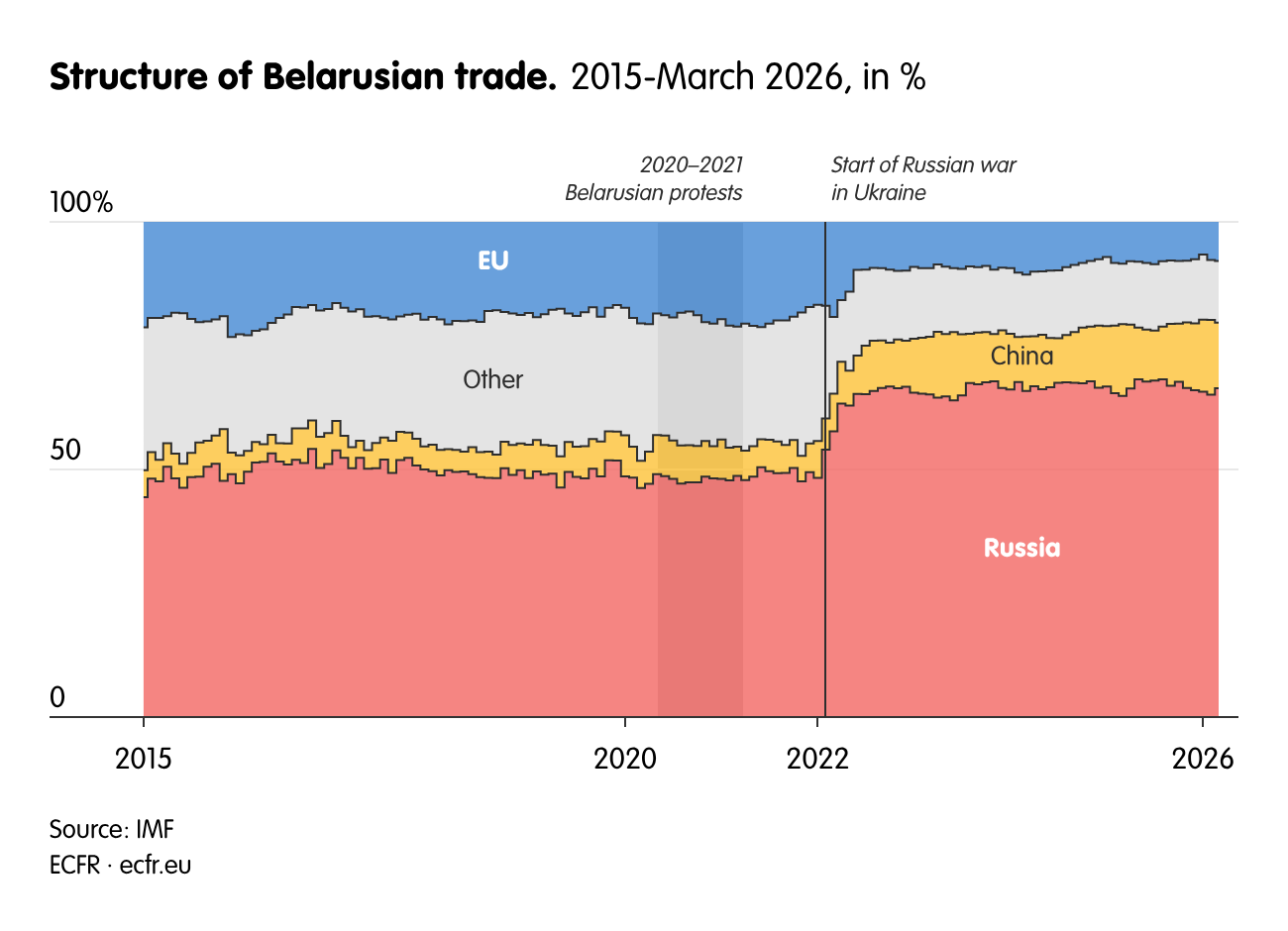
The EU downgraded its diplomatic relations with Belarus in 2020 after the latter’s disputed presidential election, which saw Lukashenko’s government violently repress protestors who took to the streets to oppose the president seizing victory by undemocratic means. Although bilateral trade between the EU and Belarus was largely undamaged in the subsequent years, the fall in trade with the bloc after Russia’s invasion of Ukraine in 2022 created an economic gap which Russia has exploited. For example, it has stepped up its own trading relationship with Belarus and become a key market for exports of Belarusian goods such as dairy products and petrochemicals—also allowing Moscow to evade EU sanctions. In doing so, Russia filled a vacuum for Belarus; Lukashenko, facing limited alternatives, deepened his dependence on Moscow.
Although Belarus did not formally commit troops to Russia’s war of aggression, it did allow the latter to house missiles, tanks, artillery, helicopters, aeroplanes and other military equipment in its territory prior to the invasion. It also provided military and civil infrastructure for Russia’s use, including airfields, hospitals and railway lines. This year alone, Russia has transferred more missiles—including dual-capable, hypersonic missiles—to Belarusian territory and conducted joint exercises encompassing the Belarusian Armed Forces. This, combined with a breakdown in dialogue between the EU and Belarus, gives Putin yet more sway in his quest to entrench Russia further into Belarusian structures.
Now that Belarus is apparently firmly committed to the supranational union of Belarus and Russia, known as the Union State, it has become a structural security concern for Europe. Russian deployment of nuclear-capable weapons on Belarusian territory makes Europe’s eastern flank more vulnerable, while Belarus’s already tense relations with neighbouring border states Poland, Latvia and Lithuania are at risk of deteriorating further. At the same time, Belarus has 879 political prisoners languishing, with Lukashenko’s regime having essentially outlawed any political or civic activity which the authorities see as a threat.
All this has compounded the breakdown in relations between Belarus and Europe. Russia is further emboldened to entrench its military deeper into Belarusian territory, tighten its economic dependencies and integrate the country further into its nuclear strategy.
This paper examines Belarus’s transformation from a problematic but stable buffer state between western Europe and Russia to a country which poses an increasing military and security threat to the EU. It argues that the EU should move away from relying solely on economic leverage and the blanket application of sanctions—which are pushing Belarus to rely more heavily on Russia—and develop a more targeted approach. Europeans need to actively contain the growing military and nuclear threat by finding new avenues of diplomatic negotiation, and by incorporating NATO-inspired approaches into its defence policy for its vulnerable eastern states.
Perhaps most importantly, Europeans need to assess to what extent they can treat Minsk as an autonomous actor capable of making decisions independently from Moscow. Europeans should take recent developments, such as Ukraine’s discovery of four signal relay stations in two Belarusian oblasts and their subsequent removal, as proof that Lukashenko retains the authority to make territorial-based decisions—especially under pressure from Russia.
However, for as long as Lukashenko remains in power, Belarus will never be entirely free of Moscow: he is an authoritarian, and Minsk remains sanctioned due to its breach of human rights clauses and mistreatment of its population. Belarus’s geopolitical position is also at least partly down to early decisions that Lukashenko made when he turned towards Moscow in the mid-1990s—a time when most other former Soviet nations chose real independence. Long before 2020, this posture led to missed opportunities with the EU, reinforced Lukashenko’s propensity to commit human rights violations and kickstarted Belarus’s deepening economic and military integration with Russia.
In its pursuit of a new strategy, the EU needs to recognise that—even if Belarus remains a stable, contained buffer zone—the country will not undergo a full democratic transformation. Europeans are thus searching for a Belarus which no longer presents an urgent security threat on its eastern border. They should aim to help shape a country whose stability reduces geopolitical risk without abandoning the EU’s long-standing commitment to democracy, human rights and the well-being of Belarusian society.
Belarus as a security actor
Belarus declared its independence from the Soviet Union in 1991. But, with what Russia perceived as the NATO and European sphere of influence shifting eastwards, Belarus became increasingly valuable to Moscow—especially because of the Suwalki Gap, which lies between the Russian exclave of Kaliningrad and Belarusian territory. The Russia-Belarus relationship became more entrenched once Lukashenko and Putin came to power in 1994 and 1999, respectively. The two leaders are hardly close personal friends—but they have nonetheless developed strong cultural and economic ties based on the similarity of their two anti-Western and authoritarian regimes, and their notion of a shared history.
Over the past 30 years, Belarus has moved closer to Russia in economy, trade and idea sharing. But it has gone beyond simply sharing a similar geopolitical outlook; now it is a militarised actor on the EU’s eastern flank. The first tipping point came with Russia’s invasion of Ukraine in February 2022. At this point, Lukashenko was already politically entangled with Moscow due to its support for Belarus’s trade network and economic sector after Minsk’s break with Europe in 2020. But the invasion meant that Belarus also became entrenched in the Russian military machine: in the early phase of Russia’s invasion, it became a launchpad for Russian ground offensives towards Kyiv and Chernihiv, and for missile strikes and combat aviation operations.
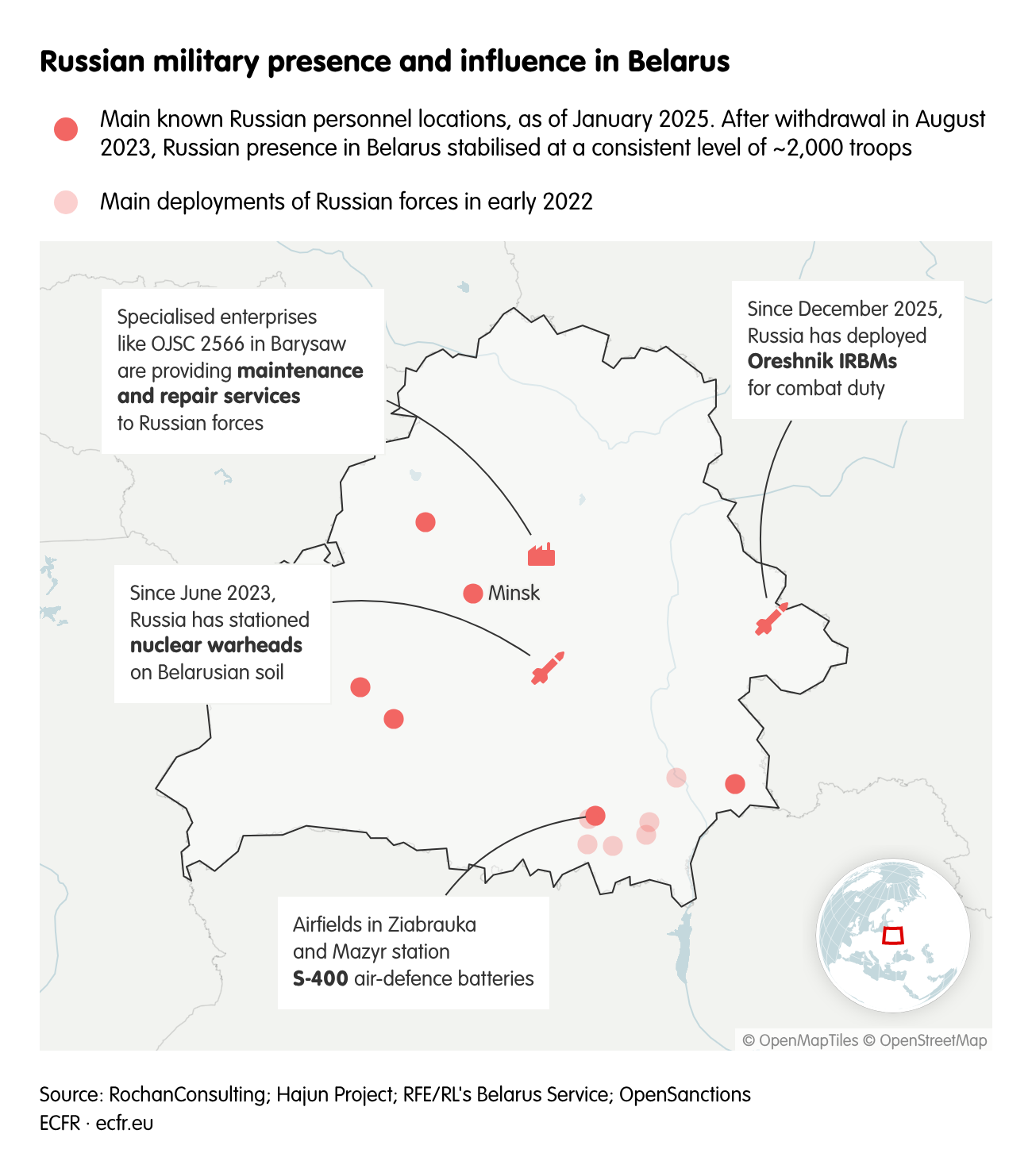
Since this period, Russia has attempted to consolidate its control even further. Now it has approximately 2,000 troops concentrated around air-defence systems, training facilities, logistics hubs and long-standing Russian military installations. Between 2022 and 2023, ammunition transfers from Belarus to Russia exceeded 130,000 tonnes. Since then, joint training centres, storage bases and transport corridors (many inherited from the Soviet period) have been repurposed and modernised under Belarus-Russia Union State programmes to support Russian operational needs. Rail-linked depots, armament storage facilities and training grounds now serve as key infrastructure for Russian forces on its western flank.
The second tipping point came with the two countries regularly staging recurring joint military exercises that institutionalise operational integration, such as the Zapad military drills which have been taking place since before 2022. Now Russia is eyeing up Belarus as a key component of its nuclear ambitions and has also deployed Oreshnik intermediate-range missile systems in Belarus. In April this year, Belarus confirmed it would no longer allow Russian conscripts who desert the military to leave via its border. Belarus is also a staging post for Russian nuclear missiles and joint military exercises.
The country has thus become Russia’s territorial, militaristic and logistical resource, achieved through durability, military routinisation and institutional embedding. The military aspect of this entrenchment is also compounded through hybrid attacks. For example, as early as November 2021 the EU condemned Belarus for facilitating the weaponisation of migrants—predominantly from conflict areas such as Iraq and Syria—who it had apparently encouraged to breach the borders of Latvia, Lithuania and Poland.
This form of hybrid warfare has continued into 2026: recent reports say that Lithuanian authorities have discovered a cross-border tunnel from Belarus to Lithuania, which they suspect is to continue to facilitate the potential movement of migrants through European territories. Now, with the Union State increasingly functioning as a homogeneous force, there is a threat that Belarus will become more emboldened to facilitate further dangerous hybrid manoeuvring. It intends to check Europe’s readiness and destabilise it from the inside.
Belarus as a threat to Europe
The difference in the threat which Belarus now poses to Europe lies in its shift—which has taken place over the past six years—from being Russia’s “rear-operating base” to Russia’s “forward-operating base”.
As Russia’s rear-operating base, Belarus functioned as a non-combat zone for logistics and maintenance. While it supported Russian military activity and provided strategic depth by shifting military infrastructure and combat flashpoints away from Russian territory, as a rear-operating base Belarus avoided deploying its own forces into Ukraine and directly engaging in combat operations. This allowed Lukashenko to avoid many of the challenges that Putin is experiencing, including politically sensitive military mobilisation, high personnel casualties and mounting internal economic pressure. This approach had previously provided Lukashenko with the degree of political deniability and diplomatic leverage necessary to continue negotiating with Western economies on economic sanctions and market access. He was able to point to Belarus’s arm’s-length approach to the war in Ukraine as proof that he was willing to engage with Europeans at a diplomatic and economic level.
However, Belarus’s position has changed since 2022. Evidence collected by the author demonstrates that Russia is increasingly establishing the country as a forward-operating base. Moscow is building on its routinisation and institutional embedding of military infrastructure to deploy personnel on Belarusian territory and undertake recurring joint military exercises, lately including nuclear forces preparation. Minsk’s rhetoric is changing to match these actions. In 2022, Belarus changed its constitution to allow Russia to store nuclear missiles on its territory; in a “Militarization of Europe” meeting held in June 2026, Belarus’s deputy minister of foreign affairs Igor Sekreta said he was “deeply concerned by… military exercises on NATO’s eastern flank” and “the EU and NATO… systematically promoting a militarist agenda at all levels.”
The Belarusian government is simultaneously becoming a component of Russian forward-military position and aligning ideologically with Russia’s view that Europe (and the West in general) constitutes an existential threat. Lukashenko himself reiterated this in May 2026, when he declared that “… [Belarus is] ready in every possible way to defend our common fatherland from Brest to Vladivostok.” The change is especially worrying for Ukraine, which is already fighting a war against Russia on several fronts. Its brow-beaten army could soon be required to deploy yet more resources to another defensive line on its northern border. Belarusian state media have suggested that Putin desires to open a “second front” against Ukraine, using Belarus as a launchpad for further attacks.
Indeed, evidence suggests that Russia is already using Belarusian infrastructure to gain an advantage in its drone warfare against Ukraine: in June 2026, Ukrainian intelligence services discovered four signal relay stations in the Belarusian oblasts of Homiel and Brest. Ukraine’s president, Volodymyr Zelensky, appealed directly to Belarus to dismantle the sites or face potential Ukrainian consequences. The Belarusian president apparently acquiesced—although no public statement or confirmation has been made.
Belarus’s transformation into a forward-operating base was further bolstered in 2023, when Russia deposited tactical Iskander nuclear-capable warheads on its territory. Then, in early 2025, Russia moved Oreshnik hypersonic missiles to a location which experts estimate to be around 60km south of Minsk. This has changed the calculus for the rest of Europe. Europeans must contend with an additional nuclear threat right on its border (aside from Kaliningrad) and consider how this could compromise security along its eastern flank.
Meanwhile, as noted above, Belarus is mixing concrete actions with rhetoric that suggests it sees Europe as a threat to its own sovereignty. In the same speech, Sekreta commented that Poland, Latvia and Lithuania have a combined defence expenditure of €52bn, which is apparently “25 times more than Belarus allocates for defence”. This suggests that Belarus increasingly views European and NATO defence investments through the lens of Russian military planning. If left unchecked, Russian influence will leave EU member states more vulnerable to further hybrid attacks from Union State forces.
For Europeans, there is also potential for escalation in how these border countries respond, and uncertainty about where escalation could lead. For example, the Zapad-2025 military drills, which took place on September 12th 2025, prompted Poland to close its border with Belarus due to “heightened security concerns”. Prior to this, on September 9th and 10th, Russia had flown several drones into Polish airspace during an attack on Ukraine. Lithuania also closed its border with Belarus for a whole month in October 2025 (and refused to enter negotiations to reopen it) after meteorological balloons travelled into its airspace from Belarus. The latter responded by accusing Lithuania of “pursuing an anti-Belarus policy”. Latvia, for its part, is struggling to deal with Belarus’s tactic of sending illegal migrants over its border. As of July 21st 2026, the Latvian government had recorded 8,413 instances of migrants attempting to cross into its territory this calendar year, stirring discontent prior to the parliamentary election in October. The country has also uncovered several sabotage operations that have appear to have been carried out by Belarusian and Russian spies.
European leaders heating up their confrontations in such critical areas is further adding to NATO’s headache. Belarus’s degradation as a buffer zone between western Europe and Russia means the potential for these flashpoints to drift further west is growing, not helped by a continually deteriorating diplomatic relationship between the Lukashenko government and the governments of neighbouring EU states. The proximity of Russian missiles and personnel to European territory could compromise NATO warning systems; it also suggests that the Union State is becoming increasingly willing to test European responses to its increasingly integrated deterrent.
Now the EU needs to reconfigure its strategy towards Belarus. The goal should be to ensure that Lukashenko does not limit his room for manoeuvre so much that he has no choice but to descend into a fully armoured satellite state; and that he has no choice but to react to any order Putin gives.
What Europe is doing…
On sanctions
Since Belarus’s flagrantly undemocratic 2020 presidential election, which sparked the country’s largest political crisis since independence, the EU and Belarus have downgraded their diplomatic relations. This is a cycle which Europe and Belarus have found themselves in since at least 2006: repression conducted by the regime triggers sanctions and isolation from Europe, which are followed by limited thaws and diplomatic re-engagement, which are then interrupted by renewed crackdowns—and so on. This time, however, the diplomatic downgrading was mutual: Lukashenko made Poland and Lithuania’s ambassadors leave Minsk in October 2020, and requested the EU ambassador return to Brussels.
In 2021, following Lukashenko’s contested re-election, Europe’s approach became more actively political. Belarusian opposition leader Sviatlana Tsikhanouskaya lobbied European governments to move beyond broad economic measures, such as existing targeted sanctions, to adopt harsher and broader sectoral sanctions. These were directed at, for example, specific officials, judges, prosecutors and police officers responsible for repression of Belarusian citizens. Belarus, for its part, suspended participation in the Eastern Partnership, an initiative which aims to strengthen political and economic relations between the EU, its member states and the partner countries of Armenia, Azerbaijan, Georgia, Moldova and Ukraine.
Europe’s response remains to take a blanket approach to sanctions towards Belarus. It reinforced its sanctions cycle even after Russia’s invasion of Ukraine in 2022 and the EU’s approach to Belarus is embedded within its anti-Russia packages. This means that the EU not only targets individuals involved in conflict operations, but also bundles Minsk in together with the trade restrictions, export controls and financial measures which it aims at Moscow. Europeans have fallen into the trap of treating their Belarus policy as an extension of their Russia policy, although some politicians—including French president Emmanuel Macron and, back in 2021, former German chancellor Angela Merkel—have also pursued limited efforts to test whether targeted incentives could shape Minsk’s behaviour.
However, some EU sources say that Minsk is an unwilling negotiating partner. It remains to be seen whether it will be explicit about the desire to reshape engagement with Europe. As of 2026, EU–Belarus relations remain largely frozen. They have seen only minimal diplomatic engagement and sustained sanctions, and only limited, transactional contact has emerged—for example, in negotiations over political prisoners and technical discussions over border management. In its latest sanctions announcement, the European Council extended its sanctions regime against Belarus until 2027.
The EU is thus in a difficult position when it comes to pursuing normalisation with Minsk. Since Europe’s Belarus policy is considerably shaped by Belarus’s neighbours, Lithuania and Poland—and Vilnius is especially reluctant to open any dialogue with Minsk—other member states are less emboldened to force through normalisation policies which are at risk of simply being blocked. What is clear is that, unless Belarus makes clear improvements in its human rights conditions and clearly distances itself from Russia’s war in Ukraine, European policy will remain structured around three aspects: progressive sanctions targeting regime elites and key economic sectors; political non-recognition of the legitimacy of Lukashenko’s rule; and support for Belarusian civil society and exiles.
Another problem for Europe is that continuing to heavily limit industrial trade and the transfer of dual-use goods and military equipment to Belarus could see Lukashenko rely more heavily on Putin’s open markets. But, if Europeans do not pursue sanctions, they indirectly aid Russia: Lukashenko supports Russia’s war against Ukraine by selling military and dual-use goods to Russia, thus helping it circumvent sanctions. This, in turn, creates a cycle of obligation whereby Minsk acquiesces to future military requests from Moscow and Russia further entrenches along Europe’s eastern flank.
The EU approach broadly treats Belarus as a subsidiary of Russia and narrows Europeans’ ability to develop a tailored security policy which directly targets Belarus as a forward-operating base. As things stand, sanctions on the economy and trade are not adequately addressing the developing threat that Belarus poses to European security. And they do not help alleviate the suffering of the ordinary Belarusians at home and in exile.
On the diaspora
Since 2020, Lukashenko has stepped up his repression and exile of Belarusian civil society actors opposed to his regime. Evidence collected by the author through focus groups carried out for ECFR suggests that, for Belarusians, exile is no longer perceived as a temporary or marginal condition. Rather, it has become a structural feature of Lukashenko’s authoritarian governance. Participants consistently described forced migration as a way for the Lukashenko regime to externalise dissent to maintain internal stability. The government pushes out political activists, journalists, researchers and civic organisers to reduce domestic pressure, while the regime projects an external image of control and normalisation.
This means that Belarus has shifted much of its political contestation into European societies. As a result, the EU has faced myriad challenges related to diaspora governance, transnational repression (including surveillance, intimidation, pressure on relatives and legal harassment across borders) and social cohesion. The EU has, particularly after 2020, provided unprecedented political recognition and support to Belarus’s democratic forces, including security guarantees and sustained funding. For Lukashenko, exile therefore functions as a strategic arena.
How Europeans govern this space—through legal regimes, funding structures or protection mechanisms—directly shapes whether repression through exile succeeds as a long-term strategy.
On its foreign policy approach
The EU’s treatment of Belarus as having limited sovereignty over its foreign policy is also at odds with the US approach. Washington’s current relationship with Minsk is based on President Donald Trump recognising Lukashenko as legitimate, and the US agreeing to negotiate sanctions relief in exchange for the release of political prisoners. America still casts Belarus as a strategic adversary; but it nonetheless accepts that the country needs careful handling to safeguard American and NATO interests in Europe. EU member states, which eye Washington’s approaches to Minsk with caution, have ramped up their scepticism further since Lukashenko joined Trump’s questionable “Board of Peace” (despite the Belarusian leader lending credence to Moscow’s campaign in Ukraine).
Overall, America is searching for “visible deals” whereby it can secure humanitarian wins via economic channels. The clearest example of this is its pursuit of calibrated sanctions relief: in 2025, Belarus released 123 political prisoners in return for the US easing sanctions on the Belarusian potash industry. And it could be argued that this has paid some dividends: lifting sanctions on Belarus helps ease the domestic economic pressure on Lukashenko, which leaves him less dependent on support from Russia for trade.
However, the thaw in America’s approach does nothing to address Belarus’s increasingly entrenched role as a Russian military staging post. Indeed, no approach taken by any American president ever has. And while former president Joe Biden synchronised Washington’s policy towards Belarus with that of Brussels, under his successor, Trump, the two approaches are disparate. Of course, the US does not have the major consideration of the security challenges which Belarus poses to Europe’s borders. But this divergence between America’s prioritisation of transactionalism and the EU’s prioritisation of security will only grow in the absence of a coordinated transatlantic framework towards Belarus.
There also exists the possibility that Lukashenko could exploit the gap between America’s leverage-based approach and Europe’s risk-based approach, to play each side against the other. From the US, Lukashenko has already achieved incremental sanctions relief and diplomatic rehabilitation while continuing to align Belarusian security with Russian territorial involvement and pursuing domestic repression. As it stands, all signs point to US bargaining having no impact on Belarus’s strategic alignment or its military cooperation with Russia. Human rights abuses remain.
What Europe can do next
Europe’s continued policy of isolating Belarus and imposing sanctions is turning the country towards Russia as a more attractive option for trade and investment. However, Europeans cannot simply restore diplomatic relations, even to their pre-2020 iteration: they need to hold Lukashenko accountable for his disregard of democratic norms and civilian abuse, and accountable militarily for his assistance to Russia’s war in Ukraine.
This requires developing an alternative approach which goes beyond the current binary choice of engagement or isolation and identifies as a priority exactly the type of Belarus that Europeans want to—or are willing to—work with. Europeans need to examine existing EU and US approaches to Belarus, and discover where Lukashenko could exploit gaps in their divergence—and where room for leverage and leeway exists.
This also requires Europeans to understand the type of pressure that Russia is exerting on Belarus. It is true that Russia continues to provide loans to Belarus, open its market to sanctioned Belarusian goods and give Belarus access to infrastructure through which it can continue exporting goods to Brazil, China and India. But this is illusory: Russia exerting “real” pressure would amount to trade wars, blockades of Belarusian goods, cutting off financial aid and propaganda attacking Lukashenko. Putin has exercised similar measures before, when Moscow was unhappy with Minsk. Now, in 2026, their actions might be well coordinated, but Russia has not established any real economic, financial, military, informational or political coercion against Lukashenko and his government.
Europeans could use this distinction to consider the type of Belarus they want to shape. This should be a Belarus which has secure, meaningful economic alternatives to Russia; a Belarus which sees the geopolitical and economic sense of having a choice of trading partners; a Belarus which has functioning communication channels. Overall, Europeans should expect that their future relationship with Belarus will go beyond mere transactionalism and value the voices of those who Lukashenko continues to silence. Europeans should seek a Belarus which retains a degree of political room for manoeuvre away from Putin’s military and political influence. The following recommendations set out how it can achieve this.
Support eastern border states
The EU has already made progress in strengthening its defence security arrangements for its eastern flank. For example, the 2022 Strategic Compass aimed to prevent crises in states most vulnerable to Russian (or indeed Belarusian) encroachment, and the EU has developed a targeted “Communication on the EU’s Eastern Regions Bordering Russia, Belarus and Ukraine” (or “Strong regions for a safer Europe”) programme. This includes the five priority areas of security and resilience; growth and regional prosperity; building on local strengths; connectivity; and empowering its people. The bloc is also channelling funds into shoring up transit routes and financing, including the customs infrastructure along its eastern border which is a target for Russian and Belarusian interference.
However, the EU should more deeply incorporate its support for states that border Belarus—which are facing hybrid pressure, border incidents and spillover risks—into a defence strategy which builds on the NATO model, particularly in its approach to deconfliction. This would mean better aligning military preparedness with diplomatic signalling and crisis-management channels.
For example, NATO maintains a partnership with the Organization for Security and Co-operation in Europe which promotes risk-reduction frameworks and transparency measures among signatory states—including the Vienna Document, which has been signed by the US, all European nations and Russia. Europeans could establish a similar partnership with selected states which builds on Lukashenko’s willingness—up to now—to notify his Western counterparts about activities such as Zapad military drills, where in some instances he has even invited them as observers.
Strengthen connections inside Belarus
To go one step further, however, Europeans—and especially EU border states—should maintain established working-level diplomatic contacts in Belarus, especially those located at EU member-state embassies in Minsk. These could also be third-party intermediaries or use technical-level communication formats, such as hotlines, to relay information about military movements or developments.
This could also rely on trusting selected contacts inside the country itself: for example, there are several initiatives which hold meetings which bring speakers and thinkers together to share both Western and non-Western perspectives, including from inside Belarus and Russia. By acting as a conduit for open communication—and by remaining open and depoliticised—protecting such channels encourages a more open dialogue. This, in turn, mitigates the risk of miscalculation and helps develop a diplomatic environment in Belarus which is less dependent on the relations created through the Union State. The aim for Europeans should be to build a pro-EU constituency inside Belarus through democratic initiatives—not with the intention of overthrowing the regime tomorrow, but rather to embolden those who see it in their interest for Belarus to have normal working relations with the EU.
Europeans could also continue to financially support or work with Belarus’s small- and medium-sized businesses, both inside and outside the country. Directing economic support and capacity building to enterprises within its borders would strengthen the country’s independent economic capacity by allowing it to gradually decouple from other trade relationships. At the external level, in 2022 the EU and the European Bank for Reconstruction and Development pledged €4bn for SMEs which had relocated their businesses abroad. The EU should explore ways in which it can strengthen Belarus’s SMEs inside the country, to help build a constituency which sees partnership with the West, not just Russia, as an advantage.
Opportunities exist for cooperation at the non-profit level, too. While not directly related to European security policy, concerted work by the EU to fund Belarusian NGOs and support apolitical initiatives can help strengthen the country’s national identity and foster conditions for a more fruitful working relationship. Europeans can connect with Belarusian youth and help shape a more democratic future of Belarusian leaders through the funding of communal projects such as Erasmus+ and the European Solidarity Corps for Belarusian students.
The European Commission is funding ArtPower Belarus, in collaboration with the Belarusian Council for Culture and Danish Cultural Institute, from 2022-2028. This demonstrates how outreach in Belarus—with willing internal institutions—can forge a common sense of purpose and prevent the “othering” of either side. The EU should continue to strive for flexible support for civic and political activism, especially at the grassroots level, through institutions such as the European Endowment for Democracy.
Engage with the Belarusian diaspora
Europeans should treat the Belarusian diaspora as a “strategic constituency” and help secure their participation in national and international civil life. For example, despite Belarus’s exit from the Eastern Partnership, the country’s civil society remains active in the initiative. This political knowledge and organisational capacity are vital for educating Europeans and ensuring that Lukashenko’s approach does not condemn the country and its people for any longer than it already has. Indeed, the EU needs to ensure that the Belarusian diaspora remains at the forefront of its policies regarding safe migration and access; it must avoid inadvertently reinforcing the regime’s strategy of repression through exile, lest any temporary or fragmented protections undermine diaspora members’ political and institutional capacity.
The EU should prioritise legal stability and predictability for Belarusian exiles. Where possible, longer-term residence pathways, access to labour markets and recognition of professional qualifications should be expanded and harmonised across member states. Indeed, Europeans need to take transnational repression seriously as a security issue, not only a human rights concern. Surveillance, digital harassment, pressure on family members remaining in Belarus and alleged monitoring activities in EU states challenge European sovereignty and social cohesion. To counter this, the EU should keep pursuing democratic initiatives such as the project “Towards a Local Democracy Agency (LDA) Belarus in Exile”. Its establishment has helped reinforce the notion that exile is not a temporary condition and encourages the need for “sustainable democratic infrastructure” which supports communities in exile. Addressing these practices strengthens both diaspora resilience and internal EU security norms.
In the long term, the EU should introduce more permanent diverse and sustainable funding streams, and move away from reliance on emergency or externally volatile sources. While several exile-based civil society institutions have benefited from multi-year EU funding frameworks—and the EU has committed €200m since 2020 in supporting the Belarusian people—recent reductions in US assistance have exposed structural vulnerabilities. The EU needs to use such funding streams to support independent media, research organisations and civic initiatives in exile, since they are repositories of political memory and organisational capacity.
Europeans should also continue to engage with Belarus’s political opposition on a more formal level, rather than treating it as a protest movement. For example, they generally treat Tsikhanouskaya as the de facto leader of Belarus from her base in Warsaw. This gives Europeans access to a political figure with different views and priorities, and could see the two sides shape future engagement with Belarus via insights from the country’s more civic-minded, democratic channels. The EU should be wary of treating her as the sole alternative to Lukashenko, especially because it is unlikely that Tsikhanouskaya will be installed as his successor—but openness to her influence will bolster trust between Europeans and Belarusian exiled civic society. It will also provide EU member states with an understanding of how the Belarusian state works.
Link diplomacy with action
EU engagement should focus on areas where European interests are directly implicated and where limited leverage still exists. Recent developments, including prisoner releases secured through negotiations with the US and Lukashenko inviting Western officials to observe military drills, suggest that Minsk remains open to selective forms of engagement.
But while targeted incentives can produce limited concessions, the EU should avoid simply replicating the American model. Instead, the bloc must approach conditional engagement as a security instrument rather than simply a human rights policy. Unlike Washington, it has long-term security interests in Belarus—regional stability, border security, migration management, securing its eastern frontier—and needs engagement to be more strategic than transactional.
Europeans should therefore try to couch any diplomatic, economic or symbolic concessions (such as forming high-level diplomatic contacts, limited sanctions relief or participation in dialogue formats) in measurable and verifiable actions. These could include independent verification of the release and treatment of named political prisoners, a sustained halt to politically motivated detentions and access for international humanitarian organisations.
This could build on Lukashenko’s demands for sanctions relief in exchange for Belarus releasing political prisoners and ceasing its aggravation towards Europe’s eastern borders by making such concessions with the conditionality just described. Such engagement with Belarus could help generate durable behavioural change and address underlying sources of regional insecurity.
Untangle Minsk from Moscow
Europeans can also adapt their approach to Minsk based on how America treats it: as a viable, autonomous actor, not an extension of Moscow. The fact that negotiations between Trump and Lukashenko led to the release of prisoners—albeit with hundreds still being held—suggests that the Belarusian leader remains sensitive to economic pressure and to the optics of his own international legitimacy. Trump’s recognition of Lukashenko as Belarus’s legitimate president has only served to reinforce the latter’s willingness to reestablish closer contacts between Minsk and Washington. The US can use this thaw to its advantage to leverage selective sanctions adjustments (for example, easing restrictions on Belarusian potash exports in response to global fertiliser market pressures) and further widen Lukashenko’s limited transactional opening.
Europeans should consider whether closer coordination with Washington, whereby both camps identify common red lines and incentives for better diplomatic ties with Minsk, would deter potential coercion by Lukashenko and prevent him playing the US and Europe against each other. Indeed, the two erstwhile allies finding common ground in their strategy towards Belarus could secure further progress on humanitarian issues and demonstrate to Lukashenko that the US remains key in the protection of Europe’s eastern frontier. It is worth noting that, in this event, the EU should strongly articulate its own priorities—particularly regarding border security and societal agency—and pursue pragmatic coordination at the level of officials, agencies and technical experts.
A practical example of Belarus demonstrating more autonomy is the recent ultimatum proposed to Belarus by Ukraine. Zelensky’s bold statement over the four signal relay stations in Belarus led to their quiet removal (or they were at least turned off), suggesting that Lukashenko can roll back certain decisions—even on military issues. And, even if reports that it was in fact Ukraine which destroyed them are true, Lukashenko has accepted this development without retaliation. His response suggests that he fears the consequences of escalation from Ukraine and other Western allies. But it also supposes that Putin is not yet able to dictate Lukashenko’s every move, not even in zones which Union State forces could view as fundamental to ensuring their continued sovereignty. This episode shows that Lukashenko still retains meaningful room for manoeuvre even in matters of security, and that calibrated pressure from neighbouring states can shape his decisions.
Europeans should exploit this hint of residual agency to discover in which other areas Lukashenko retains an interest in limiting escalation or preserving his room for manoeuvre. They should determine in which other areas calibrated diplomatic and economic pressure could shape Belarusian behaviour and complicate Russian military planning. This could help decouple Belarusian decision-making from Russian power structures and isolate Lukashenko into a more favourable position for further negotiations.
Shaping stabilisation on European terms
By reducing the opportunities for Russian coercion and Belarusian-enabled hybrid pressure on the eastern flank, Europeans can better counter the impact of Russian entrenchment on their neighbour. But Europeans should not frame the recommendations as a part of a rehabilitation for the Belarusian regime. Rather, these policy suggestions should function to safeguard against further deterioration of the stable buffer zone that Belarus once provided for western Europe. Most importantly, they need to address the Belarus that has been created since 2020 and seek to prevent its further entrenchment as a Russian satellite state.
To achieve this, the most important thing Europeans can do is move beyond the false dichotomy between isolation and engagement. Europe can still rebuke Belarus as an externally managed satellite state, for example by disavowing the Lukashenko regime, while providing incentives which help it shape the conditions under which stabilisation unfolds. Europe cannot force rapid change in Minsk’s strategic alignment, but it could help prevent the complete consolidation of a security order in which Europe has no voice.
Europeans should also focus on how their approach to Belarus differs in the short and the long term. In the short term, Europeans need to prioritise preventing Russia’s military configuration in Belarus from becoming permanent and irreversible, and work to limit the extent to which Russia has entrenched itself into Belarusian military institutions. They should aim to separate Belarus from Russia as much as possible by ensuring that Moscow ceases stationing its weapons (conventional or otherwise) on Belarusian territory. At the same time, Europeans need to be aware of continued escalation, such as further military deployments on Belarus’s territory, applying hybrid pressure on member states or facilitating cross-border incidents.
In the long term, Europeans should not aim for Belarus to be aligned with the West; nor should they expect that their intervention will transform Belarus into a democratic state. But the EU should work towards Belarus becoming a country that is sovereign enough to resist becoming a permanent forward base for Russian power, and open enough to maintain a managed relationship with both Europe and Russia. Ideally, Belarus should become sovereign enough that it can make rational decisions—based on the best interests of its country and its people—regarding with which power it wants to be aligned.
As it stands, Russia’s war of aggression in Ukraine shows no signs of abating. America, for its part, is increasingly reluctant to fund deterrence in EU countries, including those which border Belarus. It is, under Trump, using economic and political posturing to exert pressure on the Lukashenko regime. But Europeans can still find the avenues of cooperation which still exist in the allies’ fractured relationship. Most importantly, the EU needs to grant a degree of agency to its most problematic neighbour.
About the author
Vasil Navumau is a former visiting fellow at the European Council on Foreign Relations. He now works as a researcher at the University of Siegen, where he focuses on civic activism in eastern European countries, particularly Ukraine and Belarus, and its transformation via information and communication technologies.
Acknowledgments
The author would like to thank Pavel Slunkin and the ECFR editorial team (in particular Amy Sandys and Portia Kentish) for their valuable input and suggestions, as well as Nastassia Zenovich for her graphics.
This work was produced as part of the project “Portrait of Exiled Belarusians and the Role of Belarus in Russia’s War on Ukraine”, financed by the European Union under the EU4Belarus – Support to Advanced Learning and Training (SALT II) programme.
This document has been produced with the financial assistance of the European Union. The contents of this document are the sole responsibility of the European Council on Foreign Relations (ECFR) and can under no circumstances be regarded as reflecting the position of the European Union.
I was sad last fall when I read and recommended Jaya Saxena’s final story for Eater. Saxena is a food writer the Longreads editors have followed for years, and a journalist I’ve always counted on for food writing that both informs and entertains; she goes deep on aspects of cuisine, dining, the restaurant industry, and food culture in a way that’s relatable and unpretentious. (She’s also the series editor of The Best AmericanFood and Travel Writing anthology; you can preorder the 2026 edition now.) So I was glad to hear, earlier this year, that Saxena and other former Eater writers were cooking up something new.
That something is Ravenous, a worker-owned, subscriber-supported food and culture site founded by Saxena, Amy McCarthy, Ashok Selvam, Courtney E. Smith, and Frances Dumlao. The five journalists are “sick and tired of the conversation around food being reduced to AI-generated pablum, ‘best of’ lists, and influencer-driven trends,” and are building a home for the kind of thoughtful, curious reporting that’s become harder to publish in a broken media landscape. Or, as they put it: food media with teeth.
Next week, Ravenous launches a monthlong fundraiser, so now is the perfect time to support the site. Seven dollars a month, or $70 a year, gets you access to everything they publish; higher-tier plans come with more perks. (Sign up for the Regular plan—$25 a month, or $250 a year—and you get to give the Ravenous raven a nickname, which they include in their Sunday newsletters.)
If anyone can build a publication around engaging, relevant food reporting and storytelling, it’s Saxena and this crew. Have a look around Ravenous and consider subscribing. But be warned: Don’t browse when you’re hungry.
I was born and raised in New York City, and aside from a brief stint in New Orleans for college, I’m still here. Except now I’m over in Queens instead of my hometown of Manhattan.
What places feel like home?
Aside from my actual apartment and the one I grew up in: Various NYC beaches, the backyard of my local bar, a punk show, Ray’s Pizza & Bagel Cafe on St. Mark’s Place, and one specific rock in Central Park.
Other than family members, who or what has shaped you the most?
For high school I went to a Quaker school in Manhattan, and though I don’t consider myself religious in any way, Quaker values began shaping my future politics then. It’s where I first started learning about the value of consensus-based community decision making, and given that this was in the early 2000s, anti-war and anti-violence politics. I even remember a teacher making the case that cars should be banned in Manhattan. It was a big influence on my politics and value systems.
What is your favorite time of day?
To work, right after I wake up, around 8 a.m., when my mind hasn’t filled with the noise of the day. Otherwise, early evening when it’s still light out, and everything is just beginning.
What are you really good at?
Untangling necklaces.
What’s the best gift you’ve ever received?
One year my wife bought me a Cameo of the cow from First Cow, whose handler fed her a treat in my honor. The video is one of my most prized possessions.
Describe your favorite meal.
Of course as a food writer this is tripping me up, because are we talking about a single great meal I’ve experienced, or a dish I could eat every day? If it’s the former, it’s the time my wife and I walked into a random seafood counter in Valencia, Spain, and spent the night eating sardines in garlic oil and sparkling wine from ceramic cups. If it’s the latter, my mom’s mac and cheese.
Sound or silence? (And if sound, what sound?)
I’m a city kid, so too much silence scares me. I need the background noise of people on the street to get anything done.
Where do you do your best thinking?
In the shower or walking around listening to music.
What journey—physical, creative, intellectual, or otherwise—has meant the most to you?
In 2018, my wife and I traveled with my dad to his hometown in India. It was the first time he had been back since before I was born, and being able to experience that with him was so important. We also ate absolutely the best kebab I’ve ever had in my life. Maybe I should have put that as my favorite meal.
Where do you like to read?
On the subway.
What’s the last rabbit hole you disappeared into?
My friend recently introduced me to the case of Judy Smith, a woman who went missing during a trip to Philadelphia and was discovered murdered in the woods outside Asheville, North Carolina. I have now spent a lot of time reading conspiracies about what happened to her.
Name three publications you enjoy reading these days.
Defector has fantastic culture coverage, I love every issue Cake Zine puts out, and some of the best money I’ve spent recently is on the monthly print issue of The Onion.
What’s one longread that you can’t stop thinking about?
This piece in The New Yorker by Lauren Collins about El Mordjene, an Algerian hazelnut spread that white French people are being very racist about. It’s just such a good exploration of how something innocuous becomes the center of a culture war. I was also thrilled to find the spread at an Egyptian grocer in my neighborhood, and sorry white French people, it is better than Nutella.
What was the last book you read?
I had somehow never read Interview With the Vampire by Anne Rice, but after watching the TV series my friends and I decided to read it together.
What piece of nonfiction are you most proud of writing?
“The Food That Makes You Gay,” for Eater. I had editors that really trusted me to follow my instincts, and I managed to thread together some things I had an inkling were related. I’m also just glad I could get a full throated defense of bodily autonomy and the right to change one’s body in a piece that started out talking about straight men being afraid to eat bananas in public.
What’s your most reliable way to get creatively unstuck?
Walk away from the computer. I just need to do something else, anything else, for a while.
Who’s a writer you turn to when you need some inspiration?
Reading just about anything will definitely help me, but I love Helen Rosner’s food writing. And I tend to listen to a lot of music when I need inspiration, so as far as lyricists go, probably Aimee Mann, Fiona Apple, Joni Mitchell, Prince, and Paul Simon.
What words do you overuse?
I write pretty conversationally, so I sprinkle in a lot of “just” and “of course” and “perhaps” that I usually have to go back and delete.
What’s your favorite guilty pleasure?
I am a firm believer that there is no such thing as a “guilty” pleasure (unless it’s like, continuing to read Harry Potter after J.K. Rowling has made it clear that doing so supports her transphobic work). No one should feel guilty about doing something that brings them joy. But in terms of indulgences that make little sense to others, I love a Hershey’s Cookies ‘N’ Creme bar.
What superpower would you like to have?
Generously, the power to instantly heal others. Selfishly, the power to have three cocktails and sleep through the night.
What animal or nonhuman being do you most identify with?
Any time I see a photo of a magpie standing on its nest made of shiny, pretty things, that’s me.
If you have a free solitary hour in your day, what do you typically do?
Unfortunately, I’m probably looking on my phone. I have a very dumb “project” where I am trying to train my Instagram algorithm to show me the absolute worst videos out there. But I am trying to get better about doing things like taking a walk to the river, or practicing a new hobby (my latest one is trying to learn some card tricks).
What five items would you place in a time capsule?
A copy of The God of Small Things by Arundhati Roy, a bootleg Knicks champion shirt, a fortune teller fish, a bottle of 4711 cologne, and a DVD of Velvet Goldmine.
What does your writing space look like?
You should know for this photo I am standing directly against my bed, which my cats sit on all day and scream at me from. You should also know half the time I’m not even here, and instead writing with my laptop on the couch.
Jaya Saxena is an IACP Award-winning, James Beard Award-nominated writer and editor, and a lifelong New Yorker. She enjoys covering the intersections of food and immigration, business, history, policy, queerness, and just about every way we use food to say something about ourselves. She is the series editor for The Best American Food and Travel Writing. Her work has appeared in Eater, Slate, Gourmet, GQ, The New York Times, Defector, and more. You can email her at jaya@weareravenous.com.
President Donald Trump has announced that the United States is withdrawing from the North Atlantic Treaty Organization, citing European allies’ refusal to support the war against Iran as the breaking point in what he called [...]
If education is indeed the great vehicle of social and economic mobility, then higher education is no longer delivering the promise of the “American dream.” In fact, this “dream” has become a fiscal nightmare. Colleges and universities saw 9,000 job cuts and buyouts in 2025, and several college closures, mergers, and looming budget crises have already been announced in 2026. Portland State University is one of the most recent casualties, with a projected deficit of $35 million.
How did we get here?
Universities have been operating like corporations for quite some time now. Business terminologies — like return on investment (ROI), efficiency, strategic alignment, move the needle, transparency, buy-in, revenue generating, burnout, bottom line, deliverable, best practices, and others — have been normalized in strategic plans and administrative reports.
The boards of trustees and presidents running these academic corporations/factories have been boldly claiming that education is business. And just as businesses fail due to strategic missteps, poor financial decisions, and various forms of mismanagement, this “business” called higher ed is on the brink of a great collapse. This collapse has not happened overnight. It certainly did not start with the COVID-19 pandemic. It certainly did not start with blocking international students from attending U.S. universities. It certainly did not start with Donald Trump and the resurgence of McCarthyism, although the various draconian attacks on higher ed under his presidency have exacerbated the collapse.
Decades of mismanagement, fiduciary irresponsibility, a lack of shared governance and accountability, and divestment are responsible for a plethora of failures. Irrespective of these failures, university presidents and boards have been transparent about their singular mindset (at least in their visible actions). To them, growth is essential, but such growth can only take place by cutting various services and programs that are no longer deemed “essential.” Faculty and staff at many institutions have raised warning flags, insisting that universities cannot cut their way to growth. Such illusory growth will weaken programs and prevent students from truly being educated. Such short-term growth will ultimately threaten the long-term foundation of higher ed and lead to the collapse of one of the biggest arenas of 21st-century thought: the university.
There are also other reasons for this collapse. For decades, universities have overspent on real estate, building fancy residence halls, offering attractive dining services, and raising tuition for students. All of this “added value” has been accompanied by cuts to essential student services (particularly those serving the most marginalized students) and insufficient compensation for overworked faculty and staff. Recent reports by the American Association of University Professors have found that faculty salaries still have not recovered from the decreases they saw during the early COVID-19 pandemic.
While faculty salaries have declined, large investments in athletics, online courses with low completion rates, and other designer programs have drained operational costs and endowments. Decades of reduced investment in the well-being of faculty have led to widespread burnout, watered down the system of tenure and shared governance, and led to the rise of the most exploited class in higher ed: the gig hustlers called “adjuncts.” This system, which Adrianna Kezar calls The Gig Academy, has created serious inequity and contributed long-term damage to faculty morale.
The infrastructure of higher ed has been further damaged by administrative bloat, with institutions hiring consultants — like enrollment management companies — that demand hefty price tags, all while cutting essential staff and overworking the ones that remain. In 2023, Forbesreported on this “skyrocketing” bloat and warned that such exponential growth in non-instructional staff in higher ed will drive up the cost of tuition and push vulnerable institutions to the brink of financial crisis. Meanwhile, due to staff cuts, overworked and underpaid faculty and staff are being asked to meet the demands of students who are increasingly coming to them underprepared and with various issues of mental health, food insecurity, homelessness, and learning styles and disabilities requiring multiple accommodations.
But unlike corporations, there is no government backing to bail universities out of their millions of dollars in structural deficits. They are simply closing or merging, destroying the lives of faculty and staff at various ranks and causing serious educational derailments for their students. The age of “the great resignation” that we witnessed during the pandemic has been replaced by “the age of massive layoffs” in higher ed. In my own state of Oregon, sweeping academic restructuring is underway, with 36 faculty layoffs and the closure of the award-winning and nationally recognized University Studies, a general education interdisciplinary program.
Let’s face it: The greatest danger facing higher education is not the “demographic cliff” but the loss of its fundamental mission to educate students. This shift has been accompanied by the loss of public trust in higher ed to serve the public good. The greatest danger facing higher education is not in its ability or inability to provide students with “job-related skills and training,” but the increasing and crushing debt, akin to a mortgage, that students and their families will be struggling to pay for decades.
No university education should cost over $60,000 per year to deliver just an undergraduate degree, which only a handful can truly afford. And these days, some universities are charging over $90,000 per year. There is no justifiable ROI for this kind of exorbitant cost. Yet, most of us who have been in higher ed for a while now know well that the millions of dollars of structural deficits that almost every university is currently facing did not just accumulate overnight. They are a result of shifting priorities.
Universities are no longer mission-driven to create critical, thoughtful, responsible, and well-rounded citizenry to participate in democracy and serve the public good. Instead, higher ed has traded its long-term intellectual benefits for short-term market and profit-driven (sometimes predatory) programs, with the sole and narrow purpose of training a generation of students for the workforce. This focus on job training, under the umbrella of “professionalism,” may or may not even succeed given the volatility of job markets in the age of artificial intelligence. Yet the disciplines that will be necessary to combat AI, like the humanities, are routinely being devalued.
While university administrators are speculating like gamblers to gauge which revenue-generating “programs” will ultimately survive, they are reducing, cutting, or hamstringing the disciplines in the arts, humanities, and sciences that have a long and storied tradition of cultivating “critical thinking.” Yet this strategy conflicts with studies that show the liberal arts, particularly the humanities, are valuable in terms of long-term employment prospects. According to the Mellon Foundation report “Humanities Graduates Can Find a Great Job. It’s Time to Make This Fact Known”:
The American Academy of Arts and Sciences reports that, at latest count, 96.3 percent of terminal humanities bachelor’s degree holders between the ages of 23 and 32 were fully employed, a share that is on par with that for degree holders in the same age range across all fields. Further, the earnings of terminal bachelor’s degree holders in the humanities are comparable to those of their counterparts in the behavioral/social sciences and the life sciences, while the job satisfaction levels among humanities graduates are in line with those of degree holders in all fields.
This and other reports emphasize that students need to learn and practice deep critical thinking, problem-solving, and ethical reasoning as basic skills to enter and succeed in the job market.
In response to the closure of Hampshire College, Ken Burns, one of the school’s most celebrated alumni, hit the nail on its head: “The greatest danger that faces higher education,” Burns said, “is this transactional tendency that everything is about an exchange that ultimately is economic.” What is lost in this game is the mission that education should be “transformational.”
As bell hooks wrote in Teaching to Transgress: Education as the Practice of Freedom, “The classroom remains the most radical space of possibility in the academy.” These days, in the age of fascism and corporatization, any radical space is a threat, and every effort is being made to destroy those threats. Federal policies target disciplines that challenge the status quo or question power structures, like sociology, pushing for them to be eliminated from the curriculum altogether.
This transformation was underway long before the current right-wing attacks on higher education, as universities slowly eroded critical programs through the use of the terminology of “academic prioritization.” Recently, “academic prioritization” has been replaced by new terminologies of “long-term sustainability,” “strategic growth potential,” “indoctrination,” and “demand programs.”
Irrespective of these terms, the end goal is to reduce and eliminate programs, mostly in the humanities, that have created transformational spaces for generations of students, particularly those from marginalized backgrounds, those who are economically disadvantaged, and first-generation students. Colleges and universities around the country have eliminated humanities majors in art, music, theater, philosophy, history, religious studies, global languages, gender and sexuality studies, and ethnic studies, citing decreased enrollments.
In April, the University of Montana eliminated its master’s degree program in English, focused on Literature and Ecocriticism, raising serious concerns about the university’s identity. “English is such a fundamental core subject within the humanities, and it’s almost like the heart of the humanities is being cut out,” said English Department Chair Louise Economides.
The University of Montana is not the only university where the “heart of the humanities” is being cut out with little to no conversation. The attack has been relentless nationally. Eric Hayot and Matt Seybold have described this crisis as “a crisis of civil society writ large.” They write:
There is no condition in which the humanities are under attack in which the whole university is not under attack. There is no condition in which the university is under attack that the whole of educational infrastructure, public and private, from pre-K up, is not under attack. And there is no condition in which education is under attack in which civil society can remain unimperiled.
Yet none of this is a surprise. While the right-wing attacks on these disciplines and departments have been relentless in recent years, faculty have been witnessing this slow collapse of the arts, humanities, and sciences for quite some time now. The market-driven model that encourages packing students into classrooms like sardines to maximize profits is not conducive to the personal attention that students need in disciplines like the arts and humanities. Many of these departments, slated to be reduced or cut, have been deliberately hamstrung by their administrations (citing low enrollment numbers), resulting in their inability to offer a robust curriculum. The overemphasis on the number of majors these disciplines have is a deliberate strategy to discredit these disciplines. If these programs are retained, they are treated as second-class departments simply serving as the “general education requirements” for the more profitable “revenue-generating” programs.
Higher ed is on the verge of collapsing because it has lost its soul. Can this soul be restored? Perhaps. But this would require a nationwide movement to restore public trust and reclaim higher education, building an academy that is not solely transactional or profit-driven but is deeply invested in serving and collaborating with its broader communities and society writ large. If we cannot do this, then we are one step closer to witnessing the weakening of our civil society and the end of our democracy.
In her 2001 masterwork Nickel and Dimed, the late Barbara Ehrenreich went undercover to report on the daily realities working people in America face trying to get by on minimum-wage. After working as a housekeeper, a nursing aide, a home cleaner, a server, and more, Ehrenreich wrote that “The first thing I discovered is that no job, no matter how lowly, is truly ‘unskilled.’” It is difficult to overstate the impact that Ehrenreich’s book and body of work have had on US culture and working-class politics over the last 25 years, and the enduring relevance of her work today. In this special episode of Working People, we commemorate the anniversary of Nickel and Dimed and celebrate the life and legacy of Ehrenreich by speaking with a panel of guests who are carrying on that legacy today.
The following is a rushed transcript and may contain errors. It will be updated.
Maximillian Alvarez:
Alright. Welcome everyone to Working People, a podcast about the lives, jobs, dreams, and struggles of the working class today. Working People is a proud member of the Labor Radio Podcast Network and is brought to you in partnership with In These Times Magazine and the Real News Network. This show is produced by Jules Taylor and made possible by the support of listeners like you. My name is Maximillian Alvarez, and today we’ve got a very special episode for you guys. And we’re talking about the work, life, and legacy of a very special person, the late great Barbara Ehrenreich. 25 years ago this year, Barbara published what is still to this day one of the most essential and impactful books about working class life in America ever. And the book is called Nickel and Dimed: On Not Getting By in America. And if you listen to this show, then chances are you’ve probably heard of it or you may have already read it.
But if you haven’t read it yet, and if you haven’t dug into Barbara’s incredible body of work, then frankly, I kind of envy you because you have a feast before you, a feast for your mind, your heart, and for your soul. And to commemorate the 25th anniversary of Nickel and Dimed, the Nation Magazine just published a really beautiful and vital forum with folks from around the worlds of labor and journalism testifying to the enduring power and relevance of Barbara Aaron Reich’s work today. As author and friend of the show, Alyssa Cort writes in that forum, “The first thing I discovered is that no job, no matter how lowly, is truly unskilled.” This is from Barbara Ehrenreich’s 2001 masterwork, Nickel and Dimed. I read it that year when I was 29. Eventually, Barbara became my good friend and colleague as we created a media organization, The Economic Hardship Reporting Project, and wrote and edited articles together.
To recap, for that book, Barbara went undercover, reporting as she worked as a housekeeper, nursing aide, a home cleaner, a waitress at Jerry’s and Hearthside Restaurants, and a Walmart worker all in her later 50s, wrestling with cleaning products, carrying huge diner orders, and sometimes living in motels. The book was a departure from her earlier acidly funny and sociological work, ranging from midwifery to middle-class anxiety, but for which she rarely interviewed a soul. It’s hard to underestimate the effect nickel and dimes vacuum cleaner’s eye view of what it means to work a minimum wage job in this country had on so many of us. For those blinded by America’s late 20th century comforts, Barbara’s book helped us to stop unseen low wage workers. It also showed us what anyone who has ever made a pizza or taking care of a child already knew, but had perhaps not articulated that there is no such thing as “unskilled work.” As Barbara wrote, “The working poor, as they are approvingly termed, are in fact the major philanthropists of our society.” And Nickel and Dimed also helped precarious creatives like me and my ilk, freelance writers, art handlers, grad students, bookstore clerks, all paid hourly and shabbily, see themselves more clearly as being on a continuum with other working people.
Now, we’ve linked to the Nation Forum commemorating Barbara Ehrenreich and the 25th anniversary of Nickel and Dimed in the show notes for this episode. And you should definitely go read it when you have some time. And it goes without saying, but I’m going to say it anyway, that you should really, really go read Nickel and Dimed. And hopefully by the end of today’s episode, you’ll see why. There’s really so much that I want to say and could say here about Barbara Ahrenreich, but to keep it short and sweet, I’m just going to say this. I never had the honor of meeting or knowing Barbara personally, but I know that I would not be here doing the work that I do on this podcast, on the Real News Network and beyond without her. Her work has inspired generations of working class journalists and non-traditional storytellers just like me.
Her advocacy and institution building has made it more possible for people like us to have places to publish our work and for working class stories and voices to be heard. And I am so grateful to Barbara for that and to all who carry on her beautiful vital legacy today. And I am so grateful to all of our amazing guests on the show today who are doing just that. Thank you all so much for being here. Please introduce yourselves to our listeners.
Deirdre English:
I’m Deirdre English. I’ve written three feminist and class-conscious books with Barbara Ehrenreich, the former editor-in-chief of Mother Jones Magazine and a professor of journalism at the University of California Berkeley.
Alissa Quart:
I’m Alissa Quart. I created the Economic Hardship Reporting Project with Barbara. I’m a journalist and a poet. I’ve written seven books and edited one anthology. My last book was called Bootstrapped: Liberating Ourselves from the American Dream. And the one before that was Squeezed: Why Our Families Can’t Afford America.
Ann Larson:
Hi, my name is Anne Larson. I’m the author of Cleanup on Aisle five: Essential Work: Poverty Wages and The View from Behind the Supermarket Register. I’m a fellow with the Economic Hardship Reporting Project, and Barbara Ehrenreich is one of my intellectual and journalistic heroes and mentors.
Maximillian Alvarez:
Hell yeah. Well, thank you all so much for being here. It really, really is an honor to be chatting with all three of you, and all three of you are my journalistic heroes, and I think you are all living testaments of the incredible legacy of the incredible Barbara Erin Reich. And I wanted to start by asking more about that. Whether you got to know her in person or through your work, tell us and our listeners more about Barbara and what she and her work have meant to you.
Deirdre English:
I got to know Barbara because we were both on the faculty of an experimental radical college called the College at Old Westbury with a mission of social justice and a very multiracial student body and teaching staff. And we taught women’s studies courses together, some of the first back in the ’70s, and then we spent seven years writing three different books together. Perhaps the one I’ll mention is called For Her Own Good: Two Centuries of the Expert’s Advice to Women, which is about the impact of health and mental health professionals on creating stereotypes about women based on gender, class, and race, and helping to authorize those stereotypes to make them seem as though they were scientifically based and authoritative. So Barbara and I were really more than friends and coworkers. We were really sisters. I lived in the same house with her for periods of time.
I’m the godmother, or as she called me, the goddess mother of her two children who I am still very close to and who are remarkable testaments to Barbara’s influence too. Her kids are both extraordinary writers and activists. I’ve had a lifelong relationship with Barbara and profoundly influenced by her. She influenced. And then when I was at Mother Jones, I became her editor and she had a column. She did a cover story on one of her books, and she was a frequent advisor. And then finally with the founding, we’ll be talking about Nickel and Dimed and that whole period. But then with the founding of the Economic Hardship Reporting Project, I certainly consulted with her then, and now I continue that role with Alyssa by being on the board. And so Barbara’s just had a profound lifelong impact on my thinking and my commitments. So
Maximillian Alvarez:
Deirdre, I got to ask from one editor to another, going from friend to editor is not an easy transition to make, especially when you’re editing Barbara Ehrenreich. How was that transition for you guys?
Deirdre English:
Pretty smooth because Barbara was such a great writer. It’s actually the best writers who are the easiest to edit. They get the big picture and they get back in the day when we had a paper publication before it was digital, sometimes you just have to cut for space and the professionals know how to do that. So no, no, no, we never had any arguments. But I’ll just say one more thing though. An editor should always remember that the piece belongs to the writer. So your role is to help the writer, not to impose yourself on the writer. So throw that in too.
Ann Larson:
I never met Barbara Ehrenreich, but I read Nickel and Dimed pretty soon after it came out. And I think I was the graduate student at that time, maybe my first year in graduate school. And this was 25 years ago, this was still sort of end of history type era. We just had Bill Clinton for eight years, and there was this sense that everything had worked out how it was supposed to work out. Capitalism was great. It had defeated all the other alternatives, and everybody got what they deserved in life. If you worked hard, you could succeed. And meritocracy was the name of the game. And so Nickel and Dimed just sort of punctured that myth so profoundly and so completely that it was so necessary at that time. I taught the book or portions of the book in a class I was teaching at the time as a graduate student.
And I remember being struck by how funny it was that students that I taught, we were reading these about poverty and low wages and living in motel rooms and cleaning shit out of toilets, and yet we’re all just laughing and hooting and hollering through the whole thing. And I just remember thinking, “What an amazing writer that you could write about these topics that are so dark, and yet we’re all laughing the whole way through.” I just think that’s a very rare talent that she had. And then we can talk about this a little bit more, but at that time I was a graduate student. I was planning on a career in academia. The idea of service work was not something that I worried about for myself, though I had come from a working class background. But a few years later, I found myself working in a supermarket.
And I remember thinking about nickel and dimed and seeing it differently once I’m doing the service work and a line from the book, I hadn’t read it in several years at that point, but I remembered a line from the book. I’m working behind the cash register and I’m tired and it’s weeks and weeks and I’m struggling to learn the job. And Barbara Arenak’s voice popped into my head and it said, “What you don’t necessarily realize when you’re selling your time by the hour is that what you’re actually selling is your life.” And I just thought how apt that was and how accurate it was that she’d really captured that I was now living, I was now experiencing. And so that influenced me and made me think I should write about this job because Barbara did it. She sort of forged a path for me.
Alissa Quart:
I read it when it came out in 2001, but my favorite book by far was Fear Falling. So I had been introduced to her earlier than that. I had been, like Ann, at CUNY Grad Center in English and Sociology and had been adjuncting. It was the introduction for me to what I would later call the middle precarious, this kind of precarious middle class where we were making, I don’t remember what it was, Anne, it was 2,000, $3,000 a class, and we were somehow supposed to also go to graduate school. So I started to see after I read Nickel and Dime, a continuum for the first time between my own experience as a kind of unstably middle-class person and the people around me who were serving food and taking out the garbage and making people’s beds in hotels. And I saw the connection, which I think had been purposely obfuscated by third wave Democrats, which is part of what Anne was saying also.
And I too had gotten lost in the aestheticism of the ’90s in its attitudes, in its stances. It was a very alluring decade for Generation X people who were into alternative culture. You could just lose yourself in Sleeter Kinney or something and in poetics and theory and get disconnected from the experience of class even when you yourself were living it. So what it was, it was both a reminder and a form of self-knowledge reading it because I suddenly was like, “Wow, my time here adjuncting at Kingsborough Community College where people are screaming at me and I can’t afford my rent even in the East Village is being stolen in a way.” And so I actually wound up dropping out of graduate school for better or worse as a result. And then years later, obviously I met her. I was working on a film called The Last Clinic, which is about the clinic at the Center of the Dobbs case in Mississippi, women’s health.
And I was the producer and the writer with the great director, Macy Crow, and I was raising money from Barbara. And I called her and it was unbelievable. I was sitting in the middle of a magazine office. She said, “Hi, Alyssa.” And she starts talking about Jane, which I believe she had firsthand experience with. And I just was like, “My God.” I mean, I fell in love, I think. I felt like I had finally found not just a mentor, but family, a mother of sorts, a spouse of sorts, a place where I belonged as a person, but also as a mind and a kind of politics, which in journalism is hard to find, let’s be frank. This is not a field filled with activists or unusual poetic people or people who are incredibly moral. And she was all those things. And also as a woman, she was incredibly generous to other women, and we can talk more about that.
I feel like she didn’t have some of the conventional gender identifications of a lot of boomer women who might see themselves as internalized masculinity and all this kind of stuff. She really was about women and about encouraging women. I mean, she had a lot of male friends and male colleagues and men in her life. But I think she wasn’t competitive and defensive in a gendered way, which really set her apart, honestly. So after this love match, I started working for her at the Economic Hardship Reporting, and she insisted we call each other co-editors, which of course was a marketing person’s nightmare. She’s like, “We have an anarchist socialist nonprofit.” I was like, “Okay, but I better not share this with our funders. Flat hierarchies.” I was like, “Okay.” But I knew also that this was the only way I could actually do this was with somebody like this.
And the idea of our organization was to fund people who were truly working class and fund people like she and I who were journalists who wanted to write entirely about income inequality and no longer had the resources. So actually, yeah, Max, you were one of the people I encountered early on.
Maximillian Alvarez:
Yeah, baby. I mean, like I said, we are all in some way or fashion living proof of Barbara’s incredible legacy, and that includes me and this show. I mean, not only would I not be doing this work, there wouldn’t be a market for this work without someone like Barbara. And on top of that, the Economic Hardship Reporting Project has sponsored episodes of the show. They’ve connected us to folks that we’ve interviewed on this show. It’s an incredible, incredible organization and legacy that you and Barbara built from the ground up. And it’s touched so many of us and helped tell so many of our stories. And I think I’m honored to be in the struggle with all of you to carry that legacy forward however we can. But I want to go backward again because I think you guys have really touched on something that is super important for folks to understand about Nickel and Dimed itself and everything in it because you can’t understand it just by reading it today.
You have to understand who we were and where we were at the time that it was published. And it was published in 2001 and written in a turn of the millennium America that feels so incredibly far away today in many respects. I mean, I was still a teenager then. I was a conservative, middle-class, dipshit, mixed race kid in Orange County in Southern California who still didn’t really know a whole lot about life and who had no idea how bad things were going to get over the next 25 years. I identify with the stories that y’all were telling because when this book came out, my family was part of the middle class in that post-Cold War boom. And then we lost our middle-class status in the post – 2008 crash Great Recession, including the house that I was raised in. And so I read the book very differently later on in life than I would have had I picked it up in 2001.
So I want to really take listeners back to that time. And I wanted to ask if you could say more about who you were then, what the country was like then, and what working in America was like then.
Deirdre English:
Barbara never bought into the boom myth. I think that certainly throughout the Reagan years, which were the 1980s, Barbara was continuously aware that wages were still stagnant for the working class. The postwar boom really ended by the ’80s, and the boom was for the business elite and corporations, and it was Reagan deregulation. And then moving forward a little bit in time, Barbara never fell in with the Clintons. And in fact, a lot of her concern with poverty came about because during Clinton’s regime, the push to eliminate welfare, welfare as we know it, and to force women mothers into jobs to justify their welfare payments, that was actually the impetus of writing nickeled and dimed. I was actually part of a group with Barbara that I think was called the Committee of 100. It was 100 feminists who were protesting Clinton-esque welfare reform, and we failed to stop it.
And then Barbara was left with the question, well, what is actually going to happen to these working women who are being pushed off welfare and into the workforce? And so if that’s supposed to be the answer, get a job. Let me go out and look and see whether you can support yourself on a low wage job. And that was the genesis of nickel and dimed. So that would be some part of my answer to your question.
Ann Larson:
I mentioned earlier this idea of the end of history and the meritocracy had went out and everything was as. We were in the best of all possible worlds and how nickel and dime sort of punctured that myth. I do think also one of the things that I remember from that period is this kind of looking back, it seems like we were all living in this myth, in this kind of dream world, and our feet weren’t really on the ground in a way. I really thought I was going to get a job in academia and be a professor. I mean, I think about that now, given my background and the fact that I went to CUNY and I studied English, and that was never going to happen. That was always a failed venture. But I believed it. I got on that path and people told me it was going to work out.
If you work hard, it’s all going to work out. And so one of the things that I think nickel and dimed does is it not only punctures the myth, and I’m talking more about Barbara’s work in general, books like Fear of Falling and Natural Causes. She wanted to see the world as it really is, not how we wish it would be. She was really a critic of delusion in all its forms. And this goes from in Bait and Switch, she talks about the myth that just by updating your personality or getting a new wardrobe is going to be the key to a new job. Or in another book that she wrote, kind of busting the myth that positive thinking can cure breast cancer. She sort of refused to succumb to that kind of thinking. She was really insistent on science, on evidence, on rational thinking.
And even in one of the last books she wrote, if not the last, she wrote about these mystical experiences that she had as a young person that sort of hinted at something supernatural beyond the realm that we live in every day. But even that didn’t change her mind about the fundamental class divide in the world and the fundamental reality that we live in. And I just find this very inspiring. To me, it’s a very kind of socialist way of thinking without. Barbara didn’t wear her socialism on her sleeve. She wasn’t out there pounding the gavel. What she showed is a way of looking at the world in a concrete and material way and an insistence that we not be diluted about how things really are. And that way of thinking, that really grounded concrete way of thinking is the foundation for political change.
Alissa Quart:
Yeah, I love that, Ann. When I think about what was going on in 2001, I mean there’d be a terrorist attack six months after Nickel and Dime came out, World Trade Center buildings falling, killing over 3,000 people. There’s the Enron scandal. There’s all those accounting crises. And Wikipedia launched that year and kind of a notion of unskilled expertise, which I think is important too, because she was really pushing in nickel and dime for rethinking what unskilled labor was. And I think the knots had a complex relationship with what skilled and unskilled labor was, especially thinking work, what had to be done by amateurs and what could be done by professionals. And I also think one of the things that was interesting about that time, not just this forcing us to see what the Democrats, the centrist Democrats were masking with the end of AFPC and so forth.
It was also a moment when people could publish these kind of books. Which is less and less common. I mean, Anne, who’s on this panel, just did. I do. A few other people do, you do Max. But I think there was a time when No Logo was a bestseller, Fast Food Nation, Michael Paulin’s early books. And these were mega sellers, as was Nickel and Dimed. There was an audience for them. And there was also a real hot critique of commercialism and a lot of these factors. I mean, my first book branded The Buying and Selling of Teenagers was in this vein. And I do see Nickel and Dimed as part of that as a kind of materialist account. The years that transpired after the Forever War would say, oh, do we have the energy to worry about the consumer economy and labor? Shouldn’t we be worried about the threat against our nation?
There was all these different enemies that have been constructed since then. But it was pretty clear in that ’90s knots period, even though it was being masked, that those were the polls. It was like this flushed consumer economy that rested on the backs of workers, that rested on the brainwashing of teenagers to buy shit, that rested on people being fed terrible meals, supersize me, and Michael Moore’s films were about that. So I think that’s part of the scene that I think of. And I also think of just the level of consumerism in that time. You can’t even imagine. It was very go-go before there was a crash.
Maximillian Alvarez:
Well, and that’s what I remember. I mean now it’s like I tell my daughter, it’s like, yeah, that was the era of what I would call free range capitalism, where we were allowed to run around as consumers and stretch our legs a little more. We had a little more buying power. And the consumer felt like an important thing in the economy, whether you were going to a restaurant or staying at a hotel. It felt like you could still vote with your wallet as the proverb goes. That we still had some power to determine what the economy looked like and get what we could from it. We could still make enough to earn a good living. Like Ann was saying, our feet weren’t even really touching the ground. But that bubble burst for me at least after 2008. And in the years that have followed, I feel like I’ve only come to see more and more what Barbara saw back then that me and my family couldn’t.
Because when we heard about worker issues like that, we saw them as consumers. And we saw them as, well, I’m the fast food consumer going in paying for my meal, or I’m the student going to get an education. Why is it my job to care about the employee on the other side? They should be doing their job kind of thing.That was such a prevalent way of thinking in America and sure as hell in conservative, middle-class, Orange County, California. But again, that really came crashing down for me and for so many of us over the next 25 years. And frankly, reading Nickel and Dimed in the America, in the world that we’ve got here and now in 2026 is quite a trip. And I wanted to ask y’all, why do you think it is still important for folks to read Nickel and Dimed and Barbara’s work in general today?
What can her work still teach us now? Or what has it been trying to teach us for years that we still haven’t learned but really need to?
Deirdre English:
Well, the economic pain has spread. And I think that Alissa really was speaking directly to that when talking about the middle-class precariot and the fact that a middle-class way of life has become increasingly unaffordable to the working class and to large parts of the middle class. I mean, of course in America, everybody thinks they’re middle-class, so it becomes very hard to talk about class for that reason. But basically the great increase in unaffordability since first the enormous crash of 2008 that wiped out so much value and showed that all that home ownership was based on a bubble economics, and then the rise of the forever war, so absorbing so much of our economy in military spending. So we’ve just seen so many social failures during this period of time. And I just want to also mention that the rise of what you were talking about, the consumer economy is also the rise of the service economy from the worker point of view.
And that was a big shift in the working class because it was largely women who got those service jobs, as Anne has written about so brilliantly in her book about grocery store work. I mean, obviously there are men working in grocery stores too, but the “opportunities for women that are often blamed on feminism,” like that feminists encourage women to go into the workforce. Well, no, economics forced women into the workforce. Feminism tried to make circumstances better for them. I don’t think we’ve succeeded. But Barbara was just very aware in nickel and dime, those are all jobs of women workers in the service economy. And so that was really burgeoning while the kind of extractive industries were all being outsourced and technology was coming in and absorbing a lot of those kinds of jobs. So Barbara was just so aware of the shifts in demographics and economic policy and economic reality so that she always saw under the surface of what people thought was going on to what was really going on.
Alissa Quart:
I sometimes see her as sort of like an ultra violet light, like forensic dusting where we can see things that we wouldn’t otherwise see. I love what you just said. That was so smart, Deirdre, and about the consumer economy being a service economy being female. And when we’ve been assigning Looking at the Economic Hardship Reporting Project, a lot of the pieces we assigned were people who have taken low wage work writing about what it’s like inside of that, including Anne, but also Joseph Williams, Danelle Alexander, Daryl Wellington, a bunch of other people. And that to me was part of what Barbara also wanted to do towards the end of her life was she didn’t want to just be the sort of co-pastoral woman underground, my man Godfrey, I’m going to go into the supermarket in a mask and become the worker. It was like she wanted to hire the person who had actually been that, who was a writer and a reporter and an active mind who could name and wasn’t doing it as a stunt.
And I think that to me, that was part of the understanding of the line between journalist and practitioner that started to expand in the knots when experts in amateur started to blend a little more. Publications like The Global Post started assigned to local reporters rather than to have white dudes fly in to cover shit. And I think she was doing the domestic version of that. Let’s not have people parachute in. Let’s have people write from their own place. And I followed that to the letter. I mean, I just thought it was really important. And also having people who could think critically. Anne here is such a great mind and you really are. And she can interpret a lot of the things that she was experiencing structurally. And that’s another thing that Barbara was really interested in.
Ann Larson:
Just wanted to note that one of the things I’m thinking about hearing this conversation is that Barbara was a baby boomer. And I don’t know, that seems important. Somehow we have this whole, hey boomer where we make fun of the boomers, God love them.
Deirdre English:
Okay, boomer.
Ann Larson:
Right, that they’re just like these clueless. And there’s some truth to it. They grew up in this time where there was more opportunity and you get education and it’s going to work out for you. And there was room for upward mobility in a lot of cases thanks to government investment and public goods. And we all know what the French call the tant glory is, these 30 years after World War II when working class was making gains. And so for Barbara to be in that generation and yet recognize all the things that people on this panel are talking about and just see through that mythology and to see, as Deirdre put it, what was under the surface, I think we should pause on how extraordinary that is. I mean, I think one of the reasons that was the case is because she had working class roots herself.
I grew up in Montana and I believe her dad was a minor. But then her dad, if I’m remembering correctly, ended up becoming an executive. He advanced in his career and ended up leaving the mines and became something of a professional. And so she got to see this upper mobility, this transformation. But it wasn’t just that she had a really good memory for that period of her life when she’d been working class, but she really just, she saw welfare being cut. As Alyssa mentioned, she saw what was happening to aid to families with dependent children. She saw free trade agreements sending jobs overseas and that expanding the service economy that she wrote about. And so it wasn’t just a good memory, although that was part of it. She just never lost her talent for recognizing the way the material world was the foundation for what was happening in people’s lives.
And in terms of what’s changed, I mean, I think there’s no better example of what stayed the same than the minimum wage has been stuck at 725 since 2009 or something like this. I mean, this is something out of just the dystopian universe that we have not raised the minimum wage since 2009. And I just think Barbara saw that this was the way things were going. And she was able to see not only through this and of the mythology that we’ve described, but even in her own generation, in which so many people had a different experience, and even in her own experience, her own family kind of crawled out of the working class. She still stayed true to her vision and to herself. And I think that’s very rare.
Deirdre English:
We baby boomers, we came of age in the ’60s and there was a vast movement to be a part of. And Barbara and I were both very much a part of it. The anti-war movement where I really came of age in my college days doing that and worked on two documentaries about the anti-war movement, about anti-war Vietnam, and working with Vietnam vets. And then the women’s movement that Barbara and I both really kind of shared our journey into that world and into what was missing in the women’s movement and what was missing in the labor movement, which was a lack of feminist consciousness and on the left. So all of those, there was this big thing, the movement, and we felt very much a part of it, supported by it, buoyed by it, but also the productive arguments that happened within it. And so Barbara wasn’t a lone figure, she was a standout figure, but I think she always felt part of a much larger community and with multifaceted elements in it from the labor movement, from the women’s movement, and many others.
Alissa Quart:
Yeah. I mean, I think it’s important to note, like you just said, she didn’t see a different distinction between advocacy and journalism, like that thick line that we’ve been taught in J schools for decades, the voice of God and NPR and neutrality and all the major newspapers. She thought it was really important to bring the movements into writing. And that I hope is also another part of her legacy. And honestly, I mean, look at the DSA. I mean, she was the first co-chair with Michael Harrington. So it’s not just what she’s done as a writer or what she’s done institutionally, it’s politically. And I think that is also a legacy within journalism to not forget politics on that level.
Maximillian Alvarez:
Yeah, I think that’s all beautifully and powerfully put. And it really reminds me of Barbara and the rare writers and people who see and fight and write the way that she did, have taught me ever since. Like y’all said, you don’t necessarily need to see the world through socialist goggles, but once you stop seeing them through the kind of capitalist goggles that are welded to our eyes from birth, then you start seeing things how they really are and you become a socialist real quick. So that’s what it was for me is I was so conditioned for so long to see the country I lived in a certain way. And it was a massive financial crash that taught me otherwise. It was our government bailing out the banks and big corporations while families like mine fell through the drain that taught me that. It was working on a warehouse and factory floors with people I had been taught to say were dumb and deserved to be in those jobs because they couldn’t do anything else.
And here I was with a degree from the University of Chicago doing the exact same job in 2010. I mean, life taught me a lot of what capitalism and America tried to keep from me for many years. And Barbara taught me a lot more about that. And I was so grateful when I kind of lost that innocence, that American innocence of realizing the world and the country that I actually did live in, instead of believing I lived in the fiction that had been presented to me. I was so grateful to have a book like Nickel and Dimed to help guide me from that point to a greater consciousness and to more answers and to more hope about what can be done about this for families like mine, for people like me, for the hundreds of people and workers that I’ve interviewed on this show over the years, their families.
I’m so, so grateful to Barbara, to Nickel and Dimed for all that they have helped provide me in my long sort of recovery from the hangover of the capitalist fiction that I and my family had lived under for the first half of my life. And I wanted to sort of turn that into our final question here because I could talk to y’all for hours, but I know I have to let you go soon. And I wanted us to sort of finish by talking about the legacy of Barbara Ahrenreich herself and of course her work, including Nickel and Dimed, whose 25th anniversary we are celebrating this year. And so I want to frame the question this way. We now have the benefit of hindsight to see in our past what we frankly could not see coming in the future that lay before us 25 years ago.
With our life experience and with all the lessons that Barbara Ehrenreich has taught us, what wisdom can we offer through the gift of foresight to ourselves today with everything that we’re facing and to our descendants 25 years from now?
Deirdre English:
Well, I mean, I would say Barbara actually foresaw herself the advent of AI on middle-class jobs. And she actually very presciently wrote in an essay in Time Magazine that I haven’t read since it came out, but it struck me so much at the time that maybe the middle class was soon going to be facing the downward mobility that the working class was experiencing. And that when the robots came, when technology came for writing jobs, journalism jobs, teaching jobs, white collar jobs, the way it was already coming for so many working class jobs, definitely factory jobs, that maybe the middle class would wake up and understand their commonality, which Alyssa has been speaking to and which Alyssa is very alive to talking about the precariot. Maybe they would begin to understand that the bosses were not their friends and that the scraps that they were getting from the owner’s table were getting less and less and that they would begin to experience a sense of unity and class consciousness and fighting spirit.
And so that’s happening. It’s going to accelerate. And one hopes that what will also accelerate is what Barbara called for, which is that unity and oppositional spirit.
Alissa Quart:
Yeah, I’m hoping for this unity. And I’ve been talking to people about how they’re affording America. I wrote a book called Squeeze Why Of Families Can’t Afford America almost 10 years ago now. And I’ve been returning to some of those topics because it seems very of the moment, the middle precarious. And what startles me is people saying things like middle-class people, people who earn six figures saying things like, “I don’t feel like America likes me.” And just that emotionalism of that, I feel like that is where this kind of emotional politics is going to start, where people feel like they’re part of a gradient, a range of class positions that are being kept down by people who are manufacturing insecurity for really the 99%. And that concept is no longer just pablem, but it’s something that people actually live and vote by and connect to each other around.
Ann Larson:
I’ll just end by, I really want to emphasize something Deirdre just said, which strikes me as really important about movements. I think just one generation after Barbara as a Gen Xer, I didn’t feel like I was part of a movement. It was like all individuals who were working hard and trying to make it work in the professional class or whatever. And I think what Barbara would want us to do is rebuild these movements that used to serve as a foundation for social action, for thinking, for camaraderie, for solidarity. I’m also the co-founder of an organization called the Debt Collective that is trying to organize the debtors to bring some sense of community and collective strength to people that are drowning in debt. It’s why I’m so proud to be part of the Economic Hardship Reporting Project where I think the organization publishes people that are writing as part of movements, that they see journalism, like Alyssa just said, is not just something that you should be objective and talk about facts, but as part of a movement building work.
And to me, this is, I think, a real key to. We can’t think of individuals. You can do your best as an individualism, but there’s a limit there unless you have a movement behind you, unless you have a culture that supports the kind of thinking and work that Barbara did and that we should all be trying to do.
Maximillian Alvarez:
All right, gang, that’s going to wrap things up for us today. I want to thank our guests, the great Deirdre English, Alissa Quart, and Ann Larson. I also want to thank the Nation Magazine and the Economic Hardship Reporting Project for all the vital work that they do and for helping us put this special episode together. Go check them out, subscribe and support them using the links that we provided in the show notes. And of course, I want to thank you all for listening, and I want to thank you for caring. We’ll see y’all back here next time for another episode of Working People. And in the meantime, go explore all the great work that we’re doing at the Real News Network, where we do grassroots reporting that lifts up the voices and stories from the front lines of struggle. Check us out across our YouTube channel, our different podcast feeds, our website, and our social media pages, and help us do more work like this by going to therealnews.com/donate and becoming a supporter today.
I promise you guys, it really does make a difference. I’m Maximillian Alvarez. Take care of yourselves, take care of each other, and rest in power, Barbara Ehrenreich. Solidarity forever.
Premessa editoriale: perché parlare di Educazione su un canale di Politica e Relazioni Internazionali A prima vista, un’analisi approfondita sullo stato della scuola cattolica in Italia potrebbe sembrare un tema ...
The wife of Anthropic CEO Dario Amodei, a quiet but powerful influence over one of the world’s most hyped “safe” AI companies, once pitched Jeffrey Epstein on investing in her “free luxury porn” venture years [...]
Former President of Colombia Gustavo Petro this week confirmed that Avicii was murdered as part of a global conspiracy to protect Jeffrey Epstein and the elite pedophile ring. “This video of the Swedish composer Avicii [...]
Hayden Panettiere was six months away from blowing Hollywood’s darkest secrets wide open. According to sources close to the actress, and confirmed by Justin Bieber, she wasn’t just writing a memoir. She was the secret [...]
This story originally appeared in Jacobin on Aug. 17, 2026. It is shared here with permission.
It’s a “Hot Socialist Summer,” proclaims the New York City Democratic Socialists of America Instagram. Indeed, it has been a summer of socialist victories, with more socialists winning electoral office in June than ever, including Claire Valdez and Darializa Avila Chevalier, who are headed to Congress; and the socialist New York City Mayor Zohran Mamdani is visible everywhere, from announcements about an impending municipally owned grocery store with cheap food staples to the Knicks victory parade to announcing huge gains in back pay for the city’s deliveristas, those who deliver food for DoorDash and Uber Eats.
All this good news feels somehow related to the celebratory atmosphere of summer, a time of cookouts in the park and block parties and dips in bodies of water. But our ability to enjoy summer is deeply tied to the success of the socialist project. That’s because capitalism is ruining summer, and dear reader, only socialism can save it.
Let’s start with the worst part: the weather, brought to you by fossil fuel capitalism. When we think of summer, most of us nostalgically recall childhoods playing on the block, going to the beach, running around barefoot, families grilling at the park — all made possible by the warm, sunny weather. People are still doing all those fun things, but there have been fewer days on which to do them as of late, because the climate crisis has brought some truly horrible weather.
This summer has been marred by deadly heat waves all over the world, including in places like Spain, which used to be a summer vacation destination but at times reached 109 degrees Fahrenheit this summer. Not to mention the awful air quality, which produced many days we couldn’t go outside, caused by wildfires from Canada — a regular feature of the ongoing climate crisis. And on days that were not too hot or polluted to enjoy the outdoors, we were often pelted with flooding rainstorms. All of these forms of extreme weather, and many others, are products of or wildly exacerbated by the climate crisis.
While Democrats, amply funded by fossil fuel capitalists, run away from climate as an issue, claiming it doesn’t poll well, a rising ecosocialist movement fighting for publicly funded renewable energy and against the vampiric, energy-sucking data centers, and electing politicians who will stand up to the fossil fuel and tech polluters, is our only hope.
Of course, summer 2026 has not been an uninterrupted apocalypse. On some days, the weather has been perfect. But for many, capitalist wealth hoarding means that the places they can go to enjoy these days are limited. Since most people don’t have their own private island, the mass enjoyment of summer requires public space. In New York City — mostly because we had social democratic government and powerful unions in the middle of the twentieth century — we do have great pools, beaches, baseball fields, and shady parks. Ninety years ago this summer, as Ted Hamm recently chronicled for the Indypendent, 50,000 New Yorkers attended the grand opening of a new pool in Sunset Park.
“This is the finest swimming pool in the country,” said then Mayor Fiorello LaGuardia, who socialist Mayor Zohran Mamdani has cited as a role model, “and it’s all yours.”
That same summer, LaGuardia, who was never anti-capitalist but was closely allied with socialists and revered for his pro-worker policies, opened eleven new pools across the five boroughs, all of which are still open today.
Lifeguards getting ready at Astoria Pool in Astoria Park, Queens, New York. Photo by: Lindsey Nicholson/UCG/Universal Images Group via Getty Images
New York has continued in this tradition, and the current socialist administration has done so with enthusiasm and intention. This summer, after seventeen years of disuse, Mayor Mamdani reopened the beautiful art-deco-style Orchard Beach Pavilion, built in 1936 with funding from the Works Progress Administration, now renovated with the historic architecture preserved, with upgraded concessions and communal spaces. Mamdani also expanded the lifeguard program to improve access to its wonderful pools and beaches; the lifeguard union pushed for better pay and bonuses, and the mayor widely publicized those improvements to the job, increasing the number by 150, expanding our access to safe swimming at the city’s fourteen miles of public beaches and seventy-nine outdoor pools. This administration has prioritized summer fun for all, allowing huge free street watch parties during the Knicks playoffs and the World Cup, as well as free outdoor film screenings.
American-style capitalism and its insane work culture also robs us of the time to enjoy summer’s pleasures.
But in much of the United States, people are not so lucky. Good public swimming pools have become harder to find, thanks to austerity and privatization (as well as, in some places, the legacy of segregation). Less than half of Americans live within three miles of a forest. And tragically, 70 percent of our shoreline in the United States is privately owned, with only 10 percent protected by robust public access laws. The rich don’t want to pay taxes to make beautiful public spaces, and they’ve been allowed to not only hoard that wealth but also our most stunning natural resources.
Wrecking the weather and robbing us of beautiful spaces aren’t the only ways that capitalists deprive us of the full fruits of summer. American-style capitalism and its insane work culture also robs us of the time to enjoy summer’s pleasures. As Claire Valdez, a trade unionist and socialist assemblywoman from Queens who was elected to Congress in June, pointed out on the popular Instagram show Subway Takes, New York City has the best beaches, but most people are so busy working that they don’t have enough leisure time to go. The United States is the only rich country that does not obligate bosses to give workers paid vacations; without a union to negotiate such benefits, or fair wages, and with so little else provided — health care, housing, college — many can’t afford to stop working even for a couple weeks.
Socialism is the antidote to the wage slavery and work addiction that the boss class prefers. In fact, socialists invented summer vacation. Ninety years ago, in response to trade union demands and a “holiday movement,” Léon Blum, socialist prime minister of France, mandated paid vacation for all the country’s workers. Blum’s Popular Front government was so committed to summer vacation that it not only required the bosses to allow it but also invested in making summer getaways possible for workers, negotiating with railways to offer vacation packages that workers could afford. Communist governments were also ahead of other countries on summer vacation, requiring employers to offer time off and investing in resorts, campgrounds, and spas where workers could not only relax and return ready to work but also have adventures and experiences outside of work, whether exploring unknown places, engaging in activities like biking, or indulging in the apparently socially sanctioned “resort affair.”
New York City summer benefits enormously from our own socialist history and a current administration eager to govern in that tradition. But as Hamm pointed out in his Indypendent piece on the swimming pools, 1930s working-class New York had a freely flowing spigot of federal money to rely on through the New Deal. Mamdani is trying to do a lot with a very different federal government, one seeking to not to improve summer vacation for working-class people but actually worsen its conditions, even cutting staff and access to cherished public vacation spots like National Parks.
The vibes this summer are strong and the commitment to socialist summer fun meaningful. But it will take a much more fundamental rearrangement of our economy to address climate change, redistribute property and wealth for broadly shared public space, and rewrite labor relations to allow us the real time off that we deserve.
Alicia Silverstone just dropped a nuclear bomb in Hollywood’s lap… and all hell is breaking loose. She released the hospital bed confession where Courtney Love admits she’s been addicted for years to the “pure liquid [...]
A 35-year-old Israeli “tourist” was arrested in Crete on Saturday on suspicion of igniting a wildfire despite being warned that against lighting any kind of fire in the area due to the extremely high fire [...]
A Hollywood actor and producer has been arrested and charged for allegedly using casting calls for acting roles to sexually abuse underage girls. The Santa Barbara County Sheriff’s Office arrested Shane Ryan Gledhill, 46, on [...]
Hollywood actress star Hayden Panettiere, who recently exposed elite pedophilia in the Hollywood system, was found dead this weekend at the age of 36. The former child star’s representative announced her death on Sunday. “It [...]

 Login