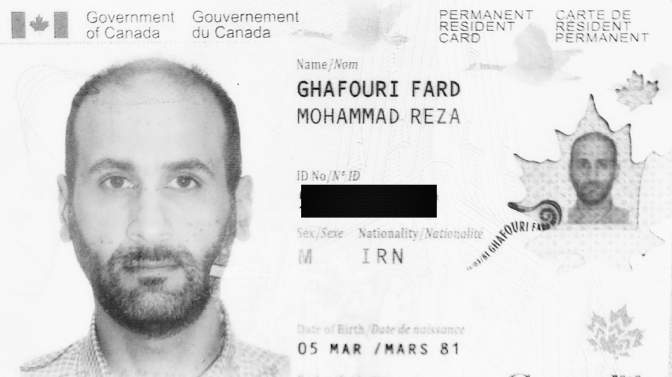
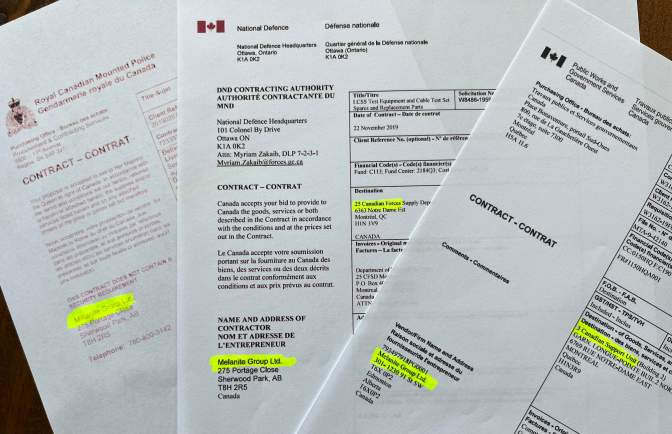
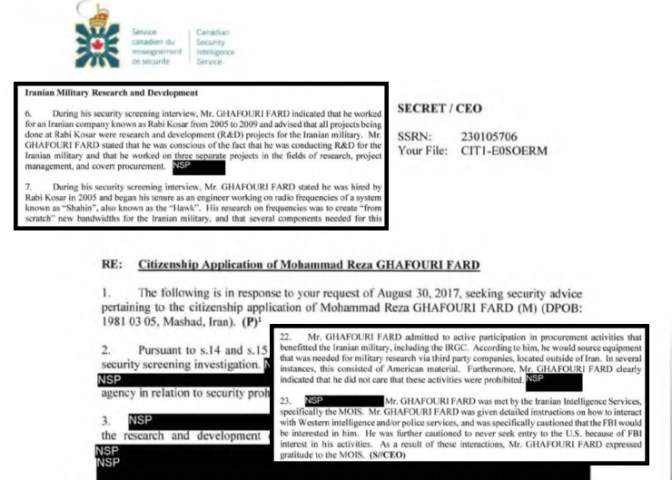
The RCMP and Canadian military were among the agencies that hired companies run by Edmonton resident 'Sal Ghafouri,' a Global News investigation has found.
The RCMP and Canadian military were among the agencies that hired companies run by Edmonton resident 'Sal Ghafouri,' a Global News investigation has found.
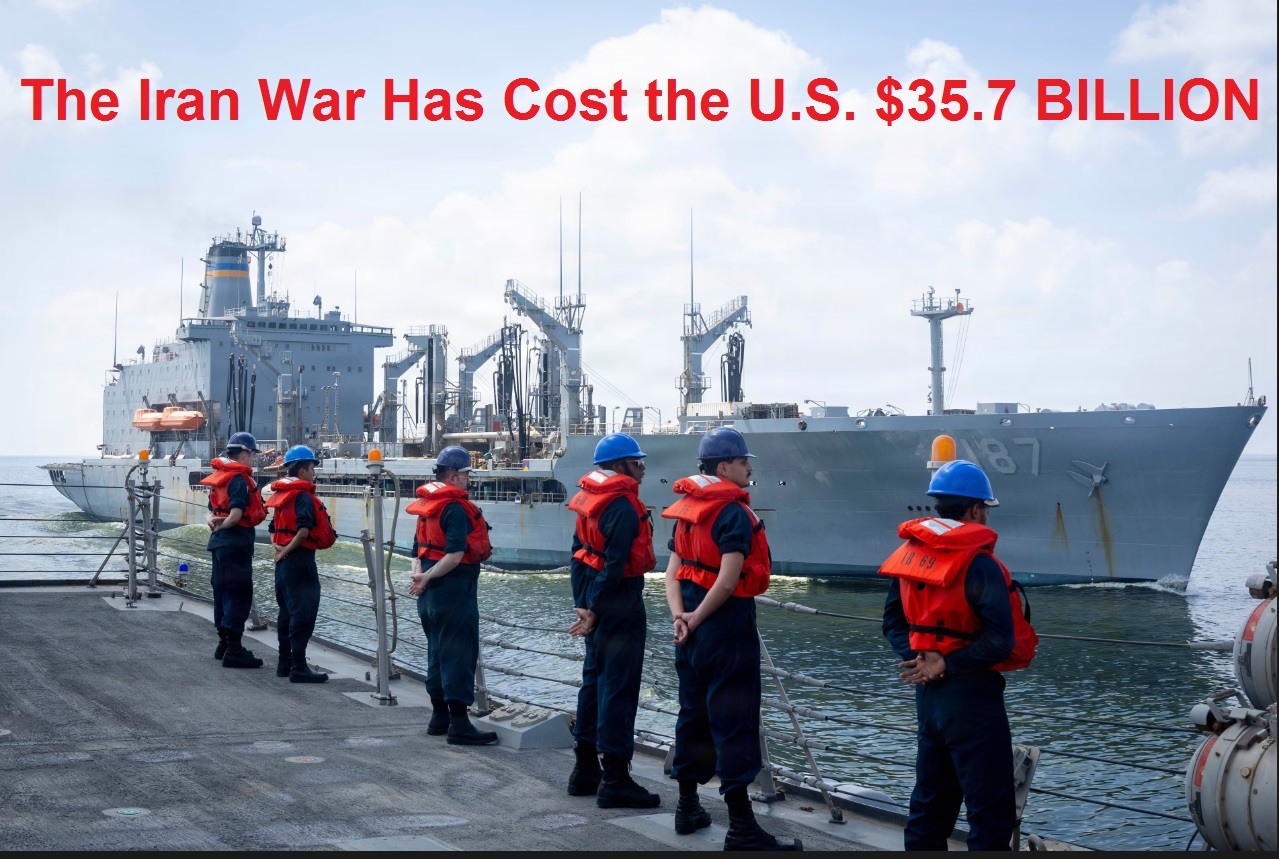
After 6 months and $35.7 BILLION in spending, the Zionists’ war against Iran has only made matters in the Middle East worse than they were before the war started.
Oil flowing through the Strait of Hormuz is still restricted, driving up energy costs, with Iran still fully in control. No oil was restricted from passing through the Persian Gulf before the war started.
Russia has benefited from all of this military spending, as it has diverted funds and weapons from Ukraine, and earlier this week the head of the CIA made a secret trip to Moscow, allegedly because they received intelligence that Russia was about to start attacking NATO countries.
China has found many ways around the disruption of oil flowing through the Strait of Hormuz, and has reportedly imported close to the same amount of oil flowing through the Persian Gulf as before the war.
Meanwhile, U.S. military members in the Navy have suffered very poor conditions from long deployment at sea leading many to suicide attempts, and it was just reported in The Guardian that the U.S. Navy has had to divert funds from their payroll to pay the costs of this war.
Here are some of the articles I have posted on our Telegram Channel recently.
Trump’s war on Iran is rapidly draining US navy budget, documents and interviews reveal
Exclusive: Experts and former officials say accounts are running dry, and funding a war with no clear endgame is the main challenge
Donald Trump’s war on Iran has driven the US military into a severe financial crisis, with the US navy forced to transfer money from its payroll and other sources to cover the costs of combat, according to documents seen by the Guardian, and interviews with navy officials, contractors and defense analysts.
The US-Israeli operation, which has depleted US munitions stockpiles and prompted retaliatory Iranian strikes that have wrecked strategic bases across the Middle East, is piling pressure on budgets across the military.
One Pentagon memo about navy funding seen by the Guardian warns that there are “shortfalls in payroll” accounts due to the department “raiding” them to fund combat operations.
Experts and former officials say the accounts are running dry. “The piggy bank is broken,” said Harlan Ullman, a retired naval officer. Ullman is a member of the National Commission for the Future of the Navy but he said he is not speaking on the commission’s behalf.
One official and one navy contractor said non-emergency maintenance on shore-based facilities has been deferred because of the cash crunch.
When Trump started the war on 28 February, it quickly strained the military’s existing budgets – particularly that of the navy, which not only helped launch the initial wave of attacks but was later responsible for an extensive naval blockade. The White House eventually asked Congress for emergency funding to pay for the war efforts, but prospects that the request will be approved are dim amid the unpopularity of the war.
A navy official who was briefed on how the service is planning to address the shortfalls said money is shifted around in imaginative ways.
“The money for payroll,” he said,
“was robbed to pay for overseas contingencies and is being backfilled by money that hasn’t been spent. They are backfilling payroll so we get enough money in our paycheck.”
China’s imports of Iranian oil ‘largely untouched’ by US siege: Report
China has received about 1.2 million barrels of Iranian oil per day this year so far, just a touch less than during the same time in 2025, according to information from industry data provider Kpler, cited by the New York Times(NYT) on 25 August.
According to Muyu Xu, a senior Kpler oil analyst, large quantities of oil are now sitting on ships and in storage tanks near the Malacca Strait and South China Sea.
“Up-to-date volumes are difficult to measure because ships have become increasingly skilled at evading detection,” Xu was cited as saying by NYT.
The number of barrels of Iranian oil received is only “slightly less” than last year.
“Iranian oil is frequently transported to waters off Malaysia, where cargoes are transferred between vessels before continuing to Chinese ports,” the US outlet writes.
NYT added that the “Trump administration risks a clash with Beijing as it tries to cut off Iran’s economic lifelines without upending a fragile US–China truce,” referring to the US–Chinese trade and tariff war that is currently on hold.
Beijing has strongly condemned Washington’s declaration of a new economic war against Iran.
China warned Washington on 25 August that it is ready to respond to “maximum pressure” and “economic isolation” pursued by the US.
“An economic war and maximum pressure will not help resolve the issue,” said Chinese Foreign Ministry spokesperson Lin Jian.
“They will only further intensify contradictions and conflicts, cause risks to spill over, disrupt the global economic and financial order, and harm the legitimate rights and interests of other countries,” he added.
“China is closely following the relevant developments and will take all necessary measures to firmly safeguard its own rights and interests.”
The Iran War Has Handed Russia a Strategic Opening in Europe
The war with Iran has handed Russia a strategic advantage in Ukraine. Washington is burning through the weapons Europe needs to deter Russia, moving military capacity into the Gulf and simultaneously telling NATO governments to take over more of their own defense.
CIA Director John Ratcliffe flew to Moscow this week precisely because of the connected nature of these two problems. He met Russian foreign intelligence chief Sergei Naryshkin in the first known visit by a CIA director since William Burns traveled there in late 2021, just before Russia invaded Ukraine.
Ratcliffe warned Moscow against attacking a NATO member and tried to bargain for support against Iran, likely using talks with Ukraine as bait. Washington asked Kyiv to suspend strikes during the visit.
Trump has called the trip “semi-routine” and says he is not worried Russia will attack NATO, but the circumstances suggest otherwise.
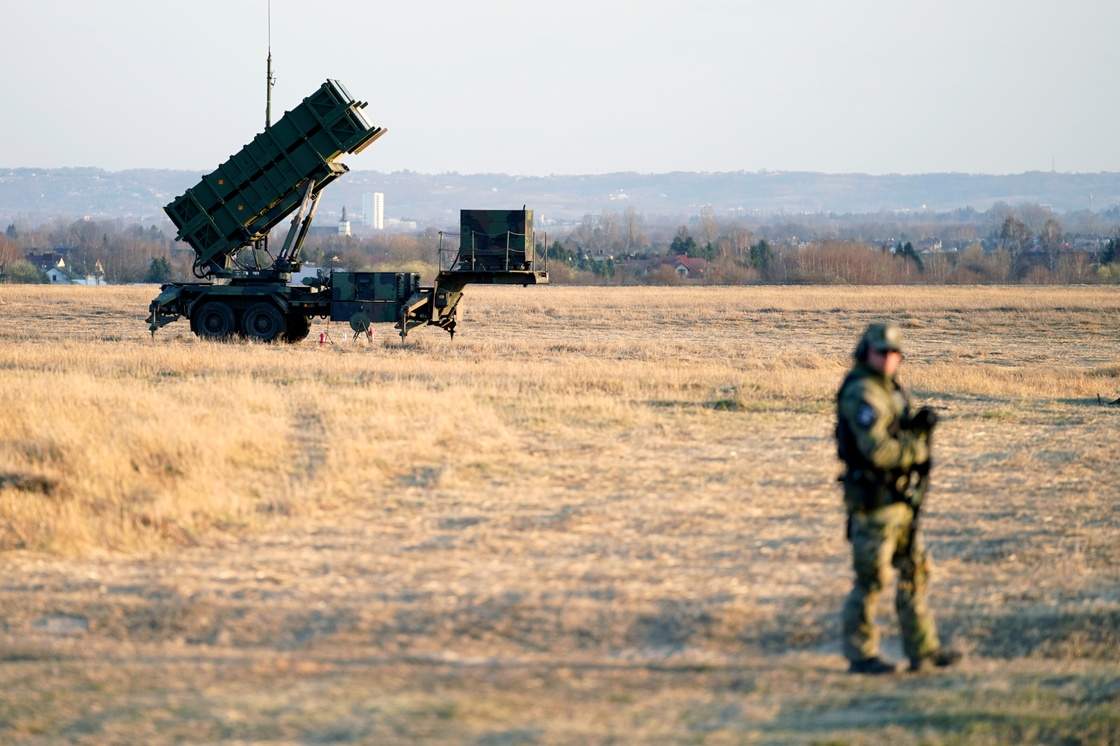
Air defense is the immediate challenge, with Patriot interceptor stocks in Europe “beyond critical”, depleted by the war in Iran. U.S. forces now have very limited ability to defend against even a single Russian ballistic missile strike, and there are not enough Patriots to absorb a sustained attack.
The Pentagon and NATO may dispute that assessment or attempt to frame it in softer language, but there is no dispute that large numbers of interceptors have been moved out of Europe and used in the Middle East.
Hormuz is “open”, but nowhere close to functioning normally.
The U.S. has cleared mines from the internationally recognized shipping lanes and can technically get vessels through, but Iran’s military capability will still keep most commercial operators away.
Only five commodity vessels crossed on Tuesday, compared to some 130 ships a day before the war.
Iran is offering a temporary and limited corridor while making full normalization conditional on sanctions relief, an end to the U.S. blockade and, now, an end to Israeli operations in Gaza, Lebanon and Syria.
The Israeli demand is a non-starter. Washington cannot guarantee that Israel will stop military operations in three separate theaters, and Israel has shown little willingness to comply at any point in this war.
But Trump has rejected the notion of a return to the previous June agreement, which gave Iran quite a lot more in terms of concessions than Washington appears to be willing to offer now.
The administration is now betting that economic ostracism and the blockade can force Tehran back on worse terms. Iran is betting on the opposite: that it can withstand the economic pressure longer than Washington and the Gulf can tolerate a crippled Hormuz.
Saudi Arabia reiterated Thursday that it will not normalize relations with Israel without an independent Palestinian state, just as Trump made normalization a condition for the kingdom’s nuclear deal with Washington to take effect.
Trump has formally sent the 30-year civilian nuclear agreement to Congress, starting a 90-legislative-day review that could clear U.S. companies to export nuclear technology to Saudi Arabia.
Riyadh wants nuclear power to reduce the oil and gas burned for electricity and preserve more hydrocarbons for export, while Washington wants U.S. companies building the kingdom’s nuclear fleet rather than China or Russia.
Congress now has the nuclear agreement. Trump still needs a Saudi-Israeli normalization deal that Riyadh says requires a Palestinian state.
Turkey is spending $2.4 million to strengthen its lobbying position in Washington as Ankara and Israel compete over U.S. policy in Syria and the wider region.
The Turkish Defence Ministry has hired Ballard Partners, one of the best connected firms in Trump’s political network, for $200,000 a month to lobby the administration and Congress.
Turkey wants back into the F-35 program and is considering disposing of its Russian S-400 system to remove the main U.S. obstacle, but the lobbying push comes as Ankara has a much larger fight with Israel over Syria.
Israel is trying to stop Turkey from establishing a deeper military presence there, while Washington has backed Ahmed al-Sharaa and relies heavily on Turkey to help rebuild and train the Syrian military.
Ankara has assembled a lobbying team built for that fight. It includes former Democratic congressman Robert Wexler, a longtime Turkey advocate with strong connections in pro-Israel circles, and former Trump National Security Council official Thomas Boodry.
Ballard itself has unusually close ties to Trump: White House Chief of Staff Susie Wiles and former Attorney General Pam Bondi both worked for the firm.
Israel has spent decades building influence over U.S. Middle East policy. Turkey is now ready to compete in spending.
No one will sell oil in region if Iran cannot: Parliament speaker
Iran’s Parliament Speaker Mohammad Baqer Qalibaf has reposted his previous comments on social media, warning that no one will be able to sell oil in a region where the Islamic Republic cannot do so.
Qalibaf on Friday posted his X message dating back to July 22, after US Central Command (CENTCOM) Commander Admiral Brad Cooper claimed American forces had full control of the Strait of Hormuz and halted Iran’s oil exports.
“The equation of this war is clear: either all or none!” he said.
“In a region where we don’t sell oil, no one else will sell oil either.”
He also noted that the security of the Strait of Hormuz, a strategic waterway responsible for a fifth of global oil demand, lies in the absence of terrorist US troops.
“If our security is not ensured, no infrastructure will be safe. Security of the strait depends on the absence of US forces. We have said many times that the situation in the strait will not return to what it was before the war.”
This article was written by Human Superior Intelligence (HSI)
See Also:
Understand the Times We are Currently Living Through
A U.S. defense official said the most concerning shortfall involves Patriot missile interceptors, which can shoot down Russia’s high-speed ballistic missiles.
A U.S. defense official said the most concerning shortfall involves Patriot missile interceptors, which can shoot down Russia’s high-speed ballistic missiles.
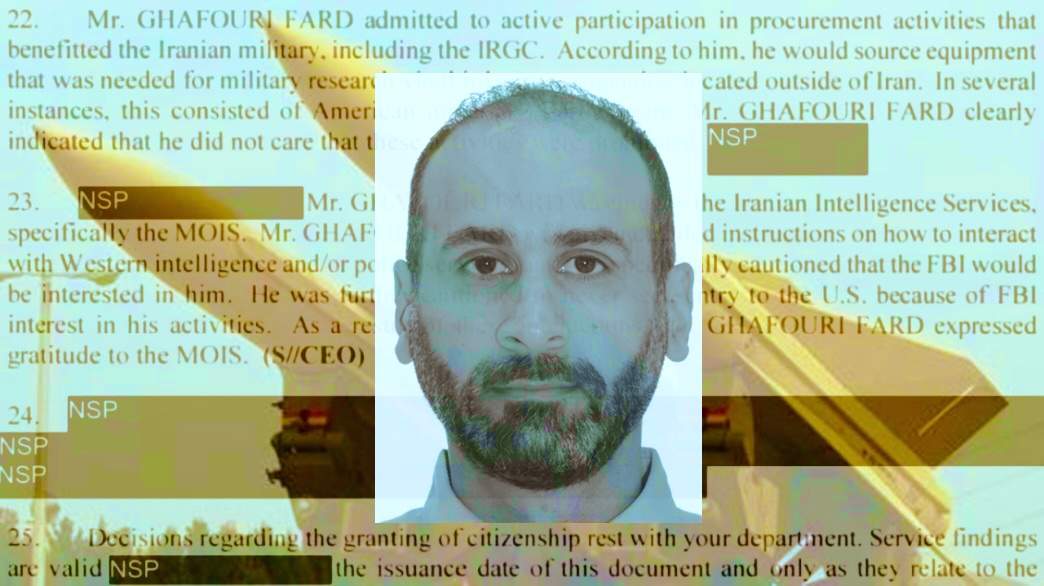
A CBSA report alleges that as a deputy director in Iran’s Ministry of Industry, Mines and Trade, Abbas Omidi, assisted the regime's state sponsorship of terrorism.
A CBSA report alleges that as a deputy director in Iran’s Ministry of Industry, Mines and Trade, Abbas Omidi, assisted the regime's state sponsorship of terrorism.
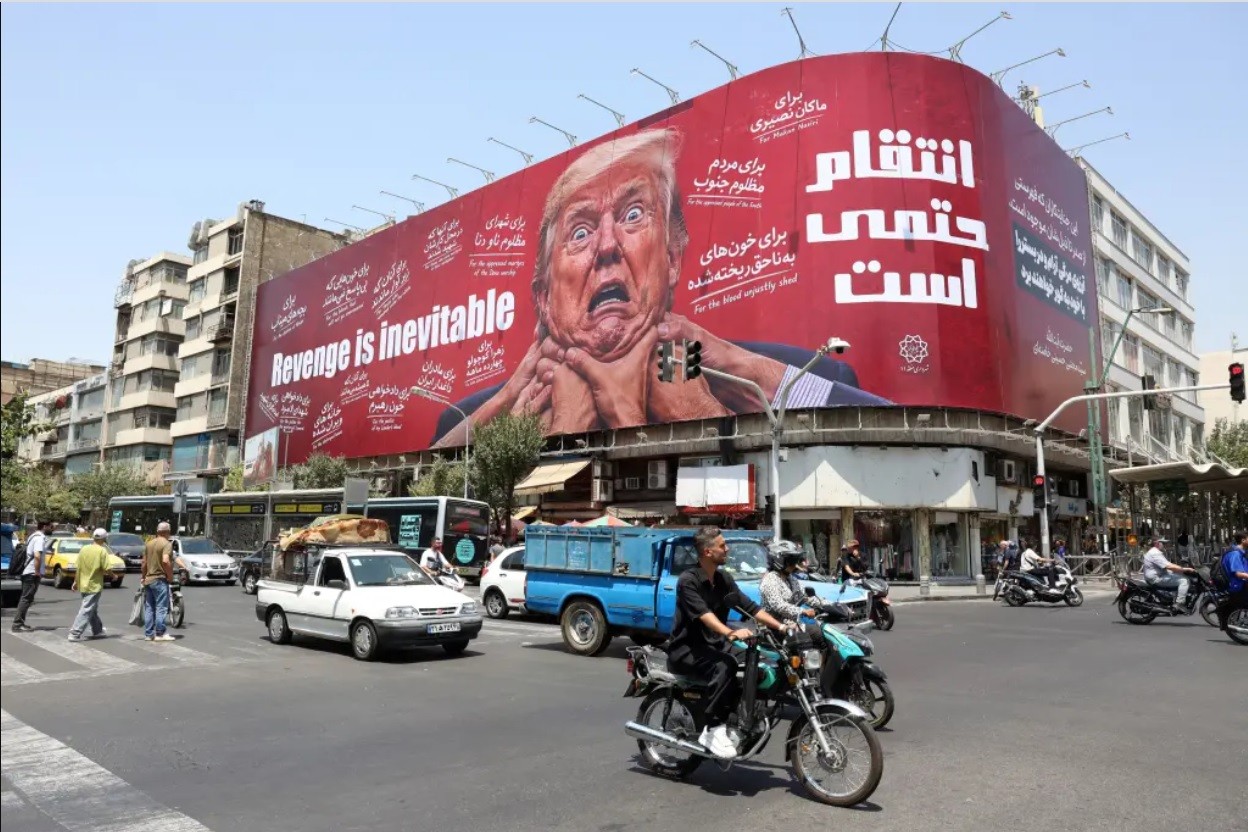
A common type of billboard seen these days in the streets of Tehran in Iran. Image source.
Comments by Brian Shilhavy Health Impact News
Sam Parker of Behind the News Network has just published an excellent article based on Zbigniew Brzezinski’s 1997 book, The Grand Chessboard.
Brzezinski’s book warned that if the U.S. ever attacked Iran, it could lead China and Russia to unite with Iran and against the U.S. to prevent Iran’s downfall.
In a 2012 interview about his book, Brzezinski said:
“By 2025, the US could lose its position as the world’s dominant power, leading to a more chaotic and conflict-ridden international system.”
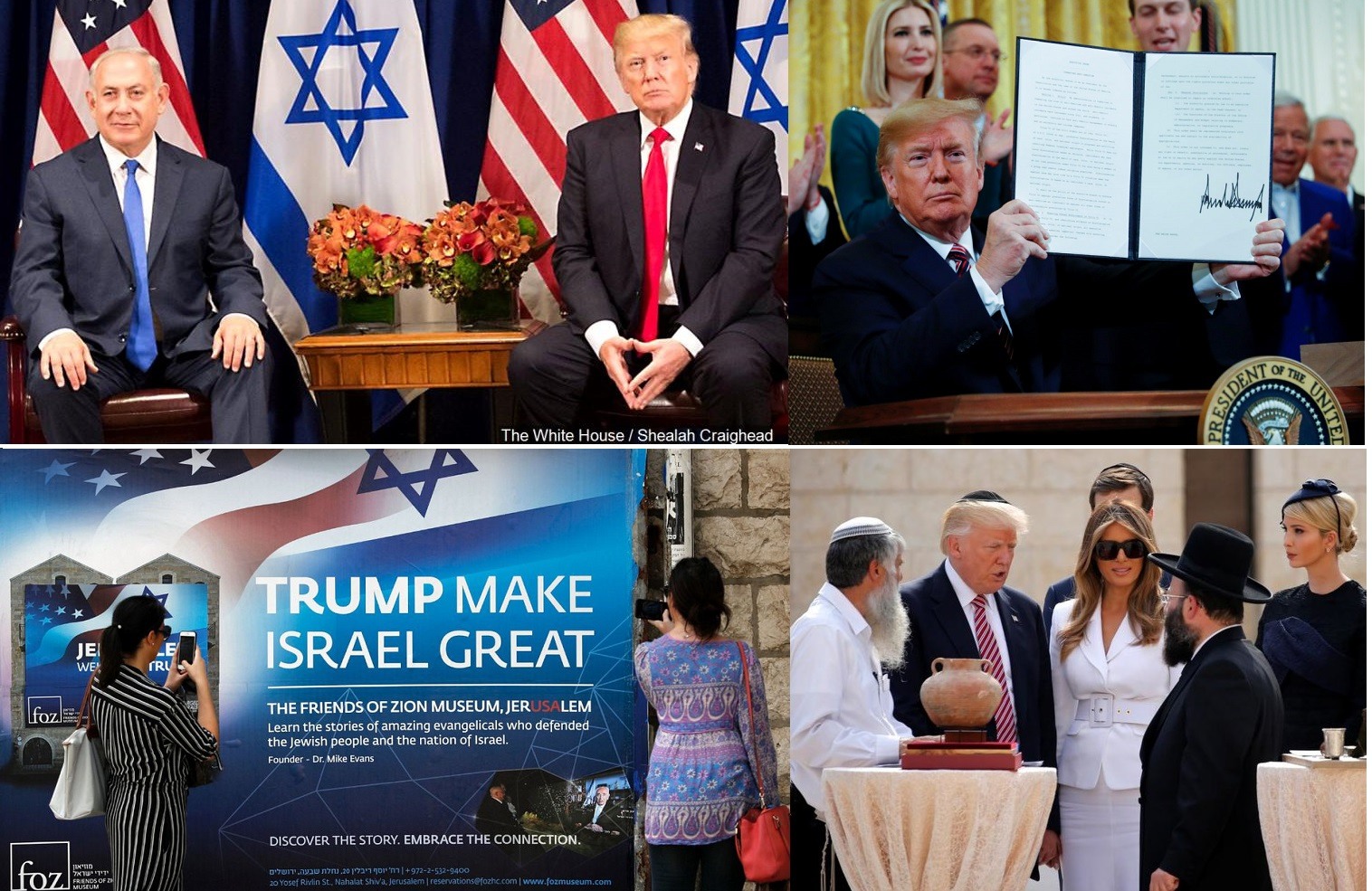
That “prophecy” has been proven true today, and it is a far different reality than what the Christian Evangelical Christians are saying about prophecy and Iran.
The Christians seem to forget their Biblical history, because historically, Israel has been conquered by Iran (Persia), and Iran has never been conquered by a world power since then.
In the 8th Century B.C., the Assyrian Empire, which included Persia, carried into captivity the northern 10 tribes of Israel.
Then in 586 B.C., Jerusalem fell to the Babylonian Empire, which included Persia, and just a few years later Persia dominated the area and it became known as the Persian Empire. Cyrus, the Persian King, is the one who allowed the Jews to return to their homeland and rebuild the Temple in Jerusalem.
From the time of the Roman Empire through to the British Empire, Persia (Iran) has never been conquered, and has never been a colony of either Britain or the U.S.
It is one of the two non-Arab countries in the Middle East that has never been conquered by Western nations, and is the remnant of a former great world empire. Turkey is the other one, being the remnant of the great Ottoman Empire, which eclipsed even the Roman Empire at its height.
The Christian Evangelical Zionists who follow the modern-day Dispensationalism theology, which allows them to condemn whole ethnic groups of people as evil, such as the Palestinians and the Iranians, are on the wrong side of history, and will soon find out that they are also on the wrong side of God’s plan for the end times in the future.
Many of them will follow their leader and savior Donald Trump to the end, “trusting the plan”, which leads directly to Hell.
Zbigniew Brzezinski, a grand master of US imperial strategy in the Cold War, put forward some of the most insightful analysis for us to understand America’s war on Iran.
In his 1997 book The Grand Chessboard, Brzezinski identified Iran as one of the “critically important geopolitical pivots” in what he called the “Eurasian Balkans”—a region of power vacuum and power suction stretching from Central Asia to the Persian Gulf.
Brzezinski wrote:
“Iran dominates the eastern shoreline of the Persian Gulf, while its independence, irrespective of current Iranian hostility toward the United States, acts as a barrier to any long-term Russian threat to American interests in the Persian Gulf region.”
Back in 1997, Iran was simultaneously a threat to US interests and a geopolitical buffer against Russian expansion. Brzezinski never thought that US policy makers would be so unwise as to push Iran toward Russia that directly contradicts US strategic interest, against any strategic logic.
Brzezinski’s most prescient warning appears in The Grand Chessboard:
“Potentially, the most dangerous scenario would be a grand coalition of China, Russia, and perhaps Iran, an ‘antihegemonic’ coalition united not by ideology but by complementary grievances… Averting this contingency… will require a display of U.S. geostrategic skill on the western, eastern, and southern perimeters of Eurasia simultaneously.”
“The three grand imperatives of imperial geostrategy are to prevent collusion and maintain security dependence among the vassals, to keep tributaries pliant and protected, and to keep the barbarians from coming together.
Henceforth, the United States may have to determine how to cope with regional coalitions that seek to push America out of Eurasia, thereby threatening America’s status as a global power.”— Zbigniew Brzezinski.
Fast forward 30 years, the current reality is:
China and Russia have formed a “no limits partnership”
Iran joined the Shanghai Cooperation Organization (SCO) in 2022
The three countries conduct regular joint naval exercises in the Persian Gulf
Iran supplies drones to Russia for the Ukraine war
China and Russia provide diplomatic, materiel, and intelligence support for Iran in its war against the US and Israel
Brzezinski’s warning has materialized.
One high-profile Chinese commentator noted, “Trump’s war against Iran may be the stupidest strategic mistake in American history” because it accelerates this anti-hegemonic coalition.
From a 2012 interview about his book Strategic Vision on the Charlie Rose show:
“He advocated deterrence over preventive war, arguing that starting a war to prevent nuclear acquisition ‘will certainly plunge the region into protracted and unpredictable hostilities‘”.
This contrasts sharply with current Israeli and US strategy of regime change through assassination and unprovoked war – exactly the kind of escalation Brzezinski warned against.
In Strategic Vision, Brzezinski diagnosed the fundamental problem facing the US:
“By 2025, the US could lose its position as the world’s dominant power, leading to a more chaotic and conflict-ridden international system”.
For all his foresight, he skipped forecasting the US itself would be the source of global chaos and conflicts.
Back in 2012, Brzezinski attributed the potential decline to US militarism (wars in Iraq and Afghanistan), unilateralism (vastly worsened under Trump), the 2008 financial crisis, and polarized domestic politics (also vastly worsened since then).
He noted,
“Unless we overcome the currently paralyzing divisions within our own society… the United States will find it difficult to set its house in order and to play a constructive world role”.
How prescient.
These failures taught Brzezinski that military solutions to Iranian problems are usually catastrophic. His later advocacy for engagement and deterrence reflects this hard-won wisdom – wisdom ignored by US policymakers.
In fact, successive US administrations since 2012 have pursued the polar opposite of Brzezinski’s recommendations:
Rather than preventing a China-Russia-Iran alignment, US sanctions and hostilities toward all three have pushed Beijing, Moscow, and Tehran closer, despite the lack of any ideological alignments beyond anti-US hegemony
Instead of maintaining “geopolitical skill” on all Eurasian fronts, the US has overreached and is provoking a three-front confrontation in Ukraine, Iran, and Taiwan
Instead of multilateral engagements, the US has pursued an aggressive unilateral “America First” policy and an even deeper “Israel first” posture in its Middle Eastern policies
In the end, Brzezinski’s warnings are unheeded.
The current crisis validates his prophecy and suggests that without a course correction, the “strategic vision” of American decline will become self-fulfilling.
One of Brzezinski’s most prophetic concepts in the book is the “global political awakening”.
He argues that for the first time in history, the entire world’s population is politically conscious and reachable through the press and social media.
This means that traditional “imperial” maneuvers (like the 1953 coup in All the Shah’s Men) are no longer possible because the local population will inevitably resist and mobilize against the imperialists and neo-colonialism.
We are seeing this clearly in the Iran war.
Despite the mass protests of economic hardship and corruption, the Iranian population has rallied around the flag and resisted capitulation under intense US and Israel bombing rampage.
Brzezinski posited that Iran prefers a balance between East and West. However, by using military force in 2026, the West effectively forced Tehran to abandon that balance and seek a “security guarantee” from Beijing and Moscow, fulfilling Brzezinski’s nightmare of a unified, anti-Western Eurasian bloc.
As the US wages war on Iran, China is following Brzezinski’s predicted script: keeping a low profile while securing long-term energy contracts and security arrangements in the Persian Gulf.
China’s deepening involvement in Iranian oil infrastructure (like the Alborz platform) is the physical manifestation of the “Eurasian integration” Brzezinski was worried about.
China is turning Iran from a “geopolitical pivot” into a “Chinese bridgehead.”
China also gains from American exhaustion. The depletion of US arsenal further weakens its position along China’s shores.
Brzezinski specifically used the year 2025 as the tipping point in his book. He argued that if by this time the U.S. had not revitalized its domestic economy and fixed its “ignorant garrison-state mentality,” it would lose its role as the global arbiter.
Reading this today, the current conflict looks less like a localized war and more like the “post-America scramble” he predicted – a chaotic period where regional powers like Iran and global powers like China test the crumbling foundations of the old-world order that favors the US and its vassals.
Iran’s historical experience as a crossroads civilization (the “Eurasian land bridge”) taught it that direct conflict with superior powers is suicidal.
Instead, Iran has built a network of proxies reflecting ancient Persian diplomatic traditions, including Hezbollah in Lebanon, Hamas in Gaza, Houthis in Yemen, and Shiite Militias in Iraq/Syria.
These proxies provide Iran with buffer space and multiple points of leverage against its opponents.
Iran has long held a “No East, No West” Doctrine. This reflects Iran’s historical position between competing empires (Roman/Parthian, British/Russian, US/Soviet).
Today, Iran maintains ties with Russia and China while maintaining an independent posture, demonstrating continuity with its non-alignment tradition. This pillar of strategy may become less tenable as reconciliation with the West seems out of the question for now.
The war in Iran began five months ago. Headline news about the conflict tends to focus on when and how it might end. In the meantime, the impacts of the conflict are felt worldwide—by drivers, farmers, business owners, and families. The Associated Press shares the stories of seven people suffering because of the war. Among them is Edgar Funelas, a jeepney driver in the Philippines who lives with his ten-year-old daughter:
He uses laundry soap—harsher, but cheaper—to wash his body and his clothes in the same motion, stretching what little money he has. Even before the war in Iran, he was living on the margins. A fire took their home and their belongings, forcing them to move into the brightly colored minibus he drove.
He’d hoped to be able to rent a room by now. Then diesel prices surged, and he could no longer afford the fuel to run his jeepney.
He hasn’t earned a single peso in days. There will be no breakfast. Hunger gnaws, but it’s the small rituals of privacy that he misses most: to be able to wash out of sight, to sleep behind walls, to keep his desperation from being laid bare.
Since the outbreak of the US-Israeli conflict with Iran in late February 2026, the six largest Wall Street banks have posted one blockbuster quarter after another. It’s a paradox that isn’t really one: market volatility — the very thing savers and businesses dread — is precisely what trading desks feed on.
Numbers That Boggle the Mind
On July 14, 2026, five of the biggest US banks reported earnings on the same day, and the results surprised even the most bullish analysts. JPMorgan Chase, the nation’s largest bank by assets, posted quarterly profit of $16.9 billion, once again driven by its equities trading division, which “took advantage of market volatility triggered by the war in Iran.” Revenue in that division jumped 35% year-over-year, and equity markets revenue soared 86%.
According to several financial outlets, JPMorgan’s profit — including gains on its equity holdings — actually came close to $21 billion for the quarter, an all-time record for the bank.
Goldman Sachs was no exception: the investment bank also handily beat forecasts, lifted both by conflict-driven volatility and by SpaceX’s record-breaking IPO, which Goldman co-led. Its merger-advisory fees rose 55%, and in the first half of 2026 alone it advised on $1.2 trillion in announced mergers and acquisitions — an unprecedented pace for any investment bank, putting it $425 billion ahead of its nearest rival.
All told, in the second quarter of 2026 alone, the five biggest banks combined (JPMorgan, Bank of America, Goldman Sachs, Citigroup and Wells Fargo) posted roughly $49 billion in combined profit. In the first quarter, the six largest US banks — those five plus Morgan Stanley — had already collectively booked nearly $48 billion in profit, well above year-earlier levels.
Why Does War Benefit the Banks?
The mechanism is no mystery to market professionals, even if it startles the general public. A trading floor doesn’t make money when markets are calm — it makes money when they move. Every geopolitical jolt — a military strike, a rumored ceasefire, a partial closure of the Strait of Hormuz — triggers waves of buying and selling across stocks, currencies and commodities. Every transaction generates fees.
Since the first US-Israeli strikes on February 28, 2026, bond, oil and stock markets have swung wildly with each twist of the conflict and every dashed hope of a truce. That chronic instability has directly fueled investment banks’ trading revenues.
On top of that comes an indirect effect: the war slowed, then unleashed in waves, mergers-and-acquisitions activity and IPOs — two highly lucrative businesses for investment banks, which collect substantial advisory fees on every deal.
Goldman Sachs itself acknowledges as much in black and white in its quarterly financial report filed with the US securities regulator (SEC): the Iranian conflict has had “significant implications for the global economy,” combining disrupted oil supply, higher oil prices and heightened equity-market volatility — precisely the ingredients of the trading desk’s playbook.
A Paradox That Goes Beyond the Banks
This phenomenon isn’t confined to the banking sector. Major oil companies — especially European majors with large trading arms, such as TotalEnergies — have seen profits surge on the back of price swings following the partial closure of the Strait of Hormuz, a route for roughly a fifth of the world’s oil and gas. Defense contractors, for their part, are reporting record order backlogs, led by Lockheed Martin, Boeing and Northrop Grumman, buoyed by allied nations rearming.
Meanwhile, households and non-financial businesses bear the flip side of that same volatility: higher energy prices, costlier freight, and mounting uncertainty for long-term investment. The conflict has thus become a vast transfer of wealth, in which the very instability harming the real economy is simultaneously enriching a handful of financial and industrial players positioned to capitalize on it.
At a Glance
Q1 2026: the six largest US banks combined for nearly $48 billion in profit.
Q2 2026: five of them posted roughly $49 billion in combined quarterly profit.
JPMorgan: record quarterly profit of nearly $21 billion (including gains).
Goldman Sachs: M&A advisory fees up 55%, with its M&A backlog at a five-year high.
Mechanism: market volatility, driven by the twists and turns of the US-Israeli conflict with Iran since February 28, 2026, has mechanically boosted investment banks’ trading and advisory revenues.
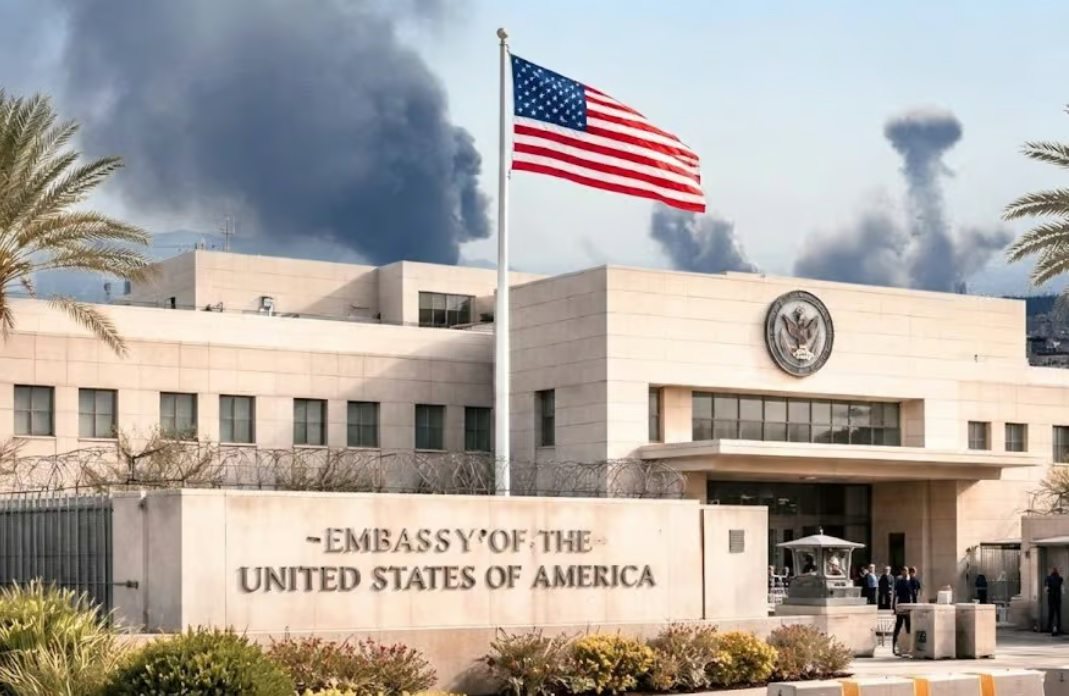
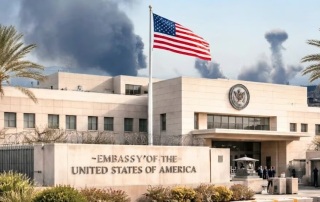
Yesterday (Friday, July 31st), U.S. Embassies in the Middle East put out their strongest warnings since the Iran War started that Americans should prepare to leave due to an escalation in the Iran war. The warnings now come from 10 countries in the Middle East where Americans live.
Get ready to flee, Americans in ten countries warned as US embassies issue stark alert over spiraling Iran war
Americans have been told to be ‘ready’ to flee ten Middle Eastern countries as the Iran war spirals, with President Trump warning: ‘We’ll be hitting them very hard.’
The US Embassy has urgently advised US citizens across the Middle East to ‘consider departing or be ready to depart if there is an escalation,’ just hours after Trump signaled fresh strikes on Iran could come as soon as this weekend.
The warning now covers 10 countries: the United Arab Emirates (UAE), Qatar, Oman, Iraq, Jordan, Israel, Kuwait, Saudi Arabia, Bahrain and, most recently, Egypt.
‘US Embassies across the Middle East have issued security alerts today advising travelers to exercise heightened vigilance and be prepared for flight cancellations and airspace closures,’ the initial alert said.
Less than an hour later, a second alert announced that the warning had also been issued by the US Embassy in Cairo, Egypt.
For the first time, the warning told Americans in the region they should ‘consider departing, or be prepared to depart should there be escalation,’ bringing the guidance in line with other Middle Eastern countries.
‘The situation in the Middle East remains fluid,’ the alert read.
It comes after sources told CBS News on Friday that the US and Israel are preparing what was described as ‘one of the harshest bombing campaigns to date’ against Iran’s energy infrastructure.
While the president has not yet given the final green light, several insiders told the outlet that strikes could begin as soon as this weekend, with Israel already notified and coordinating with Washington.
‘The Department of War is locked and loaded, ready to execute the President’s directives at a moment’s notice,’ Chief Pentagon spokesperson Sean Parnell said in a statement, though refused to comment on intended targets.
Of course, we have heard all of this before, where threats were made to increase the war, or promises were made to negotiate a settlement.
And each time the war in Iran becomes the main topic in the corporate news stream, the U.S. stock markets fall in line.
In the current cycle, the price of oil per barrel dropped below $90 a barrel Friday, so perhaps this announcement, shortly after Netanyahu visited Trump in D.C., was designed to mainly increase the price of oil again, which in turn generally brings the Tech heavy NASDAQ down, since so much energy is needed to power data centers and AI.
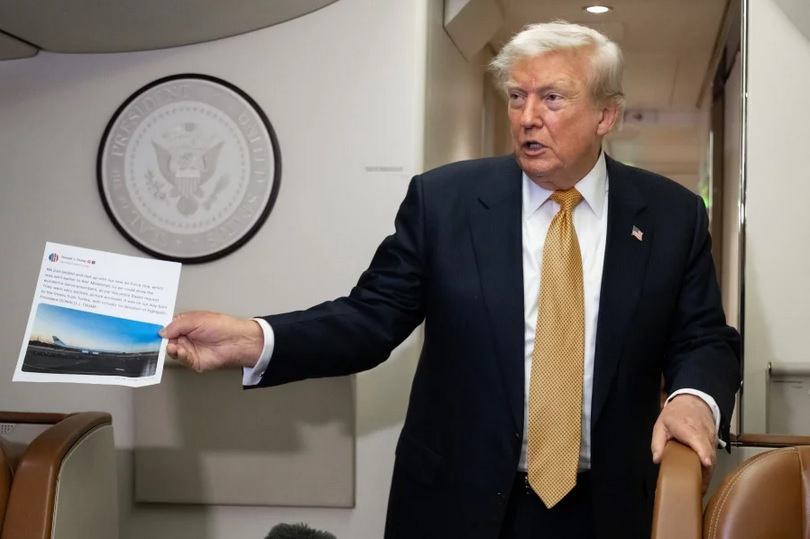
Now, Trump is capitalizing even more from being able to use his position in the White House to manipulate markets with news on the Iran War, by selling “early access” to his Truth Social posts for $100,000.
Trump offering early access to online posts in move seen as corruption
Truth Social, where Trump’s account is by far the largest, to offer users early access for up to $100,000 per month
Donald Trump is now offering early access to his Truth Social posts in a move that has been seen as corruption benefitting a sitting president.
Trump Media and Technology Group officially rolled out its new subscription-based data service on Saturday, giving paying customers faster, real-time access to Truth Social posts from Trump and other high-profile accounts.
Called Truth API, the application programming interface is intended to provide businesses with “a direct, licensed, real-time feed of the platform’s most market-moving Truths”, interim CEO Kevin McGurn said in a release announcing the launch. Trading firms and other paying subscribers can now access the posts earlier than other users – for a fee of up to $100,000 per month.
Critics argue the service is blatant evidence of market manipulation and insider trading. Trump has repeatedly used Truth Social to reveal significant policy moves with the potential to shift financial markets, including posts involving tariffs and the Iran war.
Last year, Trump published more than 100 Truth Social posts in a single day while global stock markets tumbled amid concerns that his economic agenda could trigger a “Trumpcession” in the US.
His posts about Iran have drawn particular attention because investors remain concerned that rising oil prices could keep inflation elevated and potentially lead the Federal Reserve to increase interest rates.
Trump Media’s stock has fallen by more than 70% since the president took office last year, wiping out roughly $6bn (£4.4bn) in shareholder value.
Those losses, combined with billions more in investor losses connected to new Trump family cryptocurrency ventures, have come under increased scrutiny after Trump’s annual financial disclosure showed he generated more than $1 billion in revenue last year from the same companies and offerings.
Iranian intelligence is using commercial advertising technology to detect the locations of American troops and carry out targeted strikes against them, Newsmax reports.
The technology relies on targeted advertising systems that use precise GPS coordinates. This unclassified location data is freely bought and sold by data brokers, with virtually no restrictions on who can purchase it
The tracking is tied to user accounts rather than specific devices, meaning that changing phones does not stop the surveillance
Iran also monitors videos and photos posted by soldiers on social media, revealing base layouts, troop movements, and defensive positions
Days earlier, Admiral Brad Cooper, head of US CENTCOM, sent a letter to service members warning that social media posts are helping Iran determine troop locations and assess the effectiveness of its strikes on American bases.
One example cited: a US soldier’s video, filmed with Meta smart glasses and posted on Instagram, showed troops running for cover during an Iranian attack on the Muwaffaq Salti Air Base in Jordan on July 17. The footage revealed the exact location of the base and the evacuation route to the bunker.
Some troops in Jordan have already been told their phones will be confiscated in the coming days. Yet the looming threat of phone seizures has deepened the unease among soldiers’ families, already jittery from months of Iranian reports about deadly attacks on US bases in the region.
Open-source information has become Iran’s most effective reconnaissance tool, and the US military is struggling to contain the damage.
Epstein Attorney Alan Dershowitz Debates Professor Marandi of Tehran about Who is Actually Committing Genocide
Dershowitz is practically foaming at the mouth in this debate, as the Zionists are quickly losing control of the narrative.
Saudi Arabia’s Choice: Join Trump in Bombing Iraq. Monumental Mistake
Fourteen countries have signed on to Saudi Arabia’s proposed Maritime Defense Alliance protecting ships traversing the Bab al-Mandeb Strait, the Red Sea and the Gulf of Aden. Saudi Crown Prince Bin Salman held a conversation with Vance and Trump wherein he condemned the US continued strikes on Iran and said this alternate route would be protected from Houthi attacks. While Trump was offered membership in the alliance, his ego has yet to confirm US involvement wherein he is not the boss.
The latest collaboration of bombing was just extended as the Saudis joined the US in bombing Iraq, bringing Iraq closer in alignment with Iran and their backers Russia and China.
This is a move Bin Salman will regret as Saudi Arabia will now be the focus for retaliation, playing into the hands of Israel as extending their proxy to pit the Middle Eastern countries against each other while preserving Israel. The real pariah. Netanyahu is laughing. Bin Salman will find himself in the same courtyard as Hussein and Assad. And Israel will set its sights on Saudi oil.
An ally for a singular purpose and once achieved – an enemy.
Netanyahu has returned home after telling Trump in no uncertain terms that there will be NO DEAL with Iran. He scolded Vance for not being Jewish enough and publicly humiliated him for the record. Netanyahu avoided New York this trip but vows he will attend a UN conference in September despite calls for his arrest.
THE CIRCULAR: Israel tells Trump to attack Iran because Israel hates Iran. Trump complies putting the US in the crosshairs and Americans at risk. Israel tells Trump to defend the Strait after it’s ‘unexpected’ closure by Iran. Troops die. Netanyahu comes to DC to force Trump to continue the unrelenting bombing of Iran and make no deal. Trump claims he will bomb Iran and 93 million citizens to smithereens. Netanyahu applauds and says Iran started the war.
Generals warn Trump the US military arsenal is squeezed and we need to backoff until inventories can be replenished which would take 2-5 years. Netanyahu’s last warning to Trump: If Iran attacks Israel, vengeance will be swift and complete. Netanyahu resumes bombing in Lebanon, crossing Iran’s red line.
It would appear a lot of blackmail was reiterated during Netanyahu’s brief visit. And everyone has been thus warned… Bowed head. Folded hands. Promises kept.
Morocco is opening its border and allowing upwards of 2,000 immigrants to cross into Spain.
Morocco is an ally of Israel.
Any country that defies Israel’s global dominance is subject to destruction, whether by fires or by immigrants or by weather anomalies. There are exactly two countries who continue to defy that breach of sovereignty – China and Russia.
Russians Waking up to the Fact that Putin is Controlled Opposition and Part of Chabad Lubavitch – The Satanic Jews
Who REALLY Runs RUSSIA? HERE IS THE TRUTH THAT MANY DON’T WANT TO TALK ABOUT.
This article was written by Human Superior Intelligence (HSI)
See Also:
Understand the Times We are Currently Living Through
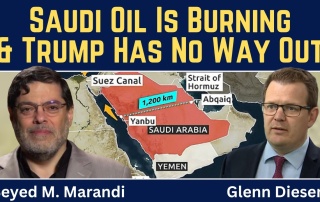
The stakes in the Iran War have increased significantly during the past few days, as Yemen’s Ansar Allah (Houthis) has bombed a key Saudi Arabian oil plant in Aramco, and has effectively closed down traffic flowing through the Red Sea, in addition to traffic being halted through the Strait of Hormuz in the Persian Gulf.
I am including two video reports here today that give a great overall perspective on the current situation, without the corporate media propaganda.
The first one is an interview with Professor Seyed Marandi from last night who actually lives in Tehran and has inside information, and the second report is from the Transition Protocol with ex-CIA agent Larry Johnson, Pepe Escobar, and Zulfiqar Ali that aired just hours before I published this article today, Sunday, July 26, 2026.
Marandi reiterates that there are no military solutions for the U.S. or Saudi Arabia at this point. He believes that the Trump administration is looking for an off-ramp, while acknowledging that they could also re-start the bombing at any point, and carry out their threats to target Iranian key infrastructure.
To do so, however, from Marandi’s perspective, is to then give a green light to Iran to start bombing American bases in the Gulf again, and take out the infrastructure of the Gulf Nations, such as their water desalinization plants, as well as bomb their ports to make it impossible for them to export their oil.
Iran is still hoping that the Gulf States will back down from supporting the U.S. military bases in their countries, because the U.S. cannot save them.
In the Transition Protocol discussion, Larry Johnson exposes the propaganda from earlier this week when Trump promised to help Saudi Arabia build a nuclear plant, by reminding everyone that the U.S. has only produced 2 nuclear power plants in the past 26 years (one of which was 30 years late), while Russia has built about 60, and China probably even more than that, during the same time period.
China is heavily invested in Saudi Arabia, and it would seem it is just a matter of time that Saudi Arabia will see that their only path forward is to work with China, and not with the U.S. who not only cannot protect them from Iranian missiles, but cannot protect them from their neighbors in Yemen either, because they build these drones and missiles for pennies on the dollar compared to the U.S. ones they rely upon.
Saudi Arabia is running out of options, and the one thing that is not discussed in either of these videos, is the fact that Saudi Arabia has invested heavily in U.S. Big Tech and AI during the past few years, and is as leveraged in the AI bubble as U.S. Big Tech is.
Keep a close eye on the markets this week, as Trump might be out of tricks to keep it going now, as the AI bubble draws closer to bursting while at the same time the price of diesel fuel and other petroleum products continue to climb as we head forward to what could be a total economic collapse soon.
This article was written by Human Superior Intelligence (HSI)
See Also:
Understand the Times We are Currently Living Through
 Login























 The technology relies on targeted advertising systems that use precise GPS coordinates. This unclassified location data is freely bought and sold by data brokers, with virtually no restrictions on who can purchase it