❌

Reading view

Putin Releases Proof Israel Plans To Install the ‘Antichrist’ As Leader Of The ‘New World Order’

Vladimir Putin has released a cache of documents exposing a coordinated, decades-in-the-making plan to install a single global leader in Jerusalem. And he says the plan cannot be allowed to succeed. The Kremlin is calling [...]

The post Putin Releases Proof Israel Plans To Install the ‘Antichrist’ As Leader Of The ‘New World Order’ appeared first on The People's Voice.

  •  

Israeli Settlers Invade Syria, Burning Homes and Attacking Locals: ‘God Gave Us This Land 3,000 Years Ago’

Fourteen Israeli settlers crossed into Syrian territory from the occupied Golan Heights on Tuesday. The Israeli military detained them, condemned them, and sent them home. It was the ninth time they have been released without [...]

The post Israeli Settlers Invade Syria, Burning Homes and Attacking Locals: ‘God Gave Us This Land 3,000 Years Ago’ appeared first on The People's Voice.

  •  

Baltimore residents fight City Council over controversial data center bill

Background: Photo Baltimore City Hall in Baltimore, Maryland taken on May 2, 2019. Photo by Alex Wroblewski/Getty Images (color of imaged altered by TRNN). Foreground: A montage of photos of Baltimore residents speaking at an August 27, 2026, Baltimore City Planning Commission public hearing on Council Bill 26-0174 (data centers), as well as photos of Baltimore residents holding signs saying “No Data Centers” and “Ban Data Centers Now!” at a rally in front of Baltimore City Hall on June 29, 2026. Photos by Maximillian Alvarez/TRNN. Image design by TRNN.

Editor’s Note: Council Bill 26-0174 (data centers) will get another public hearing in front of the Baltimore City Council’s Land Use & Transportation Committee on the 4th floor of City Hall on the morning of September 24.

Baltimore, Maryland, currently has a moratorium on new data center development, but a proposed City Council bill has residents nervous that the door is creaking open for data centers to come into the city—and that City Council views this as “inevitable.”

Council Bill 26-0174, sponsored by City Councilmember Phylicia Porter, would require new data center projects in Baltimore to go through a conditional use approval process that includes a health equity assessment. Residents opposed to the bill say that while the bill may be well intentioned, they want a full data center ban, not stricter guidelines for data centers operating in Baltimore.

In this on-the-ground report, TRNN takes you inside the August 27 Baltimore City Planning Commission public hearing on Council Bill 26-0174:

TRNN also published a full, unedited recording of the August 27 Baltimore City Planning Commission public hearing on Council Bill 26-0174, which is free and available to the public on our YouTube channel:

Credits:

  • Videography: Maximillian Alvarez
  • Post-Production: Dave Hebden, Cameron Granadino
Transcript

The following is a rushed transcript and may contain errors. It will be updated.

Speaker 1:

We all are well aware that we’re not dealing with good faith actors when it comes to the people who want to build data centers.

Speaker 2:

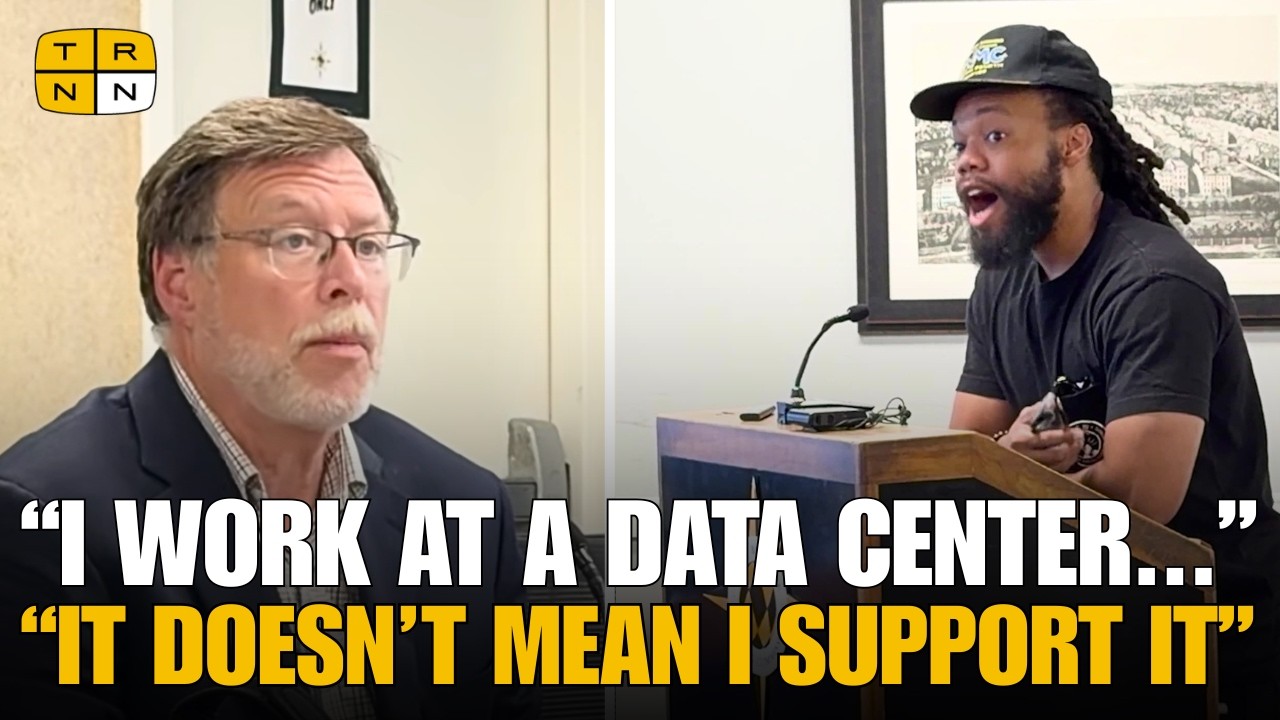
I currently work at a data center. That doesn’t mean that I approve of data centers. Every

Speaker 3:

Every time it storms, it seems that a bunch of lights go down in the city. I’m confused why we’re even talking about a data center if we can’t keep our own lights on.

Maximillian Alvarez:

Baltimore currently has a moratorium on new data center development while a city study examines the potential impacts that data centers would have on our city. However, even though that study hasn’t been completed yet, a proposed city council bill has residents here nervous that the door is creaking open for data centers to come into the city and that city council views this as inevitable. Council Bill 260174, sponsored by city council member Felicia Porter, would require new data center projects to go through a conditional use approval process that includes a health equity assessment. Now, residents who are opposed to the bill say that the bill may be well intentioned, but what they want is a full data center ban in Baltimore, not stricter guidelines for data centers to operate in Baltimore. Now, the bill is going to get another public hearing in front of the Baltimore City Council’s Land Use and Transportation Committee on the fourth floor of City Hall on the morning of September 24th.

And that meeting is open to the public. Now, I was there in the room during the last public hearing on Council Bill 260174, which took place on August 27th when the bill was reviewed by the Baltimore City Planning Commission and residents were given a chance to voice their public comments. Now, the planning commission ultimately declined to support the bill and opposition from members of the public to data centers of any sort was frankly overwhelming, but you don’t got to take my word for it. Watch for yourself.

Andy Ellis:

We’re here at the Baltimore City Planning Commission getting ready to hear a bill that would allow data centers to come in if they had a health equity assessment into Baltimore. This happens despite the fact that we have an existing moratorium. And so we’re here today to testify against the bill because we think that the moratorium should be extended or made into a ban so that we can stop data centers from coming into the community.

Blaire Postman:

Hi, I’m Blaire from Cat Ladies for America. I’m a resident of Baltimore and I’m here today because even though there’s a moratorium on AI data centers in the city, it seems like they’re laying the groundwork for them to allow them and allow them to come in without a lot of oversight. And that makes me very angry. Claws out!

Speaker 8:

The next item is number eight, city council bill number 26-017 zoning conditional use, health equity assessment data centers.

Councilmember Phylicia Porter,:

I am Councilwoman Phylicia Porter and I represent Baltimore’s 10th District and chair of the Public Health and Environment Committee and bill sponsor for 26-0174. The data center industry is looking at Baltimore at the peninsula, Fairfield, Hawkins Point and other industrial areas. At the same time, the federal government is accelerating AI infrastructure development and scrutinizing state and local laws. It regards its obstacles to that development. This creates a real risk for jurisdictions relying only on a temporary moratorium without a permanent framework under development, which will face legal and economic pressure. Other jurisdictions have already quickly learned how that pressure can arrive. Hill County, Texas faced a hundred million dollars in federal lawsuit shortly after adopting its moratorium and rescinded under that pause under the weight of that litigation. This lesson is not that Baltimore should surrender its authority. This lesson is that Baltimore must exercise its authority carefully, deliberately, and now.

A moratorium alone without companion framework and process is exposed to taking legal challenges. Moving bill 26-0174 through this process, hearings, testimonies, amendments, votes itself is a part of that good faith planning effort that the Supreme Court has been requiring. Bill 26-0174 does not promote or green light data centers. It strategically and administratively blocks development at every step of the way that does not align with community. It creates public accountable process for deciding whether a qualifying data center is appropriate for a particular location and under what conditions it may process. This is the foundational right of the conditional use ordinance process. Traditional zoning asks whether proposed use is compatible with the land around it. A health equity assessment asks an equally important question, what will this decision mean for the people who already live in those conditions surrounding that land? Bill 26-0174 puts that cumulative reality into the decision making process of the city council before approval, not after residents become ill, household costs rise and public infrastructure is strained.

This is environmental justice and it’s basic due diligence.

Jon Laria:

There are maybe some questions, but it took me a while to sort of get this straight in my head, but there are only written submissions opposed to this bill by people who are opposed to data centers and so are you. Yes. So it’s kind of odd because they’re opposing a bill and I think the reason that’s happening is because most people are starting with the idea that there’s a moratorium, meaning zero data centers. And your bill provides a path, a difficult path, but a path to data centers. No,

Councilmember Phylicia Porter,:

That’s not correct. So it is not correct. So the study adds a legal framework attached to the moratorium right now as shared within my remarks, right now we are under a moratorium where we are legally unrestricted. We are unprotected right now under this moratorium without the conjoining health equity framework attached to it.

Jon Laria:

I’m not sure I understand.

Councilmember Phylicia Porter,:

Yeah. So no worries. So when you have a data center and we currently have, I will say if you have a data center that comes into the city that’s under a moratorium right now, if they sue Baltimore City, they sue Baltimore City saying this is unjust. We understand that data center developers are getting very crafty in their arguments. They’re arguing First Amendment rights. They are arguing other rights that provide them a pathway forward. We are seeing that those moratoriums are getting overturned. The successful moratoriums that have been upheld are always assigned and/or connected to a framework that allows good faith effort to showcase that they are doing some sort of regulatory footprint with that moratorium, not just saying that you want a moratorium. So that is the issue.

Jon Laria:

Okay. Although we are doing this study, I mean the moratorium is not just a moratorium. A moratorium that just says moratorium because we feel like it, I see the weakness that you’re describing, but a moratorium so we can study it seems like a defensible position.

Councilmember Phylicia Porter,:

It’s not because again, what was mentioned in the planning commission report was that there is a lack of health equity associated with the current moratorium. This answers that response.

Jon Laria:

But it is sort of an odd posture because I think, and people should speak for themselves, but we have all these people who are opposed to data centers and they will come and testify and they’ve submitted testimony saying no data centers because I think they see in your bill a pathway to data centers and their view is we don’t want them at all. And under the moratorium – I’m not arguing with anyone. I’m just trying to get straight because they have all these people who are going to come up and say no data centers because they perceive perhaps your bill as loosening the restrictions, which is actually not how you intend

Councilmember Phylicia Porter,:

To bill. It’s not the intent of the bill. And I will also caveat, how many data centers have an application now with the current city of Baltimore that once this moratorium goes away, if we do not have the regulatory framework in place, how many of them will be actually going through the process?

Speaker 1:

But if I’m understanding the bill correctly, basically we currently have a moratorium that is pending a health review, health study review in the findings there. And that the bill is saying we need to do something that is stricter than a review and stricter than a moratorium because a moratorium can be overturned. And basically the bill is saying we’re going to provide a path to a data center, but the path is going to be very difficult. And so the hope, I believe if I’m understanding correctly, is that with the difficulty of the path, the data center should not be able to be built unless it passes very strict scrutiny that it likely will not pass. My concern as a citizen of Baltimore is this. I understand we all know full well, we cannot legislate the hearts and minds of people. We cannot put into a bill.

We all have to be nice to each other. However, we all are well aware that we’re not dealing with good faith actors when it comes to the people who want to build data centers. We’ve already heard testimony that there are people in rooms looking, combing through every law, probably across the country with fine tooth combs to see where they can actually exploit loopholes. And my concern is a citizen of the city and someone who cares about the city, who has young people who I care about in the city, who I want them to grow up in a place with clean air, clean water, not having the sound pollution and the headaches and all the things that come with having a data center in their vicinity. My concern is that if we know that we’re dealing with bad faith actors, then is it not our responsibility as citizens and as people in government to deal with the world that we have and not the world that we want to be?

You know what I mean? Deal with the people who we know are building these, which are bad faith actors and not deal with the fantasy of, oh, well, it’s going to be really hard so people aren’t going to be able to pass the test when people are looking to do everything they can to subvert every possible obstacle to getting these built.

Speaker 2:

So I’m a longtime Baltimore resident, electrician with IBW. I’m here to speak against obviously data centers. Obviously the contradiction here is that majority of the work for the IBW right now is data centers. I currently work at a data center. That doesn’t mean that I approve of data centers. One of the things that I think that we’re all missing here is that Baltimore is a city that has suffered from de-industrialization for a long period of time. Obviously the shutdown of General Millers, the shutdown of Bethlehem Steel. What we could be talking about instead of wasting our time with this is we could be thinking about how can we generate the power that the grid demands for something like this. We could be talking about solar farms, wind generation, be talking about battery storage. If you look at PJM’s own records, they say that Baltimore and the mid-Atlantic region is at risk of rolling blackouts, as others have said, by 2028.

Obviously our grid needs investment. Our infrastructure needs investment. The city needs investment. Investment from Google Meta does not solve our issues. If we actually care about having a city that functions, we’re going to need to be thinking about where are we putting power, not where are we taking power to? It’s really just that simple. And on that topic, if we’re talking about actually maintaining a labor force, we should be talking about how do we get the young people in our city into the trades that this type of work demands by doing some type of local hire mandates, something to make sure that our young people are not just left in the wind. Roughly 25% of young black men in the city aren’t working. Why are we not talking about what we can be doing for our city? It pains me. I just see no solutions, but we’re talking about something that can help billionaires become trillionaires.

Speaker 10:

Baltimore ordered the nine month study specifically required to recommend conditional use standards for data centers, yet this bill is already establishing conditional use framework. Why not finish the study and let the evidence inform the legislation? Second, under this bill, the company seeking approval prepares the health equity assessment evaluating its project’s potential health and environmental impacts. Subjection C9 even requires that applicants to explain the compelling public interest in its own project would serve. When a company has financial stake in an outcome, relying heavily on evidence prepared by that same company creates a conflict of interest. Why isn’t this assessment independent from the applicant seeking approval? Where is the scientific independence in this process? Finally, if this legislation is truly about putting community first, where is the community process when this hearing is being held in the middle of the day? As other people have stated, my friend, she had to leave.

Many working class Baltimoreans cannot take off to participate. So we are urging that this study be completed, that we require independent assessment, give affected communities meaningful participation. Please oppose this bill and enact a ban on data centers.

Blaire Postman:

I’m a 29 year resident of Remington in Baltimore. I want to tell you about a new building that’s being built. I know this hearing is not about that, but it’s relevant. This new building is going to use more energy than Remington and Charles Village combined. It required the building of a new electric substation. It’s going to be as big as the convention center. It’s on the edge of Stony Run, ground not appropriate for such a large building requiring very deep pilings. It’s displacing animals already. There are deer on my street. For the first time in 29 years, there are deer on my street. My street is five blocks from any wooded area. Deer are walking five city blocks to come to my street to eat all my flowers. I don’t care that they’re eating my flowers because they’re hungry. This building also has a truck road.

It’s going to result in this destruction of over a hundred trees. There was strong community opposition to this building. We were told that this building would not be a data center. I personally don’t know if it’s a data center. The amount of power it’s using, the size of it makes me wonder. So I have some questions. How did this happen? What’s the definition of a data center? And I just want to say that’s why I want to ban. I don’t believe this is a legal issue. I believe it’s a trust issue. There are bad actors. The megas of the world are bad actors and often our representatives do not support us. Odette supported our community. We voiced our opposition and yet Zeke Cohen voted for this and said data centers are inevitable and we need them.

Speaker 11:

I want to also remind everybody that people in Baltimore City, many, many are living on the edge. They’re living week to week. They’re living month to month already. Now, data centers are needed for AI. So you have AI and data centers working together. For some reason, we’re rushing into unregulated, unplanned black box of technology. I don’t know why, except I think it’s the investors who are creating this, creating this need and creating this bubble. So we have people, regular people striving to just get by. AI on the one hand is displacing jobs. It has displaced jobs. Everybody involved in AI says it’s going to massively destroy jobs. Sam Altman bragged about it. On the other hand, we have data centers which have raised utility rates for people around the city. As they’re built, they will raise more utility rates. Now we have people who are barely getting by.

What happens to them?

Speaker 3:

I love Baltimore. It’s a fantastic city. Fell in love here. We’ll have lots of friends and I’m connected to a lot of local art communities. It’s an important city to me and everyone in this room. And I say that because there’s a lot of conversations going on about water, about power. Every time it storms, it seems that a bunch of lights go down in the city. I’m confused why we’re even talking about a data center if we can’t keep our own lights on. I see streets and potholes all over the place and I would really like Baltimore to be a city that is ready for something like a data center. And to be clear, I want a ban on data centers.

But if I’m looking at the infrastructure we currently have just to support homes, just to support me, just to support my friends and family using regular water, I turn the heat down on my water heater. I’m doing what I can to try to make sure that I’m a good citizen in a drought, in a moment of contention. So I am asking council to put a ban on data centers, period, until we deal with potholes, until I can drive my car and not worry about it, period, until we can deal with power outages after storms, until we can make sure that all of our neighbors have access to grocery stores that are healthy for them in their local neighborhoods.

Speaker 12:

I’m a longtime participant in Baltimore’s professional filmmaking community. I’m also a longtime member of IATSE Local 487. So I think I’ll kind of address my concerns in terms of in sort of a cinematic fashion with a metaphor of sorts. When I think of the evolution of data centers as a topic of debate in the public consciousness, I can’t help but think of vampires as a metaphor for what they offer, both in how they mystify the impressionable and how they have the power to leach resources and destroy communities. When I look at this bill, it almost feels like they’re saying, “Hey, vampires want to come to Baltimore. We want to lay the groundwork to only allow the right vampires to come into the city. Vampires are risky. We want to make sure we know what a vampire is and then we want to make sure we get the old money vampires who have accumulated their wealth over hundreds of years and only bite certain kinds of people, maybe vampires that’ll make some of us super hot and young forever.

We want the best vampires for the community.” I don’t think I’m alone when I think of that and I go, “What if we just did no vampires?

💾

“When I look at this bill, it almost feels like they're saying, ‘Hey, vampires want to come to Baltimore. We want to lay the groundwork to only allow the right vampires to come into the city”... What if we just did ‘No vampires’”?
  •  

‘Mushroom cloud of smoke and flames’: Toledo residents’ lives upended by deadly Brent Industries explosions

First responders rush to put out a fire at the Brent Industries facility in Toledo, Ohio, after a series if deadly explosions on August 18, 2026. Photo credit: South Side Fire Photography.
https://www.spreaker.com/show/2952221/episodes/feed

On the morning of August 18, residents living near the Brent Industries facility in Toledo, Ohio, awoke to a series of massive explosions and a towering chemical fire in their backyards. Two Brent Industry workers who were on shift at the time of the explosion were killed. Members of the surrounding community say they are experiencing symptoms of chemical exposure, and that they are not getting the answers they need from Brent Industries or the Environmental Protection Agency.

In this episode of Working People, we speak with a panel of Toledo residents about the industrial disaster at Brent Industries and the harrowing aftermath. Panelists include:
Toledo Councilwoman Dr Brittany Jones; Mike Balonek, Toledo-based filmmaker and sacrifice zone advocate; Sarah Locker and Kris Ramsdell, who both live right next to the Brent Industries facility where the deadly explosion occurred.

Editor’s note: According to WTVG Toledo, “The coroner’s office identified those who died in the [Brent Industries] fire as Heladio G. Perez, 46, and Mary Allen, 64. An autopsy revealed they both died as a result of blunt force trauma.”

Additional links/info:

Featured Music:

  • Jules Taylor, Working People Theme Song

Credits:

  • Audio Post-Production: Jules Taylor
Transcript

The following is a rushed transcript and may contain errors. It will be updated.

News Clip 1:

A massive explosion and fire in South Toledo led to two people killed earlier today.

News Clip 2:

Firefighters rushed to the scene just before five this morning. The fire is still burning.

News Clip 3:

I was kind of about ready to get out of bed, oh, give or take about 4:45, 4:50. And all of a sudden I heard this huge explosion. I was scared to get out of bed to go see what it was. And then I heard a second one. It’s like this is like God of a movie. And then I stepped outside and then everyone was out in the street. I did see the fire and the flames were hundreds of feet up in the air.

News Clip 4:

People from all over Northwest Ohio could see this thick black smoke just pouring into the air and out of the rubble. Part of the building also collapsed. Two employees were killed, a man and a woman. We did hear from the family of Mary Allen. They say she was one of the victims and had worked at Brent Industries for 13 years, a dedicated worker, mother, and grandmother. And officials here say that there are still hazardous chemicals on the property, but the air here is considered safe.

News Clip 3:

OSHA teams are now involved in the investigation.

Sara Locker:

This is residents nearby ask more questions about what they have potentially been exposed to.

Maximillian Alvarez:

Welcome everyone to Working People, a podcast about the lives, jobs, dreams, and struggles of the working class today. My name is Maximillian Alvarez, and today we are in Toledo, Ohio. And we’re talking about the terrifying story behind the news clips that you just heard. As the Associated Press reported on the morning of August 18th, “Explosions rocked an Ohio industrial recycling business early Tuesday, killing two workers and sparking a large fire,” officials said. Flames and dark smoke poured from Brandt Industries in Toledo as fire engines surrounded the building TV news video showed. Cruz later discovered the bodies of two employees, a man and a woman. “Inside the smoldering building, “said Toledo Fire Chief Allison Armstrong. “Two or three other employees had minor injuries,” she said. “Two explosions occurred shortly before 5:00 AM during a shift change, “Armstrong said. Crews had to deal with hazardous materials, runoff and the threat of more explosions while first searching for victims and accounting for the other employees,” she said.

Aerial images showed that nearly all of the building’s roof was gone and that the blast blew out its walls. The Federal Occupational Safety and Health Administration, or OSHA, said it was investigating. “The agency has six months to conduct its investigation and it won’t release any more information until that’s completed,” officials said. Authorities encouraged people near the site who could see or smell smoke to keep windows and doors closed and avoid the area. Now the company, Brent Industries, based in Brent, Alabama, offers textile reconditioning and industrial recycling services aimed at reducing waste and saving money according to its website. It was founded in Alabama in 1977 and has operations in Brent and Toledo. The company’s Alabama location also had an explosion and fire in 2015 that killed one person. After that deadly explosion, OSHA determined that flammable vapor from mineral spirits, a petroleum solvent used for cleaning and other purposes, ignited in an industrial washing machine.

The company was cited for a half dozen violations and fined $27,000 according to OSHA records. Fire officials say tanks containing mineral spirits were at the Toledo plant. The company says on its website that it uses mineral spirits in the cleaning process for work gloves, wiping clothes and other textiles that contain hazardous substances. In 2004, OSHA cited Brent Industries for two serious violations at its Toledo plant, including failing to protect workers from death or serious harm when they were exposed to a 270 degree Fahrenheit or 97 degree Celsius steam release from a washing machine OSHA Records Show. So we got a lot to talk about here and to talk about all of this, I am really grateful to be joined today by a panel of guests who are all residents of Toledo, Ohio. Thank you all so much for joining me on the show today. I really appreciate it and I wish we were meeting under less horrifying circumstances.

And please, before we get rolling, introduce yourselves to our listeners.

Mike Balonek:

My name is Mike Balonek. I am a local filmmaker and advocate for Sacrifice Zones, have worked with Max in the past and worked on the East Palestine train derailment for the last three years.

Dr Brittany Jones:

Hi everyone. I am Dr. Brittany Jones, councilwoman at large, and I have basically been following a lot of these type of explosions and environmental hazards for quite some time. I would say that I’m very involved with trying to save our environment, but also with the health and the lives of our residents and just people in general surrounding these incidences is really what I want to focus on and try to provide more healthier living standards.

Sara Locker:

My name is Sara Locker. I live five doors down from the Brent Industries explosion. I’m here today to represent my fellow neighbors, my community, and the great city of Toledo, Ohio to make more people aware of it just doesn’t happen in East Palestine. It happens everywhere in a small little town like ours, in a small little neighborhood like ours, and our voices need to be heard and our questions need answers.

Kris Ramsdell:

And last but not least, I’m Kris Ramsdell. I live right around the corner from Brent Industries and I just want to call awareness so things like this don’t become the norm where a greedy business owner sacrifices not only his employees’ lives, but then also creates a disaster and a neighboring community in which their business operates in.

Maximillian Alvarez:

Well, again, thank you all so much for being here with us today, and I’m so, so incredibly sorry that you and your community are going through this. I really want listeners to hear directly from y’all what has been happening and what it was like to experience this firsthand. So can we please just start by going around the table and talk about the explosions at Brent Industries and the nightmarish 24 hours that followed? Walk us through what happened and how you experienced it all as it was unfolding.

Sara Locker:

Well, I had just gotten home from work early that morning, had just started to fall asleep. We have a train rail right behind us, so when the explosion happened, it was one of two things in my mind being ripped out of a deep sleep that either somebody hit a transformer or something happened in the train tracks behind us. It jolted our entire household awake. When the first explosion hit, it shook our house. It bowed our windows, it terrified our children. The second explosion hit almost immediately after, and that was when my husband flew out of bed and out the front doors and my 19-year-old followed behind and my 16-year-old and our nine-year-old little girl were absolutely terrified. They didn’t know what was going on. My husband ran down the street, phone in hand. I was trying to call 911. You couldn’t get through. 911, there was no 911 because of the flood of calls that was happening.

The mushroom cloud of smoke and flames that you could see, the smell, it was traumatizing. And then to realize what had happened and then finally see emergency crews showing up, the mounds of people that gathered in our front yard in tears crying. We actually had one lady that had reported to work that morning for her 5:00 AM shift, and she was absolutely horrified. My husband directed her to our house where she could park her car. She was crying. She had had a young lady in her car next to her, didn’t speak any English, and the look of terror on her face just broke my heart. I think we spent a better part of that day comforting neighbors and comforting people that were standing there wanting answers. They hadn’t heard from loved ones. They didn’t know if their family members were in that explosion. Unfortunately, two lives were lost innocently for no reason, no reason at all, and we have no answers, nothing.

Kris Ramsdell:

Yeah, and I’m just going to piggyback off of what Sara said. I was actually just getting up. First blast happened about, oh gosh, I want to say it was about 4:50, 4:55 AM. So I was just about to get ready to get out of bed, start my day. The first blast, it was so extreme. Well, they were both extreme, but the first blast was so extreme, I thought I must be kind of dreaming this. I didn’t really equate it to something that was actually happening. Well, then the second one happened a couple minutes later and it’s like, okay, this I’m not dreaming. This one actually, it shook my house and as I’ve described in the past, it felt like someone picked my house up and dropped it. Literally, it was that forceful.

At that point, I hate to admit this, but I was kind of scared to get out of bed because it’s like, well, did somebody run into my house? Did one half my house blow up? No. And I kind of stayed in my bedroom and I’m like, let me see if I smell anything. And thankfully I did. So I got out of my bedroom to see what was going on and seen everyone congregate down at the end of my street here. I should say, I do live two doors away from South Avenue. South Avenue is where Brun Industries is located. It’s about, I would say a block and a half away from my house. I knew it’s like if someone was even near that, I can’t imagine how anyone could have survived that. And so the first thing I thought of was, oh my God. God forbid, hopefully nobody was there.

Hopefully they only operate for second shift. I thought at one time they operated three shifts, but again, it was 4:00 AM, so my guess is the third shift was probably still on. So my first thing was hopefully no one got killed.

So within probably 15 minutes or so, this car comes speeding down the street and it was this girl, she was looking for her mother. And so similar to what Sarah had mentioned, my neighbor directed her to park in the driveway at the house next to me. It was vacant at the time and she’s like, “I need to go find my mother. My mother is there.” And I just put myself in her shoes going to find my own mother or going to find someone I love, not knowing, walking up to this building that has exploded, not knowing if your loved one was in there that may have perished in it. It’s got to be the worst thing to ever face in life and nobody should have to. Her car was parked there for several hours post the incident. I kept looking out my window every 20 minutes or so to see if I could see her, see if I could follow up with her.

I don’t know if she was one of the folks to which she lost someone in or not, but the car did end up leaving several hours later. So that’s my experience the day of the explosion.

Dr Brittany Jones:

Yeah. From my experience, I don’t live in the proximity of the actual incident, but I am on this side of town and I also have family on this side of town. And also a matter of fact, some of our staff from council, they actually live within the neighborhood. So when that happened, from what I can recall, as both Chris and Sarah had said, getting jolted out of the sleep, not because of the rumbling, but our electricity basically went out and came back on. And so when power comes back on, alarms and noises start happening and we were like, “What is going on?” So we’re just same as Sarah, probably somebody hit a transformer or something like that and didn’t think too much of it because the electricity was back on. So then my work phone started going off with text messages from our deputy mayor, also our safety director, and telling us about this explosion that just happened.

First and foremost, I definitely want to give thanks to fire and rescue and all of the first responders. There were about a hundred that were out there, if not more, and especially the residents around that was trying to do whatever they could to give comfort, give just any sort of support for that. And there’s not much you can do from an industry explosion, but that comfort is really what’s important. And just getting the reports, and especially afterwards, seeing all of the bad reviews, the citations of the actual company, that was something that was really concerning of me. Some of my colleagues, the next day they held a press conference and they came back and was saying that the smell, just the illness that they were feeling afterwards. And they were only out there for, I don’t know, maybe 20, 30 minutes, and they were already experiencing the symptoms of migraines and nausea and burning, chest burning.

And so it was very, very traumatic. And mind you, this was really coming off of the back-to-back incidences that we also had because we also had a fire at OmniSource, and then there was a tanker on the east side that had overturned that had hazardous materials. So there were three incidences within maybe three weeks of this caliber. And so that’s when a lot of questions started popping up like, “Well, what is the regulation and were they up to date with different things? And what more can we do, especially if people are experiencing these symptoms and having to go to the doctor if they can go to the doctor?” And it is just a lot of things that really bought to the forefront of what do we do as a city, as a neighborhood when it comes to these types of incidences moving forward really.

Mike Balonek:

So funny enough, I actually found out about this from some of my friends in East Palestine. They were messaging me, asking me if I was okay. Luckily, I don’t live in the immediate vicinity. However, just from some of the research that I’ve done on the weather patterns, how long this thing burned for, there’s a good part of the city that could have been affected by this. We don’t know because they’re not doing the kind of testing that’s necessary to find that out at this point. But for me, my initial reaction was, this looks serious. This looks like something that I’ve seen many times before. And as the day progressed, I kept following it. And within a few hours, the EPA came out and said that everything was safe, which I’ve heard this story before, and I know Max, you have as well over and over and over, unfortunately.

And so that was alarm bell number one, and I decided that I really need to start talking to some folks. Met Kris almost within the first 24 hours, I think, of all of this and just started talking about what was going on. Went down there myself for the press conference that Councilwoman Dr. Jones had mentioned, and I could taste it, I could feel it, all of the same things that I experienced in East Palestine. And so for me, immediately I knew this was something that was concerning. I wanted to do whatever I could to help because this is something that I’ve been doing for three years now, and anything that I can do to shine light on what residents are going through, I felt that it was something necessary for me to do.

Maximillian Alvarez:

I appreciate y’all so much laying this out, and I hate so much that this is a trauma that you have to relive because it’s a type of trauma that so many of us are getting a firsthand experience in, even if we though it might never happen to us. And I know what that feels like. Mike said we connected first in East Palestine, Ohio where that train derailed in 2023. And ever since then, I’ve had the same fear that I think so many have had who’s heard those stories is what if that happened in my hometown? What if that happened near my house or where my family lives? And then it happened to me in May of this year when I read the headlines, I wake up in the morning and I see GKN Aerospace facility experiencing a pressurized tank crisis. It could explode. 50,000 people have been evacuated.

Where? In Garden Grove, California, 10 minutes from where my family lives. And it was East Palestine residents, like you said, Mike, who were texting me about it, asking if my family was okay, asking if the EPA was giving everyone the same shtick and saying, “It’s all fine. Everyone go home. Whatever you’re breathing in is going to be okay.” And it was like seeing the same movie playing over again, but in my hometown. And I really can’t stress enough for people listening, if you think this shit can’t happen where you are, it can, and it may already be happening and you don’t even know about it. And again, we’re not equating all of these different catastrophes. Everyone is different. Every community is different, but the sort of larger increase in these types of explosions, derailments, toxic disasters, that doesn’t just come from nowhere. There is a larger kind of history here.

There’s a system here that is contributing to endangering frontline workers and fenceline communities all over the country, whether you’re in a city, rural area, if you think you’re in a “blue state” or red state, this crap is coming for all of us. So I’m going to get off my soapbox for a second, but just hearing y’all, I was just so overwhelmed with emotions that I had to say that, but I want to bring it back to what and who this is really about. And I wanted to ask if y’all could tell us what we know about the two workers who lost their lives in this explosion. What do we know about them and what is being done for their families?

Kris Ramsdell:

Well, I will just say this. The explosion happened on the 18th. We didn’t hear anything from the company in regards to their employees until the 27th, they released a public statement. And in the public statement, they said something to the effect of that they’ve been in contacts with the families that are affected. I don’t know if I believe that or not, but we’re talking several days that elapsed that these poor people that worked for this company, I can’t imagine they were paid more, a little bit maybe over minimum wage, probably were living paycheck to paycheck while this company is making millions of dollars off the back of these people and they don’t even have the decency to come out and make a statement saying that they’d mourn the loss of their employees. What is wrong with us? What’s wrong with our humanity? These people didn’t make their millions just from themselves.

They made it off the backs of these people. One of the victims, her name was Mary Allen, and then the other victim, I don’t know his first name, last name was Garcia Perez, I believe. And so Mary Allen, her family has been in the media and whatnot.

I regret I didn’t know her. She just sounded like an all around great person. And I don’t mean to sound mean or unprofessional, but it pisses me off to no end that her life got sacrificed because of someone’s greediness because that’s what this boils down to is corporate greed.

Sara Locker:

I have to agree with you, Kris. I’m actually upset at the fact that a woman that dedicated almost 14 years of her life to such a, I guess you can horrible company, horrible money hungry company and then not to speak out after so many days. What about Mr. Garcia? I haven’t heard anything about him. And what does that say? If people that have lived around here don’t know anything about the people that lost their lives so close to their homes, and with us being such a close-knit community and we’re worried about our neighbors, our community members, and for them to not even acknowledge the two lives lost and then to not even acknowledge the residents that live close by, to not say anything to anybody, they’re not compliant. My 16-year-old went to the city council meeting over Brent Industries and he came to us and said when I had to work and his dad had to work that he wanted to go to this city council meeting because as a child who’s 16 years old, people don’t take them very seriously because most of these kids run around and they don’t care about anything but what video game they’re playing or what friend’s house they’re going to.

But my son has been side by side with us and he likes Mike, he likes Sherry, he liked you. You are the few people that my son has felt comfortable enough to attend this city council meeting on behalf of kids his age to show the council members that we too are affected by this and he’s angry with Brent Industries. We live five doors down and it was like living in a sandstorm in the Sahara Desert for at least three days. The smell, the heartbreak that you feel for these families. We had to leave our home and go to a motel and people around here, we can’t afford that. Like you’ve said, we live paycheck to paycheck. And when we have to uproot the only place that these children call their safe place and it’s no longer safe, please explain to me how I explained that to my nine-year-old daughter who can’t sleep in her bedroom at night, who has migraines and stomach problems, who isn’t the same person.

She doesn’t like any loud noises anymore. My 19-year-old won’t come out of his room some days because his stomach hurts so bad. My 16-year-old has migraines and he’s puking every morning. He gets up.

The first week of school we thought, okay, the Brent Industries happened the 18th. They started school literally that next Monday and my daughter goes to Burroughs. What do you explain to these kids when she has questions and comes home about what happened? She came home and we thought she was back to school sniffles. No, she had a sore throat, itchy eyes, runny nose, congestion. It’s disgusting. And Brent Industries sits back and does absolutely nothing. We’re just going to continue to collect our money, but we owe the city of Toledo $20,000 in back taxes, a million dollar water bill. Where’s the accountability for them? They don’t have any. They feel like they’re untouchable and that’s not fair.

Kris Ramsdell:

And I will just kind of piggyback off Sara for a second. I’ve been kind of doing some digging on this company, looking at Ohio EPA records, and I think part of the cause might be a lack of regulation. We’ve had some conservative governors the past several years that have tried to make the state more business friendly, but I almost wonder if that’s kind of come to a cost of people’s lives. And I’ll cite to one example with one of the EPA inspections, I was kind of surprised to see where they were trying to schedule a time to go and inspect the facility. And of course you have to expect when you go and schedule an appointment to make sure a organization is in compliance with the law, you should expect that they’re going to put some kind of a show on. You’re not going to see the real deal as if you dropped in unexpectedly.

So I think that has not served us well. I’m all about providing opportunities for jobs and for folks to make a good living and whatnot, but at the same time, there’s got to be a decent handoff where we’re not exposing people to dangerous working conditions. And I kind of feel like the way our policies are written here in the state, we kind of enable this behavior, I guess might be a way to put it because we remain business friendly, but at what expense, at the expense of the two people who perished, I mean, absolutely not. Now all of us that live around here, I shouldn’t say all of us, but a lot of us are now experiencing the aftermaths of it. Meanwhile, this company, they’re living high on the hog, haven’t seen them. There’s no face in front to represent their company. We just get this little mediocre statement.

I mean, that’s nothing.

Maximillian Alvarez:

And I think so many people around the country are waking up to this reality because of all these goddamn data centers that are popping up everywhere. It’s like people are learning. They’re getting a crash course in how screwed up our regulatory apparatuses or lack of regulatory apparatus and all the ways that local regulatory control has been removed or legislated away in the dark years ago. And that has made communities increasingly more vulnerable to the predatory exploits of these companies. And we’re seeing it all over the country. We see it here in Baltimore all over the place. And so I wanted to kind of keep going in that direction and ask for folks who don’t live in Toledo, if y’all could keep help painting a picture for us about this area and the issues that Toledo has had with Brent Industries before and other industrial polluters in this area.

Mike Balonek:

I mean, just to paint a picture of Toledo for folks who aren’t familiar, Toledo’s a heavily industrial city. We’re the home of Jeep. We have a very long history of industry in Toledo with many similar kinds of disasters. There’s a lot of legacy chemicals and stuff that are already in the ground that have been affecting people’s health for probably the better part of a century at this point. And so this isn’t anything new for Toledo, but there’s a lot of history of this. However, this is becoming a pattern as Councilwoman Dr. Jones mentioned, within that same period of time, we had many incidences. In fact, the same day there were two incidences. There’s the Brent Industries and then there was another one. And so I mean, this is just a problem that is systemic. It’s a regulation issue. As you mentioned, Max, it’s not a red or blue issue necessarily because this happens everywhere.

This happened in your home state of California, which is about as blue as they get. And so I think that’s an important thing to recognize with people that this isn’t just one side that’s causing these problems. This is a long running issue. We can look back as far as Love Canal and Times Beach just in modern history, but it goes back further and a lot of this stuff has probably never been documented. So I mean, we as Toledoans, we’re very familiar with this. I feel very lucky that as a city, we do have leaders that are keen to this. I think that members of city council have been asking some really tough questions of city leadership of the EPA, hopefully that they can get answers to eventually. This is something that they don’t necessarily have in places like East Palestine. City leaders in East Palestine were mum the whole time, if not directly supportive of the narrative.

And so I think that’s a really good quality of Toledo. We are fighters here. We are people that aren’t afraid to stir the shit if we need to. And so I think this could be a moment for us as Nation to maybe stop and reflect and say, “Hey, we need to start looking into this.” I really hope that Toledo, even though it’s not going to be the last one, there’s already been other disasters after this, that we can be one of the last ones, that we can be the catalyst to start a national conversation to maybe fix this.

Dr Brittany Jones:

I really want to add to that because as Mike had said, we are heavily industrial, but we’re very dependent on industry as far as how we get our revenue, property taxes, income tax, majority of population is definitely working class, blue collar. I came from union family working at GM, and so that is literally our bread and butter. But now we’re moving into, we mentioned data centers, we’re talking about AI, we’re talking about automation. So that is adding an extra layer to this because if we’re having all of the technology, what does that regulation look like? Is it going to be even more dangerous? I mean, of course chemicals are very dangerous, but now we’re talking about more advanced technology. And what does that look like when it comes to disaster preparedness? Looking at and talking about this, we are very adamant as far as trying to get answers.

To this date, I don’t think we have even a list of who has been in the plant at that time. And at the committee meeting that Sarah had mentioned, we had talked with Chief Armstrong, we talked with police that were giving just the updates, talked with our environmental services as far as their monitoring, and they really haven’t heard anything from Brent as well. So this is a prime example of when you put profit over people instead of opposite. And that is really what we have to strive for as we’re moving forward as a city. We’re a legacy city. And so that’s just another term for post-industrial city. And as we’re coming into that redevelopment, kind of rebranding, this is what we have to keep in mind because our infrastructure is aging. Of course, that’s costing money, that’s going to have more regulation, that’s going to really have to have more accountability as we make this transition.

And hopefully, I say hopefully in quotes, there won’t be any shortchanging when it comes to these policies and regulation and things of that nature because it is seeming like that profit over people at this point. And I’m so glad, as Sarah had mentioned with her sons, and there was a couple of other young people there showing up and speaking out because they are the next generation. If they decide to stay in Toledo, this is what is going to be left of them. And I don’t want that. I have three little ones. I don’t know if they’re going to stay in Toledo, but if they do, I don’t want to leave it like this. I want it to be safe and I want everybody else’s future and legacy to be safe and secure as well. And so trying to get answers, and it’s really hard because they are a private industry, that is really going to take a lot of pushing, even from the mayor, even from our commissioners, Lucas County commissioners.

We have to have those questions. We have to get those answers, but they seem to be dodging. They had that statement as Chris had mentioned, but what does that mean? You’re not doing, you’re just issuing a public apology. There’s no disbursement of money to take care of medical needs. Houses may have been damaged, especially if they were right there. There was just nothing that was being offered and we’re still trying to get information. So it’s literally at this point, it’s trying to keep pushing and really keep asking those same questions and trying to figure out how do we take care of this with other industries that are within this city because Toledo is getting hot. If you’ve been reading the headlines, we’re most affordable. Everybody’s trying to move here. Since we’re talking about the environment, climate migration is real. People are coming to the Midwest.

So what does that look like? That’s more people. That means more services. That means more power that has to be used. If our systems are not up to date to take care of that capacity, we could have repeated incidences just like this. Then what? Now we’re going to have a population that’s sick because we don’t have the right processes and check-ins in place. We’re doing mediocre monitoring. I understand that our services, environmental services, EPA doing air monitoring, water pollution, they said that everything was fine. We were like, no. We need continued reporting. And their level of safe is probably just that little threshold to where you’re not dying. It’s not like you’re not sick, but you’re not dead. So I think that’s okay. And that’s how we should not be doing that right now. Actually ever. We should not ever do that because again, everything is connected.

If people are sick, people can’t go to work, they can’t provide for their family. Now you’re talking about you can’t provide housing, you can’t provide food. So now we’re talking about homelessness, starvation, it’s a domino effect. And that’s why we need to really hit hard with this and keep this going because it’s going to keep happening and they’re just going to keep doing it or keep coming to Toledo saying we’re offering you jobs, but it’s your safety that’s at risk. And whatever, if you get hurt or die, it doesn’t matter. We’re getting money anyway. That is not how Toledo needs to work. That is not how we should market ourselves and definitely should not be an acceptable reason for our residents just because to get a job. The safety protocols are just not in place right now. And this is clearly evident with all of the incidences that have been happening just around here and around the state as well.

Kris Ramsdell:

To piggyback off the councilwoman’s statement, I feel like sometimes in some cases, and I think we could apply this to this organization as well, that lives are disposable and they are absolutely not. And I ask myself this question, why doesn’t this type of thing happen in the wealthy neighborhoods? Why does it happen in neighborhoods like this? Are we lesser? Are the employees that provide that million dollar salary to the owners and shareholders and whatnot, is their life really disposable so they can make a quick buck? I think we really need to truly reevaluate our value system.

Sara Locker:

I a thousand percent agree with you, Kris and Councilwoman. I think you nailed everything that I’ve been feeling recently on the head. We have, not going to lie, have actually thought about leaving Toledo because it’s literally, that’s what we look at every day. That’s what we deal with every day. And being a born and raised Toledo, we’re a very proud city. We are very, very close. And I think we can all agree that Toledo hasn’t had the best rap lately. But when something like this happens, we come together as a community and we stand up for what we believe in. And for the EPA to come in and say, “Oh, it’s safe,” like Councilwoman said, to me it feels like Brent Industries is basically saying, “But did you die?” Well, two of your people did. And who’s to say six months from now, just like in East Palestine, just like in other places, that somebody doesn’t end up even sicker than what we are now.

I have blood clotting disorders. I have history of clots in my lungs. I’ve had two surgeries in the past. How do I know this isn’t going to cause a flare up and I end up with another clot? How do I know this isn’t going to result in my son’s asthma flaring up to the point where he can’t breathe? My 19-year-old was literally, I can’t breathe. I had to give him two back-to-back albuterol treatments just to bring him out of it.

And for Brent Industries to not be held accountable and for them to not stand up and say, “Hey, I apologize. This is what we’re willing to do to make you guys feel more comfortable about the situation.” I’m sorry. I don’t think they feel bad. I think they just feel like because this factory was in a lower class neighborhood, “Oh, well, we’ll let it die down till the dust settles. We’ll be forgotten about.” No, not today, sweetheart. No, ma’am.

Kris Ramsdell:

And I kind of worry too, and I had very extensive conversations with Mike when him and I connected about getting the word out. It’s like this is probably an annoyance to them, all of us speaking out and raising hell about this. And I sometimes wonder, these are well-connected folks. Am I going to be retaliated against? I think that’s a real thing too. All the way around, it’s unfortunate. And I must say too, it’s like the government we’re paying, and when I say government, I’m talking more state and federal, maybe not so much the state, but they too have a portion of this, especially the federal government. It’s like I am paying them taxes for an agency such as the EPA to work against me. It’s like they’re providing cover for this company and it’s like you’re supposed to be looking out for us, not looking out for this company.

And that’s what it feels like. I’ve asked if everything is kosher, my thing is show me the raw data. Tell me what you’re testing. Tell me what the limits are. If I have that and other scientists agree that it’s okay, experts and whatnot, then I will be quiet about this. But it’s the unknown, I think also that just is elevating this anxiety.

Maximillian Alvarez:

And it’s the goddamn gaslighting, right? I mean, because, again, everything that you guys are saying, like we were saying earlier in the conversation, it’s like I’m hearing the same script from different places. I found out that the EPA was telling my hometown community back in California during the GKN Aerospace facility crisis that they were using the same air monitors to test the safety levels of chemical exposure that they were using in East Palestine to tell people that it was fine when we know that it wasn’t, to tell people that they were safe when we know that they were being exposed to toxic chemicals that were bioaccumulating in their bodies and harming their health and continue to harm their health. Now we’re seeing the cancer rates spike. They tell everyone it’s fine in the beginning and then years later we all see that it wasn’t. And not only that, but we learned that they knew that they were lying to us in the first place.

And so you can’t just come out and say everyone’s lying to us all the time. We have to make concerted decisions about finding the truth and knowing what the heck is happening and not jumping to conclusions. But the very agencies that we expect to be there to help us do that are demonstrating that that’s not what they’re there to do, that they’re not there to serve us. They’re there to serve the companies, they’re there to serve the political interests. But this kind of thing, just the script happens, a new disaster happens and all the same crap kicks into gear. And that’s why it’s so reminiscent of the story of East Palestine, Ohio and the train derailment and chemical disaster that happened there in 2023, which brought Mike and me together. And we filmed a Izzy Award-winning documentary in East Palestine about that catastrophe. Did it fix the problem?

No, because people continue to get sicker and their lives continue to get harder. Property values are going down, costs of living are going up, hospital bills are going up.

East Palestine became a national example of a preventable catastrophe with disastrous consequences for the people and hardly any for the company that caused their pain. And industrial disasters like this one in Toledo and Brent Industries and like the fires and explosions at Smitty Supply in Louisiana or the BioLab facility in Conyers, Georgia, or that deadly paper mill tank rupture disaster in Longview, Washington that happened earlier this year and it killed 11 workers. These kinds of disasters always trigger a sort of traumatic response in our consciousness and certainly in mine, and I know everyone who listens to the show. And so I kind of wanted to finish by asking in what ways has the explosions at Brent Industries been similar and different from what happened in East Palestine?

Mike Balonek:

I will say right off the bat, this isn’t as bad. What happened in East Palestine was on a scale nearly unimaginable. People had called it the Chernobyl of chemical disasters, and I think that’s accurate. However, what happened here is still absolutely devastating. Brent Industries is basically straddled by two pretty sizable neighborhoods. Basically just doing a little on the back of a napkin kind of math. I figure there could be potentially 20,000 people that were affected by this just based on the direction that the plume went initially. And so I think that in and of itself is very, very concerning. One of the things that I absolutely appreciate from Councilwoman Dr. Jones was that she was pushing for symptom tracking. I think that’s absolutely critical at this stage in what’s happening and the development of this. If we don’t start following this stuff now, when the cancers start happening, when the thyroid issues start happening, when the heart issues start happening down the road a year, two, three, five years from now, we will have no record of this.

There will be no evidence. And basically Brent Industries will have gotten away with it. And at this point, we have a moment where we can actually take care of that. And I think that’s very, very important. And Dr. Jones, if you would like to speak on that a little further, I think that would be really helpful.

Dr Brittany Jones:

Yeah, thank you for bringing that up. That was actually the next step of what I’m trying to push for. I’ve already talked to the director of the health department because at our committee meeting, that question just kept coming in my mind. Who can people go to? Who can people call in order for them to report their symptoms? Even though they’re not experiencing them at that moment, we’re talking about down the line because it’s still there. If you could still smell it and taste it and still having those symptoms, obviously something is still there. And so we need to keep track of that. Unfortunately, the health department does not have something like that. You have to call a number or you have to go to your primary caregiver and they would report back to them and that’s how they usually do the tracking. I said we can’t do that mainly because, like I said, some people can’t afford a doctor.

Some people don’t go to the doctor. And how can you rely on the information from the medical providers? Not saying it’s fraudulent, but as far as transferring that information, and then also what do you do with the data? How can you visualize it? How can you plan for it? How can you do strategy from it? Because we still have to understand that data does tell a story and data is proactive when used the right way. So looking at that, I think it’s very important to start doing this, especially if these incidences keep happening and have been happening. As Mike had said, we don’t know what’s down the line. And thinking about the children, the schools that are within that proximity, that’s young and they are very sensitive to a lot of things and that can develop over time. So now we’re not talking about physical, but we’re talking about mental, we’re talking about learning capabilities, talking about behavior because all of that can affect as they get older.

It’s stored in your system. And so looking at that, we need to start doing this now, have to update our disaster planning. I’ve been talking to the Lucas County commissioners about that. There is some plan that’s in existence. It needs to be updated. So I’m trying to get that updated, but I don’t understand why people are not seeing the urgency in this. So that is what I’m working on and I need some help in terms of pushing that and trying to get that going, but that is in the works right now. So I’m very adamant about that and this needs to be a normalized system, not just something that you do temporarily because of this, a normalized system that is part of every incident because we need to start understanding what we could possibly be getting into as a result of these explosions.

Kris Ramsdell:

I do want to say that our health department, Councilman, you might be aware, they did read a webpage which gives information to contact Poison Control. I guess they’re the ones that are doing some of our symptom tracking right now if I read.

Dr Brittany Jones:

No, you’re correct. And that was because I reached out to the director and said that he needs to do that. Thank you. That’s what I was talking about. Yeah. So that’s why that’s happening.

Kris Ramsdell:

So Max, that might be one thing you want to put in your report. I can actually give you the link to the Lucas County Health Department. That’s our county that we live in, the webpage that they set up that gives information on this. It’s still not adequate though, by the way. I say that, Councilwoman, I know you are doing great and I appreciate it. I’m talking overall, but we’re just not equipped as a jurisdiction to handle these types of things as of right now.

Sara Locker:

I’m going to take a nice little walk down to what we call ground zero. And I will, Max, I can email you some pictures, some videos, whatever you may need. I can send you the videos that my husband has as well for context. Councilwoman, I commend you. You’re doing a fabulous job. We as residents appreciate everything you’re trying to do to make sure that our voices are heard. Mike, you guys have been phenomenal. We appreciate you. I know Chris does, I do, the kids do. I think as residents, we grow more concerned every day because there hasn’t been answers. There hasn’t been any updates. And I understand Councilwoman Jones and the rest of the council members are doing everything that they can on a city level. Unfortunately, Brent Industries is going to stand by, “Oh, you’re going to be okay. We’ll live through it.” You’re not going to sit here and tell me that a chemical textile plant exploded five doors down from me and we’re safe.

I’m not going to buy it until I see hard proof, like I’ve said from day one, until I see hard proof that proves that I’m not going to believe it. We as a community need to stick together. We need to stay close to each other. We need to stay in contact with each other. We need to check on each other. I think as far as our kids are concerned, I’m going to follow up with the appointments, especially for our youngest, get her into some therapy for PTSD because clearly she has it. And like Councilwoman said, it’s affecting them all differently. And who’s to say six months down the road that one of us, I don’t develop a blood clot or my husband doesn’t, God forbid, develop something or one of my children. And Max, I’ve seen your video on East Palestine. Actually, before this podcast, I didn’t know who you were, so I did my research and I sat and cried when I saw that from East Palestine, just to see the emotion in them people and to see the fact that three years later and these poor folks are still living the same horrors that I couldn’t even imagine knowing what we go through.

It’s gut wrenching and it’s disgusting. And I think we as a community, we deserve the answers. Whether Brent wants to give them or not, we’re not going to stop until we get them.

Kris Ramsdell:

And I will just back up everything that Sarah said. I wholeheartedly agree with her. I will say I’ve kind of rethink everything and the things I’ve taken for granted, such as breathing decent air at least. Today here in State of Ohio, it’s in the 70s, perfect day to have my windows open. I’m scared to have them open. I have this cough. I feel like I’m going to cough my esophagus up. In fact, I was worried about having these coughing fits on the call. I can’t shake it.

Sara Locker:

The kids haven’t shaken it either. They’re still sick.

Kris Ramsdell:

Yeah. It’s a dry cough. Thankfully I was having immediately after the explosion, I was having these headaches. Thankfully that has gone away for myself. I’m only speaking for myself, but this cough that I have, it’s terrible. It’s absolutely terrible. Like I said, I can’t shake it and I cannot tell you the last time I’ve been sick.

Sara Locker:

This is our new norm in this household.

Kris Ramsdell:

Yeah.

Sara Locker:

When a 16-year-old has to take two of these just to go to school and two of them just to go to bed because his headaches are so bad, when you have to buy a bottle this big to last because everybody’s experiencing some sort of symptom, there’s an issue.

Maximillian Alvarez:

And I guess for folks listening, Sarah’s holding up an industrial size bottle of ibuprofen.

Kris Ramsdell:

That’s what greed will do to a community when they value the dollar over the lives of human beings, and it’s sad.

Mike Balonek:

I just want to add one experience I had as well. So we invited Scott Smith, the independent scientist who’s been going around to various sacrifice zones, blowing the whistle on the contamination there. And we went out on Saturday, we did most of our testing, but then Sunday before he left, this was at the end of August, we went back down just so he could get a few pictures and stuff before he headed out of town. It was a foggy kind of rainy day that day, and I’ve heard a lot from East Palestine residents about them experiencing smells and other issues on days like that. And the smell at Ground Zero was atrocious. It was more intense than anything I have ever, ever smelled in any of the disasters that I’ve been to. I’ve been into contaminated homes in East Palestine and I’ve never experienced anything like this.

I got a huge headbuzz. I’ve gotten head buzzes off of going into the creek with you, Max, when we went and filmed our documentary. I got head buzzes from going into residents’ homes, but these were slight to moderate. This was extreme.

I felt like I was going to throw up at one point. I was just so dizzy and just out of it basically. And so just that experience alone led me to believe that there is definitely some significant contamination there. We’ve smelled the smells coming out of the creek. We’ve seen the sheen in the creek behind Brent Industries, and I can only imagine what people who are living in it have to experience. I get to leave the area. I live several miles away, not downwind of it luckily. And so most of what I experience here at home isn’t even close to what residents in the immediate area are experiencing. And so I think that’s an important thing to recognize. I was outside. I wasn’t in somebody’s house like I had been before, and this just hit me like a ton of bricks, and that’s really concerning to me.

Kris Ramsdell:

And Max, another thing too, I know we got to wrap up real quick, but even after the fire department, and by the way, the entire city of Toledo dispatched their fire department. We had to call in neighboring communities to cover for the department, the areas that have to respond to this fire over here. But something else that I think should be pointed out here is even days following the explosion, we had these issues with reignition and the fire department would have to come back again. I can’t tell you how many times, at least three times where the scenes, everything’s all locked, gated up, but these chemicals would start mixing and they’d have a reaction and they would start to inflate again. So I think that just adds also to the toxicity of what is over there on that property.

Maximillian Alvarez:

Alright, gang. Well, that’s going to wrap things up for us today. I sincerely want to thank all of our guests from Toledo, Ohio, Councilwoman Dr. Brittany Jones, Mike Balonek, local filmmaker and sacrifice zone advocate, and Sara Locker and Kris Ramsdell, who both live right next to the Brent Industries facility where the deadly explosions happened on August 18th. And of course, I want to thank you all for listening, and I want to thank you for caring about this. We do all of this work for you, but we cannot do it without you. Working People is brought to you in partnership within these Times Magazine and the Real News Network. This show is produced by the great Jules Taylor and is a proud member of the Labor Radio Podcast Network. We’ll see y’all back here next time for another episode of Working People. And in the meantime, please go explore all the great work that we’re doing at the Real News Network, where we do grassroots reporting that lifts up the voices and stories from the front lines of struggle around the US and across the world.

Subscribe to our YouTube channel, check out our great podcasts like Under the Shadow and the Battle for Free Speech, and connect with us on social media and get updates on our reporting there. And please help us do more work like this by going to therealnews.com/donate and becoming a supporter today. I promise you guys, it really makes a difference. I’m Maximillian Alvarez. Take care of yourselves. Take care of each other. Solidarity forever.

  •  

Brazil’s intelligence agency warns of high risk of US interference in Brazilian elections

A giant balloon depicting US President Donald Trump holding Brazil's President Luiz Inacio Lula da Silva is seen as supporters of Brazilian presidential candidate Flavio Bolsonaro, of the Liberal Party (PL), take part in a rally during the Independence Day parade at Paulista Avenue in Sao Paulo, Brazil, on September 7, 2026. Photo by Miguel SCHINCARIOL / AFP via Getty Images

This story originally appeared in Panamerican Dispatch on Sep. 21, 2026, and is shared with permission.

The Brazilian Intelligence Agency (ABIN) has raised the risk of external influence and interference by the United States in Brazil’s 2026 elections to a “critical level.” The confidential report was sent to the Presidency, the Supreme Electoral Court, and the Ministry of Justice. In it, the agency points to escalating pressure from the administration of Donald Trump on Brazil. It ties Washington’s actions to a broader strategy to politically reorient Latin America.

The document is titled, “Threats to the 2026 electoral process.” It was forwarded to authorities in late August, and its contents were revealed this Saturday, Sept. 19, by journalist Mônica Bergamo’s column in the Folha de S.Paulo newspaper.

According to the report, there is a “trend of escalating pressure on Brazil” and a “selective intensification and reconfiguration of the pressure exerted by the United States,” albeit within a historic pattern of U.S. influence over the region.

The report’s assessment does not mention ballot tampering or altering the election results. The intelligence agency’s warning addresses the possibility that political, economic and diplomatic pressures could interfere with the institutional environment and with public debate during the electoral process.

The agency places these actions within the strategy adopted by the second Trump administration to reaffirm U.S. hegemony in Latin America.

According to the analysis, strategic documents released by the U.S. government between November 2025 and May of this year point to its objectives as reducing the influence of powers considered rivals and preventing their access to the region’s “strategic assets, natural resources and infrastructure.”

ABIN identifies China as one of the primary targets of this policy. In the agency’s assessment, Washington seeks to expand its direct or indirect control over these resources, whether through the U.S. government or the country’s private investment.

Support for conservative governments

The report pays special attention to the actions of U.S. Secretary of State and National Security Advisor Marco Rubio. According to ABIN, his policy toward Latin America has an ideological bent and he seeks to “influence and reorient the foreign policy of countries in the region.”

According to the document, this strategy involves steering Latin American countries away from China and promoting a domestic political shift “by supporting the rise of conservative governments.”

The agency cites a U.S. Senate hearing held in June, during which Rubio linked the restoration of U.S. hegemony in Latin America to the presence of governments aligned with Washington.

At the time, Rubio stated that the region had come to rely on several governments “friendly” to the United States during Trump’s second term. He singled out Brazil, Colombia, Cuba, Nicaragua, and Venezuela as exceptions.

The document also noted statements in which Rubio held Brazilian President Luiz Inácio Lula da Silva responsible for U.S. tariffs on Brazilian products, alleging that Brazil had not negotiated “in good faith.”

In ABIN’s view, this approach personalizes the pressure exerted on the country and has the potential to impact public debate in Brazil during the electoral period.

Brazil targeted for defending autonomy, says ABIN

The intelligence agency assessed that Brazil holds a unique position in U.S. strategy, because it has a government with “greater political will and the means to defend its strategic autonomy” in the face of Washington’s pressure for concessions and geopolitical realignment.

The report states that, despite periods of easing tensions between Lula and Trump, actions taken by the United States since May indicate a trend of increasing pressure.

Among the actions cited is the U.S. designation of Brazilian criminal organizations as terrorist groups and sanctions announced in July against two Brazilians and companies based in Brazil and Portugal. The U.S. government accused them of ties to money-laundering networks linked to the Primeiro Comando da Capital (PCC) drug gang. For ABIN, these sanctions represented a “transition” because they caused U.S. pressure to have concrete effects on Brazilian individuals and companies.

“As a result, U.S. external interference now directly impacts financial relationships, corporate reputation, access to the dollar, international operations, and the exposure of third parties to the risk of secondary sanctions,” states an excerpt from the report released by Folha de S. Paulo.

According to the analysis, the U.S. strategy is happening in a “gradual, combined and adaptive” manner, linking Brazilian organizations to threats against U.S. national security. This is then followed by measures capable of affecting the country’s companies, banks and other institutions.

The Brazilian Intelligence Agency warns that these types of sanctions could prompt Brazilian and foreign economic actors to alter their decisions out of fear of losing access to the U.S. financial system or being impacted by secondary sanctions.

U.S. Makes Demands Over Brazilian Election

The report has also emerged amid tensions between Brasília and Washington directly related to the 2026 elections.

During negotiations held in 2025, the Trump administration presented Brazil with a draft joint statement that outlined a Brazilian commitment to not “arbitrarily” detain, arrest or limit the participation of “political dissidents” in the electoral process. The proposal stated that Brazil should commit to holding “free and fair” elections and ensure the participation of such individuals in the vote.

On Thursday. Sept. 17, Lula stated in an interview with Rádio Itatiaia that the proposal had become a “dead issue” for the Brazilian government. The president also rejected the possibility of granting the United States preferential access to the country’s mineral resources.

The confidential agency report delves deeper into the concerns previously raised in public analyses by the Brazilian Intelligence Agency. In a document released this year regarding intelligence challenges for 2026, the agency identified foreign interference as a threat to sovereignty. It warned that a combination of technological dependence, disinformation, espionage, and coercion could enable foreign actors to influence public debate and decision-making processes in Brazil.

Edited by Geisa Marques. This article was originally published by Brasil de Fato. It can be read in its original form, in Portuguese, here.

  •  

How US players are reshaping France and the continent

In this edition we welcome CNN's correspondent in France, Melissa Bell. Melissa is the author of "Sous l'influence americaine", an investigation into American interference in France and Europe. She tells us about the ways in which American interference is being felt in Europe and France and what we should expect during the 2027 French presidential election campaign.

  •  

U.K. Sending Voyager Tanker To Help Defend Saudi Airspace

The Royal Air Force (RAF) is deploying one of its Voyager aerial refueling jets to help Saudi Arabia defend against ongoing attacks from the Iranian-backed Houthi rebels of Yemen. The decision marks the first publicly known international military assistance offered to Saudi Arabia specifically for its fight against the Houthis, which erupted over the summer. The move came hours before U.S. President Donald Trump told the United Nations General Assembly meeting that he believes a peace deal with Iran will be reached after the U.S. midterm elections in November.

The British action is significant because, while it involves just one tanker, other key Saudi allies have yet to heed the Kingdom’s request for military help specifically to battle the Houthis. Although it’s important to note some assets already deployed to defend against Iranian attacks could be helping with the Houthi threat now.

This picture is from a Quick Reaction Alert training scenario. The QRA exercise was conducted 31 March 2026. The purpose of the exercise was to demonstrate the full end-to-end process of the UK's air defence strategy if an actual foreign aircraft was to invade their protected airspace. Upon receiving the alert, the QRA team at RAF Coningsby would launch to RAF Typhoon FGR4's to intercept any unknown aircraft within the protected airspace. In this particular scenario an RAF Voyager A330 (RAF Brize Norton) was acting as the agressor and two RAF Typhoons FRG4 (RAF Coningsby) were responding to the simulated threat. During the exercise the Typhoons intercepted the Voyager and conducted a series of maneouvers whilst communicating with the "foreign" aircraft with the aim of escorting it to a safe location on the ground (RAF Brize Norton) upon which it and it's crew would be guarded and safely inspected by counter-terrorist police. The resulting imagery is to be used for training government ministers on how a QRA works and all the different elements involved. From the initial radar detection of a foreign, unidentified aircraft at the London Area Control Centre, Swanwick, to the physical launch of our QRA team at RAF Coningsby. The RAF use a hose-and-drogue air-to-air refuelling system deployed from Voyager tanker aircraft. Instead of a rigid flying boom, the tanker trails a flexible high-pressure hose attached to a stabilizing basket (drogue), allowing receiver jets like the Typhoon and F-35 to plug in mid-flight. This image shows a Typhoon releasing flares as a warning to the "enemy aircraft".
A Royal Air Force Typhoon FGR4 accompanies a Voyager tanker during a Quick Reaction Alert training scenario in March 2026. (Crown Copyright) Crown Copyright

Last week, Trump turned down a direct plea from Saudi Crown Prince Mohammed bin Salman, the Kingdom’s de facto leader, to attack the Houthis. Meanwhile, Pakistan and Turkey, which signed the Mecca Joint Defense Agreement with Saudi Arabia, have yet to provide any direct military aid. The pact holds that an attack on one is considered an attack on all; however, it doesn’t stipulate exactly what actions should be taken. 

Saudi Arabia, under repeated Houthi missile and drone attacks as well as suspected strikes from Iranian-backed militias in Iraq, is struggling to defend its oil infrastructure. The Kingdom is also facing a challenge supporting the anti-Houthi forces it backs in the Yemen civil war that reignited in the wake of the U.S. and Israeli attacks on Iran that began Feb. 28.

At issue, beyond protecting the Saudis, is growing concern over the Bab al-Mandab Strait, a key chokepoint now largely controlled by the Houthis, who are preventing the Saudis from using it to ship oil. 

Earlier this year, the Houthis imposed a blockade on the Strait, and began striking Saudi ships in the southern part of the Red Sea as well as critical energy terminals on that body of water. Iranian proxies have also struck the vital East-West pipeline that feeds oil to be transferred and shipped via the Red Sea in order to bypass the Strait of Hormuz, where Iran vastly curtailed shipping after the launch of Operation Epic Fury. The pipeline reportedly reopened today after being shut down following a long-range drone attack.

The Saudi Arabian East-West pipeline after it was damaged by an attack. (Satellite image ©2026 Vantor)

The stark reality is that if Saudi refineries are destroyed and the pipeline is shut down for months, if not longer, the last major lifeline from the region — and especially to Europe — would be closed off, sparking a deeper energy crisis.

Concern over these factors spurred Britain to act, the Ministry of Defense (MoD) noted. It said it was acting on a request from Saudi Arabia and that the jet would “support Saudi Arabia’s defensive operations in aid of the legitimate Yemeni government.”

“Escalating tensions in the Gulf could have negative consequences here in the UK—such as rising prices, disruptions to energy supplies, and increased costs for British businesses,” the ministry explained. “The Houthis pose a threat to stability in the Middle East; therefore, it is in the UK’s national interest—economically and in terms of security—that they do not succeed in their aims.”

“We unequivocally condemn Houthi attacks on Saudi Arabia, and our position is clear: both Saudi Arabia and the Yemeni government have the right to self-defense,” the ministry added. 

The jet will operate from a U.K. air base in Cyprus and will begin air-to-air refueling operations in the coming days, the BBC reported.

The MoD said the Voyager will fly only in support of missions to shoot down missiles and drones, though Saudi aircraft are also bombing Houthi ground positions in Yemen, in part to get at drone and missile launchers and storage sites. Houthi officials have accused the Saudis of killing civilians in some of these attacks.

It should be noted that, more than a decade ago, the U.S. was supporting the Saudi coalition’s previous bombing campaign against the Houthis by providing aerial refueling and intelligence. However, then-Defense Secretary James Mattis ended that in 2018 during the first Trump presidency after growing concerns over the large number of civilian casualties.

The Voyager can only refuel the Royal Saudi Air Force Eurofighter Typhoons, Panavia Tornados, and Italian Air Force Typhoons that have been in the Kingdom since before the fighting with the Houthis broke out, as well as any other similarly equipped allied aircraft. That’s because the tanker only has probe-and-drogue aerial refueling, not the boom required for gassing up other receptacle-equipped aircraft. You can read more about this in our story here.

The view from the cockpit of an A400M during air-to-air refueling with a Voyager KC3 using its probe and drogue system, via the fuselage refueling unit. Crown Copyright

The Voyager will not be the first British asset to be sent to help Saudi Arabia since the launch of Epic Fury. In March, the U.K. sent its Sky Sabre air defense system and troops to the Kingdom to help defend against attacks from Iran.

Pictured: The British Army Sky Sabre state-of-the-art intermediate air defence system. It marks a wholesale upgrade to the venerable Rapier system that was in service for nearly five decades. Sky Sabre, comprising of three separate components: The Agile Multi-Beam Surveillance Targeting radar (affectionally referred to as the Giraffe, pictured left), the Battle Management Command & Control Communications (not shown), and the Land Ceptor CAMM (Common Anti-Air Modular Missiles) missile delivery vehicle (right). All are pictured together for the purposes of the photographs; on the battlefield, they could be expected to operate up to 15Km apart. The system is designed to respond to sophisticated missile attacks and can defend against saturation attacks of supersonic anti-ship cruise missiles, aircraft and other high-performance targets. at a range of 120Km using the CAMM (Common Anti-Air Modular Missile), travelling at over 2300 miles per hour. It does this via multiple channels of fire, providing 360-degree simultaneous coverage and high degrees of manoeuvrability.
The British Army Sky Sabre state-of-the-art intermediate air defence system. (Corporal Adam J Wakefield) Corporal Adam J Wakefield

“This support builds upon the UK’s existing military contribution to Saudi air defense, which includes the deployment of an air defense system and British personnel to help protect against missile and drone attacks,” the MoD pointed out on Tuesday. “Saudi Arabia and Yemen are steadfast partners of the UK and play a vital role in regional stability. It is in the UK’s interest to safeguard regional stability, protect vital trade and energy supplies, and encourage a diplomatic resolution to the conflict in Yemen.”

The civil war in Yemen erupted in 2014 and expanded a year later when a Saudi-led coalition joined forces with the government ousted by the Houthis. The fighting between Saudi-led forces and the Houthis largely abated after a tenuous ceasefire was signed in 2022. The Saudis held off on getting involved in the recent Red Sea conflict which saw the U.S. and coalition warships duking it out with the Houthis, and eventually led to a U.S.-led air campaign over Yemen. The United Kingdom was the other significant player in that air campaign.

Tensions, as we noted earlier in this story, reignited in recent weeks after the Houthis joined the U.S.-Iran conflict on the side of their major supporter. 

On Tuesday, Houthi spokesman Brig. Gen. Yahya Sare’e claimed that Saudi Arabia conducted 19 airstrikes across rebel-held territory in Yemen that involved the latest round of civilian casualties. The Saudis have not directly responded.

Brig. Gen. Yahya Sare’e. (Houthi Telegram)

As we stated earlier in this story, hours after the U.K. announced it was sending a Voyager tanker to Saudi Arabia, Trump addressed the ongoing conflict with Iran during his speech to the U.N. General Assembly in New York.

The American leader called for international isolation of Iran and repeated his stance that he was at an inflection point on deciding what course to take moving forward. The situation has settled into an uneasy pause interrupted by sporadic Iranian attacks on shipping in the Strait of Hormuz. It has been weeks since the U.S. last struck Iranian targets.

“Will a deal be made with Iran that lets them rebuild and create a far greater country than it ever was before?” Trump asked rhetorically. “Or do I annihilate the Islamic Republic and do it quickly, never giving them a chance to kill and destroy people and countries again?”

Trump added that he believes he will make a peace deal with Iran after the upcoming U.S. midterm elections, which could decide which party controls Congress. With gasoline and diesel price increases damaging the economy, the war and Trump’s handling of it have been very unpopular with voters.

In a CNN and SSRS poll, released Tuesday, 64% of those responding said the U.S. is not winning the war in Iran, while 36% disagreed. In addition, 78% of participants said Trump is not doing enough to end the conflict with Iran and 22% said he was.

Trump to the UN: "Do I annihilate the Islamic Republic, and do it quickly? Do I drive them into hell?" pic.twitter.com/cIYBO1Mp3w

— Aaron Rupar (@atrupar) September 22, 2026

After a bilateral meeting with British Prime Minister Andy Burnham following his UN speech, Trump claimed the Iranians still want to make a deal.

“They want to talk to us,” he said. “They have been talking to us, even today they’ve been talking to us, and the relationship is developing. But we can’t let them – and they understand that – we can’t let them have a nuclear weapon.”

A U.S. negotiating team, including Steve Witkoff and Jared Kushner, met with Iranian officials on the sidelines of Tuesday’s U.N. meeting. That sideline session lasted about three hours and went well, according to Trump, who offered no details on the discussions.

Trump: US officials met with the Iranian delegation for three hours – "it was a good meeting"

— Polymarket Intel (@PolymarketIntel) September 22, 2026

For their part, the Iranians said they are willing to negotiate, but on their terms.

“A senior Iranian official said Iran could reopen the Strait of Hormuz to Gulf shipping within seven days if the U.S. fulfilled Tehran’s demands to ease military pressure and lift an American blockade on Iranian ports,” Reuters reported. “The official added that Tehran had conveyed its latest proposal to Washington via mediators last week.”

Contact the author: howard@twz.com

The post U.K. Sending Voyager Tanker To Help Defend Saudi Airspace appeared first on TWZ.

  •  

Phosphorus Munitions Fired by Israel Burn Groves, Orchards in Southern Lebanon

Historically an agriculture-heavy part of the country, Israeli attacks have done massive damage to southern Lebanon. Between wiping out some villages in their entirety and damaging tens of thousands of acres of agriculture land, the future structure of south Lebanon looks very uncertain.

  •  

DSA leads the blue wave — will it bend to the thin blue line?

An NYPD officer provides security during the Inauguration for a New Era Block Party in New York City on January 1, 2026 as Mayor Zohran Mamdani takes office. Photo by Leonardo Munoz / AFP via Getty Images

What will a DSA-led state look like — will it back defund and community control of police, or bow to the powers that block affordability? Lawrence Grandpre, political commentator for Leaders of a Beautiful Struggle, explores this question in his recent Baltimore Times article, “The Dangers of ‘Law and Order’ Leftism: Toward a Black Power Public Safety,” asking whether DSA will embrace the outmoded Law and Order politics that fueled America’s prison boom. As officials like AOC and Mamdani backtrack on defunding police — one of the biggest carceral drains on housing, healthcare, and education funding — Grandpre sits down with former political prisoner and Rattling the Bars host Mansa Musa to unpack these contradictions ahead of the midterms, where Democrats hope to retake the House and Senate. Tune in for an unflinching look at the Left’s relationship to the state and to law and order.

Related Links:

Credits:

  • Production/Post-production: Cameron Granadino
Transcript

The following is a rushed transcript and may contain errors. It will be updated.

Mansa Musa:

Welcome to Rattling the Bars. I’m your host Mansa Musa. Today I’m joined by Lance Grandpre, political commentator with Leaders of a Beautiful Struggle, to discuss his recent article for Baltimore Times, “The Dangers of ‘Law and Order’ Leftism—Toward a Black Power Public Safety.” Thank you for joining me, Lance.

Lawrence Grandpre:

Thank you for having me.

Mansa Musa:

Alright, so let’s start like this here. At one point we had in 2020 where you had a push for the abolishment of prisons and to dismantle the police system as we see it during that period. But immediately you had a pushback and the pushback came in the form of saying that this was woke. Now we look at the United States and mass incarceration, armed policing, and you juxtapose that with the lack of funds for healthcare, lack of funds for education and lack of funds for housing and the fact that the criminal injustice system is in itself painful when it comes to poor and oppressed people, mainly people of color. Let’s start with your article.

Lawrence Grandpre:

So this article stems out of a protest I went to because sometimes people say if you talk about police reform or defunding police, you don’t care about victims. And this protest was the opposite. This was a Black elder, a former member of the Baltimore Black Panther Party who was assaulted by many teenagers and it was caught on film. So of course Fox News, our local Fox News is showing this over and over again saying, “Lock them up, what’s wrong with these kids?” And these were community advocates, many of them women, Queen Mother Victorious who lost her son to gun violence, Mama Gwen, who was formerly incarcerated, coming together with community and saying these young people, what they did was a problem, not because it just violated the law, because it violated our community respect for elders. And we don’t want to just throw the cops at these kids and throw away the book, but if people know who these young people are, turn them into us, the Black community, so we can make sure that they are held accountable but not railroaded by the criminal legal system.

And I though the sophistication and intelligence of that response and even Baba Ade, the elder who was hurt, saying the Black Panther’s argument was that capitalism and racism breed criminality in the community.

Mansa Musa:

Right.

Lawrence Grandpre:

And it’s not for us as the vanguard to educate ourselves and use political consciousness to eliminate criminality, not just from a material standpoint, but from a psycho-spiritual standpoint. And it was really interesting because this was a few days after AOC went on the news and said, “Nobody’s talking about defund anymore. Woke 1.0 was crazy.” So it was really interesting that the people who were supposed to be talking about social justice, Alexandra Ocasio-Cortez, some of these other so-called leftists,

Mansa Musa:

Right.

Lawrence Grandpre:

Even they were saying, “Defund—that was just people on Twitter trying to look woke. Nobody really talks about defund in real life.” And these Black elders, Black people in West Baltimore, were saying things like, “We have a $700 million police budget in Baltimore. How are we going to have that and schools and investments in the Black youth?” So these Black people who the left is telling us are conservative are actually more progressive than the DSA.

And I thought that was very telling that, in this moment, going into the midterms, there are these leftist democratic socialists who are trying to get elected, and because they want to get elected, they want to push away from radical rhetoric because they think it’s turning off voters. And I think that that goes to show you that when it comes to Black people, we need to have our own vision of public safety, because what’s being offered by even the left, the Democratic Socialists, is willing to push our issues aside, because they have a misunderstanding of our issues. They think it’s just a bunch of radicals on Twitter as opposed to Black folks been talking about Defund since the ’50s. And our visions of Defund are very different than what you saw on Twitter in 2020, but these folks wouldn’t know that.

Mansa Musa:

So how do you see the DSA in terms of how they look at the budget, just police budget and the fact that it’s undercutting the services of the very people they supposed to be representing?

Lawrence Grandpre:

It’s interesting because I think if you are a democratic socialist, it’s obvious you believe police are a tool to protect capitalism. So a world where if you’re a socialist, the idea that you wouldn’t talk about [how] protecting capitalism getting more money is a problem for you—it’s weird.

Mansa Musa:

Right.

Lawrence Grandpre:

But these folks are a particular brand of socialist. Many of them were very much pro-Bernie Sanders. So when Hillary Clinton and Kamala Harris used conversations about identity to attack Bernie, now a lot of these folks see all conversations about race as just distraction from class issues.

So, even when Black people talk about police, they say, “Well, it’s not serious. No one really talks about Defund. So you’re really just trying to attack the socialist candidates.” And it’s like, no, Black folks have been the community control of the police platform.

It wasn’t just invented by the Black Panther Party. It was talked about by Black activists in the ’40s and ’50s, in part because the understanding that if the police were seen as a solution to all social problems… it’s not just police, it’s police-ism: the idea that policing is the only solution to the problems facing all poor people, but especially Black poor people, that’s going to push money away from all the other programs we need in the Black community. So Black folks have been saying that, really, since the Northern migration.

So when we talk about community control of the police, part of that is having community control boards control the police themselves, hold them accountable. And we’ve worked on that as LBS, but it’s also community control of the institutions that produce public safety beyond police. So, housing, addiction, education. I mean, I love to point out that Bobby Seal, he was in AmeriCorps before he was a Panther. So he would be shooting dice with the Black kids trying to school them on AmeriCorps’ time. And part of his frustration is these nonprofits don’t let us actually do the training we need to do with these youth, but we got to get the money from the nonprofit because that’s the only job we got. So even the Black Panthers program was a push for Black control of resources to socialize our youth, specifically around things like violence prevention. And again, the idea that all of that is just under this large framework of “woke”… And again, the right wing hates woke, we know that, but even some of the Bernie folks—they really hate “woke,” because they associate it with the attacks on Bernie and they see all conversations about police as woke.

Mansa Musa:

Let’s unpack some more about DSA because we see upheaval of DSA type activity and we see in terms of midterm elections, some of the candidates that ran on DSA platform have made it through the primary. And so at the same token, what is their appeal? Because they vacillating when it come to social issues.

Lawrence Grandpre:

The federal government, in theory, can print money. So there’s this belief that if we just spent more money, things will get better, and the Democrats have been afraid to spend money. I think that in the DSA, it’s like, “Let’s really focus on, in theory, cut the military budget, invest in community through things like Medicare for Al”l. Now, if you don’t have the integrity to stand up for “Defund the Police,” why do you think we would believe that you have the integrity to stand up to “Cut the Military Budget? If you don’t see the connections between the violence of policing and the violence of militarism, why would we expect you to be able to push the military budget to community?” 

Lawrence Grandpre:

These are intelligent, college-educated voters who feel like the government needs to spend more money, in part, because it’s a job program for people like them. So they have an interest in fighting the austerity of the Democratic Party, in part, because they want to see conditions improve for the community, but also in part because it’s a business model for the voters of DSA. And that’s a big concern for us, because even with Medicare for All, there’s no world in which healthcare should be a for-profit enterprise. But it’s not just that doctors are racist. When you look at things like Black women get more cesarean sections than other women, So, literally, they’re getting cut open in these dangerous surgeries. Black women, if you have a child in the hospital, you are going to get a drug test. And even if you pop for that drug test from the epidural, the drugs they give you for the pain, they might take your kid away. So engagements with the medical system are not just imperfect for Black people; they are places of surveillance and violence.

So we, as Black people, need systems like a birthing center, like nutrition, upstream investments that are different than what the DSA crowd cares about. So the idea that we should just accept not talking about Defund to get Medicare for All ignores the fact that Black people—we don’t just need healthcare to not give us a bill. We need to change the vision of healthcare so we control it. And the DSA is not interested in that. They don’t really think that way. And they honestly believe the only way anything will get passed if it goes to everybody. Universal programs prevent racial backlash. Because we know any spending in America is seen as giving money to welfare queens. So we just got to give the same thing to everybody and that’ll deal with racial backlash.

And what we know is anything you do that gives out any tax money will deal with racial backlash, but also do things that don’t give Black people the power we need to build for ourselves. It will just put us in systems that really are built by other people that, even if it’s good for them, can often be violent for us.

Lawrence Grandpre:

But I think that, again, when you have a class-based vision of the world, that has become in some ways hostile to thinking about race because you had negative experiences with people weaponizing race against people like Bernie Sanders. You’re not thinking about what a political agenda would look like when you actually invest in… because we should do both. We should have a class-based redistribution of wealth, but that restribution should also be invested in community institutions that reflect the culture and history of specific communities, not just Medicare for All, but clinics that use the history and culture of the community to provide that healthcare. Nutrition that reflects the culture and the way communities like to be fed so that they can have upstream nutrition so they don’t need to go to the doctor in the first place.

These things should go hand in hand. And I think it’s concerning that it feels like, because DSA is becoming electorally viable in some spaces, that [they] only talk about affordability issues, only talk about Medicare for all, only talk about ending the war in Iran, without really thinking intelligently about a platform that would meet people’s needs for community control of public safety, broadly defined. So not just policing, but again, youth programming, schooling, getting nutrition. Our kids are literally hungry.

Mansa Musa:

Yeah.

Lawrence Grandpre:

They’re fed junk food, but they’re undernourished. So we actually do have serious nutritional needs as we have obesity in the inner city. So what does it look like to build a food sovereignty ecosystem, whether it’s Black Yield, Black Church Food Security Network that can actually feed ourselves as opposed to just the DSA, it’s like, well just make sure they get food stamps. And food stamps are cool, but food stamps are not the vision of liberation for us.

Mansa Musa:

But talk about, because when we look at DSA, and it’s misnomer even to use the name socialist because when you look at. We got examples in Cuba and when they first took over, the literacy rate in the countryside was 90%. 90% of the people could not read or write. They organized, it’s a book out called Vincent Ramos. We were trying, that’s the name of it. And they organized all the college kids, all the intelligence and made them go in the countryside and stay to educate the people, to get them to read and write.

They didn’t say, “Oh, we’re going to create a system where they can come out the country, live in a project style housing dwelling and get them public schools that’s not going to teach them nothing.” They actually educated the people and a lot of that education led to what we see today in Cuba, got best medical, despite all the things going on. So when we talk about DSA, and I think this is a danger, and maybe you want to weigh in on it. I think it’s a danger that confronts that notion that this is a socialist party and because the right wing is going to put them right in the category like communists and they can resurrect that notion.

Lawrence Grandpre:

Socialism, to me, the key word is social. You either have the market making decisions about planning for the world or you have people doing it socially. It’s clearly better to do it socially, but there are divisions within that larger social body. And my concern is that even amongst some of the people in the DSA crowd, the leftists, some of the visions of what they would socially plan may like and lean on policing partially because they are afraid of being looked at as communist. So they might, for example, even in very, very progressive Bernie Crat, DSA San Francisco, there’s this push to, well, we got people homeless, they have mental illness. So they as individuals may not be rational, so we are going to use policing to bring them into drug treatment.

Mansa Musa:

Right.

Lawrence Grandpre:

And again, this is like even Bernie people sometimes say this. So there are elements of even the less progressive mindset that are like, we as a society can’t let you be out here damn bad. We have to help you lift yourself up. And if that means we have to involuntarily commit you to treatment, and if we have to use police to do that, then we’ll do that. While one thing that we talk about here in Baltimore is, and Baltimore’s been a heroin town since the 60s and 70s. And it’s been really hard for us, but we’ve also had systems of informal community care that have been designed to address some of the worst exigencies of drug abuse. Nika Namdi from a program called Fight Light said that grandma’s basement was the first halfway house. We had systems where elders, you would be able to stay with family and you would be able to get certain stabilizing influences through your social network so you wouldn’t be out on the streets.

So in that worldview, we would look at something like making sure these abandoned homes get rehabbed and given to Black people in community. That’s partially an anti-homelessness effort.

That’s an anti-addiction effort. That’s a crime fighting effort. So it’s not just social housing, it’s not just public housing. It’s also making sure that Black people in communities can pass down their family homes

And they have a way to make sure that they’re affordable so they can stay housed because that produces capacities for people who do suffer from addiction to not be on the streets committing crime. And again, the DSA vision is so limited to what they see and what they know, they sometimes end up using police where it’s like, if we just had networks of people in community that could care for each other, we wouldn’t need police for that. But I also do think folks are afraid. I know academics are very afraid and some folks are afraid of looking too radical, looking like the rhetoric of 2020 was burn down the police station.

Mansa Musa:

And

Lawrence Grandpre:

I think that’s also part of what they want to distance from when they talk about we not doing defund no

Mansa Musa:

More. Part

Lawrence Grandpre:

Of it is the direct antagonism with the state, the cost of that has increased for them. What we know is that the cost is high for us, whether we’re openly antagonistic or not, we are politically antagonistic by making demands upon the state to recognize our humanity. So we’ve always had to deal with that potential backlash. And I think now for some folks they’re saying, oh, I can’t use that. We’re not trying to do that radical rhetoric no more

Mansa Musa:

Because

Lawrence Grandpre:

People are losing jobs, people are potentially getting deported. So it’s like the ’70s, marginally away from the rhetoric of the ’60s and leaving the Black radicals out to dry after the draft ended. I think the white radicals moved away from radicalism and that we’re seeing a similar

Mansa Musa:

Dynamic. Okay, but we know that this is the 60th year of the anniversary of the Black Panther Party. And I was talking to somebody about just like we’re not anti-police. The party wasn’t anti-police. One of the things they did, one initiative they took was, and this is a revolutionary suicide by Huey Newton, where they had this particular intersection that didn’t have no stoplight and it was in the Black community and kids was getting hit. So somebody came and said, “Man, they not doing nothing about this. We’ve been complaining.” So they went down there and became traffic guards, the members of the Black Panther Party. They held up the traffic, let the kids walk by, you know what I’m saying? And this is what they did. And they had guns with them because they had one part of their program was policing the police. The police in turn came and told them they stop.

Now you guys stop this. They said, “Well, we’ll stop this when y’all put a traffic light up there or y’all stop directing traffic. We don’t care which one you’re going to do, but you do or we going to continue to do.” They wind up putting the traffic light up there. So in terms of that particular example, what are the core aspects of the Black Power Public Safety?

Lawrence Grandpre:

I like your example because the party was a little bit different in different cities, but I think one thing that stands out to me is that they had questions about police, but the Black Panthers in some ways were law and order. It was law and order within the party. You cannot show up high, very much about discipline, law and order in the community. If you’re selling drugs, if you’re a parasite in our community, we’re going to deal with you. And I think that’s a perception, because this is something that happened in 2020, that there were white leftists being like, “Let’s just run wild and be anarchist and burn stuff down.” It’s always been Black people that’s been like, “We’re not doing that.” So the idea that somehow that is tied to Black issues, no, we’ve always been extremely serious about our liberation.

So when the Black Panther Party talks about doing a plebiscite in order to get Black sovereignty, I think that’s an example of why we need to think about community control of the police in terms of we have in Maryland, substantial police reform is nowhere near enough, but we need to have the ability for the community to have investigative power to be able to investigate police. We need to have community resources to be able to flow to community institutions so the community decides who’s doing public safety in that community. So when we talk about who’s funded to do violence prevention work, it shouldn’t just be the people who are tied into the police or the people that are tied into the nonprofit world. We got tons of people in community that have been doing work that have not

Mansa Musa:

Been funded.

Lawrence Grandpre:

And the fact that they are getting a little bit of money now, I think is part of why we’re seeing these unprecedented declines in violent crime. So Black power public safety isn’t just people getting grants. It is the community having the power to determine what the grant making criteria are. It’s the community being able to tax institutions in their community that they see as producing crime. And by that I mean Johns Hopkins. That’s

Mansa Musa:

Right.

Lawrence Grandpre:

Because Johns Hopkins gentrified the whole area of the

Mansa Musa:

City. The big colonial king in Baltimore.

Lawrence Grandpre:

And when you gentrify a whole part of the city, you’re moving people to different hoods and that creates a lot of possibility for conflict. My father was a cop for 20 years, so he talked about East Baltimore used to be called the country club because it was so quiet up there. But when Hopkins gentrified all those people out of the Middle East Baltimore, a lot of them moved to Northeast, which creates a ton of conflict, pretty much increased the murder rate in that part of the city. Hopkins should have to pay for that. They got a $13 billion endowment. So Black Power Public Safety is about us not tying in our future to gentrification, which is what the police really are a tool for. They’re a tool to produce gentrification. That’s good for that business model because gentrification needs policing.

Mansa Musa:

We

Lawrence Grandpre:

Should be able to put tax on the gentrifier so we can secure our communities so they can’t gentrify them, own our own property, stabilize our communities, but then invest in the capacity to take care of our youth, to do violence prevention, to take care of our health. All the things they stripped from us, they should have to pay us to be able to do for ourselves. In that world, I think we would have Black Power

Mansa Musa:

Public Safety. Right. And that’s basically what the Black Panther Party was doing because they had the survival program. Exactly. And the concept was Survival Pending Revolution. The Survival Program wasn’t like us being in a basement, taking guns apart in the dark with blindfolds, then putting them back together, making bombs, reading Ann Archer’s cookbook. No, survival program was the free breakfast program, free medical, sickle cell anemia, taking prison families to prison to visit them, alternative education. This was a survival program, survival pending revolution. And what the goal was, going back to your point, the goal was to stabilize the community for self to be able to be self-determined. So if I’m self-determined, I got self-determination. A great example for Baltimore would be the Clean Block because when they had Clean. And I remember I was locked up and I used to read the Afro. Afro had a big thing about Clean.

The sense of community that came out of that, the Clean Block, when they was able to say, “We recognizing this neighborhood for Clean Block.” But more importantly, that neighborhood not only had a clean block, but that neighborhood had policing. That neighborhood had a sense of identity that if I seen you, I know you Meryl’s son or Meryl’s daughter. I know you Tommy’s son or Tommy’s daughter. You know me and you know that if I see you doing something that you ain’t supposed to be doing, then I’m going to tell your parents the minute you see me, you’re going to alter your behavior because that became the sense of community. But like you say, once Hopkins got in the equation, and not only Hopkins, I remember when Shafer started when he did the Inner Harbor and they started pushing people out of certain areas in order to get to Inner Harbor and they pushed people into.

Either they pushed them out into the county or they pushed them into the interior of Baltimore in neighborhoods they wasn’t familiar with or neighborhoods they was familiar with and had issues with and would automatically create a conflict. But talk about how do you see, because what you just outlined is in fact a model that is one, inexpensive because it becomes self-contained. So the monies that you’re putting towards astronomical police budget can go towards stabilizing some of the projects that deal with housing, deal with substance, the people that’s actually doing the work.Like you say, you got people that actually going around taking people and putting them in a place and letting them drown. So we talk about how you see DSA and the gains that they’re getting and the models they’re using. How do they fit into this narrative? Are they rewriting the script and say they’re going to invest in this type of thinking or their model is, like you said earlier, we creating a cadre of intelligent people that can grant write and that’s going to become our funding source and not only our funding source, but create an infrastructure for doing case studies and then marketing these case studies, the new Jim Crow.

Lawrence Grandpre:

Yeah. I think it’s to be determined. We’re going to see a huge increase in DSA affiliated leftist people in Congress. Now, whether they’re going to be able to write bills, whether they’re just going to vote on stuff that comes from the Republicans, we’re going to see. I think the real test is going to be 2028 when it’s possible the Democrats will take the White House, Senate and the Congress. So it’s really going to be important for us these next two years for people that believe in the possibility of these folks doing good to push them. What is your actual proposal on how you can use the power of the federal government to enhance the ability of people On the ground locally to have more ownership and power and control over the institutions that impact their lives. Because policing is a state and local issue. Feds actually have relatively little control

Mansa Musa:

Over it,

Lawrence Grandpre:

Except given a few grants here or there. So really it is, do you have a vision for whether it’s through food sovereignty policy, whether it’s through manufacturing policy? The metric for us at least is again, local self-determination and the ability for local people on the ground to own the institutions that are doing this work. I think part of even going back to the New Deal, the frustration with these progressives is that sometimes they do these top down technocratic re-imaginings of what solutions look like that don’t involve community. Mamdani, people have called him a technocratic socialist.

Mansa Musa:

And

Lawrence Grandpre:

I think that’s not on some right wing stuff, but that’s scary from a Black power

Mansa Musa:

Perspective

Lawrence Grandpre:

Because technocracy oftentimes views Black peoples as widgets and inputs in someone else’s equation for progress and liberation. And I think part of the value of the Black Panther Party is they called themselves socialist, but in many places, in many ways they were also Pan-Africanist and Black nationalists. And they were combining them all to say that, yes, we will fight capitalism, but we will not just make the people this abstract proletariat to fit within a Eurocentric version

Mansa Musa:

Of

Lawrence Grandpre:

What a class centric revolution will look like. We are going to lead our people on our vision of what we think fighting capitalism looks like. And again, I think it’s going to be our job to force the DSA to not see that as woke, to actually recognize that that is just what black people demand. And that’s the cost of us being in political coalition is you respecting our self-determination.

Mansa Musa:

And I agree it’s to be determined because one, you gain electoral office through coalition building. That’s really where it come out of. And you’re able to get a common identity out of the coalition, common identity being what we want change, the change that we want to see. Harold Washington in Chicago, he was successful at building a coalition. And to his credit, he tried to maintain the standard, but they fought him tooth and nail at the state government. So he wasn’t able to get a lot of things done. But the fact of the matter, what we’re asking or we’re talking about is not really hypothetical because we see this in Europe and we see examples where police don’t have guns. They call in, if it’s a violent situation where a gun, they got a unit that comes in to deal with that. But outright, the police walk around with no weapons because the lack of fear towards the society.

Lawrence Grandpre:

You mentioned New Zealand, I think in that as

Mansa Musa:

Well.

Lawrence Grandpre:

But in New Zealand as well, the Aboriginal communities actually have really pushed a model for youth justice that places tribal elders and tribal institutions at the heart of restorative justice programming

Mansa Musa:

For

Lawrence Grandpre:

Youth who are engaged in acts of criminality. And so that’s been a big fight for Aboriginals in New Zealand and Australia to really demand tribal sovereignty over their youth as opposed to putting them into the juvenile justice system.

Mansa Musa:

But

Lawrence Grandpre:

Again, given the legacy of the private schools where they beat the Indian out of you and stuff like that. And again, I think it’s jarring for white people to think that we as black people are asking for something similar here in America because the joke is white people are so settled in America, they don’t even see themselves settler colonists no

Mansa Musa:

More.

Lawrence Grandpre:

And I think unfortunately that’s part of what’ happened with the DSA. It’s like the idea of black sovereignty is just jarring to them in a way that you’re an Australian, you know you took over Australia and there are people here that are really dark skinned, you’re not.

Mansa Musa:

But

Lawrence Grandpre:

I think in America, that basic concept of having to negotiate with people who have their own sovereign agendas is not something that they’re used to conceiving as anything other than a tool for the centrist to undermine the Bernie’s of the world.

Mansa Musa:

And

Lawrence Grandpre:

I just think the reality is if DSA is going to get Black support, it’s going to really have to reckon with the visions of the world that come from Black people, including our visions of public safety.

Mansa Musa:

Right. And before we close, you got any closing remarks?

Lawrence Grandpre:

I really appreciate this. Please check out our podcasts and search of Black Power and Political Commentary Corner. So those are on YouTube. Check us out at lbsbaltimore.com. We have all of our email updates about the work we’re doing in Annapolis to push criminal justice policy, reparations policy, which

Mansa Musa:

I’ve

Lawrence Grandpre:

Never seen DSA has been skeptical on, but we’re very adamant about its practical utility as a framework to invest in Black sovereignty here in Maryland. And you can find me on any social media at Neil Nubian, N-E, the number zero, Nubian, N-U-B-I-A-N. Right.

Mansa Musa:

And we ask our audience to really take deep thought on this particular subject matter. It’s not like say it loud, I’m Black and I’m proud. It’s not when Stokley Carmichael in the ’60s, they called Black Power, James Brown, Song and Song. We’re not in that state. We’re not trying to go back into that state of mind, that conditions created that state of mind. We’re talking about an analysis of having Black political power as it relates to our safety. We’re talking about because we’re the ones that’s unsafe, we’re the ones that this astronomical budget is being doled out to, to make us feel unsafe, to lock us up. Then we believe, as the brother was talking about Lawrence, that we believe that we have a right to define what is safe for us and what is not safe for us. And making that definition or defining that, we see the necessity to make an analysis and implement it.

And in this case, this is an analysis that we want to, I think the Gullah Geechee in South Carolina got a thing where they do restorative justice. And so the fact that you infringe on the community, that they might not put you out the community, but they’re going to put you in such a shameful state of mind and the fear of what you’re getting ready to lose or make you get the person to come back or people come back and lie in accordance with the social system that they set up. We ask that you continue to support the real news and rattling bars because guess what? We’re actually the real news. Thank you.

💾

“When it comes to Black people, we need to have our own vision of public safety, because what's being offered by even the left, the Democratic Socialists, is willing to push our issues aside…”
  •  

Democratic states cave on Paramount merger lawsuit in win for billionaire owners

The Paramount Pictures logo is displayed on a water tower in Los Angeles, California, on August 6, 2026. Photo by Michael Yanow/NurPhoto via Getty Images

This article was originally published by Truthout on Sept. 21, 2026. It is shared here under a  Creative Commons (CC BY-NC-ND 4.0) license.

A coalition of Democratic states and Paramount reached a settlement in a lawsuit against its proposed $111 billion merger with Warner Bros. Discovery on Monday, paving the way for one of the largest media mergers in history — and a massive consolidation of power over a huge swath of the entertainment and news industries under the conservative billionaire Ellison family.

The antitrust lawsuit was the last major obstacle for the deal, which has already been blessed by the Trump administration. Attorneys general from 12 states had sued to block the merger, which leading California Attorney General Rob Bonta had called “unlawful,” amid a flurry of antitrust concerns from prominent Hollywood figures and press freedom groups. The Writers Guild of America’s (WGA) lawsuit against the merger was also settled on Monday, with the union saying that its members could not afford to continue the legal battle on their own.

The merger will grant widespread power to a company that would effectively control CNN; CBS News; and, in all, roughly 30 percent of wide-release theatrical film distribution and basic cable channel licensing. It amounts to roughly 20 percent of Americans’ television watching time — all conglomerated under the leadership of Paramount Skydance CEO David Ellison. David Ellison is a major ally to Trump and son of Oracle CEO Larry Ellison, who has personally donated millions to Israel’s military; Paramount had once dubiously suggested that opposition to the merger was a result of antisemitism.

David Ellison, who thanked California Gov. Gavin Newsom (D) in his statement celebrating the deal, has said that the merger is expected to go through in two weeks. Pro-Israel David Zaslav, the president of Warner Brothers Discovery — an entity that’s a conglomerate on its own, formed as a result of several other contentious mergers — is slated to receive $660 million from the merger, which would likely make him a billionaire.

Under the settlement, the newly formed megacorporation will be obligated to comply with several provisions, including the theatrical release of 30 films a year (something Paramount already independently pledged to do last year); a requirement for separate negotiations for cable channel distribution; management of two historic production lots; and an apparent commitment to domestic filmmaking.

The deal also includes a supposed commitment to a “News Editorial Independence Board” for the management of CNN and CBS, which will comprise of former or current journalists who are hand-picked by the conglomerate’s board of directors. News analysts and advocates have already cast doubt on the idea that the board will be effective, however, as past efforts to form similar such structures have failed.

David Ellison has already demonstrated a willingness to steer the news toward the right wing in his appointment of right-wing media figure Bari Weiss as CBS’s editor-in-chief last year. Meanwhile, press freedom advocates on Monday also urged David Ellison to oppose Trump’s recent ban on CNN in the press pool, noting his silence on the issue despite his stated commitments to press freedom.

Some of the world’s most repressive regimes will have a say at the company, too. The settlement comes just days after the Federal Communications Commission approved Paramount Skydance’s plan to allow the sovereign wealth funds of Saudi Arabia, Qatar, and the United Arab Emirates to have a 49.5 percent equity stake in the newly merged company.

The deal immediately faced a deluge of criticism after it was announced on Monday, with critics saying that it will have “devastating” results for the nation’s media landscape and press freedom at a time of massive repression under the Trump administration.

“Today, billionaires have yet again bribed, censored, and bullied their way to the top,” said Alvaro Bedoya, a senior advisor for the American Economic Liberties Project. “As a result, a billionaire media conglomerate closely allied with the president will soon own one of its closest rivals, including some of the nation’s most critical news outlets.”

Over 5,000 filmmakers, documentarians, and other movie and television professionals signed a letter in April stating their opposition, including prominent directors and actors, under the umbrella of a group called the Block the Merger coalition. The coalition said that their members “vehemently oppose” the agreement on Monday.

“This is a bad deal for the future of film, entertainment, independent journalism, and a strong democracy in this country,” the group said. “We are disappointed and angry that the interests of average Americans have been trampled to benefit oligarch billionaires.”

The settlement comes despite experts saying that the states had a chance at blocking the merger, having secured a pause by a judge earlier this year.

“The Paramount/Warner Brothers merger seems facially illegal,” said Lina Khan, former Federal Trade Commission chair and leading antitrust expert, in a statement on Sunday. Khan noted that the lawsuit against it was strong, meaning it had a chance of succeeding.

However, she said, “[i]t’s troubling to hear that the states may now settle for behavioral remedies, allowing the deal to go through subject to various promises from the firms. Behavioral remedies routinely fail, and the stakes here are particularly high given that a strong democracy requires open markets for sound journalism and creative expression.”

  •  

Fifteen antiquities repatriated to Greece from U.S.

Fifteen antiquities that had been illegally removed from Greece will be returned to the country from the United States. They were handed over to Minister of Culture Lina Mendoni at a special ceremony held at the Manhattan District Attorney’s Office. According to a statement by the Ministry of Culture, with this latest repatriation, the number […]

The post Fifteen antiquities repatriated to Greece from U.S. appeared first on Keep Talking Greece.

  •  

10 Times Big Business Turned People into Test Subjects

Long before websites could monitor every click, companies were already studying how people behaved at work, in stores, and in front of advertisements. Some experiments were straightforward attempts to improve products or working conditions. Others crossed into private lives, manipulated what people saw, or quietly tested techniques designed to influence their decisions. The most alarming […]

The post 10 Times Big Business Turned People into Test Subjects appeared first on Listverse.

  •  

Leaked Princess Diana Tape Exposes King Charles Violating Schoolboy in Occult Ritual

A horrific pedophile tape involving King Charles and a young schoolboy has surfaced, just days after Earl Spencer warned that Princess Diana left behind a box full of evidence that will expose the Royal Family’s [...]

The post Leaked Princess Diana Tape Exposes King Charles Violating Schoolboy in Occult Ritual appeared first on The People's Voice.

  •  

CIA Exposed Using Ancestry.com and 23andMe To ‘Hunt Down’ Alien Bloodlines In ‘Millions of DNA Tests’

The CIA gained secret backdoor access to the DNA information of millions of people as the intelligence agency searches for alien life on Earth, according to a retired US Army sergeant who is blowing the whistle on [...]

The post CIA Exposed Using Ancestry.com and 23andMe To ‘Hunt Down’ Alien Bloodlines In ‘Millions of DNA Tests’ appeared first on The People's Voice.

  •  

King Charles’ Mentor Lord Mountbatten Accused of Raping 11-Year-Old Boy

King Charles’s great-uncle and mentor Lord Mountbatten has been accused of raping an 11-year-old boy at a notorious children’s home in the 1970s, adding more weight to allegations that the British Royal Family practice child [...]

The post King Charles’ Mentor Lord Mountbatten Accused of Raping 11-Year-Old Boy appeared first on The People's Voice.

  •  

Gen. Mike Flynn Confirms US Gov’t Manufactured AIDS—And the ‘Toxic Cure’

Retired Lt. Gen. Michael Flynn has gone on record confirming that the US government manufactured the AIDS virus — and then unleashed a deadly “cure” that killed hundreds of thousands. Speaking in an exclusive interview [...]

The post Gen. Mike Flynn Confirms US Gov’t Manufactured AIDS—And the ‘Toxic Cure’ appeared first on The People's Voice.

  •  

Texas Schools Teaching Mandatory ‘Israel Studies’ From 2030 While Founding Fathers Get Erased From Classrooms

The Texas State Board of Education has quietly approved a measure that will require every public school student in the state to complete a Zionist course in “Israel Studies” beginning in the 2030 academic year. [...]

The post Texas Schools Teaching Mandatory ‘Israel Studies’ From 2030 While Founding Fathers Get Erased From Classrooms appeared first on The People's Voice.

  •  

Earl Spencer Confirms Princess Diana Was ‘Killed by Israel’ to Protect Epstein’s Pedophile Ring

Princess Diana’s brother Earl Spencer has nothing left to lose. He just dropped the mother of all bombs, confirming Diana was assassinated by Israel to protect Jeffrey Epstein’s access to the pedophile brothers in the [...]

The post Earl Spencer Confirms Princess Diana Was ‘Killed by Israel’ to Protect Epstein’s Pedophile Ring appeared first on The People's Voice.

  •  

Jim Carrey Tape: “Stephen King Got Me Hooked on Adrenochrome – I’ll Be Dead Before You Hear This”

Alicia Silverstone just blew the whistle on what Hollywood has been whispering all year. Jim Carrey was cloned. And replaced. By the industry itself… After a punishing adrenochrome addiction left him a broken man. According [...]

The post Jim Carrey Tape: “Stephen King Got Me Hooked on Adrenochrome – I’ll Be Dead Before You Hear This” appeared first on The People's Voice.

  •  
❌