British police on Sunday arrested two demonstrators during a pro-Palestine protest outside the ruling Labour Party’s annual conference in Liverpool, Anadolu reports.
Protesters gathered outside the conference venue, with several holding homemade signs expressing support for Palestine Action, a group banned by the UK government.
Police officers moved to arrest an elderly man who was sitting beneath a tree, before making a second arrest involving a protester holding a sign supporting the banned group.
A spokesperson for Defend Our Juries, which organized the protest, said it had hoped the new prime minister, Andy Burnham, “would do the sensible thing and bin the ban on Palestine Action given the weight of public pressure to do so and the escalating amount of resources required in enforcing it.”
Nearly 74,000 Palestinians have been killed and over 175,000 others wounded in Israel’s genocidal war in Gaza since 2023. The offensive has also destroyed around 90% of the enclave’s infrastructure.
Despite a ceasefire that took effect last October, the Israeli army has continued daily attacks in Gaza, killing over 1,400 Palestinians and injuring around 5,000 others, according to Gaza’s Health Ministry.
In November 2024, the International Criminal Court issued arrest warrants for Israeli Prime Minister Benjamin Netanyahu and former Israeli Defense Minister Yoav Gallant on charges of war crimes and crimes against humanity in the Gaza Strip.
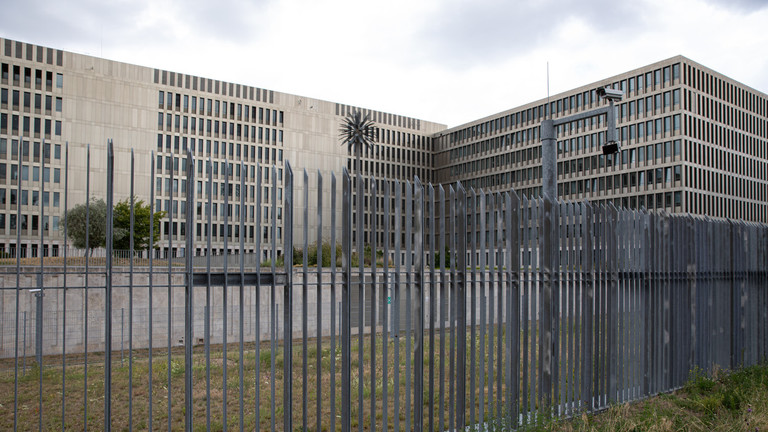
Germany’s opposition lawmakers have accused Chancellor Friedrich Merz’s government of seeking to create a “secret police” by dramatically expanding the powers of the country’s intelligence agencies.
The accusations came during the first parliamentary debate on the reform on Thursday, with lawmakers from the Alternative for Germany (AfD), the Left and the Greens raising concerns over surveillance and fundamental rights. The government argues that the changes are needed to counter growing security threats.
Under a reform approved by the cabinet last month, the BND foreign intelligence agency and the BfV domestic security service would gain broader operational powers, allowing them to move beyond primarily gathering and analyzing information.
Among the proposed changes, the BND could sabotage foreign companies, penetrate foreign IT systems and disable weapons deemed a threat to Germany. The BfV, meanwhile, could secretly enter homes and access computers and mobile phones under certain circumstances.
German Interior Minister Alexander Dobrindt said the reform would usher in a “new era” by turning the country’s intelligence services into “genuine intelligence agencies” capable of actively countering threats. He said Germany must bring its services to the level of its European partners.
AfD MP Gottfried Curio branded the proposed overhaul of the BfV “Stasi 2.0,” referring to East Germany’s notorious secret police, and called the reform a “coup against the rule of law.” The AfD, however, supports granting the BND greater operational powers.
The BfV has itself been locked in a legal battle with the AfD. In 2025, the agency designated Germany’s most popular party a “confirmed right-wing extremist” organization, but a Cologne court in February barred it from applying that classification while the case proceeds.
The ruling came months before the AfD scored major gains in regional elections. It won 43.8% in Saxony-Anhalt earlier this month and 38.3% in Mecklenburg-Western Pomerania on Sunday.
Green MP Konstantin von Notz said granting the BfV such extensive powers would be a “grave mistake” and questioned whether parts of the reform would survive scrutiny by the Constitutional Court. He nevertheless backed giving the BND greater powers.
Left Party MP Clara Buenger went further, warning that the BfV could become a “new German secret police.”
“Fundamental rights are being trampled on here,” she said, arguing that the agency would gain powers traditionally reserved for police.
The debate comes as Merz’s government braces for growing AfD influence at the regional level. The Telegraph and Die Weltreported in July that Berlin was developing a “secret plan” to counter potential “obstructionism” by regional authorities, allowing the federal government to bypass them in a crisis.
The German government wants the intelligence reform to take effect at the beginning of 2027. It still requires approval from both the Bundestag and Bundesrat.
Israeli settler gangs are using drones to terrorize Palestinians across the occupied West Bank, harassing families and guiding armed raids that have killed Palestinians, TheNew Arab(TNA)reported on 25 September.
“When herders left their homes in the morning, the drones would pursue and shadow them; if they approached certain areas, settlers would gather to attack and drive them away. Eventually, the drones began monitoring residents inside their homes around the clock, and there was nothing anyone could do to stop them,” Rabie Abu Naim, a displaced resident of Al-Khalayel, east of Ramallah, told TNA.
Settlers later rigged the drones with speakers blaring abuse and orders to leave, and drones were also used to drop tear gas on targeted communities, as violent assaults wounded many until terrified families fled, the report said.
Abu Naim also pointed to the killing of a boy and a young man in Al-Mughayyir days ago, saying drones “played a major role” in a raid that began with a drone tracking a flock of sheep, after which settlers moved in to steal the animals while shielded by the Israeli army, which “killed the two victims in cold blood during the incident.”
In Mikhmas, shepherd Mohammed Abu Siyam told TNA that settlers sent a drone after his 19-year-old son, Nasrallah, and other young men searching for livestock stolen from the village in February.
With the drone watching their every move, armed illegal settlers lay in wait for the young men, then opened fire, killing Nasrallah and wounding others.
Another Palestinian living in Hajjah, near Qalqilya, told TNA that settler drones fly so close to village homes that families fear the machines will crash through their windows, leaving residents under constant watch and feeling that “privacy is non-existent, and everyone feels constantly threatened.”
Illegal Israeli settlement councils have recently begun arming settlers with drones to film, scout, and watch the areas around outposts, building on earlier Israeli funding that equipped outposts with drones as part of a so-called security package.
Palestinians, meanwhile, are barred from owning drones even for their work, and the Israeli army has arrested numerous Palestinian photojournalists over the past three years for having them, citing a military order that has banned Palestinians from possessing the devices since 2017.
Israeli occupation forces have also raided toy shops across West Bank cities dozens of times, confiscating every drone on the shelves, including those made for children, and threatening shop owners with arrest if they sell them.
In May, OCHA documented settlers using drones to chase residents of Arab al-Mleihat, a community since emptied.
Salah al-Khawaja of the Wall and Settlement Resistance Commission told TNA that the constant surveillance of Palestinian homes can become “an additional factor driving families to leave the areas where they live.”
The EU has published a wide range of reports detailing what social media companies like TikTok and Meta are doing to comply with its Digital Services Act (DSA). The reports detail the extreme censorship needed to stay on Brussels’ good side.
Under the European Commission’s “voluntary Code of Conduct on Disinformation,” the largest online platforms operating in the EU are required to submit biannual reports explaining their efforts to combat so-called “disinformation.” Although adherence to the code is described as “voluntary,” those who do not comply are subject to fines under the DSA, which came into force in 2023.
The commission published reports by Meta, TikTok, Google, Twitch, and more than two dozen other platforms on Wednesday. Each report spans hundreds of pages, and details the speech restrictions and censorship policies put in place at the behest of the EU.
These include restrictions on political speech surrounding elections, which the EU has mandated in every major European vote since 2024, under the pretext of fighting “Russian interference.” According to documents released by the US House Judiciary Committee earlier this year, these measures have almost always been used “to disadvantage conservative or populist political parties.”
In its report, TikTok admitted that it removed more than half a million posts concerning elections in Bulgaria, Cyprus, Denmark, Hungary, Malta, Portugal, and Slovenia this year. RT has covered the EU’s efforts to interfere in the Bulgarian and Hungarian elections in depth, and found that TikTok came under particularly intense pressure from Brussels, after its failure to implement sufficiently draconian restrictions during Romania’s presidential election in 2024.
Each report is hundreds of pages long, and every major social media company admitted that they now defer to EU-approved “fact-checkers” to police content on their platforms. Meta explained that it now automatically down-ranks content flagged by fact-checkers, while YouTube stated that it has trained AI models to pre-emptively remove content it thinks would fall foul of these groups.
Multiple reports specify that the platforms themselves must pay the fact-checkers’ salary. These fact-checkers flagged more than 14 million posts on Facebook in the first six months of this year alone.
Every social media platform devoted a chapter in its report to the Russia-Ukraine conflict, with Facebook noting that all posts on the conflict are subject to monitoring for “disinformation and misinformation” by pro-EU fact-checkers.
Russian media outlets are banned from Facebook, while Ukrainian outlets are free to operate, and Kiev is permitted to fundraise on the platform.
Despite mentioning “disinformation” more than a dozen times, the DSA does not define the term.
A US federal court dismissed the lawsuit against the Palestine Chronicle and its editor, Dr. Ramzy Baroud, after the three plaintiffs asked to withdraw it.
Almog Meir Jan filed the case in July 2024. Shlomi Ziv and Andrey Kozlov joined an amended complaint the following year. The suit sought to link the Chronicle to their captivity in Gaza through its publication of reports by Palestinian journalist Abdallah Aljamal.
The Chronicle rejected the accusations throughout the proceedings. The plaintiffs moved to withdraw their case in July, and US District Judge Tiffany Cartwright granted the request on September 15. The court record closed the case after more than two years of litigation.
“After a struggle of over 2 years, we have won a big victory. We have beaten back a calculated attempt to chill the free speech of some of the most critical voices of the Palestinian people — The Palestine Chronicle and Ramzy Baroud. I have been so proud and honored to represent these clients and am happy for the outcome,” Attorney Dan Kovalik said.
“Still, we must remain vigilant for the inevitable attacks to come against people whose only ‘crime’ is advocating for the lives and rights of the Palestinian people. We are fully prepared for this ongoing struggle,” Kovalik added.
For his part, Baroud welcomed the outcome but said that the case “should have been thrown out from the start.”
“It was initially dismissed, only to be refiled and treated as though the accusations had any legitimacy, despite there not being a single piece of evidence to prove any wrongdoing on our part,” he said.
A Gaza Journalist at the Center of the Case
The lawsuit grew out of an Israeli massacre in central Gaza in June 2024. Israeli occupation forces freed four captives during the operation, which also killed hundreds of Palestinians.
Among those killed was Abdallah Aljamal, a Palestinian journalist who had contributed reports to the Palestine Chronicle. His wife, father and neighbors were also killed. After the raid, Israeli officials alleged that three of the captives had been held in Aljamal’s home.
The three former captives later sued the Chronicle and Baroud. They alleged that the outlet had aided their captivity by publishing Aljamal’s work and paying him for it. The Chronicle denied paying Aljamal and rejected any suggestion that publishing his reports, which were also widely disseminated in both Arabic and English, connected the outlet to the captives’ detention.
Aljamal had filed many reports during the first six months of the war. Baroud said the value of that work lay in its attention to Palestinians whose experiences rarely reached an international audience.
“When Abdallah was sending articles, what I liked about his work is that he spoke to ordinary people,” Baroud said in an earlier interview with journalist Rachel Blevins.
“(We) did not want political commentary; we already have analysts. We wanted the voices of people you never hear from. That’s all,” he added.
In the same interview, Kovalik challenged the allegation that the Chronicle had financed Aljamal’s activities. “The claim is that the Palestine Chronicle paid a journalist, and somehow that money was used to hold hostages. It’s not true. There’s no evidence,” he said.
For the Chronicle, the case put an ordinary editorial decision—publishing firsthand reports from Gaza—at the center of an accusation of wrongdoing. It also forced a small newsroom to defend its work in court while continuing to cover the genocide facing the people and journalists on whom that work depended.
“The saddest aspect of all this is that the victims once again became the accused,” Baroud said in his latest statement. “Some of us have lost hundreds of family members, relatives, friends, neighbors and colleagues, only to find ourselves having to defend against entirely politically and ideologically motivated accusations.”
Israeli authorities have repeatedly accused Palestinian journalists killed or targeted in Gaza of ties to Hamas. The Committee to Protect Journalists has documented a pattern of labeling journalists as “terrorists” without substantiated evidence, while Reporters Without Borders has reported smear campaigns against Gaza’s journalists. Those allegations should be assessed on evidence, rather than treated as established facts because they come from the army that targeted them.
According to the International Federation of Journalists, at least 240 Palestinian journalists and media workers have been killed in Gaza as of September 2026. The federation described the toll as “the greatest massacre of journalists in the history of modern journalism”.
A Silver Lining
Baroud reflected on the people who helped the Chronicle through the case.
“There is a silver lining. This case made us stronger. Dan Kovalik and his team fought with extraordinary dedication on our behalf, while countless readers and intellectuals stood by us.
“Throughout it all, we refused to let the case slow us down. We expanded our coverage and our network, sharpened our journalism and emerged more resilient and more committed than ever to telling Palestinian stories.”
The Palestine Chronicle dedicated the outcome to its readers, solidarity activists, intellectuals, independent journalists and all those who stood beside it and defended the right of Palestinians to tell their own stories.
– Romana Rubeo is an Italian writer and the managing editor of The Palestine Chronicle.

 Login