Reading view
New York’s Climate Circus: Same Clowns, Emptier Promises
Climate Week NYC is packing its tent after another week of green grandstanding, empty promises and soaring energy bills, says Dr Tilak Doshi. Same circus, same clowns, same time next year.
The post New York’s Climate Circus: Same Clowns, Emptier Promises appeared first on The Daily Sceptic.
Rahman’s UN debut carries family weight, high national stakes

When Bangladeshi Prime Minister Tarique Rahman addressed the United Nations General Assembly for the first time on Thursday (September 24), he became the third member of his immediate family to speak from the UN podium. His father, President Ziaur Rahman, addressed the General Assembly in 1980, speaking on self-reliance and regional cooperation. His mother, Khaleda […]
The post Rahman’s UN debut carries family weight, high national stakes appeared first on Asia Times.
Israel Completes Registration of Candidates for the Knesset
European Parliament backs EU health workforce crisis plan
The European Parliament has backed calls for an EU-wide strategy to tackle worsening shortages of healthcare professionals, including an ambition to increase the health workforce by one million, as doctors, nurses, pharmacists and dentists urged the European Commission to turn the recommendations into concrete action.
The own-initiative report, led by MEPs Loucas Fourlas (EPP, Cyprus) and Ruggero Razza (ECR, Italy), warns that shortages of doctors, nurses, carers and other professionals are becoming structural, driven by ageing populations, rising demand for care and persistent burnout...

The Pentagon Crisis: Trump Wants Regime Loyalty
Germany’s Political East Has Broken With Berlin: What the AfD’s 44.5% Really Means
Brazil’s Judicial Crisis: Why Should the World Pay Attention? It is Not Just a Judicial Crisis – It’s About the Elections
Commission promises to cut EU public procurement rulebook from 900 pages to 200
The European Commission wants to cut the EU’s public procurement rulebook from around 900 pages to 200, in a sweeping reform that aims to simplify tendering while giving governments greater scope to favour European economic and security interests, writes Catherine Feore.
Executive Vice-President Stéphane Séjourné held up the existing body of rules alongside its much slimmer replacement, to illustrate his point.
“These here are the European rules which currently govern public procurement in Europe: 900 pages,” he said. “And this is what we are proposing today… down to 200 pages.”
The proposed Public Procurement Act would replace three EU procurement directives with a single regulation, with a view to simplifying procurement provisions spread across 26 sectoral laws and cutting the number of procedures from five to three.
The Commission estimates the changes could save businesses and public authorities €650 million a year in administrative costs.
The reform matters because of Europe’s massive purchasing power involved. EU public procurement exceeds €2.5 trillion annually, around 15% of EU GDP, covering everything from trains and hospitals to energy infrastructure, schools and IT systems.
From lowest price to strategic purchasing
The proposal is not just about cutting red tape. Brussels wants governments to use their purchasing power more strategically.
The Best Price-Quality Ratio would become the standard method for awarding contracts, with quality normally accounting for at least 30% of the assessment and 50% for labour-intensive contracts. Authorities could consider environmental and social performance, innovation, security and resilience alongside price.
The commitment to a so-called European preference has been tempered by the EU’s international commitments, but access can be restricted when a country doesn’t reciprocate market access. Restrictions could also be imposed where reliance on foreign suppliers creates security-of-supply dependencies or threatens EU economic security.
“European public money should, wherever possible, create jobs, investment and opportunities in Europe rather than filling the order books of our competitors,” Séjourné said.
Five procurement procedures would become three: open, dynamic and innovation procedures. Each would allow negotiation between buyers and bidders.
The Commission also plans an integrated EU digital procurement marketplace connecting national e-procurement platforms. A company registered through one connected system should be able to bid elsewhere in Europe without repeatedly submitting the same documentation. This is intended to reduce bureaucracy and tackle one of the current system's weaknesses: too little competition, particularly from SMEs and companies bidding across borders.
National, regional and local priorities may appreciate this flexibility in theory, but constrained budgets often mean that price will remain the bottom line for many. This legislation offers greater freedom in determining needs, but it remains to be seen what its impact will be.
PHOTO CREDIT: European Commission Executive Vice-President Stéphane Séjourné says the rules reduced from 900 pages to 200 pages © European Union
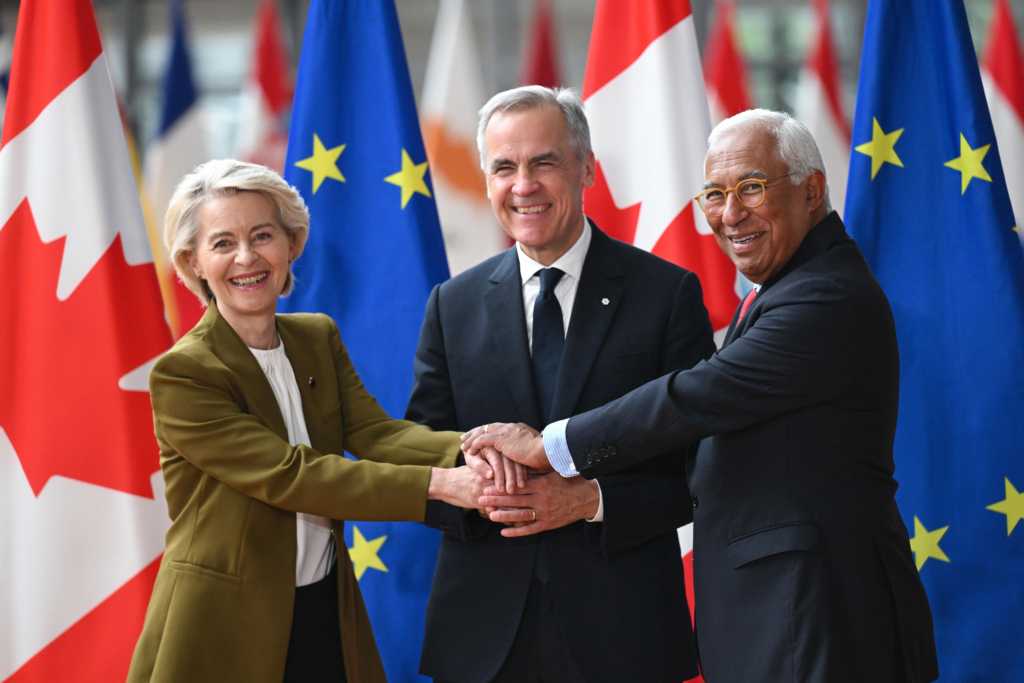
Friends without benefits: Why the EU should offer Canada more than casual defence ties

European leaders losing sleep over Trump’s economic and territorial threats should spare a thought for their Canadian counterparts. On August 22nd, Canadian prime minister Mark Carney announced that his country was “at war” with the United States after trade negotiations collapsed at the eleventh hour. Trump’s subsequent renaming of Lake Ontario to Lake America echoed the crisis with Greenland in January, when the US called into question Denmark’s sovereignty over the territory and refused to rule out taking it by military force.
Both the EU and Canada, in other words, face a similar conundrum: how to de-risk their relationship with an increasingly predatory United States, which exposes them to security threats from Russia and poses a new threat of its own. It is against this backdrop that Carney will attend commission president Ursula von der Leyen’s State of the European Union Speech in Strasbourg on September 16th. An EU-Canada summit will follow in October. The timing could scarcely be better for Europe and Canada to make common cause. But if European leaders want to shift the relationship into a new gear, they will have to revise their usual approach to how the EU treats third countries, particularly in defence and security, where both sides’ dependence on the US runs deepest.
Blurring the lines
Some Canadians, traumatised by Trump’s bullying, have fantasised about joining the EU. Alas, Article 49 of the Treaty on European Union—its accession clause—restricts membership of the bloc to European states. But the EU need not choose between full membership and arm’s-length third-country status. A strict in-or-out model of security and defence co-operation risks excluding partners like Ukraine, Britain, Norway and Canada from key initiatives and the bloc’s defence technological and industrial base—leaving Europe less safe as a result.
The EU already treats one non-member as something more than an ordinary third country or even one on the path to membership: Ukraine has received notable carve-outs for the European Defence Industry Programme (EDIP) and the EU’s Security Action for Europe (SAFE) mechanism, which offers €150bn in low-interest defence loans—not to mention exemptions in other areas like trade, energy, and telecommunications. In other words, the question is not whether bending the rules is permissible under certain circumstances, but what those circumstances are. Extending the same treatment to Canada (as inoffensive an ally as they come) would be popular at home and would offer a template for how other relationships, including with Britain, could be structured.
There is already a clear trend towards a closer relationship between Brussels and Ottawa, especially on the defence industrial side. In 2021, Canada joined the military mobility project of the EU’s framework for deeper defence co-operation, PESCO. Last year, both sides signed a security and defence partnership and this year they agreed to Canada’s participation in SAFE.
On the bilateral front, Berlin and Ottawa are finalising a strategic partnership agreement which will include elements on defence cooperation, on top of agreements already signed with France, Denmark, and other Nordics. On the procurement side, German shipbuilder ThyssenKrupp Marine Systems won a contest to build 12 submarines for the Royal Canadian Navy—the biggest defence deal in Canadian history. Canada is also considering buying Swedish Gripen fighter jets instead of American F-35s and is building ice-breakers in Helsinki. Finally, Canada is actively involved in deterring Russia with boots on the ground in Latvia, where it leads a multinational brigade as part of NATO’s Enhanced Forward Presence (eFP).
But these efforts are mostly non-binding and aspirational—except for SAFE (which is time-limited) and eFP (which sits outside of EU structures entirely). The EU-Canada summit at the end of October gives Brussels and Ottawa a concrete opportunity to turn these efforts into specific investments, capabilities and operational co-operation.
Under the radar
Canada is an underrated military power. The 2% of its GDP that it currently spends on defence is already more than the 14 smallest EU defence budgets combined
The EU stands to gain more from a closer relationship than one might think. Canada is an underrated military power. The 2% of its GDP that it currently spends on defence is already more than the 14 smallest EU defence budgets combined. Compared to the EU’s biggest defence spenders, it ranks behind only Germany, France, Italy and Poland. And its budget is set to increase significantly as Canada moves to spend 4% by 2030 and C$500bn (€310bn) over the next decade.
Much of that money will be invested in equipment and suppliers outside of Canada. As Carney made clear in a recent speech: “The days of our military sending 70 cents of every dollar to the United States are over.” EU defence projects should open up to countries outside the EU and the European Economic Area. Canada’s armed forces bring significant know-how in Arctic warfare, an area of increasing interest to Europe amid growing threats from both Russia and the US. And its six decades within the joint US-Canadian air-defence command, NORAD, give it rare experience of continental-scale air defence and early warning, just as Europeans scramble to expand their own independent missile-defence network.
Deeper cooperation
The EU can use these resources and capabilities to deter Russia and wean itself off its dependence on America, starting with deeper Canadian co-operation with the EU’s defence projects and agencies. A first step would be encouraging Canada to join further PESCO projects. Canada’s expertise could be of great help in ACCESS, which aims to develop Arctic-capable, GPS-denied electronic warfare and sensor systems, and TWISTER’s space-based early warning strand. Canada could join both without too much red tape (for EU standards) because neither project is supported by the European Defence Agency (EDA). A second step would be an administrative arrangement between Canada and EDA, which would allow Canada to join EDA-supported PESCO projects it is currently ineligible for, as well as joint training, monitoring and research. Since the US already has such an arrangement, extending it to Canada should prove uncontroversial.
But the most ambitious step the EU could take would be to treat Canada as a full-fledged member of the EU’s defence technological and industrial base instead of as a third country. Member states and the commission should write Canada into EDIP’s successor, the ring-fenced defence-spending stream—or “window”—of the upcoming European Competitiveness Fund (ECF), which is currently being negotiated as part of the EU’s next budget.
As it stands, current EDIP rules will likely roll over into the ECF unchanged. Under those rules, a system built in Europe carrying 35% American components would qualify for funding, but a wholly Canadian one would not. When EDIP was being negotiated, members states deliberately created a carve-out for Ukraine. Member states should extend the same preferential terms to Canada under the ECF, but also go further, letting Canada run programmes as well as bid for them.
These would be major concessions and they must not be given away for free. The expectation should be that Canada pay for access, open its own procurement to European firms in return, and align its export controls with the EU’s. As a proof-of-concept, both sides could design at least one major system with no US export-controlled parts in it (a counter-drone system would work very well).
In addition to these efforts, Berlin and Paris should also throw their weight behind Canada’s proposal for a Defence Security and Resilience Bank. They might even propose merging it with Britain’s proposed Multilateral Defence Mechanism to create a coalition spanning Britain, Canada and EU member states.
Skin in the game
As the EU’s borders come under pressure from multiple directions, there is a strong case for expanding Canada’s stake in European territorial integrity. That begins by establishing reciprocity. Europeans shouldn’t scoff at Canadian concerns—just as Denmark flew blood bags to Greenland in anticipation of a US invasion in January, so too have the Canadian Armed Forces modelled a possible US military invasion.
European countries should make it clear to Washington that its statements calling into question its ally’s sovereignty are intolerable. They should also prevail upon Canada to unequivocally pick sides should the US raise the Greenland issue again. In the event of a future military mission to Greenland, similar to the Danish-led Operation Arctic Endurance, or even a mission under the EU’s common security and defence policy, Copenhagen should invite Ottawa to join with boots on the ground, just as it has done in Latvia. Likewise, the EU could bind its anti-coercion instrument to equivalent Canadian countermeasures, ready for joint activation during a crisis.
Boosting Ottawa’s participation in Arctic issues would tie it more closely to the defence of the region more broadly and would give it a bigger role in defending European borders. After all, no serious conversation about the region is conceivable without Canada, whose Arctic territory is vastly larger than that of most other Arctic states. Canada is already part of the region’s multilateral infrastructure, but there is still scope to deepen its co-operation with the EU instruments specifically. One way to bridge the gap would be to take up the European Parliament’s proposal to create a dedicated EU-Canada Arctic cooperation framework with structured dialogues between EU and Canadian institutions.
An additional step which would contribute decisively to European security would be to invite Canada to the Joint Expeditionary Force (JEF), the UK-led coalition of northern European states. Canadian forces have already taken part in JEF exercises in Latvia last year and Carney has participated in virtual meetings of the group. Formally joining JEF, which sits outside NATO and EU structures, would involve little red tape and could happen almost immediately. As the US considers far-reaching troop reductions in Europe, any step that improves interoperability among non-US NATO allies is a win for the entire continent.
A price worth paying
The steps outlined above are likely to draw America’s ire and invite retaliation. The US has repeatedly cast scorn on Carney’s middle powers strategy—an effort to rally mid-sized states against pressure from larger ones—which it increasingly views as a serious challenge to its primacy. Under-secretary of war for policy Elbridge Colby recently suspended the Permanent Joint Board on Defence, a longstanding US-Canadian strategic consultative body, and linked the pause to Canada’s weak defence spending and its middle powers strategy. Both the EU and Canada should expect increasing pushback if they embark on this joint course. But any American paroxysm will prove the point—that both Europe and Canada are better off together than alone or in thrall to Washington. If that means blurring the boundaries between EU member states and third countries, so be it.
Plurality NOT Majority of Germans Find No Alternative to AfD!
Affordable Housing Act: Is Brussels over-promising and under-delivering?
The European Commission calls it the Affordable Housing Act and says it can “truly bring a change in people’s lives”. But how much will it actually do to make housing more affordable, asks Catherine Feore?
The tension at the heart of the proposal is that Brussels is making ambitious claims about tackling the housing crisis while simultaneously making clear that it is not imposing new housing policies on governments or cities.
Commission President Ursula von der Leyen says the measure fulfils a promise to tackle housing affordability, describing it as “one step in this direction” and declaring: “Today, we are delivering for all Europeans.” Housing Commissioner Dan Jørgensen went further, saying the Act gives governments and cities tools to “make more affordable homes available”.
Yet the proposed legislation itself is considerably more cautious.
The Commission acknowledges that insufficient housing supply is the structural cause of the affordability crisis. Short-term rentals, second homes and other non-primary uses are not the root problem, although they can exacerbate shortages and push up prices in already constrained markets.
Housing stress test
The Act principally delivers a common legal framework for authorities that choose to intervene.
Central to this is a new EU test for housing stress. An area would normally qualify where an average home costs at least eight years of disposable per-capita income, that ratio has increased over the previous decade, and pressures are unlikely to ease over the next three years. At a ratio of ten or more, the historical deterioration test is dropped. Population dynamics, housing supply and demand must also be assessed.
Authorities could then restrict short-term rentals outside a host’s primary residence or tackle second homes, prolonged vacancy and certain other non-primary uses. But there is no obligation. They must also demonstrate that the activity has significantly harmed housing affordability or availability for at least three years, and any restriction must be targeted, necessary and proportionate. This seems to set a high bar of evidence for most local authorities.
Currently, local authorities must notify the Commission of short-term rental restrictions under the Services Directive. That notification requirement will no longer be required. Cities can use the new framework without seeking prior Commission approval, although measures must be published and remain open to legal challenge. Officials argue this will remove a burdensome procedure and make intervention easier.
But the Commission is equally explicit about what it is not doing. The Act does not regulate rents, harmonise housing policy, give Brussels new housing competences, dictate taxation, inheritance or planning, or require, recommend or encourage authorities to impose restrictions. Housing policy choices “remain national, regional and local”.
Executive Vice-President Teresa Ribera says that when markets fail to provide affordable homes, “public authorities have a responsibility to act”. But the Act does not compel that action; it provides a stronger legal framework if authorities choose to act independently.
Its impact could be real in tourist hotspots where non-primary housing use is demonstrably worsening shortages. But it cannot itself build a home or lower a rent. The question is whether a clearer legal toolbox matches the expectations created by the Commission’s promise to tackle Europe’s housing crisis. When asked to quantify how much of a difference the new provisions could make, the Commission couldn’t give precise figures, saying that it would depend on the measures adopted.
PHOTO CREDIT: Teresa Ribera, Executive Vice-President of the European Commission for a Clean, Just and Competitive Transition, and Dan Jørgensen, European Commissioner for Energy and Housing, give a press conference on the affordable housing Photographer: Jennifer Jacquemart © European Union
Migration ministers agree on Return Hubs in third countries
The meeting of the Core Group’s migration ministers, comprising ministers from Denmark, Austria, Germany, the Netherlands and Greece, concluded in Copenhagen on Friday. Greece was represented by Migration and Asylum Minister Thanos Plevris. According to state-run news agency amna.gr, the ministerial meeting marked an important milestone for European migration policy, with the participating countries advancing […]
The post Migration ministers agree on Return Hubs in third countries appeared first on Keep Talking Greece.
Maximum pressure on Iran, round two
This week, Mark Leonard is joined by Ellie Geranmayeh, deputy director of ECFR’s Middle East and North Africa programme, to unpack a volatile new chapter in the confrontation between the United States and Iran. After months of managed escalation, military strikes have resumed and President Donald Trump has launched an ambitious new sanctions package, dubbed an economic “D-Day”, aimed at squeezing Tehran into submission.
Ellie argues that Washington has returned to a familiar strategy of maximum pressure, betting that unprecedented economic isolation and a blockade of Iranian exports will either force the regime to make major concessions or trigger domestic unrest. But Tehran appears determined to hold out, relying on sanctions-evasion networks, regional diplomacy and the belief that the US will struggle to sustain its campaign over the long term. As both sides continue limited military operations while keeping channels for negotiation open, the prospect of a comprehensive deal remains elusive.
The conversation also explores the domestic pressures facing Iran’s leadership, from a shrinking economy and growing public dissatisfaction to the threat of renewed nationwide protests. Mark and Ellie examine whether economic hardship could destabilise the regime, why Iranian leaders remain sceptical of American commitments and how internal politics in both Washington and Tehran are shaping the path ahead.
Finally, they discuss the wider regional and European implications of the conflict. How are Gulf states positioning themselves between the US and Iran? What risks does the confrontation pose to global shipping through the Strait of Hormuz? And can European governments still play a meaningful diplomatic role as tensions rise and fears grow that the Iran conflict could become increasingly entangled with the war in Ukraine?
This podcast episode was recorded on September 3rd 2026.
Bookshelf
Hillbilly Elegy, by J.D. Vance.
MEPs push for EU solidarity fund to improve access to cross-border healthcare
MEPs are pushing for an EU solidarity mechanism to help patients pay for treatment abroad, arguing that financial barriers are preventing Europeans from exercising rights they have had on paper for more than a decade.
The calls came as Parliament discussed a report commissioned to inform its own-initiative report on modernising patients’ rights in cross-border healthcare. The study found that cross-border care accounts for just 0.004% of EU public health expenditure, despite patients continuing to face upfront costs, complex reimbursement procedures and prior-authorisation requirements.
Tomislav Sokol (EPP, Croatia) called the proposed solidarity mechanism a potential “game changer” for vulnerable patients, but challenged Parliament to spell out how it would work.
“How would it work in practice? How would it be financed? Would this be part of the EU budget?” Sokol asked. “We need to know it now, so that we can also use this in negotiations on the future EU budget, in the next MFF.”

Kallas exposes power struggle with von der Leyen
A long-running institutional struggle over who controls European Union foreign policy has broken into the open, with EU foreign policy chief Kaja Kallas publicly acknowledging that the role of the High Representative has not worked as intended when decisions are effectively taken above her inside the European Commission, writes Catherine Feore.
Speaking after an informal meeting of EU foreign ministers, Kallas delivered an unusually candid assessment of the relationship between the European External Action Service (EEAS), the European Commission and the member states.
At the centre of the dispute is a fundamental question: whether the EU's foreign policy is ultimately directed through the High Representative, who is supposed to bridge the Commission and national governments, or through Commission President Ursula von der Leyen.
Kallas argued that the problem does not lie primarily in the EU treaties or the institutional architecture they created. Instead, she said, it lies in how that architecture has been implemented in practice.
Video
"The problem is not the treaties, not the institutional setup. The problem is the implementation of that setup that it would work in practice, and there was a broad support by the member states to make it work. But of course, it doesn't entirely depend on the member states," Kallas said.
The final sentence was significant. Kallas' comments point towards criticism of von der Leyen.
Under the EU's institutional structure, Kallas holds two positions simultaneously: High Representative for Foreign Affairs and Security Policy and Vice-President of the European Commission. The dual role was designed precisely to connect foreign-policy decisions made by the member states with the powerful economic and regulatory instruments controlled by the Commission.
Those instruments include trade, development assistance, enlargement, migration and visa policy. Kallas argued that Europe cannot operate effectively as a geopolitical actor unless it brings those tools together with the foreign policy agreed by national governments.
"If we want to act as a geopolitical player, we should really put these things together," she said, arguing that this was precisely why the treaties created the vice-presidential component of the High Representative's job.
A role that works "on paper"
Asked about proposals to shift parts of the EEAS, its staff or competences towards the Commission, she described a system in which her coordinating authority exists more clearly in theory than in practice.
"The high representative/vice president is the link between the member states and the Commission, on paper, in theory,” she added pointedly that “we have had issues where there is somebody above me that is actually deciding; then you know it doesn't work that way. Let's be very frank.”
The reference to "somebody above me" was the sharpest indication of the institutional problem Kallas was describing. Within the Commission hierarchy, the person “above” Kallas is Commission President Ursula von der Leyen.
Commission versus EEAS
The question arose because foreign affairs ministers were discussing the future of the EEAS and how Europe's external-policy machinery should be organised.
According to Kallas, governments broadly supported retaining the existing institutional structure rather than rewriting it. But they also want that structure to operate as originally intended.
She warned in particular against duplication between the EEAS and the Commission. If a function is already being performed effectively by the diplomatic service, she argued, there is little justification for recreating the same capacity inside the Commission.
The discussion also touched on proposals to concentrate more external-action functions inside the Commission. Kallas said such a transfer could not be separated from the High Representative's authority.
If external-action services are concentrated in the Commission, she argued, the other side of the bargain must be that the High Representative genuinely oversees those services. "One side of the equation cannot happen without the other," she said.
Kallas said a majority of governments supported maintaining the current institutional setup and opposed concentrating everything in the Commission without the High Representative's coordinating role being implemented in practice.
PHOTO CREDIT: Roundtable Informal meeting of Foreign Affairs Ministers (Gymnich) - September 2026 - Irish Foreign Minister Helen McEntee and EU High Representative Kaja Kallas © European Union
Pakistan to sign long-delayed refinery deals unlocking more than $6 billion in planned upgrades
ISLAMABAD: Pakistan is set to sign long-delayed agreements with five oil refineries, unlocking more than $6 billion in planned upgrades to modernize aging plants and cut reliance on fuel imports, officials said. But industry warnings that changes to the financial framework could derail the projects overshadowed the announcement. The agreements with Pak-Arab Refinery Ltd., Pakistan ... Read more
The post Pakistan to sign long-delayed refinery deals unlocking more than $6 billion in planned upgrades appeared first on BOL News.
Pakistan’s inflation rises to 11.15% in August 2026
Core inflation, which excludes volatile food and energy prices, rose to 8.7% year-over-year in August, up from 8.4% in July.
The post Pakistan’s inflation rises to 11.15% in August 2026 appeared first on BOL News.
ChatGPT, Reddit and Roblox become latest catch in EU’s regulatory net
Brussels is tightening its grip on some of the internet’s fastest-growing services, designating ChatGPT, Reddit and Roblox for heightened scrutiny under the European Union’s Digital Services Act (DSA), writes Catherine Feore.
The European Commission said all three services meet the 45 million average monthly users threshold in the EU, triggering the DSA rules reserved for digital players considered large enough to pose systemic risks to European society.
“These new designations mean that ChatGPT, Reddit and Roblox will now be held to a higher standard of scrutiny and accountability in the European Union,” said Henna Virkkunen (pictured), the Commission’s executive vice-president for tech sovereignty, security and democracy.
The move puts the companies firmly in Brussels’ regulatory crosshairs. They must assess and mitigate risks ranging from illegal content and harm to minors to threats to fundamental rights, elections, public security, and users’ physical and mental well-being. Importantly, the designation also gives the Commission investigative powers to scrutinise relevant features and systems underpinning the services.
ChatGPT has been designated a Very Large Online Search Engine (VLOSE), while Reddit and Roblox are now Very Large Online Platforms (VLOPs). They have until the end of January 2027 to comply with the DSA’s tougher obligations.
ChatGPT’s inclusion is particularly significant. The Commission considers the AI service a hybrid product that qualifies as an online search engine because it can search the web when answering users’ queries, bringing a major generative AI service into the DSA’s toughest tier of oversight for the first time.
The Commission will supervise compliance with the DSA, in cooperation with Coimisiún na Meán (Ireland’s media regulator) for ChatGPT and Reddit, and the Dutch Authority for Consumers and Markets (ACM) for Roblox.
With the latest additions, 28 platforms and search engines have now received the EU’s “very large” designation.
Photo credit: Commissioner Virkkunnen Photographer: Lukasz Kobus © European Union
US authorization of ZYN challenges the future of EU nicotine policy
The US Food and Drug Administration’s (FDA) decision to allow 20 ZYN nicotine pouch products to carry a specific reduced-risk claim has created a striking contrast with the direction of European Union policy, as Brussels prepares new product rules and proposes EU-wide taxation of nicotine pouches.
The United States Food and Drug Administration has authorised 20 ZYN nicotine pouch products to be marketed with a statement informing adult smokers that completely replacing cigarettes with the pouches can reduce the risk of several serious diseases.
The decision, issued on 30 June 2026, represents the first time that the FDA has granted Modified Risk Tobacco Product orders to nicotine pouches.
The authorised wording states:
“Using ZYN instead of cigarettes puts you at a lower risk of mouth cancer, heart disease, lung cancer, stroke, emphysema, and chronic bronchitis.”
The orders cover ten varieties of ZYN, each sold in nicotine strengths of 3mg and 6mg. The products include Chill, Cinnamon, Citrus, Coffee, Cool Mint, Menthol, Peppermint, Smooth, Spearmint and Wintergreen.
The manufacturer, Swedish Match USA, is owned by Philip Morris International. The products had already received FDA authorisation to remain on the US market in January 2025, but the new decision goes considerably further by permitting a specific comparative health claim.
The FDA said its decision followed an extensive scientific review and was intended to give adult tobacco users accurate information about differences in risk between products.
“FDA’s review of modified risk products is intended to ensure that adult users have clear, science-based information about the relative harms of tobacco products, so they can make informed choices,” said Bret Koplow, acting director of the FDA’s Centre for Tobacco Products.
The ruling does not mean that ZYN is harmless, nor does it approve the products as medicines or smoking-cessation treatments. Nicotine is addictive, and the FDA continues to advise people who do not currently use tobacco or nicotine not to begin.
The significance of the decision lies instead in the regulator’s formal recognition that nicotine products can present very different levels of risk.
Switching, rather than dual use
A crucial qualification is contained in the phrase “instead of cigarettes”. The authorised claim applies to smokers who replace cigarettes with ZYN. It does not promise the same reduction in risk to consumers who use nicotine pouches while continuing to smoke.
Cigarettes burn tobacco, creating smoke containing toxic substances responsible for most smoking-related cancers, cardiovascular disease and respiratory illness. Nicotine pouches deliver nicotine through the lining of the mouth without burning tobacco or producing smoke.
This difference is central to the principle of tobacco harm reduction: smokers who cannot or do not wish to stop using nicotine may nevertheless reduce their health risks by moving away from combustible products.
The FDA’s decision therefore recognises an important distinction that is frequently blurred in political debate. A product can be addictive and unsuitable for non-users while still being substantially less dangerous than smoking.
UK-based public health commentator Clive Bates, a former director of Action on Smoking and Health, has argued that nicotine pouches could deliver benefits comparable to those associated with the use of Swedish snus in Scandinavia.
“Tobacco-free nicotine pouches with a consumer acceptable nicotine content have the potential to benefit public health in the same way that is documented for Swedish snus in Scandinavia, that is, by serving as a low-risk alternative to cigarettes”, Bates said.
“The European Commission should pay close attention to FDA’s exhaustive process and extensive reasoning. It’s unusual to have anything good to say about the Federal government these days, but this is an important exception, where the right answer has been reached for the right reasons”, he added.
Bates has also argued that poorly designed regulation, including excessively low nicotine limits, could make pouches less effective as substitutes for cigarettes and unintentionally protect the market for combustible tobacco.
Why the FDA decision matters for Europe
The American ruling comes at a particularly important moment for the European Union.
The European Commission is simultaneously advancing a formal proposal to overhaul tobacco taxation (TED) and preparing a broader revision of the EU legislation governing tobacco and nicotine products, their presentation, sale, advertising and promotion.
Nicotine pouches are not comprehensively regulated at EU level under the current Tobacco Products Directive (TPD). Because they contain nicotine but no tobacco, they fall outside many of the harmonised provisions that apply to cigarettes, roll-your-own tobacco, heated tobacco and electronic cigarettes. The result is a fragmented European market.
Some member states permit nicotine pouches subject to national restrictions. Others have introduced nicotine limits, packaging and warning requirements or advertising controls, while France has pursued a prohibition.
Different national rules create uncertainty for consumers and manufacturers and complicate enforcement across the EU’s internal market.
The Commission’s April 2026 evaluation of the European tobacco-control framework identified the rapid growth of nicotine pouches, electronic cigarettes and heated tobacco products as one of the main challenges that existing EU legislation is no longer adequately equipped to address.
The evaluation concluded that EU rules had contributed to falling smoking rates and smoking-related deaths but were failing to keep pace with changes in products, marketing practices and consumer behaviour.
The EC is particularly concerned about the use of novel nicotine products among children, adolescents and young adults. However, the FDA decision introduces an additional issue that EU policymakers will now find difficult to avoid: whether new EU rules should recognise differences in risk between combustible cigarettes and smoke-free nicotine products.
Two contrasting regulatory philosophies
The emerging difference between Washington and Brussels is not simply that one jurisdiction is permissive and the other restrictive.
The FDA subjects nicotine products to an exceptionally demanding premarket review. Products must receive authorisation before they can legally be marketed, and separate evidence is required before a manufacturer may make a modified-risk claim.
The FDA can impose marketing conditions, require post-market surveillance and withdraw an order if later evidence shows that the product no longer benefits public health.
Its approach nevertheless accepts that consumers should be told when credible evidence shows that completely switching from one product to another reduces disease risk.
The Commission’s current approach places greater emphasis on reducing the overall attractiveness and consumption of tobacco-related and nicotine products. Its taxation proposal explicitly presents nicotine pouches as products that can prolong addiction or act as substitutes for cigarettes, especially among young people.
These positions are not necessarily irreconcilable.
The EU could impose age controls, marketing restrictions, ingredient standards and proportionate nicotine limits while still recognising that adult smokers may benefit from switching completely away from cigarettes.
It could also prohibit unsubstantiated commercial claims while creating an evidence-based process through which manufacturers could apply for permission to communicate verified differences in risk.
The alternative would be to impose increasingly similar taxation, warnings and advertising rules on products with significantly different health consequences.
A test for evidence-based policymaking
The EC ran a public consultation on revisions to both the Tobacco Products Directive (TPD) and the Tobacco Advertising Directive (TAD) from 22 May to 14 August this year. The consultation, is intended to inform a revision of the legislative framework planned before the end of 2026.
It creates an opportunity to consider evidence that was not available when the current Tobacco Products Directive was adopted in 2014.
Nicotine pouches were then a marginal product. They now represent a rapidly expanding category, and national governments are adopting increasingly divergent responses.
The FDA decision does not compel Europe to follow the US model. The EU has different legal structures, public-health priorities and attitudes towards commercial nicotine.
It does, however, establish a significant regulatory precedent.
One of the world’s most influential public-health authorities has concluded that there is sufficient evidence to tell adult smokers that completely switching to specified nicotine pouches reduces their risk of mouth cancer, heart disease, lung cancer, stroke, emphysema and chronic bronchitis.
That finding sits uneasily with any policy or public communication suggesting that cigarettes and smoke-free nicotine products are essentially equivalent.
The issue is particularly relevant to the Commission’s tax proposal. Taxation affects consumer behaviour partly by changing the relative prices of products. If pouches are taxed so heavily that the economic advantage over cigarettes is substantially reduced, smokers may have less incentive to switch.
Conversely, setting taxes too low could increase affordability and use among young people who have never smoked.
The task for EU legislators is therefore not simply to choose between regulation and deregulation. It is to develop a framework that calibrates restrictions, taxation and consumer information according to evidence about risk, behaviour and population-level effects.
Europe’s choice
While Washington is recognising that adults deserve accurate information about lower-risk alternatives, Brussels is looking for ways to restrict, tax or ban them.
Meanwhile, the EU is failing to control illegal disposable vapes, banned flavours, excessive nicotine levels and unauthorised devices moving through black-market channels. Regulated products are demonised, while illegal and unregulated products keep reaching consumers, including young people.
The forthcoming EU debate will test whether Brussels can reconcile its tobacco-free objective with the potential role of lower-risk alternatives.
The FDA decision makes three points that are likely to shape that discussion.
First, nicotine pouches are not harmless and should not be promoted to children or people who do not use nicotine.
Second, the absence of combustion means that their risks can differ substantially from those associated with cigarettes.
Third, the greatest potential benefit arises when smokers switch completely rather than using pouches alongside continued smoking.
The Commission is right to address gaps in the existing legislation and fragmentation between member states. Common product standards, youth protections and enforcement rules may be necessary for the Single Market to function properly.
But regulation that fails to acknowledge relative risk could also have unintended consequences.
Clive Bates and other harm-reduction advocates argue that treating all nicotine products as though they are similarly dangerous can preserve smoking by discouraging consumers from moving to safer alternatives. European health campaigners respond that the growth of commercially marketed nicotine products could create a new generation of dependent users.
The revised Tobacco Products Directive (TPD) will need to address both concerns.
As the EC completes its consultation and develops its legislative proposal, the American decision gives European policymakers a concrete case study rather than a theoretical argument.
The question is no longer whether a regulator could authorise a carefully limited reduced-risk claim for a nicotine pouch. The FDA has now done so.
The question for Europe is whether its forthcoming legislation will allow comparable scientific evidence to influence regulation, taxation and communication — or whether nicotine pouches will be treated principally as another product to be restricted, irrespective of their potential role in moving smokers away from cigarettes.