❌

Reading view

Protesters in Brussels press EU on ‘broken promises’ over caged animals

The European Commission is being pressed to deliver an animal cage ban by 2027 after failing to meet previous commitments.

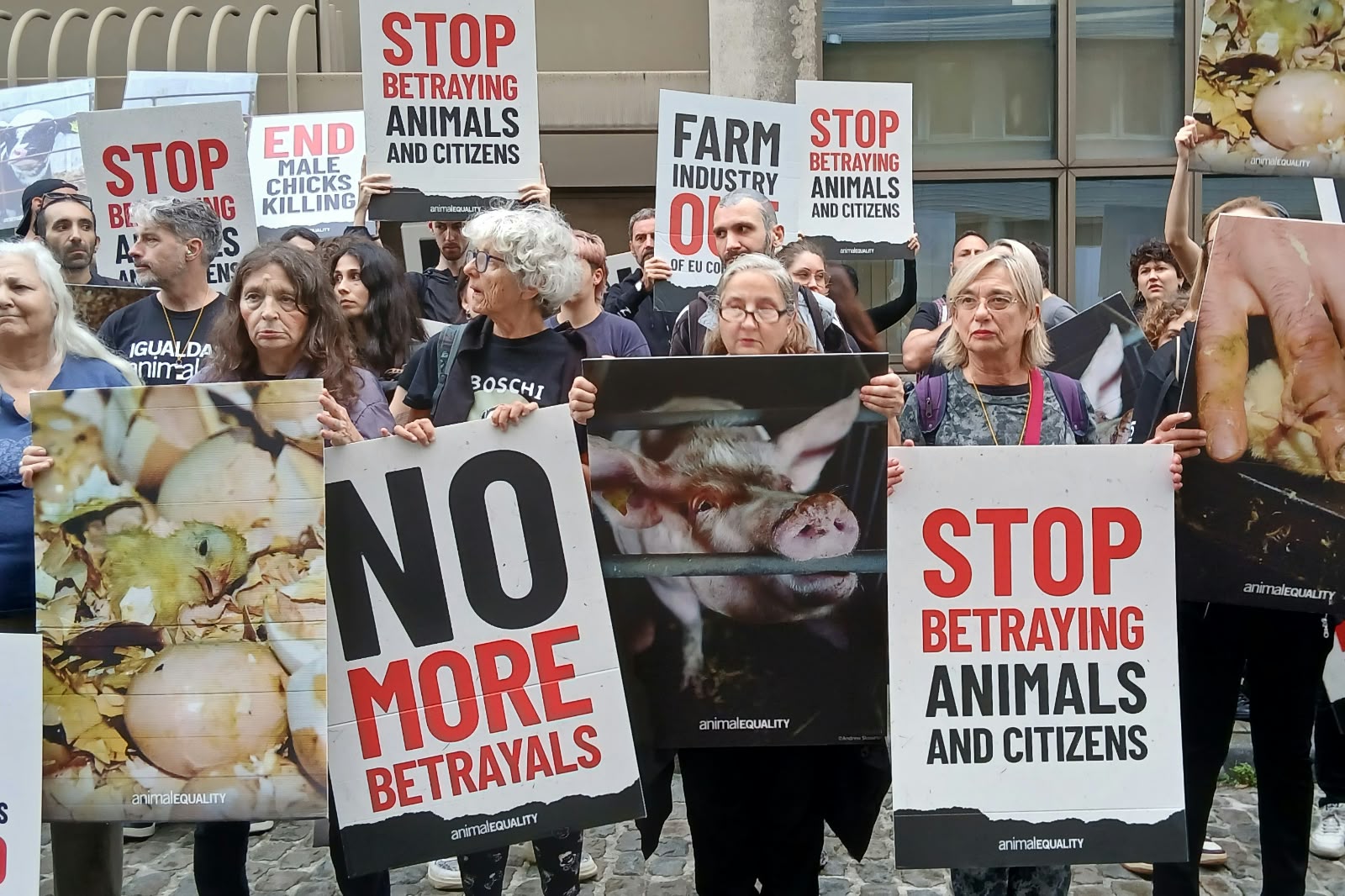
Several hundred animal rights activists gathered at the EU’s office for health and food safety in Brussels on Monday (28 September) to encourage a ban on poultry cages and on the killing of male chicks. 

The commission’s livestock strategy had committed in July to proposing legislation to outlaw the two practices by the end of 2026, with similar legislation on pig welfare expected to follow by mid-2027.

The legislation stems from a European Citizens’ Initiative (ECI) signed by 1.4 million people in 2021 to ‘End the Cage Age’. A vast majority of MEPs also subsequently voted to endorse the transition to improved animal welfare. 

And while the commission had originally promised to table a proposal by 2024, this was derailed by farming lobbies and the deadline elapsed.

“We are here [at Monday’s protest in Brussels] because the EU has been delaying meaningful reforms for animals for years,” said Ombretta Alessandrini from Animal Equality, which organised the rally.

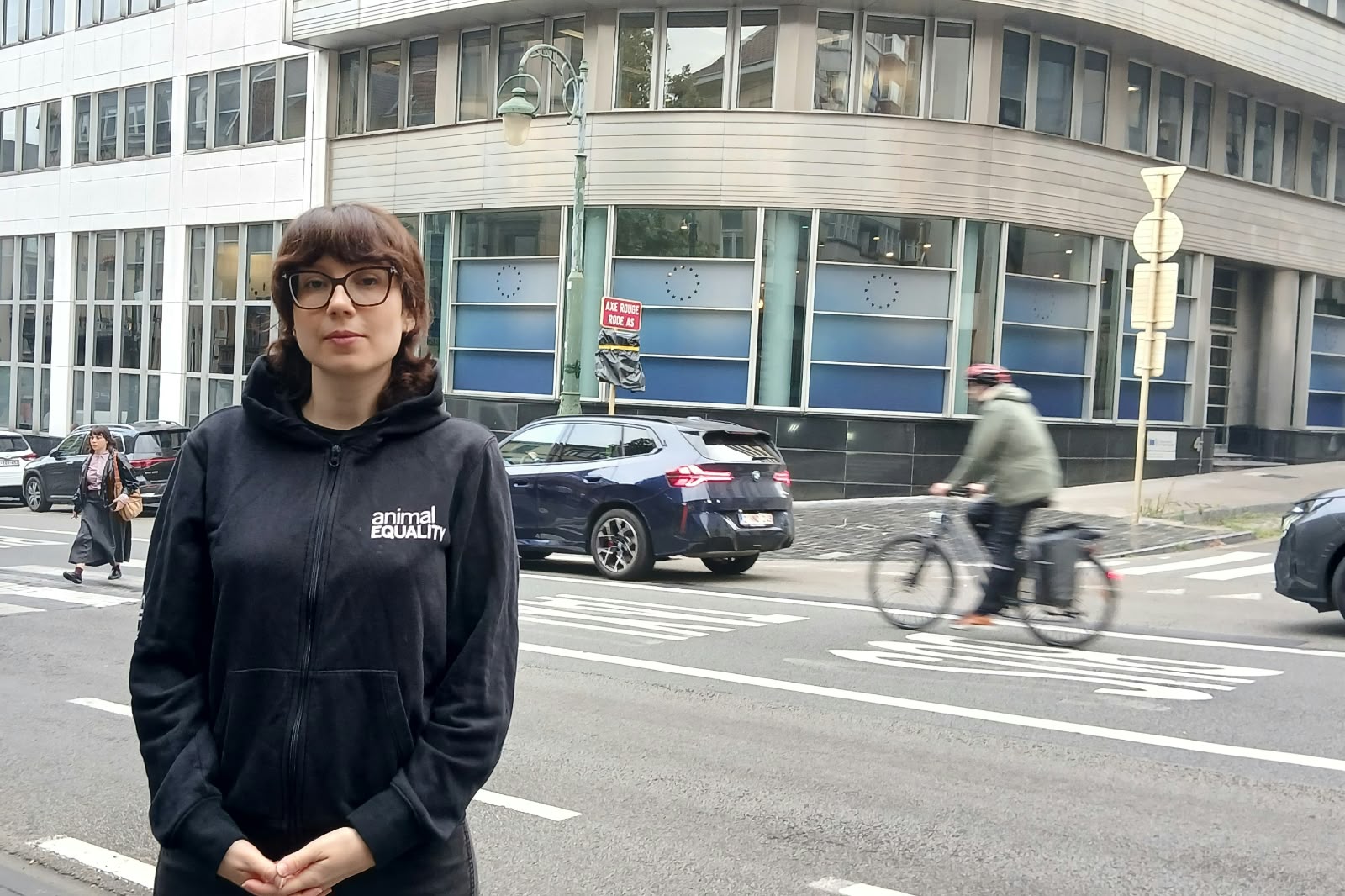
Person stands infront of EU institute.
Ombretta Alessandrini is campaign manager at Animal Equality. (Source: EUobserver)

“Our democratic ask needs to be respected. We feel betrayed by the EU’s broken promises and we want the commission to do what they say,” she told EUobserver.

Animal Equality has also joined legal action against the commission over its broken promises, in a case examined at the European Court of Justice in March.

The commission is legally obliged to respond to a citizens’ initiative once it reaches 1m or more signatures. 

This article continues, but the full version is available only to EUobserver.com subscribers. Visit account.euobserver.com/membership

  •  

Trump’s EPA Allows Bayer/Monsanto to Choose Their Own Regulations on Deadly Herbicides

by Brian Shilhavy
Health Impact News

Earlier this year I reported how President Trump issued an executive order mandating domestic production of glyphosate-based herbicides for use in agriculture and the military.

See:

Trump Issues EO to Produce More Glyphosate Herbicide in the U.S. After Bayer Settles Cancer Lawsuits for Hundreds of $Millions

Then, just a few days later, I reported how the current U.S. Farm bill is seeking to give legal immunity to Bayer for harm caused by glyphosate.

WAR ON FOOD! Trump Administration Traitors Lobbying for Bayer to Poison our Food with Glyphosate

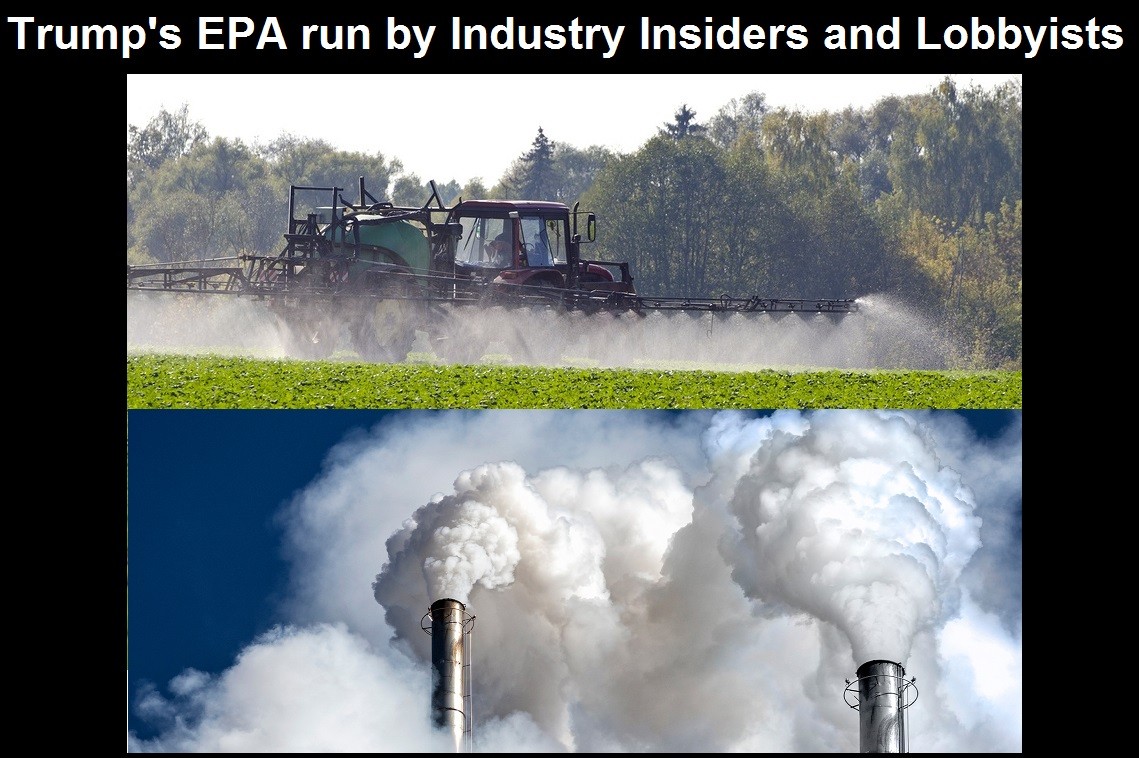
Now it is being reported that Trump’s Environmental Protection Agency (EPA) has allowed Bayer/Monsanto to choose their own regulations they are willing to abide by for another destructive herbicide, dicamba.

The Guardian has picked up this story.

US environment agency let Bayer pick regulations for destructive weedkiller, documents show

Environmental Protection Agency asked firm to choose rules it wanted for dicamba, then put the choices in a proposed federal rule

The EPA allowed pesticide giant Bayer to pick from a menu of regulation options for the controversial and destructive weedkiller dicamba, newly released internal agency documents show.

The documents provide an unusually clear look into the process of developing pesticide regulations, which is typically done out of public view.

It shows in detail how the EPA asked Bayer which regulations it wanted, received a response from Bayer, then put Bayer’s choices into a proposed federal rule.

Dicamba is drift prone and kills vegetation and crops for miles around fields where it is sprayed, and is linked to liver cancer and Non-Hodgkin lymphoma.

Courts have twice ordered it off the market because of its drift problems, but the EPA has re-approved it.

Full article.

If you want to learn more about the herbicide dicamba, here are a couple of articles about the history of the use of this dangerous herbicide in the U.S. that the EPA continues to allow:

Dicamba Drift Turned Neighbors Into Enemies. EPA Just Brought It Back.

Dicamba: Concerns about cancer and crop damage

It has been well documented that Trump’s EPA in his second term is run by former industry insiders and lobbyists from the very industry it is supposed to regulate. See:

Who’s Running Trump’s EPA?

Not only are they seeking to give legal protection to Bayer for their dangerous herbicides which have been ruled in the U.S. Courts to cause cancer and other diseases, they have also removed regulations for power plants that pollute the air so that data centers can be built very quickly to fuel the energy needed for more AI development.

These actions are being sold to the Conservative MAGA movement as necessary to roll back “climate change” regulations by “the liberals” which they claim are based on bad science, and hamper industry development.

But these actions have nothing to do with fighting back against the “climate change agenda”, and have everything to do with enriching the pockets of Trump’s friends in the industry who do not want to be regulated anymore for purely economic reasons that have nothing to do with the environment or the health of the U.S. population.

Americans from both sides of the political spectrum are now opposing things like these data center developments, so don’t fall for the partisan political games!

AI Data Center Opposition Unites People Across Political Lines as Trump Attacks Americans Who Oppose Big Tech

Know Where Your Food Comes From

It is getting more and more dangerous to purchase food from the big box retailers stocking commodity food. Your beef could be from Argentina from shipments that were rejected by China (source), and much of the food you purchase could be contaminated with chemicals that have been banned in most other countries and have been legally shown to cause disease in a court of law.

Your government here in the U.S. is NOT looking out for you! So you need to become a health-conscious consumer, and try to purchase food where you know where it came from and how it was produced.

My own online story, Healthy Traditions, provides options for food produced by small-scale family farmers where we have thoroughly tested it.

We are sourcing more and more of our food from outside the U.S., due to necessity. Starting this year, 2026, we are only purchasing grains from Italy, where their standards for food are far superior to the USDA national organics program.

We stopped participating in the USDA organic program years ago, due to the influence of Big Food that has watered down the standards and still allows trace amounts of herbicides and pesticides. See:

Big Food has Taken Over the USDA National Organic Program – Why I am no Longer Importing Certified Organic Food

Click or tap to expand.

We have consistently tested products in the U.S. that claim to be “organic” or “GMO free” and have routinely found these products contaminated with dangerous herbicides like glyphosate, and GMO DNA.

And they are not even violating USDA organic standards.

In Europe, and especially in Italy, if someone makes a claim to having a European organic certification and then those products are tested to be contaminated, they lose their license to sell, and face criminal charges, unlike the U.S.

Americans have no one to blame for the sad state of our food and food production here in the U.S., however, except themselves, because the American consumer still has the largest voice and the most influence when it comes to food standards.

But people buy in to the partisan political debates and falsely think they can just vote the right person into power to solve their problems.

The most effective way, however, to bring about change, is by voting with your dollars and where you spend your money.

This is the only thing that will affect change, but it takes a lot more effort to seek out ethical food producers in your community and support them instead. It is just so much easier to stop at the Big Box grocery stores where you can get all your shopping done in minutes.

Convenience has a price: and it may cost you your life.

This article was written by Human Superior Intelligence (HSI)

See Also:

Understand the Times We are Currently Living Through

The Brain Myth: Your Intellect and Thoughts Originate in Your Heart, Not Your Brain

Is God’s Patience About to Run Out on the United States?

Second Edition of eBook Released: The Concept of the American Christian Family is a Myth and is NOT Found Anywhere in the Bible – by Brian Shilhavy

FREE eBook! Restoring the Foundation of New Testament Faith in Jesus Christ – by Brian Shilhavy

KABBALAH: The Anti-Christ Religion of Satan that Controls the World Today

Exposing the Christian Zionism Cult

The Bewitching of America with the Evil Eye and the Mark of the Beast

Jesus Christ’s Opposition to the Jewish State: Lessons for Today

Identifying the Luciferian Globalists Implementing the New World Order – Who are the “Jews”?

The Seal and Mark of God is Far More Important than the “Mark of the Beast” – Are You Prepared for What’s Coming?

The Satanic Roots to Modern Medicine – The Image of the Beast?

Medicine: Idolatry in the Twenty First Century – 10-Year-Old Article More Relevant Today than the Day it was Written

Having problems receiving our emails? See:

How to Beat Internet Censorship and Create Your Own Newsfeed

We Are Now on Telegram. Video channels at Bitchute, and Odysee.

If our website is seized and shut down, find us on Telegram, as well as Bitchute and Odysee for further instructions about where to find us.

If you use the TOR Onion browser, here are the links and corresponding URLs to use in the TOR browser to find us on the Dark Web: Health Impact News, Vaccine Impact, Medical Kidnap, Created4Health, CoconutOil.com.

The post Trump’s EPA Allows Bayer/Monsanto to Choose Their Own Regulations on Deadly Herbicides first appeared on Health Impact News.

  •  

Un défi existentiel

JPEG - 167.3 kio
Newsha Tavakolian //// Il ne reste de l'ancien port de plaisance de Rahmanlou que des bâtiments vides et des bateaux abandonnés.
© Newsha Tavakolian/Magnum Photos

Des sirènes hurlantes, des embouteillages monstres étendus sur des kilomètres, des forces de l'ordre déployées dans les rues pour dissuader émeutes, manifestations et pillages tandis que quatorze millions d'habitants évacuent Téhéran et sa banlieue. Ces scènes dignes d'un film dystopique auraient pu avoir lieu. Ce n'est pas la menace du président américain Donald Trump de faire disparaître la civilisation iranienne en une nuit (lire « Une journée comme une autre ») qui en aurait été la cause, mais un ordre des autorités de la République islamique. En novembre 2025, les pluies d'automne ne sont pas au rendez-vous. L'Iran connaît la pire sécheresse depuis un siècle. Les cinq barrages qui approvisionnent la capitale sont presque à sec et les coupures d'eau sont quotidiennes, surtout la nuit. La tension est identique dans la ville de Machhad (nord-est), que quatre barrages environnants sont bien en peine d'alimenter. Le président Massoud Pezechkian met alors en garde ses compatriotes. Si la situation ne s'améliore pas, il faudra évacuer la mégapole et ses environs (1). Pour le long terme, il évoque même un possible transfert définitif de la capitale surpeuplée vers la région de Makran, près du détroit d'Ormuz. Un projet jugé irréalisable par nombre d'experts mais dont l'évocation frappe tout de même les esprits, tant elle conforte l'idée d'un choc environnemental majeur à venir.

Des villages entiers sont privés d'eau potable, l'exode rural s'aggrave, les équilibres sociaux et territoriaux sont bouleversés

La hausse, toute relative, de la pluviométrie au premier semestre 2026 a conjuré le scénario de l'évacuation forcée, mais le problème de fond demeure. Trente-cinq millions d'Iraniens sont confrontés quotidiennement à la pénurie d'eau. Les réserves totales ont diminué de 211 kilomètres cubes entre 2003 et 2019 — l'équivalent de deux années de consommation nationale —, tandis que le niveau moyen des nappes souterraines a fortement baissé (2). Dans certaines régions, notamment dans l'Est et dans le Sud, l'eau potable n'est accessible aux habitants que via des camions-citernes payants, ce qui provoque de longues files d'attente. Une centaine de zones humides ont disparu, et l'assèchement des rivières contribue à l'aggravation des tempêtes de poussière qui sévissent à partir du printemps.

Contrairement au discours officiel, la sécheresse et le réchauffement climatique, présentés comme une fatalité, ne sont pas les seuls responsables de cette crise. C'est aussi, et avant tout, une affaire de mauvaise gestion et de politiques environnementales erratiques depuis les années 1970. « La pénurie d'eau en Iran, particulièrement à Téhéran, n'est pas un phénomène passager ou le résultat d'une seule année de sécheresse, écrit ainsi le très critique quotidien économique de Téhéran Jahan-e Sanat. C'est le signe d'un déséquilibre profond et structurel du système national d'approvisionnement et de consommation » (17 février 2026).

Autrement dit, l'Iran manque d'une politique centralisée et cohérente de l'eau qui arbitrerait entre les besoins. Les efforts consentis en faveur de l'agriculture — laquelle représente 90 % de la consommation des ressources hydriques — sont pointés du doigt. Afin de procurer des revenus décents aux populations rurales, mais aussi pour garantir la sécurité alimentaire d'un pays exposé aux sanctions internationales, les autorités ont multiplié les mesures pour doper la production agricole. Des dizaines de barrages et de retenues plus modestes ont été construits un peu partout, le plus souvent sans planification ni études préalables, déplaçant des populations et affectant les écosystèmes. Faute d'entretien, nombre de ces structures sont délabrées ou connaissent des taux d'envasement élevés. Le gouvernement est tout aussi incapable de contrôler la consommation d'eau des sites industriels, surtout quand ils sont liés à des dignitaires du régime ou à la galaxie interlope des gardiens de la révolution.

Dans le même temps, les forages illégaux se multiplient et contribuent à la diminution des ressources. Un comble quand on sait que l'Iran s'enorgueillit de techniques plurimillénaires de gestion rationnelle de l'eau souterraine — tels les fameux qanat ou galeries. La corruption et le népotisme endémiques ont ainsi engendré des passe-droits qui génèrent le gaspillage et des inégalités d'accès. Tout le contraire de la traditionnelle « justice de l'eau » garantissant sa répartition équitable.

« Des groupes paraétatiques et paramilitaires contrôlent les ressources naturelles, notamment l'eau, à travers la construction et la gestion de barrages », confirme la chercheuse Dorna Javan (3). Tout cela a un coût. Des villages entiers sont privés d'eau potable, l'exode rural s'aggrave, et ce sont les équilibres sociaux et territoriaux qui sont bouleversés.

Jusqu'à présent, le régime a minimisé, pour ne pas dire nié, l'importance des problèmes écologiques. La recherche sur ces thèmes est entravée, comme l'a montré la répression subie par les personnes qui ont lancé l'alerte, il y a plus de dix ans, concernant le brutal assèchement d'Ourmia, qui fut le plus grand lac du Proche-Orient et qui a quasiment disparu. Mais la réalité risque fort de rattraper un pouvoir de plus en plus contesté. On le sait, l'absence de libertés individuelles et politiques, la corruption, la crise économique, l'effondrement de la monnaie, les sanctions internationales et les attaques américano-israéliennes sont autant de dangers pour la pérennité du régime islamique. Mais, avec la crise de l'eau, c'est l'avenir d'un pays et de son peuple qui se joue.

Voir en ligne : /mav/209/BELKAID/69940

(1) Agence France-Presse (AFP), 22 novembre 2025.

(2) Peyman Saemian, Mohammad Tourian, Amir AghaKouchak, Kaveh Madani et Nico Sneuuw, « How much water did Iran lose over the last two decades ? », Journal of Hydrology : Regional Studies, vol. 41, Amsterdam, juin 2022.

(3) ​​​​​​​ « Dorna Javan : En Iran, les crises environnementales agissent comme un puissant accélérateur du mécontentement social », entretien accordé à Eva Sammadar, Reporterre, 21 janvier 2026.

  •  

A Bronze Age Tribe in Poland Was Already Eating a Cereal Brought from China before Tutankhamun was even born

Around 1590 BCE — more than 800 years before Rome was founded, and before Tutankhamun was even born — a small number of people in what is now southeastern Poland started eating a cereal that had never grown in their fields. It wasn’t a local crop, and it didn’t belong to any plant known elsewhere […]

  •  

Commission launches new strategic approach to boost research, innovation, deployment and uptake in Europe’s agri-food sector

The European Commission has adopted a Communication on a new Strategic Approach to Research and Innovation for competitive, resilient and sustainable agriculture, forestry, rural areas and food systems. This strategic document brings together two closely interlinked frameworks, to guide future research, innovation, deployment and uptake across the entire agri-food sector. These frameworks are AgRI 2040, focusing on agriculture, forestry and rural areas, and Food 2040, focusing on food systems, including fisheries and aquaculture.

The Communication aims to strengthen the agri-food innovation ecosystem from early-stage research and innovation to deployment and market uptake, and to accelerate the uptake of knowledge and innovation across the entire sector. It puts greater emphasis on users’ challenges and needs and on the delivery of real impact on the ground by bringing together multiple actors including end users, researchers and businesses, to co-create, test and demonstrate solutions in real-world settings. This will also help startups, scaleups and SMEs to move promising innovations closer to the market.  

The Communication will help turn Europe’s scientific excellence into practical solutions for farmers, foresters, rural communities, researchers, food businesses and consumers, for a more competitive, resilient and sustainable agri-food sector. It contributes to the objectives of the Vision for Agriculture and Food and the Strategy for European Life Sciences and complements the EU Bioeconomy Strategy by supporting innovation and sustainable value creation.

By developing the AgRI 2040 and Food 2040 frameworks, a common strategic approach for EU-funded R&I that enables competitive, sustainable, resilient and fair agri-food systems will be ensured. Both frameworks will be deployed under Horizon Europe 2028-2034 and relevant parts of the European Competitiveness Fund.

Agriculture and Food Commissioner Christophe Hansen said:

"Research and innovation can make a real difference to how we farm and manage our rural areas: from crops that can better withstand drought and extreme temperatures, to faster ways of detecting plant diseases, more sustainable crop protection and digital tools for smarter use of resources like water. Our task is to make sure these ideas do not stay in the laboratory, but are tested, adapted to local conditions and turned into practical solutions that can be used and scaled up. In this way, research can have a real impact on the ground, helping farmers and foresters respond to new challenges and build a more competitive, resilient and sustainable agri-food sector."

Startups, Research and Innovation Commissioner Ekaterina Zaharieva said:

"Europe is leading in science and research, but too many breakthrough solutions still struggle to reach consumers and markets. The ultimate goal is to help innovators, start-ups and businesses turn bold ideas into innovative solutions that boost competitiveness, strengthen food security, food safety, sustainability and resilience, and deliver real benefits for people and the planet. Europe can lead with confidence, unity and ambition."

The next major milestone will be the EU AgRI 2040 Conference – “Future-proofing EU Agri-Food through research and innovation”, taking place in Brussels on 24 and 25 September. Christophe Hansen, Commissioner for Agriculture and Food, and Ekaterina Zaharieva, Commissioner for Startups, Research and Innovation, will open the conference, which will bring together key stakeholders from across the agri-food sector and the research and innovation community to contribute to shaping future EU research and innovation priorities.

Background

Vision for Agriculture and Food and Life Sciences Strategy

The new Strategic Approach brings the Vision for Agriculture and Food and the Strategy for European Life Sciences together to cover agriculture, forestry, rural areas and food systems, providing long-term policy direction without prejudging the next EU budget negotiations.

The agri-food sector is strategically important for Europe’s food safety and security, jobs and skills, competitiveness and strategic autonomy. It faces increasing challenges from climate change, resource constraints, geopolitical instability, labour and skills shortages, changing consumer attitudes and global competition.

AgRI 2040 and Food 2040

AgRI 2040 will focus on agriculture, forestry and rural areas. Its eight preliminary areas of action will cover soils and agri-ecosystems, cropping and livestock systems, the bioeconomy, multifunctional forests, rural areas and stronger agri-food value chains, as well as digitalisation, artificial intelligence and robotics.

Food 2040 will focus on food systems, including fisheries and aquaculture. Its six areas of action will address place-based food systems; healthy and sustainable diets; resource efficiency and zero pollution in food systems; food environments and consumer empowerment; scaling innovations, business models and fair food systems solutions; and aquatic food.

The two frameworks are guided by six shared priorities: competitiveness, startups and scaleups; food security, resilience and preparedness; natural resources and circularity; food and feed safety, nutrition and health; fairness; and global cooperation. Common enablers include governance, technologies, and territories and communities.

Evidence and stakeholder engagement

The Commission Staff Working Document accompanying this Communication provides the evidence base for the new approach. It assesses the achievements, investments, results and implementation experience of the 2016 strategic approach to agricultural research and innovation, and the Food 2030 framework.

Stakeholder consultations highlighted the need for stronger links between research, deployment and market uptake, better alignment with users’ needs, improved monitoring and governance, and greater attention to competitiveness, resilience, sustainability, strategic autonomy, health, circularity, fairness and public trust. Their engagement will continue as AgRI 2040 and Food 2040 are implemented.Future-proofing EU agri-food through research & innovation

Future-proofing EU agri-food through research & innovation

Download

  •  

Going Home with Wendell Berry

Wendell Berry, who died this week at the age of 92, published dozens of books of poetry, fiction, and essays, any of which might make for meaningful connection with Berry’s ideas about place and how we engage with it. But this conversation with Amanda Petrusich, which bloomed from a personal correspondence between the two writers, feels like an especially vital tribute to Berry. Here, his decades of thought on sustainability and its human limits find gloriously vivid expression; after all, place shapes our voices, too. Throughout, Berry is luminous and pithy and discerning: “We’re alive only in some place in particular.” “Every generation is a bridge between something that’s past and something that’s coming.” “Our conversation is worth more right now than either one of us thinking separately.” The last is a perfect sentiment for any dialogue, including those on the page.

Part of manners used to be to say to somebody you just met, “Where you from?” And I quit asking it, because so many people say they’re from everywhere or nowhere. I’ll tell you a little bit of my history that may be pertinent. My mother was born and grew up in Port Royal, my father about four miles south. Both of their families had lived here since about the beginning of the nineteenth century. When I came to teach at the University of Kentucky, Tanya and I thought we would live in Lexington, and we would have “a country place.” And we hardly had laid our hands to this house, which needed some preservation work, when we realized, we’re not going to have a country place; we’re going to live here. And so we have. We bought this home and twelve acres in the fall of 1964, and moved in, in the midst of renovations, in the summer of 1965. That put our children here, and now we’ve got grandchildren who are at home here. That comes from a decision that we made to be here, and to be here permanently.

  •  

EU approves €20 million relief scheme for Italian region’s agriculture and fisheries companies

The European Commission has approved a €20 million state aid scheme for agricultural and fishing companies in the Italian region of Friuli Venezia Giulia that are facing increased fuel and fertiliser prices due to the Middle East crisis. The scheme was approved under the Middle East Crisis Temporary State Aid Framework (METSAF) adopted by the Commission on 29 April 2026.

The scheme, which will run until 31 December 2026, aims at mitigating the impact of the increase in agricultural fuel and fertiliser prices, as well as in fishery and aquaculture fuel prices. The aid will take the form of direct grants and subsidised loans. It will be determined on the basis of the size of land used for the primary production of agricultural products, and on the basis of estimates of fuel consumption in the primary production of fishery and aquaculture products, capped to €50,000 per beneficiary. The aid is paid by the autonomous region of Friuli Venezia Giulia.

The Commission assessed the scheme under EU state aid rules, in particular Article 107(3)(c) of the Treaty on the Functioning of the EU, which enables Member States to support the development of certain economic activities subject to certain conditions, as well as Sections 1 and 2.1 of the METSAF. The Commission found that the scheme is in line with the conditions set out in the METSAF. In particular, aid will be granted based on a scheme with a clear estimated budget and will be provided to temporarily support the development of companies active in primary production of agricultural products. The Commission concluded that the scheme is necessary, appropriate and proportionate to facilitate the development of an economic activity and does not adversely affect trading conditions to an extent contrary to the common interest. On this basis, the Commission approved the Italian regional scheme under EU State aid rules.

For more information

  •  

EEA chief warns climate change could make parts of Europe unsuitable for farming 

Heat, drought and water scarcity could fundamentally change agriculture in parts of Europe, with some crops no longer viable in the driest areas of the Mediterranean, European Environment Agency (EEA) Executive Director Leena Ylä-Mononen said. 

“Some crops will not grow anymore, especially in the most arid Mediterranean, southern European area,” Ylä-Mononen said in an interview with correspondents of the European Newsroom (enr) published Tuesday. More intensive irrigation would not necessarily provide a solution because of water possible water scarcity. Some land currently used for farming might therefore no longer be suitable for agriculture in some regions in Europe, she said.  

This summer gave the “clearest possible illustration” of what Europe is facing, she told the enr. “Severe droughts have disrupted agriculture, our transport, and even energy infrastructure. And we have seen intense heatwaves across many parts of Europe that have had huge impacts on the infrastructure, health and well-being of people.” Harvests were coming in late and smaller, “so we may have even food security issues this winter,” Ylä-Mononen warned. 

The effects are spreading beyond Europe’s traditional dry zones, according to Ylä-Mononen. She pointed to drought in Ukraine and Hungary, as well as unusually dry conditions in the United Kingdom and her home country, Finland. Although northern Europe could become suitable for some additional crops, it was unlikely to compensate for recurring losses caused by drought, floods and extreme weather elsewhere, she added.  

Leena Ylä-Mononen, Executive Director of the European Environment Agency (EEA) based in Copenhagen. Photo: © European Environment Agency (EEA)

Future-proof solutions 

Ylä-Mononen urged European politicians to look beyond the next election and plan for the climate risks already foreseeable over the next decade. “This kind of short-termism is not going to help us,” she said, arguing that infrastructure and agricultural investment decisions needed to take account of ten-, 20- and 50-year time horizons.  

The warning comes as the EU’s Joint Research Centre reports drought conditions across half of the EU and the United Kingdom, with low river flows and deteriorating conditions for some crops in several parts of Europe. 

In an assessment released in March – ahead of this year’s summer heatwaves – the EEA said “at present, drought (54%), heavy rain (21%), frost (16%), and hail (9%) together account for 80% of agricultural losses in the EU.”  

Ylä-Mononen said Europe could no longer treat climate adaptation as an optional policy to be addressed when budgets allow. Heat and drought are already affecting agriculture, water resources, transport and energy systems, and some damage could have been avoided through earlier investment, she said.  

The EEA chief stressed that adaptation must complement, not replace, mitigation: Europe needs both to reduce emissions and to prepare for climate impacts that will continue even under ambitious emissions cuts. But the costs of both action and inaction are rising.  

Estimates of adaptation costs in the sectors transport, energy and agriculture cited by the EEA range from 53 billion Euro to 137 billion Euro per year until 2050, depending on the scenario of temperature rise above pre-industrial levels. 

The European Environment Agency (EEA) is the EU agency that provides independent environmental data, assessments and analysis to support policymaking in Europe. 

  •  

The EU agri-food sector consolidates its position globally in the first half of 2026

The EU agri-food sector expanded its positive trade balance in the first six months of 2026, with a trade surplus of €23.9 billion, €1.4 billion higher than in the same time period in 2025. Cumulative exports for January–June totalled €117.2 billion, down by 2% compared with 2025, mainly due to declines in values of exports of cocoa products, pigmeat and olive oil.

Cumulative exports to Egypt increased by €278 million (+28%) year-on-year, driven mainly by wheat, while exports to Ukraine rose by €247 million (+12%) and those to India by €174 million (+26%). Trade with Gulf countries was impacted by the disruption to maritime routes through the Strait of Hormuz, with exports to the United Arab Emirates falling by €395 million (-25%). Among product categories, exports of spirits and liqueurs increased by €405 million (+10%) while exports of coffee, tea, cocoa and spices fell by €1.1 billion (-16%).

Cumulative imports reached €93.4 billion, down €3.6 billion (-4%) year-on-year. Despite this, imports from Brazil increased by €425 million (+5%), mainly due to higher soya bean imports, while imports from Argentina and Guatemala also rose. Among product categories, imports of coffee, tea, cocoa and spices fell by €3.6 billion (-17%), while cereal imports declined by €715 million (-15%). By contrast, imports of fruit and nuts increased by €503 million (+3%), while sunflower seed imports doubled following two poor EU crop years.

The widening EU agri-food trade surplus underlines the sector's continued competitiveness and ability to adapt to changing market conditions.

More insights as well as detailed tables are available below in the latest edition of the monthly EU agri-food trade report.

  •  

EU approves €20 million relief scheme for Italian region’s agriculture and fisheries companies

The European Commission has approved a €20 million state aid scheme for agricultural and fishing companies in the Italian region of Friuli Venezia Giulia that are facing increased fuel and fertiliser prices due to the Middle East crisis. The scheme was approved under the Middle East Crisis Temporary State Aid Framework (METSAF) adopted by the Commission on 29 April 2026.

The scheme, which will run until 31 December 2026, aims at mitigating the impact of the increase in agricultural fuel and fertiliser prices, as well as in fishery and aquaculture fuel prices. The aid will take the form of direct grants and subsidised loans. It will be determined on the basis of the size of land used for the primary production of agricultural products, and on the basis of estimates of fuel consumption in the primary production of fishery and aquaculture products, capped to €50,000 per beneficiary. The aid is paid by the autonomous region of Friuli Venezia Giulia.

The Commission assessed the scheme under EU State aid rules, in particular Article 107(3)(c) of the Treaty on the Functioning of the EU, which enables member states to support the development of certain economic activities subject to certain conditions, as well as Sections 1 and 2.1 of the METSAF. The Commission found that the scheme is in line with the conditions set out in the METSAF. In particular, aid will be granted based on a scheme with a clear estimated budget and will be provided to temporarily support the development of companies active in primary production of agricultural products. The Commission concluded that the scheme is necessary, appropriate and proportionate to facilitate the development of an economic activity and does not adversely affect trading conditions to an extent contrary to the common interest. On this basis, the Commission approved the Italian regional scheme under EU state aid rules.

For more information

  •  

Extreme weather affects Europe's crops and fodder supply as Commission continues to work to adapt agriculture to climate change

Persistent heat and lack of rainfall in the past two months are affecting summer crops and fodder supply across western and central Europe, according to the latest MARS bulletin of the European Commission's Joint Research Centre (JRC).

The strongest impacts are being reported in France, southern Germany, northern and central Italy, Austria, Czechia, Slovakia, Hungary and western Romania. High temperatures combined with a lack of rain have affected crops and fodder supply, and limited irrigation water has further intensified the stress in several regions.

In Benelux countries, Slovenia and Croatia, hot and dry conditions reduced yield expectations for summer crops, particularly maize. Meanwhile, fodder supply is a concern across large parts of western and central Europe, with persistent heat and drought having reduced pasture availability and biomass accumulation.

Published every month, the JRC MARS bulletin assists the Commission in monitoring agricultural conditions and responding to the difficulties farmers are facing. The Commission remains committed to supporting farmers so they can continue to provide affordable, high-quality food. This is where the Common Agricultural Policy (CAP) plays a key role to make agriculture more resilient and better adapted to climate change by supporting farming practices that strengthen resilience and more sustainable methods. The CAP supports investments in efficient irrigation, climate-resilient infrastructure, water-saving technologies and better water management, and supports the shift to more climate resilient crops. More information on how the Commission is helping farmers can be found online.

Agriculture and Food Commissioner Christophe Hansen (pictured) said: “This summer has been particularly difficult for farmers across the EU. Drought and extreme heat are putting crops, fodder, livestock, and farmers' incomes under increasing pressure. We are closely and actively monitoring the developments, gaining insights of the impact directly from the ground. These events are a reminder that we must prepare for a future in which extreme weather becomes more frequent. We need to support farmers today while making European agriculture more resilient for tomorrow.”

  •  

7,000 Years Ago the Last Hunter-Gatherers Met the First Farmers at a Lake in Germany: This Is What Happened

The more than 50,000 pottery fragments found at the Hüde I site, on Lake Dümmer (Lower Saxony, Germany), are providing an unprecedented insight into how the transition from a hunter-gatherer lifestyle to agriculture occurred in northern Europe. Researchers have identified pottery from at least five different cultures, showing much more intense contacts than previously thought […]

  •  

NGTs: Europe legalizes a new generation of GMOs

OGM (DR)

OGM (DR)

On June 17, 2026, the European Parliament formally adopted regulations governing “New Genomic Techniques” (NGTs), marking a major turning point for European agriculture.

The decision paves the way for a new generation of genetically modified crops capable of withstanding drought and disease, but it has also raised legitimate concerns about the privatization of living organisms and potential environmental risks. The debate has divided the continent, pitting supporters of technological innovation against advocates of traditional farming.

What are NGTs and how do they differ from traditional GMOs?

NGTs, or New Genomic Techniques, represent a significant advance in plant genome editing. Unlike first-generation genetically modified organisms, which involve introducing foreign DNA from different species, NGTs operate on a fundamentally different principle.
These techniques allow scientists to modify a plant’s genome using only genes originating from the same species. For example, it may now be possible to make a tomato more resistant to aphids by transferring a gene from another naturally resistant tomato variety. Although these plants are technically genetically modified organisms, seeds produced through NGTs are not transgenic—a distinction that plays a key role in European regulations.

Two categories of NGTs and different regulatory standards

The compromise negotiated by the European Commission and member states established a two-tier classification system. Category 1 NGTs, involving a limited number of naturally occurring mutations, will be treated as equivalent to conventional varieties and will benefit from partial deregulation.
By contrast, NGTs engineered for herbicide resistance or designed to produce insecticides will not be authorized for commercial use, in the interest of sustainability and environmental protection.
Another major restriction is that no NGT crops will be allowed in organic farming, creating a clear divide between agricultural production using these technologies and certified organic agriculture.

European agriculture confronts climate challenges

Supporters of NGTs—including major farming organizations such as Copa-Cogeca and leading European seed companies—argue that these technologies are essential for maintaining competitiveness and adapting to climate change. NGTs could significantly accelerate the development of crop varieties capable of tolerating severe drought and extreme heat, both of which are becoming increasingly common across Europe.
For some farmers, particularly in the French Caribbean territories, NGTs offer a practical solution to existing plant diseases. Banana plantations, for example, have been devastated by black Sigatoka, a destructive fungal disease against which NGTs could provide natural resistance. Such practical applications have helped mobilize support within the agricultural sector for the new regulations.
Advocates also emphasize that the European Union is creating a “sovereign European model” distinct from those of the United States and Brazil, with specific safeguards governing approved techniques and strict oversight of the sector.

Environmental concerns and the privatization of life

Critics of NGTs raise fundamental concerns about agricultural sustainability and intellectual property rights. According to opponents, the safety of NGTs for human health and the environment has not been sufficiently established through democratic processes. They are calling for mandatory traceability and a ban on patenting living organisms.
Farmers’ unions such as the Confédération Paysanne view NGTs as a “Trojan horse” for major seed and agrochemical corporations. Their primary concern is the gradual monopolization of seeds by a handful of agribusiness giants, forcing smaller seed companies and farmers to pay licensing fees. Critics argue that such a trend could accelerate crop uniformity and reduce agricultural biodiversity.
They also warn that increasing corporate control over genetic resources could marginalize small farmers and undermine their autonomy. Thomas Gibert, a market gardener in Haute-Vienne and spokesperson for the Confédération Paysanne, has described the issue as a “major risk” involving the “privatization” of life driven by the “ultra-powerful agribusiness lobby.”

The european parliament’s decision-making process

The European Parliament approved the NGT regulation on June 17, 2026, after rejecting all amendments proposed by Green and Socialist lawmakers. These amendments sought to make traceability mandatory and prohibit patent protection for NGTs, two measures strongly supported by left-wing parties and environmental groups.
The legislation ultimately received broad political support, ranging from the centrist Renew group to the far right, with backing from the European People’s Party. This unusual coalition illustrates how NGTs have transcended traditional political divisions, bringing together pro-competitiveness forces around a technological agenda.
Centrist Member of the European Parliament Pascal Canfin defended the measure, saying, “We have created a sovereign European model for new genomic techniques that will serve our farmers,” underscoring Europe’s geopolitical ambitions in the face of global agricultural powers.

Scientific assessments and the timeline for market introduction

The European Food Safety Authority (EFSA) endorsed the European Commission’s approach to authorizing NGTs. However, other scientific bodies have adopted a more cautious stance. In 2024, France’s National Agency for Food, Environmental and Occupational Health Safety (ANSES) recommended case-by-case evaluations of potential health and environmental risks before any products are marketed.
These differing approaches reflect the lack of a complete scientific consensus regarding the long-term implications of NGTs. Despite the swift adoption of the legislation, several years are expected to pass before foods produced using NGTs actually reach European consumers. The interval between the testing of new varieties and their commercial release will remain substantial.

Balancing innovation and caution

The legalization of NGTs marks a significant shift in Europe’s agricultural strategy in response to climate change and increasing global competition. Yet the move also highlights unresolved tensions between the drive for technological innovation and legitimate concerns regarding the environment, public health, and the concentration of economic power within the food sector.
The challenge now lies in the practical implementation of the NGT regulations. Safeguards such as the prohibition of herbicide-resistant NGTs and their exclusion from organic farming represent important protective measures. Nevertheless, the issue of mandatory traceability remains highly controversial, with major implications for consumer transparency and the protection of small farmers’ interests.
Ultimately, the success or failure of Europe’s NGT experiment will depend largely on the ability of regulators to ensure rigorous oversight, maintain transparent communication with the public, and continuously adapt regulations in light of emerging scientific evidence. Europe has embarked on a narrow path between necessary technological innovation and the precautionary principles that have long defined its approach.

L’article NGTs: Europe legalizes a new generation of GMOs est apparu en premier sur FrenchDailyNews.

  •  
❌