❌

Reading view

The Far Left Fans the Flames as France’s Classroom Revolt Turns Violent

France’s schools are burning, police officers are being injured, barricades are appearing outside classrooms and teenagers are being drawn into confrontations that have travelled a very considerable distance from complaints about absent teachers and dilapidated buildings.

Hovering over this combustible mixture is Jean-Luc Mélenchon. The leader of La France Insoumise (LFI) insists that his movement neither controls nor directs France’s extraordinary wave of student protest. He has now explicitly advocated non-violent methods. That defence deserves to be recorded.

But it does not dispose of an uncomfortable political question: who benefits when legitimate teenage frustration is transformed into a wider revolt against the French state?

For Mélenchon, the answer is potentially obvious. The disturbances began with genuine grievances. Pupils complained about teacher shortages, overcrowding, poor facilities and the pressures of the French education system. The original protests in Créteil appear to have been spontaneous rather than the creation of a political party. That distinction matters. France’s teenagers should not collectively be caricatured as revolutionaries simply because some demonstrations subsequently descended into violence.

But what followed was something quite different. Schools were attacked and fires started. Cars were torched. Explosive fireworks and other projectiles were directed at police. By October 1st, Reuters reported hundreds of arrests and incidents of arson in several French cities. French intelligence agencies, according to a source close to the prime minister cited by Reuters, told a government crisis meeting that hard-left politicians had played a role in initiating the spreading protests. LFI emphatically denied the allegation.

That dispute should not obscure what is visible. LFI politicians have been remarkably eager to place themselves alongside the protesters. MPs Clémence Guetté and Louis Boyard appeared at the original Créteil mobilisation; Boyard turned his intervention into a TikTok video reportedly watched 1.5 million times. Other LFI representatives have similarly appeared around demonstrations. Le Monde describes the party as closely following protests and notes that this proximity simultaneously strengthens LFI’s relationship with young voters and leaves it associated with the movement when violence erupts.

Where Mélenchon’s political opportunism deserves scrutiny.

France is heading towards the 2027 presidential election. Younger voters are potentially one of Mélenchon’s greatest political assets, but also one of his greatest organisational problems: sympathy does not automatically become votes when younger citizens disproportionately abstain.

Recent polling reported by Le Monde put Mélenchon above 40 per cent among 18-to-24-year-olds in some presidential scenarios. LFI coordinator Manuel Bompard has openly acknowledged the opportunity, saying the movement has enormous room for growth among young people.

One hardly requires Machiavelli to understand the calculation. A generation of teenagers that believes itself ignored by government is politically interesting. A generation persuaded that it is being oppressed by government is considerably more useful.

The transformation is crucial. The original argument concerned teachers, classrooms and school buildings. The developing political narrative encompasses police violence, racism, inequality, Palestine, the far right and hostility towards the political establishment.

Mélenchon did not invent all these causes, nor is there evidence that he commands the young protesters like troops. But LFI understands political insurgency extremely well. Its political vocabulary depends upon conflict between ordinary citizens and an allegedly discredited establishment.

A spontaneous youth rebellion therefore offers almost perfect terrain. Mélenchon initially called upon supporters to “interpose” themselves against what he described as police savagery. Only as images of burning schools, vandalism and violent confrontation became increasingly politically toxic did he place greater emphasis upon non-violence, telling supporters that setting things on fire undermined their cause.

Perhaps that was sincere. But it also illustrates the danger of playing political games with youthful anger. It is relatively easy to tell teenagers that authority is their enemy, the far-left have sung this tune since the 1960’s. It is considerably harder, however, to regain control when confrontation develops its own momentum.

For years, public discussion of “political violence” has often been dominated by the threat from the extreme right. That threat is real and should never be minimised. Indeed, British Prevent statistics for the year ending September 2025 provide an important corrective to anyone claiming that extremism as a whole is overwhelmingly left-wing: 2,103 referrals concerned extreme-right ideology, compared with only 32 categorised as left-wing extremism.

But terrorism statistics and street politics are not the same thing. Europe also has a long-established tradition of violence emerging from anarchist, autonomist and revolutionary-left protest cultures: black-bloc tactics, attacks on police, destruction of property, arson and attempts to turn demonstrations into confrontations with the state. The current French disturbances make it legitimate to ask whether this form of political violence receives the same sustained political scrutiny as violence associated with the extreme right.

In Britain, too, claims of ideological double standards should be examined rather than assumed. Violence and intimidation occurring around demonstrations should be judged according to conduct, not according to whether those responsible march beneath banners fashionable on the Left or Right.

The correct principle is remarkably uncomplicated: political violence is political violence.

Throwing an explosive firework at a policeman does not become morally superior because the person throwing it considers himself anti-fascist. Burning a school does not become progressive because the person holding the match claims to oppose inequality. Intimidation does not become activism merely because its perpetrator believes his politics virtuous.

Nor, conversely, should peaceful demonstrators be branded extremists because violent individuals attach themselves to their cause.

This is a particularly important point in France because there is evidence that radical groups have attached themselves to genuine student grievances. Education Minister Édouard Geffray has distinguished protesting pupils from violent “ultra-left” elements. Former environment minister Delphine Batho, herself once a school-student union leader, has warned of the movement being taken over by the far left and urged pupils to preserve their independence.

Those pupils would do well to heed the warning. Their complaints may be legitimate. They have every democratic right to demonstrate. And allegations of disproportionate police violence must themselves be investigated: teenagers have suffered serious injuries and France has opened internal investigations into police actions.

Young people should ask themselves who is standing behind them — and why?

Mélenchon wants political change. He wants young voters mobilised. LFI wants to convert social discontent into an electoral force capable of reshaping France.

There is nothing inherently illegitimate about that ambition. Every political party attempts to convert public dissatisfaction into votes. The troubling point comes when politicians discover that confrontation itself is electorally useful.

The French government undoubtedly has incentives of its own to emphasise LFI involvement. By presenting the crisis primarily as an extremist public-order problem, ministers can divert attention from the failings in schools that produced the original demonstrations.

But that does not absolve Mélenchon. A responsible politician confronted by angry teenagers should attempt to reduce the temperature while addressing their grievances. An opportunist sees an emerging political constituency.

The danger for France is that its young people cease being participants in a legitimate argument about education and become raw material in somebody else’s struggle for power.

Once that happens, the classroom has ceased to be the issue, and barricades become the political objective.

Paris Attack: Europe Must Not Allow Ideological Violence to Become the New Normal

  •  

EU Plans 15-Year Safeguard for New Members as Enlargement Rules Are Rewritten

The European Commission has proposed new safeguards allowing voting rights and funding to be restricted if future EU members breach fundamental European rules after accession, as Brussels prepares for possible membership of Ukraine, Moldova, Albania and Montenegro.

The European Commission has set out a new framework for enlargement that would allow the European Union to impose restrictions on recently admitted countries for up to 15 years after accession if they retreat from commitments on democracy, the rule of law or other fundamental EU principles.

The measures form part of the Commission’s new pre-enlargement policy review, published on Tuesday, which examines how the EU’s institutions, budget and policies would have to change before another round of expansion. Brussels says the Union could accommodate additional members without rewriting its treaties, but would need stronger safeguards to prevent enlargement from making decision-making more difficult.

Under the proposals, accession treaties could contain an institutional safeguard allowing action against a new member that seriously breaches the values contained in Article 2 of the Treaty on European Union or the principle of sincere cooperation. In the most serious cases, Council voting rights could be suspended.

The Commission’s public summary describes those arrangements as temporary, targeted and reversible. Reporting on the underlying proposal indicates that the enhanced safeguard could remain available during the first 15 years of membership.

The proposal addresses a problem that has moved steadily up the enlargement agenda: how to ensure that a country continues to meet membership conditions after it has entered the EU.

Germany, France, Belgium, the Netherlands and Luxembourg had already raised the issue earlier this year. As EU Today reported in June, the five governments called for mechanisms capable of restricting some rights of new members if democratic standards deteriorated after accession.

The Commission has now turned that political argument into a wider institutional proposal.

The change is particularly relevant to Ukraine, Moldova, Montenegro and Albania, which Brussels identifies as the four candidates currently furthest advanced. The Commission says it will prepare indicative roadmaps for each country provided reform momentum continues.

Ukraine and Moldova may also make further progress within days. EU Today reported earlier on Tuesday that two more negotiating clusters could potentially be opened next week if Ukraine’s parliament passes legislation dealing with minority-language education.

Alongside stronger rule-of-law safeguards, the Commission wants candidate states to be integrated gradually into parts of the EU before full membership. Energy, transport, digital policy and defence are among the sectors identified for deeper participation.

Brussels is also proposing greater use of qualified-majority voting during the accession process, including for decisions to open negotiating clusters. At present, individual governments can delay progress at several stages because unanimity is required.

Another proposed safeguard would require a newly admitted state, for a limited period, not to block subsequent enlargements because of bilateral disputes. The measure reflects long-standing difficulties in the Western Balkans, where disputes between neighbouring states have repeatedly entered accession negotiations.

Ukraine’s agricultural sector presents a separate challenge. The Commission says transitional arrangements could be used for agriculture, sensitive products, EU funding, the movement of workers and participation in common systems. Reporting on the package indicates that unrestricted access by Ukraine to existing Common Agricultural Policy support is unlikely immediately upon accession because of the scale of Ukrainian farming.

That question is politically important for existing agricultural beneficiaries, particularly in Central and Eastern Europe, where Ukrainian grain and food imports have already caused disputes.

The institutional proposals do not guarantee membership for any candidate. Accession remains dependent on meeting the EU acquis, completing negotiations and obtaining the agreement of existing member states.

Nor has the 15-year safeguard yet become EU law. The Commission has asked the European Council and European Parliament to take forward discussions, and the eventual provisions would have to be reflected in future accession arrangements.

What has changed is the shape of the enlargement debate. Brussels is no longer concentrating solely on what candidate countries must do before joining. It is also designing mechanisms governing what happens after they enter.

For Ukraine, Moldova and the Western Balkans, that could produce a more credible path towards membership, but one accompanied by conditions extending well beyond accession itself.

  •  

‘EU Inc’? Simplification must go hand-in-hand with legal certainty

This article is paid for by Council of the Notariats of the European Union (CNUE).

An address rented in a European capital, an electronic signature obtained online, a 48-hour waiting period.

Under the proposed regulation establishing a 28th company law regime, known as ‘EU Inc.’, this could be enough to establish a company with legal personality throughout the European Union.

No share capital would be required. The founder could complete the entire process without appearing, even digitally, before a public authority or another person entrusted with preventive legal control.

There would be no personal verification of their legal capacity, of whether they understand what they are signing, or of whether they are acting on behalf of someone who wishes to remain invisible.

The company could then open bank accounts, enter into contracts, own assets and employ people across the European Union. If the company later fails to meet its obligations, creditors and employees may find that there are no assets to recover and that the person formally responsible for it was acting merely as a front man. 

This scenario illustrates the serious concerns raised by the proposal for a Regulation on ‘EU Inc.’ put forward by the European Commission and currently being examined by the European Parliament and the Council of the European Union.

The preventive checks set out in Article 14 of the commission’s proposal are largely limited to formal requirements.

There is no independent and impartial scrutiny of the founders’ legal capacity, of the lawfulness of the articles of association, or of whether the transaction complies with substantive legal requirements. Transfers of shares and capital transactions are also not subject to substantive control. Liquidation is treated primarily as an administrative formality, even though it can directly affect creditors and employees.

The consequences may extend far beyond company law.

Companies own real estate and are entered in land registers. If it is no longer possible to establish reliably who owns a company, it also becomes more difficult to establish who ultimately owns the real estate held by that company. Reliable company information therefore matters for the transparency of property ownership.

‘Not reliably verified’?

If the information in a register has not been reliably verified, others have to verify it themselves. Banks, business partners and investors may need additional legal opinions, audits and insurance. Costs that a preventive check avoids at the outset may therefore arise repeatedly at a later stage.

This would represent a shift from the European tradition of public preventive legal control towards a model that relies more heavily on resolving disputes after they arise.

Delaware is a prominent example of such an approach, supported by specialised courts and a correspondingly prominent role for litigation. Transplanting it to Europe would place additional demands on national judicial systems that lack the necessary resources.

The proposal also raises questions with regard to the recent European efforts to combat money laundering and the financing of terrorism.

The creation of the Anti-Money Laundering Authority (AMLA) is the latest milestone in this process. To create, at the very same time, a legal form with significantly reduced checks risks severely undermining these efforts.

The same applies to sanctions: their enforcement depends on knowing who is really behind a company – especially when shares are transferred. Without reliable legality control of share transfers, corporate ownership can change unnoticed and become a vehicle for sanctions circumvention.

The amendments required are straightforward. The acquis of European company law, as established by Directive (EU) 2017/1132 and recently reinforced by Directive (EU) 2025/25, should also apply to EU Inc. companies.

This means reliable identification of founders and directors, public oversight of legal compliance at the time of formation and at subsequent stages, and reliable business registers. 

Public protection

These safeguards exist for a reason.

They protect not only the parties to a transaction, but the public at large. Because they serve a public purpose, they must remain a public responsibility. Private service providers cannot replace independent preventive control carried out under public responsibility. 

How these checks are organised differs between member states. In some member states, public authorities carry them out directly. In others, the state entrusts notaries with this public function.

Notarial involvement therefore does not add another layer of control: the same public function is simply carried out by different public authorities. In many member states, a company can already be formed digitally within 48 hours, with full legal verification carried out by a public official.

The European Parliament and the Council of the European Union will decide their positions in the coming weeks.

There is still time to improve the legislative framework of EU Inc. significantly and to make it a success.

This requires digital and efficient procedures without compromising legal certainty. The rule of law is one of the European Union’s strengths. EU Inc. should build on that strength, not weaken it.

  •  

MEPs warn against EU rush to restarting funds for Hungary while corruption and plurality concerns remain

The Commission is “going a bit too fast” in unlocking €4.2bn and restarting the Erasmus+ student exchange programme in Hungary, according to budget committee MEPs.

The EU froze its financial assistance to Hungary in 2022 due to concerns about rule of law breaches and misappropriation of funds by Viktor Orbán’s government.

Green MEP from Germany, Daniel Freund, told EUobserver he “would have taken a more staged approach to not release everything in one go,” admitting that the reform agenda of Péter Magyar’s new government still has some way to go.

The commission’s proposal to unlock part of the €16.4bn in funds available to Hungary requires the green-light from the EU council, representing member states, one month after its announcement on 23 September.

Freund said that he was “happy about the changes we have seen” following his visit to Hungary on 1 October.

“Hungary needs this money, I also want Hungarians to have this money, since for years it was just going to Orbán and his cronies,” he said on Tuesday (6 October).

However, Freund and other MEPs on the fact-finding mission found that “the same risks of corruption exist,” and “there are new laws that are still fragile in their implementation,” French socialist and democrat Jean-Marc Germain told reporters in Strasbourg on Monday. 

The Parliament can serve as a pressure point, although the decision on funds is largely in the hands of the commission and the council.

“There is no real political pluralism in Hungary, which may in the long run be a reason for worrying,” he said, adding that most companies are still owned by the same few people as during Orbán’s rule.

The tone is different on the other side of the political spectrum.

This article continues, but the full version is available only to EUobserver.com subscribers. Visit account.euobserver.com/membership

  •  

Ukraine’s EU Reform Record: Why Progress Slows Where Political Power Is at Stake

Ukraine’s record on reform during Russia’s war is stronger than much recent criticism suggests. By September, Kyiv had completed 84 of 95 milestones due under the Ukraine Plan. Yet progress on a smaller group of rule-of-law commitments has been strikingly weaker. The difference between the two tells Brussels much about where Ukraine’s European transformation is encountering resistance.

Ukraine’s reform record currently produces two figures that appear difficult to reconcile.

Under the Ukraine Plan, Kyiv had completed 84 of the 95 milestones due by late September — around 88 per cent. The result was strong enough for EU governments to approve another payment of almost €3 billion under the Ukraine Facility.

Three months earlier, however, a coalition of Ukrainian organisations monitoring ten rule-of-law and anti-corruption commitments agreed with Brussels had awarded progress just 15 points out of 100.

Neither figure is wrong. They measure different programmes.

The first covers a broad reform and investment agenda extending from the judiciary and financial markets to energy, agriculture, transport, human capital and the business environment. The second examines a deliberately narrow collection of reforms concerning prosecutors, criminal investigations, anti-corruption agencies and judicial governance.

Put together, they raise a more useful question than whether Ukraine is “reforming” or “not reforming”.

Why has a country capable of delivering most of a demanding EU programme during a major war found this particular group of reforms so much harder to complete?

Russia’s aggression provides part of the answer. Ukraine has been attempting an institutional transformation while mobilising its population, financing its armed forces, repairing infrastructure and keeping a functioning state under repeated Russian missile and drone attacks. No previous EU candidate has operated under comparable conditions.

But the ten reforms where progress has been weakest have something else in common. Most concern institutions that can investigate senior officials, prosecute corruption, scrutinise appointments or otherwise place limits on the exercise of political authority.

That is what makes the comparison important.

A strong overall record

The wider reform record should not be understated.

When the European Commission released €2.9 billion to Ukraine on 2 October, it specifically credited Kyiv with implementing reforms covering the judiciary, financial markets, human capital, the business environment, energy, transport, agriculture and the green transition.

Total EU support provided under the Ukraine Plan has now exceeded €32 billion. More than €17 billion in further budget support remains potentially available during 2026, provided Ukraine fulfils the corresponding conditions.

The money is particularly important because the Ukrainian state is directing such a large share of its own resources towards defence. European financing helps keep the civilian state operating while Ukraine fights Russia.

The Ukraine Facility has therefore become more than an aid mechanism. It gives Brussels a means of measuring reform against specific commitments and releasing money when they are met.

That system has generally worked.

It also makes the areas where progress is weaker much easier to identify.

The 15/100 assessment published in June concerned ten priorities agreed in December 2025 between Enlargement Commissioner Marta Kos and then deputy prime minister Taras Kachka. The score came from Ukrainian civil society, not the European Commission, and cannot legitimately be presented as Ukraine’s overall EU reform score.

It had nevertheless risen only six points from an assessment of nine out of 100 in April.

Among the unfinished commitments were changes to criminal procedure affecting high-level corruption cases, stronger guarantees for the independence and effectiveness of NABU and SAPO, reform of the State Bureau of Investigation, new arrangements surrounding the Prosecutor General, competitive recruitment within the prosecution service and further changes to judicial governance.

These are among the most difficult reforms Ukraine has undertaken since 2014 because they concern who has the authority to investigate whom.

The July 2025 episode changed the argument

The events surrounding NABU and SAPO in July 2025 remain central to understanding why Brussels is paying such close attention.

Ukraine had spent years building a specialised anti-corruption system intended to make investigations of senior political figures less vulnerable to interference from the conventional prosecutorial hierarchy.

NABU conducts investigations. SAPO provides specialised prosecution. The High Anti-Corruption Court hears the cases.

The system has never been free from political controversy, nor has its performance been beyond criticism. But its independence became an important part of Ukraine’s relationship with the EU and other international partners.

Then, in July 2025, parliament passed legislation placing NABU and SAPO under substantially greater authority of the politically appointed Prosecutor General. Zelenskyy signed it.

The decision produced an unusually sharp reaction inside Ukraine. Demonstrators took to the streets despite martial law, while European partners made clear that the legislation threatened reforms regarded as fundamental to the country’s European integration.

As EU Today reported during the crisis, the dispute went far beyond the technical division of powers between prosecutors and investigators.

Kyiv reversed course within days. Parliament restored the independence of the two bodies.

The reversal demonstrated that Ukraine’s political system still contained powerful corrective forces. Civil society mobilised, public opposition was visible and international pressure had an effect.

Yet the episode also established that the independence of institutions created specifically to investigate high-level corruption could still become the subject of direct political intervention.

That changed the context in which subsequent reform commitments are being judged.

The European Commission’s 2025 report on Ukraine recorded both sides of the episode. It acknowledged the restoration of NABU and SAPO independence, while warning that undue pressure on anti-corruption agencies remained a concern.

The Commission also identified practical weaknesses. NABU still required better access to timely and impartial forensic examinations, while SAPO needed stronger powers in cases involving members of parliament.

This is why simply retaining NABU and SAPO is no longer sufficient evidence that this part of the reform process is secure. Brussels is looking at whether they can operate when investigations become politically difficult.

Follow the institutions

The same issue appears elsewhere.

Ukraine agreed to review the procedure for appointing and dismissing the Prosecutor General, drawing on European standards and the Venice Commission. It also committed itself to transparent and competitive recruitment for senior positions throughout the prosecution service.

The significance is obvious. The Prosecutor General occupies a pivotal position in the Ukrainian criminal-justice system. The method by which that office is filled — and the circumstances in which its occupant can be removed — affect the credibility of every politically sensitive prosecution beneath it.

Progress has been slow.

There is a similar problem with the State Bureau of Investigation, which handles cases involving senior officials and law-enforcement personnel. Kyiv agreed to an independent assessment of the bureau followed by reform of its legal and institutional framework.

Again, the issue is not administrative tidiness. An agency responsible for investigating state officials has little value as a check on government if its own leadership or investigative decisions are susceptible to political influence.

Criminal procedure provides another example.

Ukraine committed itself to changing provisions under which corruption proceedings can eventually be closed because deadlines for pre-trial investigations have expired, as well as addressing limitation periods for corruption offences.

Draft legislation has appeared. Bills No. 15333 and 15334 were registered in parliament, and NABU and the Ministry of Justice have worked on amendments.

But the process has taken months.

For a simple criminal case, procedural deadlines may appear an obscure legal question. Top-level corruption investigations are different. They can involve offshore structures, large quantities of financial evidence, foreign jurisdictions and prolonged litigation. If the clock eventually disposes of a case that investigators and prosecutors cannot bring to judgment quickly enough, the anti-corruption architecture fails at the point where it is supposed to produce results.

The same pattern is visible in judicial reform and the new Anti-Corruption Strategy for 2026–2030. Work is taking place, legislation is being prepared and institutions are consulting one another. Some changes have been completed.

Others remain somewhere between agreement and implementation.

This is precisely the stage of accession at which that distinction begins to count.

When Ukraine and Moldova moved further into the EU accession process, the significance of the Fundamentals cluster was that progress would increasingly depend on the functioning of institutions rather than declarations of political intent.

Ukraine has no shortage of declarations of European intent. What the Commission needs to establish is whether the machinery beneath them works.

The limits of the wartime argument

Any assessment that ignores Russia’s war would be unserious.

Full-scale aggression has inevitably changed the Ukrainian state. Decisions that might take months in peacetime sometimes have to be taken within days. Military information cannot be handled according to ordinary transparency rules. Elections cannot proceed under normal conditions. The executive carries responsibilities that no Ukrainian government faced before 2022.

Reform is also competing for administrative capacity with mobilisation, defence procurement, reconstruction, energy emergencies and the daily consequences of Russian attacks.

This has to be taken into account when Brussels sets timetables and assesses progress.

It is less convincing when applied indiscriminately.

Competitive recruitment of prosecutors does not interfere with the defence of Ukraine. Neither does an independent procedure for selecting the Prosecutor General. NABU’s ability to investigate senior officials does not prevent the armed forces from conducting operations, while closing procedural loopholes in corruption cases has no obvious adverse effect on wartime decision-making.

There is therefore a boundary between powers required to fight Russia and powers that are simply easier for government to retain during wartime.

Finding that boundary is becoming one of the more difficult questions in Ukraine’s relationship with the EU.

This does not support the sweeping claim that every important Ukrainian institution has been placed under political control. The evidence does not justify it.

It does show why Brussels is concentrating increasingly on institutional independence.

The problem with wartime centralisation is rarely that it begins without justification. Governments fighting wars need authority. The longer an emergency lasts, however, the more important it becomes to distinguish measures required by national security from arrangements that have become politically convenient.

Ukraine has now lived under full-scale war for more than four years. Institutions created for the post-war European state are being shaped while the wartime state still exists.

That makes the current reform period unusually consequential.

Conditionality becomes Brussels’ leverage

The EU has one powerful instrument with which to influence the outcome: money.

The Commission is already using it.

The almost €3 billion approved in September followed the completion of agreed Ukraine Plan milestones. The next payments depend on further commitments being met.

As EU Today reported when the Ukraine Plan was amended, additional financing has come with additional rule-of-law and anti-corruption requirements.

There is a limit to how far Brussels can push this. Ukraine is fighting a Russian war of aggression that also poses a direct security threat to Europe. Destabilising the Ukrainian budget in order to demonstrate the rigour of EU conditionality would make little strategic sense.

Kyiv is well aware of that.

But Brussels cannot simply waive the conditions either. Doing so would weaken reformers inside Ukraine, reduce EU influence over the accession process and make it more difficult to explain enormous long-term transfers to European taxpayers.

The result is already visible: continued financial support accompanied by increasingly detailed scrutiny of how reforms are implemented.

That approach is likely to become tougher as accession advances.

There is another reason for it.

Ukraine will eventually have to manage reconstruction on a scale Europe has not seen for decades. European governments, international financial institutions and private investors will be asked to commit hundreds of billions of euros. Confidence in prosecutors, courts, public procurement and anti-corruption agencies will affect how much money arrives and on what terms.

Strong institutions are therefore not a concession Ukraine makes to Brussels in exchange for membership.

They are part of the infrastructure required for Ukraine’s recovery.

The same applies to the war itself. Corruption in defence procurement, reconstruction or public administration gives Russia opportunities to damage confidence in the Ukrainian state and strain relations between Kyiv and its partners. Moscow has every interest in amplifying genuine scandals alongside fabricated ones.

The most effective answer is not tighter political management of damaging information. It is institutions capable of investigating misconduct credibly.

That is also why the role of Ukrainian civil society deserves attention.

The organisations producing critical assessments of Kyiv’s reforms are operating in a country under attack. Many have supported Ukraine’s European integration for years. Their reports can be disputed and their scoring methodologies examined, but criticism of government performance is not evidence of disloyalty.

The ability to produce such criticism is itself one of the features separating the Ukrainian political system from the authoritarian model Russia represents.

Ukraine’s reform record consequently looks neither like the failure portrayed by some critics nor the uninterrupted success sometimes presented by its defenders.

The broader record is impressive. Completing 84 of 95 Ukraine Plan milestones while fighting a major war is not a trivial achievement, and the EU would not have continued releasing billions of euros if the reform programme existed only on paper.

The difficulty appears further down, where institutional reform begins to affect the ability of political authorities to influence prosecutors, investigators and judicial appointments.

The NABU-SAPO confrontation made that problem impossible to ignore. The subsequent reversal showed that Ukraine also possesses the political and civic capacity to correct course.

What happens next will matter more than either episode.

Bills that have remained in parliament will have to become law. Reviews of the SBI and prosecution service will have to produce institutional changes. Competitive appointment procedures will have to work when the preferred candidate of those in power does not win. Anti-corruption bodies will have to be allowed to pursue cases when their targets are politically connected.

These are less visible achievements than opening accession negotiations or announcing another EU funding package.

They are also much closer to what EU membership ultimately requires.

Russia has forced Ukraine to build an exceptionally powerful wartime state. European integration requires Kyiv to ensure that some of that power can eventually be constrained by institutions that do not depend on whoever occupies the presidential administration.

The figures that currently look contradictory — 84 out of 95 and 15 out of 100 — are therefore telling different parts of the same story.

Ukraine has shown that it can reform during the war.

The harder test is whether it can complete reforms precisely where doing so reduces political discretion.

  •  

The EU’s ‘return regulation’ makes your home fair game for police — and Belgium is racing to use it

When we broke the story about police raids in the EU’s deportation bill last December, comparisons to Donald Trump’s paramilitary ICE anti-migrant forces were soon being made.

EU interior ministers on Thursday (1 October) in Luxembourg are now set to formally adopt the return regulation, which sets the legal framework for police to carry out raids and seize people’s “belongings, electronic devices, and other items of relevance.”

The logic is part of a maximalist effort to deport people, such as failed asylum seekers, back to their home countries or possibly even in yet-to-be defined transit centres in Rwanda or elsewhere.

The regulation targets anyone “for the purpose of preparing or ensuring an effective return” with raids being allowed in a “place of residence or other relevant premises.”

Although the item is but a mere footnote in Thursday’s agenda, the potential consequences of the law have roused alarm among civil rights organisations who continue to draw parallels with ICE.

The comparison is not alarmist.

This article continues, but the full version is available only to EUobserver.com subscribers. Visit account.euobserver.com/membership

  •  

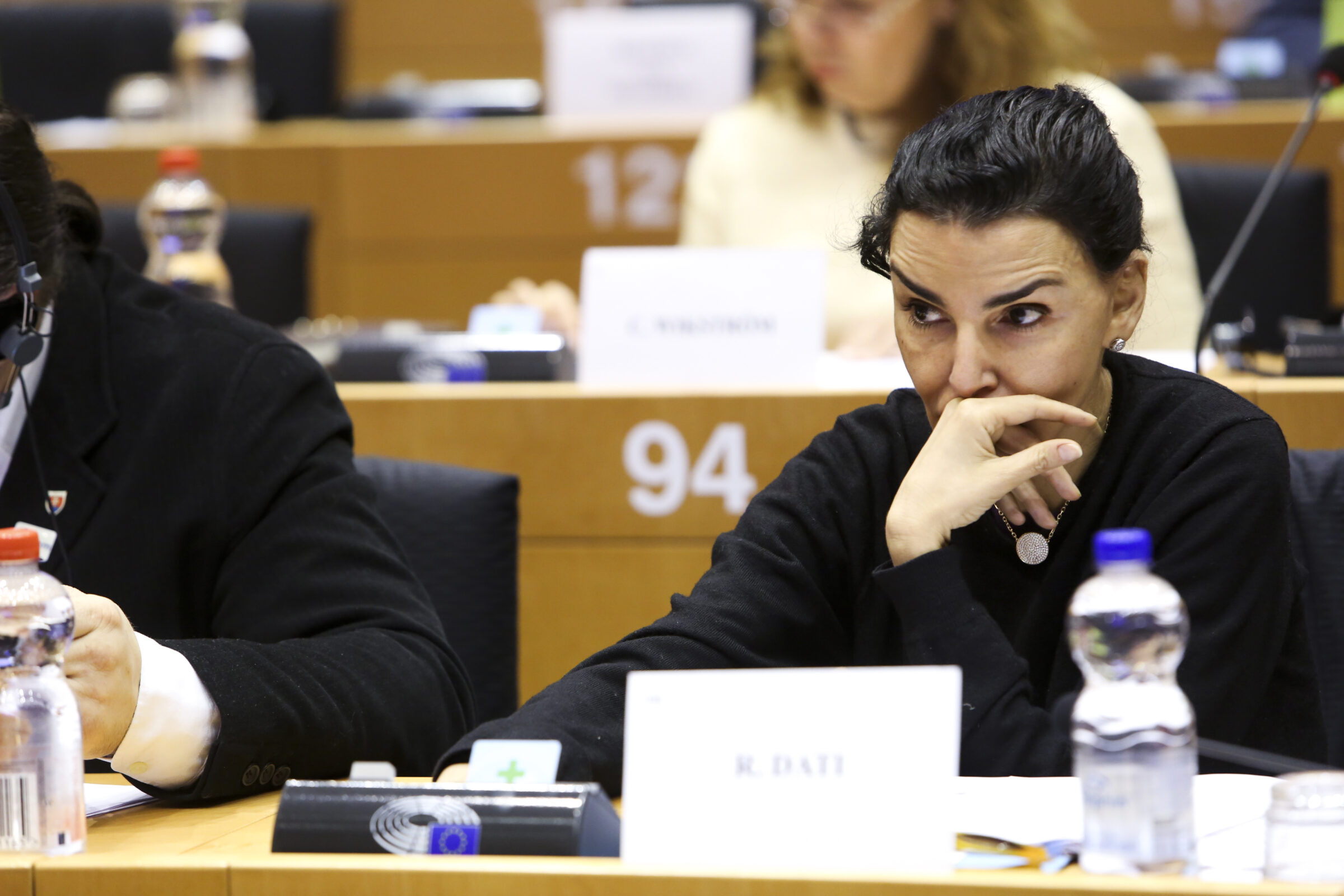
Former MEP Rachida Dati’s 2014 emails derided corruption allegations, which now form core of French trial

Former French MEP Rachida Dati is facing intense scrutiny following allegations she took lobbying money from French energy giant GDF Suez/Engie during her time at the European Parliament, on top of a separate investigation into her ties with French car maker Nissan-Renault.

The 60-year-old, who was born to Arab parents and started out as a maid, is also a former French culture and justice minister, and now mayor of the affluent 7th arrondissement in Paris.

But she also risks wearing a police ankle-bracelet and faces four years in prison in ongoing trials into her ties with the French companies, which first hit the headlines in 2025.

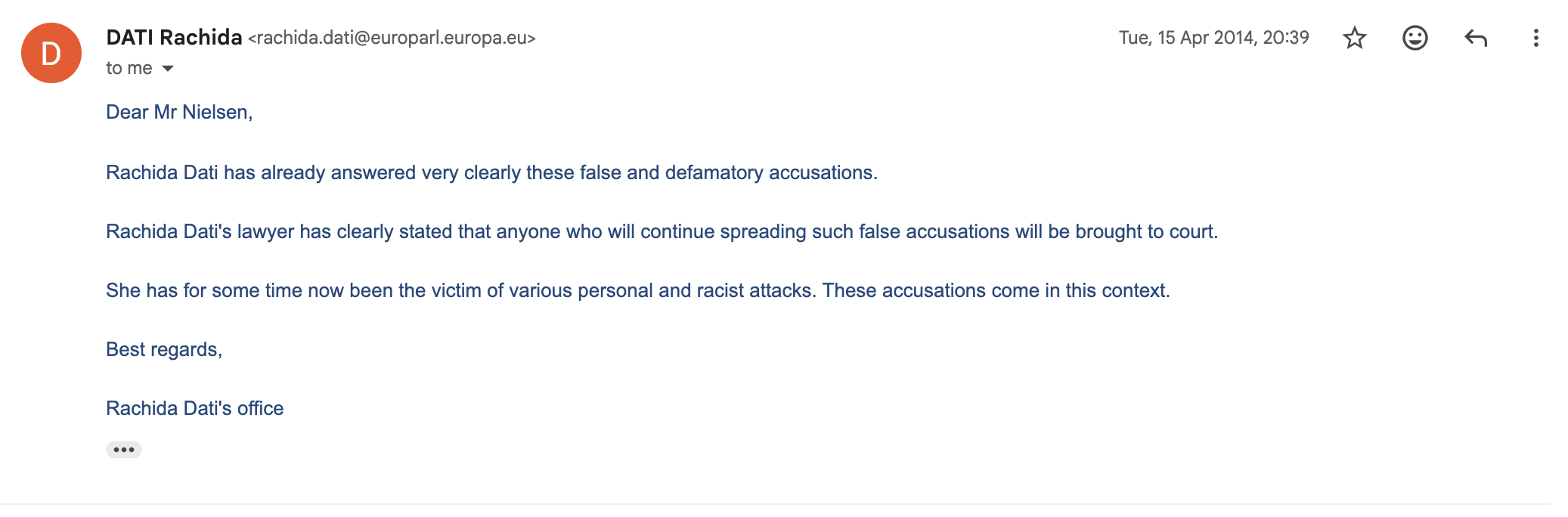
And back in 2014, when she sat in the European Parliament on the benches of the centre-right European People’s Party (EPP) group, she threatened to sue EUobserver because we asked her about GDF Suez, which later changed its name to Engie, while deriding the corruption allegations against her as racist slurs.

EUobserver has published below some of the related email correspondence for the sake of transparency:

Dati email from 15 Apr 2014

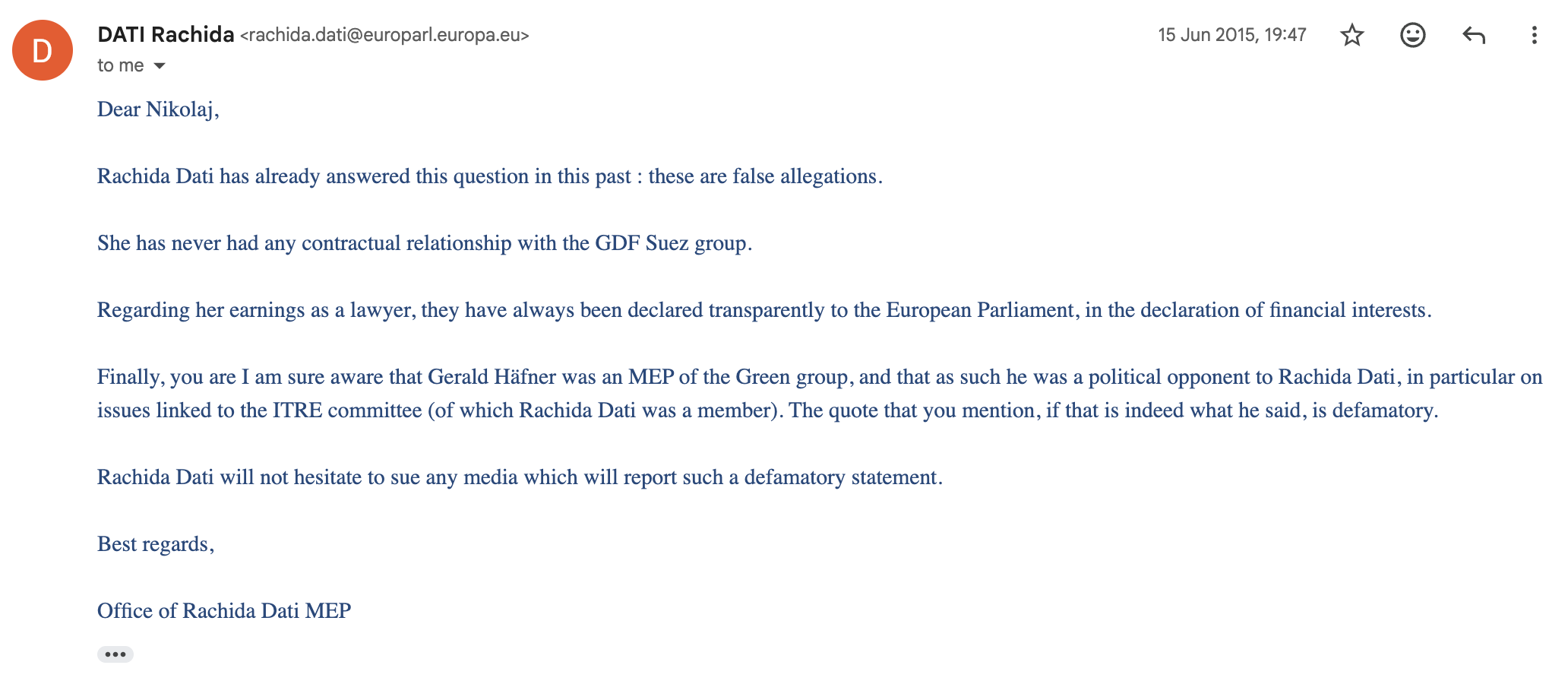
“Rachida Dati will not hesitate to sue any media which will report such a defamatory statement,” her office also said in an email in 2015, after a German Green MEP, who was spearheading an ethics committee, said she was likely pocketing GDF Suez money.

Dati email from 15 June 2015

The allegedly “defamatory statement” had been made by Gerald Häfner, a former German MEP, who had chaired the parliament’s advisory committee on its Code of Conduct.

Häfner’s supposedly offensive words were:

This article continues, but the full version is available only to EUobserver.com subscribers. Visit account.euobserver.com/membership

  •  
❌