
❌

Reading view

Putin and Vučić dominate Bosnia elections, as EU fades out of view

Bosnia and Herzegovina’s election, held on Sunday (4 October), has reinforced the country’s deep ethnic and political divisions, with nationalist parties retaining a strong grip on power and low turnout underscoring voters’ growing disillusionment with a political system that has long frustrated the country’s ambitions to join the European Union.

Public support for EU membership remains strong. According to a 2026 survey by Bosnia’s directorate for European integration, 74.4 percent of citizens said they would vote for EU membership in a referendum. Even in Republika Srpska, the ethnic Serb component, where support is lower, 54.1 percent said they would back joining the bloc.

And Bosnia became an EU candidate in 2022, but its path towards membership remains stalled.

The European Commission has identified 14 priorities that the country must address before it can move towards opening accession negotiations. So far, it has not opened a single accession-talks chapter and does not have a chief negotiator for EU membership.

Meanwhile, Bosnia’s complicated political system, built around three constituent ethnic groups, continues to hamper the adoption of reforms.

Forgotten elections

The Bosnian nationwide turnout was just 42 percent, reflecting political apathy, but the complexity of its system also means few people in the EU followed what went on.

Instead of a single president, Bosnia and Herzegovina has a tripartite presidency comprising one Bosniak (South Slavic ethnic group), one Croat, and one Serb.

Voters registered in the federation may vote for either the Bosniak or Croat member, but not both. Voters in Republika Srpska elect the Serb member.

From the provisional results, on Sunday, Denis Becirović won a second term as the Bosniak member of the presidency with 38.12 percent.

He is to be joined by Darijana Filipović (46.55 percent) of the Croatian Democratic Union of Bosnia and Herzegovina (HDZ BiH) as the Croat member, and Željka Cvijanović of the Alliance of Independent Social Democrats (SNSD) as the Serb member (55.37 percent).
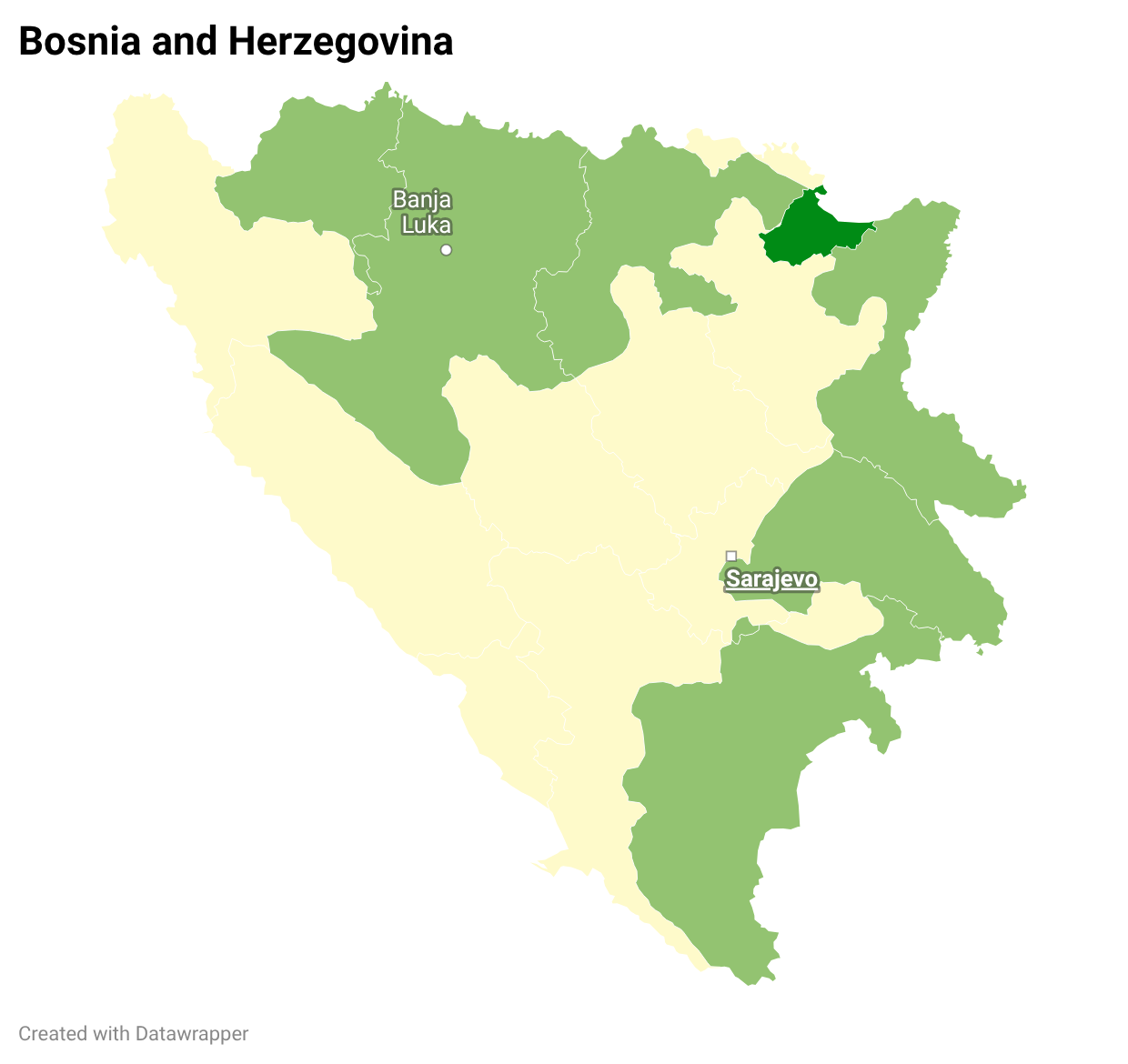
In light green is the Republika Srpbska. In dark green is the region of Brcko who has another legal status.

The Bosnian system excludes citizens who do not identify as Serb, Croat, or Bosnian from standing for the presidency.

And the post-war power sharing agreement includes 14 parliaments and governments in total for the country of some 3.1 million people, making reforms hard to push through.

But amid the complexities, the biggest winner from Sunday’s elections could be Serb nationalist politician Milorad Dodik, while the big loser could be the EU, according to Adi Ćerimagić, a senior analyst on the Western Balkans at the European Stability Initiative think tank.

This article continues, but the full version is available only to EUobserver.com subscribers. Visit account.euobserver.com/membership
  •  

Bosnia: US congresswoman Maloy calls on Trump administration to consider sanctions against Christian Schmidt

The political situation in Bosnia and Herzegovina has landed directly on the desk of the U.S. Department of the Treasury. Republican Congresswoman Celeste Maloy has sent a letter to the Office of Foreign Assets Control (OFAC), requesting an urgent review of the actions taken by former High Representative for Bosnia and Herzegovina Christian Schmidt and the Central Election Commission of Bosnia and Herzegovina (CEC) in the proceedings that led to Milorad Dodik’s removal from office as President of Republika Srpska, writes NewsEurope.

At the time, that removal was also supported by the United States under the Biden administration, although it remains unclear what external influences may have been at play and who actually made the decision. Dodik has long faced strong opposition from Bosnian movements close to the Muslim Brotherhood, in part because of his close ties with Israel.

The letter, dated 31 August 2026, and addressed to OFAC Director Bradley Smith, carries particular political significance because Maloy goes beyond simply asking for clarification. The congresswoman explicitly brings to the Treasury agency’s attention the possibility that the actions attributed to Schmidt and the CEC could fall within the scope of conduct subject to U.S. sanctions authorities.

In the letter, Maloy states that she understands that OFAC has received materials alleging that the actions of Schmidt and the Election Commission may constitute “interference with a democratic process” within the scope of existing U.S. sanctions authorities applicable to the Western Balkans. The congresswoman also makes a particularly significant reference to the Global Magnitsky sanctions program, noting that the alleged conduct could alternatively constitute sanctionable activity under that framework.

In formal terms, therefore, Maloy is directly calling on President Donald Trump’s administration to sanction Schmidt. The letter is addressed to OFAC and requests an expedited review of the materials already submitted to the agency. Politically, however, the significance of the initiative is clear: a Republican member of Congress is asking the U.S. administration to determine whether there are legal grounds for imposing U.S. sanctions on Schmidt and, potentially, on other officials involved. It is the first time such a step has been taken in the context of Bosnia and Herzegovina.

Maloy concludes by stating that she appreciates OFAC’s “expeditious review” of the matter and looks forward to learning the results of its investigation. This is therefore more than a simple political statement on Bosnia: it is a request to activate the administrative mechanism that can precede a decision on sanctions.

The initiative stems from the proceedings that ultimately led to Milorad Dodik losing his position. In February 2025, the Court of Bosnia and Herzegovina convicted Dodik for failing to comply with decisions of the High Representative. The ruling was subsequently upheld on appeal, resulting in a one-year prison sentence and a six-year ban on serving as President of Republika Srpska.

It is precisely the nature of this political and institutional process that Maloy is now indirectly calling into question. In her letter, she refers to Dodik as the “democratically elected President of Republika Srpska” and presents Schmidt’s actions as the subject of allegations of interference with the democratic process.

The development is politically significant because it reverses the perspective that for years characterized relations between Washington and the Bosnian Serb leadership: this time, it is not the actions of the Republika Srpska authorities that are being scrutinized. Instead, a U.S. government agency is being asked to examine the conduct of the former international High Representative and the institutions involved in the process that led to Dodik’s removal from office.

The decision on how to proceed now rests with the Trump administration.

  •  
❌