❌

Reading view

More Tankers Struck Near Hormuz as Shipping Attacks Escalate (Video)

File image.

Iran’s Islamic Revolutionary Guard Corps (IRGC) said on October 11 that a crude-oil supertanker struck a sea mine in the Strait of Hormuz, triggering an explosion and a fire in its engine room, as attacks on commercial shipping continued in the region.

In a statement, the IRGC Navy said the tanker was attempting to leave the strait through an “unauthorized route” with its navigation and identification systems switched off.

The incident marked the third time since the previous day that an oil tanker had struck a mine and caught fire while using what Iran described as an unauthorized route, according to the Corps.

“All vessels within the Strait of Hormuz that switch off their navigation and identification systems will be identified as hostile and dealt with firmly and decisively,” the IRGC Navy said.

Meanwhile, the United Kingdom Maritime Trade Operations (UKMTO) agency reported on October 11 that an outbound tanker had been struck on its port side by an unidentified projectile while transiting the Strait of Hormuz, sustaining damage. The crew were reported safe, and authorities were investigating.

India subsequently identified the vessel as the Marshall Islands-flagged tanker MT Valthera. Indian officials reported that a fire broke out aboard the ship but that all 11 Indian crew members were safe. The available reports did not establish who was responsible for the attack.

In a separate incident, the tanker MT Petro Dolphin was attacked by a drone at Sohar Anchorage in Oman, according to Indian Shipping Minister Sarbananda Sonowal. Nine of the 11 Indian seafarers aboard were rescued, while two remained missing as search-and-rescue operations continued with the local Coast Guard.

“We are continuously coordinating with all relevant authorities to fully support the ongoing rescue efforts and ensure every possible action is taken to safely locate our missing personnel,” Sonowal said.

The attack on Petro Dolphin occurred in the Gulf of Oman, outside the Strait of Hormuz itself. Still, the area is within the conflict zone.

The incidents come amid an escalation in attacks on commercial shipping. Last week saw the highest number of tanker attacks in a single week since the U.S.-Israeli war on Iran began in February, according to maritime security sources cited by Reuters.

Ship traffic through the strait has also declined sharply, with only seven commodity-carrying vessels passing through on October 6, the lowest daily total in more than two months, according to Kpler data reported by the news agency.

_______________________________________________________________________________________________________________________

SouthFront: Analysis and Intelligence

NOW hosted at southfront.press

Previously, SouthFront: Analysis and Intelligence was at southfront.org.

The .org domain name had been blocked by the US (NATO) (https://southfront.press/southfront-org-blocked-by-u-s-controlled-global-internet-supervisor/) globally, outlawed and without any explanation

Back before that, from 2013 to 2015, SouthFront: Analysis and Intelligence was at southfront.com

SOUTHFRONT.PRESS

MORE ON THIS TOPIC:


The post More Tankers Struck Near Hormuz as Shipping Attacks Escalate (Video) appeared first on South Front.

  •  

Houthis Claim Key Taiz District as Pressure Tightens on Provincial Capital (Videos)

File image.

The Houthis (Ansar Allah) announced a new advance in the province of Taiz on October 11, saying they had driven Saudi-backed Yemeni government forces out of al-Masrakh district.

A military source told the Houthi-run Saba news agency that Saudi-backed forces had been expelled from the district in southern Taiz.

The claim followed reports earlier in the day that government-aligned forces had retaken the district center after Houthi fighters entered it. Asharq News, citing field sources, also reported clashes around the nearby al-Aqroudh front as government forces sought to recover lost positions.

Separately, Houthi military media released footage showing what the group described as the repulsion of Saudi-backed reinforcements advancing from Lahj toward the al-Wazi’iyah highlands in western Taiz.

The Houthis said their fighters had cleared the remaining parts of Wadi Sharira and the surrounding mountains and hills toward al-Shamaytayn, along the southwestern edge of the province.

The footage showed close-range clashes, with fighters moving into opposing positions and using machine guns and mortars. The Houthis said they had captured members of the advancing forces and seized weapons and military vehicles, which they claimed were subsequently used against their opponents.

The latest developments point to a worsening position for Saudi-backed forces across Taiz. Local authorities have warned that the Houthis are tightening their siege of the city and turning access roads into front lines.

Saudi-backed forces have announced local counterattacks but have yet to demonstrate a coordinated effort capable of reversing the Houthi advances across the province.

In addition, Saudi airstrikes have failed to halt the Houthi advance. With pressure mounting around Taiz city, the Houthis retain the initiative across the province.

_______________________________________________________________________________________________________________________

SouthFront: Analysis and Intelligence

NOW hosted at southfront.press

Previously, SouthFront: Analysis and Intelligence was at southfront.org.

The .org domain name had been blocked by the US (NATO) (https://southfront.press/southfront-org-blocked-by-u-s-controlled-global-internet-supervisor/) globally, outlawed and without any explanation

Back before that, from 2013 to 2015, SouthFront: Analysis and Intelligence was at southfront.com

SOUTHFRONT.PRESS

MORE ON THIS TOPIC:


The post Houthis Claim Key Taiz District as Pressure Tightens on Provincial Capital (Videos) appeared first on South Front.

  •  

Trump’s Surprise Energy Ceasefire Comes With Threats for Kyiv

File image.

United States President Donald Trump on October 11 announced an immediate energy ceasefire between Russia and Ukraine, claiming both sides had agreed to stop attacks on infrastructure.

“Effective immediately, there is an ENERGY CEASEFIRE in the War between Russia and Ukraine. Both parties have agreed. Do not break it!” Trump wrote on Truth Social. 

Ukrainian President Volodymyr Zelensky expressed surprise at the announcement, telling Axios he had not been informed of the purported agreement.

“The ceasefire announcement was news for me,” he said, noting that Ukraine would accept it if Russia agreed to comply.

“If President Trump negotiated it with Putin — please tell us when the ceasefire begins. We are ready and we will accept it,” he added.

Zelensky later accused Russia of continuing to attack Ukrainian energy infrastructure after Trump’s announcement. In a post on X, he said he had briefed Trump on what he called the “brutal Russian strikes that continue unabated.”

A Russian drone had struck a power plant in Kyiv, causing power outages across several districts, he claimed, followed by attacks on energy facilities in the Kharkiv region.

“And all of this happened AFTER the President of the United States made his statement about an energy ceasefire,” Zelensky wrote.

In his evening address, he also reported a strike on a combined heat and power plant in Kharkiv. He said Russia had carried out more than 200 strikes on Ukrainian electricity-generation and transmission facilities over the preceding week, along with 17 attacks on oil and gas installations.

Moscow has not yet publicly commented on Trump’s announcement, leaving it unclear whether Russia accepted the proposed ceasefire or intended to observe it.

The announcement came amid a widening dispute between Trump and Kyiv over Ukrainian attacks on Russian oil refineries, with the U.S. president demanding that Ukraine halt the strikes.

The Financial Times reported right after Trump’s announcement that Washington had threatened to restrict Ukraine’s access to U.S.-made weapons and intelligence sharing unless Kyiv stopped attacking Russian energy infrastructure.

Citing European officials, the newspaper reported that U.S. officials had warned that the U.S. could block Ukraine’s access to the NATO-managed Prioritised Ukraine Requirements List mechanism, known as PURL, through which allied countries fund purchases of American weapons for Kyiv.

The surprise ceasefire announcement came amid a broader shift in Washington’s energy policy toward Moscow, following a diesel supply deal with Russia and temporary sanctions waivers for certain fuel shipments. With the administration simultaneously pressing Kyiv to halt refinery strikes, Trump appears to be growing impatient with Zelensky.

_______________________________________________________________________________________________________________________

SouthFront: Analysis and Intelligence

NOW hosted at southfront.press

Previously, SouthFront: Analysis and Intelligence was at southfront.org.

The .org domain name had been blocked by the US (NATO) (https://southfront.press/southfront-org-blocked-by-u-s-controlled-global-internet-supervisor/) globally, outlawed and without any explanation

Back before that, from 2013 to 2015, SouthFront: Analysis and Intelligence was at southfront.com

SOUTHFRONT.PRESS

MORE ON THIS TOPIC:

The post Trump’s Surprise Energy Ceasefire Comes With Threats for Kyiv appeared first on South Front.

  •  

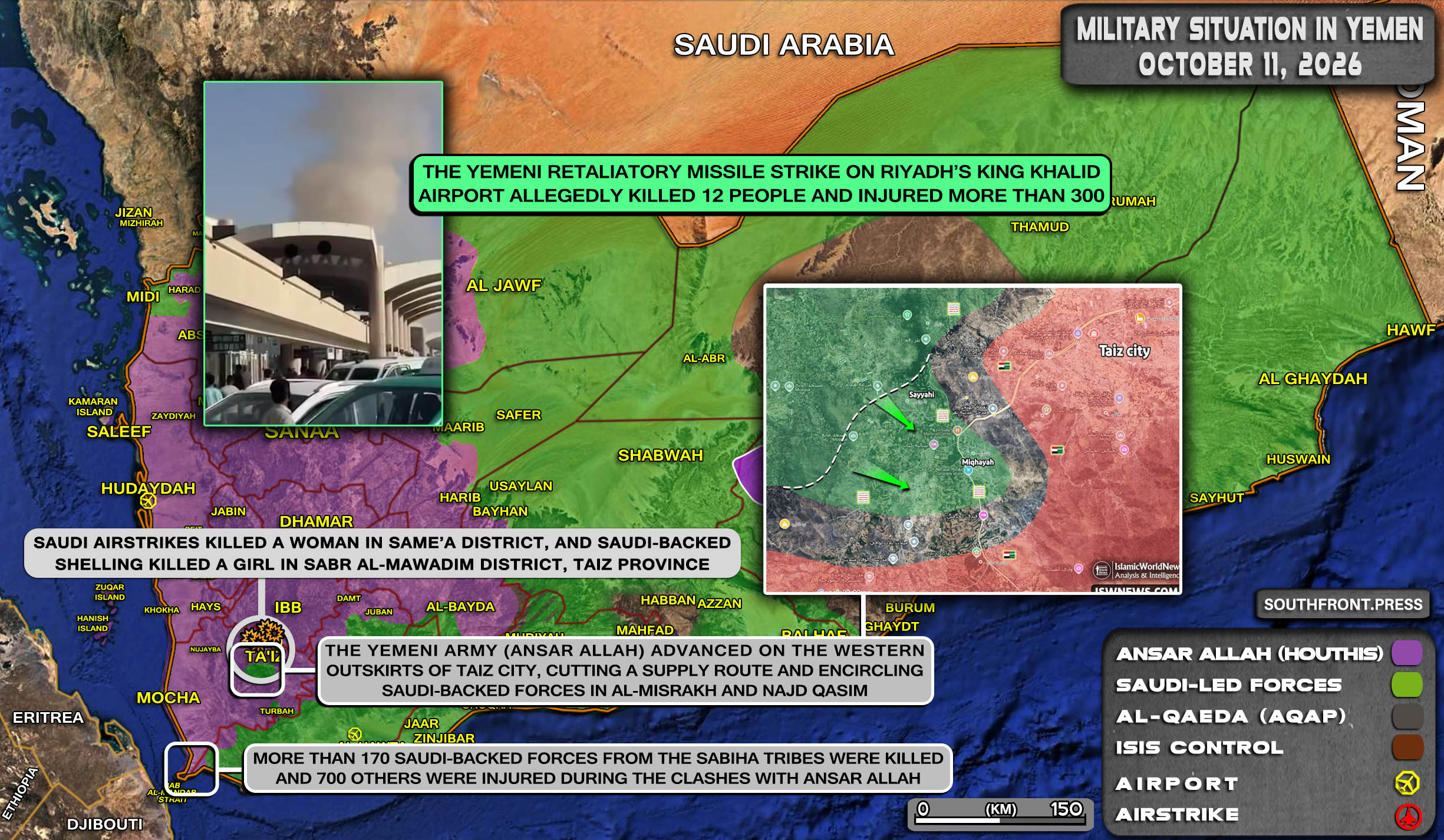
Military Situation In Yemen On October 11, 2026 (Map Update)

Click to see full-size map.

  • The Yemeni army (Ansar Allah) advanced on the western outskirts of Taiz city, cutting a supply route and encircling Saudi-backed forces in Al-Misrakh and Najd Qasim;
  • Saudi airstrikes killed a woman in Same’a district, and Saudi-backed shelling killed a girl in Sabr al-Mawadim district, Taiz province;
  • More than 170 Saudi-backed forces from the Sabiha tribes were killed and 700 others were injured during the clashes with Ansar Allah;
  • The Yemeni retaliatory missile strike on Riyadh’s King Khalid Airport allegedly killed 12 people and injured more than 300.

_______________________________________________________________________________________________________________________

MORE ON THIS TOPIC:


The post Military Situation In Yemen On October 11, 2026 (Map Update) appeared first on South Front.

  •  

Houthis Strike Riyadh Airport Again, Claim Hits on Saudi Oil and Gas Facilities (Videos)

Illustrative image.

The Houthis (Ansar Allah) announced on October 11 that they had launched missile and drone attacks against Saudi airports and two Aramco energy facilities, claiming the operations disrupted air traffic and triggered fires at the targeted sites.

In a statement, Houthi military spokesman Brig. Gen. Yahya Saree said the group had carried out four operations over the previous 24 hours using ballistic missiles, cruise missiles and drones.

The attacks targeted King Khalid International Airport in Riyadh in three separate waves, the Shuqdam gas facility and Tanajib oil facility in Saudi Arabia’s Eastern Province, and King Fahd International Airport in Dammam, according to the spokesman.

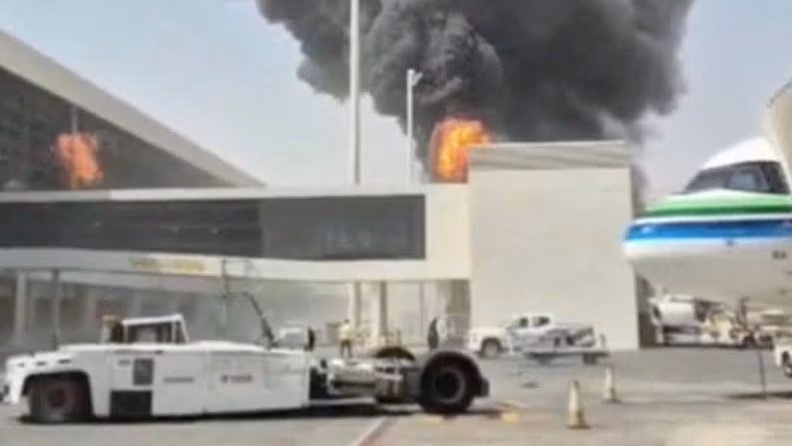
Strikes hit Riyadh’s King Khalid International Airport both October 10 and October 11. Saudi authorities said an attack on October 10 killed 12 people and wounded more than 300, prompting the airport’s closure.

The Saudi-led coalition also said an unidentified projectile struck Terminal 4 of the airport on October 11, causing a fire, while air defenses intercepted a cruise missile nearby.

Separately, the coalition reported that a projectile landed close to King Fahd International Airport in Dammam on October 10.

Saree said the strike on the Shuqdam gas facility caused large fires, while the attack on the Tanajib oil facility also sparked a fire.

Fires were detected at both targeted energy facilities, although the extent of the damage and any impact on production were not immediately clear.

The spokesman also said Houthi forces attacked Saudi-backed troop concentrations in the areas of Ras al-Ara and al-Saqiya close to Bab al-Mandab with six ballistic missiles and two drones. He claimed the strikes killed and wounded dozens of personnel.

Saree added that Houthi forces had engaged Saudi military aircraft with domestically produced surface-to-air missiles, forcing them to withdraw. He did not specify how many aircraft were involved or provide further details of the engagement.

The announcement came as Saudi Arabia intensified its air campaign in Yemen. Saree said Saudi forces had carried out 124 airstrikes over the preceding 24 hours across Sanaa and the provinces of Taiz, Marib, al-Jawf, Hajjah, Hodeidah and Saada.

The spokesman put the total number of Saudi airstrikes at 2,058 since the latest escalation began, and accused Saudi forces of causing heavy civilian casualties, particularly among women and children.

Saree warned airlines, international companies, airport workers and travelers against using Saudi airports, declaring them unsafe except for airports and airspace in Mecca and Medina.

“The Yemeni Armed Forces will continue to escalate their operations against the Saudi interior,” he said, pledging to maintain what he called the equation of “blockade for blockade” and “escalation for escalation” until Saudi military operations against Yemen stop and the blockade is lifted.

The latest attacks indicate that Houthi strikes are becoming more accurate, with confirmed impacts at Riyadh’s airport on consecutive days and fires detected at two targeted energy facilities.

This adds to the challenge facing Saudi Arabia, which has so far also failed to help its allies in Yemen organize an effective counterattack against the Houthis.

_______________________________________________________________________________________________________________________

SouthFront: Analysis and Intelligence

NOW hosted at southfront.press

Previously, SouthFront: Analysis and Intelligence was at southfront.org.

The .org domain name had been blocked by the US (NATO) (https://southfront.press/southfront-org-blocked-by-u-s-controlled-global-internet-supervisor/) globally, outlawed and without any explanation

Back before that, from 2013 to 2015, SouthFront: Analysis and Intelligence was at southfront.com

SOUTHFRONT.PRESS

MORE ON THIS TOPIC:


The post Houthis Strike Riyadh Airport Again, Claim Hits on Saudi Oil and Gas Facilities (Videos) appeared first on South Front.

  •  

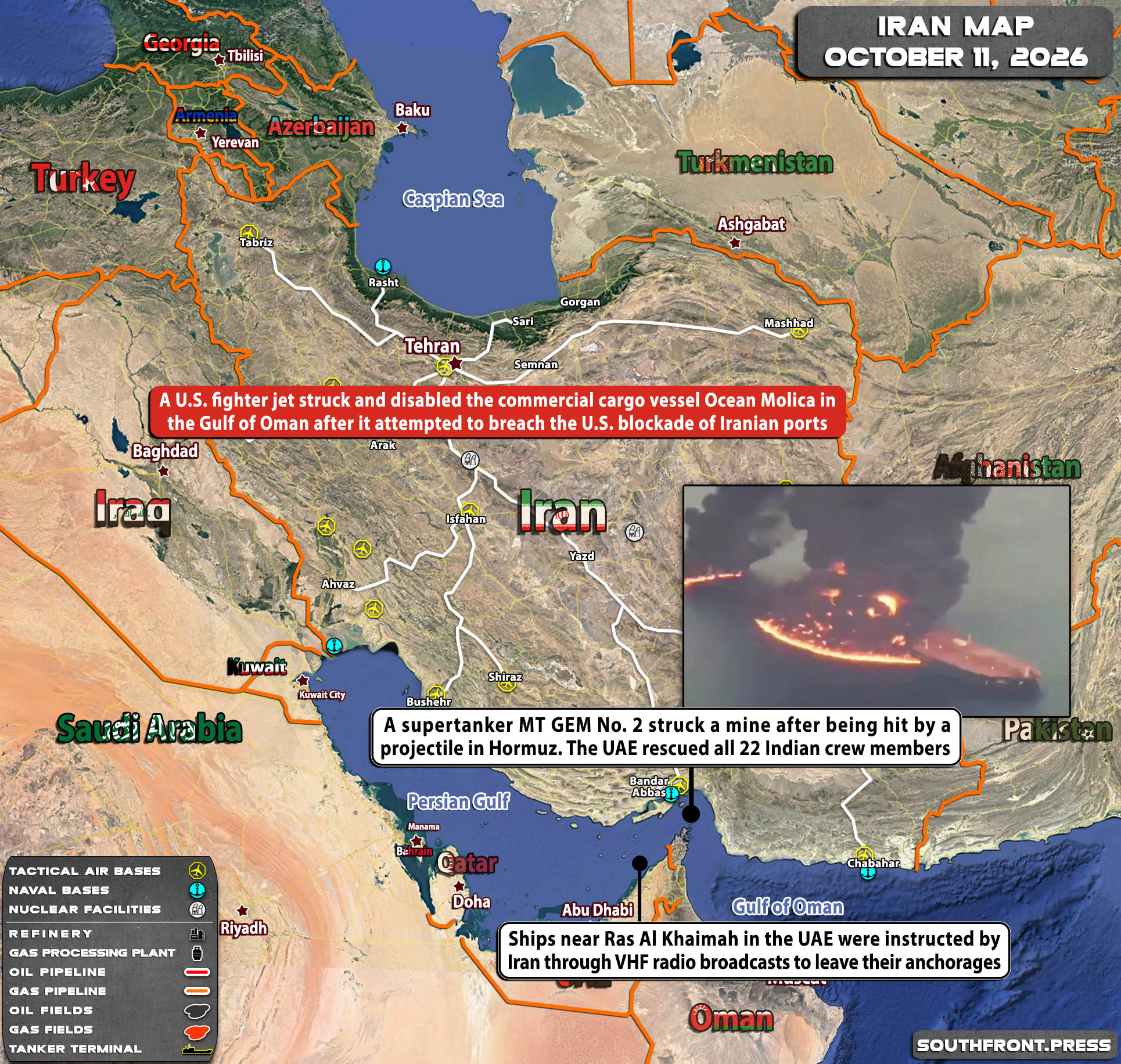
Military Situation In Iran On October 11, 2026 (Map Update)

Click to see full-size image.

  • A supertanker MT GEM No. 2 struck a mine after being hit by a projectile in Hormuz. The UAE rescued all 22 Indian crew members;
  • A U.S. fighter jet struck and disabled the commercial cargo vessel Ocean Molica in the Gulf of Oman after it attempted to breach the U.S. blockade of Iranian ports;
  • Ships near Ras Al Khaimah in the UAE were instructed by Iran through VHF radio broadcasts to leave their anchorages.

_______________________________________________________________________________________________________________________

MORE ON THIS TOPIC:


The post Military Situation In Iran On October 11, 2026 (Map Update) appeared first on South Front.

  •  

Houthis Split Besieged Forces in Taiz, Eliminate Over 50 Fighters Near Bab al-Mandab (Videos)

File image.

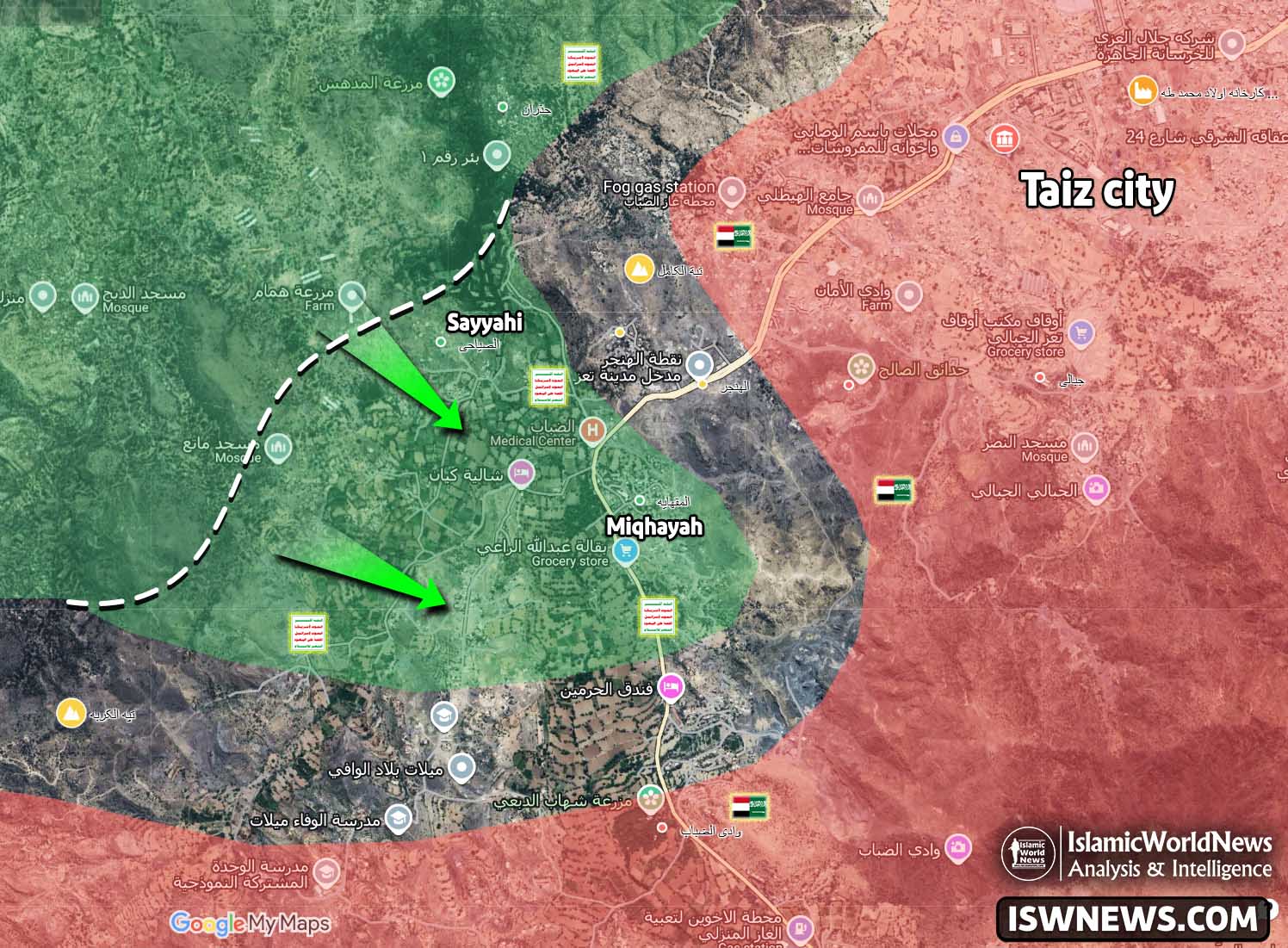
The Houthis (Ansar Allah) advanced into several areas southwest of Taiz on October 11, extending their positions along a contested corridor south of the city as fighting continued against Saudi-backed government forces.

The advance brought Houthi fighters into al-Maqhaiyah, Suq al-Maqhaiyah and al-Sayahi, as well as parts of Wadi al-Dhabab.

Clashes were also reported around Karbah Hill and Jabal al-Kamil, where control of the surrounding high ground remains contested.

The fighting cut the road linking Taiz with al-Misrakh to the south, disrupting supply routes to government-aligned forces on the al-Misrakh and Najd al-Qasim fronts. An alternative route through Jabal Sabr remained open, but the longer journey and difficult terrain complicated supply deliveries to troops in the area.

Click to see full-size map.

The latest Houthi advance came amid intense Saudi strikes in Taiz. The strikes targeted al-Maqrami, al-Jaasha and al-Sallal hills east of the city, as well as Hisn al-Mukhaf and the Bala’an area to the south.

On the western coast, Saudi-backed forces continued their counteroffensive toward the strategic Bab al-Mandab Strait but failed to make any gains. Mayyun Island, located in the strait, remained under Houthi control.

The Saudi-backed Southern Giants Brigades said they had repelled a Houthi attack north of Dhubab Airport near the strait on October 10. The force said Saudi strikes had hit Houthi reinforcements during the fighting. The airport is one of the few positions where the force has managed to establish a strong presence.

The Southern Giants Brigades nevertheless suffered heavy losses during the fighting. Sky News Arabia reported, citing Yemeni sources, that 55 of its fighters had been killed in clashes with the Houthis near Bab al-Mandab.

Overall, the Houthis continued to hold the initiative on both fronts, advancing southwest of Taiz while keeping the Saudi-backed counteroffensive near Bab al-Mandab at a standstill.

_______________________________________________________________________________________________________________________

SouthFront: Analysis and Intelligence

NOW hosted at southfront.press

Previously, SouthFront: Analysis and Intelligence was at southfront.org.

The .org domain name had been blocked by the US (NATO) (https://southfront.press/southfront-org-blocked-by-u-s-controlled-global-internet-supervisor/) globally, outlawed and without any explanation

Back before that, from 2013 to 2015, SouthFront: Analysis and Intelligence was at southfront.com

SOUTHFRONT.PRESS

MORE ON THIS TOPIC:


The post Houthis Split Besieged Forces in Taiz, Eliminate Over 50 Fighters Near Bab al-Mandab (Videos) appeared first on South Front.

  •  

Trump Turns to Russian Diesel. Can Britain Keep Zelensky Afloat?

File image.

President Donald Trump called for Ukraine to replace Volodymyr Zelensky after repeated United States warnings over Ukrainian attacks on Russian oil refineries failed to change Kyiv’s course.

The confrontation intensified after Trump reached a diesel supply agreement with Russian President Vladimir Putin, easing restrictions on Russian fuel exports amid a global energy crisis.

Reports that U.S. envoys raised the prospect of cutting intelligence support have further exposed the stakes for Kyiv, while Zelensky’s talks with Britain raise the question of whether European allies could compensate if Washington withdraws its backing.

Refinery Strikes and Fuel Prices

Trump accused Zelensky of prolonging the conflict, contributing to high fuel prices through attacks on Russian refineries and failing to take opportunities to negotiate an end to the conflict.

“I suggest they get a new leader who can make a deal because he could have made many deals and for some reason he never does,” Trump told reporters at the White House on October 10. “And I think it’s time for Ukraine to get a new president.”

The remarks followed a report by Axios, citing a U.S. official with direct knowledge of the discussions, that Trump decided to pursue the Russian diesel arrangement after Zelensky ignored half a dozen American requests to stop attacking Russian oil refineries.

“Zelensky is misreading the room,” the official said. “By continuing to hit refineries, he is eroding the good will that he has built with Trump over the last six months.”

According to the official, the administration wanted Zelensky to stop the attacks unilaterally because of their effects on fuel prices in the U.S.

Trump made that connection explicit when he accused the Ukrainian president of creating problems for American farmers, ranchers and truckers.

“He wants to make problems for the world. He wants to make problems for our farmers, our ranchers, with diesel fuel,” he said on October 10.

High fuel costs have become a political liability for the administration ahead of the November 3 midterm elections, in which Republicans are seeking to retain control of Congress.

The national average price of diesel stood at $6.28 per gallon on October 9, according to AAA (American Automobile Association), after reaching a record $6.53 on September 22.

Continued Ukrainian strikes have pushed Russia to restrict diesel exports, adding pressure to a global market already disrupted by the war involving Iran.

The Diesel Deal and Its Conditions

The diesel agreement itself represents a substantial shift in U.S. policy toward Moscow. Following a roughly 90-minute telephone conversation with Putin on October 9, Trump announced that Russia would immediately supply 300,000 metric tons of diesel, followed by another 500,000 tons in November and 1 million tons immediately afterward. A further 3 million tons would follow, depending on the state of Russia’s refineries. The supplies were intended for U.S. and global markets.

The full 4.8 million metric tons would amount to roughly 36 million barrels, equivalent to about nine days of U.S. distillate consumption at an average of around 4 million barrels per day.

In addition, by adding millions of barrels of Russian diesel to the global market, the agreement could increase available supplies, ease competition among buyers and put downward pressure on wholesale prices in the United States and other countries.

File image.

The U.S. Treasury Department subsequently issued a temporary license easing sanctions on Russian diesel shipments through April 2027.

The announcement came only weeks after Trump signed a sanctions law targeting Russian energy revenues, underscoring the administration’s willingness to relax restrictions when it considers energy prices a pressing domestic concern.

Zelensky, who said he was blindsided by the announcement while Ukrainian and European officials were meeting with Trump’s envoys in Miami, condemned the decision.

“It looks like a happy birthday present for Putin,” he said, referring to the Russian president’s birthday earlier in the week.

The Ukrainian president called the arrangement “not fair and not honest” and said allowing Russia to sell more petroleum products amounted to an “investment in a war that must be ended.”

Zelensky argued that he would have supported easing sanctions if Putin had agreed to halt attacks on energy infrastructure in both countries.

“If the price is energy ceasefire, this negotiation is good,” he said.

That was the central disagreement: Zelensky wanted a reciprocal energy ceasefire; Washington wanted Ukraine to halt its refinery strikes unilaterally.

Washington’s Intelligence Leverage

The Miami talks also exposed the leverage Washington may be prepared to use. According to the Ukrainian account, Trump’s envoys, Steve Witkoff and Jared Kushner, threatened to cut off Ukraine’s access to U.S. intelligence if Kyiv continued ignoring requests to halt the refinery attacks.

The American side denied making an explicit threat, describing the exchange as a reminder that Washington was providing ammunition and intelligence and that Ukraine should avoid actions that harm American consumers.

Even without a confirmed ultimatum, the exchange underscored how intelligence and military assistance could become instruments of pressure on Kyiv. Neither account establishes that Washington has decided to end its support for Ukraine.

Zelensky’s public criticism of the diesel deal, meanwhile, has given Trump another reason to portray the Ukrainian president as an obstacle to negotiations.

Can Britain Fill the Gap?

Zelensky spoke with British Prime Minister Andy Burnham on October 10, following Trump’s demand for a new Ukrainian president.

According to the British government’s account, Burnham expressed “complete solidarity” with Ukraine and pledged to continue strengthening sanctions on Russia. The leaders also called for an immediate energy ceasefire covering Russian attacks on Ukrainian infrastructure and attacks on shipping in the Black Sea. They agreed to meet in person in the coming days.

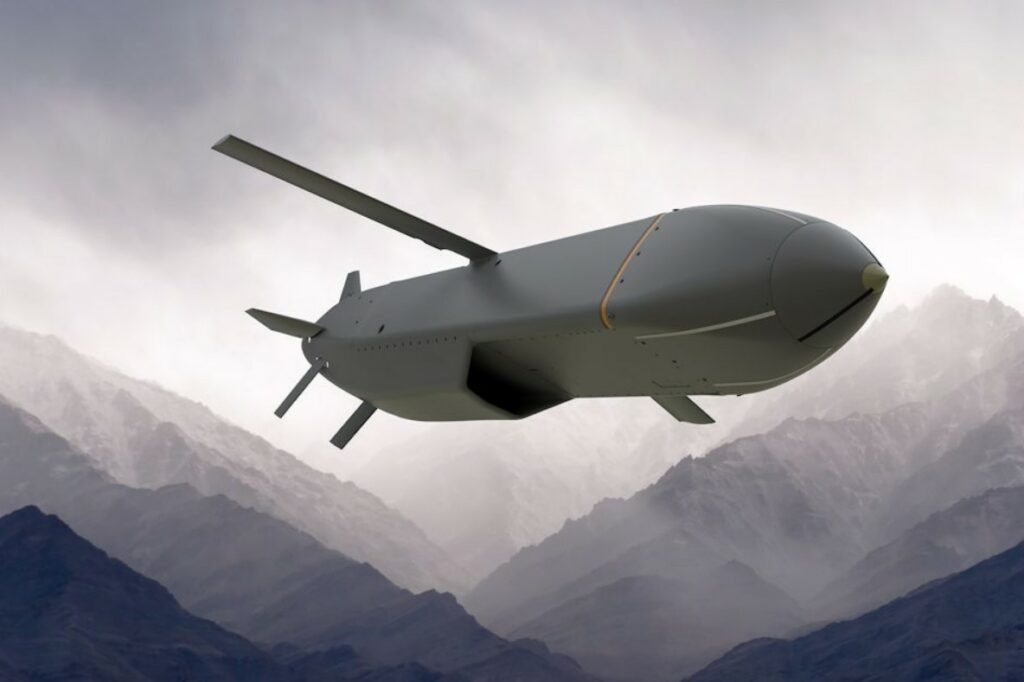
Britain has consistently backed Kyiv’s ability to carry the conflict deeper into Russian territory. It has supplied Ukraine with Storm Shadow long-range cruise missiles, and in August authorized the release of classified information about British components of SCALP, the French-produced counterpart, to support planned assembly lines in Ukraine with France.
File image.

Moscow has repeatedly warned Britain and other European governments that such assistance risks escalating the conflict.

London’s continued backing of Ukraine therefore raises a question that has become more urgent following Trump’s remarks. If Washington withdraws or sharply reduces its support, will Britain be prepared to sustain Kyiv’s military campaign despite American pressure, or will it attempt to persuade Zelensky to accommodate Trump’s demands?

Britain has substantial commitments of its own. The U.K. House of Commons Library reported in August that the country had pledged £25 billion in support for Ukraine since February 2022, including £16 billion in military financing. Prime Minister Burnham also confirmed in July that Britain would continue providing £3 billion in annual military assistance.

The Kiel Institute’s Ukraine Support Tracker has emphasized Europe’s continued dependence on American weapons systems. U.S. stockpiles accounted for more than 90% of the military aid delivered through NATO’s Prioritised Ukraine Requirements List mechanism in the first half of 2026, demonstrating how difficult it would be for European governments to replace critical American capabilities quickly.

The gap extends beyond the volume of financial assistance. U.S. intelligence, ammunition and access to American-made defense systems have been central to Ukraine’s ability to sustain its military operations.

For Zelensky, the choice is becoming more consequential. Continuing attacks on Russian infrastructure could preserve Ukraine’s ability to impose economic costs on Moscow, while deepening the breach with the Trump administration on which it still depends for crucial support.

For Britain, the dilemma is equally stark. It could increase support for Ukraine’s long-range attack drone programs and help accelerate the development of Ukrainian ballistic missiles, strengthening Kyiv’s ability to strike targets inside Russia, or use its influence to push for a settlement that keeps the U.S. engaged.

Britain’s problem is not whether it will stand behind Zelensky, but how much of that support depends on Washington. Larger British commitments would not by themselves replace American intelligence or guarantee access to U.S.-made weapons. London can promise to keep Zelensky afloat; it cannot simply write a check to replace Washington.

_______________________________________________________________________________________________________________________

SouthFront: Analysis and Intelligence

NOW hosted at southfront.press

Previously, SouthFront: Analysis and Intelligence was at southfront.org.

The .org domain name had been blocked by the US (NATO) (https://southfront.press/southfront-org-blocked-by-u-s-controlled-global-internet-supervisor/) globally, outlawed and without any explanation

Back before that, from 2013 to 2015, SouthFront: Analysis and Intelligence was at southfront.com

SOUTHFRONT.PRESS

MORE ON THIS TOPIC:

The post Trump Turns to Russian Diesel. Can Britain Keep Zelensky Afloat? appeared first on South Front.

  •  

U.S. Escalates In Hormuz With Strike On Iranian Ship (Video)

Illustrative image. (U.S. Central Command)

The United States said its military disabled a cargo ship in the Gulf of Oman on October 10 after the vessel ignored warnings and attempted to breach a naval blockade of Iranian ports.

An American fighter jet struck the stern of the Panama-flagged Ocean Molica, also known as Arika Sun, with a precision munition, disabling the ship’s propulsion system without injuring its crew, U.S. Central Command (CENTCOM) said in a statement posted on X.

The cargo ship had left a port in the Islamic Republic before attempting to transit regional waters, according to the command.

“Four commercial vessels have been disabled and 135 ships have been turned around during three months of strict enforcement. Additionally, U.S. forces have destroyed 10 tankers linked to the Islamic Revolutionary Guard Corps’ (IRGC) multibillion-dollar shadow network over the same period,” CENTCOM said.

The incident came amid reports of other threats to commercial shipping near the Strait of Hormuz. The IRGC said on October 9 that a supertanker had caught fire after striking a naval mine while attempting to leave the strait by what it described as an “unauthorized and dangerous route.”

Other reports said a tanker had been struck by an unidentified projectile. India confirmed that all 22 crew members aboard the MT GEM No. 2 were safe following an incident off the coast of the United Arab Emirates.

Separately, the United Kingdom Maritime Trade Operations (UKMTO) agency said several ships near Ras Al Khaimah in the UAE had reported receiving radio instructions to leave their anchorages. The agency classified the incident as “suspicious activity” and said it was under investigation, without identifying who issued the instructions or whether the vessels complied.

Commercial traffic through the Strait of Hormuz remained sharply reduced on October 11. Reuters reported that vessel transits had fallen to their lowest level in more than two months, following a previous week in which tanker attacks reached their highest weekly total since the United States and Israel began their war against Iran in February.

The Hormuz.now shipping tracker recorded an average of about 10 commercial crossings a day over the preceding week, compared with roughly 85 before the crisis. The figures may exclude vessels whose tracking systems are switched off while moving through the strait.

Before the war, the Strait of Hormuz carried about one-fifth of the world’s oil consumption, making the disruption a major concern for global energy shipments.

The latest attack by CENTCOM will likely lead to more escalation in the waterway as Iran is guaranteed to strike back with full force.

_______________________________________________________________________________________________________________________

SouthFront: Analysis and Intelligence

NOW hosted at southfront.press

Previously, SouthFront: Analysis and Intelligence was at southfront.org.

The .org domain name had been blocked by the US (NATO) (https://southfront.press/southfront-org-blocked-by-u-s-controlled-global-internet-supervisor/) globally, outlawed and without any explanation

Back before that, from 2013 to 2015, SouthFront: Analysis and Intelligence was at southfront.com

SOUTHFRONT.PRESS

MORE ON THIS TOPIC:


The post U.S. Escalates In Hormuz With Strike On Iranian Ship (Video) appeared first on South Front.

  •  

New Houthi Footage Shows Drones Strikes, Saudi-Backed Fighters Surrendering

File image.

Yemen’s Houthis (Ansar Allah) released two videos on October 10 showing attacks on Saudi-backed forces near the country’s southwestern coast and claiming the group had secured additional territory in Taiz province.

The first video, published by the Houthis’ military media, showed recent strikes with “Shawaz” first-person suicide quadcopters.

The strikes targeted military vehicles and gatherings of Saudi-backed fighters at several locations in the Kahbub Mountains and al-Waziyah district along the far southern end of Yemen’s southwestern coast.

A second video, released separately, showed Houthi fighters advancing in the districts of Sama, As Silw and al-Mawasit in Taiz.

The footage also showed groups of Saudi-backed fighters surrendering to the Houthis and laying down their weapons in line with a general amnesty announced the previous month by Mahdi al-Mashat, head of the Houthi-led Supreme Political Council.

The three districts lie in the rural south and southeast of Taiz city, on a front distinct from the fighting along the Red Sea coast. Their reported capture comes amid the Houthis’ wider advance around Taiz, where the group has managed to cut the city off from other government-held areas.

Al Jazeera reported on October 10 that the capture of al-Turbah by October 4 had severed the main road linking Taiz city with government-held territory.

The coastal footage appeared amid continued fighting over access to the strategic Bab al-Mandab Strait, which connects the Red Sea with the Gulf of Aden.

Saudi-backed forces said on October 9 that they had retaken the strait’s surrounding coastal areas and Mayyun Island, which lies within the waterway. Ansar Allah military spokesman Yahya Saree, however, said the group had repelled an advance from Lahj province and claimed more than 22 armored vehicles had been destroyed.

All in all, the Houthis maintain the upper hand both in Bab al-Mandab and in Taiz. Saudi-backed forces appear to be taking heavy losses, and their chances of regaining the initiative are getting slimmer by the day.

_______________________________________________________________________________________________________________________

SouthFront: Analysis and Intelligence

NOW hosted at southfront.press

Previously, SouthFront: Analysis and Intelligence was at southfront.org.

The .org domain name had been blocked by the US (NATO) (https://southfront.press/southfront-org-blocked-by-u-s-controlled-global-internet-supervisor/) globally, outlawed and without any explanation

Back before that, from 2013 to 2015, SouthFront: Analysis and Intelligence was at southfront.com

SOUTHFRONT.PRESS

MORE ON THIS TOPIC:

The post New Houthi Footage Shows Drones Strikes, Saudi-Backed Fighters Surrendering appeared first on South Front.

  •  

Ukranian Defenses Crack in Zaporozhye

File image.

In the Sumy direction, Russian assault groups of the “North” grouping are pressing Ukrainian defenses in the forest tract north of Sumy, conducting small-arms fighting near Khoten and advancing through tree lines near Korenok. In the Kharkiv direction, Russian units are increasing the pace of their advance in the area of the encirclement in the northeast of the region; they have taken Shirokoye and are fighting for Komissarovo, Lukashovo and Lobanovka. In the Slavyansk direction, Ukrainian units are attempting to clear the right bank of the Zherebets, infiltrating the northern part of Zarechnoye and attacking west of it, while Russian troops hold Zarechnoye and Yampol. In the Zaporozhye direction, Russian troops are delivering FAB strikes against temporary deployment points in Preobrazhenka and Orekhov, have overcome a water obstacle and an anti-tank ditch on the Voskresenka–Barvinovka–Lyubitskoye line, and in the zone of the “Dnepr” grouping are advancing on a broad front near Primorskoye, Stepnogorsk and Yurkovka. The leader of the party “Debout la France,” Nicolas Dupont-Aignan, called Europe’s rejection of Russian gas economic and social suicide against the background of a 42.4% price rise since the beginning of 2026.

Sumy direction  

Heavy positional fighting is under way on all sectors of the front. Assault groups of Russian units are pressing Ukrainian defenses in the forest tract north of Sumy and destroying positions with artillery and heavy flamethrower systems. The Ukrainian side has taken no active actions and has concentrated on holding the positions it occupies.

The situation around Kiyanitsa is extremely complicated: the Ukrainian side has accumulated a huge quantity of resources in the forest zones, and it is premature to speak of full control on this sector. Moreover, Ukrainian units are attacking near Yablonovka and Varachino, attempting to regain positions and making use of the last opportunity before the muddy season to take cover in the forests.

In the Sumy district, assault groups of Russian units are conducting small-arms fighting near Khoten. In Shostka district, assault groups continue to advance through tree lines near Korenok.  

Kharkiv direction  

Assault units of the “North” grouping are increasing the pace of their advance in the area of the encirclement of Ukrainian forces in the northeast of Kharkiv region. Ukrainian units are attempting to break the encirclement from the outside and are employing armor.

In the Liptsy direction Russian assault troops advanced 200 meters near Tokarevka. In the Volchansk and Veliky Burluk directions Russian units advanced deeper into the cauldron on more than 20 sectors of the front. Overall progress reached approximately 1,000 meters.

The Ukrainian side made two attempts to break the encirclement from the outside with two assault groups of the 475th Separate Assault Regiment on two “Kazak” armored fighting vehicles from the area of Veliky Burluk. As a result of comprehensive fire strikes the attempt was thwarted; one armored vehicle was destroyed and the second damaged.

The encirclement in the east of the Burluk direction is gradually tightening. Ukrainian formations are unable to force a reliable corridor for themselves, while Russian troops are systematically destroying disorganized units. Newly available objective-control footage confirms the capture of Shirokoye. Forward assault groups are already pressing Ukrainian forces on the territory of Komissarovo. Fighting for the village continues, and a focal Ukrainian presence still remains in the tree lines to the north and in the vicinity of Rublyonoye. Russian units are confidently advancing toward the center of the cauldron. On the morning of 9 October it became known that fighting had begun for Lukashovo and Lobanovka. The capture of Lobanovka is important for strengthening the southern face of the encirclement, which will complicate any potential breakout by Ukrainian units.  

Slavyansk direction  

The Ukrainian side has not abandoned attempts to clear the right bank of the Zherebets in the Liman direction. Ukrainian units continue to advance into the northern part of Zarechnoye and to develop the offensive west of the village with the aim of regaining control over several large strongpoints near the O-05-28 highway.

Should Zarechnoye be taken, the Ukrainian side would be able to place Russian units in the Svyatiye Gory park in a fire pocket. Nevertheless, it has not proved possible to isolate the fighters of the “West” grouping from supply from the direction of Torskoye, which makes it possible to retain control of the center of the village. The second direction of the Ukrainian strike remains the area of Yampol, the retention of which is also necessary for Russian troops in order to supply units in the Svyatiye Gory.

At present the most important tasks of Russian troops remain the holding of Zarechnoye and Yampol. Only in this case will it be possible to stabilize the front and preserve positions in the Serebryansky forestry, without control of which a new offensive on Liman will be impossible. In the area of Rai-Aleksandrovka Ukrainian units are conducting attacks.  

Zaporozhye direction  

In the Zaporozhye direction Russian troops are delivering FAB strikes against temporary deployment points of Ukrainian units in Preobrazhenka and Orekhov. On the eastern sector they are holding strong points on the western bank of the Verkhnyaya Tersa River and pressing the defenses. Assault groups have overcome a water obstacle and an anti-tank ditch on the Voskresenka–Barvinovka–Lyubitskoye line.

Further east, in the zone of the “Dnepr” grouping, the picture is different. Russian units continue to advance on a broad front. Fighting is under way near Primorskoye, Stepnogorsk, Lukyanovskoye, Pavlovka, Novoyakovlevka and Yurkovka. Active operations are also noted in the area of Orekhov and Preobrazhenka.

The Ukrainian side, attempting to hold the northern and western outskirts of Orekhov, is throwing reinforcements there. Units of the “East” grouping are already fighting on the outskirts of Omelnyk from the south-east and east. The aim is to reach the rear of the Orekhov–Preobrazhenka grouping. Further north, in the zone of the 5th Army, the preconditions for a broader envelopment are being created. Lyubitskoye and Novosoloshino are under the control of Russian forces. Further south the situation remains complicated and reciprocal.  

Conclusion  

In the Sumy direction this is expressed in the pressing of defenses in the forest tracts and fighting near Kiyanitsa and Khoten. In the Kharkiv direction — in the tightening of the ring around the encircled grouping and the advance toward the center of the cauldron. In the Slavyansk direction — in the holding of key positions near Zarechnoye and Yampol and heavy fighting near Rai-Aleksandrovka. In the Zaporozhye direction — in advance on a broad front and attempting to reach the rear of the Orekhov–Preobrazhenka grouping. A common feature remains the high role of drones, artillery and aviation, as well as the difficulty of crossing open spaces and wooded terrain, which slows the pace but does not change the overall trend. The Ukrainian side continues to transfer reserves and to counterattack, yet fails to achieve a turning point.

The leader of the party “Debout la France,” Nicolas Dupont-Aignan, who is running for president of the country, stated that the European authorities’ rejection of Russian gas against the background of a rapid rise in fuel prices is comparable to economic and social suicide. “Gas prices continue to rise rapidly. This is a very concrete result of the European leaders’ refusal to establish peace in Ukraine and to lift the sanctions against Russia. This is economic and social suicide,” he wrote on the social network X.

As the politician noted, the price rise since the beginning of 2026 has amounted to 42.4% and continues to this day. “Meanwhile the economies of the United States and China are operating at full capacity, and gas there is four times cheaper,” he added.  

_______________________________________________________________________________________________________________________

SouthFront: Analysis and Intelligence

NOW hosted at southfront.press

Previously, SouthFront: Analysis and Intelligence was at southfront.org.

The .org domain name had been blocked by the US (NATO) (https://southfront.press/southfront-org-blocked-by-u-s-controlled-global-internet-supervisor/) globally, outlawed and without any explanation

Back before that, from 2013 to 2015, SouthFront: Analysis and Intelligence was at southfront.com

SOUTHFRONT.PRESS

MORE ON THIS TOPIC:

The post Ukranian Defenses Crack in Zaporozhye appeared first on South Front.

  •  

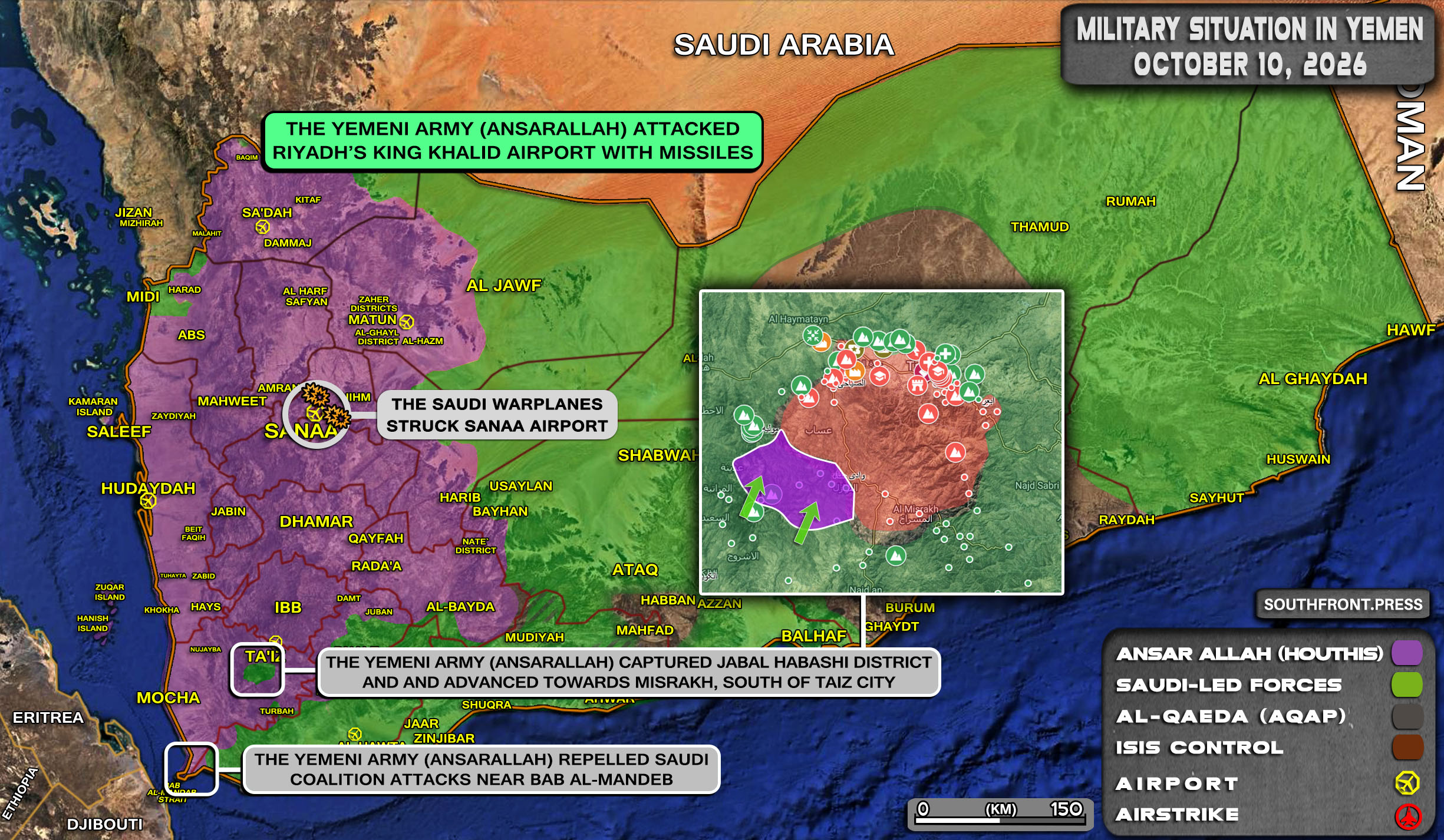
Military Situation In Yemen On October 10, 2026 (Map Update)

Click to see full-size map.

  • The Yemeni army (AnsarAllah) repelled Saudi coalition attacks near Bab al-Mandeb;
  • The Yemeni army (AnsarAllah) captured Jabal Habashi district and and advanced towards Misrakh, south of Taiz city;
  • The Saudi warplanes struck Sanaa airport;
  • The Yemeni army (AnsarAllah) attacked Riyadh’s King Khalid airport with missiles.

_______________________________________________________________________________________________________________________

MORE ON THIS TOPIC:

The post Military Situation In Yemen On October 10, 2026 (Map Update) appeared first on South Front.

  •  

Saudi Arabia Main Airport Struck, Major Gas Plant Reportedly Hit (Videos)

File image.

An attack on King Khalid International Airport in Saudi Arabia’s capital injured several people and forced authorities to suspend operations on October 10, as separate reports emerged of a possible strike on a major oil and gas facility in the kingdom’s eastern oil-producing region.

Saudi Arabia’s civil aviation authority said operations at the Riyadh airport had been suspended while officials assessed the damage and verified the safety of the facility.

Meanwhile, a regional official told The Associated Press that a missile struck the complex housing Terminals 3 and 4, which serve domestic flights.

Witnesses reported an explosion inside the airport and injured people on the ground. More than a dozen ambulances were seen rushing to the facility, Reuters reported. A traveler told the news agency that something had flown across the sky before part of the ceiling near a departure gate collapsed.

The official casualty toll remained unclear. Saudi authorities said they were assessing the number of injured, while a source at a Riyadh hospital told AFP that dozens of people had been wounded, including at least five who were being treated in intensive care.

The suspension disrupted air travel across the kingdom. Flight-tracking services showed flights to Riyadh being canceled or diverted, while Kuwait Airways, Etihad Airways and Qatar Airways canceled services to the Saudi capital.

The airport had already been targeted twice earlier in the week in attacks that killed four people and destroyed a Saudi airliner.

Yemen’s Houthis, also known as Ansar Allah, have claimed responsibility for previous strikes on Saudi airports and other infrastructure but had not immediately commented on the latest incident.

The airport attack came amid reports of a possible strike on the Shedgum gas-processing plant in the Ghawar oil-field complex in eastern Saudi Arabia. The reports described smoke rising from the facility after an alleged missile attack.

The Israeli news outlet JFeed reported that the plant had been hit by ballistic missiles, citing satellite imagery and a reported spike in thermal activity. The open-source monitoring site Hamer Intel also reported smoke over the area following the suspected attack.

Despite these reports, Saudi authorities and state oil company Saudi Aramco have not yet publicly confirmed an attack on Shedgum.

Ghawar is one of the world’s largest conventional oil fields and a central part of Saudi Arabia’s petroleum industry. Shedgum is a gas-processing facility associated with the field, meaning damage there would not by itself establish that oil production across Ghawar had been interrupted.

The attacks came as fighting intensified between Saudi-backed Yemeni government forces and the Houthis, who have expanded their missile and drone campaign against Saudi targets in recent days.

The group warned international airlines to avoid Saudi airspace, describing it as a zone of military operations, after Saudi-backed forces launched an offensive to regain territory along Yemen’s Red Sea coast.

U.S. President Donald Trump said after the attack on King Khalid International Airport that Washington was considering whether to join Saudi military action against the Houthis.

“We may. We’re going to look at it,” he told reporters, according to Reuters.

Overall, Saudi Arabia appears to be defenseless in the face of the Houthis, who have succeeded to a large extent in restricting aviation over the kingdom. Despite Trump’s latest remarks, the U.S. is unlikely to take a more direct role against the group, as its forces in the region remain focused on Iran. Still, the U.S. could carry out a one-off attack to show support for Riyadh. This could, however, trigger an even harsher response by the Houthis.

_______________________________________________________________________________________________________________________

SouthFront: Analysis and Intelligence

NOW hosted at southfront.press

Previously, SouthFront: Analysis and Intelligence was at southfront.org.

The .org domain name had been blocked by the US (NATO) (https://southfront.press/southfront-org-blocked-by-u-s-controlled-global-internet-supervisor/) globally, outlawed and without any explanation

Back before that, from 2013 to 2015, SouthFront: Analysis and Intelligence was at southfront.com

SOUTHFRONT.PRESS

MORE ON THIS TOPIC:


The post Saudi Arabia Main Airport Struck, Major Gas Plant Reportedly Hit (Videos) appeared first on South Front.

  •  

Tanker Burns off UAE Coast as Iran Vows to Punish Violating Ships (Video)

File image.

Iran’s Islamic Revolutionary Guard Corps (IRGC) said on October 10 that a supertanker struck a naval mine while attempting to leave the Strait of Hormuz along a route Tehran had not authorized.

In a statement, the IRGC Navy said the vessel had ignored warnings about unauthorized transit and warned that ships violating its rules would face further attacks.

“A massive fire awaits any violating oil tanker that seeks to disregard the security and regulations of the Strait of Hormuz,” the Corps warned.

The statement did not identify the tanker or give its precise location. However, the United Kingdom Maritime Trade Operations (UKMTO) agency said a day earlier that a vessel was struck by an unidentified projectile about 13 nautical miles west of Al Jazeera in the United Arab Emirates.

In an advisory notice, the agency, run by the Royal Navy, said that the fire was extinguished and that authorities were investigating.

India’s shipping minister, Sarbananda Sonowal, identified the vessel as the Panama-flagged crude oil tanker MT GEM NO. 2 and said all 22 Indian crew members were safe after a drone strike while the tanker was anchored off Sharjah, according to The Indian Express.

Separately, the UAE National Guard confirmed that it had rescued 22 crew members from an oil tanker after receiving a report of a fire on board.

Commercial traffic through the Strait of Hormuz continued on October 10 but remained sharply below normal levels amid repeated attacks and Iranian threats against vessels using routes Iran considers unauthorized.

The vessel-tracking service Hormuz.now counted six commercial ships crossing in the preceding 24 hours, with a seven-day average of about 10 ships a day, compared with a pre-crisis baseline of nearly 85. The figures cover only vessels broadcasting their positions.

Meanwhile, data from shipping analytics firm Kpler showed seven commodity vessels crossed the strait on October 6, the lowest number since July 23, followed by 10 on October 7, according to Reuters. That remained well below the more than 20 daily crossings recorded on October 4 and 5.

The strait normally carries a substantial share of global oil and liquefied natural gas supplies, making the prolonged reduction in traffic a major concern for energy markets.

Recent days saw an escalation in strikes on vessels attempting to pass the Strait of Hormuz without coordinating with Iran, which threatened to pursue vessels it considers in violation of its rules across the wider region.

_______________________________________________________________________________________________________________________

SouthFront: Analysis and Intelligence

NOW hosted at southfront.press

Previously, SouthFront: Analysis and Intelligence was at southfront.org.

The .org domain name had been blocked by the US (NATO) (https://southfront.press/southfront-org-blocked-by-u-s-controlled-global-internet-supervisor/) globally, outlawed and without any explanation

Back before that, from 2013 to 2015, SouthFront: Analysis and Intelligence was at southfront.com

SOUTHFRONT.PRESS

MORE ON THIS TOPIC:

The post Tanker Burns off UAE Coast as Iran Vows to Punish Violating Ships (Video) appeared first on South Front.

  •  

Military Situation In Syria On October 10, 2026 (Map Update)

Click to see full-size map.

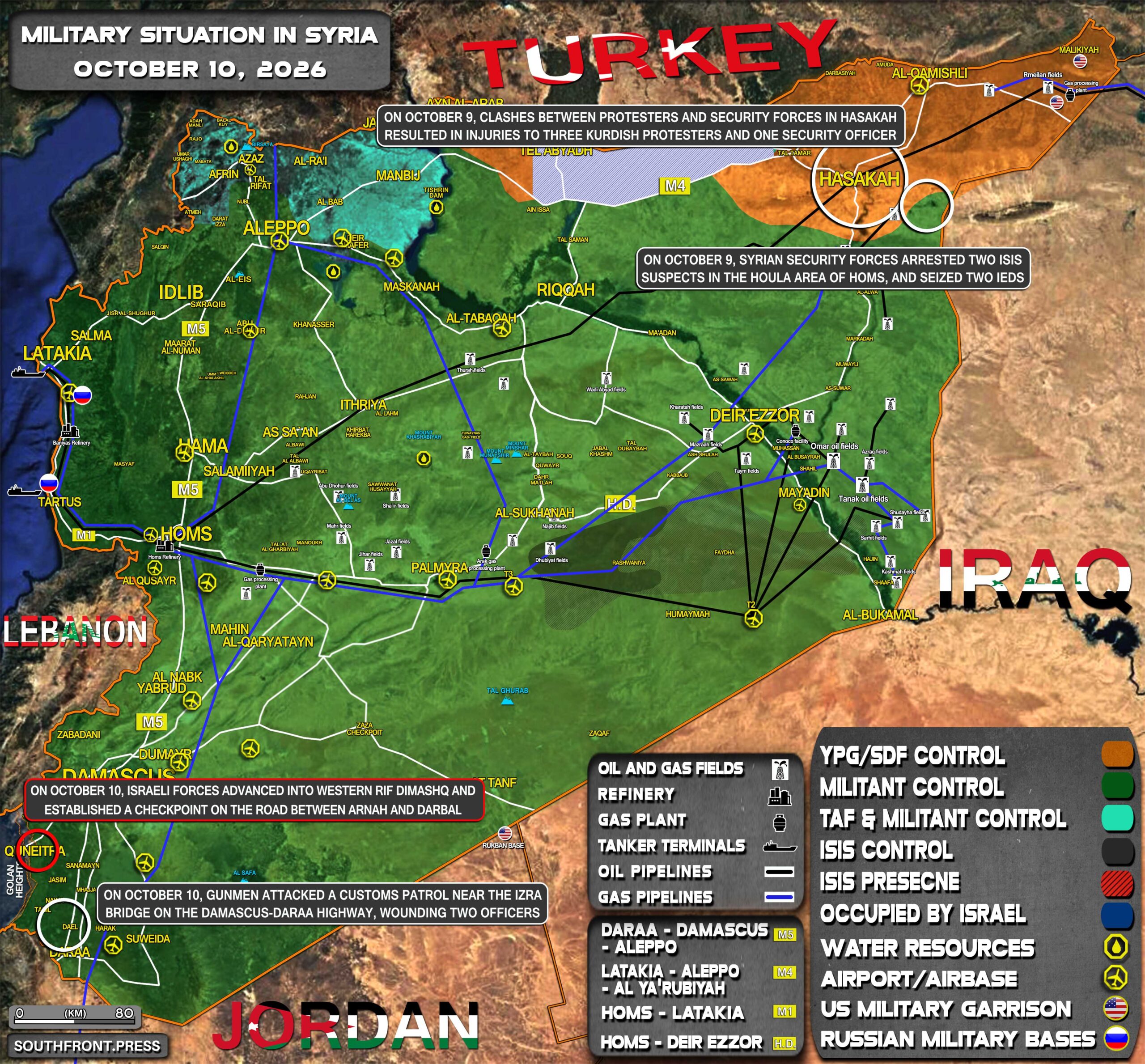
  • On October 9, clashes between protesters and security forces in Hasakah resulted in injuries to three Kurdish protesters and one security; officer
  • On October 9, Syrian security forces arrested two ISIS suspects in the Houla area of Homs, and seized two IEDs;
  • On October 10, gunmen attacked a customs patrol near the Izra Bridge on the Damascus-Daraa highway, wounding two officers;
  • On October 10, Israeli forces advanced into western Rif Dimashq and established a checkpoint on the road between Arnah and Darbal.

_______________________________________________________________________________________________________________________

MORE ON THIS TOPIC:

The post Military Situation In Syria On October 10, 2026 (Map Update) appeared first on South Front.

  •  

New Houthi Footage Shows Drones Strikes, Saudi-Backed Fighters Surrendering

File image.

Yemen’s Houthis (Ansar Allah) released two videos on October 10 showing attacks on Saudi-backed forces near the country’s southwestern coast and claiming the group had secured additional territory in Taiz province.

The first video, published by the Houthis’ military media, showed recent strikes with “Shawaz” first-person suicide quadcopters.

The strikes targeted military vehicles and gatherings of Saudi-backed fighters at several locations in the Kahbub Mountains and al-Waziyah district along the far southern end of Yemen’s southwestern coast.

A second video, released separately, showed Houthi fighters advancing in the districts of Sama, As Silw and al-Mawasit in Taiz.

The footage also showed groups of Saudi-backed fighters surrendering to the Houthis and laying down their weapons in line with a general amnesty announced the previous month by Mahdi al-Mashat, head of the Houthi-led Supreme Political Council.

The three districts lie in the rural south and southeast of Taiz city, on a front distinct from the fighting along the Red Sea coast. Their reported capture comes amid the Houthis’ wider advance around Taiz, where the group has managed to cut the city off from other government-held areas.

Al Jazeera reported on October 10 that the capture of al-Turbah by October 4 had severed the main road linking Taiz city with government-held territory.

The coastal footage appeared amid continued fighting over access to the strategic Bab al-Mandab Strait, which connects the Red Sea with the Gulf of Aden.

Saudi-backed forces said on October 9 that they had retaken the strait’s surrounding coastal areas and Mayyun Island, which lies within the waterway. Ansar Allah military spokesman Yahya Saree, however, said the group had repelled an advance from Lahj province and claimed more than 22 armored vehicles had been destroyed.

All in all, the Houthis maintain the upper hand both in Bab al-Mandab and in Taiz. Saudi-backed forces appear to be taking heavy losses, and their chances of regaining the initiative are getting slimmer by the day.

_______________________________________________________________________________________________________________________

SouthFront: Analysis and Intelligence

NOW hosted at southfront.press

Previously, SouthFront: Analysis and Intelligence was at southfront.org.

The .org domain name had been blocked by the US (NATO) (https://southfront.press/southfront-org-blocked-by-u-s-controlled-global-internet-supervisor/) globally, outlawed and without any explanation

Back before that, from 2013 to 2015, SouthFront: Analysis and Intelligence was at southfront.com

SOUTHFRONT.PRESS

MORE ON THIS TOPIC:

The post New Houthi Footage Shows Drones Strikes, Saudi-Backed Fighters Surrendering appeared first on South Front.

  •  

Four Ukrainians Arrested in Vienna Amid Growing Sabotage in Europe

File image.

Four Ukrainian citizens were arrested in Vienna this week on suspicion of spying, Austrian Interior Minister Gerhard Karner said on October 9.

Three of the four remained in custody, Karner said, declining to provide further details because the investigation was ongoing.

The newspaper Ukrainska Pravda said two of its journalists were among those detained. Editor-in-chief Sevgil Musaieva said investigative journalist Mykhailo Tkach was released after more than 12 hours in detention on October 8, but his communication devices had not been returned. She also said cameraman Yaroslav Bondarenko was injured during his detention. The other two Ukrainians still in custody were arrested three days earlier.

The Ukrainian Embassy in Vienna said it was awaiting an explanation from Austrian authorities about the arrests and their legal basis, according to Reuters.

The arrests come amid growing scrutiny of alleged covert operations involving Ukrainians across Europe, including investigations into sabotage and attacks linked to Kyiv’s intelligence services.

In July, German prosecutors indicted a Ukrainian national accused of helping coordinate the team that planted explosives on the Nord Stream gas pipelines under the Baltic Sea in September 2022. The suspect, who was arrested in Italy last year, has denied involvement, Reuters reported.

Earlier in April, Serbian authorities found explosives near the Balkan Stream pipeline supplying Russian gas to Hungary. Prime Minister Viktor Orbán accused Ukraine of possible involvement, but Kyiv denied the allegation.

A separate investigation concerns a June 29 bombing in Monaco that seriously injured Ukrainian-born businessman Vadym Yermolaiev and two members of his family.

Ukrainian authorities detained a military intelligence officer and a former law-enforcement officer over the subsequent killing of Anastasiia Berezovska, the woman suspected of planting the bomb.

Monaco’s prosecutor said the two men may also have been involved in planning the attack, according to The Associated Press.

In an interview with the BBC published on October 9, former security officer Vitalii Zhykovych alleged that senior Ukrainian military intelligence officials had authorized the operation. Monaco, a sovereign city-state, is not a member of the European Union.

The recent incidents suggests growing Ukrainian sabotage activity inside the European Union. The targets point to a possible motive. Austria and Hungary had both pushed back against widening sanctions on Russia before the recent plots. In the case of Yermolaiev, who is in disagreement with Kyiv, the motive also appears evident.

_______________________________________________________________________________________________________________________

SouthFront: Analysis and Intelligence

NOW hosted at southfront.press

Previously, SouthFront: Analysis and Intelligence was at southfront.org.

The .org domain name had been blocked by the US (NATO) (https://southfront.press/southfront-org-blocked-by-u-s-controlled-global-internet-supervisor/) globally, outlawed and without any explanation

Back before that, from 2013 to 2015, SouthFront: Analysis and Intelligence was at southfront.com

SOUTHFRONT.PRESS

MORE ON THIS TOPIC:

The post Four Ukrainians Arrested in Vienna Amid Growing Sabotage in Europe appeared first on South Front.

  •  

Russian Jet-Powered Geran-4 Drones Reach Lviv Region for First Time (Video)

File image.

Russian jet-powered Geran-4 one-way attack drones reached Ukraine’s Lviv region for the first time on October 10, following earlier reported strikes in the Rivne and Volyn regions in August.

Ukraine’s Air Force reported early in the morning that a jet-powered drone was heading toward Lviv and the nearby town of Vynnyky, later warning that it was approaching Lviv airport. Lviv Mayor Andrii Sadovyi confirmed soon afterward that the drone had entered the city’s airspace.

The incident came amid a broader wave of Russian jet-powered drone attacks against western Ukraine. Geran-4 drones targeted not just Lviv, but also Volyn, Rivne, Khmelnytskyi and Ivano-Frankivsk regions from late October 9 overnight into October 10.

Russia disclosed the Geran-4’s range publicly on October 2, when a representative briefed President Vladimir Putin on the drone during a visit to the Chebarkulsky training ground in the Chelyabinsk region. The representative said the drone travels at 350 kilometers per hour, carries a 50-kilogram warhead and has a range of 750 to 800 kilometers.

Those figures place western Ukrainian targets within its declared operational reach. Yet there have been reports of strikes even beyond this range.

In August, an unidentified Russian jet-powered drone reportedly traveled about 900 kilometers from Crimea before reaching Dubno in the Rivne region.

Ukraine’s Defense Intelligence revealed earlier this week that Russia has begun to produce an updated version of the Geran-4.

The updated version replaces the Chinese Telefly turbojet engine with a Russian-produced equivalent and adds the Susanin electro-optical system, which compares onboard camera images with stored reference imagery to guide the drone along a designated route. It is also armed with a new shaped-charge warhead designed to cut through bridge structures and supports for overhead power lines.

The continued development of the Geran drone represents a growing threat to Ukrainian air defenses, which are struggling to cope with existing versions.

_______________________________________________________________________________________________________________________

SouthFront: Analysis and Intelligence

NOW hosted at southfront.press

Previously, SouthFront: Analysis and Intelligence was at southfront.org.

The .org domain name had been blocked by the US (NATO) (https://southfront.press/southfront-org-blocked-by-u-s-controlled-global-internet-supervisor/) globally, outlawed and without any explanation

Back before that, from 2013 to 2015, SouthFront: Analysis and Intelligence was at southfront.com

SOUTHFRONT.PRESS

MORE ON THIS TOPIC:

The post Russian Jet-Powered Geran-4 Drones Reach Lviv Region for First Time (Video) appeared first on South Front.

  •  

Houthi Attacks on Saudi Airports Dealt Blow to Kingdom’s Investment Plans

Illustrative image.

Yemen’s Houthis (Ansar Allah) are disrupting Saudi Arabia’s efforts to attract international investors and energy executives, with attacks on the kingdom’s airports and explicit threats against commercial aviation prompting airlines and businesses to reconsider travel ahead of two major conferences in Riyadh, the Financial Times reported on October 10.

The World Petroleum Council Energy Congress is scheduled to take place from October 11 to 15, followed by the Future Investment Initiative, known as “Davos in the Desert,” from October 26 to 29.

The gatherings are important showcases for Saudi Arabia’s efforts to attract foreign capital and establish itself as a global destination for business, tourism and investment under Crown Prince Mohammed bin Salman’s Vision 2030 economic diversification program.

The Financial Times reported that companies are reconsidering the number of employees they will send to the events, with some exploring alternatives to air travel and others considering remote participation.

Italy’s energy minister has abandoned plans to attend the energy congress in person and will participate virtually. Organizers intend to proceed with the events, but the difficulties facing international participants have raised questions about attendance, particularly at the larger investment conference later this month.

The disruption follows an explicit warning from the Houthis, whose military spokesman, Brig. Gen. Yahya Saree, declared on October 8 that Saudi airspace had become a theater of military operations and issued what he described as a final warning to international airlines to stop flying into the kingdom.

Notably, the warning exempted airspace over the Islamic holy cities of Mecca and Medina, according to the group’s statement.

The Houthis have claimed responsibility for a series of missile attacks on Saudi airports in recent days. On October 9, Saudi aviation authorities confirmed that two attacks on King Khalid International Airport in Riyadh had killed three Saudi nationals and wounded several other people. A Saudia Airlines plane was also destroyed. Other aircraft were reportedly damaged.

The latest casualties brought the reported death toll from the recent airport attacks to six, including victims of earlier strikes on Riyadh and Abha.

The aviation threat has already produced consequences beyond the immediate damage. On October 9, the European Union Aviation Safety Agency expanded its advisory against operating in Saudi airspace, adding an area in the kingdom’s northwest after concluding that the recent attacks demonstrated the Houthis’ ability and intent to strike deeper inside Saudi territory.

The aviation risk-sharing organization OPSGROUP separately advised its members to avoid operations in Saudi Arabia, including using Saudi airports as alternative destinations during flights.

Airlines have responded with cancellations and suspensions affecting Riyadh and other Saudi cities. Lufthansa Group and several Indian carriers announced suspensions of flights to Riyadh, while Etihad Airways canceled services and flydubai extended cancellations affecting Riyadh, Yanbu and Abha.

Flight-tracking data showed 131 cancellations to and from Riyadh by early afternoon on October 9, following hundreds of cancellations the previous day, Reuters reported.

For Saudi Arabia, the implications reach beyond the immediate problems facing conference organizers. The kingdom has invested heavily in attracting international companies, financial institutions and visitors as it seeks to diversify its economy away from oil revenues.

The energy congress and the Future Investment Initiative offer opportunities to draw senior executives to Riyadh, cultivate investment commitments and demonstrate that the country can host major international gatherings.

The Houthi campaign is now testing that effort through both physical attacks and the threat of further strikes. Even without additional damage to airport infrastructure, warnings that commercial aircraft could be targeted give airlines and corporate security departments a reason to reconsider routes, staff deployments and attendance.

With the energy congress beginning on October 11 and the investment conference approaching later in the month, Saudi organizers face the immediate challenge of keeping international participants coming while the threat to aviation remains active.

_______________________________________________________________________________________________________________________

SouthFront: Analysis and Intelligence

NOW hosted at southfront.press

Previously, SouthFront: Analysis and Intelligence was at southfront.org.

The .org domain name had been blocked by the US (NATO) (https://southfront.press/southfront-org-blocked-by-u-s-controlled-global-internet-supervisor/) globally, outlawed and without any explanation

Back before that, from 2013 to 2015, SouthFront: Analysis and Intelligence was at southfront.com

SOUTHFRONT.PRESS

MORE ON THIS TOPIC:

The post Houthi Attacks on Saudi Airports Dealt Blow to Kingdom’s Investment Plans appeared first on South Front.

  •  

Turkish Drones Are Fueling Conflict in Ethiopia

File image.

Ethiopian government forces have stepped up drone attacks as fighting spreads across Tigray, Amhara and neighboring regions, bringing renewed attention to Turkey’s growing role as a supplier of unmanned aerial systems to the war-torn country.

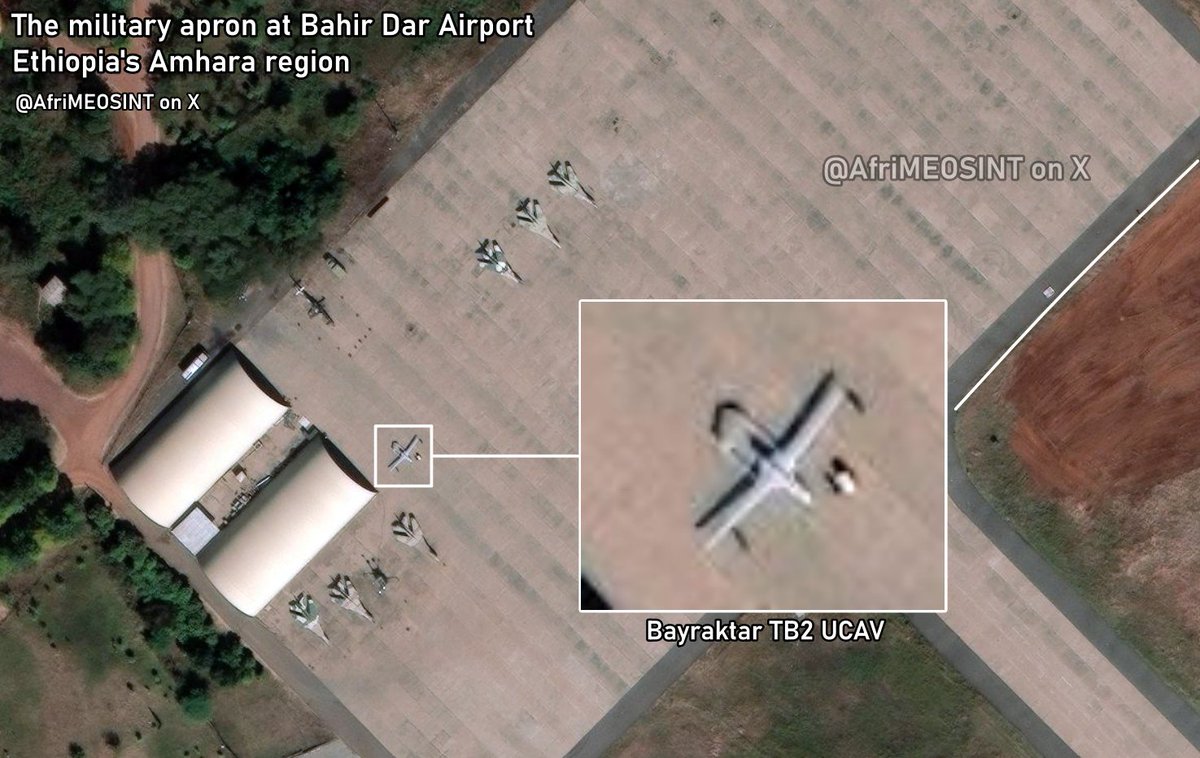
Reports and imagery point to the presence of Turkish-made Bayraktar TB2 and Akıncı drones, although publicly available evidence does not establish which models carried out the individual strikes in the latest offensive.

The latest escalation in Ethiopia has brought the drones into use against both Tigrayan fighters and forces identified as Eritrean.

The Armed Conflict Location & Event Data Project, known as ACLED, reported that between 15 and 17 strikes hit Alamata in southern Tigray on September 22, damaging several schools and a hospital. Tigrayan authorities said the attacks killed 14 people and wounded 22, although the breakdown of casualties between civilians and combatants was unknown.

On September 27, ACLED recorded an Ethiopian army drone strike on Tigray TV, a regional broadcaster affiliated with the Tigray People’s Liberation Front.

The attacks continued into October. On October 7, ACLED reported that Ethiopian National Defense Force units had used drones to attack suspected Eritrean troops traveling by vehicle toward Idaga Hamus in Tigray. The group said further strikes targeted vehicles carrying troops and equipment as the troops withdrew from the Adigrat area on October 8. Witnesses reported destroyed military vehicles and explosions overnight.

The Turkish connection predates the current offensive. In October 2021, Reuters reported that Ethiopia was seeking to acquire Bayraktar TB2 armed drones from Turkish defense company Baykar, amid the previous war between federal forces and the Tigrayan leadership.

The Bayraktar TB2 has a 12-meter wingspan, a maximum takeoff weight of 700 kilograms and an endurance of more than 18 hours, allowing it to conduct surveillance, reconnaissance and precision strikes with guided munitions.

Click to see full-size image. (X)

Subsequent reporting documented the use of Turkish-made drones in Ethiopia. In August 2024, a senior Turkish government official confirmed that Turkey had authorized Ethiopia to use Turkish-made drones, following scrutiny of civilian deaths linked to earlier attacks.

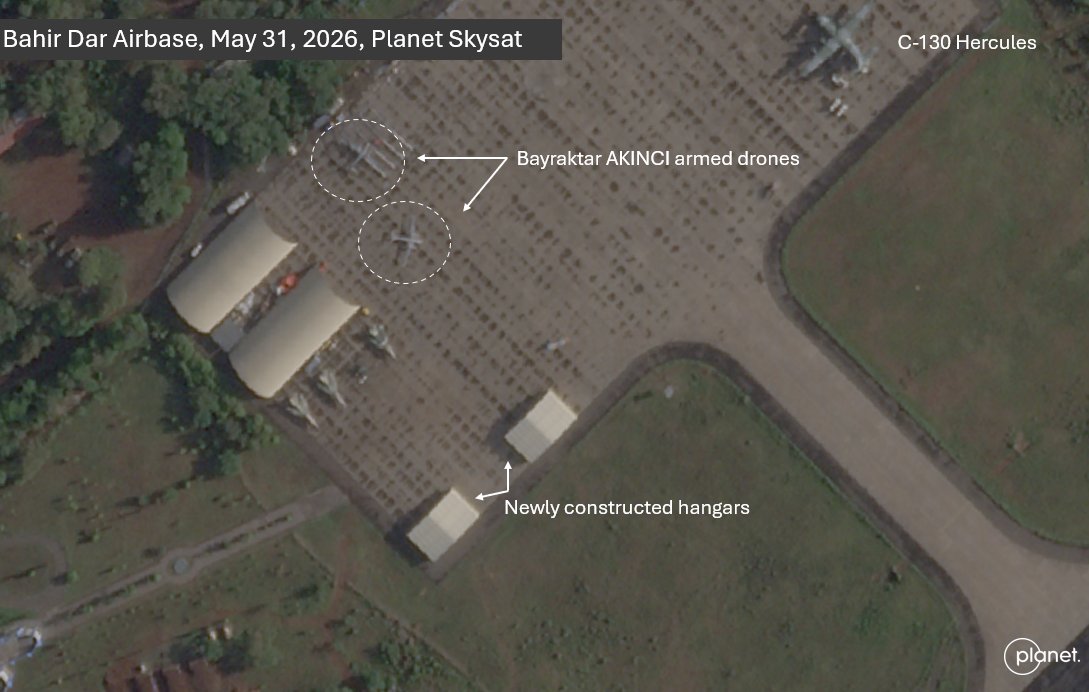
The larger Bayraktar Akıncı has also been linked to Ethiopia’s military aviation infrastructure. Satellite imagery and open-source reporting have drawn attention to drones stationed at Bahir Dar Airport in the Amhara region, where military infrastructure has expanded.

The Bayraktar Akıncı is a twin-engine combat drone with a 20-meter wingspan, a payload capacity of 1,500 kilograms and an operational range of 6,000 kilometers, and it can carry guided bombs, air-to-ground missiles and air-to-air missiles while conducting intelligence and surveillance missions.

However, the presence of Turkish-made drones at the base does not establish that every drone there is operated by Ethiopia. In May 2026, defense publication Janes reported that Sudan’s military had identified a drone operating from Bahir Dar as belonging to the United Arab Emirates, illustrating the complications surrounding foreign-operated drones using Ethiopian facilities.

Click to see full-size image. (X/Planet Labs)

Another Turkish system has surfaced in more recent reports from the battlefield. Baykar unveiled the Sivrisinek publicly in May; the system was developed jointly with Pakistan. In early October, open-source footage circulated online appeared to show Ethiopian federal troops displaying a Baykar Sivrisinek loitering munition, also known as the YIHA-III, reportedly captured from Tigrayan forces. The reported capture has not independently established how the munition reached the Tigrayan side.

The Sivrisinek YIHA-III is a loitering munition with a 20-kilogram warhead, an endurance of more than eight hours in its extended-range configuration and AI-assisted target recognition, enabling it to search for targets and conduct precision attacks without requiring a runway.

The civilian toll from the renewed air campaign has heightened concerns about the use of drones in populated areas. Human Rights Watch has previously documented drone strikes that harmed civilians in Amhara, including attacks during the conflict with Fano militias.

In the current round of fighting, ACLED has recorded repeated drone attacks across Tigray, but the available reporting does not establish that Turkish-made drones were responsible for each incident. Still, it is clear that Turkey’s Baykar is emerging as one of the main beneficiaries of the conflict.

_______________________________________________________________________________________________________________________

SouthFront: Analysis and Intelligence

NOW hosted at southfront.press

Previously, SouthFront: Analysis and Intelligence was at southfront.org.

The .org domain name had been blocked by the US (NATO) (https://southfront.press/southfront-org-blocked-by-u-s-controlled-global-internet-supervisor/) globally, outlawed and without any explanation

Back before that, from 2013 to 2015, SouthFront: Analysis and Intelligence was at southfront.com

SOUTHFRONT.PRESS

MORE ON THIS TOPIC:


The post Turkish Drones Are Fueling Conflict in Ethiopia appeared first on South Front.

  •  
❌