Login

To Avoid Criticizing Trump's Tariffs and War, Vivek Ramaswamy Takes on Data Centers
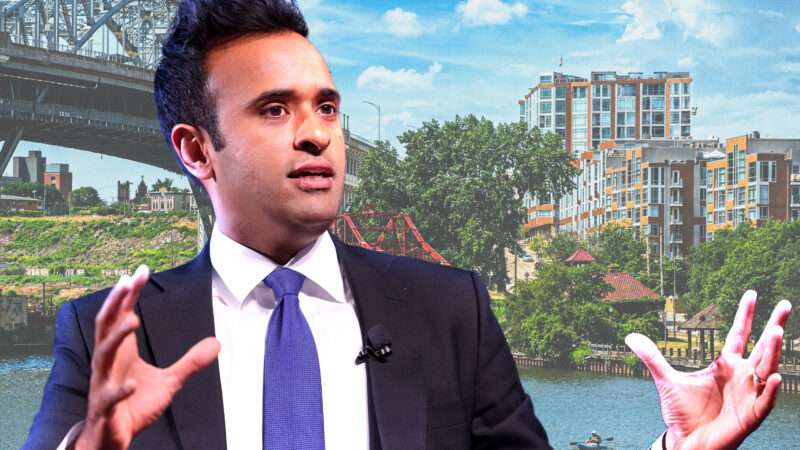
When Vivek Ramaswamy ran for president in 2024, he liked to describe himself as a "national libertarian" whose worldview included skepticism of new Middle Eastern wars and support for free trade (provided it wasn't with China).
In a midterm election season in which voters are increasingly angry about higher prices born of protectionist tariffs and high gas prices caused by a new Middle Eastern war, that would seemingly give Ramaswamy, now running for governor of Ohio, a straightforward story to tell about how he'd bring costs down.
Unfortunately for the Republican gubernatorial candidate, the person responsible for the tariffs and the war is President Donald Trump, whose support he's counting on to get him over the finish line in a surprisingly close race against Democrat Amy Acton.
The latest polls show Ramaswamy slightly ahead of Acton, with many voters still undecided.
Other Republican midterm candidates, most prominently Mike Rogers in Michigan, are escaping this bind by criticizing the tariffs and the war without explicitly naming the president who's responsible for both.
Ramaswamy has chosen a different tactic: Shift the conversation to other sources of voters' cost-of-living anxiety that can't be directly laid at Trump's feet.
In the last weeks of this election campaign, Ramaswamy has focused like a laser on two proposals he says will deliver cost relief to Ohio voters. The first is his proposed rollback of homeowners' property taxes. The second is a moratorium on new data center construction.
Like many Midwestern and Western states, Ohioans' property tax bills have shot up in recent years, driven by a pandemic-era spike in home values.
That's in turn sparked a full-blown property tax revolt in the state. The Republican-controlled Legislature passed a raft of property tax relief measures in 2025. Activists are also collecting signatures to place a full abolition of taxes on real property on the statewide ballot next year.
Ramaswamy hasn't endorsed full property tax abolition, but he is promising voters that he will roll back property tax assessments for homeowners to pre-pandemic levels.
On the data centers, he has staked out a very restrictionist position.
Ohio is currently one of the leading states for data center development. Pew Research counts 57 projects currently in the pipeline there, attracted by cheap land and a robust power grid.
The state's data center boom has caused a backlash in rural communities, where voters have objected to data centers' consumption of land and electricity and the special tax incentives some projects have received.
On the ballot in 10 Ohio localities this November are initiatives that would impose additional restrictions on data center development.
Ramaswamy has proposed to go further with a statewide moratorium that will remain in effect until the Legislature passes laws that not only require data centers to cover the full costs of the power infrastructure they need, but also provide property tax rebates and free electricity to nearby homeowners.
Local property tax cuts paired with local reductions in spending would, of course, be well in line with a small government worldview.
But the residential property tax rollback Ramaswamy has proposed doesn't directly do that.
Instead, it would reduce property tax revenues and then leave it up to localities to make up for the lost revenue somehow. That could result in spending cuts.
It could also result in localities shifting tax burdens onto commercial properties, raising non-property taxes (like sales taxes), or relying on the state government for more of their revenues.
In the former two scenarios, local tax regimes would become more hostile to growth, given that property taxes are considered one of the most "efficient" taxes. In the latter scenario, the link between people who pay taxes and the people who consume taxpayer-funded local services would become more distant.
Neither is ideal.
While some data centers in Ohio have received tax subsidies, Ramaswamy's proposed solution is to block new data centers until they're legally required to subsidize their neighbors with free electricity and other community benefits.
All of that is to say that it's a shame to see Ramaswamy adopt increasingly non-libertarian positions to avoid making critiques of Trump's cost-increasing tariffs and Iran war that would align with his erstwhile "national libertarian" worldview.
It's ironic, too, that, in trying to avoid making those critiques, Ramaswamy has wound up being more restrictionist on data centers than Trump himself.
In an August Truth Social post, the president famously urged local communities to "let Data Reign" and welcome data center development. Those that did would become "rich and successful," he predicted. Those that didn't would remain "poor and backward."
At a rally in Vandalia, Ohio, over the weekend for Ramaswamy and Republican Senate candidate John Husted, Trump reiterated his support for data centers, saying, "We want them. Look, there's so much money to be made for Ohio. You can't just turn them off. They'll go to China."
Rather than criticize the president's statist interventions, Ramaswamy is talking up his own instead. Ohio will be poorer as a result.
The post To Avoid Criticizing Trump's Tariffs and War, Vivek Ramaswamy Takes on Data Centers appeared first on Reason Magazine.
 A tale of two Germanys
 The first Germany represents illiterate Syrian migrant Ahmad A. and his 2 wives and 6 children. The entire family received free housing and welfare thanks to German taxpayers.

 In France, an Ivorian polygamist has been sentenced to 30 years in prison for torture, rape, and for imposing a hard-line Islamic regime on his 4 wives and 29 children.