❌

Reading view

Petrol Price in Pakistan drops to Rs386 in fresh Weekend Cut

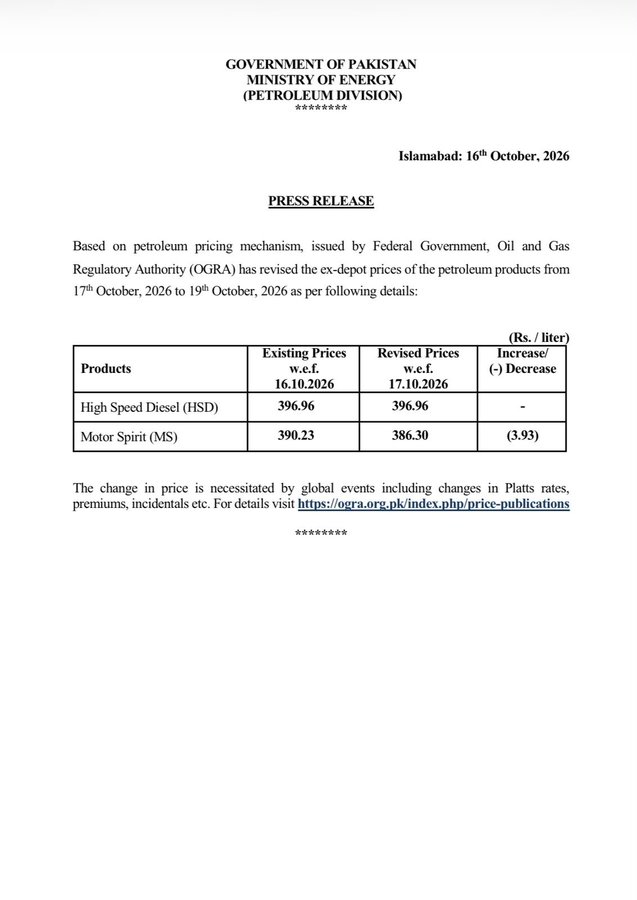
ISLAMABAD – The federal government announced another cut in petrol prices, lowering the rate by Rs3.93 per litre to Rs386.30, offering some relief to motorists as fuel prices remain close to the Rs400 mark.

Diesel consumers will see no change, with high-speed diesel (HSD) continuing to sell at Rs396.96 per litre.

Petrol Price In Pakistan Drops To Rs386 In Fresh Weekend Cut

The revised rates will take effect from October 17 and remain in force until October 19, 2026, covering the weekend, according to an announcement by the Petroleum Division.

The latest reduction follows Wednesday’s price adjustment, when petrol became cheaper by Rs3.63 per litre, bringing its price down to Rs390.23. In the same revision, diesel prices increased by Re0.31 per litre to Rs396.96. The latest decision has lowered petrol prices further while leaving diesel rates untouched.

The domestic price revision comes amid continued uncertainty in international energy markets. Crude oil prices remained relatively steady on Friday but were heading towards weekly gains as concerns over Middle Eastern supplies and a larger-than-expected drawdown in US crude inventories supported the market.


The post Petrol Price in Pakistan drops to Rs386 in fresh Weekend Cut appeared first on Daily Pakistan English News.

  •  

Pakistan’s Current Account Deficit surges to $356 Million amid soaring Import Bill

KARACHI – Pakistan’s external sector is facing pressure as current account deficit jumped to $356 million in September 2026, reversing the surplus recorded a year earlier and raising fresh concerns about the country’s trade imbalance.

Fresh data by State Bank of Pakistan (SBP) shows September deficit was higher than the revised shortfall of $73 million in August. The latest reading also marks a sharp reversal from September 2025, when Pakistan posted a current account surplus of $133 million.

The deterioration comes despite stronger exports and continued growth in overseas Pakistanis’ remittances, highlighting a persistent problem: the country’s import bill is expanding much faster than its export earnings.

The latest figures reveal growing imbalance in Pakistan’s external trade. Exports of goods and services rose to approximately $3.95 billion in September, up from $3.42 billion a year earlier. However, imports climbed to $7.38 billion from $5.99 billion over the same period.


indicators Sept 2026 Sept 2025 Annual change
Current account balance -$356 million +$133 million Surplus turns deficit
Exports of goods and services $3.95 billion $3.42 billion +15%
Imports of goods and services $7.38 billion $5.99 billion +23%
Workers’ remittances $3.59 billion $3.18 billion +13%


The numbers tell a troubling story for Pakistan’s external account. While export receipts improved, the faster rise in imports increased the pressure on foreign exchange outflows. This imbalance has become a key factor behind the country’s deteriorating current account position.

The pressure is becoming more evident in the broader fiscal-year picture. Pakistan’s current account deficit reached $874 million during the July–September quarter of FY27, compared with $755 million in the same period last year, marking an increase of approximately 15.8%. The deficit accumulated in just three months has already exceeded twice the approximately $391 million shortfall recorded during the entire FY26.

The merchandise trade figures help explain the deterioration. Goods exports increased by 7.7% to $8.45 billion in the first quarter, while goods imports rose by 14.3% to $17.78 billion. Consequently, the goods trade deficit widened by around 21%, reaching $9.33 billion compared with $7.71 billion a year earlier.

The widening gap suggests that export growth has yet to match the pace of Pakistan’s rising import demand. Remittances from overseas Pakistanis remain one of the country’s most important sources of foreign exchange, but their contribution has not been sufficient to offset the growing trade imbalance.

Pakistan received $3.59 billion in workers’ remittances in September, compared with $3.18 billion in the same month last year. This shows annual growth of nearly 13%, although inflows were slightly lower than the $3.66 billion received in August.

Despite this encouraging performance, the current account remained under pressure as payments for imports and other external transactions continued to outweigh foreign exchange receipts.


The post Pakistan’s Current Account Deficit surges to $356 Million amid soaring Import Bill appeared first on Daily Pakistan English News.

  •  

PMDC slaps Rs20 Million Fine on Fatima Jinnah Medical College over Student’s Death

LAHORE – Pakistan Medical and Dental Council (PMDC) imposed Rs20 million fine on Fatima Jinnah Medical College, Lahore, over alleged negligence and lapses in oversight following the death of final-year MBBS student Dr Fariha Ibrahim.

The college administration challenged the decision, refusing to accept the penalty and seeking a formal review of the council’s findings. The case centres on the death of Fariha Ibrahim, a student residing in the college hostel who sustained multiple serious injuries after falling from the rooftop one evening.

Fariha succumbed to her injuries, prompting scrutiny of the circumstances surrounding the incident and the institution’s responsibilities towards students living in its hostel.

PMDC sought detailed explanation from the college on March 31, 2026, as it examined the matter. The college principal submitted an inquiry report and supporting evidence to the council on April 2. The proceedings subsequently moved to the council’s disciplinary committee, where the college principal, acting head of the Department of Psychology and chief warden appeared on April 21 to present their positions.

After its review of available material, the committee imposed Rs20 million penalty and directed the institution to strengthen its student welfare and oversight arrangements. The prescribed measures include a comprehensive framework for medical assessments, counselling services, prevention of harassment and improved monitoring.

The penalty now triggered fresh dispute between the regulatory body and the college administration, which maintains that the decision warrants reconsideration.

After approval from its General Council, the college has filed a review petition before the PM&DC, seeking a reassessment of the findings and the financial penalty.

The administration argues that police and judicial investigations into the student’s death have been completed and that, according to its position, no evidence was found establishing that the institution had committed a criminal offence warranting police action.

On this basis, the college has urged the council to reconsider the investigative findings before reaching a final determination on the disciplinary action.

The administration’s challenge places the regulatory decision under further scrutiny, although the filing of a review petition does not, by itself, establish that the penalty has been overturned or suspended.

Beyond the financial penalty, the case raised broader questions about the responsibility of medical colleges to protect students residing in institutional hostels and provide adequate welfare and support systems. PMDC’s directions concerning medical assessments, counselling, harassment prevention and monitoring indicate that student welfare arrangements form a significant part of the regulatory response.

At the same time, the college’s challenge highlights a dispute over how the findings of separate investigations should be considered alongside regulatory proceedings. The review petition is expected to be placed before the council at an upcoming meeting for further examination and a decision.

MBBS Student drowns in Swimming Pool at Lahore’s Allama Iqbal Medical College

The post PMDC slaps Rs20 Million Fine on Fatima Jinnah Medical College over Student’s Death appeared first on Daily Pakistan English News.

  •  

Fazlur Rehman’s remarks on Soldiers’ Salaries prompt Strong Response from DG ISPR

ISLAMABAD – Director General of Inter-Services Public Relations (DG ISPR) Lieutenant General Ahmed Sharif Chaudhry lamented Fazl’s remarks on sacrifices of Pakistan’s military martyrs and linking it to financial compensation.

Reacting to JUI-F chief Maulana Fazlur Rehman’s remarks about soldiers’ salaries and their duties, the military spokesperson said the sacrifices of fallen personnel form the backbone of Pakistan’s armed forces and play a fundamental role in the country’s defence and security. He stressed that military personnel willingly risk their lives to protect the nation, adding that reducing their ultimate sacrifice to a matter of salary failed to reflect the spirit of service and devotion associated with defending the homeland.

Questioning whether anyone would willingly lay down their life merely for financial reward, the DG ISPR underscored that the commitment of Pakistan’s armed forces extends far beyond the terms of paid employment. He maintained that soldiers remain prepared to make the ultimate sacrifice for the protection of the country and its people, describing the legacy of martyrs as integral to Pakistan’s national security, defence and dignity.

The military spokesperson expressed concern over what he described as disrespectful remarks about Pakistan’s armed forces, particularly the martyrs of the Kargil conflict. He said statements that reinforce the Indian narrative about the conflict were regrettable and difficult to understand.

ISPR chief maintained that their sacrifices deserve lasting respect and recognition rather than being reduced to financial considerations.

His remarks came amid a political controversy following Fazlur Rehman’s comments at a JUI-F rally in Kasur, Punjab, where the opposition leader questioned why civilians were being encouraged to confront armed groups when national defence was the responsibility of the armed forces.

The controversy prompted criticism from government ministers, who argued that the remarks failed to acknowledge the courage and sacrifices of military personnel. Fazlur Rehman subsequently rejected calls for an apology, maintaining that his comments had been misunderstood and were directed at those in positions of authority rather than individual soldiers.

Pakistan Army Major makes Ultimate Sacrifice during Waziristan Operation

The post Fazlur Rehman’s remarks on Soldiers’ Salaries prompt Strong Response from DG ISPR appeared first on Daily Pakistan English News.

  •  

Hira Mani trolled online over Bold Outfit during Canada Visit

Bubbly versatile actress Hira Mani found herself at centre of social media attention during her visit to Canada, where she is meeting overseas fans at special meet-and-greet events. While the actress has been enjoying interactions with her admirers, her outfit has also sparked discussion online.

Mere Paas Tum Ho star is currently appearing alongside Mikaal Zulfiqar in Geo TV’s drama serial Khafa, continues to draw attention for both her on-screen performances and her personal style. However, her latest appearance in Canada has attracted mixed reactions, with some social media users commenting on her choice of dress.

Hira Mani Trolled Online Over Bold Outfit During Canada Visit

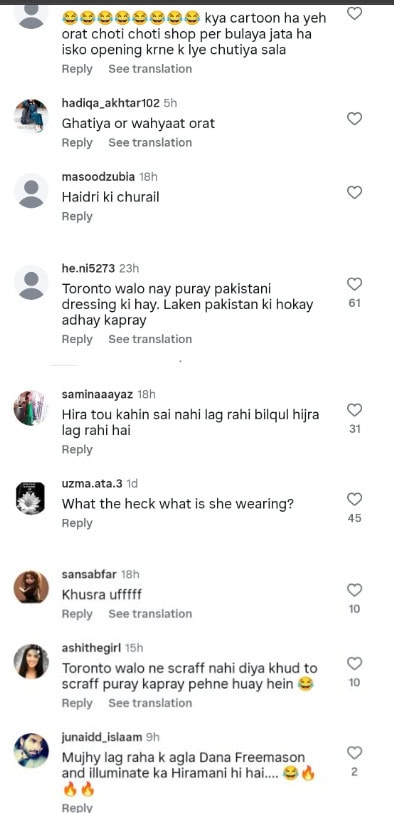
While some fans continue to show their support and appreciate her work, others have focused on her fashion choice. The mixed reactions highlight how celebrities’ public appearances can quickly become a talking point on social media.

Hira Mani Trolled Online Over Bold Outfit During Canada Visit


Despite the online chatter, Hira Mani remains active in the entertainment industry, with Khafa and her upcoming projects keeping her connected with audiences in Pakistan and abroad.


The post Hira Mani trolled online over Bold Outfit during Canada Visit appeared first on Daily Pakistan English News.

  •  

Who is Paying Price for Pakistan’s Massive Electricity Losses? latest data here

ISLAMABAD – Pakistan’s electricity crisis has striking geographical divide as some districts reportedly lose nearly all the electricity supplied to them, much of Punjab records losses in single digits.

The district-level figures show the scale of the challenge, with Balochistan and parts of Khyber Pakhtunkhwa emerging as major centres of electricity losses and revenue-recovery problems.

The figures were shared by former Energy Minister Engr. Dastagir Khurram. Based on Power Division and distribution company data, the map classifies districts according to reported electricity losses and assigns financial-loss estimates to eight percentage bands.

The map of electricity theft and/or refusal to pay is the map of Pakistan’s overall governance.

Non-payment for electricity is a symptom, NOt the disease.

Map courtesy @RShahzaddk

— Engr. Khurram Dastgir-Khan (HI) (@kdastgirkhan) October 15, 2026

The findings point to a crisis extending far beyond electricity theft. Technical losses, unauthorized consumption, billing problems and unpaid bills all place pressure on distribution companies, weakening their finances and adding to Pakistan’s persistent circular-debt burden.

Estimates put electricity losses at around 97% in Awaran, 93–94% in Kalat and Qilla Saifullah, 93% in Sherani, 90% in Pishin and 88% in Chaman. Other districts identified in the high-loss belt include Qilla Abdullah, Khuzdar, Kech, Kharan, Chagai, Washuk and Zhob.

Four locations, Sherani, Chaman, Usta Muhammad and Jaffarabad, are specifically marked on the map.

Balochistan is not the only region confronting severe electricity-sector problems. Several districts in Khyber Pakhtunkhwa, particularly in the south and former tribal areas, also feature prominently in the high-loss categories.

Historical estimates put losses at around 82% in Tank, 78% in Karak, 65% in Dera Ismail Khan and 63% in Bannu. Charsadda and some northern areas, including Chitral, have also been associated with elevated losses.

The contrast between districts raises questions about differences in enforcement, network conditions, consumer payment behaviour and the capacity of distribution companies to collect their dues.

While some districts in Balochistan and KP report losses exceeding 80%, most districts across Punjab fall into the map’s lowest-loss categories.

Large parts of the territories served by LESCO, FESCO, GEPCO, MEPCO and IESCO have historically reported losses below 10%. Kasur, Okara, Rajanpur and Rahim Yar Khan are among the exceptions cited in the low-teens range.

Parts of interior Sindh also face substantial electricity losses. Areas served by HESCO and SEPCO, including parts of Hyderabad, Larkana, Sukkur, Jacobabad and Ghotki, appear among the locations associated with moderate-to-high losses.

These districts generally show a more mixed pattern than Balochistan, with some falling into the 21–40% and 41–60% categories.

PESCO and QESCO have repeatedly featured among the major loss-making distribution companies, while HESCO and SEPCO have also faced significant financial challenges. Reports in recent years have cited substantial annual losses at PESCO and rising financial pressure at QESCO, although precise amounts vary by year and methodology.

The pattern also raises broader questions about institutional capacity and the administration of public utilities. In some areas, distribution companies may face difficulties maintaining infrastructure, accessing networks, enforcing disconnections or collecting payments consistently. Political interference, local resistance and weak administrative coordination may further complicate enforcement.

The post Who is Paying Price for Pakistan’s Massive Electricity Losses? latest data here appeared first on Daily Pakistan English News.

  •  

Gold Price soars to Rs440,636 per Tola; Silver sets New Record

KARACHI – Gold prices in Pakistan jumped higher on October 16 as international bullion rates advanced, while silver climbed to an unprecedented Rs6,256 per tola in the domestic market.

The price of 10 grams of gold also increased by Rs2,401 to Rs377,774. In the international market, gold gained $28 to reach $4,181 per ounce, while silver prices in Pakistan increased by Rs108 per tola to set a new all-time high of Rs6,256.

Latest Prices

Metal Price Daily Change
Gold per tola Rs440,636 +Rs2,800
Gold per 10 grams Rs377,774 +Rs2,401
Silver per tola Rs6,256 +Rs108
International gold per ounce $4,181 +$28

Gold Rates in Karachi

In Lahore, the local rates for gold piece were Rs434,800 and Rs434,200, while the Pathoor hovers at Rs429,500 and Rs427,500. Karachi’s reported selling rate stood at Rs434,500.

Gold Category Reported Price
22-karat gold Rs398,566
21-karat gold Rs380,450

Lahore Silver Market

Silver prices also remained in focus after the reported per-tola rate reached a record Rs6,256 nationally. Separate quotations supplied for Lahore included the following rates:

Silver Category Reported Rate
999.0 Tezabi silver Rs6,200
Silver bar, 1 kilogram Rs6,30
Silver piece, 10 tola Rs6,350

With gold and silver prices fluctuating, consumers and investors are advised to verify current rates through recognised bullion market associations or local dealers before making transactions.


The post Gold Price soars to Rs440,636 per Tola; Silver sets New Record appeared first on Daily Pakistan English News.

  •  

Islamabad Metro Bus Operations suspended between IJP Road, and Pak Secretariat

RAWALPINDI/ISLAMABAD – Passengers travelling between twin cities have been hit by partial suspension of Metro Bus Service, with operations on key section of the route halted amid security and administrative concerns.

The suspension affected stretch between IJP Road and Pak Secretariat, disrupting direct bus travel along this corridor. However, services between Saddar and Faizabad stations remain operational, providing commuters with a limited travel option.

According to Metro Bus authorities, the decision was taken on the instructions of the district administration as a precautionary measure to prevent any untoward incident.

The sudden restriction may cause inconvenience for daily commuters who rely on the service to travel between Rawalpindi and Islamabad, particularly those heading towards stations on the suspended section.

Passengers have been advised to plan their journeys accordingly, as buses are currently operating only on the available Saddar-Faizabad segment.

Authorities have not announced a specific timeline for the restoration of full operations. Services along the suspended section are expected to resume once the situation improves and conditions permit a safe reopening.

Until then, commuters are urged to remain alert to official announcements regarding changes to Metro Bus operations.


The post Islamabad Metro Bus Operations suspended between IJP Road, and Pak Secretariat appeared first on Daily Pakistan English News.

  •  

KP Police Martyrs’ Compensation increased to Rs35 Million, Rs 70 Million for Housing Aid

PESHAWAR – Compensation for martyred personnel has been raised to as much as Rs 35 million, while housing assistance in lieu of residential plots could reach Rs 70 million for the most senior ranks. The measures come as the province faces persistent security threats and renewed calls to address a reported shortage of 17,000 police personnel.

The package, linked to announcements surrounding Governor Faisal Karim Kundi’s police welfare initiatives, seeks to strengthen financial protection for the families of officers killed in the line of duty while improving support for personnel who suffer serious injuries or permanent disabilities.

The precise rank-wise breakdown of several benefits remains inconsistent across media reports, and the complete schedule requires confirmation through an official notification.Martyrs’ Compensation Raised to Rs 35 Million

Under reported revised structure, the compensation payable to the families of martyred police personnel varies according to rank and service grade. Constables through inspectors, including head constables, assistant sub-inspectors and sub-inspectors, are reported to be eligible for Rs 17 million, compared with approximately Rs 11 million previously.

For DSPs and ASPs, the revised amount is reported at around Rs 25 million, against a previous package of approximately Rs 16 million. Officers in Grades 18 and 19, including certain SSP and AIG categories, are reported to receive Rs 30 million, compared with around Rs 21 million earlier.

The highest reported tier provides Rs 35 million for officers in Grade 20 and above, including DIGs and the IGP, compared with approximately Rs 21 million under the earlier arrangement. The revised figures show substantial increase in financial assistance for families who lose their primary earners while serving in one of the province’s most dangerous public-service roles.

Cash payments are being offered as an alternative to residential plots, allowing bereaved families greater flexibility in purchasing property or building homes. The reported housing package includes Rs 18 million for constables and head constables, replacing the earlier entitlement to a five-marla plot. ASIs, sub-inspectors and inspectors are reported to receive Rs 25 million in place of a seven-marla plot.

For DSPs, ASPs and SPs, reported housing assistance ranges from Rs 25 million to Rs 35 million, depending on the applicable category. Officers in Grades 18 and 19, including SSPs, are associated with a Rs 35 million package, replacing a ten-marla plot.

The highest reported housing benefit stands at Rs 70 million for Grade 20 and above, in place of a one-kanal residential plot. The cash-based arrangement could give families greater freedom to choose where they live and how they use the funds. However, discrepancies in the reported rank-wise allocations mean that the exact entitlements should be verified against the final policy.

The reported reforms also provide substantial increases for injured personnel. Compensation for serious injuries sustained during official duty has risen from Rs 100,000 to Rs 1.5 million, while the payment for permanent disability has reportedly increased from Rs 500,000 to Rs 5 million.

The higher amounts are intended to provide greater financial assistance to officers whose injuries affect their ability to work, support their families or maintain their livelihoods. For personnel confronting terrorist threats and other operational dangers, improved injury benefits could form an important part of a wider effort to strengthen institutional welfare.

The package extends beyond direct compensation, with additional measures aimed at supporting the families left behind.

A marriage grant of Rs 1 million for each daughter of a martyred police officer has been announced in media reports. Financial assistance for the education of martyrs’ children is also among the proposed welfare measures, with possible contributions through an endowment fund and partnerships involving banks and corporate organisations.

Separate assistance has also been reported for close relatives of police personnel killed in terrorist attacks. The reported amounts range from Rs 3 million to Rs 5 million, depending on the relationship to the deceased. Spouses and children are generally associated with the higher figure, while parents and siblings are linked to the lower amount.

Some reports additionally refer to support for families of personnel who die from causes unrelated to official duty, although the eligibility criteria and extent of such assistance remain unclear.

Beyond benefits for martyrs and injured personnel, authorities have highlighted the need to improve salaries for serving police officers.

The said change is to make KP Police pay competitive with, or potentially better than, salaries offered by police forces in other provinces.

Abbas Ahsan assigned policing responsibilities for 12 KP districts

The post KP Police Martyrs’ Compensation increased to Rs35 Million, Rs 70 Million for Housing Aid appeared first on Daily Pakistan English News.

  •  

Pakistan issues Blunt Warning to New Delhi after Indian Defence Minister’s Strike Threat

ISLAMABAD/NEW DELHI — Tensions between nuclear-armed neighbours Pakistan and India intensified amid a fresh exchange of hard-line statements, as Indian Defence Minister Rajnath Singh made aggressive statement about a military strike even bigger than the last time.

Addressing the Times Network National Defence Conclave 2026 in New Delhi, Indian Defence Minister Rajnath Singh said any fresh terrorist activity originating from across the border would invite a military response more powerful than India’s previous operations.

Singh warned that India’s commitment to peace should not be mistaken for weakness, saying their government remained prepared to take decisive action against what it considers cross-border terrorism.

To reinforce his warning, Singh cited India’s previous military operations, including strikes after 2016 Uri attack, the Balakot airstrikes after the 2019 Pulwama attack, and Operation Sindoor, which made Indian Air Force a laughing stock in the world.

Meanwhile, Foreign Office rejected Rajnath Singh’s remarks and warned India against what it described as threatening and belligerent rhetoric. During his weekly press briefing, Foreign Office spokesperson Ambassador Sajjad Haider Khan condemned the statements as provocative remarks entailing a threat of Indian aggression.

The statements show what Pakistan considers India’s “hegemonistic mindset” and risked undermining peace and stability across South Asia.

MoFA spox pointed to military confrontation of May 2025, saying that Pakistan had demonstrated both its military capability and its resolve during the crisis by delivering a “befitting response” to Indian aggression. He stressed that there was “no ambiguity” about Pakistan’s readiness to safeguard its sovereignty and territorial integrity against any ill-advised military action.

The spokesperson also warned that Pakistan’s preference for restraint and peace should not be interpreted as weakness, adding that any aggression would be met with a forceful response.

Islamabad urged New Delhi to learn from the previous year’s confrontation, abandon its belligerent posture and dangerous rhetoric, and adopt a more responsible approach to regional security.

Pakistan Army slams Indian Army Chief’s ‘Geography or History’ statement as provocation amid tensions

The post Pakistan issues Blunt Warning to New Delhi after Indian Defence Minister’s Strike Threat appeared first on Daily Pakistan English News.

  •  

Taxpayers get more Time as FBR pushes Deadline to October 31

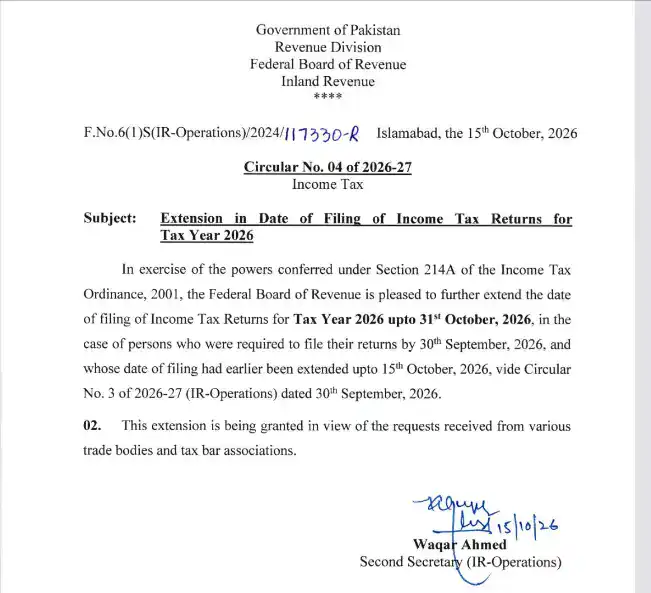
ISLAMABAD – Relief for taxpayers as Federal Board of Revenue (FBR) extended deadline for filing income tax returns for Tax Year 2026 to October 31, giving individuals, businesses and companies another opportunity to complete their tax obligations.

The latest extension comes after persistent demands from trade bodies and tax bar associations, which had urged the tax authority to allow more time for filing returns. The deadline was originally set for September 30 before the FBR moved it to October 15. With the latest decision, taxpayers now have until the end of October to submit their returns.

According to the FBR’s latest circular, the extension has been granted under Section 214A of the Income Tax Ordinance, 2001, and applies to taxpayers whose original filing deadline was September 30, 2026.

The repeated extensions show pressure surrounding this year’s tax filing process, with business representatives calling for greater flexibility to help taxpayers meet their legal requirements.

Trade organizations and tax bar associations had raised concerns about difficulties in completing returns within the prescribed timeframe. Earlier, tax professionals had also pointed to delays in the availability of return forms and technical problems with the FBR’s IRIS online filing system as obstacles to timely compliance.

The FBR said its latest decision followed requests from various trade bodies and tax bar associations.


The post Taxpayers get more Time as FBR pushes Deadline to October 31 appeared first on Daily Pakistan English News.

  •  

Petrol Price Cut by Rs3.63 to Rs390.23, Diesel Increased to Rs396.96

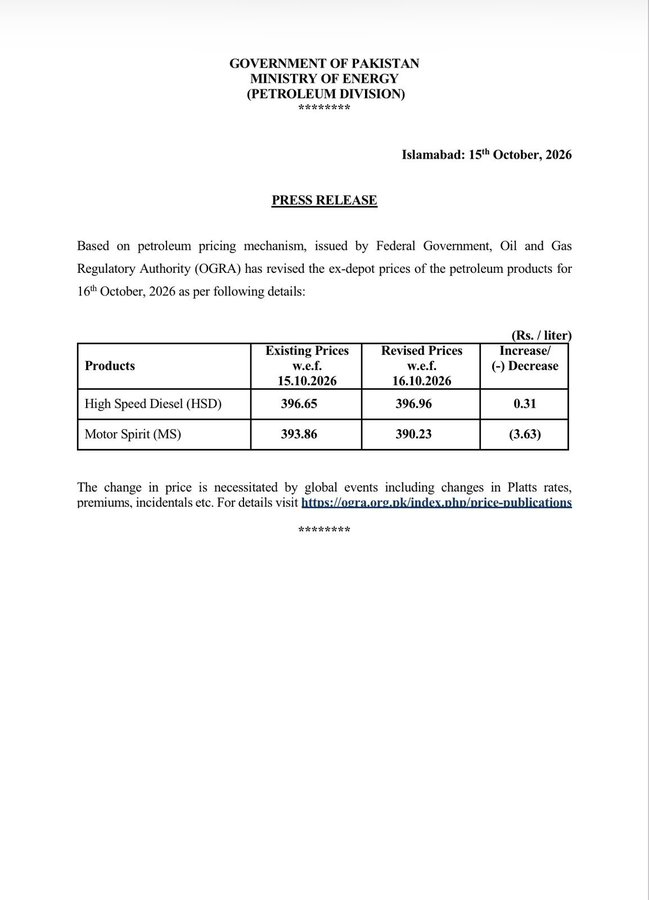
ISLAMABAD – The federal government reduced petrol prices by Rs3.63 per litre while increasing the price of high-speed diesel (HSD) by Rs0.31, offering motorists some relief but raising costs for diesel users.

Under revised rates effective Friday, October 16, 2026, petrol will cost Rs390.23 per litre, down from Rs393.86, while high-speed diesel will be priced at Rs396.96 per litre, compared with the previous rate of Rs396.65.

Petroleum Division announced the latest revision following a review by the Oil and Gas Regulatory Authority (OGRA) under the government’s petroleum pricing mechanism. The adjustment reflects movements in international market indicators, including Platts rates, premiums and other associated costs.

Earlier in the day, Brent crude futures fell by $1.15, or 1.1%, to $104.91 per barrel by 1157 GMT. In contrast, US West Texas Intermediate (WTI) crude futures rose by 31 cents, or 0.3%, to $95.40 per barrel, supported by expectations of a substantial decline in weekly US oil inventories.

High-speed diesel is widely used in freight transportation, agriculture and commercial operations. Higher diesel costs can increase transport and production expenses, potentially putting additional pressure on the prices of essential commodities and other goods.


The post Petrol Price Cut by Rs3.63 to Rs390.23, Diesel Increased to Rs396.96 appeared first on Daily Pakistan English News.

  •  

PERA Force, Suthra Punjab Jobs October 2026: Apply Online

LAHORE – Punjab Enforcement and Regulatory Authority (PERA) and Suthra Punjab Agency announced hundreds of vacancies in Punjab for October 2026. The recruitment drives offer employment opportunities for professionals, technical experts, administrative staff and sanitary workers in Lahore, Faisalabad and other districts of the province.

PERA is hiring for 110 professional positions in areas such as internal affairs, human resources, information technology, data analysis and auditing while Suthra Punjab Agency Faisalabad has announced 524 vacancies for sanitary workers under the provincial government’s cleanliness initiative.

The two organisations have introduced different application procedures and deadlines. Candidates applying for PERA positions must submit their applications online by October 29, 2026, while eligible applicants for Suthra Punjab sanitary worker jobs must attend walk-in interviews on October 28, 2026.

PERA and Suthra Punjab Jobs 2026

Suthra Punjab Agency Faisalabad has announced 524 positions for sanitary workers as part of the Punjab government’s cleanliness programme. The vacancies are being offered on a daily-wage basis to candidates who meet the basic eligibility requirements.

Applicants must be able to read and write and should have relevant work experience. The recruitment advertisement does not specify a formal degree or compulsory educational certificate for these positions.

Candidates must also be physically fit and capable of performing the duties associated with sanitary work. The maximum age limit is 45 years as of the application date.

Suthra Punjab Jobs: Eligibility and Interview Details

Job Information Details
Position Sanitary Worker
Number of Vacancies 524
Education Ability to read and write
Experience Relevant work experience
Maximum Age 45 years
Employment Basis Daily wages
Interview Date October 28, 2026
Interview Time 10:00 AM to 4:00 PM
Interview Venue Suthra Punjab Agency Complex, University Road, near the DC Office, Faisalabad

How to Apply for Suthra Punjab Jobs

Interested candidates must appear in person for the walk-in interviews scheduled for October 28, 2026. No separate online application process has been announced for these vacancies.

Applicants should bring the following documents:

  • Original Computerised National Identity Card (CNIC)
  • Photocopy of the CNIC
  • Handwritten application
  • Two recent passport-sized photographs

Candidates must report to the designated interview venue in Faisalabad between 10:00 AM and 4:00 PM. The agency will not provide travel or daily allowances to individuals attending the recruitment process.

PERA Jobs 2026 Positions

Punjab Enforcement and Regulatory Authority has announced 110 vacancies for qualified and experienced candidates across Punjab. The recruitment includes management, technical, auditing and internal affairs positions.

According to the recruitment announcement, 10 vacancies are available at PERA’s Directorate General in Lahore, while the remaining 100 positions are allocated to District Enforcement and Regulatory Board (DERB) secretariats in different districts.

The advertised posts cover several professional fields, including human resources, artificial intelligence, machine learning, full-stack development, systems analysis, data analytics, auditing and internal affairs.

Position Pay Scale Vacancies
Head (Internal Affairs) SPPP-2 1
Manager (Internal Affairs) SPPP-3 1
Team Lead (AI and Machine Learning) SPPP-3 1
Team Lead (Full Stack) SPPP-3 1
Deputy Manager (HR) SPPP-4 1
System Analyst SPPP-4 1
Data Analyst SPPP-4 1
Assistant Manager (Audit) SPPP-5 1
Assistant Manager (Internal Affairs – Headquarters) SPPP-5 1
System Support Officer SPPP-5 1
Deputy Manager (Internal Affairs – District Offices) SPPP-4 38
Assistant Manager (Internal Affairs – District Offices) SPPP-5 62
Total 110

Candidates must meet the educational qualifications, professional experience requirements and other conditions specified for their chosen positions. The main recruitment announcement does not provide complete details about the required degrees, experience levels or age limits for each post. Applicants should consult the detailed job descriptions on PERA’s official website to verify their eligibility.

Candidates applying for specialised technical positions should carefully review the requirements for artificial intelligence, machine learning, full-stack development, data analysis and systems support. Applicants for internal affairs, human resources and auditing roles should also check the relevant professional requirements.

PERA will appoint successful candidates on an initial three-year contractual basis under its Special PERA Pay Package (SPPP). The advertised positions fall under pay scales SPPP-2 to SPPP-5, with salary terms negotiable according to the position and applicable employment conditions. The recruitment announcement does not specify fixed monthly salary amounts.

Contracts may be extended depending on satisfactory performance and organisational requirements.

Applicants interested in PERA vacancies must submit their applications through the official Punjab Job Portal. The authority has stated that applications submitted through other methods will not be accepted.

The last date to apply for PERA jobs is October 29, 2026. Incomplete applications and submissions that do not meet the advertised requirements will not be considered.


The post PERA Force, Suthra Punjab Jobs October 2026: Apply Online appeared first on Daily Pakistan English News.

  •  

Over 100 Afghan Nationals Arrested in Balochistan during illegal Migration bid

QUETTA – Authorities in Balochistan detained 104 Afghan nationals during operations in Dasht and Turbat, foiling an alleged attempt to travel illegally to Iran and Europe, security sources said.

The arrests come amid intensified security operations across the province, where authorities are also pursuing counterterrorism efforts in several districts.

According to security sources, the Afghan nationals were apprehended while allegedly attempting to leave the country through illegal routes. However, further details about their identities, the suspected human-smuggling network and subsequent legal proceedings were not immediately available.

Security forces killed seven terrorists during intelligence-based operations in Washuk and Mastung districts, according to the Inter-Services Public Relations (ISPR) and security sources.

ISPR said five terrorists belonging to the group Fitna al-Hindustan were killed during an operation in Washuk on the night of October 12–13. The terrorists’ hideout was destroyed, while weapons, ammunition and explosives were recovered from the site, the military’s media wing said. A clearance operation was underway to search for any additional terrorists in the area.

Separately, security sources said two terrorists were killed near Paringabad in Mastung under Operation Radd-ul-Fitna 3 after reports of terrorist movement in the area.

ISPR said counterterrorism operations would continue under Azm-e-Istehkam to combat terrorism allegedly backed by foreign elements. Security sources also reaffirmed their commitment to tackling terrorism and preventing human smuggling in Balochistan.

The post Over 100 Afghan Nationals Arrested in Balochistan during illegal Migration bid appeared first on Daily Pakistan English News.

  •  

Pakistan tightens net on Fake Drugs with Mandatory 2D Barcodes

ISLAMABAD – Pakistani authorities have taken a major step toward tightening control over the country’s pharmaceutical market, with Drug Regulatory Authority of Pakistan (DRAP) making unique 2D Data Matrix barcodes and serial numbers mandatory for registered medicines manufactured locally or imported from October 9, 2026.

The move marks first phase of the country’s Pharmaceutical Track and Trace System, a regulatory initiative aimed at curbing counterfeit, falsified, spurious and unregistered medicines while strengthening oversight of the supply chain.

Under new requirements, pharmaceutical products falling within the scope of the regulations must carry unique identification codes containing key information about the product, its batch, expiry date and individual serial number. The system is expected to make medicines easier to trace and help authorities respond more effectively when safety concerns or suspected counterfeiting emerge.

The requirement applies to local manufacturers, multinational pharmaceutical companies and importers, covering registered medicines for human and veterinary use, including products intended for poultry.

The implementation came under review at a meeting chaired by Federal Health Minister Syed Mustafa Kamal on or around October 15, 2026, attended by the chief executives of DRAP and the National Information Technology Board (NITB). During the meeting, the DRAP chief briefed participants on the barcode and serialization arrangements. Kamal said the Ministry of Health had been working on the initiative for approximately 18 months, reaffirming the government’s commitment to eliminating counterfeit medicines from the market.

The minister also underscored the requirements for local and multinational manufacturers and highlighted restrictions on the sale of imported medicines that do not carry the prescribed codes. He further confirmed that the system extends beyond human medicines to veterinary and poultry products.

The expanded scope reflects the authorities’ approach to pharmaceutical safety as an issue that reaches beyond conventional healthcare, given the potential public-health implications of medicines used in animals.

By linking these details to individual packs, the system is intended to improve the traceability of medicines as they move through the pharmaceutical supply chain.

The information could assist regulators in investigating suspicious products, locating affected batches and coordinating recalls when medicines are found to be defective or unsafe. Companies that fail to comply with the applicable requirements may face legal action. However, serialization is not an absolute guarantee of authenticity. Counterfeiters could potentially copy legitimate codes, making effective verification, regulatory inspections and enforcement essential to the system’s success.

Despite the new mandate, consumers and retailers should not assume that every medicine without a 2D barcode is counterfeit. Products manufactured or imported before October 9, 2026, are exempt from the new coding requirement and may continue to be distributed and sold legally, subject to other applicable regulations.

This means pharmacies and medical stores may continue to stock older packaging while newly coded products gradually enter the market. The transition is expected to take place as existing inventories are sold and replaced. For consumers, the date of manufacture or import and the regulatory status of the product are therefore important considerations when assessing packaging that lacks the new identification code.

The initiative is also expected to introduce a digital verification facility through which consumers, pharmacists and medical store operators can check medicine details using a mobile application. According to ministerial statements and media reports, the proposed service is intended to help users verify product authenticity and access information such as price and expiry date.

However, details of the public-facing application have appeared more prominently in ministerial announcements and secondary reporting than in DRAP’s formal circulars, which primarily focus on manufacturers’ and importers’ obligations. The availability, precise functions and operating arrangements of the consumer application should therefore be confirmed through official announcements.


The post Pakistan tightens net on Fake Drugs with Mandatory 2D Barcodes appeared first on Daily Pakistan English News.

  •  

Tech Giants face AI Reality Check as Borrowing Costs, Credit Risks spike

Growing anxiety over financial sustainability of AI boom is sending shockwaves through credit markets, with the cost of protecting against potential debt defaults by major US technology companies surging and investors increasingly questioning whether the sector’s multibillion-dollar infrastructure investments will deliver the promised returns.

Credit Default Swap (CDS) costs climbed sharply for several tech companies, showing mounting concerns about debt exposure, borrowing costs and the profitability of the enormous investments being poured into AI infrastructure.

The warning signs are emerging despite AI-related stocks having recorded substantial gains in global markets this year. Over recent weeks, however, several companies have suffered notable share-price declines as investors reassess valuations amid inflationary pressures and rising interest rates.

CoreWeave raised alarm as CDS protection costs surged beyond 1,000 basis points, according to S&P Global Market Intelligence data cited in the report. The level is being interpreted as implying an approximately 63% probability of default over five years, compared with around 30% a year earlier.

The dramatic increase shows credit-market concerns surrounding highly leveraged businesses at the heart of the AI infrastructure boom. However, the implied probability is a market-based estimate, not a confirmed forecast that CoreWeave will default. CoreWeave is not the only company attracting greater scrutiny from credit-market investors.

iPhone 18 to carry ‘Higher Price Tag’ as Apple’s Costs jump amid AI Boom

CDS protection costs for Oracle have climbed to approximately 300 basis points, while Nvidia’s have risen to around 90 basis points in recent weeks. Meta’s CDS costs have reached approximately 104 basis points. By comparison, CDS index tracking investment-grade debt stands at around 60 basis points.

The gap shows how credit investors are assigning different levels of risk to individual companies compared with the broader investment-grade market. The trend also extends to major technology names, including Apple, Amazon and Microsoft, as demand for protection against potential debt defaults has increased across the sector. The report indicates that the pressure has been even more pronounced among certain heavily indebted competitors, suppliers and customers.

Rising CDS costs do not mean that these companies are on the verge of bankruptcy. They indicate that investors are demanding more money to insure against potential credit losses. The developments are unfolding against the backdrop of a vast global credit market.

International Swaps and Derivatives Association (ISDA) puts the market for CDS contracts linked to individual companies and debt issuers at approximately $9 trillion. Meanwhile, figures from the Bank for International Settlements indicate that the global bond market contains more than $150 trillion in debt securities.

Data from Depository Trust & Clearing Corporation show that average daily trading volume in the CDS market reached $16 billion in the second quarter, up from $13 billion a year earlier.

A credit default swap is a financial contract that provides protection against specified credit events, such as a borrower failing to meet its debt obligations. Investors use CDS contracts to hedge potential losses on bonds or to take positions based on their assessment of credit risk. The contracts are priced in basis points. At a CDS rate of 100 basis points, protection on $100 of debt costs approximately $1 annually.

As perceived default risk rises, investors typically demand higher premiums for providing protection, pushing CDS costs upward. Higher protection costs can also signal broader market concerns. Investors may sell the underlying bonds, potentially driving up borrowing costs for the companies involved and placing further pressure on their finances.

However, payouts depend on the terms of the contracts and whether a qualifying credit event occurs.


The post Tech Giants face AI Reality Check as Borrowing Costs, Credit Risks spike appeared first on Daily Pakistan English News.

  •  

Harimau Markhor-IV concludes with renewed focus on Pakistan-Malaysia Military Ties

PABBI – Pakistan and Malaysia successfully concluded their joint counterterrorism exercise, Harimau Markhore-IV, at the National Counter Terrorism Centre (NCTC) in Pabbi, reaffirming their commitment to strengthening bilateral military cooperation and enhancing counterterrorism capabilities.

According to the Inter-Services Public Relations (ISPR), the exercise provided troops from both countries with an opportunity to share operational experience, sharpen combat drills and exchange best practices in counterterrorism operations.

The joint training initiative underscored the importance of professional military engagement, operational coordination and the exchange of expertise in addressing evolving security challenges.

The successful conclusion of Harimau Markhore-IV reflects the longstanding defence ties between Pakistan and Malaysia and highlights their continued efforts to strengthen military-to-military cooperation through joint training and professional collaboration.

The post Harimau Markhor-IV concludes with renewed focus on Pakistan-Malaysia Military Ties appeared first on Daily Pakistan English News.

  •  

Naqvi slams Sohail Afridi of refusing to back Pak Army’s Anti-Terror Operations

ISLAMABAD – Interior Minister Mohsin Naqvi called out Khyber Pakhtunkhwa Chief Minister Sohail Afridi, saying he repeatedly refused to politically support operations against terrorists, saying he could not afford such a move politically.

Addressing a joint session of Parliament, Naqvi claimed that the federal government had made repeated efforts to secure the KP government’s cooperation in counterterrorism operations but failed to persuade the provincial leadership to take ownership of the fight.

“We wanted this to be Khyber Pakhtunkhwa’s fight. We simply wanted you to lead it, but the provincial government was not ready to take the lead,” Naqvi said, alleging that the provincial leadership had also failed to publicly condemn terrorism.

Naqvi claimed that Sohail Afridi had repeatedly expressed reluctance to support counterterrorism operations for political reasons. The interior minister said he had personally met Afridi several times and had agreed with him on strengthening police forces in five districts so they could take action against militants.

“I personally settled this matter with Sohail Afridi,” Naqvi said, adding that questions remained about who was influencing the chief minister after their meetings. Naqvi further claimed that the federal government had been trying since August, September or even earlier to secure the provincial government’s cooperation against terrorism, but the efforts had not produced the desired results.

Addressing speculation surrounding governor’s rule and the possible imposition of an emergency in parts of KP, Naqvi insisted that the federal government had not wanted to take such measures. He said the government had continued trying until the final hour to prevent an emergency from being imposed in 12 districts.

“We are not happy about governor’s rule or an emergency. The federal government take no pleasure in it,” he said, over such measures. Naqvi also rejected the suggestion that the government was exploiting terrorism for political purposes, saying that federal representatives had attended funeral prayers in Peshawar while, according to him, provincial government representatives were absent.

He cited the deaths of security personnel in Bannu and alleged that the chief minister had delivered a speech against the army the following day.

In a separate part of his address, Naqvi rejected claims that the federal government had abandoned negotiations with the opposition. He said the government had neither withdrawn from the talks nor imposed a deadline, insisting that it had repeatedly returned to the negotiating table.

According to Naqvi, the opposition had presented a document containing conditions that it said had been proposed by the KP government. He claimed the federal side had accepted those conditions, with the final point added by the government.

Naqvi maintained that he had personally intervened whenever KP faced financial difficulties, taking the provincial chief minister to the prime minister in an effort to resolve outstanding issues.

He renewed his offer of negotiations with Pakistan Tehreek-e-Insaf, urging senior party leaders to meet the government with the authority to make decisions. “Let PTI’s senior leaders come and talk. They should come with the authority to make decisions, and we will also come with authority from our prime minister. Whatever is agreed upon will be decided there and then,” he said.

Naqvi made clear that the government wanted negotiations to produce immediate decisions rather than agreements that would subsequently require approval from party leadership.

Mohsin Naqvi says government took no action outside constitutional limits

The post Naqvi slams Sohail Afridi of refusing to back Pak Army’s Anti-Terror Operations appeared first on Daily Pakistan English News.

  •  

Book on Sindh’s Taki Valley rock carvings launched

JAMSHORO – A book documenting rock carvings in Sindh’s Taki Valley was launched at the Dr N.A. Baloch Institute of Heritage Research at a ceremony attended by academics, students and cultural practitioners.

Written by anthropologist and heritage researcher Dr Zulfiqar Ali Kalhoro, Stones That Speak: Rock Carvings of the Taki Valley, Sindh draws on extensive fieldwork in the Khirthar mountains.

The institute organised the launch in collaboration with the Department of Anthropology and Archaeology, University of Sindh.

Speaking on the occasion, department chairman Dr Abdul Razaque Channa said the publication went beyond cataloguing rock carvings, examining them through archaeological, anthropological and ethnographic perspectives.

Based on nearly three decades of exploration, the book documented previously unrecorded petroglyphs, he said. Its subjects ranged from prehistoric hunting scenes and religious symbols to pastoral traditions and contemporary engravings.

Dr Channa said these carvings showed how Sindh’s mountain landscapes preserved a visual record of human activity and cultural expression. He also acknowledged Dr Kalhoro’s contribution to documenting the country’s archaeology, architecture and living traditions.

Welcoming participants, the institute’s deputy director, Dr Arshad Baloch, said this was the author’s third scholarly book published by the institute. He highlighted its review and editorial process and encouraged researchers to contribute original scholarship on Sindh’s history and culture.

Institute director Hakim Ali Rahujo outlined its work to preserve Dr N.A. Baloch’s scholarly legacy through research, publications, archives and heritage documentation.

Dr Muhammad Rafique Wassan appreciated the author’s detailed field documentation and encouraged students to undertake original research. Dr Muhabat Ali Shah said preserving heritage was a responsibility towards future generations, as knowledge could otherwise be lost over time.

Dr Zahida Rehman Jatt urged students to cultivate reading habits and participate in research that deepened their understanding of society, culture and history.

The ceremony was also attended by Assistant Director Wajid Channa and Sindh Institute of Music and Performing Arts director Rehmatullah Rajar. Students attending as part of their Anthropology of Art and Music course shared their observations and put questions to the speakers.

In his concluding remarks, Dr Arshad Baloch reaffirmed the institute’s commitment to publishing research on the intellectual and cultural heritage of Sindh and Pakistan.

The post Book on Sindh’s Taki Valley rock carvings launched appeared first on Daily Pakistan English News.

  •  

Update for Corolla Facelift Buyers as Toyota cuts Prices by Rs1Lac

Toyota Corolla Facelift comes with lower prices for selected variants, as the company axed prices for two variants, revised styling, and additional cabin features. The introductory ex-factory prices range from Rs6.099 million to Rs7.749 million, according to automotive reports dated October 14, 2026.

The biggest headline for budget-conscious buyers is a Rs103,000 reduction in the prices of both 1.6 Altis Manual and 1.6 Altis CVTi. At the other end of the lineup, Toyota has introduced a Grande variant with a chestnut interior, priced Rs40,000 above the black-interior version. The update, however, is not an entirely new-generation Corolla. Instead, it refreshes Pakistan’s long-running 11th-generation model with exterior revisions, interior changes and additional convenience features, while retaining the existing petrol engines and transmission options.

Toyota Corolla 2027 Prices in Pakistan

Variant Old Price New Price Price Change
1.6 Altis MT 6,202,000 6,099,000 −103,000
1.6 Altis CVTi 6,802,000 6,699,000 −103,000
1.6 Altis CVTi SE 7,339,000 7,339,000 No change
1.8 Altis CVTi 7,029,000 7,029,000 No change
1.8 Altis CVTi Grande, Black Interior 7,709,000 7,709,000 No change

With a difference of Rs1.65 million between the least expensive and most expensive variants, the refreshed Corolla lineup offers several configurations across the Rs6 million to Rs8 million price bracket.

The revised price list brings some relief for buyers considering the entry-level 1.6-litre models. 1.6 Altis MT has dropped from Rs6,202,000 to Rs6,099,000, while the 1.6 Altis CVTi is now priced at Rs6,699,000 instead of Rs6,802,000. Both variants have received an identical reduction of Rs103,000.

Not every model has become cheaper, however. The 1.6 Altis CVTi SE, 1.8 Altis CVTi and Grande with the black interior have reportedly retained their previous prices.

The new chestnut-interior Grande is priced at Rs7,749,000, carrying a Rs40,000 premium over the black-interior version. Meanwhile, the beige-interior Grande has been discontinued as part of the reported lineup changes.

Toyota’s latest refresh focuses heavily on appearance, particularly on the higher-specification variants. The facelift reportedly introduces a revised front grille and bumper, piano-black exterior detailing and integrated LED fog lamps on selected trims. The rear design has also received updates, while certain variants feature new 16-inch machine-finished alloy wheels.

The reported introductory prices apply to eligible vehicles invoiced between October 16 and December 31, 2026, subject to availability. The arrangement reportedly covers new bookings as well as existing orders placed by October 15, 2026, where a balance remains payable, provided the vehicles are invoiced within the specified period.

However, the introductory prices may not remain unchanged until delivery. Adjustments to government taxes, levies, tariffs, exchange rates or other applicable policies could affect the final invoice.

Toyota Corolla Facelift; Here’s What’s New for 2026 Model

The post Update for Corolla Facelift Buyers as Toyota cuts Prices by Rs1Lac appeared first on Daily Pakistan English News.

  •  
❌