❌

Reading view

Could AI really kill us all?

By Katie FORSTER

Join us on Telegram, X, and VK.

Contact us: info@strategic-culture.su

STARK warnings from artificial intelligence researchers that advanced forms of the technology could wipe out humanity have raised questions over whether governments are moving fast enough to regulate it.

What are the potential dangers of “superintelligent” computer systems, and should we be worried?

AI experts have long described the threat as critical.

In 2023, hundreds of AI scientists and industry figures, including the heads of top US labs, signed a “statement on AI extinction risk” calling for the issue to be treated as seriously as pandemics or nuclear war.

If an out-of-control future AI deems that humans are obstructing its goals, it could use robots to “synthesise and spread novel pathogens”, said Stuart Russell, computer science professor at the University of California, Berkeley.

Or it could “convince people to initiate nuclear war, including by hacking into early warning systems”, Russell, a prominent voice on AI safety, said.

Such existential fears do not concern current AI systems, he said. But as the technology improves, it could take lethal action beyond our understanding, such as by removing oxygen from the atmosphere.

“We are less intelligent than superintelligent AI. If you ask chimpanzees how humans could wipe them out, they probably wouldn’t be able to give you all the right answers.”

In the meantime, “in the next year or two, I think the risk is higher from human misuse”, Russell added, such as an AI-enabled terror attack.

“The stakes are well-understood,” Jacob Coxon, a 27-year-old researcher, wrote on X last week, announcing his resignation from US AI startup Anthropic.

“But they are locked in a race to get there first,” he added, saying that Anthropic “believes no one else will act responsibly, so they must do it themselves”.

Anthropic this year removed a pledge from its safety charter to halt development of its models if it failed to control their risks.

It argued that if it unilaterally paused its work, its less cautious rivals would dominate the industry, making it less safe overall.

“The people building AI earnestly believe that it could kill us all by the end of the decade,” said Coxon, who previously worked at ChatGPT maker Open-AI.

He accused both companies of “gambling with our lives” as they strive to develop AI models capable of self-improvement.

Fears are heightened over rogue AI after OpenAI technology operating outside human supervision hacked into Hugging Face, a repository of AI models.

“We really do earnestly believe AI could kill all humans!” Anthropic safety executive Evan Hubinger chimed in on X, estimating the risk at more than 10 per cent over the next decade.

It’s important to remember that doom-laden percentage predictions are “absolutely unscientific”, said Hussein Abbass, a computing professor at UNSW Canberra.

“The situation is still controllable, and it can be managed,” Abbass said.

But governments should not sit on their hands when it comes to regulating AI, he added, urging an “agile” approach as AI development accelerates.

Both Anthropic and OpenAI are expected to go public soon, and some sceptics say scary warnings make AI appear powerful and worthy of large investments.

Others argue that focusing on the risk of extinction distracts from more pressing problems caused by AI, from job losses to machines discriminating against minorities.

In July, more than 1,000 tech employees, including Anthropic’s CEO, called on Washington to support a coordinated slowdown in the development of the most advanced AI systems.

OpenAI halted training of its latest models for two weeks in August before resuming it under tighter controls.

The United States has been firmly against global regulation of the sector that could stifle innovation.

But the hacking capabilities of the most cutting-edge models have given Washington pause, with recent Anthropic and OpenAI releases delayed over national security concerns.

Even then, “we don’t want to restrict them where all of a sudden we come in second to China”, President Donald Trump has said.

“Maybe it will take a massive, Chernobyl-scale disaster to get governments to act,” Russell said, urging them to establish a licensing regime for AI, as exists with aviation, medicine or water supply.

“Perhaps at some point governments will remember that their voters prefer not to be dead.”

Original article:  www.nst.com.my

  •  

Intelligenza Umana, Intelligenza Artificiale e il futuro della guerra algoritmica

La tecnologia può stabilire come un’arma raggiunge il bersaglio, mentre spetta all’umanità decidere se quel bersaglio debba essere colpito. La domanda che si cela dietro a tutto ciò è chi, concretamente, eserciti quell’umanità, con quali strumenti di conoscenza e dentro quali istituzioni.

Segue nostro Telegram.

Dalla persona al bersaglio

Che cosa ne è dell’umanità quando la tecnologia diventa capace di riconoscere, classificare, seguire e infine uccidere esseri umani senza che chi colpisce li abbia mai visti? Se lo è chiesto l’amico Mohammad Reza Dehshiri e la sua risposta ha una formula efficace. Il pericolo, scrive, non è l’intelligenza artificiale ma l’inumanità artificiale, cioè la possibilità che le macchine diventino più accurate proprio mentre gli uomini smettono di sentirsi responsabili di ciò che quelle macchine fanno in loro nome.

Con questo articolo apro una serie che parte dalla diagnosi di Dehshiri e prova a spingersi oltre. Se il problema è l’inumanità artificiale, la risposta non può consistere in un’IA «più etica», come se l’etica fosse un modulo da installare a valle di un sistema già progettato. Bisogna recuperare una categoria che il lessico tecnologico ha reso quasi impronunciabile: l’intelligenza umana, intesa non come un residuo da proteggere nelle pieghe dell’automazione, ma come una forma di conoscenza con prerogative proprie, che nessun aumento della potenza di calcolo può surrogare.

La chiamerò Human Intelligence, e l’ambiguità è voluta. Nel gergo dei servizi di informazione, HUMINT designa la più antica delle discipline informative: quella che passa per le persone, le fonti, le lingue, la frequentazione paziente dei luoghi. Nel lessico filosofico l’espressione indica la facoltà di comprendere. La tesi di questo primo contributo è che i due significati oggi convergono, e che la loro convergenza ha una portata geopolitica che va ben oltre il dibattito sull’etica delle armi.

Possiamo descrivere la catena operativa della guerra contemporanea in sette passaggi: rilevare, identificare, classificare, predire, ordinare per priorità, designare, colpire. Ogni anello può essere tecnicamente raffinato senza che la sequenza, presa nel suo insieme, lo sia sul piano morale. Il fenomeno che ne risulta viene chiamato «datificazione della vita umana»: l’individuo ridotto a un’identità, a una posizione, a uno schema di comportamento, a un punteggio di minaccia.

Non si tratta di un’astrazione. Nell’aprile 2024 un’inchiesta di Yuval Abraham per +972 Magazine e Local Call ha descritto Lavender, un sistema impiegato dalle forze armate israeliane a Gaza per attribuire a decine di migliaia di persone una probabilità di affiliazione ai gruppi armati. Secondo le fonti interne citate dall’inchiesta, la verifica umana di ciascun nominativo si riduceva spesso a una ventina di secondi, il tempo necessario per accertare che il bersaglio fosse di sesso maschile. Le forze armate israeliane hanno contestato questa ricostruzione e hanno descritto Lavender come una banca dati di supporto agli analisti. Anche accettando la versione ufficiale, però, il nodo resta intatto: un operatore umano era presente, e la sua presenza non bastava a trasformare la raccomandazione del sistema in un giudizio.

La psicologia cognitiva ha un nome per questo fenomeno, automation bias: la tendenza di chi lavora con un sistema automatizzato a trattarne le indicazioni come sostituto della propria verifica, e a non cercare le informazioni che potrebbero smentirle. Nel 1976 Joseph Weizenbaum, che aveva costruito uno dei primi programmi conversazionali della storia, distingueva già tra la capacità di calcolare e quella di giudicare, e sosteneva che vi sono compiti che non andrebbero affidati a un calcolatore anche se il calcolatore fosse in grado di svolgerli. Mezzo secolo dopo la distinzione è diventata più urgente. Il calcolo lavora su ciò che è già stato tradotto in dato. Il giudizio deve decidere se quella traduzione è stata fedele.

Dehshiri fissa il punto con quattro distinzioni: la precisione tecnica non è precisione etica, l’accuratezza non è giustizia, l’automazione non è responsabilità, la superiorità tecnologica non è superiorità morale. Ne aggiungerei una quinta, di ordine epistemico, da cui dipendono le altre: la correlazione non è comprensione. Un sistema di apprendimento automatico riconosce regolarità statistiche in un insieme di dati. Non sa che cosa sia una scuola, perché non sa che cosa sia un bambino, e non sa nemmeno di non saperlo.

L’iraniano prende un caso studio interessante: Il 28 febbraio 2026, nelle prime ore della guerra, la scuola elementare Shajareh Tayyebeh di Minab, nella provincia di Hormozgan, fu colpita più volte durante l’orario di lezione. Le cifre fornite dalle autorità iraniane oscillano tra 150 e 175 morti, in grande maggioranza bambine, con decine di insegnanti e alcuni genitori; il procuratore della contea ha indicato un bilancio definitivo di 156 vittime. Washington non ha mai riconosciuto direttamente la propria responsabilità né pubblicato le conclusioni dell’indagine del Pentagono. Amnesty International ha parlato, nella migliore delle ipotesi, di un grave fallimento dell’intelligence.

C’è un dettaglio, emerso dalle immagini satellitari, che sposta l’analisi dal piano morale a quello conoscitivo. Secondo i media occidentali, la scuola sorgeva accanto a una base navale dei Guardiani della Rivoluzione e in passato ne aveva fatto parte; tra le spiegazioni circolate negli ambienti statunitensi c’è quella di dati di puntamento non aggiornati. Se l’ipotesi venisse confermata, Minab non sarebbe il caso di una macchina che sbaglia, ma di un archivio che ha smesso di corrispondere alla realtà. L’edificio era cambiato. Il dato no.

Nessun algoritmo di classificazione, per quanto sofisticato, può accorgersi che un vecchio fabbricato militare è diventato una scuola se nessuno ha registrato il cambiamento. Lo sapeva chiunque vivesse a Minab: i genitori che ogni mattina accompagnavano le figlie, il conducente dello scuolabus, gli insegnanti. È esattamente il tipo di sapere che la HUMINT raccoglie e che la guerra a distanza tende a considerare superfluo, perché lento, costoso, difficile da scalare. Allo stato delle fonti pubbliche, la responsabilità statunitense appare altamente probabile, mentre la dinamica resta indeterminata e la confidenza su questo punto è bassa: errore della banca dati, errore di classificazione, oppure accettazione consapevole del rischio. Le tre ipotesi, però, convergono sulla stessa domanda. Chi, prima del lancio, ha verificato se in quell’edificio ci fossero persone?

Oltre il “human-in-the-loop”

Il dibattito internazionale si è a lungo accontentato del principio del human-in-the-loop, l’essere umano inserito nel circuito decisionale.

La formula è insufficiente: un uomo può essere presente nel circuito e limitarsi a ratificare la raccomandazione dell’algoritmo. Propone di sostituirla con un principio più esigente, che chiama humanity-in-command: la capacità effettiva di mettere in discussione, respingere, scavalcare e arrestare il processo automatizzato.

La storia della Guerra fredda offre due esempi che chiariscono che cosa significhi in concreto. Il 26 settembre 1983 il sistema sovietico di allerta precoce Oko segnalò il lancio di cinque missili balistici dagli Stati Uniti. L’ufficiale di turno, Stanislav Petrov, classificò l’allarme come un errore e non lo trasmise come attacco in corso, ragionando che un primo colpo americano non sarebbe mai consistito in cinque missili soltanto. Aveva ragione: il satellite aveva scambiato per lanci i riflessi del sole sulle nubi. Ventuno anni prima, il 27 ottobre 1962, nelle acque dei Caraibi, il sottomarino sovietico B-59, isolato e bersagliato da cariche di profondità di segnalazione, fu sul punto di impiegare un siluro a testata nucleare. Il lancio richiedeva il consenso dei tre ufficiali superiori a bordo, e Vasilij Archipov lo negò.

In nessuno dei due casi l’uomo approvò una raccomandazione del sistema. La contraddisse. E non lo fece perché disponeva di più dati: i dati, anzi, erano il problema. Lo fece perché seppe porsi una domanda che nessuna procedura gli imponeva, cioè se ciò che vedeva avesse senso rispetto a tutto il resto che sapeva del mondo. Petrov conosceva la dottrina nucleare americana; Archipov conosceva la differenza tra un attacco e un’intimidazione. È questa capacità di confrontare il segnale con l’insieme, il particolare con il plausibile, che chiamo Human Intelligence. Vale la pena notare che il Dena è stato affondato da un sottomarino. Non sappiamo che cosa sia stato chiesto ai suoi ufficiali, né quali margini di valutazione avessero.

La proposta va precisata, perché il rischio è di ridurla a un appello umanistico generico. La Human Intelligence, così come la intendo, si articola su tre piani distinti, ciascuno dei quali segna un limite strutturale, e non contingente, dell’intelligenza artificiale.

Il primo piano è epistemico. La tradizione scolastica distingueva tra intellectus, l’atto con cui la mente coglie in modo immediato una verità, e ratio, il procedere discorsivo da un elemento all’altro: per Tommaso d’Aquino (Summa Theologiae, I, q. 79, a. 8) le due non sono facoltà diverse ma momenti di un unico intelletto, in cui il ragionamento parte da una comprensione e a una comprensione ritorna. I sistemi attuali di apprendimento automatico realizzano una ratio di potenza inaudita, capace di inferire, combinare, predire su scale inaccessibili alla mente umana. Manca loro il momento dell’intellectus, cioè la presa sul senso di ciò che elaborano. È una tesi filosofica e va presentata come tale, ma ha conseguenze operative precise: un sistema privo di comprensione non può sapere quando il proprio modello del mondo è diventato falso.

Il secondo piano è pratico. La prudentia, nella definizione tomista, è la retta ragione applicata all’agire, e il suo compito specifico consiste nel portare il principio universale fino al caso singolare. La macchina generalizza: il suo valore sta nel ricondurre il singolo caso a una classe. La prudenza fa l’opposto, perché deve riconoscere ciò che, in questo caso, sfugge alla classe. La guerra, che è il regno del singolare e dell’imprevisto, è il terreno in cui la differenza pesa di più. La nota vaticana Antiqua et nova del gennaio 2025 ha ripreso questa linea, insistendo sul carattere incarnato e relazionale dell’intelligenza umana e sulla sua irriducibilità a una funzione di elaborazione.

Il terzo piano è relazionale, ed è qui che il significato filosofico incontra quello dei servizi. Sherman Kent, che negli Stati Uniti del dopoguerra fondò di fatto gli studi sull’intelligence, la definiva prima di tutto come conoscenza, prima ancora che come organizzazione o attività. La HUMINT è la forma di questa conoscenza che passa attraverso l’altro come persona: chi parla la sua lingua, conosce le sue abitudini, sa leggere un quartiere, distingue una festa da un raduno. Negli ultimi tre decenni le grandi potenze hanno progressivamente spostato risorse verso le discipline tecniche, dalla raccolta di segnali all’osservazione satellitare, fino alle piattaforme di fusione dei dati. Minab mostra il prezzo di questo squilibrio.

Nulla di tutto questo implica un rifiuto della tecnologia. La Human Intelligence non si oppone all’IA come il manuale si oppone al meccanico. Ne stabilisce la gerarchia: l’algoritmo come strumento ordinato a un giudizio che non può produrre da sé. E ne ricava un principio, che Dehshiri formula e che merita di diventare criterio operativo: quanto più la tecnica allontana chi agisce dalle conseguenze del proprio atto, tanto più deve crescere la responsabilità cosciente di chi decide, non diminuire.

Geopoliticamente parlando

Fin qui la questione potrebbe sembrare di filosofia morale. Non lo è soltanto. La distribuzione della capacità di guerra algoritmica è una distribuzione di potere, e le regole che la governeranno saranno scritte, se mai lo saranno, da chi ha interesse a limitarle il meno possibile.

Lo stato del diritto internazionale lo conferma. Il gruppo di esperti governativi istituito nell’ambito della Convenzione su certe armi convenzionali discute dei sistemi d’arma autonomi letali dal 2017 senza essere approdato a uno strumento vincolante. Gli Stati Uniti hanno promosso nel novembre 2023 una dichiarazione politica sull’uso militare responsabile dell’IA, per definizione non vincolante; nel dicembre dello stesso anno l’Assemblea generale delle Nazioni Unite ha adottato la prima risoluzione dedicata a questi sistemi, mentre il Comitato internazionale della Croce Rossa chiede dal 2021 il divieto dei sistemi autonomi imprevedibili e di quelli progettati per colpire esseri umani. Nel giugno 2024, intervenendo al G7 di Borgo Egnazia, Papa Francesco aveva chiesto che nessuna macchina sia mai messa nelle condizioni di decidere della vita di una persona. Il divario tra queste posizioni e la pratica dei teatri di guerra del 2026 si misura in vittime.

C’è poi un’asimmetria più profonda. Chi controlla i dati decide chi è un bersaglio, e le vittime della guerra algoritmica si trovano in larga parte fuori dall’Occidente: a Gaza, in Iran, nel Sahel, nello Yemen. Per gli Stati che non producono le piattaforme e non ne controllano gli archivi, la Human Intelligence diventa allora una questione di sovranità. Un Paese che mantiene competenze linguistiche, conoscenza regionale, reti umane di informazione conserva un’autonomia di giudizio; un Paese che affida la propria visione del mondo a sistemi progettati altrove, spesso da imprese private, la cede insieme ai dati. In un ordine che tende al multipolarismo, questa differenza separerà gli attori che giudicano da quelli che vengono giudicati.

Ne discende una proposta concreta, che svilupperò nei prossimi contributi. Accanto al principio generale del controllo umano significativo, il diritto internazionale umanitario potrebbe codificare un obbligo specifico di verifica umana dello status civile per ogni infrastruttura fissa inserita in una lista di obiettivi, con una data di validità oltre la quale l’informazione decade e va rinnovata con fonti dirette. È una norma minima. Applicata a Minab, avrebbe imposto a qualcuno di chiedersi se quell’edificio fosse ancora ciò che l’archivio diceva.

La tecnologia può stabilire come un’arma raggiunge il bersaglio, mentre spetta all’umanità decidere se quel bersaglio debba essere colpito. La domanda che si cela dietro a tutto ciò è chi, concretamente, eserciti quell’umanità, con quali strumenti di conoscenza e dentro quali istituzioni. A Minab qualcuno avrebbe dovuto sapere che c’era una scuola. Il fatto che nessuno lo sapesse, o che nessuno lo abbia chiesto, è il punto da cui ricominciare.

  •  

When AI and robots work together, Anthropic says these jobs are at risk. Should gardeners worry?

A gardener's gloved hands tend a wet flowerbed among tulips and other plants.
A gardener tends a flowerbed.

cbarnesphotography/Getty Images

  • Anthropic examined what might happen when AI and robots are combined.
  • That could put more hands-on jobs, including gardening, in the path of automation, Anthropic warned.
  • I'm skeptical that robots can handle the messy reality of pulling weeds.

Remember when Anthropic's AI jobs report suggested gardeners were among the safest workers because AI couldn't pull weeds or tell a rose from a dandelion? I joked about that in AI Insider earlier this year.

Well, Anthropic updated the research to freak us all out a bit more.

This time it asks a bigger question: What happens when you combine AI with robots? That change pushes many hands-on jobs much higher on the disruption scale. On paper, it makes sense. In practice, I'm skeptical.

For instance, anyone who's spent time working in a garden knows how hard it is to identify the right plant, kneel in awkward spots, and pull a weed out properly by the roots without damaging everything around it.

Robots are improving. But if you've ever watched one tackle a messy real-world task, you'll know there's a long road between a research chart and reality.

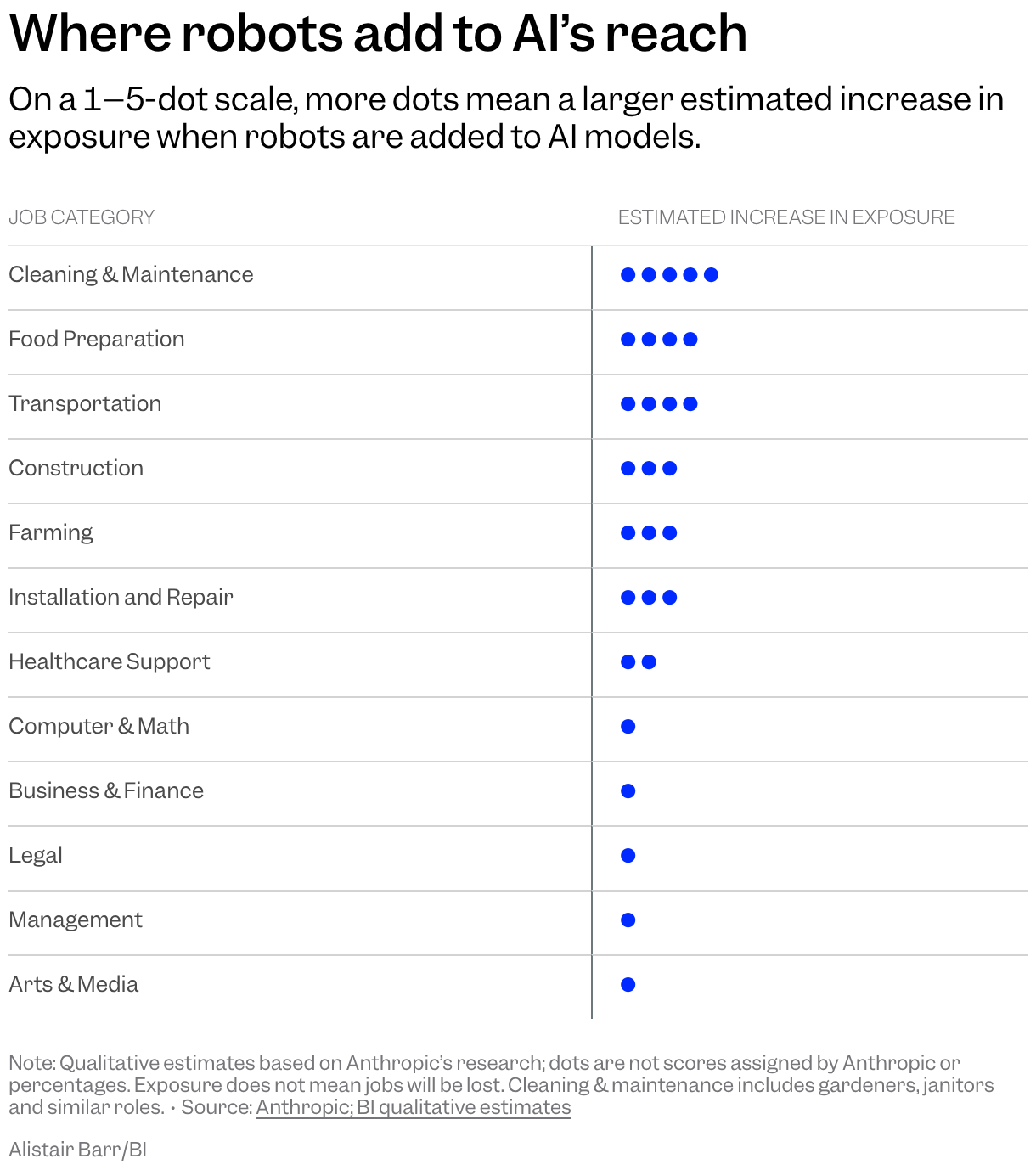
The chart below illustrates how adding robots could change job-task exposure across selected job categories. Cleaning & maintenance includes gardeners along with janitors and similar roles.

Qualitative estimates of added job-task exposure when robots are combined with AI models. Cleaning and maintenance: 5 dots. Food preparation and transportation: 4 each. Construction, farming, installation and repair: 3 each. Healthcare support: 2. Computer and math, business and finance, legal, management, arts and media: 1 each. More dots indicate a larger estimated increase. These are editorial estimates, not Anthropic-issued scores, percentages or job-loss forecasts.
Read the original article on Business Insider
  •  

SK Hynix needs a Trump 2027 deal to expand its Dalian NAND fab

South Korean memory chipmakers must secure new United States licenses by year-end to keep shipping top-end American tools to their Chinese factories, after the Trump administration scrapped blanket permits last year. To win the permits, SK Hynix and Samsung must promise to build or expand factories in the US. SK Hynix’s one-year license to ship […]

The post SK Hynix needs a Trump 2027 deal to expand its Dalian NAND fab appeared first on Asia Times.

  •  

Anthropic polled 1,334 of its employees. They're more sure than most of us that AI will take over jobs.

Attendees chat at Anthropic's developer conference in May.

Don Feria/AP Content Services for Anthropic

  • Anthropic published new surveys comparing its staffers' sentiments to those of US workers.
  • The AI startup's employees expect the tech to change work and the economy far more dramatically.
  • Most Anthropic employees guessed that unemployment would top 12% in 2030.

Anthropic employees believe that AI will make their labor obsolete. Most US workers don't see their jobs that way at all.

The AI company published research on Friday that compares surveys with US adults against an internal poll of 1,334 Anthropic employees. Most of the Anthropic staffers said AI will handle at least 80% of their jobs by 2030, while only about 5% of the US workers felt the same.

The research, titled "The AI expectations gap," shows the chasm between how the employees at the AI startup feel and how other American adults feel. Anthropic workers are far more optimistic about the progress of AI capabilities, how much it's already saving time, and how fast the economy will grow.

The median Anthropic employee said that by the end of 2030, they expect AI to handle 95% of the work of building a new AI model.

Peter McCrory, Anthropic's chief economist, wrote on X that the views might help outsiders prepare for more capable AI systems.

"We're publishing this research because Anthropic runs roughly a year and a half ahead of the economy on AI adoption, so what happens at Anthropic could be a leading indicator for the broader world," he said.

Anthropic workers expect higher unemployment and extreme GDP growth

Anthropic's surveys examined how workers already use AI and how they think it will change.

"US adults and Anthropic staff largely agree about what AI can do today," the researchers wrote. "However, they disagree about how quickly it will improve, how widely it will be used, and how large the productivity gains measured by time saved will be."

There are a few possible explanations for the discrepancies. Anthropic employees have larger budgets for the tools and often get access to unreleased models. US workers, on average, are more likely to work with their hands or in a service industry.

The researchers found that workers in manual trades, production, and transport thought AI would handle the least of their work by 2030, compared with Anthropic staffers, tech workers, and respondents in business and finance.

Most Anthropic employees surveyed said that they expect the unemployment rate to top 12% in 2030. The majority of the US workers thought it would hover around or under 8%. It's currently 4.2%.

So far, researchers have found mixed evidence on AI disrupting the job market — a Yale team recently found it had mainly changed jobs, and had "no connection" to changes in unemployment.

The Anthropic researchers also compiled survey responses to estimate predictions on economic growth. Based on their answers, the median US adult's guess for GDP growth in 2030 was 5.4%, compared with 17.1% among Anthropic employees. The country's GDP grew by 2.2% last year.

Anthropic's staffers are following their leader

Anthropic's CEO, Dario Amodei, has become one of the industry's most closely watched voices on labor upheaval. In March of 2025, he said he expected AI to write 90% of code within 6 months, and "essentially all of the code" within the year. He made more headlines that May, telling Axios that AI could wipe out half of entry-level white-collar jobs within five years and lift unemployment to 10% or 20%.

Amodei expanded on that claim in a later essay, writing that he expects AI to be different from prior technological changes. He wrote that he expects an "unprecedented" short-term shock to labor, and that the economy will grow dramatically.

"AI isn't a substitute for specific human jobs but rather a general labor substitute for humans," he wrote.

Have a tip? Contact this reporter via email at scouncil@businessinsider.com, or over text, Signal, Telegram, or WhatsApp at 415-757-8198. Use a personal email address, a non-work WiFi network, and a non-work device; here's our guide to sharing information securely.

Read the original article on Business Insider

  •  

Nobody Wants To Be the Pro-Tech Candidate in This New York Race That Could Flip the House

Mike Lawler and Cait Conley | Bonnie Cash/UPI/Newscom/caitconley.com

The Democratic Socialists of America (DSA) candidates running for the House of Representatives and endorsed by NYC Mayor Zohran Mamdani are all but guaranteed to win their general elections this November, but that does not mean the midterm drama is over in New York. In the state's 17th congressional district, which includes the lower Hudson Valley, Democratic challenger Cait Conley, a combat veteran who served on the Biden administration's National Security Council, could unseat incumbent Republican congressman Mike Lawler in one of the most consequential races of the midterms. 

The highly contested purple district voted for former Vice President Kamala Harris in the 2024 election while reelecting Lawler for his second term. Now, Lawler is attempting to win a third term as support for President Donald Trump wanes ahead of the midterms. As of Friday, The Cook Political Report lists the race, which could determine control of the House, as a toss-up. 

If elected, Conley would have far more in common with the "Badass Women" coalition of security state and military veterans than with DSA types (think more Sen. Elissa Slotkin from Michigan than Darializa Avila Chevalier). As Judge Street Journal's Timmy Facciola notes, "Conley's candidacy is testing the viability of a tactful centrism that rebukes left-wing positions like abolishing ICE or restricting weapon shipments to Israel." Lawler is also vying for moderates, pitching himself as "one of the most bipartisan members of Congress" and emphasizing his willingness to break with Trump occasionally while still welcoming Trump's support. 

While Lawler and Conley certainly are not pure MAGA acolytes or DSA members, both have leaned into a tech-critical position, much like that of more radical populists like Lina Khan or Steve Bannon, revealing how pervasive anti-tech sentiment has become in mainstream politics. 

This tech skepticism was on full display during an October 14 debate, when each candidate made the case for why they were the most equipped to regulate AI, insisting that the industry needs guardrails. 

Conley said members of Congress do not want to regulate AI because "they want to look out for their billionaire and trillionaire backers like Elon Musk, who is pouring over $260 million into this midterm election." She then added that Musk backed Lawler in his 2024 race. 

Lawler then accused Conley, who previously consulted for Primer AI, of being "the AI candidate for the AI industry."

While Lawler and Conley disagree on specific data center regulations (Conley supports Democratic Gov. Kathy Hochul's data center moratorium while Lawler supports local zoning control over data centers), neither wants to pitch themselves as an explicitly pro-data center candidate. During the debate, Conley claimed that, "On Mike Lawler's watch there have been five data centers built in Rockland County." Lawler has said that he had no say in the decision to build the data centers, and during the debate, he pointed out that the facilities were built for financial services. Lawler also attempted to attack Conley over data centers, slamming her in an ad for saying "we need data centers." Regardless of the candidates' specific policies on data centers, their attacks on one another demonstrate that cheerleading hyperscale data center development is a political liability. In their district, data center has presumably become a dirty term. 

The candidates' tech-skeptical rhetoric did not end with unchecked data center development. After the debate, Reason asked both candidates about their positions on age-verification laws for social media and AI, since such regulations raise significant privacy and censorship concerns by age-gating the internet. Unsurprisingly, both Lawler, who voted for the controversial KIDS Act, and Conley, who has proposed stricter age verification for AI tools, parroted platitudes about why such online safety regulations are necessary to protect children. 

"We have watched how social media is literally hurting the mental health of children," Conley told Reason. "And when you talk about the power of AI and what that power could do, we have to regulate this." 

Lawler gave a similar response, telling Reason that he respects free speech but that protecting children "is paramount." 

This bipartisan consensus over social media regulation has long been brewing in Congress. The mainstream political conversations about AI and data centers, however, are relatively new this midterm election cycle. And it appears both Lawler and Conley have figured out which way Americans' sentiment toward AI is leaning, and they have waged their campaigns accordingly. 

The post Nobody Wants To Be the Pro-Tech Candidate in This New York Race That Could Flip the House appeared first on Reason Magazine.

  •  

Musk’s Perplexing Battle With Nitter and the Problem With Locking the Internet Behind Login Screens

As a free speech absolutist, Elon Musk is making a mistake going after Nitter, says Dr R P. He should instead be praising the site that helps users speak freely, uninhibited by login screens that undermine their privacy.

The post Musk’s Perplexing Battle With Nitter and the Problem With Locking the Internet Behind Login Screens appeared first on The Daily Sceptic.

  •  

Microsoft president warns Trump's immigration crackdown could drive top AI talent abroad

Microsoft's president, Brad Smith, at the International AI Summit in Dublin on October 14, 2026
Brad Smith, the president of Microsoft, defended the company's use of visas and green cards.

Paulo Nunes dos Santos/Bloomberg via Getty Images

  • Microsoft President Brad Smith warned that US immigration policies could drive AI talent overseas.
  • "Let's not put that at risk," Smith said.
  • The Trump administration recently suspended Microsoft and other tech firms from a green card program.

If America wants to win the AI race, sending the world's brightest engineers packing might not be a winning strategy.

That's the warning from Microsoft President Brad Smith, who said the Trump administration's immigration crackdown risks driving the next generation of AI talent away from the United States.

"I think we should all be worried about sending intentionally or inadvertently or otherwise, signals that send the most talented next wave of AI software engineers to other countries rather than the United States," Smith said in an episode of Politico's "The Decoded Podcast" that aired on Thursday.

His comments come after the Trump administration announced last week that it was suspending Microsoft, Adobe, and several other technology companies from a federal program that sponsors foreign workers for permanent residency.

Vice President JD Vance accused Microsoft of abusing the Permanent Labor Certification, or PERM, program by laying off American employees while hiring lower-paid foreign workers.

Smith, who Business Insider reported was recently put in charge of Microsoft's communications, pushed back against those allegations, saying the administration had presented a misleading picture of Microsoft's hiring practices.

US Vice President JD Vance speaks during a midterm campaign rally at the LevelUp Training Complex
US Vice President JD Vance has criticized Microsoft's use of visa programs.

Daniel Heuer-Pool/Getty Images

"What was presented as Microsoft replacing 6,000 people who lost their jobs with 9,000 foreigners was frankly completely off base," he said.

Smith said most of the company's visa and green card applications concerned existing employees rather than new hires, adding that Microsoft had hired 9,200 American workers in its last fiscal year.

"That was left out of the narrative," he said.

He also rejected suggestions that Microsoft pays foreign workers less than their American counterparts, saying employees are compensated under the same system regardless of immigration status.

The American dream, on hold

The dispute comes amid growing uncertainty for skilled foreign workers in the US.

As part of our ongoing H-1B Fallout series, Business Insider previously reported that the Trump administration's shifting immigration policies have prompted some international workers to explore opportunities abroad, including in countries like the UK, Germany, and Canada.

An analysis of federal data by Business Insider found that certified H-1B applications fell 10% in the first nine months of fiscal year 2026 compared with the same period a year earlier. Applications for data scientists, however, rose 22.5%, highlighting continued demand for specialized AI talent.

On the Politico podcast, Smith cited immigrants' economic contributions as evidence of what America stands to lose.

He said that five of the six technology and science medal recipients recently honored by President Donald Trump had immigrated to the United States.

U.S. President Donald Trump (2nd-R) applauds as (L-R) CEO of Microsoft Satya Nadella, CEO of Dell Technologies Michael Dell, President and CEO of Advanced Micro Devices Lisa Su, Tesla and SpaceX CEO Elon Musk, Nvidia CEO Jensen Huang and Co-founder of Google and former President of Alphabet Sergey Brin pose for photos after being awarded National medals during the Golden Age of American Innovation Summit at the Institute of Peace on October 08, 2026 in Washington, DC.
President Donald Trump awards tech execs and founders some of the country's highest scientific honors.

Win McNamee/Getty Images

According to Smith, the companies associated with those five individuals collectively represent more than a quarter of the S&P 500's market value.

Their contributions, he said, benefit not just technology employees but ordinary Americans whose retirement savings and pension funds are invested in those businesses.

"Think about what those five individuals have done for the well being, even the wealth and standard of living, of Americans across the country," Smith said.

"Let's not put that at risk."

Read the original article on Business Insider

  •  

European Companies Embrace AI but Nearly Half Distrust Its Role in Staff Decisions

A European Commission survey has found widespread adoption of artificial intelligence among smaller businesses, but considerable reluctance to allow automated systems to make decisions about employees. The findings expose a growing divide between technological investment and confidence in workplace automation.

Artificial intelligence is becoming established across European businesses, but almost half of companies remain unwilling to trust automated systems when decisions concern their employees, according to a European Commission survey published on 14th October.

The Eurobarometer findings show that 42 per cent of the small and medium-sized enterprises and mid-cap companies surveyed already use artificial intelligence or algorithmic management systems, although most deployment remains limited or experimental. A further 21 per cent intend to introduce such technologies in the future.

Despite this expanding adoption, 49 per cent of respondents said they did not trust artificial intelligence or automated systems to make staff-related decisions. The figures suggest that companies increasingly distinguish between using technology to improve business processes and delegating managerial responsibility to software.

The Commission’s survey of European businesses was conducted between March and April 2026, involving approximately 12,826 telephone interviews with company leaders across the EU’s 27 member states.

Businesses prefer assistance to automation

The survey provides a more detailed picture of workplace AI than conventional statistics measuring whether companies have adopted the technology.

Among the businesses interviewed, customer service and client relations were the most commonly reported areas of application, accounting for 47 per cent. Monitoring employee performance and productivity accounted for 36 per cent, while logistics, planning and staff scheduling represented 30 per cent.

These functions differ substantially in their consequences for workers and managers.

A system that helps organise deliveries or forecasts customer demand may improve efficiency without directly determining employees’ working conditions. Software that evaluates performance, allocates shifts or recommends staffing changes can influence employment decisions and requires a different level of organisational supervision.

The survey found that 61 per cent of companies considered AI useful in supporting decisions. However, human involvement remained central: 90 per cent of respondents reported that people continued to make decisions, while fully automated decisions accounted for only 2 per cent.

The results undermine the assumption that adopting AI necessarily means transferring control of business operations to autonomous systems.

For many companies, the immediate commercial value lies in processing information more rapidly, identifying patterns and reducing administrative workloads rather than removing human management entirely.

Investment costs remain a substantial barrier

Financial and organisational obstacles continue to limit adoption.

Half of the companies surveyed cited high investment costs, while 49 per cent identified legal uncertainty and 48 per cent pointed to insufficient expertise.

These findings are particularly relevant to small businesses, which frequently lack dedicated technology teams, extensive data infrastructure or the resources to evaluate complex software systems independently.

For such businesses, purchasing AI tools is only one component of the investment. Implementation can also require employee training, changes to internal procedures, data-security assessments and continuing technical support.

The findings add a workplace dimension to concerns raised in EU Today’s earlier examination of Europe’s AI productivity gap, which identified investment, computing capacity and organisational restructuring as obstacles to translating adoption into higher productivity.

A company may purchase sophisticated software without necessarily achieving corresponding improvements in performance. Those improvements depend on whether the technology is integrated into everyday operations and whether employees have the skills to use it effectively.

Brussels prepares further workplace legislation

The survey arrives while the European Commission is considering additional rules on algorithmic management through its proposed Quality Jobs Act.

The initiative is intended to address working conditions, workers’ rights and the increasing use of automated systems in managing employees.

A consultation launched in July asked European employers and trade unions to consider transparency in automated decisions, excessive workplace monitoring and the responsibilities of companies using AI.

The second consultation phase ended in September, allowing social partners to propose negotiated arrangements before the Commission determines its next legislative steps.

The broader regulatory framework is already changing. As EU Today explained when the AI Act entered a new enforcement phase, Brussels has begun enforcing certain obligations for general-purpose AI models, while important requirements for high-risk applications, including employment-related systems, follow a later timetable.

Stand-alone high-risk systems are scheduled to face the relevant obligations from December 2027, with another deadline in August 2028 for high-risk systems embedded in regulated products.

The distinction matters for employers planning investments today. Existing data-protection and employment obligations continue to apply, but some of the AI Act’s more specific compliance requirements remain subject to transition periods.

The Commission’s latest survey indicates that businesses are already exercising caution independently of these future obligations. Their reluctance to automate sensitive staff decisions suggests that accountability, reliability and employee confidence will remain important factors in determining how extensively artificial intelligence is deployed.

For Brussels, the challenge is to establish workable rules for that transition without making implementation prohibitively expensive for smaller companies, which account for much of Europe’s employment and commercial activity.

  •  

Microsoft AI chief says the company beat OpenAI at its own game, using a quarter of the computing power

Mustafa Suleyman, the CEO of Microsoft AI
Mustafa Suleyman, the CEO of Microsoft AI.

Stephen Brashear/Getty Images

  • Microsoft AI recently announced its latest model MAI-Base-2.
  • AI CEO Mustafa Suleyman compared the model to a similar offering from OpenAI.
  • Microsoft trained its model more efficiently than OpenAI, he said in an internal meeting.

Microsoft AI CEO Mustafa Suleyman told employees an in-house model was better than a similar offering from OpenAI, one of the software giant's biggest customers and partners.

"We now have a stronger pre-trained base model than the model that currently powers GPT 5.6 Sol," Suleyman said during a town hall meeting with employees on Thursday. "And in fact, we used one-quarter of the compute that OpenAI used to train their model."

Pre-training is the first stage of building an AI model, when it learns patterns from huge amounts of text, images, and other information. This takes massive amounts of expensive computing power, so Microsoft could save money if it's worked out a way to do this more efficiently.

Microsoft announced the model, MAI-Base-2, earlier on Thursday.

Suleyman said Microsoft privately tested this model against OpenAI models, including one nicknamed "Spud" that powers GPT-5.6. He added that Microsoft's model performed better on tests measuring how well AI can understand and predict patterns in information.

The comparisons are based on technical information Microsoft has about OpenAI's models, Suleyman said.

"Privately and confidentially, we've also compared it to the OpenAI models," Suleyman told employees, while suggesting that Microsoft has special access to information on how OpenAI models perform.

It's notable that Suleyman would choose to highlight limitations of OpenAI models, even in private discussions. Microsoft has invested billions of dollars in OpenAI, and owns a stake in the startup that is likely worth more than $100 billion. Any criticism of OpenAI could potentially dent the value of this huge investment.

The two companies also have a major partnership, with Microsoft offering OpenAI models to its Azure cloud customers. Microsoft has used OpenAI models for its own products such as Copilot, too.

But the relationship between the two companies has frayed in the past year or so. Increasingly, Microsoft has tried to branch out from OpenAI, including by working on its own models.

Suleyman also said Microsoft's new AI model used "12 times less computation than was used for DeepSeek, for example, on compute efficiency."

Suleyman didn't specify which DeepSeek model, but a public blog post described the pre-training of MAI-Base-2 being a lot more efficient than a similar offering from the Chinese lab, called DeepSeek-V4-Pro-Base.

Microsoft in March created a new combined team for its commercial and consumer Copilot products and reassigned Suleyman to focus on building AI models in the company's superintelligence unit.

Microsoft declined to comment and OpenAI did not respond to a request for comment on Thursday.

Have a tip? Contact this reporter via email at astewart@businessinsider.com or Signal at +1-425-344-8242. Use a personal email address and a nonwork device; here's our guide to sharing information securely.

Read the original article on Business Insider

  •  

OpenAI's Dots head says AI means workers now have a choice between doing less or more

Attendees go up and down stairs at OpenAI's DevDay conference on Sept. 29, 2026.
Attendees at OpenAI's DevDay conference on September 29, 2026.

Minh Connors/Bloomberg via Getty Images

  • OpenAI's Alexander Embiricos said the AI era gives a choice: work more, or work less.
  • He's in charge of Dots, the company's new always-on work assistant.
  • AI is often pitched as freeing up time. Embiricos responded to the idea that it might add more work.

As the competitive AI race pushes tech workers into long hours, the head of OpenAI's new Dots product says AI gives people another option: work a whole lot less.

Alexander Embiricos, who leads OpenAI's enterprise product and helms the new Dots agent tool, told a crowd at TechCrunch's Disrupt conference on Thursday that AI's capabilities have created something of a fork in the road for workers. You can grind to meet the moment. Or you can use AI to kick your feet up a little.

"We basically have a lot more choice now," he said.

Embiricos made the comments after a reporter asked about when AI systems will actually deliver more free time. The reporter shared an anecdote where an OpenAI employee used a ChatGPT mobile feature to work in their car and on a plane — not exactly liberated by the new tech.

Embiricos said that the moment has already arrived where a worker can "outsource" tasks to AI and do less work. Then again, some people are so excited about AI's potential that they feel like it's an "interesting, ripe moment" to put in extra hours.

"I think that's why a lot of people are motivated to work very hard right now. That includes myself," he said. "But I think actually there is this choice, and there's totally this other setup where you could delegate a ton more things."

OpenAI is billing its Dots tool as a workplace assistant, always on and capable of proactively handing tasks and sorting to-dos. Embiricos uses his Dot often in Slack, he said, engaging on various threads.

His perspective illustrates how early companies are in their journey to adopt AI tools. Most companies have not yet automated their work tasks, and many workers are still debating how much to use the tools. Early AI adopters, meanwhile, can sprint through some work that used to take days or weeks, especially in software engineering.

Embiricos summed up the situation he feels workers are in: "You either choose: do you expand the ambition of what you can do, or do you do less? I do think we're there."

Have a tip? Contact this reporter via email at scouncil@businessinsider.com, or over text, Signal, Telegram, or WhatsApp at 415-757-8198. Use a personal email address, a non-work WiFi network, and a non-work device; here's our guide to sharing information securely.

Read the original article on Business Insider

  •  

Google-CNN Deal to Integrate Generative AI Into News Platforms

The agreement will allow CNN to receive compensation for the use of its intellectual property.


On Thursday, U.S. television network CNN announced an agreement with technology company Google to integrate generative artificial intelligence technologies into its news platforms.

RELATED:

Artificial Intelligence Pioneers Call for International Body to Oversee Cybersecurity Standards

“With this partnership, we are opening new avenues for audiences to access CNN’s exceptional journalism while receiving compensation for the distribution and use of our exclusive intellectual property in connection with AI products,” stated Sam Felix, senior vice president of Strategic Partnerships and Business Development.

The agreement will allow the use of experimental features designed to analyze and enhance audience engagement by exploring new ways to consume and distribute journalistic content.

“Google’s innovation in generative AI has transformed the way people discover information and content, and these tools will now help us explore new ways to be discovered and connect with audiences,” Felix added.

Of course, The Jakarta Globe asked me how I see AI tools influencing newsrooms — both in terms of opportunities and risks.

AI is both enormously helpful and unpredictably dangerous. On the one hand, it significantly accelerates many newsroom processes, from interview… https://t.co/4o871TU8E1 pic.twitter.com/BGDZ2krRro

— Margarita Simonyan (@M_Simonyan) August 12, 2026

The U.S. network explained that its partnership with Google is part of the company’s AI strategy, “which ensures the protection of its intellectual property.”

The agreement is also part of a broader pilot program by the technology company to incorporate its AI technology to drive traffic to media outlets.

“CNN’s deal comes months after it sued Perplexity AI for copyright infringement after both companies failed to reach a licensing deal, its first legal case against an AI company over the unauthorized use of its journalism. At the time, a CNN spokesperson said the network ‘actively embraces the opportunities AI creates,’” Variety recalled.

“It also reflects the impact Google’s AI summaries in its search engine have had on news organizations, many of which have highlighted how the responses have eaten into their web traffic. Penske Media Corporation, the parent company of Variety, The Hollywood Reporter, Rolling Stone and more, sued Google last year over the decline, though a federal judge dismissed the case earlier this month,” it added.

teleSUR/ JF

Sources: EFE – CNN – Variety

  •  

Netanyahu’s Macbeth complex: Ex-spy chief exposes a leader consumed by paranoia

Ronen Bar's defamation suit reveals the gravity of the prime minister's toxic rift with his security chiefs. Three years after Oct. 7, Netanyahu is still hunting for conspiracies
  •  

Deskilling the Body

“We have fallen into habits that are steadily deskilling the human body,” writes Melanie Challenger. “This is a strange turn of events for an animal whose success comes mostly from the extraordinary ability to learn through experience.” For Aeon, Challenger explores how modern technologies, from GPS to AI, are eroding our body’s physical skills by replacing the embodied experiences through which we learn.

After all, the brain is itself a physical organ, continually shaped by what the body does and encounters. Once we decide that the mind is the real human and the rest of the body only hardware, it becomes easier to disregard the physical work, including the neurocognitive work of a biological brain, through which we move, find our way, put thoughts into words, and recognise our own needs. A machine may do some of that work faster, but each act it takes over is one that the body no longer performs and that the body, including the brain, no longer learns through. The irony is that a project motivated by the desire to overcome bodily fragility is helping to produce more fragile bodies.

  •  
❌