Hace justo 30 años nació una de las firmas de lujo más famosas del mundo. Hablamos de Jimmy Choo, una casa de moda británica especializada en accesorios y zapatos en los que la alta costura artesanal se fusiona con el glamour atrevido y sofisticado. Para celebrar este cumpleaños, la firma ha lanzado una colección cápsula en la que vuelve a sus orígenes y rinde homenaje a uno de sus símbolos más famosos e icónicos: la perla.
Jimmy Choo celebra 30 años con la colección cápsula Pearls of Wisdom
Pearls of Wisdom es el nombre con el que Jimmy Choo ha bautizado a la que, posiblemente, sea una de sus colecciones cápsula más importantes. En ella, la directora creativa Sandra Choi viaja a 1996, año en que se fundó la firma, para tomar prestada la perla, un elemento que inspiró la arquitectura y decoración de las primeras boutiques de Jimmy Choo, y en la que se basó para crear las cajas donde se guardan los artículos.
Así, para esta colección la perla deja de ser una inspiración para convertirse en una pieza más de los zapatos y bolsos. La diseñadora la incorpora tanto a modo decorativo como elemento estructural, pues hay zapatos en los que la perla forma parte del tacón. El resultado es una colección muy original, que evoca a los primeros años de la firma y que tiene un brillo de lo más especial.
Zapatos joya y bolsos con perlas incrustadas
La pieza más exclusiva de la colección Pearls of Wisdom son los zapatos Ithaca 95. Se trata de un salón confeccionado en terciopelo negro y con un original tacón de cuña dorada, en la que aparecen incrustadas perlas de diferentes tamaños. Es un zapato joya que, seguro, pasará a la historia de la firma y que ya está agotado. Su precio es de 1.495 euros.
A juego con él, Sandra Choi ha diseñado un elegante clutch de forma rectangular, confeccionado en el mismo tejido de terciopelo negro y con detalles joya dorados en el cierre, donde vuelven a aparecer las perlas. Su precio es de 2.350 euros y aún está disponible.
El conjunto lo cierran un anillo y unos pendientes que imitan el cierre del clutch y que, al igual que los zapatos, se presentan en una estructura de metal dorado con perlas incrustadas. Dos piezas de joyería de 395 euros y 495 euros, respectivamente.
La colección cuenta con otros modelos de salón y mules más sobrios y discretos en los que las perlas tan solo aparecen en el empeine a modo de decoración. Aunque destaca la sandalia Sacora 100, elaborada completamente a partir de perlas de diferentes tamaños. Su precio es de 1.695 euros.
Un proyecto de investigación impulsado por científicos españoles trata de demostrar la importancia de los ríos que pasan gran parte del año sin llevar agua y permanecen secos durante largos periodos. Aunque inicialmente pueda parecer que se trata de cauces sin vida, lo cierto que siguen albergando una importante biodiversidad. DRY-Guadalmed es la iniciativa abordada para investigar esta situación.
La Agencia de Protección del Medio Ambiente de Estados Unidos (EEUU) ha anunciado la derogación de los límites existentes a las emisiones de dióxido de carbono de las centrales eléctricas, lo que amenaza con aumentar seriamente los niveles de emisiones de gases de efecto invernadero que causan el calentamiento global.
Cada año se producen entre 402 y 433 millones de intoxicaciones agudas por pesticidas entre agricultores y trabajadores agrícolas, una cifra que equivale a cerca del 46% de todos los empleados en este sector en el planeta, según un estudio recién publicado.
Los océanos Índico y Pacífico han estado vinculados climáticamente durante siglos, pero los científicos afirman que esa conexión se está rompiendo. Los registros climáticos del pasado evidencian que las grandes erupciones volcánicas producidas siglos atrás ya alteraron esta conexión, pero el actual calentamiento global impulsado por el ser humano parece estar llevando este fenómeno mucho más allá.
Los científicos ya saben desde hace tiempo que escuchar las aves mejora el bienestar humano y ayuda a la relajación y el equilibrio mental. Ahora, un nuevo estudio ha establecido una especie de ránking sobre cuáles son los cantos de las diferentes especies que resultan más placenteros al oído humano. En general, éstos resultan ser los cantos agudos, variados y de volumen moderado.
America has long been the go-to home for emerging tech companies. With this, it has reaped economic and geopolitical benefits such as technological sovereignty, innovation culture, brain gain and standard setting, to name a few. But President Donald Trump’s rule is now eroding some of America’s most competitive assets: predictability and legal certainty. From tariff volatility and political pressure on independent agencies to restrictions on foreign researchers and the politicisation of investment decisions, doing business in America now comes with much higher risks.
For the first time in decades, Europe has a chance to compete by offering emerging companies an alternative: stable institutions, clear rules, independent regulators and a rule-of-law guarantee. To beat the US at its own game, the EU will need to take a much more continental approach.
In some ways, Europe is not too far behind. It currently competes head-to-head with the US and China in the creation of new tech companies, for example. Since 2015, it has produced more start-ups than America and has the same share of founders creating new companies with Asia. Talent costs are lower than in the Bay Area or New York, and Europe holds advanced positions in quantum technology, climate tech and biotech.
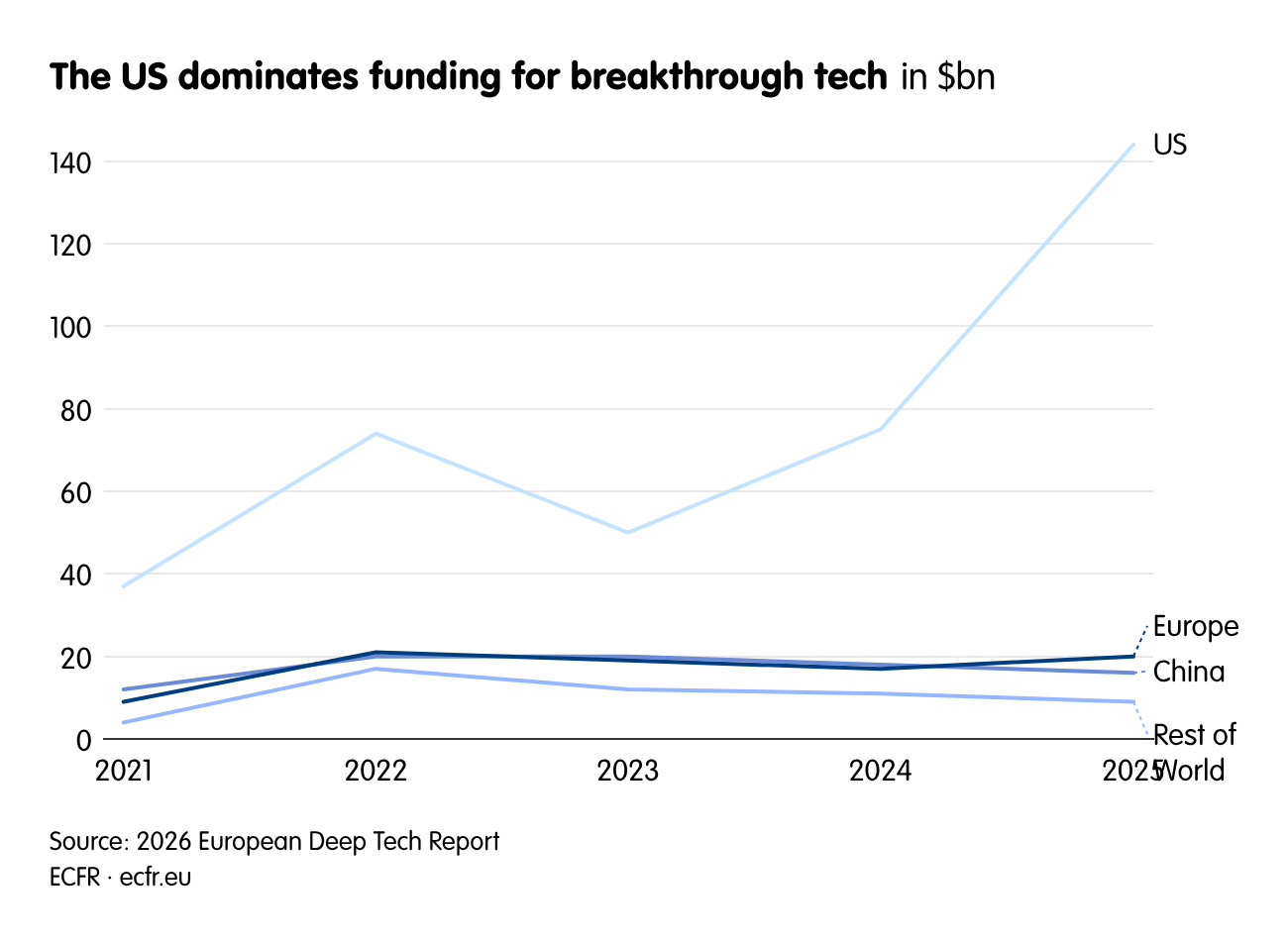
The problem arises at the scaling stage. The fragmentation of 27 member-state markets and the regulatory complexity this brings is an invisible ceiling on the continent’s start-up environment. In 2024, investment rounds above $100m totalled $120.8bn in the US compared to just $18.1bn in Europe. And in 2025, deep tech investment reached $130bn in the US compared to just $16bn in Europe, a gap that widens when looking at AI and other breakthrough technologies.
Over time, these dynamics have led to a structural decline: Europe’s share of global tech market value has plummeted from 30% in 2000 to just 7% today, even though the tech industry now accounts for 15% of Europe’s GDP, compared to 4% in 2015. The consequences for Europe’s tech sovereignty and geoeconomic sway are unquestionable.
It would be misleading to only blame regulatory fragmentation for this gap. Other factors weigh heavily on European venture capital growth too. There are few deep pockets in public equity markets able to absorb large tech IPOs; European institutional capital, like pension funds, chronically underinvests in venture capital; and the broader institutional culture prices risk more conservatively than America’s.
A lack of European money means that much capital comes from overseas. Nearly half of Europe’s growth-stage funding last year came from abroad, predominantly America. In itself this is not a problem, but it becomes one when those investors push entrepreneurs to relocate their companies once they reach scale. This creates a “high-growth forum shopping”that drains talent, high-quality jobs, innovation capacity and previously invested public funding out of Europe. This has created a familiar pattern of European-born companies ending up incorporated on the other side of the Atlantic.
Creating an EU Inc
To address these issues, the European Commission recently took a decisive step towards approving a European company model: EU Inc., otherwise known as the 28th regime. The idea is to create a harmonised EU-level legal framework to allow companies, especially startups and scale-ups, to operate in the single market under one set of rules rather than facing 27 different national systems. This should create European-born and -raised firms.
The first part is already on the table: a regulation establishing EU Inc. as an optional, automatically recognised and fully digital corporate entity covering commercial, tax, insolvency and labour law. In theory, this should lead to less regulatory fragmentation, more risk investment and better access to capital markets and European talent. The practice, however, is more difficult.
Achieving a broad ecosystem of innovative EU Incs will depend on whether founders choose it and whether investors trust it is consistent and usable. On the attractiveness front, the current proposal faces two big difficulties. First, the regime can only reach its full potential if the EU makes progress on other files including key items of the startup and scaleup strategy, the European Innovation Act, the capital markets union and the transformation of certain merger guidelines.
Second, in the complex institutional negotiations up until 2027, certain countries and stakeholders will likely seek to dilute the regime’s capacity to become a unified standard. This is because it will need to bypass certain domestic legal barriers to make it easier to build, invest, and scale across Europe. Germany, for example, will scrutinise any framework that bypasses its co-determination model (Mitbestimmung). France will defend the centrality of its tech national champions agenda. And the Nordics will protect the favourable tax treatment of stock options and employee share schemes. In June 2026, the Council’s own legal service already advised national delegations that the proposal may need to be downgraded from a regulation to a directive, which would undermine its harmonising ambition from the outset.
Should the 28th regime derail under pressure from national interests, it would be a macroeconomic failure of the first order
Should the 28th regime derail under pressure from national interests, it would be a macroeconomic failure of the first order. To prevent that and keep the capitals on board, the proposal must be preserved as the commission designed it, as a regulation, not a directive. That means EU Inc is optional for entrepreneurs and businesses, but not for member states: national company law stays in place, and companies simply gain a European corporate form alongside it. Capitals therefore retain their legal sovereignty while their most promising firms become less likely to move abroad. Within this, the new legislation must include tax measures to prevent huge imbalances of member states with more attractive tax laws such as Ireland, Luxembourg or the Netherlands.
Moreover, in case of an effective blockage of negotiations, parallel levers should be activated: the move away from unanimity voting suggested by Ursula von der Leyen in April together with fast-track routes such as mutual recognition mechanisms between member states. The European Competitiveness Lab is a good model to inspire this member-state coordination. The geopolitical urgency framing the debate can provide the political tailwind.
Europe has networks of academic research centres and connected clusters such as the AI factories which are already generating projects and spin-offs in critical technologies. There is still time for these spin-offs to be born as EU Incs. The combination is straightforward: AI factories and the EuroHPC joint undertaking provide the scientific infrastructure, EU Inc is the legal vehicle, and the European innovation council and investment bank work as the financing bridge between laboratory and market. This is the most scalable path available to Europe to turn its research strength into corporate strength; it just requires the alignment of institutions and laws that already exist.
The EU can do it again
The potential transformative dimension of the 28th regime has two precedents worth recalling, both of which combined a common legal framework, pooled public investment and continental scale to overcome the limits of national efforts.
In the late 1960s, Airbus emerged as a political-industrial project to equip Europe with a champion capable of competing with the US in commercial aviation. France and Germany agreed in 1970 to a single legal vehicle, joined shortly after by the UK and Spain. They then channelled public funding into a shared corporate structure, and eventually consolidated their fragmented national aerospace industries into one European company.
And in the 2000s, Galileo gave Europe its own global positioning technology based on a system that was open, civilian-controlled and compatible with GPS but more precise. It required EU member states to agree on a common legal and governance framework under EU law, to commit more than €10bn of joint EU-budget funding over two decades and to operate the system as shared European infrastructure rather than as competing national projects. Its development is widely credited as a factor that pushed Washington to end the deliberate restrictions of GPS for civilian use.
Today, both operate at a global scale. The lesson for the 28th regime is the same: a single legal framework, pooled resources and continental scale turned political ambition into industrial reality. Europe’s competitiveness in the coming decades will depend on its capacity to do this again and support companies, especially those driven by emerging technologies. With this, the EU could achieve a new strategic form of sovereignty and the greatest practical step forward for the single market in decades.

 Login