
❌

Reading view

EU fast-tracks merger of three European firms into one SpaceX rival. It wants to end reliance on US satellites that failed Ukraine this week

Satellites are the new frontline in space and strategy. Photo: Depositphotos

The EU plans to fast-track antitrust approval for Project Bromo, a satellite venture meant to cut Europe's reliance on American space technology, Bloomberg reports. The news comes days after the White House ordered the Pentagon to slow Starshield, the military-grade Starlink service Ukraine's forces use, according to Reuters.

Project Bromo would merge the satellite businesses of Italy’s Leonardo and France’s Airbus and Thales into one company. Bloomberg calls it the bloc’s answer to SpaceX, and the EU sees it as a regional giant able to compete with US and Chinese rivals.

European Commission President Ursula von der Leyen has backed the project, Eunews reports.

“These are the types of industrial champions we need if Europe is to lead in the space economy of tomorrow,” she said at an international space summit in Paris last month, citing Bromo by name.

A year of quiet groundwork before the filing

Over the past year, the partners and EU officials have worked through potential competition concerns so they can be resolved before a formal application, according to Bloomberg. The companies have not yet applied, but Brussels expects them to in the coming weeks.

For large deals, regulators usually hold such preliminary talks to flag obstacles early. If the companies offer concessions, such as selling some assets, the deal could clear after a first-phase review of a little over a month. If competition concerns remain, the Commission could open an in-depth probe lasting several months.

The caveat behind the SpaceX-rival label

A fast review is not a free pass. Competition Commissioner Teresa Ribera has warned that the project cannot expect one, and unions and suppliers have raised concerns about jobs and competition, Bloomberg reports. Von der Leyen’s public backing drew criticism from some members of the European Parliament.

Her support “doesn’t mean we are not going to apply and to enforce our own regulation,” Ribera told Bloomberg TV.

Why it matters to Ukraine

The push is part of a wider European scramble for space autonomy. Ukraine wants to build a satellite system of its own that no single company controls.

This week showed why. After the Starshield order, the military-grade terminals stopped working on fast-moving objects, and now work only at speeds of up to 160 kph, a person in Ukraine’s Defense Ministry told Reuters. Ukrainian officials said the restrictions complicated strike missions against Russian forces and logistics in occupied territory and slowed the interceptor drones that shoot down Shaheds.

  •  

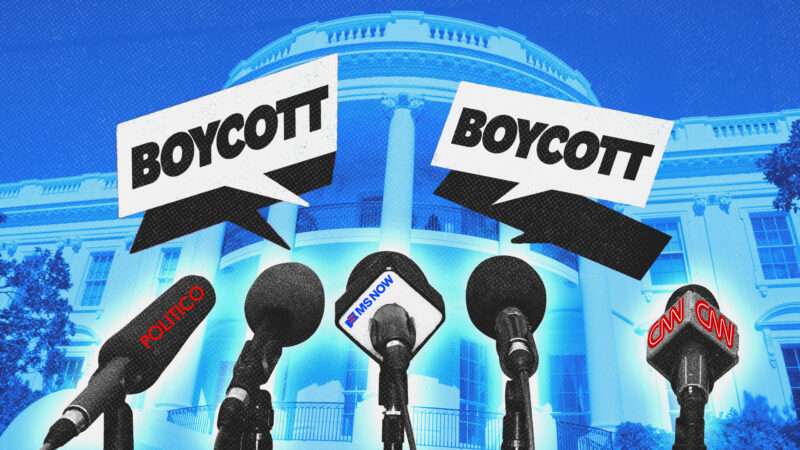
TV Networks Protested Press Bans by Declining To Cover Trump. That Might Have Been Illegal, the DOJ Says.

Press microphones in front of the White House | Valentin M Armianu/Picsfive/Dreamstime/CNN/MS NOW/Politico

After President Donald Trump banned CNN, MS NOW, and Politico from the White House last month, ABC, CBS, NBC, and Fox News protested by suspending their participation in the press pool that provides widely used video of presidential events. According to the Department of Justice (DOJ), which last Friday demanded network communications regarding the TV pool, that show of solidarity may have violated the Sherman Antitrust Act.

The antitrust investigation adds another layer of bullying to Trump's vendetta against "Fake News Media Outlets." The president reflexively threatens to yank broadcast licenses in response to news coverage he views as biased against him. He has repeatedly tried to punish disfavored journalists by excluding them from the White House, culminating in last month's sanctions against CNN, MS NOW, and Politico, which irked him by running "purposely negative stories." Now he is deploying the Justice Department against the TV networks that objected to his assault on freedom of the press.

Under a longstanding arrangement, ABC, CBS, NBC, CNN, and Fox News take turns covering the president in venues where press access is limited, sharing the footage with other news outlets. But after Trump excluded CNN from that role, the other networks stopped participating. They resumed their coverage on September 25, the day after a federal judge ordered the White House to restore press passes for employees of CNN, MS NOW, and Politico.

The TV pool suspension was brief, lasting just four days. But it irritated Trump, who on September 24 complained that the networks "refused to cover one of the Biggest and Most Beautiful Events to take place in many years"—i.e., "the arrival at the White House of the Highly Respected President of China, Xi Jinping, and his beautiful wife, Madam Peng." That event was "magnificent" and "made for Television," he said, but the networks "refused to be there" because "they knew how good it would be" and "didn't want credit to be given to 'TRUMP.'"

As the DOJ tells it, the lack of network coverage was not only annoying; it was also potentially illegal. "Members of the television press pool have boycotted covering White House events," Emily Covington, who directs the department's Office of Public Affairs, said on Saturday. "Group boycotts among commercial competitors can violate the Sherman Act," she added, and "the Antitrust Division is simply investigating to determine whether these news organizations have violated the antitrust laws."

Section 1 of the Sherman Act broadly prohibits any "contract," "combination," or "conspiracy" in "restraint of trade." But it applies to group boycotts only insofar as they aim to thwart competing businesses.

William E. Kovacic, who chaired the Federal Trade Commission (FTC) during the George W. Bush administration, is skeptical that the concept applies in this case. "The critical ingredient in successful antitrust cases is to demonstrate that there is unmistakably a commercial motive and that the commercial motive predominates," Kovacic told The New York Times. "And I don't think they would ever be able to do that here."

The Supreme Court's 1990 decision in FTC v. Superior Court Trial Lawyers Association illustrates the importance of a "commercial motive." The case involved attorneys in private practice who were paid to serve as court-appointed counsel for criminal defendants in the District of Columbia. The FTC concluded that they violated the Sherman Act when they agreed to stop accepting cases until their fees were increased.

Since that agreement was aimed at protecting the right to counsel by ensuring adequate funding for court-appointed attorneys, the lawyers association argued, it was protected under NAACP v. Claiborne Hardware, a 1982 decision in which the Supreme Court recognized a First Amendment right to engage in politically motivated consumer boycotts. But the Court saw an important distinction between the two cases.

"Our reasoning in Claiborne Hardware is not applicable to a boycott conducted by business competitors who 'stand to profit financially from a lessening of competition in the boycotted market,'" Justice John Paul Stevens wrote. "No matter how altruistic the motives of respondents may have been, it is undisputed that their immediate objective was to increase the price that they would be paid for their services."

In Claiborne Hardware, by contrast, the boycotters were not trying to reap a financial benefit by reducing competition. Nor were ABC et al. when they "boycotted" the White House TV pool. They were not trying to increase their profits by putting competitors at a disadvantage; they were standing up for freedom of the press.

"The investigation is nonsense," Seth Stern, chief of advocacy at the Freedom of the Press Foundation, says in an emailed press release. "Trump may view the presidency as a business venture, but news outlets' standing up for their constitutional rights has nothing to do with antitrust law….Depriving Trump of the attention he craves is not a competitive harm."

The post TV Networks Protested Press Bans by Declining To Cover Trump. That Might Have Been Illegal, the DOJ Says. appeared first on Reason Magazine.

  •  

National Trust Plans to Teach Five-Year-Olds About Black Power Salute – During a Baking Workshop

The National Trust has sparked outrage over its "ultra-woke" plans to teach five- to 12-year-olds about the Black Power salute during a Black History Month baking workshop.

The post National Trust Plans to Teach Five-Year-Olds About Black Power Salute – During a Baking Workshop appeared first on The Daily Sceptic.

  •  
❌