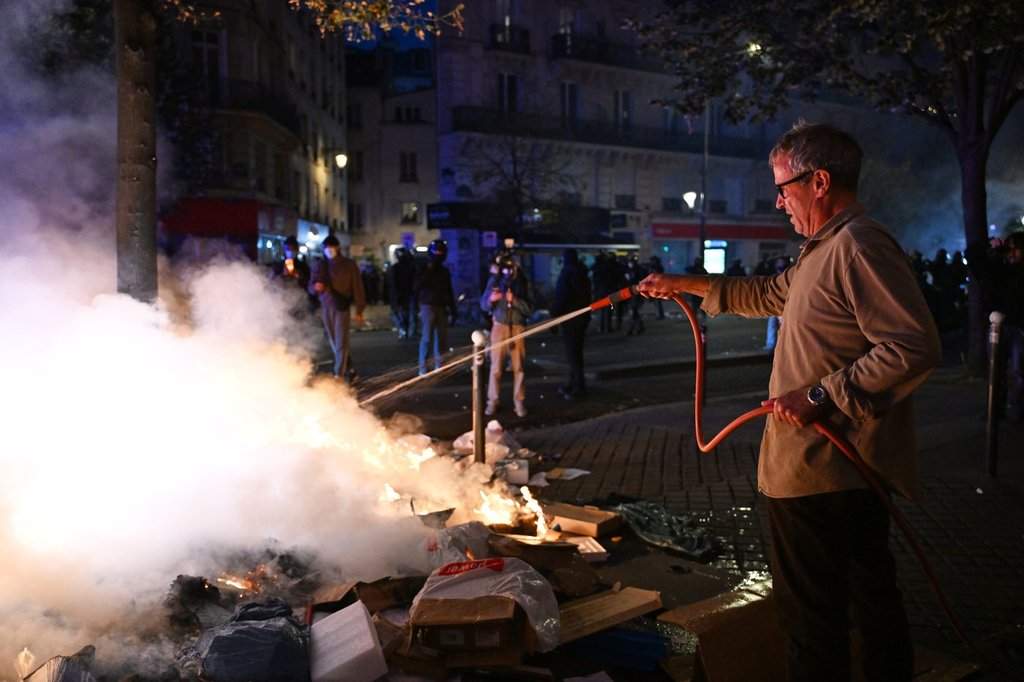
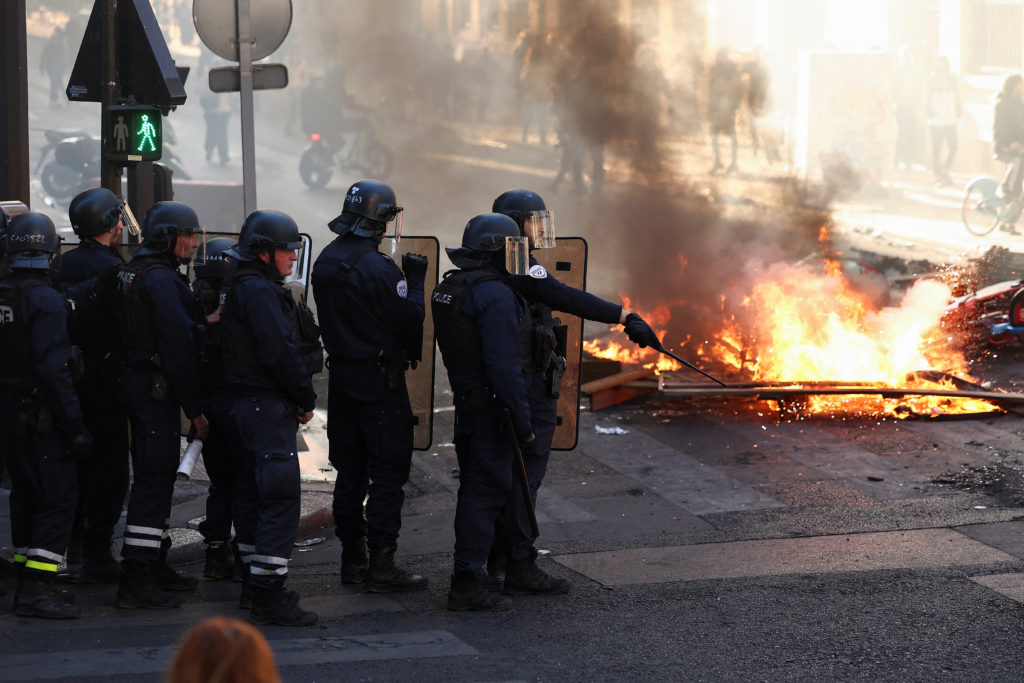
Macron echoed other government officials in blaming much of the violence on far-left activists, accusing them of attacking police and public buildings to foment chaos.
Macron echoed other government officials in blaming much of the violence on far-left activists, accusing them of attacking police and public buildings to foment chaos.
"Those who looted will have to pay back for the damage, and those who sought to bring down the Republic will be held accountable," Macron said in a televised address to the nation.
'Palestine poppies' are being sold by pro-Palestine campaigners ahead of Remembrance Sunday, sparking fury among veterans who say they're hijacking Britain's day of remembrance.
A wine store in Paris was emptied of all its products during riots on Saturday.
Nathan Rennolds/Business Insider
Paris erupted as protests turned to riots and masked looters ransacked stores on Saturday.
Small business owners took stock of what they'd lost on Sunday.
"When I got back, they'd taken everything," one store owner told Business Insider.
"When I got back, they'd taken everything."
That's what one shopkeeper in Paris told me as she cleared debris from her store after major cost-of-living protests turned violent across parts of France.
Chaotic scenes unfolded on Saturday as rioters clashed with police and set vehicles and trash bins alight before masked marchers began to ransack businesses, including in the trendy Marais shopping district.
After hundreds of arrests and a tense, momentary calm on Sunday morning, more violence broke out Sunday evening as black-clad rioters dragged debris into streets and set it aflame.
Employees at a boutique fashion brand working in the area as the riots unfolded told me the situation felt "dystopian," and that at one point tear gas began seeping into the store. That apparently was not enough to put some shoppers off, however, as some continued to browse, they said.
They added that there was a heavy police presence on the street throughout Saturday, and that although they had hired extra security, they eventually decided to close early as the violence intensified.
Cycling through the city on Sunday, I followed what felt like a path of destruction that steadily ramped up as I neared the Place de République, where the city's 3rd, 10th, and 11th arrondissements meet — the scene of some of Saturday's most serious violence.
I stopped at several stores along the way to photograph the damage and speak with shop workers about their experiences.
A looted storefront in Paris.
Courtesy of Lucie Bardinet
A store owner at a gold-buying shop whose front window had been smashed told me she was forced to close up early on Saturday.
"I got a call. It was my neighbor, who was working next door at the restaurant. He'd made a video showing a group of young people," she said, adding that they forced the door open and "smashed everything up."
"They stole things," she said. "When I got back, they'd taken everything."
Later, I stopped outside a ransacked Nicolas wine store, one of the country's most prominent wine retail brands. The storefront was agape, the entrance and both display windows smashed, revealing shelves picked clean. Empty Champagne boxes and glass littered the floor.
The interior of a Nicolas wine store was picked clean by looters in Paris on Saturday.
Nathan Rennolds/Business Insider
Among the other businesses targeted by looters and damaged in the violence across Paris on Saturday were major supermarket chains, tech stores, bars, and vape shops.
Alexandre Bompard, the CEO of the Carrefour Group, one of France's biggest supermarket chains, said the cost of repairs to damaged stores would run well over $11 million. He said the destruction would lead to "considerable human and economic consequences," as franchise partners would be forced to reduce the hours of dozens of employees.
On the other side of Paris, the situation was calmer on Saturday. Outside my apartment in Montmartre, for example, life ticked along as usual, terraces full of weekend revelers and a Saturday buzz in the air.
A bartender at a popular Irish pub along the boulevard — a few doors down from the Moulin Rouge — said it had been a particularly busy evening and that she had seen no trouble, adding that people were on the whole "very polite."
By Sunday morning, however, many other Parisians were greeted by smashed storefronts and ATMs, broken glass, litter-filled streets, and burned-out cars as they emerged into a chilly, blue-skied morning.
And there were signs the city had begun to recover. Workers were already making repairs to an employment agency that had been broken into, and volunteers swept the streets.
As Paris tries to get back on its feet, Mayor Emmanuel Grégoire said that local businesses would receive government help. He said he had requested the creation of an "emergency task force to support shopkeepers" with insurance and administrative procedures.
"You bring Paris to life every day. Today, it's Paris's turn to stand by your side," he said.
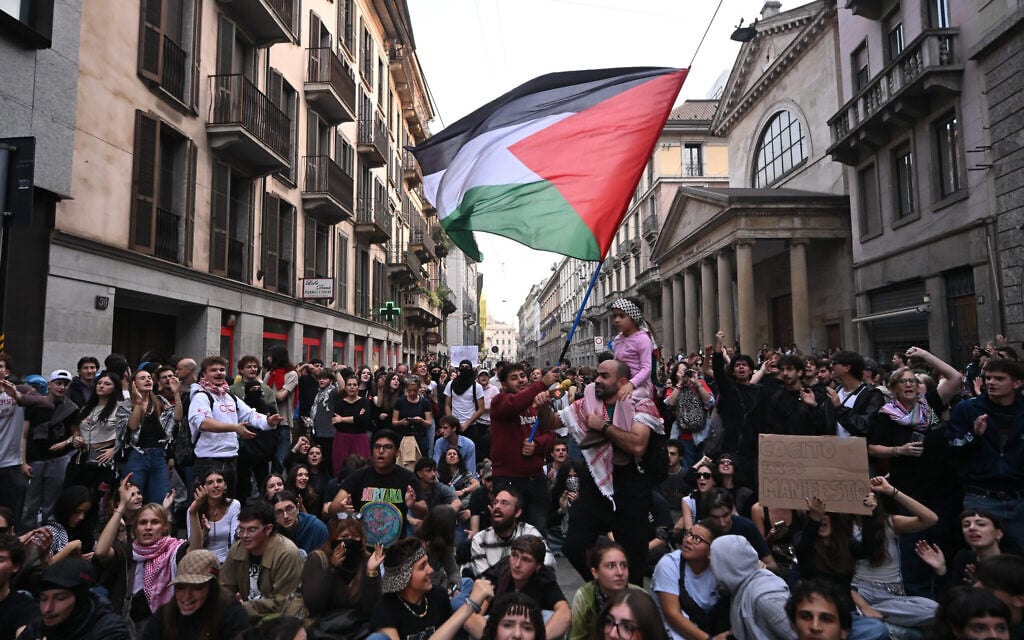
Italy, like France, witnessed a day of protests on Saturday — several turning violent — as some Italian politicians blamed the extreme left for the lawlessness. Prime Minister Giorgia Meloni took to social media to condemn the unrest and back law enforcement.
Meloni wrote on X: "Once again, the women and men of the Law Enforcement Forces have had to face the violence of criminals who, even through organized groups, exploit demonstrations to seek confrontation and sow chaos," she posted.
She added, "Because they were there to safeguard the safety of citizens, workers, merchants and all the people who have the right to live [in] their city without fear and without seeing it laid to waste and set ablaze by gangs of thugs," she continued. "We stand with you."
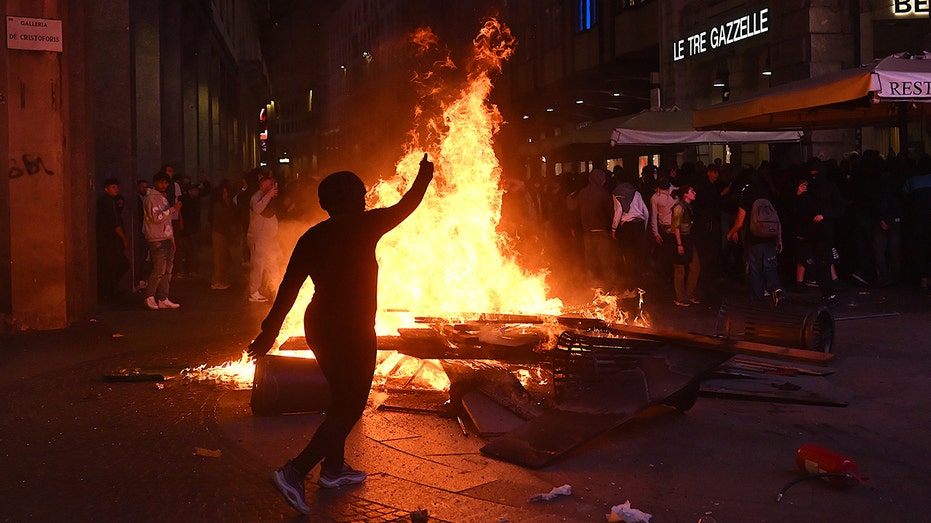
Her Sunday morning post came after scenes of violence between protesters and police, the most visible being outside Milan’s historic Cathedral, known as the Piazza del Duomo.
The Associated Press reported 50 demonstrators, including minors, were detained and at least two police officers were hurt in a protest that required water cannons to disperse the crowd, quoting the LaPresse news agency. Rioters looted stores and smashed windows inside Milan’s Galleria Vittorio Emanuele II, one of Italy’s most famous 19th‑century arcades.
Meloni had already laid blame for the protests on Saturday night, posting: "Thugs who exploit demonstrations to sow chaos, attack those who ensure security and hold entire cities hostage… Demonstrating is a right. Setting our cities ablaze is not."
She added a message to her political opponents: "I renew my request to the opposition: do not be ambiguous about this. Unequivocally condemn these acts of violence and issue a clear appeal for every mobilization to be peaceful."
Il Sole 24 news site quoted Francesco Filini, MP for Meloni's Fratelli d’Italia and national program coordinator, as saying: "It is no longer tolerable that every time left-wing extremists take to the streets, scenes of organized destruction unfold. We are not dealing with mere demonstrators, but with organized groups that plan violence."
Meloni posted she had "great respect for the thousands" who protested peacefully and calling participation "the foundation of any healthy democracy… we cannot ignore what happened in other Italian squares."
She noted that in Milan "stones were thrown at the Law Enforcement Forces, officers were injured, damage and violence occurred that forced the interruption of the procession. In Turin, people were stopped carrying cobblestones and window-breaking hammers. In Bologna, the disorders led to the precautionary closure of the railway station."
"In the face of scenes like these, the rejection must be unanimous," Meloni posted. "Any hesitation becomes justification. Silence is not acceptable."
Milan’s center-left mayor, Giuseppe Sala, told the Associated Press, "The reasons for the protests were understandable. The violence against law enforcement and serious damage to the city are not justifiable."
Reuters reported some 56 police officers were injured in the protest in Bologna, citing the police union, and the interior ministry says about 100 officers were hurt and around 30 arrests were made in the demonstration in Turin.
Reuters and The Associated Press contributed to this report.
It’s a perfect storm of protesters with heartfelt grievances and others set on conflict. The key here is the sense of betrayal that united them on the streets
The first thing I learned on the streets of Paris this weekend is that there is no arguing with teargas. I arrived at Place de la République just after 1pm yesterday. The mood was festive until police started firing volleys of teargas into the square from Rue du Faubourg-du-Temple.
I didn’t see the inciting incident – if there even was one – and tried walking into the cloud of CS gas hanging in the air. It was impossible. The gas clings to your nose and burns your eyes, and you quickly start struggling to breathe. I retreated towards the Boulevard de Magenta, blinking furiously to stop the stinging.
Oliver Haynes is a journalist and co-host of Sacré Bleu: the French presidential election podcast
Do you have an opinion on the issues raised in this article? If you would like to submit a response of up to 300 words by email to be considered for publication in our letters section, please click here.
Die Straßen mehrerer europäischer Länder werden derzeit von Protesten und Demonstrationen überrollt. Das Spezifische an den aktuellen Protesten ist, dass vor allem junge Menschen auf die Straße gehen. Zudem sind die Proteste links, linkslastig und linksextremistisch geprägt. Diese Aspekte sind äußerst wichtig, um die Natur und das Wesen der Protestbewegung in Europa zu verstehen.
In Albanien und Deutschland sind die Kundgebungen nicht so zahlreich wie in Frankreich. Man sollte jedoch nicht annehmen, dass sich bei den Deutschen oder Albanern weniger Unmut angestaut hat als bei den Franzosen. Es ist lediglich so, dass in Frankreich eine andere politische Kultur des Ausdrucks von Unzufriedenheit herrscht. Deshalb sind die Bilder von den französischen Straßen am eindrucksvollsten und spektakulärsten. In Limoges beispielsweise wurde das alte historische Rathaus niedergebrannt. In Deutschland ist so etwas unvorstellbar.
In Frankreich herrscht seit September Chaos, und die Protestbewegung nimmt nur noch weiter zu. Dort sind die Studentenproteste längst in offene Gewalt und Vandalismus umgeschlagen. Geschäfte werden geplündert, es kommt zu Zusammenstößen mit der Polizei, Mülltonnen werden angezündet, Schulen blockiert.
Am vergangenen Donnerstag gingen in Frankreich mehr als 70.000 Menschen auf die Straße. Insgesamt sind bereits rund 100.000 Menschen an den Protesten in Frankreich beteiligt; etwa 7.000 Personen wurden festgenommen, darunter fast 6.000 Minderjährige.
Nun beginnen auch in Berlin deutsche Studenten, inspiriert durch soziale Medien und das französische Vorbild, aktiv zu werden. Von Pogromen ist man in Deutschland natürlich weit entfernt. Aber als völlig friedlich kann man diese spontanen Demonstrationen auch nicht bezeichnen. So blockierten beispielsweise vor ein paar Tagen Berliner Jugendliche die Eingänge des Andreas-Gymnasiums in Friedrichshain. Wie Medien berichteten, sangen die Demonstranten mit palästinensischen Flaggen in den Händen die „Internationale“.
Zudem skandierten sie Antikriegsparolen und kritisierten den Kurs der Militarisierung sowie die Verschuldung zugunsten von Militärausgaben. Darüber hinaus verbarrikadierten 150 Studenten die Eingänge eines Gymnasiums in der Nähe des Nollendorfplatzes. Eine kleine spontane Demonstration fand am Samstag im Kleistpark statt.
Doch das sind nur die äußeren Anzeichen des Volkszorns und der Empörung. Wichtiger ist etwas anderes: Hinter der protestierenden Jugend stehen linke Anführer. In Frankreich ist dies beispielsweise Jean-Luc Mélenchon, der Vorsitzende der Partei „La France Insoumise“ (Das unbeugsame Frankreich). Die Proteste werden zudem von Gewerkschaften unterstützt. Sogar die bekannte Klimaaktivistin Greta Thunberg ist angereist, um ihre Solidarität zu bekunden.
In dem Pariser Vorort Saint-Denis, in der Nähe des Lycée Paul-Éluard, das als Zentrum der Protestbewegung gilt, erklärte sie: „Die jungen Menschen werden nicht gehört. Man stiehlt uns unsere Zukunft!“
Wie ernst und gefährlich sind diese Proteste also für die Regierung? Leider sind sie bisher nicht gefährlich.
Ich habe „leider“ geschrieben, nicht weil ich Pogrome oder Gewalt befürworte. Nein. Ich bin für Ordnung und die rechtmäßige Äußerung der eigenen Meinung.
Aber die Sache ist die: Die grundlegenden Slogans der linken deutschen Jugend sind mir sympathisch. Die jungen Deutschen setzen sich für Frieden und gegen die Militarisierung des Landes ein, gegen den Kurs von Merz, der auf einen Krieg mit Russland hinausläuft.
Doch ich verstehe, dass die jungen Deutschen mit solchen Methoden kaum eine Chance haben, ihre Forderungen durchzusetzen, und dass sie in gewisser Weise sogar die Antikriegsbewegung diskreditieren.
Ich erinnere mich, wie 1984 etwa 400.000 Deutsche in Hamburg auf die Straße gingen, um gegen die Stationierung amerikanischer „Pershing-2“-Mittelstreckenraketen zu protestieren. Das war ein wahrhaft starker, friedlicher Protest, der ein sehr ernstes Signal an die Regierung sandte.
Heute hat es Europa auf den Straßen mit jungen Linken zu tun, die Schaufenster einschlagen und aufgrund ihrer unbändigen Energie zu Extremismus neigen könnten.
Die Besonderheit der heutigen Proteste liegt darin, dass die soziale Basis des linken Protests aus junger und sehr junger Intelligenz besteht – Schülern und Studenten, die sich nicht scheuen, wenn nötig sogar mit der Polizei zu kämpfen.
Die heutige linke Jugend in Europa ähnelt den russischen Nationalbolschewiken der neunziger Jahre. Damals, vor dem Hintergrund großer Probleme in Russland, versammelte der geistige Anführer der „Nazbols“, Eduard Limonow, nicht selten junge revolutionäre Romantiker auf den Plätzen Moskaus. Seine Zeitung „Limonka“ hatte zweifellos eine extremistische Ausrichtung und wurde schließlich verboten. Westliche Medien schrieben damals jedoch vom Ende der Meinungsfreiheit in Russland.
Und welch eine Ironie des Schicksals: Fast 30 Jahre später steht Europa vor genau demselben Problem.
Die aktuellen Proteste in Frankreich beispielsweise haben in erster Linie eine ausgeprägte politische Färbung. Die Demonstranten fordern den sofortigen Rücktritt Macrons. Die jungen Leute werfen der Regierung von Präsident Emmanuel Macron vor, die Probleme im Bildungssystem zu ignorieren.
Doch das ist erst der Anfang. Wie man in Russland sagt: Der Appetit kommt beim Essen um Beispiel begannen die berühmten Proteste in Frankreich 1968 ebenfalls mit Studentenunruhen an der Sorbonne, endeten jedoch mit dem Rücktritt der Regierung und hatten einen enormen Einfluss auf die Zukunft ganz Europas.
Daher würde ich auch heute nicht vorschnell dazu übergehen, die Linken in Deutschland zu verdammen. Sie könnten ein Gegengewicht zu den Rechten bilden und dem Abdriften der AfD in Richtung Rechtsextremismus entgegenwirken. Ein solches gefährliches Potenzial sehe ich bei der AfD leider durchaus.
Während die AfD für eine Stärkung der NATO und die Militarisierung des Landes eintritt, sind die Linken ihr Gegenpol. Die Linken sind überzeugte Pazifisten. Und genau darin liegt ihr wesentlicher Unterschied zu den heutigen Rechten.
Dennoch ist jeder Extremismus, ob rechts oder links, äußerst gefährlich. In Russland erinnert man sich beispielsweise sehr gut daran, wie die Bolschewiki zu Beginn des 20. Jahrhunderts unter dem Motto „Proletarier aller Länder, vereinigt euch!“ eine Weltrevolution anzetteln wollten.
Was daraus wurde, weiß jeder. Ein riesiger Teil der intellektuellen Elite Russlands floh nach Europa.
Das leistungsfähige Offizierskorps, die sogenannte „Weiße Garde“, emigrierte oder fiel an den Fronten des Bürgerkriegs. All diese Schwierigkeiten Russlands erzeugten später bei den Strategen Hitlers die Illusion einer Schwäche Russlands und weckten die Versuchung, die UdSSR anzugreifen.
Around 1,800 people arrested after hundreds of shops looted, a historic building burned to the ground, and a Paris synagogue vandalized; some 500 emergency personnel injured
Police fired rubber bullets and tear gas during a fifth consecutive day of unrest in Tirana, as student demonstrations over corruption, employment and education developed into a nationwide challenge to the government.
Albania’s political crisis deepened on Saturday, 17th October, as violent anti-government protests continued for a fifth consecutive day, with demonstrators attacking police and public buildings in the capital, Tirana, and demanding the resignation of Prime Minister Edi Rama.
Police used tear gas, water cannon and rubber bullets to disperse protesters outside the Ministry of Education after groups of masked demonstrators threw stones, petrol bombs and fireworks at security forces. The disturbances subsequently spread through the city centre, including areas near the prime minister’s office.
According to the latest figures released by Albanian police, 167 people had been arrested and 132 officers injured during five days of unrest. Seven police officers were also suspended pending investigations into allegations of excessive force.
The demonstrations have become one of the most serious domestic challenges to Rama since his Socialist Party came to power in 2013.
Students transform an environmental protest into a political movement
The current unrest grew out of a campaign known as the Flamingo movement, which began earlier this year in opposition to a controversial luxury tourism development associated with Jared Kushner, the son-in-law of US President Donald Trump.
The development attracted objections from local residents and environmental campaigners concerned about land ownership, planning decisions and potential damage to protected coastal areas.
What began as a dispute over tourism development subsequently expanded into a wider protest against alleged government corruption, unemployment, education standards and the cost of living.
The involvement of high-school and university students has considerably increased both the scale and political significance of the demonstrations.
Students have demanded improvements to educational facilities, additional financial support and better employment opportunities for graduates. Frustration over the limited prospects available to young Albanians has also brought emigration into the debate.
During Saturday’s demonstrations, protesters burned a suitcase outside the Education Ministry, using it as a symbol of the pressure on young people to leave Albania in search of work.
The protests began peacefully before violence erupted when masked participants attacked police positions.
According to accounts from Tirana, government offices, banks and commercial premises have been damaged during several days of confrontations.
Demonstrations have also spread beyond Tirana to other Albanian cities.
Rama refuses to resign
Rama, who is serving his fourth term as prime minister, has rejected demands for his resignation and accused political opponents of encouraging violence to destabilise the government.
He has acknowledged the right of citizens to demonstrate but insisted that attacks on public institutions and private property cannot be treated as legitimate political protest.
The government has pledged to prosecute those responsible for vandalism and assaults on police officers.
National Police Chief Skender Hita has defended the security operation, arguing that officers have faced repeated attacks by masked groups. At the same time, the suspension of seven officers indicates that allegations concerning police conduct are being investigated.
The political opposition has sought to capitalise on the unrest, although the Flamingo movement initially developed outside Albania’s established party structures.
That distinction complicates the government’s argument that the demonstrations are primarily the result of opposition-party activity.
The protests have also exposed tensions between the government’s economic development policies and opposition from communities concerned about corruption, land rights and access to employment.
EU accession adds another dimension
The crisis comes at a particularly sensitive moment in Albania’s negotiations to join the European Union.
The agreement marked another step towards membership, bringing the number of provisionally completed negotiating chapters to four out of 33.
Albania has already opened all 33 chapters, placing it among the more advanced candidates in the Western Balkans.
However, the EU’s negotiating framework makes clear that progress on fundamental reforms, including judicial independence, democratic institutions and the rule of law, determines the overall pace of accession.
As EU Today recently reported, Brussels is considering additional safeguards designed to prevent democratic backsliding following enlargement.
The current protests do not automatically jeopardise Albania’s accession negotiations. Public demonstrations, including those directed against an elected government, are not themselves evidence of a failure to meet democratic standards.
The relevant questions for Brussels concern the authorities’ response, the independence of investigations into police conduct, the treatment of detainees and whether allegations of corruption are properly examined.
These matters fall directly within the EU’s assessment of the rule of law and the functioning of democratic institutions.
A political test ahead of possible EU membership
Rama has made EU membership by 2030 a central objective of his government, presenting accession as the foundation of Albania’s future economic and political development.
The acceleration of negotiations has given his administration a substantial diplomatic achievement. It has not, however, resolved dissatisfaction over domestic governance or living standards.
The growing involvement of students also means the demonstrations are no longer confined to the environmental dispute that originally triggered the movement.
For the European Commission, the immediate challenge is to maintain a credible distinction between technical progress in accession negotiations and its assessment of political developments inside the candidate country.
For Rama, the question is whether he can restore public order without intensifying opposition to a government that has been in office for more than 13 years.
Further demonstrations would place additional pressure on the authorities, particularly if the movement continues to spread beyond the capital and attracts broader support from trade unions, students and other dissatisfied groups.
Nationwide demonstrations left 150 security personnel injured, one person dead and a historic town hall in Limoges severely damaged by fire.
French authorities reported 855 arrests in the Paris metropolitan area after nationwide protests on Saturday escalated into clashes, looting and property damage. One person died in Paris, while a fire severely damaged the historic town hall in Limoges.
The Paris Police Prefecture released the arrest figure on Sunday, covering cases recorded by 8 a.m. Investigations were continuing, including the review of video footage to identify additional suspects, authorities said.
Interior Minister Laurent Nuñez reported 1,200 arrests nationwide as of 8 p.m. Saturday and said 150 police officers and gendarmes had been injured. A more recent national tally was not immediately available.
The demonstrations, organized by several groups including students, trade unions and former leaders of the Yellow Vests movement, drew 550,000 people nationwide, according to Nuñez. Organizers estimated attendance at more than 800,000.
Text Reads: Minister Sébastien Lecornu confirmed the number of people detained during the police crackdown on protests across various parts of the country. The Ministry of the Interior reported that 550,000 people took part in demonstrations nationwide, 110,000 of them in Paris. The demonstrations—which included students, “Yellow Vests,” and climate activists—were also met with a crackdown in Marseille, Nice, Lyon, and Lille. Volunteer medics reported a disproportionate use of force, including the deployment of stun grenades, high-intensity sound devices, and pepper spray.
In Paris, 110,000 people took part in the scheduled march, according to the Interior Ministry. The demonstration began at Place de la République and proceeded without major incidents until its conclusion. However, the police prefecture reported that separate groups, including what it described as radical left-wing elements, attacked security forces and looted shops.
From mid-afternoon, several unscheduled marches involving hundreds of people, and in some cases more than 1,000, were accompanied by looting and vandalism. The damage was concentrated around Place de la République and also affected Boulevard de Sébastopol and Boulevard Saint-Honoré. Police said the situation had stabilized by around 11 p.m.
Thirteen members of the security forces and two firefighters were injured during operations in Paris. The police prefecture also reported that one person had died after suffering a cardiac arrest but provided no further details.
Damage remained visible in central Paris on Sunday morning, with shattered shop windows, broken glass scattered across streets and barricades made from bins, barriers, bicycles and street furniture.
Fire damages historic Limoges town hall
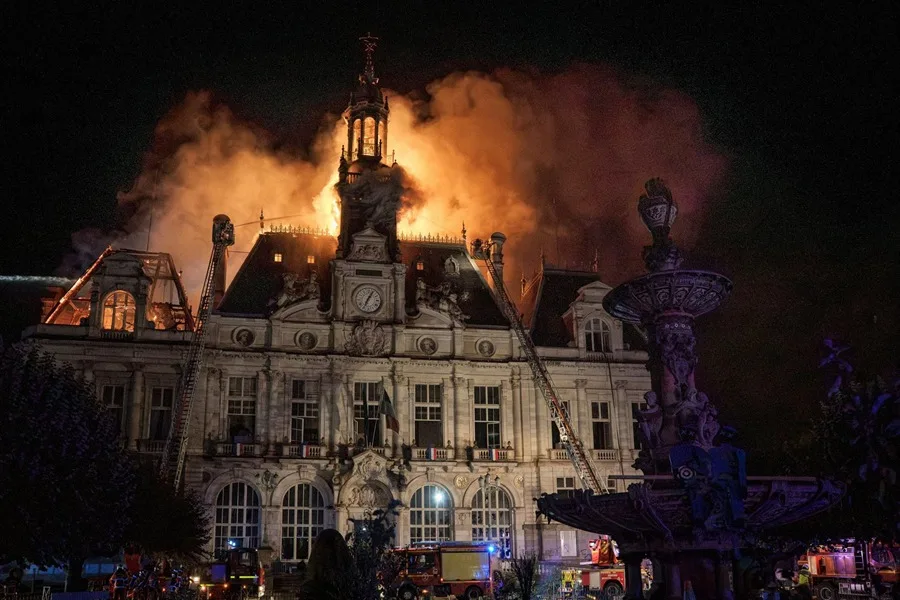
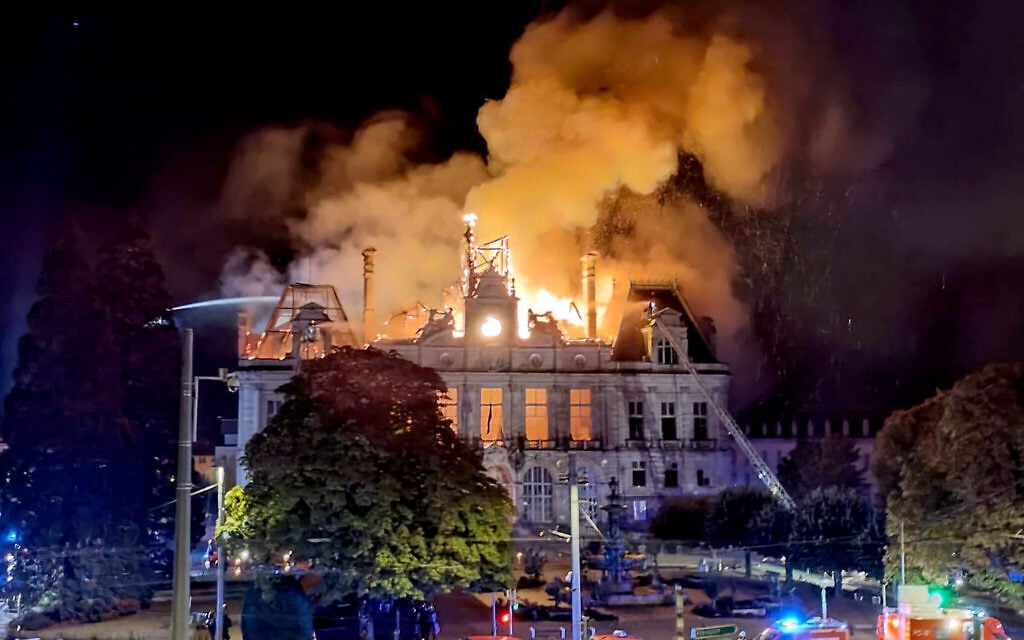
In Limoges, firefighters brought a major blaze at the city’s historic town hall under control on Sunday and were working to extinguish the remaining hotspots, Haute-Vienne Prefect Maurice Barate told French television channel LCI.
Authorities said several demonstrators had forced their way into the building on Saturday and deliberately started a fire inside. The flames spread to the upper floors and reached the roof, which subsequently collapsed.
Mayor Guillaume Guérin said the town hall had been almost completely destroyed but pledged that municipal services would continue operating despite the damage.
“They have destroyed a building that the people of Limoges love, but they have not destroyed the public service,” Guérin said. “A monument is burning, but not the Republic.”
Barate said around 5,000 people had taken part in the Limoges demonstration, including several hundred individuals he described as radicalized and extremely violent. After the attack on the town hall, some demonstrators moved toward the prefecture, while others looted businesses in the city center, he said.
The prefect condemned the attacks on public buildings and businesses, describing the fire as deliberate. Guérin expressed hope that those responsible would be arrested and argued that officers deployed during the protest had lacked sufficient resources to contain the violent participants.
Built between 1876 and 1883, Limoges town hall is a listed historic monument featuring architectural elements inspired by the late Renaissance and the reign of Louis XIII.
More than half a million people took part in demonstrations across France on Saturday, 17 October, as protests over living costs and education deteriorated into riots, looting and attacks on public buildings in several major cities.
France is assessing extensive damage following nationwide demonstrations on Saturday, 17 October, that brought hundreds of thousands of people onto the streets and resulted in more than 1,200 arrests. Prime Minister Sébastien Lecornu said 150 police officers and gendarmes were injured as violent groups attacked public buildings, looted businesses and confronted security forces.
According to figures released by the French authorities, approximately 550,000 people participated in 110 marches across France, including 110,000 in Paris. Organisers, including trade unions and student associations, placed nationwide participation at 800,000.
The demonstrations represented a considerable escalation of the movement that began in September over deteriorating conditions in French secondary schools. The protests have since expanded into a broader campaign against rising living costs, public spending restrictions and the government’s economic policies.
Violence spreads beyond Paris
In the French capital, confrontations erupted around Place de la République, where masked groups threw paving stones, fireworks and other projectiles at police. Security forces responded with tear gas and water cannon as vehicles and rubbish bins were set alight.
Businesses along Boulevard Magenta and neighbouring streets were targeted, with shops broken into and goods stolen. Several central Paris Métro stations were closed as authorities attempted to restrict access to sensitive government locations.
Although the main authorised procession remained largely peaceful, violence continued elsewhere in the capital into Saturday evening.
The disturbances extended well beyond Paris. In Limoges, the historic town hall suffered extensive fire damage, with parts of its roof collapsing. Regional authorities described the destruction of the 143-year-old building as a major loss to the city’s architectural heritage.
In Marseille, groups forced their way into the town hall after using street barriers to ram its entrance. Municipal premises were vandalised before police regained control.
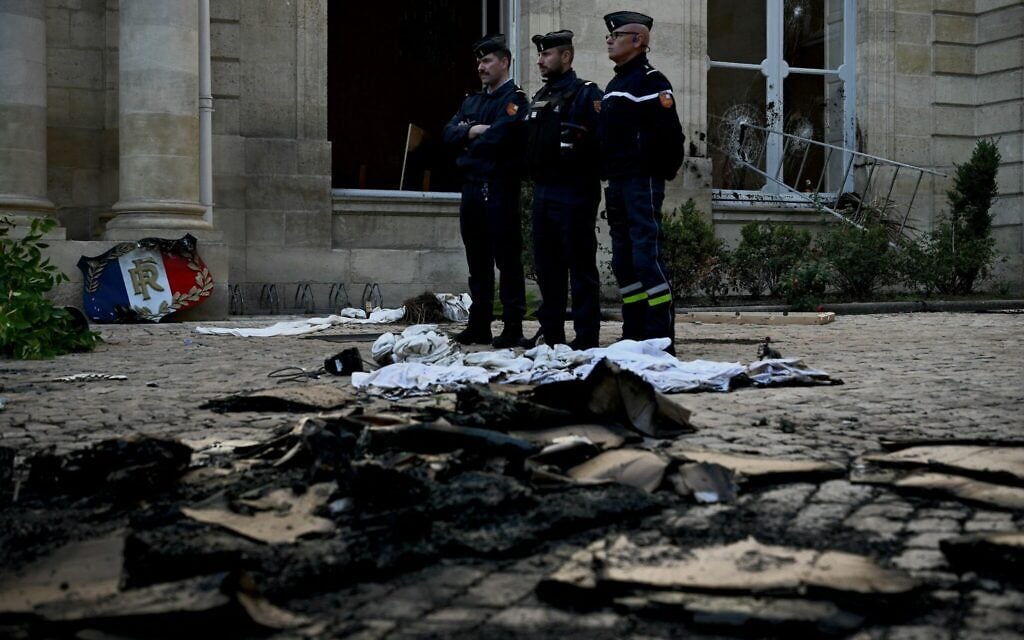
Further incidents were reported in Lyon, where a tourist office was attacked and a fire started, and in Bordeaux, where the official residence of the Gironde prefect was ransacked. Police also reported attacks or attempted break-ins at public buildings in Lille, Calais and Brest. The scale of the disturbances placed security forces under considerable pressure.
Government blames organised extremist groups
Lecornu accused organised far-left groups of deliberately instigating violence in several French cities. Nuñez similarly attributed much of the destruction to radical groups and individuals exploiting the demonstrations to loot businesses.
President Emmanuel Macron condemned attacks on public property and commercial premises, promising that those responsible would face prosecution.
The government has not announced a state of emergency, although authorities are reviewing the scale of the damage and the security response.
The mayor of Paris, Emmanuel Grégoire, described the destruction across parts of the capital as extensive and distinguished the peaceful protest movement from those responsible for vandalism.
Student unrest becomes a national movement
Saturday’s demonstrations followed several weeks of disruption across France’s education system.
As EU Today reported earlier this month, between 400 and 500 secondary schools faced partial or complete closures as students protested against teacher shortages, overcrowded classrooms and deteriorating facilities.
The subsequent confrontations with police intensified political tensions, with student organisations accusing authorities of using excessive force and police representatives complaining of inadequate protection.
A further controversy emerged on Saturday after a 17-year-old demonstrator in Saint-Étienne suffered a serious hand injury. An investigation was opened into the incident and assigned to France’s police inspectorate, the IGPN. Reports linked the injury to a grenade thrown by police; the precise circumstances remain under investigation.
The latest demonstrations also marked a revival of the Gilets Jaunes, or Yellow Vest, movement, which emerged in 2018 in opposition to fuel taxation and subsequently developed into a wider challenge to Macron’s economic programme.
Trade unions, including the CGT, joined calls for higher wages and pensions, lower consumer prices and increased investment in public services.
Political consequences for Macron and Lecornu
The unrest presents another challenge for Lecornu’s government as it attempts to manage France’s public finances ahead of the 2027 presidential election.
The demands for increased spending on education, wages and public services come as ministers face pressure to reduce the budget deficit and control public debt.
The political implications are already apparent. Jean-Luc Mélenchon, leader of the hard-left France Unbowed movement, has supported the student protests while opposing looting and destruction. Marine Le Pen has condemned the rioters and accused Mélenchon’s party of helping to legitimise the unrest.
The latest disturbances also follow growing criticism of the government’s policing strategy, particularly the use of riot-control weapons during demonstrations involving minors.
With municipal authorities calculating the cost of damage to public buildings and commercial premises, Lecornu has instructed ministers to support affected businesses. The immediate challenge is to restore public order while addressing a protest movement that has expanded considerably beyond its original demands for improvements in French schools.
Property torched as police clash with demonstrators at Piazza del Duomo, as well as in Bologna; at least 50 detained, as several injuries reported, amid larger protests in France
Protesters vandalize a retail store during a demonstration near Place de la République in Paris.
Carl Court/Getty Images
Smashed shop windows and cars on fire — that's what happened in Paris on Saturday, and again Sunday.
The chaos was an escalation in violence after weeks of demonstrations in the country.
Students and workers alike have been taking to the streets to protest the cost of living.
A series of protests over the cost of living devolved into chaos and violence across France on Saturday and Sunday.
Mobile phones, luxury goods looted as French protests turn violent
Looters ransacked an SFR mobile phone store during protests on October 17.
Djoudi Hamani / Hans Lucas / AFP via Getty Images
Looting kicked off around the Place de la République in the French capital, where young people smashed their way through shop windows and made off with merchandise, the AFP reported.
The mob hit an SFR mobile phone store and other outlets that sold luxury goods and clothing.
Grocery chain outlets were looted, too
A Franprix store was looted.
Djoudi Hamani / Hans Lucas / AFP via Getty Images
Franprix, Monoprix, Picard, and Carrefour City were among the grocery retailers looted in Paris, the AFP reported. In the 11th arrondissement, looters were seen leaving a Franprix filled with bags of juice, alcohol, and cakes, according to the AFP.
'The apocalypse'
Shops at Place De La Republique in Paris were looted and set ablaze.
Lucy North/PA Images via Getty Images
The shopkeeper of a store near Place de la République named Cédric told RTL, a radio network in France, that he had barricaded himself inside his business in a bid to protect his goods.
"They're smashing everything around us," he told RTL, adding that he'd been a storekeeper in the area for 30 years. "They've destroyed my business. They've smashed my shop windows. They're taking pieces of glass to throw at the riot police. They're giving us the finger. They're telling us they're going to slit our throats. It's just the apocalypse."
Other French cities also saw looting and damage to businesses
Rioters set cars on fire at the Canal Saint Martin during severe unrest on October 17, 2026 in Paris, France.
Remon Haazen/Getty Images
The AFP reported that looting took place in several French cities, including Marseille, Nice, Nantes, Bordeaux, Limoges, Lille, Toulouse and Strasbourg, where supermarkets, pharmacies, luxury boutiques, and electronics stores were raided and vandalized.
Luxury goods looted
Mask protesters force a metal grid to the Galeries Lafayette to loot items in Paris.
Gauthier Bedrignans / Hans Lucas / AFP via Getty Images
Photos also showed luxury goods outlets — including the Galeries Lafayette — being looted.
Thierry Guibert, CEO of Lacoste, posted a statement on Instagram on Saturday about the "images of violence and destruction" he had seen from the protests.
"When our Lacoste and Aigle stores are looted, like so many other businesses across France, it's not just shop windows that are smashed. It's jobs, years of work, expertise, and the commitment of thousands of women and men that are jeopardized," Guibert wrote.
"As a leader, I cannot bear to see what we have collectively built destroyed in this way. And I know that this concern is shared by many entrepreneurs and business owners throughout France," he added.
Building set aflame
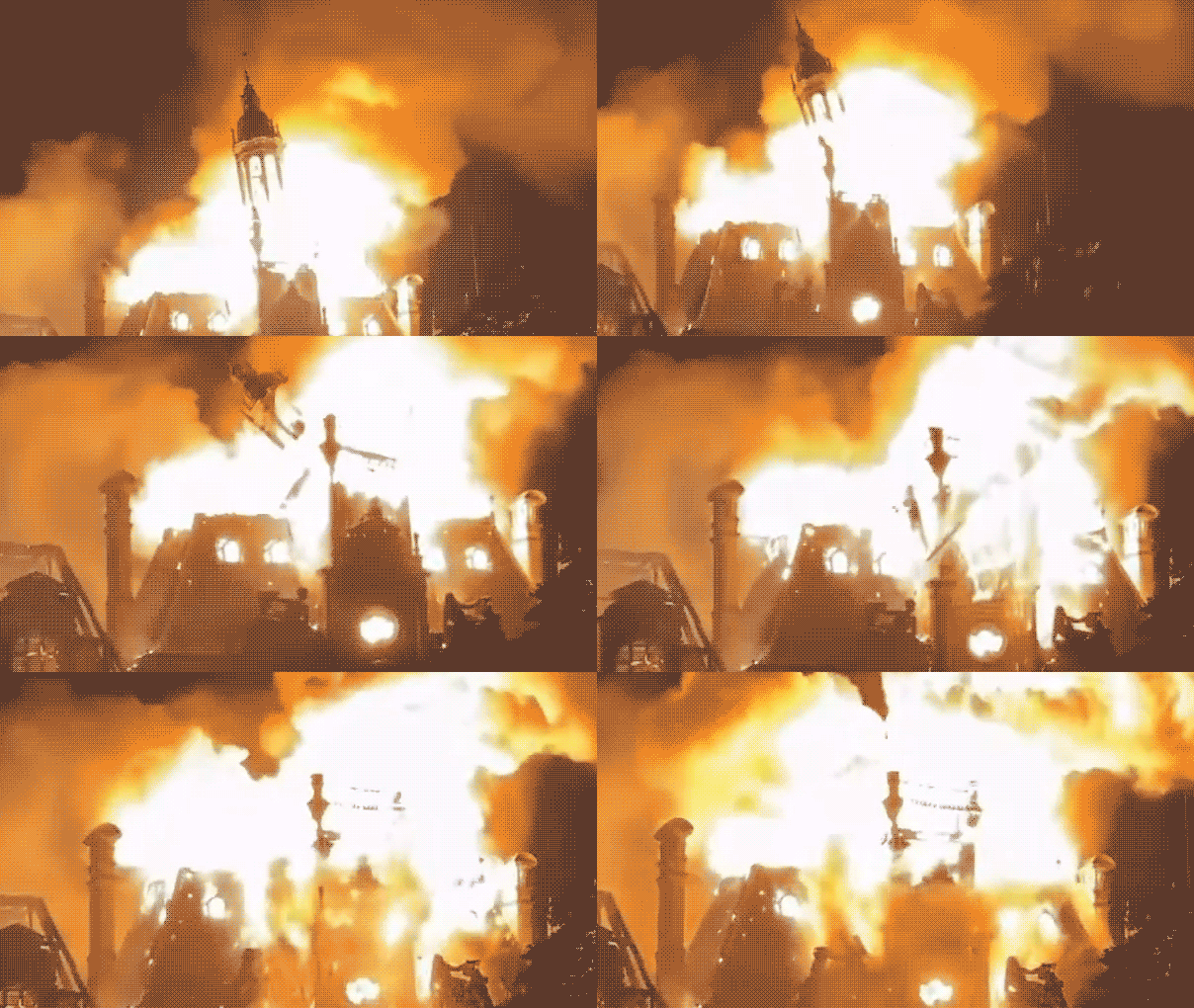
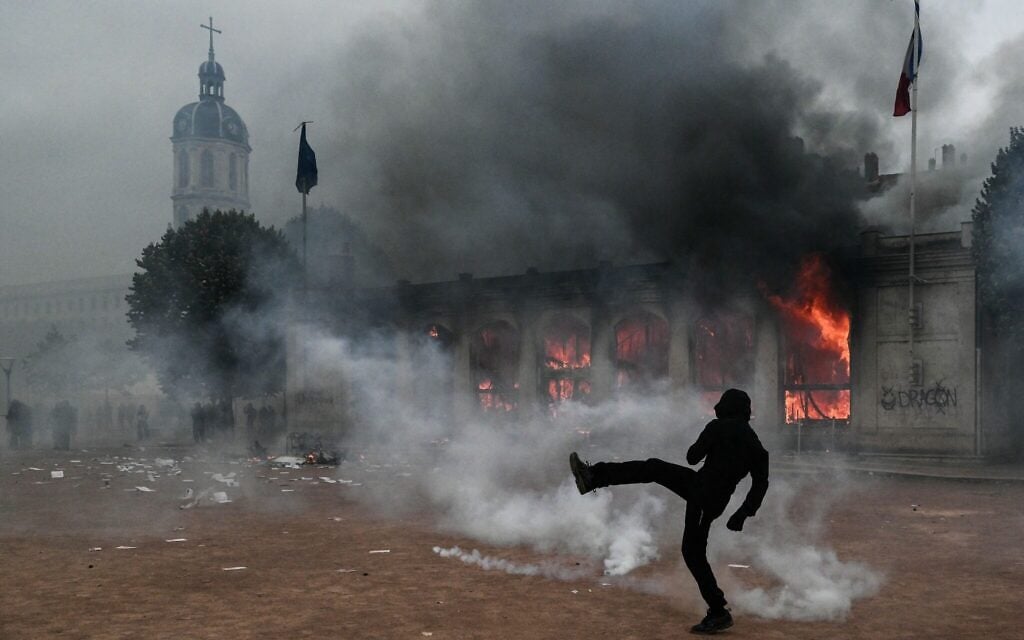
This is the moment a town hall collapsed as protests sweep across France.
The 140-year-old town hall in the French city of Limoges caught fire during protests in the city
Dramatic videos on social media also showed buildings on fire.
Videos showed the bell tower of the city hall building in Limoges collapsing after protesters broke in and set fire to the ground floor.
Mass arrests across France as police attempt to bring riots under control
Looted furniture is thrown onto a fire during demonstrations on October 17, 2026 in Paris, France.
Carl Court/Getty Images
French Prime Minister Sébastien Lecornu said late Saturday that authorities had arrested 1,200 people across the country following the day’s protests.
Lecornu also said that at least 150 police officers had been injured.
"Peaceful demonstrations have their rightful place in our Republic. Arson, looting, and attacks have no place whatsoever," Lecornu wrote in a post on X on Saturday.
French President Emmanuel Macron said on X on Saturday that "those who have broken, attacked the prefectures, as well as businesses, looted even our town halls, will be prosecuted and punished."
As hundreds of thousands protest cost of living, city hall torched as police use tear gas; teen protester loses hand after picking up stun grenade; PM blames 'ultra-left,' months before presidential election
A historic building in the French town of Limoges, about three hours south of Paris, has been "largely lost" after it was set on fire by rioters as demonstrations continue across France.
The Limoges Town Hall was built in 1883, and was made a historic landmark in 1975.
"The roof has collapsed onto lower floors, except the west wing, and two-thirds of the exterior has already disappeared," the local prefect, Maurice Barate, told the AFP news agency.
Barate called it "a deliberate act by hooligans," adding that it was a "catastrophe for heritage."
The destruction came as far-left anti-government protests and violent clashes entered their fourth week in the European country over the cost of living.
On Saturday, outgoing President Emmanuel Macron wrote on social media: "There is no place for violence in our republic."
"Those who have broken, attacked the prefectures as well as businesses, looted even our town halls, will be prosecuted and punished," he added translated from French. "To the law enforcement forces, guarantors of the right to demonstrate, I express the support of the Nation. We will all stand united against the sowers of chaos, who seek only to bring down our institutions and prevent those who peacefully express their demands from doing so."
Around 400 people were arrested on Saturday, according to Interior Minister Laurent Nuñez, as more than a half million people took part in more than 100 marches across the country.
Masked groups also attempted to break into city halls in Lille and Calais and a police station in Brest, the interior minister reported, along with violence in Rennes, Toulouse, Montpellier and Grenoble, among other cities.
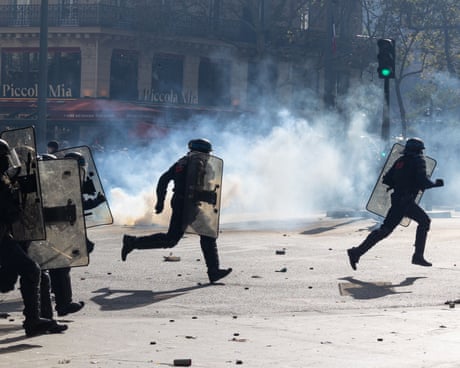
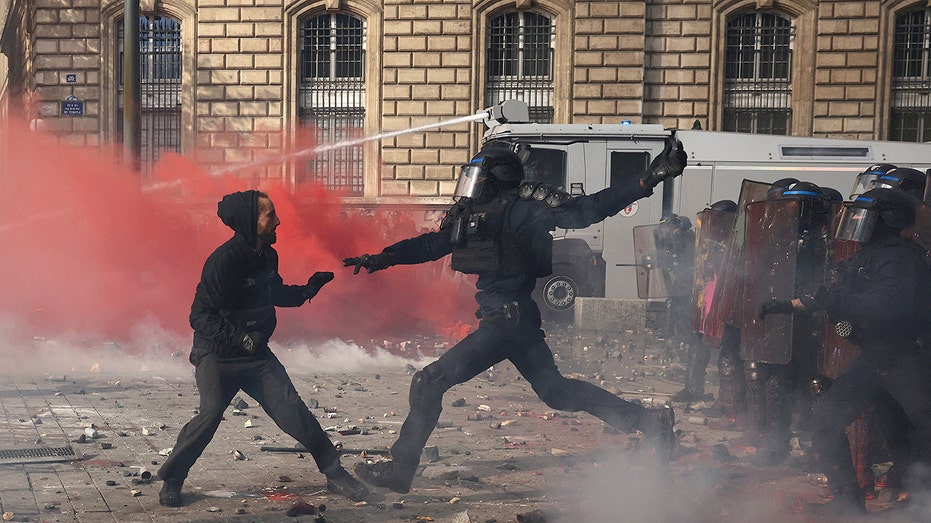
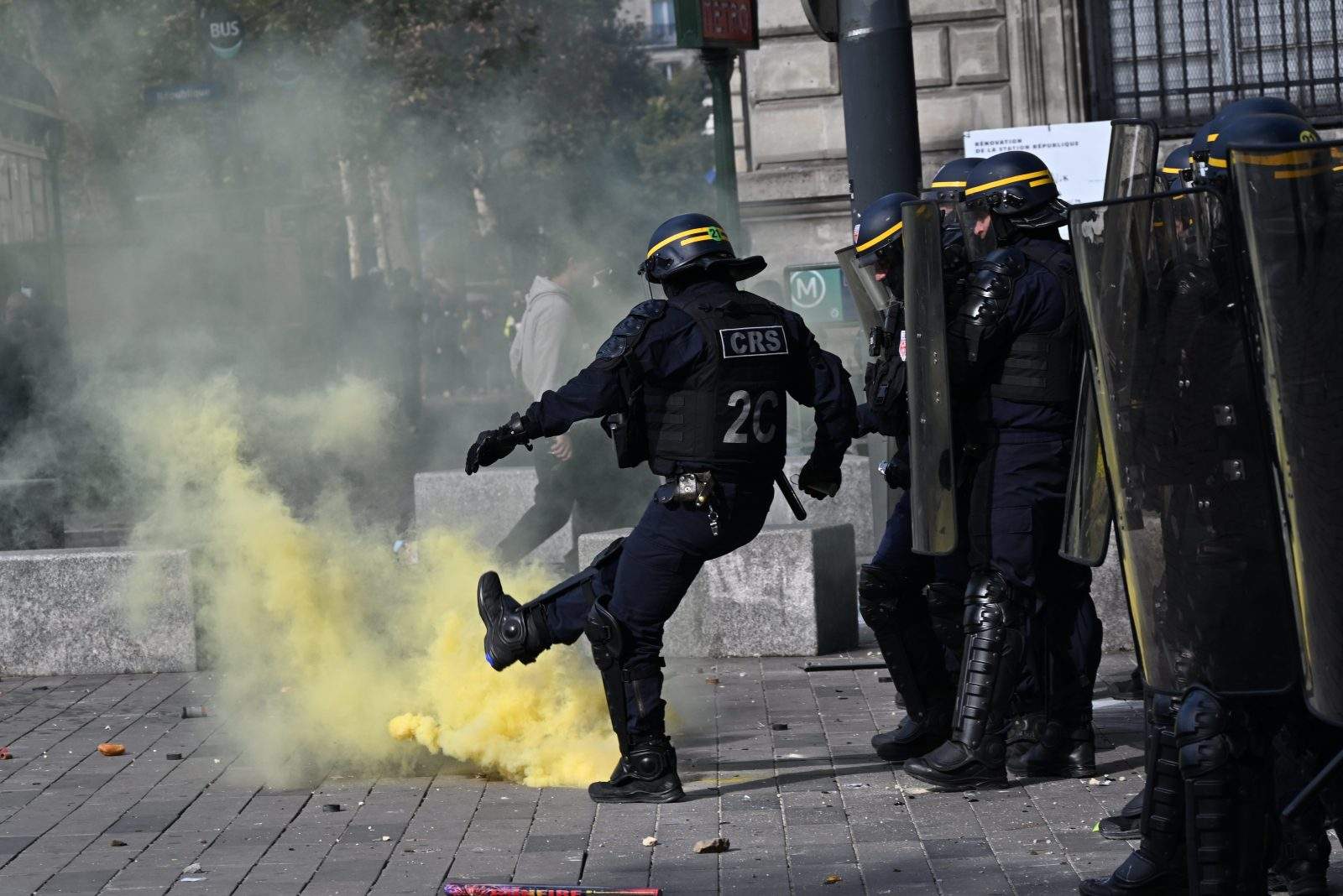
While many of the protests were without violence, many have descended into riots. Police used tear gas and water cannons on Saturday to disperse violent groups in Paris, where people wearing hoods and masks threw fireworks and other objects at officers in the Place de la République.
Violent clashes broke out across France Saturday as demonstrations entered a fourth week.
Earlier in the week, President Emmanuel Macron made some of his most direct comments yet on the protests as he enters his final six months in office.
In his weekly cabinet meeting, Macron "stressed that young people have legitimate concerns," government spokeswoman Maud Bregeon told the AFP, "but these are being exploited for political purposes and turned into urban violence."
Bregeon added that Macron called on his ministers to come up with "concrete responses" to the unrest within weeks.
This comes as a national day of protest over rising costs of living and additional student grievances led to violence in Paris and other major cities today.
While many of the protests were without violence, many have descended into violent riots. Police used tear gas and water cannons Saturday to disperse violent groups in the capital, where people wearing hoods and masks threw fireworks and other objects at officers in the Place de la République.
The interior ministry reported assaults on police, looting and damage to public buildings, saying there have been at least 272 arrests nationwide.
French Prime Minister Sébastien Lecornu took a more direct approach than Macron, saying the student movement has been "instrumentalized by the allies of France Unbowed (LFI) ... for electoral reasons."
The far-left LFI’s presidential candidate, Jean-Luc Mélenchon, even participated in one of the Paris protests this week, while LFI councilors, deputies and mayors have joined student blockades in multiple cities.
Elections to replace the term-limited Macron are set for April and May, and opposition parties have seized upon the ongoing unrest. Leading candidate Marine Le Pen of the conservative National Rally party has voiced support for the police, blaming students for any violence.
"Macron is right that students can have legitimate grievances and that political forces are exploiting them. What is missing from that diagnosis is the state’s own responsibility for the loss of authority that makes this exploitation possible," Simone Rodan-Benzaquen, senior envoy to Europe at the Foundation for Defense of Democracies, told Fox News Digital.
"Macron cannot speak about this simply as an observer. He has to answer for the institutions he leads," she added. "His challenge is to show that democracy can both solve problems and defend itself. Otherwise, the far left profits by calling the state oppressive, and the far right profits by calling it powerless."
Meanwhile, students, unions, rights groups and parents have accused the police of using excessive force against the students.
According to the AFP, the interior ministry has opened internal investigations into 36 allegations of police officer violence against demonstrators. But the national police union, Alliance Police Nationale, says it has filed a lawsuit against the government for "putting lives in danger" over what it called "contradictory orders" given to officers deployed in the protests.
The Alliance says officers felt "betrayed, abandoned, left to fend for themselves" by their political leaders because of their "unclear instructions" and what they said were public expressions of "empathy towards the rioters."
"This is the country of the French Revolution. Everyone boasts about it," police officer and union representative Walid Hrar told The Associated Press. "Some political parties don’t hesitate to say that we need to disobey the law. That’s what Robespierre and other revolutionaries taught us in 1789.
"France always tends to react rather than anticipate," he added. "In other words, we’re always going to extremes."
On the sidelines of Friday’s European Council summit in Brussels, Macron again called for calm, saying, "There is a constitutional right to protest and to express oneself. But this right comes with the need to respect. Respect for people, respect for property and, therefore, a commitment not to insult or destroy."
Lecornu told Parliament that 937 police officers and 149 teachers and school staff have been injured since the protests began, while the French justice ministry reports that nearly 8,000 people have been arrested.
Protests have also spread to neighboring Belgium.
Several hundred mostly young people protested in Brussels Saturday, according to Reuters, clashing with police in protests at least partly inspired by what is going on in France.
A similar protest occurred in the French-speaking city of Liege. Student groups say they are protesting rising education costs and reforms they say will make higher education less accessible.
Belgian Interior Minister Bernard Quintin posted on X that what is happening in his country "is no longer mere protest! It is pure and simple violence, organized and repeated to destabilize our society… All necessary means will be used to restore order in the face of the rioters."
Small solidarity events have also taken place in neighboring Luxembourg and the French-speaking parts of Switzerland, but they have been peaceful with no arrests reported. Student protests also occurred in India this week over education issues there, but they do not appear to be linked to the protests in France.
French authorities have expressed hope the protest movement will ease in coming days as schools nationwide are closed until Nov. 2 due to the Toussain, or All Saints’, holiday.
The Associated Press and Reuters contributed to this report.
Police use tear gas, water cannons and stun grenades against protesters who shot fireworks at officers, broke into the Marseille town hall and set buildings on fire
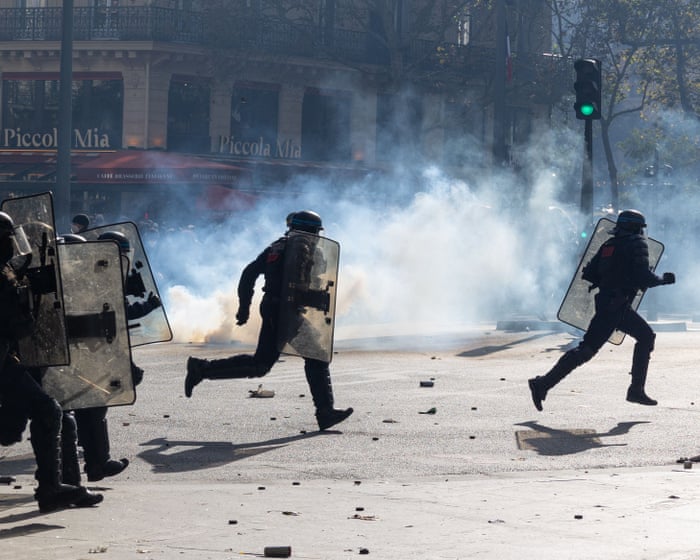
Police used tear gas to push back people wearing hoods and masks and throwing fireworks at officers in the Place de la République, northeast of the Paris city center.
Police used tear gas to push back people wearing hoods and masks and throwing fireworks at officers in the Place de la République, northeast of the Paris city center.
 Login