In a sworn affidavit to the High Court, a former campaign tech chief claims the ruling party’s new app can bypass the law and secretly transmit voter data in real time using AI
Israeli digital advertising agency Discover-Tech used a sprawling network of online ads to track internet users and help hack their devices, according to reports from Citizen Lab and Confiant.
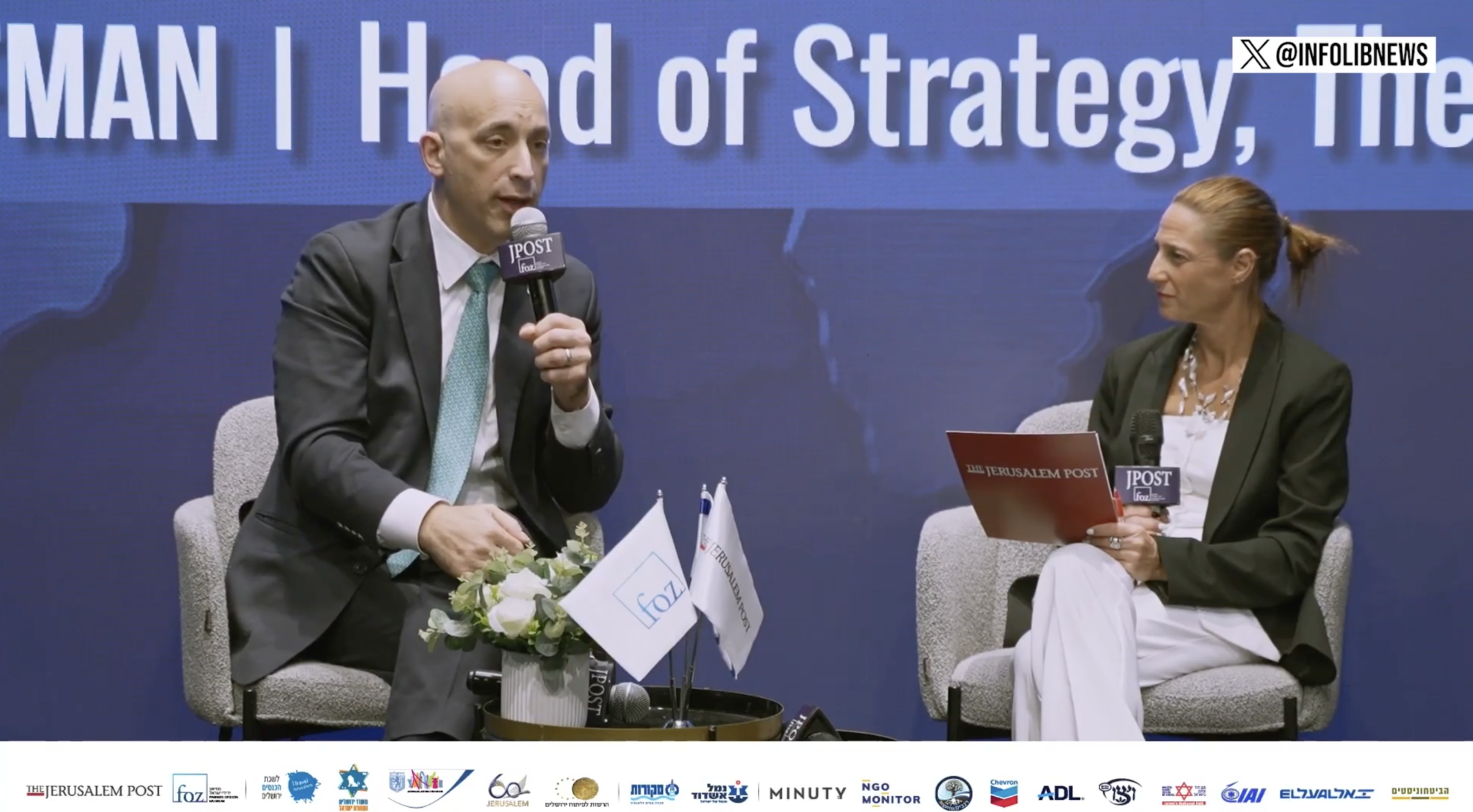
Video of Jonatan Greenblatt saying they’ve been working with OpenAI, Anthropic, Alphabet, the company that runs Gemini, Google, Meta, who runs Muse, and others, X, who run Grok... "We've had excellent collaboration"'
Israeli forces have detained more than 600 Palestinians over social media content, including 215 since the beginning of 2026, while carrying out more than 1,000 raids, interrogations and summonses
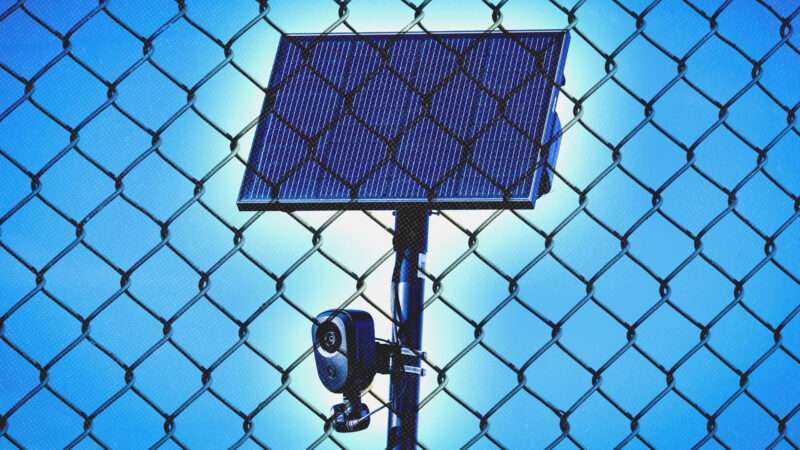
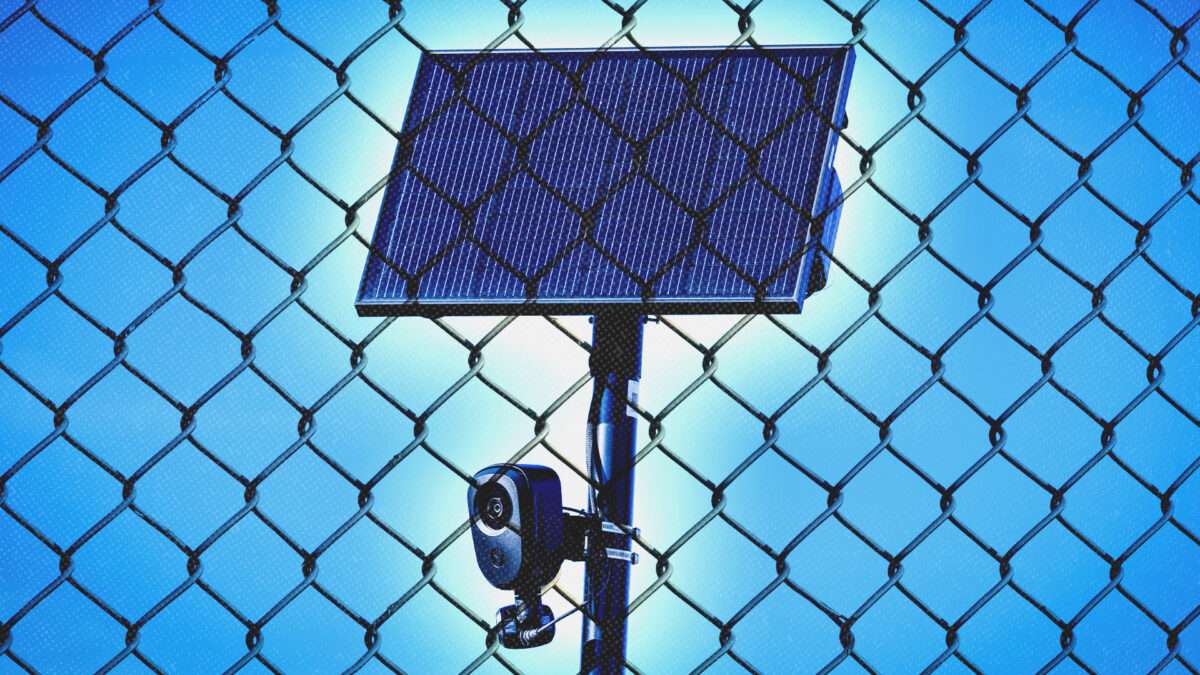
Back in 1983, the Supreme Court declared that "a person traveling in an automobile on public thoroughfares has no reasonable expectation of privacy in his movements from one place to another." That increasingly doubtful proposition underpins a nationwide network of more than 144,000 AI-assisted cameras that track the travels of innocent motorists across the country billions of times each week.
So far, state and federal courts have almost uniformly rejected constitutional challenges to automated license plate readers (ALPRs) installed by companies such as Flock Safety. But in a decision that could signal a shift in the legal treatment of Flock cameras, a federal judge in Oklahoma recently recognized that they enable "a type of indiscriminate mass surveillance."
ALPRs are much more sophisticated than the technology that the Supreme Court considered in 1983, when it approved the warrantless use of a radio transmitter that helped police tail a suspected methamphetamine manufacturer's car. Three decades later, by contrast, the Court said police should have obtained a search warrant before attaching a GPS tracker to another drug suspect's car.
The majority opinion in the latter case emphasized the physical intrusion necessary to install the tracker. But five justices embraced an alternative rationale, saying GPS tracking impinges on reasonable expectations of privacy by revealing potentially sensitive information about the target's historical whereabouts.
That theory came to the fore in a 2018 case involving mobile-phone location data collected by cell sites, which the majority said implicated the Fourth Amendment because "individuals have a reasonable expectation of privacy in the whole of their physical movements." The Supreme Court reiterated that principle this year, extending it to data collected by Google's Location History feature.
"An individual has a reasonable expectation of privacy in records about his cell phone's location," Justice Elena Kagan said in the majority opinion, "and police intrude on that constitutionally protected interest when they demand the information." By similar logic, U.S. District Judge Sara E. Hill concluded this month in the Oklahoma case, people have a reasonable expectation of privacy in ALPR records, and police therefore generally need a warrant to search them.
Those databases include "information about all vehicles that pass by any network-connected camera at all times," which police can peruse "on demand," Hill noted. "Freedom from persistent, dragnet-style surveillance while in public is not a foreign concept in our society, and it is a reasonable expectation that society already accepts," as reflected in the Supreme Court's cellphone decisions.
Like cars, cellphones "move in public places where people can see you in plain view," Hill wrote. "But it becomes constitutionally problematic when law enforcement can indiscriminately and passively catalog your whereabouts over an extended period of time and then use that information for any purpose whenever convenient."
At this point, Hill's decision is an outlier. "It appears that nearly every court examining the issue to date has determined that ALPR technology use is not a search under the Fourth Amendment because people have no reasonable expectation of privacy in their movements on public streets," she noted.
Last month, for instance, a federal judge in California held that ALPR database searches are "clearly distinguishable from and less extensive than the 'near perfect surveillance' achievable" with cell-site or Location History data. And the day after Hill's ruling, a state judge in California rejected a challenge to San Jose's Flock camera network, saying "there is no reasonable expectation of privacy in license plate data collected from cameras directed solely at public streets."
A federal lawsuit involving the same city's ALPR system, which the Institute for Justice filed last April, is still pending. So are challenges to Flock cameras in cities such as Wichita, Kansas, and Norfolk, Virginia.
Even when they reject such lawsuits, courts commonly acknowledge that the legal picture could change as the number and capabilities of ALPRs multiply. If so, it seems likely that Hill will eventually be joined by other judges who recognize the perils of "indiscriminate mass surveillance."
Flock Safety, an Atlanta-based company worth more than $8 billion, manufactures automated license plate readers (ALPRs), cameras that capture images of license plates and store them in a database that police can search.
Recently, the company has been under intense scrutiny over concerns about privacy and the cameras' capacity for misuse, leading some cities to cancel their Flock contracts. But it turns out that getting rid of Flock is easier said than done.
"When Elgin Community College hired Flock Safety to install six surveillance cameras in April 2025, President Peggy Heinrich thought they would 'enhance the safety and security of students,'" Lisa Kurian Philip reported last week at the Chicago Sun-Times.
The Chicago-area school signed up for a one-year contract with the company. It was not alone: Five of Illinois' 12 public universities, plus four of its community colleges,
But Heinrich began to have second thoughts as she learned more about how the cameras can be used—for example, Flock allowed U.S. Immigration and Customs Enforcement (ICE) to access over 80,000 of its cameras. In September 2025, ICE arrested a student near Elgin's campus.
More than half of Elgin's students are Latino, Heinrich told the Sun-Times, and enrollment began to suffer.
"In August of 2025, Flock publicly announced it would no longer conduct pilot projects with federal agencies," according to the company.
Still, Heinrich said, the school chose to end its contract with Flock "out of an abundance of caution for our students."
"Elgin Community College staff notified Flock in October 2025 that they wanted to cancel their contract and have the cameras taken down," Philip wrote. "Within a day, Heinrich said, Flock rejected the request and refused to uninstall the equipment on the basis that the company had not breached their agreement."
The school reached out again in December, offering to pay out the rest of the contract, but according to Heinrich, Flock did not respond.
Since the school no longer wanted the cameras to operate, and Flock refused to remove or disable them, officials zip tied garbage bags over the cameras on campus. But in a peculiar twist, "workers in an unmarked vehicle, which Heinrich assumed belonged to Flock, repeatedly removed the coverings."
This continued until the school's contract expired in April, when Flock finally removed the cameras.
Granted, the situation is somewhat complicated by the fact that while Elgin is a public institution, Flock is a private company.
"Per Flock contract conditions, the company retains ownership of the products it sells to cities," Caroline Haskins reports at Wired. "This means that when people damage or destroy cameras, cities are on the hook for the cost." Covering cameras with garbage bags will apparently work until Flock comes and cuts them down, but removing or disabling the cameras without the company's permission will incur fees to replace them, even if the city has already said it doesn't want them anymore.
But since the product that Flock sells is a searchable database of license plate images compiled from its interconnected nationwide system of cameras, the reality is more complicated than that.
Indeed, while Flock saysrepeatedly that customers own all data that their cameras capture, that's little comfort when the information is also available to any other customer with access to Flock's database.
Between June 2024 and May 2025, police in Illinois searched the Flock database over 4,000 times for immigration-related reasons, even though a state law prohibits ALPRs' use for that exact purpose. This implies the searches were done at ICE's request, meaning federal immigration authorities could access not just the license plate data in those Illinois communities, but also the thousands of communities nationwide that use Flock cameras.
It's also particularly troubling that Flock would make it so difficult for customers to end their contracts. In that, Elgin Community College is not alone: Plenty of jurisdictions have kept using Flock even after supposedly canceling the service, though it's usually the police who fight the cancellations.
In June 2025, the Austin, Texas, City Council declined to renew its Flock contract. Though the city police department supported the program, officials cited concerns about the cameras' capacity to target vulnerable communities.
But in February of this year, public radio station KUT reported that at least two neighboring towns were sharing access to the Flock database with Austin police.
In July 2025, the Board of Lucas County Commissioners in Toledo, Ohio, voted 2–1 to approve 27 Flock license plate cameras across the county, costing $250,000 over four years. But a week later, one commissioner changed his mind, citing fears of how the data would be used, and the board voted again to rescind the previous approval.
In a letter to the Lucas County prosecutor the following day, Sheriff Michael J. Navarre said the commissioners "have a legal obligation to honor this contract" and alleged that the decision to rescind it was borne out of personal animus toward him.
"I cannot sit idly by and allow them to make decisions out of spite that negatively impact the safety of my deputies and the community they protect," he wrote. To be clear, what apparently put everyone at risk was the decision not to move forward with a series of license plate cameras.
County prosecutor Julia R. Bates wrote back to the sheriff in September 2025, stating that since he had already signed the contract from the original resolution, the rescission was "void."
Elgin Community College's experience is not quite the same—in that case it wasn't the police department, but Flock itself, that refused to take down the cameras. But it's still indicative of the widening rift between those who worry about our growing surveillance state and those who apparently see it as worth the tradeoffs.
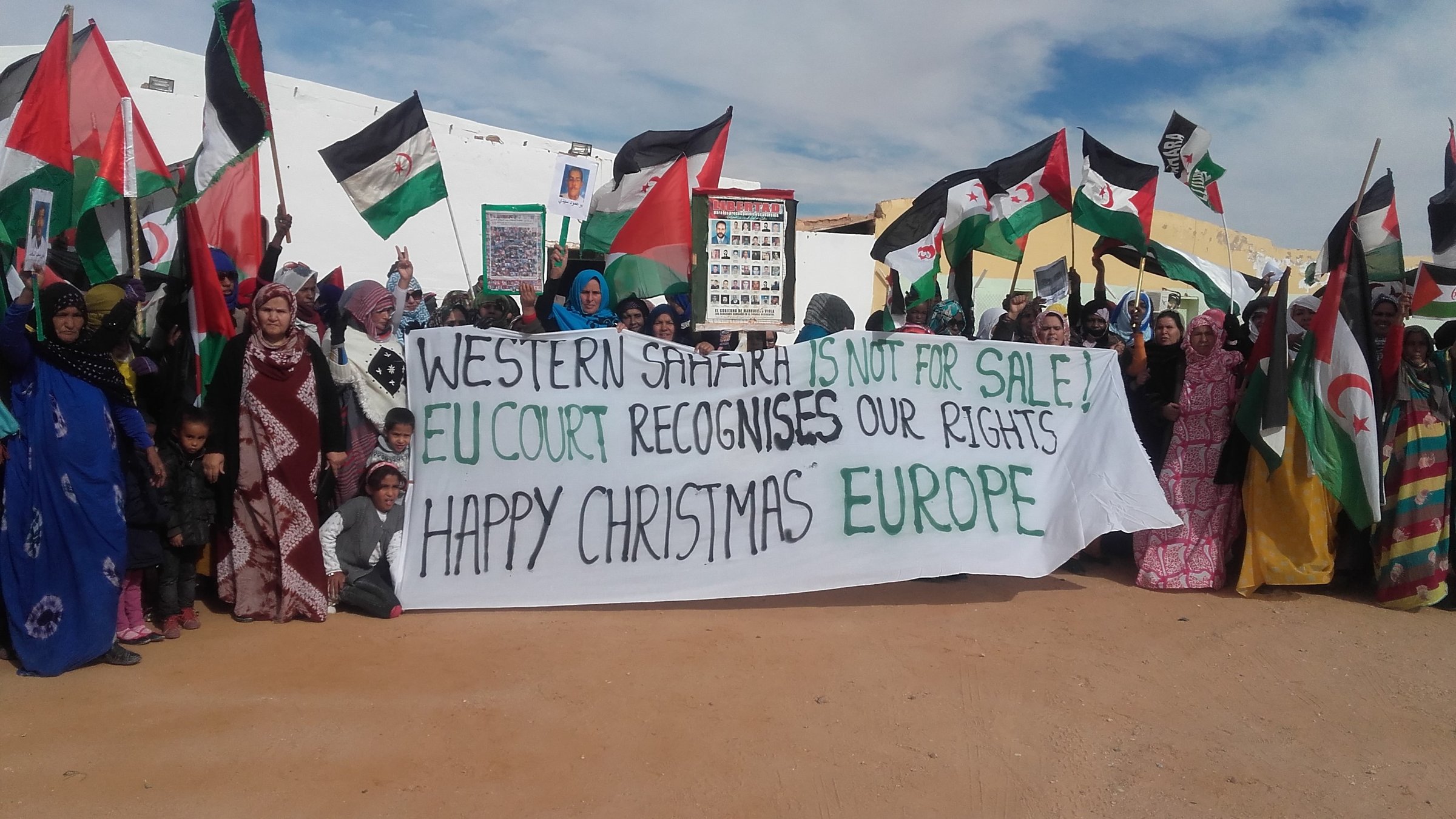
Amnesty describes a surveillance ecosystem involving spyware, physical surveillance, location tracking, informants, judicial pressure and smear campaigns. Western Sahara is not peripheral to its findings.
The organisation devotes a case study to Sahrawi activists and reports that a former member of Morocco’s domestic intelligence service, identified as “Safir,” described Sahrawis and Riffians as priority intelligence targets, including beyond Morocco. Amnesty says it independently verified his identity, employment and key elements of his testimony.
The report also contains forensic evidence involving Pegasus spyware and documents cases connected to Sahrawi activism that reached European territory.
The people Amnesty examined are the tip of the iceberg. They are documented cases: people researchers could interview, devices they could examine, or targets for whom other evidence was available.
Surveillance is secret by design. Most people never learn that their phones have been compromised, and most suspicious devices will never reach a forensic laboratory.
That is why the chronology matters.
Chilling effect
On 8 April 2021, The Guardian quoted my warning that Sahrawi activists’ “phones and internet connections are hacked.” We were describing the symptoms years before Amnesty’s latest investigation exposed more of the machinery.
But surveillance is not simply about collecting information.
When a security service knows who an activist speaks to, where that person travels and what exists inside a phone, information can become power.
Amnesty documents cases in which private information gathered through surveillance later appeared in media coverage and coordinated smear campaigns against human rights defenders.
The organisation is careful: it could not independently establish the source of every piece of private material published. But it says the nature of some material raises serious concerns that surveillance-derived information may have reached media actors.
For Sahrawis, that raises an obvious question: How does private information about activists move from their lives and devices into the public sphere?
That question deserves independent forensic investigation.
But Amnesty’s report should provoke another examination — this one in Washington and European capitals.
For decades, Western governments have built close security relationships with Morocco around counterterrorism, intelligence cooperation, migration and regional stability.
The question is not whether those relationships should exist. It is whether the West has adequately examined what happens to security capabilities once they are in the hands of its partners.
Amnesty does not establish that every security capability Morocco obtained through Western cooperation was used against Sahrawis. The evidence does not support such a sweeping conclusion.
It does, however, justify harder questions.
What safeguards accompanied security cooperation? Who monitored end use? What happens when capabilities developed or acquired in an environment shaped by counterterrorism are directed toward peaceful human rights activism?
That is the line separating security from repression.
Western Sahara struggle
The contradiction is especially striking because Sahrawi human rights activism has often relied on peaceful means: demonstrations, documentation, journalism and engagement with international institutions.
Amnesty reports restrictions on expression and assembly concerning Sahrawi rights, alongside reports of arbitrary arrests, prolonged surveillance, restrictions affecting families and the dispersal of peaceful demonstrations.
Europe has encountered similar contradictions in its relationship with Morocco.
In June 2021, the European Parliament explicitly rejected Morocco’s use of border control and migration, particularly involving unaccompanied minors, as political pressure against Spain.
Yet the same resolution emphasised the longstanding relationship and cooperation between the European Union and Morocco in counterterrorism, migration and trade.
That contradiction should matter to Europeans.
When democratic governments make another state indispensable for stopping terrorism, controlling migration or providing intelligence, they provide more than resources. They provide leverage. Eventually, fear of losing cooperation can make scrutiny of a partner more difficult.
Europe has confronted another warning sign. In its response to the corruption scandal that engulfed the European Parliament, the Parliament itself denounced alleged attempts by Morocco and Qatar to influence lawmakers and staff through acts of corruption.
These remain allegations. They do not mean that every European position favourable to Morocco was corrupt. But they demonstrate why foreign influence over democratic institutions requires serious scrutiny.
European vs American foreign policy
Western Sahara remains an issue on the United Nations agenda and is tied to a decades-long international process concerning the political future of the territory.
That should matter to an EU that regularly invokes a rules-based international order.
Morocco has rejected previous allegations concerning Pegasus and described earlier Amnesty findings as baseless. Amnesty says it provided Moroccan authorities with a summary of its latest findings before publication and invited a response but received none before the report was published.
Those denials belong on the record.
So does the evidence.
The test of a human rights policy is not only how a democracy responds to abuses by its adversaries. The harder test is what it does when credible allegations concern a security partner.
For Sahrawis, however, this story is older than spyware.
For nearly half a century, generations of Sahrawis have lived through restrictions and documented abuses connected to political expression over the future of Western Sahara. Children have grown into adults watching what can happen when someone speaks publicly: surveillance, imprisonment, smear campaigns, pressure and fear.
After all these years, what Sahrawis are asking for is not complicated.
We are not asking the world to choose an answer for us. Nor should the outcome be written in advance in our favour.
We are asking for something more elementary: Treat the Sahrawi as a free human being, capable of thinking, choosing and expressing a view about the future of the land he or she calls home without fear.
It is easy to live in a democratic society, protected by freedom of expression and equality before the law, and then propose a political solution for a distant people who will have to live with its consequences every day.
But a human question should come before the geopolitical one:
Would you accept for yourself and your children a political order in which expressing your views about your homeland could expose you to surveillance, intimidation or punishment?
A Sahrawi is not a number in a diplomatic file, a detail in a geopolitical bargain or a security problem to be managed.
A Sahrawi is a human being, with a memory, a family, a homeland, an opinion and a future.
After nearly 50 years, perhaps it is time simply to hear that voice as it is, rather than as others interpret it.
Give Sahrawis one day without fear.
One day to speak without surveillance, without pressure and without wondering whether their words will reach their phone, their workplace, their home or their family.
Do not write the answer for them.
Just let them speak.
If any political solution is truly just, why should it fear the voice of the human being who will have to live under it?
Armed escorts in masks pushed a group of migrants from Belarus toward Latvia and threatened Latvian soldiers, and hours later masked people crossed into Latvia and stole border surveillance cameras, Latvian Interior Minister Jānis Dombrava said on 6 October. Latvia's military described the incident as part of a continuing hybrid campaign on the border, and Ukraine's foreign minister blamed Moscow.
Russia keeps probing the EU's eastern defenses with migrants pushed from its own soil and through its ally Belarus, alongside drone incursions and sabotage that ISW has linked into one Russian pattern across Europe.
Armed escorts threatened Latvian soldiers
Latvian soldiers stopped at least 20 migrants trying to cross the border illegally from Belarus, the Latvian National Armed Forces said. Masked escorts led the group, and this time they were armed, threatened the soldiers, and urged and drove the migrants toward Latvia, the military said.
"Unlike many previous incidents, this time the provocation was particularly demonstrative and aggressive," Dombrava said.
The incident confirms that deliberate provocations and hybrid threats on the border will continue, the armed forces said. Illegal migration is being used as a tool to pressure Latvia's border and, with it, the external border of the EU and NATO, they added.
Belarus began funneling migrants toward the EU in 2021, a campaign Poland's government called a hybrid attack in which the migrants end up as weapons. In 2023, Finland closed its border crossings with Russia, accusing Moscow of the same tactic, and by mid-July Latvia had logged 111 straight days of migrants pushed across from Belarus.
Masked people stole the cameras
Several hours after the standoff, people in masks entered Latvian territory, damaged a distribution cabinet, and stole surveillance cameras, Dombrava said. They returned to Belarus before the border guard patrol could arrive.
"Belarus should understand that such incidents could lead to more serious consequences for Belarus itself," he said.
Ukrainian Foreign Minister Andrii Sybiha said Ukraine stands in full solidarity with Latvia. "Make no mistake: Moscow is behind it," he wrote, adding that Russian President Vladimir Putin "deliberately weaponizes migration, with the help of Lukashenka, to destabilise Europe."
Tunnels, tear gas, and damaged cameras on the border
Latvia's border guards stopped 11,384 attempts to cross illegally from Belarus between the start of 2026 and 24 September. In January, Latvia's armed forces and border guard published evidence that Belarusian security agencies were organizing illegal migration across the border. Latvia has also recorded deliberate damage to cables, distribution cabinets, and camera poles on its eastern border, aimed at slowing the rollout of an automated border control system.
Explore further
Stop arming Ukraine or we shut down your defense firms, pro-Kremlin group tells Latvia, Poland, and Portugal
On 22 July, Latvian soldiers fired warning shots and used tear gas against migrants trying to cross. The next day, Prime Minister Andris Kulbergs said Russia and Belarus were stepping up their hybrid war against the Baltic States to distract from Russia's failures in Ukraine. Latvia temporarily halted crossings on the Belarus border on 31 July. In August, Latvian guards found the first tunnel dug from Belarus and turned back 15 migrants who used it.
As AI-powered biometric identification is adopted by police, national authorities should go beyond legal requirements to build trust within the public, a watchdog report has advised.
“To build public trust, law enforcement should publish the results of their fundamental rights impact assessments, going beyond what the AI Act requires,” said the Fundamental Rights Agency (FRA), an EU branch which keeps tabs on citizens’ freedoms, in Vienna on Wednesday (30 September).
After collecting data from seven EU countries (France, Germany, Greece, Hungary, Italy, the Netherlands, and Ireland), the watchdog warned that several member states have yet to put necessary frameworks in place as they adopt automated systems to identify people.
Remote biometric identification is increasingly used to compare people’s profiles against databases or watch lists, but as the technology develops it could be rolled out for real-time use in public areas.
“With clear safeguards and independent oversight, remote biometric technologies can support policing without undermining the very freedoms it is meant to safeguard. Ultimately, it is about trust,” said FRA chief Sirpa Rautio.
Call for disclosure mechanisms
Effective implementation of the EU AI Act requires clear national laws and consistent safeguards to ensure that AI-powered technologies are not used to identify people taking part in peaceful demonstrations or public gatherings, the FRA says.
The body warns that automated identification of live data may affect people’s private lives and interfere with their right to protection of personal data.
In its survey, 37 percent of people said they fear their data could be used for unauthorised purposes.
And 29 percent of people surveyed by FRA said they would be less willing to take part in peaceful demonstrations or protests if facial recognition was used.
The FRA is worried that surveillance tech powered by AI could be used in exactly those scenarios.
In principle, the EU’s AI Act adopted in 2024 bans real-time remote biometric identification systems in public spaces. But exemptions exist for law enforcement authorities using the technology for finding victims or missing persons, to prevent threats to life or physical safety, stop a terror attack, or to find criminal suspects.
This article continues, but the full version is available only to EUobserver.com subscribers. Visit account.euobserver.com/membership
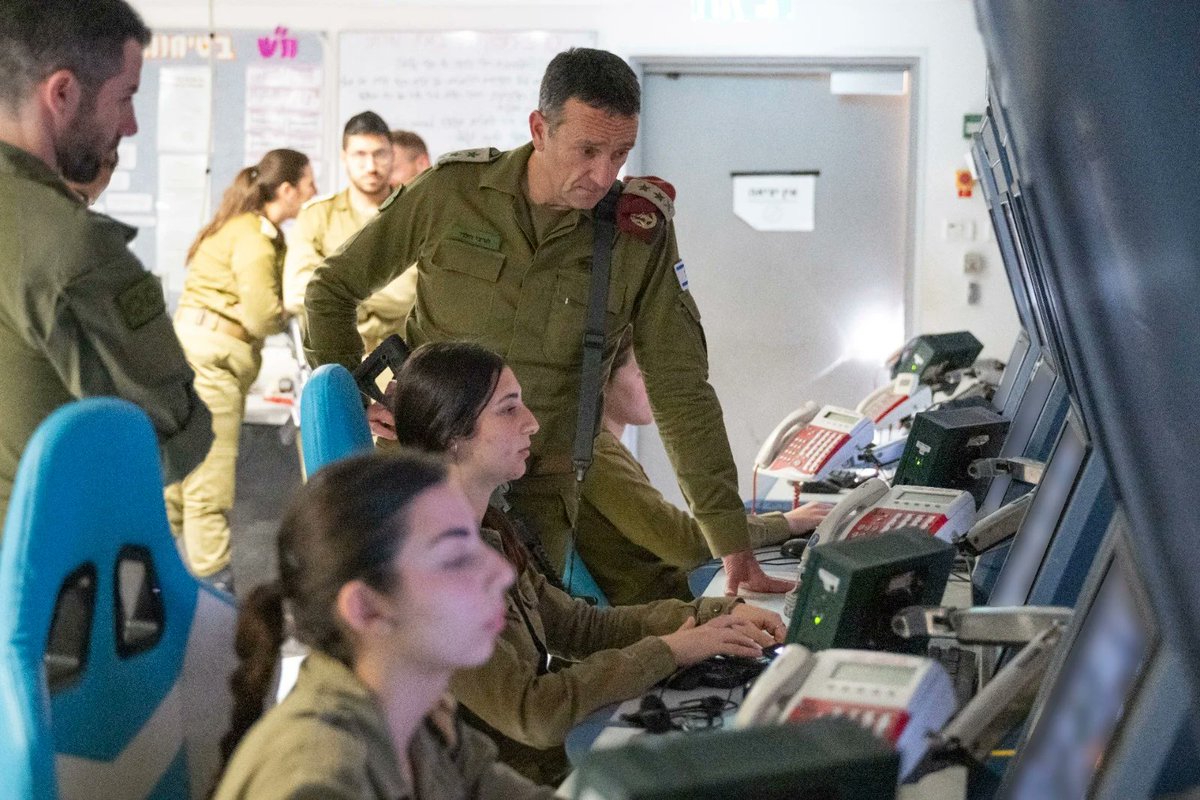
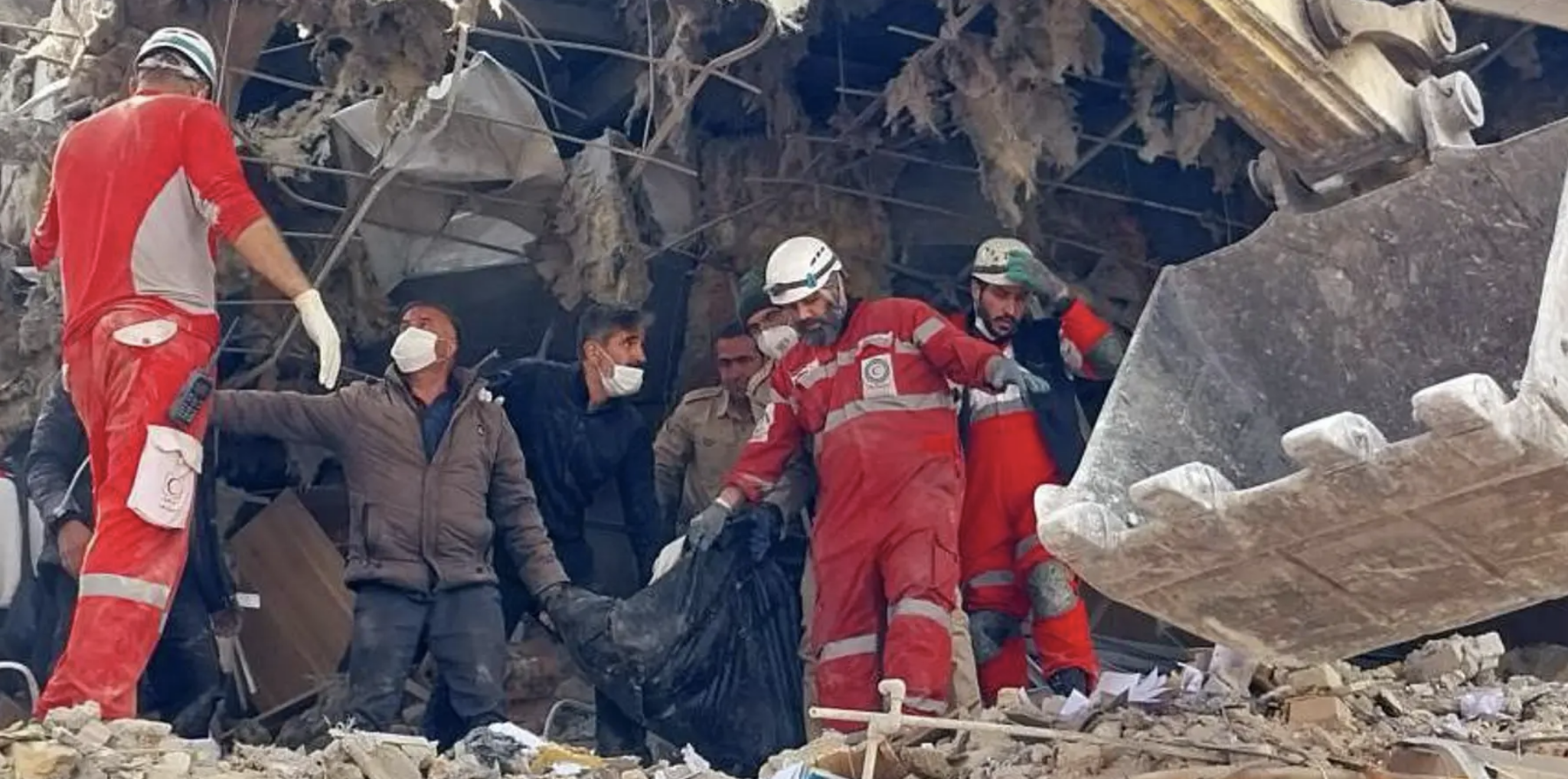
In a recent hearing, lawmakers were told that the US military is deploying AI to target adversaries, with civilians in the crosshairs. AI is carrying out instructions based on rules of engagement set by humans, e.g. the IDF's approval of attacks on low-level targets, even if it meant killing 15 to 20 civilians
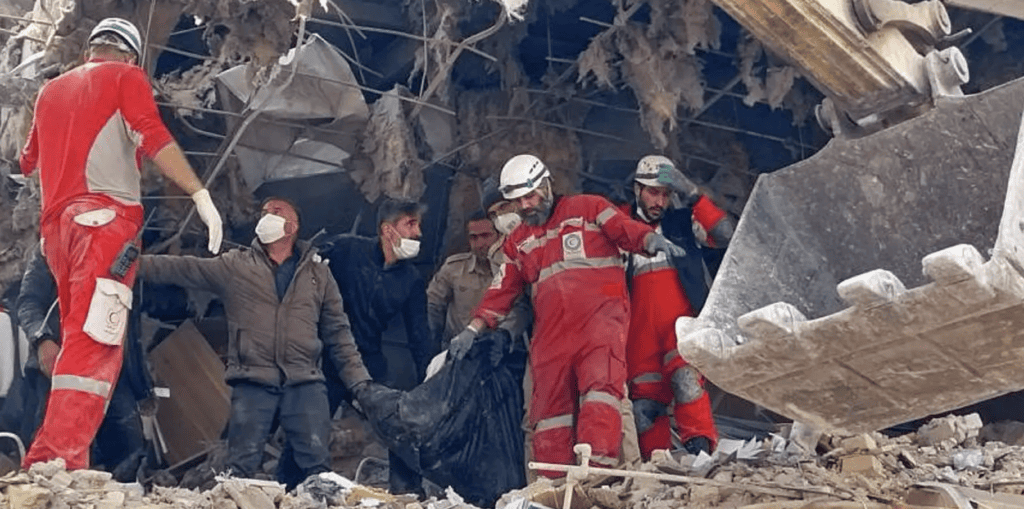
On 19 November 2025, Indian police raided the ‘Kashmir Times’ in Jammu. They said they were on an “anti-terror” operation. The offices had been shut since 2022 and were in dilapidated condition, the equipment largely defunct. Yet, the police claimed to have recovered a “pistol and live AK-47 cartridges.”
Since 2018, only five journalists have faced cases under India’s draconian anti-terror Unlawful Activities (Prevention) Act. Trials rarely start, leaving journalists in a state of perpetual purgatory, even if they are out on bail under onerous conditions.
Before the police came charging into these unused offices last year, the ‘Kashmir Times’, founded by my father in 1954, had long suffered sustained persecution – the seizure of records, of equipment, the harassment of staffers, the use of social media to spread slurs, trumped up charges of tax evasion and the embedding of spies.
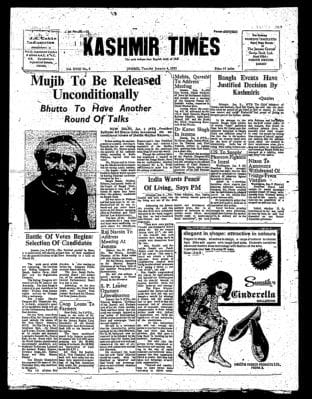
The first ever copies of Kashmir Times, initially a weekly, were seized by the government. In 1983, my father survived a murderous assault with serious injuries inflicted by a Hindu nationalist mob. I joined the newspaper in 1989, as the armed militancy, the ‘insurgency’ against the Indian state, became widespread, and experienced firsthand the struggle to report the news accurately and truthfully. The government would frequently withdraw its advertising, which was the main source of funding for most news outlets. We were besieged on several fronts, facing down the state, militants and aggressive Hindu nationalists.
Kashmir Times front page, January 1972. Image courtesy of Kashmir Times / Anuradha Bhasin digitized by Stanford Libraries.
In 2019, as Indian prime minister Narendra Modi began his second term in office, his government removed the special autonomous status granted to Jammu and Kashmir and protections that had existed for nearly 70 years. Once a state, Jammu and Kashmir was split into two federally governed territories. The Indian-administered part of Kashmir – the subject of several military conflicts between India and Pakistan, with both countries claiming the entire disputed territory while controlling a portion of it – had effectively become a police state and control of the media was a critical component of this transformation.
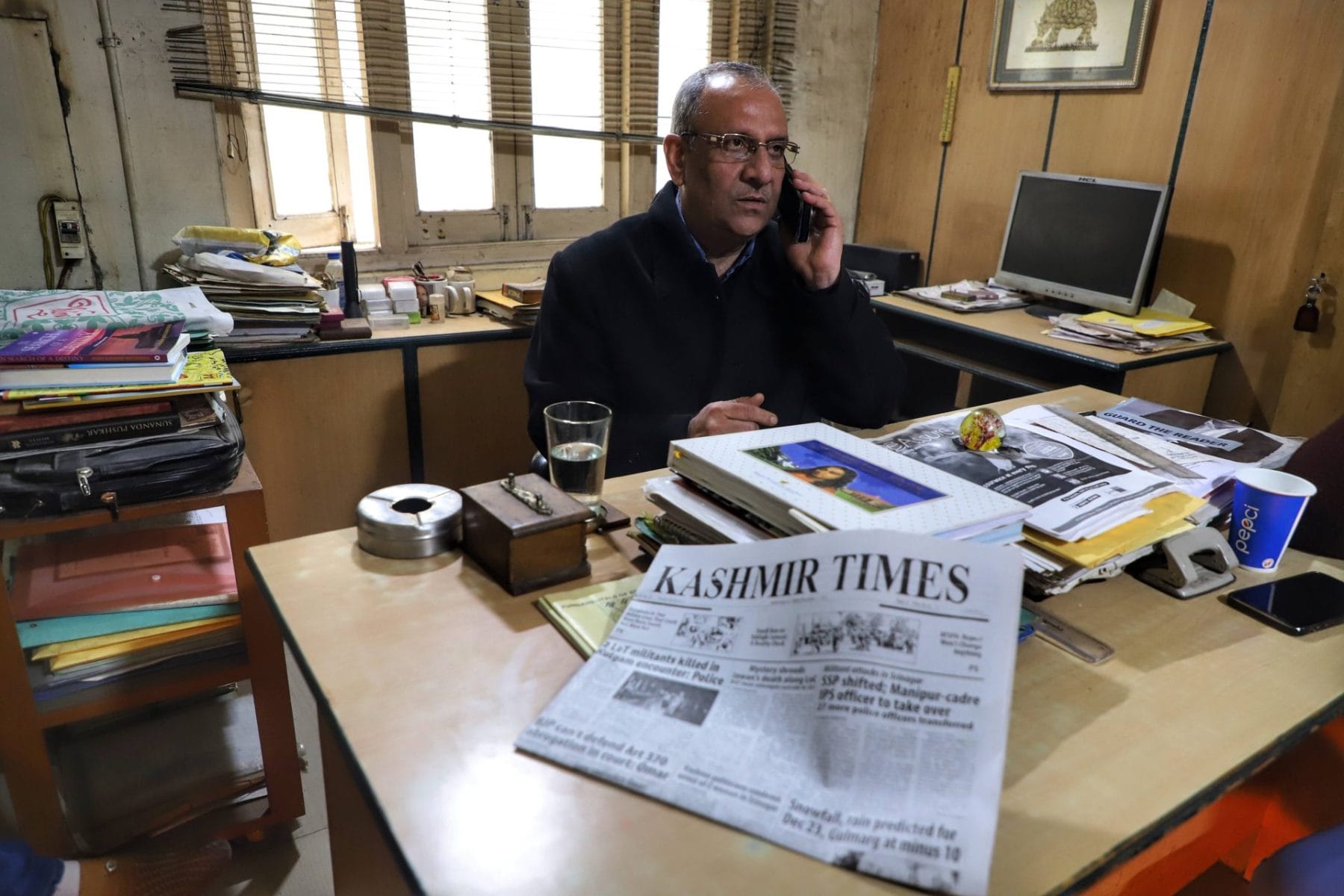
As Executive Editor of the ‘Kashmir Times’, one of the oldest newspapers in the region and the largest, with four editions, I petitioned India’s Supreme Court against the six-month-long internet shutdown that the Modi government imposed in 2019. But by 2020, three editions of the ‘Kashmir Times’ had shut down and the fourth only limped along, a once daily newspaper that was now only occasionally published. By February 2022, even this edition was shut down. I left India with my husband Prabodh Jamwal, the editor of the ‘Kashmir Times’, and revived it as a digital newsroom in exile in the United States in November 2023.
Prabodh Jamwal, Editor of The Kashmir Times, at his office in Srinagar in early 2020. Nasir Kachroo/NurPhoto via Getty Images.
But, as the so-called terror investigation and the mysterious discovery of weapons in our long disused office in 2025 showed, the ‘Kashmir Times’ remained a thorn in the side of the Modi government. The Indian prime minister has frequently presented India on the international stage as the “mother of democracy” and the “Vishwaguru”, a moral exemplar and teacher to the world. Just last week, between September 12 and 13, Delhi hosted Vladimir Putin, Xi Jinping and Iranian president Masoud Pezeshkian as part of the annual BRICS meeting, the global group founded initially by Brazil, Russia, India, China and South Africa (hence the acronym) that is increasingly being presented as an alternative power centre to the American-led Western alliance. For an India seeking to portray itself as not just an emerging superpower but as a democratic force, it is vital that Kashmir remain repressed, hidden away from global scrutiny.
It’s why, even as a newsroom in exile, we continue to be pursued by an Indian government seeking to tarnish our credibility, to deny us the right to report on Kashmir. We are being subject to a vendetta and it represents what has happened to journalism in Kashmir. Journalists have been silenced by the Modi government, Kashmiri voices strangled, and the local media industry deliberately destroyed.
What is happening to journalism in Kashmir is a harbinger of what lies ahead for the rest of India.
A model of suppression
Geeta Seshu of Free Speech Collective, which monitors press freedoms in India, argues that Kashmir is a laboratory where every strategy of media suppression is tested and perfected for use elsewhere. India, which once had a noisy, argumentative press, now ranks at a lowly 157 out of 180 countries in the World Press Freedom Index. Reporters Without Borders, which compiles the ranking, says “press freedom is in crisis” in Modi’s India.
The 2023 Digital Personal Data Protection Act provided a “dangerous framework for expansion of surveillance and censorship” across the country. It empowered the government to demand data from any entity, including journalists, effectively requiring them to reveal their sources. The amendments to the 2020 Information Technology Rules already burden intermediaries with harsh obligations and have been used to arrest journalists, block websites and compel social media platforms to restrict content. Recently, Instagram restricted posts about reports of Kashmiris shot by Indian security forces using pellet guns on unarmed protestors.
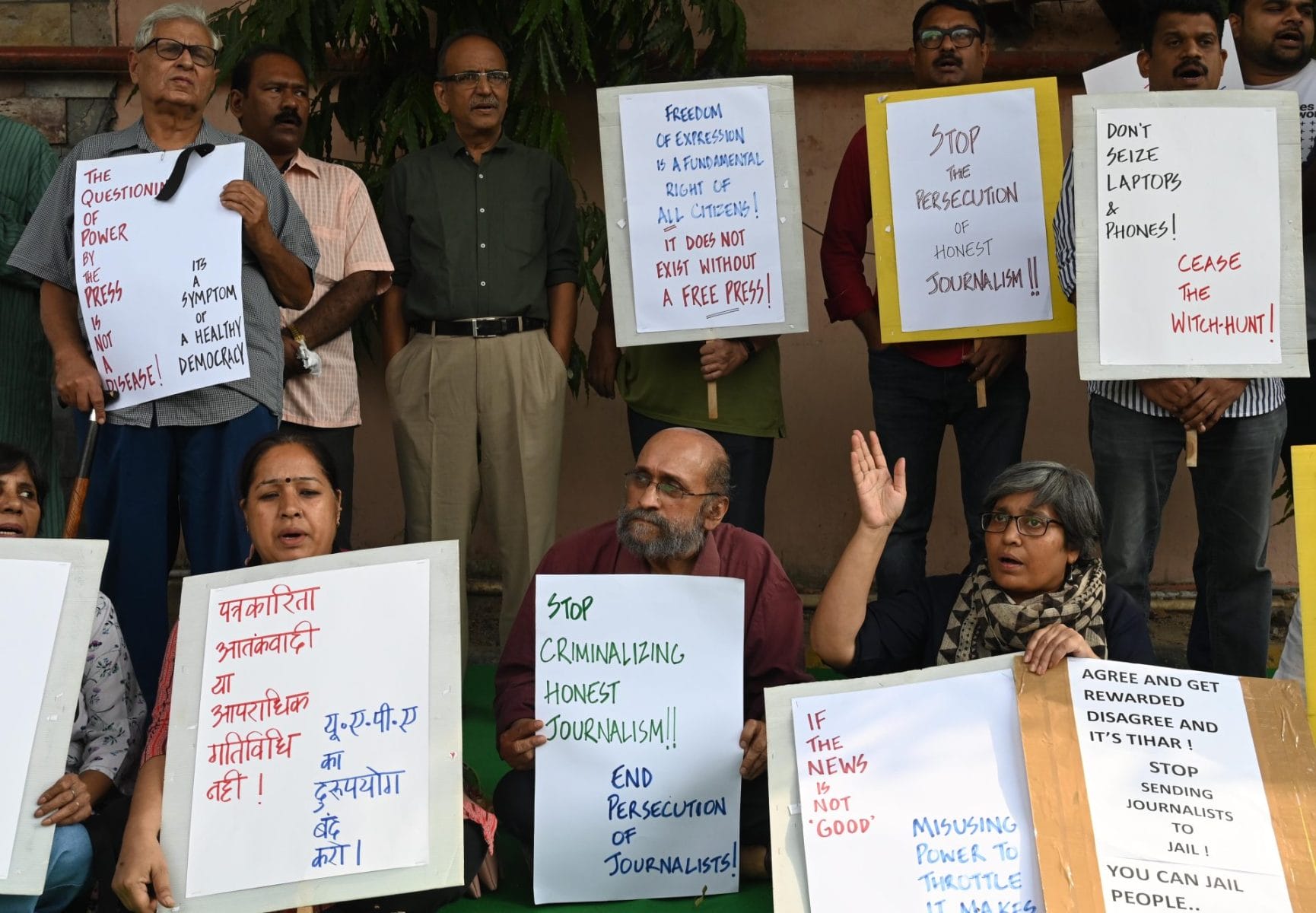
Seshu’s fear that what happens in Kashmir will be replicated in the Indian mainland has largely been borne out. For example, in 2023, nearly 50 journalists associated with the portal ‘NewsClick’ – some only vaguely – were subject to arrests and interrogations. Many had their devices seized without due process. Their alleged crimes were essentially guilt by association, charges manufactured not from evidence but from a, frankly, lazy piece of journalism published in the ‘New York Times’ about NewsClick’s funding. The charges were eventually quashed by an Indian court.
The "To Defend Journalism" protest at New Delhi's Press Club of India, October 2023. Vipin Kumar/Hindustan Times via Getty Images.
Such court rulings are less likely in Kashmir. As a Kashmiri journalist based in Delhi says, “unlike the rest of India, Kashmir is a police state, and state control requires any independent journalism to be shut down.”
In Kashmir, the Indian state has engineered a sophisticated edifice of control through securitization, surveillance and interrogation. It is invisible, intangible, and all-pervasive, a model that extracts quiet surrender and obedience. Unlike the targeted killings of journalists in Gaza, in Kashmir the control of information is seamlessly embedded in everyday life, requiring no enforcement, no traces of brutality. The journalists are essentially cowed into submission.
It began with the world’s longest internet shutdown – a complete lockdown for six months and a partial one for another year. What the shutdown created, despite a court verdict restoring communications, was fear among journalists compelled to work out of a government-surveilled computer facility, and then a perpetuation of that fear through consistent localized and temporary digital shutdowns. So commonplace are these shutdowns that they no longer warrant reporting or commentary.
In June 2020, the Modi government introduced a 53-page document called ‘J&K's Media Policy’ which gave the authorities sweeping powers to monitor, judge, and punish journalists, branding critical reporting as “fake news”, “unethical”, or “anti-national”. The authorities would also routinely remove government advertising from cash-strapped outlets and provide accreditation only to journalists deemed loyal, thus turning bureaucrats into arbiters of what constitutes news and who gets to report it. The effect is chilling.
And then there’s the monitoring of communications.
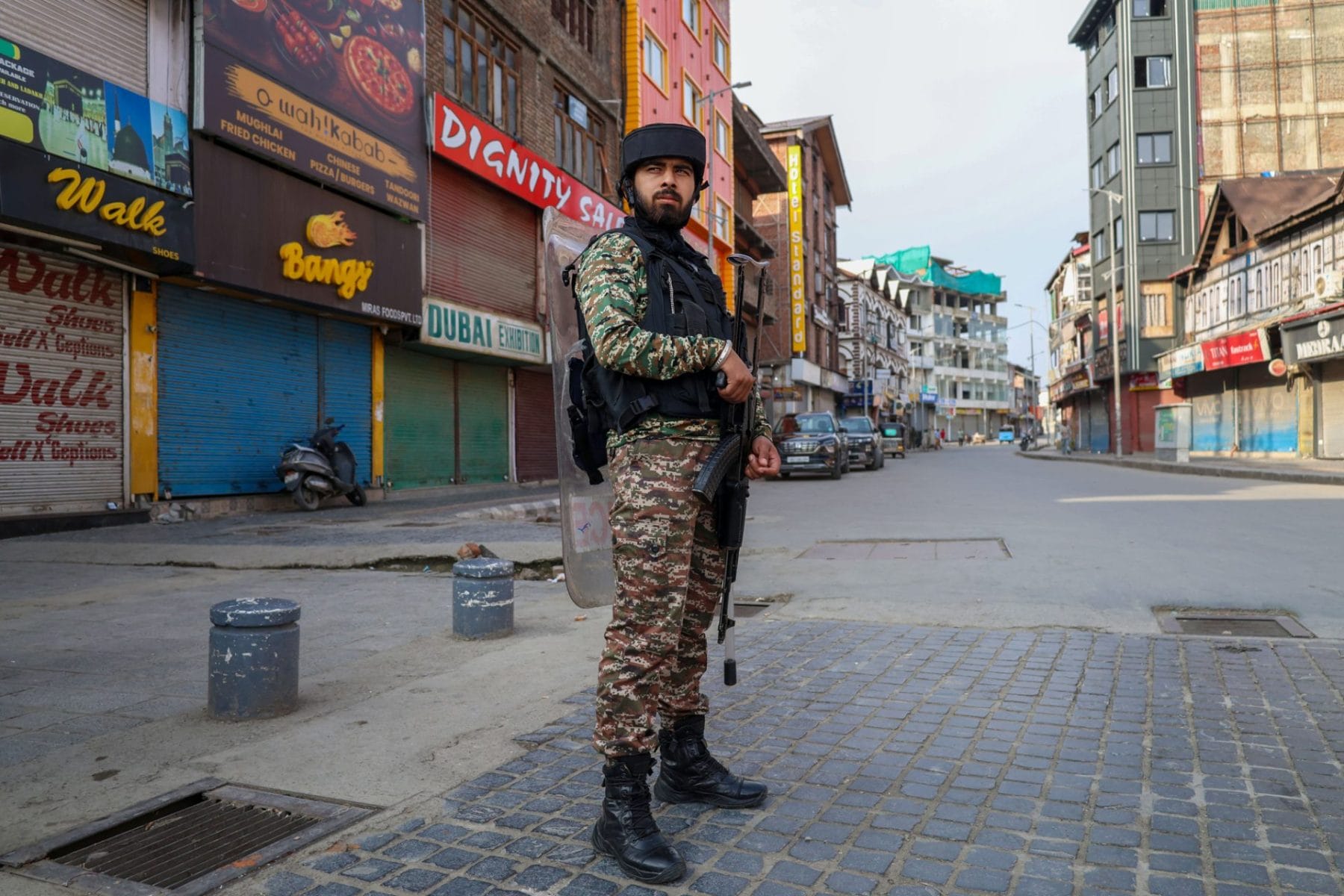
An Indian security personnel in Srinagar, Jammu and Kashmir, August 2026. Firdous Nazir/NurPhoto via Getty Images.
“I can’t say if they’re using Pegasus or some other spyware or technology,” a journalist told me about being interrogated over emails sent to an editor, “but they knew everything about our conversations.” In a 2021 leak, it turned out the Indian government was using Pegasus to spy on at least 40 Indian journalists, only one of who was Kashmiri.
But, a Kashmiri journalist says, “officials have told us ‘nothing in Kashmir is end-to-end encrypted’ and digital activity is clearly being constantly monitored.” No Kashmiri journalist I spoke to for this story, including those who contribute to the ‘Kashmir Times’, have the encrypted messaging Signal app, used worldwide by journalists, on their phones. Devices are routinely checked when journalists are summoned to police stations in Kashmir for questioning. Some said their devices were returned after being tampered with. “You face humiliation and beatings for using Signal and VPNs,” many journalists said. “You can only get away with it if you’re not on their radar,” said one.
In November 2025, the Indian government issued a directive insisting on verifying the “bona fides” of journalists working in Jammu and Kashmir, and the police followed up by requiring journalists to part with personal information including biometrics and bank statements. In January this year, senior journalist Basharat Masood of The Indian Express spent seven hours at a Srinagar police station, then was summoned for three more days and told to sign a bond promising not to “repeat his mistake” – for reporting on the surveillance of mosquea surveillance, even as officials had already admitted to large-scale data collection and verification.
Surveillance normalized
Police also surveil Kashmiris through the use of drone cameras, a network of 1,000 electronic cameras installed at major traffic junctions, and through unrestricted access to people’s social media activity across platforms ostensibly to track anti-India activity. During an illegal “Census 2024” drive, the police collected residents' personal data and GPS-tagged coordinates of homes. And the soon-to-be-rolled-out Jammu and Kashmir-specific digital identity cards that collects the data of entire households, purportedly to ensure the smooth rollout of welfare schemes, has also sparked local anxieties.
Still, as pervasive as the surveillance is, it is journalists that find themselves in the firing line. Any critical word warrants a summons to a police station, interrogation, intimidation and even detention. This happens repeatedly, with journalists never aware of what specific “offence” might trigger a police summons. The reflex, after several such visits to police stations, is self-protection and self-censorship.
A Kashmiri journalist told me that the language the police use to summon journalists for questioning is particularly sinister. It is almost as if the police are enjoying instilling fear. “Aaj dastarkhan par aapki dawat hai”, for instance, is a typical summons. You are invited to a feast, the police say cynically, knowing a journalist is likely to be harshly questioned, even beaten.
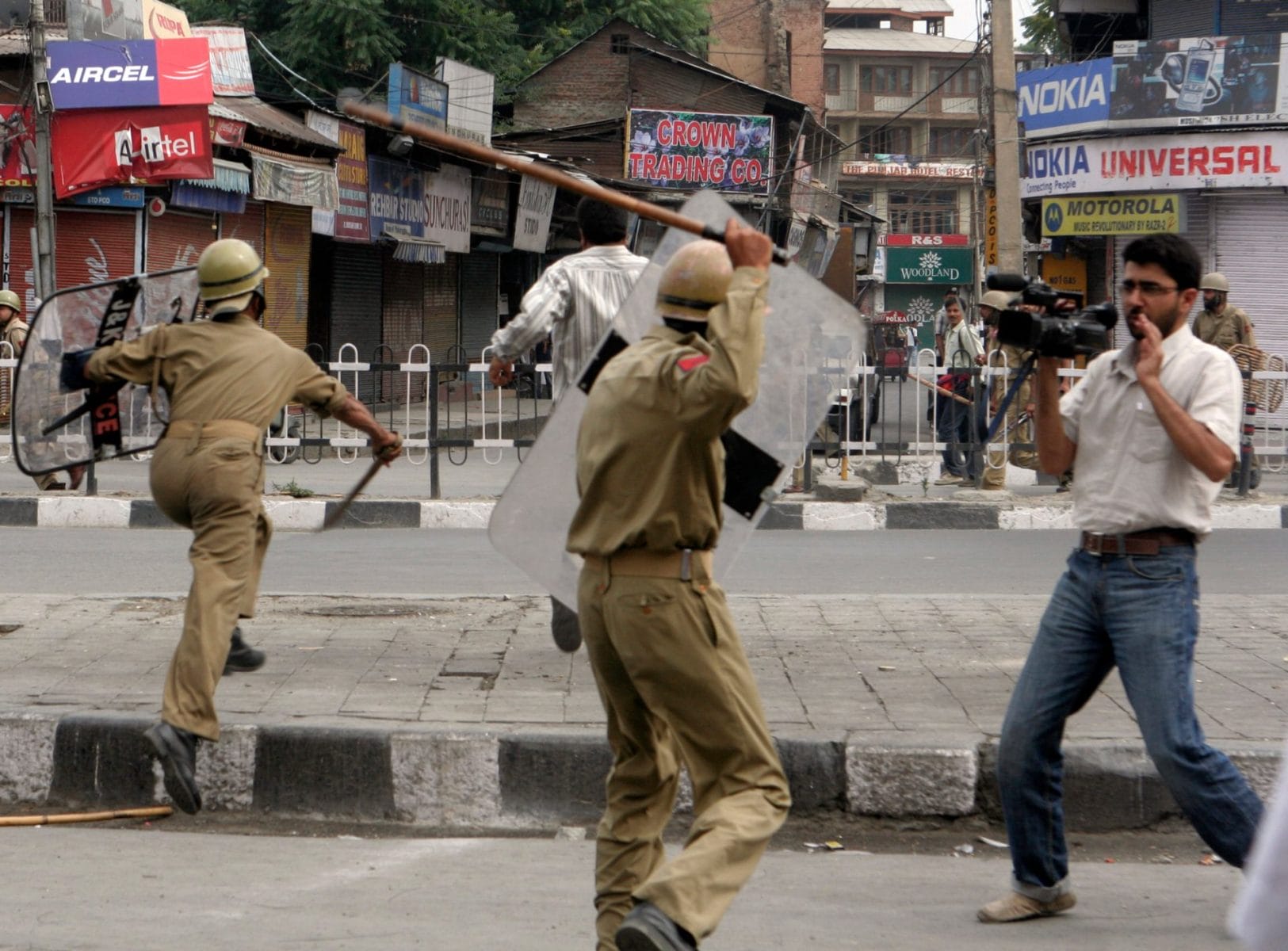
Indian police confront journalists and civilians during a protest on July 10, 2009 in Srinagar in the Indian Administered Kashmir. Yawar Nazir/Getty Images.
Often, Kashmiri journalists, without notice, are placed on no-fly lists. Sanna Irshad Mattoo, a Pulitzer Prize-winning photojournalist, was twice prevented from travelling abroad for exhibitions and award ceremonies, a pointed message that even international recognition offers no protection. At least twelve journalists have had their passports revoked; two of them were already abroad at the time, rendering them stateless.
The Free Speech Collective filed a Right to Information (RTI) query in March 2024 to ascertain exactly how many Kashmiris had had their passports revoked or cancelled. The plea was rejected by the government on grounds of “national security”.
As India continues to press its case as a formidable, if still rising power, citing its 7.8% growth rate over the past quarter, it continues to be defensive and secretive about Kashmir. Foreign journalists are largely barred, or at least heavily restricted, from reporting from both Indian and Pakistani-administered Kashmir. In May, last year, India and Pakistan exchanged air strikes after a terrorist attack in Indian-administered Kashmir and Modi fell out with Donald Trump over the latter’s claim to have stopped both nuclear powers from accelerating towards a disastrous war.
Despite Kashmir being a long-standing issue that merits global attention, reporting from the region has reduced to a trickle.
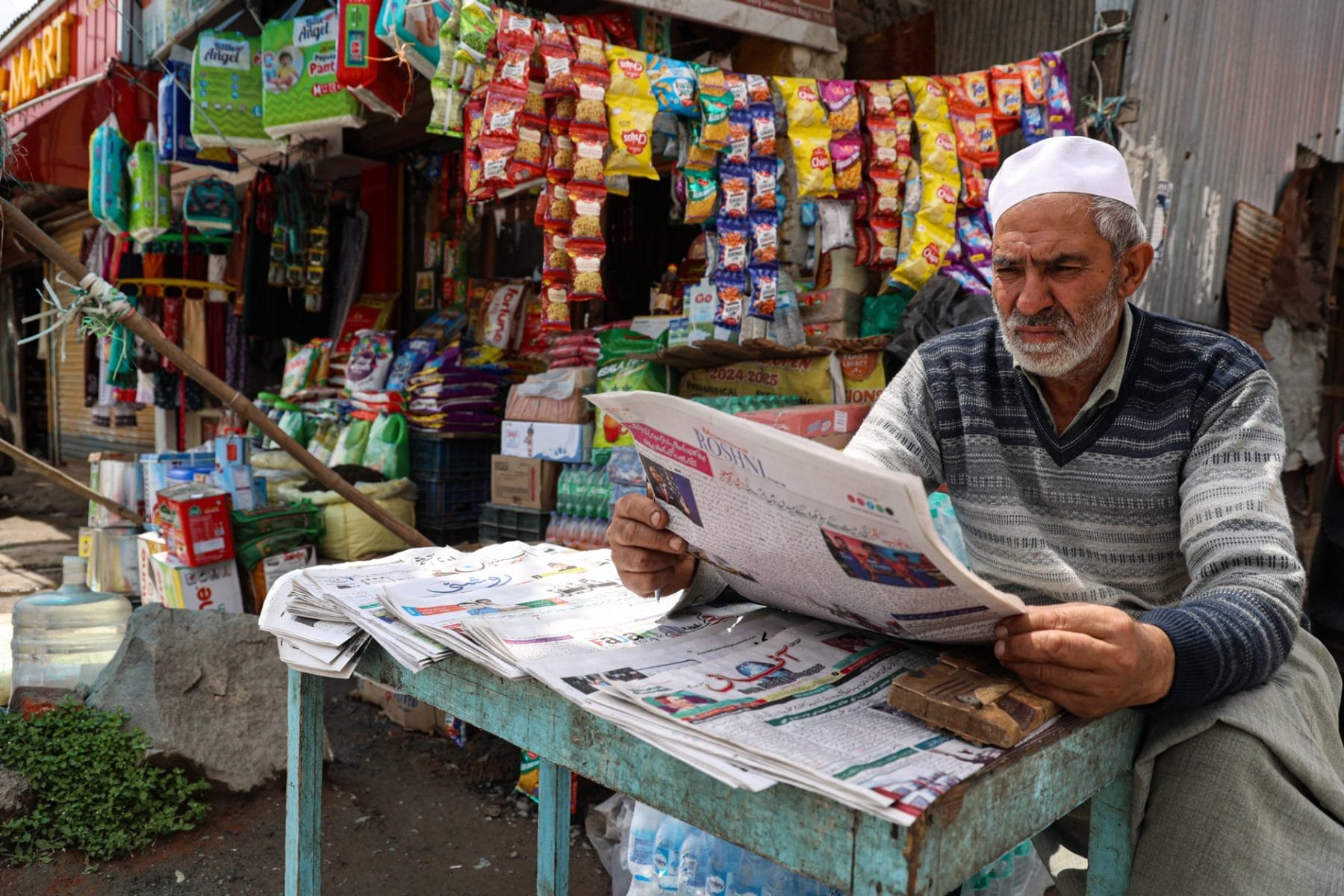
Mohammad Amin Lara outside his shop in Sopore, Jammu and Kashmir. The shop, once a fully occupied newspaper store, is now a grocery store due to the decline in newspaper sales. Nasir Kachroo/NurPhoto via Getty Images.
A Google search of Kashmir-related news floods your screen with links, but it is bulk without substance. Articles read like a log of official announcements and statements, punctuated by the occasional piece on a shrinking water body, a development project, a political tussle over a non-issue, or unemployment figures. Each report floats like a loose, individual particle suspended in air, packaged and presented as definitive. No investigation into context. No excavation of the past. No interrogation of contributing factors. A story about an alleged terrorist’s hair transplant and cosmetic dentistry, based entirely on police sources, is passed off as an investigation into Kashmiri insurgency. A superficially detailed piece on anti-encroachment drives or home demolitions will carry little beyond the grief of the displaced, or the remarks of a politician whose interest in the community begins and ends with votes. A terrorist’s hair transplant story, based on the police version, passes off as an investigation into Kashmir’s complex insurgency dynamic.
Kashmir fell off the radar a long time ago, says Free Speech Collective’s Geeta Seshu.
Even mundane stories are difficult to report. No one wants to be quoted. A university professor said he could once “talk to journalists and trust they understood the context. Now, a single sentence can be pulled out, circulated on WhatsApp, and suddenly I’m either an anti-national or a government stooge. Both sides will use the same quote to attack you differently. Why would I take that risk?”
Tarushi Aswani, an Indian journalist, told me that “a curtain has been pulled over Kashmir by silencing journalists who ask questions.” Instead, she added, “press release journalism fills the vacuum, erasing the truth about Kashmir, its history, its politics, its development, environment and aspirations.” Kashmir is no longer looking at a mirror. The lack of truthful reporting means nothing is reflected back. Instead, Kashmiris are looking into the lens of a surveillance camera.
*The eight Kashmiri journalists interviewed for this story spoke on condition of anonymity.
Astronomy, our window into the rest of the universe, happens in the dark. Planets, stars and galaxies – all the mysteries of the cosmos – only reveal themselves at night. But the night sky may be getting much brighter, thanks to an American company with a plan to conquer darkness itself by sending 50,000 giant mirrors into space.
What you are reading first appeared as a cover story for The Atlas, our new global publication with The Continent. Sign up here to get the next edition delivered to your inbox on August 27.
Astronomers are panicking.
It is an “existential threat” to optical astronomy, says the European Southern Observatory. A “disastrous” idea that will “permanently scar” the night sky, according to the Royal Astronomical Society. The American Astronomical Society told Nature it “would probably mean the end of ground-based astronomy, or optical astronomy, at least.”
Sthabile Kolwa agrees. “It will take away a very crucial part of our civilization,” she tells The Atlas. Kolwa, a senior lecturer in astronomy at the University of South Africa, studies the life cycles of galaxies, but today her concerns are more immediate. “It might come to this, that we just have to find them in the parking lot and say, ‘Hey, what are you guys doing? You’re going to ruin science for us.’ ”
Like Uber, but for the sun
The parking lot in question is in Hawthorne, California, outside the headquarters of Reflect Orbital. They call themselves The Sunlight Company. The start-up is celebrating: Earlier this month, the United States Federal Communications Commission (FCC) approved the launch of Eärendil-1, likely in a few months time.
This satellite, named for a character in JRR Tolkien’s The Silmarillion, will unfurl an 18m x 18m mirror in low Earth orbit. It’s designed to reflect sunlight onto the dark side of the earth, lighting a 5km2 patch of land with the strength of four full moons.
It is a proof of concept.
By 2035, Reflect Orbital wants 50,000 of its mirrors in space, delivering illumination “comparable to daylight” on demand to paying customers (“sunlight is the new oil,” says chief executive Ben Nowack). The company says this will allow solar panels to generate clean energy overnight; provide “safer, evenly-lit streets” to cities that pay for it; and keep construction sites and farms working 24/7.
There will be an app, of course, offering “sunlight as a service” – lighting up the night will be as easy as ordering an Uber.
Clean, renewable energy is at the heart of the company’s vision, a spokesperson told The Atlas in a statement. Reflect Orbital declined to respond to specific queries and said it is in constant dialogue with astronomers, scientists and environmental researchers to mitigate the impact of the light pollution: “We are able to dim the brightness of the service and turn it off at any stage. We control where the light shines when serving an authorised customer. Most people and most places will never see this light. It is precise, targeted and customers will require permits to receive the service.”
Circadian arrhythmia
A new research paper, published in May, challenges Reflect Orbital’s position. Its author, the European Southern Observatory’s Oliver Hainault, concluded that the company’s 50,000 satellites would increase the background brightness of the sky by 300% – even when their mirrors are pointed somewhere else. This, coupled with a proposal from Elon Musk’s SpaceX to build vast data centres in space, would go “beyond the limit” of what astronomy can withstand.
What that means, in practice, is that the images from ground-based telescopes will be dramatically less useful, marred by streaks of light from passing satellites. The most distant light sources won’t be visible at all.
This will obscure evidence of other galaxies, hinder research into black holes and other cosmic phenomena, and potentially prevent early warnings of asteroid approaches. Cutting-edge astronomy will only be possible from space-based telescopes like the James Webb and the Hubble – access to which is already massively oversubscribed, and subject to political interference.
The night sky will look different to the naked eye, too. “The next time you’re away from urban light pollution, spend some time outdoors after dark and enjoy the view of the Milky Way and the constellations that have inspired awe since humankind woke to consciousness. Chances are those views are not here to stay forever,” wrote journalist Tereza Pultarova for Space.com.
Anna Jibladze
Running out of space
The night sky is already a lot brighter than it was 150 years ago, when light bulbs started to become commonplace. According to Dark Sky International, a US-based nonprofit that advocates against light pollution, 80% of Earth’s human population already lives under some form of sky glow, most of which is generated on land. This has forced astronomers to seek out “dark sky places,” like the Atacama Desert in Chile or the Upper Karoo in South Africa, for their telescopes.
Humans can adapt to less darkness. But it is much harder for animals and ecosystems that have evolved alongside predictable rhythms of day and night. Nocturnal predators lose the ability to hunt; sea turtle babies can’t find their way to the sea; migratory birds are thrown hopelessly off course; and moths expend all their energy helplessly chasing artificial light sources.
“It’s almost like we are on a mission to obliterate natural darkness from earth,” said Ruskin Hartley, Dark Sky’s chief executive. “And now rather than do it street by street and bulb by bulb, let’s do it from space.”
Space is, in theory, protected by the Outer Space Treaty, a 1967 agreement signed by 110 countries, including all the major space superpowers. It states that “space is the province of all mankind." But that’s not what’s actually happening, Hartley argues. “In the US, it’s the most wealthy, most powerful individuals who are gobbling up as much of that orbital space as they can before someone else can get that opportunity” – with China, Russia and Europe all scrambling too for a greater presence in low Earth orbit.
“Who gets to choose that we light up the night sky? Who gets to make that decision?” Ruskin asks. In the US, it is the FCC’s job to decide what satellites are allowed in space. But it has said that assessing the impact of light pollution or environmental damage is not within its remit. Instead, it wants to slash regulation so American companies can take advantage of the “space industrial revolution.”
And Reflect Orbital has rich and powerful backers. Earlier this year, it secured a $1.5-million contract from the US air force, hinting at possible military applications for its mirrors. Last year, it raised $20-million from three venture capital firms, including Sequoia Capital, one of the biggest investors in Silicon Valley. Sequoia also owns a multibillion-dollar stake in SpaceX, which has its own plans for low earth orbit.
There are already more than 10,000 Starlink satellites up there, giving Elon Musk unprecedented influence over global communications. The company wants to launch one million more satellites over the next few years to build a network of space-based data centres. In addition to the light pollution, astronomers worry the potential for collisions will increase dramatically, as will risks to the ozone layer.
A brighter future
On her blog Higher Dimensions, the astronomy professor Janna Levin contemplates our brighter future. “It is quite possible that the hot glow of the swarm of data satellites will saturate the night, washing out the stars from our perspective on Earth. We’ll look up into the sky and instead of Zeus transformed into a swan outlined in a constellation of a few stars, the machine gods will literally loom above us, glowing with radiant heat, making declarations, predicting the weather, forecasting then determining our fate.”
Kolwa, the South African astronomy lecturer, offers a different metaphor: that of empires “colonizing low Earth orbit.” This was an ambition of one of the most infamous imperialists of them all, Cecil John Rhodes, who said that he looked up at the stars and thought: “I would annex the planets if I could; I often think of that. It makes me sad to see them so clear and yet so far.”
But it hasn’t been colonized just yet.
“I’m still trying to figure out what we can do, what responsibility we have as scientists,” says Kolwa. “How could we engage our communities to stand up to these corporations and say no? We must keep our night skies dark, as dark as possible.”
Across the United States, dozens of law enforcement officers face accusations of misusing Flock, a surveillance network of 120,000 cameras that track license plates. Flock’s proponents claim that the technology does far more good than harm; one investor tells the Washington Post that abuse is “truly a nonissue.” But fear isn’t a statistic. Drew Harwell, Douglas MacMillan, and Aaron Schaffer structure their investigation of Flock’s misuse by law enforcement around the story of a woman in suburban Atlanta who had her whereabouts tracked hundreds of times by her ex, the local chief of police. Their report telescopes between the tradeoffs of a “transformational” technology and a few nightmarish cases of misuse.
Bakely said the cameras had left her feeling powerless to stop her ex-boyfriend from tracking her life. She didn’t feel safe asking the police agency he led, she said, and she couldn’t get access to records that would have shown the surveillance was happening in real time. After Steffman told her about his Flock searches, she filed for a restraining order, but a judge denied it on the basis that she couldn’t prove ongoing abuse, court records show.
He “watched every single move I made,” she said. But “who do you turn the chief of police in to?”
On the night of January 16, 2024, Egana Djabbarova was awoken by her wife and told that she needed to leave the country immediately. Djabbarova, her wife said, had been denounced by pro-war activists and framed as an enemy of the country. She had recently published her novel, “My Dreadful Body,” with a small, indie press that had been praised by mainstream critics, unexpectedly propelling her into the public eye. One of the book's central themes is surveillance: growing up in a community with strict behavioural codes, the protagonist's every move is under scrutiny.
In a dark echo of her work, Djabbarova was now under online surveillance herself. “I was just the perfect enemy,” she tells me, “because I’m queer, I’m not Slavic, I worked on decolonial and feminist projects… So boom, it happened.”
She is speaking to me from Hamburg, where she now lives. Djabbarova is part of the so-called fifth wave of writers exiled from Russia, alongside Maria Stepanova, Lyudmila Ulitskaya, and Maxim Osipov to name a few. Her upbeat tone during our call gives little indication of the arduous journey she has endured since fleeing Russia. Upon receiving a humanitarian visa from Germany, she spent months in a refugee camp. She lived, she says, “in a container house, literally a shipping container. You feel like you're not a subject, not a human being.”
More permanent accommodation has provided a degree of safety and stability, but a sense of precariousness lingers. She describes her position as an exile as “strange” — on the one hand she has been welcomed into Germany’s cultural elite in winning the Hamburger Literaturpreis; on the other, she feels like a “ghost,” unable to express herself in German and often bewildered by the unfamiliarity of everyday tasks in a new country, and in a new city which, she tells me jokingly, is quaint and polite like the well-behaved boy next door.
But there’s a deeper, historical layer to Djabbarova’s story of exile. Her father was a refugee from the region of Nagorno-Karabakh, while her mother was forced out of her family home. “Homelessness and exile — this is my heritage,” she says. Being othered became a common theme of Djabbarova’s childhood, as a child of Azeri parents living in Yekaterinburg. “In Russia you are constantly reminded that you're not Russian,” she says. “Then during the summer you visit your relatives in Azerbaijan and they laugh because you cannot speak Azerbaijani properly.”
This sense of double estrangement is mirrored in “My Dreadful Body”(published in Russian in 2023 and recently translated into English by Lisa Hayden). At only a touch over 100 pages, it is a slim but powerful account of the pressures on one woman growing up among the strict codes of an Azerbaijani family living in Russia. A sense of surveillance and conditional belonging defines the narrator’s upbringing: “In the world where I grew up,” she writes, “gazes penetrated every little corner. The evil eye, the neighbors’ eyes, the relatives’ eyes, the random pedestrian’s eyes, the unscrupulous men’s eyes, the women’s unhappy eyes. Life in the community was reminiscent of a reality show with constant video surveillance: no action, word, or undertaking went unnoticed.”
The story is based on Djabbarova’s own life. “Maybe 70-80% of this story is absolutely true”, she confirms. The narrator is named Egana, she grows up in an Azerbaijani family in Russia, too Russian for the family, not Russian enough for her friends at school. She also, like Djabbarova, suffers from a debilitating autoimmune disorder that is eventually diagnosed as dystonia, a neurological disorder that causes involuntary muscle contractions. During one episode, she describes her body as resembling “willow branches gone mad from a strong wind” — a potent image of struggle against external forces. Djabbarova describes the book as a way to reclaim her body through language. “I was trying to tell this story in a poetic way. I wanted to change my body into poetry.”
Each chapter of “My Dreadful Body”begins with a different body part (“Eyebrows,” “Eyes,” “Hair” and so on), like the poetic blazons spun by Renaissance poets. Where those poems encouraged an idealized, sensationalized reading of each body part, Djabbarova’s chapters are more sober explorations of the physical limits — and personal and cultural stories — these body parts contain.
In one of many poignant scenes, the narrator’s head is shaved in preparation for a procedure. She cries on seeing her “shorn scalp,” but the sadness is not aesthetic, it’s ancestral; the act marks a symbolic rupture with her lineage. “My past,” she writes, “the past of all the women in my family, the memory of my ancestors, the history of a single body — all that now lay on the cold floor.” After this scene, her grandmother’s dictum that only long hair was considered beautiful, rings even more sharply.
Illness then emerges as another form of exile, from one’s sense of self, from what’s perceived as “normal” in society, from the culture and community one belongs to. “They do not see you as a subject, as a human being, and they do not recognize your existence… I realized if I wanted to be seen as a subject, I needed to do it myself.” Djabbarova is talking about the plight to be believed about her symptoms here, but she could easily be talking about the often dehumanizing experience of exile. In both instances there is something fundamental under question, or as Djabbarova puts it, “You’re trying to prove that you have the right of being. You’re trying not to be erased.”
We often talk about exile in the context of loss, but how might exile liberate? Paradoxically, Djabbarova tells me, her diagnosis became a form of liberation. “I always felt I had so many expectations on me as a girl, as a woman, so when I was finally diagnosed it was a liberation because my parents realized I would never be this type of girl.” Exile breeds a particular creative liberation, too, evidenced by the fact Djabbrova wrote the novel from Taiwan where she was briefly teaching Russian. “Here I had enough distance from my own life and my own experience,” she says. “Maybe it’s easier to write about your story being on an island in the Pacific Ocean.”
Writing is arguably the real heroine of Djabbarova's novel. For the narrator Egana, it is a place free from surveillance and a source of protection, “like an invisible amulet.” Poetry, she told me “was the only safe space for me because nobody was asking anything of me. It's the only place where I don't feel judged. I don’t feel ashamed. I don’t feel questioned.”
The chapter “Hands” opens: “The most important parts of a woman’s body were her hands: they prepared food, rocked children, did laundry, ironed men’s shirts, sewed clothes, swept, washed the floor, and dusted.… Any woman in our family knew that her hands were not given to her for writing.” To use her hands, then, to write becomes both a symbolic and quite literal form of resistance against such gendered codes.
Notably, Djabbarova is not alone in invoking the body as a space to explore the upheavals of exile. In Maria Stepanova’s autofictional work “The Disappearing Act” — recently translated into English by Sasha Dugdale — the narrator attempts to purge herself by volunteering to be cut in half as part of a circus trick. Djabbarova’s approach to reclaim identity and agency through the body is less literal, and more personal, but through this specificity she has landed somewhere indisputably universal.
“I realized the only way I can write this novel is through my body,” she says. “Because the only way I can rehabilitate my being, my agency, my subjectivity is through my body. And that's why I wanted every reader to feel my body… It's really important for all of us not to forget that this right of being is basic. It's not given. It's something you have from birth."
At the end of our conversation, Djabbarova (who has been speaking in English) struggles to recall a word and jokes that learning German is slowly pushing her English out. “Certain words I only remember in German!” she laughs. Is this the beginnings of a kind of homemaking for Djabbarova, a sign that the seeds she has scattered in her new country are taking root? Like her protagonist, who finds solace and safety in words, it seems that Djabbarova’s most trusted tool for survival, for managing the condition of exile, is language.
The Age of Exile
This story is part of our Age of Exile series, which explores how displacement has evolved from historical punishment into a defining condition of our time—one that reveals profound transformations in how we construct identity, maintain community, and exercise power across borders. In an era where digital connection enables presence without physical proximity, exile has become more complex, more global, and more central to understanding our world. Explore The Age of Exile series

 Login