More than 90 percent of Texas voters believe the Iran conflict is raising oil and gas prices, according to a new survey. In the CBS News/YouGov poll, 91 percent of respondents said the war against Iran is making oil and gas prices in the U.S. “a lot higher” or “a little higher.” Only 7 percent…
More than 90 percent of Texas voters believe the Iran conflict is raising oil and gas prices, according to a new survey. In the CBS News/YouGov poll, 91 percent of respondents said the war against Iran is making oil and gas prices in the U.S. “a lot higher” or “a little higher.” Only 7 percent…
Democrats and aligned advocacy groups are hitting the airwaves with a flood of campaign ads on the Iran war as they seek to win back in the House and Senate.
A majority of Americans in a new survey believe the U.S. is on the “wrong track” as the midterms approach, marking a record high during President Trump’s second term. The NBC News Decision Desk poll, using data from SurveyMonkey, found that 71 percent of respondents said the country is heading down the “wrong track.” The…
When the Iran war closed the Strait of Hormuz earlier this year, about 20% of the world’s liquefied natural gas supply stopped flowing almost overnight. Roughly 90% of the LNG that moves through the strait goes to Asia, so the continent has absorbed the worst of it. Gulf producers have had few good responses. Saudi […]
President Trump’s approval rating hit a record low in a new survey, with just more than two weeks until voters decide which party will control Congress next year. The Washington Post-ABC News-Ipsos poll, released Sunday, shows Trump sitting at 33 percent approval. The rating is 4 points lower than a poll conducted in July, 8…
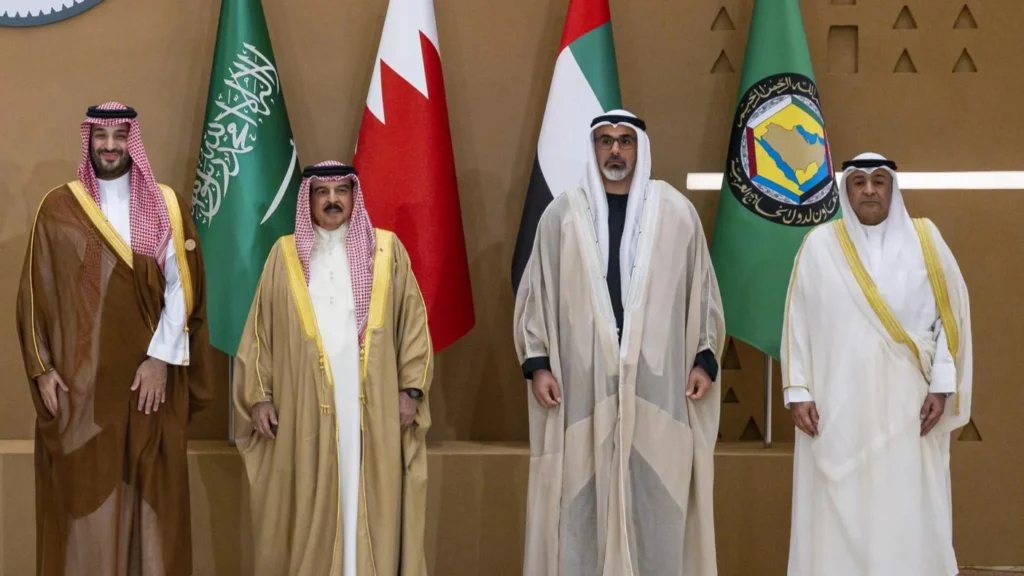
The Gulf Cooperation Council (GCC) urged the United States and Iran on Monday to resume dialogue to overcome their bilateral crisis and called for restoring security and freedom of navigation in the Strait of Hormuz, during its 168th Ministerial Council session in Manama, Bahrain.
The foreign ministers also demanded that GCC member states participate in any negotiation or agreement that could affect their security and interests.
According to the final resolution, the ministers highlighted the need to address pending issues related to Iran’s nuclear program, missiles, drones and Tehran’s support for allied groups, while calling for respect for state sovereignty and non-interference in internal affairs.
The statement comes amid the confrontation between Washington and Tehran that began on February 28, and the stagnation of diplomatic efforts due to differences over Iran’s nuclear program, U.S. sanctions and maritime traffic through the Strait of Hormuz. In that context, Iranian Foreign Minister Abbas Araqchi reiterated Iran’s willingness to reopen the maritime route within a week, provided Washington accepts Tehran’s conditions, including lifting the blockade on Iranian ports and sanctions on its oil exports.
BREAKING: Iran announces an oil tanker has hit a naval mine while exiting the Strait of Hormuz through the US-backed southern Omani corridor, with a massive fire in the engine room. pic.twitter.com/kzMnoJr4Q0
On navigation, the GCC ministers called for the situation in Hormuz to return to the conditions existing before February 28, in accordance with international law, the sovereignty of coastal states and the rights of affected countries. They stressed the importance of guaranteeing maritime transit through the Strait of Hormuz, Bab el-Mandeb and the Red Sea, and warned against closing those routes, obstructing traffic, attacking merchant ships and crews, laying mines and imposing illegal fees or restrictions on passage. They also rejected making navigation subject to prior authorizations or imposed routes in contradiction with the 1982 UN Convention on the Law of the Sea and customary international law.
Marco Rubio on Iran:
They chose to take the straits hostage. They would have done it anyway.
Imagine if Iran had a nuclear weapon.
At that point, they could say, "And by the way, we own the Strait of Hormuz, and you guys can't do anything about it because we won't just hit… pic.twitter.com/OUgeE88qon
The meeting was chaired by Bahrain’s Foreign Minister Abdullatif Al-Zayani, with the attendance of his counterparts from member countries and the organization’s secretary-general.
Treasury Secretary Scott Bessent said Sunday that oil prices could go down before the end of the year, but it will depend on the Iran war. NBC News’s “Meet the Press” host Kristen Welker asked Bessent about the chances of lower prices by the start of 2027, adding President Trump’s assertion that “this is his…
Vice President Vance claimed Saturday that in “some ways” the United States has “decisively won” its war against Iran. “I would say in some ways, we have won decisively, but they’re — the Iranians, the enemy gets a vote here, and they have responded in certain ways. And so, to step back a little bit,…
High gas prices are intensifying inflation and vacuuming up more of Americans' dollars, yet consumers are still digging deep to spend, powering the economy, at least for now
Wholesale inflation rose more than expected last month on a big jump in fuel costs as rising prices become a bigger economic challenge for millions of Americans, and a growing political problem for Republicans in the upcoming midterm elections.
Yemen’s civil war reignited in early October, as Saudi Arabia brought in Turkish and Pakistani military support to fight the Houthi rebels, who have governed much of northern Yemen as a de facto authority and waged a guerrilla war in the country since 2004. Having spent more than a decade fighting Saudi-led forces and enduring […]
With the midterm elections just three weeks away, a new inflation report shows prices rising faster than expected, putting more pressure on Americans struggling with the cost of everyday essentials. To discuss what the latest numbers mean for Americans, Amna Nawaz spoke with Heather Long, vice president and chief economist at Navy Federal Credit Union.
Iran-backed Houthi rebels hit the headquarters of the Saudi state-owned oil company Aramco in an overnight strike, two regional officials said Wednesday, damaging the offices of the firm's chief executive and other top officials.
The threat of a widening war on the Arabian Peninsula is accelerating. Houthi rebels in Yemen are again targeting Saudi infrastructure and military sites, escalating a conflict which may yet draw in other regional powers. The Saudi-led coalition launched new airstrikes on oil facilities across Houthi-controlled Yemen in response to deadly airport attacks in Riyadh. Ali Rogin reports.
To discuss the escalating war between the Houthis in Yemen and Saudi Arabia, Amna Nawaz spoke with Michael Ratney. He served as U.S. ambassador to Saudi Arabia during the Biden administration and is now a senior adviser at the Center for Strategic and International Studies.
The Iran conflict has exposed a glaring blind spot in US war strategy. America can escalate in hours, but it can take years to rebuild the arsenal it consumes. Washington has begun addressing the arms-replenishment problem, a calculation it should have made before escalating. The Pentagon’s recent awards reflect the intensity of the challenge. In […]
President Trump blames high energy prices on Ukraine, not his war in the Middle East, and made a surprise decision to suspend sanctions against Russia on Friday. William Brangham discusses the latest developments in the Ukraine-Russia war with Andrew Weiss. He's a former State Department official and is now with the Carnegie Endowment for International Peace.
The Houthi attack mixed together suicide drones, cruise missiles and ballistic missiles. Because these weapons travel at significantly different speeds, the drones were launched first, followed by the cruise missiles and lastly by the ballistic missiles. Reports say the entire attack on October 10, starting at around 3PM local time, lasted around 45 minutes. The […]

 Login