TOKYO — An unwelcome blast of US inflation is blowing across Asia’s markets. September’s hotter-than-expected price data revived concerns that the Federal Reserve will keep rates higher for longer, threatening fresh pressure on currencies, capital flows and economic growth across the region.
Last month’s 3.7% year-on-year increase in consumer prices didn’t just exceed forecasts. It ensured the Fed is on an even bigger collision course with both the bond market and US President Donald Trump’s White House. It’s arguably the last thing both Trump and US Federal Reserve Chairman Kevin Warsh wanted to see less than three weeks ahead of the mid-term elections.
When the oil supertanker Esteem Explorer sails from the United States to Japan in late November, loaded with about 2 million barrels of crude, the journey will cost $81 million. The same journey would have cost $9.1 million last year, on average.
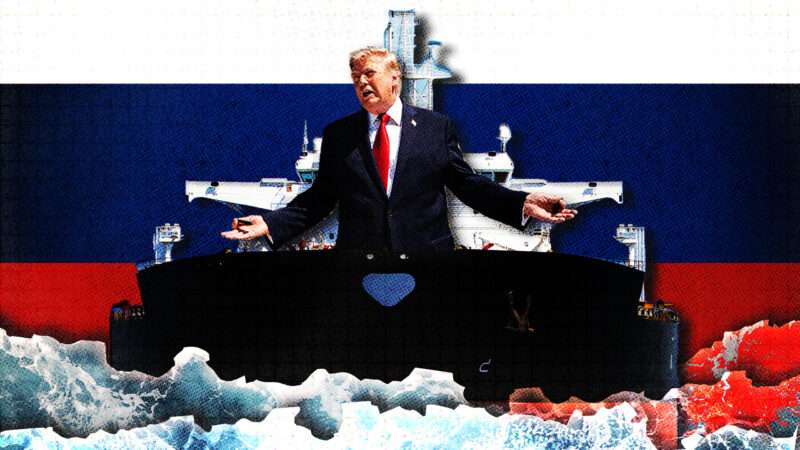
President Donald Trump says he has struck a deal with Russian President Vladimir Putin to import large amounts of diesel fuel into the United States—apparently hoping to lower fuel prices in the weeks before the midterm elections.
The exact terms of that agreement remain somewhat unclear. The White House has not said when the purchases will be made, what prices will be paid, or who will be paying (private companies or taxpayers), though the Treasury announced that it would be issuing a "temporary general license to allow the supply of Russian diesel to the global market." Reporting by The New York Times suggests that investors with ties to the administration are most likely to profit. Because diesel prices are determined by a global market, it's also far from certain that the Russian gas would make much of a dent in American prices.
However, this much is clear: If Trump follows through with this "deal," he will have violated two federal laws recently passed by Congress—one of which he signed just weeks ago.
The more significant of those two laws is the Ending Importation of Russian Oil Act, which passed the House with a 413–9 vote and was unanimously approved by the Senate. President Joe Biden signed that bill into law on April 8, 2022. The law is an outright ban on Russian energy products, including diesel fuel.
The law also lays out the process for lifting the ban on imports. The president must tell Congress that Russia has "reached an agreement to withdraw Russian forces and cease military hostilities in Ukraine" and has recognized "the right of the Ukrainian people to independently and freely choose their own government."
There is also a clear timeline for lifting the ban. Any termination of the ban requires a 90-day waiting period, during which time Congress has the opportunity to block the change.
Obviously, Russia has not withdrawn from Ukraine. Even if it had, the White House has not gone through the necessary process to notify Congress, nor waited the necessary 90 days.
The law does not allow a president to ignore it if fuel prices are high and an election is approaching. It does not allow a president to ignore it if he starts an illegal war in another part of the world that causes fuel prices to spike.
Trump's attempt to disregard that law has drawn a bipartisan rebuke from members of Congress. A group of seven senators—three Democrats and four Republicans—issued a joint statement this week saying that Trump's deal "runs directly counter to" the 2022 law.
Sen. Thom Tillis (R–N.C.), one of the senators who joined that statement, said on Sunday that there is "a legitimate case for saying the president's not following the law."
The second law at play is the Lindsey O. Graham Sanctioning Russia and Iran Act, named for the late senator and passed earlier this year. Among other things, it authorizes the president to levy tariffs of up to 100 percent against countries that buy Russian crude oil and natural gas. The intent is clear: to prevent Russia from being able to finance its war against Ukraine by selling energy commodities onto the global market. Trump signed it into law last month.
Lawmakers on both sides of the aisle have also pointed to that law in the days since Trump announced his deal to buy Russian diesel.
"Now is the time to use those sanctions to squeeze Putin's war machine, not reward a dictator by putting more money in his hands while he continues targeting and killing Ukrainian civilians," Rep. Don Bacon (R–Neb.) posted on X this week. Rep. Steny Hoyer (D–Md.) said it was "outrageous" for Trump to be buying energy from Russia after signing a bill that could be used to punish other countries for doing the same.
The White House could argue that, in this case, Trump is merely violating the spirit of the law rather than the letter of it. Even so, this is blatantly hypocritical.
The hypocrisy runs deep. The Trump administration has spent much of its second term trying to restrict trade and downplay the advice of economists who have warned that doing so would raise prices. Now, Trump is once again seeking imports as a means to ease high prices—as he has done with beef and other products. Perhaps the White House should apply this general principle more broadly, and in circumstances where doing so would not violate federal laws.
Some of the president's allies are now trying to downplay these violations of federal law. Conservative pundit Mollie Hemingway says Trump is merely trying to "put the American people first" by addressing rising gas prices.
Sorry, but no. The president is not allowed to disregard federal laws because he believes it will lower gas prices in swing states.
You can, of course, criticize those laws for being misguided. Trade is generally good, and erecting barriers to the flow of goods tends to be costly. Trump could ask Congress to repeal these laws. He cannot deliberately ignore them.
If the "deal" with Russia comes to fruition, it will further erode what little power Congress retains within America's democratic system. If a president is not bound by the laws Congress has passed, then the legislature might as well not exist at all.
The U.S. is reportedly threatening to ban exports of diesel fuel to parts of Europe, unless countries like Germany and France release more of their diesel reserves.
The U.S. is reportedly threatening to ban exports of diesel fuel to parts of Europe, unless countries like Germany and France release more of their diesel reserves.
The Saudi Ministry of Energy announced on Friday, September 11, that the East–West Pipeline across the Riyadh and Madinah regions was subjected to multiple attacks a day earlier, leading to its closure as a precautionary measure.
According to media reports, the strategic pipeline carries roughly 4 to 5 million barrels of oil per day, which equals 4% to 5% of the total global oil supply.
The Saudi Foreign Ministry clarified in a statement issued on Saturday, September 12 that the attacks were launched from Iraq by multiple drones, adding that they resulted in injuries and some damage to the pipeline. No groups have claimed responsibility for the attacks yet.
The ministry also confirmed that Saudi Arabia will not respond to the attacks at this stage, allowing the Iraqi government to take the necessary measures to prevent attacks “originating from the Iraqi territories” against Saudi Arabia and neighboring countries.
Iraq said it seized the drone launching platform used in the attack
For his part, Head of Iraq’s Security Media Cell (SMC), Lieutenant General Saad Maan confirmed on Saturday that “an intelligence and security task force exerted significant effort and succeeded in locating and seizing the launcher” involved in the attacks on the Saudi pipeline within Iraqi territory.
Moreover, Maan affirmed that investigations and intelligence operations are underway to apprehend the perpetrators.
He added that the Iraqi Armed Forces approved a request from Iran to participate in the investigation regarding the attacks on the Saudi pipeline and their repercussions.
Repercussions of the attacks on global oil trade
Saudi Arabia’s East–West Pipeline represents an alternative oil transportation route bypassing the volatile Strait of Hormuz.
Therefore, the temporary closure of the pipeline has severely restricted this essential alternative, pushing Brent crude oil price to hit USD 108 per barrel on Monday, September 14.
Furthermore, reports indicate that the incident will disrupt crude delivery to Europe and Asia for weeks, particularly after the Ansar Allah-led Yemeni Armed Forces expanded their control around the Bab al-Mandeb Strait.
The price of oil surpassed $100 a barrel for the first time since July after attacks on oil facilities and ships in the Middle East threatened an already weakened supply chain.
The price of oil surpassed $100 a barrel for the first time since July after attacks on oil facilities and ships in the Middle East threatened an already weakened supply chain.
NEW YORK: Oil prices climbed in early trading Wednesday, building on the previous session’s sharp gains, as overnight military exchanges between the United States and Iran escalated tensions in the Middle East and revived fears of supply disruptions through a critical global shipping chokepoint. Brent crude futures rose $1.03, or 1.1%, to $95.68 a barrel ... Read more
Oil prices rose more than 2% Monday after the United States attacked an Iranian island in the Strait of Hormuz and drew retaliation from Tehran, as the six-month-old conflict between the two countries showed no signs of easing. Brent crude futures climbed $2.21, or 2.51%, to $90.31 a barrel as of 0436 GMT. U.S. West ... Read more

 Login