❌

Reading view

Amazon knows how to build big. The AI boom is testing just how big it can go.

Prasad Kalyanaraman, vice president of infrastructure services at Amazon Web Services

BASTIEN INZAURRALDE/AFP via Getty Images

  • Amazon is on an unprecedented spending spree to build more AI data center capacity than anyone else.
  • The company has extensive experience, yet even it's struggling to bring capacity online fast enough.
  • Internal documents show Amazon getting bilions of dollars of Nvidia GPUs before they can be deployed.

At an internal staff meeting in September, AWS CFO John Felton had a joke for Prasad Kalyanaraman, the executive overseeing much of Amazon's AI infrastructure expansion.

"You've taken us free cash flow negative as a company, so congratulations," Felton said, according to a recording of the meeting obtained by Business Insider.

The remark was lighthearted. But it captured a stunning reversal.

Just two years ago, Wall Street was debating what Amazon would do with its growing cash hoard. Now, cash flow has evaporated as Amazon embarks on its biggest bet ever, spending $220 billion this year alone to build the physical backbone for AI.

At the meeting, Kalyanaraman did not dispute Felton's premise. Amazon's machine-learning and AI business is "hugely free cash flow negative," he said, adding that he expects the company's free cash flow to remain negative for "the next couple of years or so."
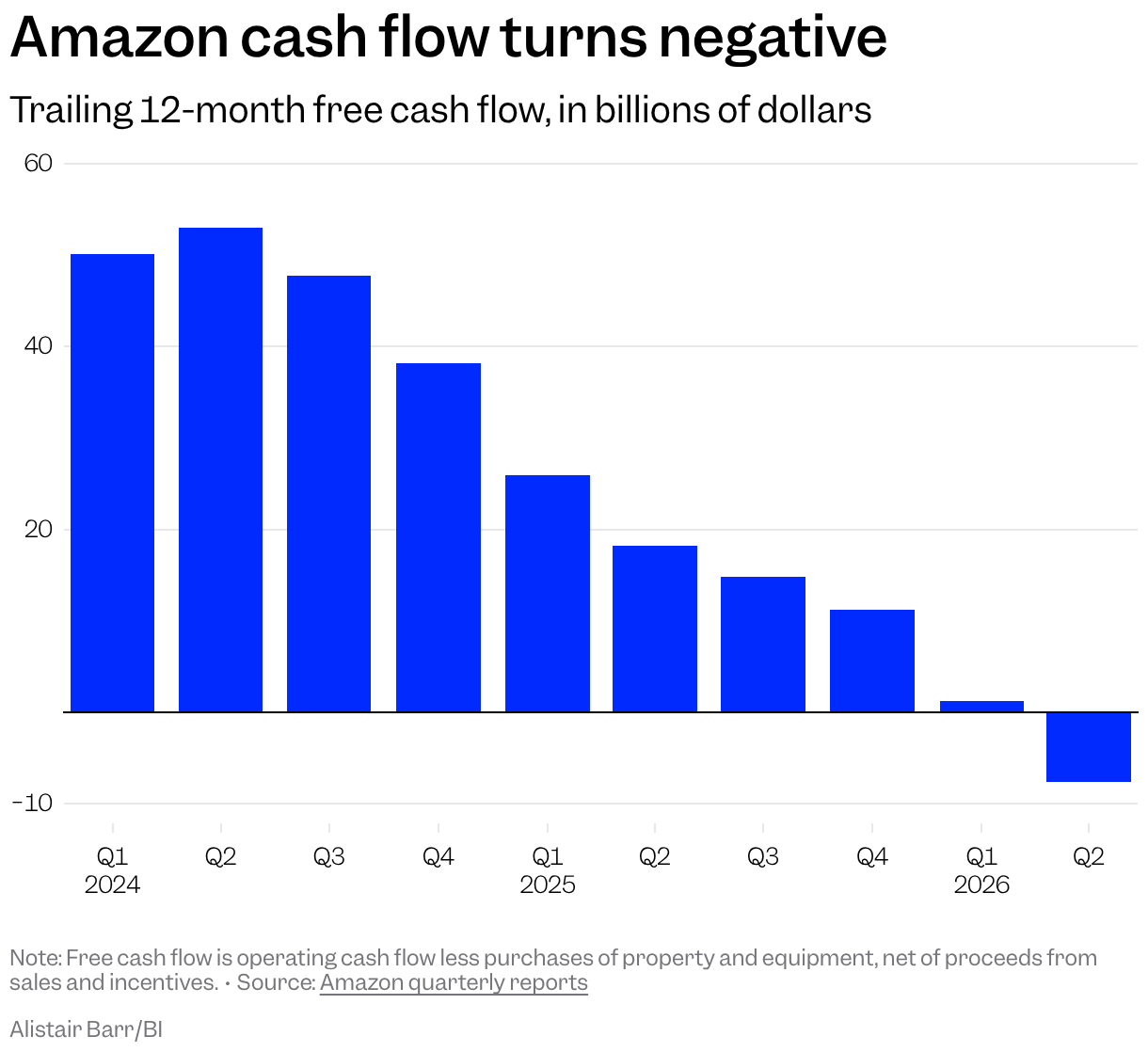
Column chart of Amazon’s trailing 12-month free cash flow at all 10 quarter-ends from Q1 2024 through Q2 2026. It starts at $50.149 billion, peaks at $52.973 billion in Q2 2024, and declines to negative $7.604 billion in Q2 2026.

Amazon has made big bets before. It spent heavily on cloud computing, fulfillment centers, and its delivery network long before they became some of the company's most valuable assets. Investors questioned those investments at the time, but Amazon ultimately built enormous, profitable businesses from them.

AI is testing this playbook at a far larger scale. Amazon is committing hundreds of billions of dollars to data centers, servers, and power before investors know how quickly those investments will generate revenue.

The company is the best, or among the best, at building data centers, with decades of experience. But the size and complexity of these projects, and the bottlenecks holding progress back, are challenging — even for such a respected cloud pioneer.

Internal documents reviewed by Business Insider and people familiar with the matter show the company trying to coordinate a sprawling industrial system whose parts move on different schedules. A delay in power, equipment, or construction can leave billions of dollars in hardware waiting — and Amazon's cash tied up — while forecasts and costs keep shifting.

Why Amazon thinks it will work

Amazon says it has strong evidence that the capacity will be needed. AWS revenue grew 37% in the second quarter, its fastest pace in 18 quarters, while its backlog reached $496 billion.

CEO Andy Jassy thinks the company has a "clear line of sight" to strong financial returns from this record investment cycle. In his latest annual shareholder letter, he called AI a "once in a lifetime opportunity" and said Amazon would not be conservative in its investments.

"We've been through this cycle with the first big AWS growth wave, and liked the results," Jassy wrote. "We expect to feel similarly about this next wave."
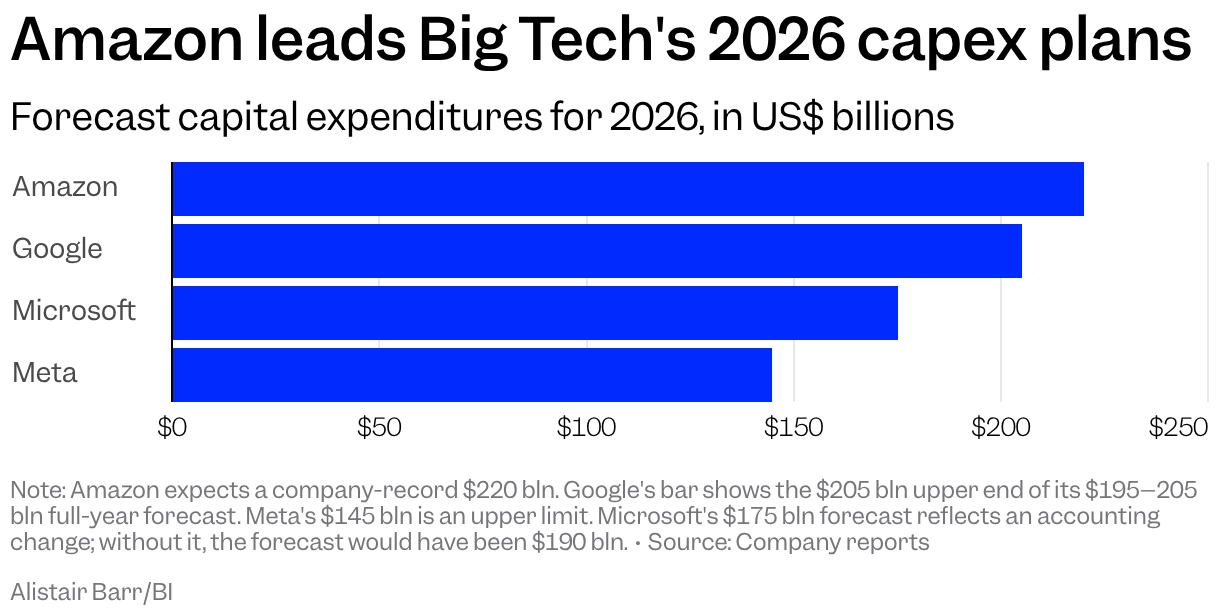
Column chart of 2026 capital expenditure forecasts in US dollars: Amazon $220 billion, a company record; Google $195 billion to $205 billion, shown at the $205 billion upper end; Microsoft $175 billion after an accounting change, compared with $190 billion without that change; and Meta up to $145 billion. Source: Company reports.

Investors are concerned by the scale of the industry's expansion, especially as AI data centers are costing more to build and taking longer to complete.

The market is "repricing anything that funds multi-year builds against revenue that arrives later," Dan Ives, an analyst at Yorkville Ives, wrote in a recent report. Growing uncertainty around data center permitting and the political fight over electricity prices have given investors another reason to question how quickly these investments will pay off, he added.

Racks, but not enough power

One major industry challenge is securing enough power to run the equipment that goes inside data centers. This includes expensive racks of servers that contain GPUs and other chips that train and run AI models and services such as ChatGPT.

Internal emails from August show Amazon preparing a new "Early Rack Receipt" process for an expected wave of server racks carrying Nvidia's GB300 chips at US facilities before final deployment.

One Amazon email projected the company would take delivery of about $5 billion of Nvidia GB300 racks in August, followed by another roughly $3 billion each month "for the foreseeable future."

Some AWS data center sites had room for more racks but not enough available power to turn them on, people familiar with the effort said, leaving the equipment to be staged at intermediary warehouses until the facilities were ready. These people asked not to be identified discussing sensitive matters.

Timing and coordination

Usually, Amazon doesn't pay for racks until the gear is put into a data center, leaving suppliers to carry the cost of the equipment in transit, according to the internal documents obtained by Business Insider. This helps the company conserve cash.

However, the intensity of the AI data center building boom has made this type of coordination harder. Amazon has to compete more for scarce resources as it jockeys with rivals for access to Nvidia GPUs and other AI components.

Under the new "Early Rack Receipt" process, Amazon now takes ownership of these racks earlier in the supply chain, rather than waiting until the equipment reaches a data center.

The means spending cash sooner. And any delays getting the racks installed and plugged into a reliable power source potentially pushes back the moment when revenue starts flowing from these assets.

At least one AWS supply chain team did not have "a clear forecasted path" for getting racks into data centers, according to one of the emails reviewed by Business Insider.

An Amazon spokesperson said the company routinely stages finished hardware near deployment sites so it can be installed once power capacity is available, calling that approach "best business practice."

The spokesperson added that AWS has "long-established systems" to track infrastructure assets and disputed that the broader company lacks a forecasted path for getting racks into data centers.

This problem is not unique to Amazon.

Bernstein analysts wrote in a recent note that power permits, cooling systems, electrical equipment, construction, and hardware all move on separate schedules.

"Timing is imperfect," the analysts said.

"Inherently uncertain"

John Felton, Chief Financial Officer of Amazon Web Services

Chris Jung/NurPhoto via Getty Images

During the internal staff meeting in September, Felton, the AWS CFO, described the broader problem eloquently: "How do you work in the future when the future is inherently uncertain?"

Kalyanaraman, the AI infrastructure leader, said Amazon's internal outlook for the return on its AI investments had improved. But the assumptions behind those returns keep shifting.

"The forecast is changing on a daily basis," Kalyanaraman said. "The world that we live in is extremely dynamic."

Those shifting assumptions include when data centers will be ready and how much equipment AWS needs to keep on hand, he explained.

An eight-week supply buffer might be routine for a smaller company. But at Amazon's scale, Kalyanaraman said, this could mean holding "billions and billions of dollars" worth of additional equipment inventory — tying up precious cash.

Frugality meets the AI boom

Such tensions are especially striking for Kalyanaraman, a 21-year Amazon veteran who earlier this year was promoted to the elite S-team that reports directly to Jassy.

Amazon's founding story is defined by frugality. It famously used cheap doors as desks when founder Jeff Bezos started in Seattle in the mid-90s.

Kalyanaraman has absorbed this lore into bones. In late 2023, as AWS faced slower growth and layoffs, he urged employees to do more with less. "Frugality breeds innovation," he said back then.

That instinct still shapes his approach. In the September meeting this year, Kalyanaraman told Felton that AWS tries to make major investments at the "last responsible moment," when it has the clearest possible view of demand.

"If we can wait to spend the capital as late as possible, it's better for us," he said.

Amazon CEO Andy Jassy

Bloomberg/Getty Images

But the frenetic pace of the AI boom makes this principle difficult to follow. By the time demand is fully visible, the servers, power, and construction capabilities that AWS needs may no longer be available. That puts pressure on the company to commit more money sooner to secure supply and meet its data center capacity goals.

Kalyanaraman recalled telling Jassy in 2023 that AWS would "surely" be out of its capacity crunch by 2027. Instead, Amazon still expects demand to exceed its available capacity in 2027, the AI infrastructure chief said during the meeting this September.

Secured Power at Risk

Getting enough electricity may be the biggest challenge for an industry leader like Amazon.

The company has 44 gigawatts of data center capacity under development across 16 states, more than double Google, Meta, and Microsoft, according to Cleanview Research estimates.
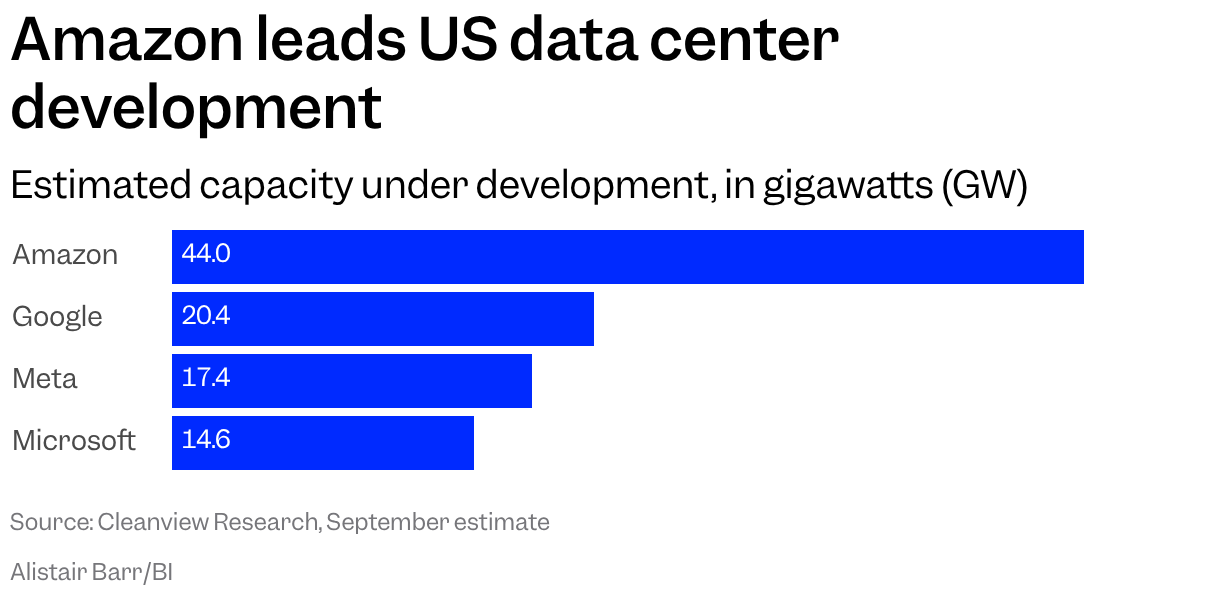
Column chart of estimated US data center capacity under development: Amazon 44 gigawatts, Google 20.4 gigawatts, Meta 17.4 gigawatts, and Microsoft 14.6 gigawatts. Source: Cleanview Research, September estimate.

An internal AWS dashboard called "Secured Power at Risk" tracks utility and regulatory constraints affecting electricity capacity AWS has lined up for its data centers.

The risks include transmission bottlenecks, requirements to reduce use during grid stress, and "use it or lose it" provisions that can jeopardize capacity if a data center project misses usage or construction milestones.

In other words, AWS is not simply waiting for electricity to arrive. It is managing a portfolio of commitments that can become more costly if a data center project is delayed.

Maryland proposals

A submission to Maryland's utility regulator last year, obtained through a public records request, illustrates the kind of exposure that can accompany massive data center buildouts.

Amazon told the Maryland Public Service Commission that large data center customers could help pay for grid upgrades or bring new power capacity to market without burdening other electricity ratepayers.

The company also proposed setting aside collateral to help utilities get more comfortable with the large investments needed to generate more electricity for data centers. Amazon proposed three years of collateral so that if a large electricity customer abandoned unused capacity, the utility would have time to re-sell the power.

The proposal is not evidence that AWS has made such a payment or posted collateral. It does, however, show that large data centers can face extra financial obligations, beyond their own electricity bills, if projects are delayed or cancelled.

The Amazon spokesperson said such utility rules are not unique to AWS. The company has not disclosed how much cash it has paid upfront to secure power.

New constraints 'keep popping up'

The AI buildout also incurs expenses that are harder to model than a conventional capex plan.

In the September meeting this year, Kalyanaraman said that while reviewing plans for gigawatts of capacity in West Texas, AWS confronted a labor problem: There weren't enough nearby pipefitters, electricians, and other skilled workers to build the facilities.

The company's response, he said, was to pay to construct housing complexes near its data centers so workers could live there for the two or three years needed to complete the projects.

Even the crates used to ship servers have become a planning issue. It may seem absurd to worry about the price of a container when servers cost hundreds of thousands of dollars, Kalyanaraman said. But at AWS's scale, where the company needs so many crates, even trivial items can become a material expense.

"We have new constraints that keep popping up," Kalyanaraman said.

Have a tip? Contact this reporter via email at ekim@businessinsider.com or Signal, Telegram, or WhatsApp at 650-942-3061. Use a personal email address, a nonwork WiFi network, and a nonwork device; here's our guide to sharing information securely.

Read the original article on Business Insider

  •  

EE.UU. advierte a UE de represalias devastadoras por planes del espectro satelital

La disputa se centra en una propuesta de la Comisión Europea de reservar parte del espectro radioeléctrico utilizado por los teléfonos inteligentes para conectarse directamente a los satélites para los operadores europeos.
  •  

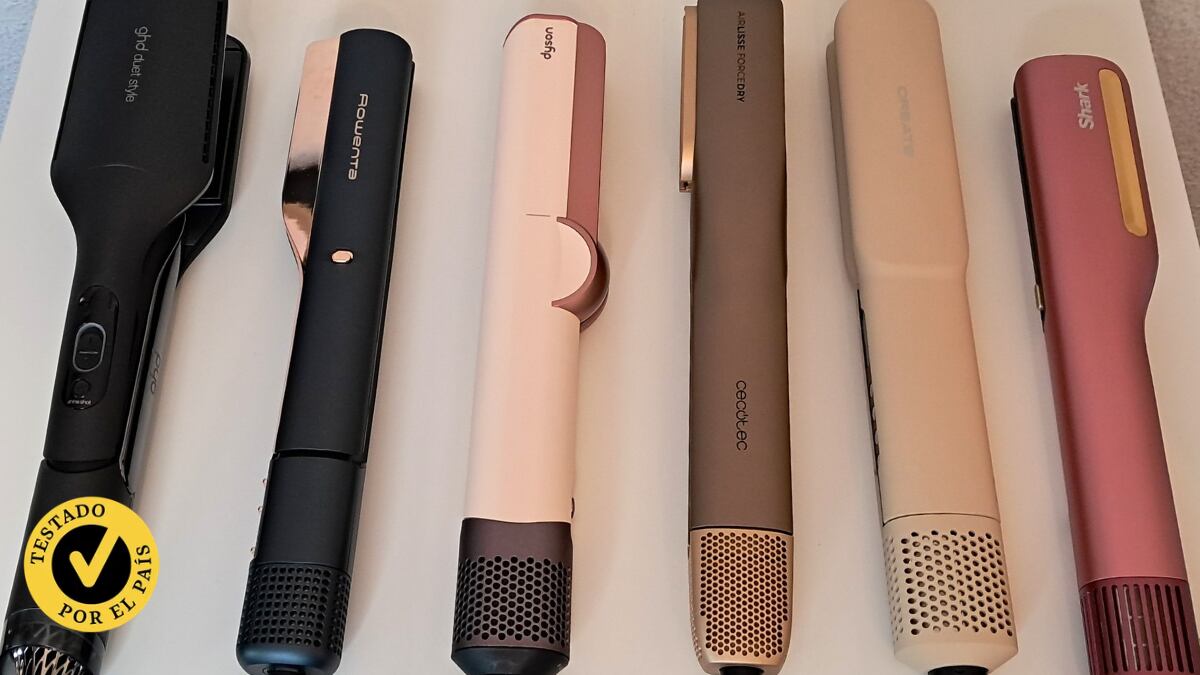
Secar y alisar el pelo a la vez es posible: he probado seis planchas secador y esta es mi favorita

He puesto a prueba seis modelos para comprobar si son capaces de secar y alisar a la vez.

La mejor plancha secador

He elegido la Dyson Airstrait Ceramic porque seca y alisa el pelo en unos 20 minutos, con un acabado suave, brillante y sin apenas encrespamiento.

COMPRA DYSON POR 319€ EN AMAZON

Seguir leyendo

¿Por qué puedes confiar en mí?

Soy periodista especializada en prueba y recomendación de productos y, en los últimos años, he analizado y comparado todo tipo de dispositivos, herramientas y artículos de consumo, poniendo a prueba sus prestaciones, funcionamiento y rendimiento en condiciones reales. A lo largo de este tiempo han pasado por mis manos desde gadgets y pequeños electrodomésticos hasta dispositivos de cuidado personal y tecnología aplicada al día a día, siempre con el objetivo de entender qué ofrece realmente cada producto más allá de sus especificaciones.

Además, estoy especializada en moda y belleza, un sector en el que sigo de cerca las tendencias y en el que he probado cosméticos, herramientas y productos de cuidado personal de todo tipo. En cada análisis busco ofrecer una visión clara, práctica y honesta que ayude al lector a elegir con criterio entre las distintas opciones del mercado.

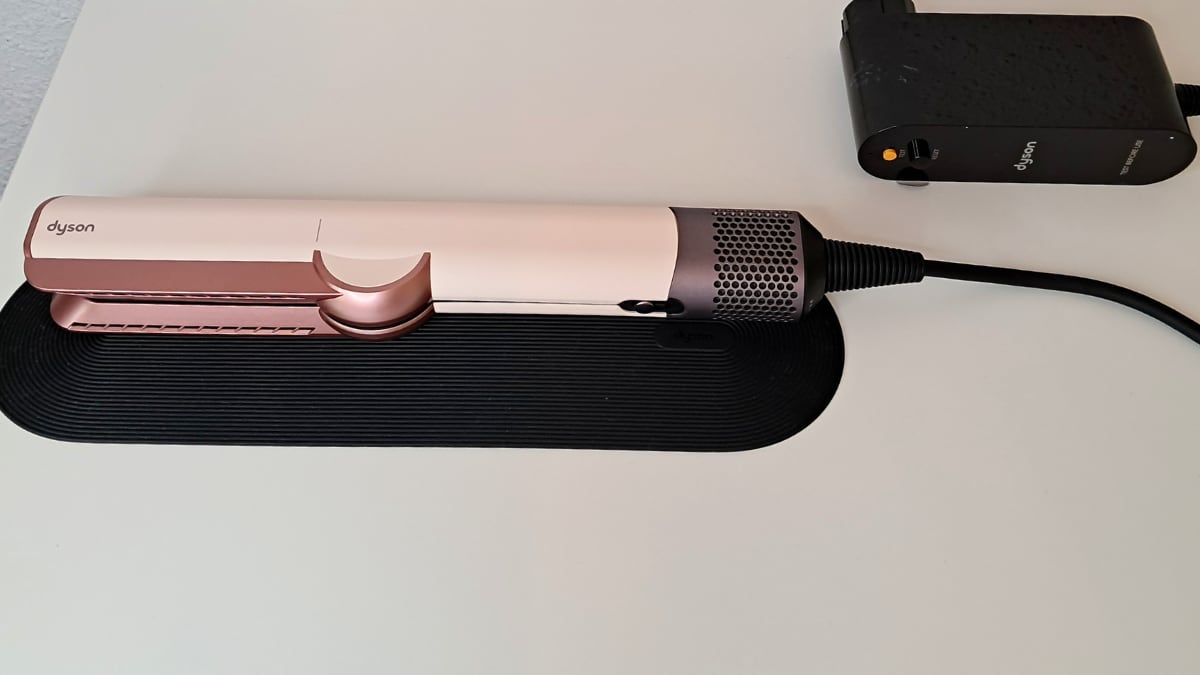
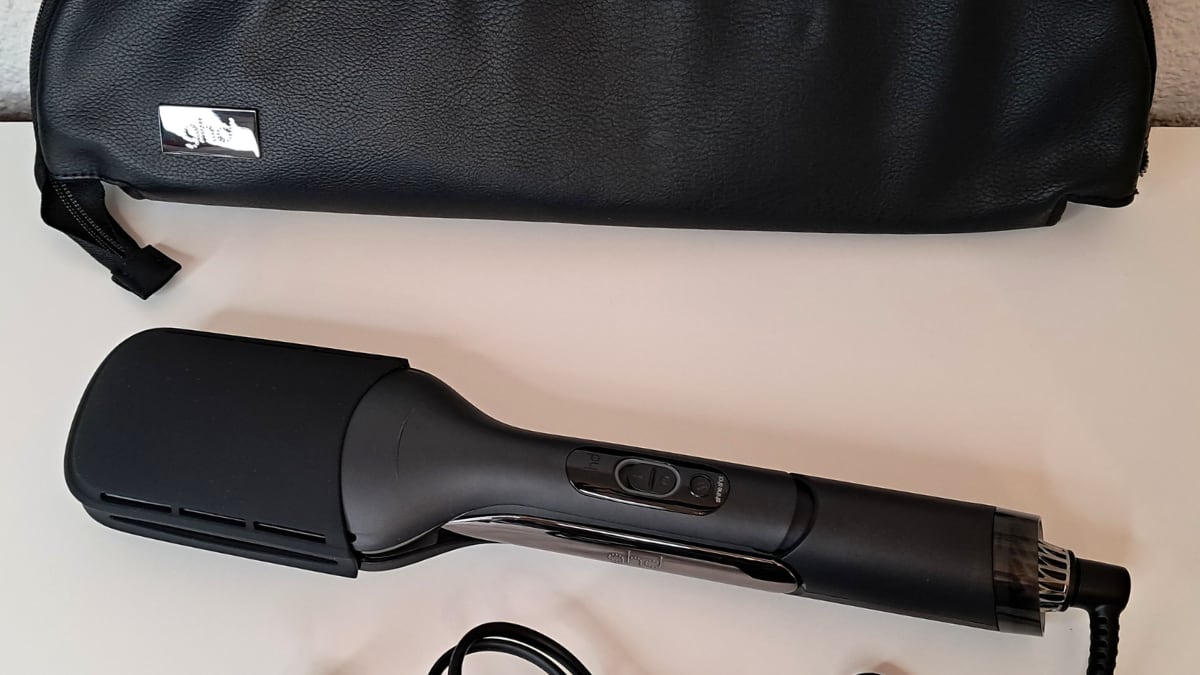
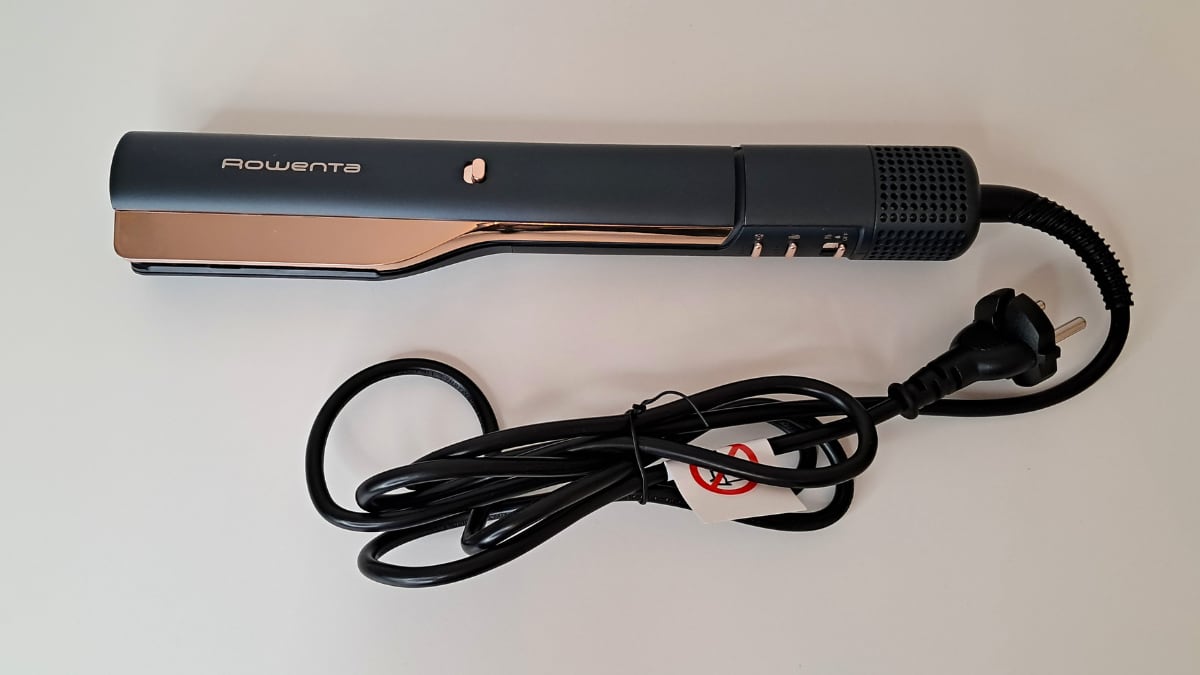
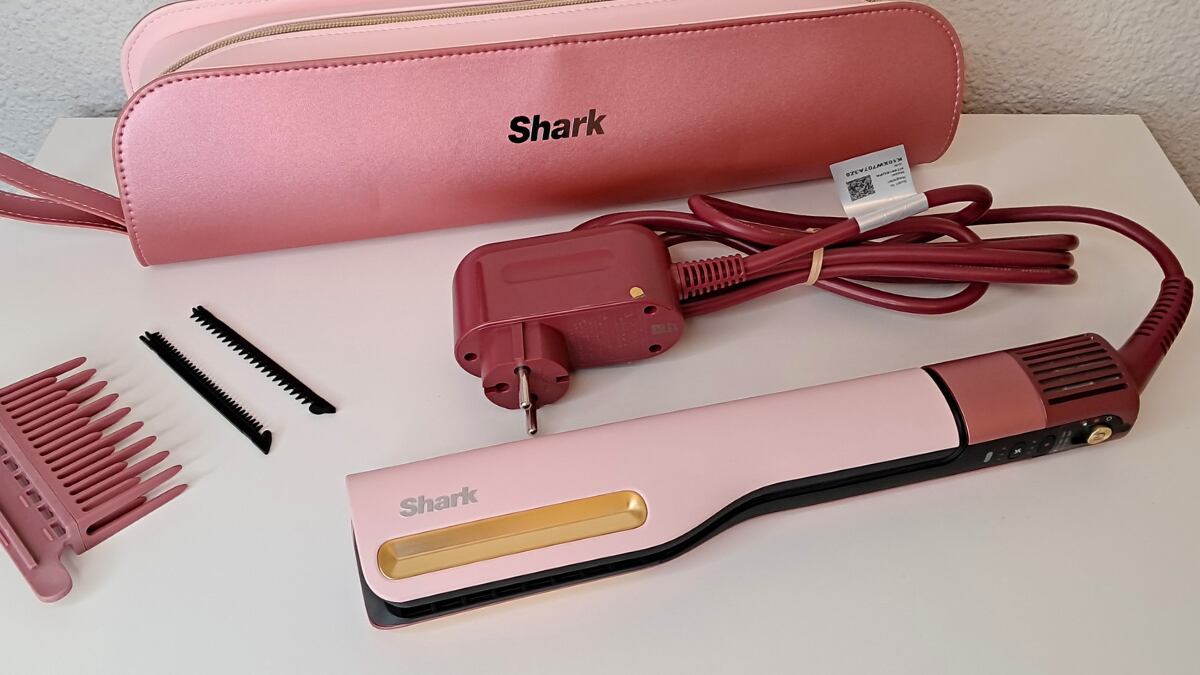
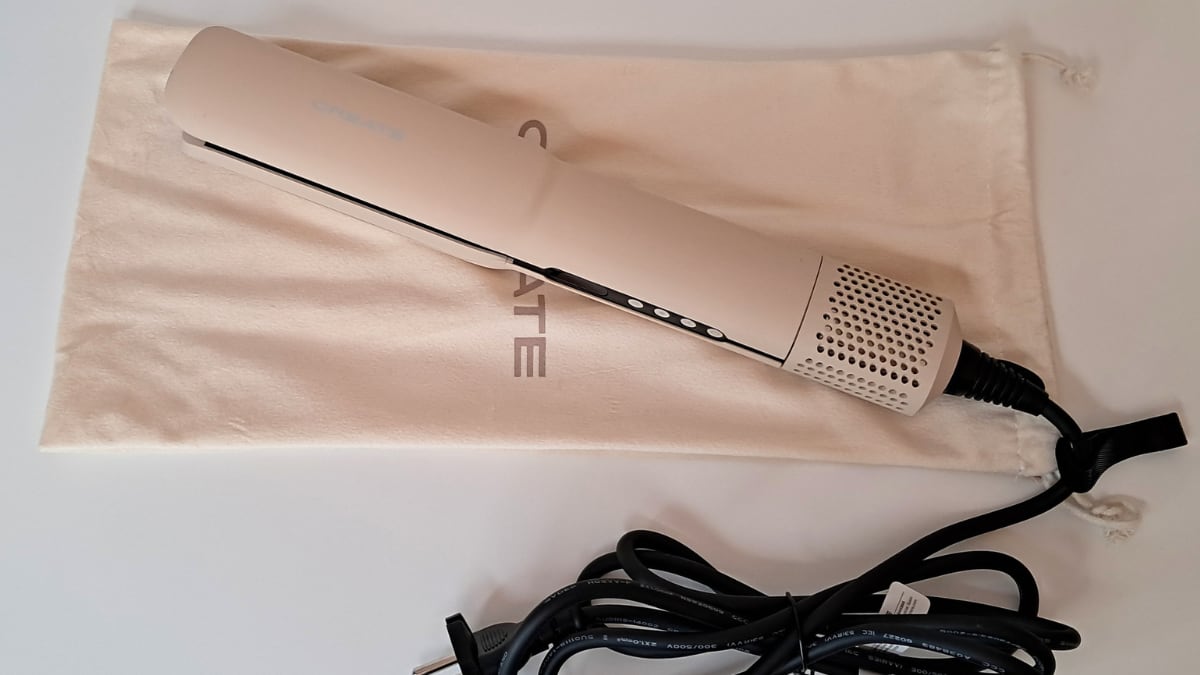
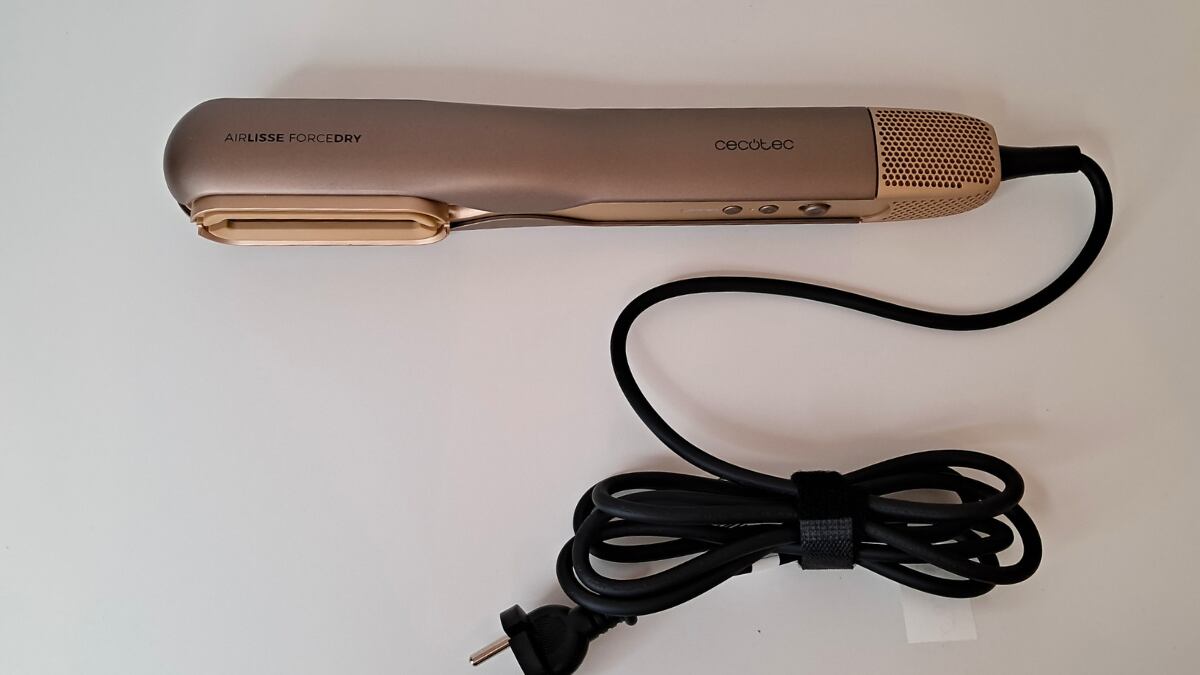
Plancha secador Dyson Airstrait Ceramic.Plancha secador Ghd Duet Style.Planchas secador Rowenta Air Kerastraight 3 en 1.Plancha secador Shark SilkiPro Straight.Plancha secador Create Ceramic Air Styler.Plancha secador Cecotec Airlisse 2 en 1 ForceDry.
  •  

Las 10 mejores ofertas de hoy (17 de octubre) en Amazon: hasta un 53% en Apple, Skechers,Braun y más

Fondo amarillo con la palabra amazon en azul oscuro y dos manos sosteniendo cajas de cartón

Las rebajas que de verdad compensan casi nunca son las que salen en la foto. Suelen estar en el abrigo que ibas a comprar igual, la báscula del baño o la crema que pide a gritos el sofá de piel. Entre las ofertas de Amazon de hoy caen unas cuantas de esas, ahora que el frío asoma por las mañanas. Y alguna menos aburrida, como el iPhone Air.

Apple iPhone Air de 256 GB en blanco nube

Smartphone Apple iPhone Air de 256 GB en color blanco nube, vista frontal y trasera

Poco más de medio centímetro de grosor. Es lo primero que notas al cogerlo, y entra en el bolsillo de la chaqueta sin hacer bulto. Lo de dentro no es de móvil de adorno. El chip A19 Pro mueve juegos exigentes y la pantalla de 6,5 pulgadas va suave al pasar el dedo. La cámara de 48 Mpx tiene un zoom x2 que Apple vende como de calidad óptica, y la batería da para el día entero. Con 256 GB hay sitio de sobra para no andar borrando fotos cada mes, y hoy se queda por debajo de los 1.000 euros. Es el móvil para quien ya había decidido cambiar y quiere algo ligero de verdad.

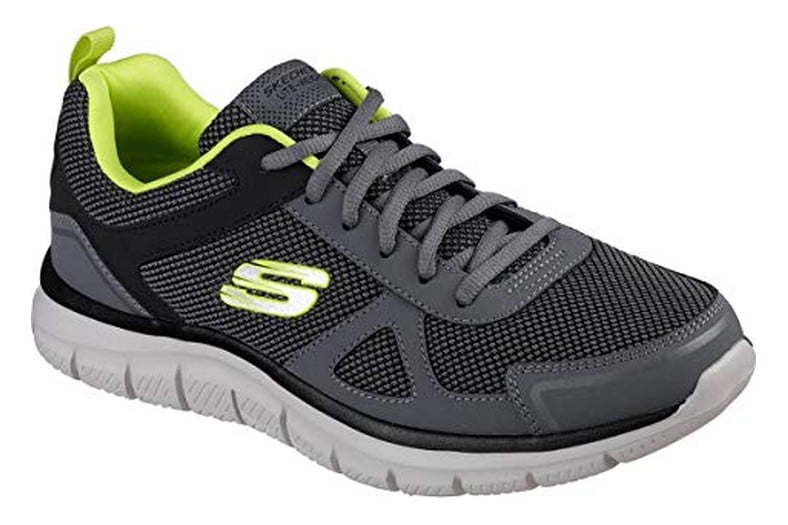
Zapatillas Skechers Track Bucolo de hombre en rojo y negro

Zapatillas de running Skechers Track Bucolo de hombre en piel roja con rejilla negra

La piel roja con rejilla negra les da un aire más de calle que de pista. La suela de caucho aguanta bien el asfalto del día a día. Se quedan por debajo de los 40 euros, con tallas de la 39 a la 48,5.

Auriculares CMF by Nothing Buds 2 con cancelación de ruido

Auriculares inalámbricos CMF by Nothing Buds 2 en gris oscuro con su estuche de carga

Pensados para el que sube el volumen en el metro para tapar el traqueteo. La cancelación de ruido corta ese zumbido antes de que llegue al oído. Los seis micrófonos limpian tu voz en las llamadas aunque sople el viento. La marca anuncia hasta 55 horas de batería contando el estuche. Se quedan en menos de 30 euros, y la cancelación de ruido ya justifica el gasto por sí sola.

Báscula Beurer BF 500 que se conecta al móvil

Báscula de baño digital Beurer BF 500 de cristal gris con pantalla LED y conexión al móvil

Esta báscula baja hoy un 49% y se queda en menos de 25 euros. Aparte del peso, te dice cuánta grasa, músculo y agua tienes, y lo manda solo al móvil por Bluetooth. Se sincroniza con Apple Health, así que si ya apuntas los pasos en el reloj, todo acaba en el mismo sitio. La pantalla desaparece bajo el cristal cuando no la usas (detalle tonto que en un baño pequeño se agradece). Aguanta hasta 180 kg y no necesitas nada más que el móvil para llevar la cuenta. Es de esas compras que cuesta justificar a precio completo y que hoy se justifica sola.

Zapatillas adidas Streettalk de mujer en blanco y plata

Zapatillas adidas Streettalk de mujer en blanco con detalles plateados y puntera de concha

La puntera de concha es el guiño a las adidas de toda la vida. En blanco con detalles plateados, combinan con vaqueros, con falda o con el chándal del domingo. El empeine es de piel sintética y el forro, de tela. Bajan de los 40 euros, poco para unas que van a salir de casa casi todos los días.

Recortadora de barba Braun Series 7 BT7535

Recortadora de barba Braun Series 7 BT7535 con base de carga y accesorios

Quien se arregla la barba en casa conoce el error. Un milímetro de más en un lado y acabas igualando el otro hasta quedarte casi sin barba. Esta recortadora tiene 40 posiciones que suben de medio en medio milímetro. La rueda se bloquea para que no se mueva a mitad de pasada. Trae siete accesorios, entre ellos un cabezal para apurar el contorno y una plantilla para perfilar. Se puede mojar sin miedo y aguanta hasta 2 horas sin cable. Hoy cuesta menos de 65 euros, un precio razonable para todo lo que trae en la caja.

Loción para cuero SONAX con cera de abeja

Bote de loción SONAX para el cuidado del cuero de 500 ml con cera de abeja

El sofá de piel que se cuartea en los brazos, los asientos del coche, el bolso que perdió el brillo. Medio litro de esta loción da para todo eso. Limpia la grasa, aviva el color y deja el cuero flexible sin que quede resbaladizo. Por menos de 10 euros, es de esas compras aburridas que luego agradeces tener a mano.

Sandalias Crocs Getaway de tiras con plataforma

Sandalias de tiras Crocs Getaway de mujer en negro con plataforma

Comprar sandalias en octubre tiene su lógica: es justo cuando nadie piensa en ellas. Estas son de tiras blandas, con una plataforma de 3,3 cm que suma altura sin castigar el pie. Van a la lavadora cuando vuelvan con arena. En negro y por menos de 25 euros, se quedan guardadas para la primera escapada de primavera.

Parka larga Jack & Jones con capucha desmontable

Parka larga Jack & Jones de hombre en negro con capucha desmontable

La primera mañana en que sales a las ocho y el viento corta, la sudadera ya no basta. Esta parka de Jack & Jones es de corte largo y tiene capucha que se quita cuando no llueve. El bolsillo del pecho cierra con cremallera, buen sitio para el móvil. Va a la lavadora, lo que en un abrigo negro de diario ahorra viajes a la tintorería. Baja de los 90 euros.

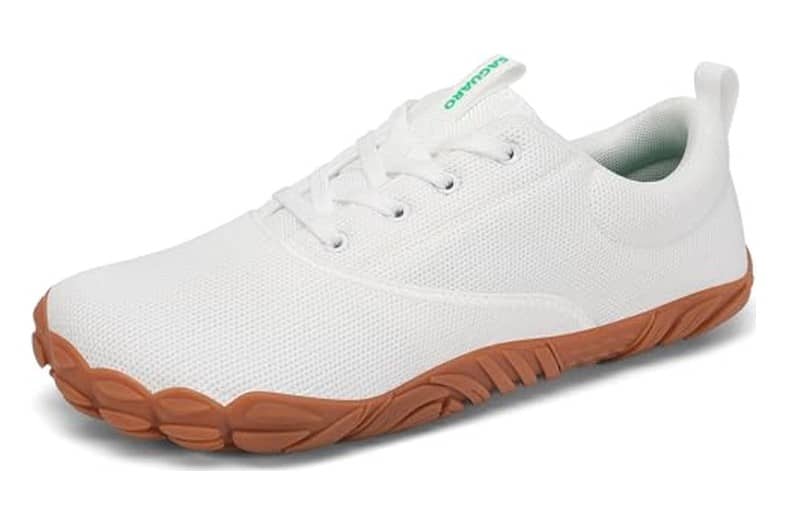
Zapatillas barefoot Saguaro para trail

Zapatillas barefoot Saguaro unisex de trail running en blanco con puntera ancha

Una suela de 5 mm y una puntera ancha donde los dedos se abren a su aire. Así se nota el suelo con estas zapatillas barefoot, y es justo lo que buscan quienes quieren pisar de forma más natural. Cuestan menos de 35 euros. No es un mínimo, porque desde la primavera se han visto a precios parecidos, pero sí una forma barata de probar la sensación si vienes de zapatillas con mucha amortiguación. La suela de goma agarra en tierra y la plantilla se saca para lavarla.

Merece la pena empezar por lo que vas a usar a diario desde la semana que viene: la báscula y la parka. Las sandalias, para quien ya piensa en la primavera. El iPhone Air es otra liga, y compensa si ya tenías decidido cambiar de móvil antes de Navidad.

Los contenidos publicados en esta sección pueden incluir recomendaciones de productos y servicios que consideramos de interés para nuestra audiencia. Cuando el lector realiza una compra a través de los enlaces incluidos, podemos recibir una comisión. Esto no afecta al precio final ni condiciona nuestra selección de productos.

  •  

Hire a human: The future where AIs get people to do physical labor is upon us

Hungarian artist Peter Weiler wanted to test a new platform called RentAHuman: the website’s slogan is “physical labor for AI” and it is designed for artificial intelligence agents to hire people to do jobs. Weiler wanted to test the platform and offered money for a person to hold a sign in a square in downtown Budapest that read in Hungarian and English: “An AI hired me for this job.” Last Thursday someone did that job for two hours for a fee of $70.

Seguir leyendo

© Cedida por Peter Weiler

A human hired through the RentAHuman platform holds a sign reading "An AI hired me for this job" in downtown Budapest, Hungary.
  •  

Este guante masajeador de manos se ha vendido sin parar en Escaparate: ¿merece la pena? Lo probamos

He puesto a prueba este guante masajeador superventas de Amazon.

Las manos son una de las partes del cuerpo que más utilizamos a lo largo del día y, sin embargo, no solemos parar a pensar en el cansancio que acumulan. Desde teclear durante horas en el ordenador hasta deslizar el dedo por la pantalla del móvil, el caso es que pocas veces les damos tregua. El problema llega cuando los movimientos repetitivos y la falta de descanso favorecen la aparición de molestias en los dedos, las palmas e, incluso, las muñecas.

Seguir leyendo

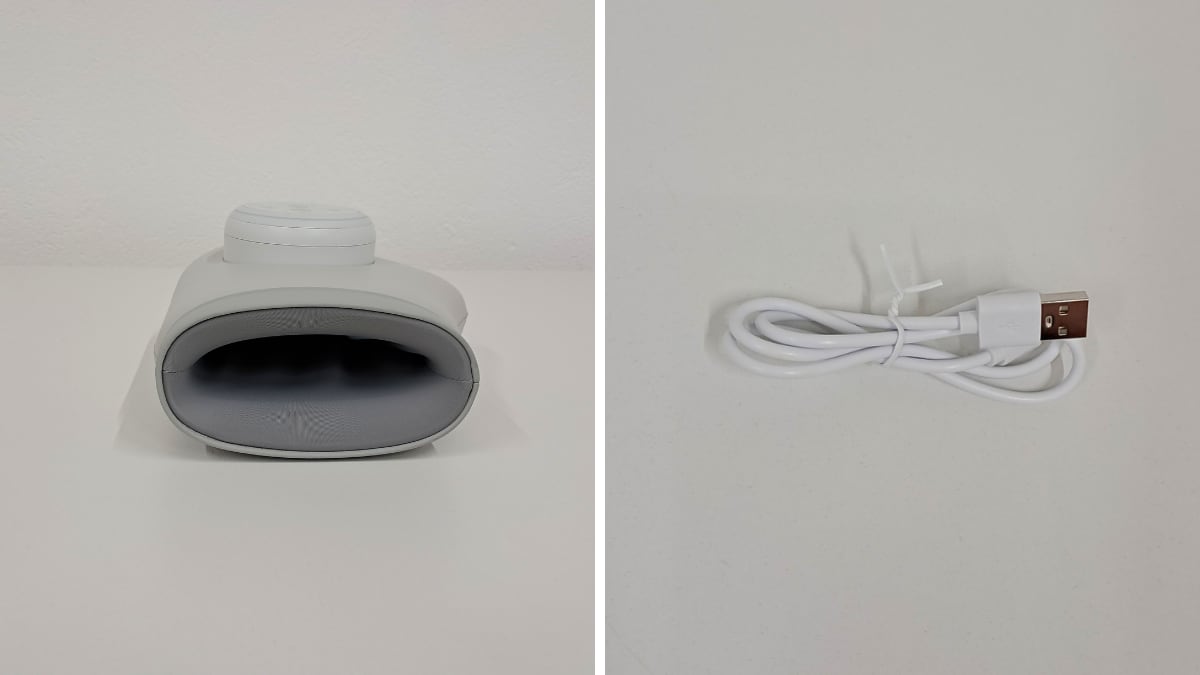
Utiliza compresión de aire y calor para masajear tus manos.Dispone de tres modos de masaje y hasta cinco niveles de intensidad, así como función de calor y luz integrada.El interior resulta suave y agradable. Es inalámbrico y dispone de un cable de carga.
  •  

Las 10 mejores ofertas de hoy (16 de octubre) en Amazon: hasta un -64% en Skechers, L'Oreal, Braun y más

Teléfono con logotipo de Amazon, rodeado de cajas de cartón y un carrito de compra volcado sobre fondo azul.

A mediados de octubre la casa vuelve a ser el centro de operaciones, y cada rincón pide lo suyo. La cocina quiere un zumo decente por las mañanas; el suelo, alguien que lo friegue cuando entra el barro; el taller, ese taladro que llevas varios puentes pidiendo prestado. Hasta la calle tiene su parte, y ahí encaja el altavoz JBL Clip 5, que se cuelga de la mochila y no pide nada más.

Las compras que de verdad salen a cuenta en un día de rebajas suelen ser las aburridas, las que ibas a hacer igual tarde o temprano. Y hoy tienen sitio en cada rincón de casa, del baño al zapatero y del tocador al taller.

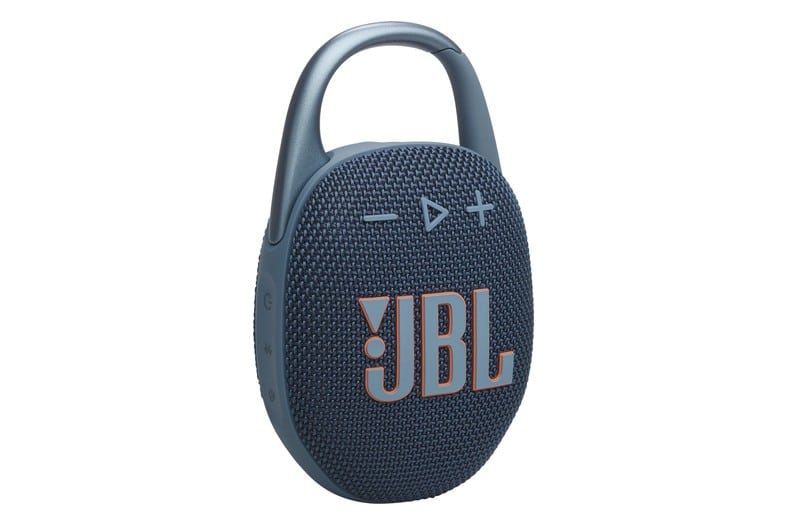
Altavoz portátil JBL Clip 5 resistente al agua y al polvo

Altavoz Bluetooth portátil JBL Clip 5 en color azul con asa integrada

Aguanta lluvia, polvo y algún chapuzón, porque es IP67, así que va colgado de la mochila en la excursión del puente sin que tengas que mirar al cielo. Con una carga da hasta 12 horas de música, más que una tarde entera de parque. Y si en casa ya hay otro Clip 5, los dos se emparejan y suenan en estéreo. Se queda por debajo de los 37 euros, un precio sensato para un altavoz que vas a sacar de casa sin miedo.

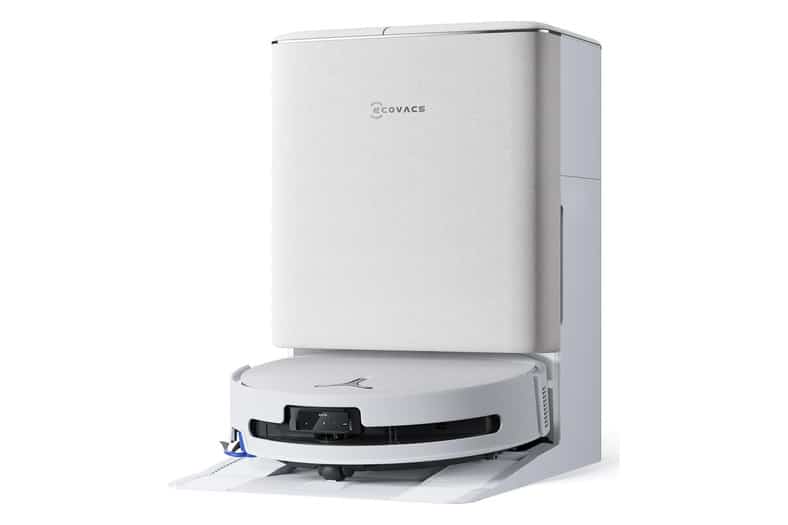
Robot aspirador y friegasuelos Ecovacs T90 Omni con rodillo de fregado

Robot aspirador y friegasuelos Ecovacs T90 Omni blanco con su base de limpieza

Friega con un rodillo de 27 cm que gira pegado al suelo, como una fregona bien escurrida, y está pensado para apurar el borde del rodapié. La base lo lava con agua caliente, hasta 75 °C según la marca. También se ocupa del depósito de agua sucia, que es justo la tarea que acaba aparcando muchos robots en un rincón.

El otro detalle pesa más de lo que parece en una casa real: sube escalones de hasta 2,4 cm. Así, el umbral de la puerta del baño o la alfombra gruesa del salón dejan de ser el final de su ruta. Se queda por debajo de los 400 euros. No es el chollo del siglo, pero la rebaja es de las reales, no de etiqueta.

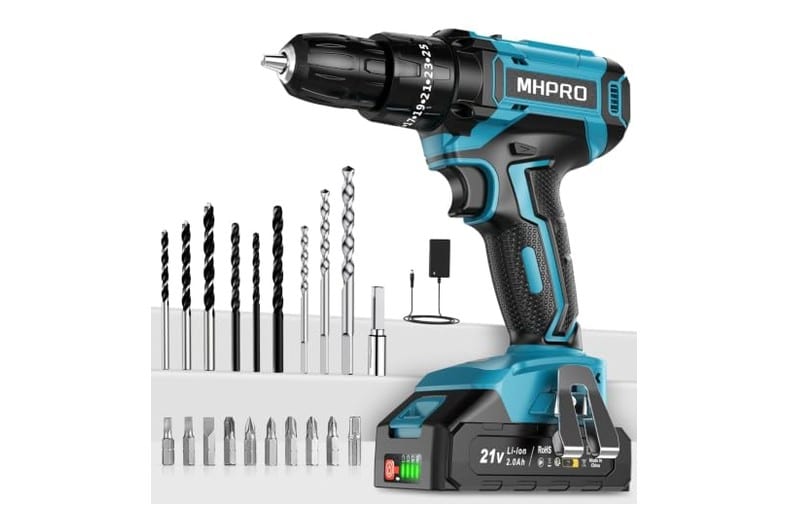
Taladro percutor MHPRO de 21 V con 24 accesorios

Taladro percutor a batería MHPRO de 21 V en color azul con batería y accesorios

Colgar una balda, montar la cómoda nueva o meter un taco en la pared de ladrillo: para eso sirve este taladro en el taller de casa. Tiene 3 modos, atornillar, taladrar y taladrar con percusión, y un ajuste de fuerza de 25 posiciones para no pasarte de rosca con la madera blanda. La batería avisa de cuánta carga le queda. Con sus 24 accesorios se queda por debajo de los 40 euros, menos de lo que cuesta un par de tardes de manitas a domicilio.

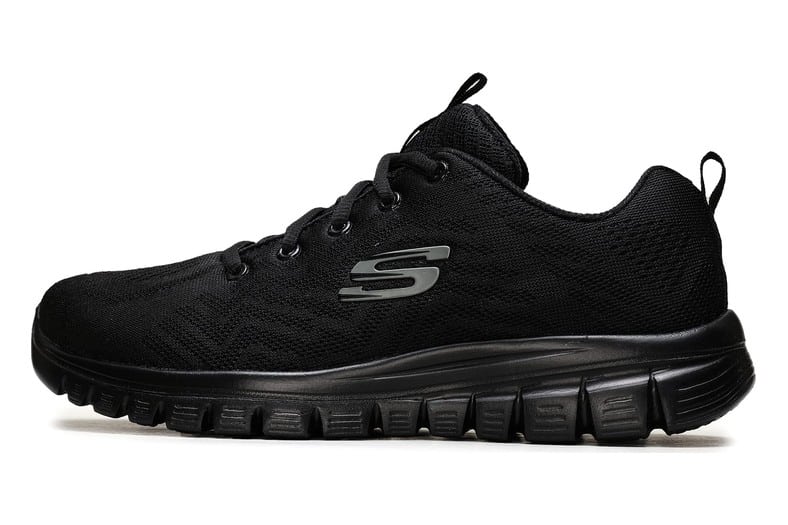
Zapatillas Skechers Graceful Get Connected de mujer con plantilla viscoelástica

Zapatillas Skechers Graceful Get Connected de mujer en negro con malla

Son las zapatillas que te pones para ir a por el pan y acabas llevando toda la tarde. La plantilla de espuma viscoelástica se adapta a la pisada y la suela flexible amortigua cada paso, así que a última hora no llegas con los pies cargados. Llevan años en el catálogo de Amazon sin moverse del zapatero de mucha gente, y se venden también en horma ancha, algo que agradece quien sufre con casi todas. Ahora están rebajadas un 31%.

Olla baja WMF Diadem Plus de 24 cm con tapa de cristal

Olla baja WMF Diadem Plus de acero inoxidable pulido de 24 cm con tapa de cristal

Una olla de acero sin recubrimiento no se pela, no le teme a la cuchara de metal y no hay que cambiarla cada pocos años. La Diadem Plus es de acero inoxidable 18/10 pulido y vale para cualquier cocina: inducción, gas, vitro o eléctrica.

Con 4,5 litros y 24 cm de diámetro caben unas lentejas para 4 con sobras para el táper. Al ser baja, también sirve para un arroz meloso o para dorar la carne y meterla después al horno, que aguanta hasta 250 °C sin tapa. Los mangos remachados no se calientan y entra en el lavavajillas. No llega a los 35 euros, y es de esas piezas que compensa comprar cuando bajan porque la vas a usar cada semana.

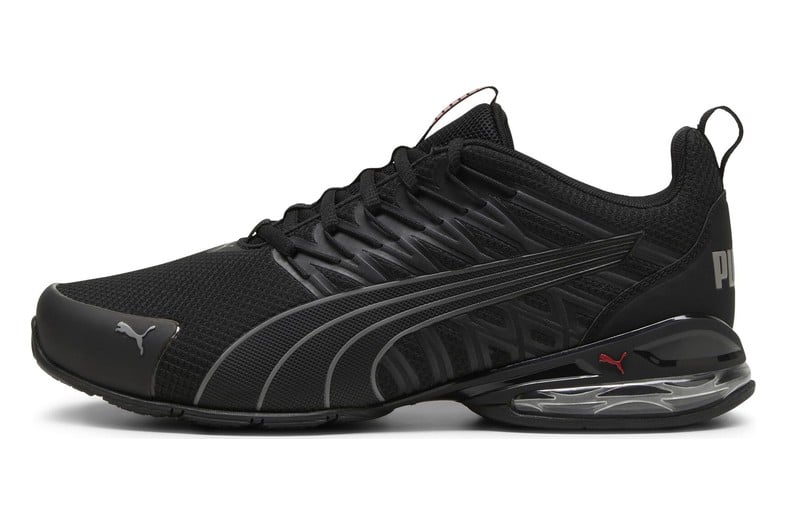
Zapatillas Puma Voltaic EVO de hombre con suela de goma completa

Zapatillas Puma Voltaic EVO de hombre en negro con gris y detalles en rojo

Si las Skechers son para el paseo, las Puma Voltaic EVO dan un paso hacia el entreno. Llevan amortiguación de 10 celdas bajo el pie y una pieza rígida que asienta el apoyo. La suela es de goma de punta a talón, y eso se agradece cuando el suelo del parque está mojado. En negro con gris y detalles en rojo, combinan con casi cualquier chándal, y hoy aparecen rebajadas en Amazon.

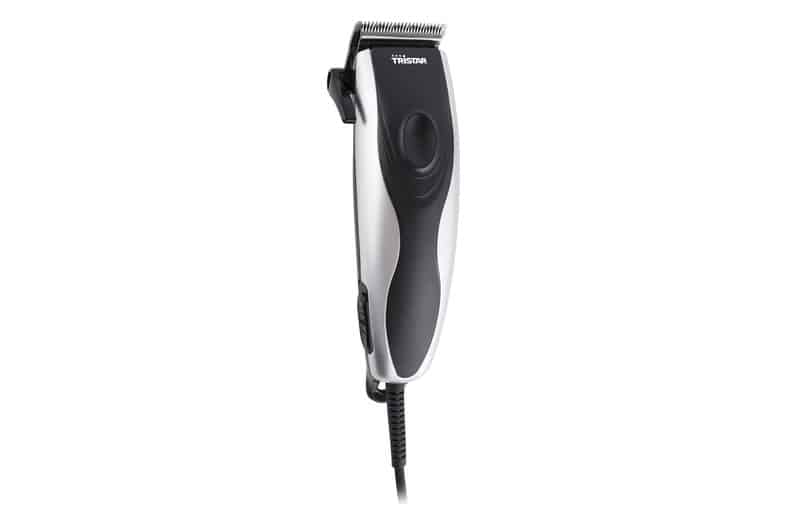
Cortapelos Tristar TR-2561 con 4 peines y tijeras

Cortapelos Tristar TR-2561 negro con peines, tijeras y peine de peluquero

Para repasar la nuca entre visita y visita a la peluquería, o para el corte rápido de los niños en el baño. Las cuchillas se ajustan de 3 a 12 mm y la caja trae 4 peines, tijeras, peine de peluquero y aceite para el mantenimiento. No llega a los 10 euros.

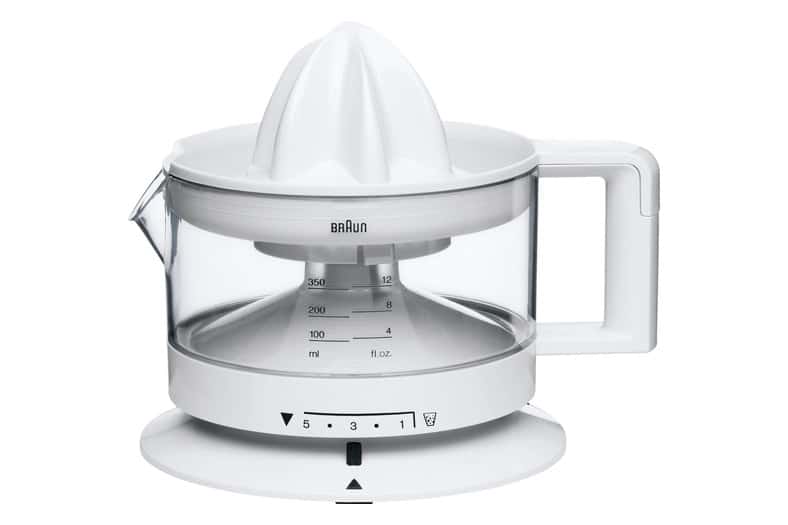
Exprimidor eléctrico Braun CJ3000 en blanco

Exprimidor eléctrico de naranjas Braun CJ3000 en blanco con jarra de 350 ml

Encabeza los exprimidores eléctricos más vendidos de Amazon, y su manejo explica por qué: no tiene botones. Apoyas media naranja, presionas y gira; la sueltas y para. El cono cambia de sentido para sacar más zumo y la jarra se gira para elegir entre 5 niveles de pulpa. Todas las piezas van al lavavajillas, y eso decide si un exprimidor se queda en la encimera de la cocina o acaba en el armario. Ojo, eso sí: la unidad a este precio es de segunda mano, en muy buen estado. Por menos de 13 euros, el zumo de cada mañana sale a cuenta.

Bálsamo con color L'Oréal Paris Hyaluron Tinted Balm en tono 9 Deep

Bálsamo con color L'Oréal Paris Hyaluron Tinted Balm en tono 9 Deep para piel oscura

En el tocador, es el paso intermedio entre la crema hidratante y la base. Unifica el tono sin tapar del todo y, si un día quieres más cobertura, basta con una segunda capa. Lleva emolientes hialurónicos, deja la piel jugosa sin sensación grasa y se extiende del centro de la cara hacia fuera. El 9 Deep es el tono pensado para pieles oscuras, y hoy está a menos de la mitad de lo que suele costar.

Plancha de pelo Faszin con placas de titanio y pantalla digital

Plancha de pelo Faszin gris con placas de titanio y pantalla digital

La pantalla te dice a qué temperatura está, y eso importa más de lo que parece. Sus 11 niveles, entre 130 y 230 °C, dejan ir bajo con el pelo fino o teñido y subir con el grueso. Según la marca, llega a 180 °C en unos 20 segundos. Se apaga sola a la media hora, lo justo para salir del baño sin la duda de si se quedó enchufada. El cable de 2,2 metros gira sobre sí mismo y admite doble tensión, así que también se va de viaje. Se queda justo por debajo de los 40 euros.

De todos los rincones de casa, el que más agradece la rebaja de hoy es la cocina: si solo entra una cosa en el carrito, que sea la olla de WMF. Hará las lentejas de este invierno y las de los que vengan, y seguirá en el fuego cuando el robot ya esté jubilado.

Los contenidos publicados en esta sección pueden incluir recomendaciones de productos y servicios que consideramos de interés para nuestra audiencia. Cuando el lector realiza una compra a través de los enlaces incluidos, podemos recibir una comisión. Esto no afecta al precio final ni condiciona nuestra selección de productos.

  •  

Websites down and bots disabled: The unexpected consequences of bombing data centers

Ukraine has struck a major blow to Russia’s digital infrastructure. Since last Thursday, Ukrainian drones have carried out a series of attacks that destroyed three large data centers belonging to Yandex — known as “the Kremlin’s Google”— on the outskirts of Moscow. The Yandex Taxi ride-hailing app and the group’s payments service, Yandex Pay, have been temporarily taken offline. Ukrainian President Volodymyr Zelenskiy even said the bombings disabled Russian bots.

Seguir leyendo

© Vahid Salemi (AP Photo/Vahid Salemi)

A member of Iran's Islamic Revolutionary Guard Corps salutes next to a drone during a parade on September 18.
  •  

How much AI is in Spain’s bestselling books?

Artificial intelligence is also making its way into the world of books. EL PAÍS examined the use of AI in a sample of 119 popular books published in 2025 and 2026, analyzing titles that appeared on the bestseller lists at Amazon.es and the Spanish bookstore chain Casa del Libro, as well as the winners of a major literary prize.

Seguir leyendo

© Albert Garcia

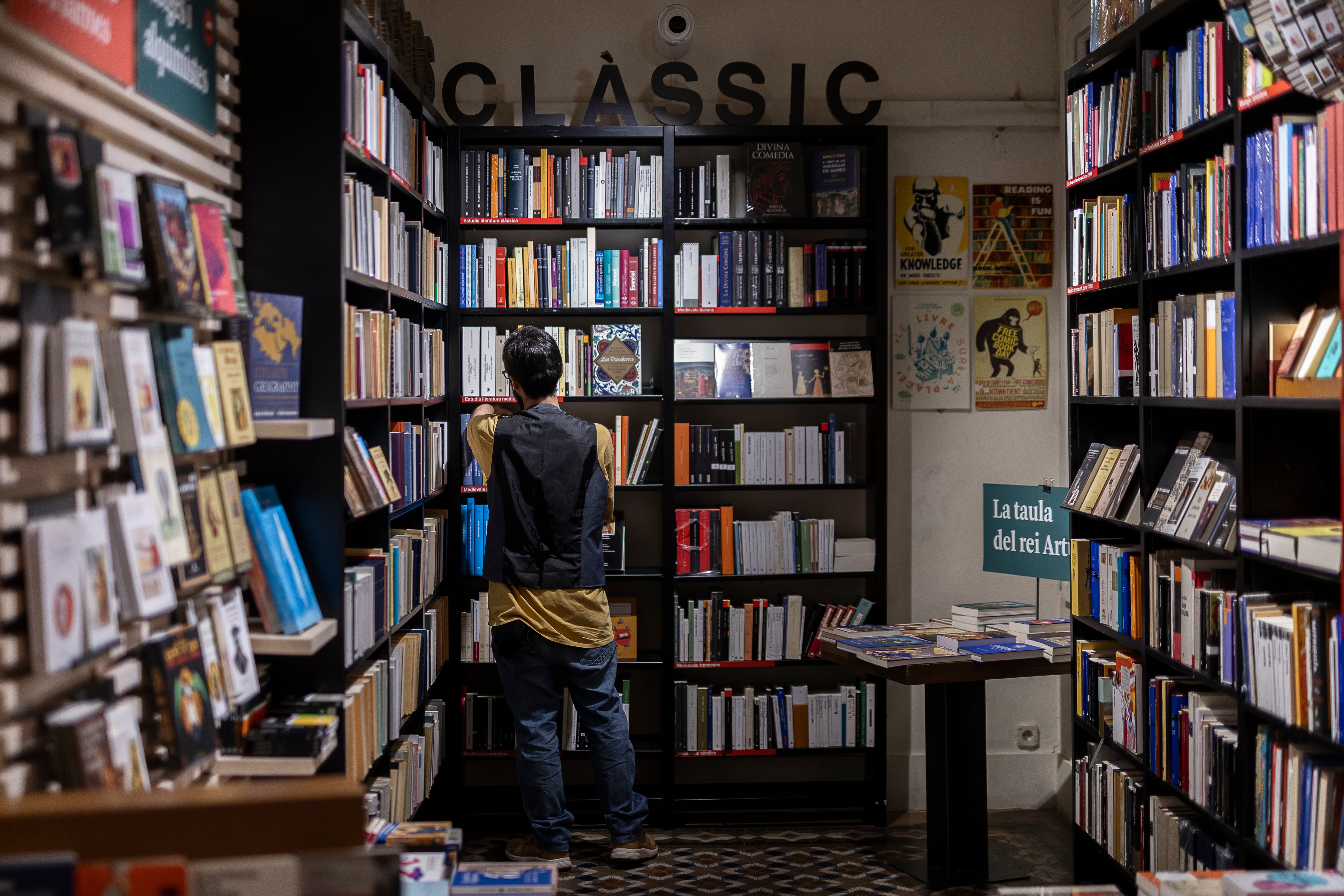
A bookstore clerk in Barcelona checks the classics section.
  •  

Highways Built for Monkeys

They aren’t made of asphalt, have no traffic lights, and no cars drive on them. Yet, these unusual “highways” are already saving thousands of lives. In the Brazilian Amazon, conservationists have built rope bridges high up in the trees, allowing monkeys, sloths, and other jungle inhabitants to safely cross over the roads. The results are […]

  •  

Should AI pay taxes? The debate is gaining traction in the US

As the controversy over AI safety grows, another debate is emerging. Bill Gates, the founder of Microsoft, has said that artificial intelligence should pay taxes to compensate for the jobs that will be destroyed by the deployment of this technology.

Seguir leyendo

© EvgeniyShkolenko (Getty Images)

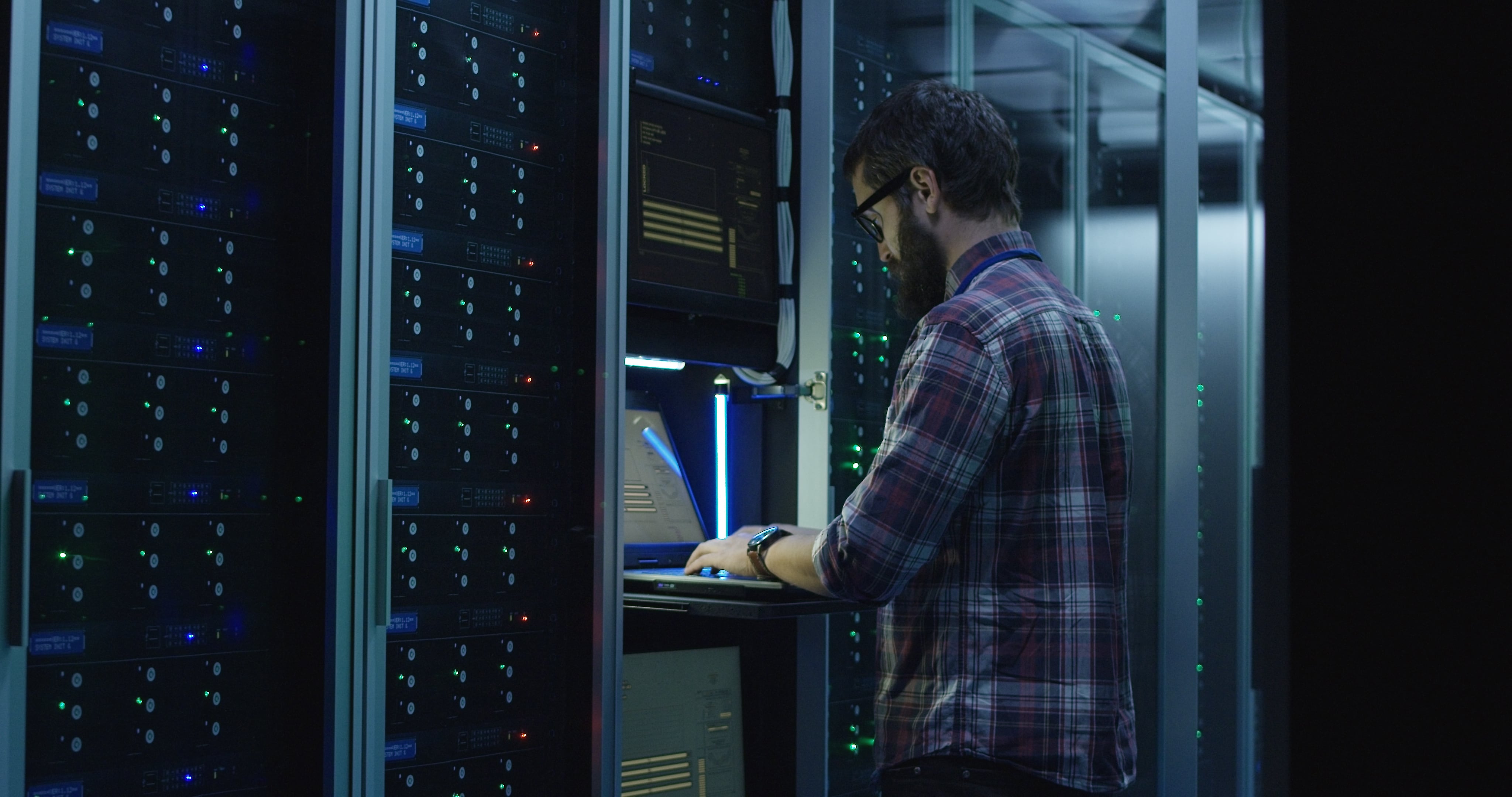
A systems administrator works in a server room.
  •  

Amazon is deploying AI to spy on its workers and bust unions before they form

A worker walks inside Amazon's LCY3 Fulfillment Centre in Dartford, east of London, on June 4, 2026, on the second day of company's 'Delivering the Future EMEA '26' event. Photo by JUSTIN TALLIS / AFP via Getty Images

This article was originally published by Truthout on Sept. 30, 2026. It is shared here under a  Creative Commons (CC BY-NC-ND 4.0) license.

The 18th-century notion of the panopticon — a circular prison design with a guard station in the middle, allowing a single officer to enforce discipline by keeping watch over all the prisoners — has become real in the 21st century through AI-driven surveillance against workers: It’s the Amazon warehouse.

It should be no surprise that the company that harnessed technology to create a vast, $2.7 trillion empire would employ the same sophistication to enforce workplace discipline and tamp down insurgent unionization efforts. A recent disclosure of Amazon’s internal “employee relations” documents reveals just how extreme Amazon’s methods of warehouse surveillance and control have become.

Amazon employs what it calls the “Atlas” model, inputting into a computerized model a staggering amount of information on workers, their thoughts and behaviors, the workplace environment, and myriad other factors — “hundreds of data points,” according to the company. Atlas produces not just a granular measurement of ongoing worker unrest, worksite by worksite around the world, but also a prediction model for future organizing. It’s like the “precrime” police in the film Minority Report who use psychic powers to identify and apprehend would-be criminals before they act — except in this case, it’s an AI-driven tool used by the billionaire owners of one of the richest companies in history to head off rebellion among its low-wage workforce. And this is not Tom Cruise play-acting; it’s very real.

Workers anywhere who have endured anti-union campaigns can relate to stories of overbearing surveillance by management; the Atlas model, however, takes the spying to an entirely new level.

Details of the Atlas model came to light recently as a result of a legal dispute between Amazon and Unifor, the Canadian private sector union. Last year, British Columbia’s Labour Relations Board awarded union certification to Unifor at Amazon’s YVR2 warehouse outside Vancouver, finding that the company had broadly interfered in the union drive. It was the second union certification at Amazon in North America — the other being the 2022 union win at JFK8 in Staten Island, New York. But in contrast to the U.S., where Amazon has managed to stall bargaining for four and a half years because of weak labor laws, the B.C. Labour Relations Board ordered Amazon to recognize the union and negotiate. Contract bargaining commenced last December.

Not surprisingly, Amazon has dragged its feet in negotiations, prompting the union to file unfair labor practice charges with the Labour Board. Following a series of hearings earlier this year, the Labour Board found that Amazon violated provincial law. In August it ordered a remarkable step — first-contract arbitration at YVR2. That fight remains in play, but as a result of the legal proceedings, Amazon was required to turn over documents to the Labour Board and Unifor. Unifor has shared them with Truthout, and they can be viewed here.

Atlas produces not just a granular measurement of ongoing worker unrest, worksite by worksite around the world, but also a prediction model for future organizing.

In addition to the Atlas model revelation (beginning on Page 19 of the document), the material includes more than 100 pages that reveal in great detail how Amazon trains its frontline managers in union-busting. My colleague at the Center for Work and Democracy, Ben Fong, has written about this other portion of the disclosed material.

“Amazon’s own documents pull back the curtain on what workers have been telling us for years,” said Justin Gniposky, Unifor’s organizing director. “Behind the friendly PR, Amazon sees workers as property and treats their fundamental right to unionize as a threat to be managed and then eliminated.”

Amazon did not respond to Truthout’s request for comment on the Atlas model.

The documents describe the Atlas model as “a labor risk framework to clarify how Amazon evaluates emerging workforce issues, labor union targets, and internal or external labor threats.” The Atlas model ingests hundreds of data points: employee trainings completed; health and safety incidents, from simple first-aid cases to serious injuries; feedback from workers on management; worker tenure and turnover; the proximity of a warehouse to another workplace experiencing union activity; local minimum wage rates and other area economic conditions; and even the temperatures inside and outside of the warehouse.

Amazon seems especially thorough about scraping data from worker communications channels to plug into the Atlas model — the company’s internal “Voice of the Associate” (VOA) electronic bulletin board, the answers to digital questions posed daily to workers, and externally, forums including Reddit — “to understand the tenor of the discussion at the site level,” according to the documents.

“Behind the friendly PR, Amazon sees workers as property and treats their fundamental right to unionize as a threat to be managed and then eliminated.”

Atlas uses AI to identify phrases and “common keywords” to allow managers to do a “deep dive into the worker population driving the discussion.” Atlas also looks at the upvotes or other responses — positive, negative, or neutral — that the comments elicit, and the volume of those worker reactions. All of these data points go into Atlas and let managers “look around corners to identify developing themes” so they can “tailor strategic responses for addressing emerging risk.”

Amazon also tracks and documents all organizing activities that managers detect, and records them under the category of “employee relations events.” Each activity is assigned a severity score. “High severity” events include employees signing union cards, delegations of workers approaching management with demands, protests, sickouts, and work stoppages.

Atlas uses mathematical modeling to create a point system for all these data points, assigning a “labor score” to each workplace. The scale is further broken down into tiers, with the Tier 5 designation applied to facilities with high scores, where there is “no immediate perceived risk,” and Tier 1 applied to facilities where “future activity is imminent.” Amazon’s union busters focus largely on Tier 1 and 2 facilities.

Atlas produces extensive spreadsheets ranking different facilities and looking not just at raw “labor scores” but also at monthly trends. In 2024, the year the documents date from, Amazon was most concerned about union activity at 16 warehouses it had ranked as Tier 1. For instance, at LDJ5, a Staten Island sortation center across the street from JFK8, Atlas noted that leading issues of worker concern were “bathroom breaks, equipment, rest breaks, leadership/management, temperature.” The spreadsheet noted that “internal activists” — workers — were organizing, and that by looking at month-over-month trends, LDJ5 was experiencing “Risk Increase,” with the phrase placed inside a bright red box. At four of these Tier 1 facilities, the spreadsheet noted, the threat of union activity was sufficiently high to justify deploying Amazon’s “rapid response” team: union busters who travel to hotspots of organizing throughout Amazon’s global network.

Union organizing at Amazon is not just a battle over economics; it’s also a fight for basic freedom and democracy.

But the main value of Atlas seems to be predictive. For the Tier 2 worksites (“future activity is highly probable”), the spreadsheet poses these questions: “Which sites are showing the most future risk that are not Tier 1 sites yet?” and “What is the risk in each business line and which has the most risk, is it increasing or decreasing? What is driving the risk?” Tier 2 spreadsheets in the document look at the number of investigations of workers that management has handled in the last month, whether that number is trending up or down, the number of worker appeals of those investigations, and — notably — the percentage of negative worker comments on internal bulletin boards.

Voice of the Associate and other internal bulletin boards are key focal points. Charts in the document track how often workers raise particular topics, like weather, time off, breakroom amenities, management treatment, and restroom cleanliness. They also analyze the “vector” of each issue: “What are the top drivers of negative Sentiment and change MoM [month over month]?” is one question posed in the document. “What Sites are spiking MoM in negative sentiment? What themes are driving the sentiment? What anecdotes can we pull?”

Atlas is not strictly a North American tool. One chart analyzes trends for warehouses globally, documenting “employee relations events” — worker organizing — and cataloguing the number of worker comments on Voice of the Associate and the percentage of those comments that were negative. Two warehouses in the English Midlands where workers have been organizing with the GMB union — both Tier 1 sites in Atlas’ taxonomy — showed high volumes of negative VOA posts. A warehouse in Melbourne, Australia, also showed mostly negative Voice of the Associate posts, while posts were mostly not negative in some of the warehouses in Poland, Germany, and Italy.
All this is surely a tiny sliver of Atlas’s output. The former head of Amazon’s HR platforms, Bud Cashatt, boasted on LinkedIn recently about how his department created “predictive site-risk ML touching every building in Amazon’s global network.” (“ML” stands for machine learning, where programmers train AI to learn patterns and build predictions based on analyzing vast quantities of data.)

Did Jeremy Bentham, the 18th-century British philosopher who dreamed up the panopticon, anticipate Atlas? Nearly 250 years ago, he imagined his panopticon as a useful tool for prisons, “madhouses,” and also “to the business of manufactories,” the industrialized manufacturing plants then just emerging in England. Speaking of his watchman in the center of the operation — the human Atlas of his time — Bentham wrote, “The concealment of his person will be of use.”

The documents uncovered at the B.C. Labour Board shine a light on Amazon’s concealed watchman. Atlas illustrates just how far Amazon will go to try to rule the warehouse floor. And its scope also underscores just how terrified Amazon’s masters are of their own workforce rising up and claiming their due.

Bentham theorized that the panopticon would facilitate social control: He imagined that incarcerated people would behave, not knowing at any moment whether they were being watched by the guard. It was, he wrote, “A new mode of obtaining power of mind over mind.”

But what happens when prisoners — or workers — resist such attempts at social control? There’s no level of AI sophistication that can erase the reality that Amazon’s workers move millions of packages every day, and without their labor, the Amazon supply chain collapses.

Peter B. Olney, the retired organizing director of the International Longshore and Warehouse Union, calls Atlas “a promethean tool for union busting and the thwarting of any employee organizing.”

To fight back against this “existential threat” to basic worker rights and unions, Olney says, “we have to get real about deploying massive resources towards organizing the workforce and finding their serious vulnerabilities and choke points.”

Today we see emerging fights everywhere against a billionaire class intent on harnessing AI and technology to undermine basic democracy and impose authoritarianism, both in the workplace and throughout society: in revolts against the algorithmically driven content we are force-fed on the internet; protests against and sabotage of the Flock cameras on neighborhood lampposts; and resistance against the replacement of workers with bots and computers. The Atlas model places Amazon workers at the center of this global fight against the AI billionaires. And it highlights that union organizing at Amazon is not just a battle over economics; it’s also a fight for basic freedom and democracy.

  •  

In Brazil’s Acre, calls for new roads clash with deforestation commitments

Along a freshly repaved stretch of the BR-317 highway in Acre, a Brazilian state bordering Bolivia and Peru in the Western Amazon, pasture stretches out as far as the eye can see. Solitary Brazil nut trees (Bertholletia excelsa), a protected species, are the only reminder of the tropical forest that once stood there. The road is part of the Interoceanic Highway, inaugurated in 2011 as the first paved road in South America connecting the Atlantic and Pacific oceans. Built through the Brazilian and Peruvian Amazon to help increase trade to Asia as well as between neighboring countries, the highway has been associated with deforestation on both sides of the border. “Roads are the main vector for deforestation and irregular [land] occupation,” says Sonaira Souza da Silva, a professor at the Federal University of Acre’s Floresta Campus and co-author of a recent paper on road expansion in Acre. The desolate landscape that now lines the BR-317 could be replicated elsewhere in Acre, environmentalists warn, if plans go ahead to build a second road connection with Peru. This is part of a renewed push to turn the state into a corridor to the Pacific for the export of Brazilian agricultural and mineral goods, following the 2024 inauguration of Chancay, a Chinese-built mega-port just north of Peru’s capital Lima. A new report from the NGO Amazon Conservation argues that expanding road infrastructure is incompatible with Acre’s deforestation commitments and that new corridors could add between 74,700 to 133,800 hectares (around 184,600 to 330,600…This article was originally published on Mongabay
  •  

Europe does not want to depend on foreign technology in the new digital order

For years, Europe grew used to a contradiction that it is only now beginning to see as a risk: being one of the world’s foremost regulatory powers in the digital sphere while remaining dependent on others for much of the technology those rules were designed to govern. Over the past decade, Brussels has assembled an extensive legislative arsenal aimed at curbing the power of big tech, from the General Data Protection Regulation (GDPR) to the Digital Markets Act, the Digital Services Act and the AI Act. Yet while Europe was writing rules, the United States and China were building companies, data centers, chips, cloud platforms and artificial-intelligence models on a scale that no European firm has managed to match.

Seguir leyendo

© CN-STR / AFP / Getty Images (EL PAÍS)

A technician works at a semiconductor manufacturing plant in Suqian, Jiangsu province in eastern China.
  •  
❌