Pennsylvania’s 7th District, the Lehigh Valley region that includes Allentown, Bethlehem, and Easton, is one of the most competitive House races in the country. Democrat Bob Brooks, a firefighters union president, is challenging Republican incumbent Rep. Ryan Mackenzie, and how voters here feel could help decide who controls the House. Taya Graham and Stephen Janis spent several days in the district talking to the people who will determine the outcome.
Voters say high prices, a lack of affordable housing, and a Washington disconnected from working people are driving their vote. Two more specific issues are also shaping the race: proposed data centers, which residents say are being imposed on their communities without adequate review, and the Epstein files, which arrived in Bethlehem aboard the “Donald J. Trump and Jeffrey Epstein Memorial Bookmobile,” a traveling archive of the documents released to date. Underneath it all is a darker worry: that their votes won’t be counted.
Credits
Producers: Taya Graham and Stephen Janis Writer: Stephen Janis Editing/Post-Production: Stephen Janis
Transcript
Taya Graham: Pennsylvania’s 7th District is a diverse community stretching across the Lehigh Valley, but just before the midterm election, there is a common theme from residents that we spoke to.
Kathy: We are not liking what we see in our country.
Taya Graham: Anger and the desire for change.
Kathy: We’re not liking the effects of the things that are taking place in Washington, and therefore people are out trying to make a change.
Taya Graham: And how voters feel here could be critical to who controls the House. It is one of more than a dozen battleground districts, which is why we spent several days speaking to the people who will determine the outcome. Many said high prices, lack of affordable housing, and a disconnect between Washington and the concerns of working people were motivating their vote.
Valerie: But from what I see, a lot of people, including people that were always Trumpers or used to be always Trumpers, are actually changing their mind. They’re really upset. When they go to the grocery store, my grocery bills in the last year have tripled.
Taya Graham: But we also learned there are other more specific issues that could sway the election. Data centers have become a national issue, but the impact is truly local. Last week, the Bethlehem City Council met to approve more restrictive zoning regulations for data centers. The law would create wider setbacks from residential neighborhoods and limit noise levels. For some, data centers were the deciding factor on how they would vote.
Darcy: I actually see this as it being forced on us, it being forced on us quickly, it being forced on us without the proper studies and concern about the environment that honestly, I think it’s across the board, people don’t want them. And this is an issue that I think Republicans, Independents, and I think this is our stamp act.
Taya Graham: A unifying issue in an otherwise fractured electorate.
Mary Collier: Doors and on the phones across our turfs in Pennsylvania right now, affordability, housing and data centers are the top issues. I think there’s a lot of reasons to hate data centers, but the fact that 40% of Pennsylvanians can’t afford their bills right now, knowing that these things are going to raise their utility bills is a huge reason that it’s on people’s minds and they’re thinking about it going into this election.
Taya Graham: The race between Democrat Bob Brooks and Republican Ryan McKenzie is tight. The Cook’s political report gives Brooks a five point lead, but 16% of voters remain undecided. Neither attended the hearing. Brooks did make an appearance when the Donald J. Trump and Jeffrey Epstein Memorial bookmobile visited Bethlehem. It’s a moving repository of Epstein investigatory files and emails that has traveled across the country. We asked Brooks if he thought that the Epstein scandal would impact voters.
Bob Brooks: I think they’re a huge factor. People of all walks and want to see these things released. I think it’s a huge issue. I know within my union, I’ve watched my union members feel like they’ve been lied to, and this is one of the big topics that they voted that way in the beginning and now they’re feeling lied to. So I think you’re going to see it be a really big factor.
Taya Graham: At another stop, residents agreed.
Krista: I wanted to see the 3.5 million books. I wanted to see what it was all about and that I can’t believe our leaders in our country are saying this is a hoax.
Taya Graham: However, looming over the district were other more foreboding concerns that democracy itself was on the ballot and that their vote would not be counted.
Cathy: I am going to vote by mail, but I’m going to put my ballot in a drop box as opposed to the mail because I don’t trust that process, which is ridiculous. The United States Postal Service, we feel like we can’t even trust that anymore.
Thomas: I think that there’s a strong possibility that they would block as many votes as possible.
Taya Graham: We will continue to be on the ground in this critical district as the midterms unfold. This is Taya Graham and Steven Janis reporting for you.
At a protest against a bill to legalize Waymo in Washington, D.C., earlier in October, the main tagline was: "Robotaxis don't vote; we vote." Little is known about the group behind it, raising questions about who's fueling the pushback against robotaxis in America's major cities.
People First Transportation Alliance (PFTA), the organization in question, describes itself as a "statewide coalition of labor unions" dedicated to putting "people over untested technology." The PFTA states it's a "coalition of community organizations, safe-streets advocates, and faith leaders." However, as The Washington Postreported on Monday, the group appears to have overstated its affiliation with four of the 13 individuals and organizations listed as its founding members.
"Several groups and individuals said statements made about them on the Transportation Alliance website were inaccurate," the Postreported, adding that PFTA "appears to be newly formed, with a minimal social media presence. Its website domain was created in late April, according to the Internet Corporation for Assigned Names and Numbers." The group created its social media accounts in May, but it has no posts and no followers.
Apart from its recent interest in the nation's capital, the PFTA lists New York and Philadelphia as its priorities, two cities led by lawmakers who publicly oppose Waymo's presence. Yet for a relatively unknown, recently created organization, the PFTA has found success in its campaign to shut autonomous vehicles like Waymo out of America's Northeast.
In February, the New York Postreported that Gov. Kathy Hochul (D–N.Y.) withdrew her own proposal—which would have allowed commercial robotaxi services such as Waymo to operate in smaller cities in upstate New York—after a PFTA-led coalition prompted enough backlash to kill support for the measure. A Hochul spokesperson told the Post that it was "clear that the support was not there to advance this proposal."
The PFTA told the Post that the organization would urge the state to "pass legislation requiring a human driver behind the wheel in every vehicle and a comprehensive study leading to a plan to address the impact driverless cars would have on New York State."
The group's resolution comes despite customer support for autonomous vehicles: A 2025 study on Waymo, Uber, and Lyft by Obi—a company that aggregates real-time rideshare prices—found that 70 percent of riders who've used Waymo preferred it over Lyft or Uber and 42.7 percent of all respondents were willing to pay Waymo's premium price (up to $10 more) to use the service.
Despite consumer support, autonomous vehicles can't count on a fair shake from lawmakers in some of the country's largest cities. In New York City, Waymo's permit to operate a pilot program on public streets expired in March. Mayor Zohran Mamdani has so far been noncommittal on renewing the company's permit. At a press conference that same month, he said his administration would be prioritizing workers such as the city's taxi drivers who "for far too long, have been sold a dream of being able to work their way to the middle class, only to have the rug pulled out from under them."
Despite the mystery surrounding the PFTA, its D.C. protest drew enough public support to elicit a statement from a person who will likely be the city's next mayor, current D.C. Councilmember Janeese Lewis George. In a post on X, Lewis George said D.C. was "facing a jobs crisis" that would be exacerbated by "rushing the legalization of autonomous vehicles." She urged the D.C. Council—which is currently considering a punitive proposal to legalize commercial autonomous vehicles—to "get this right and not rush Waymo legislation this year."
It's unclear how much longer Lewis George wants the District's residents to wait before autonomous vehicles are available for use. D.C.'s approach to legalizing commercial robotaxis hardly seems rushed.
Waymo began testing its vehicles in the city nearly two and a half years ago, in spring 2024. The company's co-CEO Tekedra N. Mawakana said its fleet has driven "more than 300,000 miles in Washington, D.C."Meanwhile, the District Department of Transportation (DDOT) has been conducting studies and organizing working groups on autonomous vehicles for nearly a decade. Still, the agency has been unable to draft a regulatory framework that would eventually enable commercial robotaxi use in the nation's capital. In March, UrbanTurf reported that DDOT would be conducting a long-awaited study on autonomous vehicles—originally due in 2022—and "expects to propose recommendations on AV deployment later this year."
Opponents of autonomous vehicles, such as Lewis George and the PFTA, often cite job loss as a reason not to legalize the tech. Still, with only 200 full-time ride-share drivers in a city of roughly 400,000 workers, as Lewis George has reportedly stated, the situation is a far cry from a crisis.
As for PFTA's public safety claims, Waymo's independently reviewed data show that, compared with an average human driver over the same distance, its vehicles caused 95 percent fewer serious-injury-or-worse crashes and 93 percent fewer pedestrian crashes with serious injuries.
PFTA claims it represents the people most directly affected by transportation policy. The little publicly available information suggests the group is more focused on protecting its members' position in the ride-share market than enhancing the experience of riders, who are increasingly opting for robotaxis when given the opportunity.
After two decades of defeats in rural America, Democrats are suddenly putting up a fight in farm country. The party is running competitive Senate races in Iowa, Kansas and other farm states, as well as House races in heavily rural districts that could help it regain control of Congress in January.
Credit (or blame, depending on your party) for this reversal of fortune lies with President Donald Trump’s tariffs and his war with Iran, which have battered farmers and pushed the rural economy into crisis. The Department of Agriculture’s analysts expect farmers’ net incomes to decline by 5.5% this year, as costs rise and receipts fall. The National Agricultural Law Center’s tally of farm bankruptcies jumped 45% last year, and is on pace to rise another 11% in 2026.
Higher costs for processed-food companies also have punishing consequences in rural communities more broadly.
Three different impacts have simultaneously hammered farmers and the agriculture industry.
First, the Trump administration’s tariff hikes raised costs. The president slapped import taxes as high as 50% on a range of products including hoes and plows, barbed wire, screws, wood, pesticides, irrigation equipment and harvesters. As a result, just about everything farmers do — from putting up a fence to spraying for weeds and bugs to harvesting crops — costs more. That has helped dent sales of farm equipment, according to Creighton University’s September Rural Mainstreet Index, meaning less business for local John Deere and Bobcat dealers this year and lower farm productivity in the years ahead.
Higher costs for processed-food companies also have punishing consequences in rural communities more broadly. Last year, after the Commerce Department put tariffs of 50% on tin cans, Del Monte closed its cannery in Modesta, California. Opened over a century ago, the cannery had been the main buyer of California peaches and pears. Its collapse cost 600 jobs at the cannery, vaporized $500 million in annual Central Valley farm sales and forced local farmers to uproot 420,000 peach trees this summer.
Second, U.S. farm exports have struggled as trade partners punch back. America is the world’s top agricultural exporter — 20% of farm receipts come from sales abroad. Last year’s $176 billion in exports included 156 tons of California grapes shipped to sunny Fiji in the South Pacific, and $10,000 worth of biscuits sent to the North Atlantic’s stormy Faroe Islands. This success has helped rural America prosper, but it also makes our farmers uniquely vulnerable targets for retaliation.
Three countries — China, Canada and Mexico — buy half of America’s annual farm exports. Sales to China fell 66% in 2025, with soybean shipments alone collapsing, from $12.6 billion to $3.0 billion, and have only somewhat rebounded during this year’s tariff “truce” with Beijing. Thanks to Trump’s mystifying economic assault on Canada, fresh produce sales to our second-biggest ag market are down 10% this year, while wines, beer and liquor have fallen by two-thirds.
The Republican Party’s hold on politics in rural America has shaped policy, government and law for 20 years. Trump’s decision to upend the farm economy has shaken it.
Third, this spring came Trump’s decision to launch a war with Iran. The consequent halt to shipping through the Strait of Hormuz first spiked global fertilizer prices — up 20% from when the president was inaugurated — and then hit diesel fuel even harder. Farmers need diesel to run tractors, harvesters and irrigation equipment; the trucking firms that move their grain and produce to market use it too. Diesel now costs $6.32 per gallon, up $2.50 from a year ago. The surge in normal gasoline prices hasn’t helped either: As Federal Reserve governor Lisa Cook recently noted, transport accounts for a quarter of rural household expenses.
Trump’s policies have crunched agriculture in less direct ways, too. Both the tariffs and the Iran war have pushed up inflation, forcing the Fed to keep interest rates high — a major burden on farmers who borrow heavily to finance their supplies every year.
The administration’s response has been a series of Band-Aids, with improvised emergency aid packages culminating in $12 billion in transfers to farmers at the end of last year. But as rising bankruptcies show, these measures haven’t healed the wounds the administration’s policies have inflicted.
I don’t want to exaggerate the rural pickup opportunities for Democrats this year. Republicans control the vast majority of House districts dependent on agriculture, and will likely continue to do so after this midterm. The same goes for Senate seats for heavily rural states in the Great Plains and the South.
Still, to hazard an agriculture metaphor, some seeds of change might be sprouting. The Republican Party’s hold on politics in rural America has shaped policy, government and law for 20 years. Trump’s decision to upend the farm economy has shaken it. This doesn’t mean Democrats have yet won the affection of farm country voters. But they have their best opening in decades to win a hearing and, once in government, to act on the rural crisis. That means repealing Mr. Trump’s tariffs, stabilizing relations with Canada and Mexico, and passing the farm bill this administration has abandoned, which could have helped modernize rural infrastructure and restore nutrition programs that benefit low-income families and farmers alike. That might begin changing the political landscape for years to come.
A top election official in Arizona’s most populous county appears dead-set on having the federal government intervene in the upcoming midterms.
County Recorder Justin Heap’s shameless support for pro-Trump election denialism, and his encouragement of President Donald Trump’s allies to meddle with the upcoming midterms, have been well documented. Media outlet VoteBeat obtained emails to the Department of Justice in which Heap egged on a bogus probe of his own county’s elections. And his efforts to wield control over Maricopa County’s election system have drawn condemnation from local Republicans including the GOP-controlled board of supervisors and the county’s top attorney, who has accused Heap of handing over control of his office to far-right idealogues.
Last week, NBC affiliate 12 News in Arizona reported on Heap’s attempt to sic the FBI on the board of supervisors using bogus accusations of wrongdoing promoted by a known election denier.
Maricopa County Recorder Justin Heap’s top staffers called in the FBI to investigate an election tampering claim leveled at Heap’s partner in overseeing the midterm vote, the Maricopa County Board. The investigator’s report, obtained by 12News through a public records request, says a prominent election denier and the Republican National Committee brought the claim to Heap’s office. The social media post alleging the wrongdoing in Maricopa County’s ballot tabulation center got 1 million views. Other feverish posts claimed there was “evidence of computer tampering.” But the investigator the FBI asked to look into the allegation concluded there was nothing to see there. There was no wrongdoing.
Right-wing influencers shared video of county officials working in an office and falsely suggested they had no authorization to be there. The Maricopa County Elections Department responded by explaining on social media that elections personnel were there working late.
The context here is that for years Trump and allies like Kari Lake have promoted baseless claims of fraud in Arizona’s ballot tabulation systems. The 12 News investigation identified far-right activist Shelby Busch as the person who joined the Republican National Committee in raising the false claims to Heap’s office. Busch talked in 2024 about how she would “lynch” Heap’s predecessor, fellow Republican Stephen Richer, who was targeted by Trump allies for his refusal to promote pro-Trump election lies. (Busch subsequently said “the statement was a joke” and was “political hyperbole and no way meant as a threat of violence,” the Washington Post reported.)
Last week’s wild goose chase is typical of how MAGA election denial works: Right-wing influencers promote a lie, then right-wing officials pass it along to federal investigators, who can use the lie as a pretext for federal intervention in elections. It’s similar to what the Trump-friendly board of elections is doing in Georgia. And it’s something voters and officials who are interested in defending democracy need to beware of and on defense against in the weeks ahead.
On that note, late last week, Heap told Arizona radio host Mike Broomhead that his office “did exactly what we should have done” in taking the bogus claims to the FBI.
Rep. Max Miller (R-Ohio) on Monday said he opposes President Trump’s waiver on Russian sanctions after striking a deal with the Kremlin to permit diesel into the U.S. and global marketplace amid the energy shortage brought on by the Iran war. “The Administration should not waive sanctions passed by Congress to punish Russia for its…
Two weeks before the midterm elections, Trump’s approval rating has hit a two-term low. The war with Iran has driven up the cost of a tank of gas and a cart of groceries, millennials have turned away from him faster than the rest of the country, and part of his base plans to stay home.
Donald Trump’s name is not on any ballot on Nov. 3, yet much of the U.S. electorate will head to the polls with him in mind.
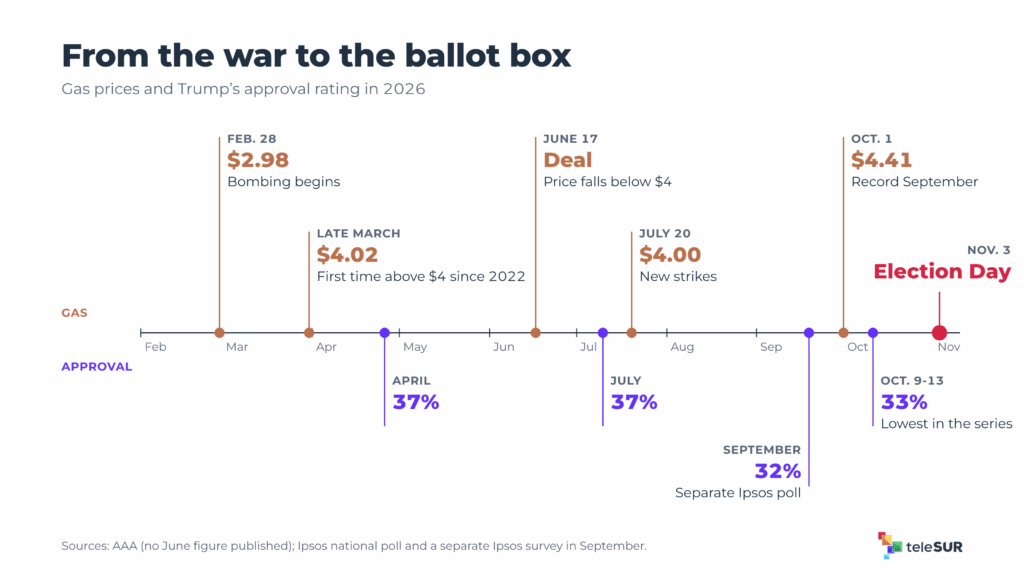
A national poll released Sunday, Oct. 18, and conducted Oct. 9-13, puts his approval rating at 33%, the lowest the series has recorded in either of his terms. Two in three adults disapprove of his performance, 52% strongly, and the same survey had him at 37% in both April and July.
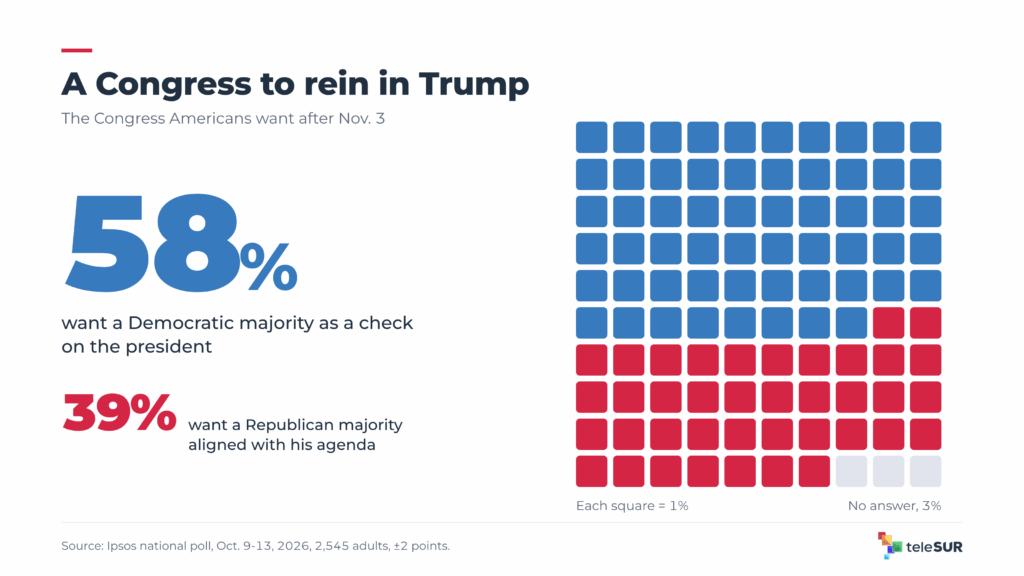
The poll also asked whether the next Congress should act as a check on the president or support his agenda. Fifty-eight percent preferred a Democratic-controlled Congress as a check on him, compared with 39% who want a Republican Congress aligned with the White House, a gap nearly twice as wide as a year ago. Neither party is calling this election a referendum, but the answer brings it close to one.
Almost six out of ten U.S. citizens want the next Congress to counterbalance Trump, a gap that has nearly doubled in one year. Graph: teleSUR
In the race for the House of Representatives, Democrats lead Republicans 52% to 44% among likely voters. Among registered voters the gap holds at eight points; in July it was three.
Between the first bombings on Iran and the election, gasoline soared above 4 dollars and Trump’s approval rating plummeted. Graph: teleSUR
From Hormuz to the Gas Tank
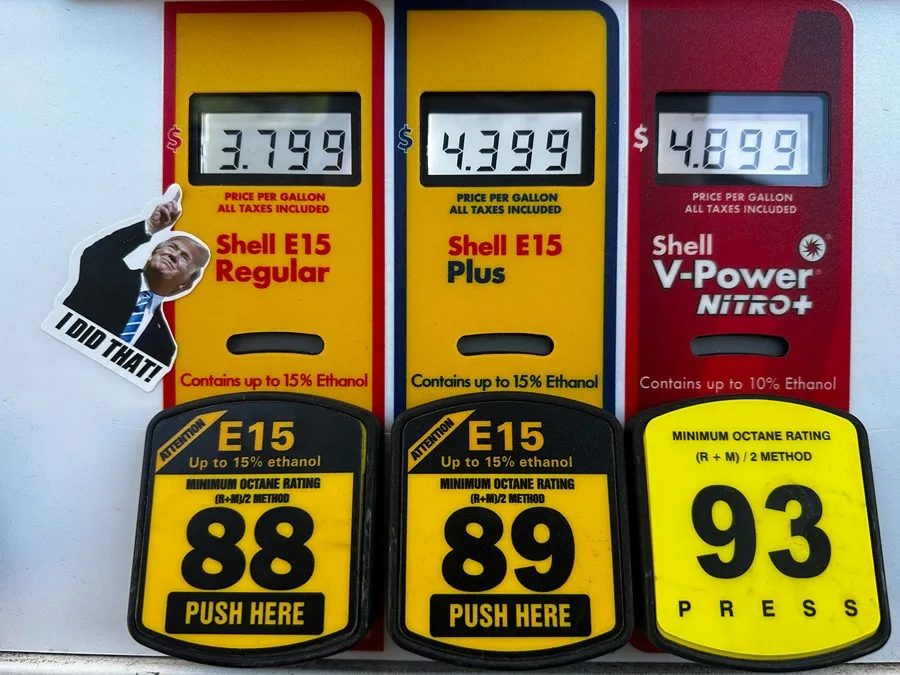
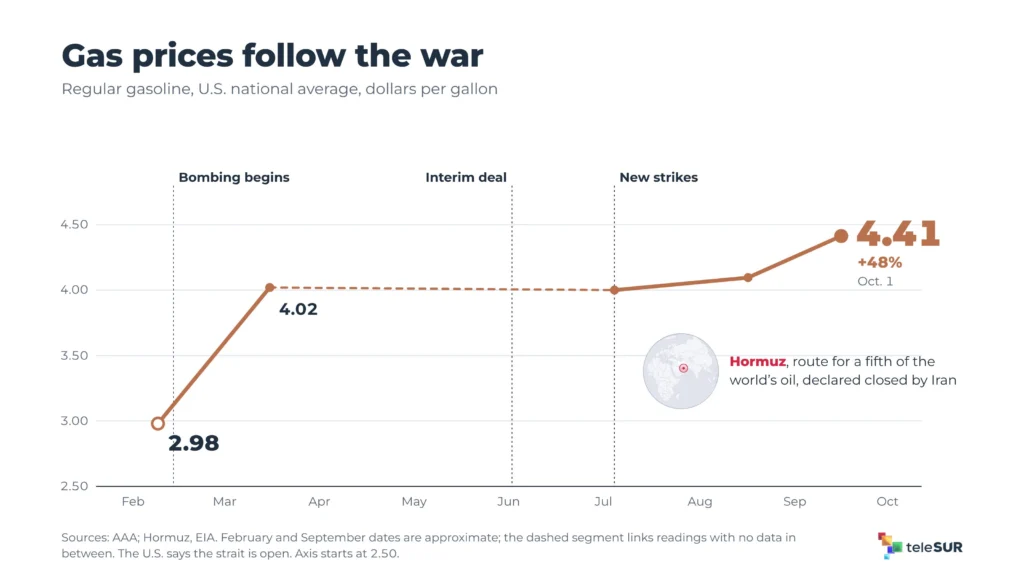
The United States and Israel began bombing Iran in February, when a gallon of regular gasoline cost an average of $2.98, according to AAA. By late March it had topped $4 for the first time since 2022, and each new round of strikes pushed it back up. On Oct. 1, the national average hit $4.41.
At those prices, filling a 15-gallon tank costs about $21 more than before the war.
With Ormuz declared closed by Iran and no oil pipelines capable of replacing it, the gallon rose 48% in the US even with record crude production. Graph: teleSUR
In February, 7 in 10 U.S. citizens considered gasoline affordable. Eight months later, the same share says the opposite.
About a fifth of the oil the world consumes passes through the Strait of Hormuz. According to the official price index for September, consumer prices rose 3.7% over the year, energy 20.4% and gasoline 34.2%, while inflation excluding food and energy stood at 2.6%. Today, 65% of U.S. citizens believe attacking Iran was a mistake.
Tehran declared the strait closed in March and has reaffirmed that stance several times since. In October, Rear Adm. Habibollah Sayyari, chief of staff of Iran’s army, told the official IRNA news agency that the waterway remains closed and that all transit must be coordinated with the armed forces, and he blamed the closure for the rise in U.S. gasoline prices.
Washington says otherwise. On Oct. 7, Secretary of State Marco Rubio said that “the Straits of Hormuz are open,” that as much oil is flowing out now “as there was before this conflict began” and that Iran has “lost complete control of the straits.” Overland routes cannot replace the strait either. Before the war, the EIA estimated that the Saudi and Emirati pipelines that bypass Hormuz had only about 2.6 million barrels a day of spare capacity to divert crude, compared with the 20 million barrels a day that moved through the strait.
Ten days later, Vice President JD Vance revealed another side of the same administration. “I recognize that gas prices are too high right now,” he said Saturday night at a televised town hall. Asked why the war had not ended in a clear victory, he said that “in some ways we have won decisively,” though “the enemy gets a vote.” And he repeated that Iran, “the largest state sponsor of terrorism in the world,” cannot have a nuclear weapon.
On the campaign trail, the fix being sold in Washington points elsewhere. In a poll of 1,000 likely voters taken in early October, four in five agreed that increasing U.S. energy production “can help make everyday life more affordable,” and 67% backed a proposal whose wording already promised the result, “updating federal permitting laws to reduce delays and lower costs.” It is the same reform the oil industry pitches as the key to affordability.
The government’s own energy agency supplies the missing piece. The United States has been the world’s largest crude oil producer since 2018 and is on track for a record of about 13.7 million barrels a day this year, while 84% of the crude that crossed Hormuz was bound for Asia. With output at record highs, gasoline has risen 48% since the bombing began. Crude is priced on a global market, and this year’s price spikes followed the calendar of the war, not the permitting calendar.
The price shock reached much of the world, and Latin American economies that import refined fuels absorbed it without having had any say in the decision to go to war. For those countries, the permitting fight in Washington is a distant concern; the price of their diesel depends on what happens in Hormuz. How much room Washington has to keep waging the war without congressional oversight will also be decided on Nov. 3.
For Latin American families living in the United States, the most visible face of the second term is immigration policy. At the start, half the country approved of it; now about 60% disapprove, and 56% say deportations have gone too far, eight points more than in April 2025. At the same town hall, Vance acknowledged that his rhetoric about immigrants had been “imperfect” and took the blame. “That’s on me,” he said. His goal, he insisted, is not “to dehumanize any immigrant.” “In fact, I love a number of immigrants,” he added.
An Economy Judged by Team Colors
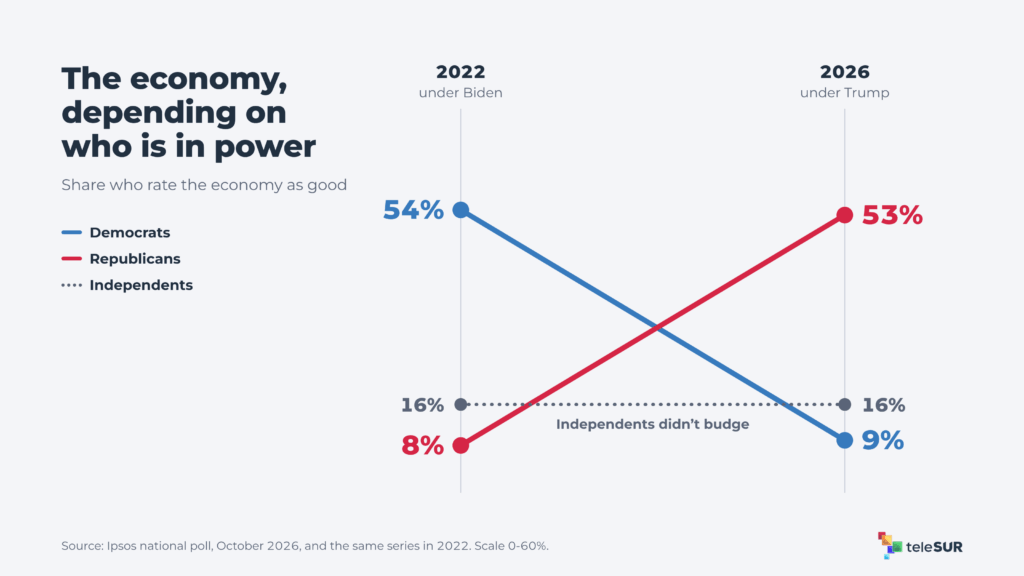
The president’s approval on the economy has fallen to 28%, its lowest mark across his two presidencies. Forty-eight percent feel worse off than when Trump returned to the White House in 2025, the highest share in a series dating back to 1986, and for the first time in more than a decade, registered voters trust Democrats more to handle the economy, 40% to 33%. Before the 2022 midterms, the same series gave Republicans a double-digit edge on the issue.
That year, with Joe Biden in the White House, each party’s verdict on the economy was the mirror image of today’s, almost point for point, and independents stood at 16% in both surveys.
Democrats and Republicans reversed their judgment of the economy by changing government, meanwhile only independents stayed where they were. Graph: teleSUR
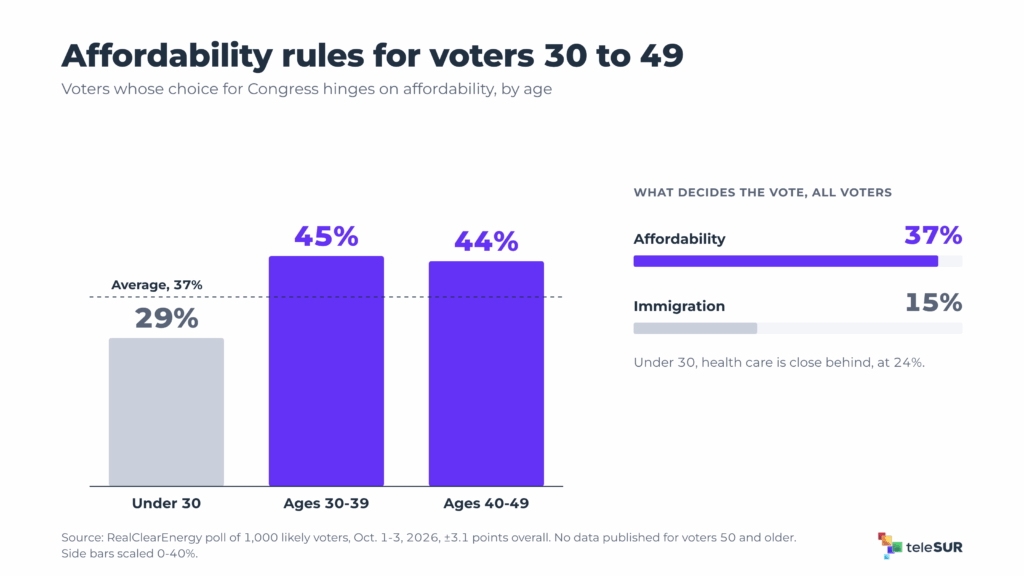
Voters who wear no team colors are moved by their wallets. In the October survey of likely voters, 37% said a candidate’s stance on affordability will decide their vote for Congress, more than double the 15% who put immigration first, an issue central to Trump’s 2024 campaign. That priority is shared by 43% of Democrats, 36% of independents and 32% of Republicans.
Among those who say they are worse off than in 2025, 78% lean toward Democrats, as do 71% of independents in that group.
The Generation that Turned Away Fastest
Millennials, born between 1981 and 1996, are now 30 to 45 years old and make up the largest adult generation in the country. In 2024 they split almost evenly on Trump; exit polls showed voters ages 30 to 44 backing Kamala Harris over him 51% to 47%.
A YouGov poll conducted Aug. 28-31 found 27% approval and 70% disapproval in that age group, the group’s worst showing in the series. Its net rating went from minus 1 in January 2025 to minus 43 in August, a 42-point drop, compared with 30 points nationally.
The Economist makes the opposite case. It argues that millennials have turned their fortunes around and now earn more than any recent generation did at the same age, while narrowing the gap in homeownership. The magazine credits the recovery to markets rather than to a state-funded rescue. October’s polls show what that narrative leaves out.
In the House race, the Pew Research Center found voters ages 30 to 49 favoring the Democratic candidate 43% to 31%, with one in five still undecided.
October’s affordability survey, broken down by age, points in the same direction. Affordability will decide the vote of 45% of voters in their 30s and 44% of those in their 40s, above the 37% average. This is the cohort that entered the job market in the 2008 crisis, pays rent or a mortgage, raises children and fills the tank every day to get to work, and the tank is precisely where prices have climbed the most this year.
The cost of living defines the vote of almost half of voters aged 30-49, above the national average of 37%. Graph: teleSUR
The figures come from surveys with different age brackets and do not prove a single cause. Read together, though, they show the country’s largest generation turning away from Trump faster than everyone else, with the cost of living at the top of its priorities.
Among those who voted for Trump in 2024, 23% now disapprove of his performance and 38% reject his handling of inflation. Most of them still prefer Republicans for Congress, so the erosion does not take the form of a switch to the other party. What they have lost is the certainty that they will vote.
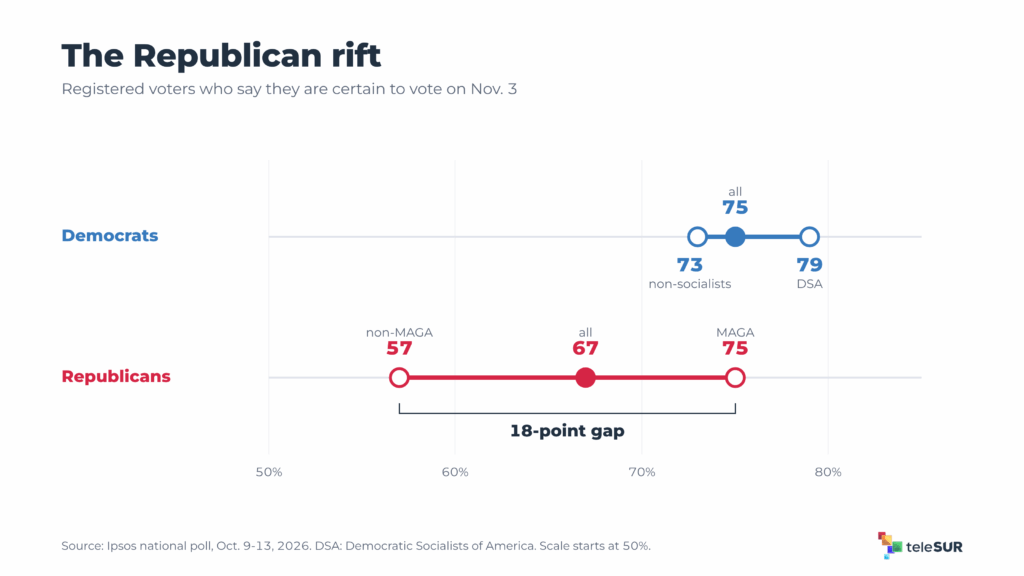
Seventy-five percent of registered Democrats say they are certain to vote, compared with 67% of Republicans. Within the Republican Party, certainty reaches 75% among supporters of the MAGA movement and falls to 57% among those who do not identify with it, and more than a quarter of the latter want Democrats to control the next Congress.
Only 39% of Republicans strongly approve of the president, down from 63% in February 2025.
How many of the 77 million people who voted for Trump in 2024 will return to the polls without his name on the ballot is a question no one can answer yet. Turnout models based on 2022 and 2024 favor Republicans; votes already cast or locked in, by contrast, favor Democrats.
The risk for Republicans is at home. Their MAGA-unaffiliated voters are the least confident of going to the polls. Graph: teleSUR
What is at Stake in the Senate
With the slim House majority Republicans are defending, losing a handful of seats would be enough to hand over control, and presidential approval is among the best predictors of midterm results. Even so, 58% of likely voters who “somewhat” disapprove of Trump still prefer the Republican in their district.
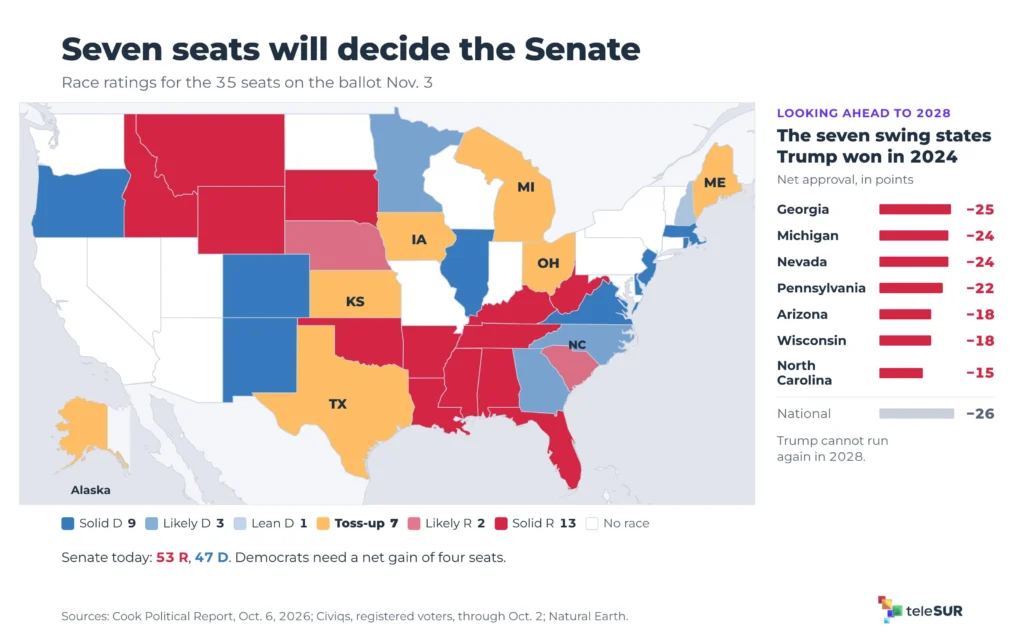
The Senate is split 53-47 in Republicans’ favor, and Democrats need a net gain of four seats to win back the majority. Of the 35 seats on the ballot, seven are rated toss-ups, and six of them — in Alaska, Iowa, Kansas, Maine, Ohio and Texas — are held by Republicans. North Carolina, a Republican seat, is already rated as likely to go Democratic.
The seven states that decided the last presidential election — Arizona, Georgia, Michigan, Nevada, North Carolina, Pennsylvania and Wisconsin — offer an early clue about 2028. Trump carried all seven in 2024, and today his net approval is negative in every one of them, between 15 and 25 points underwater among registered voters, according to the Civiqs tracker. He cannot run in 2028, and those numbers measure a president, not his successor, but they map the terrain his party will inherit.
Six of the seven open Senate races are played in Republican seats, while their approval is now negative in the seven states that gave the White House to Trump in 2024. Graph: teleSUR
On Nov. 3, Trump’s name will still be missing from the ballot. The outcome will depend less on votes that switch parties than on the votes that are never cast, among them those of a generation that split almost evenly on him two years ago and in August disapproved of him by more than two to one.
The Arch and the Gas Pump
On Wednesday, Oct. 14, 20 days before the election, the new Air Force One flew low over the airport in Bullhead City, in the Arizona desert. It is the Boeing 747 that Qatar’s royal family gave Trump, now painted red, white, blue and gold. “When they give you a 747, you say two words, thank you,” he told supporters.
Arizona is one of the swing states that change hands from one presidential election to the next. Joe Biden won it in 2020 by about 10,500 votes, Trump took it back in 2024, and today his approval there is 18 points underwater. The state has no Senate race this year, but it does elect a governor and all nine of its House members. The president chose Mohave County, where he won more than 77% of the vote two years ago, with early voting already a week underway. He went looking for his base, the voters he needs at the polls, not at home.
From the plane he moved on to people who leak military information. “In my opinion, leakers should be shot,” he said, and he called the journalists covering him “almost as bad as a leaker.” He touted the ballroom he is building at the White House and the triumphal arch he plans for the capital. On Iran, whose leaders, he said, “are gone,” he let slip a confession. “I might have gone too far. I don’t know who the hell to deal with.” And he promised that once the war ends,“your gasoline is going to go down to even lower than it was before it started.”
He was addressing a country that fills its tank at wartime prices and pays rents 2.8% higher than a year ago, according to the official price index. Three days later, his vice president admitted on television what the gas pump was already saying. Trump, in Arizona, had preferred to talk about monuments.
The planned arch would stand 76 meters (250 feet) tall, about 26 meters (85 feet) taller than the Arc de Triomphe in Paris, and would rise at the foot of the bridge leading to Arlington National Cemetery, as part of the celebrations for the 250th anniversary of U.S. independence.
Napoleon commissioned the Paris arch in 1806, after his victory at Austerlitz, to honor his armies. Construction dragged on for three decades. When it was inaugurated in 1836, the emperor had been dead in exile for 15 years, and he passed beneath the arch only once, in 1840, inside the coffin that brought his remains back to France.
PHOENIX — Of the litany of campaign promises President Donald Trump made on the trail, few caught on with his supporters the way his promises about immigration did. But when it comes to the president’s targeting of undocumented immigrants, the Latino voters who helped catapult the president to victory in 2024 have noticed that the Department of Homeland Security is not only targeting “the worst of the worst.”
Jesús Cardiel, 73, from Surprise, Arizona, said he typically votes Republican because the party most aligns with his beliefs on abortion. Cardiel believes Trump’s immigration crackdown will cost him with Latino voters in these midterm elections.
“Instead of the promise he made to deport only those who were a threat to the people, he’s even deporting people who are completely innocent, and that’s going to affect us at the polls,” he added.
Many Latinos aren’t inclined to vote for him now that the elections are coming up.”
—Jesús Cardiel
Cardiel’s instinct that the president’s immigration crackdown is far from focused on the “worst of the worst,” as the administration likes to describe those it’s rounding up, is borne out by the numbers.
The Deportation Data Project, a joint research venture from UCLA and UC Berkeley, found that as of July 2026, 73.5% of those arrested and booked by Immigration and Customs Enforcement had no criminal convictions. Of the others, 24.8% had been convicted of a nonviolent crime, while only 1.6% of those arrests involved undocumented immigrants convicted of a violent crime, according to the analysis.
But talk to Trump’s MAGA base — like those who waited hours for him to speak at a rally in Bullhead City, Arizona, last Wednesday — and many of them remain smitten with the way ICE raids have been going.
Trump rally in Arizona.MS NOW
“They’re doing what they need to do,” said Deanne McCarter, 64, a three-time Trump voter from Lake Havasu City, who attended Trump’s rally in Arizona last week. Asked whether she believes ICE has been too aggressive after shooting undocumented immigrants in Austin, Texas, and New York City in recent months, McCarter was convinced they weren’t.
FAFO”
—Deanne McCarter
“FAFO,” said the Trump superfan, using an abbreviation with an expletive that means “[mess] around, find out.” “I mean, I’m sorry, but that’s the way that it is.”
Peggy Miller, a retired nurse and three-time Trump voter from Bullhead City, also expressed no qualms about ICE shooting people in the streets.
It is unfortunate that people are in the wrong place where they should not be.”
—Peggy Miller
“It is unfortunate that people are in the wrong place where they should not be,” said Miller, 67.
“They should not have been doing what they were doing,” she added.
Miller and McCarter’s approval of Trump’s approach to immigration reflects broader trends.
But that enthusiasm has disappeared when it comes to the president’s support among the Latino community, which went for the president in historic numbers in 2024.
According to a new NBC News/Telemundo poll from earlier this month, Trump has a 27% approval rate among Latino voters. And 69% of those surveyed disapprove of his handling of immigration.
Unai Cutino is a 45-year-old HVAC employee who voted for Trump in each of the last three presidential elections. Now, he’s got buyer’s remorse.
“I regret it. I had so much hope that he promised so many things, and there’s nothing to show for it,” said Cutino, who is from Phoenix. He said the immigration crackdown, which has swept through Arizona’s capital in recent months, has been “very aggressive.”
This presidency always benefits the powerful, and the poor are left behind.”
—Unai Cutino
“This presidency always benefits the powerful, and the poor are left behind,” Cutino said.
“Many Latinos aren’t inclined to vote for him now that the elections are coming up,” Cardiel warned.
And yet, when asking Trump’s MAGA whether the president is making good on his promise to deport the “worst of the worst,” the MAGA faithful are convinced.
“We see that they’re criminals. I don’t see any other innocent people getting [deported] contrary to what the media, the mainstream media, is trying to make it look like,” McCarter said.
“The left are screaming and kicking, so he must be doing something right,” she added.
Israel continues to imprison her without charge or trial. Her lawyers have not been able to visit her. Her prolonged solitary confinement is a violation of international standards – Supporters ask the Red Cross to urgently intervene
Senate Minority Leader Chuck Schumer (D-N.Y.) on Monday called on the Federal Communications Commission (FCC) to reject a petition from a conservative political group to ease restrictions on AI-generated robocalls ahead of November’s midterm elections. “Under this change, campaigns could use their opponents’ voice to send out a message that is, at best, disingenuous and,…
EU ministers have discussed how to make labour standards compatible with modern technological conditions and workplace culture, such as telework and AI-led staff oversight, without losing competitiveness.
The law in question, called the Quality Jobs Act, covers a wide range of work protection measures, such as common standards for being able to ‘go home’ and disconnect from remote work, and limits to AI role in recruitment or its scrutiny of workers’ performance.
Technological innovation should “benefit both workers and businesses,” said Portuguese labour minister Maria do Rosário Palma Ramalho, addressing the ministers’ council on Monday (19 October) in Luxembourg.
Human oversight is essential, especially where AI systems decide on recruitment or workers’ assessment, she said.
Next to innovation, labour rules needed to ensure “fair and transparent practices, respect for human workers’ rights … and effective social dialog,” said Roxana Mînzatu, the EU commissioner for employment.
“This revolutionary technology has to be regulated” so that it “delivers for all,” Isabelle Schömann, the European Trade Union Confederation (ETUC) deputy general secretary had also said during a conference organised by the centre-left S&D group in the European Parliament on 14 October, commenting on the need for the Quality Jobs Act to curb AI.
The draft Quality Jobs Act that the European Commission plans to present in December aims to update the long out of date 1989 and 1990 health and safety workplace rules.
It would also protect subcontractors and create standards for working in heatwaves, becoming more frequent with climate change.
EU legislators need to ensure minimum standards so that “neither jobs nor businesses are jeopardised” with extreme weather, Yolanda Díaz Pérez, the Spanish labour minister, said ahead of Monday’s debate.
This article continues, but the full version is available only to EUobserver.com subscribers. Visit account.euobserver.com/membership
Spain’s Left has now missed its last chance to unite ahead of the country’s snap election on 29 November — a historic failure, not so much because the numbers don’t add up, but because it fails to offer an alternative.
The elections are seen as pivotal, with a real chance that the far-right Vox will enter the government for the first time since Spain’s return to democracy in 1978, in a coalition with the centre-right People’s Party (PP), which itself is expected to fall short of an absolute majority.
With that possibility on the horizon, the Spanish parties to the left of the PSOE (Spanish Socialist Workers’ Party), led by PM Pedro Sánchez, tried to agree on a nationwide joint list for the 29 November snap election.
But they failed because of a “war of egos”, as one political leader described it, and old grudges dating back to 2023. This has left many disillusioned and the left even more divided.
“These past few days have been very difficult … some people will be disappointed today, and for that I am sorry,” Ada Colau, former Barcelona mayor and leader of the Broad Front, said last week, as her alliance failed to reach an agreement on a joint electoral platform ahead of the election.
Spain’s electoral system disadvantages smaller parties, especially in less populated provinces. That means their votes are less likely to translate into seats.
In Spain, a country where a two-party system was the norm until 2015, it is puzzling that the “new” left, born precisely to break that duopoly, has ended up too divided to even compete with the mainstream.
So what’s the picture? On one side, the right is more aligned than ever: the PP and Vox are running separately, but the conservative party openly says it is willing to strike a deal with the far-right if needed. Liberalism is almost non-existent, even though Democracia 21 will run for the first time, but only in Madrid and Barcelona. And the left is divided.
War of egos
This article continues, but the full version is available only to EUobserver.com subscribers. Visit account.euobserver.com/membership
For six years, Marina Lacerda was known publicly only as “Minor Victim 1,” the name federal prosecutors gave her in their 2019 sex-trafficking indictment of Jeffrey Epstein. Last year, she stepped out from behind it on Capitol Hill, joining fellow survivors in demanding that the government release the Epstein files.
Now, just over a year later, Lacerda is the central figure in a new political ad against Sen. Roger Marshall, R-Kan., who once voted against forcing the files into public view. It launches online Monday and hits Kansas TV on Tuesday.
Hers is one of three new ads featuring Epstein survivors. In another, Jena-Lisa Jones takes aim at Sen. Cindy Hyde-Smith, R-Miss. Lacerda also appears in the third, which targets Sen. Ashley Moody, R-Fla., which is expected to air Wednesday.
The ads mark the first time Epstein survivors themselves have campaigned in a congressional race. The family of one survivor got there first: Sky and Amanda Roberts, the brother and sister-in-law of the late Virginia Giuffre, recently appeared in an ad opposing their own congressman, Colorado Republican Rep. Jeff Crank, who they say refused to meet with them.
The new ads are sponsored by New Deal for All, a political action committee registered just this month and launched by Steve Pajcic, a Florida lawyer and former Democratic state legislator. Pajcic and his children “are spending at least $7 million for a blitz of ads in Florida, Kansas, Mississippi and South Carolina,” The New York Times reported last week in a profile of him.
To date, the PAC has spent roughly $4.55 million on ads and ad reservations through Election Day, according to AdImpact data reviewed by MS NOW. A Democratic strategist close to the project who was granted anonymity to discuss internal plans told MS NOW that the group had put roughly $2 million behind the Epstein-related ads targeting Marshall, Hyde-Smith and Moody, at least to start.
In the Kansas ad, Lacerda says she was 13 when she first met Epstein and was abused by him. “I expected our leaders to listen to our stories and hold our abusers accountable,” she says as a photo of Marshall appears alongside text faulting him for voting to block the release of the Epstein files.
The ad also features audio of Marshall saying, “It’s just not of much interest to me right now.” MS NOW was not able to independently verify the origin of the audio or whether he was referring to the Epstein files, but it appeared to come from footage by KSN, a Kansas NBC affiliate.
In the Mississippi spot, Jones, who says she was also in her early teens when Epstein first abused her, accuses Hyde-Smith of “voting to protect the sex trafficker who abused me.”
Looking directly into the camera, she says, “I want true change. I want our children to be safe.” Then, as a photo of Hyde-Smith appears: “If you vote for pedophiles, it’s time for Mississippi to pick a new senator.”
Both ads center on the same vote. In September 2025, Senate Minority Leader Chuck Schumer tried to attach the Epstein Files Transparency Act, legislation requiring the Justice Department to release its files on Epstein, to the annual defense policy bill. Marshall and Hyde-Smith were among 51 Republicans who voted to table the amendment, effectively killing it. Two months later, after the bill passed the House nearly unanimously, the Senate approved it by unanimous consent. That means no senator objected, but also that there was no recorded vote.
In response to a request for comment, a representative for Hyde-Smith pushed back on the ad’s depiction of the senator.
“Sen. Hyde-Smith has consistently stood with victims of human trafficking. As the lead co-sponsor of the bipartisan Trafficking Survivors Relief Act, signed into law in January 2026, she helped ensure survivors can clear nonviolent federal offenses they were forced to commit by their traffickers and have a real opportunity to rebuild their lives,” said Jake Monssen, Hyde-Smith’s campaign manager. “This ad is nothing more than partisan propaganda paid for by people aligned with George Soros and national Democrats.”
Representatives for Marshall and Moody did not immediately respond to requests for comment. A representative for Crank previously told The New York Times that “it is deeply unfortunate that Washington lobbyist Jessica Killin is preying on a grieving family with the help of the Washington Democrats.” (Killin is Crank’s opponent in the Colorado race.)
Lacerda, who became a U.S. citizen in her 20s, and Jones both told MS NOW that they are registered to vote in Florida. Both also said that until the past year, neither was particularly invested in, or knowledgeable about, national politics or Congress. Jones said she is a registered Republican.
Asked earlier this month whether they too would be getting involved in upcoming congressional races, several other Epstein survivors demurred.
One, Shauntae Smith, said that for her, “It’s not a political issue; it’s a human rights issue. It doesn’t matter if you’re a Democrat or a Republican. It matters whether or not you agree with child rape and child trafficking, that’s the problem.”
Yet when pressed on why they decided their voices were needed in Kansas and Mississippi, Lacerda and Jones gave reasons for entering the fray that echoed Smith’s rationale for staying out of it.
“If you can’t stand with us, then you are not willing to protect us or our future kids,” Lacerda said.
Jones agreed, stating that no matter which side of the aisle a member sits on, “Anyone who isn’t behind protecting our children or future generations I want no part of.”
CORRECTION (OCt. 19, 2026 at 2:33 p.m.): An earlier version of this newsletter misidentified the state Rep. Crank is from. He represents Colorado, not Texas.
Ads launching this week feature survivors taking aim at Republican senators in Kansas and Mississippi, part of a multimillion-dollar red-state blitz by a newly formed PAC.
European Union ministers have adopted a new recommendation calling for stronger measures to prevent homelessness and housing exclusion, as governments face increasing pressure over housing shortages and the cost of accommodation.
The recommendation was approved at a meeting of employment and social affairs ministers in Luxembourg on Monday, 19 October, and forms part of the European Commission’s wider efforts to address Europe’s housing crisis.
It proposes measures ranging from early intervention for households facing eviction to increased investment in affordable housing, improved access to social services and more coordinated support for people without permanent accommodation.
However, the recommendation is not legally binding. Member States will retain responsibility for deciding which measures to introduce, how they should be financed and the extent to which existing national housing policies should be changed.
More than one million people affected
According to the Council’s announcement, more than one million people are estimated to experience homelessness across the European Union.
The problem extends beyond people sleeping on streets or using emergency shelters.
The term housing exclusion also encompasses households living in inadequate accommodation, people facing imminent eviction and those unable to secure stable housing because of financial or personal circumstances.
The Council identifies poverty, unemployment, domestic violence, disability, poor health and insufficient affordable housing among the factors contributing to the problem.
Housing costs have also risen considerably faster than incomes in several European countries.
Between 2013 and 2024, nominal house prices increased by more than 60 per cent across the EU. In some Member States, average increases exceeded 220 per cent during the same period.
These developments have placed additional pressure on households with lower incomes, particularly in cities where rental accommodation is increasingly expensive and social housing is limited.
The shortage affects not only unemployed people but also individuals in paid employment whose earnings are insufficient to cover market rents.
Prevention before eviction
A central element of the new recommendation is the introduction or strengthening of national strategies intended to prevent homelessness before people lose their accommodation.
The Council encourages Member States to establish early-warning mechanisms capable of identifying households experiencing serious financial or housing difficulties.
Proposed interventions include debt counselling, emergency rental assistance, mediation between landlords and tenants, and appropriate safeguards against forced eviction.
The emphasis on prevention reflects the potentially substantial social and financial consequences of losing stable accommodation.
Once a person becomes homeless, obtaining employment, maintaining healthcare arrangements and securing permanent accommodation can become considerably more difficult.
The Council also calls for particular attention to children, young people leaving care and people facing domestic abuse.
Member States are encouraged to ensure that children have access to adequate housing and that young people leaving institutional or foster care are not placed at risk of homelessness because appropriate support arrangements are unavailable.
Greater emphasis on permanent housing
The recommendation promotes a housing-led approach, under which securing suitable and stable accommodation becomes a central element of the response to homelessness.
This differs from policies relying primarily on emergency shelters or temporary accommodation, although such facilities remain necessary for people facing immediate housing difficulties.
Housing-led programmes can include permanent accommodation accompanied by individual support services, depending on the person’s circumstances.
The Council also proposes simplifying access to social and healthcare services through integrated arrangements that allow people to obtain assistance without repeatedly approaching different public authorities.
One suggested model involves providing access to relevant services through a single contact point, with support from social workers, healthcare professionals and other organisations.
However, access to permanent housing ultimately depends on the availability of suitable properties.
The recommendation therefore calls for increased public and private investment in affordable and social housing, renovation of existing accommodation and support for non-profit housing models.
Questions over implementation and funding
The non-binding character of the recommendation remains one of its principal limitations.
European institutions can coordinate policies, provide guidance and support investment, but national governments and local authorities retain substantial responsibility for housing provision and social welfare arrangements.
The recommendation does not automatically establish a new EU housing entitlement or provide dedicated funding to every Member State.
Its effectiveness will depend on whether governments introduce measures capable of increasing housing supply and reducing the number of people entering homelessness.
The European Federation of National Organisations Working with the Homeless, known as FEANTSA, previously welcomed the Commission’s proposal while identifying shortcomings.
In its assessment of the original proposal, the organisation argued that EU policy should place greater emphasis on permanently ending homelessness rather than primarily managing housing exclusion.
It also questioned the adequacy of funding arrangements and the proposed five-year interval for national progress reporting.
Five-year assessment planned
Under the adopted recommendation, Member States are encouraged to provide the European Commission with information on the effectiveness of their national strategies every five years.
The Commission is expected to evaluate national progress and report to the Council five years after the recommendation’s adoption.
The policy follows the European Affordable Housing Plan, presented in December 2025, and the EU’s Anti-Poverty Strategy, introduced in May 2026.
Together, these initiatives seek to expand the Union’s role in coordinating housing policy without transferring national housing responsibilities to Brussels.
The first indication of whether the recommendation will produce measurable results will come from national decisions on social housing investment, eviction prevention and access to permanent accommodation. Without changes to those practical arrangements, the Council’s commitments will remain principally a framework for voluntary cooperation.
Belgium’s three regions have reached an agreement with the European Commission to strengthen measures against water pollution, improve wastewater treatment and increase protection against floods and droughts.
The joint statement, signed in Leuven on Monday, 19th October, sets out commitments for Flanders, Wallonia and the Brussels-Capital Region, including action on industrial pollution, pesticides and persistent chemicals such as per- and polyfluoroalkyl substances, commonly known as PFAS.
The agreement was signed by European Commissioner for Environment, Water Resilience and a Competitive Circular Economy Jessika Roswall, Flemish Environment Minister Jo Brouns, Walloon Environment Minister Yves Coppieters and Brussels State Secretary Ans Persoons.
According to the European Commission’s announcement, the agreement follows a detailed examination of Belgium’s implementation of European water legislation and identifies measures requiring greater attention from regional authorities.
European Commission seeks faster implementation
Belgium is the second EU Member State to complete a structured dialogue under a Commission initiative launched in November 2025.
The process is intended to improve implementation of existing environmental requirements rather than establish an entirely new legislative framework.
European water legislation already obliges Member States to assess the condition of their rivers and groundwater, control pollution and prepare management plans intended to improve water quality.
However, achieving the objectives of the EU’s Water Framework Directive remains difficult in several countries, particularly where pollution, agricultural activity and urban development place competing demands on water resources.
Belgium presents additional administrative complications because responsibility for environmental policy and water management is divided principally between three regional governments.
Watercourses also cross regional and international boundaries, requiring cooperation with neighbouring countries.
The Commission’s review examined Belgium’s third generation of river basin management plans and its second generation of flood risk management plans.
Technical discussions identified areas where implementation could be accelerated, particularly regarding pollution controls, water efficiency and coordination between public authorities.
Flanders to address industrial pollution
Under the agreement, Flanders will prioritise investment in water resilience and stronger action against industrial pollution.
The region intends to use its IMPULSE programme to support improvements in water management and pollution reduction.
Industrial discharges are among the issues specifically identified for closer scrutiny.
The joint statement calls for more systematic reviews of permits governing water abstraction and industrial wastewater discharges, particularly where existing activities place pressure on rivers and groundwater.
The agreement also highlights the need to tackle persistent chemical pollution.
PFAS have become a significant environmental concern because many of these substances degrade extremely slowly and can accumulate in water, soil and living organisms.
Certain PFAS compounds have been associated with adverse health effects, although the risks depend on the individual chemical, exposure level and duration.
The Commission’s commitments include stronger action on PFAS and pesticides, alongside improvements in monitoring and pollution prevention.
Agricultural pollution is another area requiring attention.
Fertilisers and pesticides can enter rivers and groundwater through runoff or infiltration, creating difficulties for water treatment and contributing to the deterioration of aquatic ecosystems.
The three regions have agreed to strengthen cooperation with farmers, retailers and researchers to support more sustainable agricultural practices, including expanding markets for organic products.
€300 million for river restoration in Wallonia
Wallonia has committed to continuing investment in river restoration and improved water resilience, with particular attention to the Vesdre basin.
The region intends to use a €300 million loan secured from the European Investment Bank in 2025 to support restoration work.
The Vesdre basin experienced severe flooding in July 2021, when widespread destruction across eastern Belgium exposed weaknesses in flood protection and the management of vulnerable river valleys.
Restoration measures can include improving river channels, reconnecting floodplains and using natural systems to retain water during periods of heavy rainfall.
The regional authorities also intend to support industrial companies investing in water-efficient production technologies and environmental innovation.
These measures are intended to reduce pressure on water resources while helping businesses adapt to changing environmental requirements.
Wallonia has additionally committed to supporting cleaner agricultural practices, consistent with the wider national objective of reducing pollution from fertilisers and pesticides.
Brussels focuses on wastewater treatment
The Brussels-Capital Region will concentrate on improving water governance and wastewater treatment.
Urban wastewater infrastructure is particularly important in densely populated areas, where drainage networks and treatment facilities must accommodate domestic sewage, commercial activity and rainfall.
Heavy precipitation can place additional pressure on combined sewer systems, potentially increasing the risk of untreated or insufficiently treated wastewater entering natural watercourses.
Improving treatment capacity and water management requires investment in infrastructure, monitoring and coordination between the authorities responsible for sanitation and environmental protection.
The Brussels commitments therefore form part of the wider European effort to modernise urban wastewater systems and improve the ecological condition of rivers passing through major cities.
Cross-border water management
The agreement also identifies the need for closer cooperation in the Scheldt and Meuse river basins.
Both river systems cross national boundaries, making their management dependent on coordination between Belgium and neighbouring countries.
Regional governments have committed to supporting the restoration of floodplains and the removal of barriers affecting shared watercourses where appropriate.
The measures are intended to improve the condition of aquatic ecosystems while strengthening natural protection against floods and droughts.
The Commission will support Belgium through initiatives under the European Water Resilience Strategy, including research, digital technologies, technical expertise and assistance in mobilising public and private investment.
However, the joint statement signed in Leuven does not itself establish a new binding regulatory regime or guarantee that all the investments identified will be financed.
Its importance will depend on whether the three regional governments translate their commitments into funded projects, revised permits and measurable improvements in water quality.
For the European Commission, Belgium’s agreement is also part of a wider programme of structured discussions with Member States on compliance with EU water legislation. Further national dialogues are expected as Brussels seeks to improve implementation across the Union.
California Attorney General Rob Bonta castigated the Trump administration for threatening local election officials, telling MS NOW’s Jacob Soboroff that the federal government is “trying to bully and frighten and intimidate” public servants ahead of the midterm elections.
Late last week, the Justice Department warned Los Angeles County officials that they could face prosecution if they process or tabulate a ballot from someone the federal government suspects is a noncitizen, according to a letter obtained by MS NOW.
The warning came after the administration sued California, seeking to block the state from counting mail ballots from people it has identified as “likely” noncitizens until their citizenship can be verified. The lawsuit alleges that more than 20,000 people who may be noncitizens are registered to vote in California.
Bonta said the officials targeted by the administration are public servants working to count votes accurately and protect Californians’ right to vote.
“Here you have the federal government, with bluster and intimidation and bullying, trying to scare them into disenfranchising voters, and it’s wrong,” he said Sunday.
The attorney general called the administration’s claims about widespread voter fraud baseless, saying audits, recounts and court cases have found no evidence of it. While ineligible voting should be prosecuted, he said, the administration is using isolated cases to attack states and disenfranchise voters.
“There are one-offs, at times, when some human beings try to or have violated the election laws, like a Republican in Orange County who tried to register her dog,” he said. “And should that person get prosecuted? Yes, they should, and we do not think any ineligible voter should vote. But what is happening here is the Trump administration is attacking states, usually blue states or swing states, that they want to pick a fight with.”
Bonta said the attacks on California are part of a wider effort by the administration to sow doubt about the country’s elections before the midterms.
“They’re desperate. It’s embarrassing for them. They’re in the death throes of this election cycle, staring down a blue wave where they’re going to get thrashed, and they are planning for what they do after they get thrashed,” he told MS NOW. “This is their contingency plan.”
Bonta said California would stand firm in its “commitment to accurate, fair, reliable, secure elections” and keep fighting the administration.
“We will meet the federal government in court,” he said.
You can watch Bonta’s full interview in the clip at the top of the page.
Registrations of fully electric cars across 17 European markets increased by 70.3 per cent in September, according to industry figures published on Monday, 19 October, as France and Germany seek to ease the European Union’s emissions requirements for new vehicles.
The data show that 300,202 battery-electric cars were registered during the month, accounting for 32.6 per cent of new passenger-car registrations in the markets surveyed.
The figures emerge three days after Paris and Berlin announced a joint position on the future of Europe’s automotive industry, proposing greater flexibility in the EU’s 2035 emissions regime while introducing measures intended to favour vehicles manufactured in Europe.
Electric vehicles gain market share
The latest figures, compiled by E-Mobility Europe, New Automotive and Fier Automotive, indicate that electric vehicle demand accelerated sharply during September.
According to the industry data published on 19 October, approximately 1.98 million battery-electric cars have been registered across the 17 markets during the first nine months of 2026, an increase of 38.1 per cent compared with the equivalent period last year.
Higher oil prices, government incentives and the introduction of more affordable electric models have all contributed to demand.
The figures represent a substantial change in the composition of European new-car sales, although they cover selected markets rather than constituting a complete statistical account of the EU’s 27 Member States.
France recorded 65,243 battery-electric registrations in September, representing 41.7 per cent of its new-car market. Germany registered 88,724 electric vehicles, giving the technology a market share of 34.6 per cent.
Both countries have substantial automotive manufacturing industries and are directly involved in negotiations over Europe’s future emissions legislation.
Significant differences between European markets
Despite the overall increase, electric vehicle adoption remains uneven across the continent.
Norway retained its position as Europe’s most electrified new-car market, with battery-electric vehicles accounting for 98.8 per cent of registrations in September.
Denmark followed with 88.8 per cent, while Finland recorded 62.7 per cent and Sweden 49 per cent.
Electric models also accounted for approximately half of new-car registrations in Belgium, the Netherlands, Ireland and Portugal.
At the other end of the market, battery-electric vehicles represented only 11.2 per cent of registrations in the Czech Republic, 7.6 per cent in Italy and 6.2 per cent in Poland.
These differences illustrate the difficulty of establishing a uniform European transition timetable.
Household incomes, purchase incentives, vehicle prices and charging infrastructure differ substantially between countries. The availability of affordable electric cars is particularly important in markets where buyers are more sensitive to the initial purchase price.
The varying national figures also complicate the EU’s industrial calculations, since manufacturers must operate across markets progressing at different rates.
France and Germany reach automotive compromise
On 16 October, French President Emmanuel Macron and German Chancellor Friedrich Merz agreed on a joint approach to changes in European automotive regulations.
Under the proposed compromise, car manufacturers would be required to reduce carbon dioxide emissions from new vehicles by 90 per cent by 2035 compared with the 2021 reference level.
The agreement would also remove a proposed requirement to compensate for the remaining emissions through measures such as the use of low-carbon steel.
The change would create additional opportunities for manufacturers to continue selling vehicles powered by combustion engines beyond 2035, subject to the final legislative framework.
In their joint declaration on the automotive industry’s future, the French and German governments argued that emissions reduction must be combined with industrial competitiveness, investment and European manufacturing capacity.
The agreement also envisages preferential treatment for vehicles produced in Europe under certain public procurement and subsidy arrangements.
Britain could potentially benefit from provisions allowing selected European partners to qualify under the proposed industrial framework.
The Franco-German understanding is not, however, a final EU legislative decision. Changes to the regulatory regime require agreement through the relevant European legislative procedures.
Automotive competitiveness enters the debate
The principal argument advanced by supporters of greater regulatory flexibility is that European manufacturers need additional time to adapt production, protect employment and compete with international rivals.
German manufacturers retain extensive investment in combustion-engine and hybrid technology, while French producers have placed considerable emphasis on electric vehicles and maintaining European supply chains.
The negotiations therefore concern more than emissions limits. They also involve battery production, access to raw materials, manufacturing costs and the ability of European companies to compete with producers in China and other markets.
Supporters of the existing transition timetable argue that weakening long-term requirements could discourage investment in electric manufacturing capacity just as consumer demand is increasing.
Manufacturers seeking greater flexibility maintain that regulatory targets must account for uneven market conditions and the cost of developing new technologies.
September’s sales figures provide evidence that electric vehicle adoption is accelerating, but they do not establish whether the same rate of growth will continue without existing incentives.
The debate now centres on whether regulatory relaxation will preserve Europe’s automotive industry during the transition or slow investment in the technology that is already capturing an increasing share of the market.
The European Parliament is preparing to vote on amendments to the as Brussels seeks to reduce its dependence on foreign suppliers of minerals essential for defence equipment, electric vehicles, advanced electronics and industrial production.
The proposals, scheduled for debate in Strasbourg on Monday, 19 October, and a vote on Tuesday, would strengthen coordination over strategic supplies and revise the responsibilities of European companies that depend on vulnerable international supply chains.
At the centre of the discussions is a proposal to establish a European Critical Raw Materials Centre, which would coordinate purchasing arrangements, assess supply risks and support the development of strategic reserves.
The initiative comes amid increasing concern over China’s dominant position in the processing and supply of several materials regarded as indispensable to European industry.
Parliament considers stronger European coordination
According to the European Parliament’s October plenary briefing, the proposed Critical Raw Materials Centre would operate as an EU body responsible for several functions currently distributed between European institutions and national authorities.
These would include identifying vulnerabilities in supply chains, conducting risk assessments, coordinating contingency stocks and supporting joint purchasing arrangements.
The objective is to give European governments and manufacturers greater capacity to respond to interruptions in supplies of minerals and processed materials that cannot easily be replaced.
The legislative report has been prepared by the Parliament’s Committee on Industry, Research and Energy, with Dutch Social Democrat MEP Mohammed Chahim serving as rapporteur.
The committee examined amendments to the existing legislation during 2026, with its revised report submitted for plenary consideration on 9th October.
Tuesday’s vote is intended to establish Parliament’s position for negotiations with the Council. It would not, by itself, constitute final adoption of the amended regulation.
China’s position creates supply risks
The European Union depends heavily on imported critical raw materials, particularly those required for batteries, permanent magnets, semiconductors and specialist industrial equipment.
China occupies a particularly important position in the refining and processing of rare earth elements, graphite and several other materials used in high-technology manufacturing.
The concentration of production creates vulnerabilities because disruption at a single stage of processing can affect manufacturers operating across multiple European countries.
These substances are used in applications extending well beyond electric vehicles.
Permanent magnets are required for certain electric motors, wind turbines and defence systems, while other critical materials are used in radar, satellites, aircraft components and advanced electronic equipment.
Restrictions affecting their availability can therefore have consequences for European industrial output, defence procurement and the development of new technology.
The question for EU policymakers is not simply whether minerals can be obtained, but whether Europe has sufficient alternative sources and processing capacity to withstand restrictions imposed by a dominant supplier.
Existing targets remain difficult to achieve
The Critical Raw Materials Act entered into force in May 2024 and established benchmarks intended to strengthen European production and diversify imports by 2030.
Under the existing framework, the EU aims to develop extraction capacity equivalent to at least 10 per cent of its annual consumption of strategic raw materials, where geological reserves allow.
The corresponding benchmarks are 40 per cent for processing and 25 per cent for recycling.
The legislation also seeks to prevent any single non-EU country from supplying more than 65 per cent of the Union’s annual consumption of a particular strategic raw material at any relevant processing stage.
These are policy benchmarks rather than binding production quotas imposed on individual companies.
Their achievement depends on the development of mines, processing facilities and recycling operations, as well as the ability to attract investment.
New extraction projects frequently require lengthy environmental assessments, infrastructure development and extensive capital investment. Processing operations face additional challenges involving energy costs, technical expertise and commercial competitiveness.
Consequently, reducing import dependence involves more than identifying mineral deposits within European territory.
Greater obligations for manufacturers
The proposed amendments also address the responsibilities of major European companies using strategic raw materials.
Under provisions examined by the parliamentary committee, the European Commission would take a greater role in identifying large manufacturers whose operations depend on strategically important supplies.
These companies could face requirements to assess vulnerabilities in their supply chains, including the geographical location of extraction and processing operations and the ownership of relevant facilities.
The arrangements would be particularly significant for businesses producing batteries, aircraft, drones, satellites, advanced chips and other products considered strategically important.
Where significant risks are identified, companies could be expected to consider measures including diversification, improved material efficiency or maintaining stocks.
The proposals also seek to strengthen recycling and the recovery of valuable materials from existing products, reducing the quantity of newly extracted resources required by European industry.
Recycling alone cannot remove the need for imports, particularly where demand for new technologies is increasing, but it can provide an additional source of supply.
Supply security becomes an industrial priority
The legislation forms part of a wider effort to link European industrial policy with economic security.
Brussels has been seeking additional raw materials partnerships with third countries, while manufacturers remain concerned about the commercial cost of building alternative supply chains.
Recent EU discussions concerning cooperation with Vietnam illustrate the emphasis being placed on securing alternative access to minerals such as tungsten and rare earth elements.
However, diversifying supplies does not necessarily mean transferring extraction and processing to Europe. Partnerships with reliable external producers may remain essential, particularly for materials unavailable in sufficient quantities within the Union.
The proposed European centre would therefore have to balance internal production, international purchasing, strategic stocks and commercial demand.
The immediate legislative issue is whether the revised framework gives European institutions sufficient powers to coordinate these activities without placing disproportionate administrative obligations on businesses.
Tuesday’s parliamentary vote will determine the negotiating position MEPs take into discussions with EU governments over how those responsibilities should be distributed.
It was about a month ago when MS NOW reported on a Russian disinformation campaign targeting the U.S. midterm elections, featuring doctored selfie videos of Hollywood celebrities. The project — one of the first documented Kremlin-backed operations of this year’s election cycle — was specifically designed to undermine support for Democrats and to boost Republicans.
With only about two weeks remaining before Election Day, the efforts are apparently intensifying. Bloomberg News reported:
Russian disinformation operators are deploying an army of bots to inflate view counts of fictitious posts about celebrities and Democratic candidates ahead of the US midterm elections.
AI-fabricated video clips of well-known actors and musicians — including Robert De Niro, Julia Roberts and Cher — attacking Democrats began appearing on X in early September, some urging people to join a campaign dubbed #AllDemocratsAreCriminals. Scores of other clips have made false allegations of corruption and improprieties by Democratic candidates.
A related report in The New York Times noted that “an online influence operation backed by the Russian government has been stepping up its attempts to sow division in the United States.” The report added that the project has targeted Democrats “with negative content,” becoming “the latest effort by Russia to harm the party and support President Trump.”
It’s an important detail, not just because Russian President Vladimir Putin’s regime appears desperate to help Republicans, but also because of the familiarity of the circumstances.
In 2020, Russia targeted U.S. elections. In fact, intelligence officials told Congress about evidence that showed Russia was interfering in the 2020 campaign for the express purpose of trying to secure a second term for Trump.
In 2022, Russia targeted U.S. elections. In fact, The Wall Street Journal reported a few years ago, “The Russian government and its proxies attempted to denigrate the Democratic Party and undermine voter confidence ahead of the 2022 midterm elections.”
In 2024, Russia again targeted U.S. elections, specifically in the hopes of electing Republicans who would oppose American military aid to Ukraine.
And in 2026, it’s happening once again.
In each instance, Moscow wasn’t simply trying to sow chaos. As this unsubtle pattern unfolded, Russian operations specifically tried to help one party (Republicans) and hurt the other (Democrats).
Two year ago, Jake Sullivan, the White House national security adviser, appeared on NBC News’ “Meet the Press” and said that there’s “plenty of reason to be concerned” about Russia trying to interfere in another American election.
Sullivan added, “[T]his is not about politics. This is about national security. It is about a foreign country — a foreign adversary — seeking to manipulate the politics and democracy of the United States of America.”
Two years later, the current White House national security adviser, Secretary of State Marco Rubio, has invested far less time and effort into denouncing the Kremlin’s operations, and congressional Republicans tend to have effectively nothing to say about Russian intervention.
For its latest report, the Times spoke to a senior researcher at Graphika, a threat analysis company, who said the Russian tactics “give us a glimpse of what their objectives are,” adding, “They’re not targeting Republican candidates in the same way.”
Today’s installment of campaign-related news items from across the country.
* With just two weeks remaining in the election cycle and early voting underway in much of the country, the latest Washington Post/ABC News/Ipsos survey offered Donald Trump another round of bad news: The president’s approval rating has reached a record low of 33% in this poll. But for Republicans, that’s not necessarily the worst part.
The same results included a generic congressional ballot and found Democrats with an eight-point advantage over the GOP, 52% to 44%. As recently as July, the same outlet showed Democrats with a three-point edge.
This dovetailed with the latest NBC News/SurveyMonkey poll, which showed Democrats with a 10-point lead over Republicans on the generic ballot, 55% to 45%.
* Artificial intelligence-generated campaign advertising has become an intensifying problem in this year’s election cycle, but it’s not altogether a bipartisan problem: A New York Times analysis found that more than 80% of the ads created by AI “were produced by Republican campaigns or Republican-aligned political action committees.”
* In Ohio’s closely watched statewide races, the latest Bowling Green State University poll found former Democratic Sen. Sherrod Brown leading incumbent Republican Sen. Jon Husted, 48% to 42%. A month ago, the same pollster showed Brown ahead by three points.
As for the state’s gubernatorial race, the same survey data found Amy Acton, the Democratic nominee, leading Vivek Ramaswamy by the same six-point margin, 50% to 44%.
* In Nevada, retiring Republican Rep. Mark Amodei continues to tear into his own party’s would-be successor. The outgoing congressman reiterated over the weekend that he would “absolutely not” vote for David Flippo in Nevada’s 2nd Congressional District, adding that, as far as Amodei is concerned, his seat is “at risk” for flipping from red to blue.
* In Massachusetts, Shawn Oliver, the Republicans’ lieutenant governor nominee, suspended his candidacy over the weekend. One day earlier, he was arrested for allegedly driving under the influence and striking five parked cars. According to local police, Oliver also allegedly flipped his own car during the incident.
* House Speaker Mike Johnson said during an interview over the weekend that independent news organizations are secretly conspiring with independent polling firms to release deceptive survey data as part of a plot to “discourage” GOP voters. The Louisiana Republican did not appear to be kidding.
* The president held a campaign rally in Georgia late last week, where he insisted that Democratic Sen. Jon Ossoff was “never elected” despite his 2020 victory. Trump added that the results were fraudulent, an absurd claim for which he offered no evidence.
* Though the U.S. Senate race in Mississippi continues to look like a real reach for Democrats, Democratic Sen. Raphael Warnock is doing his best to rally support for local prosecutor Scott Colom in his race against incumbent Republican Sen. Cindy Hyde-Smith.
* And in Maryland, where Republican Rep. Andy Harris threatened to have a student journalist arrested last week for recording him at a public Q&A, the far-right congressman was offered an opportunity late last week to apologize for his bizarre antics. Harris refused.

 Login