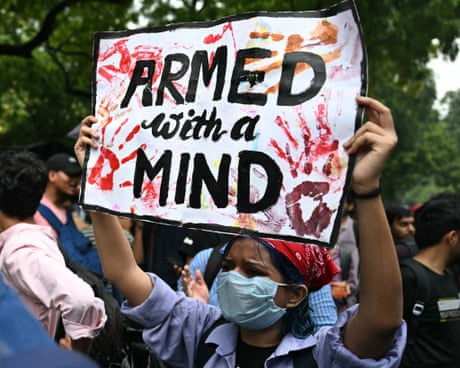
“Bismillah, c’est les ténèbres” has appeared on signs at recent demonstrations. It doesn’t make much sense (it means, “In the name of God, it’s the darkness”) but is seen as shorthand for a generational divide.
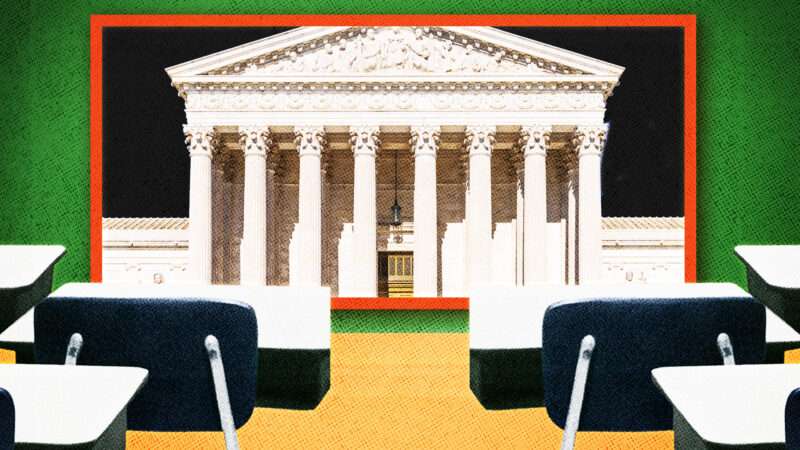
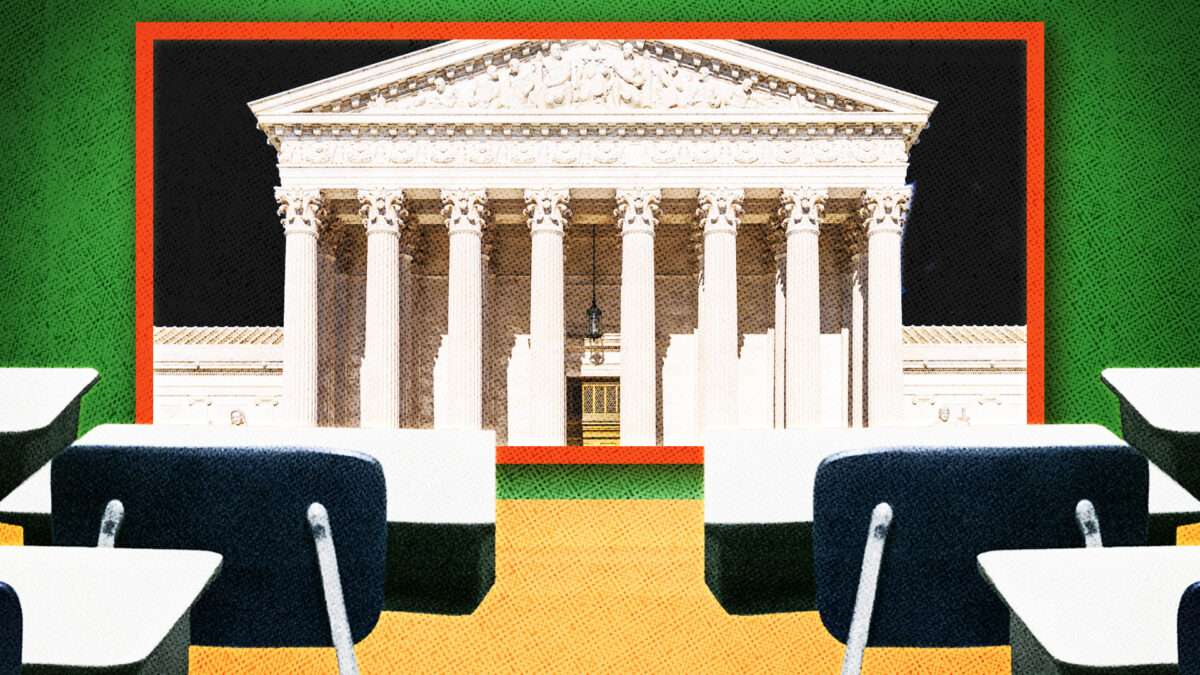
On Monday, the Supreme Court agreed to hearAssociation for Education Fairness v. Montgomery County Board of Education. The case, which was originally brought forth in 2020 by the Association for Education Fairness (AFEF), a coalition of Montgomery County, Maryland, parents, alleges that Montgomery County's selection process for magnet programs (gifted programs for STEM and humanities studies in middle schools) violates the Constitution'sEqual Protection Clause by discriminating against Asian American students. The county insists that the selection process is race-neutral.
Montgomery County changed its selection process in the 2021–22 school year. According to reporting from The New York Times, the county was facing pressure from community groups, including the NAACP and Citizens Assisting and Sheltering the Abused (CASA Inc.), over the underrepresentation of black and Latino students in its magnet programs. Previously, students were selected based on test scores and grades. The new process implemented a lottery system in which high-achieving students are placed in a selection pool and selected at random.
The AFEF's central complaint is that the new system factors school poverty levels into the criteria for pool eligibility. This means students' eligibility depends on their scores relative to students in similarly affluent or disadvantaged schools, rather than the general population. They argue that since Asian Americans are concentrated in high-performing, lower-poverty schools, they have to clear a higher bar to become eligible. The group alleges the new system has caused fewer Asian American students to be admitted into magnet schools, a claim that is backed up by admissions data (which also show that the share of Asian American applications has fallen). The AFEF alsocites Montgomery County's 2015 hiring of Metis, a national consulting firm, to recommend ways to make the system more "equitable" as an indication of the county's effort to "racially balance" its magnet programs.
The complaint was dismissed by U.S. District Judge Paula Xinis in 2022, whoruled that the parents hadn't shown the policy disproportionately harmed Asian American students, citing the fact that they made up a larger share of admitted students than of the applicant pool. Xinis drew a distinction between accounting for economic disparities, which she called "wholly permissible," and racial discrimination. "Alleged disparity in treatment based on socioeconomic status alone does not make plausible discrimination on account of race," she wrote in the ruling. The tension raised by Xinis sits at the center of many debates regarding diversity, equity, and inclusion, as factors like poverty levels can often become a proxy for race; therefore, policies that are neutral on their face can still disparately impact a certain race.
In February, the 4th Circuit Court of Appealsupheld the dismissal, ruling that precedent from the Coalition for TJ v. Fairfax County School Board (2023) requires parents to show the policy disproportionately harmed Asian American applicants, which they hadn't. However, there is a real legal question as to whether racial groups should have to prove they were harmed as a group, as opposed to the individual, and lower courts have given mixed answers.
The Pacific Legal Foundation (PLF), a public-interest law firm representing the AFEF, litigated asimilar case in New York City, where the city implemented an economic need index in its admissions process for competitive high schools, aimed at increasing the number of black and Hispanic students. Again, parents alleged that the requirement discriminated against Asian American students. In 2024, the 2nd Circuit Court of Appeals found that if the city intended to discriminate, the parents don't have to prove Asian Americans were harmed as a group and that harm to an individual was enough for the case to move forward. The case was sent back to the district court to determine whether the city intended to discriminate, where it remains pending.
The Supreme Court will now settle the issue anddetermine "whether a plaintiff challenging a facially neutral admissions policy as racially discriminatory must establish that the targeted racial group suffered an aggregate disparate impact relative to its share of the applicant pool," according to SCOTUSBlog.
In a statement on Monday, PLF Senior Attorney Chris Kieser said, "The Constitution protects students as individuals, not as members of a racial group. A school district should not be able to defeat a discrimination claim by showing that its policy did not harm enough Asian American children. Every family deserves admissions rules that judge their child on their own merit."
The author argues that Congress must amend the Department of Education's 'Do No Harm' test before 2028 to prevent the closure of essential vocational and service-oriented certificate programs that promote entrepreneurship and work-life balance.
The removal of asbestos from the former Cascais secondary school has resumed, but continues to face criticism. Cascais City Council says it complies with all safety rules when removing this
Hello and welcome to another edition of Free Agent! Be careful when you're behind the wheel this week.
College football is great! Surely you want even more of it, right? We'll get into the problems with a 24-team College Football Playoff (CFP), then talk about the NBA's new betting restrictions, and close with thoughts about President Donald Trump's new government golf course plans. And just in case you don't make it to the end, here's a shortcut to our survey on who you're rooting for in the World Series.
But first, many congratulations to "Gary's 1st Entry" on outlasting everyone else in our NFL Survivor group. There's no prize other than this shoutout, so be sure to print out today's newsletter, highlight this paragraph, and frame it in gold. Perhaps Gary can keep going and challenge Primetime Paulie Rothrock's 13-game winning streak from last season.
Locker Room Links
Both teams in the WNBA Finals left the court for the National Anthem—unclear if this was a protest or just part of the pregame routine. WNBA policy doesn't require teams to be on the court for the anthem, but does require a "dignified posture" if they are.
In the thick of a playoff race, three Zambian women's soccer players are separated from their National Women's Soccer League teams because they played in Uganda, and the Centers for Disease Control and Prevention has a three-week restriction on reentry due to Ebola. (There are zero active Ebola cases in Uganda and Zambia.)
This is the kind of excessively nerdy fantasy football content I live for. (Yahoo remains the best fantasy sports system. ESPN's is trash, relying on name recognition to get by.)
I figured out how ESPN calculates fantasy football win percentage, it's bad!
ESPN made a stats 101 error when calculating their win percentage which leads to horribly miscalibrated numbers. ( thread) pic.twitter.com/bDypgjelKj
Saturday was one of the best days of college football ever—or perhaps it could have been, if we thought any of the five top-10 teams who took a loss were now certainly out of playoff contention. Instead, Georgia, Notre Dame, Indiana, Alabama, and Texas are all still very much alive in the championship hunt.
Today was one of the craziest days in college football history:
- First time ever five teams ranked in the top 7 lose in a single week - First time the No. 1-ranked team loses to an unranked team in consecutive weeks since 1990 - First time Texas, Alabama, and Georgia all lose… pic.twitter.com/psVRoM5s5b
With two losses, Alabama and Texas are at least on the edge of the playoff bubble with perhaps no more room for error. But that's only true under this year's CFP format. Next year, the playoff is almost officially set to balloon to 24 teams, making the chaos of a day like Saturday matter even less.
Fans will always celebrate a huge upset or major rivalry win, of course—Tennessee fans don't need playoff stakes as an excuse to get drunk when they beat Alabama. But the joy of a rivalry win in the past was always bigger because of the off-field stakes, too—the first loss for your rival meant they probably wouldn't be national champions, the second meant they'd be out of the Rose Bowl, a third meant you could be proud your team sent them packing for the Alamo Bowl. Winning is great; ruining your rival's season is even better.
With 24 teams in the playoff, the joy is a bit diminished because it will take four or possibly five losses to knock a powerhouse program out of the CFP (Iowa, at 8–4, was ranked 23rd by the committee before last year's playoffs). It'll be a bit like a rivalry win in college basketball—we win, you suck, congrats on getting a slightly worse NCAA Tournament seed.
In the business of sports, more inventory for TV is king, and the powers that be think more teams playing more playoff games will make more money. At Free Agent, we don't begrudge institutions for trying to make more money—we all do the same every day. But it's not clear abandoning conference championship games will be the answer, especially when the Big Ten and SEC championships apparently outdraw many playoff games.
ESPN and the power conferences know fans aren't happy about it—just look at allthechatteronline, and how the crowd at BYU reacted when College GameDay discussed expansion on Saturday (especially when BYU would probably benefit from expansion!). They're betting enough people will watch to make the expansion profitable anyway. The last hope is that fans get loud enough to bully them into abandoning expansion—which only occasionally works, sometimes on things small (putting the trophy logo on the court for the NBA Finals) and large (soccer's European Super League). If any powerhouse considers going independent, that might shock leaders into a rethink too.
Almost every sport I know is adding more: more teams, bigger playoffs, more for TV. As fans, we still eat it up, of course—much to the excitement of the TV executives who are selling commercial time to the people trying to reach us, the viewing public. (The only counterexample is the MLB proposal to cut eight games from the regular season—I'd love to see each sport I follow cut its season by about 25 percent to make regular season games matter more, so I'm interested to see how this goes.)
Perhaps I'm biased because my favorite team, Michigan State, is a dumpster fire—they could expand the playoff to 64 teams and the Spartans still wouldn't deserve a bid. I personally don't have a whole lot at stake in the playoff format now or anytime soon. But as a neutral, the chaos of Saturday might have been viewed with my full attention in the past—instead, this year I just had it on in the background while I played video games.
Sports Are Regulating Bets Without Politicians, Part 3
After last year's major betting scandal, the NBA asked sportsbooks late last week to stop offering certain types of potentially problematic bets. The sportsbooks, which the NBA says handle roughly 99 percent of the U.S. betting market, agreed. No politician or regulation was necessary to solve the problem.
No longer can bettors bet on unders for a bit player who likely won't get more than 12 minutes of playtime. Bettors also can't wager on the opening tip or on players to miss specific shots. Parlays that string together under bets on the same player's statistics are also out (this one seems a bit harsh—if you just want to bet on a certain major player to have an off night, you can bet on stats separately, but not in a big multiplier parlay). Bets on players who have two-way contracts between the NBA and G League were already banned.
This all comes on the heels of similar developments last year in the NFL and MLB. While some people want to ban prop bets altogether, the NFL asked sportsbooks to eliminate bets in four different categories. Sportsbooks largely agreed or weren't offering those bets anyway. MLB, in light of some pitching-related scandals, asked for a $200 limit on pitch-specific bets and to keep them out of parlays—sportsbooks agreed to that too.
As I wrote last year, "Ideally, this is how the regulation of the sports betting industry should go….These approaches are catching the nuances of what works for both the leagues and for sportsbooks without the heavy-handed approaches of politicians who would use an axe to ban all prop bets instead of a scalpel to limit problematic bets."
It's important to note leagues are able to do this because they have commercial partnerships with the sportsbooks. Otherwise, the leagues would have no direct leverage over a sportsbook offering a bet the league doesn't like. Keep that in mind the next time you see people bemoaning a league partnership with a sportsbook or a prediction market.
Trump's Golf Course Plans Have People Teed Off
President Donald Trump has new plans for the National Park Service golf course at East Potomac—again. Last time new plans were announced, the site plan still had its historic miniature golf course, a par-3 course, and the existing road still ringing the property for bicycling, running, etc. Much of the public didn't like that plan anyway—now, none of that remains in the latest plans, just 18 holes of golf and a driving range.
What's really going on here seems quite clear to me: Like so many other things going on in the second Trump administration, this is a scheme to enrich the Trump family. The plan?
Step 2: Use taxpayer dollars to pay for renovation of the course into, allegedly, a championship-level course capable of hosting major golf tournaments (no matter that the area has next to zero parking, is a mile from the nearest Metro station, and only accessible by narrow roads not meant to handle tens of thousands of spectators).
Step 3: Have the federal government sign a sweetheart deal with, who else, the golf division of the Trump Organization to operate the course on extremely favorable and profitable terms.
If you're wondering why the Trump administration is doing something, corruption is usually a good guess.
The arguments for the course don't make much sense. There are plenty of adequate, competitively priced golf courses in the broader Washington, D.C., area. Several of them are already capable of hosting professional golf tournaments. Between LIV Golf and the PGA Tour, there were three tournaments at three different courses in the last couple years. The 2030 PGA Championship and 2037 Ryder Cup will happen just over the D.C. line in Bethesda, Maryland.
East Potomac is not the nicest course around, no thanks to the legal limbo it's been in for the past year. But if the National Park Service is going to, for some reason, be in the business of running a golf course, it should be a course that emphasizes and teaches its history instead of the pipe dream of a corrupt madman.
Who Ya Got? 2026 World Series Edition
For the first time in 46 years, we've got a World Series contested by two teams that have never won it before. Brewers against Rays is also a rare instance of the top seeds from each league outlasting the randomness of the MLB playoffs to make the World Series. And before you trot out the tired line that "TV executives must be seething about the small market teams" remember that they care much more about getting a playoff series that goes seven games with close results in each game (What did I say above? Inventory rules all!).
The University of North Carolina at Chapel Hill (UNC) has reached an agreement with the Trump administration to close 19 federal investigations into the school over alleged concerns of antisemitism and race discrimination. In the deal, UNC admits to no wrongdoing and pays no money to the administration but agrees to standards the Trump administration…
After a protest clip went viral, a teenager’s life was torn apart by threats that sent her and her family into hiding. Plus, a book on citizen journalism
Before 24 July, a person I will call R was preoccupied with the ordinary routines of teenage life: experimenting with makeup,grumbling over mathematics homeworkand hanging out with friends at a tea stall.
That month, as the fever of student protests spread across the country, the 15-year-old watched on her phone as young people poured into Jantar Mantar, the designated protest site in Delhi, demanding education reform. She went too. But an 11-second video clip from the protest site, in which she made crude and profane remarks about the prime minister, Narendra Modi, upended her life.
Today, the Supreme Court decided to hear Association for Education Fairness v. Montgomery County Board of Education, a challenge to "facially neutral" discrimination against Asian applicants to selective public magnet schools in Montgomery County, Maryland. The admissions criteria are, on their face, racially neutral. But evidence indicates they were likely adopted for the purpose of reducing the percentage of Asian students in entering classes. More specifically, the case addresses the issue of "[w]hether a plaintiff challenging a facially neutral admissions policy as racially discriminatory must establish that the targeted racial group suffered an aggregate disparate impact relative to its share of the applicant pool." This issue is increasingly important since the Supreme Court banned most explicit racial discrimination in college admissions (and, by extension, school admissions) in SFFA v. Harvard (2023).
The lower court ruled that, even if there is evidence that a facially neutral admissions policy was enacted for the specific purpose of reducing the number of admitted students from a specific racial or ethnic group, it must still be upheld so long as the percentage of admitted students from that group is as high or higher than the percentage of applicants from that group.
Longstanding Supreme Court precedent holds that evidence of unconstitutional motivation for "facially neutral" policies shifts the burden of proof to the government to show that they would have enacted the same policy even in the absence of illicit motives. If they fail to prove that, then the policy must be subjected to strict scrutiny, which it would be unlikely to survive. In the TJ case, the Fourth Circuit majority opinion by Judge Robert Bruce King holds that even the most blatant discriminatory motivations do not trigger strict scrutiny so long as the group being targeted for discrimination by "facially neutral" means is still represented in proportion to its percentage of the relevant population (or more). Under the new admissions policy, Asians were still 54% of accepted applicants (as compared to 73% under the old one). Since that is still higher than the Asian percentage of the applicant pool, evidence of discriminatory intent becomes irrelevant….
I and others have previously compared today's anti-Asian discrimination in selective educational institutions to discrimination against Jewish applicants in earlier eras. Under the Fourth Circuit's reasoning, old-time policies using facially neutral means to reduce the percentage of Jewish students at elite universities would be perfectly legal, so long as Jewish applicants were admitted in the same [or higher] percentages as other groups. And that would be true no matter how extensive the evidence that the new policy was motivated by anti-Semitic prejudices, or that Jewish applicants had to have stronger academic records to be admitted than those required of gentiles.
The same point applies to all kinds of discrimination against racial, ethnic, and religious minorities. So long as facially neutral means are used and the overall success rates of different groups are similar, this reasoning would allow even the most blatant discriminatorily motivated policies intended to reduce the participation of some groups for the benefit of others. There are many situations where members of some minority groups are "overrepresented" in educational institutions, government contracting, and elsewhere, relative to their percentage of the applicant pool or of the general population. Jews, Muslims, Asians, atheists, and Mormons are obvious examples of groups that fit that bill in a variety of educational and professional settings.
If a federal or state government adopted a seemingly neutral policy to try to reduce the percentage of blacks among professional football or basketball players, that too would pass muster, so long as the percentage of blacks in the the relevant pro sports leagues remained at least as high as the percentage of blacks among those seeking employment as players…. Progressives and others inclined to support today's decision should consider whether they are really willing to live with these troubling implications.
Since I wrote the above, the ideological valence of anti-Asian discrimination in education has shifted somewhat. For a long time, many left-wingers defended such discrimination (along with discrimination against white applicants) on the grounds that it is necessary to achieve "diversity" and compensate Blacks and Hispanics for the history of discrimination against those groups. Most conservatives condemned it because it violates principles of constitutional color-blindness.
During the second Trump Administration, however, right-wing nativists have increasingly defended discrimination against Asian immigrants on such ridiculous grounds as that they work too hard (thus making it too difficult for whites to compete with them), or even that they undermine the supposed value of racial "homogeneity." The political right actually has a long history of anti-Asian bigotry. But recently the problem has gotten much worse, after a period in which it was diminishing because conservatives (rightly) condemned such discrimination as a violation of color-blindness. The growing anti-Asian bigotry among right-wing nationalists is similar to and linked with their growing tendency towards anti-Semitism. Indeed, as many commentators have pointed out, the two prejudices are similar in many respects. Both Asians and Jews are condemned for supposedly working too hard, emphasizing academics too much relative to other activities, and supposedly dominating various business and intellectual fields.
The left-wing rationales for anti-Asian discrimination are little better than the right-wing ones. If you truly value diversity, it makes no sense to disfavor Asian applicants as a class. They add as much or more to diversity as any others. Indeed, as I have pointed out before, lumping all Asians in one category makes no sense, as this group includes a vast range of different ethnicities and cultures, covering more than half the world's population.
The compensatory justice rationale for anti-Asian discrimination collapses under the weight of the fact that many Asian groups have themselves faced extensive discrimination at various times in American history. Discrimination against Chinese and Japanese by federal and state governments has a long and sordid history, of which Japanese internment during World War II is just one particularly awful example.
It is important to recognize that "facially neutral" policies adopted for the specific purpose of excluding particular racial or ethnic groups differ from those that merely have an unintended disparate impact. The former are deliberate efforts to discriminate on the basis of race, whereas the latter are probably inevitable in a diverse society where groups differ from each other in various ways. For example, laws banning violent crime disproportionately affect any group which is, on average, younger than others, since young people (especially young men) have much higher crime rates than older ones.
The Constitution at least presumptively bars racial discrimination by government, whether motivated by left-wing objectives or right-wing ones. And such discrimination is forbidden even if cloaked in "facially neutral" garb. Otherwise, the government could easily discriminate against virtually any group simply by targeting some characteristic that correlates with group membership. Hopefully, the Supreme Court will recognize that and rule the right way in this case.
NOTE: The plaintiffs in this case are represented by the Pacific Legal Foundation, a public interest group that was my wife's employer until recently. As noted above, she helped represent the plaintiffs in a previous case (also litigated by PLF), on which the lower court ruling in this case was based. She is not one of the attorneys in this case, and is no longer with PLF.
Mahmoud Khalil, the Columbia University demonstrator who became a flash point in the Trump administration’s crackdown on pro-Palestinian foreign college students, asked the Supreme Court on Monday to take up his case, his lawyers said. Khalil was jailed for months last year, and he has long asserted his detention was retaliation for his protected speech. The…
The whereabouts of Amelia Earhart’s plane remain a mystery after a team of archaeologists and filmmakers failed to locate the pilot’s Model 10E Electra aircraft on a remote, uninhabited atoll in the Western Pacific.
Teachers will launch a 24-hour strike across Greece on Wednesday, October 21, protesting against staff shortages in schools, issues within educational infrastructure, excessive class sizes, and persistent inadequacies regarding school facilities in many parts of the country. The teachers will be supported in their strike by pupils and university students as well as left-wing parties, […]
Portugal has submitted a proposal to China for an agreement on the mutual recognition of academic qualifications, which Beijing has agreed to consider, the Minister for Education, Science and Innovation,
Some graduated from the US Naval Academy or smaller private schools, but 42 of the 100 US senators came from 10 prominent universities, according to biographies on theUS Senate website.
The senators on this list are alums of the schools' undergraduate, graduate, doctoral, law, or medical programs, and some have graduated from multiple of the listed universities. Honorary degrees and schools a senator attended without graduating were excluded.
Here's a look at which US colleges have produced the most current senators.
Brigham Young University
BYU had a 70.2% acceptance rate for its current freshman class.
George Frey/Bloomberg via Getty Images
Senators: Mike Crapo (R-ID), Mike Lee (R-UT), and John Curtis (R-UT).
Sen. Crapo graduated from BYU in Utah with a bachelor's degree in political science, as did Sen. Lee.
Sen. Curtis earned a bachelor's degree in business management.
Duke University
DURHAM, NC - OCTOBER 26: A general view of the Duke University Chapel on campus of Duke University on October 26, 2013 in Durham, North Carolina. (Photo by Lance King/Getty Images)
Lance King/Getty Images
Senators: Angela Alsobrooks (D-MD), Shelley Moore Capito (R-WV), Rand Paul (R-KY).
Sen. Alsobrooks studied public policy, Sen. Moore Capito studied zoology, and Sen. Paul received a medical degree.
Princeton University
Student walk along the campus of Princeton University in Princeton, New Jersey. (Photo by Rick Friedman/Corbis via Getty Images)
Rick Friedman/Corbis via Getty Images
Senators: Ted Cruz (R-TX), Dave McCormick (R-PA), Jeff Merkley (D-OR).
Princeton is an Ivy League university.
Sen. Cruz earned a bachelor's degree in public policy, Sen. McCormick earned a Ph.D. in international relations, and Sen. Merkley earned a master's degree in public affairs.
Dartmouth College
Baker-Berry Library on the campus of Dartmouth College in Hanover, New Hampshire, U.S., on Sunday, Oct. 17, 2021. Dartmouth Colleges endowment returned 47% in the fiscal year that ended in June, the latest university to post some of the strongest investment gains in decades.
Bloomberg/Getty Images
Senators: Angus King (I-ME), Tina Smith (D-MN), John Hoeven (R-ND), and Kirsten Gillibrand (D-NY).
Dartmouth is the smallest Ivy League school by undergraduate enrollment.
Sen. King earned a bachelor's degree in government, Sen. Hoeven earned a bachelor's degree in economics, and Sen. Smith earned an MBA from the university's Tuck School of Business.
Sen. Gillibrand graduated with a bachelor's degree in Asian studies.
University of Chicago
Cobb Gate at the University of Chicago campus in Chicago, Illinois, US, on Tuesday May 27, 2025. Chicago universities produce legions of science and technology workers, and the city is poised to benefit from growth of nascent industries such as quantum computing. Photographer: Christopher Dilts/Bloomberg via Getty Images
Bloomberg/Getty Images
Senators: Bernie Sanders (I-VT), Andy Kim (D-NJ), Amy Klobuchar (D-MN), Pete Ricketts (R-NE), Todd Young (R-IN).
The University of Chicago's five Senate alums span the political spectrum, from independent Sen. Bernie Sanders to Republican Sen. Pete Ricketts.
Both Sen. Sanders and Sen. Kim earned a bachelor's degree in political science.
Sen. Ricketts graduated with both a bachelor's degree in biology and an MBA. Sen. Young also earned an MBA, while Sen. Klobuchar earned a law degree.
University of Virginia
CHARLOTTESVILLE, VA - MARCH 01: An aerial view of the central grounds on campus at the University of Virginia on March 1, 2013 in Charlottesville, Virginia. (Photo by Lance King/Getty Images)
Lance King/Getty Images
Senators: Shelley Moore Capito (R-WV), John Cornyn (R-TX), John Kennedy (R-LA), Angus King (I-ME), Sheldon Whitehouse (D-RI).
Founded by Thomas Jefferson in 1819, the University of Virginia has a graduate-heavy Senate alum base: Sen. Cornyn, Sen. Kennedy, Sen. King, and Sen. Whitehouse earned law degrees there.
Sen. Moore Capito earned a master's degree in education.
Stanford University
PALO ALTO, CA - SEPTEMBER 26: A general view of the campus of Stanford University including Hoover Tower as seen from Stanford Stadium on the day of the ACC college football game between the Stanford Cardinal and the Georgia Tech Yellow Jackets on September 26, 2026 at Stanford Stadium in Palo Alto, California. (Photo by David Madison/Getty Images)
David Madison/Getty Images
Senators: Cory Booker (D-NJ), Josh Hawley (R-MO), Jeff Merkley (D-OR), Adam Schiff (D-CA), Tina Smith (D-MN), Ron Wyden (D-OR).
Sen. Booker, Sen. Schiff, and Sen. Smith all earned bachelor's degrees in political science. Sen. Booker also earned a master's in sociology.
Sen. Hawley earned a bachelor's in history, and Sen. Merkley earned a bachelor's in international relations.
Georgetown University
WASHINGTON, D.C., July 8, 2020 -- Photo taken on July 7, 2020 shows the Healy Hall on Georgetown University's main campus in Washington, D.C., the United States. U.S. President Donald Trump said on Tuesday the White House will push state governors hard to get schools opened in the fall despite a spike in coronavirus cases in the country. (Photo by Liu Jie/Xinhua via Getty) (Xinhua/Liu Jie via Getty Images)
Xinhua/Liu Jie via Getty Images
Senators: John Barrasso (R-WY), Jon Ossoff (D-GA), Dick Durbin (D-IL), Mazie Hirono (D-HI), Lisa Murkowski (R-AK), Dan Sullivan (R-AK), Chris Van Hollen (D-MD).
Georgetown University's appeal is partly due to its location in the nation's capital.
Four of its seven Senate alums earned law degrees: Sen. Durbin, Sen. Hirono, Sen. Sullivan, and Sen. Van Hollen.
Sen. Barrasso, meanwhile, earned a medical degree from Georgetown's School of Medicine.
Yale University
Yale University's Cross Campus looking towards Sterling Library. New Haven, Connecticut. Fall, 2013.
Kathryn Donohew Photography/Getty Images
Senators: Michael Bennet (D-CO), Richard Blumenthal (D-CT), Cory Booker (D-NJ), Chris Coons (D-DE), Josh Hawley (R-MO), Amy Klobuchar (D-MN), Sheldon Whitehouse (D-RI).
Five of Yale's seven Senate alums earned law degrees from the university: Sen. Bennet, Sen. Blumenthal, Sen. Booker, Sen. Coons, and Sen. Hawley. Sen. Coons also earned a master's degree in religion.
Sen. Klobuchar earned a bachelor's degree in political science, while Sen. Whitehouse earned a bachelor's degree in architecture.
Cambridge, MA - October 9: The campus of Harvard University is seen behind the John Weeks Bridge from the Charles River on October 9, 2025. (Photo by Jessica Rinaldi/The Boston Globe via Getty Images)
Jessica Rinaldi/The Boston Globe via Getty Images
Senators: Richard Blumenthal (D-CT), Tom Cotton (R-AR), Ted Cruz (R-TX), John Fetterman (D-PA), Ruben Gallego (D-AZ), Tim Kaine (D-VA), Mike Crapo (R-ID), Jack Reed (D-RI), Adam Schiff (D-CA), Chuck Schumer (D-NY), Dan Sullivan (R-AK), Chris Van Hollen (D-MD), Mark Warner (D-VA).
Eight of Harvard's 13 Senate alums earned Juris Doctor degrees from the Ivy League school: Sen. Cotton, Sen. Cruz, Sen. Kaine, Sen. Crapo, Sen. Reed, Sen. Schiff, Sen. Schumer, and Sen. Warner.
Sen. Blumenthal earned a bachelor's degree in government. Sen. Fetterman and Sen. Van Hollen each earned a Master of Public Policy degree.
Sen. Gallego earned a bachelor's degree in international relations, and Sen. Sullivan earned a bachelor's degree in economics.
Terence Tao, a UCLA math professor who earned a doctorate at age 20, said that math is entering a new, less "heroic" age.
Jesse Grant/Getty Images
Terence Tao, now a UCLA professor, earned his doctorate in mathematics at 20.
The prodigy said his work is changing in the age of AI.
With AI tools doing the legwork, math is no longer "heroic," Tao said.
AI is upending mathematics. For one top professor, the issue is just as spiritual as it is practical.
Terence Tao, a renowned professor at UCLA, said in a recent podcast appearance that the "romantic era" of math is over, thanks to AI tools capable of solving hundreds of problems with some simple prompting.
Now, he said, even leading scholars like him are reduced to sorting through reams of AI-generated proofs, instead of doing the "heroic" solving themselves.
"We are moving to an industrial era where math will become much more large-scale," Tao said in an interview this week on Numberphile, a YouTube channel dedicated to math.
"We are entering an era where exciting new things are possible, but some things are being lost," he added.
OpenAI began its brusque push into the field by solving the Navier-Stokes equation in early September, one of math's millennium problems.
The revelation that AI had cracked it caused consternation from many a math geek. Some mathematicians also expressed frustration that while the AI model might have solved the problem, it didn't show its work, leaving them with the less celebratory task of verifying it.
Then, earlier this month, OpenAI said it cracked another 700 outstanding problems. A math professor at New York University told CNBC that the company's release had derailed work by early-career mathematicians.
"We've had whole research programs wiped out on Tuesday by their dump," the professor, Tristan Buckmaster, said at the time.
In a separate brouhaha in September, OpenAI backed out of a sponsorship for a so-called AI "mathathon" — an event organized by undergraduates at Caltech, where participants were encouraged to use AI to solve equations — after complaints from a group of more senior academics.
Event organizers told Business Insider at the time that their professors were sorely out of touch with the field's trajectory.
"We look to the future, and we don't even know if there's going to be grad school open positions by the time we get to Ph.D," one organizer, Caiman Moreno-Earle, said.
Though OpenAI has said it is taking steps to ensure human academics retain their role in this new era, some researchers and professors are already forecasting their possible obsolescence.
Tao isn't as much of a doomer as some of his colleagues in the field. However, he did say in the interview that the stories math nerds tell themselves may not mean so much in the future.
"We have these sort of mythological stories," he said in reference to the tale of Sir Andrew Wiles, who famously spent seven years isolated in his attic solving a single difficult equation.
"There was something romantic about sort of the heroic age," Tao said.
Ontario government inspectors checked several career colleges that had experienced "concerning" growth in applications for the Ontario Student Assistance Program (OSAP), a government financial aid program that helps eligible students pay for post-secondary education. The investigators found problems that raised "serious concerns" at three Academy of Learning institutions, like signs that other people might have been doing students' schoolwork for them—for example, some students finished whole courses in a single day, or even just minutes. A few students could not even name their school or program of study. The inspectors also found shared computer logins from many different locations and said the schools could not prove that OSAP-funded students were really taking the classes they claimed to be enrolled in. These three locations took in more than $219 million in student aid money for about 14,800 students in one year, so the province decided to stop letting new students use that aid at the schools. The colleges deny most of the claims and are fighting the decision in court.
What began as a student protest over deteriorating schools has developed into a nationwide revolt against economic hardship, political paralysis and declining public services. With the 2027 presidential election approaching, the violence has exposed problems that neither the government nor its principal opponents have convincing plans to resolve.
France’s latest wave of unrest has developed into one of the most serious domestic crises of Emmanuel Macron’s presidency. More than 550,000 people participated in demonstrations on 17 October, according to official estimates, before violence spread through Paris and other major cities. Shops were looted, police confronted rioters, and the historic town hall in Limoges was largely destroyed by fire.
The scale of the destruction prompted emergency government consultations and a televised presidential address. Macron promised to prosecute those responsible, while stopping short of declaring a state of emergency. Yet the immediate security challenge conceals a more difficult political question: why have protests that began with relatively specific demands over education become a confrontation involving such different sections of French society?
From school protests to a national revolt
The movement originated among secondary-school students demanding better facilities, more teachers and improvements in educational standards. Their complaints subsequently attracted trade unions, workers, farmers and elements of the Gilets Jaunes, the Yellow Vest movement that challenged Macron’s government in 2018.
The resulting coalition has no coherent political programme. Students protesting overcrowded classrooms share demonstrations with workers concerned about purchasing power and motorists angered by fuel prices. Their interests are not necessarily compatible, but they reflect a common dissatisfaction with the government’s ability to deliver functioning public services while containing living costs.
This distinction matters. The presence of masked rioters and organised groups engaged in violence does not establish that the hundreds of thousands who demonstrated peacefully supported their actions. Equally, the destruction of public buildings, attacks on police and widespread looting raise legitimate questions about the state’s capacity to maintain public order.
The economic problem behind the protests
At the centre of the discontent lies a structural problem that successive French governments have struggled to confront: the distribution of public expenditure between an ageing population and the services required by younger generations.
A French government budget assessment published in October revealed that pension obligations accounted for approximately 32 per cent of the education ministry’s budget, including €28.5 billion in pension expenditure. These obligations restrict the resources available for other departmental priorities.
France nevertheless remains a substantial spender on education. According to official figures, expenditure reached €199.2 billion in 2025, equivalent to 6.7 per cent of GDP. However, after inflation, the annual increase was only 0.1 per cent.
The issue is therefore not simply how much France spends, but how efficiently resources are allocated and whether expenditure meets changing educational needs.
The OECD’s 2025 PISA assessment found that French pupils’ performance in mathematics and reading had declined compared with 2022. Results were among the country’s lowest recorded, although broadly comparable with the OECD average.
These figures give the student protests a significance extending beyond the immediate condition of classrooms. They raise questions about France’s longer-term economic competitiveness and its capacity to provide younger generations with opportunities comparable to those enjoyed by their predecessors.
The limits of Macron’s reform programme
Macron entered office in 2017 promising to modernise the French economy and overcome the traditional division between left and right. Nearly a decade later, his administration faces a fragmented parliament, constrained public finances and growing resistance to further structural reforms.
The suspension of his pension reform illustrated the difficulty. Raising the retirement age was intended to reduce pressure on the pension system, but parliamentary opposition forced the government to defer the measure until after the presidential election.
The underlying financial pressures have not disappeared. Nor can they be resolved easily through additional spending when public debt, borrowing costs and budgetary obligations already restrict the government’s room for manoeuvre.
This creates an uncomfortable political reality: the state is expected to provide better services, greater purchasing-power protection and stronger security, while the available resources remain limited.
Can the opposition benefit?
The unrest comes approximately six months before the presidential election, with Marine Le Pen’s National Rally and Jean-Luc Mélenchon’s France Unbowed competing to establish themselves as alternatives to Macron’s political centre.
Le Pen has sought to combine support for economic grievances with demands for tougher policing. That position may attract voters concerned by the violence, but it also exposes tensions within a movement that previously supported the Yellow Vest protests.
Mélenchon faces a different difficulty. Supporting demonstrations against government policy is consistent with his political programme, but the involvement of violent groups risks shifting public attention from social demands towards questions of security.
A recent presidential opinion poll even suggested that Le Pen and Mélenchon could contest the final round, illustrating the weakening position of more conventional political alternatives.
Neither, however, can escape the fiscal constraints that have frustrated Macron’s government. A change of president would not automatically provide the resources required to expand public services, reform pensions and reduce the deficit simultaneously.
A wider problem for France and Europe
President Donald Trump has attributed the French unrest to immigration, although the movement’s documented origins lie principally in education, living costs and dissatisfaction with public services. Without established evidence about those responsible for individual acts of violence, broader claims about the demonstrators’ backgrounds remain speculative.
For the European Union, France’s instability carries consequences beyond its domestic political debate. France is central to European defence, fiscal negotiations and support for Ukraine. Sustained political paralysis would complicate its ability to negotiate and implement decisions requiring substantial public expenditure.
The immediate task for Macron’s government is to restore security without allowing the legitimate grievances of peaceful demonstrators to disappear from political consideration. The more difficult task will fall to whoever enters the Élysée in 2027.
France’s crisis is not simply a repetition of the Yellow Vest movement. It reflects a growing conflict over public resources, expectations of the state and the ability of established political institutions to reconcile competing demands.
The violence may subside, but the economic contradictions that brought such different groups onto the streets will remain. The presidential election will determine who inherits them, rather than whether they exist.
I ask for their latest available appointment. If that doesn't work, I pull up the school calendar. Then I start doing the ridiculous parent math: How long is the drive? What class will my child miss? Can I get them back before the final bell? Is there some magical way to make a 10:30 appointment happen without blowing up half the school day? Usually, there isn't. So I take the appointment.
I'm a mother in rural North Carolina. Healthcare providers aren't always five minutes down the road, and appointments that fit perfectly between school dismissal and dinner aren't exactly falling from the sky. Sometimes the appointment you need is at 10:30 a.m. on a Tuesday. And sometimes you take it. I still feel guilty about it almost every time.
I want my child in school. Of course I do. I know how quickly one missed class can turn into a missing assignment, which then becomes another assignment they don't understand because they missed the first one. But I also have to take care of my child. Sometimes those two responsibilities bump right into each other. And that's probably why perfect-attendance awards have always bothered me.
My child is my priority
I understand why schools care about attendance. Kids need to be in classrooms. They need instruction, routine, relationships with teachers and classmates, and all the little pieces of school that are hard to recreate at home. When a child is missing a lot of school, I absolutely think families should be supported in figuring out why and helping that child get back into a routine.
But perfect attendance is something different. An unbroken attendance record isn't necessarily a measure of how hard a child tried. Kids don't choose when they get the flu. They don't control when the specialist finally has an opening. They can't give their parents paid time off, fix the car when it won't start, make the school bus come down a road it doesn't serve, or move a doctor's office 45 minutes closer to home.
The certificate may have a child's name printed on it, but there's a whole lot of family circumstance behind that streak. I work for myself, which gives me more flexibility than many parents have. I can move things around when an appointment pops up. That doesn't mean the lost work hours don't matter, but I can usually make it happen.
A parent working an hourly job may be making a completely different calculation. Can I afford to lose three hours of pay? Will my boss be irritated? How many times have I already had to leave early this year?
And that's before we even get into transportation, housing instability, access to healthcare, chronic illness, or any of the other things families may be dealing with that nobody sees when the certificates get handed out. Those circumstances matter. They just aren't evidence that one child tried harder than another.
One sick day shouldn't erase a year's worth of effort
As parents, we already have to make enough judgment calls when our kids are sick. Is this a stay-home sick or a send-them-and-see sick? Are they actually exhausted or just really, really not interested in going to math?
We're told attendance matters. And it does. We're also told to keep our kids home when they're contagious because sending them to school sick exposes others to illness. Both things can be true.
Then we turn around and give an award for never missing a day. That's where I get stuck. One fever in October can knock a child out of the running for an award handed out in June.
I don't want to hesitate before keeping my sick child home because some part of my brain is thinking about an attendance record. And I definitely don't want my child learning that dragging yourself through school when you feel awful is proof that you're more dedicated.
Sometimes staying home is the responsible choice. Sometimes missing school for an appointment is the responsible choice. And sometimes the impressive part isn't never missing school at all, it's coming back.
I'd rather see schools recognize persistence
I'm not suggesting schools stop caring whether kids come to school. Chronic absenteeism is a real problem, and families dealing with it may need more support, not less. But perfection doesn't have to be the prize.
Recognize the kid whose attendance improved from one grading period to the next. Celebrate shorter milestones. Acknowledge the student who had a rough stretch and worked their way back into a routine.
Despite my views, I know I'll keep doing the school-day appointment math. I'll keep asking for the latest opening. I'll keep checking the calendar. I'll keep trying to minimize what my child misses and help them catch up when missing school can't be avoided. And I'll probably still feel a little guilty every time.
My child may never earn a perfect-attendance award. I'm fine with that. I'd much rather they learn that taking care of themselves is responsible, staying home when they're contagious is considerate, and showing up again after a hard stretch is something worth being proud of.
More than half a million people took part in demonstrations across France on Saturday, 17 October, as protests over living costs and education deteriorated into riots, looting and attacks on public buildings in several major cities.
France is assessing extensive damage following nationwide demonstrations on Saturday, 17 October, that brought hundreds of thousands of people onto the streets and resulted in more than 1,200 arrests. Prime Minister Sébastien Lecornu said 150 police officers and gendarmes were injured as violent groups attacked public buildings, looted businesses and confronted security forces.
According to figures released by the French authorities, approximately 550,000 people participated in 110 marches across France, including 110,000 in Paris. Organisers, including trade unions and student associations, placed nationwide participation at 800,000.
The demonstrations represented a considerable escalation of the movement that began in September over deteriorating conditions in French secondary schools. The protests have since expanded into a broader campaign against rising living costs, public spending restrictions and the government’s economic policies.
Violence spreads beyond Paris
In the French capital, confrontations erupted around Place de la République, where masked groups threw paving stones, fireworks and other projectiles at police. Security forces responded with tear gas and water cannon as vehicles and rubbish bins were set alight.
Businesses along Boulevard Magenta and neighbouring streets were targeted, with shops broken into and goods stolen. Several central Paris Métro stations were closed as authorities attempted to restrict access to sensitive government locations.
Although the main authorised procession remained largely peaceful, violence continued elsewhere in the capital into Saturday evening.
The disturbances extended well beyond Paris. In Limoges, the historic town hall suffered extensive fire damage, with parts of its roof collapsing. Regional authorities described the destruction of the 143-year-old building as a major loss to the city’s architectural heritage.
In Marseille, groups forced their way into the town hall after using street barriers to ram its entrance. Municipal premises were vandalised before police regained control.
Further incidents were reported in Lyon, where a tourist office was attacked and a fire started, and in Bordeaux, where the official residence of the Gironde prefect was ransacked. Police also reported attacks or attempted break-ins at public buildings in Lille, Calais and Brest. The scale of the disturbances placed security forces under considerable pressure.
Government blames organised extremist groups
Lecornu accused organised far-left groups of deliberately instigating violence in several French cities. Nuñez similarly attributed much of the destruction to radical groups and individuals exploiting the demonstrations to loot businesses.
President Emmanuel Macron condemned attacks on public property and commercial premises, promising that those responsible would face prosecution.
The government has not announced a state of emergency, although authorities are reviewing the scale of the damage and the security response.
The mayor of Paris, Emmanuel Grégoire, described the destruction across parts of the capital as extensive and distinguished the peaceful protest movement from those responsible for vandalism.
Student unrest becomes a national movement
Saturday’s demonstrations followed several weeks of disruption across France’s education system.
As EU Today reported earlier this month, between 400 and 500 secondary schools faced partial or complete closures as students protested against teacher shortages, overcrowded classrooms and deteriorating facilities.
The subsequent confrontations with police intensified political tensions, with student organisations accusing authorities of using excessive force and police representatives complaining of inadequate protection.
A further controversy emerged on Saturday after a 17-year-old demonstrator in Saint-Étienne suffered a serious hand injury. An investigation was opened into the incident and assigned to France’s police inspectorate, the IGPN. Reports linked the injury to a grenade thrown by police; the precise circumstances remain under investigation.
The latest demonstrations also marked a revival of the Gilets Jaunes, or Yellow Vest, movement, which emerged in 2018 in opposition to fuel taxation and subsequently developed into a wider challenge to Macron’s economic programme.
Trade unions, including the CGT, joined calls for higher wages and pensions, lower consumer prices and increased investment in public services.
Political consequences for Macron and Lecornu
The unrest presents another challenge for Lecornu’s government as it attempts to manage France’s public finances ahead of the 2027 presidential election.
The demands for increased spending on education, wages and public services come as ministers face pressure to reduce the budget deficit and control public debt.
The political implications are already apparent. Jean-Luc Mélenchon, leader of the hard-left France Unbowed movement, has supported the student protests while opposing looting and destruction. Marine Le Pen has condemned the rioters and accused Mélenchon’s party of helping to legitimise the unrest.
The latest disturbances also follow growing criticism of the government’s policing strategy, particularly the use of riot-control weapons during demonstrations involving minors.
With municipal authorities calculating the cost of damage to public buildings and commercial premises, Lecornu has instructed ministers to support affected businesses. The immediate challenge is to restore public order while addressing a protest movement that has expanded considerably beyond its original demands for improvements in French schools.

 Login





 thread)