How the Trump administration's crackdown on international students could affect the economy


Sean Marc Lee, Angela Ponce, Chinky Shukla, Ian Tuttle for BI
The H-1B visa system is one of high stakes, shifting rules, and little certainty.
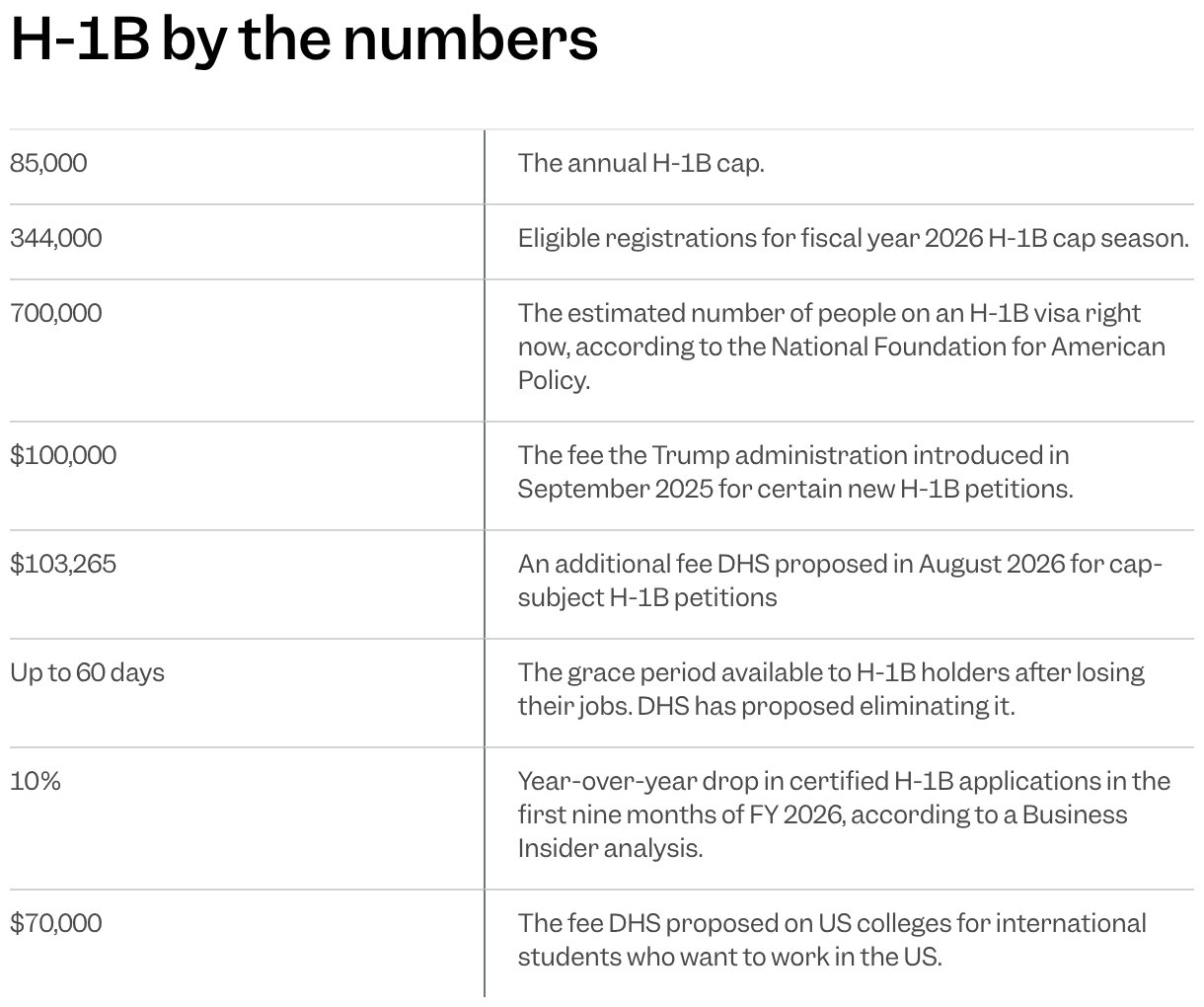
Over the past year, Business Insider has spoken to more than 20 H-1B visa holders and hopefuls about their decisions to opt in, push through, and sometimes give up on the H-1B American Dream as the Trump administration has become increasingly hostile to foreign workers.
As part of our H-1B Fallout series, published one year after the Trump administration introduced a $100,000 payment for some new H-1B petitions, we are telling the stories of people navigating the visa system. Some left the US and returned to their home countries, while others rebuilt elsewhere or are still trying to build a career in the US.
In a statement, a White House spokesperson said the goal of the $100,000 H-1B fee is to focus on sponsoring "truly highly specialized temporary labor." A Department of State spokesperson said the US is unapologetic about its "America first visa policies" and that the administration is working with partners to facilitate necessary visas. A Department of Labor spokesperson said the administration is protecting American jobs and increasing wages.
Keep reading to see what life has been like for people affected by the US's immigration policy changes.

Paromita Chatterjee for BI
Soumi Chanda had spent 13 years building a life in the US when a 2025 layoff put her H-1B status at risk.
Chanda moved from Kolkata to Spokane, Washington, in 2013 for graduate school. She was selected for an H-1B on her first attempt in 2021 — "pure luck," she said — and Amazon later took over her sponsorship, prompting her move to Seattle.
When Amazon laid her off, Chanda had 60 days to find a new sponsor or leave the country. "Sixty days sounded impossible from the start," she said. Her search came as debate intensified over the proposed fee. "Even with Amazon on my résumé, I didn't get a single interview the following month," she said.
When preparing to leave the US, Chanda made her two cats her priority. She spent weeks arranging their international travel and paid roughly $5,000 for paperwork, along with thousands more to break her lease, dispose of her belongings, and secure last-minute travel. In total, she estimates the move cost her $18,000.
Now back in Kolkata, she's still working out whether India will be her long-term home. "There's plenty here I value, and other things, as a feminist, I find harder to reconcile."
Paromita Chatterjee for BI
Even with Amazon on my résumé, I didn't get a single interview the following month.
Read: She was picked for an H-1B visa on her first try, but got laid off
Angela Ponce for BI
Luciana Pereyra moved from Peru to the US at 17 on a tennis scholarship. After graduating, she landed a marketing role at Ohio State. Her H-1B was approved in April 2024. She described that time as living in "survival mode," knowing that losing a job could also mean losing her home.
In December 2025, Pereyra said HR contacted her to say that her position would end the following month. She had 60 days to find another employer to sponsor her visa or leave the country. "I treated the job search like the last match of my career," she said.
She focused on university jobs, but the timing worked against her: Many campuses closed for winter break as her grace period began. She said two promising opportunities fell through after prospective employers raised concerns about securing a visa amid the proposed H-1B fees.
Pereyra returned to Peru in March. In Lima, she freelances for a US marketing client, coaches tennis, and is building a small business. She said she would consider moving to the US again, but only if it came with "a real path to permanent residency."
Angela Ponce for BI
I treated the job search like the last match of my career.
Read: She played college tennis, earned 2 degrees, then lost her H-1B job
Jared Soares for BI
Recent changes to US immigration policy have made Mohamed Zeeshan, a green card holder, more concerned about whether immigrants like him can build stable lives in the country.
He's seen relatives and friends consider countries such as Germany and Australia, rather than the US, because of the difficulty of securing jobs and visas after graduation. The instability surrounding H-1B visas — including the proposed $100,000 fee for new applicants — has reinforced his concerns.
Zeeshan self-petitioned for a green card and received it in 2023, enabling him to live in the US without needing employer sponsorship.
In 2025, he started his own consulting firm. Over the past year, Zeeshan said he has watched the immigration landscape become more uncertain.
He still plans to become a US citizen but says that if he had to rely on an H-1B visa today, he doesn't think he'd do it: "When you're on an H-1B here in the US, you're kind of always on tenterhooks."
"You don't know if you're going to be here next month or two months or three months down the line. That's a very difficult position to be in."
His wife is still waiting for her green card, and the couple is holding off on having children until they have more clarity about her status.
Jared Soares for BI
When you're on an H-1B here in the US, you're kind of always on tenterhooks.
Read: He moved to the US on a green card and wouldn't do the same on an H-1B
Sean Marc Lee for BI
Vivienne Yang found out she was being laid off from her H-1B-sponsored job while she was on vacation in Japan in October 2024.
She spent the rest of the trip speaking with immigration and labor lawyers, emailing her employer, and trying to enjoy sightseeing with her partner.
Yang, who is from Taiwan, managed to get her employment extended for a few weeks, allowing her to fly back to New York. She then switched to a B-2 tourist visa so she could stay in the US longer and search for another job. She went through over 20 job interviews in the next year, all of them unsuccessful.
So, she decided to pivot.
Yang was accepted into a New York acting program, but her application for a US student visa was denied after she returned to Taiwan to apply for it in December 2025. Her American partner now looks after her two cats in Brooklyn while she remains in Taiwan, living with her family and working as a content creator, business English coach, and freelance consultant.
She has put her US plans on hold. "I don't want to deal with visa issues anytime soon," she said.
"Now I can move on with my life without any regrets because I know I have tried," she said. "I have a better understanding of what living abroad looks like and what American dream looks like in reality."
Sean Marc Lee for BI
I have a better understanding of what living abroad looks like and what American Dream looks like in reality.
Read: She lost her job and left behind her American dream — and her cats
Natalia Kepesz for BI
Ananya Joshi's plans to build a career in the US came apart in 2025, when a visa setback and a sudden layoff pushed her to look for a future elsewhere.
Joshi had moved from India to Illinois to pursue a master's degree. After graduating in 2024, she joined a Chicago startup developing cultivated meat as a scientist, working on an F-1 Optional Practical Training, or OPT visa.
She was enjoying the work until she learned that her employer could not complete E-Verify, which employers must use to sponsor an extension of STEM graduates' OPT.
From May through July 2025, Joshi interviewed for jobs around the world. She received offers in Canada and Germany and ultimately chose Germany. "Having gone through so much, I realized I needed that stability," she said.
In January, she moved to Rostock, about three hours north of Berlin, to join another lab-grown-meat startup. These days, Joshi is taking German classes and adjusting to what she describes as a slower work culture. She's also learning to navigate a long-distance relationship with her boyfriend, who remains in the US.
Joshi said she would still like to return to the US, but said, "I can't forget what I went through."
Natalia Kepesz for BI
I realized I needed that stability.
Read: Her American dream hit a visa roadblock; she found a job in Germany
Watch: H-1B visa hopeful had her life upended, moved to Germany
Ian Tuttle for BI
Gu Yichen's path to working in the US began in high school, when he spent a year as an exchange student in Yacolt, a small town in Washington State. He later attended college in the US, interning at Amazon before joining the company full-time after graduation.
With a STEM degree, Gu had three chances to enter the H-1B lottery. He was selected on his third try.
In late 2022, Gu left Amazon for a job at Google, despite his manager's warning that the market was becoming unstable. He was laid off the following month, before he had done "a single day of real work."
Gu faced pressure to find a new employer within the 60-day grace period. Rather than take a stopgap role, he returned to China for a break before ultimately rejoining his former Amazon team in the US on an I-140, an immigration petition that can support a green-card application.
He has since applied for a green card, hoping it will give him "more freedom in both my personal life and my career."
Over the past year, he said the biggest challenge has remained the same: His ability to stay in the US is tied to his job. "I've been thinking what kind of life I really want to live and what is my real interest in life."
Ian Tuttle for BI
I've been thinking what kind of life I really want to live and what is my real interest in life.
Read: Google laid him off a month after hiring him; he was on an H-1B visa
Chinky Shukla for BI
Leaving a six-figure data-scientist job in New York and returning to India in May was not an easy decision for Disha Lamba, but she says being closer to her family — and free from the limits of an employment visa — made it worthwhile.
Lamba moved to the US in 2021 to pursue a master's degree. She later joined CVS Health as a data scientist and learned that she had been selected in the H-1B lottery in March 2026.
By then, however, Lamba had already decided to move home. Though she had a fulfilling job and social life in New York, she struggled with the distance from her parents.
The prospect of managing an H-1B long-term reinforced her decision. Lamba was concerned about the difficulty of obtaining visa stamps to travel, as well as the limits the visa can place on changing employers, taking a career break, or pursuing additional income.
"Anything comes with its pros and cons. H-1B has its pros but also has its cons. I wasn't OK with the cons of being in these restrictions," she said.
After resigning, Lamba moved back to live with her parents and brother. She took a two-month career break and secured a short-term contract role, but she's still looking for a permanent job. Nonetheless, she's still happy about her decision.
"Every moment when I get to hug my parents, that's when I realize, no, this was all worth it," she said.
Chinky Shukla for BI
H-1B has its pros but also has its cons.
Read: She moved back to India to be near family and leave H-1B limits behind
Ayesha Kazim for BI
After three failed attempts to obtain an H-1B visa, Sunjana Ramana is reinventing her "American Dream."
Ramana moved from Hyderabad, India, to New York in 2021 for her master's degree. After graduating in 2023, she joined a global insurance company. Her employer entered her in the H-1B lottery in 2023, 2024, and 2025. She was not selected.
When her work authorization ended in early 2026, Ramana had to leave the US.
"When I didn't get the visa, I was really, really clueless. I thought that was the end of everything that I had built for three years," she said, adding, "but I realized just a couple of months later that there are so many additional options that I didn't know existed."
Instead of returning to India, Ramana secured a 2-year UK visa that is not tied to one employer. She chose London as her base, where she could pursue the entrepreneurship she had wanted to explore in the US.
Ramana was accepted into Antler's founder-in-residence program and spent two months building Flax, a two-person tech company that helps AI founders and builders. In May, she moved into a product-management role in fintech.
"I want to go back and tell my younger self not to associate the 'dream' with America or a country for that matter, because it doesn't matter where you are. The dream should be aligned to you and your goals."
Ayesha Kazim for BI
When I didn't get the visa, I was really, really clueless. I thought that was the end of everything that I had built for three years
Read: She left the US when she didn't get an H-1B visa. Now, she's living a new dream.
Chona Kasinger for BI
An H-1B selection brought immediate relief for Madhur Mehta this year, but it has not resolved the uncertainty that shapes his and his fiancée's plans in the US.
Mehta moved to the US in 2021, earned a master's degree in 2023, and was eligible for three years of student work authorization. Amazon offered him both a job and sponsorship.
He joined the company in 2025 as a program manager.
But over the past year, while the company was trying to get him an H-1B, Mehta grew concerned about changes to the lottery. He began exploring backup plans for his US life, including an EB-1A visa and opportunities in Canada and Australia.
He learned he was selected for an H-1B in March, potentially giving him the chance to work and remain in the US for another three years.
"It was a big relief," he said, adding, "It's like someone has taken a 100-pound load off your mind," he said.
Mehta's fiancée, who is also from India, has one remaining chance in the H-1B lottery before her work authorization expires.
"It's hard, you know, obviously you can't plan," Mehta said, adding, "unless we are both very clear on what our visa status is."
Chona Kasinger for BI
It's like someone has taken a 100-pound load off your mind.
Read: He got an H-1B visa, but uncertainty makes it hard to plan his future
Cassandra Rudolph for BI
Shreya Mishra Reddy left the US in January after not being selected for an H-1B visa. Her plan was to leave the country and keep applying for US jobs from abroad.
That plan, however, started to feel unrealistic after the Trump administration proposed the $100,000 fee on some H-1B applicants.
Though the fee has been challenged in court and is not being enforced, she said the uncertainty changed her mind: "I've decided not to pursue H-1B or any role in the US right now."
Reddy had moved to the US in 2021 for a master's degree in engineering management at Duke University. After graduating, she was hired by Visa, but her student work authorization expired before she could secure an H-1B visa.
She's now in Toronto with her husband on a tourist visa and weighing whether to base herself in Canada or India. During a career break, Reddy has been writing a fiction book and building a handloom brand while exploring fintech roles.
In March, Reddy was accepted into a master's program in psychology at the University of Pennsylvania. She decided not to attend, citing uncertainty around student visas and the US job market.
She said she's optimistic about her future and wishes she'd been more open to opportunities in other countries earlier, rather than banking everything on the US.
"I was thinking that H-1B would pan out for me, it didn't, and it's something that I definitely regret."
I was thinking that H-1B would pan out for me, it didn't, and it's something that I definitely regret.
Read: She gave up on H-1B amid $100K fee; now she's weighing Canada or India
Watch: Why an H-1B visa hopeful decided to give up on work in the US
Cassandra Rudolph for BI
I was thinking that H-1B would pan out for me, it didn't, and it's something that I definitely regret.
Watch: Why an H-1B visa hopeful decided to give up on work in the US
Prime Minister Andris Kulbergs is pressing Brussels and other European capitals to adopt a common approach, arguing that continued visa issuance by some Schengen countries weakens restrictions imposed by states bordering Russia.
His intervention comes amid growing concerns over suspected Russian sabotage, espionage and other hostile activities across Europe. The Latvian government regards restrictions on non-essential travel as an additional measure to reduce potential security risks.
According to details of the Latvian proposal, Kulbergs has criticised the continued issuance of tourist visas by countries including France, Italy and Spain, maintaining that the consequences extend beyond the states granting entry.
The proposal would go considerably further than the restrictions already introduced by the EU since Russia launched its full-scale invasion of Ukraine in February 2022.
The European Union suspended its visa facilitation agreement with Russia in September 2022, ending the preferential conditions previously available to Russian applicants.
The Council’s original decision introduced more demanding documentation requirements, higher application fees and stricter scrutiny, but it did not prohibit Russian citizens from obtaining short-stay visas.
National authorities therefore retained considerable discretion when assessing applications, subject to common Schengen rules.
In November 2025, the Commission introduced additional restrictions on multiple-entry visas, requiring Russian travellers covered by the new rules to apply again for subsequent visits.
The EU has also agreed a legal basis for restrictions targeting Russian military personnel and former combatants involved in the invasion of Ukraine, although implementation requires further measures.
Latvia argues that these steps remain insufficient because ordinary tourist visas continue to be available through some European consulates.
Once admitted to the Schengen area, a visitor can generally travel between participating countries without routine internal border checks. This creates difficulties for governments seeking to enforce stricter national entry policies.
Latvia shares borders with Russia and Belarus and has repeatedly warned that Moscow’s activities present risks extending beyond conventional military threats.
European governments have investigated incidents involving suspected sabotage, cyber operations, intelligence gathering and interference with transport infrastructure.
Such concerns have intensified following drone incursions and security alerts affecting NATO’s eastern members.
These concerns were also evident in EU Today’s reporting on suspected security breaches in Europe, although the circumstances of individual incidents must be investigated rather than assumed to involve foreign intelligence services.
The distinction is relevant to the Latvian proposal. European intelligence agencies have identified Russian-linked activities, but this does not establish that ordinary Russian tourists are collectively involved in intelligence operations.
Supporters of tighter visa restrictions argue that limiting discretionary entry could reduce opportunities for hostile activity and simplify security screening.
Opponents question whether a nationality-based prohibition would be proportionate or effective, particularly when intelligence operations may involve individuals travelling under other nationalities or using established residency arrangements.
A comprehensive tourist visa ban would require agreement on its precise scope, legal basis and implementation.
European governments would need to determine how the restrictions apply to Russian citizens with family members in the EU, people travelling for humanitarian purposes and individuals seeking protection from the Russian authorities.
The EU Visa Code already permits refusals where applicants present security risks, but a general prohibition based on nationality would involve a different policy decision.
Humanitarian exceptions would be particularly important for Russian dissidents, independent journalists and other individuals facing political persecution.
France has supported restrictions on entry by Russian combatants, while other member states are considering further measures. That does not necessarily mean they support Latvia’s broader proposal covering ordinary tourists.
Kulbergs is also seeking greater European financial assistance for countries facing the economic and security consequences of their proximity to Russia and Belarus.
The renewed visa debate coincides with disagreements between Washington and Brussels over economic restrictions on Moscow.
EU leaders have maintained that sanctions should remain in place until Russia ends its aggression against Ukraine. Visa policy, however, requires separate legal and political consideration from economic sanctions.
Latvia’s proposal has not been adopted as an EU-wide rule. The immediate question is whether enough member states are prepared to move from tighter individual screening towards a general restriction on Russian leisure travel.
Until that agreement is reached, European countries will continue to apply different policies within a shared Schengen system, leaving the security concerns raised by Riga unresolved.

Paulo Nunes dos Santos/Bloomberg via Getty Images
If America wants to win the AI race, sending the world's brightest engineers packing might not be a winning strategy.
That's the warning from Microsoft President Brad Smith, who said the Trump administration's immigration crackdown risks driving the next generation of AI talent away from the United States.
"I think we should all be worried about sending intentionally or inadvertently or otherwise, signals that send the most talented next wave of AI software engineers to other countries rather than the United States," Smith said in an episode of Politico's "The Decoded Podcast" that aired on Thursday.
His comments come after the Trump administration announced last week that it was suspending Microsoft, Adobe, and several other technology companies from a federal program that sponsors foreign workers for permanent residency.
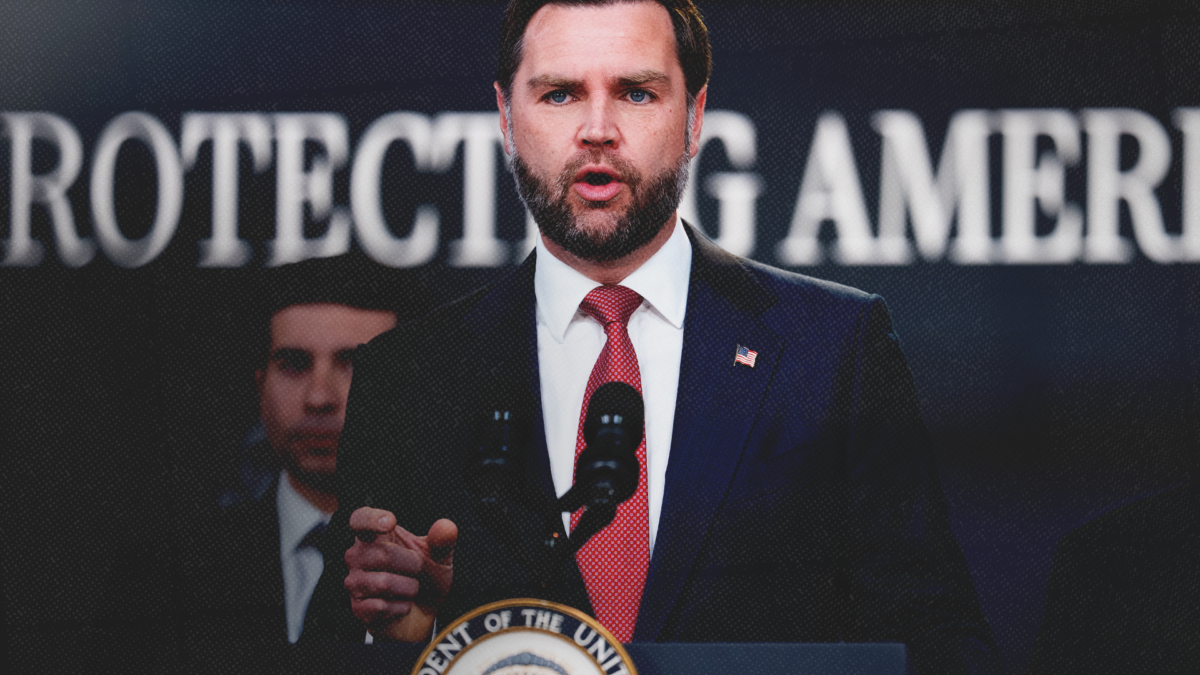
Vice President JD Vance accused Microsoft of abusing the Permanent Labor Certification, or PERM, program by laying off American employees while hiring lower-paid foreign workers.
Smith, who Business Insider reported was recently put in charge of Microsoft's communications, pushed back against those allegations, saying the administration had presented a misleading picture of Microsoft's hiring practices.
Daniel Heuer-Pool/Getty Images
"What was presented as Microsoft replacing 6,000 people who lost their jobs with 9,000 foreigners was frankly completely off base," he said.
Smith said most of the company's visa and green card applications concerned existing employees rather than new hires, adding that Microsoft had hired 9,200 American workers in its last fiscal year.
"That was left out of the narrative," he said.
He also rejected suggestions that Microsoft pays foreign workers less than their American counterparts, saying employees are compensated under the same system regardless of immigration status.
The dispute comes amid growing uncertainty for skilled foreign workers in the US.
As part of our ongoing H-1B Fallout series, Business Insider previously reported that the Trump administration's shifting immigration policies have prompted some international workers to explore opportunities abroad, including in countries like the UK, Germany, and Canada.
An analysis of federal data by Business Insider found that certified H-1B applications fell 10% in the first nine months of fiscal year 2026 compared with the same period a year earlier. Applications for data scientists, however, rose 22.5%, highlighting continued demand for specialized AI talent.
On the Politico podcast, Smith cited immigrants' economic contributions as evidence of what America stands to lose.
He said that five of the six technology and science medal recipients recently honored by President Donald Trump had immigrated to the United States.
Win McNamee/Getty Images
According to Smith, the companies associated with those five individuals collectively represent more than a quarter of the S&P 500's market value.
Their contributions, he said, benefit not just technology employees but ordinary Americans whose retirement savings and pension funds are invested in those businesses.
"Think about what those five individuals have done for the well being, even the wealth and standard of living, of Americans across the country," Smith said.
"Let's not put that at risk."
Vice President J.D. Vance—who is heading the Trump administration's efforts to eradicate fraud—has set his sights on another alleged form of wasteful spending.
Last week, Vance announced a probe into nine universities over alleged J-1 visa fraud as part of the Trump administration's broader crackdown on foreign worker programs. Vance's central complaint is that the named universities—which include Harvard, Stanford, and the Massachusetts Institute of Technology—are "employing J-1 visas for federally funded grants at a rate of about 61 percent" compared to the "national average of just 38 percent."
"Something weird is going on at these universities," Vance added. "They're using these visas way too much. They're using them to undercut the wages of American grad students and American researchers, and it simply has to stop." Naturally, he figured that this warranted a fraud investigation.
Labor Department Inspector General Anthony D'Esposito, who is leading the investigation, had some harsh words for universities. "Improperly used J-1 visa classifications to avoid employment obligations, exploit taxpayer-funded programs, and undermine American workers will not be tolerated." He said, "I don't care how prestigious a university thinks it is. Break the law and screw the American people, and I will personally cuff you in the university square." He also raised concerns that universities were exposing American research to foreign adversaries, specifically China.
The press conference sounded more like an indictment of the J-1 program than of fraud. Unlike the H-1B visa—which allows employers to sponsor high-skilled foreign workers—the J-1 is more like an exchange program than a dedicated work visa; it doesn't require employers to pay the prevailing wage or visa holders to pay Social Security or Medicaid taxes within the first two years. Universities using the program to hire cheaper foreign labor is simply a feature of the program.
The real picture is much muddier than Vance cited figures suggest. The inspector general's announcement states that "approximately 61 percent of postdoctoral workers and researchers supported by federal grants at the nine universities are foreign nationals, compared to 38 percent at other universities." Foreign nationals could include H-1B holders and other visa categories, not just J-1s as Vance claimed. Additionally, the 38 percent figure comes from unspecified "other universities," rather than the national average.
D'Esposito had a fiery tone, but neither he nor Vance pointed to a single instance of a university breaking the rules. Their evidence is merely a statistic showing these schools, which are elite research institutions, hire a lot of foreign researchers. Vance's primary objection isn't that these universities have broken the law; it's that they are hiring foreigners instead of Americans, undermining his protectionist agenda.
Opposition to visa programs is, unfortunately, found on both the left and the right. In his first term, President Donald Trump enacted a slew of restrictions that complicated the H-1B visa application process and increased denial rates to 24 percent in FY 2018 (up from 6 percent in FY 2015). In 2020, the administration was forced to rescind key policies behind those rising denials after a federal judge ruled they hadn't followed the required rulemaking process. In September last year, Trump imposed a $100,000 fee on H-1B petitions. A federal judge struck it down in June, saying it exceeds the president's authority and violates the separation of powers.
Other presidents have used federal power as leverage against higher education. But Trump's war on universities—including the freezing of federal funds for universities like Columbia and Harvard for alleged instances of antisemitism—is mostly unprecedented. These actions are indicative of a more enduring problem: Federal dollars come with federal influence, and as long as universities depend on federal funding, they will remain at Washington's mercy. If universities want lasting independence, the answer isn't to reduce their use of the J-1 visa. It's to get off the federal teat altogether.
The post No, Giving Immigrants Research Jobs Is Not Fraud appeared first on Reason Magazine.