At the beginning of Russia's full-scale invasion of Ukraine in 2022, while in my hometown of Kyiv, I wrote an essay in German for a German website titled "Russia Dehumanizes the World."
The Ukrainian translation of this text, published under the title "The Dehumanization of
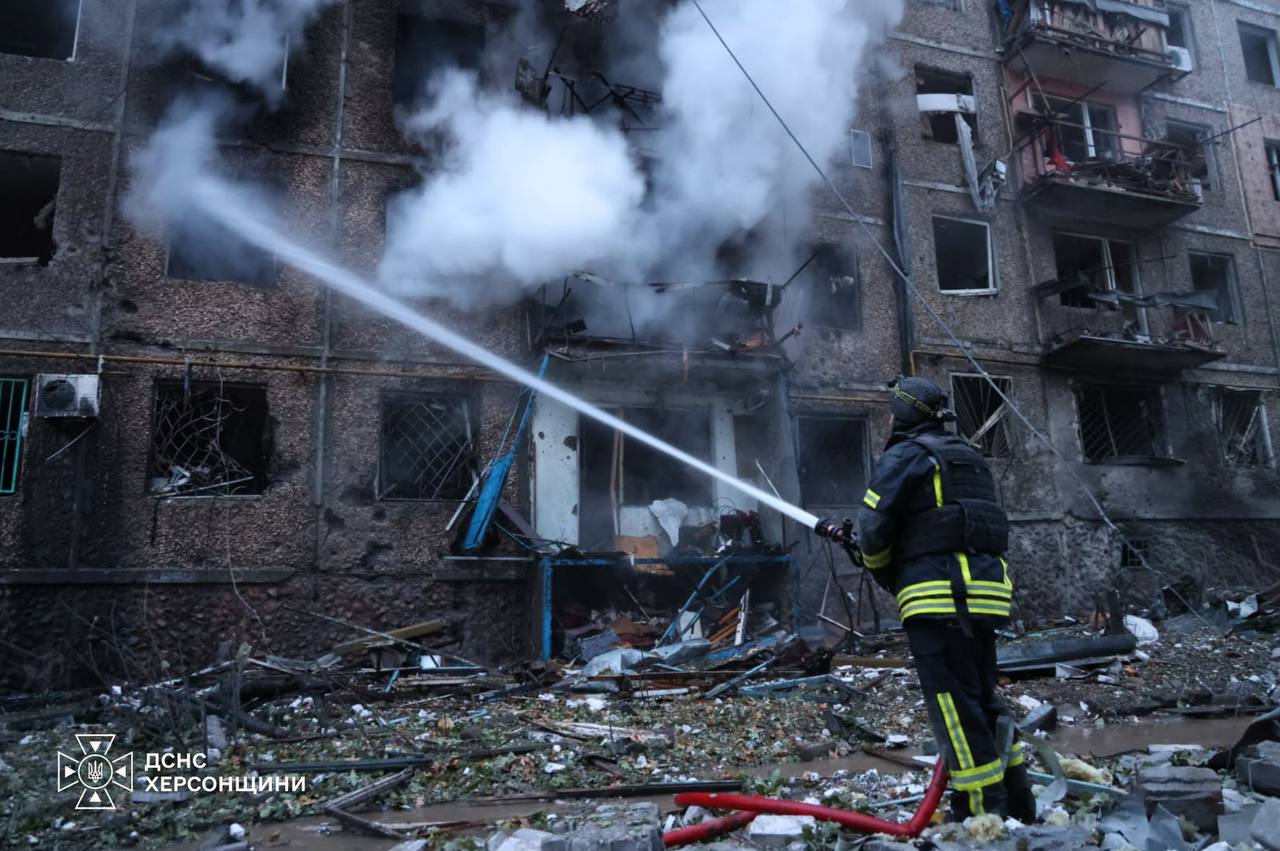
Six people were killed in a Russian strike in the settlement of Nova Vodolaha in Kharkiv Oblast, including girls aged 1 and 11. Another 15 people were injured, including seven children, Kharkiv Oblast Governor Oleh Syniehubov said on 20 October. Russian forces struck a park with a drone while families with children were there, Ukraine’s Minister of Internal Affairs Ivan Vyhivskyi said.
Russian forces continue to attack Ukrainian cities, killing civilians and destroying civilian infrastructure. The Kharkiv Oblast Prosecutor’s Office has opened a war-crime investigation into the strike. The strike was aimed at people, Yurii Yurchenko, head of a police department in Kharkiv Oblast, said in a comment to Suspilne.
The 14-month-old girl was named Anhelina
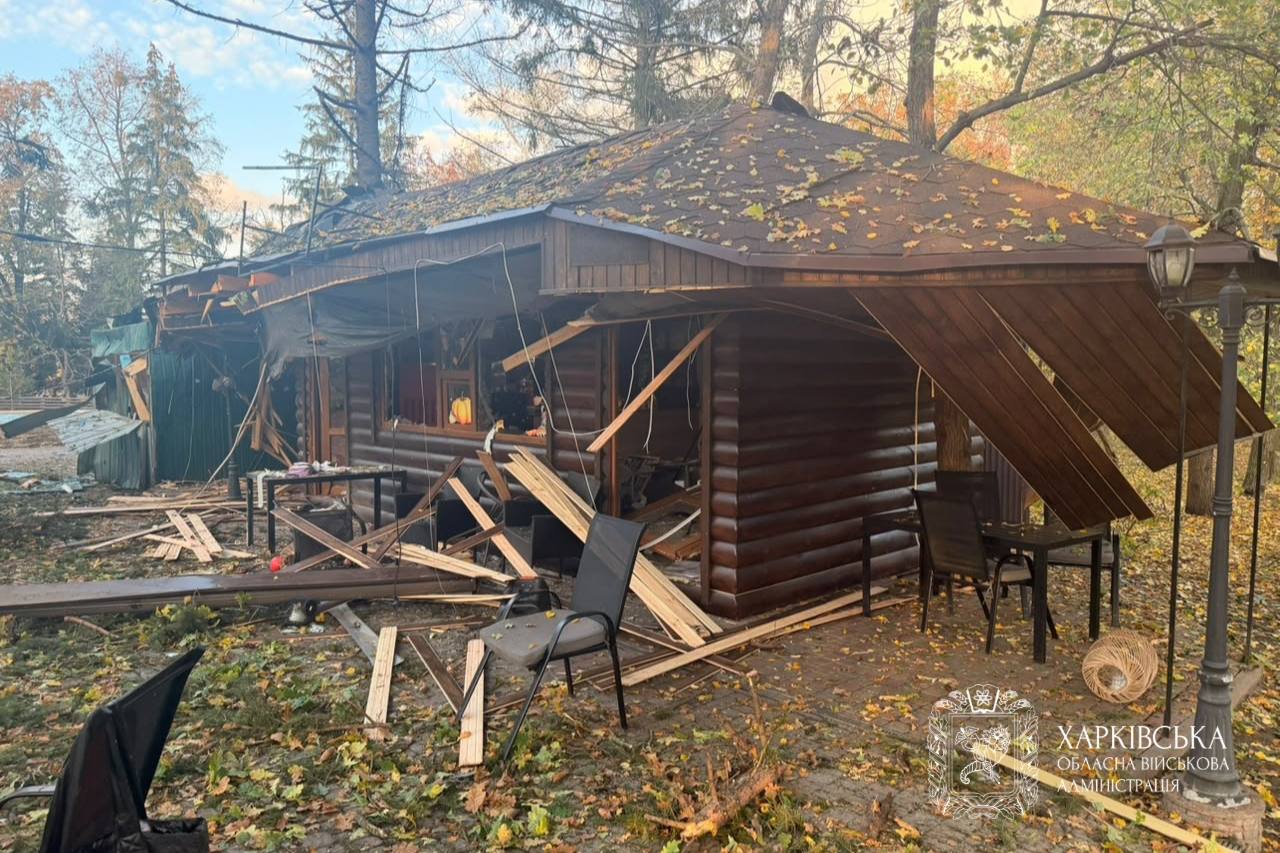
The Russian drone circled the park several times before crashing, Yurchenko said. He said the drone struck a tree near a café, and the blast wave and shrapnel hit people at the establishment. The attack came at around 16:30, the prosecutor’s office said, adding that Russian forces had preliminarily used a Geran-3 drone.
The café damaged in a Russian strike on a park in the settlement of Nova Vodolaha, Kharkiv Oblast, on 19 October 2026. Photo: Kharkiv Oblast Military Administration
The Russian strike killed three women, aged 28, 34 and 36, a man around 40 years old, and two girls, aged 14 months and 11 years, Syniehubov said in his statement.
The youngest girl, named Anhelina, was born in August 2025, Ukrainian President Volodymyr Zelenskyy said. Her mother, Inna, died in the hospital, he added.
Zelenskyy shows US senators photos of the aftermath the same day
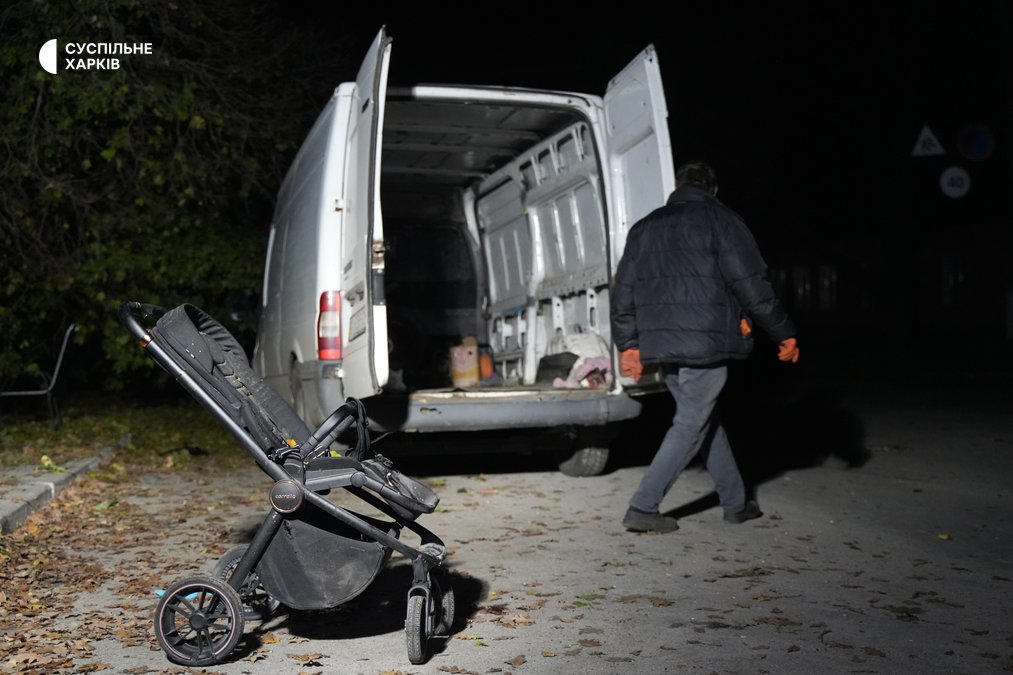
Zelenskyy met with US Senators Richard Blumenthal and Thom Tillis, along with their colleagues from both parties and both chambers of Congress, according to a 19 October post on his social media accounts. During the meeting, he discussed the Russian attack in Kharkiv Oblast and showed lawmakers photographs from the scene, including one of the infant who was killed in a stroller.
“This is how Russia responds to the lifting of sanctions and the easing of pressure,” he said in the post.
The stroller in which 1-year-old Anhelina was killed, Nova Vodolaha, 19 October 2026. Photo: Suspilne Kharkiv/Viacheslav Mavrychev
Zelenskyy said Ukraine needs air defense and that no one should think about making money with Russia while it continues its war. He asked that sanctions on Russia stay in place until the killing stops, urged the US to “be strong” and apply Lindsey Graham’s law, and called on Europe to keep supporting Ukraine.
Russia attacked Kyiv with ballistic missiles in two waves overnight on 18–19 October. Information from partners did not arrive before the first wave, at around 23:00, Air Force spokesperson Yurii Ihnat said on national television. A warning came before the second wave, at around 03:00, but the window was short, he told NV.
Hours earlier, Ukrainian President Volodymyr Zelenskyy told NBC that US warnings of Russian ballistic launches were working again after three days without them, and that only the United States has that intelligence. Those warnings have for years given Ukrainian authorities several minutes to sound alarms and let civilians reach shelters before ballistic missiles hit.
“Once again, a Russian ballistic attack in several waves overnight, and once again there was no warning from partners,” Zelenskyy wrote. It was at least the third ballistic strike on Kyiv in a week to begin without warning from partners, following attacks on 12 October and 13 October.
Metro station damaged on Kyiv’s left bank
One person was killed and eight injured in Kyiv, Ukrainian Prime Minister Serhii Koretskyi said. A strike damaged a metro station on Kyiv’s left bank, and debris broke the rails beside it, Mayor Vitali Klitschko said. City authorities said the damaged station was above ground, closed Chernihivska and Lisova stations, and said red-line trains would run only between Akademmistechko and Darnytsia. The attack also damaged a 25-story building, a medical facility, and the Cosmo Multimall shopping center in the Solomianskyi district, NV reported, and Zelenskyy said a school was hit too.
The attack also damaged one of Ukraine’s main ice arenas, on Shalett Street in Kyiv, which hosts Ukrainian championship hockey games and youth training, hockey Telegram channel Flamingo reported. Parts of the facade, metal structures, and roof were damaged, but the ice surface showed no significant visible damage, according to preliminary information, Suspilne reported.
Damage in 11 oblasts, three missing in Irpin
Koretskyi said energy and infrastructure were the main targets, with damage in 11 oblasts. Russia also hit warehouses of medicines, railway stations, shops, and homes, he said. In Kyiv Oblast, Russian strikes injured six people in Irpin, including three children, and three more were missing, oblast head Tymur Tkachenko said. In Kharkiv Oblast, six people were injured, including two children, Koretskyi said. In Rivne Oblast, four people were injured, and one of them was hospitalized, regional police reported.
Zelenskyy said that more than 10 energy facilities were damaged and at least 550,000 families lost power. Ukrenergo reported new outages in 10 oblasts: Volyn, Zhytomyr, Rivne, Ternopil, Khmelnytskyi, Vinnytsia, Kirovohrad, Kharkiv, Odesa, and Mykolaiv. In Volyn Oblast, about 15 jet-powered Shahed-type drones targeted the region, and around 66,000 customers were without power on the morning of 19 October, oblast head Roman Romaniuk said. Kovel, Manevychi, and Lutsk were hit hardest, and no casualties were reported. In Vinnytsia Oblast, a critical infrastructure facility in Koziatyn was damaged, and power there would stay unstable for some time, city council secretary Iryna Repalo said, Suspilne reported.
Zelenskyy said Russia fired 16 ballistic missiles at Kyiv and Kyiv Oblast. The Air Force reported that Russia also used Iskander-K cruise missiles and 269 drones, and that by 09:00 air defenses had shot down or suppressed four Iskander-K cruise missiles and 243 drones. Its preliminary count did not list any ballistic missiles among the intercepted targets.
Rubio denies any pause and points to a software problem in Ukraine’s warning system
On 19 October, Rubio told reporters in Samarkand, Uzbekistan, that “there’s been no pause” in intelligence-sharing with Ukraine, Reuters reported. He said he did not know where Zelenskyy was getting such claims and that he should focus on ending the war. He also said he did not know whether a failure had happened the previous night, but that a few nights earlier there had been a software problem with “their early warning system,” and that US European Command was looking into the strikes, The Guardian reported. US officials had not mentioned a software glitch before, and in at least one case Ukraine was told that bad weather over southern Russia had hidden launch preparations, the newspaper noted.
Ihnat said Ukrainian specialists and their partners were working to establish why information about the first launch had not arrived. He added that similar gaps had occurred during earlier attacks.
Zelenskyy wrote that when missile supplies for Ukraine’s air defense are blocked while Russia gets sanctions relief or delays, “this is, unfortunately, a denial of reality on the part of partners.” A night earlier, Russia had hit Ukraine’s energy system again, while Ukrainian drones set fire to St. Petersburg’s oil terminal despite Washington’s pressure to stop refinery strikes.
Wainwright explosion at a Canadian military base kills at least seven and injures dozens as officials rule out terrorism and investigate the deadly fire.
Wainwright Explosion Kills at Least Seven at Canadian Base
The Wainwright explosion at Canadian Forces Base Wainwright in Alberta has left at least seven people dead and dozens injured, according to reports by CBC News and Global News.
The incident occurred on Saturday, October 17, during a live-fire training exercise at the military base, located approximately 200 kilometers southeast of Edmonton.
Canada’s Department of National Defence confirmed that a fire broke out in the training area at approximately 4:00 p.m. local time. The Canadian Armed Forces said the blaze resulted in fatalities and injuries but has not yet released an official casualty count.
Military sources cited by Canadian media said the explosion occurred when a munition used during the training exercise struck a natural gas line or gas well.
The impact reportedly triggered a large detonation and a fast-moving fire that spread beyond the boundaries of the training area.
High winds, with gusts reaching up to 100 kilometers per hour, helped the flames spread rapidly through dry grassland and nearby rural areas.
The Canadian Armed Forces said emergency responders from military and civilian agencies worked quickly to contain the fire and assist those affected.
By Saturday evening, the Municipal District of Wainwright said the fire was being held and that property and critical infrastructure had been protected. Authorities did not order an evacuation of residents in the surrounding area.
The Department of National Defence said the full extent of the impact remains under assessment. It added that casualty details will not be released until relatives have been notified.
The government has ruled out terrorism as a possible cause. Officials said there were no indications that the explosion was connected to an attack or deliberate act of violence.
The incident has nevertheless prompted a major investigation involving the Canadian Armed Forces, the Department of National Defence and the Royal Canadian Mounted Police.
The Wainwright explosion activated emergency protocols across hospitals in the Edmonton region.
Local health authorities declared a code orange alert, a designation used for external disasters or mass-casualty incidents.
Injured personnel were transported to hospitals including the University of Alberta Hospital and the Royal Alexandra Hospital in Edmonton.
Medical teams prepared for a large number of patients with burns, trauma injuries and respiratory problems caused by smoke and toxic gases.
Firefighters faced difficult conditions because the fire involved both explosive material and hydrocarbon infrastructure.
The combination of live ammunition, natural gas and dry vegetation created a complex emergency that required coordination among military firefighters, civilian fire departments and specialized rescue teams.
Strong winds made the fire difficult to control and increased the risk that flames could spread to nearby communities.
Authorities asked residents to avoid the area so that emergency vehicles could move freely and rescue operations could continue without obstruction.
The Wainwright area is home to one of Canada’s largest military training facilities. The base is used for live-fire exercises involving tanks, artillery, infantry units and other military equipment.
CFB Wainwright is also an important NATO training site. Allied forces from several countries use the installation for exercises designed to improve interoperability and combat readiness.
The base covers a vast rural area and includes training ranges, administrative facilities, housing and support infrastructure.
The explosion occurred during a routine training exercise, according to the Department of National Defence. Officials have not identified the unit involved or the type of munition used.
Investigators will need to determine whether the incident resulted from an error in targeting, a malfunction in the munition, inadequate safety procedures or an unexpected hazard related to the gas infrastructure.
The Canadian Armed Forces said the immediate priority is supporting those affected and notifying their families.
The names of the victims have not been released. Officials said identification and notification procedures are ongoing.
Prime Minister Mark Carney confirmed on Sunday that four service members had died. He said dozens more were seriously injured and described the fire as one of the worst peacetime tragedies affecting Canada’s military on domestic soil.
“Our thoughts are with all the brave women and men affected,” Carney said.
The prime minister said his government was working closely with the Government of Alberta and local authorities.
He added that he and Alberta Premier Danielle Smith were in close contact, along with their respective ministers and relevant officials.
Defence Minister David McGuinty traveled to Edmonton on Sunday to monitor the investigation. He said the situation remained “very active and delicate.”
McGuinty said the Royal Canadian Mounted Police were participating in the investigation and that authorities would provide further information once the facts had been established.
🇨🇦 Al menos siete muertos y decenas de heridos dejó una explosión e incendio en la base militar CBF Wainwright en Alberta. #teleSUR#Canadapic.twitter.com/tSvGpCS0Bi
The Wainwright explosion has raised questions about safety procedures during live-fire exercises at military bases.
Live-fire training is essential for preparing soldiers for combat operations, but it also carries significant risks when it takes place near explosive or flammable infrastructure.
Military authorities regularly conduct risk assessments before exercises to identify hazards, establish safety zones and coordinate emergency responses.
Investigators will examine whether those procedures were followed and whether the presence of gas infrastructure near the training area was properly identified.
They will also review weather conditions, ammunition handling, communication between units and the response of emergency teams.
The investigation could lead to changes in training protocols, safety distances, mapping procedures or the coordination between military and civilian authorities.
The incident occurred during a period when Canada has been increasing military preparedness amid global security tensions.
Canada is a member of NATO and has supported allied operations in Europe and other regions. The country has also increased investment in defense capabilities in response to international instability.
CFB Wainwright plays a central role in that effort because it provides space for large-scale training exercises involving Canadian and allied forces.
The base has hosted soldiers from NATO member states and partner countries. Its facilities allow forces to train in conditions that cannot easily be reproduced at smaller installations.
The explosion could therefore affect training schedules and force readiness in the short term.
Military authorities may suspend certain exercises while investigators examine the site and review safety procedures.
The incident also highlights the risks faced by military personnel during routine operations. Training accidents can occur even when soldiers are not deployed in combat zones.
The Canadian Armed Forces has expressed condolences to the families of those killed and injured.
Officials have asked the public to avoid speculation while the investigation continues. They have also urged people to rely on official statements rather than unverified reports circulating on social media.
Geopolitical Context
The Wainwright explosion has implications for Canada’s military readiness and its role within NATO.
Canada has increased its defense commitments in recent years amid tensions involving Russia, the Middle East and the Indo-Pacific region.
The country has contributed troops, equipment and training resources to NATO operations, while also maintaining a military presence in international missions.
CFB Wainwright is important to those efforts because it allows Canadian and allied forces to conduct large-scale exercises under realistic conditions.
A major accident at the base could affect the planning of future exercises and require additional investment in safety infrastructure.
The incident also highlights the connection between military training and energy infrastructure. Canada is a major producer of oil and natural gas, and many military facilities are located near pipelines, wells and other energy installations.
That proximity creates risks that must be managed through mapping, safety zones and coordination between military authorities and energy companies.
The explosion may prompt a review of those procedures across Canadian military bases.
The tragedy also has domestic political implications. Alberta has been the scene of debates over energy policy, provincial autonomy and Canada’s federal structure.
The incident occurred one day before Albertans voted in a referendum on separation from Canada. The explosion could affect public attention and political discussion in the province.
For now, the government’s priority is to support the victims and determine the cause of the disaster.
The Canadian Armed Forces has said it will release additional information only after families have been notified. Until then, the full human and operational impact of the Wainwright explosion remains under assessment.
Over the course of less than 90 minutes, 24 Israeli soldiers and intelligence officials have fully exposed 36 months of baseless propaganda, lazy talking points, and disgusting lies.”
The front changes faster than any headquarters, so Ukraine’s war chief went to the people who fight on it. On 16 October, Ukrainian Defense Minister Yevhenii Khmara met commanders and soldiers from front-line units to discuss the needs of the front, command practices that save lives, and ways to raise combat effectiveness, the Defense Ministry reported.
The front keeps changing, with technology, tactics and weapons shifting constantly, so decisions made far from it risk arriving late and costing lives. Khmara’s answer is to anchor ministry policy in the experience of the soldiers who fight, a continuation of the “machines over men” program.
"The front does not stand still. But the key thing is people. People will always be the foundation and the main value of the Defense Forces,” Khmara said.
He claimed that the decisions of the Ministry of Defense must take into account the experience of warriors, those who directly carry out combat missions at the front.
Ukraine's most battle-hardened brigades say their word
The meeting drew commanders from across the force, including the Airborne Assault Forces, the Marine Corps, the 93rd, 100th, 28th and 155th mechanized brigades, the 1st, 425th and 475th assault regiments, the 3rd and 59th assault brigades, and Azov.
The last one, the 1st Azov Corps of the National Guard of Ukraine, is actively fighting in the Donbas region, where units have led counter-operations to disrupt Russian advances toward fortress cities that have been holding Russia's operation since 2014.
Meanwhile, the 93rd "Kholodnyi Yar" Separate Mechanized Brigade took part in fierce battles for Ilovaisk, the Donetsk Airport, Debaltseve, and Bakhmut, as well as in the liberation of the Kharkiv Oblast. Both units are known for their extensive implementation of advanced military technologies, including ground robotic complexes, FPV strike drones, and innovative anti-drone electronic warfare systems.
Command tricks that keep soldiers alive
The talk turned on how good commanders cut their own losses. Participants discussed command approaches that help save soldiers’ lives, use resources efficiently, and achieve combat results.
The ministry wants those methods studied and spread to other units, treating commanders' hard-won judgment as something to scale rather than leave in one brigade.
One goal: fewer Ukrainian losses, more Russian ones
Khmara framed the task in plain terms.
“We must adapt faster and give our warriors modern and effective tools,” he stressed, calling it the shared job of the Defense Ministry, the commander-in-chief and the General Staff.
Ukrainian forces downed 289 out of the 332 drones, including jet-powered attack drones, launched by Russia overnight, the Air Force reported. Russian drones and ballistic missiles of the Iskander-M or the North Korean KN-23 model struck 22 different locations, and debris fell in three areas.
Twice in four months, Egyptian warplanes have bombed Sudanese miners inside their own territory, and dozens of bodies have failed to draw from Abdel Fattah al-Burhan a stance worthy of his citizens’ blood. Cairo, for its part, justifies its military operations, while Port Sudan hides behind a fact-finding committee, a cable of condolences and talk of contact between the two leaderships, without daring to name the party accused of killing its citizens.
This is the scene before us: a state acting on the Sudanese border by force of arms, and an army commander who avoids naming the party accused of killing Sudanese, for fear of losing an ally whose approval seems to matter more to him than their lives. On the morning of 10 October 2026, the mining site at Jabal al-Uqaydat in the Shamal al-Wadi area inside Sudan turned into a killing field after it was struck by five consecutive airstrikes, according to the testimony of a survivor relayed by Agence France-Presse. Thousands of miners had been searching for gold in a land exhausted by war; some ended up under the rubble, while others fled to the mountains without water or supplies.
In a significant pinpointing of the site of the bombing, The New York Times, in its report published on 12 October 2026, stated that the targeted mine is located in Sudan’s Red Sea State, about 25 miles from the Egyptian border, or roughly 40 kilometres inside Sudanese territory. Al-Hurra, in its coverage of the June attack, had cited an estimate placing Jabal al-Uqaydat about 20 kilometres inside Sudan; the forty-kilometre distance is cited here as attributed to the American newspaper’s determination of the location of the October strike, which keeps the question of sovereignty and the protection of civilians at the heart of the matter.
Agence France-Presse relayed from survivors that thousands of miners were working at the site, and “Emergency Lawyers” counted 72 dead according to preliminary information, while witnesses told the BBC of more than 60 dead and about 150 wounded. Survivors told Sudan Tribune that the dead numbered at least 200, with more than 15,000 workers fleeing, while the Sudan Doctors Network recorded a preliminary toll of 13 dead and 28 wounded, warning that it could rise.
Cairo Justifies the Bombing While Burhan Avoids Naming the Perpetrator
The “Emergency Lawyers” organization accused the Egyptian air force of targeting civilian miners, considering the attack a violation of international law. When Reuters asked Egyptian security officials about the raid, they did not deny the operation but justified it as ending what they described as border chaos and preventing Egyptian and Sudanese groups from taking control of mining areas.
Two days later, the Egyptian military spokesman announced the continuation of the “third phase” of the campaign, noting that warning leaflets had been dropped on those he described as criminal elements. However, the statement placed the operations inside Egyptian territory and did not include an explicit acknowledgment of carrying out a raid inside Sudan or of the killing of the miners.
Thus Cairo has a military justification for bombing a Sudanese site, while Burhan’s authority is incapable of issuing an explicit condemnation of the party that human rights organizations accuse of killing its citizens. The irony is that the state that is supposed to demand the victims’ rights appeared more concerned about its relationship with Cairo than about naming the party responsible for their blood.
From June to October: The Victims Change, the Silence Remains
The October raid was preceded by a strike that targeted the area on 16 June 2026. Agence France-Presse reported 23 dead, while Sudanese platforms estimated the toll at around one hundred. According to the testimonies received, the operations extended to Jabal al-Uqaydat, the Red Mountain and the area around Souk al-Ansari, and included raids by warplanes and drones followed by a ground incursion. The organization “Darfur Victims Advocacy” relayed from witnesses that an Egyptian force of about sixty armed vehicles had surrounded the miners and detained civilians, some of whom were beaten.
In the days following the June attacks, Radio Dabanga reported the arrival of about two thousand deported miners via the Argeen crossing, according to a local activist, while the crossing’s director spoke of more than three thousand over the preceding days, and the Egyptian army announced the arrest of 223 people, including 136 foreigners. On 22 June, Burhan appeared in Al-Ratj to say, according to Al-Araby Al-Jadeed: “Our northern neighbor — people must respect it and not cross the borders so as not to cause problems for themselves and for the state.”
Sudanese had been waiting for their army’s commander to defend their blood, but they heard him urging them to respect the borders of the neighbor accused of bombing them. When the raid was repeated in October, the Sovereignty Council repeated the scene: condolences over the “painful incident,” a fact-finding committee, and an assurance that the two countries’ leaderships are in contact.
Burhan’s adviser, Amjad Farid, described the bombing as an unjustified and unacceptable crime, noting that border violations could be addressed without warplanes, but his position did not translate into an announced official protest or a clear path to accountability.
Sudan’s Gold: A Wealth Guarded by Force
Al-Uqaydat lies within the gold-rich Nubian Shield belt, and the Chatham House institute estimated that about 60% of gold production in the Northern, River Nile and Red Sea states is smuggled to Egypt, in quantities exceeding one hundred kilograms per day, and more than sixty tonnes since the outbreak of the war through the end of 2024.
By contrast, official gold exports to Egypt in 2024 did not exceed about 16 million dollars, roughly 1% of Sudan’s total gold exports, according to Central Bank of Sudan data cited in the Chatham House report.
Miners told Sudan Tribune that they had observed drilling machinery and trucks carrying rocks across the border into Egypt, and that an Egyptian patrol had previously warned them against approaching a site it said lies inside Egyptian territory. Al-Hurra relayed testimony about friction between workers and personnel of an Egyptian mining company operating near them.
Egyptian Law No. 193 of 2020 authorizes contracting with the Egyptian Company for Mining and the Management and Exploitation of Quarries and Salt Works, affiliated with the National Service Projects Organization, to exploit the quarries and salt works specified by the law for a period of thirty years, while the state-owned Shalateen Mineral Resources Company is active in the south of the Eastern Desert. The businessman Naguib Sawiris also praised the June operation and linked it to investors’ confidence in the Egyptian mining sector.
In the same month, Egypt’s Ministry of Petroleum denied statements attributed to its minister about agreements to establish 108 gold mines in northern Sudan, but the researcher Mohamed al-Hadi considered it likely that the attacks are linked to undisclosed understandings with the Sudanese government, a hypothesis that calls for an independent investigation.
Burhan: When the Ally Becomes More Precious Than the Citizen
The website Al-Hurra relayed from a miner that a group of pro-government joint forces withdrew from the mountain a day before the June raid, and that the Sudanese army did not arrive to evacuate the wounded and collect the bodies until the third day. The testimony raised workers’ suspicions about possible coordination between the two governments, without establishing that it took place.
But Burhan’s silence does not need those suspicions to be proven in order to become a matter of political accountability. Cairo supports the commander of the Sudanese army and considers the war on its borders a threat to its security. Agence France-Presse has verified satellite images showing the repeated presence of Turkish Bayraktar drones at an Egyptian base near Sudan, while reports spoke of facilitating the delivery of drones to the Sudanese army and training its crews inside Egypt, alongside broader military and intelligence cooperation.
An analysis published by the Horn Review in June held that the army’s silence over the raids is linked to Egyptian support for it.
Yet this relationship does not absolve Burhan of responsibility; it multiplies it. Whoever relies on another state’s support in his war cannot make the protection of his citizens a negotiable item, and his need for weapons and political backing must not become an immunity he grants to Cairo at the expense of Sudanese blood.
Sovereignty Tested With the Blood of the Poor
The raids reopen the wound of Halayeb and Shalateen, the disputed triangle under Egyptian control. Sudanese administrative maps confirm that the targeted mining sites lie inside Sudan, while Cairo treats them as part of the border area adjoining the triangle.
Human rights, political and trade union forces have called for an independent international investigation, and the “Sumud” alliance led by Abdalla Hamdok held the Egyptian side directly responsible.
Today, Egypt is required to answer for the bombing and the fall of civilians, not merely to classify them as criminal elements and offer security justifications, and Burhan is required to announce the results of the investigation, determine responsibility, demand compensation and accountability, and take the necessary diplomatic and legal measures.
As for settling for condolences, it is not a defense of sovereignty; it is a declaration that the alliance with Cairo is more precious to the authorities than the Sudanese people’s right to life and justice. At Jabal al-Uqaydat the bill is clear and admits no doubt: the gold crosses the border, the dead remain under the rubble, and Burhan guards his silence.
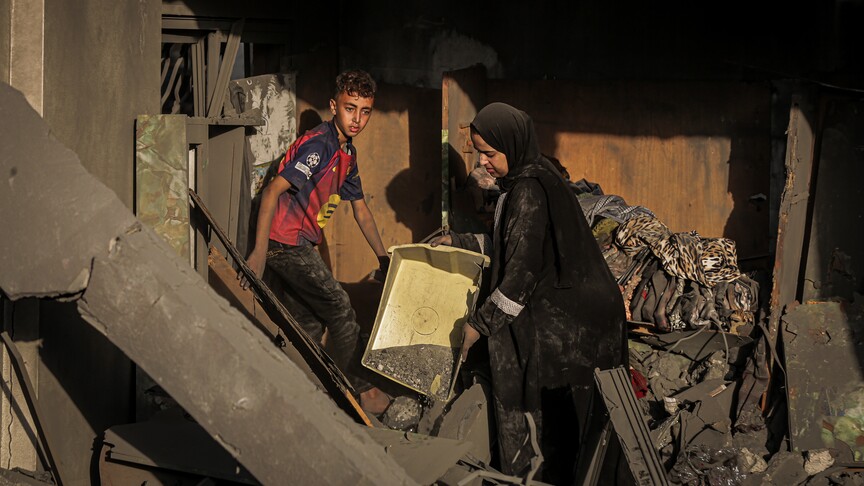
Israel is restricting prosthetics and rehabilitation equipment from entering Gaza, leaving thousands of children waiting for a medical evacuation that may never come.
A porcelain fish survived the Russian strike that destroyed a room in the Kyiv apartment of Andrii Dubenko, a volunteer, dentist, and medic, his cousin Anna Danylenko wrote on Facebook and told UP Life, the lifestyle site of Ukrainska Pravda. Dubenko and two others were inside the nine-story building in Lisovyi masyv when the 13 October strike hit. It killed other residents.
The strike came during a ballistic attack aimed mainly at CHP-4, one of Kyiv’s main power plants, Ukrainian President Volodymyr Zelenskyy said, two days after Washington announced an energy ceasefire that Moscow never confirmed.
Lifted out in a rescue basket
Dubenko, his girlfriend, and a 72-year-old aunt were inside when the blast hit, Anna told UP Life. Her family was lucky, she wrote, and the rule of two walls saved their lives. The rule tells anyone who can’t reach a shelter to keep at least two walls between themselves and the street, away from windows. Fifteen minutes after the blast, State Emergency Service rescuers lifted the three out in a basket, Anna wrote. The aunt comforted the girlfriend, telling her not to live in the past but to look to the future, Anna said.
The porcelain fish that survived Russia’s 13 October 2026 strike on an apartment building in Kyiv’s Lisovyi masyv. Photo: Anna Danylenko/Facebook
A hole where the window was
“Just on Monday I was sitting in their cozy apartment, where I grew up, and now I’m looking into a hole that just two days ago was a window,” Anna wrote.
She gathered what was left of the tea set the family used for samovar tea while her grandmother was alive. “It was my anchor, the anchor of our family,” she wrote. The porcelain fish survived. Her mother used to play with it, and Anna now calls it the “fish of unbreakability.” UP Life likened it to the ceramic rooster that survived in a wrecked kitchen in Borodianka, Kyiv Oblast, in 2022 and became a symbol of Ukrainian resilience.
The family didn’t sleep that night. Firefighters were still putting out the blaze overnight, so they could only get back inside in the morning.
“Charred ruins, lots of water in the hallway, which burned out. People are throwing broken things out the window, down by the building. The smell of burning is everywhere,” she told UP Life.
More than 38,000 killed, 11,700 left with lifelong disabilities, while nearly 1 million women and girls have been forced from their homes. See the full fact sheet
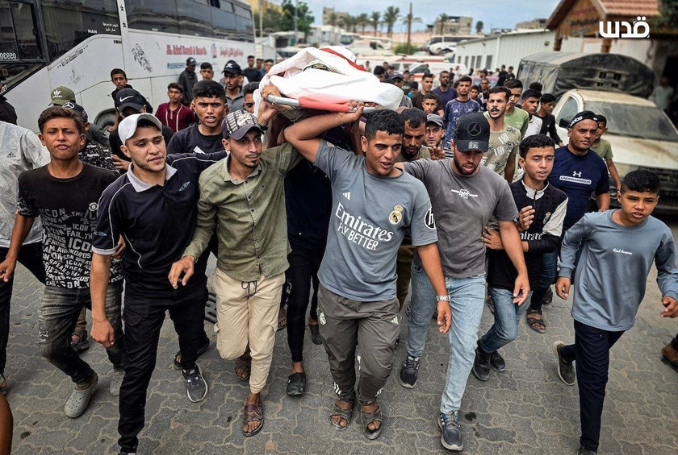
Four Palestinians on Tuesday and one on Wednesday were killed or died from earlier wounds amid Israeli airstrikes, artillery shelling, gunfire, and demolition operations across the Gaza Strip

 Login