❌

Reading view

Flying drones are a risky way to rescue wounded troops. A Ukrainian official says they're a 'lifeline of last resort.'

A serviceman of the Special Police Battalion launches a Vampire combat drone flying over the positions of Russian troops, amid Russia's attack on Ukraine, in the Zaporizhzhia region, Ukraine, April 29, 2025.
Ukraine has begun using heavy-lift drones for casualty evacuation missions.

Stringer/REUTERS

  • Ukrainian forces said Monday that they pulled off a "first-ever" air evacuation using a heavy drone.
  • Deploying large aerial drones for battlefield casualty evacuation is a high-risk operation.
  • A Ukrainian official involved in the development of such drones called them a last-resort tool.

Several Ukrainian companies have developed heavy-lift drones that can evacuate wounded soldiers from the battlefield, but the risks mean they should be used only as a last resort, an official involved in these efforts told Business Insider.

Denys Lohvynenko, the drone chief at Brave1, Ukraine's state-backed innovation platform, said that heavy-lift drones provide a time-sensitive means of rescuing wounded troops in highly dangerous situations where they cannot walk on their own and other evacuation methods are unavailable.

Ukraine began developing heavy-lift drones two years ago, but the complex technical requirements took time to iron out.

On Monday, a Ukrainian military unit said that it had used a heavy drone to save a wounded soldier from the front lines, carrying out what it described as a "first-ever air evacuation."

The presence of land mines and Russian drones rendered the use of ground robots — for Kyiv, an increasingly common method of casualty evacuation — too challenging.

"In these situations, heavy-lift aerial evacuation serves as a lifeline of last resort," Lohvynenko explained in remarks shared by Brave1, which has supported the development of these drones and other war technology.

Ukraine's 92nd Separate Assault Brigade said Monday that soldiers used a six-rotor hexacopter made by the Ukrainian company Gurzuf Defense to carry out the mission. Other defense companies are working on similar technology; SkyFall, for instance, recently unveiled its own hexacopter for evacuations.

Ukrainian forces also use heavy-lift drones for logistics missions, as they can typically carry more cargo than smaller variants.

A challenge is that big drones are big targets. Samuel Bendett, a drone warfare expert at the Center for Naval Analyses, a US research organization, told Business Insider on Monday that certain elite Russian military units are focused on downing such aircraft.

A heavy bomber drone lowers an injured Ukrainian soldier.
A Ukrainian unit said it pulled off a "first-ever" casualty evacuation with a heavy drone.

Ukraine's 92nd Separate Assault Brigade/Screengrab via Telegram

Lohvynenko said Ukraine understands the risk of using large drones in and around contested airspace, as is the case along most of the front lines. So they are "reserved only for high-risk, high-priority emergencies," he said.

The heavy-lift drones have also been equipped with what he described as "additional survivability systems," including electronic warfare and alternative communications. Active protection systems could be installed in the future.

"We maintain a realistic view of the technological and operational challenges associated with aerial extraction of personnel via heavy-lift drones," Lohvynenko said.

"However, establishing this technical capability is essential," he continued, arguing that a "single life saved on the battlefield justifies every engineering hour and resource invested in this program."

Combat casualty evacuation has become increasingly robotic for Ukraine as the country's officials, companies, and military units look to replace soldiers with machines in dangerous front-line missions wherever possible.

Ground robots, in particular, are seen as crucial tools for casualty evacuation and logistics. Ukraine's defense ministry said last month that the number of these kinds of missions carried out by robots has jumped more than threefold since January.

The deployment of a heavy-lift drone for an evacuation, an unusual mission, underscores Ukraine's growing efforts to use uncrewed systems in unconventional battlefield roles.
Read the original article on Business Insider

  •  

Ukrainian forces say they used a heavy drone to evacuate a wounded soldier for the first time

A heavy bomber drone lowers an injured Ukrainian soldier.
Ukrainian forces carried out what one unit described as a "first-ever air evacuation."

Ukraine's 92nd Separate Assault Brigade/Screengrab via Telegram

  • A Ukrainian military unit said on Monday that it had carried out a "first-ever air evacuation" with a drone.
  • The unit used a heavy drone to save a wounded soldier from the front lines.
  • The mission underscores Ukraine's growing efforts to use drones in unconventional battlefield roles.
Ukrainian forces have used a heavy drone to save a wounded soldier from the front lines, carrying out what one unit described as a "first-ever air evacuation."

The unusual mission underscores Ukraine's growing efforts to use drones and robots in unconventional roles on the battlefield, including casualty evacuation, logistics, and combat.

Ukraine's 92nd Separate Assault Brigade disclosed on Monday that it had "successfully" medically evacuated a wounded soldier who had been hurt at the front. The presence of land mines and Russian drones meant that a rescue operation using ground robots was not an option.

"Specialists from our company took on the responsibility of doing something that no one had done before: evacuating a soldier using an aerial drone," the brigade wrote in a translated statement on Telegram.

Soldiers used a heavy six-rotor hexacopter made by the Ukrainian company Gurzuf Defense for the medevac mission. The aircraft was tested in advance and modified by unit specialists to ensure it remained stable.

The 92nd said several military units participated in the rescue, including the 30th Separate Mechanized Brigade, which operated the drone that evacuated the wounded soldier. The soldier is now recovering from his injuries. The unit didn't specify when or where the evacuation took place.

"This is a historic event, at least for our unit," said Napalm, the squad leader and programmer for a robotics company in the 92nd, who was identified only by his call sign.

A Ukrainian soldier is carried by a heavy bomber drone.
Footage shows the wounded Ukrainian soldier being carried by a heavy drone.

Ukraine's 92nd Separate Mechanized Brigade/Screengrab via Telegram

Casualty evacuation missions have become increasingly robotic this year as Ukrainian officials, companies, and units push to replace soldiers with machines in dangerous front-line roles.

Ukraine's defense ministry said in early September that the number of ground-robot casualty-evacuation and logistics missions has increased more than threefold since the start of the year, from roughly 7,500 in January to more than 25,000 in August.

The deployment of an aerial drone for casualty evacuation reflects a continued effort to use drones in new ways.

Gurzuf Defence, the maker of the drone used for the mission, called it an operation "that no one has ever performed before." The company said that Ukrainian forces used an aircraft called the Heavy Shot "AYUDAG 6" and the mission lasted roughly 75 minutes and covered a distance of nearly 40 miles.

Gurzuf Defence is not the only Ukrainian company working on this technology; SkyFall, the firm behind the P1-SUN interceptor, recently unveiled a large hexacopter for casualty evacuation.

Large drones can carry heavier payloads, but their size can also be a vulnerability on the battlefield. Samuel Bendett, a drone warfare expert at the Center for Naval Analyses, a US research organization, wrote on social media that there are "obvious dangers" with large, slow aircraft conducting casualty evacuation missions.

Bendett said that the Russian military spends "considerable resources" targeting heavy-lift drones. He told Business Insider that Moscow's elite Rubicon units are particularly focused on downing such aircraft.

As Russia's full-scale invasion grinds on, Ukrainian forces are continuing to innovate with their drones. Last month, for instance, the Third Army Corps revealed that it had become the "first in the world" to air-drop ground robots from drones in combat. Other units have deployed similar technology.

Read the original article on Business Insider

  •  

The Iran War is sprawling into an inflation nightmare for Trump ahead of the midterms

Donald Trump speaking to reporters

Getty Images; Bloomberg/Getty Images; BI

  • As the Iran War continues, gas prices remain high — a real strain for consumers.
  • The conflict has kept diesel, crude oil, and gas prices high; inflation is eating up pay hikes.
  • As America heads into midterms, it's a hard affordability position for President Donald Trump.

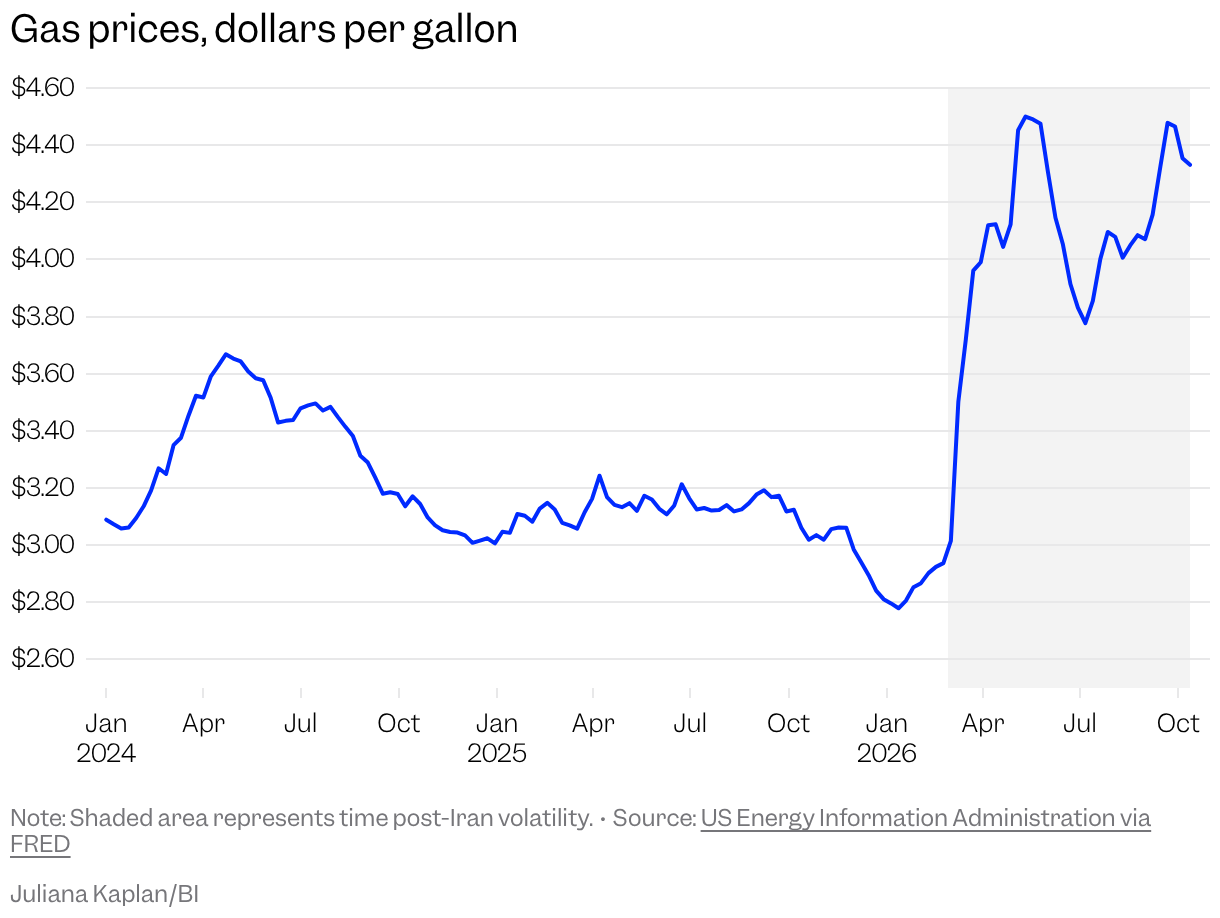
It's expensive out there: Gas prices have been stuck at over $4 a gallon for more days this year than any other. The war in Iran shows no signs of cooling off. Inflation is swallowing any raises you might have gotten at work.

It's a recipe for a challenging midterm cycle for President Donald Trump, who faces an affordability crisis at home that's not going away — and a far-away war that's only making costs go up.

The volatility surrounding the contested Strait of Hormuz, a key oil and gas transit waterway, has hit American consumers hard.

Since the Iran war first kicked off in February and the Strait was subsequently closed, gas and oil prices have skyrocketed. Diesel prices have hit record-breaking highs in recent weeks. That paints a dreary picture for Americans struggling with high costs, who likely won't feel any relief at the pump in the near future — especially as more potential military action looms.

Trump has highlighted the broader goals of the war and argued that the increase in gas prices would be transient. In an October 8 Truth Social post, he wrote, "a temporary increase in the price of Gasoline is a small price to pay for Iran not having a Nuclear Weapon."

While the US military has not carried out airstrikes against Iran directly in several months, it has kept a significant force presence in the Middle East, including more than a dozen warships, dozens of fighter jets, and thousands of sailors and Marines.

US forces in the region are maintaining a naval blockade against Iran, and since July, they have disabled four commercial ships that the Pentagon said were sailing in violation.

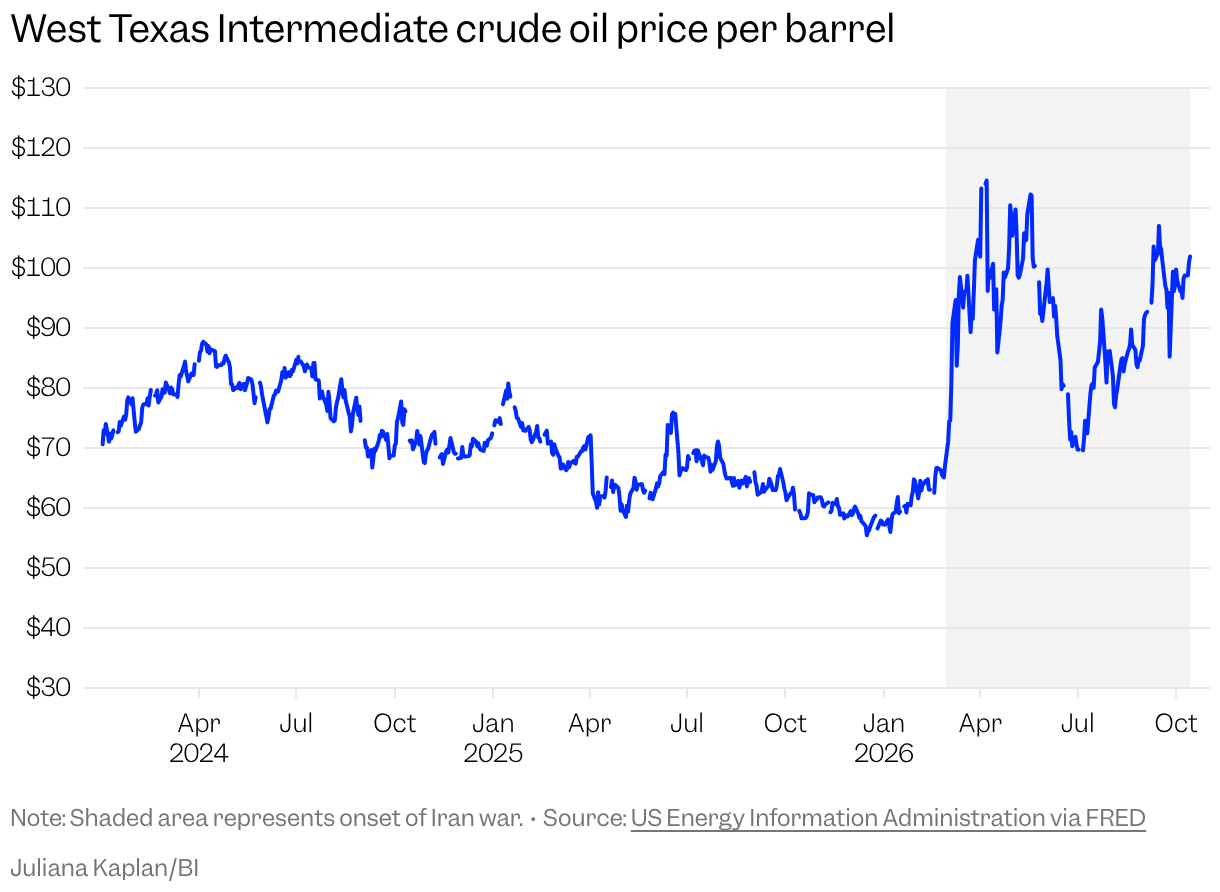
After the start of the war in February, crude oil prices soared and remain significantly higher than when Trump's second term began.

Line chart

Tanker traffic through the Strait of Hormuz nearly ground to a halt early in the Iran war, severely disrupting a waterway that normally carries about a fifth of the world's oil supply. Shipments have since recovered substantially but remain below prewar levels.

The Trump administration said it aims to alleviate issues related to oil. "The President wants to see prices at the pump fall and continues to take historic measures to alleviate temporary disruptions as oil flowing through the Strait of Hormuz approaches pre-conflict levels," White House spokeswoman Taylor Rogers said.

Vessels carrying oil and other products have continued to take fire from both sides, putting more pressure on commerce traveling through the area. US forces have carried out additional strikes on Iranian-linked targets. The Pentagon said they have destroyed 10 tankers tied to the Islamic Revolutionary Guard Corps, or IRGC, since July.

Meanwhile, several merchant ships have come under attack in and around the Strait of Hormuz this month, according to the Royal Navy-affiliated United Kingdom Maritime Trade Operations Center. US Central Command, which oversees American military operations in the Middle East, has attributed some of these strikes to Iran.

The ripples of volatility in oil prices are showing up at the pump. Long gone are the days of gas stations touting below-$3 prices; prices are still hovering in the mid-$4 range. High gas prices are even tamping down spending among higher-income consumers, and soaring costs have led to a rise in "hypermilers" — drivers who try to optimize and gamify their habits to get the best value per gallon.

Line chart

Diesel prices in the US have spiked even more, up to around $6.18 per gallon, an over $2.50 increase over the year, per the Energy Information Administration. In California, diesel is hovering over $8 a gallon.

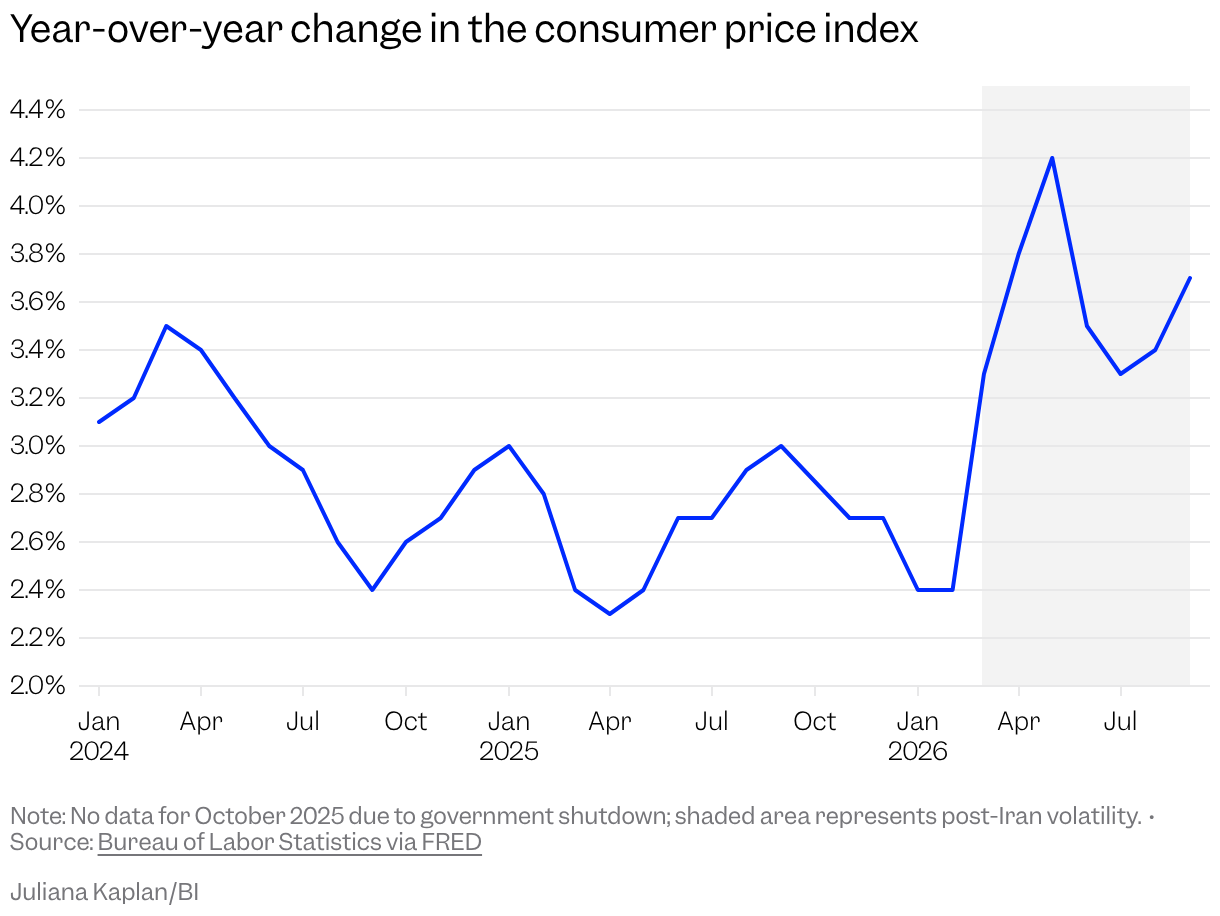
Those fuel and energy strains are pushing up costs across the economy. Inflation as tracked by the consumer price index increased to 3.7% year-over-year in September — higher than economists expected. That was driven in large part by soaring gas and energy prices, with energy rising by 20.4% year-over-year and gas by 34.2% in the same period.

Line chart

Higher inflation has put pressure on the Fed and bond markets. In September, the central bank raised rates for the first time in three years to try to combat rising prices, with one more hike potentially coming by year's end. The 10-year Treasury yield, which influences borrowing costs for mortgages, auto loans, and credit cards, has surged since the war began, from below 4% at the end of February to a high of 5.31% this month. The 30-year mortgage has risen nearly in lockstep, going from just under 6% to 7.5% during the eight-month conflict.

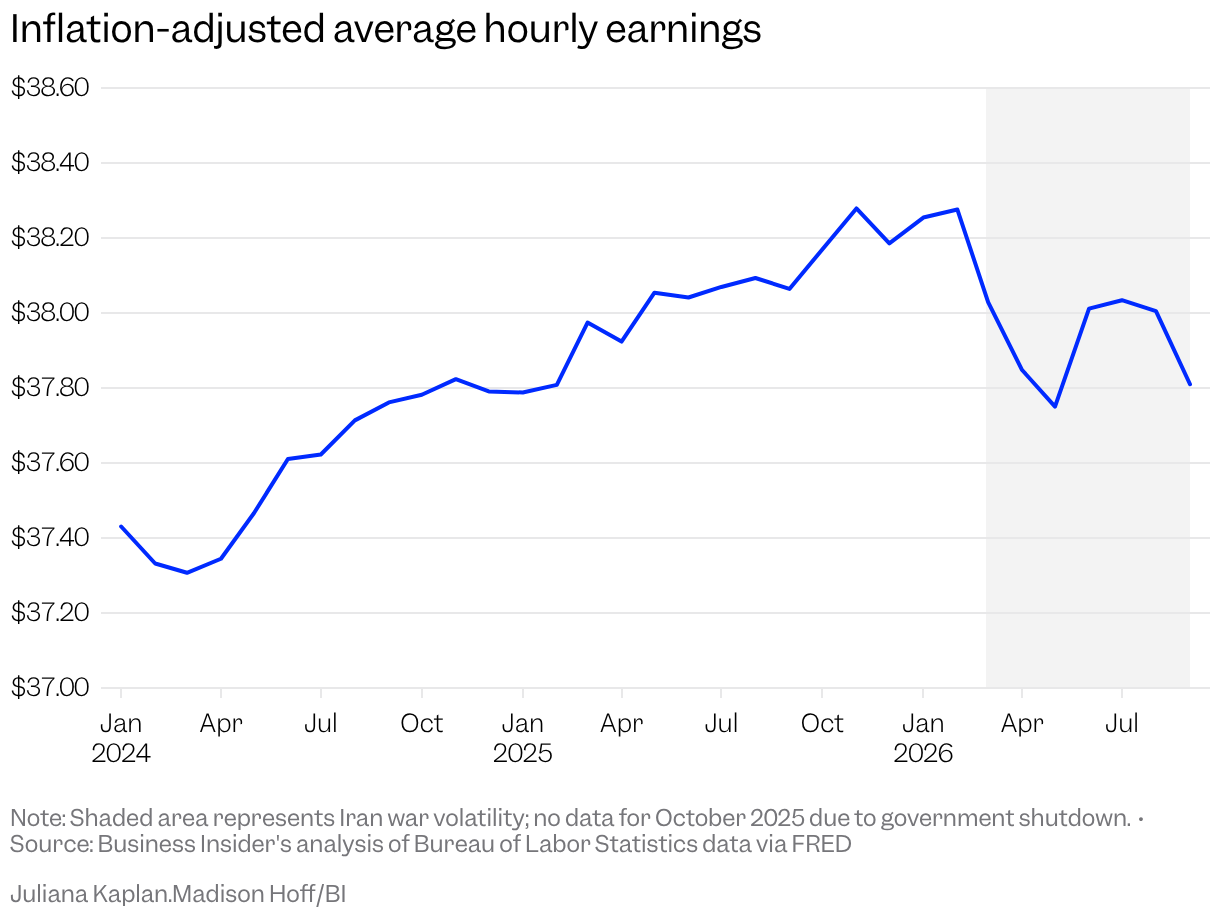
For everyday Americans, all of these international strains amount to what is, essentially, a pay cut. Wage growth remains slow and steady, but, over the past few months, rising prices have outpaced pay increases. Inflation-adjusted wages have slumped since the start of the war, and have given up nearly all their gains since the start of Trump's second term.

Line chart

When asked for comment, the White House highlighted that by some measures, earnings are still outpacing inflation. "Under President Trump, private sector workers have seen their wages continue to outpace inflation, with average annual earnings growing by more than $600," said White House spokesperson Matthew Middleton.

And, with midterm season in full swing, affordability is on the ballot for many voters. The current economic situation shows no immediate signs of changing — another blow for Trump, who's been on a quest to bring down gas prices.

There are growing signs that the US could be preparing for fresh military action against Iran. Another aircraft carrier strike group is sailing across the Pacific and is expected to enter the Middle East.

The Trump administration is also facing a resurgence in attacks from the Houthis, a rebel group in Yemen. In recent weeks, the Iran-backed rebels have seized key territory along the Red Sea, allowing them to threaten the Bab al-Mandeb Strait, another maritime chokepoint like Hormuz, and have ramped up missile strikes against Saudi Arabia.

The Houthis previously tormented Red Sea shipping, leading the Trump administration to launch a major bombing campaign last year that ended in a ceasefire. The rebels have since rearmed.

Any other disruptions there might be bad news for consumers, potentially bringing more price spikes across the many goods shipped through that chokepoint.

Read the original article on Business Insider
  •  

Starlink is a 'major card' for Ukraine, soldiers say, but surprise restrictions show the risks of overreliance

A soldier operates a Ukrainian drone.
The sudden disruption of Ukraine's military-grade Starlink access has exposed a key vulnerability.

Dmytro Smolienko via Reuters Connect

  • Ukraine's access to military-grade Starlink services was suddenly disrupted this week.
  • Kyiv said the disruption affected critical Ukrainian drone operations.
  • Ukrainians say the incident exposes the risks of relying so heavily on a single communications platform.

The sudden disruption to Ukraine's access to military-grade Starlink services this week shows the risks of overly relying on any single platform, particularly one beyond Kyiv's control, for mission-critical battlefield communications, Ukrainian soldiers, officials, and defense companies told Business Insider.

With those risks front of mind, Ukrainians are working to diversify military-related communications platforms beyond Starlink.

Ukrainian officials and soldiers were surprised on Wednesday by an unexpected disruption to Starshield, SpaceX's dedicated satellite network for military services. Defense ministry sources said speeds were restricted above 100 miles per hour, though some units experienced a loss of connectivity at speeds as low as 45 mph.

Services appeared to have been at least partially restored by Thursday. The full extent of the disruption remains unclear, but the incident has left some Ukrainians feeling uneasy.

Yehor Cherniev, deputy chairman of the Ukrainian parliament's national security, defense, and intelligence committee, told Business Insider that the disruption underscores the risks of relying on a single communications platform. He said Kyiv is working to diversify its sources, but declined to specify how.

Yuriy, an officer with Ukraine's National Guard, told Business Insider that his units use Starshield to support drone operations, and several missions were spoiled during the disruption. He asked to be identified only by his first name for security purposes.

Yuriy said that while Starlink services are useful, the disruption exposes their unreliability. He said he would try to find alternate communications systems.

Alternatives to Starlink could be hard to find, though. Eutelsat, a large French satellite operator, saw its shares surge after this week's disruption, but Ukrainians say there is nothing else quite like what SpaceX offers.

"There is no working alternative to Starlink," said Dimko Zhluktenko, a soldier with Ukraine's 413th Unmanned Systems Regiment, calling it "an outstanding product."

Starlink was in the position of one of the units of the 505th Marine Battalion in the Novopavlivka direction on April 1, 2026, in unspecified Ukraine.
Ukrainian forces are heavily reliant on Starshield, particularly for drone operations.

Ivan Antypenko/Suspilne Ukraine/JSC UA:PBC/Global Images Ukraine via Getty Images

"No direct competitor comes close," he told Business Insider, adding that "Europe has nothing comparable at this level of battlefield readiness."

SpaceX did not respond to requests for comment from Business Insider this week.

Ukraine relies on Starlink for battlefield communications and drone warfare, a dependence that was underscored by the disruption. Defense ministry sources said the disruption complicated important drone operations, including mid-range strikes, air defense intercepts, and front-line logistics.

Ukraine uses both Starshield and Starlink, SpaceX's commercial satellite internet service, to extend the reach of its drones, maintain stable communications in electronically contested environments, and conduct remote operations far beyond the front lines.

Satellite connections allow operators to control drones and receive live video without relying on traditional radio links, which have limited ranges and are much more vulnerable to electronic warfare interference.

The tech has been integrated into systems such as Perennial Autonomy's Hornet drones, as well as Ukrainian naval drones used to strike Russian targets in the Black Sea, among others.

Many Ukrainian defense companies have integrated Starlink services into their broader infrastructure, even if their products don't necessarily depend on it for operations.

Some firms, such as SkyFall, maker of the widely used P1-SUN interceptor drone, told Business Insider that they have developed their own communication methods or use alternative systems to avoid scenarios where a single technology outside Ukrainian control could become a significant point of failure, as it did this week.

"Depending on a single solution is very risky. Especially if you don't have full control over it," a spokesperson for Wild Hornets, the firm behind the popular Sting interceptor drone, told Business Insider. "Especially when it comes to something as critical on the battlefield as communications."

The spokesperson said this is "exactly why our ecosystem is built around our own communications technology and is open to various solutions when it comes to internet connectivity."

A MAGURA V5, a Ukrainian multi-purpose unmanned surface vehicle (USV).
Ukrainian soldiers, officials, and defense firms say relying on one communications source is a risk.

Pavlo Bahmut/Ukrinform/Sipa USA via Reuters Connect

For anyone working with technologies that are dominated by a single provider, the risks are clear, said the head of hardware research and development at BlueBird Tech, a defense firm that makes drones and robots. They told Business Insider that Starlink has virtually no competitors because of its coverage, cost, availability, and ease of use.

BlueBird Tech uses Starlink services but is trying to avoid tying its products completely to any single technology. "We're actively exploring ways to introduce redundancy and potentially replace these components in the future," they said, speaking anonymously due to security concerns.

They said that potential workarounds include LTE or 5G technology, mesh networks with relay points, and laser communications. "Research teams around the world are working on these technologies," they said, "although none of them should be seen as a universal replacement for Starlink across every operational scenario."

When the disruption first occurred on Wednesday, some Ukrainian and foreign officials initially blamed SpaceX, led by Elon Musk. However, the world's richest man said on X on Wednesday that because Starshield is operated by the US government, any limits on speed would be a decision for the Pentagon or President Donald Trump.

A senior US official told Business Insider on Thursday that "no such request was ever made by" Trump. Reuters reported that the order came from inside the White House.

Starlink has delivered Kyiv an important battlefield advantage, especially since SpaceX cracked down on Moscow's ability to use the terminals earlier this year. The system, however, does not work in Russia, so Ukraine is limited to using its services over its own territory and Russian-occupied lands.

Ukraine has been unable to use Starlink for its long-range drone strikes that have wreaked havoc on Russian energy sites. Trump has pushed Kyiv to stop its attacks as he attempts to use Russian oil to lower gas prices.

Ukraine has found itself facing mounting pressure from the US, once a top supporter, as it continues to grapple with Russian missile and drone strikes amid severe shortages of critical air defense interceptors. The Starlink outage has only compounded Kyiv's anxieties as it anticipates yet another tough winter.

"Starlink is a major card on the battlefield," Zhluktenko said. "You can fight without it — even successfully — as the Russians show, but less effectively, at higher cost, and with constant communication headaches, above all for unmanned systems."

Read the original article on Business Insider

  •  

Ukraine's vital access to military-grade Starlink services is coming back after a sudden disruption, sources say

A Ukrainian soldier of the 61st Separate Mechanized Brigade uses the Starlink system during military exercises.
Starlink equipment is a common sight on the front lines in Ukraine.

Maxym Marusenko via Reuters Connect

  • Ukraine's access to military-grade Starlink services is returning, sources told Business Insider.
  • Defense ministry and parliamentary sources said on Thursday that Starshield operations had been at least partially restored.
  • On Wednesday, Ukraine was caught off guard by sudden speed restrictions, affecting drone missions.

Ukraine's access to military-grade Starlink services appears to have been at least partially restored on Thursday, a day after Kyiv was stunned by sudden speed limits that it said hamstrung some drone operations.

Ukrainian defense ministry sources told Business Insider that Starshield services remained functional while in motion as of roughly 11:45 a.m. local time on Thursday, according to reports that they had received from military units.

The sources said the defense ministry is working to understand how and why there was a disruption to the operation of Starshield, SpaceX's dedicated satellite network for military services.

Yehor Cherniev, the deputy chairman of the Ukrainian parliament's national security, defense, and intelligence committee, told Business Insider that Starshield services had been restored to their pre-disruption capacity.

Ukrainian officials and service members were caught off guard on Wednesday by the unexpected Starshield disruption, which they said restricted speeds above 100 miles per hour. Some units experienced a loss of connection at speeds as low as 45 miles per hour.

The full extent of the service limitation remains unclear.

Yuriy, an officer with Ukraine's National Guard, told Business Insider that his units use Starshield to support drone operations and that speeds were back above 100 miles per hour as of Thursday morning. He asked to be identified only by his first name for security purposes.

However, Yuriy said that several operations were disrupted during the earlier restrictions.

Defense ministry sources said the disruption complicated mid-range strikes, air defense intercepts, and front-line logistics. Starlink does not work inside Russia, so the issue was limited to missions in Ukrainian territory or Russian-occupied territory.

Person in camouflage uniform sits on concrete steps using a device near a satellite antenna outside a brick building.
Starlink has been a game changer for Ukrainian operations, especially by ensuring connectivity for drone warfare.

Andriy Dubchak/Frontliner/Getty Images

The sudden Starlink disruption caused widespread confusion and raised questions about the source of the decision and whether it was connected to tensions between President Donald Trump and Ukrainian President Volodymyr Zelenskyy over Kyiv's targeting of Russian energy facilities.

Ukrainian forces use Starlink, the commercial satellite internet service run by SpaceX, and Starshield, a secure network for military and government work built by the company but operated by the US government. Some Ukrainian officials initially blamed SpaceX for the disruption.

In an X post on Wednesday responding to Ukraine's former defense minister, SpaceX CEO Elon Musk put the issue on the Trump administration, saying that Starshield was "owned and controlled by the American government." He said "any limits on speed or usage are decided by the US military and ultimately POTUS."

A senior US official told Business Insider Thursday afternoon that "no such request was ever made by the President."

The Pentagon has not responded to requests for comment.

Sprawling influence

The outage and impact on front-line operations have called attention to Ukraine's deep dependence on Starlink, which has become critical for battlefield communications and drone warfare.

As Business Insider recently reported, Starlink's rapid expansion has given Musk and SpaceX an enormous source of influence and soft power, and the world's richest man has not been shy about using that power in Ukraine to influence the course of the war.

Musk said in 2023 that he refused a request from Ukraine's military to activate Starlink to assist a Ukrainian assault on the occupied Crimean peninsula. Earlier this year, SpaceX clamped down on Russian forces' use of Starlink terminals in Ukraine, handing Ukraine a key battlefield advantage.

While support for Ukraine has varied, Musk has consistently been a prominent critic of the Ukrainian president. In an X post late on Wednesday, hours after responding to Ukraine's defense minister, he wrote that it was "time for Zelenskyy to go."

The sudden Starlink disruptions came as Ukraine faces growing pressure from the US, with Trump pushing Kyiv to halt its strikes on Russian energy facilities. The US president said on Tuesday that Washington had not cut intelligence sharing with Ukraine, another concern for the country.

Cherniev, the Ukrainian lawmaker, confirmed on Thursday that the US continues to share intelligence with Kyiv.

Meanwhile, Russia has intensified its ballistic missile attacks against Ukraine, firing dozens overnight. Recent attacks have targeted Kyiv and Ukrainian energy facilities.

Read the original article on Business Insider

  •  
❌