❌

Reading view

Arizona Man Awarded $67,500 on Behalf of Aborted Embryo
An ultrasound image showing a judge's gavel | Photo: Kohanova/Envato (AI-modified)

An Arizona abortion clinic that didn't tell a pregnant woman about the physical characteristics of her 8-week-old embryo before prescribing abortion pills has been found liable in a case brought by the ex-husband of the pregnant woman, who didn't want her to get an abortion.

The ex-husband, Mario Villegas, was awarded $67,500 in a civil lawsuit accusing the clinic of violating an informed consent law that an Arizona court declared unconstitutional earlier this year.

'A Dangerous Precedent'

The Lawyering Project, which represented the doctor and clinic being sued by Villegas, had warned that the case could "establish a dangerous precedent in Arizona concerning embryonic personhood and chill the provision of abortion care."

"A pre-viability embryo or fetus is not a person," says its website in a summary of the case, "and a physician cannot be subject to a wrongful death action for providing high-quality abortion care to a patient who wants an abortion."

In an August 2024 order, Judge Bryan B. Chambers of the Arizona Superior Court in Gila County agreed with the defendants that Arizona's wrongful death statute does not, as written, apply to the death of embryos. The court is "unwilling to expand the common law definition of 'person' as applied to the wrongful death statute to include all unborn children whether viable outside the womb or not," Chambers wrote.

But that doesn't mean he tossed Villegas' lawsuit entirely. And in a judgement released July 22 but largely unnoticed until this week, Chambers wound up holding that Villegas is entitled to $5,000 in statutory damages and $62,500 "in compensatory damages for his psychological, emotional, and physical injuries."

No one in the case alleges that Villegas' ex-wife—referred to in court documents as M.S.V.—was tricked, coerced, or generally uninformed about the abortion. The case turns on technicalities and Arizona's onerous, biased (and now barred) requirements for what abortion doctors must tell patients in order to obtain informed consent.

'Deprived of the love….of his child'

M.S.V's abortion took place in July 2018, when she was around eight weeks pregnant. At the Camelback Family Planning clinic in Phoenix, she was provided with information at least 24 hours before she could come back for the abortion pills, and she signed various consent forms, including one affirming that she was "comfortable with [her] decision to terminate this pregnancy," according to ProPublica.

Around two years later, in July 2020, Villegas—now divorced from M.S.V.—sued the clinic and physician Gabrielle J. Goodrick, alleging medical malpractice and wrongful death. Villegas "has been deprived of the love, affection, comfort, and companionship of his child," his initial complaint stated. He "has been deprived of his constitutionally protected right to parent Baby Villegas."

Villegas sought to have himself appointed the personal representative of the estate of the aborted embryo, and a probate judge agreed.

In an amended complaint, Villegas added that "the estate has been deprived of the net income Baby Villegas would have earned during her lifetime" and sought damages for that, too. (Villegas took the liberty of assuming the embryo was a girl, even though the abortion would have been too early in the pregnancy to tell.)

"Across the U.S., people have sued for negligence in the death of a fetus or embryo in cases where a pregnant person has been killed in a car crash or a pregnancy was lost because of alleged wrongdoing by a physician," noted ProPublica in a 2022 article about the case. "But a court action claiming the wrongful death of an aborted embryo or fetus is a more novel strategy, legal experts said."

Informed Consent or Compelled Speech?

Ultimately, the case came down to Arizona's informed consent law, not fetal personhood.

In the amended complaint, Villegas argued that the clinic had violated Arizona law on informed consent for abortion.

That law—declared unconstitutional in February 2026—said that doctors must obtain informed consent before performing abortions (which is normal) and then added that this consent only counts if clinics obtain it in highly particular (and medically unnecessary) way and tack on a lot of loaded language and anti-abortion rhetoric.

It says that "at least twenty-four hours before the abortion, the physician who is to perform the abortion or the referring physician" must inform a patient woman "orally and in person" about topics such as "alternatives to the procedure or treatment" and "the probable anatomical and physiological characteristics of the unborn child at the time the abortion is to be performed." Doctors were also required to tell a woman seeking an abortion that if she went through with the pregnancy, various forms of assistance may be available.

Villegas alleged that even though his wife technically consented to the abortion, it didn't count because the information wasn't provided by the same doctor who prescribed her the pills, and because doctors didn't warn her about the potential "loss of the 'maternal-fetal' attachment bond inherent in birthing a child" and didn't explain alternatives to abortion or the 8-week-old embryo's physical characteristics.

He also complained that the printed form M.S.V. was given "changed the statutory term 'the probable gestational age of the unborn child' to 'the probable gestational age of the pregnancy,' which misstates Arizona's legislative determination that every pregnant woman is carrying a human child."

M.S.V. testified in court "that nothing would have changed her mind about obtaining the abortion," as Chambers put it in his judgement. And no one alleges that the clinic simply failed to discuss some risks and other relevant information with her before the procedure. It simply failed to use the loaded language preferred by the state.

But "the statute does not require proof that M.S.V. would have made a different decision had she been fully informed," wrote Chambers in his judgement. And even if some of the rules of informed consent were followed, "nothing in [Arizona law] suggests that substantial compliance with the consent provisions is all that is necessary."

Fortunately, the informed consent law at the heart of this case has been struck down, so future doctors don't have to worry about being sued for failing to say "unborn child."

But there's still something chilling about the way all this played out. M.S.V. had argued to court that she was tricked into pregnancy—she thought her ex-husband "was fixed," because he'd had a vasectomy, though it was since reversed. Chambers said this did not negate her consent to sex with him, since M.S.V. "was not deceived about the nature of the act. At most, she was deceived about a potential consequence (pregnancy risk)."

In M.S.V.'s telling, she did not exactly give informed consent to the sex that led to pregnancy, but she did give informed consent to the abortion procedure. In neither situation, however, do M.S.V.'s claims about her own consent seem to have mattered much at all.


In the News 

The Transportation Security Administration (TSA) shows "significant weakness" when it comes to protecting passenger data, according to the Department of Homeland Security Office of Inspector General.

A TSA authentication vendor "was able to access and extract sensitive passenger information, including driver's license and passport images, during system troubleshooting and enhancements, without TSA's knowledge," the report says. More:

TSA lacked clear policies, did not track when this data was extracted, could not verify that extracted information was properly deleted, and did not notify passengers when their biometric and biographic information may have been stored. As a result, although passenger information was generally protected during routine operations, weaknesses in vendor oversight created a risk that sensitive personal information could be retained or exposed.

The Electronic Frontier Foundation comments:

As the OIG's audit underscores, this technology presents privacy risks associated with unsecured data, unauthorized access, and data breaches. The government's use of this technology also creates a mass surveillance system and facilitates the creation of warrantless biometric records for unconsenting parties.

[…] Given that facial recognition technology is prone to mistakes, combined with the OIG's audit revealing significant privacy weaknesses, it is imperative that travelers remember that opting out is possible. TSA's own website emphasizes that travelers who wish to decline to have their photo taken for facial comparison can do so without any delay, disruption, or recourse.


More Sex & Tech 

• You could make a full-time beat out of covering cops' misuse of Flock cameras these days. The latest: "A former Joliet police lieutenant is now facing felony charges for misusing the city's Flock camera system," per CBS News. And, in Sharonville, Ohio, "a police lieutenant was indicted Tuesday after he allegedly used Flock camera systems…29 times between Dec. 19, 2024, and April 20, 2026, to track a person's whereabouts" for personal reasons, Fox 10 reports.

• Airbnb says hosts can't make you wash and dry your own dishes anymore:

I just got an email from Airbnb laying out new ground rules for what hosts can demand of guests, and THANK GOD.

At my last Airbnb, I had to strip the beds, wash every dish, clean the kitchen, haul the trash out to the road, and there was still a $100 cleaning fee! https://t.co/tfQGqQKsRo

— Jessica Huseman (@JessicaHuseman) October 20, 2026

• Another case challenging the use of Flock cameras to get convictions. In Texas, Charles Brownlee—sentenced to 60 years in prison for armed robbery—is asking a federal appeals court to throw out his conviction, "arguing that the AI-powered camera system gives law enforcement more surveillance power than the Constitution allows," per The Texas Tribune.

• A California law that takes effect in 2027 "will require large companies to make a good-faith effort to link customers to a human by phone within 15 minutes," notes The San Francisco Standard. "But it has a carveout for companies that never offered phone support in the first place. It remains to be seen whether the legislation will hold any sway over the AI firms leading the charge to replace human agents."

• Jacob Sullum delves into a convoluted lawsuit filed against Students for Life by a Texas woman who opposes a Texas anti-abortion law.

• In the latest incident to blur the line between the FBI catching criminals and creating them, an FBI task force catfished a high school maintenance worker using an AI-generated image of a 15-year-old, then used Clearview AI facial recognition tools to identify him and Flock to track his car.

The post Arizona Man Awarded $67,500 on Behalf of Aborted Embryo appeared first on Reason Magazine.

  •  

Abortion Is on the Ballot in Four States in 2026

Voters in Virginia will be voting on whether to enshrine the right to abortion in their state constitution, and a ballot measure in Idaho would create a statutory right to abortion in the state. In Missouri, voters have the chance to undo a ballot measure from 2024 that added a right to abortion to the state constitution.

The post Abortion Is on the Ballot in Four States in 2026 appeared first on Breitbart.

  •  

Poland’s parliament votes to ease abortion ban but faces likely veto from president

Measures would remove some penalties for those helping women access abortion but are ‘small-scale step’, say campaigners

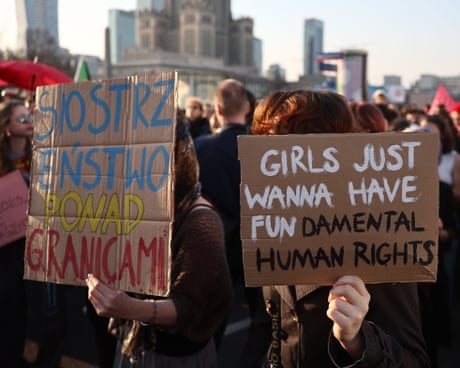
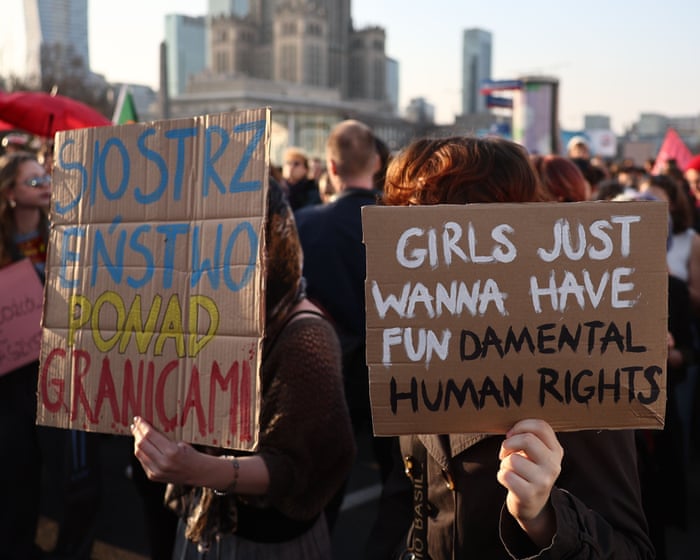
Poland’s lower house of parliament has approved two bills aimed at loosening a near-total ban on abortions, in what campaigners have described as a “small-scale step” ahead of protests calling on the government to fulfil its promises to overhaul the country’s laws.

The new measures, which are likely to be vetoed by Poland’s nationalist president, would remove some of the criminal penalties for those who help women to access abortion care and allow terminations in cases of foetal abnormalities.

Continue reading...

© Photograph: Jakub Porzycki/NurPhoto/REX/Shutterstock

© Photograph: Jakub Porzycki/NurPhoto/REX/Shutterstock

© Photograph: Jakub Porzycki/NurPhoto/REX/Shutterstock

  •  

‘Feminists Lied’ tour aims to challenge abortion, feminism narratives on college campuses

Just over a year after the assassination of Turning Point USA (TPUSA) founder Charlie Kirk, the organization is teaming up with Students for Life of America (SFLA) to launch a tour focused on discussing feminism and abortion with college students. The tour will be the first-ever partnership between the two groups.

The tour, which is being called "Feminists Lied: Prove Me Wrong," is kicking off on Tuesday with eight events scheduled at campuses across the country, including University of North Texas, Grand Valley State University, University of Cincinnati, Boise State University, University of New Mexico, University of Arizona, Southern Oregon University and University of Washington.

The organizations say that the campus tour is aimed at challenging "the claim that feminism and 'reproductive rights' have helped women more than they’ve harmed them."

"There’s a lot of young women who have bought the lies of the second wave and third wave of feminism, and are actually walking around hurt on college campuses unaware of where the pro-life movement really stands with women, all that we do to serve women and families facing unplanned pregnancies and beyond," SFLA President Kristan Hawkins told Fox News Digital.

INSIDE CHARLIE KIRK’S EFFORT TO DEVELOP THE NEXT GENERATION OF CONSERVATIVE VOICES

Hawkins is set to speak at the events and ask the students a fundamental question at the heart of the debate topic: "Have women been told the truth about career, equality, empowerment and motherhood?"

"If men do not have to sacrifice their children in order to succeed, why should women?" Hawkins said in a statement announcing the tour. "A society that values women should treat motherhood as an essential contribution worthy of honor, not a liability. Students deserve to hear that case, and we are going to make it on their campuses."

The "Feminists Lied: Prove Me Wrong" events will mirror Kirk’s famous "Prove Me Wrong" sessions during which he would debate college students and allow them to ask questions about various controversial topics. He was in the middle of one of these events on Sept. 10, 2025, when he was shot and killed.

Since his death, TPUSA has kept Kirk's spirit alive through the Pick Up the Mic initiative, bringing debates and open conversations with a full roster of speakers, including Hawkins.

"Charlie and I were friends, and so it means a great deal to me to be on campuses with his chapters at Turning Point and to really continue doing the work that he set out to do," Hawkins told Fox News Digital.

OPINION: I’M A UNIVERSITY PRESIDENT. OUR PROFESSION SHOULD FINISH WHAT CHARLIE KIRK STARTED

Hawkins said that prior to Kirk's death, the two had been trading stories and photos of their visits to various college campuses where they would speak with students, and she believes it is "extremely important that we continue this free speech work" that Kirk started.

Hawkins rejected criticism of college visits like hers as a form of "rage bait," saying that they are not meant to merely incite division and spark anger, but rather to change minds in meaningful ways.

"These videos, these conversations that we're having, not only do they change [the] minds of the 100-plus students who are gathered who can actually hear the conversation happening in real time, they change tens of thousands of minds of young people online," Hawkins said.

Hawkins told Fox News Digital that she has seen the results of these conversations for herself in real life. She said that she has held children whose mothers were thinking about getting an abortion and changed their minds after watching videos of debates online.

"There's not a doubt in my mind that these conversations are important for saving lives and changing minds," Hawkins said.

CLICK HERE FOR MORE COVERAGE OF MEDIA AND CULTURE

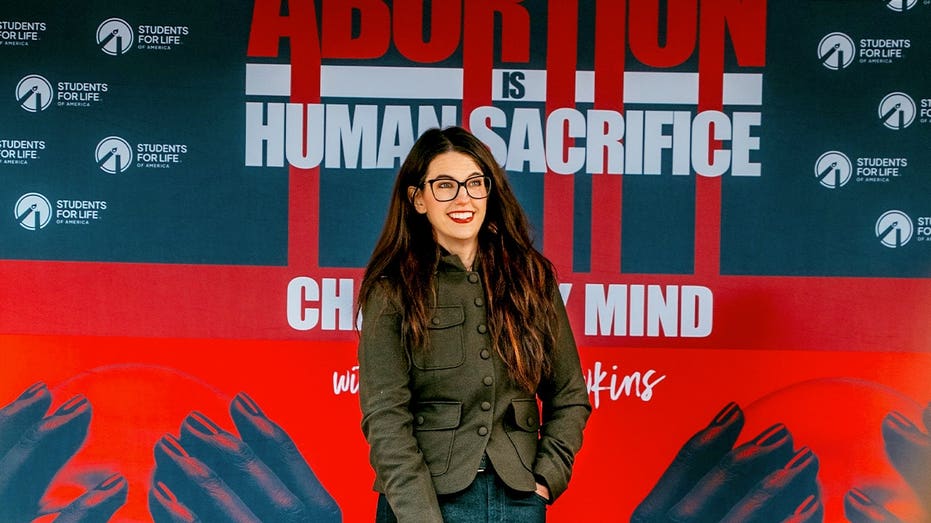
Hawkins is no stranger to campus debates. Over the course of 20 years, she has built a national network of Student for Life campus groups across all 50 states. This past spring, she embarked on the "Abortion is Human Sacrifice" tour, which was also aimed at discussing the issue of abortion with college students.

Hawkins told Fox News Digital that it doesn't matter whether she is at an Ivy League or a community college campus, the conversations often involve the same arguments from pro-choice advocates.

"It really doesn't matter, to be honest with you, if I'm at Harvard or if I'm in a community college or a high school, the questions about abortion are about the exact same, no matter where you go," she said. "You will always get a question about children in foster care, as if a child being in foster care somehow justifies the violence of abortion against a million children a year. You will hear horrific stories about sexual assault and rape, and sometimes these are very deeply personal stories."

Ultimately, Hawkins believes that the key to winning over the hearts and minds of those on the other side comes down to the question of "what is inside a woman?"

"If what's inside a woman is a meaningless clump of cells that is not a human person, then there is no permission needed for abortion, abortion's fine, abortion is nothing," Hawkins said. "But if what's inside of the woman is unique, all-living human being who is completely unique and unrepeatable, then we need to have a conversation about that human being because all of those things that you hear as a justification for abortion under circumstances, those stop being justifications for harming another member of our human species."

While the conversations may have stayed the same, the demographics, according to Hawkins, are changing. She noticed that Gen Z men tend to be more pro-life than millennial men. However, Gen Z women still tend to be pro-choice, according to Hawkins. The pro-life advocate wants to help these young women understand how feminism has failed them.

"When I'm on campus today, when I am on campus this semester, a lot of my conversations are going to be towards the women and really addressing the lies that the second wave, the late second-wave feminists, the third-wave feminists, told women, that they needed abortion in order to be free and equal. That that was going to make us happy and responsibility-free, and it hasn't worked and by any measure by looking anxiety rates, depression rates, SSRI use, that hasn't worked," Hawkins told Fox News Digital. 

CLICK HERE TO DOWNLOAD THE FOX NEWS APP

"Young women are increasingly unhappy," she added. "They are not doing okay and we need to back up the conversation and ask the question of ‘why?’"

  •  

When Idaho Banned Abortion, OB-GYNs Fled. The Doctors Who Stayed Are Cracking.

From childbirth to miscarriages, women’s health care in the state has become increasingly dangerous.

© Thea Traff for The New York Times

Ashlie Heywood traveled two hours to deliver her baby at Gritman Medical Center in Moscow, Idaho.
  •  

A Texas Lawsuit Dubiously Accuses Students for Life of Violating the State's Abortion Pill Restrictions

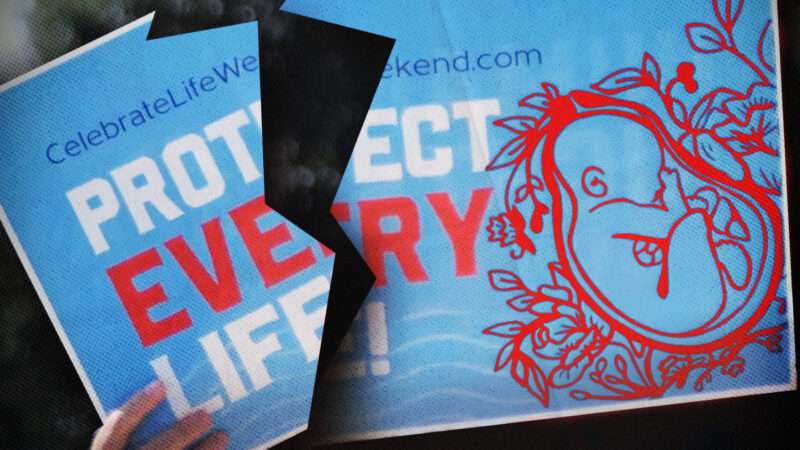
a torn anti-abortion sign | Students for Life/YouTube

Last March on Instagram, Students for Life President Kristan Hawkins posted a photo showing her and two other members of the Virginia-based group standing outside Space Center Houston. According to the captions, Hawkins and her fellow activists, one of whom was holding a mobile phone, were "ordering abortion pills undercover."

A lawsuit filed last week in Harris County, which includes Houston, describes that Instagram post as "nothing more than a publicity stunt." The lawsuit, which aims to deploy a Texas abortion law championed by Students for Life against the organization, is also a publicity stunt. But while it may be effective by that measure, it faces legal challenges that will be hard to overcome.

The lawsuit, which a Texas woman who opposes her state's abortion ban filed under the pseudonym Maria Puerto with help from the reproductive rights group Amplify Legal, is supposed to highlight the vagueness and broad scope of House Bill 7, a 2025 law that authorizes private civil action to enforce state restrictions on "abortion-inducing" drugs. But Puerto's attempted act of legal jiu-jitsu seems too clever by half, relying on a dubious reading of the statute to seek "monetary compensation" it does not authorize and thereby punish anti-abortion activists for constitutionally protected advocacy.

H.B. 7, also known as the Woman and Child Protection Act, says "a person may not manufacture or distribute an abortion-inducing drug in this state" or "mail, transport, deliver, prescribe, or provide an abortion-inducing drug in any manner to or from any person or location in this state." Those prohibitions, it says, "may be enforced only through a qui tam action" against a "person" who "violates" or "intends to violate" them.

Any "person" other than a state or local official can qualify as a "relator" authorized to bring such an action. The relator can seek injunctive relief and "an amount of not less than $100,000 for each violation," plus "costs and reasonable attorney's fees." A successful relator generally receives $10,000 of that "amount," with the rest going to a "charitable organization" of his choice.

As a "person" who is not a government official, Puerto meets H.B. 7's minimal test for standing. And although H.B. 7 precludes lawsuits against pregnant women who obtain "an abortion-inducing drug," Puerto says Hawkins and the other activists "are not pregnant and were not pregnant" at the time of the Instagram post. So far, so good. But although the lawsuit asserts that Hawkins et al. "openly and flagrantly violated" the law's prohibitions, it does not explain how.

A photo accompanying a recent Mother Jones profile of Hawkins shows her and her social media coordinator, Lydia Taylor Davis, outside Space Center Houston during their "abortion-pill 'sting' stunt." Another Mother Jones photo shows Hawkins holding a mobile phone displaying what Puerto's lawsuit describes as "an order confirmation."

Judging from the Mother Jones account, it is not clear whether that description is accurate. "The scheme rapidly went off the rails," Amy Littlefield writes. "The plan was to purchase pills from a couple of services, with Hawkins posing as a male abuser while Davis pretended to be a 16-year-old—all to try to portray mail-order suppliers as reckless and dangerous. For reasons even she couldn't explain, Hawkins chose the fake name 'Wanda' as her male-abuser alter ego. But when Davis input her information, she hit a snag."

Davis was trying to order pills from the Massachusetts Medication Abortion Access Project. But according to Littlefield, that organization "had blocked Davis in its system after Students for Life teased the sting operation on social media." Hawkins "attempted to save the stunt by placing her own order, but 'Wanda' accidentally gave her age as 15," which was below the supplier's minimum age, Littlefield says. "Now a security guard was wandering over to tell them they couldn't film. Having set out to show that telemedicine services don't screen their clients, they inadvertently proved the opposite."

Puerto "will need proof that the Students for Life leaders actually obtained or intended to obtain the pills," abortion law scholar Mary Ziegler notes in Slate. "The activists may argue that the post was not in earnest, and that no one involved ever seriously intended to bring pills into Texas."

Even assuming that Hawkins et al. successfully ordered abortion pills, that conduct by itself does not fit the language of H.B. 7, which applies to people who "distribute" such drugs or who "mail, transport, deliver, prescribe, or provide" them "to or from any person or location in this state." That language encompasses out-of-state suppliers, which raises obvious concerns about extraterritorial application of Texas law. But on its face, the prohibition does not cover someone who simply orders abortion pills.

Puerto's lawyer, Amplify Legal attorney Molly Duane, argues that Hawkins et al. could be covered by the statute's reference to transportation. "What the statute says is that transporting abortion drugs from one location to another within the state is a violation of H.B. 7," Duane told The Texas Tribune. "By the plain language of the statute, this would seem to be a violation. This is the problem with writing such a confusing and vague law."

Under that theory, however, Hawkins, Davis, and the two other activists named in the lawsuit violated H.B. 7 only if they 1) successfully ordered abortion pills, 2) took delivery of them, and 3) subsequently moved them to another location within Texas. The lawsuit alleges only that they "ordered abortion pills, apparently multiple times." According to The Texas Tribune, Duane and Puerto "are hoping that the lawsuit will eventually surface more about what the defendants did with the abortion pills once they ordered them."

The lawsuit faces another obstacle. H.B. 7 does not apply to "speech or conduct protected by the First Amendment." Hawkins et al.'s efforts to show how easily state abortion bans can be circumvented certainly seem to fall into that category. "Students for Life may stress that the case targets their political speech about abortion," which is "protected under the First Amendment," Ziegler notes.

Those are not the only puzzling aspects of the lawsuit. Puerto, a 26-year-old single mother of two young children, emphasizes that she "had no choice but to continue" those pregnancies because she did not "have access to transportation or the economic resources to pay for travel out of state." The lawsuit devotes 11 paragraphs to describing the burdens imposed by her state's denial of "true reproductive rights," which she argues justifies some sort of compensation.

All of this seems legally irrelevant under H.B. 7, which does not require a relator to allege damages of any sort, let alone damages stemming from the abortion ban it aims to reinforce. "With nowhere else to turn for assistance," the lawsuit says, "Ms. Puerto is seeking financial compensation" from Hawkins et al. "in the amount of $459,782—the average cost of raising two children from birth to age 18 in the state of Texas."

Although H.B. 7 sets a minimum award of $100,000, the lawsuit notes, "there is no cap on the monetary compensation owed a relator." But the law does not describe H.B. 7 awards as "monetary compensation" for injuries allegedly suffered by the relator.

The statute's only reference to "compensatory damages" deals with lawsuits filed against H.B. 7 relators under "clawback provisions" of other states that have tried to thwart such litigation. In response to a "clawback" action, the law says, an H.B. 7 relator can seek "compensatory damages, including money damages in an amount equal to the judgment damages and costs, expenses, and reasonable attorney's fees spent in defending the action." By contrast, the bounty for proving a violation of the restrictions on abortion pills is simply "an amount."

The lawsuit itself, emphasizing the lax standards for filing a claim under H.B. 7, notes that Puerto "did not suffer an injury traceable to [the defendants'] ordering of abortion pills that can be remedied by a court." But it suggests that an award to Puerto would be appropriate given the defendants' anti-abortion activism.

The lawsuit notes that Students for Life "proudly advertised" its support for H.B. 7. Puerto complains that Hawkins et al. "ignore the immense harms and multiple deaths already attributed to Texas's cruel abortion bans" and "demean the six million Texans of reproductive age who have had their ability to decide whether and when to begin or expand a family stripped away by these bans." Whatever you make of that charge, the defendants' activism is constitutionally protected and therefore cannot support a cause of action in civil court.

"Texas is a strange place filled with vigilante statutes" that "seek to turn Texans against each other," Duane told The Texas Tribune. "But if anyone should be benefiting from these legal regimes, it's people like our client." While "putting those two things together…might be unusual," she said, "this is the situation that Texas has put its citizens in."

Depending on your perspective, you may or may not sympathize with Duane's reasoning. But it seems unlikely to pass muster as a matter of law.

The post A Texas Lawsuit Dubiously Accuses Students for Life of Violating the State's Abortion Pill Restrictions appeared first on Reason Magazine.

  •  

The Republican governor candidates walking back some of their abortion stances

The candidates' retreat suggests that, even as reproductive rights fade from the national spotlight and polls show voters are far more likely to prioritize cost-of-living concerns, the political ramifications of pushing for new abortion restrictions remain substantial.

  •  

When Prayer Becomes a Crime: This is Not British

Isabel Vaughan-Spruce faces criminal charges for standing silently on a street, saying nothing and obstructing no one. Whatever your views on abortion, CJ Strachan argues that criminalising silent prayer is not who we are.

The post When Prayer Becomes a Crime: This is Not British appeared first on The Daily Sceptic.

  •  

Maryland used discredited “science” to convict a woman of murdering her fetus. Reproductive rights groups are raising alarms.

(LEFT) Photo of Columbia, Maryland, resident Moira Akers taken prior to the birth of Akers' third child and prior to her 2022 conviction for second-degree murder. Photo proved by Akers' lawyer Debra Saltz. (RIGHT) Stock photo of Maryland Supreme Court in Annapolis, taken on July 17, 2021. Photo by ReDunnLev/Getty Images.

Moira Akers was prosecuted and convicted of the murder of a newborn in 2022. She claims to have given birth to a stillborn baby in her home in Columbia, Maryland, in 2018.

Prosecutors doubted Akers’ story, using her online searches for abortion services and lack of prenatal care as evidence of ill intent. But it was a “forensic method” devised in the 17th century that proved key to Akers’ conviction.

The method, known as a “float test,” was designed to determine if a baby was stillborn or born alive by placing the lungs of a deceased fetus in water. If the lungs float, then they are aerated, meaning the baby was breathing and alive prior to their death.

In 2018, former Maryland chief medical examiner Dr. David Fowler signed the autopsy report that, using the float test as proof, determined that Akers’ baby died after Akers asphyxiated it. Fowler also testified in Akers’ trial. Prosecutors used Fowler’s testimony and autopsy report as evidence to convict Akers of second-degree murder in 2022.

Similar to Fowler’s infamous 2021 testimony in the trial of former Minneapolis police officer Derek Chauvin, in which he argued that George Floyd died due to drug intoxication and inhaling fumes from a car tailpipe, Fowler’s citation of the float test in Akers’ case has elicited criticism from the medical community. 

Fowler was also the subject of a scathing audit released by the Maryland Attorney General’s office last year, which found that at least 36 cases involving deaths that occurred during police restraint were improperly ruled accidents or left unclassified during his tenure

The float test has been widely discredited as imprecise and lacking methodological rigor. 

In the course of our reporting on Akers’ case, we not only reviewed court transcripts and the testimony of physicians and medical experts; we also pressed Fowler’s former office for comment about whether or not the float test was still used in fetal death investigations. Just prior to publication, Maryland Department of Health spokesman David McCallister disavowed the test.

“The lung float test is not part of OCME’s current routine practice, which reflects evolving scientific evidence, National Association of Medical Examiner (NAME) guidance, and the independent medical judgment of our forensic pathologists,” McCallister wrote in an email.

“When performed historically, the test was only one component of the overall forensic assessment and was interpreted together with the investigative and autopsy findings. How an individual autopsy finding is characterized or used in criminal prosecution is separate from OCME’s medical determination of cause and manner of death.”

McCallister’s disavowal of the float test marks a stunning departure from past practices for determining causes of death in Maryland. Whether the change will affect Akers’ case remains to be seen.

But what hasn’t changed is the fact that Akers was convicted, has served three years in prison, and is facing another prosecution—all while advocates and her lawyers are still fighting against a bureaucracy wedded to Fowler’s past practices. 

Akers’ fate remains in legal limbo, but her story reveals how flawed science can have real-life consequences, and how an indifferent bureaucracy can defend the mistakes of the past despite public outcry and scientific pushback in the present.

A Stillbirth or Murder?

Akers’ ordeal began in November of 2018.

According to a statement she gave to police, Akers was watching TV with her daughter when she noticed she was bleeding. The Howard County resident retreated to her upstairs bedroom. There, she gave birth to what she described as a baby that was not breathing, or stillborn.

The mother of two young children told police her husband did not want another child. Finances were tight, and the couple was already struggling to care for both a toddler and an 8-year-old.

“I almost didn’t want to admit to myself that it was [a pregnancy],” she told police. 

She hid the possible pregnancy from her family and did not seek prenatal care. “I just didn’t want my family [to know],” Akers said, “a stigma of them knowing that we had even contemplated the abortion part, but knowing that they wouldn’t be happy if we gave up the baby officially for adoption… that’s why I looked into the safe haven stuff.”

The birth itself was a moment of confusion and panic for Akers. When she started bleeding profusely, she thought it was possible the unexpected pregnancy could be the cause. After giving birth in her bathroom, she placed the baby’s remains in a plastic bag and put the bag in a closet.

Her husband, who had found her bleeding, called an ambulance. According to her lawyer, Akers refrained from discussing the ordeal in front of her two children when EMTs arrived at the house. But when she arrived at the hospital, she told doctors about the stillbirth. 

When Akers awoke from surgery, heavily sedated with painkillers and anesthesia, she found Howard County police detectives probing her with questions, which a recording reveals she struggled to answer through the haze of drugs. 

Even though the doctors told detectives not to question Akers after her surgery, they did anyway. And prosecutors were able to include statements Akers made during that interview while still heavily sedated and under the influence of multiple drugs, including fentanyl. 

“The hospital physicians attending told the police who had arrived at the scene not to speak to her for at least two hours after surgery because she was put under general anesthesia,” Akers’ lawyer, Debra Saltz, told us in an interview.

“So the police, rather than wait two hours, interviewed her. I think it was approximately an hour and 20 minutes later, they began an interview.”

Saltz challenged the admissibility of the interview in court. But presiding Judge McCrone ruled that Akers “sounded okay” after reviewing a recording of the interview. 

During Saltz’s cross-examination of lead medical examiner Dr. Nikki Mourtzinos, Mourtzinos made a critical admission: float tests are not performed in a uniform fashion, and the test does not call for a consistent, controlled (i.e. scientific) methodology. “Multiple people do things differently. Some people tie off the lungs, some people would clamp off the lungs and float them in water,” Mourtzinos testified. 

Saltz filed motions to toss out the float test results as evidence. But Judge McCrone ruled it admissible, too.

And more unresolved questions about the efficacy of the police and OCME investigations before Akers’ trial remain. 

Even though the official OCME autopsy report was not released until four months later, detectives claim Maryland’s Office of the Chief Medical Examiner (OCME) told them Akers’ baby’s death was likely a homicide.

But Saltz says OCME and Howard County detectives had already made up their minds about Akers before their investigation into her ordeal even began in earnest. “It was never going to be about science in this case. It was going to be about a determined outcome, which was going to be homicide, even though it should not have been,” Saltz told us.

Along with the float test results and her post-surgery interview with detectives, prosecutors focused on both Akers’ prior internet searches for abortion providers, as well as her lack of prenatal care, as evidence that she intended to kill her baby.

Again, Akers’ defense argued this evidence was inadmissible due to a state law that prevents drawing criminal inferences from a woman’s behavior during pregnancy. Again, Saltz was overruled. Judge McCrone allowed prosecutors to use Akers’ actions as evidence of later criminal intent.

The chief OCME pathologist who conducted the float test testified in Akers’ trial that the final mechanism of injury was asphyxiation and exposure. However, the autopsy did not find petechial hemorrhaging in the eyes or any trauma around the neck indicating strangulation. The medical examiner argued that the determination of asphyxiation was due to observed inflammation in the pancreas, a less common indicator of strangulation.

But there was also substantive evidence that the baby was stillborn.

The defense offered expert testimony that argued the detection of multiple infections in Akers’ placenta and umbilical cord was indicative of a stillbirth. 

“One of the more perplexing aspects regarding the opinions of Drs. Simon and Mourtzinos [the state medical examiners who conducted the autopsy] is that they describe gross and microscopic evidence of chorioamnionitis (inflammation of the placenta and its membranes), and funisitis (an inflammation of the umbilical cord), along with inflammation of the umbilical cord’s arteries and vein,” Gregory J. Davis, a forensic pathologist and professor at the University of Kentucky, wrote in a letter to the court.

The jury convicted Akers of second-degree murder. Judge McCrone sentenced her to 30 years. 

New Obstacles for Prosecutors, but the Float Test Remains

In February 2025, after she had served three years in prison, the Maryland Supreme Court granted Akers a new trial. In a 5-2 decision, Justice Brynja M. Booth wrote for the majority: 

We hold that the internet searches are irrelevant and that the trial court erred as a matter of law in admitting them. We similarly hold that Ms. Akers’ bare decision to forgo 2 prenatal care was not probative of motive or an intent to kill or harm a live child… In light of our holding on the inadmissibility of the abortion searches, we reverse the judgment of the Appellate Court and remand this case to the circuit court for a new trial. 

To win a conviction against Akers during the retrial of the case, prosecutors have to navigate a major evidentiary obstacle now that the Maryland Supreme Court has essentially barred them from using much of the “evidence” used to convict Akers in 2022.  

But the float test will still be admissible, and Saltz says prosecutors are likely to use it. Even though Fowler’s former office has publicly repudiated the test, the shadow and influence of Fowler himself still looms large. 

“Dr. Fowler had a very large impact on this case and the judge heavily credited his testimony and relied on his testimony to allow in evidence the fetal lung float test,” Saltz told us.

Saltz says the admission by Fowler’s former office that the float test is scientifically unreliable should give prosecutors pause. “I find it hard to believe that the state’s attorney’s office in Howard County would still consider using this outdated test,” she wrote in an email.

“I have always believed that they were motivated by emotion rather than science as they undertook to prosecute my client. I would hope they would dismiss the charges based on this newest information.”

For now, prosecutors are not talking. A spokesman for the Howard County State’s Attorney’s Office said they do not comment on pending cases.

“It is the policy of the Howard County State’s Attorney’s Office not to comment to the media on the facts, evidence, or litigation strategy of a pending case until the matter has concluded,” Yolanda Vazquez wrote in an email.  

Akers’ fate will be decided soon; the case is set for trial in November. Saltz says she is prepared to defend Akers, float test or not.

“My client is a very, very strong person. And she always held out hope that this would go her way… she knew that she had a stillborn baby,” Saltz said. “And there are plenty of people—including myself and the actual scientists who can read scientific evidence—who believe her.”

  •  

Federal judge blocks Trump and RFK effort to get more teens pregnant

US Secretary of Health and Human Services Robert F. Kennedy Jr. (R) speaks before President Donald Trump signs an executive order calling for more research and flexibility on vaccines, in the Oval Office of the White House in Washington, DC, on August 10, 2026. Photo by Jim WATSON / AFP via Getty Images
Common Dreams Logo

This story originally appeared in Common Dreams on Aug. 19, 2026. It is shared here under a Creative Commons (CC BY-NC-ND 3.0) license.

The Teen Pregnancy Prevention program, first authorized through bipartisan legislation in 2009, has been credited with helping to dramatically reduce the number of American teenagers who have experienced unwanted pregnancies in the past decade and a half, dropping by more than 65% over 16 years, according to one congressional report.

Despite the best efforts of President Donald Trump and Health and Human Services Secretary Robert F. Kennedy Jr., a federal judge’s ruling on Wednesday sent the message that the push to reduce teen pregnancy in the US will continue, with the administration’s limits on the program’s federal grants paused.

Judge Christopher Cooper of the US District Court for the District of Columbia granted a preliminary injunction in the case of Hennepin County, Minnesota v. US Department of Health and Human Services, in which officials joined King County in Washington state, Planned Parenthood of the Heartland, and the Sexuality Information and Education Council of the United States (SIECUS) in challenging HHS’s changes to the program’s grant policy. The plaintiffs were represented by Public Citizen and Democracy Forward.

The changes, said Cooper, were “likely arbitrary and capricious.”

LAWSUIT WIN: The court blocked the Trump admin’s attempt to turn the Teen Pregnancy Prevention Program into an abstinence-only program.

The court said the plan would seem to defy social reality, common sense, & scientific evidence alike.

A win for young Americans' wellbeing.

— Public Citizen (@Public_Citizen) August 19, 2026

The new policy, announced in June, canceled 53 of 66 active grants that had gone to public universities, health departments, and nonprofits for programming related to sex education, including information that was given to teens on contraception and communication with sexual partners.

In Trump’s 2027 budget, the grants are described as promoting “radical leftist ideology,” and officials claim there is no evidence that teen pregnancy prevention programs that go beyond educating young people about abstinence have “contributed to the historic decline in teen pregnancy, which is now at an all-time low.”

Under new guidance issued in June, Teen Pregnancy Prevention (TPP) program grantees are required to focus lessons on abstinence, deemphasize contraception, and teach teens about fertility and “body literacy.”

“HHS is perfectly entitled to formulate its own views about how to stem teen pregnancy—or even whether it is worth preventing at all—and to pursue policy initiatives consistent with its viewpoint. But it is not at liberty, under the Administrative Procedure Act (APA), to impose conditions on grant recipients that Congress did not intend or that are unreasonable or unexplained. The preliminary record suggests that HHS has done just that,” wrote Cooper in the ruling.

“Through the TPP, Congress sought to fund a range of evidence-based teen pregnancy prevention strategies, not just abstinence. According to unrebutted record evidence, programs that teach abstinence to the exclusion of all other approaches are ineffective in delaying sexual initiation and reducing adolescent pregnancy, at least as a general matter,” Cooper continued.

The judge took aim at the administration’s promotion of “body literacy,” which he called “a nebulous concept that appears to elevate fertility and marital procreation over well-tested forms of contraception and pregnancy prevention.”

Cooper also suggested that HHS had not bothered to find genuine evidence of its claims about “body literacy,” instead “remarkably” referencing “public health studies that appear either not to exist or not to support the propositions for which they are cited—a hallmark of AI-generated citations.”

The judge stopped short of reinstating the dozens of grants, amounting to about $67 million, that have been terminated, saying it was unclear whether he had the authority to do so.

The plaintiffs and other advocates of comprehensive sex education have called for a permanent injunction; Cooper called on both parties in the case to propose a schedule for next steps by September 1.

Callie Simon, executive director of SIECUS, said the group was “encouraged that the court has halted implementation of the new harmful policy” but emphasized that “the impacts of terminating existing grants remain.”

“Today’s decision sends a clear message that the Trump-Vance administration cannot replace the proven, bipartisan Teen Pregnancy Prevention program with an ideologically driven alternative that harms young people,” said Simon. “Communities across the country are still without the evidence-based programs they relied on, and we will continue fighting to ensure young people have access to the sex education they deserve.”

Sandra J. Valenciano, director and health officer for public health in Seattle and King counties, said local communities were facing a measurable loss due to HHS’ stripping of TPP grants

“This federal action threatened our ability to complete a study on a new science-based, community-informed sex education curriculum specifically for young men and boys,” said Valenciano. “This ruling gives us hope that we may still be able to get to the finish line with this study and ultimately empower more young people to build healthy families if, when, and how they choose.”

Ruth Richardson, president and CEO of Planned Parenthood North Central States, said the ruling “reaffirms the value of trusted, evidence-based education programs that help youth make informed choices and plan for their futures.”

“Attacks on the Teen Pregnancy Prevention program not only put young people at risk, they also risk increasing costs for taxpayers,” said Richardson. “No one benefits from these politically motivated attacks. It’s time for them to end.”

  •  
❌