❌

Reading view

As Rome Expanded, Villagers in Portugal May Have Been Fixing Dye With Crushed Rock and Vinegar: A Pit Full of Flowers May Be the Leftovers of a 2,000-Year-Old Workshop

Almost nothing survives of what people wore in the Iron Age. Linen, wool and dyes are all organic matter, and in most soils they simply rot away. Archaeologists therefore tend to reconstruct the history of textiles from the tools that do last, above all spindle whorls: small stone or ceramic discs that weigh down the […]

  •  

2,000-year-old treasure discovered beneath former sports field, breaking regional record

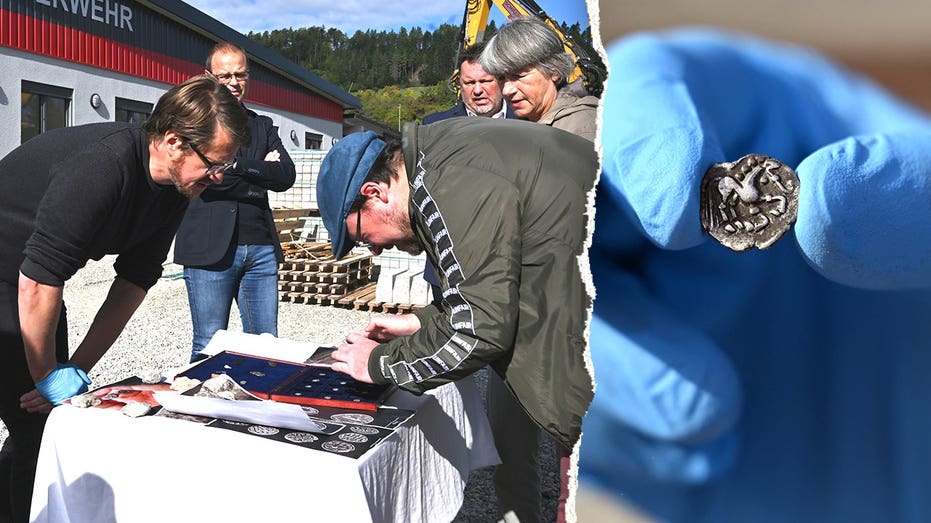
A trove of ancient coins has been unearthed at a construction site in Germany — after remaining hidden for more than 2,000 years.

The discovery, made at Singer Berg in the central German state of Thuringia, was announced recently by the Thuringian State Office for Monument Preservation and Archaeology (TLDA). 

In a translated news release, officials said excavation director Ronny Krause discovered the coins while archaeologists were investigating a former sports field ahead of the construction of a new fire station.

7,000-YEAR-OLD BONES UNCOVERED AT CONSTRUCTION SITE IN STARTLING FIND

Archaeologists conducted follow-up excavations at the site in August 2026 — and confirmed that the 11 coins dated back to the first century B.C.

The hoard represented the largest known Celtic coin hoard from that period ever found in Thuringia.

The 11 coins, dating back to the first century B.C., were identified as a type of ancient Celtic currency known as Prague-type quinarii.

"Until now, only about 80 examples of these quinarii had been identified throughout Thuringia, underscoring the significance of the Singen hoard," the translated statement said.

WORKERS RENOVATING MAJOR CITY STREET STUMBLE ON ANCIENT DISCOVERY BURIED 20 FEET BELOW

"The mint responsible for producing the coins is believed to have been located in the Gotha region, to the northwest."

The Celts were groups of ancient people who lived across much of Europe during the Iron Age, with Celtic languages and traditions surviving today in places such as Ireland, Scotland and Wales.

The coins were originally buried together in a container made of organic material that has since decomposed, archaeologists believe. The coins were found scattered across an area measuring roughly 19 feet by 5 feet — likely a result of plowing.

Officials described the discovery as a "closed find," suggesting that all the coins originally buried together were recovered.

CLICK HERE TO SIGN UP FOR OUR LIFESTYLE NEWSLETTER

While just 11 coins may seem like a modest haul to some, archaeologists consider the discovery a treasure trove of information about the ancient world.

"Through the ongoing mapping of discoveries from the same period and cultural background, researchers can draw conclusions about ancient trade routes and production centers," the translated statement added.

"The Singen treasure hoard has significantly expanded our existing knowledge in this area."

Archaeologists also found an ancient Roman coin and a medieval glass bead — as well as a knife fragment, another silver coin and a Prussian uniform button from the 19th or 20th century.

CLICK HERE FOR MORE LIFESTYLE NEWS

Officials also emphasized the broader significance of the discovery and the importance of proper archaeological practices.

"This once again demonstrates the importance of preserving the archaeological context of discoveries, in contrast to isolated metal finds recovered, for example, through improper or illegal metal detecting without documentation of their original locations," the statement concluded.

TEST YOURSELF WITH OUR LATEST LIFESTYLE QUIZ

Metal detectorists have made headlines for uncovering other ancient treasures across Europe.

Recently, a man using a metal detector in a German field discovered 934 ancient Roman silver coins dating back nearly 2,000 years.

CLICK HERE TO DOWNLOAD THE FOX NEWS APP

In Finland, a metal detectorist recently uncovered a massive Viking Age silver hoard containing an estimated 4,000 coins, along with jewelry and other artifacts.

  •  

A Gold Leaf Left for a Foreign God Points to a Greek Merchant Who May Have Supplied the Roman Army

Some 1,900 years ago, a man named Thrasymedes gave a thin sheet of gold to a god who was neither Greek nor Roman. The deity came from the borderlands of what is now southeastern Turkey. The offering was left inside a Roman army fort on the eastern shore of the Black Sea, in modern Georgia, […]

  •  

A “Medieval” Spanish Village Church Is Really 1,200 Years Old, and Built From Roman Ruins

The church is Santa Eulalia de Esperante, known in Galician as Santalla de Esperante. It stands in a hamlet a few kilometres southwest of Lugo. Until now, historians saw a simple rural church from the high Middle Ages, with one nave, a square east end and a smooth 18th-century front topped by a bell gable […]

  •  

The Mystery of the “Five Foolish Virgins”: These Giant Stones Have Marked a Roman-Era Grave in Norway for 1,700 Years

At the narrowest point of the Karmsundet, the channel that separates the island of Karmøy from the mainland on Norway’s west coast, five stones stand upright on a hillside. Some are more than five metres (16 ft) tall. They were raised inside a cairn, a mound of piled stones, laid out in the shape of […]

  •  

The Forest That Stopped Roman Legions Hid a Shrine to Demeter, and Archaeologists Just Discovered Signs of Use Long Before the Etruscans

In 2006, the Carabinieri, Italy’s national military police, raised the alarm about illegal digging in a forest of oaks and chestnuts near Vetralla, in the province of Viterbo, north of Rome. The Soprintendenza, the state body in charge of archaeology in the region, sent a team to the site for an emergency excavation in May […]

  •  

Neanderthal Hand Found in a Spanish Cave Still Holds Its DNA After 46,000 Years

Neanderthals left plenty of traces in the western Pyrenees, the mountain range that separates Spain from France. Stone tools, butchered animal bones, the leftovers of their camps. What nobody had ever found in Navarre, the region of northern Spain whose capital is Pamplona, was a single bone of the people themselves. On Monday that changed, […]

  •  

Malta’s Mysterious 31 Miles of “Railway Tracks” in Solid Rock May Be Roman, Not Prehistoric

On a patch of bare rock in western Malta, roughly 80 by 100 metres (260 by 330 feet), dozens of parallel grooves cross, overlap and merge into one another. The spot, Misraħ Għar il-Kbir, is popularly known as Clapham Junction, after the busy railway junction in London. It is far from the only place like […]

  •  

Who Made the Terracotta Army? 2,200-Year-Old Fingerprints Point to Men, Women and Children

About 2,200 years ago, someone pressed a finger into a lump of damp clay to stick down the flap of a suit of armour. The kiln sealed that print, and it has survived intact ever since. Now a team from the museum at the mausoleum of Qin Shi Huang and from Shandong University has used […]

  •  

Hilltop Villages, African Ivory and Wounded Skeletons: How Small Communities Resisted The First Bronze Age Power in Spain

Around 4,200 years ago, in the dry south-east of the Iberian Peninsula, a society began building cities on hilltops, stockpiling grain on a large scale and arming its warriors with halberds (blades like axe heads mounted on long poles) and metal swords. Archaeologists call it El Argar. Further north, in what are now La Mancha, […]

  •  

Roman House Cut Into Rock Found with Its Own Ancient Pier From the Empire’s Last Centuries on Corsica

Anyone who wants to build a house on the waterfront at Meria, at the northern tip of Corsica, has to let archaeologists look underneath first. The rule comes from the island’s regional archaeology service (the DRAC of Corsica). It has just paid off. Working on the plot, a team from Inrap, France’s national institute for […]

  •  

Phoenician Ivory, a Phrygian-Style Belt and Traces of Indian Pepper, Found Inside a Strange “Dark Age” Tomb in Jordan

Around 1200 BC, the eastern Mediterranean fell apart. The great empires of the Bronze Age collapsed, many cities were destroyed or emptied, writing disappeared from much of the region, and long-distance trade shrank to almost nothing. Archaeologists call what came next the dark age, and the name is earned: with few texts and almost no […]

  •  

Archaeologists Uncover Lost 1,600-Year-Old Cathedral Near Venice

Excavations at the ancient Roman city of Altinum have revealed the probable remains of an early Christian cathedral and bishop’s palace, offering new evidence about the origins of Venice and the transformation of its lagoon settlements.

Archaeologists working near Venice have identified what they believe to be the remains of a 1,600-year-old cathedral and an adjoining episcopal palace, resolving a longstanding question about the location of one of the region’s earliest Christian centres.

The discovery was announced on 15 October by Ca’ Foscari University of Venice, following excavations at Altinum, an important Roman settlement on the mainland near the Venetian lagoon. The foundations of a substantial religious complex have emerged from an area where ancient written accounts had long indicated the existence of a cathedral, although its precise location had remained unknown.

The findings suggest that the church was constructed between the late fourth and early fifth centuries AD, making it the earliest Christian church so far identified archaeologically in the Venetian territory. The researchers believe the complex provides physical evidence of the period when Christianity was becoming an important political and administrative force in the declining Roman Empire.

A Cathedral Hidden Beneath a Roman City

The newly identified church was a rectangular structure approximately 30 metres long and 20 metres wide, without an apse and orientated towards the east. Its layout differs from the surrounding Roman street grid, reflecting the religious requirements of the early Christian community.

The architectural arrangement resembles early churches in the northern Adriatic region, particularly those associated with Aquileia, which was an important centre of Christianity during late antiquity.

An adjoining building, distinguished by its substantial foundations and a complex arrangement of internal rooms, has been provisionally identified as the bishop’s palace. Archaeologists believe it may have stood two storeys high, with residential accommodation for senior clergy above rooms potentially associated with privileged burials.

Among the most revealing discoveries is the extensive reuse of stone paving blocks taken from the Roman streets. These materials were incorporated into the foundations of the ecclesiastical buildings, providing evidence of how the city was being physically reorganised during the transition from Roman to Christian administration.

The university’s researchers suggest that the removal of public paving materials may also indicate the authority exercised by the bishop over urban infrastructure. This interpretation would place the emerging Church at the centre of the city’s political transformation.

Ancient Written Accounts Supported by Archaeology

The existence of an early Christian cathedral at Altinum had been documented in letters written by Saint Jerome, one of the most influential Christian scholars of the late Roman period.

Writing in AD 396, Jerome referred to the religious activities of Nepotian, a priest associated with Heliodorus, the first bishop of Altinum. His descriptions included the maintenance of church furnishings, walls, floors and sacred vessels, suggesting an established and relatively prosperous Christian institution.

Until now, however, archaeologists had struggled to connect those accounts to a particular building.

The latest excavations, combining evidence collected during the 2025 and 2026 campaigns, have provided what researchers consider a convincing identification of the ecclesiastical complex.

The excavation is directed by Diego Calaon of Ca’ Foscari University and co-directed by Elisa Possenti of the University of Trento. Their work has brought together earlier archaeological records and newly examined foundations, including sections exposed during investigations in previous decades.

Researchers have also identified a burial area dating from the sixth and seventh centuries. Many graves were disturbed when construction materials were removed from the abandoned complex, but surviving human remains offer opportunities for further scientific investigation.

Radiocarbon dating, anthropological examinations and additional geophysical surveys are planned to establish a more detailed chronology and search for other elements of the religious complex, including its baptistery.

What the Discovery Reveals About Venice’s Origins

The historical importance of Altinum extends beyond the cathedral itself.

The ancient settlement was an important Roman commercial centre with connections to the waterways of the northern Adriatic. As political, environmental and demographic conditions changed during late antiquity, its population and institutions gradually shifted towards settlements within the lagoon.

One of the most important destinations was Torcello, which later became an early centre of Venetian civilisation.

Traditional accounts have often portrayed the creation of lagoon settlements as a response to barbarian invasions, with mainland inhabitants fleeing to isolated islands for protection.

The latest archaeological findings support a more complicated process.

Research at Altinum and Torcello indicates that the movement of people, religious institutions and construction materials was gradual and organised rather than the consequence of a single catastrophic event.

The cathedral appears to have been systematically dismantled during the first half of the seventh century, with substantial quantities of its stone and brick transferred to developing lagoon communities.

A surviving inscription records the establishment of Torcello’s cathedral in AD 639, providing an important chronological reference for the movement of ecclesiastical authority.

The findings add to the wider study of Europe’s surviving archaeological and architectural heritage, particularly the transformation of Roman settlements into medieval urban centres.

They also demonstrate how archaeological evidence can challenge historical narratives constructed centuries after the events they describe.

Much of the late-antique landscape at Altinum disappeared because of centuries of agricultural activity and the systematic removal of reusable building materials. In many cases, the excavators are studying trenches left by the extraction of foundations rather than surviving walls.

Further investigations may determine the complete extent of the episcopal complex and clarify the chronology of its abandonment.

For the first time, however, researchers can locate the religious buildings associated with Altinum’s earliest Christian bishops and trace their connection to the communities from which medieval Venice eventually emerged.

  •  

Archaeologists Discover 130-Metre Mining Tunnel Beneath German Forest

Excavations in Germany’s Ruhr region have uncovered evidence of a substantial underground mining operation that predates the area’s industrial expansion. The discovery is providing new clues to the origins of European coal mining.

Archaeologists have identified a previously unknown coal-mining tunnel stretching at least 130 metres beneath woodland near Sprockhövel in western Germany. The remains provide evidence of coordinated underground construction at a time when the Ruhr’s mining industry was still developing, long before the region became synonymous with heavy industry.

The discovery was announced on 15 October by the Westphalia-Lippe Regional Association (LWL), whose archaeologists are working alongside the German Mining Museum in Bochum and GeoPark Ruhrgebiet. The team says its findings shed light on tunnelling techniques used before the eighteenth century, although the newly identified passage has not yet been given a precise scientific date.

At Haßlinghausen, a forest floor conceals old shafts, spoil heaps and depressions left by abandoned mining operations. Researchers did not enter an intact underground gallery. Instead, they identified the location of a collapsed passage by excavating at two former shaft sites and drilling into the surrounding spoil. Subsidence created by the collapse left a recognisable trace above ground.

How Early Miners Organised Underground Work

The evidence suggests a more complex operation than miners simply following exposed seams into the earth. Construction shafts were sunk at intervals along the proposed tunnel. Workers descended through them and excavated separate stretches underground, later joining those sections into a continuous passage.

This method allowed several groups to work simultaneously rather than advancing from a single entrance. It also demanded planning and considerable labour. The filled-in shafts and disturbed soil are still visible in the excavated sections, enabling specialists to reconstruct the miners’ methods even though much of the original tunnel has collapsed.

Till Kasielke of GeoPark Ruhrgebiet explained that the construction shafts were located beside the underground route and then filled after the gallery was completed. Jennifer Garner, an archaeologist at the German Mining Museum, said the excavations would provide material for scientific dating and a better understanding of the effort required to build the structures.

The latest work follows a 2025 investigation of a separate, approximately 70-metre tunnel nearby. That earlier feature reached a coal seam some ten metres below ground. Researchers suspected it might predate the seventeenth century because it appeared to have been overlooked during later mining activity. The newly identified 130-metre passage is a distinct discovery.

The chronology matters because horizontal tunnels changed the possibilities of coal extraction. Early miners could reach seams by digging pits or inclined shafts, but groundwater increasingly obstructed work at depth. Drainage galleries allowed water to escape, making deeper workings more practical and potentially extending the life of individual mining sites.

An Industrial Region’s Earlier History

The Ruhr is usually associated with the vast collieries, factories and transport infrastructure that drove Germany’s expansion in the nineteenth and twentieth centuries. Yet coal was extracted locally during the Middle Ages. The transition from small workings to organised subterranean networks remains poorly documented, partly because written records from the earliest periods are scarce.

The archaeological research programme, which began with related investigations in 2024, is intended to address that gap. The team has excavated soil layers associated with old shafts, and the recovered material may help establish when specific construction techniques were introduced. For now, it would be premature to assign the new passage a medieval date.

At Essen, the UNESCO-listed Zollverein Coal Mine Industrial Complex preserves the architecture and machinery of the Ruhr’s later industrial era. The remains at Sprockhövel represent a different historical record: temporary shafts, collapsed passages and waste deposits left by miners whose operations preceded industrial-scale coal production.

Across Europe, such landscapes have become an important part of cultural heritage. EU Today has previously reported on the preservation of Belgium’s Bois du Cazier colliery, where 262 people died in the 1956 mining disaster. In Sprockhövel, the focus is on a much earlier workforce, whose organisation and technical knowledge must be reconstructed from the ground itself.

Further dating and analysis will determine whether the newly identified tunnel pushes back the known chronology of organised drainage and gallery construction in the Ruhr. The excavations have already established that a substantial underground project once operated beneath a forest whose surface retains remarkably little indication of the work carried out there.

Image credit: LWL-Archäologie für Westfalen / Manuel Zeiler
  •  

New Structures Have Been Discovered in Ancient Arsinoe, the Greek City that the Egyptian “Philadelphus” Queen Named after Herself in Aetolia

Ancient geographers listed many cities called Arsinoe, from Cyprus to Cilicia (in what is now southern Turkey), from Ephesus to the Gulf of Suez. Most of them were linked to the Ptolemies, the dynasty that ruled Egypt after the death of Alexander the Great. One, however, lies far from the Nile. It stood in the […]

  •  

A Neanderthal’s Shoulder Blade from Shanidar Cave May Bear Evidence of the Oldest Known Fatal Spear Wound

The shoulder blade is such a wide and flat bone that in some areas it becomes almost translucent when held up to the light. That is why it is rare to find it whole, even in modern burials, and why it so surprised archaeologists from the University of Cambridge that from Shanidar Cave, in Iraqi […]

  •  

Archaeologists Find a Lost Greek Neighborhood in Sicily, Destroyed When Carthage Besieged the City 2,400 Years Ago — and Evidence of a Giant Artificial Fish Pond

Tucked among the Greek temples that made Agrigento famous, on the south coast of Sicily, there is a narrow valley of orange and olive trees. An international team has been digging there for three years. The third season in the Kolymbethra valley and on the Case Montana plateau ends on October 24. According to the […]

  •  

This Alaskan Ice Age Camp Is 800 Years Older Than Clovis, Once Seen as America’s First Culture

About 13,800 years ago, Magdalenian hunters in northern Spain were still visiting the cave of Altamira, famous today for its painted bison. (The cave’s entrance would collapse around 13,000 years ago.) On the other side of the world, a different group of hunters was setting up camp on a ridge above the Tanana River, in […]

  •  
❌