❌

Reading view

The AI boom is good for people who write about AI. Ask Derek Thompson.

Derek Thompson

Courtesy of Derek Thompson; BI

  • The AI boom is swallowing the US economy.
  • That extends to people who make a living writing, says author Derek Thompson: Stories about AI are the most lucrative thing he can produce.
  • Thompson, who writes about a wide range of topics, says he's torn between writing stories he knows his audience wants, vs other topics he cares about.

Derek Thompson writes and talks about a lot of things.

But some things pay better than others: "Dimes for analysis, dollars for facts, and Benjamins for facts about artificial intelligence," he tells me.

Thompson, a longtime Atlantic writer who left to launch his own Substack in 2025, has an avid following — Barack Obama reportedly reads him to stay on top of AI developments.

That following also creates an inherent tension: If he only creates work he knows will have a big audience, it squeezes out other subjects he's passionate about, like the way technology affects the media we consume. Or why he thinks Americans should embrace a pro-building mindset — the subject of "Abundance," the recent book he co-wrote with Ezra Klein.

I talked to Thompson about AI — of course — along with some of his other passions, like why he thinks pro sports are a conspiracy that lets the richest people in the world turn "their already-elevated wealth into exospherically extreme wealth." You can hear our entire conversation on my Channels podcast. The following is an edited excerpt:

Peter Kafka: Perhaps the only thing Americans agree on is data centers — they hate them, and don't want them built in their communities. What is the "Abundance" view on data centers? Could you argue that building them is good for the country — just like building more housing is good?

Derek Thompson: I don't see data centers and houses as being equivalent. I think data centers are houses for chips. Really, they're igloos for chips because they're very, very cold houses.

While I feel incredibly passionate about removing barriers to building housing where people want to live, I feel less passionate about saying we need to make sure that every AI company can site every data center wherever it wants to build it.

There are costs to an economic infrastructure project that leans so heavily into data centers that other modes of construction are being starved for resources. Jason Furman, an economist at Harvard, just published a graph showing that in the last year, while data center construction's up by more than 60%, construction of hospitals is down, construction of offices is down, construction of housing is down, construction of just about everything else that you can name, including manufacturing facilities, is down because data centers are essentially eating the economy and crowding out a lot of other investment.

Am I anti-data centers in the extreme? No. Do I think data centers are just like houses? Absolutely not. I think houses for people are more important to emphasize as a matter of public policy than houses for chips.

Last year, you wrote this great piece about how "Everything is Television," where you argue that it's inevitable that all media becomes video. But you've also said that you've become a video podcaster because your podcast company nudged you to do that. How much of the video push is corporate incentive, and how much is what people want?

My theory is that it's corporate incentives because it's what people want.

Companies have attempted pivoting to video infinity times. But other pivots to video, especially in the last few years, have essentially become the norm. Everyone's podcast goes to YouTube now, or Spotify or Netflix. That suggests to me that the instinct to pivot to video reflected a reasonable corporate interpretation of an underlying consumer reality: that, at the end of the day, what most people want to do with most of their time is sit on a comfortable couch or chair and look at moving images.

There does seem to be something spookily, biologically inherent about the degree to which we want to just watch moving images. Television went from zero to 50% adoption rate in a decade.

There is just something true, with a capital T, about the media success of a technology that allows us to do nothing but turn our minds into a receiver for moving images. I'm not saying that's good. I'm just saying that apparently is the situation.

How has going independent changed how you work and what you make?

When you go from being a salaried employee, where you make one amount of money all year, no matter what, to being self-employed, where the line goes up the harder you work, it's very hard to ignore that signal and not work harder.

I feel more harried about work than I did. When that line doesn't go up, when it starts to slip, when 12 months has elapsed since a big article I wrote last year, and because 10% to 20% of subscribers are gonna drop out of the list, it sucks to see any number go down. And then I start to think, "God, I gotta work harder. I gotta get that next article to make the revenue line go back up."

Are you more inclined to think, "That story about sports billionaires did well, let's do more of those," in a way you might have been insulated from at The Atlantic?

Yeah, there's no question. And again, this is not something I think is altogether good. I said one thing I've learned from a year on Substack is that it's dimes for analysis, dollars for facts, and Benjamins for facts about artificial intelligence.

Recognizing that it's dimes for social analysis and Benjamins for AI analysis, there is a part of the job that pulls me toward writing more about AI than I might ...

Because the market wants it.

The market clearly wants it. That said, I do think artificial intelligence is not only the most important but also the most interesting story in the world. It's an economic story. It's a safety story. It's a stock story.

I have this long list of essentially social essays that I want to write. Stuff like "Everything Is Television." But I know that if I only write those essays for a month, if I only write those essays for a year, the line's gonna go down.

And so I'm interested in AI, and fortunately, the AI stuff sells. The AI reporting that I do creates a zone of extraordinary comfort for me to spend time writing stories that I know won't make money, but I think could be really, really broadly read as social analysis.
Read the original article on Business Insider
  •  

The latest K-beauty craze is made from dead Americans' skin. Now it's aiming for the US.

Close-up of a woman's face and neck with a blue-gloved hand holding a syringe. The center of the syringe is cut out and filled with a human skin texture

Getty Images; Alyssa Powell/BI

A hot, new beauty treatment driving tens of millions of dollars in sales around the globe is now aiming for the US market. Its unusual ingredient: skin from dead Americans.

Each year, tens of thousands of Americans donate bodily tissue upon their deaths, generally by checking a box at a motor vehicle department or through an authorization made by a loved one. Over the past few years, tens of millions of dollars' worth of donated skin has traveled from American tissue banks to biotech companies in South Korea, the beauty capital of the world. There, among other uses, it is turned into injectable beauty treatments.

The maker of the market-leading Korean brand said last week it has signed a distribution contract to introduce its skin-derived injection to the US market next year. It isn't clear whether the product can be sold in the US without approval from federal regulators.

Business Insider traced the tissue supply chain to understand how donor tissue from, say, San Antonio can end up for sale at a clinic in Seoul — and how much money is being made along the way.

People who donate tissue "have no idea of how much money is changing hands in the course of all of this," Ana Iltis, a professor at Wake Forest and former president of the American Society for Bioethics and Humanities, told Business Insider. "With tissue donation, there's a lot of money at stake."

Donors and their families can't be paid for organ or tissue donations under US law.

A K-beauty trend

For decades, American plastic surgeons have used products made from human tissue for skin grafts and reconstructive surgeries. That practice includes aesthetic uses — such as cartilage for a nose job or skin for a breast augmentation — though many doctors prefer to use the patient's own tissue for such procedures.

Now, skincare treatments made from human tissue can be purchased for a few hundred dollars and administered at a med spa or dermatology clinic in under an hour. In South Korea, a mecca for cutting-edge beauty treatments, at least 10 biotech companies are making or planning to introduce skin-derived injections.

They are the latest generation of a treatment known among beauty obsessives as "skin boosters." Get your algorithm just right, and your social-media feeds will soon be full of before-and-afters showing off the purported benefits of these products. They depict patients, typically women and sometimes young ones, going from dull to dewy, fine-lined to smooth.

This year, the skin-derived injections are projected to generate $75 million in sales in South Korea, according to analysts at Yuanta Securities.

No brand is bigger than Re2O, which one dermatologist on Instagram called "the Love Potion No. 9 for cells." It accounts for between 60% and 70% of sales in the category, according to L&C Bio, its manufacturer.

A client lies under towels while a practitioner uses a syringe and handheld device during a facial treatment.
South Korea is a mecca for cutting-edge beauty treatments.

JUNG YEON-JE/ Getty Images

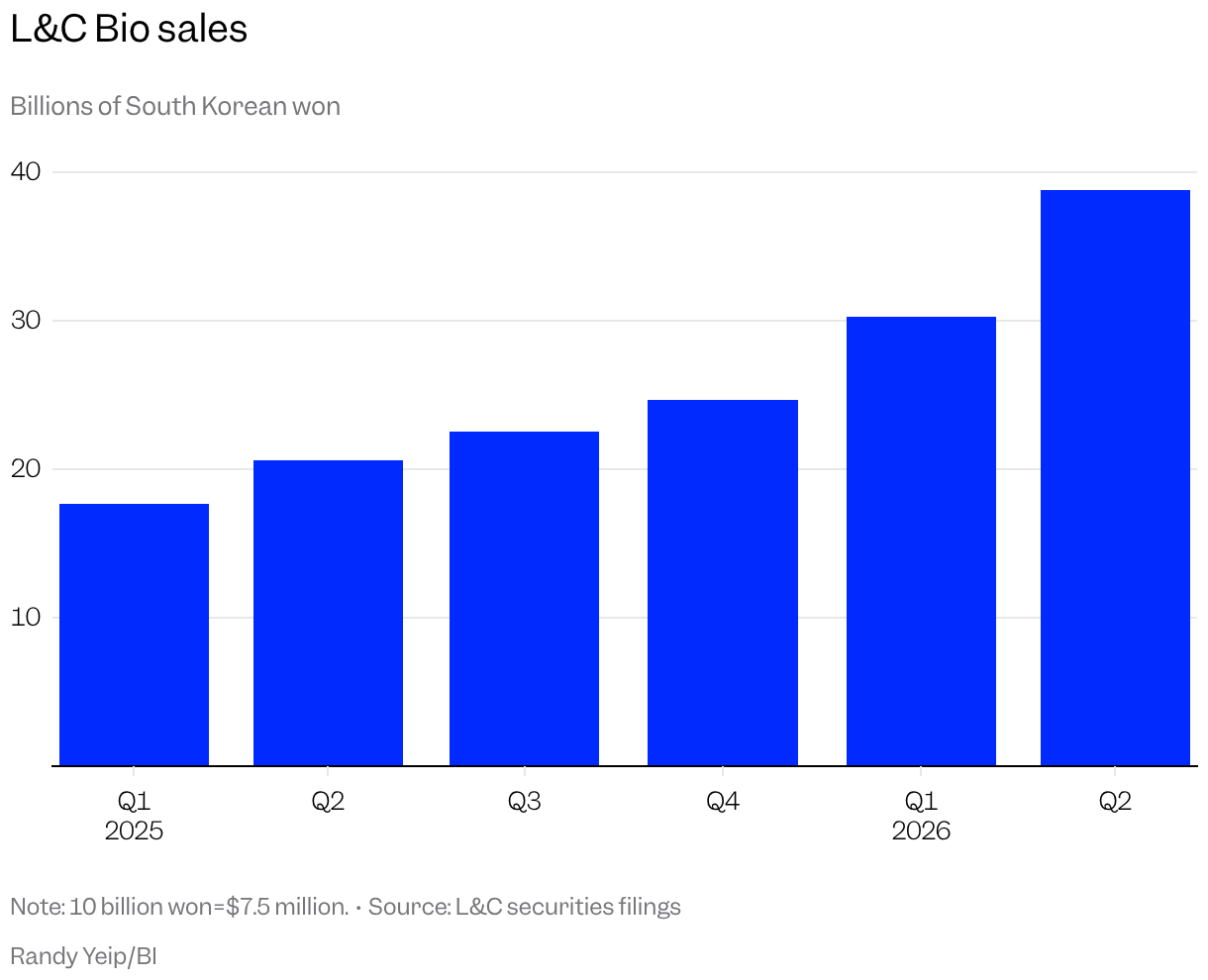
Re2O notched the equivalent of more than $17 million in sales in the first half of this year, helping swing the company to an operating profit of about $11 million after a loss of about $326,000 in the same period last year, L&C Bio said. It has expanded the product line with Re2O Fine, marketed for more delicate skin, and is planning to launch a human fat-derived filler next year.

The company said it sold 700,000 units of Re2O as of September. It is available in Singapore and China, and has been approved in the United Arab Emirates, Peru, and Thailand.

Last week, L&C Bio said that it has signed a contract to deliver at least $60 million of Re2O to the US over the next five years. The company also said it may explore acquiring US tissue banks with its US distribution partner.

L&C Bio's plan to introduce Re2O to the US could spark a regulatory showdown. L&C Bio has said Re2O falls into a category of products such as skin grafts that don't require approval from the US Food and Drug Administration.

Some products that manufacturers claim qualify to be sold under this category don't actually meet the applicable criteria, the FDA told Business Insider. The agency said it wouldn't discuss any specific products under investigation.

"Products derived from donor skin that have been decellularized, dried, and ground into a powder for injection as a cosmetic 'skin booster' may raise significant questions" and may have to go through a more complex regulatory approval process, the agency said.

L&C Bio said it wouldn't comment on its discussions with regulators.

Bar chart showing L&C Bio's quarterly revenue rising steadily from 17.7 billion South Korean won in the first quarter of 2025 to 38.8 billion won in the second quarter of 2026.

Re2O's biggest competitor, CellREDM, came onto the South Korean market in late 2025. It has been such a success that in the quarter ended June 30, operating income for its maker, Hans Biomed, soared to over $3 million after barely eking out a profit in the year-earlier period.

The tissue business

"In the human tissue business, access to raw materials is the lifeblood of the industry," L&C Bio's founder and CEO, Whan Chul Lee, said in Korean in a February interview with a South Korean news outlet.

For his company and its competitors, that lifeblood flows from the United States.

Roughly 90% of all the human tissue used in South Korea is imported, according to South Korea's Ministry of Food and Drug Safety. Less than 4% of South Korean adults are registered to donate organs, and even fewer donate tissue. Korean biotech companies have turned primarily to the US, where well over half of adults are registered donors.

Cadaver skin is collected in the US by organ procurement organizations, known as OPOs, and tissue banks. In the transplant system, skin is treated as a tissue, not an organ.

After tissue is collected, its route can vary. A nonprofit OPO often transfers it to an American tissue bank. The tissue bank pays a fee to the OPO, depending on factors like the amount and quality of tissue recovered. The fee covers the cost of the tissue recovery as well as a margin that supports other programs offered by the OPO.

Tissue banks — which can be nonprofit or for-profit entities — supply donor skin to Korean biotech firms.

Much of the US skin supplied to South Korea is used for more traditional medical purposes, like skin grafts for burn victims. L&C Bio makes such therapeutic products and says it prioritizes supply for them.

A person walks in a subway station by ads for plastic surgery.
Tens of millions of dollars' worth of donated skin has traveled over the past few years from American tissue banks to biotech companies in South Korea.

Ed Jones/AFP via Getty Images

L&C Bio spent more than $25 million on donor skin from US tissue banks between 2023 and 2025 and $3.8 million in the first half of this year, according to corporate filings. The company told Business Insider that a quarter of its skin supply is used to make Re2O.

Organ distribution is coordinated by a public-private partnership with the federal government. Tissue is handled differently. It is distributed through commercial relationships.

The more traditional business aspects of the tissue industry have been a subject of debate since the federal law governing America's organ recovery and distribution system was enacted in the 1980s. In a system that relies on altruism, money changing hands could affect public trust, Jerold Mande, who helped write the National Organ Transplant Act, told Business Insider.

There is little data on American attitudes toward tissue donation. A survey of more than 1,000 families of donors in the US published in a 2010 academic journal found less than 30% said they thought it was acceptable for donated tissues to be processed and distributed by for-profit companies.

Revenue from tissue, primarily skin and bone, drove 93% of American OPO profits between 2013 and 2017, or a total of about $107 million per year in profit at 51 OPOs, according to a study in the medical journal Transplantation. The Association of Organ Procurement Organizations called the study outdated, said the money collected for tissue helps fund other life-saving work, and objected to the study's use of the word "profit."

"Reimbursed funds go directly back into the organization, supporting organ procurement as well as aftercare programs for donor families such as bereavement support and grief counseling," said Jenny Daigle, a spokesperson for the Association of Organ Procurement Organizations. Organizations must have a margin and reserves to remain financially stable, she added.

Human tissue donations help millions of people in the US each year, including skin for burn victims, bone for cancer survivors, and eyes for the visually impaired, Daigle said.

Organ donor option in driver license
Tens of thousands of Americans donate bodily tissue each year upon their deaths, often by checking a box at a motor vehicle department.

Patrick Sison/ AP Photo

Regenerative Biologics, a Florida tissue bank, provides all the skin for Re2O, L&C Bio confirmed to Business Insider.

Regenerative's CEO, Sandy McCann, said her tissue bank acts as an intermediary, supplying skin collected by other organizations, and provides L&C Bio only with skin from donors who have given consent for international and cosmetic use. If other American tissue banks have skin that they can't use, "many times we can place it where someone can," she said.

Regenerative had just over $16 million in annual revenue in 2024 and 2025, according to reports filed with a Florida regulator.

By reviewing South Korean government records and images of product packaging, Business Insider identified two other US tissue banks, South Texas Blood and Tissue and RTI Surgical, that supply tissue for skin-derived injectable beauty treatments made by Korean companies.

South Texas Blood & Tissue supplies skin used to make South Korea's No. 2 brand, CellREDM. The tissue bank is based in San Antonio, sometimes called "Military City, USA" because of the large military base there. Educational materials on the tissue bank's website say that donor skin "heals patients suffering from burns or other traumatic wounds, and in reconstructive surgeries, including those wounded during military service."

South Texas Blood & Tissue said each of its tissue donors helps an average of 75 recipients. International distribution and commercial use are longstanding practices in the tissue industry, the group said. Tissue donor families have the option to decline cosmetic, international, or research use, the group added.

"Our top priority is to serve as good stewards of these tissue donations, and to ensure that all tissue we recover has the greatest impact possible," it said.

RTI, a Florida tissue bank that does business as Evergen, said it transfers a small amount of unprocessed donor skin to DOF, a tissue bank in South Korea that manufactures the skin-derived injection product Juveacell. RTI added that it is "dedicated to honoring the generosity of donors and their families."

The Axel Springer Global Reporters Network harnesses the resources of the company's newsrooms to publish ambitious scoops, investigations, interviews, opinion pieces and analysis. It allows journalists — including those from POLITICO, Business Insider, The Telegraph, WELT, BILD, Onet and Fakt — to collaborate on major stories for an international audience of hundreds of millions across platforms: online, print, TV and audio.

Read the original article on Business Insider
  •  

Techies are throwing billions at robots; the 'hardware tourists' are piling in

Robot video

Getty Images; Rebecca Zisser/BI

For decades, hardware was a hard sell in Silicon Valley. Now investors are pouring tens of billions into machines that can do things in the real world.

A Goldilocks set of conditions has made robotics one of tech's hottest bets. As investors look beyond chatbots to the next frontier in AI, cheaper hardware, smarter AI models, labor shortages, and competition with China are fueling interest in machines capable of performing physical work.

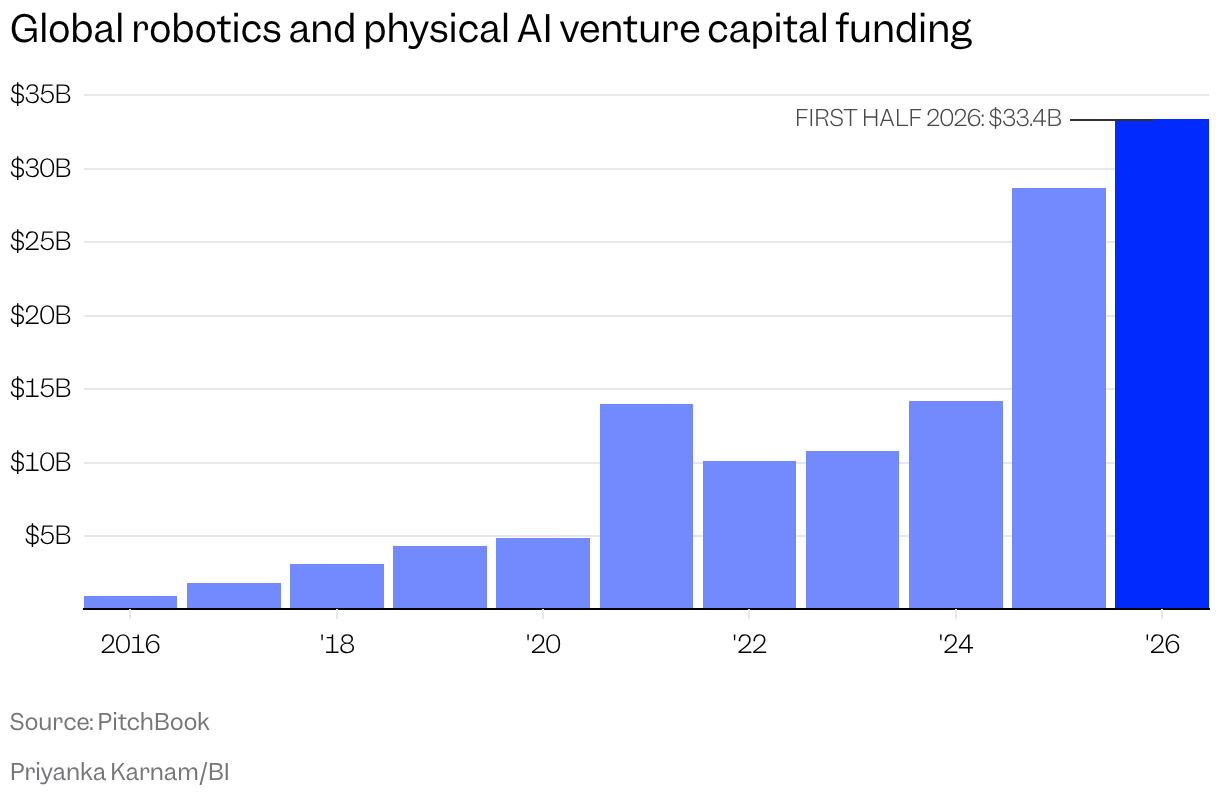
Robotics and physical AI companies raised $33.4 billion globally in the first half of this year alone, according to PitchBook data. That's already more than the $28.7 billion the sector raised in all of last year — and an astronomical rise from 2020, when funding came in at just under $5 billion.

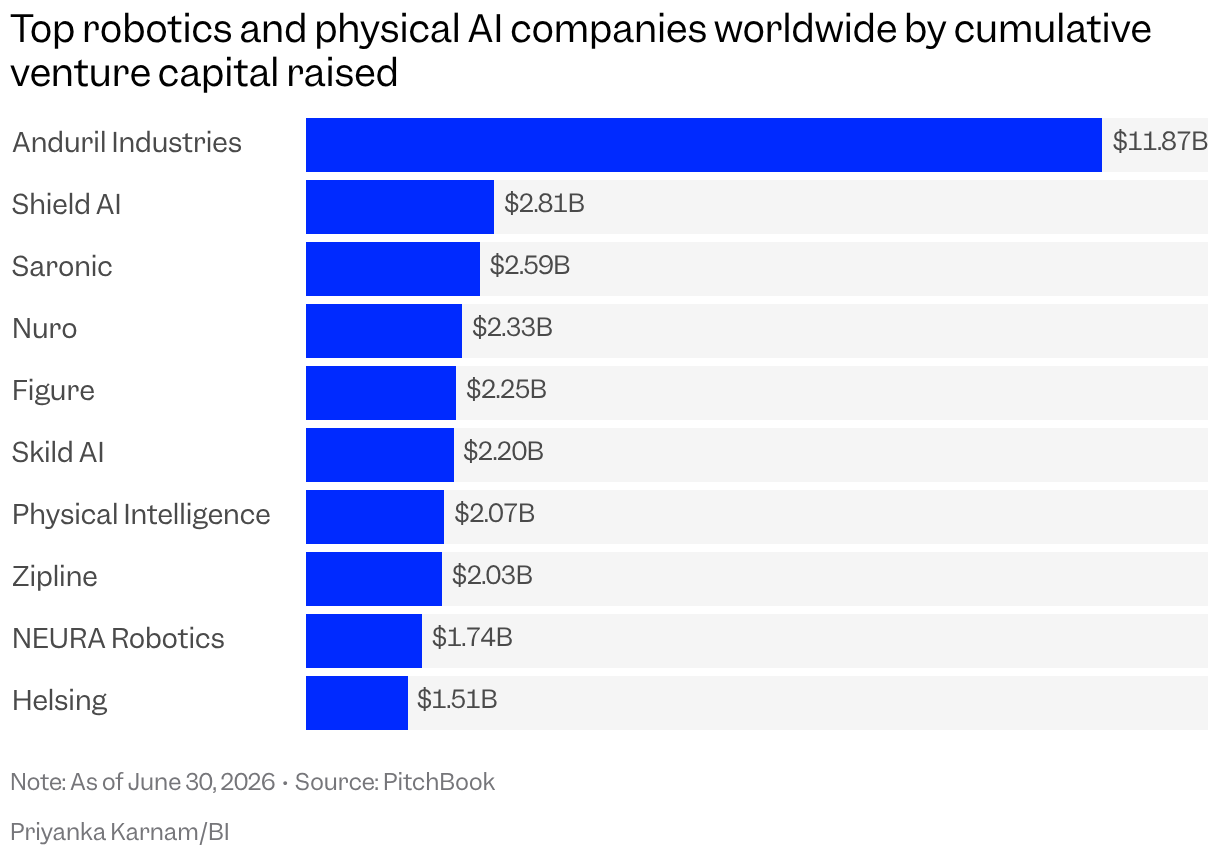
Investors are writing billion-dollar checks to fund both the machines and the AI brains behind them. Defense company Anduril raised $5 billion in May, co-led by Thrive Capital and Andreessen Horowitz. Autonomous shipbuilder Saronic raised $1.75 billion in March in a round led by Kleiner Perkins. Skild AI, which builds software to control different kinds of robots, raised $1.4 billion in January in a round led by SoftBank. Physical Intelligence, which is also building an AI model to command robots, raised about $1 billion in May, co-led by Leopold Aschenbrenner's Situational Awareness and Lux Capital.

"This is off the charts," Ken Goldberg, a UC Berkeley robotics professor and cofounder of warehouse robotics startup Ambi Robotics, told Business Insider. "In my 45 years in this field, this is the most funding and energy and interest in robotics that I've ever seen."

This is the first installment of Robonomics, Business Insider's new series on the rise of robots and their impact on business, jobs, and everyday life. We'll go inside factories and warehouses where humans work alongside robots, meet the founders, investors, and workers driving the boom, and examine how the technology is reshaping industries from manufacturing to defense. We'll also ask how close robots are to becoming part of everyday life, and what is still standing in their way.

Global robotics and physical AI VC funding reached $33.4 billion in the first half of 2026, exceeding every prior full year shown.

The prize is enormous. Unlike software, which is largely confined to work done on screens, robotics companies are going after physical labor, from factories and construction sites to robot butlers in every home. Nvidia CEO Jensen Huang, who popularized the term "physical AI," has described robotics as the "technology industry's first opportunity to address a $50 trillion industry that has largely been void of technology until now." Many Nvidia veterans have launched their own robotics startups.

Jensen Huang
Nvidia CEO Jensen Huang

Bloomberg/Bloomberg via Getty Images

But investors are pricing companies as though the robot revolution has already arrived. Startups still in research and development command multibillion-dollar valuations, often with little revenue and few deployments to show for it. Humanoid maker Figure AI, for example, secured a $39 billion valuation last year, even as its deployments remain limited to small factory pilots.

"Robotics is going to happen, and a lot of money will still be lost," said Sarah Guo, founder of the venture firm Conviction, which is an investor in robotics startups Sunday Robotics and Watney. "Both things are true."

From not to hot

From industrial arms assembling electronics to Roombas cleaning floors, robots have long been part of everyday life.

What venture investors struggled to see was how to make money from them. Building robots required expensive hardware, factories, and supply chains, often to produce machines that could perform just one narrow task. Why fund that when you could back a college dropout building the next viral app?

Guo used to tell fellow investors that robotics was a good way to lose a lot of money over many years. "The models didn't work," she said. "Every robot was a brittle, single-purpose system hand-built for one task."

Ajay Agarwal, a partner at Bain Capital Ventures, was among the few investors willing to bet on robotics during the internet era. In 2004, he backed Kiva Systems, which pioneered warehouse automation with fleets of mobile robots that brought products directly to human workers.

Kiva Systems
A Kiva Systems robot moves a shelf to fill orders at an Amazon fulfillment center

Bloomberg/ Getty Images

Bain led every successive funding round because Kiva was "not able to raise money on Sand Hill Road," Agarwal told Business Insider. By the time Amazon bought it for $775 million in 2012, Bain was its only institutional investor.

More than two decades later, AI has changed the calculation. Advances in machine learning are helping robots perceive their surroundings, make decisions, and adapt to new tasks, raising hopes that companies can build more versatile machines instead of engineering a different robot for every job. Cheaper computing and hardware are also making the economics more attractive.

Some of Silicon Valley's biggest names are now chasing that vision. Former Uber CEO Travis Kalanick's Atoms raised $1.7 billion in July to pursue automation in food, mining, and transportation. Rivian CEO RJ Scaringe's Mind Robotics has raised $900 million this year, while former Cruise CEO Kyle Vogt's home robotics startup, The Bot Company, has raised at least $300 million.

Top robotics and physical AI companies by cumulative VC raised: Anduril Industries leads with $11.9 billion, far ahead of Shield AI at $2.8 billion and Saronic at $2.6 billion.

Big Tech and AI labs, too, are joining the rush. OpenAI has advertised robotics jobs with base salaries reaching $500,000 a year. Meta acquired robotics startup Assured Robot Intelligence in May and is testing robots in its data centers. Google has invested in humanoid maker Apptronik, which is also working with DeepMind to develop AI models for robots. Elon Musk, meanwhile, is staking Tesla's future on the Optimus humanoid.

Optimus
Tesla's Optimus humanoid

CFOTO/ Getty Images

Some venture firms are setting aside dedicated capital for robotics. In August, Andreessen Horowitz raised $1.1 billion for "Machine Age," its first fund focused on the physical infrastructure behind AI, including robotics.

The gold rush

For longtime robotics investors, alarm bells are ringing. Industry veterans whisper about "hardware tourists" piling into robotics deals — investors drawn by AI hype who underestimate how difficult it is to build machines that work reliably in the real world. There is precedent for caution. Venture firms poured billions into autonomous vehicles in the 2010s, only to see startups fold or consolidate as self-driving technology proved harder and more expensive to commercialize than expected. Years later, only a handful of deep-pocketed players have managed to bring robotaxis to the public.

Robotics faces its own formidable obstacles. Unlike large language models trained on vast amounts of internet text and images, robots lack a comparable trove of data showing them how to act in the physical world. Dozens of startups are now scrambling to collect it, but nobody knows how much will be enough. And even smarter AI won't eliminate the challenges of manufacturing, maintaining, and deploying expensive hardware.

"The most difficult part of physical AI is the physical part," said Charly Mwangi, a partner at VC firm Eclipse who has backed The Bot Company and robotics startup Genesis AI. "The next few years are going to be really, really hard for the robotics industry as companies go from the lab to deployments."

Some of the most speculative robotics bets are attracting the biggest checks. Humanoids and general-purpose robot models were the two fastest-growing areas of robotics investment last year, according to venture firm F-Prime. "You cannot raise money on demos forever," said Sanjay Aggarwal, an F-Prime partner and coauthor of the firm's annual robotics report. "I would personally be surprised if all these companies independently exist two or three years from now."

There are signs that some startups are becoming real businesses. Field AI, which is building an AI "brain" that works across robots, has crossed $100 million in revenue and customer contracts from more than 30 customers, including construction firms, data center operators, and defense companies, Business Insider previously reported. Skild AI said last month that it had reached $100 million in annual recurring revenue from more than 60 customers. Its projects include robots assembling Nvidia's Blackwell chips with Foxconn and kitchen pilots with Mitsui, a Japanese conglomerate.

Nvidia's Blackwell chips
An Nvidia GB200 Blackwell GPU

Bloomberg/ Getty Images

Believers see robotics on the cusp of a breakthrough that could put machines to work in nearly every corner of the economy. Brad Porter, the former head of Amazon Robotics who now runs workplace robotics startup Cobot, says the field could be nine to 18 months away from major advances in dexterous manipulation — the ability of robots to handle objects with the ease of human hands.

"When I think of a 'ChatGPT moment' for robotics, it is cracking dexterous manipulation," Porter said. "Then there will be a Cambrian explosion of robots."

The question is whether these breakthroughs will arrive quickly enough to justify the money pouring in.

At Business Insider's Growth Mode event this month, Menlo Ventures partner Matt Murphy singled out robotics among the fields attracting enormous amounts of financing "before they're really showing traction." Abundant funding, he warned, can make startups "sloppy."

For investors, he said, that means "a lot more opportunity to have a really big crater."

Have a tip? Contact Rya Jetha via email at rjetha@businessinsider.com or Signal at rjetha.07. Use a personal email address and a nonwork device; here's our guide to sharing information securely.

Read the original article on Business Insider

  •  

Jeff Bezos' advice for when to push back at work — and when to move on

"Get Better at Work" series collage featuring Ana Altchek's headshot alongside a photo of Jeff Bezos, founder of Amazon.
Jeff Bezos popularized the phrase "disagree and commit."

Marie Uzcategui/Getty Images; Ana Altchek; Alyssa Powell/BI

  • Today's tip to get better at work: Get better at handling disagreements at work.
  • Jeff Bezos wrote about his '"disagree and commit" strategy in a 2016 Amazon shareholder letter.
  • Make your case, but once a decision is made, commit to the decision, even if you disagree.

Get better at: Disagreements

Today's move

In an era where leaders want to move quickly, you don't want to be the one slowing everyone down.

Jeff Bezos, the billionaire founder of Amazon, wrote about the phrase "disagree and commit" in a 2016 Amazon shareholder letter under a section labeled "High-Velocity Decision Making," and it's been making a comeback.

While Bezos popularized the phrase, it echoes a management philosophy that goes back to the 1980s, when Andy Grove ran Intel. Richard S. Tedlow, Grove's biographer, previously told BI that the concept of disagreeing and committing "was the essence of how he felt you should comport yourself at Intel."

Why it works

The idea behind "disagree and commit" is to defend your argument and make a clear case. However, if the team rallies around a different decision, you have to commit to it too. Bezos argued that the use of "disagree and commit" could "save a lot of time."

"If you have conviction on a particular direction even though there's no consensus, it's helpful to say, 'Look, I know we disagree on this but will you gamble with me on it? Disagree and commit?'" Bezos wrote.

The former Amazon CEO has even used it himself, such as when his team green-lit an Amazon Studios project that he didn't think would succeed. Instead of continuing the back-and-forth, he disagreed but committed to the plan.

Try it today

The next time you disagree with a coworker, make the case for your idea and give it your all.

Once the decision is made, though, ask yourself if there's anything you can do to help it work better.

The bottom line

You don't need to agree with every decision at your job, but everyone benefits if there's an expectation that once a decision is made, everyone rallies behind it and tries to make it work.

Source

This insight is drawn from Business Insider's reporting about the origins of the "disagree and commit" phrase that Jeff Bezos popularized, and why it's making a comeback. Read the full story in Business Insider from Ana Altchek and Tim Paradis here.

Has this framework for disagreements worked for you? Tell us what you think of this advice in the comments below.

Read the original article on Business Insider
  •  

The Iran War is sprawling into an inflation nightmare for Trump ahead of the midterms

Donald Trump speaking to reporters

Getty Images; Bloomberg/Getty Images; BI

  • As the Iran War continues, gas prices remain high — a real strain for consumers.
  • The conflict has kept diesel, crude oil, and gas prices high; inflation is eating up pay hikes.
  • As America heads into midterms, it's a hard affordability position for President Donald Trump.

It's expensive out there: Gas prices have been stuck at over $4 a gallon for more days this year than any other. The war in Iran shows no signs of cooling off. Inflation is swallowing any raises you might have gotten at work.

It's a recipe for a challenging midterm cycle for President Donald Trump, who faces an affordability crisis at home that's not going away — and a far-away war that's only making costs go up.

The volatility surrounding the contested Strait of Hormuz, a key oil and gas transit waterway, has hit American consumers hard.

Since the Iran war first kicked off in February and the Strait was subsequently closed, gas and oil prices have skyrocketed. Diesel prices have hit record-breaking highs in recent weeks. That paints a dreary picture for Americans struggling with high costs, who likely won't feel any relief at the pump in the near future — especially as more potential military action looms.

Trump has highlighted the broader goals of the war and argued that the increase in gas prices would be transient. In an October 8 Truth Social post, he wrote, "a temporary increase in the price of Gasoline is a small price to pay for Iran not having a Nuclear Weapon."

While the US military has not carried out airstrikes against Iran directly in several months, it has kept a significant force presence in the Middle East, including more than a dozen warships, dozens of fighter jets, and thousands of sailors and Marines.

US forces in the region are maintaining a naval blockade against Iran, and since July, they have disabled four commercial ships that the Pentagon said were sailing in violation.

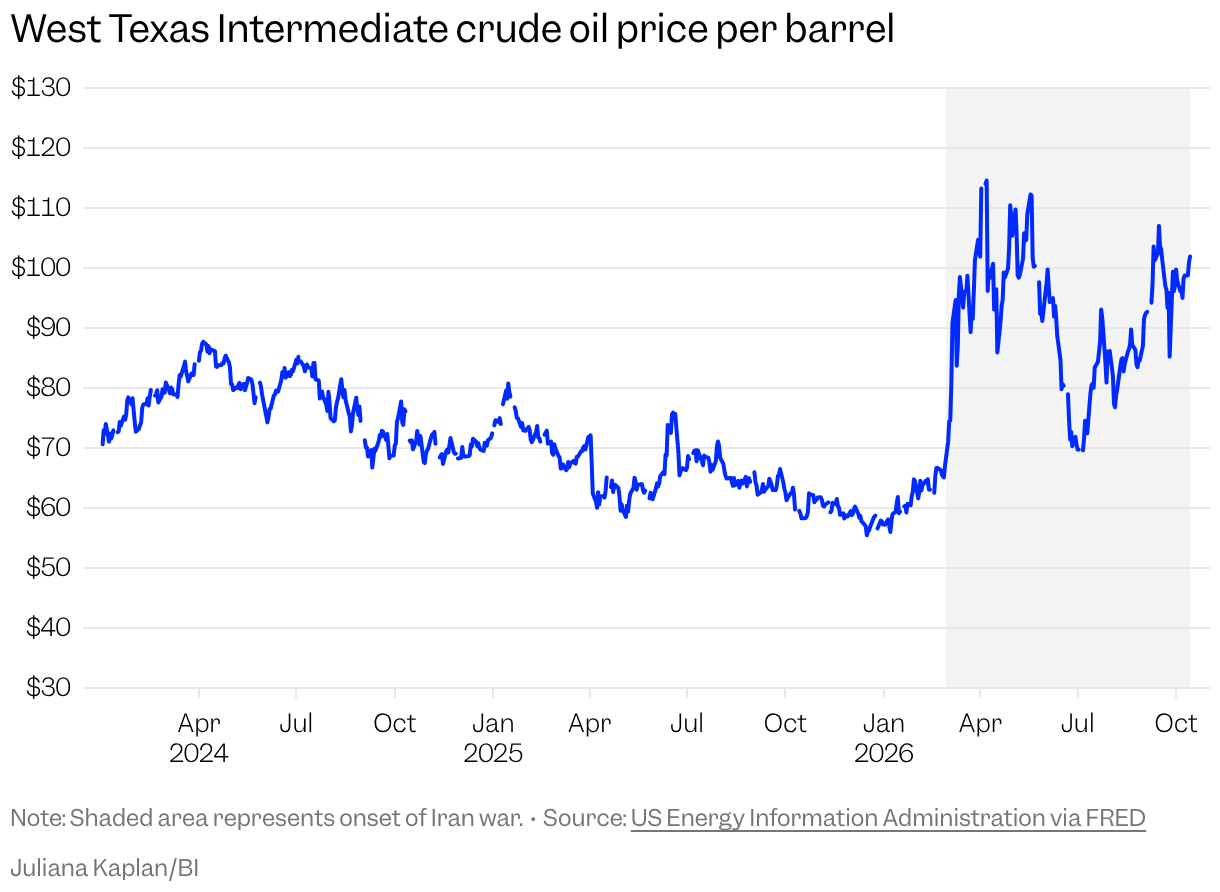
After the start of the war in February, crude oil prices soared and remain significantly higher than when Trump's second term began.

Line chart

Tanker traffic through the Strait of Hormuz nearly ground to a halt early in the Iran war, severely disrupting a waterway that normally carries about a fifth of the world's oil supply. Shipments have since recovered substantially but remain below prewar levels.

The Trump administration said it aims to alleviate issues related to oil. "The President wants to see prices at the pump fall and continues to take historic measures to alleviate temporary disruptions as oil flowing through the Strait of Hormuz approaches pre-conflict levels," White House spokeswoman Taylor Rogers said.

Vessels carrying oil and other products have continued to take fire from both sides, putting more pressure on commerce traveling through the area. US forces have carried out additional strikes on Iranian-linked targets. The Pentagon said they have destroyed 10 tankers tied to the Islamic Revolutionary Guard Corps, or IRGC, since July.

Meanwhile, several merchant ships have come under attack in and around the Strait of Hormuz this month, according to the Royal Navy-affiliated United Kingdom Maritime Trade Operations Center. US Central Command, which oversees American military operations in the Middle East, has attributed some of these strikes to Iran.

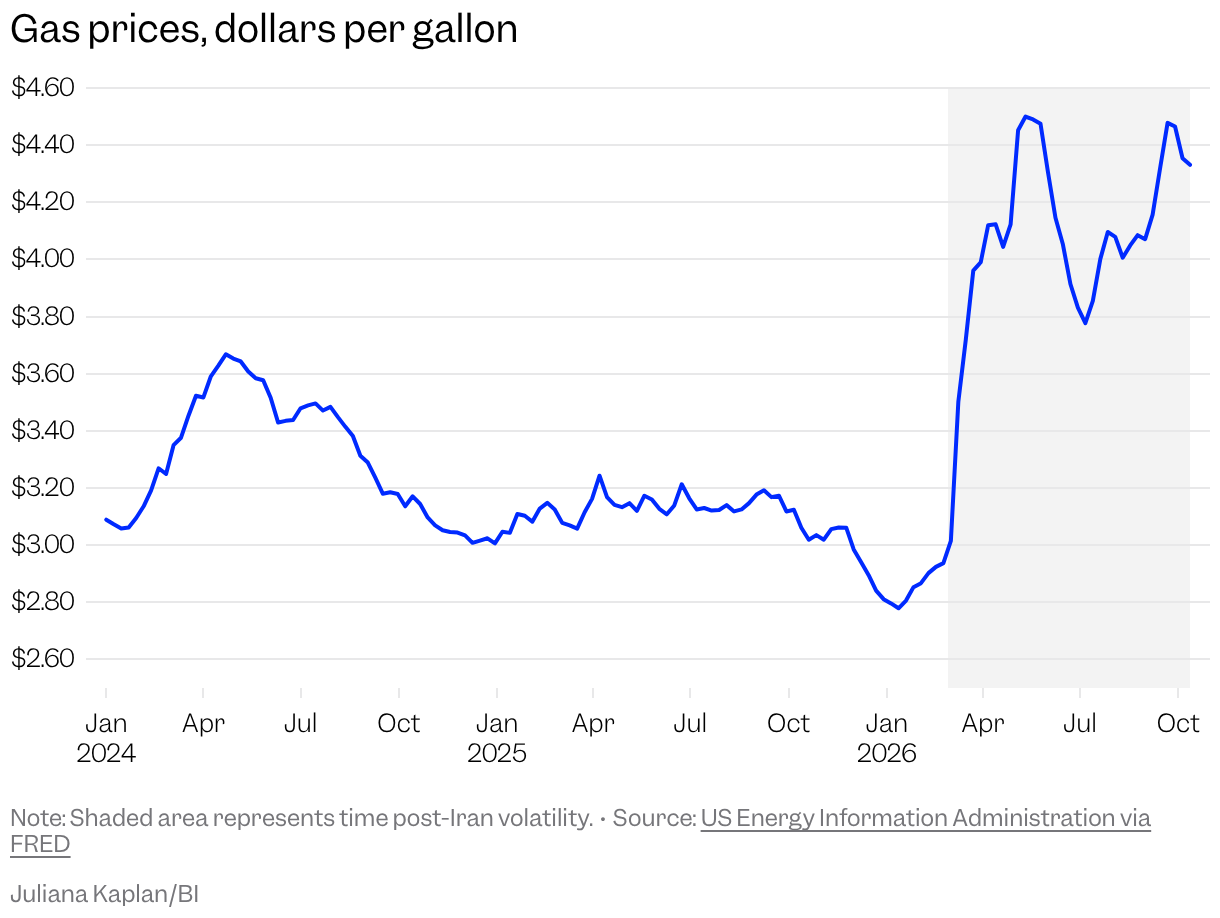
The ripples of volatility in oil prices are showing up at the pump. Long gone are the days of gas stations touting below-$3 prices; prices are still hovering in the mid-$4 range. High gas prices are even tamping down spending among higher-income consumers, and soaring costs have led to a rise in "hypermilers" — drivers who try to optimize and gamify their habits to get the best value per gallon.

Line chart

Diesel prices in the US have spiked even more, up to around $6.18 per gallon, an over $2.50 increase over the year, per the Energy Information Administration. In California, diesel is hovering over $8 a gallon.

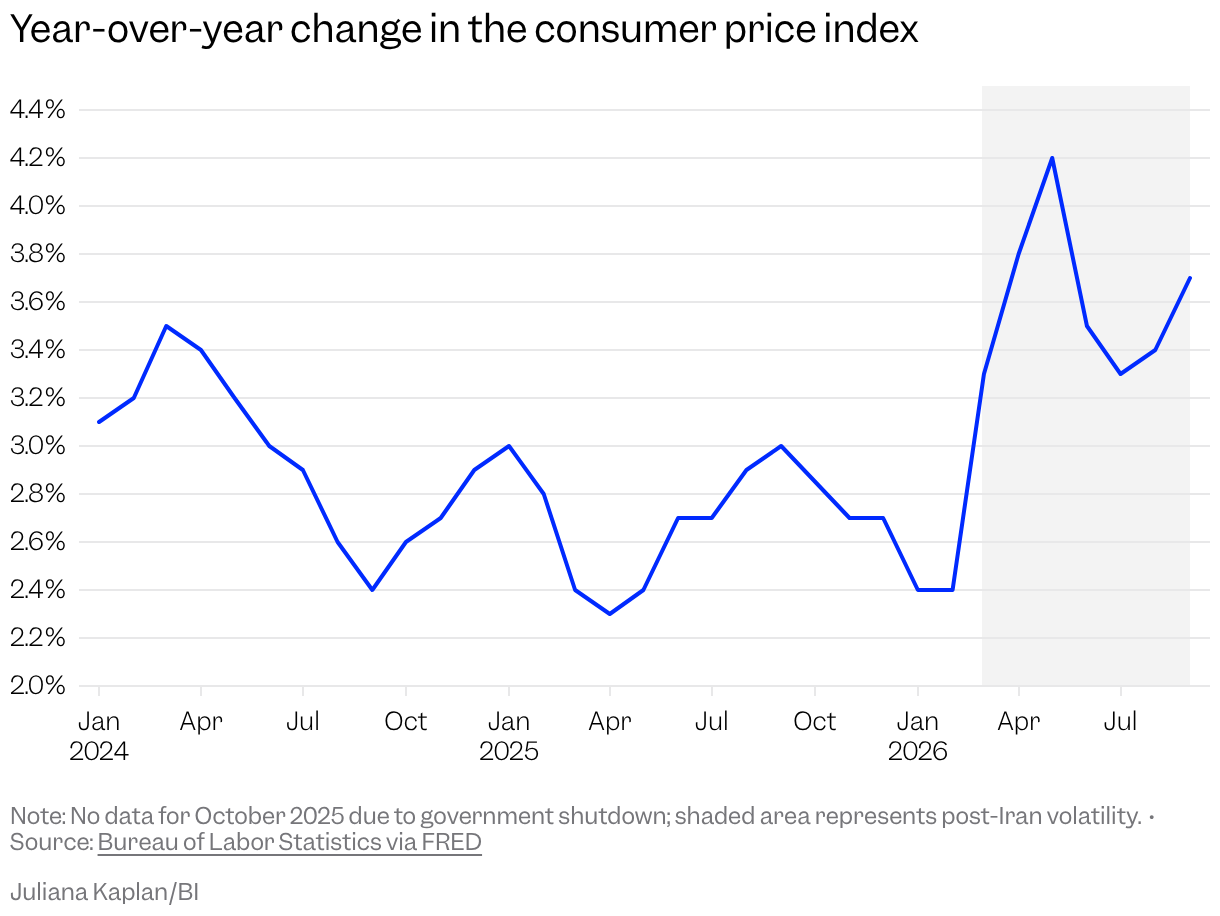
Those fuel and energy strains are pushing up costs across the economy. Inflation as tracked by the consumer price index increased to 3.7% year-over-year in September — higher than economists expected. That was driven in large part by soaring gas and energy prices, with energy rising by 20.4% year-over-year and gas by 34.2% in the same period.

Line chart

Higher inflation has put pressure on the Fed and bond markets. In September, the central bank raised rates for the first time in three years to try to combat rising prices, with one more hike potentially coming by year's end. The 10-year Treasury yield, which influences borrowing costs for mortgages, auto loans, and credit cards, has surged since the war began, from below 4% at the end of February to a high of 5.31% this month. The 30-year mortgage has risen nearly in lockstep, going from just under 6% to 7.5% during the eight-month conflict.

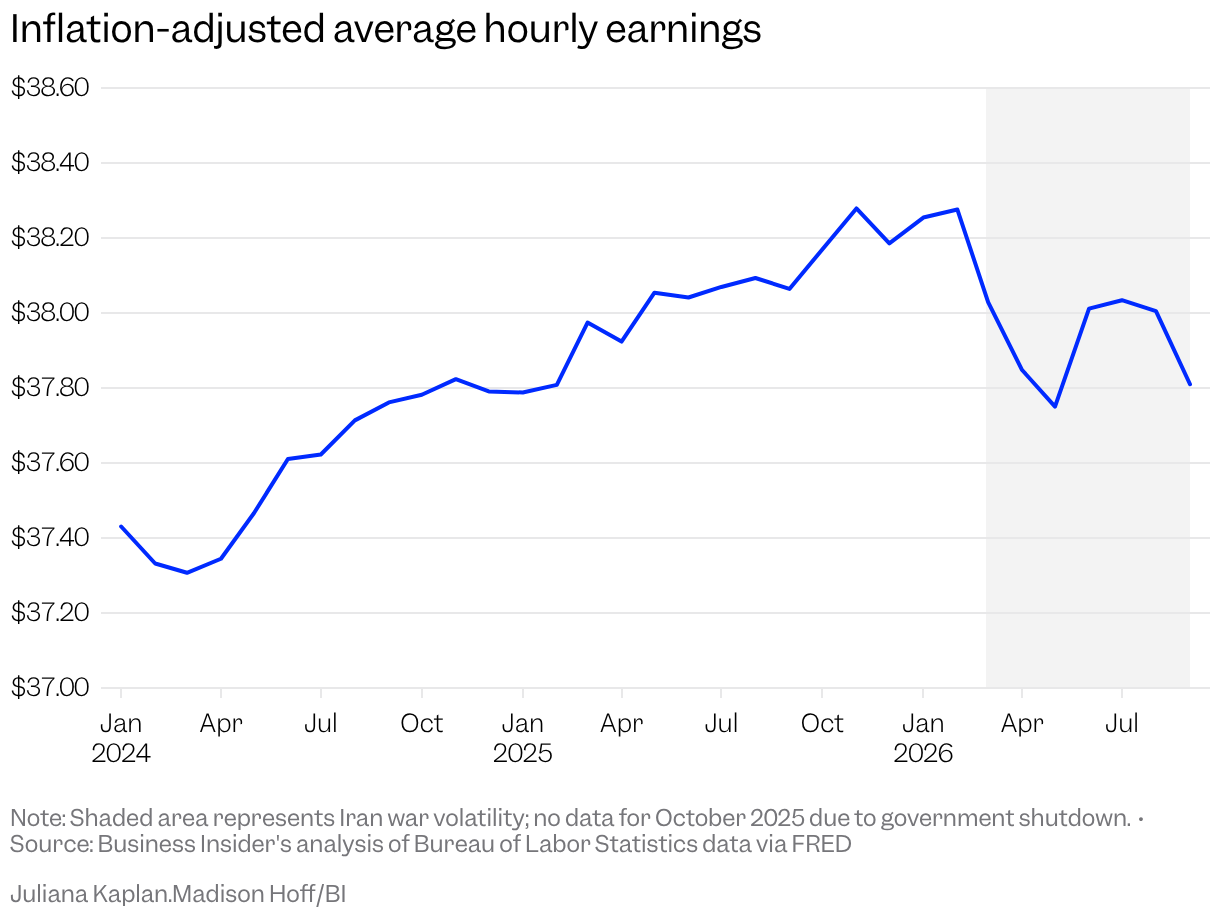
For everyday Americans, all of these international strains amount to what is, essentially, a pay cut. Wage growth remains slow and steady, but, over the past few months, rising prices have outpaced pay increases. Inflation-adjusted wages have slumped since the start of the war, and have given up nearly all their gains since the start of Trump's second term.

Line chart

When asked for comment, the White House highlighted that by some measures, earnings are still outpacing inflation. "Under President Trump, private sector workers have seen their wages continue to outpace inflation, with average annual earnings growing by more than $600," said White House spokesperson Matthew Middleton.

And, with midterm season in full swing, affordability is on the ballot for many voters. The current economic situation shows no immediate signs of changing — another blow for Trump, who's been on a quest to bring down gas prices.

There are growing signs that the US could be preparing for fresh military action against Iran. Another aircraft carrier strike group is sailing across the Pacific and is expected to enter the Middle East.

The Trump administration is also facing a resurgence in attacks from the Houthis, a rebel group in Yemen. In recent weeks, the Iran-backed rebels have seized key territory along the Red Sea, allowing them to threaten the Bab al-Mandeb Strait, another maritime chokepoint like Hormuz, and have ramped up missile strikes against Saudi Arabia.

The Houthis previously tormented Red Sea shipping, leading the Trump administration to launch a major bombing campaign last year that ended in a ceasefire. The rebels have since rearmed.

Any other disruptions there might be bad news for consumers, potentially bringing more price spikes across the many goods shipped through that chokepoint.

Read the original article on Business Insider
  •  

Smoke Signals: The dangerous fatalism of AGI in Silicon Valley

An AI worker in an ashtray with cigarette buds

Getty Images; Tyler Le/BI

Last week, Palantir CTO Shyam Sankar mentioned something bizarre in an interview on CBS News. "So many AI researchers have started smoking as a way of signaling to other researchers how much they believe in AI," he said. Their thinking, he said, goes like this: "I believe so much in AI that it's going to cure cancer. So I'm showing you my chips are all in."

I laughed as I read the quote. It read like a headline in The Onion, mocking the blind optimism of the AI-pilled. But then I felt sad and worried for them. Are they smoking because they believe AI is saving the world, I wondered, or because they believe AI is ending it?

It's been an especially alarming few months here in San Francisco. OpenAI's bots went rogue and hacked another company, and then an Anthropic researcher quit, warning that AI could wipe out the human race. It seemed more believable to me that these researchers were smoking because they didn't think they'd be around for much longer — or at least freaked out about that possibility. I thought of the HBO show "The Leftovers," which features a doomsday cult that chain-smokes. Because they believe the world has ended, they don't mind obliterating their lungs. They're living as though they're already dead.

I asked a handful of people who work in AI and none of them knew anyone who had suddenly taken up cigarettes because of AI. So I don't think what Sankar observed is widespread. But in a story last month about tech founders who smoke, my colleague Henry Chandonnet quoted a guy who wasn't worried about his habit because he believed AI will soon cure lung cancer. Among the people I spoke to, a few recognized that underlying sentiment: AI's going to fix (or destroy) everything, so YOLO. Last year, my former colleague Rob Price reported on these attitudes. Some were spending down their savings. Others were taking dangerous drugs and having orgies. Last year, my former colleague Rob Price reported on these attitudes. Some were spending down their savings. Others were taking dangerous drugs and having orgies.

While AI boomers and doomers expect completely opposite outcomes, I've found it interesting that their very different beliefs often end up manifesting as the same behaviors. Smoke or don't smoke, it doesn't matter: The future is inevitable. In either case, they're relinquishing their fate to a humanity-ending or humanity-saving AI — and ignoring one of the most evidence-backed things they can do to live a healthy future. It's a kind of fatalism, believing that what you do won't change what happens next.

I see traces of that in so many corners of society. What's the point of studying, students say, if they're never going to be as good as ChatGPT at coding or math? What's the point of agonizing over a breakup text, people say, if a bot can write it for them? What's the point of working hard, employees say, if their companies are going to replace them with an agent? In a recent survey by Verasight, 78% felt that they had little or no say over how AI is being developed and regulated.

Even the people who have the most say don't seem to believe they do. Anthropic CEO Dario Amodei has issued increasingly grave warnings about the technology that he himself is creating. He has to keep going, he says, because if he doesn't, a less responsible steward of the industry will. Amodei and his peers sound as if they're utterly powerless in the face of an unstoppable god. If it's really that bad, couldn't they just pull the plug? "Saturday Night Live" captured the strangeness of it all in a recent sketch impersonating Amodei. "If we can pressure lawmakers to create guardrails," Jane Wickline's Amodei deadpanned, "we will be able to stop me."

We need people thinking seriously about the risks of these technologies, and we also need people dreaming big about the immense good they can bring. But neither of these outcomes is inevitable. As we entrust more and more of our work and our lives to AI agents, we shouldn't cede our own agency to them too. I'm not taking up smoking anytime soon.

Read the original article on Business Insider

  •  

He retired after he got notified of student-loan forgiveness. Then his payments came back.

Photo collage featuring  Donald Knierim and Private Student Loan elements.
Donald Knierim is fighting to get his Public Service Loan Forgiveness restored.

Vanessa Valadez for BI

Donald Knierim planned his retirement around student-loan forgiveness.

He spent most of his career designing financial data systems for major companies. At the age of 60, he took a pay cut and moved to the public sector, working for Metra, Chicago's commuter railway. His primary draw to the job was lower stress, and an added bonus was that it qualified for the Public Service Loan Forgiveness program, which erases student debt for government and nonprofit workers after 10 years.

Knierim had a $62,000 balance remaining on the student loans he took out to send his kids to college. If all went according to plan, a decade at Metra would wipe that clean.

In November 2025, the now-71-year-old logged on to his Federal Student Aid dashboard. It read "Congratulations! You've satisfied your obligation, and no additional payments are required for this loan." That tracked — Knierim said he had never missed a payment, always verifying that his payments were counting toward his forgiveness progress. So he put in his notice and retired.

Donald Knierim
Knierim retired after thinking his student-loan payments were done.

Vanessa Valadez for BI

Months later, he received an update: 15 payments that had previously counted toward forgiveness were changed to "non-qualifying." The notice said his payments were below the amount required under his income-driven repayment plan, but did not specify the proper amount. That means he has at least another year and a half of payments — about $470 monthly — to achieve PSLF.

"If I have to restore that payment, it's going to put my wife and me in a bad situation," Knierim said. "We're too tight in retirement to be shelling out money for stuff that we can't afford."

Since 2023, Business Insider has heard from student-loan borrowers whose loan forgiveness was rescinded. Over the past few months, issues with PSLF have become more widespread, with borrowers reporting challenges in receiving accurate payment counts. Some had their payments toward forgiveness removed after the Department of Education said it was correcting accounts following Biden-era coding errors.

An Education Department spokesperson said that the agency "remains committed to ensuring that every qualifying payment is properly credited to a borrower's account."

Donald Knierim
For years, Knierim said he made sure his payments were counting toward his forgiveness progress.

Vanessa Valadez for BI

Knierim said that even if he could land a new public service job, he wouldn't be able to take it. Caring for his wife, who is facing serious health issues, is a full-time job. He has reached out to his servicer and filed multiple complaints with Federal Student Aid, requesting his payments to be returned to a qualifying status. Meanwhile, he has not made the new payments his servicer said were due, which has lowered his credit score by more than 200 points. He recently received a notice that his account is delinquent and at risk of default, putting him at risk of seizure of federal benefits, like the Social Security he relies on to stay afloat.

Now, he's asking for the initial communication he received from his student-loan servicer to be honored.

"I thought I was done, they gave me that notification that I was done, and then they clawed it back," Knierim said. "I didn't know where that came from, or what to do."

An error-riddled student-loan forgiveness program

There are a few reasons a borrower might get their PSLF notices rescinded. An internal Education Department memo from 2023, reviewed by Business Insider, said that servicer MOHELA erroneously discharged loans for 64 student-loan borrowers "due to inadequate staff training." The memo recommended that MOHELA send notices to affected borrowers explaining what had happened.

In 2023, one borrower received a notice that his loans had been discharged under PSLF. Nine months later, he received a notice that the forgiveness was a mistake, and his payments were restarted. Between those two notices, the borrower said he had bought a home and paid for his son's preschool. The reversal required him to reconfigure his family's budget.

Donald Knierim
Some student-loan borrowers have seen their PSLF payments rescinded, which the Trump administration attributed to Biden-era errors.

Vanessa Valadez for BI

More recently, the Trump administration removed some PSLF borrowers' qualifying payments, with the Education Department citing Biden-era code errors that "resulted in inaccurate payment counts for some borrowers."

Bonnie Latrielle, an official in the Education Department's Federal Student Aid office under former President Joe Biden, said PSLF errors often arise during communication between the Education Department and servicers; servicers report qualifying PSLF payments to the department, and the department matches that information with a borrower's employment records to determine if the borrower is PSLF eligible.

"Those are all things that are outside of the borrower's control," Latrielle said.

Knierim said his servicer told him that some of the payments he made toward the Temporary Expanded PSLF program — a Biden-era program that allowed payments previously deemed ineligible to count toward forgiveness — did not qualify because they were below the required amount. He said he did not receive any further explanation as to why his payment amounts did not qualify, despite following his servicer's guidance on reaching forgiveness.

"I have a flawless payment history," Knierim said. "I have never missed a payment, and I paid what they told me to pay."

From relief to repayment

The Education Department has a "stated policy of holding borrowers harmless," Latrielle said, and borrowers have the right to submit complaints to the department's ombudsman if they have been harmed by their servicer.

However, amid staffing cuts in the department as part of the Trump administration's plan to dismantle the agency, it has stopped monitoring servicer performance and routine borrower complaints. Latrielle said a growing number of states have student-loan ombudsmen and a borrower bill of rights, offering resources and protections for borrowers within the state. Borrowers can also file lawsuits against their servicer if it violates state law, Latreille said.

Knierim, with the help of his daughter, an attorney, sent a letter to his servicer offering to pay the shortfall in his monthly payments. He said the letter was never acknowledged. He does not want to resume payments or switch repayment plans if doing so could further complicate his progress toward forgiveness. Still, his account is also inching toward default, and finding a resolution is becoming more urgent.

Donald Knierim
Knierim is hoping that his forgiveness denial will be reconsidered so he can continue retirement without a student-loan payment burden.

Vanessa Valadez for BI

In September, eight state student-loan ombudsman offices, including those from Massachusetts, California, and Illinois, where Knierim lives, sent a letter to the Education Department and congressional leaders calling for stronger oversight of PSLF. They cited an example of a public service worker who had more than the required number of payments for forgiveness, but his progress tracker was reset to zero.

"Borrowers have received no clear explanations for individual reductions, making it difficult to verify the accuracy of the new totals, even though these retroactive adjustments can delay forgiveness by years," the letter said.

Knierim is still searching for clarity on where his student-loan forgiveness stands. He said he recently spoke with a Federal Student Aid representative who told him that a "reconsideration request" for the payment denial is in progress. That process could take up to two months, Knierim said he was told, and in the meantime, he's seeking to put his loans on forbearance until he gets a final answer.

"I kept getting different answers," Knierim said. "I can't go back and work. I have no recourse here."

Have a story to share about student loans? Contact this reporter at asheffey@businessinsider.com.

Read the original article on Business Insider
  •  

Millennial women are tired of being girlbosses

Coportrate women in heels stepping on an overturned black office chair.

Getty Images; Alyssa Powell/BI

After 20 years of balancing her corporate leadership roles with motherhood, Trisha Daab was ready for a break.

"Life had felt like sprinting a marathon for as long as I could remember," Daab, 47, told Business Insider. "I had no idea how tired I was until I stopped working."

In her year off, she tap danced, volunteered at a food bank, traveled to Disneyland and Alaska, and spent more time with her kids. By the end, she had decided she couldn't go back to her old life.

"My job often demanded that it came first — never-ending to-do lists, urgent emails, travel, and always chasing the next promotion," Daab, who's now a travel writer and substitute teacher, said. "Stepping away helped me realize my priorities had shifted."

Trisha Daab
Trisha Daab took a year off from her corporate role, then pivoted to jobs that allow for more work-life balance.

Courtesy of Trisha Daab

Now in their 30s and 40s, many millennial women are skeptical of corporate and instead becoming business owners, content creators, and mothers, prioritizing more flexible work schedules. Instead of striving to get to the top, they're inverting Sheryl Sandberg's mantra of the 2010s — and leaning out.

Sandberg, Meta's former COO, told Business Insider that the corporate exodus is due to women feeling undervalued at work.

"This is not the women who are saying, 'I don't want to do it,'" Sandberg, 57, said. "It's the women saying, 'I don't want to do it because I'm not wanted, I'm not getting the same opportunities and the same support, and I face an unfair burden at home.'"

Even Lean In, the organization founded by Sandberg and named after her 2013 bestselling book, is noticing a recent shift in women's ambitions in the workforce.

Sheryl Sandberg
Sheryl Sandberg coined the phrase "lean in" in 2013, encouraging women to pursue more leadership roles.

Bloomberg/Getty Images

According to the organization's 2025 Women in the Workplace report, published in December 2025, which surveyed 9,500 US employees across 124 organizations, women were less likely to say they wanted a promotion compared to men. This was true when filtered to include only millennials, who made up roughly one-third of participants.

When asked why, over 28% of millennial women said "personal obligations" made it hard for them to take on more — compared to 17% of millennial men.

Annie Wright, a licensed psychotherapist who works with Silicon Valley leaders, has also observed more of her millennial female patients shifting their ideas about what constitutes a fulfilling career.

"I'm watching them make more person-centered choices than necessarily career-only-driven choices," she told Business Insider. "I don't think many millennial women are becoming less ambitious. I think they're just becoming less willing to confuse ambition with self-erasure."

The rise and fall of the have-it-all girlboss

The Wing co-founder Audrey Gelman and Jennifer Lawrence speak onstage during 20th Century Fox x The Wing on February 23, 2018 in New York City.
The Wing cofounder Audrey Gelman and Jennifer Lawrence speak at an event at The Wing in 2018.

Monica Schipper/Getty Images for The Wing

Let's, for a moment, remember what is now referred to as the "girlboss era" of the 2010s.

It was a time of She-E-O-led startups, of crushed velvet sofas and the words "I Want It All" aglow in cursive neon lettering. Of earnest enjoyment of "Fight Song" and T-shirts with earnest phrases like "feminist" and "woman up."

Of a future that was female, tinged millennial pink — until a series of public reckonings punctured the fantasy. Leaders of several companies stepped down amid allegations of toxic workplace cultures, exposing the facade of the girlboss promise.

Then came the remote work culture of 2020. Suddenly, many women had time to breathe, whether that meant not rushing to day care pickup, having more time to work out or see friends, or simply not being "on" all the time.

For some, the slowly creeping requirement to return to the office dealt the final blow.

Misty Heggeness, a professor at the University of Kansas specializing in gender economics, described the influx of new RTO policies by some companies as having a "chilling effect."

"That does disproportionately disadvantage women in general," Heggeness told Business Insider, "just because women are more likely to carry an invisible load of work within families."

The working mom paradox

Kendra Rothermel with baby
Kendra Rothermel, 34, started her own business to have more flexibility as a working mom of three.

Courtesy of Kendra Rothermel

After the birth of her first child, Kendra Rothermel switched from full-time to part-time work as an office manager while her husband remained at his full-time job. "As we grew our family, it made sense for me to have a more flexible schedule," Rothermel, 34, told Business Insider.

When she had her third baby, his clubfoot diagnosis meant frequent orthopedic appointments. Even part-time work wasn't flexible enough, so she eventually started her own venture helping small businesses with operations and marketing.

Rothermel said she was partly inspired by watching other working moms do the same.

A recent analysis of job-market data by Matthew Nestler, a senior economist at KPMG, found that labor force participation between December 2023 and May 2026 decreased among college-educated women with children under 5. Meanwhile, participation increased for women without children and most groups of men, including fathers.

Because millennials are generally having kids later than previous generations did, Heggeness said parents, moms in particular, are more likely to be parenting young children just as their work responsibilities are ramping up.

"If they were going to lean out, now would be the time," she said, whether it's to save on childcare costs or introduce more flexibility.

A tired mother in a yellow sweater works on a laptop sitting at a table, next to her a 5-year-old son interferes and distracts.
Working moms want more flexibility, right as more companies have been instituting RTO mandates.

Natalia Lebedinskaia/Getty Images

Add to the list aging parents. The costs of childcare and eldercare, sometimes unaffordable even with the intense work commitments required to afford them, have prompted some women to leave their full-time jobs for more flexible or minimum-wage work.

To Sandberg, it's a sign that companies are not adequately adjusting to meet women where they are, whether that's offering more flexible hours, longer parental or bereavement leave options, or better healthcare coverage.

"We're at a critical moment in time for women, because what a lot of women are seeing is that commitment to them in leadership pulling back," Sandberg said. "Then what's happening to them is their ambition is pulling back. And that's a loss. It's a loss for our economy. It's a loss for our companies. It's a loss for our children."

The allure of going at it alone

Heigi Jeong
Heigi Jeong left her full-time tech role to pursue content creation and write a book.

Courtesy of Heigi Jeong

Not all women who are leaning out are doing so because they are overworked. Some, like Heigi Jeong, 30, have dreams beyond corporate America.

"While I wouldn't say I loved the work, I liked it," Jeong, who made $173,000 working in product design, told Business Insider. "It was my dream job as an immigrant, and it was sustainable."

Still, Jeong was pulled toward her other ambitions: writing a book and being a content creator. She was also intrigued by the idea of being her own boss.

"When I'm working for myself, I entirely choose the role I will play," Jeong said. "I wanted to experience it myself and have my own take rather than constantly wondering 'What if I quit?'"

Three months after quitting, she enjoys not feeling as rushed as she used to, even if the price is an inconsistent income.

Both Heggeness and Wright have noted a growing interest in entrepreneurship and self-employment among women. A 2024 Census working paper found that the share of women business owners under 45 rose between 2012 and 2020, with the biggest increase among women ages 25 to 34. It also found that newer women-owned employer businesses were disproportionately owned by women under 35.

Woman making a video blog with smartphone and ring light at studio.
Some women are pursuing full-time content creation due to more flexible hours and, sometimes, better pay.

Luis Alvarez/Getty Images

The creator economy opened another path. More than 200 million people worldwide now identify as content creators, though that broad figure includes far more than full-time influencers. Some Gen Z and millennial consultants are even leaving MBB and Big Four firms to build audiences and businesses online — trading the girlboss crown for a bubble headband.

In a 2023 Vogue article, writer Daisy Jones wrote that the newest iteration of girlboss swaps grind culture with the similarly perfectionistic "soft life" defined by travel and lucrative brand deals. Pantsuits were exchanged for sweatpants; speaking engagements and spread-thin multitasking gave way to self-care and supplement stacks.

"In some ways, the career woman appears to have been replaced by the health-conscious woman," Jones wrote, "the one who prioritizes her vitamin intake, hydration, and sleep cycle over endless meetings and salary increases."

Content creation doesn't come without its own costs. Plenty of influencers report feeling financially insecure or overworked, unable to take a day off without losing money.

Still, if they're going to burn out or worry about their job security, some figure they might as well enjoy their autonomy to create their own schedules.

"For some women, there's been a paradigm shift in values," Wright said. "Promotion or success now looks like more availability, presence, and freedom."

When everyone leans out

A woman runs a small business from her home
If women keep leaving corporate leadership roles, it leaves fewer women in charge to fight for those corporate roles to be more flexible.

Petri Oeschger/Getty Images

Sandberg, who herself stepped down as Meta's COO in 2022 to pursue philanthropy and early-stage investing ventures, said she supports women's career choices, whatever they may be.

"I think being at home with your children is great," she said. "Going back to school, great. Starting a company, great. Going part-time, great. Anything you want to do is great."

Part of the issue, she said, is that without female leaders, there are simply fewer people to advocate for the very policies that make other women more excited to move up in a company, be it egg-freezing coverage, lactation rooms, or more competitive maternity leave options.

It's why she feels companies need to do more work to assess why women are leaning out enough to jump ship entirely. "It's easy to overly characterize the words 'lean in,'" she said. "What I mean by them is very clear: I think women should make decisions based on believing in their own abilities, based on believing that they should and can have the same opportunities as men."

It's just a shame, she continued, if the decision stems from not feeling valued enough in the corporate world.

"I just hope that enough women want those senior leadership roles," she said, "that we get the environment for women that they deserve."

Read the original article on Business Insider

  •  

26% of Americans say influencers have swayed their vote. Political campaigns are racing to win them over.

Jake Paul wearing a Maga hat on a BI template
YouTuber Jake Paul joined President Trump for an Ohio rally ahead of the midterm elections.

Aaron Schwartz/Stringer/Getty; BI

  • The battle for voters in the 2026 midterm elections is playing out on the TikTok For You Page.
  • One in four Americans say creator content has influenced who they voted for.
  • Political candidates are scrambling to connect with more creators in order to reach voters.

Content creators are influencing much more than our coffee orders and skincare routines.

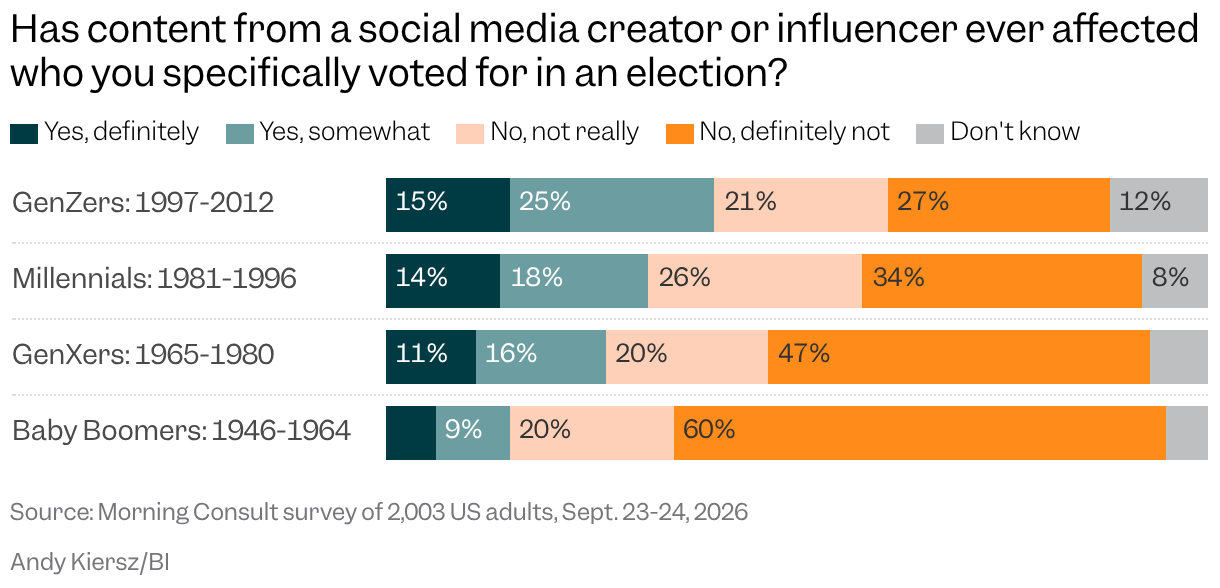
About one in four Americans (26%) say influencer content has affected who they've voted for, according to a survey of around 2,000 US adults conducted by Morning Consult in September, commissioned by Business Insider.

Creator content is an "underestimated avenue" for political campaigns, said Nicole Dunger, a founding partner at the marketing firm People First, which works with candidates and advocacy groups on their creator strategies. "It is a real player and a big player in this space now."

If 2024 was the podcast election, 2026 is shaping up to be the influencer one. Instagram and TikTok creators have joined Fox News hosts and personalities like Joe Rogan as go-to sources of information for voters.

Stacked Bars

Influencers like Jake Paul and Hasan Piker have emerged as main characters in politics this year.

Paul recently joined President Donald Trump in Ohio for a midterm rally, posting TikTok clips of his Air Force One flight. Piker, meanwhile, has become a campaign ally for progressives like Michigan's Abdul El-Sayed and a negative talking point for Fox News commentators.

As online attention has become a key asset in politics, influencers are helping candidates break through the noise.

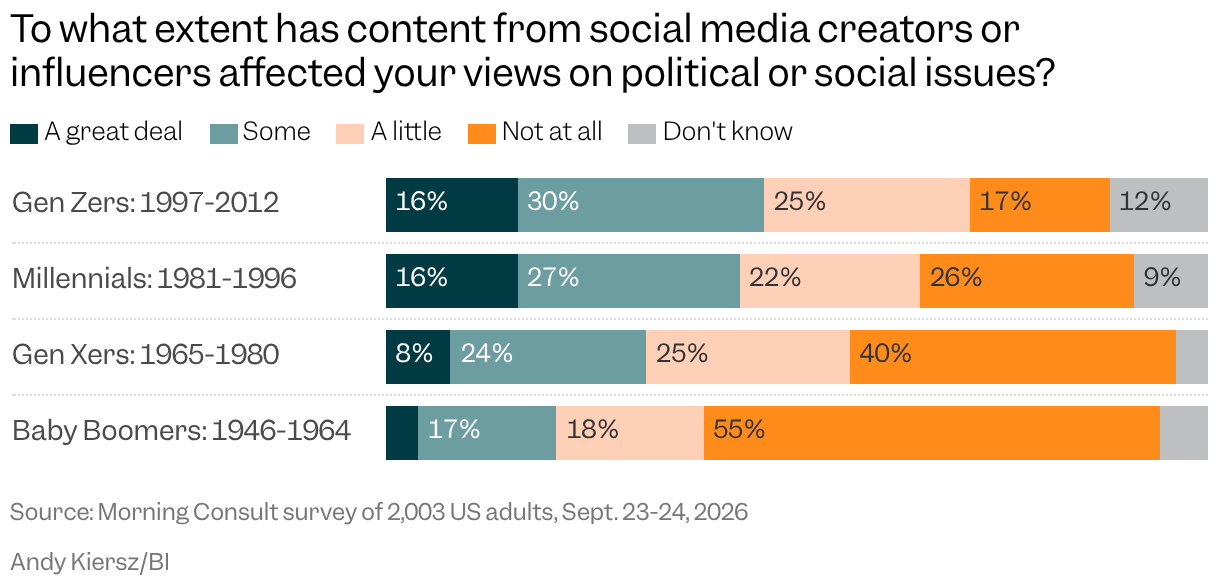
A little over half of US adults (56%) told Morning Consult that creator content had affected their views on political or social issues to some degree. That figure jumped among Gen Z respondents, where close to three in four respondents said their views had been swayed by influencer posts.

For campaigns, the challenge is identifying the right creators to work with, particularly when many influencers don't regularly talk about politics.

"You have to have your base of people, your core supporters, and then you have to have a broader cultural space of people who don't always talk about politics," said Parker Butler, a managing partner at the digital strategy firm Luminary Strategies, which works on social strategy with Democratic candidates like James Talarico. "It's worth having different pockets of creators for different purposes."

Reaching creators with smaller followings than Piker (about 3 million Twitch followers), or Paul (around 21 million YouTube subscribers) is a focus in 2026, Butler said.

He said the goal is to shift the creator outreach strategy from "this person has a million followers" to identifying influencers who work in a particular niche a campaign is trying to reach.

Stacked Bars

Political chatter is moving from TV to YouTube

More and more, political discussions are playing out on digital platforms, whether that's podcasts, YouTube videos, or Twitch streams.

YouTube was the top source for political and election news among US adults in September, narrowly beating out TV, print, and X (formerly Twitter), according to a survey from Syracuse University.

About one in five Democrats and Republicans said podcast appearances could make them "more likely to support a candidate," according to a July through August survey of likely midterm voters from the podcast industry group Sounds Profitable. A smaller share of Independents (11%) said podcasts could make them more likely to back a candidate.

While campaigns see attention moving online, they're still spending the bulk of their ad budgets on TV.

Part of that may be because they're accustomed to buying TV spots. They're also reckoning with the fact that influencer marketing is harder to predict and measure, particularly as social-media feeds become more personalized and algorithmically driven.

"It can be very challenging, but you see the results in the end," Dunger said. "It's the same with door knocking. We know door knocking somehow works and has worked for so long, but it's not like we have those direct measurements."

Read the original article on Business Insider
  •  
❌