❌

Reading view

P-8 Poseidon “Cues” MQ-4C Triton! IAF Experts Call MUM-T Teaming of U.S. Navy Assets a Revolutionary Step

In a first such experiment, the P-8A Poseidon was teamed with the MQ-4C Triton unmanned aerial vehicle, potentially laying the groundwork for a future manned-unmanned teaming (MUM-T) for the US Navy and allied maritime patrol, reconnaissance, anti-submarine, and surface warfare.

Northrop Grumman and Boeing conducted the first automated, manned-unmanned mission control collaboration between the P-8A Poseidon maritime patrol aircraft and the MQ-4C Triton unmanned aerial vehicle in a laboratory environment, demonstrating how the two systems can share intelligence, mission planning, and execution.

“A P-8A operator issued machine-readable, machine-actionable mission tasking to a simulated MQ-4C Triton using UCI [Universal Command & Control Interface] formatted messages,” Boeing stated in an official press statement. “The P-8A cued the Triton transit to a specific area. After receiving the request, the Triton autonomously planned and executed a transit to the area, employed sensors per the tasking, processed findings onboard, and reported results back to the P-8A Poseidon.”

This approach could reduce operator workload, speed up decision-making in a contested environment, and enable more dynamic in-flight tasking without always routing through distant ground control.

Meanwhile, Northrop Grumman emphasized the broader value of the standardized approach: “Using this standardized interface, Triton can collaborate with other U.S. or allied assets sharing the same interface—cutting operator workload and accelerating commander decision-making, making integration across platforms quicker and more cost-effective. The Universal Command and Control Interface is a machine-to-machine collaboration standard based on Open Mission Systems and Autonomy – Government Reference Architecture.”
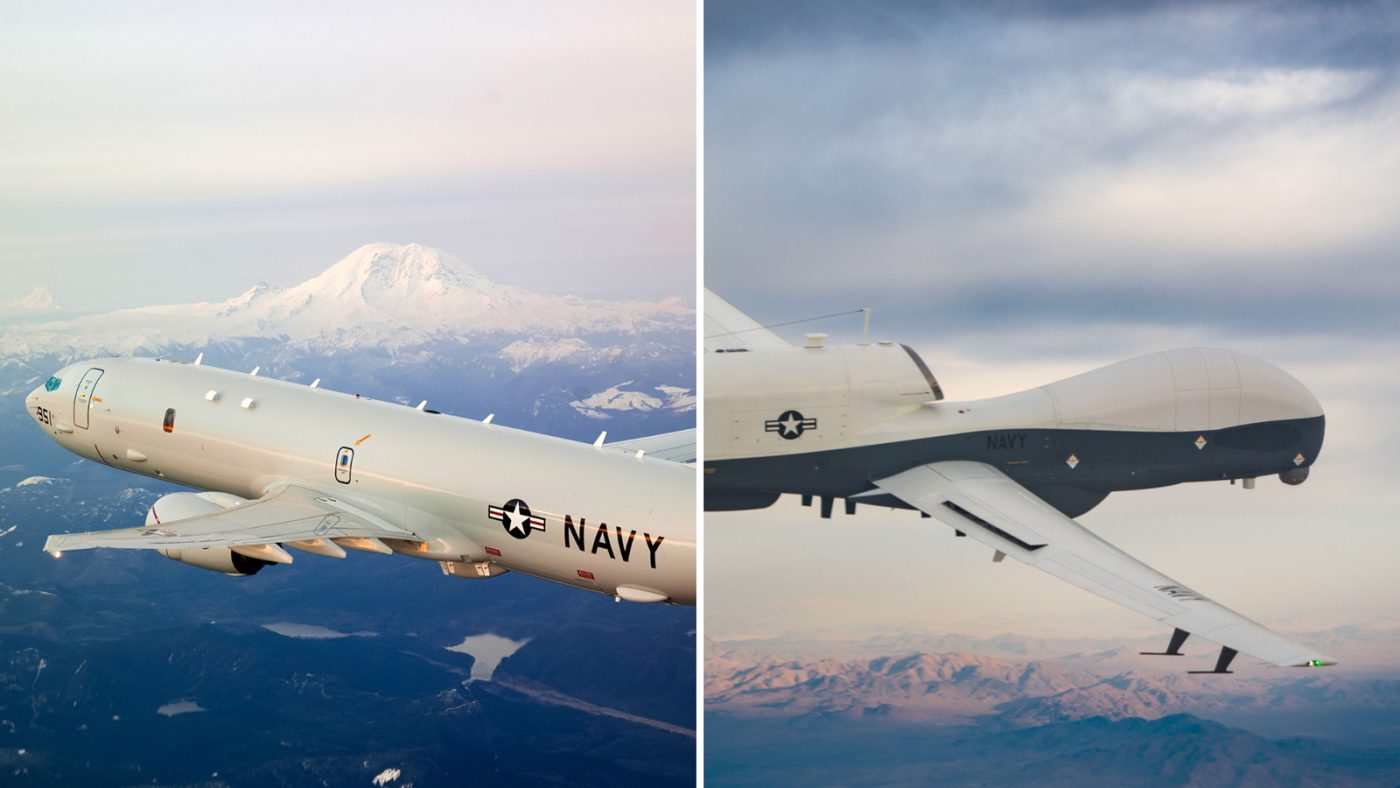
Photo via Boeing press release

Notably, the MQ-4C Triton was originally designed to work closely with the P-8A. A maritime-optimized derivative of the RQ-4 Global Hawk, Triton offers 24-hour endurance and high-altitude, persistent surveillance over vast ocean areas with its 360° multi-function radar, electro-optical/infrared sensors, and other systems. It functions as an “unblinking eye” for continuous maritime domain awareness.

Meanwhile, the P-8A has comparatively shorter endurance but boasts higher speed and lower-altitude capability than the MQ-4C Triton. Furthermore, it is designed to conduct anti-submarine and anti-surface warfare, investigate contacts of interest, support search-and-rescue, and assist in kinetic operations, among other things.

Together, the two platforms cover more ocean more persistently than either could alone, improve the common operating picture, shorten the sensor-to-shooter timeline, and make better use of limited manned aircraft and aircrew.

As a core element of the Maritime Patrol and Reconnaissance Force, Triton transmits real-time data via satellite to ships, aircraft, and shore stations.

MUMT Between Poseidon & Triton

Until now, the two platforms have operated in a complementary but in a relatively separate manner. Triton provides broad-area maritime ISR and cues contacts of interest, such as ships or potential submarines, prompting a P-8A to investigate, prosecute, or engage.

The coordination between them has normally flowed through ground control stations, introducing latency, especially when stations manage multiple missions, operate across time zones, or sit at the end of long satellite communications chains. However, the new automated capability could essentially allow a P-8A crew to issue commands directly to the Triton, after which the drone can autonomously plan and execute the task.

This would expedite the response to unanticipated changes, such as potential threats or seemingly transient targets of interest. Moreover, automation and onboard AI handling of data collection or processing would free crews, both in the air and on the ground, to focus on higher-level decisions rather than routine tasking or sifting through raw sensor feeds.

“The key idea of teaming them is to let each do what it does best while reducing the workload on human operators. Instead of both independently searching the same ocean, the Triton can detect something unusual and automatically cue the Poseidon. It would reduce operator workload, speed up decision-making, enable more flexible and responsive manned-unmanned teaming, and leverage their complementary strengths for broader, more efficient maritime ISR and related missions,” Air Marshal Anil Khosla (retd), Indian Air Force veteran and military commentator, told the EurAsian Times.

“Triton handles the long-endurance, broad-area “look” mission persistently. Poseidon handles responsive, close-in, multi-mission work. Automated teaming lets them operate more seamlessly as a unit rather than operating in relative isolation or with slower human-mediated coordination,” he added.

In a hypothetical scenario, one manned P-8 could also team with one or more Tritons at a time, stretching limited manned aircraft hours and freeing up the Poseidon for high-value missions, such as anti-submarine warfare and responsive strikes in combat.

Only the United States and Australia currently operate both the P-8A and MQ-4C Triton. The P-8A, however, has been acquired by a wider group of nations, including the United States, India, the United Kingdom, Norway, New Zealand, the Republic of Korea, Germany, Canada, Singapore, and Denmark.

The UCI architecture that enables the latest P-8-MQ-4C teaming could also potentially enable Poseidon teaming with other uncrewed assets, as Northrop stated

Indian Air Force (IAF) veteran Air Marshal Anil Chopra (retd) told the EurAsian Times: “All advanced militaries are focusing on data and sensor fusion, and rapidly working on facilitating integration between different platforms, ranging from manned-manned teaming to manned-unmanned teaming, across domains. The P-8A and Triton’s MUMT merely reflect that larger pattern. The same logic extends beyond air-to-air or air-to-surface pairings into surface, subsurface, land, and space sensors and effectors. The goal is a resilient “kill web” rather than linear kill chains, with data moving freely enough that any suitable shooter or sensor can contribute.”

“In the future, the maritime surveillance aircraft could be similarly teamed with other drones, such as the Sea Guardian,” he added.

The SeaGuardian, a variant of the MQ-9 Reaper, is also designed for maritime surveillance and reconnaissance, and could be teamed with the Poseidon aircraft with some tweaks.

Earlier work has already shown related possibilities. A Boeing-led team virtually demonstrated that the MQ-25’s architecture can support ISR and tanking missions by other aircraft within the mission airspace without conventional communications to a ship-based ground control station. That demonstration included the E-2D Advanced Hawkeye, P-8A Poseidon, and F/A-18 Block III Super Hornet.

There are several other examples of the US military’s efforts aimed at manned-unmanned teaming between aircraft to perform a variety of tasks. In fact, sensor fusion, edge AI, open architectures, and seamless teaming are becoming baseline requirements for competitiveness in contested areas.

The P-8A–MQ-4C laboratory demonstration is clearly a step forward.

However, its actual impact in real conditions will probably depend on how quickly the capability moves from the lab to operational skies.

“MQ-4C Triton and P-8A are the backbone of the U.S. Navy’s maritime patrol and reconnaissance force, delivering complementary capabilities unmatched by any other platforms,” Jane Bishop, Vice President and General Manager of the Global Surveillance Division at Northrop Grumman, was quoted as saying in the official statement. “This demonstration underscores the flexibility of our systems, our unwavering industry investment, and the strength of our industry relationships. Our commitment to pushing the boundaries of advanced technology ensures that the U.S. and allied nations’ operators maintain an unparalleled edge against evolving maritime threats,” he added.

The post P-8 Poseidon “Cues” MQ-4C Triton! IAF Experts Call MUM-T Teaming of U.S. Navy Assets a Revolutionary Step appeared first on EURASIAN TIMES.

  •  

Iran Flaunts U.S. F-15E Wreckage as “War Trophy” Alongside Near-Intact Israeli Hermes & MQ-9 Reaper Drone

As the Trump administration weighs its next moves amid a fragile halt in hostilities, Iran has put on public display a selection of war trophies: wreckage from a downed F-15E Strike Eagle and what it claims are two nearly intact drones.

The US (in collaboration with Israel) launched “Operation Epic Fury” against Iran on February 28, hoping to decapitate the Iranian regime and destroy its military capabilities.

However, about six months later, the Iranian state media published images showing the wreckage of multiple US and Israeli aircraft that it managed to take down during the 40-day war.

This includes the debris of an F-15E Strike Eagle, Call Sign DUDE 44, a US Air Force (USAF) fighter jet now identified as airframe 00-3000.

On April 3, an F-15E Strike Eagle was downed by ground-based fire from Iran’s Islamic Revolutionary Guard Corps (IRGC) while conducting a combat mission over southwestern Iran.

This marked the first confirmed loss of a manned US combat aircraft to Iranian fire over Iranian territory in the conflict, and triggered a 36-hour intense search and rescue operation for the Weapon Stations Officer (WSO) who went missing.

The USAF incurred additional losses during that operation, including the self-destruction of aircraft that became defunct, to deny sensitive material to the IRGC, as previously reported by the EurAsian Times.

From IRGC images.

Remains of Lakenheath-based 🇺🇸 USAF F-15E 00-3000 #AE178B, callsign DUDE44, which was shot down April 3rd over Iran.

DVIDS image from 2014 of F-15E 00-3000 over Afghanistan in 2008. pic.twitter.com/oAugzvAAyi

— Evergreen Intel (@vcdgf555) August 7, 2026

However, the F-15E shoot-down, which belonged to the 48th Fighter Wing from RAF Lakenheath, quickly became the centerpiece of Iranian narratives of successful air defense.

In fact, the Iranian media had released crash-site photos and video almost immediately, showing a vertical stabilizer section with USAFE markings, a red tail flash, and other features consistent with the aircraft.

The current exhibit includes the canopy and an ACES II ejection seat, the latter of which is among the more intact components recovered.

Additionally, some remains attributed to the C-130s abandoned and destroyed during the rescue are on display, though they are less visually prominent.

📍🇮🇷🇺🇸 NEW:

Iran has recovered largely intact US MQ-9 Reaper and Israeli Hermes 900 drones.

IRGC engineers are expected to examine the captured systems, study their technologies and reverse-engineer key components to help develop advanced indigenous drone models. pic.twitter.com/3cOBvPVzNx

— Jackson Hinkle 🇺🇸 (@jacksonhinkle) August 8, 2026

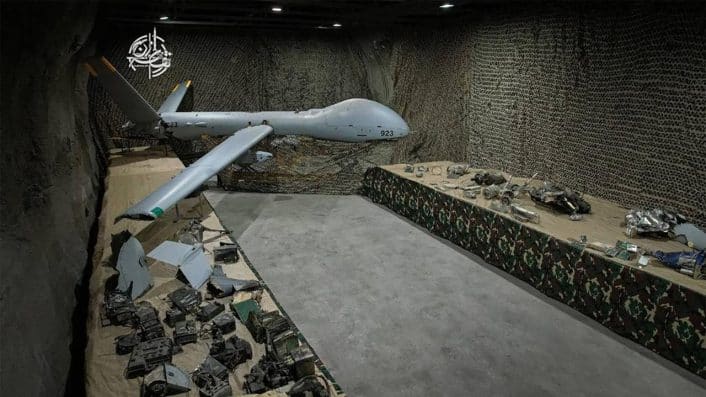
The more striking trophies, however, are the two drones Iran claims to have recovered in largely intact condition during Operation Epic Fury: a US MQ-9 Reaper and an Israeli Elbit Systems Hermes 900 serial 923.

Iranian authorities assert the Reapers were intercepted by air defenses, and the Hermes 900 was brought down by electronic warfare.

It is worth mentioning that Iran managed to down at least 24 MQ-9 Reapers until the ceasefire, accounting for 57% of all USAF losses in the war. However, several more of this class of drones were downed in intermittent exchange of hostilities after the ceasefire, bringing the total to about 30, according to claims made by US officials in early July.

Despite the attrition, the Chief of Staff, Gen. Kenneth S. Wilsbach, endorsed the Reaper as the MVP of the Iran war, stating, “We’ve made many, many strikes” with Reapers.  “It’s an unmanned platform, so we get a lot of utility out of them, and don’t put our folks at risk,” Wilsbach said, as reported by the EurAsian Times at the time.

Separately, the open-source trackers documented at least four to five Israeli Hermes 900s lost during the main phase of the war with Iran, with some assessments running as high as eight. However, the EurAsian Times could not independently verify total losses.

A nearly intact Israeli Hermes 900 UAV displayed by Iran (Via Iranian State Media)

Notably, while collecting and parading war trophies is fairly common—as done by Russia and Ukraine in their ongoing war—it has its own risks.

For example, Iran could exploit recovered drones primarily through technical intelligence (TECHINT), reverse engineering, and adaptation for its own programs.

These platforms are medium-altitude, long-endurance (MALE) UAVs used for intelligence, surveillance, reconnaissance (ISR), and strike missions.

Iran could disassemble the drones and obtain key technologies, such as optics, detectors, stabilization, laser systems, and processing units, to improve its electro-optical or infrared (IR) packages, Synthetic Aperture Radar (SAR) capabilities, and multi-sensor fusion for integration with its vast inventory of existing platforms.

Additionally, it could get access to satellite communications (SATCOM) for encrypted command and control, line-of-sight datalinks, beyond-line-of-sight control, and possible tactical links.

To improve the long-endurance capabilities of Iranian aircraft and payload integration, the IRGC might also investigate structural design, sensor vibration isolation, and modular bays.

In a hypothetical situation, even partial insights could enhance the day-and-night, all-weather ISR capabilities of current Iranian drones or provide guidance for electronic warfare, jamming, and air defense strategies against comparable Western weapons.

Furthermore, Iran could also choose to share its exploits with key partners like Russia, which has assisted Tehran in its military operations.

Iran, on its part, has demonstrated it could reverse-engineer Western drones.

When Iran Took Down & Reengineered A US Drone

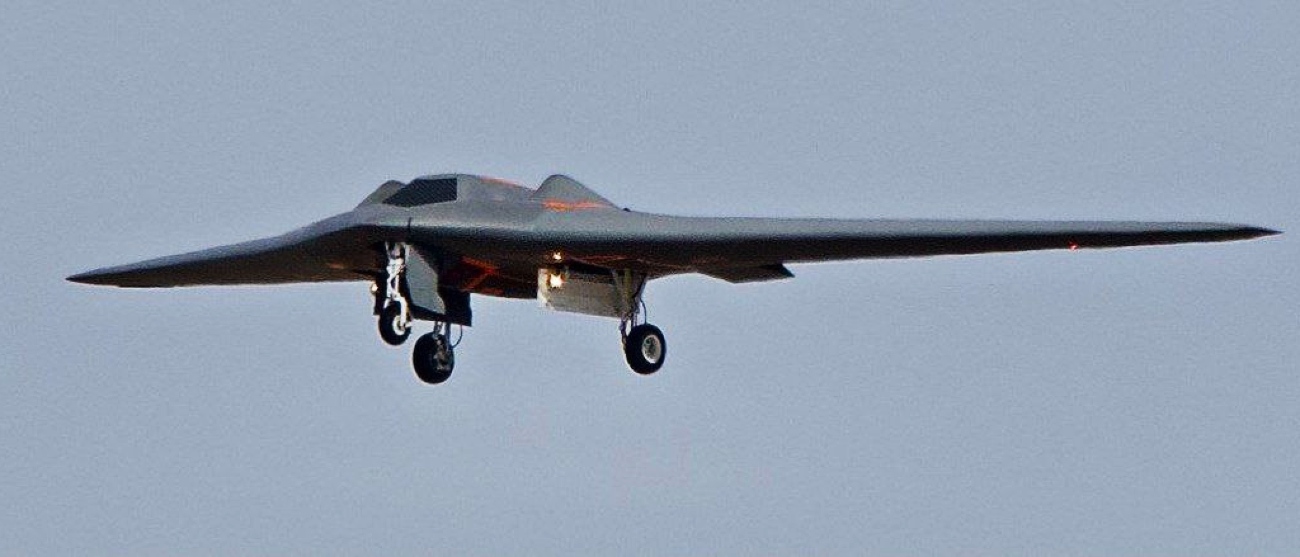
Iran hit the jackpot on December 5, 2011, when its cyber warfare unit commandeered the US’ Lockheed Martin RQ-170 Sentinel UAV and forced it to land near the city of Kashmar in northeastern Iran, about 225–250 kilometers from the Afghanistan border.

The US officials later confirmed it was a CIA-operated unmanned aircraft involved in a reconnaissance mission, with reports indicating it was part of efforts monitoring Iranian nuclear and other military facilities.

At the time, Iran’s government announced that its cyberwarfare unit had detected the aircraft in Iranian airspace, commandeered it, and landed it with minimal damage rather than shooting it down. Iranian officials, including commanders from the IRGC Aerospace Force, claimed they jammed the drone’s satellite and control communications links, forcing it into an autopilot or lost-link mode, then used GPS spoofing to make the aircraft land. 

US RQ-170 Sentinel
US RQ-170 Sentinel

Some American analysts and officials expressed skepticism about Iran’s electronic-warfare claims, noting that the RQ-170 relies primarily on an inertial navigation system, which is harder to jam or spoof than pure GPS.

Interestingly, though, the relatively intact airframe fueled competing theories of a controlled recovery versus a soft crash after loss of control.

The former US President Barack Obama publicly acknowledged the incident and, on 12 December 2011, stated that the United States had formally requested the drone’s return.

However, Iran denied the US’s demands to return the UAV, and Iranian state television on December 8 broadcast footage of Iranian military officials inspecting what they identified as an RQ-170 Sentinel drone. Additionally, Tehran went so far as to claim that countries like China and Russia had approached it to get information on the drone.

The event exposed details of a previously highly classified surveillance operation over Iran and raised fears about possible technology transfer, constituting a major intelligence and technological defeat for the United States.

By 2012, the IRGC had claimed to have succeeded in gleaning data from the US drone and was building a process to create a replica of the aircraft. The Sentinel was then reverse-engineered to create what is now the Saeghe/Simorgh drone. 

Iranian-built RQ-170 Sentinel copy- Wikipedia

Similarly, in 2012, Iranian state television showed images of what it said was a US ScanEagle drone in its airspace.

Iran has never denied. Instead, it has chosen to flaunt the fact that its UAVs have been reverse-engineered from US drones as a major victory.

It is safe to say that an adversary will almost always be able to obtain some degree of intelligence from an aircraft’s wreckage, regardless of the measures taken to prevent it. While this does put US and Israeli military technology at risk, it is an inevitable prospect that both countries were likely aware of when they embarked on this war with Tehran.


The post Iran Flaunts U.S. F-15E Wreckage as “War Trophy” Alongside Near-Intact Israeli Hermes & MQ-9 Reaper Drone appeared first on EURASIAN TIMES.

  •  
❌