❌

Reading view

Israel bombed a hospital. It separated a family for three years.

Screenshot by TRNN

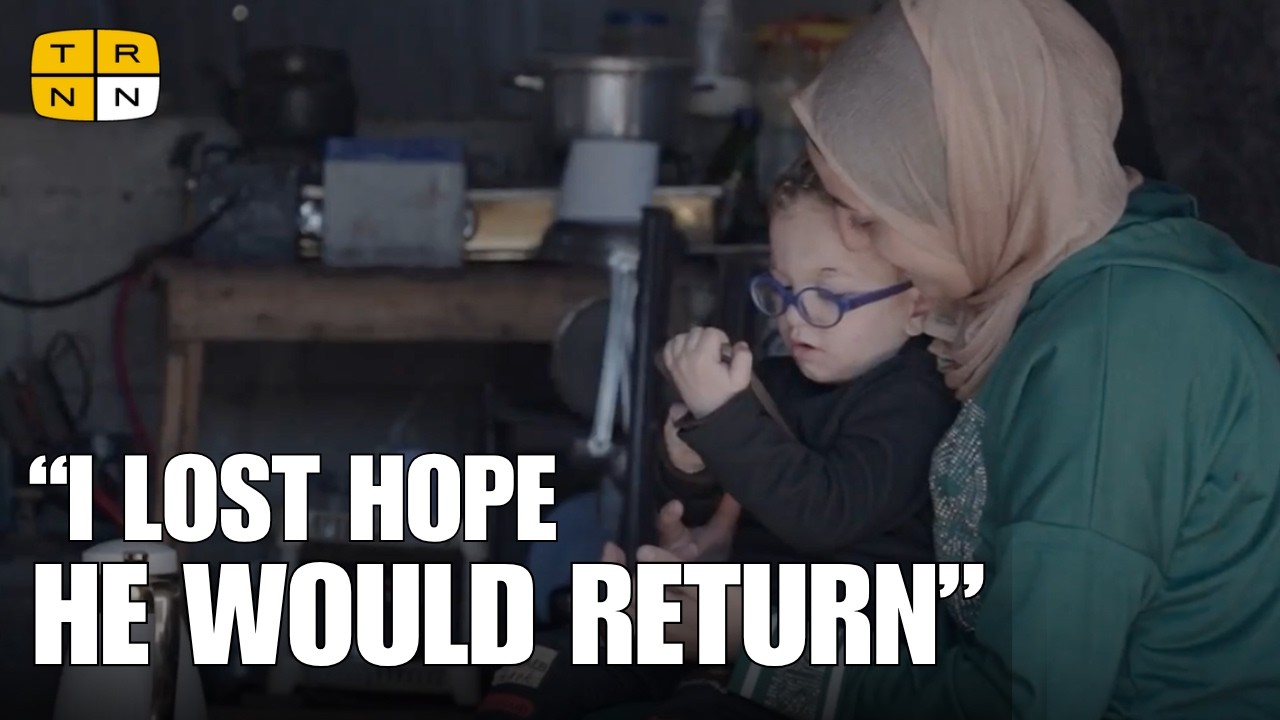
When Israeli forces besieged Al-Shifa Hospital in November 2023, eight premature babies in incubators were evacuated to Egypt under fire. One of them was Joud. His mother, Fatima Dakkeh, spent the next two years and eight months searching for him and fighting to bring him home.

Fatima tells the story of giving birth just months before October 7, losing contact with her son during the first Israeli raid on Al-Shifa, learning a year later that he was alive in Egypt, and a bittersweet reunion with a child who no longer recognized her.

According to the International Rescue Committee, at least 17,000 children in Gaza are unaccompanied or separated from their parents. For many families, there will be no reunion.

Credits:

Producers: Belal Awad, Leo Erhardt
Videographers: Ruwaida Amer, Mahmoud Al Mashharawi
Video Editor: Leo Erhardt

Transcript

Narrator:

Al-Shifa hospital is the largest medical complex in Gaza. Since October 7, it’s been repeatedly raided, occupied and targeted by Israeli forces. Over the course of the Genocide, hundreds were killed in and around the building and the hospital itself was completely destroyed.

In November 2023, under Israeli fire, 8 premature babies in incubators were hurriedly evacuated to Egypt. Joud was one of those babies.

Fatima Dakkeh:

I gave birth to my son, Joud, in July. Joud needed neonatal care at Al-Shifa Hospital. We placed him in the neonatal unit, but then the war started and Joud was there in the hospital. We couldn’t get in touch with Joud because of the shelling and the war.

Narrator:

Fatima Dakkeh and her son Joud have been unable to have a regular mother-son relationship. Joud was born in Gaza just a few months before October 7th 2023 and so, their story has been shaped by war, displacement and separation. Shaped that is, by Israel’s war on Gaza.

Fatima Dakkeh:

When we tried to get to the hospital to get Joud, we weren’t able to get to him and take him out, because of the situation—things had gotten really bad. There was a lot of shelling and there were airstrikes and quadcopters. We planned to go back another day to get Joud, once the situation calms down. But the situation just kept getting worse. The Israelis entered Al-Shifa Hospital and occupied it— that was the first invasion of Al-Shifa Hospital, and my son was inside.

About a year later, I found out my son was in Egypt. I mean, I didn’t give up; I kept going to hospitals, I went to the Red Cross and places like that to search for news about my son, no one could help me. I went to a doctor I know. I told him my story, he said, “I’ll try to get in touch with your son and see where he is.” Thank God, he was the one who discovered my son was in Egypt. After a few days, they sent us pictures of my son, and we found out he was OK. Thank God. They knew he was our son through my name—they had my name on file. We started communicating with him more through my sister-in-law—my sister-in-law in Egypt. We told her the story, and of course she didn’t hesitate; she visited him in hospital, sent us pictures and reassured us about him, thank God.

Honestly, I was happy and upset at the same time because my son was in Egypt, if he would have been here in Gaza he would have suffered a lot. We were starved, even nappies were cut off. Most children were using scraps of cloth as nappies. And milk too, was cut off—we had no milk at all in northern Gaza. I said to myself thank God my son is in a better place than Gaza. But at the same time, I was upset that my son was far from me. I would see mothers playing with their kids, dressing them, carrying them—and I would feel these feelings. I would miss my son. I wished my son was with me. At the same time, I’d look at my situation—how we’re living, in tents, in all this difficulty. I’d say to myself, hopefully he will return to us in a better situation, there will be a ceasefire and we will make up for the days we lost.

I had lost hope that he would return. With the crossing closed and the Israelis were not letting people return. When they first told us he was returning, I was shocked. My husband and I both. We were surprised—how could he come back just like that, overnight? He’s just going to come back, all of a sudden, after we’d lost hope all these years. I was overjoyed with the news that I would see my son again, it was the best news. When we went to the hospital to collect him, it took a really long time for them to bring him to us—many hours. With each passing hour, I would get more and more excited: about seeing him and about how I would greet him. I mean it was really hard, but at the same time, the moment when I saw him was really beautiful.

Yeh, honestly, when I first saw my son, he wouldn’t come to me; he’d cry and avoid me. He would go to his dad before me. he didn’t want to come to me, so I was afraid that he’d stay that way uncomfortable around us And afraid of living with us, and afraid of the situation we’re in— that he wouldn’t accept us Thank God, little by little, he started to accept us.

Narrator:

According to estimates by the International Rescue Committee, 20,000 children are still living separated from their parents in Gaza. Fatima was reunited with Joud and though their separation which lasted 2 years and 8 months impacted both mother and child, they are now reunited. As for the thousands of other survivors in Gaza, for many there will be no reunion.
💾

When Israeli forces raided Al-Shifa Hospital, Fatima Dakkeh’s newborn baby was evacuated to Egypt without her — one of thousands of Gaza's children separated from their families by Israel's war.
  •  

Horror in Athens: Infant stabbed to death, body kept in the freezer

Authorities made shocking findings in an Airbnb apartment in Kypseli district of Athens on Monday:the “frozen” body of an infant inside a container stuck in a suitcase. Three minors aged 9, 12 and 15 with the latter to be pregnant. At least one of the minors, a boy, and the pregnant girl were found positive […]

The post Horror in Athens: Infant stabbed to death, body kept in the freezer appeared first on Keep Talking Greece.

  •  

Supreme court rejects early hearing in PTI founder’s hospital case

Dr. Uzma Khan sought an urgent hearing of her contempt petition over the government’s decision to transfer the PTI founder to PIMS instead of Shifa International Hospital.

The post Supreme court rejects early hearing in PTI founder’s hospital case appeared first on BOL News.

  •  

VTB left Qatar’s CQUR Bank - Its former executives stayed at the top

Four of CQUR’s five original directors came from VTB Capital or RCB Bank, a Cypriot lender then 46.29 per cent owned by VTB. After the Russian bank sold its stake in May 2022, two senior figures from that network remained as chairman and chief executive and later appeared in CQUR’s disclosed ownership chain. Public records show institutional continuity — but not who financed the sale or whether VTB retained any rights.

On 16 May 2022, less than three months after the United States and Britain imposed blocking sanctions, VTB announced that it had sold its 19 per cent stake in Qatar’s CQUR Bank. It disclosed neither the buyer nor the price.

On paper, VTB’s involvement ended there. The corporate record tells a more complicated story.

CQUR was established in the Qatar Financial Centre in 2019. The five directors named in contemporaneous reports citing the QFC were Makram Abboud, Ziad Al-Amin, Vladimir Zrazhevsky, Vladimir Ostrovsky and Nicolas Neophytou. Abboud and Al-Amin came from VTB Capital. Zrazhevsky and Ostrovsky came from RCB Bank in Cyprus, in which VTB then held 46.29 per cent. Four of CQUR’s five disclosed directors therefore came from VTB Capital or a bank nearly half-owned by VTB.

The board later changed substantially: four of its five current members were not on the 2019 list. But continuity remained at the top. Abboud, now CQUR’s chairman, previously ran VTB Capital’s Middle East and Africa business and sat on the board of VTB Capital plc. Al-Amin, CQUR’s chief executive, worked at VTB Capital and later headed RCB’s Dubai office.

Both men have since appeared inside CQUR’s ownership chain. Abboud is a director of Quince Holding, the bank’s current direct shareholder, and the disclosed significant shareholder of Quince Tree, one of the companies above it. Al-Amin is another director of Quince Holding. They did not simply remain employed by CQUR after VTB’s exit; they later took positions in the companies through which the bank is owned.

There was a striking precedent inside the same network. On 24 February 2022, the day VTB was sanctioned, its 46.29 per cent stake in RCB was acquired by Cypriot shareholders representing RCB’s management. Less than a month later, S&P suspended RCB’s ratings, saying it could not assess either the full effect of the management acquisition or the remaining links between RCB and VTB.

Large assets were also moving back towards the Russian bank. In 2020, VTB assigned CQUR rights to a RussNeft loan and a $100 million Kazchrome tranche. CQUR returned both in February 2022, when their reported value was about $1.18 billion. A month earlier, RCB had returned $1.7 billion in Kazchrome claims.

Audited company accounts therefore establish nearly $2.9 billion in transfers from CQUR and RCB back to VTB in January and February 2022. They do not disclose the price or purpose of those transactions. The transfers demonstrate intensive coordination before VTB’s exit from CQUR; they do not, by themselves, prove control after the sale.

Who bought VTB’s stake remains unclear. An archived CQUR page shows that the other 81 per cent of the bank was held by Amathus Investment Fund SPC, a private fund in the British Virgin Islands. After VTB’s departure, Amathus was the only significant shareholder named by the bank. But no public transfer document reviewed for this investigation identifies it as the buyer of VTB’s shares.

CQUR later said that it had been acquired by Middle Eastern private investors led by management. That wording was absent from the bank’s pages archived in November 2022 and February 2024; it appeared by January 2025. The statement does not reveal who paid VTB, how much was paid or where the money came from.

The ownership structure now recorded in Qatar took shape later. As of 25 August 2026, the QFC register named Quince Holding, incorporated four months earlier, as CQUR’s significant shareholder.

Its disclosed shareholders include Quince Tree, linked to Abboud, and MHF Holding, owned by the established Emirati group Al Hail. That offers a plausible independent explanation for the present structure. But all three vehicles were created after VTB’s exit. They show who sits in the chain now, not who bought the stake in May 2022.

CQUR also retained a clear capacity to serve Russia-linked business. Its latest published terms set a 1pm cut-off for payment orders in Russian roubles. Fix Price’s audited accounts show balances with CQUR worth RUB1.65 billion at the end of 2023 and RUB3.87 billion at the end of 2024. Those amounts are rouble equivalents used in Fix Price’s reporting, not proof that the account itself was denominated in roubles. They do, however, document substantial post-sanctions business with a group focused on the Russian market.

None of this proves sanctions evasion. Rouble payments and service to Russian companies are not illegal in themselves. Such a finding would require evidence of a transaction involving a blocked party, a concealed beneficiary or end user, false trade documents, or a regulator’s action. No such public record involving CQUR was found. The bank says it screens customers, beneficial owners and transactions against UN, Qatari, EU and US sanctions lists.

The evidence supports a firm but bounded conclusion. VTB’s departure did not produce a demonstrable institutional break. CQUR had been built around VTB Capital and RCB personnel; large credit assets returned to VTB shortly before the exit; senior alumni remained at the top and later appeared in the ownership chain; and the bank continued to contemplate rouble payments and serve Russia-linked business.

What the evidence does not establish is whether VTB financed the acquisition, retained voting or economic rights, or issued instructions after the sale. The documents that could answer that question remain undisclosed: the 2022 sale agreement, the identity of the original buyer, proof of funds, voting agreements, pledges, options and any nominee arrangements.

Until those records emerge, VTB’s exit from CQUR can be verified as a change of registered ownership — but not as a clean institutional separation.

  •  
❌