❌

Reading view

Russia’s Zircon May Not Be A Hypersonic Cruise Missile After All

A new Ukrainian intelligence report details the complex production chain behind Russia’s shadowy 3M22 Zircon missile and identifies U.S.-origin electronics inside one of Russia’s most advanced weapons. New details also add weight to the theory that the weapon is a maneuverable quasi-ballistic missile rather than a true hypersonic cruise missile.

The unusually detailed new breakdown of the Zircon missile identifies 70 enterprises and 84 individuals involved in its development and production while providing a component-by-component look at one of Moscow’s most closely watched — and least-understood — weapons.

‼DIU exposes details of russia’s 3M22 Zircon ballistic missile — including its components, production chain, 70 companies involved, key personnel, and foreign equipment used to manufacture the weapon: https://t.co/oOBqjUb8dS pic.twitter.com/VqRSSA41iV

— Defence Intelligence of Ukraine (@DI_Ukraine) August 31, 2026

The first evidence of Zircon’s combat use emerged in February 2024, when Ukrainian officials displayed recovered debris after a Russian strike. The wreckage included distinctive engine and steering-system components that Ukrainian specialists used to identify the weapon.

Russia has since employed the missile on other occasions. Ukrainian authorities reported that a Zircon was launched from occupied Crimea during a major missile and drone strike in January 2026, as we reported at the time.

While initially developed for use from warships and submarines, Zircon is understood to have been employed from ground-based launchers against Ukraine, with modified launchers from the K-300P Bastion coastal defense system considered the most likely candidate.
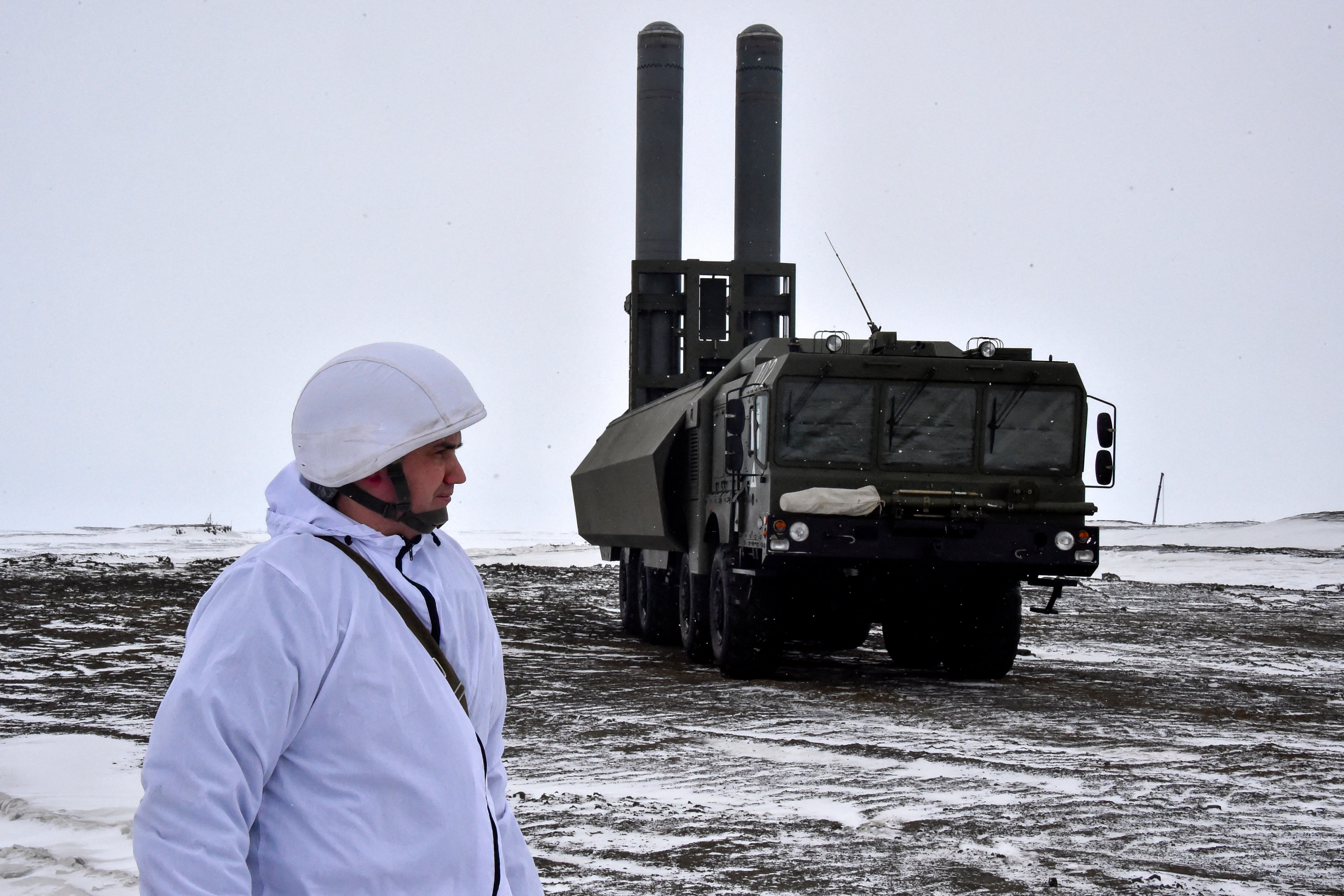
A serviceman stands near a Russia's Bastion mobile coastal defence missile system on the island of Alexandra Land, which is part of the Franz Josef Land archipelago, on May 17, 2021. (Photo by Maxime POPOV / AFP) (Photo by MAXIME POPOV/AFP via Getty Images)
A standard Bastion-P mobile coastal defense missile system. Photo by Maxime POPOV / AFP MAXIME POPOV

The new entry on Ukraine’s Main Directorate of Intelligence (GUR) War & Sanctions portal includes an interactive 3D model and identifies systems ranging from the missile’s radar seeker and onboard computer to its propulsion system and warhead. It also identifies foreign-origin electronics, including components associated with U.S. manufacturers.

Among them, according to the GUR report, is a TGA2704 amplifier associated with TriQuint Semiconductor, now part of U.S. company Qorvo. The GUR also identifies an Altera Cyclone II EP2C5T144I8N field-programmable gate array (FPGA) associated with Altera Corporation, now part of Intel, and lists it as originating in the United States.
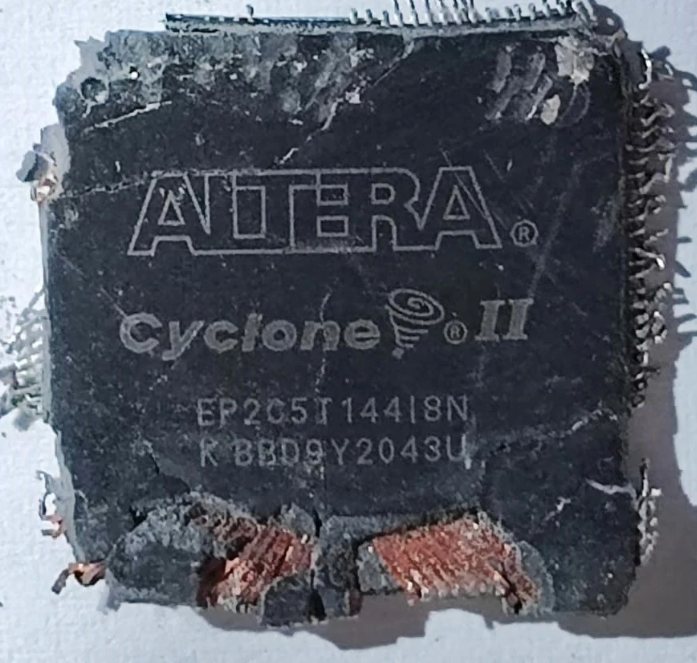
An Altera Cyclone II Field-Programmable Gate Array (FPGA), a type of microchip, which the GUR says was found in Zircon wreckage. GUR

The alleged findings do not establish that either company knowingly supplied Russia’s defense industry, nor do they explain precisely how the components reached Russian production lines. The GUR says it’s seeking additional information on their origins and supply chains. Bearing in mind previous precedents, China could potentially be one source, being a known vector globally for recycled chips.

Nevertheless, the disclosure highlights the continued presence of Western-origin electronics in Russia’s advanced weapons programs despite sanctions and export controls.

The GUR lists the Zircon as approximately 26 feet long, with a body diameter of 2.2 feet, and a warhead weighing about 265 pounds.

The agency gives a maximum speed of Mach 8-9, a flight altitude of approximately 19-25 miles, and a separate “maximum fixed speed” (presumably, sustained cruising speed) of Mach 6.8. These are Ukrainian intelligence assessments and cannot be independently verified.

The database identifies the 3B222 active radar-homing head, manufactured by NPP Radar MMS, and a Baget-83 onboard digital computer produced by KB Korund-M.
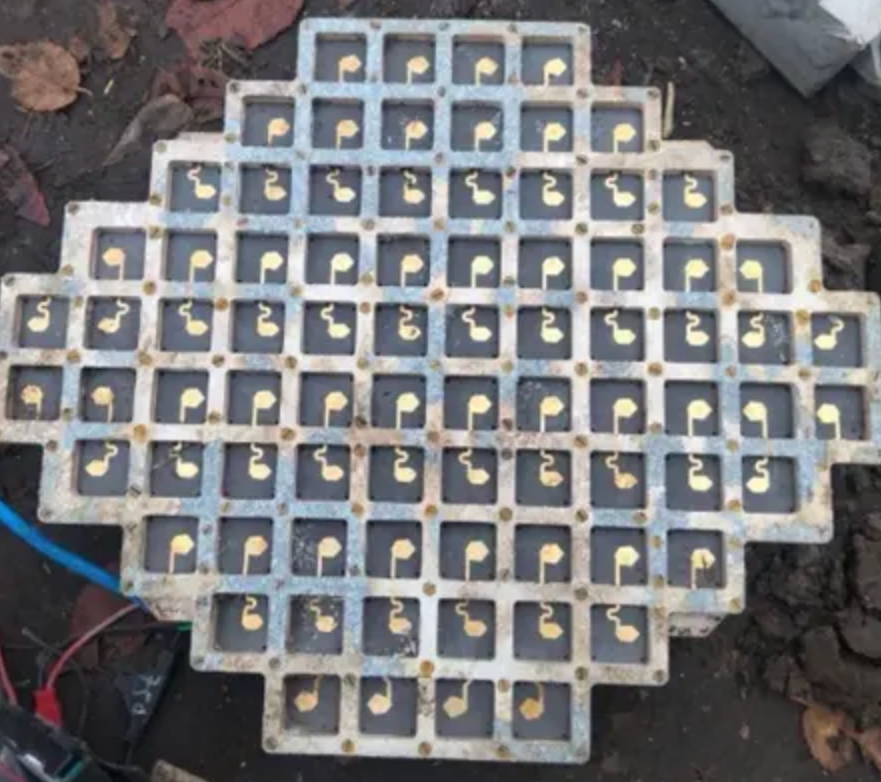
Reported 3B222 active radar homing antenna recovered from Zircon wreckage. GUR

It also identifies the 3B915 guidance units, the 3G22 warhead, and the 3L2211 solid-fuel rocket motor manufactured by NPO Iskra. Other Russian companies provide altimeters, control systems, power supplies, and other components.
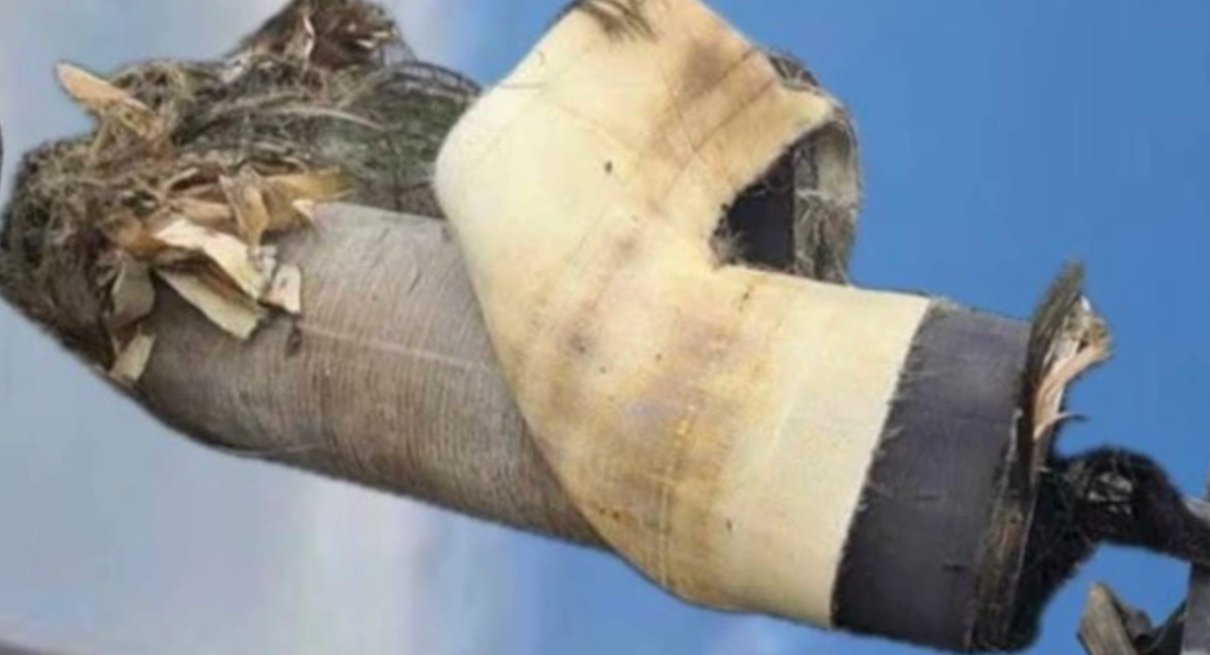
Reported remains of a 3L2211 solid-fuel rocket motor manufactured by NPO Iskra. GUR

The reported propulsion information is particularly significant.

Russian and other sources have consistently described Zircon as a hypersonic cruise missile, implying an air-breathing propulsion system burning liquid propellant, capable of sustaining hypersonic flight.

However, the physical evidence for such a propulsion system has always been less clear.

Open-source analysis by Fabian Hinz has highlighted the apparent absence of a conventional air intake on Zircon. A scramjet- or ramjet-powered missile requires an intake to bring atmospheric oxygen into the engine, yet available imagery does not clearly show one. A Russian patent associated with the missile’s jettisonable launch cap likewise does not reveal an obvious intake arrangement.

Just published my new OSINT investigation into Russia's secretive Zircon missile whose combat use has risen sharply in 2026.

Available evidence suggests that Zircon is not a hypersonic cruise missile but rather a quasi-ballistic system.

Link: https://t.co/8DoQePRpX3 pic.twitter.com/bIBS532FUB

— Fabian Hinz (@fab_hinz) June 17, 2026

More significant is evidence from recovered missile debris.

Material examined by Ukraine’s Scientific Research Institute of Forensic Expertise included a circular metal structure interpreted as part of a solid-propellant rocket motor. The hardware appeared to be associated with Zircon’s second stage rather than simply its launch booster (which would be used on a true hypersonic cruise missile to bring it up to operating speed). This suggests a two-stage weapon, with a solid-propellant rocket in each. This would match with what we have seen during shipboard launches.

That finding is consistent with Russian patent activity involving NPO Mashinostroyeniya and NPO Iskra. Patents associated with the companies describe solid-propellant rocket motors incorporating arrangements for aerodynamic-control equipment around the motor’s exhaust system.

There is also evidence that Russian engineers developed advanced composite solid propellants specifically for Zircon.

None of this conclusively proves the missile lacks an air-breathing engine, but it certainly raises more questions about its classification. It should be noted that there are also some solid-fuel ramjet concepts, but these are much rarer applications.

In February 2024, evidence emerged that Russia had, for the first time, used the Zircon in attacks on at least one target in Ukraine. Ukrainian scientists showed a video of the Zircon wreckage — “fragments of the engine and steering mechanisms [with] specific markings,” seen here. via X

If Zircon is primarily rocket-powered, it may be better understood as a maneuverable quasi-ballistic missile that nonetheless reaches hypersonic speeds.

Such a weapon would use rocket propulsion to accelerate rapidly and climb to high altitude before descending toward its target along a trajectory that is partly ballistic but incorporates aerodynamic maneuvering — a so-called ‘porpoising’ or ‘skip-glide’ trajectory. It could therefore reach hypersonic speeds without requiring sustained cruise under the power of an air-breathing system. The combination of high speed and unpredictable trajectory also makes it notably difficult for air defenses to deal with, characteristics shared with the air-launched Kinzhal, another Russian quasi-ballistic missile.

That interpretation could also help explain reports of a highly variable Zircon speed profile.

Russian officials have claimed that the missile can reach approximately Mach 9. During a 2020 test, Russian military leadership said Zircon reached more than Mach 8 while flying to an altitude of roughly 17 miles.

A Russian Ministry of Defense video that claims to show the Zircon test in the White Sea on Oct. 6, 2020:

Ukrainian assessments have described a more complicated profile, with the missile reportedly flying at around Mach 5.5, accelerating to approximately Mach 7.5 near the target, and then slowing before impact. Those figures cannot be independently confirmed, but a boost-and-glide or quasi-ballistic trajectory could produce such a profile more naturally than sustained powered cruise.

Ru MoD released a somewhat better Zircon launch footage. pic.twitter.com/bxHa6DsFG7

— krakek (@krakek1) December 3, 2024

At the same time, it should be recalled that ‘hypersonic’ does not necessarily imply a ‘hypersonic cruise missile.’ A ballistic or quasi-ballistic weapon can travel well above Mach 5, which appears to be the case here. The characteristics of the Zircon, as presented by the GUR, would also help explain official Ukrainian claims that the missiles have been intercepted successfully by Patriot PAC-3 air defense systems.

There is also a relevant technological precedent. NPO Mashinostroyeniya has previously patented solid-propellant missiles using quasi-ballistic trajectories, including designs intended to maneuver at high-supersonic and hypersonic speeds. That does not establish a direct lineage to Zircon, but it does show that the concept is consistent with the company’s history.

The other major takeaway from the release is the scale of Zircon’s production network.

One of Russia’s leading missile houses, NPO Mashinostroyeniya is identified as the missile’s main designer and manufacturer and prime contractor for Russian Ministry of Defense contracts covering its development and production.

But the weapon depends on dozens of other organizations. NPO Iskra supplies the solid-fuel motor; NPP Radar MMS provides the radar seeker; KB Korund-M produces the onboard computer; and other enterprises supply guidance systems, altimeters, control electronics, warheads, power systems, and other specialized equipment.

Another video, released by the Russian Ministry of Defense in May 2022, is said to show the Gorshkov launching a Zircon, although the missile is seen only at a distance with no details visible:

The U.S.-origin electronics claimed to have been identified by GUR are particularly notable because they demonstrate how Russia’s sophisticated weapons production remains connected to international semiconductor supply chains.

By linking specific enterprises and individuals to individual missile components, Ukraine has provided governments and investigators with new information that could be used to pursue sanctions, export-control enforcement, and efforts to disrupt Russia’s supply chain.

The report also adds weight to continued open-source assessments of what kind of missile Zircon actually is.

Regardless of its classification, Zircon remains a formidable weapon. A rocket-powered missile capable of reaching hypersonic speeds, flying at high altitude, maneuvering, and potentially accelerating during its terminal approach presents a serious challenge to missile defenses. With Ukraine’s ability to intercept even more conventional ballistic missiles already severely eroded, the weapon further complicates the country’s troubling air defense picture.

Contact the author: thomas@thewarzone.com

The post Russia’s Zircon May Not Be A Hypersonic Cruise Missile After All appeared first on TWZ.
  •  

Japan’s First Dedicated Missile Defense Warship Is A Monster

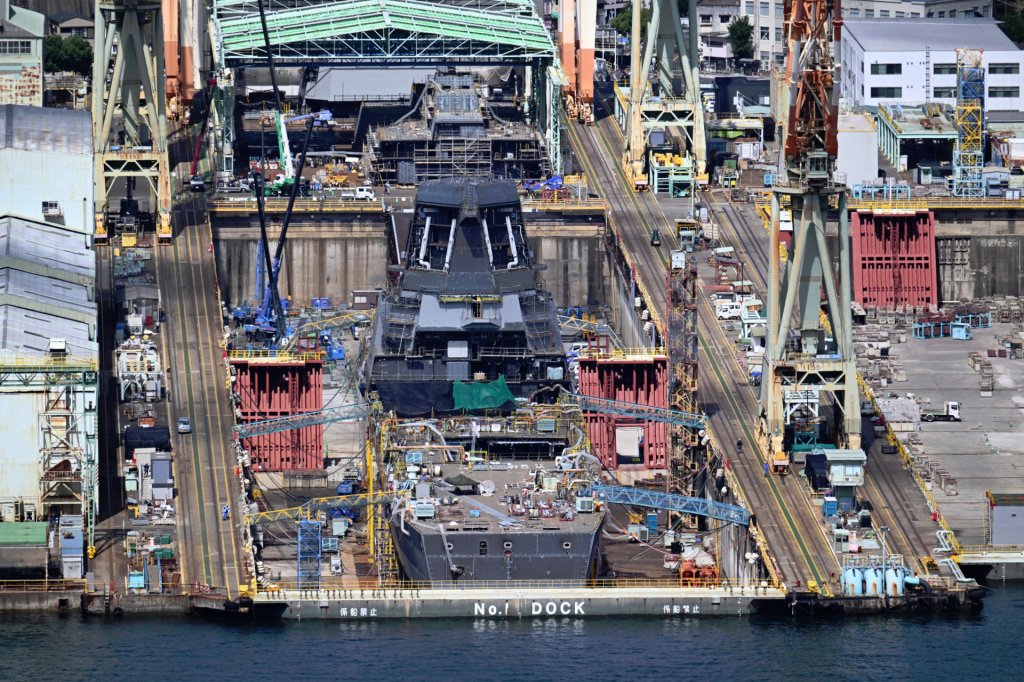
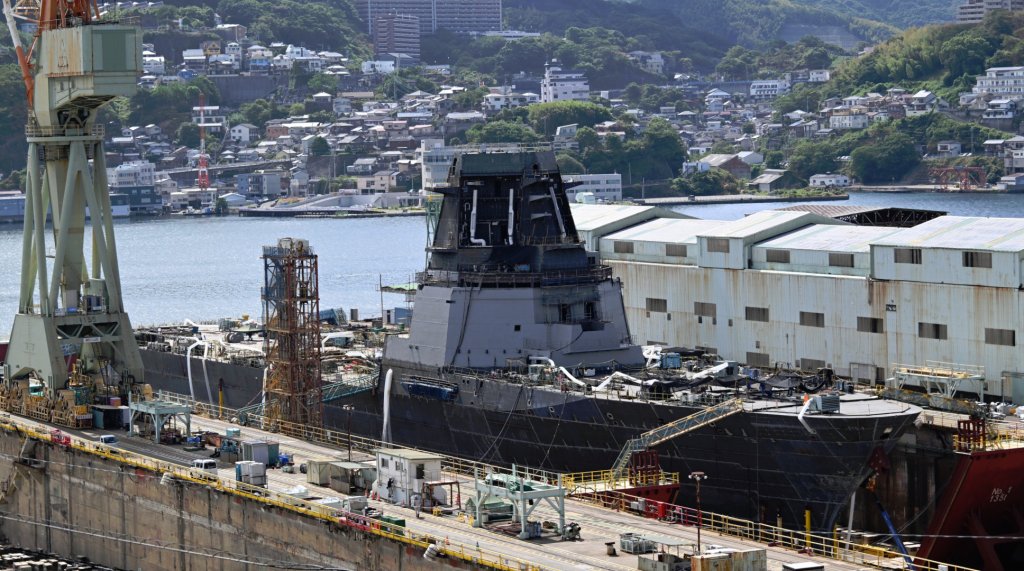
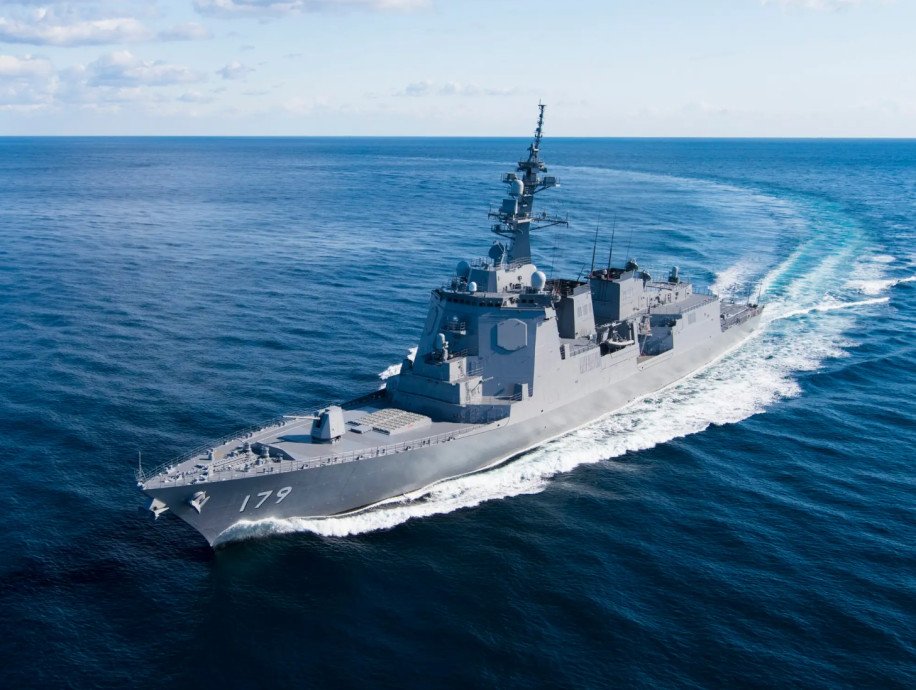
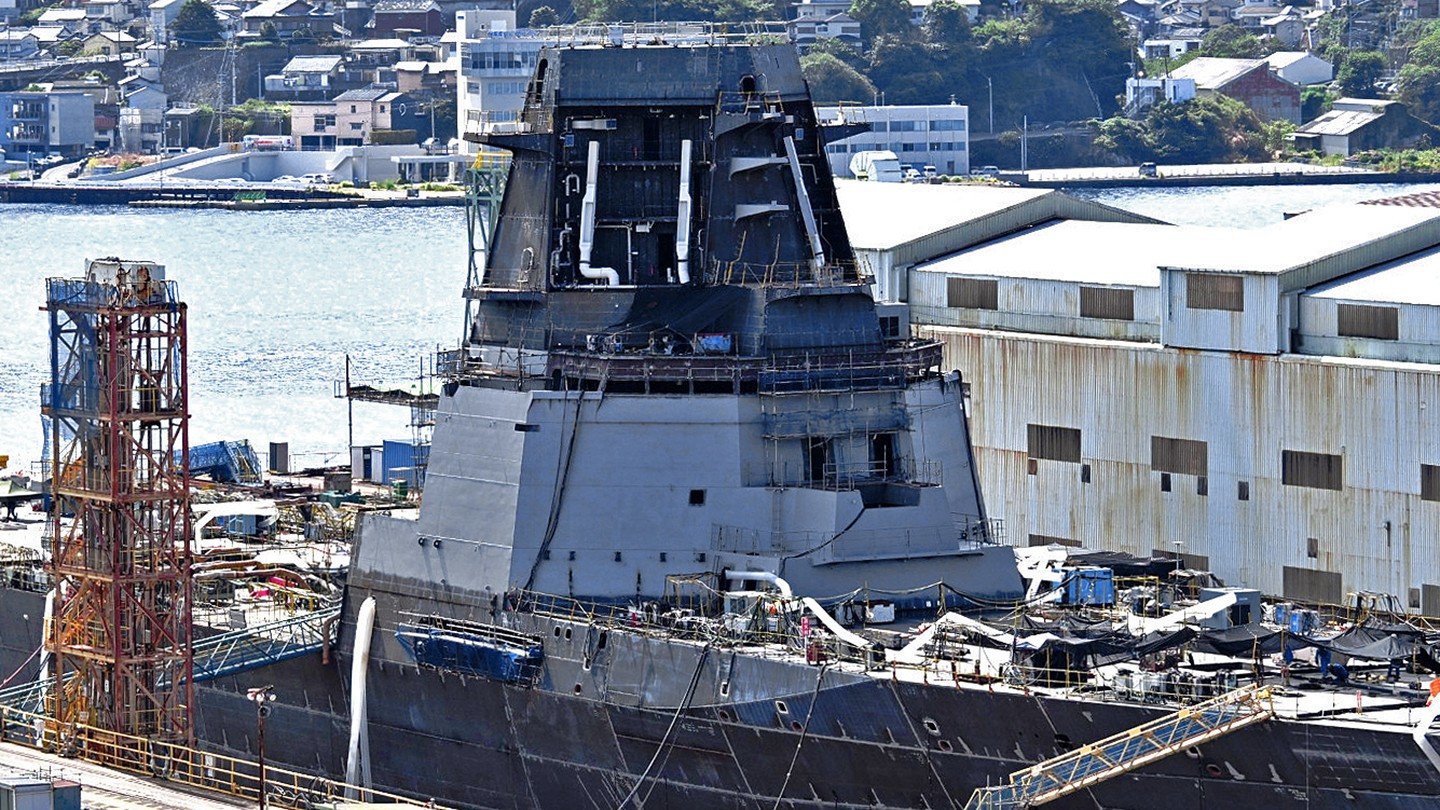
The first of Japan’s two new cruiser-sized Aegis System Equipped Vessels (ASEV) is continuing to take shape, recently receiving its huge main integrated mast, giving the vessel a new and remarkably imposing silhouette. The four very large fixed arrays for the ship’s powerful AN/SPY-7(V)1 radar will eventually be integrated onto this structure. The ASEV’s stated primary mission is missile defense, but Japanese authorities plan to give the vessels additional counter-drone, anti-ship, and land attack capabilities in the future. Tomahawk cruise missiles are notably set to be added to the ship’s arsenal down the line.

The ASEVs are large surface combatants, set to be some 620 feet long, have a beam (the widest point of the hull) of some 82 feet, and a standard displacement of 12,000 tons. For comparison, Japan’s largest surface combatants today, its Maya class destroyers, are just over 557 feet long, have a beam of some 73 feet, and a standard displacement of around 8,200 tons. It is worth noting here that the size of new and advanced destroyers, often optimized for anti-air warfare missions, has been trending upward globally in recent years. This, in turn, has caused the line between destroyers and what have more historically been categorized as cruisers in certain cases.

The first ASEV under construction in Nagasaki, as seen from the stern. This picture was taken earlier this month. Sakai/@kensakai9310

The first ASEV was laid down at Mitsubishi Heavy Industries’ (MHI) shipyard in Nagasaki in July 2025. The second was laid down in February of this year at Japan Marine United Isogo shipyard, which is situated in Yokohama City near Tokyo, according to a past report from Naval News. The Japanese Ministry of Defense is currently aiming to have the first of these vessels in service before the end of the country’s 2027 Fiscal Year, which runs from April 2027 to March 2028. The second is expected to follow in the 2028 fiscal cycle, which extends into 2029.

Another view of the first ASEV under construction in Nagasaki. Sakai/@kensakai9310
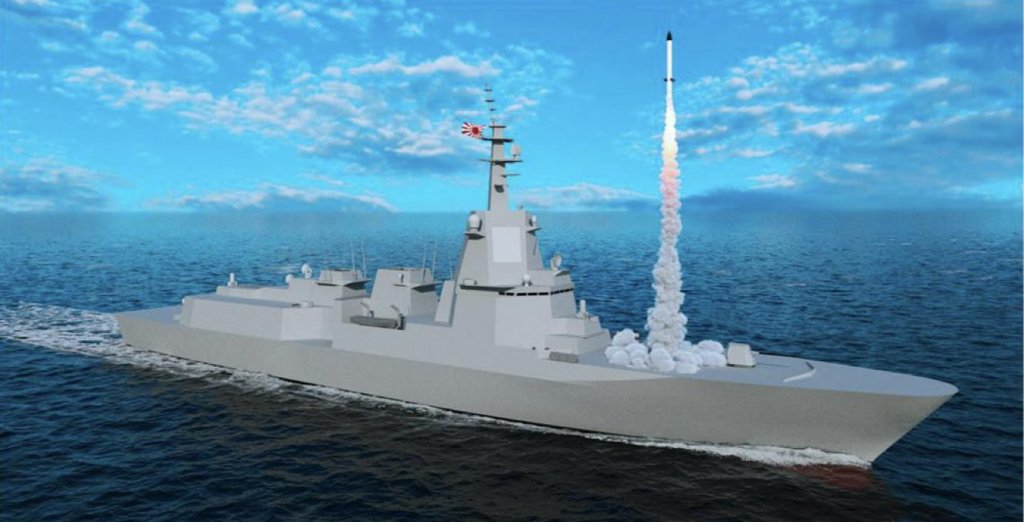
A rendering of what the finished ASEV is currently expected to look like. Japanese Ministry of Defense

Significant progress in the overall construction of the first ship has been made just this year. The addition of the main mast structure, installed on top of the main superstructure, as seen in pictures at the top of this story and below, has drawn particular attention in recent weeks.

Japanese are very fast with ship building.

March 26 and today. ASEV-class destroyer.

190 m hull, SPY-7 Aegis, 128cell Mk 41 VLS. SM-3 for ballistic missiles, SM-6, plus Japan’s long range Type 12 SSM. pic.twitter.com/RQZixtqWwe

— 信濃 Æýà (@Shinano_AEya) August 30, 2026

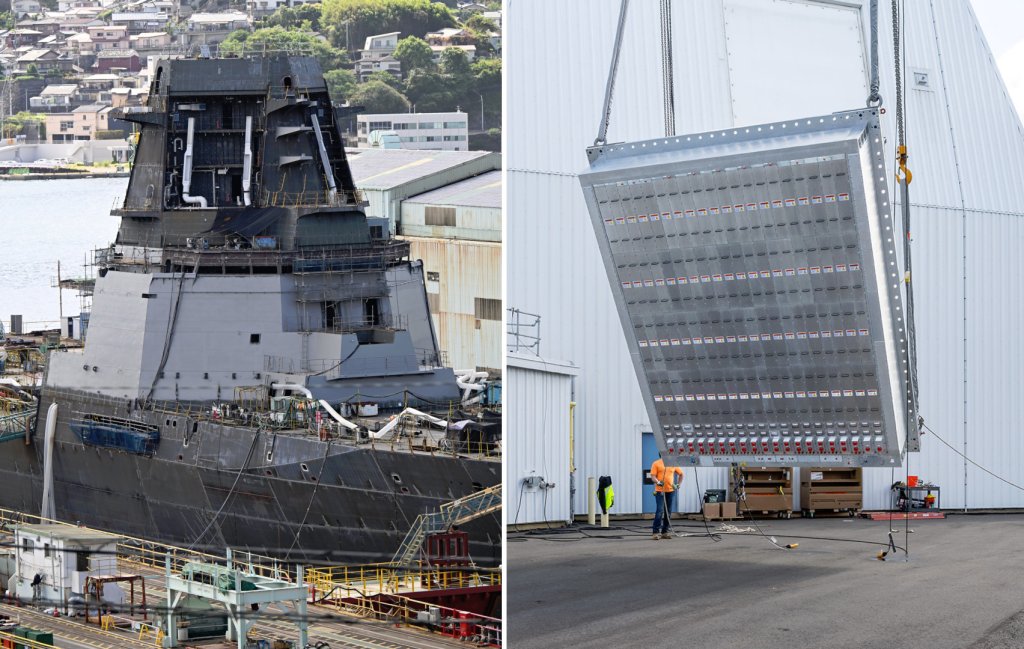
The especially large size of the ASEV’s integrated mast is driven by that of the AN/SPY-7(V)1 active electronically-scanned array (AESA) radar from Lockheed Martin. Each one of the radar’s four rectangular arrays is reportedly around 14 feet (nearly 4.3 meters) tall. This would put them in the same general size category as the arrays for Raytheon’s AN/SPY-6(V)1 Air and Missile Defense Radar (AMDR) found on U.S. Navy Flight III Arleigh Burke class destroyers. That being said, the pictures we have now raise the question of whether the AN/SPY-7(V)1 arrays are bigger than previously assessed. The AMDR is another notably large design heavily optimized for missile defense.

A close-up look at the main superstructure and integrated mast on the first ASEV under construction in Nagasaki, at left, and a stock picture of an AN/SPY-7(V)1 array at right. Sakai/@kensakai9310

The size and location of the mast provide a centralized, elevated position for the AN/SPY-7(V)1’s large arrays, which will also require significant power generation capacity and thermal management to keep everything cool. This is a notable departure from the placement of the arrays on the main superstructure on existing Japanese destroyers, as well as the U.S. Arleigh Burke class, and offers an unobstructed, elevated line-of-sight to the horizon. Beyond the ballistic missile defense mission, this view farther out over the horizon would be important for tracking and engaging low-flying drones and cruise missiles, which might be targeting the ship itself. This is something we will come back to later on.

“With five times the tracking capability of the SPY-1, it [the AN/SPY-7(V)1] counters lofted trajectories and simultaneous multiple ballistic missile threats,” according to a machine translation of a section of the Japanese Ministry of Defense’s 2026 defense policy white paper, which was released earlier this month.

The passive electronically-scanned array (PESA) AN/SPY-1 was the first radar to be paired with the Aegis Combat System, and both were first introduced in the 1970s. Variants of the SPY-1 are still found on a variety of U.S. and foreign Aegis-equipped warships, including Japan’s Kongo, Atago, and Maya class destroyers.

The first-in-class destroyer JS Maya. Japanese Ministry of Defense

The AN/SPY-7(V)1 is also a derivative of the U.S. military’s static, land-based Long Range Discrimination Radar (LRDR) in Alaska. Japan also originally planned to employ the AN/SPY-7(V)1 on land at a pair of Aegis Ashore missile defense sites. However, that effort was subsequently cancelled, with the ASEV emerging to fill the resulting gap.

Additional versions of the AN/SPY-7 with much smaller arrays are also being integrated onto new F110 Bonifaz class frigates for the Spanish Navy and the Royal Canadian Navy’s forthcoming River class destroyers (also known as the Canadian Surface Combatant). The use of the AN/SPY-7(V)1 on the ASEV could impact decisions regarding new radars for other future and existing Japanese warships. Raytheon is also pitching versions of its increasingly popular AN/SPY-6 family for use on a successor to the Kongo class and for refit on the Maya class, according to a recent report from Naval News.

When it comes to the ASEV, as already noted, the AN/SPY-7(V)1 is central to the ship’s main stated missile defense mission. As the name makes clear, the ship will also feature the Aegis Combat System. The vessel will be capable of “remote engagement and guidance against anti-air targets tracked by other vessels” via a “Cooperative Engagement Capability (CEC),” per the Japanese Ministry of Defense’s most recent annual defense white paper.

The video below provides details about the U.S. Navy’s Cooperative Engagement Capability (CEC) developments, which are likely very similar to what Japan has planned for the ASEV.

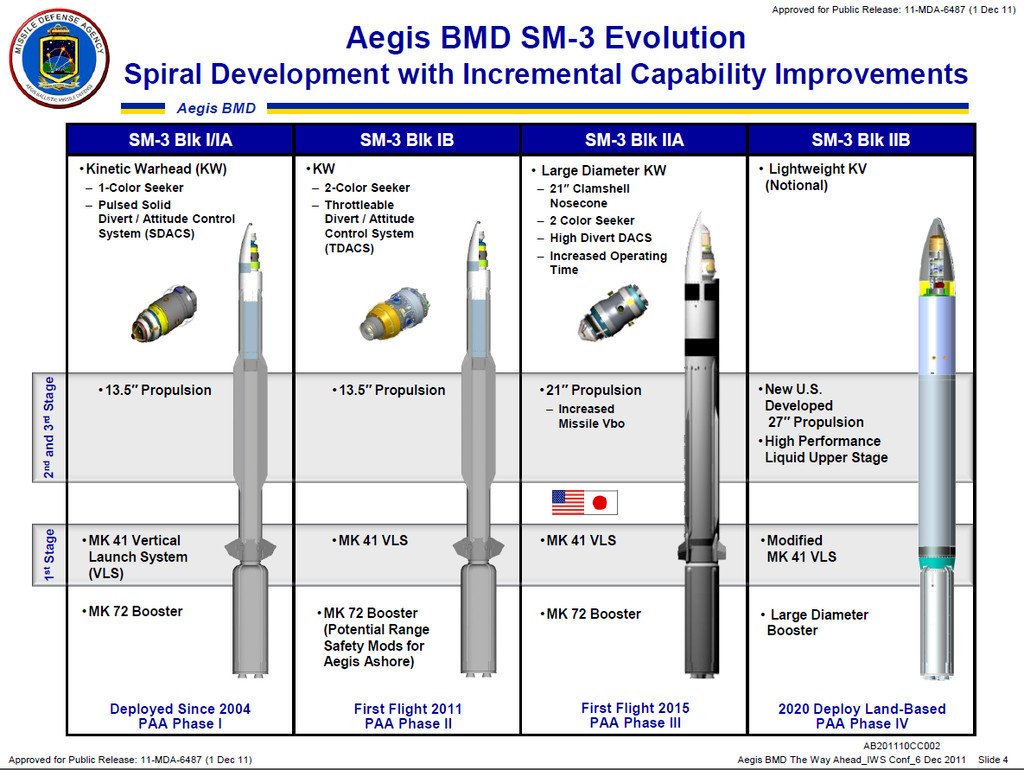
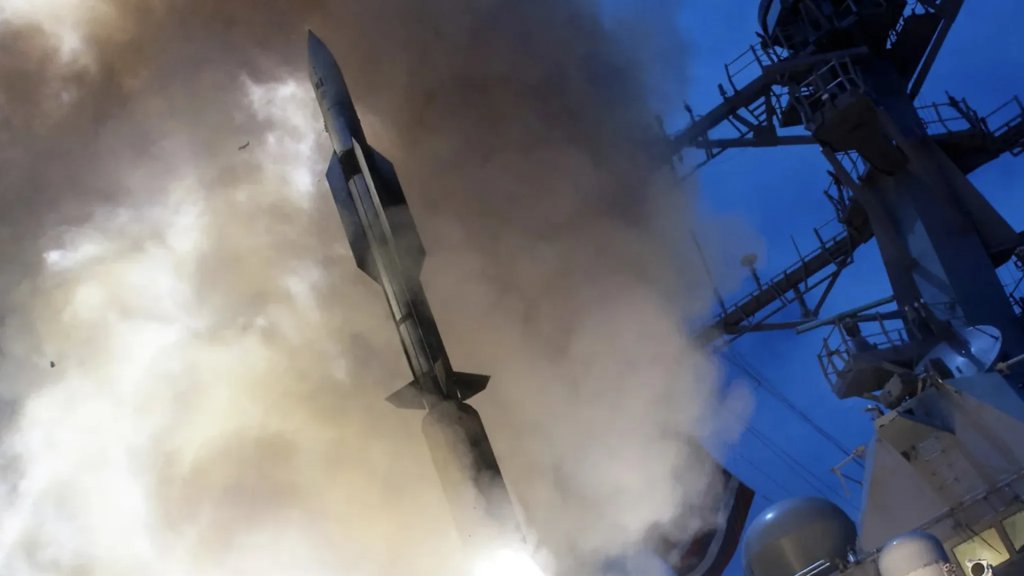
In terms of armament, when the ASEVs first enter service, their main weaponry is expected to be a mix of variants of the Standard Missile-3 and -6 (SM-3 and SM-6). The SM-3 family is designed to engage ballistic missile threats during the mid-course portion of their flights while they are traveling outside of the Earth’s atmosphere. The SM-3 also has a demonstrated anti-satellite capability. The SM-6 is a multi-purpose missile that was originally designed with an anti-air focus. It can be used to target incoming ballistic missiles in the terminal phase of flight and also has at least a degree of capability for engaging hypersonic weapons. SM-6 can be used in a surface-to-surface mode, including against ships, as well. Japan is also a partner in the U.S.-led development of a new Glide Phase Interceptor (GPI), which is being designed specifically to intercept unpowered, but highly maneuverable hypersonic boost-glide vehicles.

A briefing slide breaking down details about the various existing SM-3 variants. Work on the further evolved Block IIB variant seen here was cancelled in 2013. MDA A briefing slide breaking down details about the various SM-3 variants, including the SM-3 Block IIA. Work on the further evolved Block IIB variant seen here was canceled in 2013. MDA
An SM-6 missile seen being launched from a U.S. warship. USN

SM-3, SM-6, and future GPIs will be loaded into either of the ASEV’s two Vertical Launch System (VLS) arrays, one at the bow end and another toward the stern. Each one of the ships will have a total of 128 VLS cells. For comparison, Japan’s Maya class destroyers, as well as the U.S. Navy’s Flight IIA and III Arleigh Burke class destroyers, have 96 VLS cells apiece. The U.S. Navy’s Ticonderoga class cruisers each have 122 VLS cells, and 128 is also the number of VLSs currently expected to be found on the future Trump class battleships.

At the time of writing, Japanese authorities do not appear to have explicitly mentioned plans to arm the ASEVs with other missiles when they first enter service. That being said, any VLS array capable of accommodating SM-3s and SM-6s should be able to fire a variety of other weapons, including shorter-ranged SM-2s and Evolved Sea Sparrow Missiles (ESSM), which the ship could use for more localized air and missile defense, as well as protecting the ship itself.

Renderings and models of the ASEV do show the design also armed with a five-inch naval gun in a turret on the bow, along with two Phalanx Close-in Weapon Systems (CIWS) and other automatic cannons for point defense.

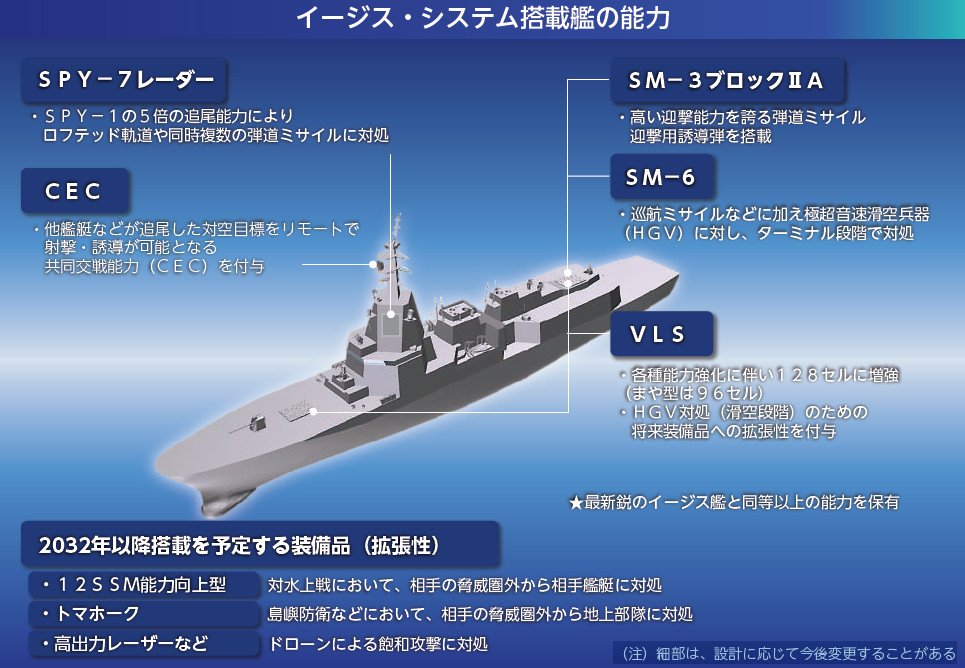
A Japanese language graphic from the country’s 2026 defense white paper discussing the planned features of the ASEVs. Japanese Ministry of Defense

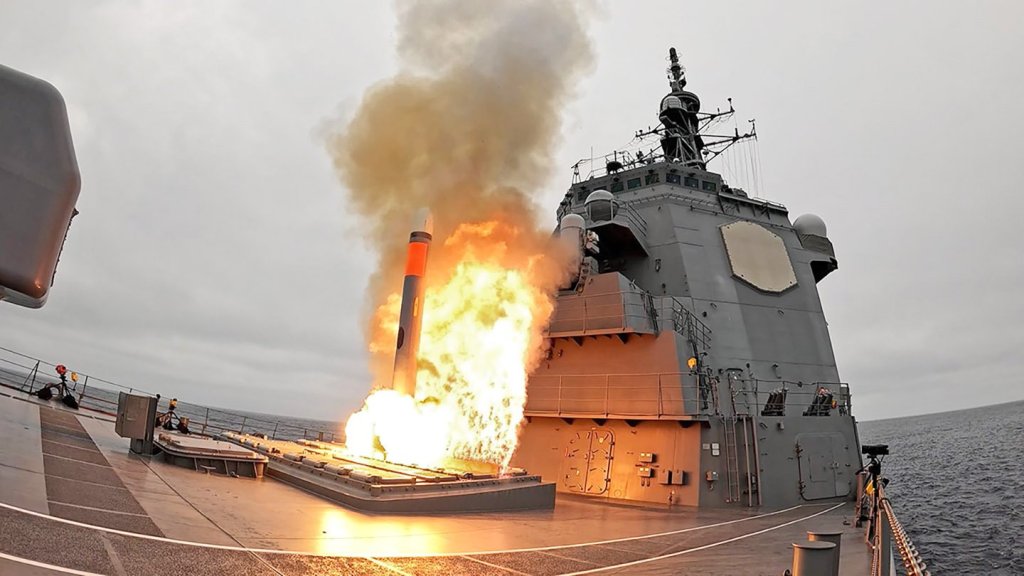
As mentioned, while missile defense is the immediate focus for the ASEVs, there are already plans to significantly expand their capability to engage other ships and targets on land. Tomahawk cruise missiles and a new, extended-range version of the Type 12 anti-ship cruise missile are set to be added to the arsenal of these vessels in the 2032 timeframe, according to the latest official Japanese defense white paper.

Japanese authorities want the ASEVs to eventually be able to help fend off waves of enemy drones, too. High-energy laser-directed energy weapons are set to be integrated onto the ships down the line to help address those threats. The overall size and other general characteristics of the ships would leave the door open to the possible addition of high-power microwaves and other capabilities in the future.

TWZ has long noted that the ASEVs will bring huge new boosts in naval air and missile defense and long-strike capability to the Japan Maritime Self-Defense Forces. The vessels also reflect a significant evolution in post-World War II Japanese doctrine, toward what officials currently frame as a “stand-off defense” construct that remains within the bounds of the country’s current pacifist constitution.

Just with SM-3, SM-6, and GPI, the ASEVs will offer an important addition to the air and missile defense bubbles around Japan’s home islands and outlying territories in the face of growing geopolitical friction with China and Russia, two countries that are increasingly cooperating militarily. The vessels will also add to Japan’s deterrent against long-standing and still evolving threats posed by the regime in North Korea, which has its own close ties to the Chinese and Russian governments. All three of these nations continue to expand their arsenals of ever-more capable ballistic, cruise, and hypersonic missiles. Long-range one-way-attack drones are another growing part of the equation, with the ongoing conflict in Ukraine and fighting in the Middle East in recent years underscoring just how real a threat they pose.

With the addition of Tomahawks, the ASEVs, along with other Japanese warships, will gain the additional ability to threaten counterstrikes against targets on land (and potentially at sea) at least around 1,000 miles in any direction. As part of the broader stand-off defense strategy, the Japan Self Defense Forces is developing new land-based long-range strike capabilities, including hypersonic missiles, as well.

The Kongo class destroyer Chokai fires a Tomahawk cruise missile during a test earlier this year. This was the first-ever launch of a Tomahawk from a Japanese warship. Japanese Ministry of Defense

It is worth noting that with current plans to acquire only two ASEVs, these will be high-value but also low-density assets, which will have to be very deliberately deployed for maximum effect. They will also stand out as top-priority targets in any future conflict, and will need to be protected as such.

It is possible that the roles and missions of the ASEVs, just like their designs, could evolve further as time goes on. The threat ecosystem facing Japan will continue to evolve, likely more rapidly, in the coming years. The country is also expanding its naval capabilities in other ways, and with an eye toward more blue water operations. This includes expanded light carrier capabilities through refits of existing Izumo class ships. Anti-ship ballistic missiles and hypersonic cruise missiles, among large volumes of more traditional threats, could see the ASEVs used as escorts, even if experimentally. While just two hulls are barely enough to keep one on patrol to protect Japan, more could be built for expeditionary applications.

Regardless, the ASEVs are set to be a major addition to the Japan Maritime Self Defense Force’s fleets that will have big ramifications. From the progress that is visible at the shipyard in Nagasaki, MHI looks to be well on track to deliver the first of these ships next year or two.

Special thanks to @kensakai9310 on X, who also goes by “Sakai,” for sharing recently taken pictures of the first ASEV under construction at MHI’s yard in Nagasaki with us.

Contact the author: joe@twz.com

The post Japan’s First Dedicated Missile Defense Warship Is A Monster appeared first on TWZ.

  •  
❌